




Abstract
Nonreligion is often thought to be commensurate with nihilism or fatalism, resulting in the perception that the nonreligious have no source of meaning in life. While views to this effect have been advanced in various arenas, no empirical evaluation of such a view has been conducted. Using data from the 2008 American General Social Survey (N = ~1,200), we investigated whether atheists, the religiously unaffiliated, and persons raised religiously unaffiliated were more likely than theists, the religiously affiliated, and persons raised with a religious affiliation to report greater levels of fatalism, nihilism, and the perception that meaning in life is self-provided. Results suggested that these groups did not differ with regard to fatalism or nihilism. However, atheists and the religiously unaffiliated (but not persons raised in a religiously unaffiliated household) were more likely to indicate that meaning in life was endogenous—that is, self-produced. While atheists and the nonreligious differed from their counterparts on source of meaning in life, this was not associated with any “penalty” for overall existential meaning.
A core component of human psychological functioning is the construction of meaning and purpose in life, a process that is subject to self-perceptions and situational effects (Baggini, 2004; Baumeister, 1991; Berger, 1967/1990; Park, 2010). However, for atheists and other nonreligious individuals, it is sometimes assumed that being without god(s) is the equivalent of being bereft of meaning or purpose in life (cf. Blessing, 2013). This assumption is somewhat odd, given that Bering (2002, 2003) suggests humans are evolutionarily hardwired with an existential theory of mind, which is a general cognitive mechanism compelling humans to find religious or philosophical meaning or purpose in life events (Coleman & Hood, 2015). Similarly, sociological approaches to meaning conceive it as a compulsion “. . . to impose a meaningful order upon reality,” all the while emphasizing the creation and sustainment of meaning as an inherently social, cultural, and discursive practice (Berger, 1967/1990, p. 22). In essence, the impetus to construct meaning or purpose in life is a quintessential consequence of being human, rather than something wholly under the purview of a specific religious or philosophical framework.
In this vein, there is no shortage of views on what life meaning is, how it “works,” or how we should conceive of it. Frankl (1959/2006) argued that meaning in life was something that each individual seeks and constructs for themselves, whereas Baumeister (1991) argued that life meaning is comprised of four elements: a goal or purpose, values and justification for goals and purposes, a sense of control, and self-worth. Schnell (2009) identified twenty-six sources of meaning in life, ranging from aspects of community and togetherness, to nature, generativity, religion, and self-knowledge. In a nuanced approach, Park (2010, 2013) has drawn a distinction between global meaning and situational meaning. Global meaning refers to abstract conceptual systems and schema such as “religious beliefs . . . fairness, control, coherence, benevolence of the world and other people” (Park, 2013, p. 361). Situational meaning refers to ascriptions of meaning or purpose in specific encounters; the meaning or purpose a person ascribes to an event depends on her or his preconceptions and experiences.
Because meaning and purpose in life can be framed in numerous ways and are derived from multiple sources and circumstances, one could reasonably expect that some sources or paths substantially differ from others. Park and McNamara (2006) note that religious systems provide purpose or meaning to individuals. In fact, this is often seen as a primary function of religion. Other researchers have echoed these sentiments and explicitly recognized that religious systems provide strong and coherent sources for meaning in life, due to the fact that these systems appeal to an “ultimate” source (Crescioni & Baumeister, 2013; also see Vail et al., 2010). Park and McNamara (2006) suggest that not only are “religious frameworks comprehensive, but they tend to be much more ‘existentially satisfactory’ than secular explanations such as the cold, hard objectivity of science” 1 (p. 67; also see Farias, Newheiser, Kahane, & de Toledo, 2013; Schumaker, 1992, on belief in science in the face of stress and existential anxiety).
Nonreligion and Meaning in Life
There are some major drawbacks of this aforementioned research. One is an inability to separate the functioning of purely secular psychological mechanisms from any specific religious/spiritual processes (Galen, 2017a, 2017b). This inability may be related to research suggesting that religious/spiritual activities do not have intrinsic benefits, but rather benefits that are contingent on an individual’s valuation of those activities (Speed, 2017; Speed & Fowler, 2017). This accords with the simple view that “whatever makes life meaningful is heavily loaded with whatever people value” (Klinger, 2012, p. 29). In other words, some persons may find that without a framework centered on the divine or transcendent, they are more likely to adopt a nihilistic or fatalistic perspective (i.e., a negation of [life] meaning; Crosby, 1988). However, the conclusion that god(s) or religious frameworks are necessary for meaning is predicated on the idea that religion or spirituality intrinsically promote meaning for everyone, which can be read to imply that meaning cannot be internally derived or generated. The perception that an individual is forced to accept nihilism or fatalism in their worldview because they lack a religious or spiritual schema with which to interpret the world is unsupported by the existing literature (Caldwell-Harris, Wilson, LoTempio, & Beit-Hallahmi, 2011; Coleman & Arrowood, 2015; Langston, 2014). Furthermore, the logic of why religious or spiritual frameworks would promote meaning in life is highly selective. It could be argued that a person who surrenders to god(s)’ perceived will would accept that there is one path to follow or that there is no meaning other than serving god(s). Instead, most discussions surrounding this topic tend to assume as a default that relatively higher religion or spirituality, however measured, implies greater meaning (e.g., Crescioni & Baumeister, 2013; Pargament, 1997; Park & McNamara, 2006).
The consequences of atheism or being religiously unaffiliated for meaning in life, and for psychological well-being more broadly, are unknown or at the very least not held to be static or linear. A cursory examination of the literature would show that atheists are characterized as having various psychological deficits (e.g., Barrett, 2012), and popular perceptions remain that they are likely to be more nihilistic or have viewpoints consistent with fatalism (cf. Blessing, 2013). Other research suggests that nonreligiosity “divest[s] people of certain age-old pathways to psychological health” (Schumaker, 1992, p. 65).
Additionally, research shows consistent links between meaning in life and psychological well-being (e.g., Krause & Pargament, 2017; Schnell, 2009; Zika & Chamberlain, 1992; for a review, see Steger, 2017), as well as meaning in life and religiousness or religiosity (e.g., Ivtzan, Chan, Gardner, & Prashar, 2013; Steger & Frazier, 2005; Tiliouine & Belgoumidi, 2009). These findings align with Schumaker (1992), who found that accounting for the relationship between meaning in life and well-being substantially reduces the salutary effects of religiosity (Schumaker, 1992). In other words, some of the benefits associated with religiosity are due to its positive relationship with producing meaning in life.
However, other research has shown that the irreligious do not experience deficits in meaning in life (Caldwell-Harris et al., 2011; Wilkinson & Coleman, 2010), happiness (Speed, 2017; Speed & Fowler, 2017), or well-being (Galen, 2015; Streib & Klein, 2013), and that the irreligious do not differ in terms of psychological well-being (Galen, 2015; Streib & Klein, 2013; although cf. Hayward, Krause, Ironson, Hill, & Emmons, 2016). Essentially, the literature is incongruous: irreligious persons are ostensibly disadvantaged for psychological well-being, but do not seem to report poorer psychological well-being.
This dissonance within the research is problematic for a number of reasons. More than 20% of the American population identifies as nonreligious (Religious Landscape Study, 2016), and some projections suggest this number could climb to almost half of the U.S. population by the year 2042 (see Stinespring & Cragun, 2015, who estimate between 26% and 47%). Furthermore, in adolescents and young adults, we find a generational difference, which suggests children are significantly less religious than their parents (Thiessen & Wilkins-Laflamme, 2017; Twenge, Exline, Grubbs, Sastry, & Campbell, 2015), and have relationships with religion ranging from explicit repudiation to quiet apathy (Lee, 2012; see also Francis & Robbins, 2004). 2
The relationship between youth and religion can also be confusing when we consider whether a religious home environment confers a health benefit (i.e., meaning in life, psychological well-being) or whether an unaffiliated home environment confers a health penalty. Research suggests that the home environment can predict future religious/spiritual identities (Baker & Smith, 2009; Beit-Hallahmi, 2015; Gervais & Najle, 2015), but the health consequences of said home environment remain unclear. Studies comparing secular sources and levels of meaning, values, and purpose with religious sources are virtually nonexistent (Koenig, 2012), as are the consequences of nonreligiosity, a nonreligious upbringing, and atheism on mental well-being (Galen & Kloet, 2011; Hwang, Hammer, & Cragun, 2011; Morgan, 2013).
The existing literature on the relationship between theological beliefs, atheism, and fatalism allows us to broadly suggest that fatalism entails an acceptance of what is perceived as an inevitable or uncontrollable outcome, rather than a lack of meaning in life or a lack of purpose. However, fatalism is negatively related to environmental mastery, itself a component of psychological well-being (Greenfield, Vaillant, & Marks, 2009). Conceptually, a person who would say that there is little that can be done to change the circumstances of his or her life (a person low on a sense of mastery or internal locus of control) is arguably less likely to believe that life, the universe, and personal relationships are meaningful in any global or time-invariant sense. While some research shows that mastery is positively correlated with religious attendance and/or religiosity (Ai, Peterson, Rodgers, & Tice, 2005; Ellison & Burdette, 2011; Schieman, Pudrovska, & Milkie, 2005), other research finds that this relationship is inconsistent (Greenfield et al., 2009; Speed & Fowler, 2017). Thus, while there is some evidence that theists and the religiously affiliated would be more likely to report greater mastery, there is no persuasive evidence that atheists, the nonreligious, and those with a nonreligious upbringing are predisposed toward fatalism (see also Langston, 2014, who finds that higher external locus of control scores reflect higher odds of being a theist).
The present study investigates the relationship between an internal source of meaning, fatalism, and nihilism in a nationally representative American sample in a series of nine planned analyses. More specifically, we sought to investigate whether belief in god(s), religious affiliation, or religious upbringing were significant predictors of an internal source of meaning, fatalism, and nihilism.
Method
Participants
We accessed data from the 2008 General Social Survey (GSS), which was collected by the National Opinion Research Center (NORC) at the University of Chicago (Smith, Marsden, Hout, & Kim, 2013). These data are freely accessible from NORC’s website, which also provides a copy of the questionnaire and the user manual. Because this was secondary data analysis, we did not require the Institutional Review Board (IRB) clearance from any institutions to conduct the present study. The 2008 research year was chosen because it is the most recent year that contained all variables of interest to our research question. To be included in the present study, respondents had to have answered all covariate questions, at least one of the outcome variables, and at least one of the religious/spiritual (R/S) identifier variables. Persons answering questions with “I don’t know” or persons who answered by refusing to respond were excluded from the analyses to maintain the continuous nature of the data. The exact number of participants fluctuated slightly from one analyses to the next, but was approximately N = 1,200 (see Table 1 for descriptive statistics).
Weighted Descriptive Statistics by Religious/Spiritual Identifiers.
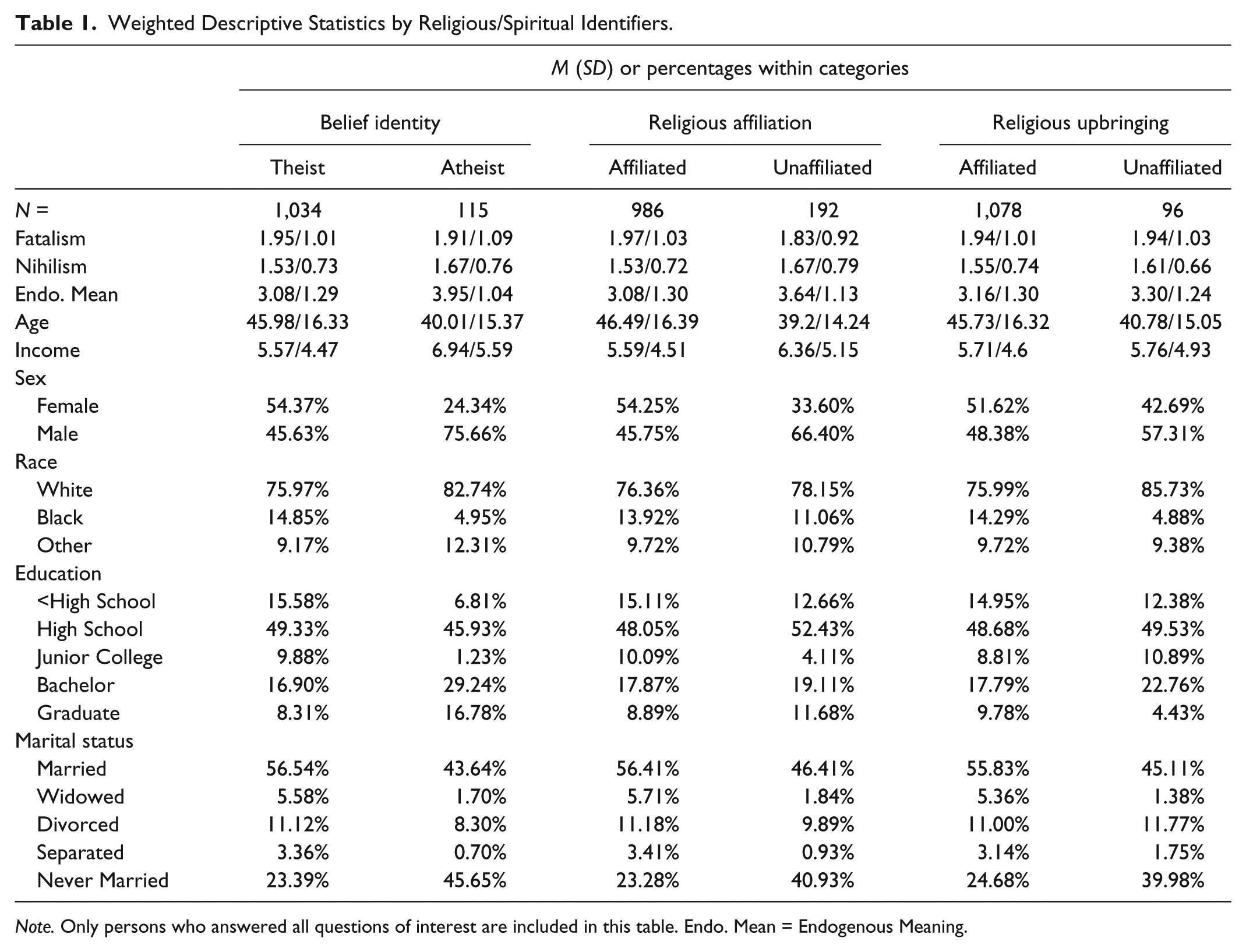
Note. Only persons who answered all questions of interest are included in this table. Endo. Mean = Endogenous Meaning.
Measures
Meaning in life
Endogenous Meaning, Fatalism, and Nihilism were measured using a 5-point Likert-type scale (i.e., 1 = strongly disagree, 2 = disagree, etc.), with higher scores indicating greater levels of agreement. The 2008 GSS had an item we described as Endogenous Meaning (“Life is only meaningful if you provide the meaning yourself”), and was conceptually similar to other questions dealing with whether life meaning was internally constructed (e.g., Coleman, Silver, & Hood, 2016; Goodenough, 1998; Schnell & Keenan, 2011; Streib & Hood, 2013). The 2008 GSS had two items as proxy measures for meaning in life: Fatalism (“There is little people can do to change the course of their lives”) and Nihilism 3 (“In my opinion, life does not serve any purpose”). Although the 2008 GSS had an item that assessed God Meaning to some extent (“To me, life is meaningful only because God exists”), we did not consider using it because this question would make little conceptual sense with the definition of atheism used in the present study. Conceptually, Endogenous Meaning provides information as to the perceived source of meaning in life, while Nihilism and Fatalism should be inversely related to whether life has a personalized sense of meaning.
Religious/spiritual identifiers
We made use of three R/S Identifiers as they related to meaning in life: (a) Belief Identity, (b) Religious Affiliation, (c) and Religious Upbringing. Belief Identity was based on the GSS item, “Which best describes your beliefs about Gods?” Response options included (a) I don’t believe in God now, and I never have; (b) I don’t believe in God now, but I used to; (c) I believe in God now, but I didn’t used to; and (d) I believe in God now, and I always have. Persons indicating that they believe in God now were labeled as “Theist,” and persons indicating that they did not believe in God now were labeled as “Atheist.” Belief Identity was coded, Theist = 0 and Atheist = 1. While the definitions provided for atheism are occasionally conflicting (Hwang et al., 2011), the definition used by the present study is consistent with negative atheism (see Bullivant, 2013), which is the most inclusive definition of nonbelief.
Religious Affiliation was based on the item, “What is your religious preference?” followed by a list of different religions. Persons who indicated “None” were labeled as “Religiously Unaffiliated” and persons who indicated anything other than “None” were labeled as “Religiously Affiliated.” Religious Affiliation was coded as Religiously Affiliated = 0 and Religiously Unaffiliated = 1.
Religious Upbringing was based on the question, “In what religion were you raised?” followed by a list of different religions. Persons who indicated “None” were labeled Raised Religiously Unaffiliated, and persons who indicated anything other than “None” were labeled Raised Religiously Affiliated. Religious Upbringing was coded as Raised Religiously Affiliated = 0 and Raised Religiously Unaffiliated = 1.
Covariates
The present study controlled for sex (male/female), age, race (White, Black, Other; White served as the omitted category), marital status (married, widowed, divorced, separated, never married; married served as the omitted category), education (less than high school, high school, some postsecondary, postsecondary, graduate degree; less than high school served as the omitted category), and income in constant dollars (e.g., 1 = US$10,000; 2 = US$20,000, etc.). Please note that “sex” was used in lieu of “gender” as the GSS had asked a dichotomous male/female question.
Procedure
All data analysis was done with Stata 13. The 2008 GSS used a complex sampling methodology to achieve a representative sample. Because of this, data were weighted to correspond to which strata respondents were in, the primary sampling unit, and a weighting correction for nonresponse rate. To achieve this weighting, Stata’s survey analysis module was used to specify the weighting parameters by using the syntax provided by Smith and colleagues (2013). In situations where a stratum only had a single respondent, we used a scaled approach to address issues with determining variance.
Hierarchical linear regression was used in all analyses. Because we used Stata’s survey analysis module, denominator degrees of freedom in all regression models were based on the number of strata rather than the number of respondents. To meet the underlying assumption of homogeneity of variance, heteroscedastic consistent errors (HC1) were employed. Multicollinearity was not an issue, as the mean variance inflation factor did not exceed 1.13 for any model.
Nine hierarchical linear regression models were used to assess all three R/S Identifiers (belief, affiliation, upbringing) and three outcome variables (fatalism, nihilism, endogenous meaning). Each model followed the same pattern.
The inclusion of demographic covariates in Block 2, as opposed to Block 1, was done to avoid issues with suppression effects. It is possible that by entering covariates in Block 1 and variables of interest in Block 2, variables of interest may register as significant only because covariates acted as suppressor variables. This potential issue is often overlooked, likely because there has been a historical interest in ΔR2 values. However, we were interested in whether specific R/S Identifiers predicted meaning in life, which could be determined by a simple investigation of the relevant coefficients (i.e., ΔR2 were not germane to the overall purpose of the study). Placing R/S Identifiers in Block 1 as opposed to Block 2 does not change outcomes or analysis, but rather was done to avoid a potential problem, at no cost to the overall integrity of the study.
Using G*Power (v3.1.9.2), we estimated that there was sufficient power to detect small-to-medium differences (d = .28) between Theists/Atheists (Power = .82); sufficient power to detect small-to-medium differences (d = .23) between Affiliated/Unaffiliated (Power = .83); and sufficient power to detect small-to-medium differences (d = .30) between Raised Affiliated/Raised Unaffiliated (Power = .80). Because it was possible for each regression model to miss small differences (d = .20), the effect sizes associated with R/S Identifiers were still discussed regardless of whether R/S Identifiers were statistically significant. To make this discussion of effect sizes transparent, all outcome variables were standardized (West, Aiken, & Krull, 1996). By standardizing the outcome variables, R/S Identifier coefficients could be interpreted in terms of how many standard deviation units groups differed by (e.g., Table 2, Block 1 for Endogenous Meaning, Belief ID = .64; Atheists were higher than Theists by an average of .64 SD units). A consequence of this standardization was that the coefficients became close approximations (within 2% in Block 1) of Hedges’ g effect size index (.20 = small, .50 = medium, .80 = large). The discussion of effect size is critical when using large databases because statistical significance is a product of power—with sufficient power any difference will become statistically significant. Consequently, if a coefficient was below a “small” effect size (i.e., B < .20), then researchers noted that the differences may be statistically different but not practically significant.
Belief Identity Predicting Endogenous Meaning, Fatalism, and Nihilism.

Note. Belief Identity: 0 = Theist; 1 = Atheist; ID = Identity.
p < .05. **p < .01. ***p < .001.
Results
Belief Identity: Theists Versus Atheists
The first set of analyses are displayed in Table 2. Endogenous Meaning was regressed onto Belief Identity in Block 1 (n = 1,156), R2 = .038, F(1, 110) = 39.61, p < .001, and Belief Identity was a significant positive predictor, t = 6.29, p < .001, B = .83, 95% confidence interval (CI) [0.57, 1.09]. Persons who were Atheists were more likely to indicate higher levels of Endogenous Meaning than persons who were Theists. Covariates were added in Block 2, ΔR2 = .036, R2 = .074, F(13, 110) = 2.25, p = .012, but even with their inclusion, being an Atheist was associated with significantly higher levels of the Endogenous Meaning, t = 5.56, p < .001, B = .56, 95% CI [0.37, 0.77] (see Figure 1).

Theists and atheists for endogenous meaning (with standard error bars).
Fatalism was regressed onto Belief Identity in Block 1 (n = 1,165), R2 = .001, F(1, 111) = 0.21, p = .650, but the model did not significantly improve. When covariates were added in Block 2, ΔR2 = .105, R2 = .106, F(13, 111) = 7.18, p < .001, the model significantly improved. However, Belief Identity remained a nonsignificant predictor in the overall model.
Nihilism was regressed onto Belief Identity in Block 1 (n = 1,161), R2 = .003, F(1, 111) = 2.25, p = .137, but the model did not substantially improve. Covariates were added in Block 2, ΔR2 = .109, R2 = .112, F(13, 111) = 4.60, p < .001; while the model improved, Belief Identity remained a nonsignificant predictor of Nihilism. Although the coefficient for Belief Identity was not statistically significant, given the coefficient for Nihilism (B = .19) was close to the cut-off point of B = .20 for practical significance, researchers conducted an additional analysis to determine there was a genuine relationship between atheism and nihilism.
Noting that Atheists scored significantly higher on the Endogenous Meaning measure than Theists, and that Endogenous Meaning itself was positively correlated with Nihilism scores (unweighted r = .21, p < .001), researchers explored the relationship between Nihilism and Belief Identity while controlling for Endogenous Meaning. The analyses revealed that once Endogenous Meaning was controlled for, the relationship that Belief Identity had with Nihilism dropped sharply (cf. B = .19, B = .10). These results suggest that Atheists are not more likely to score differently than Theists in terms of Nihilism, especially once Endogenous Meaning is controlled for.
Religious Affiliation: Religiously Affiliated Versus Religiously Unaffiliated
The second set of analyses is displayed in Table 3. Endogenous Meaning was regressed onto Religious Affiliation in Block 1 (n = 1,185), R2 = .023, F(1, 111) = 16.47, p < .001, and was a significant positive predictor, t = 4.06, p < .001, B = .41, 95% CI [0.21, 0.61]. Covariates were entered in Block 2, ΔR2 = .035, R2 = .058, F(13, 111) = 2.06, p = .024, and with their inclusion, Religious Affiliation continued to be a significant predictor, t = 3.10, p = .002, B = .34, 95% CI [0.12, 0.55]. Ultimately, Religious Affiliation continued to positively predict Endogenous Meaning with the inclusion of covariates (see Table 3 and Figure 2).
Religious Affiliation Predicting Endogenous Meaning, Fatalism, and Nihilism.

Note. Religious Affiliation: 0 = Religiously Affiliated; 1 = Religiously Unaffiliated; ID = Identity.
p < .05. **p < .01. ***p < .001.

Religiously affiliated and religiously unaffiliated for endogenous meaning (with standard error bars).
Fatalism was regressed onto Religious Affiliation (n = 1,196) in Block 1, R2 = .003, F(1, 112) = 2.15, p = .145, but being Religiously Unaffiliated was not associated with Fatalism. Researchers added covariates in Block 2, ΔR2 = .103, R2 = .106, F(13, 112) = 7.33, p < .001, but even with these inclusions, Religious Affiliation was again not associated Fatalism.
The relationship between Nihilism and Religious Affiliation (n = 1,191) was investigated next. Nihilism was regressed onto Religious Affiliation in Block 1 of the regression model, R2 = .004, F(1, 112) = 2.81, p = .097, but Religious Affiliation was a nonsignificant predictor of Nihilism. Covariates were added in Block 2, ΔR2 = .103, R2 = .107, F(13, 112) = 4.70 p < .001; however, Religious Affiliation did not predict Nihilism.
Subgroup analyses
In a series of unplanned post hoc tests, we expanded on the analyses pertaining to Religious Affiliation and investigated whether specific religious categories were associated with differences in meaning in life. Unfortunately, while the 2008 GSS provided information on religious affiliation, most of the category options were underpopulated. Consequently, only four categories could be compared (Religiously Unaffiliated, n = 177; Protestant, n = 601; Catholic, n = 285; and Other, n = 97).
We examined whether moving from the Religiously Unaffiliated group to the Protestant group, Catholic group, or Other group was associated with differences or changes in Fatalism, Nihilism, or Endogenous Meaning. Because the comparisons were unplanned, we used Holm–Bonferroni corrected p values in interpreting the coefficients. Results showed no differences across the Fatalism or Nihilism models using these corrected values. However, moving from the Religiously Unaffiliated group to the Protestant group was associated with a significant drop in Endogenous Meaning, t = −3.78, p < .001, B = −.42, 95% CI [−0.64, −0.20]. However, whether this was a product of something special about the Protestant group in relation to the Religiously Unaffiliated group is unclear.
Religious Upbringing: Raised Religiously Affiliated Versus Raised Religiously Unaffiliated
The third set of analyses is displayed in Table 4. Endogenous Meaning was regressed onto Religious Upbringing in Block 1 (n = 1,182) of the regression model, R2 = .001, F(1, 112) = 0.99, p = .321, but Religious Upbringing was a nonsignificant predictor. Covariates were added in Block 2, ΔR2 = .044, R2 = .045, F(13, 112) = 2.84, p = .002, but Religious Upbringing remained a nonsignificant predictor of Endogenous Meaning (see Table 4).
Religious Upbringing Predicting Endogenous Meaning, Fatalism, and Nihilism.
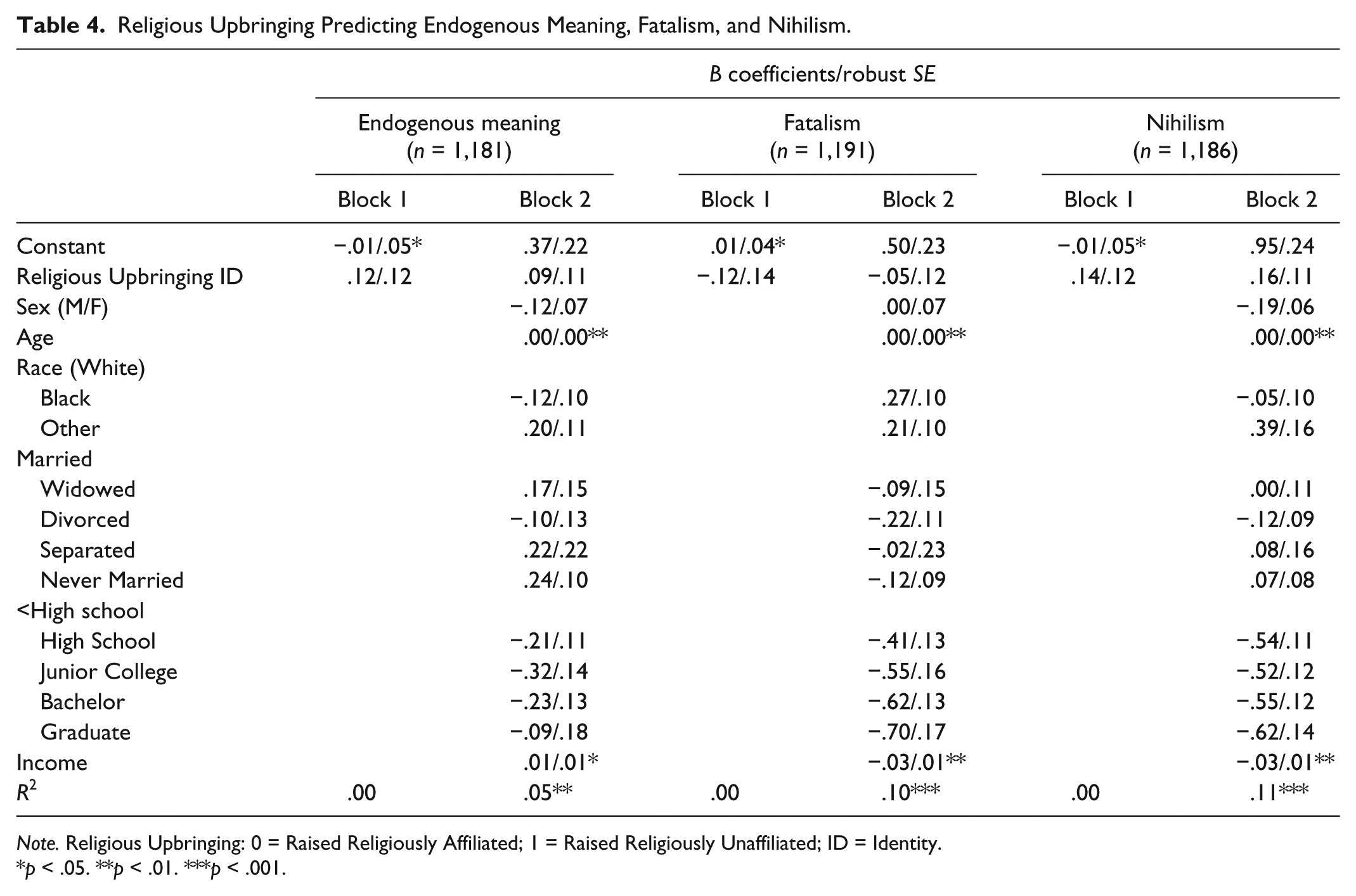
Note. Religious Upbringing: 0 = Raised Religiously Affiliated; 1 = Raised Religiously Unaffiliated; ID = Identity.
p < .05. **p < .01. ***p < .001.
Fatalism was regressed onto Religious Upbringing in Block 1 (n = 1,193) of the regression model, R2 = .001, F(1, 113) = 0.74, p = .391, and Religious Upbringing was a nonsignificant predictor of Fatalism. With the inclusion of covariates in Block 2, ΔR2 = .104, R2 = .105, F(13, 113) = 7.16, p < .001, Religious Upbringing continued to be a nonsignificant predictor of Fatalism.
We then investigated the relationship between Religious Upbringing and Nihilism (n = 1,188). Nihilism was regressed onto Religious Upbringing in Block 1 of a regression model, R2 = .001, F(1, 113) = 1.29, p = .259, but did not significantly improve on the prediction of Fatalism. Covariates were added in Block 2, ΔR2 = .104, R2 = .106, F(13, 113) = 4.69, p < .001, but even with their inclusion, Religious Upbringing remained a nonsignificant predictor of Nihilism.
Subgroup analyses
Following up on the Religious Upbringing analyses, researchers investigated whether being raised Protestant (n = 656), Catholic (n = 376), or Other (n = 51) was associated with differing levels of Fatalism, Nihilism, or Endogenous meaning when compared with persons who were raised in a Religiously Unaffiliated home (n = 103). We used Holm–Bonferroni corrections for these comparisons across the three regression models. However, results showed no differences across the Fatalism, Nihilism, or Endogenous Meaning models. In other words, being raised in a Catholic, Protestant, or Other home was not associated with differences when compared with persons raised in a Religiously Unaffiliated homes.
Discussion
The present study investigated whether various aspects of irreligion predicted fatalism, nihilism, and the perception of life meaning being internally produced. While the existing literature specifies inherent deficits that atheists, the religiously unaffiliated, and persons raised in religiously unaffiliated homes are likely to face regarding meaning in life, our results did not produce support for such views. In fact, these “identity variables” were largely irrelevant to the statistical models. However, the analysis confirmed that atheists and the religiously unaffiliated were more likely to indicate that life has endogenously produced meaning—one of the few persistent differences between the groups we examined.
Are the Irreligious More Likely to Be Fatalists and Nihilists?
Our present results do not support the idea that atheists or the religiously unaffiliated possess a greater sense of fatalism or nihilism. While it is possible to frame the results from the present study as running against the existing literature, we think that the case for atheist or nonreligious deficits in life meaning was never adequately established to begin with. This is because most views on this topic rest on academic speculation as to the relationship between atheism, religion, and meaning in life, rather than empirical tests. Our findings suggest that atheists/theists and the religiously unaffiliated/affiliated do not systematically differ with regard to fatalism and nihilism, constructs that are routinely linked with psychological well-being. Overall, these findings would be consistent with at least a few other studies that find that atheists or the religiously unaffiliated do not suffer from psychological deficits because of their position (Galen & Kloet, 2011; Speed, 2017).
Are Assumptions Underpinning Meaning in Life Warranted?
In light of our findings, it is instructive to investigate why the idea persists that irreligion should reflect differences on nihilism, fatalism, and source of meaning in life in general. In our view, the literature often fails to appropriately distinguish between types of meaning, either in its endogenous form (meaning perceived to be internally produced) or exogenous form (meaning perceived to be externally produced). It is important to note that exogenous meaning does not necessarily imply the source is god(s). Granted, this may be a “traditional” source of exogenous meaning, but it should not be thought of as a sole source as persons may perceive any number of external things provide them within meaning (e.g., the universe, karma, membership in social groups, relationships, occupation). However, if meaning in life is assumed to be given or bestowed on persons from a transcendent source, then this assumption has a substantial impact on investigating an atheistic worldview. Under such an assumption, it would be technically true to suggest that atheists have less meaning in their lives than theists, but this is only because the notion that atheists do not derive meaning from god(s) would be tautological. Moreover, given a definition of meaning where a deity is inherent, what would differences between atheists and theists actually signify? In such a case, one group would, by definition, be excluded from experiencing meaning.
Making one’s own purpose
A consistent and strong finding that emerged from the present study was related to Endogenous Meaning. Being either an atheist or religiously unaffiliated was associated with stronger agreement that meaning in life came from within, and these differences persisted despite the inclusion of covariates. Not only were these differences statistically significant, but they were also of practical significance. The observed effect size for atheists in this regard was g = .57 (a medium-to-large effect), and the effect size for the religiously unaffiliated was g = .34 (a small-to-medium effect). These findings are consistent with two complimentary ideas: Theists and the religiously affiliated are more likely to believe that life has extrinsically produced meaning (possibly due to god or gods), and atheists and the religiously unaffiliated are more likely to perceive meaning as a product of the self rather than a product of an external source or agent (or a relationship with this agent).
Researchers often start with the perception or assumption that meaning is exogenous, or that exogenous meaning is richer or more fulfilling than endogenous meaning (e.g., Park & McNamara, 2006). This approach can, unsurprisingly, lead to conclusions that atheists have impoverished levels of meaning in life as compared with theists. If meaning in life is exogenous, then one would expect atheists and, to a lesser extent, the religiously unaffiliated, to report greater levels of fatalism and nihilism. However, despite an adequately powered analysis using nationally representative data, these relationships did not emerge. While several reasons could be provided to explain these null findings, we think that the simplest explanation is that meaning in life is multidimensional and varies across social categories. On average, atheists (and to a lesser extent the religiously unaffiliated), in theory, are less likely to accept an exogenous source of meaning—and were more likely to believe meaning was internally produced. Again, these findings are consistent with the idea that “whatever makes life meaningful is heavily loaded with whatever people value” (Klinger, 2012, p. 29). Atheists in particular are perhaps less likely to have an externally grounded meaning in life—but not any meaning in life (Jörns, 1997).
Our findings generally align with Wong (1998), who generated a personal meaning scale, by asking individuals about what makes life meaningful and then factor analyzing the responses. An overwhelming number of the items were related to goal pursuit; the factor of achievement striving explained over three times the amount of variance explained by the “religion” factor (see Klinger, 2012, p. 29). Religiously derived meaning may serve as a central source of meaning only insofar as it is personally and socially valued, and such valuation itself may be part of socialization and learning processes. This illustrates the issues with assuming that common beliefs or behaviors are generalizable to all. Exogenous meaning certainly exists for many, but that does not mean that endogenous meaning can or should be ignored. As King, Heintzelman, and Ward (2016) suggest, “the experience of meaning in life may be quite a bit more commonplace than is often portrayed” (p. 211), and we observe that religion is one of many paths for attaining it.
We can also point out that if exogenous meaning is defined as meaning that is not self-made, this definition does not intrinsically implicate religion or theism. In this study, we were specifically concerned with exogenous meaning-making processes in the context of theism, that is, specifically religious meaning-making. The religiously unaffiliated, and even atheists, can reference or at least perceive a spiritual or transcendent meaning of external origin, though for atheists, this would very likely depend on how “spirituality” was framed or defined. For example, studies suggest that when atheists are given the opportunity to list sources of profundity and meaning, they often list external sources such as nature, the universe, social causes, and humanity (Caldwell-Harris et al., 2011; Coleman & Arrowood, 2015; Coleman, Silver, & Holcombe, 2013). Future research should explore the psychological consequences of utilizing these external sources of meaning.
Limitations, Future Directions, and Conclusion
The present study had several limitations. First, we assessed the perception of the extent to which life meaning is internally produced, the perception that life was without meaning, and the perception that one could not act meaningfully with agency. In other words, “life is only meaningful if you provide the meaning yourself” is not equivalent to “I have a high level of self-produced meaning” or other measures of meaning in life. Ideally, we would have assessed actual levels of self-produced life meaning, which would have allowed for more robust conclusions. However, the questions used in the present study demonstrate some conceptual overlap with aspects of the Meaning in Life Questionnaire (cf. Steger & Frazier, 2005) for nihilism (“In my opinion, life does not serve any purpose”; cf. “My life has no clear purpose”; Steger & Frazier, 2005). Generally, our point yet remains that, to avoid classification and measurement issues with nonreligious individuals and populations, future research should always seek to discriminate between meaning-making processes that rely on external versus internal sources. To the extent that such distinctions are obscured or not accounted for, this may produce misleading conclusions about the impact of meaning in life on other important psychological outcomes.
Second, given that archival data were used, the present study was limited to whichever items were asked. However, the 2008 GSS was specifically chosen because it contained relevant questions that allowed us to adequately test hypotheses related to meaning, religion, purpose, and fatalism. A related limitation was the number of atheists (n = 115), religiously unaffiliated (n = 192), and raised religiously unaffiliated (n = 96) available in the dataset. While these numbers allowed for adequately powered analyses, it would be beneficial to have a greater number of these groups represented in future research. Although the GSS is a nationally representative sample, the final sample size was more characteristic of psychological studies than of sociological studies at the macro level. An overall larger sample size would also be desirable to attain more precise population parameter estimates, allowing us increased confidence in the presence (or absence!) of differences between groups.
It should be noted that focusing on the self as a source of meaning bears a specific relation to the kind of culture found in the United States, which is a notably individualistic one. In this way, we caution that our findings may only be plausible in the context of postindustrial, Westernized countries. This raises the question of whether the self would be a salient source of meaning for nonreligious or atheistic individuals elsewhere in the world. There is good reason to think that the self would be less prominent an element of meaning-making in other cultures and countries. As such, a cross-cultural perspective on our topic would be a valuable contribution to the study of meaning systems, identity, and the production of meaning in life.
Future research should also seek to delineate between types of religious affiliation and religious upbringing to determine whether meaning in life is predicted by this specificity. Unfortunately, while the GSS contained a more specific breakdown of religious affiliations, many of the categories were too small to allow for adequately-powered analyses. Nevertheless, it is possible that a more refined analysis of these groups, using a different dataset, would allow for a better picture of differences to emerge.
Overall, the present study found no support for the contention that atheists and the religiously unaffiliated were more prone to nihilism or fatalism than their respective counterparts. While these groups were more likely to indicate that meaning in life was endogenous, these differences did not seem to coincide with a view that life was uncontrollable or without meaning. Religious affiliation and/or belief in god(s) is certainly a pathway toward meaning in life; however, no potential source for meaning is also a necessary source for meaning.
Footnotes
Acknowledgements
The authors would like to thank Luke Galen for helpful comments on an earlier draft of this manuscript.
Authors’ Note
All authors are members of the Atheist Research Collaborative.
Declaration of Conflicting Interests
The author(s) declared no potential conflicts of interest with respect to the research, authorship, and/or publication of this article.
Funding
The author(s) received no financial support for the research, authorship, and/or publication of this article.
