




Abstract
This article presents a systematic review of the literature on the role of educational vlogging in enhancing learning and teaching outcomes. The researcher analyzed a total of 60 papers published from 2011 to 2021 using qualitative analysis with complementary quantitative analysis. The findings shed light on the vital role of vlogging in education over the last decade. This systematic review provides scholars and practitioners in the fields of education and educational technology with valuable information about how to improve learning and teaching through vlogging. The data was collected using the Preferred Reporting Items for Systematic Reviews and Meta-Analysis (PRISMA) method. The findings indicated that students and teachers have a positive attitude toward vlogging. Vlogging in higher education is more extensive than in K-12. The main subject in which vlogging is used in K-12 was language, while the main subject in higher education (HE) was found to be reflective practices.
Introduction
Social networking platforms have begun to play an important role in education. They create a participatory learning culture in which teenagers and young learners can easily be active learners and interact with digital content (Greenhow & Lewin, 2016). The last decade of the 21st century brought dramatic changes in educational settings powered by ubiquitous connectivity, allowing those with access to utilize global online networks. Now is the greatest time in history to be a learner (Reich, 2020). Vlogging is one of the media approaches that has recently emerged as a learning tool and has been used extensively by the education industry in the learning and teaching process in the last decade (Aini, 2020), especially in the last 3 years during the Covid-19 pandemic, when schools and universities were forced to shut down and rely on online learning.
As defined in the list of new words to be included in Merriam-Webster’s dictionary, a vlog is a video blog. As a verb, vlogging means creating and communicating messages through video blogging (Merriam-Webster, 2022). Thus, vlogging is a form of blogging but uses video as its format. Through it, individuals—regardless of their educational, ethnic, or socio-economic background—“make their voice heard and build impressive communities around online video content” (Bacescu, 2017, p. 313). Unlike live-streaming videos, vlogs are an asynchronous medium, with no real-time interaction between the vlogger and the audience. These recorded monologues are enhanced by visual elements (Aran et al., 2014).
Vlogging is closely connected to YouTube, the main platform on which vlogging takes place. YouTube vlogging dates back to the early days of the platform when Andrew Baronho produced a vlog series called Rocketboom, in which a host presented the news and included comedic sketches. The show attracted around 300,000 viewers a day (VloggingPro, 2022). Thus, vlogging and YouTube have grown side by side in terms of content creation and dissemination of that content through Web 2.0. The popularity of YouTube over the last decade is demonstrated in 2021 statistics showing that the average person spends 100 min a day watching videos online, which amounts to five billion videos watched per day (VloggingPro, 2022).
Vlogging as a learning tool has also become increasingly popular; YouTube is used by youth not only for entertainment but for learning. Over 83% use YouTube as a learning tool (Bacescu, 2017). Vlogs in education provide students with immersive, comprehensive, and engaging experiences. Video integration into classroom instruction began in the 1980s when the first educational VCR tapes became popular. Ninety percent of teachers believe that video plays an important role in education, and 97% say they use videos in their classroom regularly, with 55% even assigning video-viewing as homework and 20% using videos as part of their daily instruction.
A large amount of empirical research has been conducted on vlogging in education over the last decade. Brott (2020) noted that vlogging had been used as an educational tool to engage learners and teachers in a reflective process as part of the larger learning process, as it closed the gap between theory and application. Therefore, he concluded, vlogging functions as a tool that improves teachers’ interaction with students—the latter benefit from vlogging as a feedback tool that helps them reflect on their learning.
Though there is extensive empirical research on the use of vlogging in education settings, there is still a need for a further theoretical understanding of this phenomenon through a configurative approach. Even though configurative approaches are very beneficial for researchers, they are rarely used in education, especially at the start of new research projects (Levinsson & Prøitz, 2017). Goagoses and Koglin (2020) noted that in order to inform future research and practice thoroughly, a configurative and systematic summary of empirical findings is needed. This study aims to comprehensively review the pedagogical applications of vlogging and how it has been used in teaching and learning over the last decade. This study also sheds new light on the vital role of vlogging at different education levels and across disciplines over the last 10 years. The study also uncovers challenges that teachers and learners face. Finally, it provides scholars and practitioners in the field of educational technology with valuable information about how to improve learning and teaching through vlogging.
Related Work
Over the last decade, a large amount of empirical research has been devoted to examining the impact of vlogging on various fields, including music, athletics, and mental and physical health (Cruz & Boehmer, 2019; Harpaz & Vaizman, 2021; Sangeorzan et al., 2019). Moreover, considerable research has been devoted to examining the positive impact of vlogging on student’s learning (Cioban & Hatos, 2019; Combe & Codreanu, 2016; Cruz & Boehmer, 2019; Desnita & Marleni, 2020; El-Garawany, 2017; Kelly, 2018; Maulidah, 2017; Niron, 2020; Wulandari, 2019). However, fewer studies have examined the effects of vlogging on teaching skills. These studies focused on a range of concepts and theories, including self-determination theory and reflective practice (Ahmad, 2014; Debbag & Fidan, 2021; Ong et al., 2020) and reported that while teachers found vlogging helpful in reflective practices (Brott, 2020). Students found it accessible but not helpful, and some found it ineffective as a learning tool (Anil, 2016).
Unlike the large amount of empirical research discussed above, few reviews have been conducted on vlogging in general and the use of vlogging as a pedagogical practice in particular. Gao et al. (2010) surveyed the current state of vlogging technology. They noted that compared to text or audio blogs, vlogs could be used in a more comprehensive range of applications, such as online education and learning, online gaming, product marketing, and news reporting. Mujiono and Gazali (2021) discussed vlogs as part of an online learning model to be applied during the Covid-19 pandemic. The researchers used the Preferred Reporting Items for Systematic Reviews and Meta-Analysis (PRISMA) method. They found that their model could be applied to physical education through the Schoology portal method and vlogs. It can also be used in the distance learning model with a collaborative approach. Amin et al. (2021) focused on using vlogging as a teaching aid (TA) in Islamic Education. The study employed a guide from the Reporting Standards for Systematic Evidence Syntheses (ROSES) literature protocol to find related previous studies. Farwana et al. (2020) discussed using video-based media to enhance clinician-patient communication and improve patient understanding, especially of non-English speakers or those with low literacy levels. They conducted their systematic review in line with the Cochrane Handbook for Systematic Reviews and Interventions and the Preferred Reporting Items for Systematic Reviews and Meta-Analyses (PRISMA) guidelines. The review concluded that using video-based media appears to be effective. Barrett and Liu (2016) discussed vlogging as one of the language resources that English language learners have used for effective oral academic presentations. Lestari et al. (2021) produced a systematic review on vlogging, ethnoscience, and social studies literacy. They used various methods, such as descriptive qualitative, quasi-experimental, exploratory, survey, and literature review. The findings indicated that these topics are interesting to study because they positively affect learning, increasing learning motivation and self-confidence. Snelson (2011) focused on how publications with “YouTube” in the title are distributed across academic disciplines. The study found that the invention of YouTube sparked an escalation in online video viewing and production that spread into education and scholarship. A synthesis literature review that is dedicated to the use of educational vlogging in terms of academic subjects, educational levels, and students’ and teachers’ perspectives is unavailable. This research is essential because vlogs are discussed across disciplines, educational levels, learning, and teaching. Thus, the systematic review is guided by the following research questions: (1) What are students’ perceptions about using vlogging in the classroom? (2) What are the advantages and disadvantages of using vlogging from teachers’ perspectives? (3) Which educational levels are represented in the vlogging studies? (4) What are the different academic subjects represented in vlogging studies?
Research Methodology
Since the use of vlogging in education is a relatively new field, one of the goals of this research was to give an overall picture of teacher and students perspectives, the educational levels at which vlogging is used, and the subjects within which vlogs are used and/or created. This study aimed to produce a comprehensive review that adequately displays the pedagogical applications of vlogging and understands how it has been used in teaching and learning over the last decade. Since educational vlogging is an emerging research area that could support the learning and teaching processes, especially in the post-Covid-19 era, a systematic review approach is most convenient for this research stage (Yang & Tate, 2009). The data was collected using the Preferred Reporting Items for Systematic Reviews and Meta-Analysis (PRISMA) method (Figure 1).

PRISMA 2020 flow diagram for new systematic reviews.
Manuscript Screening and Filtering Process
Full articles written in English published in peer-reviewed journals between January 2011 and 2021 were included in the article. The review focused on this period because it was in this decade that vlogging use in education sharply increased (Aini, 2020). Non-English articles were excluded due to the time constraint and high cost associated with translating articles. Online database searches were used as the primary literature collection approach, given the emerging research era and scattered publication channels. Six well-known online research databases were used to find relevant literature sources based on previous research. Some of these databases are related to education and technology, including EBSCOhost, ERIC, ScienceDirect, and SpringerLink, while others are general databases, such as Saga and Google Scholar. The search within Google Scholar included screening the first 10 pages (200 search records) for each research string (the page settings were set to display 20 records per page). These databases were selected for the following reasons: (1) they offered access to peer-reviewed journal articles. They included filters to (2) restrict the search to peer-reviewed articles, and (3) limit search results to a particular range of dates, and (4) they permitted title searches. In order to make the screening and coding processes easier, Zotero, a free reference management software, was utilized to remove the duplicates. Microsoft Excel Spreadsheet was used to create a matrix and color codes.
Based on the research goal, two sets of keywords were developed: (a) learning-related keywords, including vlogging, learning, students, and (b) teaching-related keywords, including vlogging, teaching, and teachers. These two sets of search combinations were used with the Boolean operators AND& OR used between the sets. The research strings were: “vlogging” AND “learning” OR “students”; “vlogging” AND “teaching” OR “teachers”; “vlogging”OR “video blog” AND “teaching”; “vlogging” OR “Video blogs” AND “learning.” Keyword and abstract searches were conducted across all six databases. After deleting the duplicates and removing irrelevant google scholar records (only 400 records were screened), the search produced 684 results from the search using the mentioned above terms and designated Boolean. A total of 60 papers were included in our final review based on the inclusion and exclusion criteria in Table 1.
Inclusion and Exclusion Criteria.

Developing the Codes and Scheme
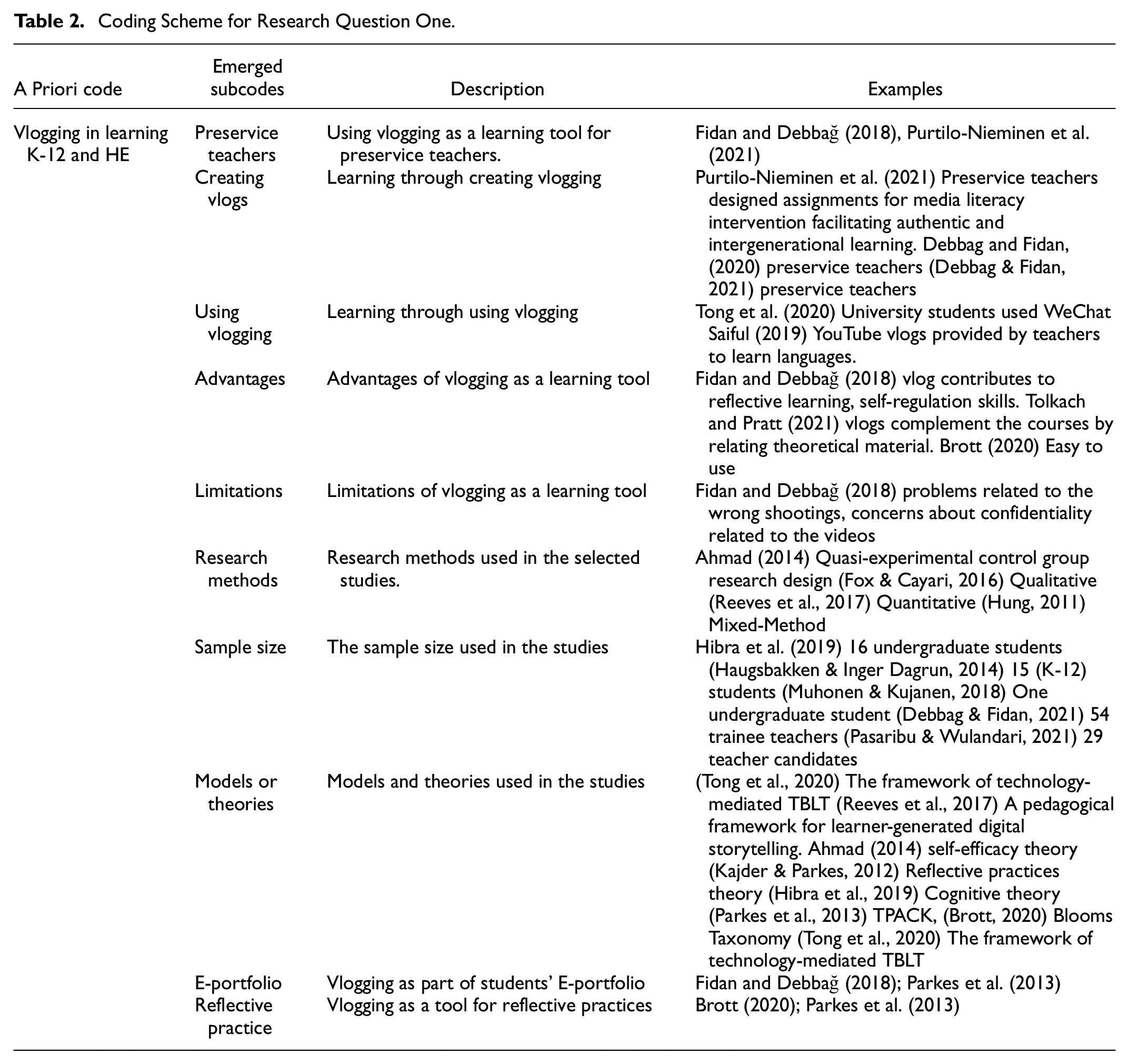
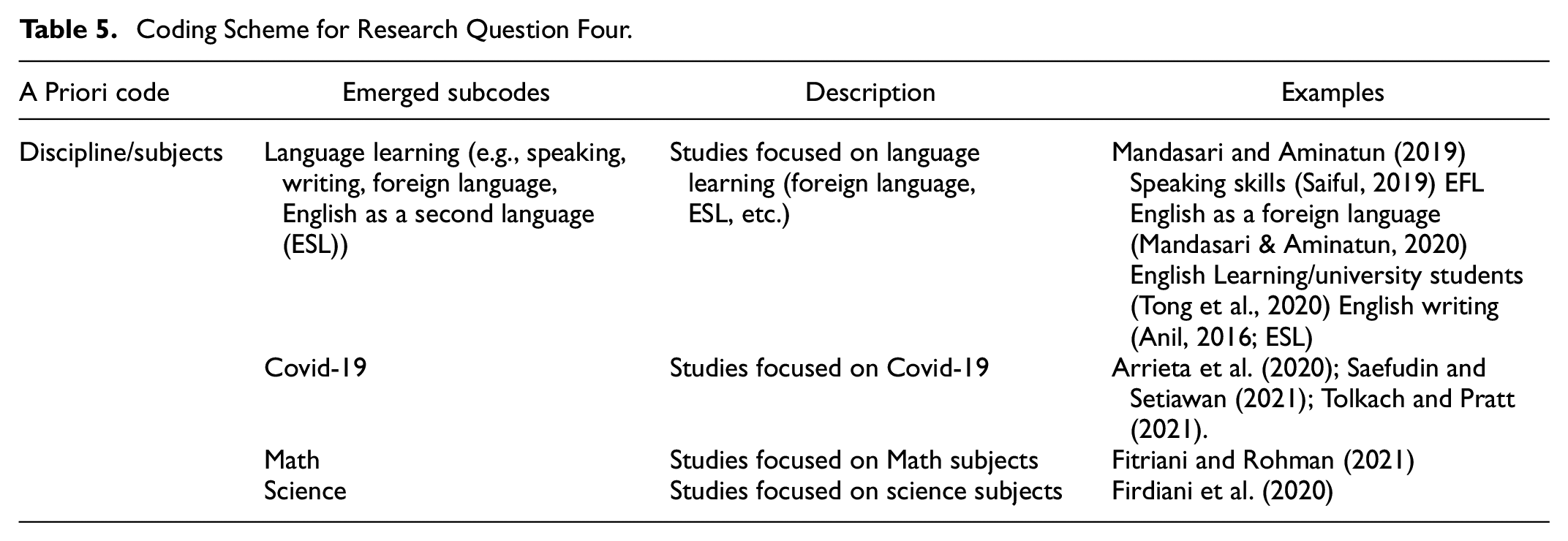
To code the studies systematically, an initial codebook was created. The codebook included numerous categories of information extracted from each research question. The coding scheme for each question included a priori code developed based on current vlogging research. From there emerged codes for each research question, explanation, and examples. For instance, the coding scheme for RQ1 included the a priori codes creating vlogging, using vlogging, vlog advantages, and vlogging limitations, while the emergent codes included e-portfolio, reflective practices, and language learning (Tables 2–5).
Coding Scheme for Research Question One.
Coding Scheme for Research Question Two.

Coding Scheme for Research Question Three.

Coding Scheme for Research Question Four.
The analysis of the coding themes not only allowed a search for answers to each individual RQ but also enabled me to (a) look for potential strategies that may make the best of the vlogging used to support a variety of online education options and (b) look at future research directions around vlogging in both K-12 and higher education.
The selected articles were mainly analyzed using a qualitative content analysis method, which is a thematic analysis concentrating on the relationship between the articles’ content and the shared characteristics of specific themes (Elo & Kyngäs, 2008). Numerical data complemented this qualitative approach.
Results
A total of 60 papers published from 2011 to 2021 were reviewed; approximately two-thirds were published after 2015. The articles varied in terms of the research approach: qualitative (n = 25), quantitative (n = 21), and mixed methods (n = 14; Figure 2). Around 18% (n = 4) of the studies focused on teachers’ perspectives, while the rest focused on students’ perceptions. The largest sample size was 389 (Aldukhayel, 2019), and the smallest was one (Muhonen & Kujanen, 2018). The systematic review revealed that data about vlogging and education were collected using multiple and various methods such as interviews, focus group discussions, and open-ended questionnaires. Some studies adopted mixed methods in collecting the data, such as control groups and panel discussions.
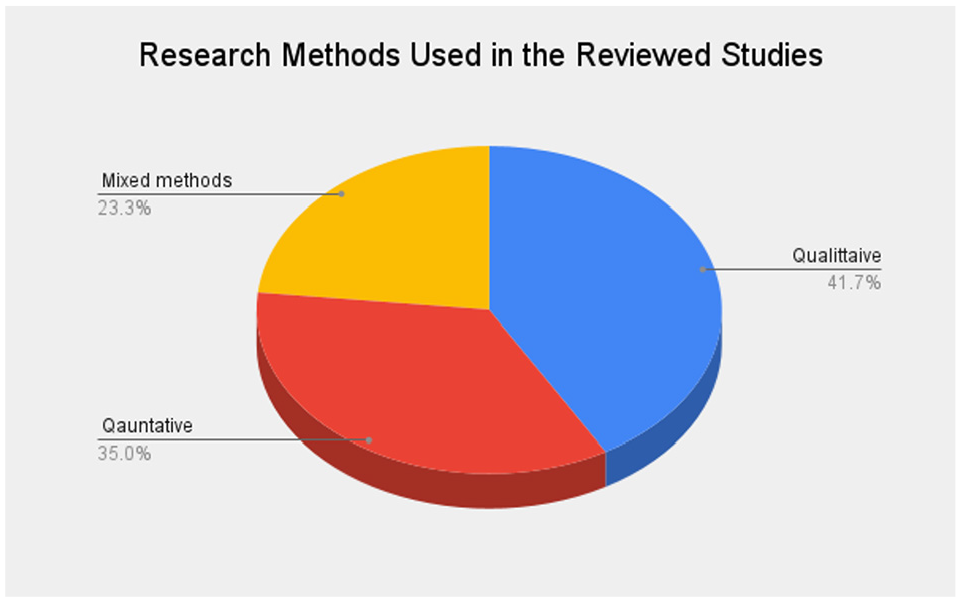
Research methods used in the reviewed studies.
Theoretical frameworks used in the reviewed articles demonstrated considerable and varied theoretical bases in investigating vlogging in education. Theories and theoretical models included cognitive theory, Bloom’s Taxonomy, Constructivism, the Technological Pedagogical Content Knowledge (TPACK) model, self-efficacy, reflexivity, and teacher cognition. The results are presented below in an order that corresponds with the research questions.
RQ1: What are Students’ Perceptions About Using Vlogging in the Classroom?
Students generally found that vlogging supported language learning and shifted learning from accessing and sharing information to designing communities of inquiry where they could actively engage in meaningful collaborative learning (Muhonen & Kujanen, 2018). Preservice teachers believed that vlogging reinforced their critical reflection, which helped with self-regulation skills, self-expression, communication, information sharing, and critical thinking. In addition, pre-service teachers drew attention to technical aspects such as easy accessibility, common use, and easy uploading-watching. The advantages also included visual representation, relief from time constraints, self-evaluation, professional development, a wider audience, peer learning, and technical capability (Debbag & Fidan, 2021; Fidan & Debbağ, 2018; Hung, 2011). Also, The trainee teachers reported that Vlogs were a potential media for self-assessment, reflection, and peer learning and for developing techno-pedagogical skills in teacher education (Anil, 2016; Debbag & Fidan, 2021; Fidan & Debbağ, 2018). However, it was reported that students identified a number of challenges that hampered its effectiveness, including technical difficulties, affective interferences, weak linkage to real-time communication, and time issues. Unlike what Reeves et al. (2017) expected, their study’s findings reported that students didn’t perceive video blogging as beneficial to learning and didn’t motivate them to learn more about their subject. Additionally, they found that students rarely took the time to re-watch the videos they had uploaded or comment on the videos their peers created and uploaded.
RQ2: What are the Advantages and Disadvantages of Using Vlogging From Teachers’ Perspectives?
The teachers were pleasantly surprised by how some spontaneous opportunities and engagement with authentic resources unexpectedly promoted student participation. In language learning, when Tong et al. (2020) introduced their undergraduate students to WeChat, a mobile social networking tool that included vlogs for language learning, they found that instructors play unique roles in meeting the technological goals of the tasks and in affording unique learning opportunities to some learners. However, they recommended paying enough attention to individual student needs when implementing homework. Other EFL teachers noted that a YouTube vlog is a potential medium for teaching and learning activities and a valuable resource for teachers seeking to enhance their language lessons with lively, topical content (Saiful, 2019). Faculty in higher education found that vlogging is an efficient tool for self-reflection for students to reflect on their learning and for instructors to reflect on their instructional methods. Brott (2020) explained that vlogging holds promise as an accessible medium and provides feedback for students to reflect on their learning and for instructors to reflect on their instructional methods.
RQ3: Which Educational Levels are Represented in the Vlogging Studies?
Regarding vlogging in relation to educational levels represented in the studies, 58% of the articles (n = 35) focused on higher education (two studies addressed graduate level, and 33 addressed undergraduate level). In comparison, 41% of the articles (n = 25) focused on students in K-12, including primary, middle, and secondary school students (Figures 3 and 4).

Educational levels represented in the reviewed studies.
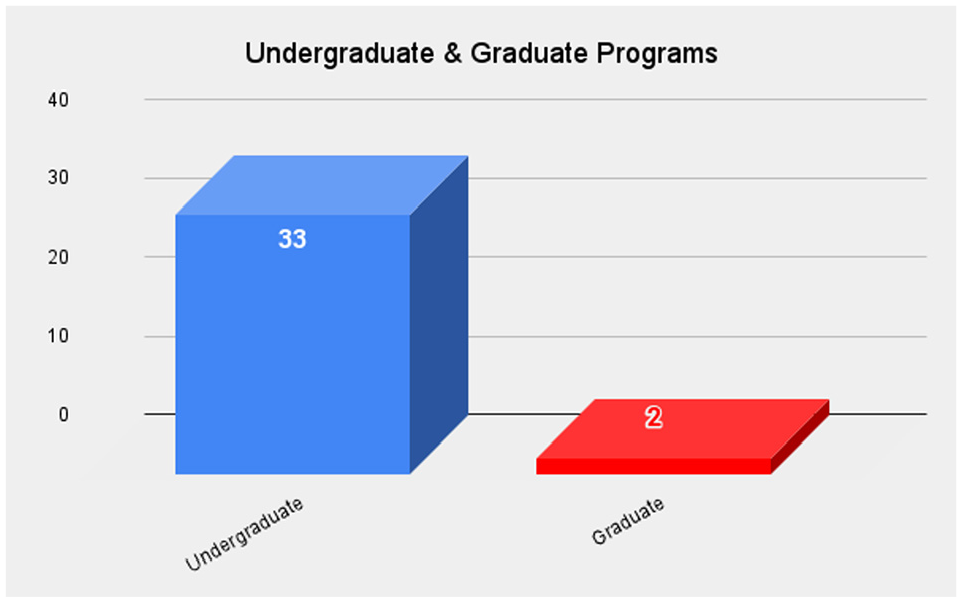
Graduate and undergraduate programs represented in the reviewed studies.
RQ4: What are the Different Academic Subjects Represented in Vlogging Studies?
Vlogging studies have generally focused on language learning in K-12, reflective practices, and foreign language learning in higher education. Forty-four studies (73%) discussed language learning (speaking, reading, listening, and writing) in K-12 and higher education. One study focused on listening, one on reading comprehension, one on writing, and ten on speaking. Most of the studies discussed English as a foreign language (EFL). One study examined English as a specific language (academic English writing). Three studies addressed the pandemic era in K-12 (focusing on science and self-confidence) and higher education (focusing on tourism). One study focused on Math, and two focused on Science in K-12 (Figure 5).

Academic subjects epresented in the reviewed studies.
Discussion
The sample of 60 peer-reviewed journal articles and papers provides an emerging body of empirical evidence. The research focused on educational vlogging, and the general findings reported that vlogging positively affects learning and teaching but also comes with challenges. The results also reported that studies focused more on student and teacher perspectives. More studies focused on higher education than K-12. The following section will discuss and synthesize the findings in detail.
Vlogging in K-12 Education
Students and teachers in K-12 showed positive attitudes toward vlogging. Vlogging increased students’ engagement and learning motivation and helped them understand lessons more efficiently. Student perceptions were consistent with the findings of previous research that examined the effectiveness of instructional videos and YouTube (Bloom & Johnston, 2010; Smith et al., 1999; Watkins & Wilkins, 2011), in which the use of digital media was generally found to be beneficial in different subjects in general and language learning in particular. Watkins and Wilkins (2011) explained that vlogging could be performed by any student who has achieved even the lowest degree of conversational proficiency. They confirmed that using YouTube both inside and outside the classroom can enhance conversation, listening, and pronunciation skills. They also reported that YouTube videos could be utilized as a. tool to stimulate cultural lessons, improve exposure to World Englishes, and promote authentic vocabulary development. Even reading and writing activities can be structured around YouTube videos. In-class lessons and activities can be detailed, as well as homework and projects requiring online streaming videos. However, the studies included in this review showed that students and teachers also face several challenges, including copyright restrictions, content suitability, YouTube bans, and the unavailability of video streaming sites in certain countries. These findings were in line with Jones and Cuthrell (2011), who discussed the potential challenges of using YouTube in the classroom. One suggestion they offered for overcoming those challenges was to convert YouTube videos into other formats and save them onto a flash drive or a hard drive.
For. example, Zamzar.com allows users to convert and download YouTube videos legally. The challenges mentioned by students were also in line with other studies, which reported that using digital media platforms can cause distraction and/or increase the cognitive load (Atchley & Lane, 2014; Oppenheimer, 2019). It was noted that K-12 teachers mainly used others’ vlogs rather than creating their own or having students create them (Aqil, 2018; Puspita, 2019).
The studies focused mainly on using vlogging in language learning and English as a foreign language. Most vlogs were intended to help enhance students’ speaking skills, but the literature also includes one study on reading comprehension and one on listening and writing. No studies discussed the other language elements, such as grammar, though research has been done on using instructional videos for teaching grammar (Alharbi, 2019; Haight et al., 2007; Herron et al., 2006; İlin et al., 2013; Mohammed, 2013.; Secules et al., 1992). Similarly, among the 60 studies including this literature review, there were only two studies on teaching science and one study on mathematics (Arrieta et al., 2020; Firdiani et al., 2020; Fitriani & Rohman, 2021). Even though the studies’ findings reported a positive impact on students learning, it’s difficult to generalize these findings.
Vlogging in HE
The main vlogging tasks in the studies centered on reflective practices, EFL, and creating e-portfolios. Most studies showed positive results around learning and teaching using vlogging in higher education. Students found that vlogging positively impacted self-assessment, self-regulation, self-expression, and interaction (Debbag & Fidan, 2020). Self-efficacy (Ahmad, 2014) and motivation (Mandasari & Aminatun, 2019) This is in line with previous literature on using digital media in higher education and using video in reflective practices, especially with preservice teachers (Cavanagh et al., 2014). Other students found vlogging less effective than conventional instructional methods (Anil, 2016), time-wasting, and uncomfortable activity (Reeves et al., 2017). When students in some studies were asked to create vlogs as part of reflective practice, they found it an unusual medium for reflective practice. Unlike students’ negative perceptions, higher education instructors were optimistic about using vlogging in education in general and as a reflective practice tool in particular (Brott, 2020). Students also reported several challenges, including communication and time issues, tension, shyness, concerns about confidentiality, a sense of monotony, difficulty concentrating, feeling that vlogging is less effective than classroom learning, lack of interaction, emerging technical problems, and difficulty accessing the Internet (Hung, 2011). Relevant subjects mentioned were EFL and reflective practices, tourism, and administration. As with K-12 students, the foreign language had a significant share among the subjects taught using vlogging. The number of studies discussing vlogging in higher education was greater than in education. Unlike K-12 students, higher-education students have been found to create vlogs of their own (Rachmijati et al., 2019), typically using YouTube as a platform to upload their vlogs. In teaching Chinese as a foreign language to university students, vlogging was part of creating language tasks for WeChat (a Chinese social media platform). The designed WeChat tasks had to be customized for students’ language levels (Tong et al., 2020). The studies did not experiment with other platforms, such as VoiceThread and Padlet, which have the potential for vlogging. Interestingly, the teachers in most studies used vlogs and did not create vlogs themselves. More studies featuring teachers as creators of vlogs will likely emerge in post-pandemic research.
Limitations
This review is limited in several ways. The first limitation is that it includes only articles published and found in a particular set of databases. The search excluded websites and online resources outside academic bibliographic databases, which can sometimes be significant sources of literature. Some conference papers were also excluded due to the ambiguity around their peer review status. The search was also restricted by a date range and language (excluding non-English articles).
Recommendations and Future Research Directions
Since it is clear from the literature that vlogging positively affects learning and teaching in higher education, we recommend further research to investigate the educational levels, academic subjects, and types of learners that will benefit the most from vlogging. Also, further research could explore the Effect of vlogging when done by students. Most of the studies have focused on the use or production of vlogging by teachers, while few studies have measured vlog production’s impact on learning for K-12 students, especially at the middle and high school levels. These students might use vlogs to, for instance, reflect on their learning process as part of in-class projects or assignments. In terms of higher education, future research may focus on the effectiveness of using vlogging to help pre-service teachers utilize and include multimedia as an integral part of the curriculum. Studies that experiment with vlogging using different platforms such as Flipgrid and VoiceThread. More systematic reviews of broader scope that include some of the elements excluded in this study are recommended. Articles on using vlogging to teach different foreign languages could be considered as well. Though most relevant articles examined the relationship between vlogging and learning outcomes, they have narrowly focused on short-term learning outcomes. Hence, it is recommended for future research to compare the extensive use of vlogging with the implementation of other conventional teaching methods for their capacity to serve long-term learning outcomes.
Conclusion
This systematic review investigated the literature on using vlogging as a pedagogical tool in terms of student perspectives, teacher perspectives, education levels, and academic subjects. The results can be summarized as follows: (a) educational vlogging is a promising tool for supporting learning and teaching, and there is a growing reliance on it; (b) vlogging use in higher education is more extensive than in K-12. While K-12 students use vlogs more than creating them, higher education students have exhibited various uses for vlogging. The findings also indicated that language learning was the most common vlogging focus in K-12, and reflective practices and e-portfolios were the main focus in higher education. There is potential for future research and exploration of pedagogical applications of vlogging and adopting educational vlogs as effective instruction.
Footnotes

References
 ,
,