




Abstract
The promotion of the English language continues to be instrumental in helping China to engage with the world, but it has caused identity anxiety and cultural uncertainty among language learners. In this paper, we analyze data from a favorite-character-presentation task and an oral survey conducted with 82 preschool children in Shanghai. We found that Chinese remains the most important language for the participants in expressing their transcultural identity aspirations, but the influences of English can be observed in their language practice when presenting their favorite characters. These findings suggest that the participants’ identity aspirations can be understood in the context of their translanguaging practices, which unfold in their use of linguistic and pictorial resources. The paper concludes with a discussion of how language educators and policymakers should consider children’s exposure to informal language learning beyond the classroom in teaching.
Introduction
The rise of English as a global language has facilitated the cross-border flow of ideas, people, and products, but it has also created many concerns with regard to local languages, cultures, and identities in a range of contexts. In Japan, scholars have debated whether it has been possible to maintain Japanese cultural integrity and promote unique “Japaneseness” alongside efforts to promote the learning and use of English (e.g., Hashimoto, 2000). Despite its historical presence in Korea since the 1880s, English has acquired conflicting connotations during different historical periods, as the language “has been thought of as revolutionary, accommodationist, nationalist, collusive, cosmopolitan and anti-Korean” (Collins, 2005, p. 427).
In China, the English language has likewise received an ambiguous reception. While it has been considered instrumental in helping China to open up and engage with the outside world, it has also been treated with great suspicion. Qiang and Wolff (2003) regard the language and its cultural imports as a Trojan horse that will seriously undermine China’s cultural integrity, even though most of the student participants in Pan and Seargeant’s (2012) study do not regard English as a threat to their Chinese identity. Nevertheless, such identity anxiety and cultural uncertainty have been ongoing issues for many language educators and policymakers in China (Fang, 2018). His creates a need to closely monitor issues related to culture and identity in the context of learning and teaching English in China, which boasts the largest number of English language learners in the world. In this paper, we draw on data collected from a study on pre-schoolers’ experiences of learning English in Shanghai to probe their transcultural identities by examining their translanguaging language practice.
Language Learning, Cultural Identification, and Translanguaging
Identity has been approached and conceptualized in multiple ways as a lens to understand why language learners invest efforts and resources in learning. In language learning research, identity has been theorized by Norton (2013) as “how a person understands his or her relationship to the world, how that relationship is structured across time and space, and how the person understands possibilities for the future” (p. 45; see also Amorati, 2021). This theoretical lens highlights how language learners can choose to position themselves or achieve their desired positioning in relation to the imagined or real social world through investing efforts and resources in learning languages (Darvin & Norton, 2015). As this process of positioning unfolds within particular contexts where normative sets of ideas compete with one another, language learners’ identities can be seen as sites of struggle between individual learners’ aspirations and contextual impositions. For this reason, instead of being fixed entities, identities should be understood as dynamic processes of identification, which help to explain language learners’“integrative motivation to participate in” imagined or real social worlds better “in terms of [their] desired self-representations as de factor members of these [worlds], rather than in terms of identification with” these external communities (Ushioda, 2011, p. 201; see also Hiver et al., 2022; Xu & Stahl, 2022).
While young language learners may often be mistakenly thought of as passive recipients of the contextual imposition of normative beliefs in language learning, research has also recognized their potential for subject positioning as they are in the process of establishing their relationship to the world (Pfenninger, 2022). Aro’s (2012) study of the role of authoritative voices in young Finnish learners of English revealed shifting, polyphonic “voices” in these young language learners’ beliefs. Their beliefs about learning English were dominated by “voices of society,” or “slogans, or cultural truths […] that are frequently repeated and privileged in Finnish society,” such as “everyone in Finland knows English” (Aro, 2012, p. 335). However, the study also found that these young language learners increasingly put forward their own views and experiences about language learning instead of repeating what was promoted by others in their society. This means that it is important for researchers to pay more attention to how young language learners construct who they associate with in learning languages. Such findings are particularly important in contexts where the learning of influential foreign languages such as English cause concerns about young language learners’ cultural identification among language educators and policy makers.
The concerns that language educators and policymakers have about language learners’ cultural identification are understandable, as cultural identity functions as a basis upon which future generations learn to protect and preserve elements of their history, culture, or heritage (Perera, 2013). Cultural identity is an abstract complex of “an individual’s sense of self derived from formal or informal membership in groups that transmit and inculcate knowledge, beliefs, values, attitudes, traditions, and ways of life” (Jameson, 2007, p. 199). An individual’s cultural identification is often reflected in their beliefs, values, personality, behaviors, and patterns of life. It is further reinforced via positive feedback from the cultural groups one chooses to engage with (Harter, 1999). Tsui and Tollefson (2007) outline four interrelated fundamental elements in the discursive construction of cultural identities: (1) spiritual values; (2) shared historical memory; (3) anticipation of a common future; and (4) emphasis on origin and tradition. The most important carrier or representative form of these elements is language and language use (Kramsch, 1998).
Cultural identification depends upon the individual’s sense of self-identification and belongingness within a given cultural community (Zhao et al., 2022). The advent of bilingual and bicultural experiences among language learners often leads to the emergence of the hybridization of languages and cultures. In the process, language learners rely on the dynamic and functional orchestration of multilingual and multisemiotic resources to negotiate meaning in a given space and time (Zhu et al., 2019), which has been referred to as “translanguaging” (Wei, 2011, 2018).
According to Wei (2011), translanguaging enables the multilingual individual to bring multiple dimensions of personal history, experience, and environment as well as their attitudes, beliefs, ideology, and cognitive and physical capacity into one coordinated and meaningful performance, turning it into a lived experience. Different languages and identities do not exist side-by-side, waiting to be activated for separate monolingual events; instead, they work together and inform each other to form language users’ complex literacy practices and identifications (Wei, 2018). In other words, translanguaging allows individuals to articulate their identity aspirations as well as convey multidimensional, nuanced meanings more effectively (Pacheco & Smith, 2015).
This conceptual framework of language learning, cultural identification, and translanguaging provides the theoretical foundation for our research with young language learners in the Chinese context.
Chinese Children Learning English
In the last four decades, China’s rapid economic growth has been closely associated with its participation in global trade, a context which promotes and sustains the popular perception in China of English as a global lingua franca. Chinese parents have long recognized the importance of having a good command of English and firmly believe that their children should learn English as early as possible. The government introduced English as a primary school subject in 2001 (Hu, 2007), but families with resources often send their children to private tutoring even before they start primary school (Nunan, 2003).
The rising number of young English language learners in China has attracted significant attention in research (e.g., Butler, 2014a, 2014b; Hu, 2007). Studies on young language learners have primarily focused on their language learning process and language development to identify ways to help them learn English. Relevant studies have, for example, examined young language learners’ grammatical and phonological development. Zhang et al. (2006) observed young learners’ English practice in school and investigated their shifting use of syntactic structures, while other studies on young language learners’ lexical and grammatical development highlight how two fully differentiated language systems interact, leading to both positive and negative language transfer (Hidalgo, 2021; Yip, 2004). Studies have also examined factors that contribute to young language learners’ language development, such as language learning strategies and pedagogical input. L. L. Huang (2014) used memetics to analyze young learners’ language samples and concluded that the replication and transmission of memes facilitated their language development. Liu and Brantmeier (2019) explored how self-assessment as a learning strategy helps language teachers and young language learners to develop appropriate understandings of young learners’ reading and writing abilities.
Recent studies have expanded the scope of inquiry on the subject of young language learners to address their learning as a mediated social practice in specific contexts. A variety of issues, such as parents’ socio-economic status, the impact of new technology, and educational policies, have been examined (Y. G. Butler, 2014a, 2015; B. Huang et al., 2018). Butler (2015) explored how parents’ socio-economic status and beliefs about their children’s English education mediated children’s motivation to learn English in China. Chen et al. (2019) and Tao and Xu (2022) investigated the impact of technological tools on young learners’ English learning (also see Xia and Gao, 2022). These studies identified that parental involvement is critical in supporting young language learners’ technology-enhanced language learning and that differences in technology access have a significant influence on language learning (e.g., Pfenninger, 2022; Xia and Gao, 2022). In a similar vein, Curdt-Christiansen and Wang (2018) also conclude that parents, as agents of language policy implementation, provide affordances and constraints in facilitating or limiting their children’s language development.
While these studies have generated significant insights into young language learners’ language learning and development, they have not paid sufficient attention to the impact of language learning on young language learners’ development as persons or their aspirations associated with language learning. Moreover, most studies have focused on participants in primary schools. Younger language learners in pre-schools have not yet received sufficient attention in research.
According to statistics released by the Ministry of Education of the People’s Republic of China (MOE) (2022), the number of pre-school age children in China was around 48.05 million in 2021. Since Chinese parents with resources invest heavily in their children’s education, including their learning of English, it has become a major concern for educators and policymakers that young children’s unequal access to learning resources, including those to do with learning English, may exacerbate gaps in their later academic achievements in primary and secondary school (Nunan, 2003). To address this problem, the MOE of PRC issued an official notice in 2018 announcing a special campaign to address inequities in pre-school education which might impact primary school outcomes (Ministry of Education of the People’s Republic of China [MOE], 2018). The official notice explicitly forbids English and other primary-school courses to be included in pre-school curricula. A set of “double reduction” policies came into effect to ease the burden of off-campus tutoring on students to achieve educational equity in 2021. Nevertheless, Chinese parents still find ways to provide their children with private English tuition. Though these policies are claimed to address the issue of educational equity, they have also been characterized as measures taken by the Chinese government to reduce the potential negative influence of English language learning on young children’s identification with Chinese culture. This interpretation of the relevant policy initiatives was among the factors which prompted us to explore young language learners’ identity aspirations. For this reason, we conducted this inquiry with a group of pre-school children in Shanghai to address the following research question:
What influences of English can be observed in the pre-school children’s identity aspirations?
The Inquiry
Since the young language learners involved in our study, aged 5 and 6, were generally unable to write English words or Chinese characters except for their own names, we mainly relied on visual methods, inviting them to present their favorite fictional characters with drawings in the inquiry. Through this favorite-character-presentation task and an oral survey of their learning of English, we aimed to identify the influences of English on these pre-schoolers’ identity aspirations as captured by their translanguaging practices. This provides clues to their identity aspirations, suggesting a sense or subconscious choice of membership in a certain culture.
The first author’s university granted us the ethical clearance for the study. Before we collected the data, we explained what the project was about to the teachers and parents. With the consent of both teachers and parents, we implemented the favorite-character-presentation task with 82 children (45 boys and 37 girls, all aged 5–6) from middle-class families in a public pre-school. We have informed the teachers and teachers that we would protect the children’s real names from being disclosed by anonymizing the data we collected from the children. We have also assured the parents that the children’s participation or non-participation in the data collection would not influence their learning and assessment outcomes in the preschool. Since all public pre-schools in China are managed by the relevant local education bureau under the guidance of the MOE, this pre-school has followed the government’s directive not to teach English since July 2018, using it neither as a medium of instruction nor as a subject in the curriculum.
The task itself involved asking the children to draw their favorite heroes or characters from cartoons or picture books, and encouraging them to annotate or write down, if possible, some additional information about the characters (e.g., names or most memorable characteristics) on the drawings. The data collection was supplemented by the first author’s observations of the pre-school classes and an oral survey (conducted in the classroom with teachers’ assistance) which included four questions posed in Chinese: (1) Do you have an English name? (2) Where have you learnt about the characters that you drew? (3) Do you have English classes after school? (4) How often do you listen to English stories or watch English cartoons at home?
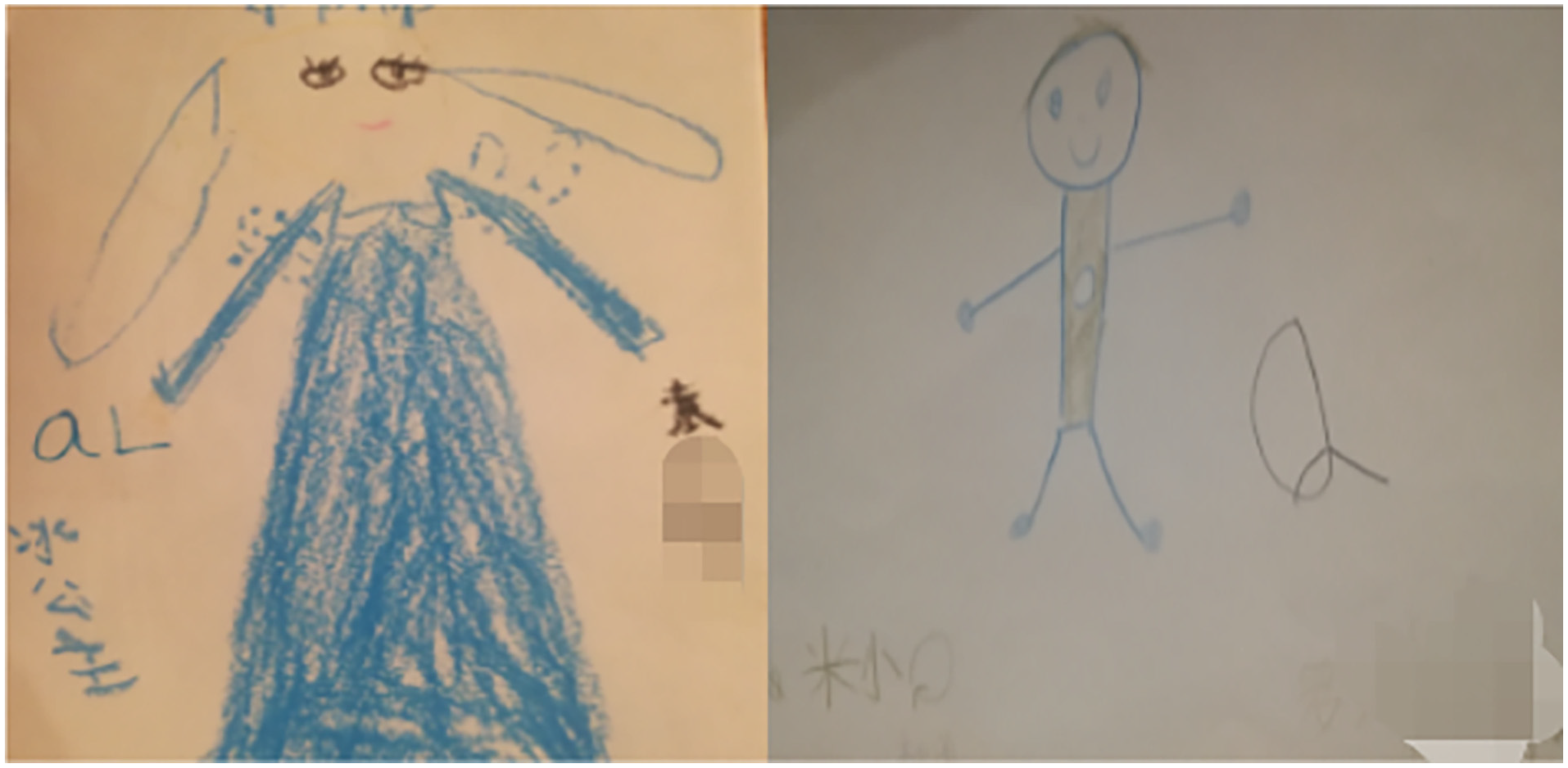
All 82 children finished the drawings of their favorite characters or heroes. Most of the drawings included three categories of information: the child’s name, a sketch of a character, and an annotation (usually the name of the character). Two examples of the drawings are shown in Figure 1 below. In order to protect the children’s privacy, their real names are obscured. The linguistic and visual resources the children used to answer the task-related questions helped us to gain insights into their identity aspirations. The analysis of the collected data was guided by the research question, with a focus on how the children constructed their cultural identities through their choices of favorite characters and their related language use. Informed by Kramsch (1998), Wei (2011, 2018), and Zhu et al. (2019), we conducted the analysis of data in two stages. First, our analysis focused on the emerging bilingual or bicultural features to identify the influences of English on the children’s translanguaging practice. Second, we examined young language learners’ identity aspirations from translanguaging and transcultural perspectives. The analysis focused on the children’s use of translanguaging practices to identified how they actively, creatively use cultural resources associated with the English language to facilitate the emergence of transcultural identities in the drawings. In the process, the children’s aspirations related to Chinese cultural identity and English or Western cultural identity were quantitatively analyzed and presented in percentage form. This process and the results will be further illustrated with examples in later sections.

Samples of the collected drawings (spiderman on the left and Elsa on the right).
Young English Language Learners’ Identity Aspirations
The influence of English can be easily observed in the children’s drawings and related language practices, even though the teaching of English in any form is now forbidden in pre-schools. This influence is apparent in the participants’ use of English names, their preference for English cartoon characters, and their occasional use of English letters or alphabetic doodles when they were asked to annotate their drawings.
Further analysis revealed that the drawings and related language practices reflect emerging bilingual features, which are evident in the children’s use of linguistic and pictorial resources in Chinese and English. The two languages as carriers and expressive symbols of two different cultures interplay with each other in the children’s drawings and related translanguaging practices, in which they draw on multisemiotic resources to transform their favorite characters (Tai & Wei, 2020). On the one hand, Chinese as the mother tongue remains the primary linguistic resource because the children think and communicate using the language in and after class and they have a strong sense of Chinese nationality reflected in the use of Chinese language and Chinese names (see Tables 1 and 2). At the same time, the influence of English, as well as the co-function of both Chinese and English, can be observed in their translanguaging practices, indicating that the children identified with hybridized transcultural icons. For instance, the child who had drawn Spiderman answered in the oral survey, “
Distribution of Language Forms in Character Annotations.

Distribution of Names Signed on the Drawings.

The Influences of English
The influences of English on pre-school children’s language practice were not difficult to detect in the analysis. The most noticeable impact of English is that 100% of the participants in the oral survey responded that they have English names (either borrowed from traditional English name lists or to their Chinese names, see Figure 2) and that they are frequently addressed by their English names at school or home. The participants also indicated that they are regularly exposed to English, with all of them stating they attended English tutoring classes either online or offline at least once a week. In order to elicit clearer data on the participants’ language use and cultural identities, we asked them to try their best to provide simple annotations for the favorite characters they had drawn, without offering any guidance or suggestions concerning language or content. As Table 1 shows, around 65% of the young participants employed Chinese rather than English to annotate the characters, even when the characters themselves are associated with English and they had learnt about the characters through English media (e.g., Elsa in Frozen). This demonstrates that Chinese as the mother tongue is clearly the pre-school children’s first language choice to express their ideas, which is fundamental to the construction of their Chinese cultural identity.
Two cases of creative annotations.
However, it must be noted that in this public pre-school, even without any English input in class, about 29% of the children (either English-speaking only or Chinese and English bilingual) used English words or letters when annotating their work. This indicates that English as a foreign language plays an observable role in the children’s language practice.
Two other phenomena in the children’s annotations deserve our special attention (see Figure 2). First, some children adopted both Chinese and English, although they were not required to do so, to introduce the character they had drawn bilingually. An example is the picture on the left in Figure 2, in which a girl signed her Chinese name and referred to the character as “
Young Language Learners’ Transcultural Identities
The children’s drawings and annotations show bilingual features that demonstrate their hybridized, transcultural identity aspirations. Favorite heroes or idols are indicative of what individuals aspire to be and identify with. For this reason, they play an important role in identity construction (Giles & Maltby, 2004). As part of our data analysis, we categorized the characters drawn by the 82 children according to their countries of origin. As shown in Figure 3, the children’s favorite characters are diverse, but most originated from one of five countries: the United States, China, Denmark, Germany, and Japan.

Origins of the characters in collected drawings.
The largest group of characters, accounting for 43% of the total (N = 34), originated in the United States, and include Iron Man, Spider-man, and Elsa. This proportion rises as high as 66% (N = 54 cases) if cartoon characters which originated from Denmark (Andersen’s Fairy Tales) and Germany (Grimm’s Fairy Tales) but were recreated in popular films produced by American studios are included in the US category. The pre-schoolers described all of these characters as “
It is worth noting that some of the characters, like the Little Mermaid, Cinderella, and Snow White, have been circulating for generations as localized characters in reading materials in China. Other characters, like Spider-man, Thor, and Elsa, were recently introduced into Chinese culture. Despite their more recent introduction, they are highly popular among the children, with 31 out of the total of 82 drawings referring to characters of this kind.
Chinese figures were much less likely to be presented in the children’s drawings. Only 15 children, about 18%, chose to sketch a character from Chinese culture. Even more surprisingly, only 2 out of these 15 cases were traditional figures (both children drew the Monkey King). The remaining 13 were from either Boonie Bears or Super Wings (see Figure 4), two Chinese cartoons produced in the last decade. This suggests that it is important for Chinese artists and educators to produce more high-quality cartoons and picture books with Chinese characteristics to attract young children’s attention. This seems to be a significant and urgent task for both educational and commercial authorities to undertake if we wish to reduce the impact of English on young language learners’ cultural identification in China.

Samples of Chinese characters (Briar on the left and Logger Vick on the right).
Names are also manifest symbols of one’s identity (Aksholakova, 2014). The choice of one’s own name in social practice contributes critically to the construction of self-identity. In this study, each of the 82 young participants reported at least three names: a formal Chinese name (FCN) used for school registration, a nickname (NN) used at home, and an English name (EN). When they were asked to sign their names on their drawings, the most frequent choice by far (see Table 2) was their FCN. This finding suggests that in the public pre-school setting, the children recognize and prefer to foreground themselves via their Chinese cultural identities. In terms of the participants’ language choice in their signatures, the use of English names was limited, but considering the co-existence of Chinese names and English names among these young children, the bilingual feature of their transcultural identification was detectable.
Conclusion and Implications
Through completing a favorite-character-presentation task together with an oral survey, the children demonstrated that Chinese as their mother tongue remains the primary linguistic resource through which they express their identity aspirations. However, the influence of English can be observed in the participants’ drawings and related language practice. The data suggest that English, although promoted as a foreign language in China, plays a noticeable role in the children’s cultural identification. It may also be argued that the learning of English (and exposure to its related culture) provides a space for translanguaging practice, which might have contributed to the emergence of transcultural identities among these pre-school children.
As shown in these 82 drawings, more than 96% of the young children chose their Chinese names, either formal names or milk names (familial nicknames of endearment usually given and used by parents or relatives during childhood), to identify themselves and sign their finished work. This decision can be seen as indicative of their self-identification (Aksholakova, 2014). However, the vast majority of the favorite characters that the participants drew were associated with English culture, with only 18% associated with Chinese culture, such as the Monkey King. Some of the characters, like the Little Mermaid, Cinderella, and Snow White, have been circulating for generations in the Chinese context as localized and integrated aspects of children’s Chinese reading materials, but it remains significant that they were far more popular among our sample than any of the characters associated with local and national cultures.
The favorite figures drawn by the participants also included other characters like Spider-man, Thor, and Elsa, which have been newly introduced into Chinese culture and are highly popular among young children. In annotating their drawings, around 65% of the participants used Chinese instead of English, even when the characters were English and they had learnt about the characters through the medium of English. It should also be noted that about one-third of the children adopted English words or letters in their annotations, which may indicate the important, though not dominant, influence of English as a foreign language in the participants’ language practice. It seems that the participants drew on the linguistic and visual resources they could access to present their favorite characters; this may be interpreted in the context of their efforts to construct their emerging transcultural identity aspirations through translanguaging strategies involving different modes of expressions.
Because the inclusion of English in the curricula of public pre-schools is now forbidden, the children’s bilingual practice seems to be related to the English language tuition and cultural exposure they receive outside the classroom. Our survey suggests that all of the 82 children had the experience of attending after-school English tutoring courses, either online or offline, and most of them listened to English stories, watched English cartoons, or read English picture books at least once a week. This reminds us that cultural identities and language acquisition are broad and complex issues involving not only language planning and curriculum design at the state and school levels, but also language planning and economic investment in the family domain, in which parents play a significant role in managing and regulating their children’ language learning and cultural exposure (Pfenninger, 2022; Xia and Gao, 2022). Therefore, while making efforts to create language policies and regulations to achieve socio-political objectives, relevant policy makers also need to consider how families (particularly parents) provide for their children’s learning of English and attach due importance to improving the supply side of high-quality language education resources for pre-schoolers. At the same time, our findings also indicate that young children’s foreign language learning is not a passive process of receiving, but rather an active and creative translanguaging practice that leads to the emergence of transcultural identities.
Despite its contributions, our study has some limitations. First, the sample used to investigate pre-school children’s identity aspirations is relatively small and taken from a major metropolitan city in China. Thus, the findings may not represent the practices of all the children in the country. Second, due to some concerns voiced by the teachers, video recording and interviews with children were not allowed. For this reason, we could only report on the analysis of the drawings rather than the drawing process. Furthermore, a longitudinal study could be done to track cultural identity development and generate a more in-depth understanding of the influences of English learning or exposure. All these limitations of this study point to key avenues to be explored in future research.
Footnotes
Declaration of Conflicting Interests
The author(s) declared no potential conflicts of interest with respect to the research, authorship, and/or publication of this article.
Funding
The author(s) disclosed receipt of the following financial support for the research, authorship, and/or publication of this article: The work reported here was financially supported by the Project of Humanities and Social Sciences, Ministry of Education, China Grant number 20YJC740012) and the Fundamental Research Funds for the Central Universities (Grant Number 22120210234).
