




Abstract
The current master’s curriculum in English Translation major in Iranian universities has not satisfied the demands of the society in which it was developed. Translation students have complained that some essential skills are not considered in the curriculum. Therefore, this study is aimed at proposing some guidelines for curriculum reformers in Iran to update the curriculum. To investigate effective components for updating the curriculum, it is necessary to focus on the curricula of other universities in foreign countries and compare them with that of Iran. For this aim, a qualitative-comparative analysis is used to compare the revised master’s curriculum of English Translation in Iran with seven prominent Asian universities, to investigate the strength and weaknesses of the curriculum in Iran, and to recognize the effective components included in the curriculum of those seven prominent universities to be recommended to update the curriculum of Iranian universities. Hence, the curricula of eight universities have been compared with five criteria, including the title of the Master’s degree, the number of credits, the course structure, the instructional objectives, and the course content. Results show that to update the curriculum of Iranian universities, a list of courses and instructional objectives needs to be added to train translators who can work with technological tools. To achieve this objective, a course named “co-translator software” should be added to the curriculum. The other objective is to improve students’ interpretation skills, which are accessible by adding a course in interpretation. The findings provide novel information for Iranian curriculum reformers to work on updating the curriculum.
Keywords
Introduction
The English Translation Studies is a thriving and developing field of study in Iran. The curriculum for the M.A. in English Translation in Iran was developed by the Supreme Council of the Institute of Research and Planning in Higher Education in 1999. Following recognition of the demand for a specialist master’s program in English Translation, Allameh Tabatabaee University in Tehran held the first master’s program in the field. Subsequently, other departments of the English language at other universities in Iran were encouraged to offer the same program. Currently, 55 universities in Iran attract hundreds of students at the M.A. level in English Translation. However, the English Translation curriculum in Iranian universities has received little attention in the past decade.
According to Pym (2005), universities are responsible for completing training translators. Universities should pay attention to the learning material, teaching methods, course contents, and instructors’ characteristics (Pym, 2005). Universities should offer appropriate translator training programs, employ knowledgeable instructors, develop a well-stated curriculum, and design-related courses accordingly. They should also provide real translation tasks and projects based on the market’s requirements (Pym, 2003). Universities must evaluate whether the courses are effectively preparing the students for jobs. Furthermore, they must evaluate if the competencies and acquired knowledge are useful to their jobs (Pym, 2003). However, the translator training program in Iranian universities, in general, does not satisfy the student’s needs, only due to the curriculum (Khazaeefar, 2001).
The translator training curriculum had some shortcomings and it is inappropriate to train specialized translators (Birjandi & Nosratinia, 2009). The main issue among new graduates is that the translator training curriculum in Iranian universities is ineffective, much theoretical, and ambiguous. Besides, some courses are irrelevant to the skills and competencies they require in their job (Mirzaibrahim-Tehrani, 2003). “The translator training program has failed its goal in fully equipping trainees with determining skills and competencies demanded to work as translators and intercultural mediators in the labor market” (Khoshsaligheh et al., 2019, p. 182). Therefore, it fails to address the learning needs of all students. Consequently, this will saturate the market with graduates possessing inadequate professional knowledge and practical skills (Razmjou, 2001; Shahri et al., 2016). Khazaeefar and Khoshsaligheh (2010) and Miremadi (2003) declared that the existing English Translation curriculum fails to provide theoretical knowledge and practical skills in translation to the students. The reason is that main emphasis is on teaching linguistics, literature, and first and second language skills. Besides, some graduates complain that they cannot put their theoretical knowledge into practice since the instructional objectives of the current M.A. curriculum are rather about “Translation Studies” than “Translator-Training” (Jafari, 2013; Mollanazar, 2003; Shahri et al., 2016).
Based on what was mentioned above, it appears that the curriculum has not met the demands of the students since they cannot provide the skills required for a professorial translator in various fields (Khazaeefar, 2001; Khazaeefar & Khoshsaligheh, 2010). According to Khazaeefar (2001), it is, therefore, necessary to revise and update the current curriculum to make effective changes based on students’ needs. In this regard, most recently after 20 years in 2019, the Ferdowsi University of Mashhad’s Department of English and Literature independently revised the curriculum. To evaluate the current curriculum, it is necessary to compare the curricula of Iranian universities with those of other prominent universities in foreign countries (Khazaeefar, 2001; Khazaeefar & Khoshsaligheh, 2010). Thus, this study aims to compare the current revised curriculum of M.A. English Translation taught in Iran with some prominent universities in Asian countries, such as South Korea, China, Thailand, the United Arab Emirates, Lebanon, Pakistan, and Turkey. The purpose of such a comparison is to determine the strengths and weaknesses of the current revised curriculum in FUM. Besides, this study aimed to investigate what effective components are in the curricula of seven prominent universities, which are essential to recommend for updating the curriculum of Iranian universities. Specifically, this study addresses the following research questions:
RQ1: What is the curriculum title of the current M.A. English Translation program in Iran and prominent Asian universities?
RQ2: What are the number of credits and length of the M.A. English Translation curriculum in Iran and prominent Asian universities?
RQ3: What is the curriculum structure (required and elective courses) of the current M.A. English Translation curriculum in Iran and prominent Asian universities?
RQ4: What are the instructional objectives of the current M.A. English Translation curriculum in Iran and prominent Asian universities?
RQ5: What are the course contents of the current M.A. English Translation curriculum in Iran and prominent Asian universities?
RQ6: What are the effective recommendations for updating the M.A. English Translation curriculum in Iranian universities?
Literature Review
Criticisms of M.A. Translation Curriculum in Iran
According to Nasrollahi Shahri and Barzakhi Farimani (2017), Iranian translation graduates face difficulties in finding a job and being employed after graduation, whose major problem is the ineffective curriculum. Some graduates believe that little attention is paid to teaching translation skills, technical terminologies, and strategies for translating authentic technical documents at the master level (Nasrollahi Shahri & Barzakhi Farimani, 2017). Jamalimanesh and Ghazizadeh (2010) introduced some curriculum shortcomings with which translation students encounter such as lack of job-specific translation skills and knowledge, lack of proficiency in Persian and English languages, lack of translation skills for different genres, lack of ability to use encyclopedias, and similar resources. They concluded that to enhance the graduates’ opportunities to succeed in the market, some courses should be added to the curriculum. Another shortcoming of the M.A. curriculum is that the option of elective courses determined in the curriculum is not enough and technological devices are not available (Nasrollahi Shahri & Barzakhi Farimani, 2017; Shahri et al., 2016).
Another criticism of the curriculum was made by Heidarian (2003). He stated that the M.A. Translation curriculum in Iran has some shortcomings, including general course design, inconsistency between some course titles and their titles in the syllabus, inconsistency between some particular courses and their textbooks and references, inappropriate textbooks, and out-of-date references. Mirzaibrahim-Tehrani (2003) asserted that the existing vague and ambiguous curriculum has some deficiencies, including a lack of emphasis on teaching translation practices from the Persian language into English, simultaneous teaching of translation and language skills, and inexperienced and unprofessional instructors. Kaveh and Karimnia (2015) also mentioned that some references and course books are unrelated to the course objectives. Additionally, Birjandi and Nosratinia (2009) stated that some course titles are incompatible with their content. Besides, some courses are inappropriate to enhance students’ language proficiency and translation competencies.
Miremadi (2003) also stated that some difficulties students face at the master level are a lack of proficiency in the first language and translation competencies. Mollanazar (2003) concluded that it is required to determine appropriate and relevant courses in the master’s curriculum to meet students’ demands. Khoshsaligheh et al. (2019) also asserted that “students did not seem to have a clear conception of their future work situation and the required skills in the translation market, and it can be deduced that the translation program has failed to properly introduce the market needs and wants to the would-be translators” (p. 200). Motallebzadeh et al. (2019) claimed that the curriculum of the Masters of English Translation program in Iran is not effective for achieving the objectives of training translation teachers because no courses have been designed accordingly.
The above-mentioned issues reveal that relatively few studies have been conducted using qualitative methods. Also, they mainly focus on the interview or quantitative methods concerning questionnaires. However, the main innovation of this research that distinguishes the current work from others is the method used. In this study, a qualitative-comparative method has been employed to overcome the limitations of the previous methods, collect more data on the subject, and thus, assume even greater significance.
Curriculum
Taba (1962) defined the concept of curriculum as a learning plan, which typically includes a declaration of aims and particular objectives; it presents the selection and organization of the course content; it shows specific learning and teaching strategies. Zais (1976) regarded the curriculum as a written plan of studies that determines the learning content, teaching and learning activities, learning outcomes, and assessment methods. Greeno et al. (1996) mentioned that the curriculum is a set of instructional objectives and activities planned to facilitate students’ development toward those objectives. The curriculum is a “set of plans, intentions, activities, or outcomes that are delivered in a variety of ways in a different setting” (Wiles & Bondi, 2010, p. 1). The curriculum is a program of study that describes the intended objectives, the course structure, the course content, teaching methods, learning strategies, assessment methods, and also determines the learning materials and references (Grant, 2014; Scott, 2001).
Method
Methodology
In this survey, the qualitative-comparative analysis is used to compare the current revised curriculum of Iranian M.A. English Translation with seven prominent universities in Asian countries (Table 1). The purpose of this comparison is to determine the strengths and weaknesses of the curriculum in Iran. Besides, it is intended to investigate what effective components are included in the curricula of seven prominent universities, which seem to be necessary to be added to the Iranian curriculum for its update. To do so, the researchers have carefully examined the comparative research literature conducted on curriculum and the analytical criteria are used to evaluate the curricula by researchers such as Hajiheidariet al. (2015), Hwang and Hwang (2013), and Motallebzadeh et al. (2019). Through this analysis, a qualitative-comparative model is developed. The model is given to three curriculum developers in the field of Translation Studies to judge its criteria. Some of the curriculum developers’ comments are used to improve the criteria. Hence, some criteria are modified and some others are removed until the researchers create a final draft. The final draft consists of five criteria for comparing the curriculum of eight universities; including; (a) the title of the Master’s degree; (b) the number of credits (number of units) and the length of the program; (c) required and elective courses; (d) instructional objectives; and (e) the course content (Figure 1; Motallebzadeh et al., 2019). Similarities or differences between the curricula of the seven universities in Asian countries and Iran (in terms of five criteria) are qualitatively described and compared to identify the most appropriate component to propose for the M.A. curriculum in Iranian universities and update it.
Eight Prominent Universities and Their Ranking.


Qualitative-comparative model for analyzing the M.A. translation curriculum.
Sampling
The purpose of selecting these seven prominent universities was that Iran is located on the Asian continent. Thus, the survey focuses on the master’s Translation curriculum of the universities which are located on the continent of Asia, with similar geographic locations, and religious and cultural values. M.A. Translation programs are on offer at 256 universities in Asia (Motallebzadeh et al., 2019). Among 256 Asian universities, seven universities are randomly selected. Three universities are from Islamic countries in southwest Asia (Turkey, Lebanon, and the United Arab Emirates), one is from Southeast Asia (Thailand), one is from South Asia (Pakistan), and two are from East Asia (South Korea and China). These universities only offer the M.A. program in Translation. In particular, six universities have been selected from top Asian universities by the Times Higher Education World University Rankings and Ranking Web of Universities in 2020. As a result, the Times Higher Education World University Rankings 2020 ranked the American University of Sharjah (United Arab Emirates) as 201 to 250th, Ewha Womans University (Korea) ranked 119th, the Chinese University of Hong Kong (China) ranked 57th, Chulalongkorn University (Thailand) ranked 201 to 250th, Boğaziçi University (Turkey) ranked 138th, Ferdowsi University of Mashhad (Iran) ranked 251 to 300th, and the International Islamic University of Islamabad (Pakistan) was ranked 201 to 250th in Asia. In 2020, Notre Dame University—Louaize (Lebanon) was ranked 3512 in Asia by the Ranking Web of Universities (World Universities Ranking; Table 1).
The data was obtained through the information provided by the forms on the Universities’ websites and faculty members’ or administrators’ emails related to the Department of Translation in eight Asian universities. It is worth noting that the post-graduate education system in Iran is an integrated system, and universities do not work in formulating an independent curriculum. Also, all universities must implement the curriculum approved by the supreme council of the Research and Planning Institute of Higher Education. Accordingly, all Iranian universities, State Universities, Nongovernmental-non-profit universities, and Islamic Azad University branches, which offer the Master Program in English Translation, have the same curriculum. However, recently, the curriculum was revised independently in 2019 by the Ferdowsi University of Mashhad’s Department of English and Literature. Some major (known as Mother) universities in Iran could slightly change the English Translation curriculum based on their goals and scope. Hence, in this survey, Ferdowsi University of Mashhad (FUM) is selected as a sample representing the revised academic curriculum in Iran. It is worth mentioning that three curriculum developers helped to analyze the curriculum of eight universities from different aspects and proposed their recommendations to update the curriculum in Iranian universities.
Results
Components of the Revised M.A. English Translation Curriculum in Asian Universities
Master’s program title
In considering the first research question, the title of the master’s program in eight prominent universities is investigated. The findings revealed that the title of the program offered in FUM is English Translation. In addition, the title of the program at Ewha Womans University, Notre Dame University—Louaize, the Chinese University of Hong Kong, Boğaziçi University, American University of Sharjah, and Chulalongkorn University is Translation. However, at the International Islamic University of Islamabad, the program is titled Translation Studies (Motallebzadeh et al., 2019).
Number of credits and program length
In addressing the second research question, the number of credits and program length at eight prominent universities are investigated. It revealed that at FUM and Ewha Womans University, 32 and 48 credits are offered in four semesters, respectively. In addition, at Boğaziçi University, 25 credits are offered during three semesters. The findings also showed that at the International Islamic University of Islamabad, 54 credits are taught in four semesters. Additionally, at the Chinese University of Hong Kong, 48 credits are taught in two to four semesters. Moreover, at Notre Dame University—Louaize, Chulalongkorn University, and American University of Sharjah 36, 36, and 34 credits are taught in four to eight semesters, respectively (Table 2).
Title of the Curriculum, Its Length, and Structure.

Required and elective courses
In considering the third research question about the curriculum structure (required and elective courses) of this M.A. English translation curriculum in Iran and prominent Asian universities, the required and elective courses included in the curriculum of the eight mentioned universities are investigated. The findings showed that FUM’s revised curriculum consists of required specialized courses (10 credits), elective specialized courses (16 credits), prerequisite courses (12 credits), and the thesis (6 credits). All students complete five required courses and eight electives (Table 2).
In addition, the curriculum of Ewha Womans University consists of commonly required courses (4 credits), required courses (34 credits), and electives (8 credits). In this curriculum 19 required and commonly required courses are offered and 4 courses are selected from 12 electives. Besides, at the end of the curriculum, a thesis is offered (two credits).
The findings revealed that the curriculum of Notre Dame University—Louaize consists of major (24 credits) and elective (6 credits) courses (Table 2). Ten major courses and two electives are chosen by the students. At the end of the program, a master’s thesis with six credits is offered. Additionally, the curriculum of the Chinese University of Hong Kong consists of the required (18 credits) and elective (30 credits) courses (Table 2). There are three required courses and in addition to those, five out of seven elective courses can be taken.
The curriculum of Boğaziçi University comprises required (22 credits) and elective (3 credits) courses (Table 2). In this curriculum, there are eight required courses. However, one course can be taken out of three elective courses. In this curriculum, the master’s thesis is also offered in the third semester. Similarly, the curriculum of the American University of Sharjah consists of the required (13 credits) and elective (12 credits) courses (Table 2). Overall, five required courses are offered. Of 13 elective courses, 4 courses can be taken by the students. Additionally, at the end of the program, a master’s thesis with nine credits is also offered (Motallebzadeh et al., 2019).
Furthermore, the curriculum of Chulalongkorn University consists of required (15 credits) and elective (18 credits) courses (Table 2). In this curriculum, there are five main courses. Out of 14 electives, 9 courses can be taken. Notably, in the end, a master’s thesis with three credits is offered in the program. Moreover, the curriculum of the International Islamic University of Islamabad includes required (30 credits) and elective (18 credits) courses (Table 2). This university has tried to improve students’ theoretical knowledge and practical skills in translation and interpretation by offering 10 required courses. Six out of 14 offered elective courses can be chosen. Based on the knowledge acquired in the required courses, students can improve their practical translation and interpretation skills by taking several electives. In addition, at the end of the program, a thesis with six credits is also offered (Table 2). Note that the arrangement of universities in Table 2 is not hierarchical.
As shown in Table 2, the Chinese University of Hong Kong, Ewha Womans University, and the International Islamic University of Islamabad offer the highest number of course credits with 48 and 54 credits, respectively. Similarly, Ewha Womans University, with 19 required courses offers the highest number of required courses. Chulalongkorn University, the International Islamic University of Islamabad, and FUM offer the highest number of elective courses, with 14, 14, and 15 credits, respectively. However, students of Chulalongkorn University and FUM take a higher number of elective courses (eight and nine courses).
Curriculum’s main instructional objectives
In addressing the fourth research question on the instructional objectives of the present M.A. English translation curriculum in Iran and prominent Asian universities, the main instructional objectives of the curriculum in eight prominent universities are investigated.
Ferdowsi University of Mashhad (FUM)
Recently, after 20 years, the FUM’s Department of English and Literature in Iran has revised a curriculum for the Master of Art in English Translation. The objectives of the curriculum are divided into two parts. (a) the training of qualified and professional translators in the humanities and social sciences, etc.; and (b) the training of translation researchers capable of conducting a research project on issues related to translation and intercultural communication. To achieve these objectives, the courses are divided into two groups, theoretical and practical. Practical courses offered in the curriculum are equally important as theoretical courses.
In line with the objective of training translation researchers, three semester-long courses entitled Research Methods in Translation, Academic Writing, and Seminar have been developed, which introduce research methods to students. At the end of the semester, the students conduct a research project. Looking at the courses in the FUM curriculum, one can conclude that a course is designed with the aim of training translation teachers. For instance, the course entitled, Translation Teaching and Assessment, is the only course that introduces translation assessment methods (used by teachers), and the methods or techniques of teaching translation to students.
It is worth mentioning that nine practical courses have been considered to improve students’ practical skills in translation. In these courses, practical translation exercises constitute a significant fraction of the content, and the students, having been introduced to the theoretical issues of translation, use them in their practical translations. For instance, the content of the course entitled Translation of Children’s Literature is theoretical-practical since students get familiarized with various translation models and concepts, and simultaneously, they engage in translation exercises. Hence, the content of these courses is fully aligned to improve students’ practical translation skills. Considering the importance of teaching technology in translation, an elective course, entitled Translation and Computer, is offered in the curriculum. The purpose of this course is to teach the required skills and knowledge for the use of translator assistant programs. As Figure 2 shows, the courses in this program are divided into four categories.
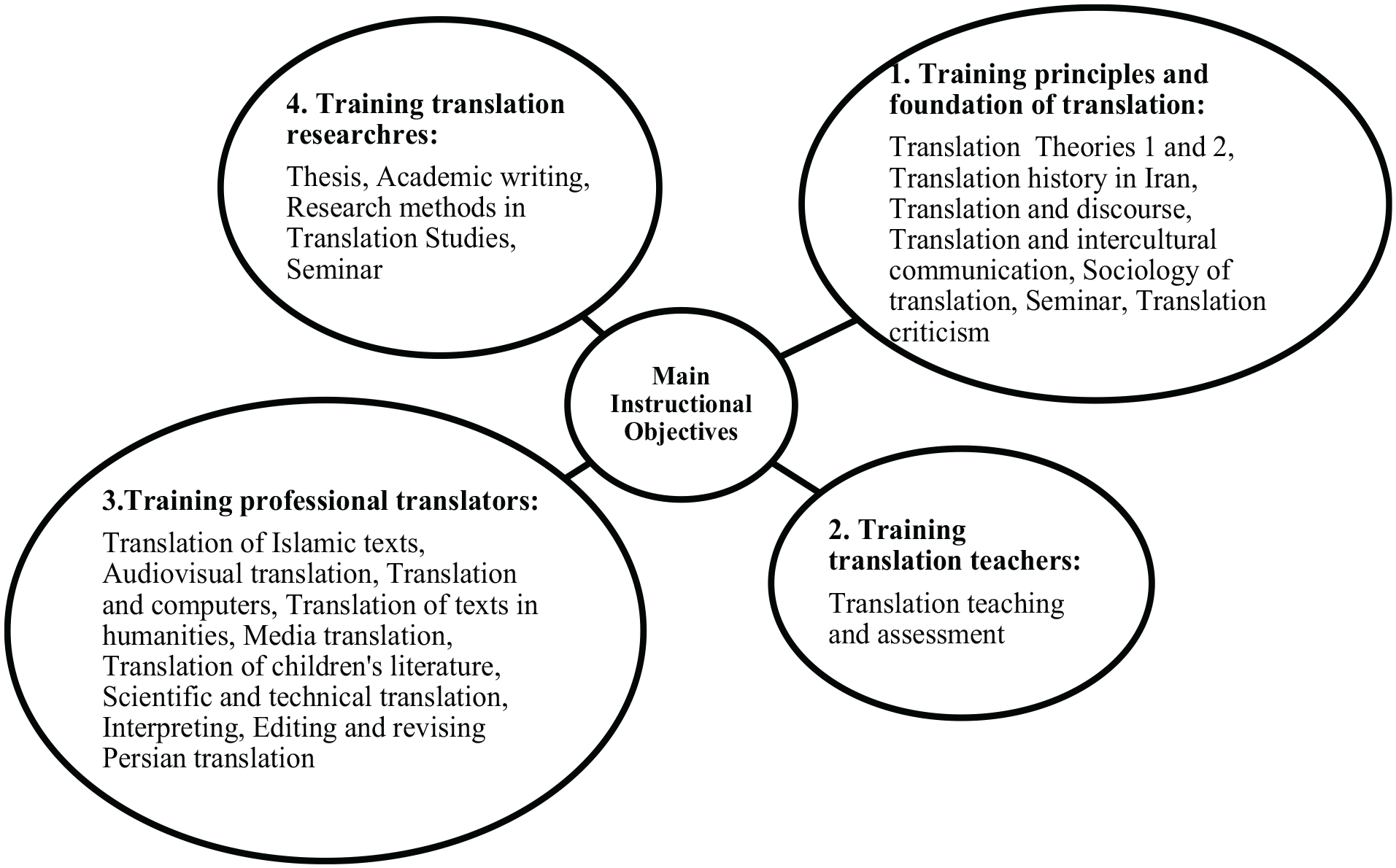
Classification of objectives and the courses based on the curriculum of FUM.
American University of Sharjah
The main objectives of the curriculum and content of courses are to increase students’ theoretical knowledge and practical skills in interpreting and translating texts in specialized and general fields. Specifically, the contents of the theoretical and practical courses in the curriculum are designed to enhance students’ theoretical knowledge in fields such as translation, culture, research, language, and critical thinking. The objectives of the American University of Sharjah are broadly diversified and divided into nine categories. (a) Teaching the characteristics of various literary and technical texts, as well as their translation methods; (b) preparing students to work in non-governmental and governmental organizations; (c) assisting students in identifying their research interests and preparing them to conduct a research project in Translation Studies; and (d) teaching theoretical principles of translation approaches. Furthermore, (e) increasing students’ awareness of intercultural communication and translation to facilitate the transfer of Islamic and Arabic cultures to other countries; (f) improving students’ knowledge of contrastive linguistics and lexicography; and (g) improving students’ problem-solving and critical thinking skills. (h) Teaching interpretation principles and skills, consecutive interpreting, note-taking techniques, and political speech interpretation, and (i) training regarding translator assistant tools (Motallebzadeh et al., 2019). As Figure 3 shows, the courses in the curriculum of this university are divided into eight categories, based on the overriding objectives.

Classification of objectives and the courses in the curriculum of the American University of Sharjah.
Ewha Womans University
This program intends to enhance students’ theoretical knowledge and practical skills in the translation field. The program at Ewha Womans University aims to boost students’ knowledge of fundamentals and theoretical principles of translation; improve students’ skills in the first and second languages; and teach research skills and methods for translating literary and technical texts (Motallebzadeh et al., 2019). This program teaches a set of skills that students need in their working environment as professional translators, such as in the course Visual Media Translation Skills. Besides, one elective course entitled Introduction to Computer-Assisted Translation is dedicated to the new technologies in the translation field. Six courses are designed to teach translation and interpretation skills. Furthermore, this program pays more attention to teaching practical translation skills; since most of the courses (15 courses) are specialized ones that intend to teach practical translation skills (Motallebzadeh et al., 2019). Moreover, more than half of the courses concentrate on teaching the translation of literary, non-literary, and technical texts. As Figure 4 shows, the courses in this program are divided into seven categories, based on curriculum objectives.
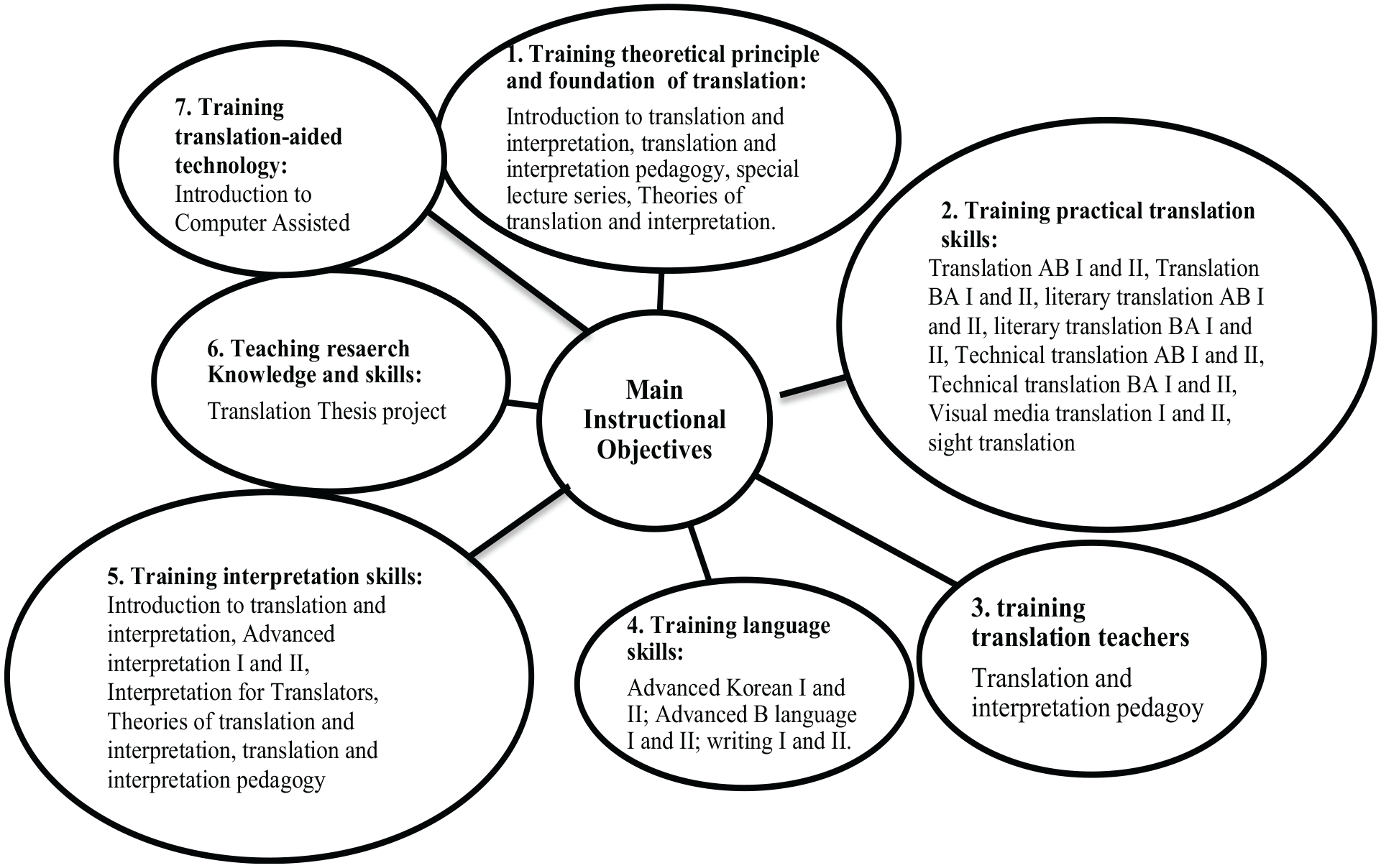
Classification of objectives and the courses in the curriculum of Ewha Womans University.
Boğaziçi University
In addressing the objectives, titles of courses, and curriculum content, this university pays more attention to teaching theoretical translation skills than practical skills. However, the main objective of the curriculum is to teach fundamental and practical translation skills. In line with the curriculum objectives, courses are divided into theoretical and practical groups. Besides, in practical translation courses (three courses), literary texts are more emphasized. Also, it attempts to improve students’ skills in translation, editing, and research fields and train translation teachers (Motallebzadeh et al., 2019). It is worth mentioning that although the training of translation teachers is one of the stated objectives of this university, it offers no courses with this title or content to students of this program. As Figure 5 shows, the courses offered in this program are divided into four categories.

Classification of objectives and the courses in the curriculum of Boğaziçi University.
The International Islamic University of Islamabad
The curriculum aims at effectively linking translation theories to translation practice and training students who can satisfy the evolving needs of the translation industry. The main objectives of the curriculum at the Intentional Islamic University of Islamabad are divided into seven categories; (a) Enhancing students’ knowledge and professional skills in linguistics; (b) training translators who are capable of working with developing technologies in the fields of translation and Translation Studies; (c) teaching the characteristics of various technical texts, along with their translation methods; and (d) improving students’ knowledge of fundamental and theoretical principles of translation and interpretation. Furthermore, (e) improving students’ skills in interpretation; (f) training researchers in the field of translation theories and the practice of translation and interpretation; and (g) satisfying national and international needs of the translation industry. The curriculum aims at training skilled and professional translators capable of interpreting and translating technical texts, using modern translator assistant tools. Thus, along with teaching theoretical principles of translation (3 courses), interpreting (5 courses), and linguistic concepts (2 courses), by offering practical translation courses in various literary and technical subjects (14 courses), the program attempts to enhance students’ practical skills. Simultaneously, students are introduced to the work environment (four courses). The curriculum planners in this university, in considering the skills that translators of this Islamic country need, have added a course titled Translation of the Meanings of the Holy Quran to the curriculum, which is an indicator of their comprehensive approach (Motallebzadeh et al., 2019). As shown in Figure 6, the courses of this program are divided into four categories.

Classification of the objectives and the courses in the curriculum of the International Islamic University of Islamabad.
University of Hong Kong
The curriculum of the Chinese University of Hong Kong is designed such that graduates can enter the job market with the qualifications and skills of a professional translator. Overall, the curriculum focuses on teaching theoretical and practical translation courses. The Chinese University of Hong Kong tries to improve students’ theoretical knowledge and practical skills in translating and interpreting. Hence, in this curriculum, teaching practical skills related to translation (three courses) and interpreting (four courses) in various subject matters is emphasized. The objective of the program regarding culture-related issues in the field of translation is fulfilled in one course. Noteworthy, no thesis is offered in this, which will ultimately leave its graduates less than competent in the field of research (Motallebzadeh et al., 2019). As Figure 7 shows, the courses offered by the program are divided into five categories.
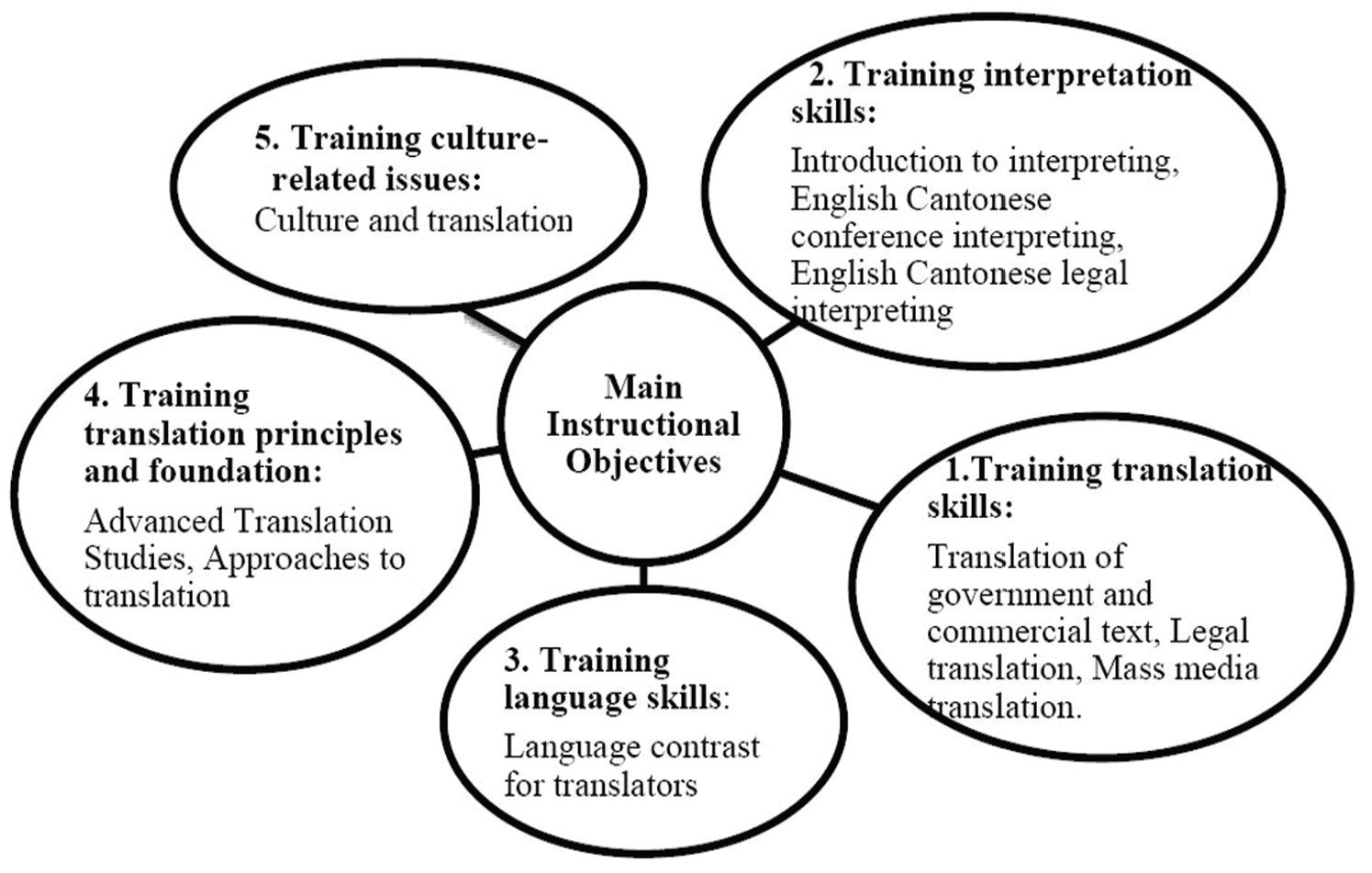
Classification of objectives and the courses in the curriculum of the Chinese University of Hong Kong.
Notre Dame University—Louaize
The curriculum objective of Notre Dame University—Louaize is to enhance students’ theoretical knowledge and skills in language and translation competency. The content of the theoretical and practical courses offered in the curriculum is designed to improve students’ skills in translation and interpretation in three languages, that is, English, Arabic, and French. Notably, the multiplicity of practical translation courses (10 courses) in various technical fields indicates the emphasis put by designers of the curriculum on practical translation skills. This program teaches research skills (two courses) as translation and interpretation fundamentals, such as Bibliography and Methodology of Research. Notre Dame University—Louaize tries to improve students’ professional ethics for translating. Students who have acquired advanced skills for analyzing oral and written texts are capable of using translator assistant tools (Motallebzadeh et al., 2019). As shown in Figure 8, the courses in this program are divided into seven categories based on the objectives of the curriculum.

Classification of objectives and the courses in the curriculum of Notre Dame University—Louaize.
Chulalongkorn University
The curriculum objective of Chulalongkorn University is to improve students’ research skills, editing, and broaden their theoretical knowledge and practical skills in the translation field. The curriculum of Chulalongkorn University aims to effectively improve students’ proficiency in the first and second languages. Congruous with these objectives, practical and theoretical translation courses are designed for the curriculum. Along with teaching the theoretical principle of translation (four courses), the program tries to enhance students’ practical skills by offering practical translation courses in various technical and literary subjects (14 courses). However, courses offered in the curriculum are mainly practical, and teaching practical translation skills in various technical fields, including literary and non-literary, is highly emphasized. Simultaneously, this curriculum aims at training professional translators capable of translating technical texts and using modern translator assistant tools. Noteworthy, the objective regarding culture-related issues in the field of translation is fulfilled in one course. As Figure 9 shows, courses offered by this university are divided into six categories based on the primary objectives of the curriculum.

Classification of objectives and the courses in the curriculum of Chulalongkorn University.
Content of the courses
In addressing the fifth research question about the course content of the current M.A. English translation curriculum in Iran and prominent Asian universities, the course content in the curricula of eight prominent universities is investigated. After the analysis of the curriculum of eight prominent universities, the content of courses in these programs was classified into seven categories; (a) fundamentals and theoretical principles of translation; (b) translation skills; (c) cultural-related issues; (d) research skills; (e) language skills; (f) translation and technology; and (g) interpretation skills.
The fundamentals and theoretical principles of translation
This program aims to improve translation students’ awareness of the fundamentals and theoretical principles of translation. As Figure 10 shows, considering the programs under study, FUM and Boğaziçi University, each with eight and six courses, have the highest number of courses related to teaching concepts and theoretical principles of translation, respectively. Furthermore, the Chinese University of Hong Kong with two courses, has the lowest number of courses related to fundamentals and theoretical principles of translation. Overall, these theoretical topics include; approaches to translation, translation theories, theories of interpretation, translation history, discourse analysis in translation, translation criticism, approaches to interpretation, translation seminars, pedagogical approaches to translation and interpretation, together with analyzing the problems and issues related to translation and translation practice. Therefore, this subject is emphasized in the curriculum of all universities under study.

The content of courses offered at prominent Asian universities based on fundamentals and theoretical principles of translation.
Research skills
Teaching research knowledge and skills is covered in the curricula of eight universities. Out of eight programs under study, the curricula of seven universities are research-based. These curricula aim at improving students’ research skills by offering courses such as Current Trends in Translation Research, Advanced Research Methods in Translation, and Thesis. As shown in Figure 11, Boğaziçi University, Chulalongkorn University, and FUM, each with five and four courses, have the highest number of courses related to teaching research knowledge and skills. Noteworthy, in the curriculum of the Chinese University of Hong Kong no courses exist related to this topic.
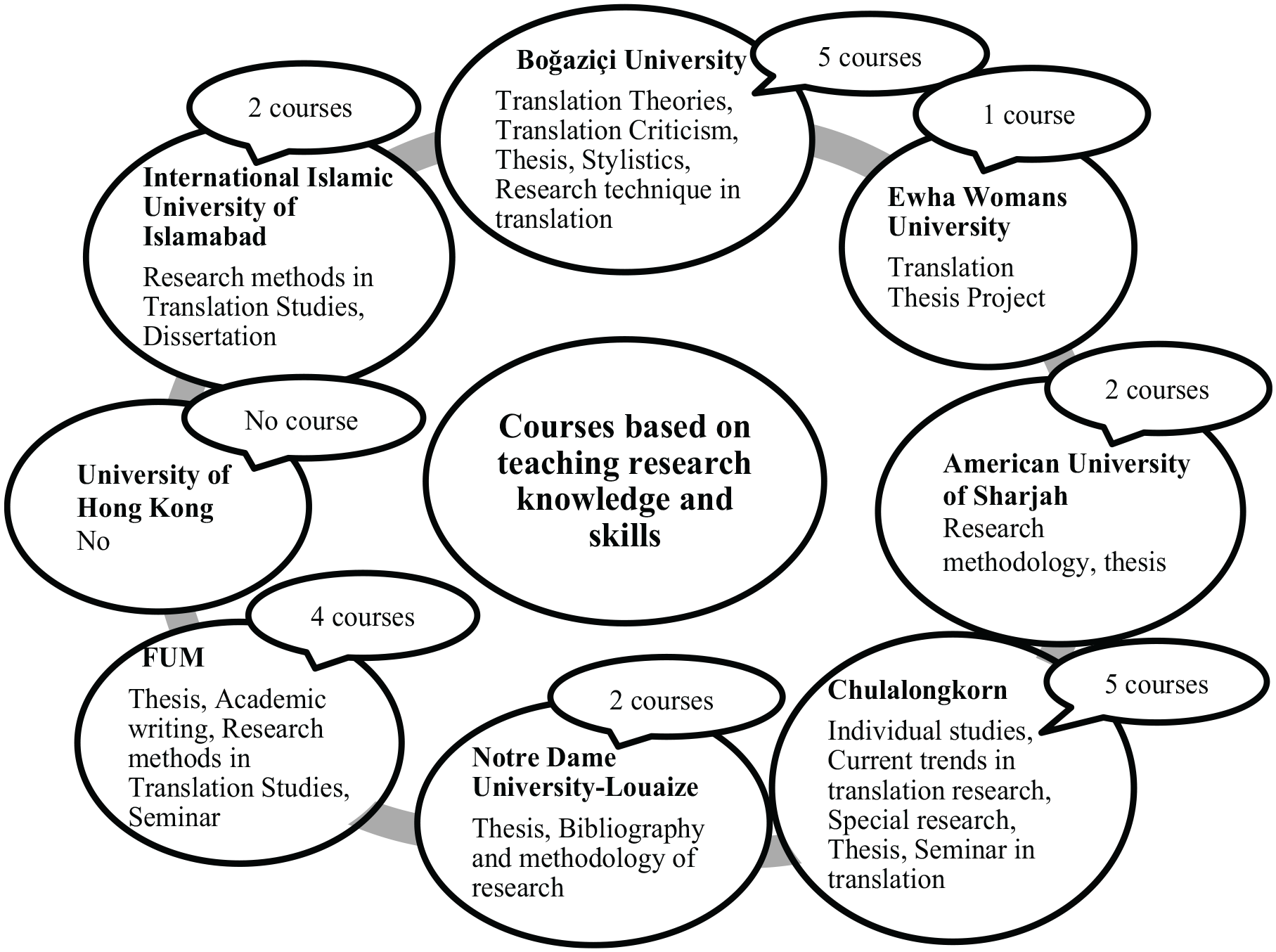
The content of courses offered at prominent Asian universities based on teaching research knowledge and skills.
Translation
Teaching practical skills of translating technical texts is covered in the curriculum of all universities. As shown in Figure 12, Ewha Womans University and the International Islamic University of Islamabad, each with 15 and 14 courses, have the highest number of courses related to teaching translation in their curriculum. In the curriculum of FUM, the American University of Sharjah, and the International Islamic University of Islamabad, one course intends to teach the required skills for translating religious and Islamic texts. This course is not present in the curricula of other universities. The main reason why this course is offered to the curriculum is the need in the translation market for translating such texts and the Islamic culture of these countries. Curriculum designers at FUM, the American University of Sharjah, Ewha Womans University, the Chinese University of Hong Kong, Chulalongkorn, and Notre Dame University—Louize have also emphasized improving audiovisual and media translation skills. The titles and content of practical translation courses show that the most frequent subjects for translating specialized texts include; visual media translation, literary, children’s literature, commercial, scientific, financial, press, audiovisual, media, legal, political, religious, subtitling, and sight translation along with the translation of general texts from the first language into the second language.

The content of the curriculum offered at prominent Asian universities based on training practical translation skills.
Translation and technology
In the curriculum of most universities, one course, on average, teaches modern translation technologies. However, in the curriculum of Boğaziçi University and the Chinese University of Hong Kong, there is no course for teaching translator assistant tools (Motallebzadeh et al., 2019). As Figure 13 shows, in programs offered by six universities, there are courses such as Computer Assisted-Translation, which are related to teaching translator assistant tools. A translator who has skills and knowledge of new translation technologies can satisfy translation market needs. It is worth mentioning that these courses indicate the modern approach adopted by curriculum designers at six universities to train professional translators.

The content of courses offered at prominent Asian universities based on teaching modern technologies in the field of translation.
Cultural-related issues
Introducing the cultural-related issues in Translation Studies is among the topics covered in the objectives and content of courses. As Figure 14 shows, cultural studies courses are offered in the curricula of five universities, including FUM, International Islamic University of Islamabad, Chulalongkorn University, the Chinese University of Hong Kong, and the American University of Sharjah. However, in Boğaziçi University, Ewha Womans University, and Notre Dame University—Louaize’s curriculum, there is no course for teaching cultural trends in Translation Studies.

The content of courses offered at prominent Asian universities based on teaching cultural related issues.
Language skills
Curriculum planners in prominent Asian universities have paid attention to improving students’ knowledge and language skills in their first and second languages. Additionally, the eight curricula attempt to enhance students’ knowledge and professional skills in contrastive linguistics and lexicography. As Figure 15 shows, Ewha Womans University, with six courses, and the Chinese University of Hong Kong and Boğaziçi University, each with one course, have the highest and lowest number of courses related to language skills, respectively. The curriculum designers at Chulalongkorn University, FUM, and Boğaziçi University have also emphasized improving editing skills. Besides, Notre Dame University—Louaize and the Chinese University of Hong Kong emphasize improving students’ language skills in three languages. Also, translation to and from these three languages is instructed. For instance, in the Notre Dame University—Louaize’s curriculum, language competency is taught simultaneously in three languages, that is, English, Arabic, and French.

The content of courses offered at prominent Asian universities based on teaching language skills.
Interpretation
Six Asian universities, including FUM, the American University of Sharjah, the Chinese University of Hong Kong, and Ewha Womans University, offer interpreting courses in their curriculum. As shown in Figure 16, Ewha Womans University and the International Islamic University of Islamabad with six and five courses have the highest number of courses for teaching interpreting skills, respectively. Besides, Notre Dame University—Louaize and FUM, each with one course, have the lowest number of courses for teaching interpreting skills. It is worth mentioning that in the curriculum of Chulalongkorn University, and Boğaziçi University, no course exists related to this topic.
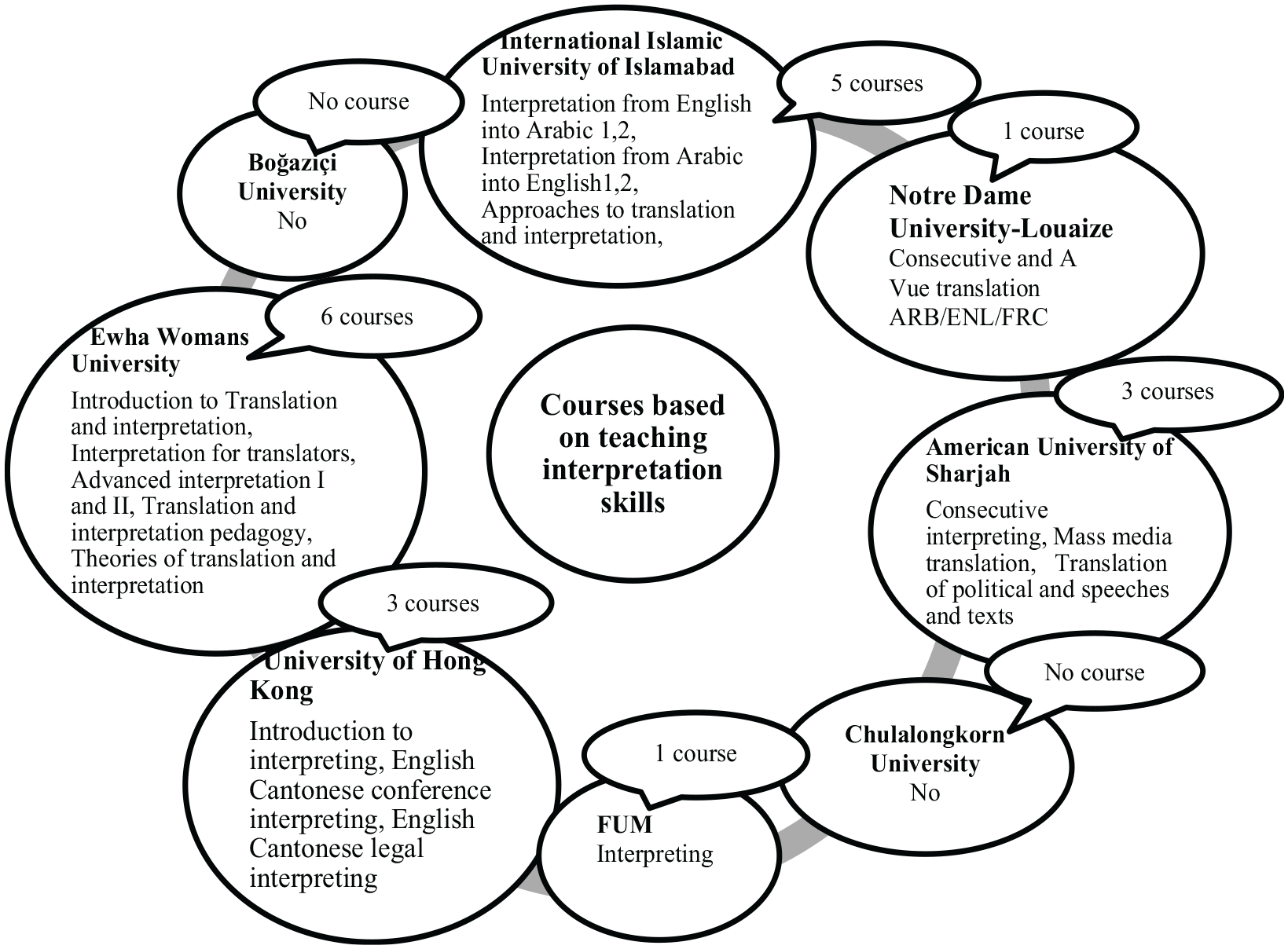
The content of courses offered at prominent Asian universities based on teaching interpretation skills.
Discussion
Based on the analysis, universities under the study are similar in terms of program length and differ in the number of required and elective credits. At these universities, courses are classified into two types: required and elective, but their only difference is the number of required courses compared to electives. The findings show that the Chinese University of Hong Kong, Ewha Womans University, and the International Islamic University of Islamabad offer the highest number of course credits. Ewha Womans University, with 19 required courses, offers the highest number of required courses. The Chulalongkorn University, the International Islamic University of Islamabad, and FUM offer the highest number of electives. However, students of Chulalongkorn University and FUM take a higher number of elective courses. This result indicates the comprehensive attitude of the planners of its curriculum to the level of skill and knowledge that a translation student acquires.
Considering the analysis of objectives and the curriculum content of prominent Asian universities considered here, one can conclude that teaching theoretical knowledge and practical skills are the objectives of this program. However, there is an emphasis on practical courses in the programs offered by these universities. Therefore, more emphasis is placed on teaching practical skills in literary, nonliterary, and technical translation to prepare students for the job market. The range of the specialized fields of translation offered by these seven prominent Asian universities is considerably similar to FUM. In the curriculum of these universities, both practical and theoretical translation courses are offered side by side. In Iranian universities, more emphasis is on theoretical and research-based education and teaching the translation of technical texts. Thus, the revised curriculum of FUM trains professional translators in specialized fields. Consequently, the students who take the revised program can learn the required skills of a professorial translator. The findings substantiate the findings of Khoshsaligheh (2014), Li (2000, 2002, 2007), and Salari and Kazaee Farid (2015), who found that practice-oriented courses have a significant role in the improvement of translation competence. The findings are consistent with the results of a study done by Khoshsaligheh et al. (2019) that found “the courses related to translation practice were ranked as the most important component of the curriculum by the trainees, highlighting that trainees favor practice-oriented translation course the most” (p. 181). Besides, Khoshsaligheh et al. (2019) and Salari and Kazaee Farid (2015) stated that the program should include a combination of theoretical and practical courses.
However, the findings are in contrast with the results of Hesabi (2013), Khazaeefar and Khoshsaligheh (2010), Miremadi (2003), Motallebzadeh et al. (2019), Rahimy (2010), and Ziahosseini (2004). Rahimy (2010) concluded that in the curriculum of Iranian universities, little emphasis is placed on teaching practical translation skills. Similarly, Hesabi (2013) and Motallebzadeh et al. (2019) stated that there is a great emphasis on teaching translation methods of literary texts in the Masters of Translation offered by Iranian universities. Khazaeefar and Khoshsaligheh (2010) also believe that curriculum designers in Iran have a slight inclination toward English literature and comparative linguistics; hence, the courses introduced by them hinge on teaching literary and linguistic principles and concepts. Moreover, they attempt to teach translational skills considering these two fields. Miremadi (2003) and Ziahosseini (2004) concluded that skills for translating specialized texts are not fully taught to translation students in B.A. and M.A. programs in Iran. Therefore, the curriculum developers in Iran should consider including theoretical translation courses alongside practical translation courses in various specialized domains such as subtitling and revoicing (Khoshsaligheh & Ameri, 2017), Persian writing, technical translation, literary translation, translation of legal documents, culture, CAT tools, morphology (Salari & Kazaee Farid, 2015), computer and information technology, information management, and translator cognition (Ahmadisafa & Amraii, 2011).
Analyzing the curriculum objectives and course content in the eight universities under the study showed that research-based education is an indisputable part of these programs. Hence, the findings are consistent with the results of a study done by Motallebzadeh et al. (2019) that found the emphasis is on research-based education in Iranian universities.
Although the considered universities mainly offer the Master’s program in English Translation, in six universities (except for Chulalongkorn University and Boğaziçi University) one or several separate courses are offered for teaching interpreting skills. Among the universities under study, six have offered interpreting courses as electives in their programs. For instance, Ewha Womans University and the International Islamic University of Islamabad have the highest number of courses for teaching interpreting skills. This finding signifies the importance of teaching interpreting skills along with translation skills. Hence, it is concluded that translators should equip themselves with the required knowledge and skills for interpreting, too. Thus, they become capable of handling translation and interpretation in various fields. Motallebzadeh et al. (2019) and Miremadi (2003) also believe that to improve students’ interpreting skills, it is necessary to add a course to the curriculum of Masters of Translation in Iran. In addition, Khoshsaligheh et al. (2019) and Li (2000, 2001) stated that interpreting courses are among the most useful courses for translation students. Hence, the results of this study suggest that one course should be added to the curriculum of M.A. Translation in Iran to improve interpreting skills.
Moreover, Cannon and Newble (2013) mention that the objectives, content, teaching methodology, and assessment methods of a curriculum should be congruous. Accordingly, the main objective of FUM’s curriculum for training scholars specializing in Translation Studies is successfully achieved, as the content of most theoretical courses conforms to increasing students’ knowledge in this regard. It seems that FUM and Boğaziçi University have the highest number of courses related to teaching theoretical foundations and principles of translation. Therefore, by analyzing the curriculum of prominent Asian universities, one can see the contents of courses and curricula are designed to train professional translators and scholars specializing in Translation Studies. Consequently, the prominent Asian universities train skilled translators and scholars specializing in Translation Studies. However, in Motallebzadeh et al. (2019) and Birjandi and Nosratinia’s (2009) view, Iranian universities were not successful in achieving the goal of training professional translators in the M.A. program. Perhaps offering theoretical courses to the curriculum of Iranian universities, which are more inclined toward translatology, makes students deprived of practical translation skills. Hence, Iranian universities can enhance students’ translation skills by offering practical translation courses in various technical and literary subjects alongside teaching theoretical principles of translation.
Furthermore, the results showed that the objectives of the revised curriculum of FUM are not explicitly expressed. The reason is that in the curriculum, objectives are divided into two categories. (a) Training skilled and professional translators in the humanities and social sciences; and (b) training translation researchers capable of conducting translation studies and intercultural communication research projects. Khoshsaligheh et al. (2019, p. 200) also mention that “the curriculum planners are advised to clarify the objectives of the curriculum.” Therefore, it is required to separate the objectives and classify them into five categories. (a) Training skilled and professional translators, (b) training scholars specializing in Translation Studies, (c) training researchers in Translation Studies, (d) training translation researchers in intercultural communication, and (e) training translation teachers. It is also suggested to add some more courses in line with the fourth objective. Moreover, it is suggested that other Iranian universities review and approve the proposed objectives for their curriculum.
Accordingly, to update the curriculum of the Master’s program in all Iranian universities, it is proposed to add some practical courses regarding the translation of specialized texts. To this end, it is suggested that, by concentrating on teaching practical skills in the Master’s curriculum in Iranian universities, short-term internship programs should also be added to the curriculum of these universities. Khoshsaligheh (2014) and Salari and Kazaee Farid (2015) also highlight the importance of including an internship course in the M.A. English Translation curriculum. Moreover, to make thesis credits more practical, it is proposed to direct the translation of scientific works toward such specialized fields, for example, medical, economic, legal, etc.
Consequently, to update the current curriculum for the M.A. English Translation in Iranian universities, a list of courses and instructional objectives is proposed to be added to the curriculum. Suggested instructional objectives are mentioned as follows:
Improving students’ theoretical knowledge of Translation Studies and interpreting
Improving students’ skills and competencies in translation in English and Persian
Improving students’ interpreting skills in English and Persian
Training researchers in the field of translation theories and the practice of translation and interpretation
Enhancing students’ professional skills and knowledge of Persian and English languages
Enhancing students’ professional skills and knowledge in the translation of various technical texts
Improving students’ practical translation skills and competency
Training translators that can work with ever-changing technological tools in the fields of translation
i. Satisfying the translation industry’s national needs by exposing students to work environments
Suggested courses are stated in the following:
Courses in advanced translation practice in various genres; especially in topics such as sight translation, subtitling, visual media, political speeches, legal and economic texts, etc.
Courses in interpretation
Courses in translation-aided technologies, such as computer-assisted technologies (CAT) and SDL Trados Studio
Courses in technical terminology in various subjects
Courses in translation-teaching methods
Courses in translation and intercultural communication
Conclusions and Summary of Recommendations
The post-graduate education system in Iran is an integrated system. Hence, all Iranian universities, including state universities, nongovernmental-non-profit universities, and Islamic Azad University branches, do not work in the formulation of an independent curriculum. All universities in Iran implement the curriculum approved by the supreme council of the Institute of Research and Planning in Higher Education. Accordingly, all Iranian universities that offer a Master’s Program in English Translation have the same curriculum. However, most recently after 20 years, the FUM as a major university in Iran, has independently revised a curriculum for the Masters of Art in English Translation. The results and findings show that the revised curriculum of the M.A. English Translation in FUM, compared with other Asian universities, has some strengths and weaknesses. The strengths of this program can be mentioned as: (a) courses congruent to the objective of training professional translators, specifically in fields such as humanities, social sciences, etc. are offered. Therefore, considering the large number of practical courses offered in the curriculum of M.A. English Translation in FUM, it can be ascertained that this program has been successful in training professional translators in specialized fields. (b) In addition to training translators, some courses were added to teach the required knowledge and skills for interpreting, language skills, and editing, as well. (c) The curriculum of the Masters of English Translation program in FUM is effective for achieving the objective of training translation teachers; because one course has been designed to be congruent with the objective of training translation teachers. (d) At the same time, in line with the objective of training scholars specializing in Translation Studies, more attention has been paid to theoretical translation courses. (e) Objectives of the Master’s program in Iran are not explicitly mentioned; therefore, it is suggested to review the classification of objectives and organize them separately, which can be considered a weak point. (f) Although one of the objectives of the program is to train translation researchers in intercultural communication, it seems that no specific courses have been designed corresponding to this objective.
Consequently, the results show that to update the curriculum of the Master’s program in all Iranian universities, a list of courses needs to be added to the curriculum, including Interpretation, Translation-aided Technologies, Translation and Intercultural Communication, and Translation-Teaching Methods. In addition, some instructional objectives require to be included in the current curriculum to update it such as “training translators that can work with ever-changing technological tools in the fields of translation.” As a result, the findings provide novel information for curriculum reformers to work on updating and improving the M.A. in English Translation curriculum. Additionally, the findings are useful for stakeholders such as translation instructors and students to become familiar with the courses and instructional objectives included in the revised M.A. English Translation curriculum in Asian universities.
Footnotes
Declaration of Conflicting Interests
The author(s) declared no potential conflicts of interest with respect to the research, authorship, and/or publication of this article.
Funding
The author(s) received no financial support for the research, authorship, and/or publication of this article.
