




Abstract
The heavy dependence on online education during the COVID-19 pandemic has long-term consequences for teaching and learning. The problem statement of the present study is to identify, from a student-centered perspective, solutions for a teaching approach in the virtual environment to increase student involvement and stimulate active relevant learning. The research objectives are to describe the team dynamics in Project-Based Virtual Learning (PBVL) and to identify the advantages and disadvantages of learning in PBVL, from the students’ perspective. At three separate intervals, 102 undergraduate students enrolled in three different courses wrote down reflections of their experience with PBVL in an online self-administrated reflective journal. Following a data-driven systematic qualitative content analysis of the students’ learning journals, four main themes emerged regarding the learning experience in virtual teams: collaboration, communication, trust, and learning. Based on the results, a three-stage framework for PBVL team dynamics was proposed: Teambuilding–Teamwork–Team performance (TTT) framework. The results show that PBVL favors the development of professional, learning, and personal skills through collaboration.
The year 2020 will not be forgotten easily: it is intrinsically linked to the COVID-19 pandemic. Owing to mobility restrictions and lockdowns, educational systems, like several other subsystems in society, were forced to move from one mode of functioning to a completely new form, in which many variables were totally unknown, within a very short time. On April 1, 2020, schools and higher education institutions (HEIs) were closed in 185 countries, which affected 1,542,412,000 or 89.4% of the total number of enrolled learners world over (Marinoni et al., 2020).
In Romania, March 2020 marked the beginning of online education, which continued for HEIs well into the next academic year. Until then, most universities had online communication platforms (e.g., Moodle) that were used temporarily by some teachers, or only for certain study programs, particularly for those designed as distance programs. The COVID-19 pandemic forced the transposition of the entire range of university activities into the online format, a process that was difficult, challenging, and full of uncertainties. Many HEIs faced problems pertaining to digital infrastructure, training of teachers and students, transposition of online courses, and conducting assessments, among other concerns. The atmosphere of fear and insecurity complicated the already complex process of transition into the online space.
In October 2020, a new academic year began in Romania, and for the first time exclusively online. Previously, the first-year students already had the experience of taking a semester of high school online, whereas second- and third-year students had experienced online teaching activities in one semester in the prior academic year. Some students did not know their colleagues at all: they had not seen the university premises, given that their admission and enrollment had taken place entirely online. Universities strive to ensure quality education for all students, which is measured from the perspective of connecting and approaching complex issues in the real world and the labor market.
Ensuring the link between theory and practice, providing opportunities for interaction, teamwork, communication, problem-solving, and the use and integration of digital technologies, lie at the core of the actions taken by many universities, especially at present with the COVID-19 pandemic and the major changes resultantly imposed. These are transversal competencies and skills required by the labor market (World Economic Forum, 2020).
In the context of higher education learning, where a low degree of active student involvement has been remarked (Børte et al., 2020), our problem statement was to identify, from a student-centered perspective, solutions for a teaching approach in the virtual environment, to increase student involvement and stimulate active relevant learning. Consulting the literature, we selected Project-Based Virtual Learning (PBVL) as a suitable teaching approach (T.-H. Lee et al., 2010) and applied it in three courses.
The objectives of this study are the following:
O1. To describe the characteristics of team dynamics in PBVL.
O2. To identify the advantages and disadvantages of learning in PBVL.
The efficiency of the PBVL approach was followed from the students’ perspective, through their reflections on the dynamics of the learning groups, in the three phases of the projects developed within each course. Based on the students’ reflections, we described an approach to group dynamics in the context of virtual learning and analyzed the advantages and disadvantages of this approach. Following these, we formulated methodological recommendations for the successful use of the PBVL approach in a university context.
The current research examined three groups of students who studied in PBVL teams. Previous studies have examined virtual teams, in business organizations (Martins et al., 2004; Townsend et al., 1998), or in universities, especially with respect to the internationalization of higher education or distance education (S. D. Johnson et al., 2002; Kim, 2008; Yoon & Johnson, 2008). Existing research has approached PBVL with different levels of virtually, from traditional face-to-face Project-Based Learning (PBL) to different degrees of blended learning. This study examines PBVL in the educational context alone, studying the team dynamics in an entirely virtual context.
The present study focused on virtual team dynamics from the students’ perspective. Data on the benefits of and barriers to collaboration among virtual teams in a PBVL context were gathered from the students’ learning journals. This research describes the dynamics of PBVL teams and generates recommendations for teaching approaches that integrate virtual learning teams into higher education programs. Until now virtual teams in higher education were considered only in particular situations. It is highly likely that this way of organizing training will be generalized at the university level, and this is why we consider our study important. The study was guided by the following research questions: What are the characteristics of team dynamics in PBVL, as seen from the students’ perspective? What are the advantages and disadvantages of PBVL from the higher education students’ perspective?
Literature Review
Project-Based Learning in Virtual Teams
PBL is a teaching and learning strategy that stimulates and develops a set of skills. The keywords are “project” and “learning.” Thus, we can define PBL as a journey of learning with concrete results (i.e., the project), or as a mechanism wherein learning is organized around projects (Loyens & Rikers, 2017; Thomas, 2000). PBL facilitates collaboration between students and culminates in the creation of an end product that addresses a problem or question (Blumenfeld et al., 1991). It involves students in the learning and assessment process, wherein they collaborate and work in teams to solve real problems and plan, develop, and implement projects that have practical applicability (Fruchter, 2001; Márquez & Jiménez-Rodrigo, 2014).
Demirhan and Demirel (2003) noted that PBL develops and enriches the learning skills of students, provides them with lifelong learning opportunities, supports them to adopt the habit of scientific study, enables them to participate in learning activities based on teamwork and collaboration, allows them to use different dimensions of their intelligence, and helps them develop problem-solving and problem-based learning skills. They also indicated that PBVL offers significant information to parents, teachers, and the school administration with respect to the students’ performance.
Projects are complex and based on challenging questions or problems that involve students in design, problem-solving, decision-making, and investigative activities; they give students the opportunity to work relatively autonomously over extended periods of time and culminate in realistic products or presentations (Thomas, 2000). One of the characteristics of this approach is that a student has control over the process. At the same time, to enhance PBL efficiency, the degree and quality of coordination offered by teachers reduce task complexity, provide structure, and reduce learner frustration (McLoughlin & Luca, 2002, Van Rooij, 2009).
In the field of education, PBL has been implemented to teach different subjects such as social science (e.g., Chang & Lee, 2010; D. R. Johnson et al., 2013), technology (e.g., Dominguez & Jaime, 2010; Mioduser & Betzer, 2007), and science (e.g., Rogers et al., 2011; Schneider et al., 2002). Whereas in PBL the use of new technologies is recommended, in PBVL communication among team members is mediated exclusively by technology. Thus, there is no face-to-face interaction. The degree of complexity of the PBVL approach increases in the contexts of not only virtual teams and exclusive online interactions between team members, but also between teachers and students.
Virtual Team Dynamics
A virtual team is formed beyond the spatial-temporal barriers of members being located in various geographical areas; it uses mediated computer communication and information technologies to carry out activities and collaborations and achieve objectives (Kohut, 2012; Makani et al, 2016; Nader et al., 2009; Powell et al., 2004; Whatley, 2006). Virtual teams can transcend time and space, connect people across disciplines, functions, geographies, and organizations, combine people’s individual skills to temporarily work together, and accomplish projects or goals (Peters & Manz, 2007). The main characteristics of a virtual team are geographical dispersion, common objectives, use of technologies for communication, collaboration, ephemeral existence, small size, diverse professional affiliation, and an interdisciplinary approach (Kohut, 2012; Nader et al., 2009).
The team dynamics reflect the way the team develops, changes, and evolves (Wiese & Burke, 2019). In this study, the team dynamic is operationalized through the descriptors of the three phases of team development characteristics, measured at three separate moments in time. The results analysis revealed the Teambuilding—Teamwork—Team performance framework (TTT).
Working in virtual teams has numerous advantages. A meta-analysis of 857 studies showed that virtual teams can bring together, from a socio-professional point of view, different individuals who are geographically dispersed. Virtual teams can ensure high levels of cohesion, involvement, responsibility, and reduction of inequalities among them (Makani et al, 2016). The literature also shows that virtual teams must overcome certain difficulties, such as the lack of physical interaction, trust, social interactions, synergies involved in face-to-face collaborations, and predictability (Nader et al., 2009). To all of these are added, categorically, difficulties related to computer-mediated communication and technology dependence, which must ensure social interaction, setting, and compliance (Hylton Meier et al., 2017).
Qureshi and Zigurs (2001) suggested that the greater the degree of virtualization, the more people need to manage their relationships, share knowledge and expertise, and coordinate joint activities in completely new ways. Individuals working in virtual team settings need to enrich their computer-facilitated communication processes through multiple communication channels, media, and feedback mechanisms.
The group dynamics and stages in team development were analyzed both for face-to-face interactions and for virtual groups (Leppisaari et al., 2009; Schaffer et al., 2008). The Cross-Disciplinary Team Learning Framework (CDTL) was developed by Schaffer et al. (2008). This model presents the evolution of team processes and learning during a project life cycle, and comprises three dimensions, namely: identification (self-assessment; information seeking; personal goal-setting; strategic planning; and self-monitoring), formation (team goal-setting; leadership; role identification; trust; interdependence; social support; peer, client, and expert feedback; communication and collaboration, information, and cognitive and knowledge creation tools; awareness, and appreciation), and adaptation (goal alignment; shared mental model; understanding; creativity; and innovation).
In another theoretical model, Leppisaari et al. (2009) synthesized the key features and critical factors at each stage in virtual teams, based on previous research in a professional teacher development context (Powell et al., 2004; Qureshi & Zigurs, 2001; Sobredo, 2008; Tenhunen & Leppisaari, 2009): foundation and induction (member recruitment, project design, and training), incubation and socialization (strategy/goal-setting, developing shared language, teambuilding, cohesion, commitment, and trust), performance improvement (communication, knowledge sharing, learning, collaborative knowledge construction, coordination, and commitment of the team), and closure (performance, skills acquisition, and satisfaction).
We compared the results we obtained with those drawn from these models as found in the literature to identify the similarities and differences, and to validate our framework on PBVL group dynamics.
Research Design
The goal of the research is to describe the team dynamics in a new learning context: a virtual, collaborative, project-based approach, from the students’ perspective. Following the problem statement, the present study identifies, from the perspective of the students, solutions for a teaching approach in the virtual environment to increase student involvement and to stimulate active and relevant learning.
Research Questions
RQ1: What are the characteristics of the team dynamics in PBVL from the students’ perspective?
RQ2: What are the advantages and disadvantages of PBVL from the students’ perspective?
Study Design
This study uses a constructivist approach, centered on describing the students’ reflective observations on the evolution and dynamics of a team in PBVL. Consequently, the subjects, namely the students, became meaning makers and direct contributors to the categories of significance analyzed. This study conducted a data-driven systematic qualitative content analysis of the students’ learning journals.
Participants
Data were collected from 102 undergraduate students who were enrolled in three different courses at the West University of Timisoara, Romania. Two of the courses were complementary disciplines forming transversal competencies for the second and the third year of study students with different majors, which included Fine Arts, Geography, Political Sciences, Economics, Philology, Biochemistry, Mathematics, Informatics, Sociology, and Psychology. Forty-two students included in our study belong to these above-mentioned study programs. Another group of sixty students were enrolled in the first semester of their first year of study in the same major, in the social sciences domain of study, and attended a complementary course forming professional competencies in the social policy domain.
The three courses considered were in the areas of social problems and public policies. Each course syllabus was structured in the PBVL frame, included 28 teaching hours and 22 individual study hours, and was taught by one of the social sciences teachers, who co-authored the present paper. All three courses were held during the COVID-pandemic, entirely online and at distance, in the first semester of the academic year 2020 to 2021.
During the summer of 2020, prior to the implementation of the courses, the teachers from the courses and one researcher in pedagogy collaborated to design and plan together the following teaching components: the teaching activities structure, a set of digital tools, and platforms of advanced technology for communication and collaboration at distance, the learning phases and the timing structure for PBVL, the guidelines for the learning journal, and clear teaching approaches for encouraging the reflective learning for students suitable for the PBVL activities, to be applied in the same manner for all three courses. During the teaching period, teachers communicated their course activities progress and worked together to collect the learning journals. The teachers have 20 years of teaching experience in HE, including the PBL method. In the previous semester, they also used the PBVL method.
The number of participants was determined by the number of students who successfully accomplished all the tasks during the courses and agreed to write their reflections three times, after each team development stage. They completed a learning journal on the PBVL teamwork processes, based on participatory observation. Each student filled in the learning journal at three predetermined times. A total of 306 text documents were obtained for analysis.
Participants’ profile
The students were selected from courses that varied in terms of the number of participants, disciplinary composition, and professional competencies acquired upon completion. The students had one-semester experience in full online and at distance learning. All students had at least an intermediate level of digital competencies, acquired during elementary and secondary school when digital competencies are included in the curriculum.
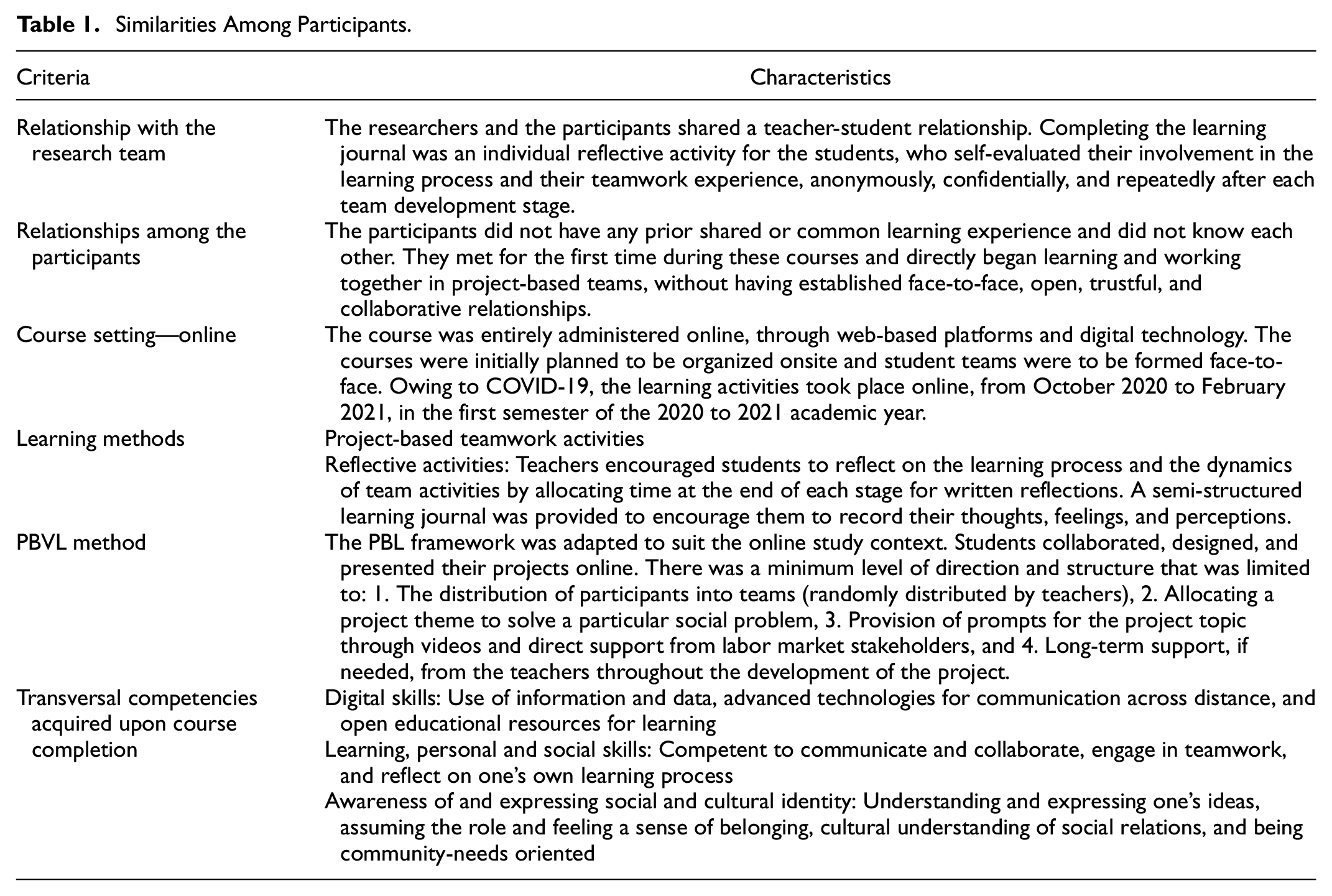
The participants shared similar characteristics and comparable descriptors (Table 1).
Similarities Among Participants.
Setting
Data were collected online, using a self-administrated reflective journal that asked the students to share about their learning experiences in virtual classrooms. The journals were Google forms with open-ended questions. These forms were distributed by the teachers to the students at the end of each of the three project development stages. Students completed the forms individually and anonymously and had limited time to register their observations. They were given up to 1 hour of reflection time for each entry and had no opportunity to read or edit their written responses later. The students’ responses were automatically recorded on a Google Spreadsheet, and the information was organized to identify topics for discussion. The students’ responses to the following questions were used as data: “What have I learned, and how did I learn it?”; “How did I perceive team collaboration?”; and “Personal thoughts, emotions, reflections.”
Data Collection
Throughout the study, the students were instructed and encouraged to reflect on the learning process, the dynamics of the groups they were part of, and their acquisitions at each stage of team development. At three separate points in time, the students were asked to write their reflections in the reflective journal, which produced 306 text documents that were distributed in three datasets corresponding with the following time series: t1=t2=t3=102 documents.
Data Analysis
The MAXQDA software was used to organize; classify; categorize by word frequencies, codes, and categories of significance; and analyze the data collected. A data-driven coding approach was used. All passages in the text pertaining to teamwork processes were identified and analyzed, wherein they were related to each team development stage. The codes that were identified enabled the research team to organize and structure the data. The relations between the codes were then examined.
Based on repeatedly reading, reviewing, and interpreting the students’ reflections, through a hermeneutic circle (Gadamer, 1975), a coding scheme based on the major categories emerged. The initial coding scheme included various preliminary codes, observations, comments, and meanings. By summarizing and interpreting the results, the final code scheme included salient categories of significance that captured the repetitive patterns (Saldana, 2008) among the students’ perspectives on the project-based team activities, learning outcomes, and relationships among these categories.
Results
Four main themes emerged in the students’ reflection on their learning experience in virtual teams: collaboration, communication, trust, and learning. Figure 1 presents these themes.

Coding scheme of students’ reflections on team dynamics.
Communication occurred exclusively electronic, virtual, and remote, with the use of technology, being fundamental for learning, developing cooperation, trust, and successful collaboration in virtual teams (Hikamah et al., 2021, p. 324; Shrivastava & Prasad, 2020, p. 76; Valente & MacMahon, 2020).
The cumulated responses from the 102 students to three open-ended questions were considered for the analysis. The text fragments with the same significance were grouped and received the same code. Two or more codes were grouped in sub-themes according to the category of significance they present. Further, the four main themes resulted.
We present the results in a longitudinal manner, according to the TTT framework (Figure 2), from teambuilding (t1) to teamwork (t2) and team performance (t3).

TTT framework.
Teambuilding (t1)
From our content analysis, we identified the following themes:
Collaboration
In the teambuilding stage (t1), the students reflected on the teamwork skills they acquired and the advantages of learning using the PBVL method.
When they began learning, the students relied on teamwork and collaboration. Working in a team was a novelty for them. They felt a sense of satisfaction around adjusting to the new learning method, especially because collaboration was seen as a means to overcome isolation during the COVID-19 pandemic.
They described their positive feelings toward collaborating in teams from the beginning. The students’ reflections focused on the progress they made in teamwork. They talked about teambuilding and knowledge exchange among members, and how they strengthened their communication networks and organized teamwork meetings outside of class hours.
The students considered team efficacy important. They reflected on the progress and efficiency of their teams and found that once they were able to organize their work, establish a schedule of activities, share tasks, and identify a (remote) communication path that suited everyone, the team made progress.
The students considered member involvement important for efficiency and they reported in their journals. In the first stage, they described their own involvement. In the subsequent stages, they began referring to the extent to which all team members were actively involved.
Students mentioned new information and skills that contributed to their professional development. This topic came up in the first and last stages.
The first stage was also characterized by the analysis of personal skills that can contribute to team efforts, such as social skills or self-confidence. It is obvious that experiential learning activities contributed to the development of the students’ social skills. There was a preference for socially desirable behaviors, such as listening and considering multiple perspectives, team integration, adaptation to expectations, empathy, and mutual help.
The students also mentioned certain barriers to collaboration in teams: inequalities among teammates in terms of commitment, and workload as an obstacle to team cohesion; the lack of experience in teamwork; fear of working in a team; the diversity of opinions, and difficulty in making decisions.
Resuming the results of the collaboration theme, as student 71, t1 said “Personally, teamwork helped me a lot, it brought me closer to my colleagues, given the pandemic situation. I learned that everything has to be addressed in a team, even if the ideas help or not. Others can express their agreement or disagreement, and if they think you don’t understand the idea, they can help you understand.” Thus, universities may introduce PBVL in the teaching strategies to develop personal development skills related to the effective collaboration in teams and increase the involvement of students in the learning process.
Communication
The students indicated that they had learned the art of interpersonal communication and active listening. They defined interpersonal communication as a means to get to know each other better, foster inclusion, and accept diversity. Most students reported positive experiences from the beginning and appreciated the opportunity to communicate with new team members. They were open to new experiences, meeting new people, and learning to accept diversity.
Active listening was mentioned as a component of communication and strengthening relationships among team members. Most students learned this through participation in teamwork. For instance, “Team collaboration is useful as we learn to listen to others, respect their opinions, and gain new information” (student 93, t1). Thus, the PBVL teaching approach could be used to increase the interpersonal communication and active listening of the students.
Both communication skills and barriers were mentioned more often by students in the first stage. Different web-based technology of communication at distance, learning management platforms, and digital tools were tested by the students working in teams without any face-to-face direct interactions in the classrooms (Armstrong et al., 2021; Mate & Weidenhofer, 2021; Mok et al., 2021; Singh et al., 2021; Swart & Meda, 2021).
Even if the universities provided certain online a-synchronic and synchronic techniques, platforms and digital resources, the students mentioned that they tested different online platforms, applications, and digital tools that they were more familiar with. These findings show that when approaching communication as one of the 21st century skills, teachers using the PBVL strategy will need to take into account the importance, intensity, and spreading of digital skills and online communication both in everyday life and in education. Teachers should use digital skills to promote the engagement of the students in real-time interactions and facilitate effective communication between students.
Trust
Trust emerged as a major theme in the students’ reflections. It refers to a sense of belonging, capitalization on group resources, and commitment.
The sense of belonging appeared in the students’ reflections in terms of group identity and mutual understanding. Personal changes were observed by self-identified shy and introverted students, who went beyond their personal limits by approaching others and assuming a group identity. The students also mentioned the importance of mutual understanding, especially in difficult conditions pertaining to the pandemic.
The students mentioned that each of them could contribute to the learning project with their experience, knowledge, and resources in order for the team to succeed. Each of them understood that they had a role in the team and that they had to valorize their strengths. For instance: “I am aware that collaborating with other people is important and if we know how to capitalize on each of our strengths, the results will be better and the work more enjoyable” (student 27, t1).
Trust was mentioned more often in the first stage than in the other stages. This highlights the importance of trust-building from the inception.
Learning
Learning emerged as a theme in every reflection, often in relation to collaboration, trust-building, and communication; learning with others; innovation; and creativity. In stage 1, the students did not mention their learning skills. They focused more on prior knowledge and establishing a project theme.
Students enhanced their personal skills in areas of communication, openness, involvement, assumption of greater responsibility, time management, self-confidence, control over emotions, confidence, and free expression. From the outset, students began to control their negative emotions and enjoy recognition from other members. They learned to better communicate with strangers, speak freely, listen to and understand each other, and respect others’ views.
Students acquired teamwork skills that included acknowledging the importance of collaboration and having diverse points of view. As student 21, t1 shared, students found it pleasurable to work with open and committed people. The students developed curiosity and engaged with their teammates. They solved problems in communication and helped each other overcome their emotions. Coming from an educational system in which evaluation was predominantly individualized and a strong stress factor, students found that the group offered support and that their responsibility and burden were shared among all members.
Resuming, student 26, t1 stated “We learned to work in a team with people we didn’t know before we formed a team. We found that we knew more than we thought about many notions, such as culture or city, and we used logic and critical thinking to analyze.”
Teamwork (t2)
The students’ reflection in the second stage focused on professional development through PBVL, team collaboration, and communication.
Collaboration
In the second stage, the students focused on the project they had to develop together. When they described what and how they had learned, the phrases “we learned together, we learned from our colleagues … we learned through consultation with our teammates” appeared in almost every reflective journal. In the second phase, the students focused more on satisfaction as a result of collaboration and on the conditions for sound collaboration.
When teachers choose to integrate PBVL activities into the learning process, they can stimulate the increase in frequency and intensity of students’ involvement in learning activities and collaborative learning. Therefore, PBVL’s main advantage is that it addresses the need for lifelong upskilling with transversal competencies for students, such as reflective learning and effective communication and collaboration across distance.
The reflections on team efficacy decreased in the second stage. Most students referred to the social skills they deemed necessary for efficient teamwork. The mentions of interpersonal skills increased in the second stage, specifically with regards to making friends, learning with the help of others, respect for each other, and diversity. “I believe that it is important to work in a team, listen to others, and ask for and offer help. Beautiful friendships can be made in a team” (student 79, 2). In this stage, students began to refer to the pleasure and joy of working and learning together in a team. They already knew each other by this time and were thus more open and relaxed. Among all the stages, the middle stage was the most relaxed and fun. Anxiety around the unknown in the first stage and the pressure of demonstrating results in the final stage may have clouded the pleasure of learning.
In the second stage, the number of collaboration in teams’ barriers identified decreased compared to the first stage. The students had become familiar with each other by this stage and had experience working together. This reduced the number of obstacles they encountered. However, personal and teamwork-related obstacles were mentioned. Some students felt a lack of experience in teamwork skills, whereas others expressed the desire to work alone, as they found this approach more conducive. A few students sensed a sense of inequity in the level of involvement.
Communication
Reflections on interpersonal communication decreased in the second stage compared to the first. The students established their preferred means of communication and did not emphasize the same as much as they did in the first stage. Communication strengthened teams and increased efficiency. Teamwork communication across distance, using synchronic and asynchrony digital means, contributed to socialization and enhanced the involvement of teammates in performing their tasks.
The number of perceived communication barriers decreased slightly in the second stage, because of experience. The barriers mentioned included the lack of non-verbal language and closeness and technical difficulties.
Trust
Reflections on a sense of belonging, capitalization on members’ resources, and commitment decreased when compared to the first stage. Students believed that they had learned to work in a team, trust each other, and express themselves freely. “I really like to collaborate in the team, especially when all teammates are involved. When we establish everything together, each member can share his opinion and not stay out” (student 91, t2).
Learning
Many reflections focused on learning at this stage. There was a significant increase in the number of mentions of developing new learning skills, innovation, and learning with others. Students appreciated the fact that they got to learn new things through teamwork, speak their minds, express their opinions, learn by doing, and acquire empathy and understanding. Although they are known as digital natives, they did not know of many communication platforms. However, they were able to easily get familiar with them. Expressions like “I learned with my team,” “we learned together,” and “it is a good way to learn” emerged several times.
Team Performance (t3)
The students’ reflection in the final stage focused on collaboration for professional development through efficient communication. In this stage, there was an increase in the students’ reflections on communication, team efficacy, and innovation.
Collaboration
In the final stage, as in the first stage, the students focused most on team collaboration. In this stage, students had to finish their projects and could not do so without collaboration. They perceived strong relations between collaboration, communication, and learning. They learned to achieve professional development through collaboration and acquired new information and skills in the process: “Team collaboration is an effective means of developing transversal and organizational skills, such as proactivity, adaptability, flexibility, team spirit, creative and analytical thinking, etc. Through collaboration, team members managed to strategically and efficiently achieve the expected results” (student 52, t3). They appreciated the usefulness of the skills they had acquired both for everyday life and their future careers.
Team efficacy gained more attention in the students’ reflections in the final stage. They referred to team efficiency in relation to the team members’ involvement, intention to participate, and the actual contribution of members with their own resources in activities: “Collaboration helped us understand each other very well. I felt the team spirit and involvement of my teammates at every meeting. But we also felt pressured by limited time and the results that the team expected from each of us” (student76, t3).
The focus was no longer on personal skills or interpersonal relations. However, students mentioned the need for mutual help and understanding. In the Team performance stage, students identified the main advantage of PBVL to be the development of communication and collaboration skills. These were revealed to be based on the progressive development of learning how to learn, searching for effective virtual communication tools, teambuilding, mutual trust, using the team members’ resources, flexibility, and critical thinking.
Several students referred to difficulties encountered in online collaboration. Not all team members were able to attend the online meetings and activities. The tasks were not synchronized every time. Some students mentioned the lack of interest among their teammates.
Communication
The reflections on interpersonal communication took place across all stages. Students mentioned that they needed efficient communication to collaborate with their team members and finish their projects.
They reflected on the communication process in relation to collaboration and learning throughout the project. “Honestly, I really think I learned a lot more than I expected. In addition to putting together a team of people who barely spoke to each other outside of class, I was able to learn how to handle the situation when things went downhill. I became more patient than I was before and managed to get out of my shell and speak up when I was bothered by the behavior of some of my colleagues because communication is vital in any team” (student 69, t3).
There were very few references to communication barriers at this stage, suggesting that difficulties were solved through knowledge and collaboration among teammates.
Trust
References to trust decreased in the final stage, both for a sense of belonging and capitalizing on the members’ resources. Commitment increased because of the focus on finishing the project. Communication facilitates collaboration and contributes toward building trust among team members. For efficient teamwork, closeness among teammates is essential: “I believe that a certain level of familiarity and trust must be established in order to avoid formal discussions every time team members meet.” (student 85, t3).
The students highlighted the need to capitalize on member resources to complete projects. Establishing relationships among teammates, reduced the initial skepticism among those who lacked experience with teamwork.
The following factors determined the students’ perception of “pleasure” or “happiness” with teamwork: team heterogeneity, acceptance of diversity, collaboration, cooperation, unity, professional and personal development, receptivity, and self-help. “I really like working in a team. I can collaborate with people who have different ideas and opinions and can learn interesting things about others. Being shy makes it difficult for me to communicate, but when I get used to my team, I like that I can communicate with them without feeling marginalized” (student 9, t3).
Students highlighted the advantages (involvement; development of communication skills; good understanding, collaboration, and interpersonal knowledge; making friends; and ability to adapt to new situations) and disadvantages (time management, limited interaction, and exclusively online) of teamwork.
Learning
The students appreciated working in teams and mentioned that they had learned many things as a result. Some students changed their attitudes toward school because of the usefulness of the perceived task. There were several mentions of the fact that they learned more easily, especially if they learned with their teammates. For some, it was their first opportunity to learn by engaging in a project. They considered this innovative and felt stimulated and involved. Some mentioned that they had developed other skills in the course of this activity, such as proactivity, team spirit, critical and analytical thinking. They mentioned specific skills, such as conducting and transcribing interviews. This was the stage for final reflections on the entire learning process. There were a lot of positive thoughts and a willingness to replicate this experience in the future. “I am very happy that I had this experience. I learned something and I grew to another level. I would repeat this experience each time, without thinking. I liked that it took me out of my comfort zone and that I developed harmoniously on both professional and personal levels. Thanks for this experience” (student 88, t3).
The reflective journals of the students, completed in the third stage, suggest certain solutions for an effective teaching approach in virtual environment. By including PBVL, teachers stimulate the participation and involvement of the students in the learning process. Students learn more easily with the help of team members; learn how to capitalize on team resources to progress in the project development; focus on developing their group identity and interpersonal knowledge; increase reflective learning, and find innovative solutions for the team project.
Discussion
This study described the evolution of team dynamics in a PBVL context. Owing to the COVID-19 pandemic, all learning activities took place online and at distance. Thus, understanding and describing the dynamics of virtual teams in a PBVL context is essential to support curriculum development in the future. With a non-structured learning design, the teams found solutions to support collaboration, teamwork, and the development of their learning projects.
The data show that PBVL delivered in an exclusively online context promotes the development of collaboration and communication, similar to the findings in the PBL context in Sari et al. (2017), and trust-building among students who do not know each other in real life (similar to Jansson, 2005, as cited in Nyström & Asproth, 2013). It gives students a sense of belonging (similar to the findings in the PBL context in Jenner & Hennessey, 2021) and facilitates mutual trust in times of incertitude and risks. It promotes professional development (similar to the findings in the PBL context in Edström & Kolmos, 2014) and the joy of learning (Larmer et al., 2017).
The results show that team dynamics comprises three stages: teambuilding, teamwork, and team performance (the TTT framework). These stages are similar to those theoretically described on the bases of previous research by Leppisaari et al. (2009), which identifies four stages of virtual teams for successful performance: foundation and induction, incubation and socialization, improving performance/implementation, and outcomes. The last three can be discussed in relation to our empirical study results.
The first stage, namely foundation and induction, was predefined by the educational context of our study as the participants had already enrolled in the courses, the project design was established in the course curriculum, and the teachers had decided to implement an open-ended project design without prior training. The teambuilding stage is similar to the incubation and socialization stage and includes in both models the processes of teambuilding, goal sharing, developing trust and commitment, and finding communication solutions. The teamwork stage is similar to the performance improvement stage in Leppisaari et al. (2009), as both involve knowledge sharing, learning activities, and skills and communication. The final stage, team performance, is similar to the outcomes stage.
Here, we discuss our findings in relation to the CDTL framework for the face-to-face learning process life cycle (Schaffer et al., 2008) to explain the characteristics that define virtual team learning. In the first stage of our study, teambuilding was the area of focus. The students shifted their focus from individual to group learning. These results are partially similar to those drawn from applying the CDTL framework (Schaffer et al., 2008). In the first stage of the CDTL model, namely identification, the teams are defined by individual processes such as introspection, information seeking, self-assessment, and planning one’s contribution to team activities. In our study, in the initial stage, the virtual team dynamics were dominated by individual processes and the identification of effective methods and tools for communication and remote collaboration. Several students reported that they had focused on team learning and invested efforts to adjust and contribute to teamwork.
The students began to adjust to this new learning experience and looked for solutions to become and learn as a team. In the CDTL model, the first stage is characterized by analyzing the personal skills one can bring to the team effort. In our study, the students reflected on their individual skills, which were however less focused on their contributions to the group effort rather more as a concern for socially desirable behavior, listening, and considering the multiple perspectives that are presented in group discussions, adaptation to requirements, empathy, and help.
As Kloppenborg and Baucus (2004) noted, the students initially faced problems while adjusting to PBL and team learning. Some felt insecure and avoided expressing their views in the course of group discussions and decision-making. In some cases, the students associated this initial fear of engaging with the effects of the COVID-19 pandemic on learning, including tendencies of increased introversion, passive participation, and isolation towards other students. They used the virtual teams’ learning situation to adapt and make progress in terms of their communication skills, and to support each other through these new and uncertain times. These findings are similar to the inferences made by Li et al. (2020) in that individual resilience can be built through virtual connections and organizational resilience.
Regarding the need for information, the reflections of students in virtual teams fit into the CDTL model; the students were eager to learn from their teammates as much information as possible, both in relation to the objectives and planning of activities and teamwork, as well as the personal characteristics, skills, and experience of teammates.
In the teambuilding stage, the students were in a different learning situation. They engaged in virtual teams and with colleagues they were meeting for the first time. They could not rely on their previous learning experiences. They did not have any previously assimilated rules and practices concerning the specifics of working in virtual teams. They were obliged by the context to find solutions toward achieving effective collaboration and communication. They underwent a natural teambuilding process through role identification, social support, and the discovery of communication and collaboration tools, which takes place in the formation stage in the CDTL model.
Communication and collaboration help teams function (Luckritz Marquis, 2021; Makani et al., 2016). In our study, they helped strengthen trust among team members. Students’ commitment to the team and their preoccupation with building trust in the first stage of teambuilding establish trust (Coppola et al., 2004; Jarvenpaa & Leidner, 1999).
The partial overlapping of stages between our framework and the CDTL can be interpreted by the alternative possibilities of interaction offered by virtual learning, such as ubiquity, timeliness, and learning task orientation (Mueller & Strohmeier, 2011). Our participants had more time to interact and meet online, and access to more tools for communication and documentation in relation to face-to-face learning, both of which accelerated the process of group formation. This is a great benefit for team learning because, in the traditional context, groups need time to become high-performing teams (Michaelsen & Sweet, 2008).
The formation is the second stage in the CDTL theoretical model, in which the purpose of the team is established and internalized; the teammates’ roles are identified; relationships of trust, interdependence and mutual support are built; information, communication, and collaboration tools are finalized. This stage is dominated by linking processes that ensure the effective functioning of the team, namely bonding, trust, peer feedback, task management, coordination, and resource management. We labeled the second stage “teamwork.” To a large extent, the processes in this stage were stable and aligned with the descriptors in the referenced model.
There was greater involvement in team activities in the teamwork stage (Juuti et al., 2021). The students reflected on the benefits of teamwork more often, particularly in relation with developing their social and learning skills. They reported treating the team and their teammates’ contributions as learning resources. They learned to communicate, collaborate, and cooperate in the virtual environment and acquired effective ways of addressing and listening to one another. They discussed with each other openly and developed relationships of trust. The students showed interest, empathy, and understanding in peer feedback communication and indicated that these positive attitudes helped them accomplish their team tasks. In the first stage, the students gathered as much information as they could about the project theme. In the second stage, they documented their chosen topic and explored it deeper. These results are similar to those derived by Dahlin et al. (2005).
In the teamwork stage, the teams achieved high levels of cohesion, sense of belonging, and mutual understanding. The dominant group processes in this stage included intensive involvement in teamwork activities, contribution with their own resources, being oriented toward solving team challenges, providing feedback to teammates, coordination, and efficiency of collaboration. At this stage, the students identified an important barrier, namely “free-riding,” where they found that not all students contributed equally. These results are similar to the findings of Hall and Buzwell (2012).
Students found that these group processes operated as regulatory factors in that they motivated members to adhere to group norms, engage intensively, respond to requirements, contribute with resources, and meet expectations. While referring to these group processes, students used positive language and indicated high levels of satisfaction with both the processes and benefits obtained during teamwork. According to the present research problem statement, teachers may use project-based learning and teamwork settings to intensify the students’ involvement in the learning process and to stimulate the development of problem-solving, coordination, and collaboration skills for the students.
Working in virtual teams gave students the opportunity to learn from each other the methods of using collaborative workspaces in the online environment and to include their own digital skills in organizing communication and collaboration within the team. In this stage, students began to highlight the pleasure and joy of working together in teams. This stage was the most relaxed and fun. Anxiety around the unknown and the pressure of demonstrating results overshadowed the pleasure of learning in the first and final stages.
In the CDTL model, adaptation was the final stage. It is a reflective and integrative process, in which the team creates knowledge, develops understanding, and expresses itself creatively and innovatively. The ideas and results of the team activities are synthesized. The teammates have the highest degree of involvement. The team is sensitive to contextual requirements and reactive to conditions in which it produces results. The members are reflective and creative. These characteristics correspond to the team performance stage in our study.
The group processes in the final stage were oriented toward the successful completion of team tasks, thus satisfying the need for a consensus on the discussions and conclusions resulting from the project. Students reflected on team performance and perceived a strong relationship between collaboration, communication, and learning. They learned through collaboration and achieved professional development by not only acquiring new information but also learning new skills.
The following factors determined the students’ perception of “pleasure” and “happiness” toward teamwork: team heterogeneity, acceptance of diversity, collaboration, cooperation, unity, professional and personal development, receptivity, and self-help. The students said that they had learned many things. They mentioned that they had developed other skills in this activity, such as proactivity, team spirit, and critical and analytical thinking. This is the stage for final reflections on the entire learning process. There were positive thoughts and a general willingness to replicate this experience in the future.
Similar to the findings in Green (1998), the students considered PBVL as an opportunity to develop lifelong learning skills. In line with Page and Garrad (2021), students perceived the relevance of learning by this method. Based on these results, we identified a few advantages and disadvantages of PBVL (Table 2).
Advantages and Disadvantages of PBVL.

This study has some limitations. First, the generalizability of the results is limited as the study focuses only on the Romanian learning context, which is characterized by the lack of experience in PBL and PBVL. These methods have been used for decades in other educational contexts, and students in such contexts are familiar with them. Further research is necessary to identify whether differences in PBVL exist for the students used to these methods. Second, methodological choices were constrained by virtual learning because of the pandemic. Future research can compare face-to-face, blended, and virtual PBL. Third, we applied a semi-structured learning design and imposed only a list of topics for the students’ team projects, offered resources for documentation, and randomly distributed the students into learning groups. However, all other processes, such as goal-setting, role distribution, finding appropriate virtual space and effective digital tools, scheduling synchronic interactions, documentation, designing, and presenting the project were left to the students. Further studies could research possible differences in the process in relation to the structure and directiveness of the PBL approach.
Certain recommendations for curriculum development were found in the research results analysis. First, PBVL proved to be an effective method for professional, personal skills, and transversal competencies development. Therefore, it can be used in various learning contexts, in any type of university course with an online component. PBVL promotes and develops collaboration and communication between students, and thus can be used as a methodological approach for courses where students have no prior relationships between them, in the first year of study, in transdisciplinary and blended mobility learning activities. Also, PBVL facilitates mutual trust and can be a solution for learning in collaborative study groups.
Other benefits of PBVL are the development of digital competencies, the flexibility of time management, and the applicability, of bringing real-life situations into the virtual classroom. For these advantages, it can be an educational approach for lifelong learning, beyond the HE learning environment. Also, PBVL can lead to social benefits, providing students with a sense of belonging, cultural understanding of social relations, and community needs-oriented. PBVL proved to be suitable for exclusive virtual classrooms, during the COVID-19 pandemic social distancing, when students were physically isolated from each other, and do not meet in person.
Teachers and trainers from HEI have the opportunity to implement PBVL in various ways. Therefore, following Badiozaman (2021), it is necessary to develop professional training courses for online teaching, including the PBVL approach.
In the future, good practice examples may be implemented in virtual environment education. In this respect, we suggest the PBVL approach for online and hybrid courses, due to the advantages we identified in this study (accelerates team development; develops learning and personal skills; develops digital competencies; allows more time for interaction; free choice of means of communication and interaction; more flexible for team time management; foster communication and support, better adjustment during the pandemic), especially for courses involving blended mobility, transnational learning short time training events, mini credentials.
The PBVL approach is suitable for the development of transversal competencies through real-life problem solving, in direct cooperation with the labor market.
Conclusions
This study aimed to describe team dynamics in a PBVL context. Based on a qualitative inductive analysis of students’ learning journals, we described three stages in virtual team dynamics: teambuilding, teamwork, and team performance. The results show that PBVL favors the development of professional skills through the acquisition of information in an unlimited virtual environment, the development of learning skills through collaboration, and the enhancement of personal skills, such as social and communication skills, acceptance, and promote diversity.
Virtual interaction in PBVL accelerated and intensified collaboration and communication processes, as it offers additional time and alternative means of interaction and documentation. If the communication through web-based technology, digital platforms and tools was widely tested during the COVID-19 pandemic period by all the higher education students worldwide, the collaboration at distance between students learning groups could have ephemeral existence and could be rather sporadic, without the certain role of support trust, synergies, and commitment inside the students learning groups.
The present research results show that in the case of the PBVL setting, the collaboration between students overcomes the barriers related to the lack of physical interactions, develops efficiently, and contributes at increasing the learning outcomes. PBVL can be considered in curriculum development, for both online learning such as during the pandemic, and in traditional educational contexts, as it has several advantages such as adaptability, flexibility, differentiation by choice, and increased learning and interaction time.
As K. Lee et al. (2021) stated, universities need to learn a valuable lesson from the COVID-19 pandemic, be prepared for any possible scenario, and invest in research and teacher training methods. Even with the return to the face-to-face system in higher education, the online learning component will be preserved (Yu et al., 2021). PBVL can be used in all learning contexts—online, blended with the benefits shown above, but also in face-to-face study groups, where classroom interaction is directly, and students can collaborate and meet, synchronously or asynchronously, in independent working hours in an online manner.
Footnotes
Acknowledgements
This article was elaborated under the EEA Financial Mechanism 2014 to 2021, project 18-COP-0016 Classroom Laboratory, implemented by the West University of Timisoara, Romania, in partnership with the Norwegian University of Science and Technology, Norway. The publication fees were supported by the West University of Timisoara, Romania.

Author Contributions
The authors of this paper take public responsibility for the content and have had equal contribution in the concept development, methodology, design, validation and analysis, writing, and revision of the manuscript. All authors have read and agreed to the published version of the manuscript.
Declaration of Conflicting Interests
The author(s) declared no potential conflicts of interest with respect to the research, authorship, and/or publication of this article.
Funding
The author(s) disclosed receipt of the following financial support for the research, authorship, and/or publication of this article: This work was realized with the Economic European Area Financial Mechanism 2014 to 2021’s, within the project Classroom Laboratory, contract no. SEE18-COP-0016 for financial support. Its content (text, figures, and tables) does not reflect the official opinion of the Program Operator, the National Contact Point, or the Financial Mechanism Office. The responsibility for the information and views expressed herein lies entirely with the authors.
Institutional Review Board Statement
Ethical approval for this project was given by the Scientific Council of University Research and Creation from the West University of Timisoara, Romania (No. 35971/29/07/2021). The researchers from the West University of Timisoara, Romania, collected personal data in compliance with the European GDPR 679/2016 and the Romanian Law 677/2001, being registered as personal data operator No. 16364.