




Abstract
Most research on social identity theory has been separately examined either at the team or individual levels. This paper aims to expand the use of the social identity theory and illuminates an emerging mechanism of task interdependence at the individual level that can affect the nature of the team identity by testing how team power distance act as a moderator Iraqi universities, this study employs multilevel structural equation modeling (MSEM) with Mplus 7.2 to test the model. The results reveal a positive indirect relationship between individual-level task interdependence and team performance through team identity. In addition, team power distance does not moderate a positive relationship between individual-level task interdependence and team identity. This study illuminates the link between task interdependence and team identity, which can eventually occur through a bottom-up mechanism to obtain high team performance. This study is novel for several reasons. First, this study finds a bottom-up mechanism between task interdependence at the individual level to team performance through team identity. Second, this study offers new empirical findings that, in the context of a middle east culture known as the high level of power distance, team power distance (i.e., contextual variable) does not associate with the interdependence of an individual to perform tasks and team identity. In addition, this answers the research call to investigate the dynamic interactions between individuals in teams and team-based overall, which has not been discussed in previous studies.
Keywords
Introduction
The work environment has been identified as critical in obtaining creativity, retention, and subunit effectiveness (Amabile et al., 2004; Middlemist & Hitt, 1981). Most work environment research has been conducted separately at individual and organizational levels (Mathieu & Chen, 2011). Burgeoning research in the work environment has also addressed theoretical and empirical work integrating these types of micro and macro fields to address top-down and bottom-up effects (Kelcey et al., 2020; Madsen & Waldorff, 2019). Surprisingly, how the underpinning mechanism of the work environment occurs at the multilevel is scarce in the literature (Martin et al., 2016). Therefore, this research stream has urged the lines of inquiry as one of the most critical challenges in management research (e.g., Aguinis et al., 2011; Mathieu & Chen, 2011; Hill et al., 2022). Given the importance of the work environment, it is crucial to understand the work environment process occurring at different levels, particularly the notion of emergent phenomenon (Martin et al., 2016). Kozlowski and Klein (2000, p. 55) argued that the emergent effect, which “originates in the behaviors of individuals is amplified by their interactions, and manifests as a high-level, collective phenomenon.”
Team performance in the organization is a determining value that can answer phenomena in the work environment (Schreuder et al., 2019). Teams in organizations consist of at least two individuals who share one or more similar objectives, interact socially, and are, to some extent, interdependent (Schreuder et al., 2019). Teams come in a variety of arrangements and can be assigned a variety of tasks (Mathieu et al., 2008). Certain teams do better than others, and the “why” and “when” of team effectiveness have been the topic of research (Schreuder et al., 2019). In fact, the growing ubiquity of teams in organizations (Balkundi & Harrison, 2006) has been accompanied by a proliferation of theories addressing team effectiveness and an explosion of empirical investigations focusing on work teams.
Many meta-analyses have been undertaken on the antecedents and mediating elements of team efficiency. However, despite the rising quantity of information on the antecedents and intervening mediating elements of team effectiveness, comprehension of a specific set of antecedents is limited (Schreuder et al., 2019). The present study proposed individual-level task interdependence as a micro construct phenomenon that amplifies interaction at the team level. Interdependence and cooperation among team members and the pursuit of common objectives are likely seen as a teamwork environment for accomplishment or unfinished work (Abbas, 2021; Jessup, 1991; Katzenbach & Smith, 1993). Although prior studies have enriched the understanding of task interdependence at both individual and collective levels, they failed to answer the call for research to investigate “the dynamic interplay between the individuals within a team and the team as a whole” (G. Chen et al., 2007, p. 331). Many studies demonstrate unequivocally that task dependency is vital to high-performing self-managing teams (Magpili & Pazos 2018). Nevertheless, the function of task dependency concerning team performance has proven ambiguous or inconsistent (Wong & Van Gils, 2022).
Task interdependence also assists in setting up a work environment that encourages positive interaction and a strong sense of group identity (C.-H. V. Chen et al., 2009, p. 634). Team members with a positive team identity contribute to the team’s ability to perform effectively (Boone et al., 2020; Ellemers et al., 2013). Once team members believe their team is excellent, they want to identify with the team (Shin & Kim, 2021). Consequently, individuals in a valued group will elevate their self-evaluation and performance (Shin & Kim, 2021). This article will use the social identity theory (Tajfel et al., 1979) to demonstrate how individual-level task interdependence facilitates the emergence of team identity and, subsequently, team performance. According to social identity theory, individuals are more likely to develop a healthy self-concept and rate themselves positively when they are part of a social group where they feel accepted and valued (Tai et al., 2022).
Social identity theory also emphasizes team members’ beliefs in the power and team status dynamics. Sui et al. (2016) argue that power distance orientation is a moderator variable that is theoretically interesting to study in team coordination. Furthermore, this present study suggests team power distance as a contextual factor. Power distance is the value orientation shown to be the most critical construct related to team relations, interactions, collaboration, creativity, and work environment (Basabe & Ros, 2005; Gibson & Zellmer-Bruhn, 2001; Ning et al., 2015; Hober et al., 2021). Team power distance has received substantial attention in team literature and has been regarded as a significant construct affecting team relationships (Paulus et al., 2005; Wu & Konrad, 2023). However, there is little understanding of how team power distance influences the emergent effects of individual-level member tasks on team identity to be further associated with team performance. Figure 1 illustrates this conceptual model of the research.
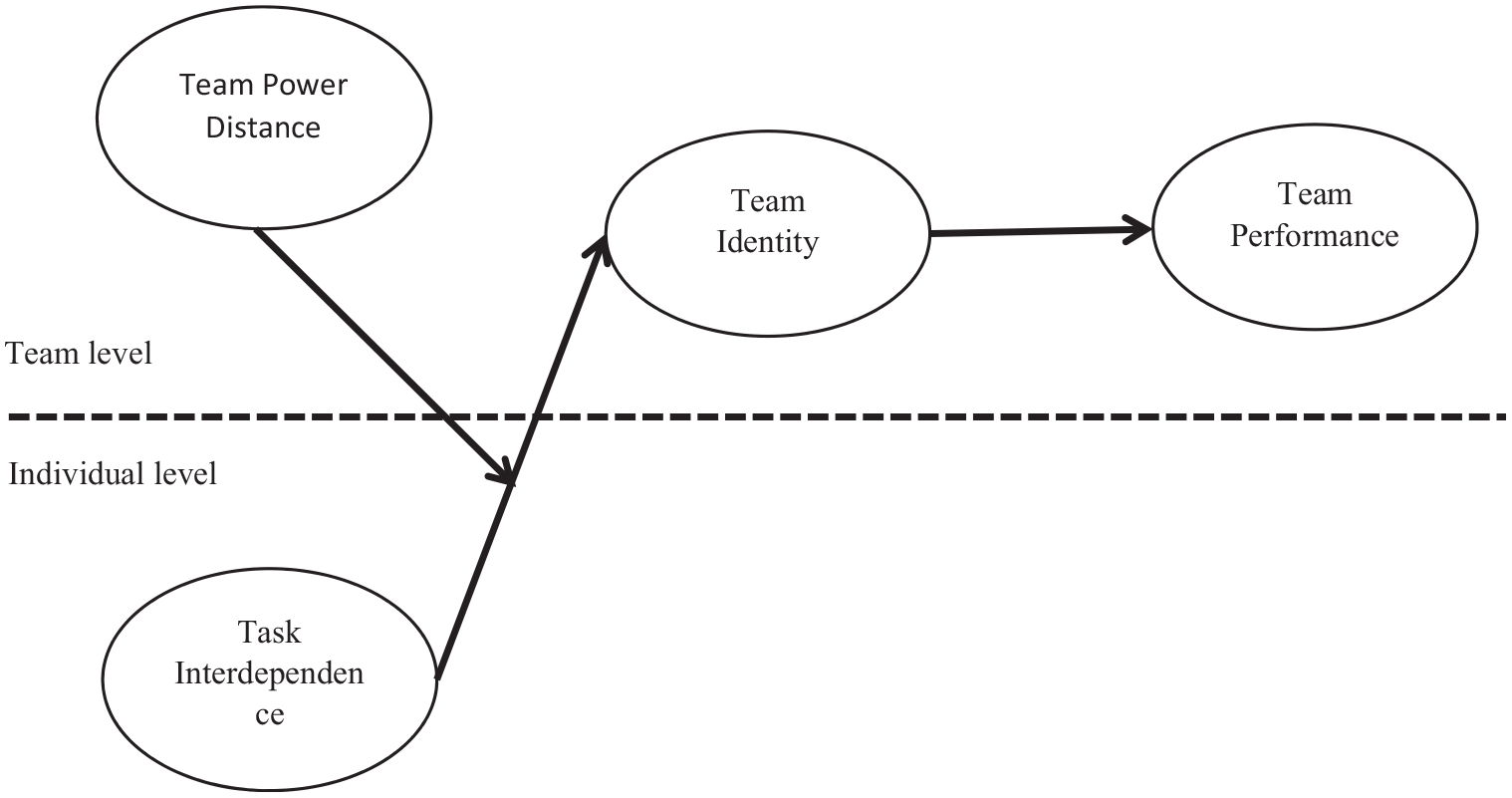
Conceptual model of task interdependence, team identity, team performance and power distance.
This research has several important contributions to the literature. First, this sheds light on a better understanding of the emerging social identity theory phenomenon. Most prior research on social identity theory separately examined team-level or individual-level constructs (e.g., Huang & Lin, 2021; Inoue et al., 2022; Schreuder et al., 2019; Tai et al., 2022). By investigating individual-level task interdependence and team identity as they relate to team performance, this study provides insights into the bottom-up process, namely, the emergence of micro-macro mechanism that demonstrates how the interactions among individuals emerge to affect at the higher level (i.e., team) (e.g., Croon & van Veldhoven, 2007; Kelcey et al., 2020). In addition, by bridging individual-level and team-level phenomena, this article contributes and expands social identity theory in past studies and examines how individual employees give impetus to the emergence of pivotal team outcomes. Second, this article illuminates an emerging mechanism of task interdependence at the individual level that can affect the nature of the team process (i.e., team identity) to be further associated with team performance. Last, by testing how team power distance as a moderator influences the relationship between individual-level task interdependence and team identity, this study helps clarify whether the interdependence task effects depend on contextual factors.
The paper is structured as follows. The first section highlights this research background. The second section reviews the theoretical background and development of hypotheses surrounding social identity theory which describes the linkages between task interdependence, team identity, power distance, and team performance. The research method adopted for this research is presented in the subsequent section. The results of empirical findings and discussion are presented before the conclusion section, further research directions, and limitations.
Literature Review
Individual-Level Task Interdependence and Team Identity
Prior study has observed a positive relationship between interdependence and social identity (Kobayashi et al., 2021; Rosendaal, 2009). Social identity theory describes how people rate themselves and others based on the social groupings to which they belong (Prayag et al., 2020). Individuals who feel a strong sense of belonging to a particular group are more likely to evaluate other members of that group favorably and less likely to do so regarding members of any other group, even if the distinctions between the in-group and the out-group are minuscule (Prayag et al., 2020). There is a shift in cognitive awareness in the social identity perspective through interdependence and embracing social identity (Lembke & Wilson, 1998). Besides, social identity theory also acknowledges that people could have as many social identities as there are groups they cognitively identify with (Al Muqarshi et al., 2021).
Task interdependence is defined as the extent to which the behavior of individual team members is required to work together to achieve the common performance goals within a team based on the task that must be accomplished (Brass, 1981; Campion et al., 1993; Gundlach et al., 2006). In other words, it refers to the degree to which team members connect to complete their jobs or tasks (Van de Ven et al., 1976). When task interdependence is high, individual team members will require information, resources, and supports from other team members to finish a team-related task (Gundlach et al., 2006; Ma et al., 2022). Moreover, high task interdependence may generate greater dependence on team identity in fostering self-esteem (Zaccaro et al., 1987). On the other hand, low task interdependence among team members leads to a lack of team identity (Bierly et al., 2009). This suggests that increased individual-level task interdependence relates to stronger team identity.
The present study proposes a bottom-up relationship between individual-level task interdependence and team identity. Albeit emerging or micro-macro effects are theoretically fruitful (e.g., Griffin, 1997; Liao & Chuang, 2004; Vandenburg et al., 1999), very few studies have been tested since available analytical methods have dampened statistical tests of such relationships (Hill et al., 2022). Recent advances in multilevel modeling techniques have made such tests feasible (e.g., Nohe & Michaelis, 2016; Preacher et al., 2010). Since typical task interdependence requires individual team members to work together collectively, such concurrent working will foster a more robust team identity. Nevertheless, less time and energy working together will decrease the possibility of the team identity of individual team members evolving (Gundlach et al., 2006). Therefore, close collaboration among individual team members prompted by task interdependence may assist in developing team identity and motivating members to work toward a common goal (Rosenauer et al., 2016). So task interdependence contributes to the importance of identification for team members (Kim & Vandenberghe, 2018; Le Blanc et al., 2021; Roberson, 2006; Zaccaro et al., 1987). Based on this explanation, the present study proposes the following hypothesis:
Team Identity and Team Performance
Lembke and Wilson (1998) introduced the term “team identity,” as the collective level of individual team identification happening across any team member. The individual-level construct of team identification emerges and drives the group-level construct of team identity (Gundlach et al., 2006). According to social identity theory, the basis of evaluations and feelings for team members is transformed from personal identity to group identity, which is based on group prototypicality (i.e., the degree to which a member is thought to resemble the group prototype) (Tai et al., 2022). A group prototype is a ‘context-specific, multidimensional fuzzy set of attributes that define and prescribe attitudes, feelings, and behaviors that characterize and distinguish one group from others (Al Muqarshi et al., 2021; Hogg, 2001, p. 187). Lembke and Wilson (1998) postulated team identity using social identity theory to explicate team performance. They argued that team identity is crucial for motivating teamwork and achieving high performance. Team identity is crucial in developing team members’ loyalty, enhancing satisfaction and commitment, and improving team performance (Shahid et al., 2022).
Providing a team with a sense of collective identity is the first step toward achieving high team performance (Boone et al., 2020; Ellemers et al., 2004). A team with a high level of team identity is more likely to perform effectively than the group members who do not portray themselves as a team (Campion et al., 1996). In other words, a high level of team performance will be obtained if the team members are cognitively, emotionally, and behaviorally aligned. To optimize team performance, team members need a strong team identity for allocating team members’ ability and effort when achieving the team’s goals (Gundlach et al., 2006). Team identity not only strengthens team performance by unifying team members into a collectively recognizable entity as a whole but also prevents individual team members from being distracted by individual goals that might take precedence over team interests (Gundlach et al., 2006, p. 1614). Team performance improves when team members’ actions, emotions, and feelings are aligned and unified (Gundlach et al., 2006). Team identity enhances team performance as it reinforces the social dynamics that play a role in organizing and guiding team members’ energy toward their goals (Gundlach et al., 2006). In addition, the higher the team identity is, the better the team performance will be (Hawkins et al., 2020; Homan et al., 2008). Thus, the hypothesis for the current study is formulated as follows.
The Mediating Role of Team Identity
Social identity refers to the part of an individual’s self-concept that is determined by both group membership and the emotional significance of the membership (Tajfel, 1982). Previous literature has suggested that a group’s social identity often results from affective processes (material based on everything related to emotions, such as appreciation, values, feelings, enthusiasm, interests, and attitudes toward something) (Mislin et al., 2015; Petitta & Borgogni, 2011)—team affective tone—with the intervening mechanism of team identification (Lin et al., 2017) to team performance. However, a social category cannot form a basis for a social identity unless group members perceive it as salient, and they cognitively identify with it (Hogg & Reid, 2006). Grounded by social identity theory actively responding to the calls by Lembke and Wilson (1998) and Al Muqarshi et al. (2021), this study examines the mechanism of the cognitive aspect (related to reasoning or thinking processes, namely the ability and activity of the brain to develop rational abilities) —interdependence—requiring individual team members to work together collectively—team identity—which in turn has an impact on the effectiveness of team performance.
Prior studies have found direct and indirect relationships between task interdependence and team performance (Campion et al., 1996; Somech, 2008, Somech et al., 2009; Stewart & Barrick, 2000; Talat & Riaz, 2020). However, the relationship between individual-level task interdependence and team performance has dominantly been examined at a similar level, either individual or team levels. It suggests that the relationship occurs through a bottom-up relationship (i.e., micro-macro level). Although task interdependence is an individual-level construct, the interdependence task will provide “togetherness” from individual team members needed to energize and support a team to perform maximally. Team members should believe that their contributions are critical to the team’s success (Hertel et al., 2004). Perceptions of task interdependence among members may lead them to believe that team performance relies on each team member’s effort (Ramamoorthy & Flood, 2004). Task interdependence affects team processes as it connects various roles in the team and the coordinated requirements of the team members (Katz-Navon & Erez, 2005). Task interdependence may increase team performance in two ways: first, it increases the sense of responsibility for team members’ work; second, it increases the reward value of team achievements (Campion et al., 1993).
The sense of shared responsibility and team achievement is more likely to engender social identification, resulting in a high level of team identity. It suggests that team identity is critical in predicting the relationship between task interdependence and team performance. Team identity is a vital mediator in facilitating team performance (Lin, 2015). Teams with high team identity are expected to have stronger team characteristics (e.g., task interdependence)-team performance relationship (Campion et al., 1996). Rather than thinking, feeling, and behaving as an individual member of a group, team identity yields a common perspective shared by team members, reflecting itself in their shared dedication toward obtaining team goals (Gundlach et al., 2006; Le Blanc et al., 2021). The team process will improve if team members have higher task interdependence (Campion et al., 1996). The strength of task interdependence significantly impacts team processes of team identity, and then a higher team performance will be achieved. Accordingly, the present study proposes the following hypothesis:
The Moderating Role of Team Power Distance
Cultural values and norms guide people’s behavior in society and thus influence the social construction of leadership and follower roles and behaviors (Blair & Bligh, 2018). Specifically, national culture helps define the relationship between individuals (leaders) and teams within groups (followers), although exactly how and by what means have not been systematically examined (Blair & Bligh, 2018). Thus, to understand those mechanisms, this article employs social identity theory, which examines the impact of norms on group dynamics (Smith & Hogg, 2008).
Hofstede (1991, p. 9) defines culture as “the collective programming of the mind that distinguishes the members of one group or category of people from another.” In this context, culture is seen as a group-level construct, and values are the identity of a culture (Daniels & Greguras, 2014; Hofstede, 1980). Hofstede (1980) identified power distance as one of four cultural values. Power distance reflects how individuals, groups, or societies accept inequality (e.g., inequalities in power, status, and wealth) as unavoidable, legitimate, or functional (Daniels & Greguras, 2014; Hofstede, 1980). Studies on power distance are rapidly expanding at all levels (Z. J. Chen, 2011; Peng et al., 2021). Initially, power distance was conceived as a societal-level cultural value, yet further research has suggested that individuals may accept unequal power distribution in institutions and organizations (Clugston et al., 2000; Hofstede, 2003).
The present study focuses on the team’s power distance to which people expect and accept unequal power distributions between superiors and subordinates (Hofstede, 1980; Yang et al., 2007), shaping a shared group orientation. Team power distance places the leader/team status differences as appropriate and rightful (Earley, 1999; J. Hu & Judge, 2017). A team’s power distance value includes an aggregation of individual members’ values, shared perceptions, and attitudes of power, control, dominance, and compliance of a team toward the leader (Cole et al., 2013; J. Hu & Judge, 2017). Teams with a high level of power distance see formal authority and manner of leading, controlling, and directing from supervisors to subordinates as source values within the group (J. Hu & Judge, 2017; Yang et al., 2007). Differently, teams with lower-level power distance prefer and ask their team leader to share their power and decision and have more autonomy (Yang et al., 2007). Individuals in power distance orientation teams value hierarchy and tend to conform to those with high status. Besides, they are likely to legitimize differentiated role arrangements.
Subgroup formation in a single entity has long been argued to be due to power and status differences (Van der Vegt et al., 2010). In the social identity theory, Tajfel (1982) argued that the perceived legitimacy of power and status differentials is fundamental for understanding social identification in groups. Social identity theory also acknowledges that people could have as many social identities as there are groups they cognitively identify with (Al Muqarshi et al., 2021). However, social identity theory has not been explicitly applied to the research of power distance and task interdependence—as a cognitive aspect mechanism—on team performance; this has been used more generally to understand leadership effects (e.g., leader prototypicality on follower outcomes, i.e., Hogg et al., 2005; LMX differentiation—affective aspect mechanism—on team coordination, i.e., Sui et al., 2016).
A high level of power distance will strengthen the relationship between task interdependence and team identity, while a low level of power distance will weaken the link between task interdependence and team identity. In a collective culture where hierarchy is critical, the interdependence task between individual members to accomplish a task will be stronger when the power distance orientation within a team is high. So, several perceptions underlie the leaders showing their behaviors and subordinates responding to them (J. Hu & Judge, 2017, p. 944). A sense of togetherness in completing interdependence tasks will be stronger when members’ attitudes toward power and control are similar, which will flourish team identity. Therefore, it is plausible that when task interdependence is high, a team will be required to work in more of a collective fashion than when task interdependence is low. Hence, task interdependence at the individual level will demonstrate a vital relationship with team identity, and its relationship is stronger when the team power distance orientation is high. Accordingly, the present study proposes the following hypothesis:
Research Method
Sample and Descriptive Analysis
This study collected data from 1,460 team members nested into 158 team leaders (88 non-academic and 70 academic teams) from nine Iraqi universities. Academic teams came from various departments, such as math, physics, and history, while non-academic teams (also known as support staff teams) worked in similar universities (e.g., student affairs and financial departments). Most of the academic departments consisted of lecturers, heads of departments, and laboratory assistants. For example, in the physics department, the lecturer team must design a curriculum, teach students, pursue research grants, and manage a laboratory with research assistants and laboratory assistants. Meanwhile, non-academic teams (e.g., student affairs) manage the teaching facilities, resources, and student admission every academic year. One person was in charge of handing out the surveys. A total of 1,869 team members and their immediate leaders were surveyed in this research. Of the surveyed population, 1,460 team members (78% response rate) and 158 team leaders (99% response rate) participated in this research. Participation was entirely voluntary and completely confidential.
The questionnaires were distributed to academic departments/or teams with members ranging from 4 to 54 members, while non-academic departments/or team sizes ranged from 4 to 22 members. In this case, 60% of the team members were males, and 80% of the leaders were males (i.e., both academic and non-academic). Members of the academic and non-academic departments varied in age from 26 to 52 years old (M = 37.98, SD = 5.30), and the age of their leaders varied from 26 to 75 years old (M = 45.40, SD = 10.37). The tenure of the department members ranged from 9 months to 21 years (M = 7.98, SD = 3.89), while the leaders’ experience stretched from 1 to 38 years (M = 10.51, SD = 6.23).
Among the leaders of the academic departments, 14% of them had a Master’s degree, and 86% had a PhD degree. Concerning the leaders of the non-academic departments, 2% of them had a secondary-school certificate; 6% had a technical degree awarded by a technical institute (i.e., 2 years of schooling, with 6 weeks of practical training each summer); 72% of the leaders had a Bachelor’s degree; 12% of them held a Master’s degree; and 8% had a PhD degree. The age of the academic and non-academic department members ranged from 26 to 52 years (M = 37.98, SD = 5.30). The age of the leaders of the academic and non-academic departments ranged from 26 to 75 (M = 45.40, SD = 10.37). The employment period of departmental members ranged from 9 months to 21 years (M = 7.98, SD = 3.89), while the leaders’ tenure spanned from 1 to 38 years (M = 10.51, SD = 6.23). The mean (average) for both academic and non-academic team members working with their current bosses was 2.5 years (SD = 1.32 years), while the mean for leaders in their current positions was 3.58 years (SD = 3.21 years).
Measures
Individual-Level Task Interdependence
Five items were adopted from Van der Vegt et al. (2001). The Cronbach’s alpha of task interdependence was 0.63. Items were measured on a seven-point Likert scale, ranging from 1 (strongly disagree) to 7 (strongly agree). An example item is, “I have to work closely with my colleagues in this department to do my work properly.”
Team Identity
Team identity is reflected by the collective level of team identification across all team members, which is constituted by the individual-level construct of team identification measured at the team level (Somech et al., 2009). Team identity is assessed using the six-item measure by Mael and Ashforth (1992). The Cronbach’s alpha of the team identity was 0.73. Team members were asked to respond on a seven-point Likert scale ranging from 1 (strongly disagree) to 7 (strongly agree). An example is, “When I talk about my department, I usually say ‘we’ rather than ‘they.’”
Team Power Distance Orientation
Team power distance was measured using a seven-point Likert scale ranging from 1 (strongly disagree) to 7 (strongly agree). This scale was developed by Earley and Erez (1997) based on Hofstede’s (1980) construct. The Cronbach’s alpha of team power distance was 0.71. A sample item is, “In most situations, bosses should make decisions without consulting their subordinates.”
Team Performance
Team members’ work performance was tested using a ten-item scale by Bhatnagar and Tjosvold (2012). Supervisors were asked to assess their teams. Items were measured on a seven-point Likert scale ranging from 1 (strongly disagree) to 7 (strongly agree). The Cronbach’s alpha of team performance was 0.93. A sample item is, “Our department has a high work performance.”
Analysis
Multilevel structural equation modeling (MSEM) was used to include the multilevel nature of this case and the necessity to test bottom-up relationships (Preacher et al., 2010). MSEM methods mainly involve decomposing observed scores into latent Between (between-team variance) and Within (within-team variance) components (Lüdtke et al., 2008; B. Muthén & Asparouhov, 2009; Preacher et al., 2010). Moreover, the link between variance components (within and between) can be modeled independently at each level to test structural and measurement models. Lastly, by decomposing variance into components at between and within levels, MSEM hinders potential issues of conflated within- and between-level effects and can estimate the indirect effect more accurately than the traditional multilevel approach (Preacher et al., 2010; Zhang et al., 2009).
Hypothesis 1 suggests a direct relationship between individual-level task interdependence and team identity. Testing the bottom-up relationship between individual-level task interdependence and team identity (Hypothesis 1), following the procedures of Preacher et al. (2010) to test the MSEM model, does not need outcomes to be measured at Level 1, nor does it require a two-stage analysis. With limited information on maximum likelihood estimation, this method is a more parsimony way of testing the bottom-up relationship (i.e., 1-2-2 model). The bottom-up relationship is represented by the coefficient of the structural relationship between the latent individual-level task interdependence and the level-2 outcome variable of team identity and team performance.
Mplus 7.2 (L. K. Muthén & Muthén, 2012) was used with robust maximum likelihood (MLR) estimation. For model comparison, a scaled chi-square difference test is used (Satorra, 2000) since the chi-square difference tests on a consistent basis cannot be applied to the models using an MLR estimator (L. K. Muthén & Muthén, 2012). Furthermore, to assess model fit, the following parameters are used: means of the root-mean-square error of approximation (RMSEA), the Tucker-Lewis-Index (TLI), and the comparative fit index (CFI) (L. Hu & Bentler, 1999).
Results
Measurement Model and Inter-Correlations of Study Variables
Table 1 shows the means, standard deviations, correlations, and Cronbach’s alpha reliabilities of the scales at the team level. The correlation between team task interdependence and team identity was significant (r = 0.33, p < 0.01). Team task interdependence was significantly related to team power distance (r = 0.18, p < 0.01). The correlation between team identity and team performance was also significant (r = 0.32, p < 0.01).
Descriptive Statistics, Correlations, and Cronbach’s Alpha.

Note. The diagonal values in the bracket are Cronbach’s alpha.
Correlation is significant at the 0.01 level (two-tailed), N = 1,460 individual members working with 158 teams/units.
The chi-square statistic (v2), the root means the square error of approximation (RMSEA), the comparative fit index (CFI), and the standardized root means square residual (SRMR) were used to assess the overall model fit in all scales. An acceptable model fit is indicated by an RMSEA value below 0.08, a CFI value above 0.90 (Browne & Cudeck, 1993), and an SRMR value below 0.08 (L. Hu & Bentler, 1999). The goodness of fit of the model indicated a good fit for the specified four-factor model of task interdependence, team identity, team power distance, and team performance. Their values are as follows: CMIN/DF = 3.658, CFI = 0.97, RMSEA = 0.04, SRMR = 0.03. These values are better than the single factor model values, which are poorly fit (CMIN/DF = 1.971, df = 628, CFI = 0.57, TLI = 0.54, RMSEA = 0.124, SRMR = 0.120). The values of the three-factor model are as follows, CMIN/DF = 7.893, CFI = 0.92, RMSEA = 0.06, SRMR = 0.06, and the values of the two-factor model are as follows, CMIN/DF = 10.178, CFI = 0.89, RMSEA = 0.07, SRMR = 0.07. Hence, the validity of the measures capturing distinct constructs is supported by these findings.
Hypotheses Testing
Hypothesis 1 proposes that individual-level task interdependence is positively related to team identity. Hypothesis 1 was supported since the research results revealed that individual-level task interdependence was positively related to team identity, as indicated by a significant unstandardized coefficient (b = 1.52, p < .01). Hypothesis 2 predicts a positive relationship between team identity and team performance. The results showed that team identity was positively associated with team performance (b = .31, p < .01). As a result, Hypothesis 2 was also supported. Hypothesis 3 proposes an indirect relationship between individual-level task interdependence and team performance through team identity. Hypothesis 3 was also supported since the results indicated that individual-level task interdependence is indirectly related to team performance through team identity (unstandardized estimate of the product-of-coefficients = .50, p < .01, 99% CI = -0.09, 0.83). Hypothesis 4 proposes that the positive relationship between individual-level task interdependence and team identity is more robust when the team experiences a high level of team power distance. This hypothesis is tested in model 2. The interaction term between individual-level task interdependence and team power distance did not link to team identity (b = 0.07, ns). So, the results did not support Hypothesis 4.
Additional Analysis
The data support Hypotheses 1 to 3 but do not support the cross-level interaction, that is, the role of team power distance moderates the relationship between individual-level task interdependence and team identity (Hypothesis 4). Team power distance might not be a moderator but act as a predictor.
Prior studies have demonstrated that power distance can interact with other outcome variables. For instance, team power distance was linked to team potency and leader identification (J. Hu & Judge, 2017). In addition, team power distance interacted with leader power distance in predicting team procedural justice climate (Cole et al., 2013). However, the previous research is obscured by the relationships between team power distance and team identity to link to team performance ultimately.
Testing the mediation model (i.e., team identity mediates the link between team power distance and team performance) is essential to ensure these variables are eligible for aggregation. It is necessary to determine if this shared agreement of the variables were sufficient. ICC1, ICC2, and rwg (j) scores were assessed. ICC1 is unaffected by the number of teams or the size of the teams (Castro, 2002). An ICC1 of at least .08 describes that data collection is sufficient (LeBreton & Senter, 2008). In this research, ICC1 scores of team identity, team power distance, and team performance were 0.17, 0.16, and 0.17, respectively. ICC2 measures the reliability of individual scores when aggregated into a group mean. ICC2 is acceptable when the value exceeds 0.60 (Ostroff & Schmitt, 1993). The ICC2 values of task interdependence, team identity, power distance, and team performance were the same, that is, 0.63. Accordingly, the ICC1s and the ICC2s met the required standard. In addition, the rwg values for task interdependence, team identity, power distance, and team performance were 0.81, 0.82, 0.81, and 0.86, respectively. Thus, these values are reasonable for aggregating the data at the team level for all variables in the model.
The specified mediation model by testing the model in Mplus 7.2 is measured at the team level. The results indicated that team power distance is significantly related to team identity (b = .32, p < .01), and team identity is significantly related to team performance (b = .34, p < .01). Additionally, the indirect effect of team power distance and team performance via team identity is significant (b = .11, p < .01 99% CI = 0.06, 1.43). Therefore, the mediation model is supported. Table 2 shows the results of model testing.
Test of Direct, Indirect, and Interaction Effects.

Note. Unstandardized estimates are reported. CI = confidence interval.
p < .05. **p< .01.
Discussion
This research examines the team performance of academic and non-academic teams in the higher education context. Notably, this study tests whether individual-level task interdependence is related to team performance through team identity. This study extends theory and research on team performance by measuring the dynamic bottom-up relationship between individual-level task variables and team process variables and team performance. In addition, this research tests whether the emerging relationship between individual-level task interdependence and team identity depends on the degree to which team power distance orientation impacts its relationships. In line with the hypotheses, the study finds a bottom-up relationship between individual-level task interdependence and team identity. The results support hypotheses since the main findings reveal a positive indirect relationship between individual-level task interdependence and team performance through team identity. Additionally, a finding shows an opposite result to the hypothesis; team power distance did not support the positive link between individual-level task interdependence and team identity.
These results shed light on several theoretical implications. First, this study contributes to the links between interdependence tasks, team identity, and team performance. Previous studies demonstrated that the relationship between interdependence and team performance occurs at the team or individual levels (e.g., Langfred, 2005; Somech et al., 2009). However, those models fail to provide insight into which individual-level tasks can contribute to the emergence of team identity and subsequently relate to team performance. Particularly, the evidence demonstrating the relationship between individual-level task interdependence and team identity suggests that task interdependence contributes to the emergence of team identity, which is, in turn, associated with team performance. Task interdependences influence the nature of team processes because it shapes the relationships among the multiple roles in the team and the coordination needs of team members as well as the work environment to obtain a shared goal (Katz-Navon & Erez, 2005; Yuan et al., 2022). It shows that task interdependence shapes the links among team members, affecting team identity as a form of the team process. Interdependence happens when the actions of others have an impact on the outcome of each person (Johnson & Johnson, 1989; Katz-Navon & Erez, 2005; Talat & Riaz, 2020).
Second, this study includes power distance orientation as a cultural context related to individual-level task interdependence’s effects. Very few studies have examined how cultural context at the team level and task interdependence at the individual level interact concomitantly to affect team process (i.e., team identity). Albeit results show a contrasting finding to the hypothesis, this revealed important insight that the different status between a leader and his/her subordinates, which is a contextual factor within a team, has no association regarding the strength of the relationship between individual-level task interdependence and team identity to be ultimately associated with team performance. That suggests that there is no significant effect since, in day-to-day work in the academic environment, everyone will focus on performing the professional task. Additionally, this conceals essential evidence that in high power distance or collective hierarchical work environments, cultural contexts such as compliance or different status are not always a core factor in proving a high level of team performance. In other words, if individuals focus on their task or job professionally and do not show concern about differences in status issues between leader-subordinates relationships, their performance will most likely improve. However, additional analysis showed that team power distance acts as a predictor of team identity.
Interestingly, the finding shows that team identity can be affected by team-level and individual-level predictors via the bottom-up effect mechanism. This finding reveals that unequal power distribution between superiors and subordinates will shape an identity of a team (Hofstede, 1980; Yang et al., 2007). Team members see compliance and hierarchy between leader and followers as the shared value that must be held by each team member. So, it strengthens the identity within the team to be eventually associated with team performance. In this case, the team members will likely rely more on their leader in making decisions. At the same time, both sides have a shared understanding of how they should behave and react (J. Hu & Judge, 2017).
Finally, this case further demonstrates the social identity approach to team performance. Prior studies have mainly employed the social identity approach to illustrate phenomena at individual levels (e.g., Kacmar et al., 2011) and, to a paucity, at collective levels (e.g., Gong et al., 2010; Nohe & Michaelis, 2016). Additionally, previous studies often focus on the top-down process (e.g., Ashforth et al., 2008), where the bottom-up process is still scarce in identity literature. This study evolves and tests the hypotheses using the social identity approach to bridge individual and team-level phenomena. The finding that individual-level task interdependence was related to team identity supports the social exchange as an underpinning mechanism of collective identity. Besides, it enlightens the critical question of how team identity occurs, that is, through a dynamic interplay between micro-and macro-level constructs.
Practical Implications
This current research shows several practical implications. These implications may assist potential members of academic and non-academic teams in accomplishing shared goals. Individual-level task interdependence of academic and non-academic teams in Iraqi universities depends on the individual-level actions for the task completion of other individuals. Thus, communication and coordination activities play a key role in the context of high-independence tasks. Clear communication and coordination among team members can minimize the potential bottleneck during task completion. Organizations can use several training strategies, such as teamwork training which plays a critical element in the success of teamwork (Stevens & Yarish, 1999).
This study also provides essential information for improving team performance in an intense task interdependence (Hollenbeck et al., 2004). Organizations or universities may develop policies encouraging academic and non-academic staff to collaborate on collaborative projects (Runhaar et al., 2016). Specifically, universities should enable their staff to collaborate with colleagues with expertise in various areas because there will be more exchanged ideas and approaches than when the collaboration is limited to colleagues in the same department—for example, designing curriculum or learning methods together with subject matters experts from different or cross departments. In addition, training will enable team members in Iraqi universities to gain new information, knowledge, and mentoring program from different perspectives. College consultation or mentorship program allows members to improve their task performance and subsequently imbue team identity to commit to a high level of performance.
Strengths, Limitations, and Future Research
This research has several drawbacks, pointing to some promising areas for future studies. While using multiple data sources is a solid feature to minimize common method bias, a cross-sectional design could not make causal inferences. In line with the IMO approach, future research can use time-lagged design surveys or longitudinal designs to promote the theoretical ordering of relationships. Longitudinal research can capture the role of team dynamics at various levels of team identity. For instance, further research may focus on an overview of the variations in team identity between one unit and another unit and its correlation with team task interdependence over time.
Furthermore, given the importance of team contexts, even though this study used social identity theory as the underlying theoretical framework to drive a selection of moderators, highlighting the urgency of status discrepancy among teams, there are other theoretically plausible alternatives for boundary conditions that can be explored in future research. This study suggests that applying social dominance theory and self-managed teams are fruitful avenues for future research. Social dominance orientation (SDO) is defined as “one’s degree of preference for inequality among social groups” (Pratto et al., 1994, p. 741). People with a high SDO are likely to believe that higher-status groups are intrinsically higher than subordinate groups, which justifies dealing forcefully with persons belonging to subordinate groups (Graham, 2015). Thus, it is interesting to reveal whether the interaction between individual-level task interdependence and the high level of SDO in a team affects team performance or a high level of self-managed team identification under interdependence tasks and different group status. Moreover, given the large size of the team, national and/or professional culture may have played a role here. Future research should aim to replicate the reported findings in or across various countries, particularly workers in different occupations, to account for the impact of national culture.
Footnotes
Declaration of Conflicting Interests
The author(s) declared no potential conflicts of interest with respect to the research, authorship, and/or publication of this article.
Funding
The author(s) received no financial support for the research, authorship, and/or publication of this article.

Data Availability Statement
The data supporting the findings of this case are available upon request to the corresponding author. The data are not publicly available due to restrictions, for example, information that could compromise the privacy of research participants.