




Abstract
Grain production is important role in ensuring food security. In order to support the local government’s promotion of technological innovation on the rice plantations, the paper aims to evaluate chemical fertilizer reduction and productivity improvement technology modes in a rice paddy in Huai’an Jiangsu from the perspective of its evaluating the social economic effects. Firstly, a brief introduction of the rice plantation requirements including fertilizer and soil requirements, are introduced. Secondly, briefly introduce the most important factors impact rice technological modes including (Economic benefit, Social benefit, Technical characteristics, and management) are briefly discussed. Thirdly, details of multi-correlation of social economic model based on gray correlation analysis for the promotion of organic fertilizer to replace part of the chemical fertilizer technology, followed by the special fertilizer mode, and the other three technology modes. Results show that among the final weights obtained through the gray correlation weighting method, the economic benefit index was 27.15%, followed by the social benefit index with 21.45%, the technical feature index has the highest weight of 34.24%, and the management index with the lowest weight was 17.16%. The evaluation scores of the five technical modes, the ranking of their comprehensive evaluation score from high to low is mode 2 (0.305925) > mode 1 (0.240125) > mode 4 (0.179925) > mode 5 (0.1447) > mode 3 (0.129825). The application of mode 2, that is, the organic substitution of partial fertilizer technology, ranks the first among the five technical modes in the comprehensive evaluation; therefore, it is worthy of prioritization.
Introduction
With a long production history rice is one of the main food crops in China; hence, it plays an important role in nation food security (Chams et al., 2020; Khanal et al., 2018). Under the current complex situation, how to sustain production capacity of rice, how to promote the continuous increase of income of rice growers, and how to make due contributions to national food security and the construction of the new socialist countryside has been an invariable strategic tasks of the government (Hall & Martin, 2005). Fertilization is regarded as a vital link to protect the rice paddy ecological environment in rice paddy management to ensure the sustainable development of rice industry as well as agricultural and social economy (Zong et al., 2007). However, rice growers’ habitual fertilization causes problems such as excessive fertilization and unreasonable nutrient input ratio in rice paddies. These practice not only brings negative effects on rice paddy such as soil acidification and non-point source pollution, but also directly affects the quality of rice and the economic income of rice growers (Harun et al., 2021; Wan et al., 2012).
In recent years, there emerged various development of rice paddy fertilizer reduction synergistic technology modes have emerged, such as controlled release fertilizer inscribed of chemical fertilizer, the different proportion of organic fertilizer for generations, and the technical mode of integrated interpolating technology (Hu et al., 2021; Wang, Fang et al., 2021). When evaluating the technical mode, some researchers pay more attention to the yield and quality of rice, but they lack the analysis of the economic benefits brought about by the technical mode (Nie et al., 2021). Nie et al. (2021) analyzed and screened the technical mode in term of rice yield, quality and economic benefit while paying attention to the reduction of chemical fertilizer. Wu et al. (2021) constructed an index model for rice paddy technological mode of reducing fertilizer application and increasing productivity, mainly including soil fertility, water environment and economic indicators, they applied fuzzy comprehensive evaluation method to conduct the overall evaluation. Most existing studies, most of them separately analyzed indicators such as rice yield, quality, economic benefit, and soil environment of rice plantation basis of field experiments. However, they failed to comprehensively the different technical models from a multi-dimensional perspective, and few researchers considered the technical model itself and management indicators (He et al., 2021; Liu et al., 2021). Many studies have been conducted in rice-producing countries such as Thailand, The Philippines, Vietnam, Indonesia, and Myanmar. For example, in Indonesia, the use of agrochemicals in rice production was initially in overuse because of subsidies and other promotions under Green Revolution and the practice was changed to a more environmentally friendly approached using input-saving technological innovation (Mariyono, 2008; Mariyono et al., 2010). Further, studies shows the training on integrated pest management reduce pesticides (Mariyono, 2015, 2019). Only a few scholars have constructed the index model and made an overall evaluation of the technical model, but they have ignored the social benefits brought about by the application and popularization of the technical model. As a result, the scientific nature and reliability of the screening results of the technical model. So, it is urgent to introduce an appropriate technical mode of reducing fertilizer application and increasing productivity in rice plantation. Moreover, the process of evaluation and selection of the technology mode of reducing fertilizer usage and increasing productivity of rice plantation should be in depth (Heong et al., 2020).
In view of the existing problems related to fertilization usage in Jiangsu rice field, this paper develops five modes of fertilizer and plantation technology model for evaluation objects including the technical features and economic benefit, social benefit, management, and the regional differences. The evaluation model mainly adopts the expert group multiple correlation weighting method and gray correlation analysis method. The model comprehensively focuses on improving rice quality, income of rice growers, and the environment of rice plantation in “Huai’an,” Jiangsu rice area through popularization and application. It is expected to screen out the best technical mode that can be widely promoted in the rice field, and to provide a reference for farmers. The knowledge can help them optimize the fertilization of rice paddies. Moreover, it can aid the government to make better decisions in promoting the local fertilizer reduction action.
Background
Rice Technological Process Mode
Rice easily grows naturally. However, given that direct seeding rice field weeds, self-growing rice, and direct seeding rice are prone to negative effects of cold air during the heading and flowering stage, rice yield is significantly impacted (Chen, Zhang et al., 2021). At the same time, due to agricultural machinery subsidies, a large amount of agricultural machinery equipment investment, the acceleration of the urbanization process of “Huai’an”JiangSu, a large number of young and middle-aged rural people migrate to the city. Give the reduced labor, the need for light cultivation methods is an urgent matter. Such cultivation methods can realize the fixed seedling migration because of the high efficiency of machine transplantation. The orderly planting and transplanting of seedlings is orderly, can make full use of light energy, the planting depth is appropriate, and the resistance is good in the middle and late stages (Tran et al., 2021).
The Rice Research Institute of Jiangsu Academy of Agricultural Sciences and the National Soil Quality Observation and Experimental Station provided the technical models and related parameters evaluated in this paper. Five fertilization levels (Ibrahim et al., 2021), studied are no fertilizer Control (CK); simultaneous application of nitrogen, phosphorus, and potassium total fertilizer (NPK); no nitrogen fertilizer on the basis of total fertilizer nitrogen deficiency (N0PK); no phosphate fertilizer phosphorus deficiency (NP0K); no potassium fertilizer on the basis of total fertilizer potassium deficiency (NPK0).
Various technology models are mainly integrated with new high productivity fertilizer technology, in which organic fertilizer to replace part of the chemical fertilizer technology and serves as soil improvement technology (Bungau et al., 2021). Table 1 shows that the five technical modes have different problems, objectives and characteristics, and the key technical measures of each mode are also different. The five fertilization patterns all adopted rotary tillage after broad application, and the time planning was one base and two topdressing (Qin et al., 2021). The ratios of base fertilizer, spring rice topdressing, and autumn rice topdressing were 40%, 30%, and 30% respectively. Other management measures, such as soil moisture, disease and insect pest control, were kept the same.
Comparison Table of Five Technical Modes.

The amount of nitrogen fertilizer (calculated as pure N) is 180 kg/hm2; the amount of phosphate fertilizer (equivalent to P2O5) is 45 kg/hm2; and the amount of potash fertilizer (equivalent to K2O) is 135 kg/hm2. Phosphate fertilizer is calcium-magnesium phosphate fertilizer, which is used as base fertilizer for one-time use; nitrogen fertilizer is urea, divided base fertilizer (50%), tiller fertilizer (30%), and ear fertilizer (20%) are applied three times; potassium fertilizer is potassium chloride, divided base fertilizer (50%), tiller fertilizer (30%), and ear fertilizer (20%) were applied three times (Mengqi et al., 2021). Each treatment was repeated three times, for a total of 15 cells. The plot is 3.6 m long, 5.6 m wide, and has an area of 20.16 m2. A 10 cm walkway is left between the repetition room and the two adjacent treatment rooms to facilitate field observation and agricultural operations (Yao, Yang et al., 2021). The five treatments modes are arranged randomly during conventional method seedling raising, artificial transplanting in 3 to 4 leaf stage, row spacing 30 cm, plant spacing 14 cm, planting double seedlings in each hole, planting 12 rows in each plot, planting 40 holes in each row, and 960 seedlings in each area (Saaty, 1987).
Analytic Hierarchy Process
From the above systematic analysis of the social benefits, economic benefits and ecological benefits of various planting systems, there are large differences between the benefits and the indicators within each benefit, and it is difficult to carry out an exact comprehensive evaluation of benefits. To determine the comprehensive benefits of each planting system, the Analytic Hierarchy Process (AHP) used and comprehensive scoring method to first determine the relative importance weights of each evaluation factor to the evaluation target through the method, and then use the comprehensive scoring method to score. According to the size of the total score, the effect of each planting Mode was systematically evaluated.
According to the principle of Analytic Hierarchy Process (Merigó & Gil-Lafuente, 2010; Reinsch et al., 2021), then selected a main index among the three benefits, constructed a hierarchical structure model of benefit evaluation according to the affiliation between factors, and then invited relevant experts who have been engaged in the research of farming system for a long time. Then few framing under experimental test condition are compare the relative importance of each factor in the evaluation model, and compare the results.
Research Methodology
Model Evaluation Index
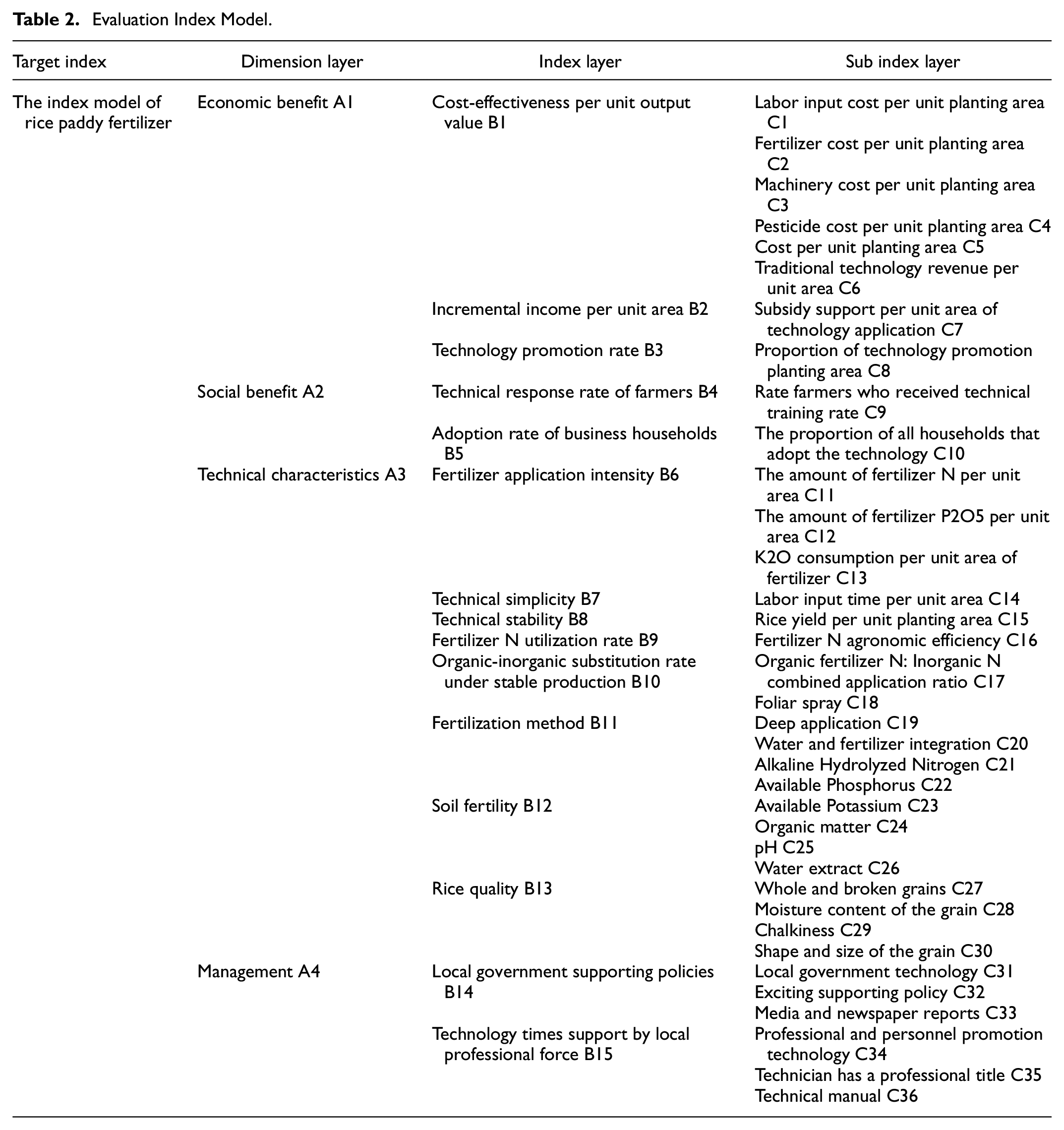
Following scientific, comparable, systematic, dynamic, gradation and typicality, regional principle, on the basis of comprehensive consideration of technical feasibility, economic sustainability, social acceptability, such as dimension, using literature synthesis method, preliminary compose built rice paddy fertilizer applied productivity reduction technology mode of social and economic effect evaluation index model, And invite agronomy, soil chemistry, plant nutrition and agricultural economic and management experts, such as multiple disciplines through several rounds of discussion, to selection and optimization of index model, finally established contains 4 dimension indicators, 15 layer indexes, and 36 sub-index indicators of rice paddy fertilizer applied productivity reduction technology model of social and economic effect evaluation index model (Table 2).
Evaluation Index Model.
Formulation of the Social Economic Model
The multiple relevance weighting method of the expert group is a subjective weighting method, which is based on the experience of decision-makers and according to their evaluation on the importance of indicators (Satori et al., 2021). However, in general, the simple arithmetic average method is often used to measure the final weight of an index. This method ignores the difference of in expert opinions and the lack of preference, which leading to the unsatisfactory final evaluation result (Yin et al., 2021). By taking advantage of the correlation of scoring opinions, the weight of each index is re-assigned to the unanimous opinions of the expert group (Jumare, 2021).
The calculation steps of the multiple correlation weighting method of the expert group are as follows: Firstly, establish the weight (scoring) matrix. Set the number of indicators as n, and score each indicator by m experts to obtain m subjective weight combinations to form the weight (scoring) matrix W:

Step 2: Calculate the correlation coefficient

Step 3: Obtain the correlation coefficient matrix
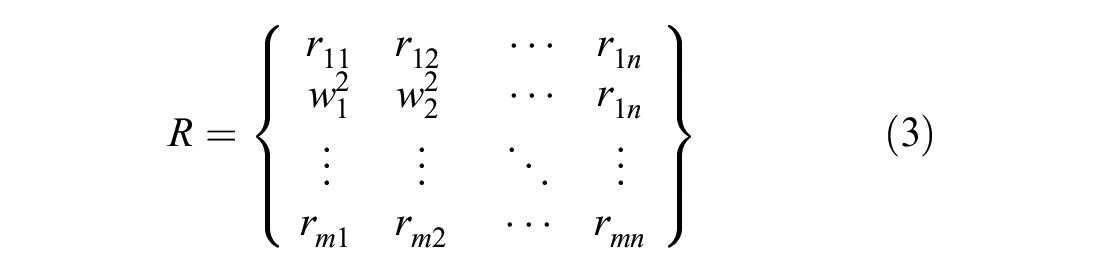
Step 4: Obtain the normalized correlation coefficient matrix
The specific calculation formula is as


Step 5: Calculate the weighted weight matrix

At this point, the expert weighted weight matrix does not have convergence. In order to obtain the convergence matrix, that is, to obtain the consistent index weighting value, this process needs to be repeated (Mussoi & Teive, 2021). That is, this matrix is used as a new weight matrix every time, and the process from the second step to the fifth step is repeated until the convergent weight result is obtained.
Step 6: Calculate the final subjective weight of each level index.
The average value of each column of the convergent weighted weight matrix is calculated, and the absolute value of the average value is normalized to obtain the subjective weight finally. In order to facilitate the expression of the following formula, the weight of N sub-indexes is denoted here as the column matrix ϖ.
The following steps show how to build an expert evaluation model that combines subjective and objective factors using Gray correlation model with multiple correlation weighting method as follows (Mussoi & Teive, 2021).
The specific steps are as follows:
Step 1: Standardize the original data
The following equations show how to eliminate the dimension the actual monitoring data of each index of the technical mode of item T:
Reverse index:

Forward index:

where,
Step 2: Construct a comparison sequence and a reference sequence.
The optimal value of the same index under different technologies after standardization is as follows:

Where,
Step 3: Calculate the correlation coefficient:
The composition matrix of
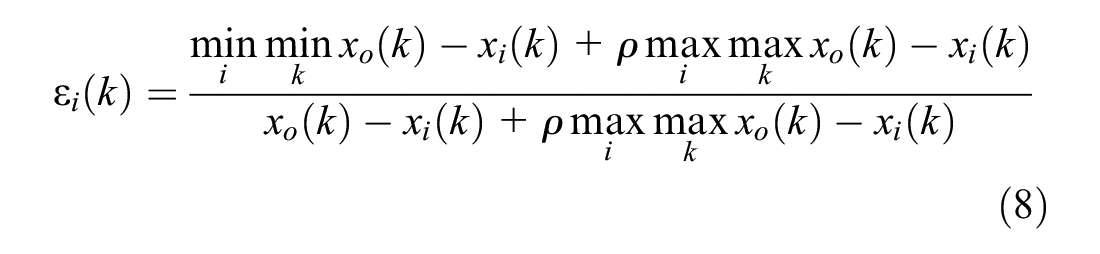
Where
Step 4: Calculate the evaluation matrix.
The evaluation numerical matrix

Where ϖ the consensus subjective weight and E is the correlation coefficient matrix

Results Analysis
Case Study Area
With the development of seedling raising technology, Huai’an’s machine transplanting has achieved long-term, multi-site, and assembly-line factory seedling raising. The reliability of raising seedlings has been improved, and machine-transplanted seedlings have also achieved tremendous local development (Long & Liao, 2021). In 2020, the machine-transplanted area of Huai’an rice exceeded 170,000 hm2, with a machine-transplanting rate of 64.5%. Figure 1, shows Huai’an which is generally located in the northern region of Jiangsu Province. The data were obtained at (33°35″N, 118°52″E) from the Jiangsu agricultural science and technology comprehensive exhibition base in 2020. This area is located to the north of the Huai River and has a temperate monsoon climate. The rice grows during the period (the statistical period is from mid-October to early June of the following year). The annual effective accumulated temperature is 2501.7°C, the precipitation is 357.5 mm, and the sunshine hours are 1,102.9 hours. The soil layer is 0 to 20 cm and contains organic matter 22.07 g/kg, of organic matter, pH 8.3, total nitrogen content of 1.68 mg/kg, quick-acting phosphorus 46.08 mg/kg, and 94.15 mg/kg of quick-acting potassium.

Huai’an, Jiangsu map.
Weighting Expert Opinions
An expert scoring table was set up according to the index model. A total of 24 experts from multiple disciplines such as agronomy, soil chemistry, plant nutrition, agricultural economics and management were invited to score and assign weights. Finally, and the expert group multiple correlation weighting method was adopted to obtain the final weight (Table 3).
The economic benefit, with a weight of 27.15%, which is not only the concern of the government, but also the concern of the majority of farmers.
The social benefit, with a weight of 21.45%, which is the common concern of extension departments and scholars. It reflects the importance of scientific and technological achievements to be finally landed or needed for production.
The technical characteristics of chemical fertilizer reduction and productivity improvement technology model, and give the highest weight to the technical characteristics themselves (34.24%).
The management index, with a weight of 17.16%, reflects the government’s emphasis on the application of technological achievements.
Weights Result Based on the Multiple Relevance Weighting Method of the Expert Group.

From the sub-indexes of the four criterion layers, among the technical characteristics indexes, the weight of rice yield increased by unit N amount and rice yield per unit planting area was higher (Gong et al., 2021). Among the economic benefit indexes, the net gain per unit area is more important than the rice growers customary technology. In the social benefit index, experts compared the proportion of the whole scale households with the technology adopted above 3 hm2 in the concentrated contiguous scale; the management index is given a relatively high weight according to whether the technology manual has been issued and whether the local government has incorporated the demonstration technology into government documents as the main technology (Malyan et al., 2021).
The five technical modes of chemical fertilizer reduction and productivity improvement for rice plantation to be evaluated in the same region, and the regional indicators reflecting regional differences in the standard layer are no longer considered. Moreover, for the five technical modes, there is no separate subsidy support, and part of the production input is the same as the management of rice plantation. Therefore, indicators with the same actual monitoring data are no longer considered in the model calculation.
Gray Correlation Analysis Model
Through the gray correlation analysis model based on the multi-correlation of expert opinions, the comprehensive evaluation results and ranking of the social and economic effects of the application of the five chemical fertilizer reduction and improvement technology modes were obtained (Table 4).
Evaluation Results of the Gray Correlation Analysis Model.

Different chemical fertilizer application reduction and productivity of technical mode show different fruit bearing and differentiation ranking according to the technical characteristics, economic benefits, social benefits and management of each technical mode in four criteria (Huang et al., 2021).
The economic benefit, there are mode 1 > mode 4 > mode 3 > mode 5 > mode 2;
The Social benefits showed pattern 2 > pattern 1 > pattern 5 > pattern 3 > pattern 4;
The technical characteristic index, the five technical modes were ranked as mode 2 > mode 4 > mode 3 > mode 5 > mode 1;
The management indicators show that the scores of mode 1 and mode 2 and mode 3 and mode 5 have the same management effect, while the management effect of mode 4 is between mode 2 and mode 3, The ranking can be described as mode 1 = mode 2 > mode 4 > mode 3 = mode 5.
Among the chemical fertilizer reduction and productivity improvement technology modes, rice growers generally focus on the yield, economy (low cost), lightness and easy operation of the technology, and the government also pays more attention to the sociality and orderly management of the technology application (Huang et al., 2021). Although the organic replacement of some chemical fertilizers with organic (Mode 2) is superior to other modes in terms of technical characteristics, social benefits and management, ranking first, its economic benefits do not meet are far from people’s expectations. Thus, Mode 2 needs to make up for the shortcoming of income, so as to be more convenient for popularization and application. Although, the special fertilizer technology mode has a low score due to its technical characteristics, and its social benefits will inevitably be affected (Firmansyah et al., 2021). Therefore, popularizing and applying the special fertilizer technology mode to break through the technical obstacles and make it more in line with the ability of ordinary people. In addition to the social benefit indexes in five fertilizer reduction productivity technology at the end of the model, the other three measures of rule layer Technology results in the five models and the second number, deserves further to overcome the lack of relevant indicators, the future promotion should be used in rice production still has great potential and space (Li et al., 2021). However, the application of urea formaldehyde compound fertilizer mode 3 and improvement of soil fertility and model 5 because of its each criterion layer index results in the five sit quite on the technical model, shows that not only is the special attention to social benefits and economic benefits, and the technical features itself, management level have obvious deficiencies, it needs in-depth innovation research and is not suitable for immediate promotion and application (Ataei et al., 2021).
Discussion
The advantages of Mode 1 and Mode 2 are significantly higher than that of other technical patterns; on the one hand the two models from the other three kinds of can enhance rice yield and ensure good quality (Ataei et al., 2021). On the other hand, both models are supported by local government and local professional forces in terms of governance. Whether the technology mode of reducing fertilizer application and increasing productivity in rice paddies can be adopted by farmers is determined by the service form and promotion intensity of technology extension in addition to the technology itself and various benefits of the technology (Wang, Sun et al., 2021). Li et al. (2021) analyzed the factors influencing farmers’ adoption of new agricultural technologies and found that the government’s support and publicity for new technologies played a significant role in farmers’ adoption of new technologies (Sun et al., 2021). In view of of disadvantage the Modes 3, 4, and 5, suggestions on strengthening technology improvement and the promotion of the rice leaves yield and output value of rice farmers are major concerns. In addition, goverment support must be strengthened. For example, they can use of modern information technology such as telephone, television, networks for propaganda and send professional technicians to the rice farmers technical training (Hou et al., 2021). These measures are effective and necessary measures to enhance the recognition and acceptance of these technical modes by rice farmers. Some scholars made statistics on the per-mu yield, per-mu output value, and fertilizer input cost of rice plantation after applying special rice fertilizer, and found that the yield of rice plantation increased significantly (Chen, Yang et al., 2021). Mode 1 has better economic benefits, mainly due to the high output value and low cost of the technology mode. However, in terms of chemical fertilizer reduction, although the input of chemical fertilizer N and total nutrient of chemical fertilizer in mode 1 decreased by 32% and 37%, respectively, compared with the local rice farmers’ customary application amount, the application amount of chemical fertilizer N per unit area was still the highest among the five technical modes, reaching 375 kg/hm2, indicating the outstanding shortcoming or deficiency of this mode compared with Mode 2. As a result, the yield of rice obtained from chemical fertilizer N input per unit area was slightly lower than Mode 2, making it at a disadvantage in the technical characteristic index. Some scholars believe that although special fertilizer for rice trees can improve the yield and quality of rice leaves, it will be more beneficial to improve the yield and quality of rice leaves if it can be applied in combination with organic fertilizer or increase the organic matter content in special fertilizer (Yi et al., 2021). For mode 1, the ratio of N, P, and K in special fertilizer for rice trees should be further optimized, especially the potential of reducing N, so as to reduce the amount of chemical fertilizer N and increase the income of rice plantation under the premise of stable yield. Mode 2, as an application mode of organic substitution of partial fertilizer technology, ranks the first among the five technical modes in comprehensive evaluation, and is worthy of priority popularization and promotion. However, although the application of organic manure can increase the soil organic matter content, improving and enrich the soil microscopic community structure, make the soil nutrient supply, promote the yield and quality of the rice leaves, but this pattern fertilizer reduction methods did not use the reduced costs offset or reduce the total cost of production, which increases the cost of the extra spending (Folina et al., 2021). Especially because of the high cost of organic fertilizer, the net gain per unit area of this modes is inferior to that of other modes compared with the traditional production technology model of rice growers. In a study of organic substitution technology Naher et al. (2021) found that the increase in the amount of organic fertilizer increases the cost of organic fertilizer. In addition, the local government’s policy of prohibiting pig breeding in this area pushes up the price of organic fertilizer and further increases the application cost of organic fertilizer (Usha et al., 2021). Therefore, the government should play an active role in promoting the technological model of organic substitution of partial chemical fertilizers, and introduce inclusive growth policies. By doing so, the government can compensate the extra cost of adopting organic substitution of chemical fertilizers, and encourage and guide the enthusiasm of rice farmers for scientific and planting (Bhatt et al., 2021).
Conclusion
This paper conducts scientific and comprehensive evaluation on whether the technology mode of reducing chemical fertilizer application can improve productivity in rice paddies. The paper presents five main points
Based on actual situation, related to sustainable agriculture technology evaluation index selection research experience, system constructed on the model of rice paddy fertilizer applied productivity reduction technology evaluation refers to the social and economic effect of the system.
Establishing a general or common optimum environmental evaluation index model of agricultural technology also has major disparities. However, it can provide reference for the construction of evaluation index model for the application effect of fertilizer reduction and productivity enhancement technology for other crops.
The multi-correlation gray correlation analysis model of expert opinions was used to evaluate the social and economic effects of the application of five technical modes in the rice area of Huai’an, Jiangsu. According to the comprehensive effect evaluation is ranked according to, mode 2 > mode 1 > mode 4 > mode 5 > mode 3.
Among the five technical models, Model 2 is the worthiest of promotion. Organic fertilizer substitutes part of the application amount of chemical fertilizer, which is proved to be feasible and reliable. However, the additional costs incurred by applying organic fertilizer exceed the original cost of reducing chemical fertilizer. This additional cost needs to be compensated by the government through support policies. In order to encourage rice farmers to continue using this technology mode in rice production, the government must be steadfast in promoting agricultural development.
Rice paddy fertilizer reduction productivity technology mode can be adopted by farmers, in addition to the technology itself and the various benefits of technology, also under the influence of technology extension service form and the promotion, Suggestions to strengthen the government support for the technical promotion and propaganda, active play to the government dominance of good technology popularization application.
Finally, the research conclusions show the impact of technological innovation on socioeconomic conditions. Therefore, future innovations on rice technologies must include advancements in irrigation system. In addition, a social-economic management system must be developed, and other types of crops such as wheat and soybean must be maximized.
Footnotes
Declaration of Conflicting Interests
The author(s) declared no potential conflicts of interest with respect to the research, authorship, and/or publication of this article.
Funding
The author(s) disclosed receipt of the following financial support for the research, authorship, and/or publication of this article: This study was supported by the Woosuk University grant No. JAS2018022.
