




Abstract
This study seeks to investigate the impact of competitor orientation (CO) on SMEs’ performance in the manufacturing sector in Saudi Arabia. As well as to demonstrate how marketing ethics (ME) moderates this important relationship. Based on a sample of 408 Saudi manufacturing SMEs, and by PLS-SEM, the links in the proposed model were investigated. The obtained results revealed that actually, CO positively affects SMEs’ performance; more importantly, this effect is conditioned by ME. The findings of this study provide advantageous insights for managers and decision-makers for SMEs, as it is expected that they demonstrate a greater commitment to practicing ME in their firms. This has ramifications in that, with the practice of ME, it is predicted that SMEs will be able to fully exploit the potential of CO to increase their overall performance.
Introduction
In today’s highly competitive business environment, SMEs exert a great influence on the economies of countries due to their sheer volume and percentage of labor engagement. SMEs, particularly in developing nations, account for the vast majority of businesses and generate the majority of jobs (Abdulrab et al., 2022; Al-Hattami & Kabra, 2022; Asad, Altaf, et al., 2020; Goaill & Al-Hakimi, 2021; Moustaghfir et al., 2020). They are the engine of economic progress and have a substantial impact on the economies of these countries (Al-Hakimi & Borade, 2020; Al-Hakimi, Borade, & Saleh, 2021; Al-Hattami et al., 2021; Asad, Chethiyar, & Ali, 2020; Asad et al., 2018; Haider et al., 2017). In Saudi Arabia, which is one of the Gulf region’s fastest-growing economies (Al-Kahtani et al., 2016), SMEs are critical contributors to economic growth and employment. Saudi Arabia’s economy, on the other hand, has been bolstered by income gained from the country’s vast oil reserves, which have helped to sustain the country’s strong and growing economy. The Organization of Petroleum Exporting Countries (OPEC, 2021) has stated that Saudi Arabia has approximately 17% of the world’s proven petroleum reserves. The oil and gas sector provides for approximately 50% of the country’s gross domestic product and approximately 70% of its export revenues.
In Saudi Arabia’s Vision for 2030, the government emphasizes that one of their action plans to transform from an oil-based economy to one that is more sustainable and diversified is to promote investment in SMEs. Therefore, SMEs are considered as the way forward due to their greater resilience and drive to obtain a competitive edge (“Vision 2030 report,” 2016). As per the Jeddah Chamber of Commerce and Industry’s (2015) report, SMEs form for nearly 90% of the overall number of firms and are responsible for 25% of overall employment. However, SMEs contribute only 20% of the national GDP, which is a low percentage compared to SMEs in neighboring developing countries, as SMEs in UAE and Bahrain contribute, respectively, 60%, 30% of the GDP (“Vision 2030 report,” 2016). The poor performance of Saudi Arabia’s SMEs is indicative of a pressing issue that requires adopting strategic options that are vital for sustainability. One such strategic option is competitor orientation (CO). CO, as part of market orientation (MO), which is defined as the firm’s understanding of “the short-term strengths and weaknesses and long-term capabilities and strategies of both the key current and the key potential competitors (Narver & Slater, 1990, p. 21),” which has been used widely in the literature on marketing (Lengler et al., 2013; Liu et al., 2013; Newman et al., 2016). As per Sørensen (2009), the effect of CO on the firm’s performance has not received much attention, necessitating further research in this area. This is further evidenced by the fact that CO enables firms to deal with changes in competitor strategies in a well-informed, if not ideal, way (Hunt & Morgan, 1995; Lengler et al., 2013). Many empirical studies have investigated and endorsed CO’s role in improving firm performance (O’Dwyer & Ledwith, 2010; Pelham, 1997; Smirnova et al., 2011; Sørensen, 2009). However, there is some contradictory research showing an inverse link or no link between CO and performance (e.g., Gaur et al., 2011).
These indecisive results have driven some scholars to suggest more research to understand the relationship of CO-firm performance in different contexts (e.g., Ali et al., 2020) to answer the question about when and how CO improves performance, focusing on contingency factors. We believe that the relationship of CO to performance is not straight but rather intricate. This study focuses on marketing ethics (ME) as a moderator for the CO-performance link. ME, which is often seen as a part of a business ethic (Murphy, 2002), deals exclusively with the ethical principles of the marketing function (Majtán & Dubcova, 2008). To the extent that firms adopt CO as part of their competitive strategy framework, the need for information about competitors increases, alongside new motivations for staff to collect competitors’ information, new stresses and opportunities for unethical behavior come (Paine, 1991). Hence, it is the duty of firms to set up a code of ethics for their product-marketing activities in order to practice and implement the best ME within organizations.
With data obtained—through a questionnaire tool developed from the previous literature—from 408 manufacturing SMEs in Saudi Arabia, this study seeks to investigate the impact of competitor orientation (CO) on SMEs’ performance, as well as to explore the moderating effect of ME on the CO-SME performance relationship.
Based on the identified gaps in the literature, the contribution of the current study is many folds, first, we examine the CO-SME performance relationship in the Saudi Arabia context. Whereas few previous studies in Saudi Arabia have tried to assess the adoption of MO and its effect in different sectors, for instance, the industry sector (Aldakhil et al., 2020; Bhuian, 1998), and the service sector like banks (Bhuian, 1997). Saleh et al. (2021a) investigated the association of MO with SME performance, with ME as a moderator. However, MO has been addressed as a one-dimensional construct, while it is preferable to deal with it as a multi-dimensional construct, as the effect of dimensions may vary across different regulatory contexts. Regarding that, several researchers have recommended that the relationship between distinct dimensions of MO and performance should be investigated at a disaggregated level in order to better understand the relationship (Gaur et al., 2011; Gotteland & Boulé, 2006). It is reasonable that a firm is good at activities related to a specific dimension (e.g., customer orientation) but is not good in other dimensions (e.g., CO, cross-functional coordination). Additionally, CO may become unimportant in certain circumstances, such as in monopolistic markets. This highlights the importance of doing a detailed analysis of the influence of various MO dimensions on performance. There is no empirical research, to the best of researchers’ knowledge, which addresses the relationship of CO with SME performance in the context of Saudi Arabia. Hence, this study attempts to fill this gap by focusing on SMEs in the manufacturing sector in Saudi Arabia and provides empirical evidence regarding this issue. Second, our study focused on ME as one of the contingent factors, which was overlooked by the majority of studies in explaining the inconsistency in previous research findings of the relationship of CO to SME performance. Hence, the current study also serves to bridge this gap in the literature.
Conceptual Background and Hypotheses Development
This section defines three main constructs (i.e., competitor orientation, SME performance, and marketing ethics), with a quick review of the pertinent state-of-the-art literature, followed by the conceptual model (see Figure 1) and hypotheses developed.

Conceptual model.
Competitor Orientation
CO is viewed as “an organizational culture” that considers the present and potential rivals’ strengths and weaknesses (Grawe et al., 2009). Competitor-oriented firms continuously assess the competitive scenario in order to compare themselves with their rivals in the industry (Newman et al., 2016). In doing so, firms benefit from the information to outrun competitors by repositioning the future offerings, therefore achieving superior performance (Bamfo & Kraa, 2019; Hilman & Kaliappen, 2014).
Strategically, sharing information about a firm’s competitors can help in promoting its sustainability (Frambàch et al., 2003). As such, the importance of CO lies in the fact that the adoption of such an orientation enables monitoring the firm’s competitors to increase knowledge of their plans and strategies, thus achieving a sustainable competitive advantage as well as providing value for customers (Danso et al., 2017; Hilman & Kaliappen, 2014). Indeed, SMEs adopt a competitor-focused perspective in order to simplify the competitive environment (Day & Wensley, 1988; O’Dwyer & Gilmore, 2019). In this context, O’Donnell et al. (2002) argue how knowledge of competing firms can assist a firm to achieve a competitive advantage, whereas failure to recognize rivals leads to SMEs being insensible of the range and influence of the networks, competencies, and experiential learning of competing SMEs, which can negatively influence on their performance. Competitor identification allows SMEs to compare information on essential abilities and resources in their competitive scenario, which facilitates competitive positioning as per marketing differentiation, complex innovation, product/service scope, market scope, quality, production capacity, leadership, cost control, competitive pricing, and differentiated advantages (O’Dwyer & Gilmore, 2019).
Marketing Ethics
ME is commonly characterized as a component of a corporate ethic that is responsible for the ethical values that underpin the marketing function (Saleh et al., 2021a), and thus, the applicability of ethics to each element of the marketing mix (Takala & Uusitalo, 1996). ME is changing along with marketing practices. For example, the Corona epidemic in 2020 prompted huge changes in marketing and business strategies, with several industry sectors being closed for months as “non-essential services,” enhancing reflections on future business development. Ethically, customers and other interested parties are always reconsidering and re-evaluating what constitutes ethical behavior (He & Harris, 2020). In this regard, Takala and Uusitalo (1996) confirmed the importance of building and restructuring the firm’s ties with other parties on the basis of ethical communication. Additionally, Saleh et al. (2021b) illustrated that while client orientation is crucial, it may not be sufficient to increase performance if the organization cannot adhere to ME. Moreover, Ferréll (2007) reports that ME represents an organizational responsibility and a basis for maintaining beneficial ties in the long term. Thus, firms’ duty is to establish a code of ethics for their activities in order to practice the best acceptable marketing behaviors.
Hypotheses Development
Drawing on resource-based theory (Barney, 1991), this study defines CO as a firm’s intangible resource that can be transformed into outputs that are valued by the customers. Competitor-oriented firms continuously assess the competitive scenario in order to compare themselves with their rivals in the industry (Newman et al., 2016). In doing so, firms benefit from the information to outrun competitors by repositioning the future offerings, thus achieving superior performance (Hilman & Kaliappen, 2014). That is, sharing information about a firm’s competitors is likely to help in creating a sustainable competitive edge (Frambàch et al., 2003).
Over the past years, the association of MO with performance has been extensively examined. Many previous researchers provided empirical backing for the positive link of MO to performance (Hwang & Chung, 2018; Qu, 2009; Saleh et al., 2021a; Salehzadeh et al., 2017). CO was addressed as a dimension of MO in the early studies under which the relationship between CO and the performance was also established (Narver & Slater, 1990). Several researchers have supported the positive impact of CO on performance. For instance, Sørensen (2009) found that CO positively affects the performance of Danish manufacturing firms. C. H. Chin et al. (2013) revealed that firm performance is positively correlated with CO. Meanwhile, Alizadeh et al. (2013) found that the correlation of CO with SME performance is positive. Later, O’Dwyer and Gilmore (2019) concluded that competitor-oriented SMEs had improved their performance. Länsiluoto et al. (2019) recently confirmed this, as they found that CO is positively associated with SMEs’ performance. Hence, we suggest the following:
H1: CO positively affects SME performance
Besides, we examine a boundary condition of ME’s role on the CO-SME performance relationship by investigating how ME impacts this relationship. Business ethics has received great attention. The traditional focus of the business ethics literature has been on the firm itself, and how its activities affect stakeholders and its outer environment (Goodpaster, 1991). Little consideration has been given to the notion that competitors are among the stakeholders of business ethics (Comai, 2003). Others such as Spence et al. (2001) argue that the broad definition of a stakeholder group should include competitors. Within the CO philosophy, collecting and analyzing competitor information is the basis for adopting this approach. However, the approach poses general ethical concerns regarding competition ideals and the spirit in which it is conducted, as well as more concrete questions about knowledge acquisition methods and limitations. Traditionally, the highest and strongest type of competition was considered to represent each competitor’s striving for excellence. Interfering with a competitor’s efforts, or even exploiting his flaws, was seen as a deviation from this standard (Paine, 1991). While Comai (2003) and Prescott (2001) stated that the process of gathering information regarding competitors is secured by using ethical practices and incorporating them into the decision-making process.
Prior studies have shed light on the positive link between CO and firm performance (Pelham, 1997; Sørensen, 2009), while others linked ethics and CO (Paine, 1991) and firm performance (Solomon, 1997). To remain competitive in the marketplace, a firm’s varied activities should consider ethical considerations (Allam, 2017; Long & Driscoll, 2008) and CO should be improved (Länsiluoto et al., 2019). Additionally, a corporation that adheres to a high ME standard improves performance (Hosmer, 1994), and even its reputation (Roberts & Dowling, 2002). In this vein, Comai (2003) argues that ME is significantly associated with CO and affects performance, as the ethical practices of marketing research help avoid the ethical dilemmas that can arise in gathering competitors’ information, thus protecting competitor stakeholders, protecting of competitor-oriented firms from legal action, as well as improving company reputation. However, no prior research has examined the moderation role of ME in the CO-firm performance link. Thence, we hypothesize that:
H2: ME moderates the CO-SME performance relationship.
Methodology
Study Sample and Data Collection
To attain the purpose of the research in exploring the moderating effect of ME in the CO-SME performance relationship, the quantitative approach was utilized with primary data obtained from manufacturers’ SMEs in three cities of Saudi Arabie (including Makkah, Riyadh, and the West region), which have the largest percentage of SMEs in the country across all sectors. The target population for this study covers a wide range of manufacturing industries, including food and beverage, plastic, packaging, textiles, furniture, and petrochemical production, among others. A total of 5,820 manufacturing SMEs are reported to exist in Saudi Arabia, according to a database of the Jeddah Chamber of Commerce and Industry (2018). Firms classified as SMEs in Saudi Arabia are defined as per some criteria (of which the number of employees, see Table 1) set by the SME Development Center of Chambers of Commerce and Industry and published by the Ministry of Commerce and Industry—Saudi Arabia (2020).
The Definition of SMEs.

For the purpose of selecting respondents, a simple random sampling method was used, which is well-known for its accuracy, impartiality, and capacity to yield results that are generalizable. A sample size of 361 SMEs was selected as a bare minimum from the entire research population, in accordance with the recommendations of Krejcie and Morgan (1970) for estimating an adequate sample size. The sample size was then increased by a factor of 2 to 722 in order to address the non-response problem and lower the sample size error (Hair et al., 2011). From 722 questionnaires, 471 questionnaires were returned, leaving 408 useable questionnaires with a response rate of 56.5% after deleting 22 invalid surveys (Table 2).
Sample Characteristics.

Measures
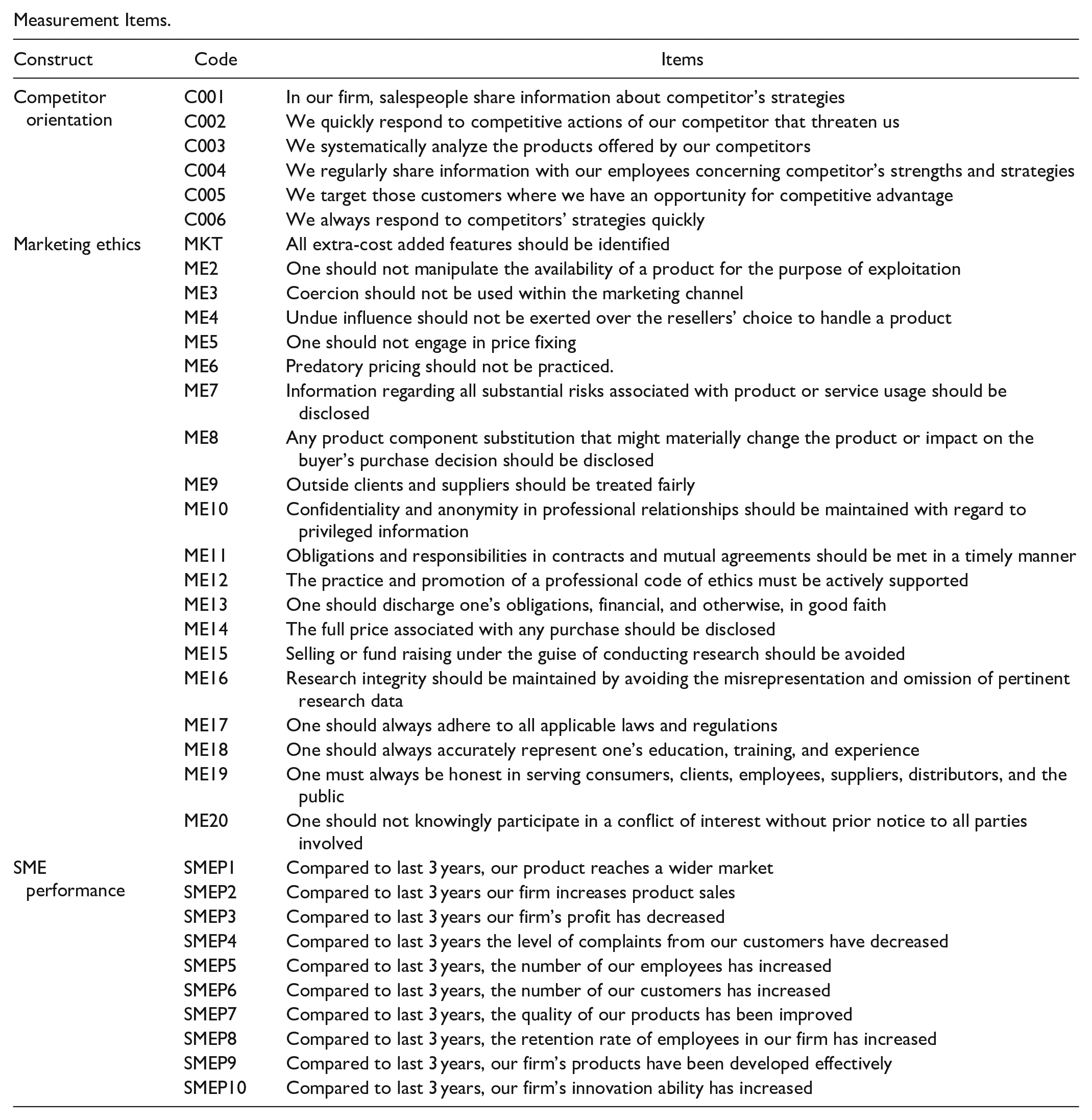
In order to acquire the necessary data for quantifying the relationships in the suggested model, we employed a questionnaire instrument and “a 5-point Likert scale (1 = Strongly Disagree to 5 = Strongly Agree)” to examine the responses. All items of the questionnaire were adopted with the help of literature as follows.
CO (independent variable)
It was measured using “6 items adopted and adapted from O’Dwyer and Gilmore (2019), Smirnova et al. (2011), and Narver and Slater (1990).”
SME performance (dependent variable)
It was measured by “10 items adopted and adapted from Ali et al. (2020).”
ME (moderation variable)
It was assessed using “20 items adapted and adopted from Cheung and To (2021), Vitell et al. (1993), and Yoo and Donthu (2002)”; see Appendix for measurement items of the variables.
Statistical Techniques
To test the hypotheses proposed, we have applied PLS-SEM by using SmartPLS 3 software, as recommended by Ringle et al. (2005). PLS-SEM offers a variety of advantages that contribute to its extensive application in management research (Al-Hakimi, Saleh, & Borade, 2021; Al-Swidi et al., 2019, 2021; Asad, 2020; Naveed et al., 2022). In the case of tiny samples, it is considered to be an appropriate approach (Henseler et al., 2009). When applied to difficult models with small sample sizes, it outperforms the covariance-based SEM in terms of statistical power (Reinartz et al., 2009). This is closely related to the existing analysis, which includes 408 cases. The PLS model contains two common related models; the “measurement model” and the “structural model.”
Analysis and Results
Descriptive Analysis
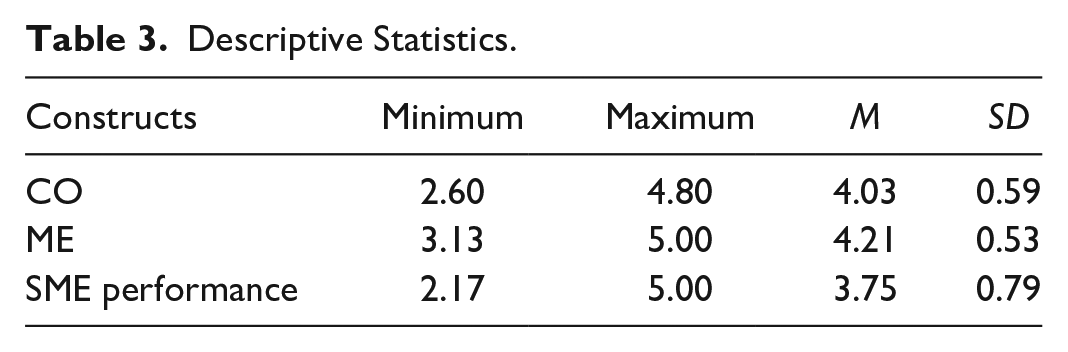
As expected, the findings in Table 3 showed the average score value for the mean and standard deviation for CO (4.03, 0.59), ME (4.21, 0.53), and SME performance (3.75, 0.79). All the construct falls into the high category. Overall, these findings demonstrated the level of interest that SME managers give to CO and ME in their firms.
Descriptive Statistics.
Measurement Model
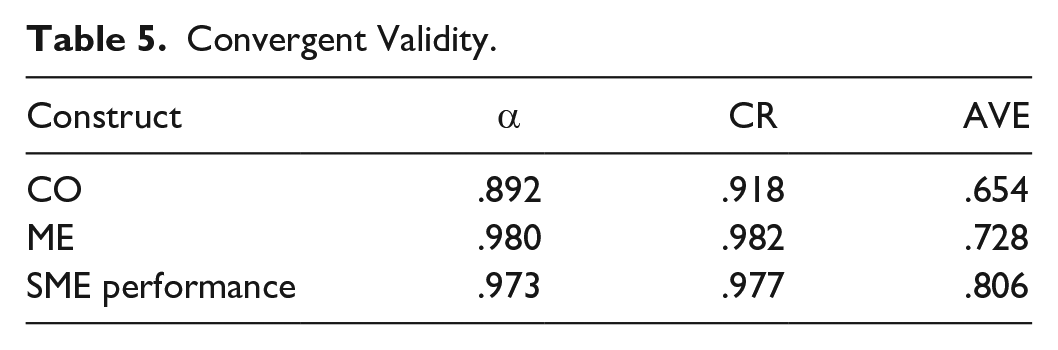
During this step, the reliability of the scale items was assessed in order to determine their internal consistency. Additionally, the construct validity of the scale items, including “convergent validity” and “discriminant validity,” was assessed using “confirmatory factor analysis” (CFA). The consistency reliability (CR) and Cronbach’s alpha (α) must both be more than .70 to be considered reliable (Hair et al., 2011). The average variance extracted (AVE) must also be more than .50, which is the usually accepted cut-off value for statistical significance (Hair et al., 2011). As indicated in Table 4 and Figure 2, the factor loadings from the constructs to indicators were >0.60 (ranging between 0.646 and 0.926), indicating individual reliability.
Loadings and Cross Loadings.


Measurement model.
Moreover, as shown in Table 5, the results of the convergent validity study revealed that the test had strong convergent validity, with all of the Cronbach’s alpha values ranging between .918 and .982, and all of the Cronbach’s r values ranging between .892 and .980. In addition, the AVEs ranged between .654 and .806, which were all within the recommended boundaries for the study.
Convergent Validity.
Furthermore, the results of the discrimination analysis of latent factors shown in Table 6 reveal that the discriminate validity of the measurement model is high, as evidenced by the fact that the square root values of AVE exceed the respective correlations of all factors (Fornell & Larcker, 1981). This suggests that the correlation between the indicators and their variables is larger than the correlation between the indicators and other factors.
Discriminant Validity.

Note. “Square root of AVE is on the diagonal” and it is highlighted in bold.
Structural model
By analyzing the structural model, R2, effect size, and “predictive relevance of the model” were evaluated; further, bootstrapping was employed to validate the research hypotheses. To validate the hypotheses and determine the appropriateness of the suggested model, the coefficient of determination (R2) was computed on an aggregate level, which indicates three levels of predictability according to W. W. Chin (1998) “.67 = substantial; .33 = moderate; .10 = weak.” The result indicates that CO and ME can explain 45% of the change in SME performance, which is within the moderate range.
Further, the effect size of latent factors on the dependent variable has been assessed through f2 analysis, which complements R2 analysis (W. W. Chin, 2010), as shown in Table 7. Cohen (2013) uses the f2 values (0.35, 0.15, and 0.02) to highlight the predictive factors’ effect sizes “large, medium, and small.” As a result, CO and CO × ME have a minor effect size (0.056, 0.013) on SME performance, while ME has a medium effect size (0.166).
Effect Sizes.

Additionally, Hair et al. (2011) indicate that if the value of cross-redundancy (Q2) is greater than 0, the model is good at predicting. The results in Table 8 shows that the Q2 value of the SME performance (dependent variable) is 0.355, which confirms that the model is good for prediction.
Model’s Predictive Quality.

Lastly, the model’s hypothesized paths were tested, as illustrated in Table 9 and Figure 3.
Path Coefficient.


Structural model.
Discussion
This study strives to examine the CO-SME performance relation in the context of an emerging economy like Saudi Arabia. The CO-firm performance link can be interpreted as a capacity of competitor-oriented SMEs to track rivals’ behaviors to gain a competitive edge and superior performance over time. Our findings indicated in Table 9 reveal that CO positively and significantly influences SME performance (β = .271, t = 4.497, p < .001). Therefore, H1 was supported. This result emphasizes that better performance could be achieved by adopting CO. Our results denote that CO is a core business strategy or capacity to achieve superior performance. This finding is similar to the existing literature findings (e.g., Alabsy, 2021; Dabrowski et al., 2019; Länsiluoto et al., 2019; O’Dwyer & Gilmore, 2019; Royo-Vela et al., 2022). CO affects the performance of SMEs in Saudi Arabia significantly and positively. Our findings contradict those of Bamfo and Kraa (2019), which indicated that the relationship of CO to SME performance in Ghana is insignificant. It is important for SME managers to pay particular attention to these findings in order to achieve outstanding outcomes. Thus, to improve performance, SME management should be persistently attentive, focusing on CO in accordance with its own strategic orientation. The logic behind this idea is that competitor-focused SMEs can have a greater understanding of the strengths and weaknesses of their rivals, making it easier to implement related strategies to position their products in a better position than their competitors.
In addition to the above, the current work explores the moderating effect of ME and assumes that ethical practices of marketing have a synergistic impact on the CO-SME performance link. Empirical results support this assumption and demonstrate that the CO-SME performance link is strongest when ME and CO are bundled together; that is, the influence of CO on SME performance is not positive in all cases. Hence, H2 was supported. This result, in general, supports prior studies related to CO, which indicate that combining CO with other suitable management strategies is likely to boost business performance (Hilman & Kaliappen, 2014). Our findings specifically reveal that CO’s effect on SME performance is higher with stronger ME compared to weaker ME. This is supported by Berrah et al. (2021), who claim that failure to incorporate the ethics dimension into the performance model will lead to abuses related to unfair or unethical behavior and will have an adverse effect on company profitability. For practitioners, our results suggest that SMEs in Saudi Arabia should view CO and ME as synergistic rather than competing strategies for resources. Such a result is especially important in the emerging economies context where some scholars have made an argument for the negative influence of ME on performance, based on the presumption that ME is inconsistent with market strategies because there isn’t enough institutional support for ME and there aren’t enough rules to prohibit unethical behavior. Foo (2007), for example, claims that the predominant idea in emerging economies can be summed by the saying “they (competitors) are ethical, so we have the competitive edge! (p. 384).” Thus, our study refutes this idea by showing that the greater the level of ME, the higher the effect of ME on performance.
Theoretically, the synergy of CO and ME into an integrated framework represents the study’s main contribution. Most of the previous research has examined CO and ME separately, leading to an incomplete understanding of both. The results obtained show that ME helps to benefit from the application of CO. It reflects the fundamental benefits of ethical practices in improving SME performance from CO. Practically, there are significant implications for this study, where SME managers should concentrate their attention on developing CO, as a more cost-effective approach. Where SMEs frequently lack the resources to conduct full-blown marketing analysis and inter-functional collaboration as specified in the marketing area (Al-Hakimi et al., 2022; Kàdic-Maglajlic et al., 2017; Tajeddini et al., 2013). By focusing on CO, Saudi SMEs can learn about the strengths and weaknesses of their existing and future rivals, making it easier to diffuse their limited resources to meet basic consumer requirements than their competitors better. Furthermore, it is important to know moderating factors, such as ME, which can interact with CO to improve performance.
Conclusion, Limitations, and Future Research Directions
This study addressed an understudied phenomenon and provided a new model that provides a better understanding of the CO-SME performance link in the developing countries’ context. In general, CO positively affects SME performance. Furthermore, the present study demonstrates that this relationship is moderated by ME. Hence, for competitor-oriented SMEs, ME is an important pillar of obtaining better performance.
This research, similar to other research, has some limitations that require future research. First, the current study merely explored the moderating role of ME on the CO-SME performance link in the context of Saudi Arabia. Future research, thus, can address other variables that may influence this link. Second, the present study is conducted in the SMEs’ context. Future studies, hence, can consider large or even micro-enterprises. Third, this study relied on data gathered from Saudi Arabia. So, future studies can conduct the same study in other countries to generalize results. Fourth, while the focus of the current study on a single moderator’s (in this case ME) analysis of the CO-FP relationship may be overly simplistic and may mask more subtle relationships, future studies could examine the interactive or synergistic effect of more than one variable. For example, competitive intensity and marketing ethics can be combined in a three-way interaction in order to explore their effects on the CO-FP relationship, as this may lead to results more accurate. Finally, this research relied on subjective performance indicators, which are based on the SMEs’ owners/managers’ perceptions; therefore, future research should concentrate on the objective performance indicators as well.
Footnotes
Appendix
Measurement Items.
| Construct | Code | Items |
|---|---|---|
| Competitor orientation | C001 | In our firm, salespeople share information about competitor’s strategies |
| C002 | We quickly respond to competitive actions of our competitor that threaten us | |
| C003 | We systematically analyze the products offered by our competitors | |
| C004 | We regularly share information with our employees concerning competitor’s strengths and strategies | |
| C005 | We target those customers where we have an opportunity for competitive advantage | |
| C006 | We always respond to competitors’ strategies quickly | |
| Marketing ethics | MKT | All extra-cost added features should be identified |
| ME2 | One should not manipulate the availability of a product for the purpose of exploitation | |
| ME3 | Coercion should not be used within the marketing channel | |
| ME4 | Undue influence should not be exerted over the resellers’ choice to handle a product | |
| ME5 | One should not engage in price fixing | |
| ME6 | Predatory pricing should not be practiced. | |
| ME7 | Information regarding all substantial risks associated with product or service usage should be disclosed | |
| ME8 | Any product component substitution that might materially change the product or impact on the buyer’s purchase decision should be disclosed | |
| ME9 | Outside clients and suppliers should be treated fairly | |
| ME10 | Confidentiality and anonymity in professional relationships should be maintained with regard to privileged information | |
| ME11 | Obligations and responsibilities in contracts and mutual agreements should be met in a timely manner | |
| ME12 | The practice and promotion of a professional code of ethics must be actively supported | |
| ME13 | One should discharge one’s obligations, financial, and otherwise, in good faith | |
| ME14 | The full price associated with any purchase should be disclosed | |
| ME15 | Selling or fund raising under the guise of conducting research should be avoided | |
| ME16 | Research integrity should be maintained by avoiding the misrepresentation and omission of pertinent research data | |
| ME17 | One should always adhere to all applicable laws and regulations | |
| ME18 | One should always accurately represent one’s education, training, and experience | |
| ME19 | One must always be honest in serving consumers, clients, employees, suppliers, distributors, and the public | |
| ME20 | One should not knowingly participate in a conflict of interest without prior notice to all parties involved | |
| SME performance | SMEP1 | Compared to last 3 years, our product reaches a wider market |
| SMEP2 | Compared to last 3 years our firm increases product sales | |
| SMEP3 | Compared to last 3 years our firm’s profit has decreased | |
| SMEP4 | Compared to last 3 years the level of complaints from our customers have decreased | |
| SMEP5 | Compared to last 3 years, the number of our employees has increased | |
| SMEP6 | Compared to last 3 years, the number of our customers has increased | |
| SMEP7 | Compared to last 3 years, the quality of our products has been improved | |
| SMEP8 | Compared to last 3 years, the retention rate of employees in our firm has increased | |
| SMEP9 | Compared to last 3 years, our firm’s products have been developed effectively | |
| SMEP10 | Compared to last 3 years, our firm’s innovation ability has increased |
Declaration of Conflicting Interests
The author(s) declared no potential conflicts of interest with respect to the research, authorship, and/or publication of this article.
Funding
The author(s) received no financial support for the research, authorship, and/or publication of this article.
