




Abstract
Peer collaboration in small groups has increasingly been recognized as an instructional technique that promotes interactive skills, socialization, learning and achievement across a range of subjects and disciplines. The study aims to measure Saudi female EFL learners’ attitudes toward the effectiveness of cooperative learning (CL) and its impact on their social and academic skills. In the present study, the researchers utilized a quantitative research tool to collect data from the participants. A 25-item Likert-scale opinionnaire was designed with closed-ended statements to measure five variables laid down by Johnson et al. tabulated into five sections. The survey was administered to 100 Saudi female EFL learners at undergraduate level to measure their attitudes toward the effectiveness of CL. The findings of the study indicate that CL enhances EFL learners’ social skills, maximizes inter-group relations, mastery of the course content and academic achievement. It further develops EFL learners’ individual and group accountability, leadership qualities and decision-making power. It is assumed that EFL learners’ cognitive faculties can be activated and optimum results can be obtained if this interactive strategy is implemented in a structured pattern with a properly designed rubric focusing on the five essential components of CL.
Introduction
Modern CL has taken its roots in the academic settings since the mid of 1960s (Johnson & Johnson, 1999). Gulnaz (2020) has stated that “collaborative learning is an umbrella term for a variety of instructional strategies, such as pair work, group work, role plays, debates and discussions utilized to initiate interaction among the learners” (p. 268). The findings of several studies discuss its effectiveness in the language classroom (Kyndt et al., 2013; Laal & Ghodsi, 2012). In a similar vein, Gleeson et al. (2005) have mentioned that instructors’ knowledge and understanding of the subject become deeper when they teach it. They have claimed that the process of organizing knowledge and transferring it to others enhances individuals’ mastery of the course content. The Roman philosopher, Seneca has recommended CL by saying, “Qui Docet Discet” (you learn twice when you teach). Similarly, Comenius (1592–1679) has suggested that students can maximize their learning both by teaching to others and being taught by others.
The effectiveness of CL could be determined from its multi-dimensional facets, that is, if it is good for the students, it is best for the teachers. Numerous interaction patterns can be initiated in the classroom. The teacher may structure the lesson and allow students (a) to collaborate in small groups to ensure that all the learners are internalizing the knowledge; (b) to involve in a win-lose struggle to choose the best and (c) to work independently in their own comfort zone to achieve the common objectives. These three interaction patterns are named competitive, individualistic and cooperative approaches respectively. The CL approach has been explored worldwide and in a variety of disciplines in different universities of Saudi Arabia. The precise objectives to undertake these studies in the context of CL are provided below:
The study of Ishtiaq et al. (2017) has investigated the teachers’ practices and perceptions about the impacts of CL on EFL learners’ language proficiency at Qassim University, Saudi Arabia. The findings of the study highlight numerous obstacles in the implementation of CL. However; it reports enormous benefits for the learners. The barriers include the learners’ inadequate knowledge and motivation to work in pairs and groups. The study recommends that CL strategies should be given due importance by the administrators and policymakers to trigger learners’ language proficiency. Almulla (2017) has examined the teachers’ classroom practices based on the five CL principles designed by Johnson and Johnson (2014). The findings suggest that all the teachers and majority of the students showed a positive attitude toward CL and preferred it over the traditional instructional method. The study has recommended that teachers should be given training for the effective implementation of CL in the classroom. Khan et al. (2017) have conducted a study to measure the impacts of CL on academic achievement of tertiary-level EFL learners at Umm Al-Qura University, Makkah, Saudi Arabia. The results reveal that the experimental group showed a significant gain in the post-test as compared to the control group. The findings suggest that CL has positive impact on the learning outcomes of tertiary-level Saudi EFL learners. The previous inquiries in the context of CL and its significance for Saudi EFL learners were undertaken at different universities of Saudi Arabia but no study has been carried out to measure the impact of five essential components of CL on EFL learners’ attitude in the context of this study to the researchers’ best knowledge.
Research Questions
The following research questions were envisaged for this empirical study:
(1) How does CL inculcate positive interdependence on each other among Saudi female EFL learners?
(2) How does CL enhance Saudi female EFL learners’ sense of individual and group accountability?
(3) How does CL enable Saudi female EFL learners to encourage and facilitate each other’s efforts to accomplish the determined objectives?
(4) How does CL enrich Saudi female EFL learners’ social and communicative skills?
Literature Review
The quest for discovering tools and devices to enhance learning of the individuals and society at large is perhaps as old as the idea of teaching and learning itself. In the discovery process, many techniques have been proposed, designed, and implemented to measure their impacts on learning outcomes, and finally, in the 1970s the notion of CL was vehemently accepted and being incorporated by academicians in educational settings. Initially, it was utilized in the field of general pedagogy and is often contrasted with competitive and individualistic learning. Its roots are embedded in the democratic view of education promoted by John Dewey (Sugie, 2011). A frequently quoted definition of CL in the field of foreign language education is: “the instructional use of small groups so that students” work together to maximize their own and each other’s learning,’ (Johnson & Johnson, 1999, p. 5). CL maps out activities that focus on developing interaction and fostering social skills among the learners to bring off the shared objectives.
Slavin (1995) has explained that CL is an instructional approach in which learners work together in small groups to help each other in mastering the course content. Kato et al. (2015), while discussing problems of CL, state that it is very common in everyday classrooms that “free-riders” do not actively engage with their peers making the interaction less effective. To address such inadequacies, CL sets forth its five basic elements. The five essential components that make cooperation work are the focus of the present study and are stacked in five tables. These variables manifest that group work inculcates learners’ (a) positive interdependence; (b) individual and group accountability; (c) promotive interaction; d) social skills; (e) and finally, it strengthens their skill of group processing. For the present study, the data were collected from 91 Saudi female EFL learners at undergraduate level to investigate their perceptions about the impact of cooperative learning on their several academic skills coupled with deep understanding of the course content. The next sections have been given over to the review of several variables investigated in the present study.
Positive Interdependence
The first crucial element of CL is positive interdependence. The learners must count on that their success is dependent on the success of their peers and vice versa, that is, they “sink or swim together”. It situates two responsibilities on the learners; (a) understanding of the given material; and (b) ensuring that the resources are understandable for the members of the group. The technical name for this two-fold responsibility is positive interdependence. The term denotes that the learners should tie in with their peers with a belief that they cannot flourish unless their peers do and they must synchronize their efforts with their peers to accomplish the task. Positive goal interdependence is based on the idea that learners work in small groups with a belief that they can achieve their learning goals on the condition that other members also attain their goals (Roger & Johnson, 1994).
Individual and Group Accountability
This element refers to the idea that learners realize that they are responsible to contribute to the processing of the project to accomplish the task. Roger and Johnson (1994) support the idea with a wise saying, popular among the early settlers of Massachusetts, “If you do not work, you do not eat.” Everyone is responsible to do their fair share of the work. The group members must know (a) which peer needs more help in completing the assignment and (b) they should not hitch-hike on the work of others. Wentzel (1994) has expressed that the learners who receive more appreciation for their performance from the team members would start feeling more responsible toward the task and group mates. Johnson and Johnson (2009) have discussed that the drive of responsibility multiplies in the presence of individual and group accountability. The bigger the size of a group, the more will be the social loafing whereas the smaller the size of a group, therefore, the higher the individual accountability (Messick et al., 1983). As the group size increases, members are less likely to see their own personal contribution to the success of the group (Kerr, 2001).
Face-to-Face Promotive Interaction
Johnson and Johnson (2009) have noted that promotive interaction happens in CL when learners help and support each other to achieve the desired goals. They comment that promotive interaction allows the learners to assist, extend support to each other and trigger their interest and curiosity toward the common goals. Gillies (2007) named the term “face-to-face promotive interaction” because he thinks that CL is a platform that facilitates participants of small groups to physically see, discuss and collaborate. Positive interdependence plays a pivotal role in establishing promotive interaction. It can be defined as a situation in which learners encourage, facilitate and praise each other’s efforts to realize the group’s goals.
Appropriate Use of Social Skills
In the context of the fourth element, Johnson et al., (2010) have mentioned that students should have social skills to work in groups which mean that they should know how to behave in a “win or lose” situation. Gillies (2007) has noted that communicative and interpersonal skills fall in the category of social skills which are important for learners to participate in group discussions. The social skills build shy learners’ self-reliance and confidence in communicating with their fellow peers and ensure high academic achievement and productivity. The study of Mestre-Segarra and Ruiz-Garrido (2022) report that the implementation of COIL approaches (Collaborative Online International Learning) along with ICLHE (Integrating Content and Language in Higher Education) not only helped learners to consolidate their master’s degree training but also enhanced their self-confidence when they applied their knowledge in real life experiences. In the backdrop of maximizing the learning outcomes, Johnson and Johnson (2009) have declared that the cooperation of inexpert groups cannot give effective results. They believe that two steps are significant to achieve effective cooperation, that is, skilled team members and their ability to execute the task. Therefore, the learners must be given training and should be prepared for the interpersonal and small group skills required for high-quality cooperation. Archer-Kath et al. (1994) have compared the effectiveness of the feedback to individual members and the whole group and confirm that feedback given to each participant separately is more effective to engage them in learning than the feedback given to the whole group.
Group Processing
The fifth essential component is group processing and its purpose is to measure the process of CL. It allows learners to reflect on how well they are doing and what is up to the mark and what they need to improve (Johnson need to improve (Johnson et al., 2010). The study of Lázaro-Ibarrola (2021) found no significant difference in the performance of the learners worked in peers and those who worked individually. Both the groups equally incorporated lexical features in their drafts with 60% accuracy rate. According to Wallestad (2010), the group members need to think about their strengths and weaknesses which enable them to fix their mistakes, learn from them, and struggle toward achieving the desired goals. The group processing enables the learners to (a) reflect on and identify helping and unhelping actions of the group members and (b) decide about what actions they need to keep doing or discontinue. The purpose of this component is to speed up the processes necessary to accomplish the group goals. In this context, Archer-Kath et al. (1994) inform that group processing with individual feedback increases participants’ (a) motivation and achievement, (b) good relationships among group members and with their teachers, (c) high self-esteem and (d) positive concerns toward the project. The group goals and their importance can easily be identified through group processing.
Learning Together Model
For the present study, the researchers have utilized the “Learning Together Model” developed by Johnson, Johnson and Holubec (1998). The authors created 25 groups of learners, each containing five participants (n = 5) to enhance their achievement, individual and group accountability, social skills, leadership qualities, and decision-making power. Slavin (2011, p. 344) has observed that cooperative learning comprises “instructional methods in which teachers organize students into small groups, which then work together to help one another learn academic content.” In this model, students worked on assignment sheets in five-member heterogeneous groups. The first pair of speakers has provided the introduction and background information about the topic, the next set of presenters furnished detailed information, and finally, the last speaker had discussed a summary of the position of each team member and provided conclusion. At the end of the presentation, the group received praise and reward based on their performance. “Learning Together Model” emphasizes team-building from the point where participants start working together to the level where regular discussions take place among the peers about their performance and how well they are working together.
Method
Research Design
The present empirical study investigated 100 (n = 100) Saudi female EFL learners at a Saudi university to measure their attitudes about the impact of CL on their academic achievement, ability to respond toward their fair share of the work, assisting and supporting team members, appropriate use of communication and conflict resolution skills and efforts to enhance the effectiveness of the group. The survey was formulated to undertake descriptive research in which perceptions of the participants were collected and quantitatively analyzed to figure out their attitudes toward CL.
Participants
The present study utilized a random sampling approach to generate the data. An Arabic version of the opinionnaire was formulated and administered to 100 (n = 100) Saudi female EFL learners of Computing & IT studying at undergraduate level in a Saudi University.
Instrumentation
The researchers have perused numerous similar contexts to design an appropriate tool to elicit the participants’ opinions, (see e.g., Johnson & Johnson, 2009; Johnson et al., 2013; Roger & Johnson, 1994; Phipps et al., 2001; Gillies, 2003; Slavin, 1995). A 25-item Likert-scale survey was designed with closed-ended items. The present empirical study envisaged four research questions in correspondence with the five variables, which are further divided into 25 items raked in the five tables.
Validity and Reliability
The first draft of the survey was sent to three experts in the field to determine content validity of the tool. The feedback received from them was incorporated in the survey. The modified version of the opinionnaire was translated into Arabic and pilot-tested with 19 randomly selected Saudi female EFL learners. The data generated through the pilot test was entered manually and Cronbach’s Alpha reliability test was run to determine the validity of the instrument. The result has indicated an acceptable level of reliability of .952. The final version of the opinionnaire was administered to the participants to collect the data (Table 1).
Reliability Coefficient.

Data Collection
The researchers followed a standardized procedure to determine the validity and reliability of the instrument. The final version of 25-items strongly-agree to strongly-disagree Likert scale opinionnaire was administered to the randomly selected 100 (n = 100) female EFL learners at a Saudi university. An Arabic version of the instrument was developed by keeping in view the fact that the English version of the opinionnaire may not impede the understanding of the participants. The researchers received 91 (n = 91) valid responses from the participants.
Data Analysis
The data collected through 91 valid responses of the respondents were coded, manually entered and descriptively analyzed in terms of means, range and standard deviation by using version 23 of Statistical Package for Social Sciences (SPSS). The items with higher mean values reflect higher preference of the participants. The descriptive statistics of data were raked in the tables to analyze and discuss with the help of the findings of studies conducted in similar contexts in the section of “results and discussion.”
Results and Discussion
This section exhibits the results gathered from the participants’ feedback and displays it in the five tables. In addition to this, the results of the present empirical study are discussed and supported with the findings of previous contexts and undertakings.
Table 2 rakes descriptive statistics of the responses of 91 Saudi female EFL learners which show that participants of this study are highly satisfied with the impacts of CL on their positive goal interdependence. All the displayed items received a high mean value of more than 4. The highest mean value (4.23) is assigned to item 5 which states that group work prompts positive alliance among the mates and inclines them to “swim or sink together”. The statistical analysis shows that learners assigned the highest importance to the item which refers to the positive relationships among the team members and is perceived as a token of success to achieve the determined learning outcomes. A similar kind of idea, that is, “CL enhances good working relationships among students,” has been discussed in the study of Farzaneh and Nejadansari (2014) with a mean value of 4.21 indicating that one of the essential principles of CL is positive interdependence. This element develops a favorable environment in which learners feel that they depend on each other in completing the assigned activity. Er and Ataç (2014) report that 92.2% of learners believed that CL evolves positive relationships among the team members. Item 4 excites participants’ belief that positive goal interdependence fosters good working relationships, understanding of the material, and high achievement. This item received the second-highest mean value of 4.16 which shows that majority of the learners agree with the point discussed in the statement. The study of Johnson et al. (1991) reinforces that positive goal interdependence fosters high achievement and productivity than resource interdependence.
Cooperative Learning Develops EFL Learners’ Ability for Positive Interdependence.

The third most-favored item in this cluster with a mean value of 4.098 remains item 1. It expresses the idea that CL braces good working relationships among the team members. The findings of Er and Ataç (2014) reveal that 83.1% of the participants endorse that CL yields harmony and trust among the group members. The participant of the study of Gonzales and Torres (2016) assigned an average mean value of 3.26 to the item stating, “I was able to share the workload with my group members.” In a similar vein, the results of Khan et al. (2020) coincide with the present study with a mean value of 3.9. The respondents of their study prefer to have good working relationships with each other and in this process like to give and receive help from their peers to complete the task. Similar results are reported by AlMashjari (2012) with a mean value of 3.92 for the statement “Group work helps in building good and effective relationship among students.” The fourth highest mean value, that is, 4.054 is allocated to item 3 of this cluster. The statement includes the idea that CL: “promotes learning and higher achievement of all the members as they share their resources and provide mutual support to each other.” In this context, Farzaneh and Nejadansari (2014) explain that “group setting facilitates creativity and learning of the members.” The participants of their study assigned a mean value of 3.85 to this item and considered it as the least preferred item among other variables. Jung and Fu (2021) reported that pragmalinguistic support helps enhance L2 learners’ understanding of the language and task content and enable them to generate lexically and pragmatically substantial output. The research of Johnson et al. (1991) endorses that positive goal interdependence maximizes higher achievement and greater productivity than resource interdependence.
In this cluster, the least preference has been attached to item 2 with a mean value of (mean = 4.00) which mentions that CL “instills motivation and creativity that enhances learners” ability to work hard and enjoy content and form of the resources,’ The findings of Farzaneh and Nejadansari (2014) are in line with the present study by receiving a mean value of 3.82. It suggests that a good number of participants have allocated importance to the item stating that they enjoy learning the material while working with their peers. In addition to this, 88% of participants of Bower and Richards (2006) strongly reinforce the point that “they enjoy working with their peers in groups”.
Table 3 displays the results generated from the data collected to measure the participants’ attitudes toward the impacts of CL on their group and individual accountability. In this cluster, four items have secured the highest mean value of more than 4 whereas one item received less than 4. Item 7 remains highly preferred with the mean value of 4.31 stating “CL environment enables learners to assist, support and encourage weak members of the team.” The research of Farzaneh and Nejadansari (2014) reported high importance for this item from the participants with a mean value of 4.17 which states that “I learn to work with students who are different from me.” The statement clearly indicates that learners enjoy working with those who have diverse capabilities and styles of learning. In a similar vein, Hooper et al. (1989) state that higher achievement can be ensured in CL in the presence of individual accountability. The second highest mean value is allocated to item 10 with a mean value of 4.25. The results show that “CL makes learners responsible to understand and perform their part in the project”. For this item, the participants of the study of Gonzales and Torres (2016) attached a mean value of 3.50, which is partly in line with the present study. The results of Farzaneh and Nejadansari (2014) coincide with the present study’s findings where participants allocated a mean value of 3.96 to the item which states that ‘I willingly participate in CL activities.’Archer-Kath et al. (1994) express that individual accountability and positive interdependence are closely interrelated to each other and the presence of the former increases the latter.
Cooperative Learning Develops EFL Learners’ Ability for Individual and Group Accountability.
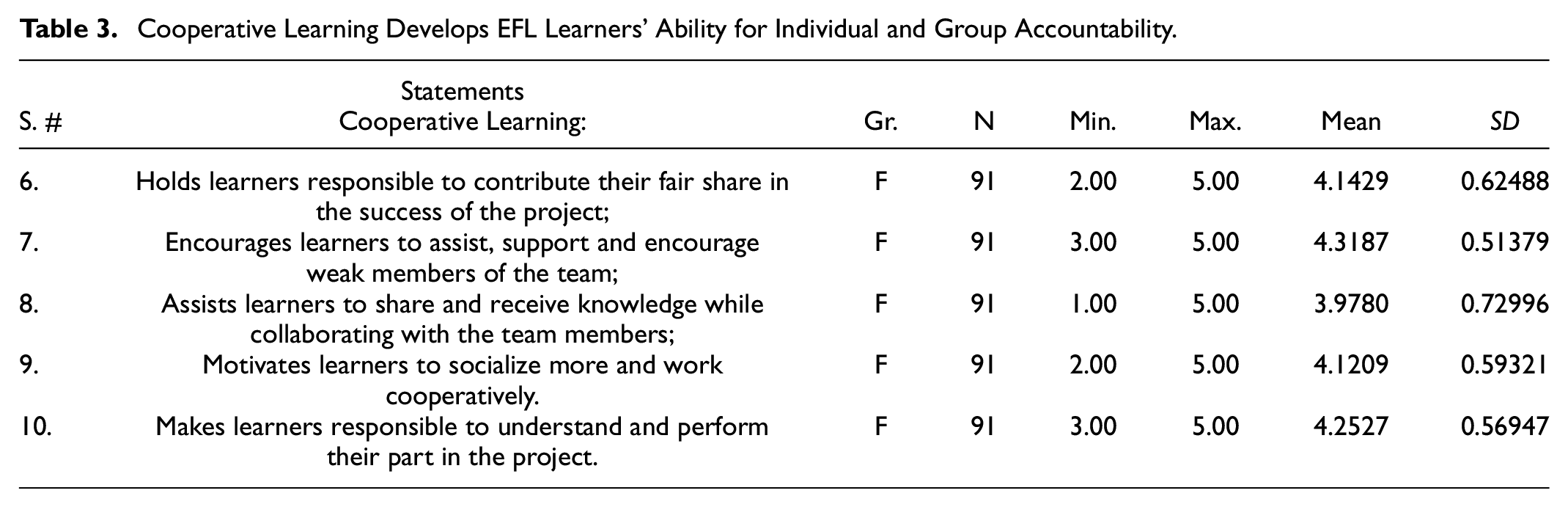
The results indicate that the participants have assigned the third highest importance to item 6 with a mean value of 4.14 which states that CL “held learners responsible to contribute their fair share in the success of the project.” In this context, the research of Gonzales and Torres (2016) obtained an average mean value of 3.37 from the participants on the item which states that “I managed to contribute my knowledge to the team.” Unlike the present study, the inquiry of Er and Ataç (2014) has received 61.4% positive responses in favor of the item which states that CL inculcates a sense of responsibility in the learners and ultimately, they work selflessly toward the success of the group. The fourth most-favored item in this category remains statement 9 which received the highest mean value of 4.12. The results suggest that the cohort of this study considers that CL motivates learners to be more social and cooperative. The participant of Farzaneh and Nejadansari (2014) assigned the highest mean value of 4.39 to the item stating “CL helps learners to socialize more” and coincide with the results of the present inquiry. They believe that one of the foundational principles of CL is to develop individual accountability in combination with group responsibility which subsequently reinforces learners’ knowledge and social skills. Likewise, McLeish (2009) recorded 84.4% positive responses for the item stating that “CL fosters their social skills” which endorse the findings of the present study.
By the same token, the next least preferred item is statement 8 which receives a mean value of 3.97 and remains the one that elicits participants’ perceptions related to the supposition that “CL assists learners to share and receive knowledge while collaborating with the team members.” The research of AlMashjari (2012) receives a mean value of 3.49, which is in line with the results of the present study. The supposition refers to the idea that “group work encourages learners to discuss their ideas and point of views.”. The findings of Er and Ataç (2014) partly coincide with the present inquiry, where 88.6% of participants attached high importance to the item which refers that “in CL students guide each other and learn while teaching to others.”
Table 4 shows the results generated from the descriptive analysis of 5 items associated with the impact of face-to-face promotive interaction on Saudi female EFL learners’ attitude. All the items included in this cluster have obtained the highest mean value of more than four. In this cluster, the highly preferred items with a mean score of 4.20 remain statements 11, 12, and 14 which elicit that CL “makes the learning experience easier and understandable, ‘allows learners to assist their peers and share resources and materials with them,’ and ‘organizes team members to work hard to achieve the group’s goals’. The findings of AlMashjari (2012) correspond to the present study with a mean value of 3.82, which mentions that: ‘group work develops learners’ knowledge.” Similar to this is the results of Gonzales and Torres (2016) which secured a mean value of 3.43 for the item which mentions: “cooperation in the group promoted a better understanding of the subject.” The results of Farzaneh and Nejadansari (2014) are in line with the present study. They report that learners assigned a mean score of 4.00 to the item which indicates that a good strength of learners acknowledged that CL enhanced their reading skills. The participants of Bower and Richards (2006) have attached 71% positive responses to the idea which reflects that “It was easier to get the task done by working in a group than alone.” In the study of Wichadee (2005) majority of the participants allocate favoring responses to the item stating that “CL enables learners to share information, make decisions and solve problems.” The results of the study partly coincide with item 12 of the present undertaking.
Cooperative Learning Augments EFL Learners’ Skill of Promotive Interaction.

The statistical data shows that participants have assigned the second highest importance to item 15 with a mean value of (4.15), which mentions that “CL imparts meaningful interaction among the team members that furnishes a deeper understanding of the subject.” The results of Gonzales and Torres (2016) partly correspond with the findings of the present study for the item stating that “interaction among group members helped learners to obtain a deeper understanding of the subject” and secured a mean value of 3.31. Similar to this is the findings of Farzaneh and Nejadansari (2014), where participants assigned a mean value of 3.82 to the item that reinforces that “learners enjoy the study material more when they work in groups.” The cohort of this study considers item 13 as the least preferred item with a mean value of (4.12), which states that “CL encourages learners to challenge team members” reasoning and arguments that enhance their understanding of the lesson.’ The study of Farzaneh and Nejadansari (2014) obtained a mean value of 3.21 and partly in line with the results of the present study. Johnson and R. Johnson (1979) and Johnson et al., (2007) comment that promotive interaction develops creativity and decision-making power of the participants and enables them to challenge each other’s reasoning and arguments.
Table 5 contains the results gathered from the descriptive analyses of five items related to learners’ attitudes about the impacts of CL on their social skills. The highest mean score of 4.14 is reported for item 20 which states that “CL triggers communication and decision-making power of the team members.” The study of Gonzales and Torres (2016) receives partly identical importance from its participants with a mean value of 3.47. The second highest mean value is allocated to item 18 with a mean value of 4.054. The item mentions that “CL develops interaction, presentation skills and powerful expression of the team members.” The investigation of Khan et al. (2020) obtains a mean score of 4.00 for the item which states that “CL provides opportunities to interact with the team members,” and its findings are in line with the present study. In this cluster, item 19 receives the third-highest mean value of 4.011. The item manifests that “CL creates an atmosphere of sharing ideas, workload, and trust among the team members.” In the study of Er and Ataç (2014), a similar kind of statement accomplishes 83.1% favoring participants’ responses and supports the present study’s findings. They believe that harmony among the participants cultivates trust and assurance that working together will bring success.
Cooperative Learning Amplify EFL Learners’ Appropriate Use of Social Skills.

The statistical data shows that participants have assigned the fourth-highest importance to item 17 with a mean value of 4.00 which mentions that “CL inculcates tolerance to listen to and respect the ideas of others”. The participants of Er and Ataç (2014) have assigned high significance to this item and attached 79.5% positive responses in favor of the idea reflecting that the students learn to respect while working in groups. Similar to this are the findings of Gonzales and Torres (2016), where participants assigned a good mean value of 3.51 to the item which reflects the idea that “CL augments learners” ability to listen to and respect each other’. The cohort of this study considers item 16 as the least preferred item with a mean value of 3.96 which states that “Working cooperatively in a group reduces stress and anxiety.” The findings of Gonzales and Torres (2016) coincide with the present inquiry with a mean value of 3.37 to the item which refers that working cooperatively with the team members is less stressful. The study of Suwantarathip and Wichadee (2010) highlights learners’ positive attitude toward CL and claims that participants of their study attained higher language proficiency scores in the post-test than in the pre-test after working in CL.
Table 6 portrays descriptive statistics of the responses of 91 female EFL learners about the impact of CL on their ability of group processing. The results of the five items reveal that the participants of this study are highly satisfied with the positive impact of CL on their skill to contribute their fair share in group processing, reflect on the performance of each other and enjoy celebrating the success of CL. All the stacked items received a high mean value of more than 4. The respondents of this survey have allocated the highest importance with a mean value of 4.08 to item 23 which states that “CL enhances cooperation and comprehensive understanding of the topic.” A similar idea has been discussed in the study of Gonzales and Torres (2016) and results partly coincide with the present study. The item states that CL fosters cooperation among the group members and received a mean value of 3.44. In a similar vein, the study of Wichadee (2005) obtained a mean value of 3.70 for the item referring to the idea that CL helps learners to acquire knowledge and understanding. The second highest mean value is allocated to item 22 with a mean value of 4.064. The item mentions that “CL allows each member to reflect on their performance and evaluate their contribution in the accomplishment of the goals.” The findings of Gonzales and Torres (2016) are in line with the results of the present study and reinforce the notion that “my group managed to achieve our group goals.” The result shows that the participants have assigned the third highest importance to item 21 with a mean value of 4.054 which mentions that “CL enables each member to contribute their fair share in enriching learning of the team members.” The study of Gonzales and Torres (2016) secured a mean value of 3.43 for the item “I learned through my mistake and was tolerant with my group members.” The findings of their study partly correspond to the results of the present empirical research.
Cooperative Learning Evolves EFL Learners’ Capability of Group Processing.

In this cluster, item 25 obtained the fourth highest mean value of 4.033. The statement fosters the idea that “I feel glad to work cooperatively with my team members and enjoy celebrating its success.” The participant of Gonzales and Torres (2016) assigned the highest mean value to the item stating “I enjoyed working with my group members as a team”. In this context, Zhang et al. (2021) called attention that instructors should constantly strive to trigger learners’ enjoyment in the learning activities. They placed emphasis on the strategies like the use of positive backchannels, sharing of different emojis and intentional guidance, planning and monitoring. Contrary to the results of the present study, the research of Khan et al. (2020) receives a mean value of 3.2, which is partly in line with the results of the present study. The statement refers to the idea that “I enjoy doing activities in the group”. The study of Er and Ataç (2014) received the least preferring responses for the item which states that “learners get better results when they study on their own.” The statement obtained 31.3% of learners’ positive responses on this item which clearly reinforces their highest preference to work in cooperative groups. Item 24 probes into the participants’ attitudes toward the significance of feedback in CL. The learners have shown their high satisfaction toward the technique of feedback while working in a cooperative group. The learners acknowledged that they found ample opportunities to give and receive feedback, which reinforced their understanding of the course content stronger than ever before. In this cluster, this item received fifth-highest preference with a mean value of 4.022. The findings of the present study partly coincide with the study of Gonzales and Torres (2016), who mentioned that the participants of their study attached an average mean value of 3.43 to the item which refers to the idea that “working cooperatively help reduced learners” misconceptions about the topic’.
Conclusion
Overall results of the study demonstrate that learners have exhibited high satisfaction toward the variables investigated in this empirical undertaking. The first question proposed for the research in hand emphasizes that (1) How does CL inculcate Saudi female EFL learners’ positive interdependence on each other? The results reveal that the participants have assigned maximum favoring responses to all the items in Table 2. Item 5 is the highly favored variable of Table 2 that supports research question 1, stating that CL boosts positive interdependence among the team members and they believe in “to swim or sink together.” It’s a well-accepted fact that more the students positively interdepend on each other, the greater they will be engaged and the harder they will work to achieve the mutual learning goals. In this context, Johnson and Johnson (1989) cited in Roger & Johnson, 1994, p. 9) report that “Long-term and persistent efforts to achieve do not come from the head; they come from the heart.” Positive interdependence reinforces the strong bond and connection among the learners in such a way that they cannot succeed unless their team-mates do and vice versa.
The second question set for the present study manifests that How does CL enhance Saudi female EFL learners’ sense of individual and group accountability? The overall findings of the third table indicate that the participants facilitated each other’s learning by encouraging and assisting their peers. They dynamically contributed their fair share in the accomplishment of the project. In this backdrop, Slavin (1983, p. 441) notes that “the best learning efforts of every member of the group must be necessary for the group to succeed, and the performance of each group member must be clearly visible and quantifiable to the other group members.”Johnson and Johnson (1999) discuss that individual accountability makes the learners stronger in their own right and they do not “hitch-hike” on the work of others.
The third question designed for the present research states How does CL enable Saudi female EFL learners to encourage and facilitate each other’s efforts to accomplish the determined objectives? The variables in this cluster receive no variation in their preference from the respondents. The majority of the participants acknowledged that CL imparts meaningful interaction among the team members that ultimately enriches mastery of the language and course content. Gillies (2003) expresses that cooperating effectively and encouraging each other to carry out the mutual task is essential to succeed in small group activities.
The fourth question envisaged for the study states How does CL enrich Saudi female EFL learners’ social and communicative skills? The communicative ability is the basic skill in the social scenario as well as the corner stone to sustain the human life. The results of the variables of Table 5 reflect that CL includes effective scaffoldings which create an atmosphere of tolerance, respect, sharing of ideas and trust among the team members. Furthermore, the process of learners’ interaction doesn’t only reduce their stress and anxiety but also work on their ability to exchange the language chunks with more confidence. The findings reveal that the participants of the study vehemently endorsed the potential of CL and acknowledged that it is an essential component to achieve academic learning.
In a nutshell, in present scenario CL is the most extensively and immensely used teaching procedure in the educational settings. The present study endorses that there are no other instructional practices which are as effective and practical as cooperative learning.
Recommendations
Descriptive analysis of the data indicates that CL cultivates active engagement of the learners, enhances the responsibility of their own and others’ learning, excites greater social behaviors and engenders high academic achievement and productivity. The highest mean value of 4.31 was attached to the item stating that CL “enables me to assist, support and encourage weak members of the team,” that reinforces learners’ positive attitude toward this approach. After analyzing the data collected from the participants of the study, following recommendations have been forwarded. The wide-spread and varied use of CL in so many subject areas, learning environments, diverse tasks, countries and cultures validate the conceptual definitions of CL. In the presence of the range of evidence that reinforces effectiveness of CL in educational environment, it is hereby suggested to the Saudi ministry of education to institutionalize this effective strategy in the schools, colleges, and universities. Furthermore, it is strongly recommended that CL should be incorporated in the curriculum, teacher training programs to influence the teachers to adopt and implement this strategy in the classrooms.
The inadequacies of a theory are identified by operationalizing it in practical situations that lead to its improvement and modification. At the University of Minnesota, Operational procedures are designed for three types of CL, that is, formal, informal, and base groups (Johnson et al., 2008). It is hereby recommended that the university administration should take measures, design procedures to train the administrative staff, instructors, and learners for the implementation of formal CL, informal CL, and cooperative base groups in the classrooms. The implementation of CL should be encouraged not only in educational settings but also in every institution across the country to address social problems. The instructors should structure cooperative pair and group work activities in the classes to increase pro-social behaviors, inculcate academic values, encourage global citizenship, prevent violence, and instill a respectful attitude among the learners. As findings suggest that the implementation of CL is not in line with what most theorists and researchers recommended, therefore, for effective CL, it is a pre-requisite to include five major elements, that is, positive interdependence, individual and group accountability, face-to-face interaction, appropriate use of social skills, and group processing (Johnson & Johnson, 2009). In this context, Phipps et al. (2001, p. 20) believe that: “What is successful with some students can fail with others, so continued involvement with a faculty support group is advisable.” It is hereby strongly recommended for the teachers training programs to equip instructors with necessary skills and develop their awareness of essential procedures indispensable to incorporate effective cooperative strategies in the classrooms.
Footnotes
Correction (February 2023):
The funding information and author affiliation has been updated in the article.
Declaration of Conflicting Interests
The author(s) declared no potential conflicts of interest with respect to the research, authorship, and/or publication of this article.
Funding
The author(s) disclosed receipt of the following financial support for the research, authorship, and/or publication of this article: The researchers (Eidhah Abdullah Al-Malki & Coauthors) acknowledge support of Taif University Researchers Supporting Project and the article will be forwarded for publication prize through TURSP Number (TURSP-2020/168), Taif University, Taif, Saudi Arabia.
Ethics Statement
Authors declare that this investigation does not involve any animal or human experimentation.
