




Abstract
Shaolin culture’s commercialization in China, along with the country’s political and economic modernization process, is controversial, and many critics are concerned about the ramifications of its commercialization. This study presents a brief history of the Shaolin Temple Cultural Center in Los Angeles using data collected from two in-depth interviews. Within the framework of Bourdieu’s cultural capital theory, the Center’s development in the highly capitalized and fiercely competitive American cultural market provides some valuable insights into Shaolin culture’s path to commercialization. This path can be characterized as the transformation of Shaolin cultural capital into social capital through its integration into local communities via cultural performances, thus promoting capital upgrading and re-institutionalization.
Keywords
Introduction
Shaolin Culture’s Development Outside China
Cultural exchange between China and foreign countries is a fine tradition of the Shaolin Temple. As a religious entity, the Shaolin Temple is the product of cultural exchanges between China and foreign countries. Founded in the 19th year of Taihe in the Northern Wei Dynasty (AD 495), it was built by Emperor Xiaowen to accommodate Tuoba, an eminent monk from India. The temple is located at the northern foot of Songshan Shaoshi Mountain, a sacred mountain facing Luoyang, the capital at that time. Subsequently, prominent Indian monks Lenamotti and Bodhi Liuzhi went to the Shaolin Temple to establish a translation center, making the Shaolin Temple an important center of Buddhism at that time. An eminent Indian monk, Bodhi Damo, brought the first Zen Dhamism to the Shaolin Temple, and thus established the noble status of the Zen ancestral court of the Shaolin Temple (Wen, 2008).
The Shaolin Temple has gradually developed valuable cultural heritage, such as Shaolin Kung Fu and Shaolin medicine, over its 1,500-year history. In particular, Shaolin Kung Fu was listed as a national intangible cultural heritage by the Chinese government in 2006 and enjoys an international reputation (China Intangible Cultural Heritage Network, 2006). Shaolin Kung Fu is characterized by the “unity of Zen and martial arts,” which differs from other martial arts schools in China, advocating for the understanding of the wisdom of Zen Buddhism and the true meaning of martial arts through practice (Shi, 2019).
Since the Shaolin Temple’s inception, Shaolin monks have always maintained the tradition of foreign exchange to spread the Dharma, study precepts, or support the practice of martial arts (Shahar, 2008). However, in the middle and late periods of the Qing Dynasty, the Shaolin Temple began to decline. In1928, Shi Yousan set fire to the Shaolin Temple, and the main buildings, such as Heavenly King Hall, Da Xiong Bao Hall, were damaged. After the founding of the People’s Republic of China, Shaolin Temple had been repaired. But during the “Cultural Revolution,” the damage of Shaolin Temple was further aggravated. At that time, there were only a dozen aged and frail monks, more than 20 mu of mountainous areas, and broken buildings (Zou, 2014). Therefore, to a great extent, the Shaolin Temple lost the objective conditions necessary to communicate with foreign countries. However, with the implementation of reforms and opening-up, especially since the 1980s, the Shaolin Temple has not only overseen its own reconstruction and revival but also gradually restored the tradition of foreign exchange and carrying Dharma forward, supported by China’s newly implemented religious policy (Ji, 2004).
Brief Introduction on Overseas Shaolin Cultural Centers
Overseas Shaolin cultural centers are cultural institutions founded by the Shaolin Temple and its disciples in conjunction with all sectors of society outside of China. Abbot Shi Yongxin emphasized that the purpose of Shaolin overseas cultural centers is to “protect the authenticity, completeness and accuracy of Shaolin kung fu communication” (Shi, 2014b, p. 14). Moreover, Abbot Yongxin also summed up two strategies for foreign communication: one is to regard Shaolin as “culture” rather than “religion” in the general sense, and the other is to bring Chinese Shaolin culture into the “mainstream society” of the West (Shi, 2014b, pp. 14−16). He referenced a saying that Shaolin culture is “one body and two wings,” that is, the one body is Buddhist belief, and the two wings are Zen martial arts culture and Zen medicine culture (Shi, 2019). Thus, Shaolin Kung Fu, Shaolin Zen, and Shaolin medicine are the main subjects of foreign cultural communication in overseas Shaolin cultural centers.
The first overseas Shaolin cultural center was established in Berlin, Germany, in 2001. According to Xu (2019), global overseas cultural centers can be divided into three types. The first are overseas institutions called “Shaolin Temple,” such as “Shaolin Temple in Germany” and “Shaolin Temple in England.” They are characterized by the monks sent by the Songshan Shaolin Temple to serve as the abbot. Second, the “overseas cultural centers” are directly subordinate to the Songshan Shaolin Temple, although there is no direct management relationship between the two. However, these overseas centers are still expatriate institutions by nature. The last category was formed by the Chinese or foreign disciples who have studied at the Songshan Shaolin Temple. They do not receive precepts, but only study Shaolin Kung Fu and culture. When they travel to foreign countries and establish institutions to teach Shaolin Kung Fu with the authorization of the Songshan Shaolin Temple, they can also directly use the name “Shaolin overseas cultural center.”
Dilemma over the Commercialization of Shaolin Culture
Shaolin culture, especially Shaolin Kung Fu, is immensely treasured in Chinese traditional culture. However, intensive media coverage on Shaolin’s commercialization (which depends heavily on Shaolin Kung Fu) has caused widespread public concern over its development. While examining the development of Shaolin Kung Fu after China adopted its opening-up strategy, many scholars have questioned the business value that has been generated by leveraging Shaolin cultural capital, arguing that it has been created at the cost of its spiritual value. Su (2016) interpreted Shaolin Kung Fu from the perspective of political economics and confirmed that the commercialization process started immediately after China adopted its opening-up strategy. Particularly, the inclusion of Shaolin Kung Fu into China’s national intangible heritage list has been crucial to China’s cultural branding, which identifies the country (China) as the legitimate inheritor of Shaolin Kung Fu. Shaolin monks assume the role of “experts” in the “expert system” with their power of “knowledge assertion” and have a superior status over “layperson” practitioners.
Meanwhile, criticism from Li et al. (2015, pp. 7–8) and others, posits that “under the trend of consumerism, Shaolin martial art becomes increasingly affected by interpretation and commercialization, while its underlying charm and image, or its spiritual value, is gradually eroded in the process of secularization.” In a survey on tourism cognition, many tourists reported that the Songshan Shaolin Temple scenic spot is, among other things, “over-commercialized,” “popular,” and “defrauding money and getting people” (Pi & Zheng, 2017). The commercialization of tourism in the development of the Shaolin Temple has been, in a sense, a process of a gradual increase in the importance of economic capital, which has gradually replaced the Temple’s cultural importance (Liu et al., 2015).
Furthermore, in recent years, the Shaolin Temple’s commercialization strategy of leveraging its cultural capital accumulated since ancient times has not only been successful in China but has also led to the establishment of numerous facilities in foreign countries. Particularly, when China promoted its Belt and Road Initiative, Shaolin Kung Fu, as part of traditional Chinese sports and culture, gained great admiration from various countries along the way. However, is it inevitable that the conversion of Shaolin cultural capital into economic capital will bring negative ramifications? How should the relationship between cultural capital and economic capital be characterized? What are the consequent implications for Shaolin’s cultural communication and integration in foreign countries? Addressing these questions may enhance positive public opinion of Shaolin culture and promote its cross-national development.
Given the recent proliferation of overseas Shaolin cultural centers, this study explores the overseas communication process of Shaolin culture by applying Bourdieu’s perspective of cultural capital, and examines the inevitability and creativity of its path to commercialization. By focusing on a successful case in the United States, We present an example of a cross-cultural adaptation process of Shaolin culture in a highly commercial environment. The selected path for the commercialization of Shaolin culture in promoting cultural communication and some innovative practices may offer insights into the processes of cross-cultural adaptation and integration worldwide. It can also provide insights to facilitate a rational view of the commercial development of national traditional culture.
Framework
Culture Capital Theory
Culture is a form of capital. Bourdieu (1997) presented a comprehensive theory of cultural capital. Specifically, he argued that cultural capital:
[m]ade it possible to explain the unequal scholastic achievement of children originating from the different social classes by relating academic success (i.e., the specific profits that children from the different classes and class fractions can obtain in the academic market) to the distribution of cultural capital between the classes and class fractions. (Bourdieu, 1997, p. 193)
Cultural capital also plays a role in determining the reproduction of social structure and class structure. According to Bourdieu, capital is accumulated labor. Different forms of capital, both material and immaterial, are important powers that shape the social order. Therefore, he argued that “it is in fact impossible to account for the structure and functioning of the social world unless one reintroduces capital in all its forms” (Bourdieu, 1997, p. 190).
Specifically, Bourdieu identified at least three forms of capital that cannot be ignored in modern society, as follows:
Economic capital, which is immediately and directly convertible into money and may be institutionalized in the form of property rights; cultural capital, which is convertible, in certain conditions, into economic capital and may be institutionalized in the form of educational qualifications; and social capital, made up of social obligations (“connections”), which is convertible, in certain conditions, into economic capital and may be institutionalized in the form of a title of nobility. (Bourdieu, 1997, p. 192)
Therefore, although cultural capital relates to culture and is one form of capital, along with economic and social capital, conversion between any two of the three forms is possible. Moreover, cultural capital can exist in three forms: the embodied state, where cultural capital refers to the long-time accumulation of capital in families; the objectified state, where it refers to capital in the form of cultural goods such as literary works, paintings, and sculptures, which can be inherited physically, similar to the inheritance of economic capital; and the institutionalized state, where it refers to the capital formed through the recognition of social institutions, which legitimizes and standardizes cultural capital, including diplomas and professional titles (Bourdieu, 1997, pp. 192–193). Thus, it is evident that (1) in acquiring cultural capital, the level of difficulty increases gradually for embodied, objectified, and institutionalized cultural capital, as does the relevant profit; (2) by upgrading the forms of cultural capital in the above order, the owners of cultural capital can gain greater social and institutional recognition; and (3) during this process, they also need to increase their capacity in social reproduction by leveraging the available cultural capital.
The empirical implications of omnivorousness and emerging forms of cultural capital as a theoretical concept remain an incisive instrument that keeps track with the workings of cultural resources in analyzing the reproduction of inequality, be it in the school context or in the society at large. (Roose, 2020, p. 8)
National Traditional Cultural Skills as Cultural Capital
National traditional cultural skills are a type of cultural capital. Long (2018) explained that the silversmiths of Miao Village in Guizhou have formed their own cultural capabilities through the re-accumulation of music and dance skills and the new accumulation of silverware forging skills. That is, there is opportunity to expand the living space of traditional culture in modern society and transform it into a certain amount of economic and social capital, which improves an individual’s social prestige. Zhu and Han (2018) used the theory of cultural capital to reveal the cultural capital attributes of intangible cultural heritage. By retroactively examining how Shi Yanxu established and operated the Shaolin Temple Cultural Center in Los Angeles and promoted Shaolin cultural communication in the United States, this study presents the processes through which Shi Yanxu gradually converted embodied cultural capital into the economic capital needed to survive in the United States, objectified and institutionalized Shaolin cultural capital, and effectively integrated Shaolin culture into the local cultural context.
The current study takes inspiration from scholars who applied cultural capital theories when studying cross-cultural adaptation. For example, Cai (2020) analyzed the difficulties and solutions concerning social integration for new Chinese immigrants in Montreal, Canada, using the relationships between social structure, human capital, and social capital. The author identified that excellence in human and social capital were the major determinants that predicted whether those immigrants would choose to stay in Canada permanently. Ren and Liu (2019) demonstrated diaspora returnees’ transnational practice and argued that the acquisition of political capital is a critical factor to successfully convert transnational cultural capital into economic capital. Liu (2015) explained how the new generation of migrant workers realized the mutual conversion of cultural, economic, and social capital through educational investment, communication investment, and impression management. This conversion process promoted their urban integration process. Friesen (2011) also discussed the processes through which Canadian immigrant engineers achieved successful career integration by acquiring various forms of capital and habitus. Further activities include:
Sport and physical activity, [which] are sites where migrant-specific cultural capital is (re)produced, where new forms of cultural capital that are valued in the destination society are generated, and where cultural capital is negotiated in relation to the dominant culture. The analytical lens of cultural capital enables an in-depth understanding of the interplay between migrant agency and structural constraints, and integration as a two-way process of change and adaptation. (Smith et al., 2019, p. 851)
Shaolin Culture as a Type of Cultural Capital
Under the guidance of Bourdieu’s theory of cultural capital and previous related research, this study considers Shaolin culture as the cultural capital held by the Shaolin Temple. It examines how to transform the Shaolin Temple’s cultural heritage into the economic capital and social capital needed to survive overseas and realize the reproduction of its own foreign culture.
In September 2007, the Los Angeles Shaolin Temple Cultural Center was established in Rosemead, California, and the Shaolin Temple appointed Shi Yanxu as its director. The Center is directly under the Songshan Shaolin Temple and mainly carries out activities such as Buddhist Dharma meetings, Shaolin Kung Fu training, and meditation. By 2019, the Center had established four branches in Temple City, Walnut, Chino, and Chinatown, with a membership of nearly 2,000 individuals. Since its inception, the Center has worked to connect organizations across the United States that promote Shaolin Kung Fu. Several Shaolin monks and their disciples, who taught at the Los Angeles Shaolin Temple Cultural Center, have successively established several branches to promote Shaolin culture in North America. Based on these branches, Shi Yanxu founded United Kung Fu. On October 12, 2013, the Los Angeles Shaolin Temple Cultural Center hosted the first North American Shaolin Cultural Festival.
Later, in May 2015, the first United Kung Fu Tournament was held in Los Angeles, which promoted professional American Kung Fu competitions. On March 22, 2016, the Overseas Chinese Affairs Office of the State Council of China reprinted an article titled “Chinese Kung Fu Gaining Popularity in Los Angeles’ Chinatown, Another Successful Story of Promoting Shaolin Culture in the World” (chinaqw.com), which introduced Shi Yanxu and his teaching of Shaolin Kung Fu in the United States (Overseas Chinese Affairs Office of the State Council, 2016). In the multicultural society of the United States, comparable cultural organizations based on Japanese and Korean cultures have been integrated into the host country over the years. For example, Judo and Taekwondo are Olympic Games events, and Judo and Taekwondo clubs have well-established development models. Therefore, it is commendable that Shaolin culture has been integrated into local communities in the United States in a relatively shorter period.
In this study, Shaolin Chan (known as Zen in Japanese), Kung Fu, medicine, and art, among other cultural elements, constitute the cultural capital that was leveraged by Shi Yanxu and the Los Angeles Shaolin Temple Cultural Center. Shaolin cultural products, such as clothing and stamps, constitute objectified cultural capital, while Shaolin Kung Fu ranking certifications represent the institutionalization of that cultural capital. The economic value created by Shaolin culture is the economic capital it possesses, while the social network and connections formed by Shaolin culture in the host country are the social capital it owns.
The remainder of this paper is structured into three sections that: (1) introduce the challenges and cultural shocks experienced by Shi Yanxu when he first arrived in the United States; (2) review how Shi Yanxu’s Shaolin Temple Cultural Center consolidated its cultural capital to objectification and institutionalization; and (3) discuss how the Los Angeles Shaolin Temple Cultural Center converted cultural capital into the economic and social capital needed to survive in the United States. Accordingly, this study also explores the role of capital transformation as part of overseas cultural adaptation, and evaluates the importance of economic capital and a commercial way of thinking in Shaolin cultural communication.
Method
In this study, two in-depth interviews were conducted to collect data on July 8–9, 2019, with Shi Yanxu, Director of the Los Angeles Shaolin Temple Cultural Center, at the Shaolin Temple in Songshan, Henan Province. The interviews lasted a total of 5 hours and 50 minutes. The topics covered included his experiences of practicing martial arts, going abroad, establishing the Shaolin Temple Cultural Center in the United States, and integrating into American society. After the interviews, Shi Yanxu contributed many videos, photos, documents, and other materials related to the courses and activities carried out by the Los Angeles Shaolin Temple Cultural Center to this study. The authors converted the interview recordings into text. Additionally, by consulting other relevant literature within the framework of Bourdieu’s cultural capital theory, this study holistically discussed Shi Yanxu’s experience in cross-cultural communication. The author made a return visit to Shi Yanxu through a video call on March 12, 2021, to confirm some of the case details included in the article, and the current state of the spread of Shaolin culture in the United States. These materials made an in-depth and reliable study possible.
Data Analysis
Arriving in America: A Different Kind of Shaolin Market
According to Chen Xinghua (Ching, 2002), China’s Shaolin Kung Fu first caught American attention when the groundbreaking TV show Kung Fu was broadcast on February 2, 1972. The lead male character, Caine, was played by David Carradine, a while American actor. At that time, there was no precedent for Asians to assume a lead role in Hollywood TV shows. The subsequent artistic and cultural exchanges from films such as Shaolin Temple (1982), Crouching Tiger, Hidden Dragon (2000), and the documentary Shaolin: Wheel of Life (2000), increased Americans’ awareness of Shaolin Kung Fu. In 1992, Shi Yanming began teaching Shaolin martial arts in the United States, and reached out to young people in a more fashionable way through rap music. Fifteen years later, in 2007, Shi Yanxu was sent to the United States by Shi Yongxin to promote Shaolin culture. It was reported that “at 28, Yanxu had never driven a car or owned a cellphone or computer. He arrived in Los Angeles to find that Shaolin, thanks to Jet Li films and Wu-Tang Clan (A famous hip-hop group from New York City. Its name was inspired by the 1980s film Two Champions of Shaolin. One of its famous members, “RZA,” is a martial arts enthusiast and disciple of New York’s famous “free monk” Shi Yanming, whose Dharma name is Hengchan.) rap songs, had become an industry” (Shyong, 2016). Further, Shaolin had already gained fame, as follows:
Many foreigners put on monk clothes. They also said that they were from Shaolin. Many related to Shaolin. Some ran martial arts schools, and some operated clinics to treat injuries. All of them claimed that they were XXX masters of the Shaolin Temple. In fact, these people have not even been to the Shaolin Temple. (Edited interview transcript with Shi Yanxu)
Owing to the differences in social and cultural backgrounds, principle aims, and audience interests, the American newspapers that reported on the Shaolin Temple often mentioned its historical significance—particularly Shaolin Kung Fu, the modes of commercialization, and unorthodox figures—which characterized the Shaolin Temple as a complex and contradictory entity (Zheng et al., 2018).
Survival Challenges
In the process of cultural communication, communicators and creators must receive payment in the form of commodity exchange to provide themselves with living materials, and thereby further expand the spaces of creation and production. In a capitalist society like the United States, everyone must stand on their own feet, which Shi Yanxu illustrated in the following:
People do not care whether you are a monk or not; they will not give you food. You have to spend money to buy it. If you miss a cent, they will not give you any food. I still remember clearly that a cabbage was USD 1.34, but I had to put it back because I could not make the payment due to the lack of a dime. (Edited transcript of the interview with Shi Yanxu)
The United States has a highly developed marked for acquiring and converting cultural resources. In the market environment that supports the maximization of economic benefits, a culture that does not have production value will be eventually eliminated. Well-known films such as Kung Fu Panda (2008) and Mulan (1998) have made extensive use of Chinese elements in their thematic materials, landscape, and costumes. Thus, they have been effectively transformed with the power of high technology. In contrast, when Shi Yanxu held his first free public lecture, no audience attended. American culture has a high degree of marketization. Under such circumstances, if Shaolin Kung Fu is to be recognized by local communities and markets, then commercial management strategies that change how Shaolin Kung Fu is presented to the public must be adopted.
Cultural Dilemma
The biggest difference between authentic Shaolin Kung Fu and other martial arts practices in other organizations in the name of Shaolin lies in their shared Chan cultural background. Shaolin culture could be characterized as “activities that depend on the Chan culture that was created by Shaolin Sangha under a specific historical environment and religious soil, and is embodied as meditation, Kung Fu, medicine, and Buddhist art cultures” (Shi, 2014b, p. 13). In the United States, Japanese Zen Buddhism, as introduced by Daisetsu Teitaro Suzuki, has been established since 1893. In the 1950s, the “Beat Generation” (The generation that pursued spiritual freedom and transcendence after World War II) initiated a craze of Zen Buddhism by disseminating Zen culture through literary creation and tried to integrate Zen into music, painting, and other artistic creations. Under such a cultural background, the Shaolin Temple, as the ancestor of Chinese Chan Buddhism, should find it easier to foster Shaolin culture in the United States market. However, Buddhism, as it is practiced in the United States, often has a strong tendency toward pragmatism. Followers pay no attention to the rational interpretation and philosophical speculation of doctrines. The way of prayer tends to be concise and appropriately absorbs the missionary methods of Christianity, gradually assimilating to American customs (Zhang, 1996). Conversely, the building of China’s cultural soft power is in the predicament of monotony. It relies excessively on Chinese and Confucian cultures in terms of strategic content, and on knowledge spread in terms of strategic form (Liu & Liu, 2017).
Therefore, the traditional teaching method adopted by the Los Angeles Shaolin Temple Cultural Center has been problematic from the beginning, as the differences between Chinese and American cultural backgrounds hinder oral communication. Moreover, Shi Yanxu found it challenging to make Americans understand Chan courses and appreciate Chan culture before he could reshape the Shaolin culture brand in the United States. He stated that:
Our Buddhism is a two-thousand-year-old culture comprising several common sayings. However, for foreigners, let alone the common sayings, they cannot understand when you speak Mandarin to them. The traditional life of the Temple has lasted for nearly two thousand years. When I tried to explain something by an allusion, they said they do not catch it. At first, I thought it was a language communication barrier, but later I found out it was the cultural background. For example, I could not translate the simple term “Dazuo.” Later, inspired by the official cases in Buddhism, I explained the idea with a story they could understand. (Edited transcript from the interview with Shi Yanxu)
Given the different cultural backgrounds, the efforts in promoting Shaolin culture may fail if the communication is ineffective. To establish a foothold in the American market and build a well-known Songshan Shaolin brand, the teaching method must be improved, and the content and form of communication must be expanded to cater to American customs and promote diversified development.
Going Mainstream: Transformation and Reproduction of Cultural Capital
Shi Yongxin’s ideas on communication were “to advocate the healthy lifestyle of modern people, to open up the wisdom of life, to improve the essence of human life and contribute to social harmony through Shaolin meditation methods and practices” (edited transcript of the interview with Shi Yanxu) to successfully introduced the Songshan Shaolin culture to American society. The first challenge for Shi Yanxu was to reshape people’s understanding of Shaolin culture within a Shaolin market that had already been in operation for years. A dual approach was needed for highlighting the orthodox identity of the Shaolin Temple to distinguish it from existing institutions and organizations that profited in the name of the Shaolin Temple, while removing the ideological constraints of traditional Chinese society so that Americans could understand the true significance of Shaolin culture and Kung Fu.
Brand Building: Objectification of Shaolin Culture
The structure of the field (i.e., the unequal distribution of capital) is the source of the specific effects of capital (i.e., the appropriation of profits and the power to impose the laws of functioning of the field most favorable to capital and its reproduction). (Bourdieu, 1997, p. 197)
Shi Yanxu arrived in the United States and found a fiercely contested market with “similar commodities.” Therefore, to emerge from such a market, a business strategy was needed that hinged on the scarcity principle by exploiting the full potential of the Shaolin Temple. The Los Angeles Shaolin Temple Cultural Center’s advantageous capital was the Shaolin cultural that had been accumulated over a long time and had been inherited largely intact. Therefore, according to Bourdieu’s classification of cultural capital, to make the Shaolin culture particularly visible, it should be presented concretely.
The Shaolin Temple is best known for its Shaolin Kung Fu. However, Shi Yanxu questioned how to systematically teach Americans the inner thoughts contained in Shaolin Kung Fu. Without such inner thoughts, it is challenging to distinguish Shaolin Kung Fu from other martial arts. In the past, Shaolin martial arts courses taught in the United States have hinged around physical fitness, with monotonous content and form. Shi Yanxu found that Americans wanted to practice Shaolin Kung Fu to see how it would affect their strength, as illustrated in the following:
The first student I accepted was a Black man who had been practicing boxing for four days. He was over 1.90 meters tall. I was just 1.70 meters with shoes on. I thought he might be a fan of Bruce Lee. He said that I would be his teacher if I could beat him. Being aware of the laws in the United States, I said that he could beat me first to see if he could do so, and then I would poke him with only one finger so that he could judge whether I could beat him. I poked him with a Shaolin Kung Fu technique. He felt the force and knelt. I recruited a lot of followers with this method. (Edited transcript from the interview with Shi Yanxu)
Thus, solid Kung Fu skills can convince students to take up the practice. However, to distinguish from the various Shaolin schools and organizations in the American market, the Shaolin Temple must underscore the legitimacy of Songshan Shaolin culture and export Chan and the culture behind “martial arts,” which are only some parts of the Shaolin culture. However, orthodox Shaolin Kung Fu denies the typical competitive consciousness in sports. Instead, it focuses not only on the perfection of skills but also on the spiritual level, or the perfection of ethics, humanity, and profound philosophy (Dlouhý, 2002). Throughout Chinese history, Shaolin Kung Fu served the country many times during war, while in peacetime, it is, to a larger extent, a means to cultivate the body and mind. In terms of its content, meaning, and philosophy, Shaolin Kung Fu is a pursuit of excellence that does not focus on competition (Dlouhý et al., 2013).
Considering the cultural differences between the two countries, Shi Yanxu decided to teach Shaolin culture by focusing on influencing Americans’ daily habits. He stated that:
It is complicated and inefficient to independently think and comprehend the connotation, cultural background, and symbolic metaphor of movements by foreigners who have grown up thinking in the Western way of life and using the Eastern cultural paradigm. That is to say, they only know how to make the movements but do not know why. (Edited transcript of the interview with Shi Yanxu)
Thus, only when Shaolin Kung Fu teaching is rooted in a wide range of traditional Chinese cultural systems and American students understand the traditional Chinese lifestyle and cultural essence, can they better understand the cultural implications behind the movements and understand Chan. Shi Yanxu stated that:
We can only start with small things, from the transformation of living habits. What are living habits? When we sit and drink tea, we just drink tea and chat. This is a kind of living habit and a kind of living practice. Only when they bring Chinese living habits into their life can they have a better understanding of Kung Fu routines. (Edited transcript of the interview with Shi Yanxu)
By reviewing Shaolin culture from the perspective of brand building, Shi Yanxu worked to improve its cultural identity. By consolidating Chan, martial arts, medicine, and arts for development, the courses were comprised of not only Shaolin Kung Fu and Chan but also Qigong lectures, tea ceremonies, zither performances, and Shaolin archery experiences to provide diverse opportunities for foreign students to interact with and understand traditional Chinese culture.
Ranking Promotion System: The Institutionalization of Shaolin Culture
Bourdieu (1997, p. 210) stated that “cultural capital … is increasingly tending to attain full efficacy, at least on the labor market, only when validated by the educational system (i.e., converted into a capital of qualifications).” After its integration into mainstream American society, the Los Angeles Shaolin Temple Cultural Center enhanced its internal management and external brand-building. In addition to Chan, martial arts, medicine, and arts as the pillars of the Shaolin brand, stamps and suitable clothing were launched to further objectify the Shaolin culture via communication and transmission. Moreover, to effectively convert Shaolin cultural capital into social capital in the United States and to distinguish the students from those who taught themselves or who were associated with other unofficial institutions, the Los Angeles Shaolin Temple Cultural Center also launched a ranking promotion system for martial arts warriors.
This system applies to Shaolin Kung Fu practitioners associated with the Los Angeles Shaolin Temple Cultural Center Kung Fu Gym. Certificates are awarded not only to students but also to teachers and instructors. The Shaolin Kung Fu warriors are grouped into corporal, sergeant, and staff sergeant levels, and each level comprises three grades. Every level corresponds to relevant class hours and courses, which include basic skills, techniques, meditation, routines, and relevant theoretical courses. Examinations are administered rigorously according to the grade criteria.
This system offers students official or social recognition upon completion of relevant courses, thereby enhancing their motivation. It is a tool for the systematic management of the Center and the channel and guarantee for economic capital conversion, capital upgrade promotion, and Shaolin culture reproduction in the United States (Table 1).
List of Shaolin Warrior Ranking Courses Provided by the Los Angeles Shaolin Temple Cultural Center Kung Fu Gym.

Note. 1 class hour = 1 hour.
Cultural Performances: Conversion of Shaolin Cultural Capital into Social Capital
The structure of the distribution of the different types and subtypes of capital at a given moment in time represents the immanent structure of the social world (i.e., the set of constraints, inscribed in the very reality of that world, which durably governs its functioning, determining the chances of success for practices). (Bourdieu, 1997, p. 190)
Although Shaolin culture has a long development history in China, it faces completely different political and economic policies and cultural and psychological conditions when entering a new social structure. Therefore, it is necessary to establish good social relations in local communities to realize the transformation of cultural capital into social capital.
Bourdieu regards social capital as an institutional social relationship that is beneficial for individuals or organizations to obtain resources and support and build a social trust network. Shi Yongxin stated: “Under the new historical conditions, the biggest advantage of Shaolin Temple is Shaolin culture. How to diffuse this culture? Shaolin Kung Fu is the best carrier. Kung Fu tours broke down the estrangement between different ideologies, civilizations, races, and religions, developing the public’s affinity for contemporary Chinese Buddhism and Shaolin Temple as the ancestor of Chinese Chan Buddhism and their interests in further learning” (Shi, 2014a, p. 37).
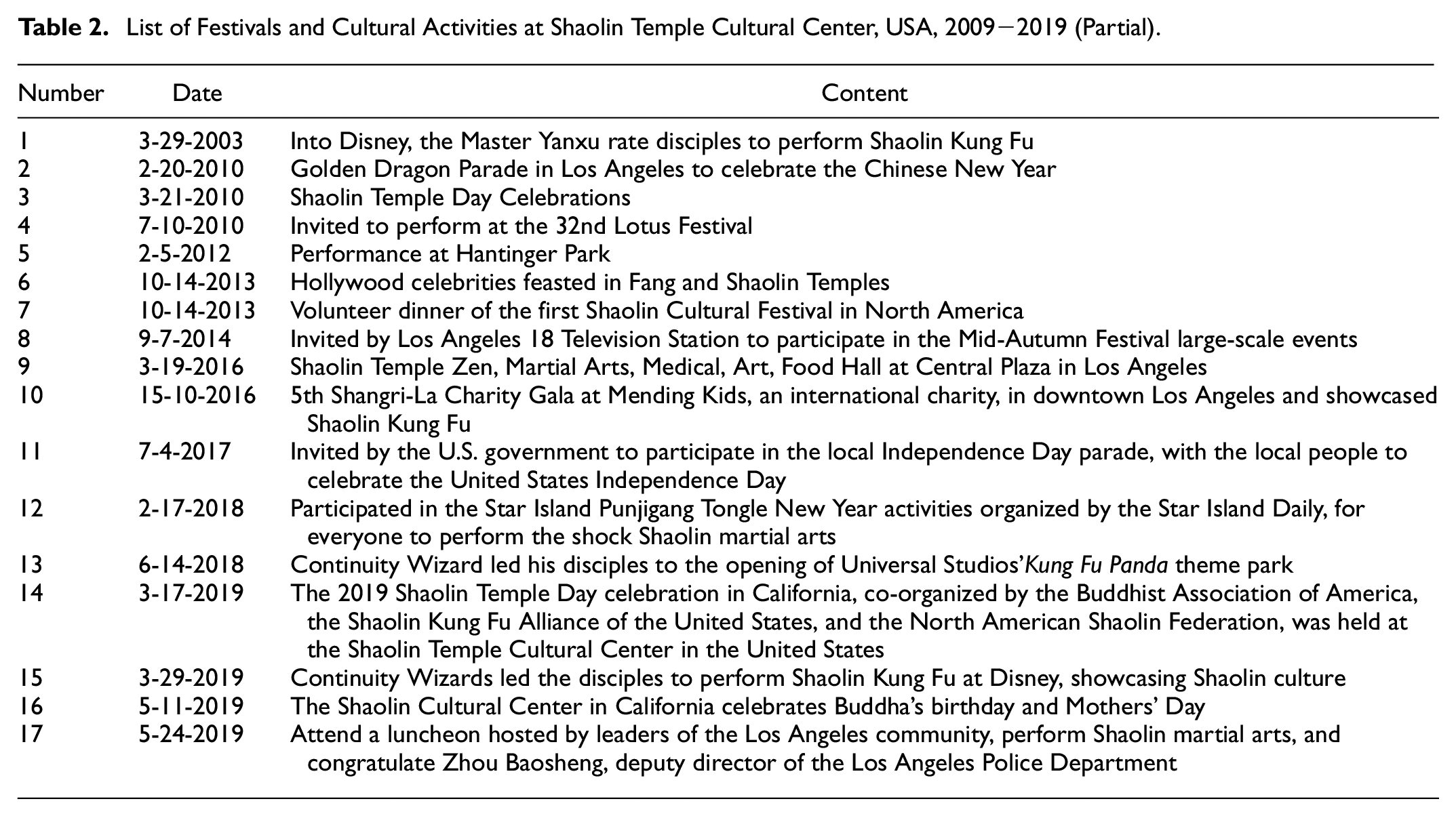
To enhance the influence of the Shaolin culture, the Los Angeles Shaolin Temple Cultural Center uses cultural performances with the help of the local government, organizations, enterprises, and other cultural and artistic activities and festival activities to engage with the American public, integrate into the mainstream society, and transform cultural capital into social capital. The Los Angeles Shaolin Temple Cultural Center has organized and participated in a series of cultural activities through the local government and the Chinese community, including government exchanges, television, film, local festivals, and performances at major tourist sites. It also holds annual year-end gratitude shows, achievements exhibitions, the North American Shaolin Culture Festival, the United Kung Fu Tournament, as well as occasional small lectures and activities at the Center. The organization and participation of these events have further strengthened the connection between the Shaolin Temple and the local community and government, thus expanding its influence in the local area. The events have also enabled the Los Angeles Shaolin Temple Cultural Center to gradually take root in the American market and enter mainstream society (Table 2).
List of Festivals and Cultural Activities at Shaolin Temple Cultural Center, USA, 2009−2019 (Partial).
Discussion
Shaolin Commercialization Path: Means or Destiny?
The commercial development mode of Shaolin culture has been through commercialization and industrialization. Specifically, the culture has moved from “worship” to “display,” rituals to practicality, uniqueness to replication, and from being profound to intimate. All these changes fully reflect the effects of commercialization on culture (Xu, 2016), but they do not necessarily mean the erosion of the Shaolin culture. In the international market, the Shaolin culture has certain advantages from being transformed into economic capital. Reasonable use of these advantages was instrumental for Shi Yanxu to set up the Shaolin Cultural Center and integrate into the international community with an appropriate identity. Upon receiving a relatively stable income, he did not stop there. Instead, he took the initiative to further integrate into mainstream American society through cultural performances. The assimilation of local cultural customs and the continuous introduction of a variety of Shaolin cultural products promoted the Shaolin culture’s objectification and institutionalization for reproduction.
The current case study on cross-cultural communication shows that commercialization is critical to the Shaolin culture’s diffusion, and the economic value derived from the Shaolin culture has motivated the output of diversified cultural production, such as international Shaolin martial art festivals, academic conferences, Buddhism activities, overseas performances, and the establishment of multiple Shaolin Temple branches and cultural activity centers. These are not possible without economic strength. When the Shaolin culture enters a new social structure, it must face the challenges of the devaluation and re-recognition of its original social values. In the diverse Kung Fu market, given the considerable differences in system and culture, commercialization is one of the only ways to achieve a breakthrough. Therefore, critics of the development mode of the Shaolin culture should not obsess over the economic benefits derived but should instead recognize the autonomy and uniqueness of culture in the production field.
Capital Conversion: Strategic Choice of Shaolin Culture Communication
Capital is accumulated labor (in its materialized form or its “incorporated,” embodied form) which, when appropriated on a private, that is, exclusive, basis by agents or groups of agents, enables them to appropriate social energy in the form of reified or living labor. (Bourdieu, 1997, p. 208)
Different types of capital have not only different specific efficacy but also different difficulties in accumulation and reproduction, with distinctive transmission methods. Such incomparability brings a high degree of uncertainty in capital conversion. Bourdieu (1997, p. 210) argued that, compared with economic capital, cultural capital is not a stable or universal currency, and it will encounter higher risks than economic capital in the process of intergenerational transmission.
For the Shaolin Temple, cultural capital is its natural capital form, which has profound advantages of accumulation and dissemination. To make good use of these advantages is to realize the transformation of cultural capital into economic and social capital, and the reproduction of Shaolin culture in foreign countries.
Through its brand image construction, the Los Angeles Shaolin Temple Cultural Center has laid the foundation for the understanding of Shaolin culture in different communities and helped these communities internalize Shaolin culture. The launch of the ranking promotion system for Shaolin Kung Fu has established academic qualifications and social guarantees for the institutionalization of cultural capital, and cultural performances have occasionally been organized to interact with governments, local communities, enterprises, influencers, and celebrities. Thus, the expanded social network and social capital have facilitated the transformation of cultural capital into social capital. The overarching guidelines for capital conversion are fundamental and critical for diffusing Shaolin culture in the United States and facilitating both value-addition and reproduction of Shaolin cultural capital.
Building Positive Cognition about Shaolin Culture
Shaolin culture has gained significant influence overseas, and Shaolin cultural centers and related institutions have been established in many regions. By examining the diffusion of Shaolin culture in China’s domestic market using the insights from this case study, the following confined and utilitarian perceptions can be identified. The universality of the Shaolin culture lies in its international adaptability, regardless of nationality or race. Although a few outliers may be occasionally detected, and it takes time for the public to understand and accept the culture, the ultimate goal of the Shaolin culture’s diffusion is in line with the Mahayana, or serving all sentient beings—a vision similar to China’s current strategy of “a community with a shared future for humankind” and the Belt and Road Initiative. Under the guidance of this purpose, the Los Angeles Shaolin Temple Cultural Center utilized a stepwise approach to building the Shaolin culture brand. Integration into American society through engagement with governments and local communities via Kung Fu performances to attract attention was only the first step for the international development of Shaolin culture. Therefore, in the new era of development, China should ascertain what Shaolin Kung Fu and Shaolin culture really are and how to make Shaolin culture known and appreciated globally rather than focusing on its temporary economic achievements. Only then can Shaolin culture have its legitimacy reaffirmed in the international market, gain a foothold in the fiercely contested international market, and be diffused to a greater extent.
Conclusion
The transformation of Chinese traditional culture into national cultural capital and resources for economic and social development embodies the principle of “creative transformation and innovative development” as a practical and rational value orientation (Fu & Yue, 2018). This transformation is an effective means to dissolve the contradiction between the value rationality existing in the national traditional culture and the instrumental rationality of modern society. Moreover, the transformation requires national traditional culture to be tested in the living environment of modern society and that cultural reconstruction be performed on the basis of the new social system (Li, 2019). Chinese traditional culture, as represented by Shaolin culture, is neither a business nor a purposeless cultural interaction in its overseas diffusion process. Instead, it shoulders the vital task of continuing the national cultural vein, promoting the communication of human civilization, and enhancing China’s soft power. The mindset that regards the material and the spirit as totally exclusive, cherishes passivity and conservatism, and fears the objection has hovered around Chinese society for thousands of years. Such a mindset often leads to the characterization of cultural commercialization as a symbol of modern spiritual crisis, the preservation of the traditional form of culture, and an unwillingness to seek innovation and change. Therefore, the Chinese government, media, and people need to jointly build a positive image of Chinese traditional national culture with a long-term vision to integrate it into the international community. Members of the international community should also adopt a more inclusive attitude toward the cultures of other countries. They should also allow cultures to exist in various forms of capital and constantly transform into forms conducive to cultural integration.
Implications for Research and Practice
One of the issues that concerned Bourdieu was the role of culture in social reproduction, that is, how groups seek strategies to produce and reproduce their collective living conditions, and how culture plays a role in constructing this reproduction process. This research verifies the important role of Bourdieu’s theory of capital transformation in cross-cultural communication, and shows how Shaolin culture, as a form of cultural capital, can transform into economic and social capital in the United States. This process is also typical of the transnational adaptation of Chinese traditional cultural organizations. However, it should be noted that in a developed capitalist society where market relations have made considerable inroads into the field of social relations, the transformation of various forms of capital is particularly high. By contrast, in a market society with a strong welfare system, the convertibility may be much less. Therefore, the discussion in this paper has some limitations. In particular, it primarily explores the capital transformation process of Shaolin culture in the United States, and verifies the important role of its path to commercialization in cross-cultural communication. However, for other countries with a low degree of marketization, including China, the transformation process of Shaolin cultural capital needs to be further discussed.
Footnotes
Declaration of Conflicting Interests
The author(s) declared no potential conflicts of interest with respect to the research, authorship, and/or publication of this article.
Funding
The author(s) disclosed receipt of the following financial support for the research, authorship, and/or publication of this article: This research was received support by grants from the National Social Science Foundation of China (18BTY022) & Henan Province Philosophy and Social Sciences Planning Annual Project (2021CTY029).
