




Abstract
Food safety culture has been posited as an important factor influencing employee behavior in the retail food industry. Although expressed as a subset of organizational culture, it is unclear the extent to which food safety culture is being defined and measured as a distinct but related organizational concept. Through a systematic review of the literature, this study explores how food safety culture is conceptualized and operationalized in studies investigating the concept in retail food establishments. Results showed no consensus in the conceptual definition, corresponding variables, and operational indicators for food safety culture across studies. Results also showed the corresponding variables identified for food safety culture were not derived from nor aligned closely with those associated with organizational culture. Together, these results suggest researchers are measuring different aspects of the same concept and not operationalizing food safety culture as a subset of organizational culture. As the development of measures to evaluate the prevailing food safety culture in retail food establishments is a prerequisite to the quantitative investigation of its impact on food employee behavior, the observed variation in corresponding variables and operational indicators of food safety culture can lead to incomparable results across assessments and studies.
Plain Language Summary
Although expressed as a subset of organizational culture, it is unclear the extent to which food safety culture is being defined and measured as a distinct but related organizational concept. This systematic literature review explores how food safety culture is conceptualized and operationalized in studies investigating the concept in retail food establishments. Results showed no consensus in the conceptual definition, corresponding variables, and operational indicators for food safety culture across studies. Results also showed the corresponding variables identified for food safety culture were not derived from nor aligned closely with those associated with organizational culture. Together, these results suggest researchers are measuring different aspects of the same concept and not operationalizing food safety culture as a subset of organizational culture. As the development of measures to evaluate the prevailing food safety culture in retail food establishments is a prerequisite to the quantitative investigation of its impact on food employee behavior, the observed variation in corresponding variables and operational indicators of food safety culture can lead to incomparable results across assessments and studies.
Keywords
Introduction
The U.S. Centers for Disease Control and Prevention (CDC) estimates nearly one in six people in the U.S. will fall sick annually from a foodborne illness (CDC, 2023). While not all these incidents of foodborne illness will be associated with outbreaks, the more than 800 foodborne illness outbreaks reported to CDC each year are most often associated with a specific retail food setting, restaurants. In fact, restaurants are linked to outbreaks more often than any other place where food is prepared (Centers for Disease Control and Prevention [CDC], 2019). In a study of restaurant-associated foodborne illness outbreaks between 1998 and 2013, CDC found 61% (2,955 outbreaks) of the 9788 outbreaks were traced to food employee behavior (Angelo et al., 2017).
Food employee behavior has been empirically linked to foodborne illness outbreaks in retail food establishments – an operation that stores, prepares, packages, serves, vends food directly to the consumer (e.g., restaurants and grocery stores), making positive behavior change a longstanding goal and tenet of regulators and leaders in the retail food industry. Although several theories that help explain the psychological drivers of human behavior (e.g., theory of planned behavior) have been advanced, there remains consensus in the psychology and organizational literature that human behavior is complex and changing human behavior can be difficult (Conner & Norman, 1994; Weinstein, 1993). Organizational researchers have examined and described the predictive power of management factors (e.g., leadership, management systems), personal factors (e.g., intrinsic and extrinsic motivators), job-related factors (e.g., workload, time pressure, and training), and external factors (e.g., law and regulation) on employee behavior (Nyarugwe et al., 2016).
Organizational culture has been studied in relation to employee and organizational outcomes in various organizations including retail food establishments (Brown, 1998; Hofstede, 1980; Martins & Terblanche, 2003; Maull et al., 2001; Van Den Berg & Wilderom, 2004). Martins and Terblanche (2003) defined organizational culture as “deeply seated values and beliefs shared by personnel in an organization,” while Schein (1985) defined it as
“A pattern of shared basic assumptions that a group learns as it solves its problems of external adaptation and internal integration, that has worked well enough to be considered valid and, therefore, to be taught to new members as the correct way to perceive, think and feel in relation to those problems.”
Discussed as a source of sustained competitive advantage (J. B. Barney, 1986; J. Barney, 1991; Sun, 2009), researchers have shown organizational culture to be a key factor for organizational effectiveness (Deal & Kennedy, 1983; D. R. Denison, 1990; Gordon & DiTomaso, 1992; Waterman & Peters, 1982; Wilkins & Ouchi, 1983). Denison and his colleagues (D. R. Denison, 1990; D. R. Denison & Mishra, 1995; D. R. Denison & Neale, 1996) in particular, identified and validated four dimensions of organizational culture conducive to organizational effectiveness: adaptability, consistency, involvement, and mission. Adaptability was described as the degree to which an organization can alter behavior, structures, and systems to survive in the wake of environmental changes while consistency refers to the extent to which beliefs, values, and expectations are held consistently by members. Involvement means the level of participation by an organization’s members in decision-making. Mission refers to the existence of a shared definition of the organization’s purpose. The prevailing theory has been that organizational culture influences employee behavior because individuals behave in ways that are consistent with their values; and organizational culture is a set of shared values. Gregory et al. (2009) explain that the culture of an organization should create behavioral expectancies that direct the employees to behave in ways that are consistent with its culture.
In the past decade, food safety culture, described as a subset of organizational culture, has been posited as a potential factor influencing employee behavior that can further help differentiate a group by influencing food safety performance (Buchanan & Huczynski, 2004; Griffith et al., 2010a; Nyarugwe et al., 2016; Schein, 2010). Griffith et al. (2010a) have also suggested more than one food safety culture may exist within an organization. However, to date, few studies appear to have investigated the relationship between food safety culture and employee behavior in retail food establishments (Griffith et al., 2010b; Neal et al., 2012). Moreover, it remains unclear whether a common definition and measure of the concept have been established. As stated by Engel and Schutt (2009), “how key concepts are defined and measured is important in order to evaluate the validity of the research” and “judgments about the evidence to support a particular intervention are not just about the demonstration of successful outcomes but also entail considerations about the quality of the measures of these outcomes.” Going from concept to measure involves two important and related steps: conceptualization and operationalization.
Conceptualization refers to the process of specifying the meaning of a term or concept (Engel & Schutt, 2009). In essence, it involves translating an ambiguous idea into a clear, exact, logical definition of a concept (conceptual definition). Operationalization, on the other hand, refers to the process of specifying the exact measuring method used for a given variable– specific aspects of a concept that vary and for which we select even more concrete indicators − which allows other researchers to follow the same methodology (Shuttleworth, 2008). Therefore, operationalization involves deciding “operational indicators,” the data that will indicate the presence of a particular variable. Think of the entire process as a continuum that goes from defining a concept to identifying corresponding variables to developing procedures to measure those variables.
The conceptualization and operationalization of ambiguous concepts allow researchers to systematically collect data on and evaluate processes and phenomena that are not directly observable (Roskam, 1989). Measures to evaluate the prevailing food safety culture in retail food establishments are a prerequisite to the quantitative investigation of its impact on food employee behaviors. The purpose of this study was to explore how food safety culture is conceptualized and operationalized in studies investigating the concept in retail food establishments. Leaving the interpretation of a concept to different respondents and readers can lead to incomparable results across assessments and studies (Driel, 2017).
Methods
The literature search was conducted on December 9, 2020, with the key search term “food safety culture” using Web of Science, PubMed, and Scopus. Results were refined by focusing on articles that include “food safety culture” in its title or abstract. Search in Web of Science processed with TI= food safety culture in which “TI” was the function for a title. Search in PubMed performed with (Title/Abstract = food safety culture). Search in Scopus utilized the function of (TITLE-ABS-KEY(food safety PRE/1 culture) AND DOCTYPE(ar)) that allows restricting articles to have the exact term “food safety culture.” Titles and abstracts of the articles retrieved from the search were reviewed to determine if they follow the inclusion criteria of the following:
Peer-reviewed articles published in English
Articles from the year 2000 onward
The article discussed food safety culture in a retail food establishment – an operation that stores, prepares, packages, serves, vends food directly to the consumer (e.g., restaurants and grocery stores)
As shown in Figure 1, a total of 165 articles were identified from the keyword search. After screening titles and abstracts for relevance and removing duplicates, the final number of articles was 22. Fourteen (14) of the 22 articles conducted an assessment of food safety culture in a retail food establishment. Of these 14 studies, 6 articles elaborated on definitions and included corresponding variables (hereafter “components”) and indicators measured (Figure 2).

Data collection process for articles focused on food safety culture in a retail food establishment.
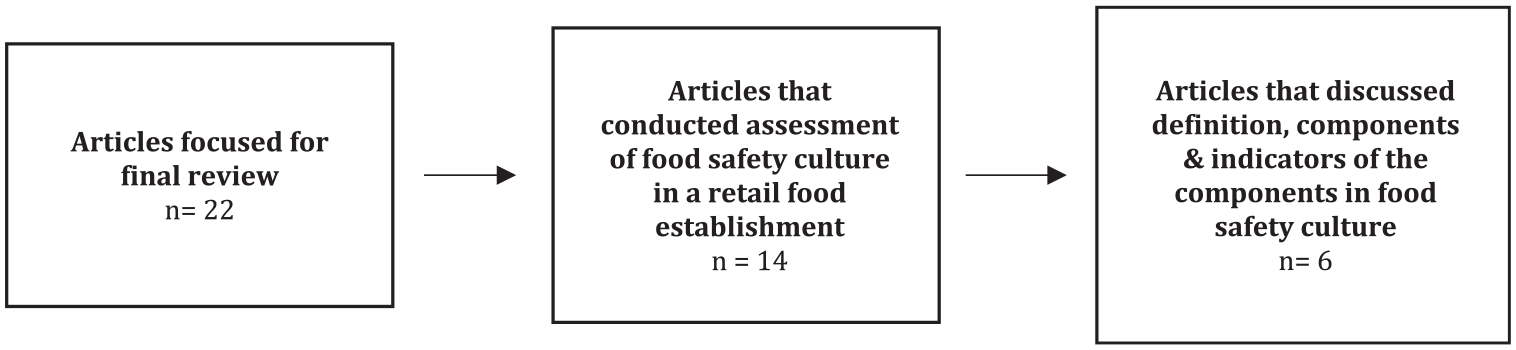
Data collection process of screening articles that assessed food safety culture and discussed definitions, components, and indicators.
Results
Conceptualization of Food Safety Culture
Among the 22 articles, 17 defined food safety culture in which we identified 9 unique definitions originating from one of five studies shown in Table 1. Of the 9 definitions, 3 appeared in more than one study. Definitions included “shared attitudes, values, and beliefs, regarding the food safety behaviors that are routinely demonstrated in food handling organizations” (n = 2) and “employees’ shared perception of leadership, communication, commitment, resources and risk awareness concerning food safety and hygiene within their current work organization” (n = 2). The most frequently occurring definition was “aggregation of the prevailing, constant, learned, shared attitudes, values, and beliefs contributing to the hygiene behaviors used within a particular food handling environment” (n = 9). Originally introduced by Griffith et al. (2010a), this definition is closely aligned to that of the Global Food Safety Initiative (GFSI) – a global industry-driven collaboration focused on advancing food safety –which defines food safety culture as the shared values, beliefs, and norms that affect mindset and behavior toward food safety in, across, and throughout an organization (Global Food Safety Initiative [GFSI], 2018).
Definitions of Food Safety Culture.

Note. 1Article contains more than one definition.
Components (Corresponding Variables) of Food Safety Culture
Like the variation observed in definitions, the components that comprise food safety culture to render the abstract concept observable and induce quantitative results also varied across studies. Sixteen of the 22 articles discussed components of food safety culture. The five most commonly occurring components (including subcomponents); commitment (n = 13), leadership (n = 10), risk perception (n = 10), communication (n = 9), and management systems or styles (n = 9) are shown in Table 2. While there was some overlap, both the number and combination of components varied across studies. The number of components ranged from two to nine. Ungku Fatimah et al. (2014) listed nine components, including environment support, teamwork, accountability, and work pressure, which were not mentioned in any of the 22 other studies. As shown in Table 2, there were only two studies with the same number of components. Both studies identified five components, however, those five were different. Interestingly, some components had the same name across studies but different descriptions of what they meant or different names for a similar description.
Comparison of Established Components and Operationalization of Food Safety Culture.

Five out of 16 studies that discussed components of food safety culture also included subcomponents under each component. For instance, Fujisaki et al. (2018) reported five components of food safety culture: individual, organization, environment, management, and management system and style. Under the component of “individual,” they included the subcomponents of commitment, experience, knowledge, and risk perception. Two studies, de Andrade et al. (2020) and De Boeck et al. (2019), included food safety climate as one of the components of food safety culture. However, the subcomponents of food safety climate differed between the studies. de Andrade et al. (2020) listed communication, self-commitment, management and coworker support, environmental support, risk judgment, normative beliefs, and work pressure while De Boeck et al. (2019) mentioned leadership, communication, commitment, resources, and risk awareness.
Operationalization of Food Safety Culture
Among the 14 articles that assessed food safety culture, only six discussed the indicators for operationalizing components of food safety culture (Table 2). The description of indicators varied across the studies identified. However, De Boeck et al. (2019) demonstrated a distinct operationalization of the food safety culture components compared to the other five studies. De Boeck and colleagues, when describing the indicators for the components of food safety culture, emphasized leadership performance by having employees rate the abilities of leaders and operators while the others focused on employees rating themselves. For instance, when operationalizing the component called “commitment,”De Boeck et al. (2019) investigated employee’s rating on the ability of leaders considering hygiene and food safety to be of great importance and operators being actively involved by the leaders in hygiene-related matters. On the other hand, Fujisaki and Akamatsu (2019) examined employee self-reported ratings on the priority or importance of safety, value, and risk perceptions.
The wide variation in operational indicators could be observed for other components as well. For the component of “leadership,”Zanin, Luning et al. (2021) focused on food handler’s rating on a questionnaire assessing managers’ involvement in food safety and ability to ensure best practices, while Wiśniewska et al. (2019) evaluated owner’s, manager’s, and employee’s rating on a questionnaire assessing management encouraging staff to respect food safety practices, highlighting the importance of food safety even with work overload, and appreciating employees that comply and focus on food safety. For another component, “communication,”de Andrade et al. (2020) investigated manager’s rating on a questionnaire assessing the training and communication strategies adopted while Ungku Fatimah et al. (2014) concentrated on employee’s rating on a questionnaire assessing the quality of the transfer of food safety messages and knowledge among management, supervisory staff, and coworkers.
Assessment Methods
Out of the 14 studies that assessed food safety culture, 12 adopted a questionnaire method which used either a five-point or seven-point Likert scale. However, the target respondent differed across studies. As described in Table 2, Zanin, Luning et al. (2021) and de Andrade et al. (2020) targeted both managers and food handlers, while Wiśniewska et al. (2019) described asking participants at all levels, including the owner, main manger, manager, shift manager, and employees. Another three studies (De Boeck et al., 2019; Fujisaki & Akamatsu, 2019; Ungku Fatimah et al., 2014) solely focused on non-mangers.
Not surprisingly, the format of questionnaires varied across studies as well. Zanin, Luning et al. (2021) and de Andrade et al. (2020) constructed two different questionnaires for managers and food handlers. In contrast, other studies distributed the same questionnaire to all participants. Two studies, de Andrade et al. (2020) and Zanin, Luning et al. (2021), adopted other quantitative methods along with a questionnaire. de Andrade et al. (2020) investigated a component of “management systems or styles” of food safety culture with a checklist. While a questionnaire was used to examine a human route of food safety culture, the checklist was used to assess a technical-managerial route of food safety culture. The checklist consisted of nine sections evaluating the presence of food safety management systems, physical structure analysis, and the food safety practices, which then assigned a foodborne disease risk score to each establishment. Zanin, Luning et al. (2021) utilized a checklist to assess the components of the “work environment” and “management systems, styles, and process.” The checklist was designed to analyze the environment such as infrastructure, equipment, and the compliance with sanitary law. While de Andrade et al. (2020) also used a checklist, the components assessed were different; even though the checklist in both studies sought to evaluate the physical food safety environment
Jespersen and Wallace (2017) recommended a method triangulation—using more than one kind of method to study—describing the approach as a more comprehensive evaluation of food safety culture considering the strengths in one method can compensate weaknesses in other methods. In keeping with this thinking, De Boeck et al. (2019), Nyarugwe, Linnemann, and Luning (2020), and Zanin, Luning et al. (2021) assessed food safety culture with a mixed-methods approach. De Boeck et al. (2019) applied internal audits and verification of registration data of Critical Control Points of HACCP system to assess techno-managerial route and a food safety climate questionnaire to examine human route. Nyarugwe, Linnemann, and Luning (2020) included interviews, card-aided interviews, questionnaires, participatory observations, and document analysis when Zanin, Luning et al. (2021) used checklists, questionnaires, and participant observations. The last two studies both adopted qualitative method of observations, but they were conducted in different manners. Nyarugwe, Linnemann, and Luning (2020) integrated researchers in a food handling group without informing the group is being observed for a different duration depending on the tasks. Conversely, Zanin, Luning et al. (2021) checked participant’s routine regularly for 4 months.
Aside from quantitative methods and mixed methods, Nouaimeh et al. (2018) and Caccamo et al. (2018) followed a Food Safety Culture Excellence model from an external organization. The model was designed with more than three questions (both quantitative and qualitative) for each subcomponent under four components of food safety culture.
Discussion
This systematic review explored how food safety culture is conceptualized and operationalized in retail food establishments. Despite being described as an important risk factor for foodborne illness outbreaks and a new focus of the retail food industry to improve food safety performance (Abidin et al., 2014), results showed a lack of consensus in the definition, components (and component descriptions), and procedures to measure food safety culture in studies exploring the concept in retail food establishments, suggesting researchers are describing and measuring the concept differently. Where one conceptual definition focused on the shared attitudes, values, and beliefs about the food safety behaviors routinely demonstrated in food handling organizations, another conceptual definition focused on the shared attitudes, values, and beliefs that affect food safety behavior. Together, this may help to explain what researchers have described as a lack of consensus in the theoretical and empirical underpinnings of the relationship between food safety culture and employee behavior (Abidin et al., 2014; Nyarugwe et al., 2016). These findings are also consistent with those of Nyarugwe et al. (2016), who in a literature review to identify determinants for conducting food safety culture research, concluded consensus on the definition, components, and indicators of what implies food safety culture is still a challenge and that “having the established food safety culture research determinants could bring clarity in food safety culture research and provide a useful starting point to the common understanding and research of food safety culture.”
As described earlier, operationalization is the translation of abstract variables into procedures that render them observable. Because both behavioral and social concepts are intertwined in food safety culture, operationalization plays a critical role in its research. This is important to induce comparable results and clarified interpretations. The observed variation in definitions, components, and associated measurement of components presents challenges in settling upon the appropriate indicators for a comprehensive evaluation of food safety culture and can lead to incomparable results across assessments and studies.
While it was expected that the components of food safety culture would align closely with those of organizational culture, the components identified in the literature studied (commitment, communication, leadership, management systems or styles, and risk perception) were largely derived from and aligned with factors perceived to influence safe food handling practices and did not align with key components of organizational culture, namely adaptability, consistency, involvement, and mission (D. R. Denison & Neale, 1996). In fact, several components of food safety culture found in this review are variables previously shown to independently impact organizational culture and employee behavior. Leadership behavior, in particular, has been shown to impact management systems, organizational commitment and culture, and employee behavior (Dunn et al., 2012; Ko & Kang, 2019; Purwanto et al., 2019; Rizki et al., 2019; Sarros et al., 2002). Therefore, there is a need to recognize and clarify whether the identified components in the literature studied duly constitute antecedents, components, or outcomes of food safety culture.
If food safety culture is to be understood as a subset of organizational culture, researchers may be well served to adopt the definition of food safety culture developed by the GFSI (2018) and future research should consider aligning the components of food safety culture more closely to the D. Denison et al. (2014) validated four dimensions of organizational culture conducive to organizational effectiveness: adaptability, consistency, involvement, and mission, within the specific context of food safety. In doing so, future research should also ensure food safety culture is operationalized distinctly and separate from other organizational variables such as leadership and food safety management systems; making clear the variables that constitute antecedents, components, or outcomes of food safety culture. Consequently, the relationship between leadership behavior, human resource practices, organizational culture, and food safety culture should also be studied.
The extensive search conducted across several databases, encompassing multidisciplinary literature, was the key strength of this study. However, a key limitation was the relatively small number of studies meeting the inclusion criteria, which limited our synthesis. It is important to note that this review focused on food safety culture in the organizational context and as an organizational concept distinct from, but related to, organizational culture. Moreover, this review focused on identifying the components that comprise food safety culture to render the abstract concept observable and induce quantitative results. Factors of the external company environment, such as national culture, were not considered for conceptualizing food safety culture within an organization. Likewise, this review did not consider an individual’s religion or personal beliefs, values, or sense of belonging to specific identity groups as factors for conceptualizing food safety culture in the organizational context. National culture can provide a broader context for understanding food safety culture as personal beliefs, values, or sense of belonging to specific identity groups will undoubtedly influence perceptions of organizational practices and policies; however, it is the individual organization and its practices that play a significant role in shaping its specific food safety culture (Ashforth & Mael, 1989; Nyarugwe, Linnemann, Ren, et al., 2020). As more research is needed to better understand the role of national culture and personal beliefs and values in shaping the prevailing food safety culture of an organization, future research should continue to explore food safety culture across multinational and diverse organizations (Nyarugwe, Linnemann, Ren, et al., 2020).
Footnotes
Declaration of Conflicting Interests
The author(s) declared no potential conflicts of interest with respect to the research, authorship, and/or publication of this article.
Funding
The author(s) disclosed receipt of the following financial support for the research, authorship, and/or publication of this article: This work (research) is supported by the Food and Drug Administration (FDA) of the U.S. Department of Health and Human Services (HHS) as part of an award totaling $3,894,104 with 0% financed with non-governmental sources. The contents are those of the author(s) and do not necessarily represent the official views of, nor an endorsement by, FDA, HHS, or the U.S. Government. For more information, please visit FDA.gov. The findings and conclusions in this study are those of the authors and do not necessarily represent the views of FDA.
Ethics Statement (Including the Committee Approval Number) for Animal and Human Studies. (If This Is Not Applicable,Please State This Instead.)
This is not applicable.

Data Availability Statement
Data sharing not applicable to this article as no datasets were generated or analyzed during the current study.