




Abstract
The goal of this in-depth interview study was to gain knowledge about important, needed and developed competencies of executives. Supplementary design factors and implementation barriers were examined as framework conditions for competency development. The study (N = 66) gathers information from three different subject groups: executives (n = 22), freelance trainers (n = 23), and corporate HR professionals responsible for executive development (n = 21). A total of 13 important competencies were extracted from the answers of all respondents. Groups agreed on five competencies (leading, communication, achievement motivation, organizing and strategy, social influence) which are therefore classified as needed. Design factors and implementation barriers were classified, ranked according to relevance and evaluated in general and on a group-specific basis. The two most important design factors mentioned by all subject groups are: 1) to ensure the practical relevance of development programs; and 2) to include time for discussion and reflection. The three most common barriers are daily business, conflicting old habits and lack of motivation. Results also show that other competencies are also developed, but are not classified as needed (e.g., openness for novelty, and self-reflection). These findings provide insight and guidance for creating training and development programs for sales executives that focus on the competencies that are needed and how these can be developed.
Vocational development has been an important topic for organizational research already for decades (Katzell, 1948), as the development of human resources plays a major role in ensuring a sustainable competitive advantage (Aguinis & Bradley, 2015). In this context, the development of executives is of special interest for many reasons, including its impact on business unit performance (Song et al., 2020), the wide range of influences on development (Deng et al., 2021; Epitropaki et al., 2021; McClean et al., 2021), and the decisive role it plays in mastering organizational challenges (Meffert & Wagner, 1992). Yet the development of executives remains a struggle (Lacerenza et al., 2017; Schied, 2001; Powell & Yalcin, 2010), especially given the changes due to the current pandemic (Caligiuri et al., 2020), and the struggle is likely to increase as many companies are forced to transform and adapt to changes faster than ever before (Arora & Suri, 2020). In order for companies to transform themselves the development of executives becomes even more important (Zotto, 2001) as personnel and organizational development are so closely interwoven. The sales department still has a special role to play here, because sales and organizational development start where growth comes from, namely with sales.
Competency and competency based development have been objects of scientific inquiry for more than 30 years (Streufert et al., 1988) and have been used in many human resource (HR) and HR development studies (Dragoni et al., 2011; Mahoney et al., 1960). The focus on executive competency development is understandable, and not just because corporate personnel development is critical for executives (Götz, 1994), but also due to its two major advantages:
First, staff development among managers is less constrained by environmental factors. While the breadth of staff development is often constrained by budgets (Donaldson, 1998), pre-selection by supervisors (Honeycutt et al., 1994), and company policy (LaForge et al., 1997), managers have more influence over their own development.
Secondly, in the development of executives the focus is mainly on interdisciplinary skills. These skills are more likely to be transferable and utilizable (Ismael et al., 2021), and less likely to fluctuate due to major environmental changes like a pandemic (Dirani et al., 2020). In this regard many promising competencies such as organizing (Sudirman et al., 2019) or organizational competencies (Gigliotti & Ruben, 2017; Ruben, 2019), empathy (Boda, 2017; Park & Faerman, 2019), achievement motivation (Jackson et al., 2003; Stahl, 1983; Stewart & Roth, 2007), social competency (Morgeson et al., 2005) or social influence (Ruben & Gigliotti, 2016), problem solving (Grzybowska & Łupicka, 2017; Moffie et al., 1964), motivation to lead (Van Iddekinge et al., 2009), motivational skills (Darling & Cunningham, 2016), and communication (Darling & Cunningham, 2016; Dirani et al., 2020; Ruben, 2019) have been grouped in various frameworks and models (Day & Dragoni, 2015; El Asame & Wakrim, 2018). In addition, methods and design factors supporting successful development have been intensively investigated (Au, 2005; Bhatti & Kaur, 2010) resulting in the publication of models for prioritizing and overcoming implementation barriers (Ikram et al., 2020). Yet the effectiveness of (sales) executive developments reported in meta-analyses (Avolio et al., 2009; Burke & Day, 1986; Collins & Holton, 2004; Lacerenza et al., 2017; Powell & Yalcin, 2010) remains moderate making it difficult to ascertain whether in fact the wrong competencies are being developed, using methods which do not fit the content, or whether learnings are not applied because of implementation barriers.
Research Gap and Conceptual Development
After careful analysis of the current situation, two main research questions arise: Which competencies do practitioners consider to be important? How are these competencies being developed, if at all?
Even though literature reviews to determine important competencies (Jokinen, 2005), surveys about perceived development needs (Viitala, 2005) and meta-analyses with implications for developments (Gaddis & Foster, 2015) have been conducted, just what exactly the “right competencies” are remains unclear. According to the literature, competency models can be found for industries (Prifti et al., 2017), specific sectors (Bashir et al., 2021; Ranjbar et al., 2014), hierarchical levels (Kan et al., 2002), positions in the company (Kaur & Bains, 2013), centuries (Rahman, 2012), generations (Harrison, 2015), subgroups such as females (Jaafar et al., 2016), core competencies (Edgar & Lockwood, 2021), as well as general competency frameworks that can be individualized (Midhat Ali et al., 2021). Yet from the abundance of models, it is difficult to determine exactly which competencies are important for specific jobs. In addition, the competencies included in the models and extension frameworks are all equally weighted (Bruno et al., 2010; Hollenbeck et al., 2006), while in reality money and time are limited, which often makes prioritization of competencies a necessity (Mikołajczyk, 2022).
Methods and design factors supporting successful development have been intensively investigated (Au, 2005; Bhatti & Kaur, 2010) as there are differences regarding how a development is designed and delivered (Salas et al., 2012). A wide range of factors have been examined, including role-play (Kaiser & Kaplan, 2006), time for discussion (Bretz & Thompsett, 1992), quality of the trainer (Rossett & Krumdieck, 1992), the development being practical and applicable (Jackson et al., 2003), and delivery methods (Wuestewald, 2016). However, it is not possible to deduce from the studies exactly what factors are preferred by the practitioners involved in personnel development.
Since obstacles often result in development occurring without implementation of what is learned, past research has also investigated application barriers. Some of the potential barriers that have been identified and discussed include lack of supervisory support after the development (Hua, 2013), unrealistic expectations of stakeholders (Hueske & Guenther, 2015), lack of motivation (Blume et al., 2019), unsupportive organizational culture (Day et al., 2014), and resistance to change (Damawan & Azizah, 2020). These studies are very important given the lack of awareness about organizational barriers (Smith, 2012) which is why there is still no consensus regarding explanations for human resources development failure (Kauffeld & Grote, 2014).
However, there are more factors contributing to the fact that in practice personnel development of managers lags behind what is believed to be theoretically possible. Executive and leadership development studies are often conducted with university (MBA) students (Ballou et al., 1999; Reyes et al., 2019) which limits the transferability of the results. The theories behind scientific competency models range from grounded theory (Pan, 2017), systems theory (Bradley & Keating, 2014), and brain theory (Dotson, 2015) to the Iceberg Model (Ho & Frampton, 2010). This broad theoretical foundation is contrasted by research practice, where an empirical foundation is the exception (Dionne et al., 2014).
Research is often one-sided (Kornau et al., 2020), since multiple perspectives are rarely surveyed, even though a more holistic picture would be generated by including multiple and also external parties. This shortcoming is apparent given the lack of empirical data in which HR professionals responsible for executive development (Rossett & Krumdieck, 1992; Wright & Grant, 1995) or freelance executive trainers (Guillemette, 2012) are included in the sample, even though they are experts with an objective perspective (Granado, 2019). Such HR professionals are also not considered in the development of newer approaches, such as data-driven human resource development (Tkaczyk, 2017). The analysis made by Kornau et al. (2020) identifies that increased diversity in research would not only help to improve the examination of complex phenomena, but would also help to prevent limitations and prejudiced views by balancing different and multiple perspectives. An effective strategy for reducing the risk of limitation, potential bias and prejudiced views is within-method triangulation. It is achieved by using different subject groups as multiple data and conducting multiple studies with the same method and questions (Natow, 2020). This approach is convenient, especially since studies using within-method triangulation together with multiple subject groups are rarely conducted (Asare et al., 2012). There is great potential in the combination of triangulation through interviews (Mayrhofer, 2009), as interviews provide more robust information (Wagner, 1948) and insights into the subjective reality, with their focus on relevant experiences, information, opinions and attitudes as valid sources of data. Triangulation of interviews is thus a valuable method for pedagogical constructivism and its emphasis on the subjective perspective. That is why triangulation is particularly suitable to elaborate the construct shared realities with others and thus to enable “viable” action (Siebert, 2005).
In order to close the research gap on executive development, reduce the lack of diversity in research approaches and perspectives (Kornau et al., 2020), and to identify commonalities in the common realities that are constructed it is necessary to gather more knowledge and understanding of competency development, design factors and implementation barriers involving multiple parties, and use of in-depth interviews. This reflects the fact that research methods used in past research have had little or no influence on the results, meaning that any respective findings from the current study will supplement existing knowledge in terms of depth and breadth. The results of this study will also enable practitioners to further improve vocational development (content, methods, and implementation), which is crucial, since developments are rarely evaluated in the literature (Gordon et al., 2012).
Definitions of Concepts
The following constructs were defined for this current study, creating the theoretical framework for the research questions:
Human resource development (HRD) is defined as all activities of an organization aimed at ensuring employees are equipped for current and future tasks. HRD has a career reference and is centered on the individual (Nerdinger et al., 2019). HRD includes developments with department-specificity, cognitive focus or general management trainings, as well as developments with a focus on multidisciplinary competency development (Armstrong, 2019). However, workplace design, outplacement programs, and organizational developments are not considered within HRD.
Competency encompasses individual personal factors enabling the individual to meet performance requirements and master the work tasks (Nerdinger et al., 2019, p. 512). This definition includes personality traits (such as openness from the Big Five personality model) that have repeatedly been proven to be related to salary across all occupational groups (Ng et al., 2005), along with knowledge, skills, abilities, social and motivational aspects (Weinert, 2001). Competencies are considered as (truly) needed if they are considered needed by all three study groups of practitioners. Otherwise, they are considered important.
Design factors of the development include techniques (e.g., role play, group discussion) and materials used (e.g., handouts, flip chart), as well as circumstances (e.g., location, instructor) relating to the realization of the development to convey the content and enhance learning. Design factors only relate to the development itself (Holton, 1996).
Implementation barriers are obstacles that emerge after the development and hinder application. Barriers are rooted in the individual (Fischer et al., 2016), including resistance to change or motivation for transfer (Hochholdinger & Schaper, 2008), or the organization (Olsen & Boxenbaum, 2009), along with lack of management support (Beer & Eisenstat, 2000) or high workload (Kauffeld & Grote, 2014). If there is no application in the workplace given that nothing has been learned or a lack of correspondence between development content and practical requirements, then the consequence is not stemming from implementation barriers.
Research Questions
The goal of this research is to answer the two main research questions (“Which competencies do practitioners consider to be important? How are these competencies being developed, if at all?”) in order to identify from them an up-to-date and comprehensive set of competencies for sales executives. To achieve this goal, practitioners involved in personnel development (executives who develop employees themselves, freelance trainers and HR staff whose focus is on personnel development) were interviewed about current procedures and their personal opinions.
The first main research question has two sub-questions. These focus on the identification of competencies currently being developed and seen as needed by practitioners involved in staff development:
1.1Which competencies are most often developed among executives?
1.2What competencies are needed for today’s executives?
The second main research question has two sub-questions in order to examine the design factors attributed to the successful development of executives (such as methods, forms, and realizations) and implementation barriers, since content cannot be conveyed without methods (Nerdinger et al., 2019) and implementation barriers have an impact on improvement (Kauffeld & Grote, 2014):
2.1What design factors are attributed to the successful development of executives by practitioners involved in personnel development?
2.2What barriers interfere with the implementation process after development according to practitioners involved in personnel development?
To reduce the risk of limitations, potential bias and biased views, there are two sub-questions for triangulation. The aim here is not primarily to evaluate the answers themselves but to explore possible biases in the results that have not been explored in previous competency research, as studies have rarely been conducted with different groups of subjects (Olsen, 1998):
3.1Is there agreement among practitioners involved in personnel development regarding the most developed and needed competencies?
3.2Is there agreement among practitioners involved in personnel development regarding design factors attributed to the successful development and barriers interfering with the implementation?
Methodology
The current research reported in this article consists of three interview studies conducted in 2017 within a sales context. The decision to use a series of interviews within this context was made based on three fundamental considerations. First, sales executives have large budgets and co-determination over utilization (Donaldson, 1998). Therefore, developments are frequent, diverse and of high quality. This means that sales executive trainers and HR professionals responsible for sales executive development also have diverse experience and the necessary expertise to make sound statements (Donaldson, 1998; Honeycutt et al., 1994). Second, sales executives spend part of their own time designing developments for their own employees and training them (Seidenglanz et al., 2016) and are thus themselves also practitioners in the field of human development. This expert experience enables them to distinguish between content and method (Hirsh et al., 2004) and knowledgeable about needs and preferences. Therefore, the three interview groups are comparable in their expertise. Third, all three subject groups have in-depth knowledge about design factors and implementation barriers (Granado, 2019), since they are all involved in some way with the conceptual design of developments, making it possible to derive valuable and useful insights from their statements.
Considering that data saturation typically occurs by the analysis of 12 interviews “if the goal is to describe a shared perception, belief, or behavior” (Guest et al., 2006, p. 76), the research goal was to also identify differences in opinion between subject groups (within-method-triangulation) meaning that the recommended number was raised by 50% for each study. Thematic saturation for each subgroup was assessed and confirmed after data collection (Guest et al., 2020) using a base size of six interviews, a run length of three and new information threshold of 0. Study 1 focused on sales executives who contributed by providing insights and information from the perspective of reflected development participants. In Study 2 freelance trainers specialized in the development of sales executives were interviewed to represent a point of view that is independent from a specific organization or organizational culture to gain a perspective without the interdependence of people and organization (Wilkens & Minssen, 2010). Study 3 targeted professionally experienced employees of human resource departments (HR executives or senior in-house consultants) responsible for the development of sales executives to provide a strategic long-term perspective.
Samples
Since a representativeness of the results was aimed for, as a sampling strategy (Prein et al., 1994) statistics were collected from the literature about each group studied (typical executives, freelance trainers and HR professionals) and average characteristics (age, gender, work experience, educational background) were extracted. Based on this data, impressionistic selection (Cook & Campbell, 1979) was performed. While in the criterion sample all cases are selected according to a predefined criterion (e.g., patients with depression), the impressionistic selection tries to include at least one case from each group studied that contains average characteristics. This can be selected—if data are available—on the basis of overall statistics, previous results or—if these do not exist—on the basis of expert interviews (Prein et al., 1994). The aim behind this is to have at least one typical representative of previous data collection in the sample (e.g., white middle-aged male executives with university degree), at the same time to allow heterogeneity in the sample, to be open and aware of changes (young female POC executives without degree), to be able to estimate the impact of changes in society as well as the impact on results of data collection resulting from environmental changes distal to the criterion and to ensure the external validity of research results.
Respondents were searched via Xing, Linked-In, and google, as well as recruited by snowballing from the first author with an email and a request for a phone call. All interviews were conducted by students (Master or PhD) who are part of a research team that has been working intensively on human resource development and sales management for years. To ensure an understanding of the situation, there was prior literature work with close supervision (meetings every 2 weeks).
Sample of Study 1: Executives
Sampling procedures for Study 1 included invitation, agreement, review, and final selection. Initially, 54 sales executives were invited to participate. At the outset seven interviews were excluded based on formal criteria. Requirements for participation in the study related to specific aspects of previous experience and participation in HRD programs and initiatives: Participation in a development program which took place less than 10 years ago, which was about learnable behavior, and which had an effect on their performance as an executive (according to their own estimation). Of the remaining 47 executives contacted, 28 agreed to participate and were interviewed. Upon examination of the transcript, six interviews were excluded from the data analysis due to content issues, as interviewees talked about development for product knowledge, for their employees, or made unclear and ambivalent answers. Therefore, the final data set for Study 1 included the interviews of 22 executives (86.3% male; with a mean age of 36.7 years, SD 5.8).
Sample of Study 2: Freelance trainers
The sample of freelance trainers for Study 2 was obtained after the procedures of invitation, agreement, review, and final selection. A requirement for participation was confirmation of freelance status (only self-employed trainers were accepted) and specialization on the development of sales executives. After invitation, 28 freelance trainers agreed to participate and were interviewed. Three interviews were excluded from the data analysis as the interviewees declared permanent employment in an organization (not self-employed) or did not have the required level of specialization. After analysis of the data, an additional two interviews were excluded due to ambivalent and unclear answers. Therefore, the final data set for Study 2 consisted of interviews with 23 freelance trainers (73.9% male; with a mean age of 39.5 years, SD 6.5).
Sample of Study 3: HR professionals
For Study 3 the sample consisted of 22 HR department professionals (executives or senior in-house consultants) responsible for the development of sales executives, after following procedures of invitation, agreement, review, and final selection. Of the 22 HR professionals invited, 21 agreed to participate and completed the interview process. No interview was excluded. The final data set for Study 3 includes interviews conducted with 21 HR professionals (38% male; with a mean age of 35.4 years, SD 6.2).
Interview Questions
All in-depth interviews started with open questions focusing on experiences with developments and had a main part with standardized open-end questions. When answers were short (less than five sentences) or unclear, interviewees were asked if it was possible to describe their experiences again, in greater detail. The first main question asked participants to identify and describe the most frequently targeted competencies in development programs (Which competencies are enhanced by human resources development activities for sales executives most frequently?).
Subsequent questions asked the participants to name needed competencies and to identify the two most important competencies (at the individual level) of executives (Which competencies are important for the job of a sales executive, and which two competencies of those are particularly relevant?). This question enabled a periodization in the results, ensuring that no group is favored in the evaluation at sample level (group level). Afterward, interviewees were asked about design factors associated with the development of executives (In your opinion, which design factors make these developments particularly effective?). Finally, interviewees were asked to identify barriers interfering with the implementation process after development programs (Which barriers impede or prevent the applicability of what has been learned in these executive developments in everyday life?).
Each interview lasted between 45 and 60 minutes and ended with demographic questions. Interviews were made by telephone and recorded. The audio data of the interviews was anonymized by deleting any personal information (relating to the individual or the company) and then transcribed in full.
Development of the Interview Coding System
An interview coding system used to identify the competencies was created by using qualitative content analysis, which occurred in two phases following procedures outlined by Mayring (2010).
The first phase was the development of a primary coding system based on the examination of half of the interviews of each subgroup. Relevant extracts of the answers were analyzed and sorted in categories that grouped extracts closely related to each other (inductive approach) by two scientists qualified in Psychology (possessing a Bachelor or higher). The categories were named with the most appropriate generalization (in line with summative content analysis) and then presented to an expert panel of six scientists who were qualified in Psychology (possessing a Master or higher) and actively pursuing research in the field of executive development. The categories were reviewed, discussed, and defined to form a primary coding system that included six categories inspired by Arthur et al. (2003): leading, communication, achievement motivation, social influence, organizing and strategy, and problem solving. These categories were further supplemented by five categories drawn from a literature review on executive development research (deductive approach): department-specific expertise, motivating others, confidence, empathy, and openness to novelty.
The second phase involved using the primary coding system to code 30 interviews by two different qualified raters (holders of a Bachelor or equivalent degree in Psychology). The Cohen’s Kappa values were calculated and discrepancies in coding were discussed. This phase included a revision of the coding system by the same panel of experts as in phase 1 following the same procedures. Revision of the coding system resulted in a reduction of complexity, as some sub-categories were deleted. For example, in the original category “communication” consisting of three sub-categories (“communication with employees,” “communication with customers,” “communication with others”), but assignment to sub-categories was not always possible as some respondents made no specification. For this reason, the sub-categories for communication were discarded, and a 12th category for answers that had self-reflection/ introspection as central elements was added. For an example of how relevant text passages are extracted and then coded, see Table 1.
Example for Coding Process.

Note: Shown is the first part of the answer of “PJ20” to the question “Which competencies are important for the job of a sales executive and which two competencies of those are particularly relevant?”
The original coding system for design factors had four categories based on research by LaForge et al. (1997), including method (e.g., group discussion), instructor (e.g., academic professional), sites (e.g., college), and forms (e.g., on the job coaching). After the coding of the 30 interviews an overlapping of categories was recognized making it difficult to integrate some answers. In response to this, two categories were changed. The original categories made coding difficult for process aspects that were mentioned (e.g., follow-ups) and could not be classified, and also for how methods were used (e.g., one participant stated, “We had a lot of role-playing but it was very individual as everyone could bring their own examples which we then played through.”). Therefore, the original category of forms was changed to structure, and sites was replaced with realization.
The primary coding system for the implementation barriers was based on theoretical considerations influenced by the model of the transfer process (Baldwin & Ford, 1988), the model of transfer proposed by Burke and Hutchins (2008) and Gessler’s (2012) model, consisted of three categories (organizational, intra-individual, and other barriers) and remained constant during the entire analysis.
Data Analysis
After finalizing the coding system (described in detail above) the systematic analysis of non-numerical data used MAXQDA software (Becker et al., 2012) to code, systemize, and compare all interviews (Leech & Onwuegbuzie, 2008). For subsequent numerical analysis, IBM SPSS Statistics 19 software was used (George & Mallery, 2016).
Results
Interrater Reliability (Cohen’s Kappa)
In order to ensure the trustworthiness and reliability of the results presented in all three studies, the interrater reliability was examined and evaluated (Fleiss & Cohen, 1973). Cohen’s Kappa was selected as it is an accepted statistical procedure for measurement of agreement between two raters (Berry & Mielke, 1988). In all three studies, Cohen’s Kappa was calculated on 10 double-coded interviews before the coding system was finalized, and again after the final coding system was applied. The values for each study are indicative of high interrater reliability (Landis & Koch, 1977) after finalizing the coding system, and are listed as follows (before/after): Study 1 (0.82/0.97); Study 2 (0.76/0.96); Study 3 (0.64/0.97). Figure 1 provides an overview of the final coding system with 4 to 5 most relevant extracts.
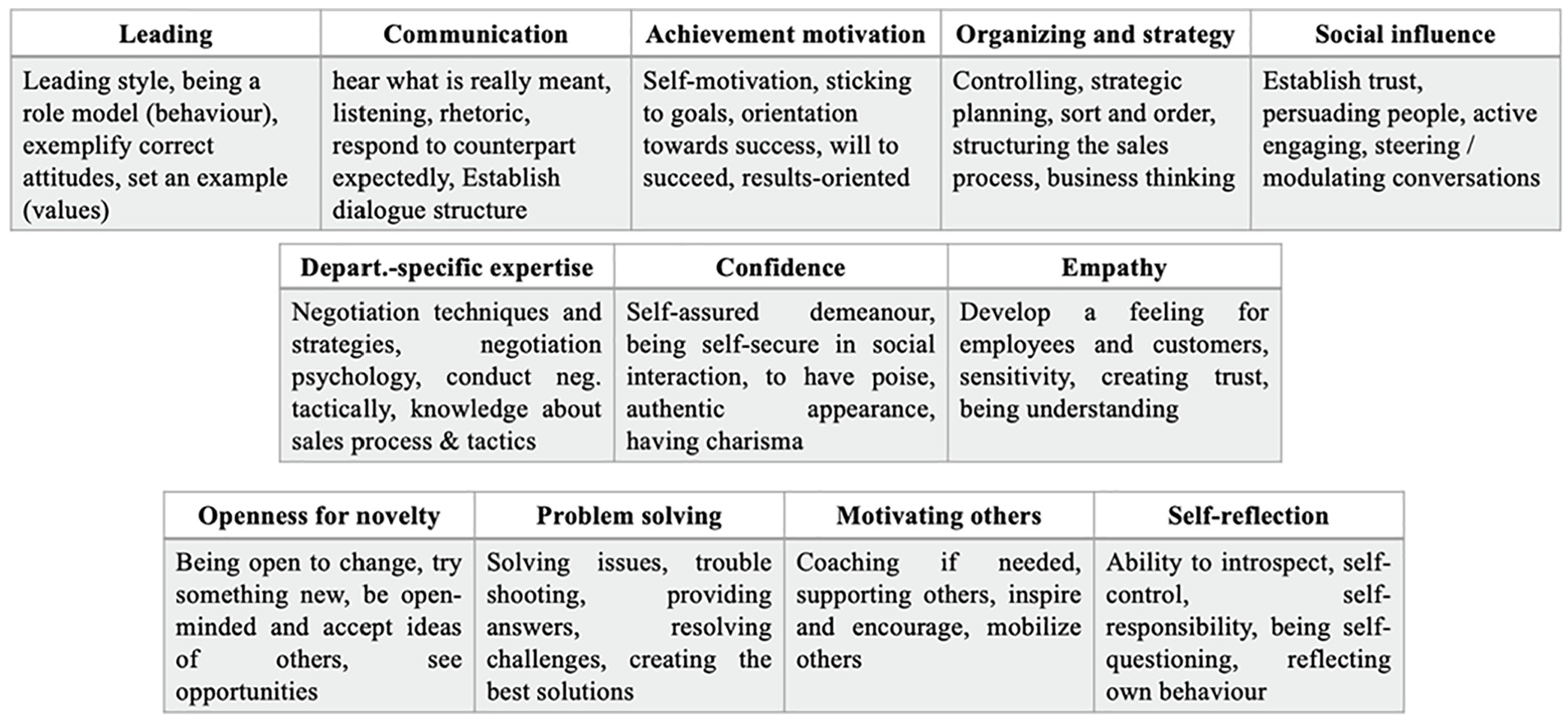
Final coding system with four to five most relevant extracts as defining components. Note.1: Competencies mentioned as needed by all subgroups are in row 1, competencies mentioned as needed by at least one subgroup are in row 2, competencies not mentioned as needed by any subgroup are in row 3. Note 2: “Typologies” would have been in row 3 but was not included in the figure because there were no common defining components.
Competencies Most Often Developed
When asked to name the competencies most often developed, the average number of reported competencies was 1.9 (executives), 2.1 (freelance trainers), and 3.2 (HR professionals). All three subject groups identified three most developed competencies (communication, self-reflection, and department-specific expertise). Additionally, executives and trainers indicated agreement on leading, while trainers and HR professionals identified typologies. Other competencies unique to individual subject groups included social influence (mentioned by executives), problem solving (mentioned by trainers), and organizing and strategy, openness for novelty, motivating others, empathy, confidence, and achievement motivation (mentioned by HR professionals). Figure 2 provides an overview of differences in judgments about developed competencies.

Differences in judgments about needed and developed competencies (N = 66).
To ensure equal treatment, only the first two answers of each participant were evaluated (individual level) for the joint evaluation. The most common response (group level) across all subject groups (sub-research question 1.1) were communication (29 interviewees, 43%), leading (22 interviewees, 33%) and department-specific expertise (14 interviewees, 21%).
Most Needed Competencies
When asked to name needed competencies, the average number of reported competencies was 1.8 (executives), 1.9 (trainer), and 2.9 (HR professionals). Executives and freelance trainers identified five competencies (leading, communication, achievement motivation, organizing and strategy, social influence) as being necessary (see Figure 1, row 1). An additional three competencies were identified by HR professionals: department-specific expertise, confidence, and empathy (see Figure 1, row 2). For an overview of differences in judgments about needed competencies see Figure 2.
To ensure equal treatment, the two competencies rated as most important answers by each participant were evaluated (individual level) for the joint evaluation. The top answers across all subject groups (group level) regarding which are the most needed competencies (sub-research question 1.2) were leading (34 interviewees, 52%), communication (32 interviewees, 48%), and achievement motivation (14 interviewees, 21%).
Design Factors Attributed to Successful Development
When asked which design factors contribute to an effective development the subject groups offered different amounts of responses. The executives had an average of 3.0 answers, freelance trainers had an average 2.8 answers, and HR professionals had an average of 2.5 answers. All answers were evaluated.
The design factors attributed to a successful development of executives by the respondents (sub-research question 2.1) were grouped into four categories: method, realization, instructor, and structure. For an overview of the categories with all corresponding design factors see Figure 3.

Design factors clustered.
Methods used in the development that were found to be effective by the participants in the study included time for individual challenges, time for group work and testing (on the job) and subsequent reflection in the group (time for discussion and reflection). For the realization of personnel development, the participants addressed issues such as comprehensibility (of presentations), concrete goals, and practical relevance. The code “practical” was assigned to answers such as “with a real-world application,” “with practical applicability” or “hands-on and realistic.” The trainer (instructor) is expected to explicitly state the benefits and objectives of personnel development and to identify with the tasks. Structural conditions that are considered helpful are follow ups, developments in stages and the possibility to get supervision from the trainer after the training. According to the results displayed in Figure 3, there is a wide variety of important design factor attributed to successful development.
The two most common design factors identified by respondents were practical and time for discussion and reflection. For an overview of all 23 design factors associated with effective design of management development named by more than 5% of interviewees, see Table 2.
Developed and Needed Competencies.

Note. Competencies mentioned by only one respondent of each subject group (less than 5% of each n) are not included.
Implementation Barriers
When asked about the barriers perceived for implementation, the subject groups offered different amounts of responses. The executives had an average of 1.5 answers, freelance trainers had an average 2.3 answers, and HR professionals had an average of two answers. All answers were evaluated and integrated into the three categories of the coding system for barriers (sub-research question 2.2). Answers mentioned by the participants that were coded as organizational barriers included organizational culture, no support of the implementation and daily business. Barriers coded as being intra-individual were lack of motivation, conflicting old habits, lack of post-processing and insecurity. Responses that were classified as other were too much information within the development, development was not practical (“not hands on”) and the development not being continuous. It is also important to mention the three most frequently identified barriers, listed in ranked order were daily business, conflicting old habits and lack of motivation. This shows that the most frequently experienced barrier is organizational, while the next two most often experienced barriers are intra-individual. Table 2 provides an overview of the 10 barriers named by more than 5% of interviewees.
Agreement Between Subject Groups Regarding Competencies
As shown in Table 3, the answers from respondents differ between subject groups regarding competencies that are most often developed and most needed (sub-research question 3.1).
Design Factors and Implementation Barrier.

Note. Design factors and barriers mentioned by only one respondent of each subject group (less than 5% of each n) are not included.
For responses identifying the most often developed competency of executives, freelance trainers identified leading (named by 14 trainers, 60%), whereas the executives identified communication (named by 12 executives, 55%). The HR professionals similarly identified openness for novelty, department-specific expertise and organizing and strategy each to be the most often developed competency (each competency was identified by nine HR professionals, 42%).
Regarding the most needed competency, both executives and freelance trainers rate leading as the most important (named by 14 executives, 64%; and 13 trainers, 57%), while HR professionals consider communication to be the most needed (named by 12 HR professionals, 57%). An overview of all competencies (developed and needed) is provided in Table 3.
In regards to needed and developed competencies, it is important to mention that both executive and trainer subject groups used words like “staff,” “colleagues,” and “role model” in their responses while talking about communication. Whereas HR professionals used words such as “customer/consumer/client” and “purchasing/marketing department.”
Agreement Upon Design Factors and Implementation Barriers
Two design factors were mentioned by all subject groups, namely practical and time for discussion and reflection. Answers coded as practical included “field experience-oriented,” “hands-on,” “applicable” and “easy to implement.” Apart from these two factors, there was no overlap of design factors mentioned by HR professionals and/or one of the other two sub-groups (sub-research question 3.2). In addition, HR professionals indicate that development should include role-plays (35%) and time for the exchange of best practice (35%). Trainers state that the quality of the trainer is of great importance (30%), while executives give high importance to a comprehensible presentation (41%) and good representation of the theme (e.g., multi modal, entertaining, 41%). Therefore, there is only a minor level of agreement on design factors between the subject groups (sub-research question 3.2). A closer examination of both Table 2 and Figure 3 reveals that most answers from HR professionals (7 out of 12) are grouped in either the “method” cluster or aspects concerning “structure” (3 out of 12). Executives and freelance trainers have a different focus: both subject groups mention mostly factors belonging to the “realization” cluster (e.g., “representations of theme,” “concrete goals,” and “comprehensible presentation”).
All subject groups identified “daily business,” “lack of motivation,” “conflicting old habits,” and “no implementation support” as barriers to successful integration of content (Table 2), but with different priorities. Factors not considered to be implication barriers, such as “too much information” or “development was not practical,” were mentioned by each subgroup. A closer analysis of the results reveals further differences between subject groups in the perception of barriers. Four of seven answers provided by the executives belong to the category of intra-individual barriers (“lack of motivation,” “conflicting old habits,” “lack of post-processing,” and “insecurity”), while the freelance trainers named three and the HR professionals only named two intra-individual barriers. HR professionals reported the highest number (4) of organizational barriers (e.g., “daily business,” “organizational culture” and “no implementation support”).
Regarding lack of support, executives mentioned missing support from superiors and employees, and the need to be open to change in order to implement what has been learned. The trainers spoke of support from both superiors and the company, and also mentioned being able to adapt processes to development innovations. Three trainers explicitly mentioned that they would like to support participants afterward but are unable to do so due to lack of funding.
The results show that although there is some agreement across subject groups on design factors and barriers to implementation, differences occur between subject groups in terms of what exactly is considered to be an important design factor, and how barriers are weighted (sub-research question 3.2), as well as who is seen responsible for support.
Discussion and Practical Implications
General Discussion
The study is the first in which three groups involved in personnel development were surveyed simultaneously and various new insights can be drawn from the results.
Five competencies were considered to be needed by all subject groups (Figure 1, row 1) and three competencies are perceived to be relevant by at least one subgroup (see Figure 1, row 2). Although the resulting competencies are empirically supported by results of previous studies (Dusen, 1948) eight is higher than the number of competencies typically examined in a single study. Consequently, this increases the probability of effectively explaining a complex situation as executives have with such versatile influence (Arasli et al., 2019; Decuypere & Schaufeli, 2020).
The results show that all three subject groups mention a higher number of developed competencies (1.9, 2.1, & 3.1) than needed competencies (1.8, 1.9, & 2.9). While the data reveals that competencies are being developed even though not a single practitioner considered them to be needed (e.g., self-reflection, see Figure 2), the studies also show that the competencies considered to be needed by all practitioners do not seem to be developed enough, such as social influence and achievement motivation. This discrepancy could be an indication that the different practitioners have different understandings of certain competencies (e.g., achievement motivation), or it could be that developments are unclearly labeled or even identified as other topics. An analogous approach is found with development programs that have “(non-violent) communication” as a label, but are conducted to improve conflict resolution in teams (Blackard, 2001). It is also possible that needed competencies are really not being developed, while competencies regarded as peripheral are being targeted in developments, which would be an indicator that developments are not meeting demands (Thomas et al., 2013). Unfortunately, this would not be surprising, since studies have shown that development programs for executives are often deficient and not adapted to specific needs (Jackson et al., 2003; Yeardley, 2017).
It is also worth mentioning that the findings show different content-related considerations between scientists and practitioners regarding competencies. For example, unlike researchers, the practitioner subject groups did not mention anything that implicates a differentiation between stable competencies (personality traits) or a learnable skill, or between cognitive and emotional factors, like scientists do (Mähler et al., 2017). Furthermore, no statements were made about a possible domain specificity; neither for the needed, nor the developed competencies. Yet given the results of our research practitioners identify a strong connection between communication, leading and influencing, as approximately one-third (34%) of participants made statements combining these competencies, which can also be supported from the literature (Tang, 2019).
The data shows disagreement between subject groups. HR professionals do not agree with the other two subject groups about most needed and most often developed competencies. This disagreement could be caused by different views of the executive tasks, different concepts of competencies or the consideration of different competencies as essential. The disagreement shows a bias and is an indicator for conflicting mindsets. Mindsets of key actors can have a focus on trade-offs, an emphasis on share-holder values, or a win-win orientation with a long-term interest (Olsen & Boxenbaum, 2009). Regardless of where the different answers come from, it is important that these have been identified, since conflicting mindsets are an organizational barrier (Olsen & Boxenbaum, 2009).
According to Noe and Kodwani (2018), the similarity across all interviewed subject groups regarding the most frequently reported design factor (being practical) occurs in three ways: it could be the most important factor, the most visible, or the most currently discussed. Apart from that, there were very broad responses and many deviations in what the subgroups considered to be effective design factors. The intersection of answers from executives and trainers was greater than that of HR. These two groups also gave more answers, which might reflect their direct involvement, making systematic over- or underestimation (bias) less common (Bromme et al., 2001). Furthermore, there was a strong focus on design factors in the clusters methods and realization. Several participants mentioned that a change of methods (e.g., from individual work to group work) within a development has positive effects on concentration and processing depth. These findings are supported by other research which has found that the design of the training is of high importance and should be consciously configured (Kauffeld et al., 2008; Lacerenza et al., 2017).
All subject groups identified daily business as the barrier most frequently perceived as hindering implementation after development participation, which has been reported in a study with senior managers as well (Suutari & Viitala, 2008). Daily Business being seen as the biggest obstacle is quite a problem, since recommendations to maximize effectiveness often give the advice to “eliminate obstacles” (Salas et al., 2012) which is probably difficult to realize. Aside from daily business, barriers stated by executives focus on internal personal factors (lack of motivation, conflicting old habits, insecurity) and may be associated with “personal failure.” HR professionals identified barriers that are rooted in the development itself, as well as organizational factors (organizational culture, no implementation support), which is consistent with current findings (Koehorst et al., 2021). This could result from having an outsider perspective and thereby being able to adopt a more differentiated view or a more long-term and process-oriented view of development (Manju & Shashikala, 2019). It is also worth mentioning that the HR professionals identified a large number of barriers which, according to each individual participant, were often a mix of personal and organizational barriers. The fact that opinions on barriers vary widely and depend on the place in the system has also been reported by other researchers (Lodgaard et al., 2016). In total, four out of 10 barriers were mentioned by all three subgroups. Therefore, it is possible that these common barriers also represent the most important barriers, as they were also frequently mentioned; however, it is also possible that these barriers are simply the most obvious or most recently discussed.
From all the findings of the study and pedagogical constructivism, an added value for the existing literature can also be derived. All the knowledge that exists in published studies is often accepted in practice only on the basis of one’s own experience (Axelrod, 1973), because an individual can assemble his knowledge only on the basis of his own experience. No individual can exceed the limits of his personal experience, the same is true for (this) single study. Existing literature should be re-evaluated by practitioners, even if the inferred results do not fit to previous own experience; otherwise new experiences with new knowledge are systematically prevented.
Limitations of the Study
There are limitations relating to the samples, methods, and results of these studies. First, even though three different subject groups were interviewed, the subject groups limit the scope of this research. Other subject groups not included might also have valuable opinions to contribute (e.g., employees or customers). Second, the basis for how respondents decided to participate (time, interest, personality, self-validation) was not questioned and may have led to selection bias.
Third, the compilation of coding categories is never unaffected by the opinions of the expert group, which might limit the generalizability. Fourth, the descriptions of needed and developed competencies (e.g., communication) differed between respondents. Therefore, it is possible that the meaning of competency labels, as well as the understanding of the concept of “competency” differs between subject groups, or between practitioners and researchers. Fifth, the results of the study may have limited application to other companies and industries. Finally, the qualitative interview method used has limitations relating to subjectivity of the data. Interviews are suitable to reconstruct perceptions and experiences (DiCicco-Bloom & Crabtree, 2006), and the data collected is therefore highly individual. Yet even with these limitations in mind, the results presented here offer avenues for research and implications for practitioners. The research design and chosen research methods makes it permissible to consider generalization of the results, since occupational demands (e.g., interacting with stakeholders, drawing logical conclusions, leading projects) are managed with occupation-unspecific competencies (Cleveland & Cleveland, 2020).
Theoretical and Practical Implications
The article provides new impulses and insights that are based on the views of practitioners to support the future work of researchers and experts. Future research using card-sorting methods to analyze whether the competencies meet scientific criteria (methodologically meaningful, value-free, clearly formulated, and separable) would be the most reasonable next step. The results from such follow-up studies would provide a basis for investigating whether the competencies are indeed related to objective success (KPIs of the executives) or subjective success (job satisfaction). In addition, it is also conceivable to proceed with a study which measures the competence levels of executives, which is then followed by a simulation or test, such as competition with an avatar or chatbot (Chung et al., 2020). This would be particularly valuable since, given the pandemic, digital technologies, and communications have become far more common, and people are having deeper conversations via digital technologies (Lee & Rapp, 2020). In this way, classical competencies such as communication will continue to be important, but facets such as bodily behavior (Pace, 1962) may be excluded in favor of more current aspects, such as establish dialog structure (Figure 1).
Future research could attempt to verify the results (competencies, design factors, and implementation barriers) by means of a questionnaire with the same target groups or to interview new subject groups, that have not yet been interviewed (e.g., employees) or conduct a replication in different setting (e.g., different country, start-ups). A longitudinal study to test whether the identified competences are developable would be a valuable contribution to research. A methodological improvement would be to conduct the interviews without an interviewer to eliminate the potential influence. It would even be conceivable to present the interview question in writing, record the participant’s auditory response and have it evaluated by an algorithm.
Several practical conclusions can be drawn from the results of the study. The needed competencies reported in Figure 1 can be used to implement the competency approach in a company, to evaluate an existing competency model and they can be used in the promotion process as a valuable basis for “clarifying roles, goals and performance expectations” of (future) executives, which is most important for development (Longenecker et al., 2014). Furthermore, development programs existing in organizations can be checked if all needed competencies are targeted and based on the results demand-oriented developments can be implemented. The identified competencies can be used to support decision-making in the selection of external training courses, which is often determined by coincidences (Weber, 1999).
The most relevant responses for the competencies (Figure 1) can be used to assess competencies (via self-assessment or observation). The responses can then be used as a basis for extensive feedback (such as 360° Feedback), for a target-performance analysis and to identify individual development needs.
The identified design factors can be used to optimize existing personnel development measures regarding variety of methods, structure, and realization. The factors can be utilized to create feedback forms for participants, to evaluate existing personnel development and to communicate about requirements for trainers. It would also be possible to inquire about method preferences prior to development programs, in order to adapt them to the needs of participants, not only in terms of content, but also in terms of realization. The identified barriers to implementation provide a valuable basis for their explicit discussion in practice and for the development of solutions. The involvement of superiors, the creation of an organizational culture conducive to teaching or extrinsic motivations (e.g., money) for implementation would be conceivable. The generated knowledge about design factors and implementation barriers is especially valuable because it is prioritized and can be used under limited resources. A joint consideration of design factors and barriers makes sense, because with identified design factors (e.g., post supervision, follow-ups) it is possible for some barriers (support, lack of motivation) to be reduced. In addition, engaging in dialog about barriers leads to a reflective error culture, which leads to an organizational climate that is sustainable and learning oriented.
In summary, the results from this series of studies helps to identify the competencies needed to be developed for sales executives, how these competencies can be developed and how their implementation can be supported in organizations.
Footnotes
Appendix
Acknowledgements
The publication was supported by the German Research Foundation (DFG) in the program “Open Access Publication Costs” and by the Publication Fund of the Alice Salomon University of Applied Sciences Berlin.
Declaration of Conflicting Interests
The author(s) declared no potential conflicts of interest with respect to the research, authorship, and/or publication of this article.
Funding
The author(s) received no financial support for the research, authorship, and/or publication of this article.

Supplementary Note
The research materials on which the paper is based can be requested from the first author.