



Abstract
Teachers’ continuous usage intention for virtual reality (VR) technology is a prerequisite for achieving its expected educational value in elementary and secondary education. Through a comprehensive model considering task-technology fit (TTF) and usage satisfaction, this study involved an analysis framework for the intention of teachers to continue using VR technology for classroom teaching. A questionnaire survey was conducted on 291 teachers of elementary and secondary schools in Jiangsu Province, China, to identify factors affecting their continuous usage intention for VR technology. The results indicated that perceived usefulness and perceived ease-of-usage significantly impacted usage satisfaction. Surprisingly, usage satisfaction did not promote continuous usage intention. System quality and service quality of VR technology were key factors influencing perceived usefulness and perceived ease-of-use, respectively. Meanwhile, TTF promoted teachers’ continuous usage intention while being positively affected by quality factors. Therefore, teachers are more concerned about optimizing pedagogical effectiveness by VR technology. Thus, further applications of VR technology in teaching should focus on improving the application modes. Moreover, a teaching environment supporting the pedagogical application of VR technology and a more autonomous classroom ecology for teachers to conduct VR-supported classroom teaching reform may be important factors to promote teachers’ usage intention for VR technology.
Introduction
Virtual reality (VR) technology is a multimedia information interaction technology that enables users to obtain environmental immersion by generating a computer-simulated virtual environment highly like the real environment (Limniou et al., 2008). In recent years, as the information technology (IT) reform deepens into the education field, VR technology is increasingly used in education and teaching as an emerging IT (Bacca et al., 2014; Boulos et al., 2007; Dalgarno & Lee, 2010). The VR devices and software used in elementary and secondary education mainly include the following: (1) desktop VR devices that directly establish virtual simulation environments in classrooms, such as Zspace; (2) painting software that produces three-dimensional vision with VR glasses, such as Brush VR; (3) virtual simulation laboratories that enable students to complete planned experimental projects as if they were in a real environment by creating a virtual experimental environment in a computer system (Brown & Green, 2016; Chittenden, 2018; Darrah et al., 2014). Researchers have been working on more convenient and affordable VR technologies, such as Spherical video-based VR (SVVR), considering the high cost of the existing VR device application in recent years (Jong et al., 2020). SVVR presents learning content through 360° spherical images or videos, which is more realistic than 3D animations and dramatically reduces the cost and time of developing the VR content (Chang et al., 2020b). Hence, teachers might be able to develop the learning content on their own (Chien et al., 2020). Empirical studies showed that SVVR has a catalytic effect on improving students’ learning achievement, motivation, and metacognitive awareness (Chang et al., 2020a; V. Lin et al., 2021; Wu et al., 2021). Despite the different application scenarios, all these techniques are intended to create highly interactive and immersive learning environments for teachers and students. This would help students perceive, understand, and apply their knowledge in real environments and help teachers optimize the instructional design in simulated environments.
China has strong policy support for the application of VR technology in elementary and secondary school classrooms. The “Opinions of the Ministry of Education on the Implementation of the National Elementary and Secondary School Teachers’ Information Technology Application Ability Enhancement Project 2.0” released by the Chinese Ministry of Education in 2019 clearly states that qualified schools should be supported to explore the in-depth application of VR in education actively (Ministry of Education of the People’s Republic of China, 2019). With government support, an increasing number of public elementary and secondary schools have purchased VR equipment and started practicing VR technology in classrooms. For example, a city in Jiangsu Province, China, built 100 Smart Campus Demonstration Schools with VR education equipment in 2020. This implies that VR technology is widely recognized as a transformative teaching technology that breaks through students’ traditional cognitive processes by creating an immersive teaching environment and thus triggering deep learning (González et al., 2013). It is believed that providing schools with sufficient VR facilities and technical support will help improve teaching quality (K. Q. Chen et al., 2020).
However, the performance of VR technology in promoting school education quality has proven to be influenced by many factors, including student ability, knowledge type, teacher engagement, and evaluation feedback form (Mayer, 2005; Merchant et al., 2014). Research on the application of VR technology in elementary and secondary classrooms has mostly focused on validating the promotional effectiveness of the technology for students’ learning from an empirical perspective. It is mostly motivated by the belief that VR technology can enhance students’ learning performance—a belief generally considered as having been supported by numerous empirical studies (Başer & Durmuş, 2010; P. Kim, 2006; Liou & Chang, 2018). Nevertheless, there is also evidence that classroom applications of VR technology may fail to achieve the desired outcomes and even pose a risk of increasing the cognitive load on students and causing redundancy effects (Al-Azawei et al., 2019; Makransky, et al., 2019; van Ginkel et al., 2019).
Recent studies have begun to examine in detail the contributions of VR technology to teaching organizations and verified the application utility of VR technology for different knowledge types, student ability levels, and teaching environments. For instance, through an empirical study on the application of VR-supported interactive learning systems, Valimont et al. (2007) demonstrated the significant role of VR technology in enhancing students’ memory of knowledge. Additionally, Yang et al. (2010) found that VR technology can effectively improve students’ learning motivation and thus improve their long-term learning performance. Further, Lu and Liu (2015) addressed how to effectively integrate VR technology into classroom teaching through structured virtual reality content.
Existing studies, mostly from the perspective of VR technology learners, have addressed whether VR technology can promote learning and how to use it more effectively. However, they have seldom examined teachers’ attitude and ability toward using VR technology (Lu & Liu, 2015). Prior studies on the effectiveness of teachers’ usage of VR technology focus on changing teachers’ habits of pedagogical technology usage and improving their information literacy through intervention measures to enhance teachers’ VR technology usage competence (Alalwan et al., 2020; Limniou et al., 2008). This implies that teachers’ ability to use VR technology directly determines the pedagogical effectiveness of VR technology. Existing studies ignore teachers’ usage intention when addressing how to improve the effectiveness of teachers’ technology usage.
Further, there is a lack of strong research evidence to support a direct causal relationship between ability and utility. Some studies have shown that when using a new technology in classroom teaching, teachers’ technology usage rate drops significantly after approximately 1 year, and their usage intention is even inversely proportional to their experience (Conti et al., 2017; Sahin et al., 2016). Field surveys on the application of VR devices in elementary and secondary schools also reveal that some teachers gradually give up after using VR technology for a period, making the new teaching technology hardly effective, although it is purchased at considerable expense by the government or schools. What are the factors affecting teachers’ continuous usage intention for a new teaching tool such as VR technology? In addition to teachers’ information literacy and other technical skills, does the quality of VR technology itself also affect teachers’ intention to use it? These questions require theoretical insights and reasonable models for causal explanations. Existing studies on the effectiveness of teachers’ VR technology usage have explained how teachers’ professional development and information literacy affect the effectiveness of VR technology usage (such as Serin, 2020; Stojsic et al., 2019). However, they admit that it is necessary to conduct research looking at more aspects (e.g., teachers’ subjective intentions) to elucidate the nature and mechanism of this influence.
This study explored the possible factors influencing the effectiveness of teachers’ VR technology usage by examining the relationship between technology quality and individuals’ usage experience. The factors influencing elementary and secondary school teachers’ continuous usage intention for VR technology were systematically analyzed. To this end, a theoretical model of technology usage intention was constructed, which integrated both the technology acceptance model (TAM) and the information system success model (ISSM). Specifically, this study mainly focused on the following three parts. First, the factors influencing teachers’ continuous usage of VR technology in classroom teaching were investigated and analyzed in an analytical framework that integrated both TAM and ISSM. Second, the factors influencing teachers’ experience of VR technology usage were comprehensively explored, considering three aspects of VR technology—information quality, pedagogical effectiveness, and technology services. Third, suggestions were provided for schools, VR technology providers, and teachers as to how to improve pedagogical application of VR technology based on the results of the preceding analyses and investigations.
Literature Review
Technology Acceptance Model
As new information technologies are increasingly used in education, measuring teachers’ intention to use new information technologies in education has become an increasingly important research direction (Elkaseh et al., 2016; Siyam, 2019). TAM was first proposed by Davis (1985) to predict and explain people’s attitudes and intention to use new information technologies or information systems. TAM assumes that individuals’ behavioral intentions to use a particular IT depend on their satisfaction with using it and that perceived ease-of-use and perceived usefulness are the two most basic factors influencing individuals’ attitudes toward usage. Perceived ease-of-use refers to the ease of using a particular type of IT, and perceived usefulness refers to the extent to which the technology improves work performance. In other words, when a technology is easy to use and can be applied significantly, people will feel satisfied with the technology and continue to use it. Studies extending TAM have demonstrated that perceived ease-of-use directly influences the degree of perceived usefulness, while perceived usefulness has a greater impact on users’ technology satisfaction (Venkatesh & Davis, 2000).
Many empirical studies on education have successfully used TAM to explain teachers’ acceptance of new educational technologies. TAM-based empirical studies have shown that teachers’ and students’ attitudes toward online learning and the usage of educational robots and their intention to use online communication tools and virtual learning communities are positive in general (Alharbi & Drew, 2014; Conti et al., 2017; Masrom, 2007). However, some factors may hinder teachers’ and students’ IT usage intention, such as their technical skills, technology service quality, and network traffic conditions (El Alfy et al., 2017; Liu, 2018; Sugandi & Kurniawan, 2018). Many studies have examined the adoption behavior of Chinese elementary and secondary school teachers for new educational technologies. For example, Liu et al. (2018) explored teachers’ IT usage intention in rural western China based on TAM. They found that perceived usefulness directly impacts teachers’ behavioral intention to use IT, while perceived usefulness is directly influenced by subjective norms and job relevance. Further, Sui et al. (2020) used TAM to measure the IT-based teaching ability of higher education teachers in Hunan Province, China. They found that their “intention to continue IT-based teaching” had a direct significant positive effect on their “IT-based teaching ability.” Accordingly, the authors proposed that the promotion of teachers’ intention to continue IT-based teaching would help improve the IT-based teaching ability of higher education teachers. Based on TAM, Qin and Zhou (2020) performed an empirical analysis of Chinese students’ satisfaction with online teaching in different disciplines and found that students’ continuous usage intention for online teaching was generally low. Moreover, they revealed that the factors affecting students’ satisfaction with online teaching (in order of decreasing importance) are perceived usefulness, perceived ease-of-use, and external environment. They also stated that the factors affecting their continuous usage intention for online teaching (in order of decreasing importance) are teaching satisfaction, perceived usefulness, external environment, and perceived ease-of-use. Studies have shown that TAM can provide clear reference variables for identifying the factors influencing the IT adoption behavior of teaching participants with considerable operability and effectiveness in examining the intention to use IT in the teaching process. Given the above context, TAM was adopted in this study to assess elementary and secondary school teachers’ usage intention for VR technology as a new type of IT.
Information System Success Model
TAM effectively estimates users’ technology usage intention through their subjective perceptions of “usefulness” and “ease of use” of the technology. However, a growing body of research has shown that this influence is too subjective and abstract, failing to provide deeper insights into users’ technology adoption behavior and especially into the influence of the characteristics of a new technology itself on user behavior (Guo et al., 2017; Mohammadi, 2015). Therefore, it is necessary to extend and adapt the framework to analyze users’ technology usage intention. Researchers are trying to extend TAM with the ISSM to examine what specific factors influence user experience (Mohammadi, 2015).
ISSM was developed by DeLone and McLean (2004) based on IS success theory to measure which factors positively influence users’ continuous usage intent for information systems. Initially, DeLone and McLean (2004) proposed six basic variables from a range of factors that influence IS success: system quality, information quality, system usage, user satisfaction, individual influence, and organizational influence. In particular, system quality and information quality were considered the most important factors influencing user satisfaction. As ISSM became more widely used, DeLone and McLean (2004) modified the original model. The most important change was the inclusion of service quality as a factor in the quality system, which was based on a belief that the new factor, along with the other two quality factors, has a direct impact on technology satisfaction. Meanwhile, the importance of users’ voluntary choice was highlighted by combining system usage, individual influence, and organizational influence to form a variable termed “usage intention” as the direct influencing factor of users’ continuous usage behavior. The quality factor (E-quality)—which comprises information quality, system quality, and service quality—is considered the core element of ISSM that influences users’ adoption of information systems (DeLone & McLean, 2004).
Given the effectiveness of ISSM in predicting user behavior, this theoretical framework has been extensively borrowed by other technological fields to explore what factors may influence users’ adoption of a given technology and the effectiveness of technology usage. For example, V. Lin (2007) argued that the style characteristics of information systems have varying degrees of attractiveness to different groups of people, and Gregg and Walczak (2010) explored the impact of the quality of IT systems on user retention. Further, Guo et al. (2017) found that the responsiveness of technology providers to users’ needs directly affects users’ loyalty to information systems. Compared to TAM, ISSM analyzes users’ technology usage intention in the context of technology quality, which improves the objectivity of the analysis of users’ technology usage intention (Gregg & Walczak, 2010).
Task-Technology Fit
TTF has been widely demonstrated to be an important factor influencing users’ continuous usage intention (Gebauer et al., 2010; Klopping & McKinney, 2004). TTF was proposed by Goodhue and Thompson (1995) based on the extension of ISSM. It represents the extent to which the technology satisfies the users’ task requirements. The degree of satisfaction depends on the interaction between task characteristics, technology features, and individual user characteristics and will have an impact on users’ expectations of technology use. For example, Wang et al. (2016) verified the association between students’ usage intention and TTF in a blog-based learning system of business education, inferring the following. First, a high perception of TTF can positively influence students’ continuous usage intention for the system. Second, students were more likely to believe that continuous usage of the learning system would have a positive impact on learning outcomes if they found that the learning system used was a good fit for their learning tasks.
Teachers’ Attitude Toward Using VR Technology
In pedagogical applications, the usefulness of VR technology in providing an integrated experience channel of visual, auditory, and tactile information, creating vivid and realistic learning situations for learners, and helping learners enhance their imagination has been demonstrated (Erbas & Demirer, 2019; Garzón & Acevedo, 2019; Merchant et al., 2014). The effectiveness of VR-supported teaching has been demonstrated to vary with instructional design elements, such as teaching objectives, learner characteristics, and teaching modes (X. Wang et al., 2019). However, only a few studies have examined teachers’ perceptions of using VR technology and the factors that facilitate or hinder their continuous usage. Based on the ACE (Acceptance, Creation, and Expertise) model, Geng et al. (2021) confirmed teachers’ positive attitude toward using ISVVR in geography education; their work also shows that pedagogical technology integration has become one of the most critical factors that affect teachers’ adoption of VR technology. Likewise, Cardullo and Wang (2021) used semi-structured interviews to explore trainee teachers’ perceptions of using Google Expeditions VR for teaching in elementary classrooms. The results indicated that teachers’ attitudes and experiences with it were positive. Nevertheless, regarding the application process, teachers also mentioned the necessity of providing technical training, adjusting teachers’ roles, and making corresponding changes in instructional design for the application of VR technology. Additionally, interviewees especially expressed concerns about the service support for VR equipment, including the storage capacity of the system, the stability of the WiFi connection, and the clarity of the screen presentation. More interestingly, teachers also mentioned the issue of the compatibility of head-mounted display devices with prescription glasses. This suggests that both the related technical training and the performance of VR technology itself can affect teachers’ perception of VR technology usage.
Furthermore, previous studies have confirmed that the ability of VR technology to create learning contexts is the most important indicator of the effectiveness of VR technology applications (Makransky et al., 2017). However, different choices of VR technology may lead to completely different teaching outcomes for a given teaching objective or knowledge type (Wiliam, 2016). This suggests that it is necessary to provide different types of VR technology to meet the needs of different pedagogical applications. Moreover, other studies have revealed that the extent to which technology providers track teachers’ usage of technology in classroom teaching affects teachers’ attitudes toward technology use (Kopcha, 2012; Teo et al., 2008).
Research Model and Hypotheses
Based on existing research, this study proposes that both teachers’ satisfaction with VR technology usage and TTF are key determinants of teachers’ continuous usage intention for VR technology. Further, the usage satisfaction is influenced by teachers’ perceived usefulness and perceived ease-of-usage of VR technology. A series of hypotheses are proposed in this study to describe the direct impact of quality systems in three aspects—perceived usefulness, perceived ease-of-use, and TTF. In the quality system, information quality refers to the fluency and realism of relevant information presentation within the virtual environment created by VR technology. This includes the clarity and stability of VR device signal transmission and the realism of the virtual learning environment. System quality refers to the ability of VR technology to optimize classroom teaching. This includes the ability to present students with a real cognitive space needed for classroom teaching, promote the concretization of abstract knowledge, and help students understand concepts better. Service quality refers to the support services that teachers receive during technology application, including technical training and support. The research model is shown in Figure 1.

Research model.
Relationship Between Usage Satisfaction and Continuous Usage Intention
Usage satisfaction is generally defined as a sense of satisfaction derived from the relationship between actual and expected experiences and reflects an individual’s post-adoption assessment of a particular system or technology (Liu et al., 2018). Prior literature considered that satisfaction might significantly influence users’ continued usage intention towards new technologies (Ho & Huang, 2009; W. T. Wang et al., 2019). The application effectiveness of VR technology in elementary and secondary schools can be intuitively perceived in terms of whether VR-supported teaching outperforms traditional teaching and whether teachers have better teaching experiences and outcomes. When believing that the benefits from using VR technology are equal to or greater than the expected benefits, teachers may develop positive sentiments toward VR technology and translate them into behavioral preferences for continuous usage of VR technology in the teaching process. Empirical studies have shown that this preference for continuous usage manifests as teachers’ continuous usage of VR technology and their intention to use it as a regular technology for teaching and recommend it to others (Huang & Liaw, 2018; Xu & Zhang, 2020). Accordingly, the first hypothesis is as follows.
Hypothesis 1: Satisfaction with VR technology usage positively influences teachers’ continuous usage intention for the technology.
Relationship Between TTF and Continuous Usage Intention
By considering TTF, the proposed model expands on the factors that influence teachers’ continuous usage intention for VR technology. Some studies have argued that TAM focuses excessively on users’ subjective perceptions of ease-of-use and usefulness while ignoring the impact of the objective outcomes of technology use on users’ expectations for subsequent technology use (Shih & Chen, 2013). This limitation can be overcome by TTF. According to the TTF model, a high fit between a technology and the task it supports can lead to positive user expectations for subsequent usage and, in turn, translation of the exceptions into strong usage intention, regardless of whether the technology is used voluntarily or by mandate (Goodhue et al., 2000). The immersive experience generated by VR can help teachers present abstract, hard-to-describe knowledge in the classroom in a straightforward manner and maintain students’ attention by generating multiple stimulation levels. Therefore, a fit between VR technology and pedagogical needs may lead teachers to have positive expectations from using the technology and generate a continuous usage intention. Accordingly, the second hypothesis is as follows.
Hypothesis 2: TTF is positively correlated with continuous usage intention, and a better fit of VR technology to the supported task leads to a higher intention in teachers to continue using it.
Relationship of Perceived Ease-of-Use and Usefulness of VR Technology Regarding Usage Satisfaction in Teachers
In the pedagogical application of IT, perceived ease-of-use refers to the level of effort that teachers must make to integrate IT into their pedagogical practices (Elkaseh et al., 2016). Given the existing research on the application of TAM in IT-based teaching, this study considers perceived ease-of-use as comprising three components: perceived ease of operating the VR technology system; perceived ease of integrating VR technology into the pedagogical design; perceived ease of integrating VR technology into the organization of classroom teaching (Wu et al., 2020).
Perceived usefulness is defined as teachers’ perceived usefulness of IT in helping solve existing pedagogical problems or improving pedagogical effectiveness (Pańkowska et al., 2020). Gao et al. (2016) summarized the educational empowerment-related role of VR technology in three dimensions—the extension of teaching space, the optimization of teaching strategies, and the development of teaching methodology. All three are adopted in this study as dimensions of the perceived usefulness of VR technology.
Nguyen and Nguyen (2020) demonstrated that perceived usefulness and ease-of-usage of technology directly contribute to satisfaction with technology use. Pańkowska et al. (2020) also found that perceived usefulness and ease-of-use are more stable indicators of users’ emotional disposition toward technology use than other factors such as technology safety. Therefore, it is reasonable to believe that for elementary and secondary school teachers, the higher the ability of VR technology to solve existing pedagogical problems or improve pedagogical effectiveness, the higher the satisfaction with the technology usage. Meanwhile, the ease of VR technology operation also affects teachers’ emotions and the effectiveness of using the technology, which, in turn, affects teachers’ satisfaction with the technology. Accordingly, the following hypotheses are formulated.
Hypothesis 3: Perceived ease-of-use is positively associated with teachers’ satisfaction with VR technology—the higher the teachers’ perceived ease-of-usage of VR technology, the higher their satisfaction with its use.
Hypothesis 4: Perceived usefulness is positively associated with teachers’ satisfaction with VR technology usage—the higher the teachers’ perceived usefulness of VR technology, the higher their satisfaction with its use.
Relationship Between Quality Factors and Perceived Ease-of-Use
Quality factors are considered in assessing the functionality and usefulness of VR technology in pedagogical applications. The relationship between quality factors and perceived ease-of-use has been demonstrated in empirical studies. For example, Lee et al. (2012) confirmed that information quality and system quality had significant effects on perceived ease-of-use in a study of the factors that influence the intention to use Internet protocol television. Rafique et al. (2020) also found that system quality and service quality had significant effects on both perceived ease-of-use and perceived usefulness in a survey of the intention to use mobile educational applications. Regarding the pedagogical application of VR technology, this study argues that the stability of VR systems, the quality of information output from VR devices, and the intensity of support service during the usage of VR technology may have a positive influence on teachers’ perceived ease-of-use. Accordingly, the following hypothesis is proposed.
Hypothesis 5: The quality factors of VR technology will positively influence teachers’ perceived ease-of-use.
Relationship Between Quality Factors and Perceived Usefulness
The positive correlation between quality factors and perceived usefulness has been confirmed by numerous studies. For example, Landrum et al. (2010) observed a significant correlation between service quality and perceived usefulness when examining the digital service quality of libraries. Liang et al. (2020) verified the positive correlation of information quality, service quality, and system quality with the perceived effectiveness of technology applications based on social capital theory. Meanwhile, the quality of the virtual environment created by VR systems in classroom teaching, the contribution of VR technology in optimizing classroom teaching, and the technical support received during VR technology usage may all have a relevant effect on teachers’ perceived usefulness. Accordingly, the following hypothesis is proposed.
Hypothesis 6: The quality factors of VR technology will positively influence teachers’ perceived usefulness.
Relationship Between Quality Factors and TTF
Studies have shown the positive influence of TTF on continuous usage intention. The higher the TTF, the more likely the users are to have strong positive expectations for subsequent technology use. For VR technology, a high fit between task and technology means that teachers can achieve the desired teaching performance by using VR technology. Ahn et al. (2017) found that interactivity is the key factor influencing user experience. Wang et al. (2019) revealed that technical service responses affect use performance. Further, Faqih and Jaradat (2021) examined the relationship between TTF and the pedagogical application of VR technology; they found that TTF has a positive effect on the usage behavior of VR technology. Moreover, Y. J. Kim and Ahn (2021) noted that the recognition, sensory immersion, and realism of VR technology promoted its learning effects. In short, the quality system will have an impact on the fit between VR tasks and VR technology, which, in turn, affects users’ continuous usage intention for VR technology. Accordingly, the following hypothesis is proposed.
Hypothesis 7: The quality factors of VR technology will have a positive impact on the TTF of VR technology.
Research Methodology
Questionnaire Design
A questionnaire survey was performed to analyze the factors influencing teachers’ intention to use VR technology. Specifically, eight constructs were measured in this work. Most items on the questionnaire were self-developed based on the research results of previous literature, while others were adapted from measures that prior studies had validated. The scales measuring continuous usage intention and satisfaction were self-developed based on the research results of Bhattacherjee (2001) and Freitas and Campos (2008). The items for TTF were adapted from Faqih & Jaradat (2021), and the items for measuring perceived ease-of-use and usefulness were self-developed based on prior studies (Jarmon et al., 2009; Wu et al., 2020). For quality factors, the items were mainly adapted from Qin and Zhou (2020) and Cardullo and Wang (2021). As some of the items were initially created in English, we translated them into Chinese and made necessary modifications to make them easier to understand. All survey items were measured on a 7-point Likert scale, ranging from 1 (“strongly disagree”) to 7 (“strongly agree”). These measure items are listed in Table 1.
Observed Variables Influencing Teachers’ VR Technology Usage.

Sample and Data Collection
The research model was tested with samples collected from elementary and secondary schools in an eastern China city. With the promotion of the government, this city has become one of the pioneer cities in their province where VR technology is utilized in classrooms. Since 2017, the city has invested heavily in modern education techniques and teacher training; as of 2021, more than 50 elementary and secondary schools have established perfect VR systems and put them into teaching applications. Therefore, this city is an ideal setting for our research.
Before the survey was formally started, four experts in the field of educational technology, three experts in the field of teacher education, and six key teachers in elementary and secondary schools were invited to discuss the content validity of the questionnaires. The questionnaire structure and language expression were revised based on experts’ feedback, followed by the second round of expert review.
We initiated the survey after revising the questionnaire, which lasted for 6 weeks. The teachers who have rich experience in teaching with VR equipment were contacted via a non-profit education organization called “Education for the future.” The organization includes 31 elementary and secondary schools whose purpose is to explore the application of new educational technologies in basic education. A total of 300 teachers from 16 elementary and 8 secondary schools were willing to participate in the survey. We sent the invitations to these teachers via email, which included the link and purpose of the survey. Teachers who participate in the survey may have a chance to get a prize. Due to the rules set by the survey website, respondents could not submit incomplete questionnaires, and the questionnaires which were finished in less than a minute would be discarded. Overall, 291 questionnaires were returned, which were screened to exclude invalid questionnaires (e.g., those with obvious regular answers), leaving 273 valid questionnaires for data analysis. Table 2 shows the demographic characteristics of the respondents.
The Demographic Characteristics of the Respondents (N = 273).

Data Processing and Reliability and Validity Testing
The study model was analyzed using partial-least-squares (PLS) regression. PLS regression is a widely used modeling method that regresses multiple dependent variables on multiple independent variables and is suitable for dealing with data of small sample sizes and non-normal distributions. According to Chang et al. (2014), data analysis in this study was performed in two steps: (1) the reliability and validity of the measurement model were analyzed; (2) the structural model data were interpreted. Data processing and analysis were performed using the software SmartPLS 3.0 developed by University of Hamburg.
The reliability and validity of all variables were tested to verify the measurement model, with testing results shown in Tables 3 and 4. First, as shown in Table 3, the construct reliability (CR) of all variables in any construct is greater than .7, proving that the data are sufficiently reliable (Gefen et al., 2000).
CR, AVE, and Correlation Coefficients of Latent Variables.

Note. The numbers highlighted in gray are the square roots of AVE and should be greater than other correlation coefficients.
Results of Confirmatory Factor Analysis..
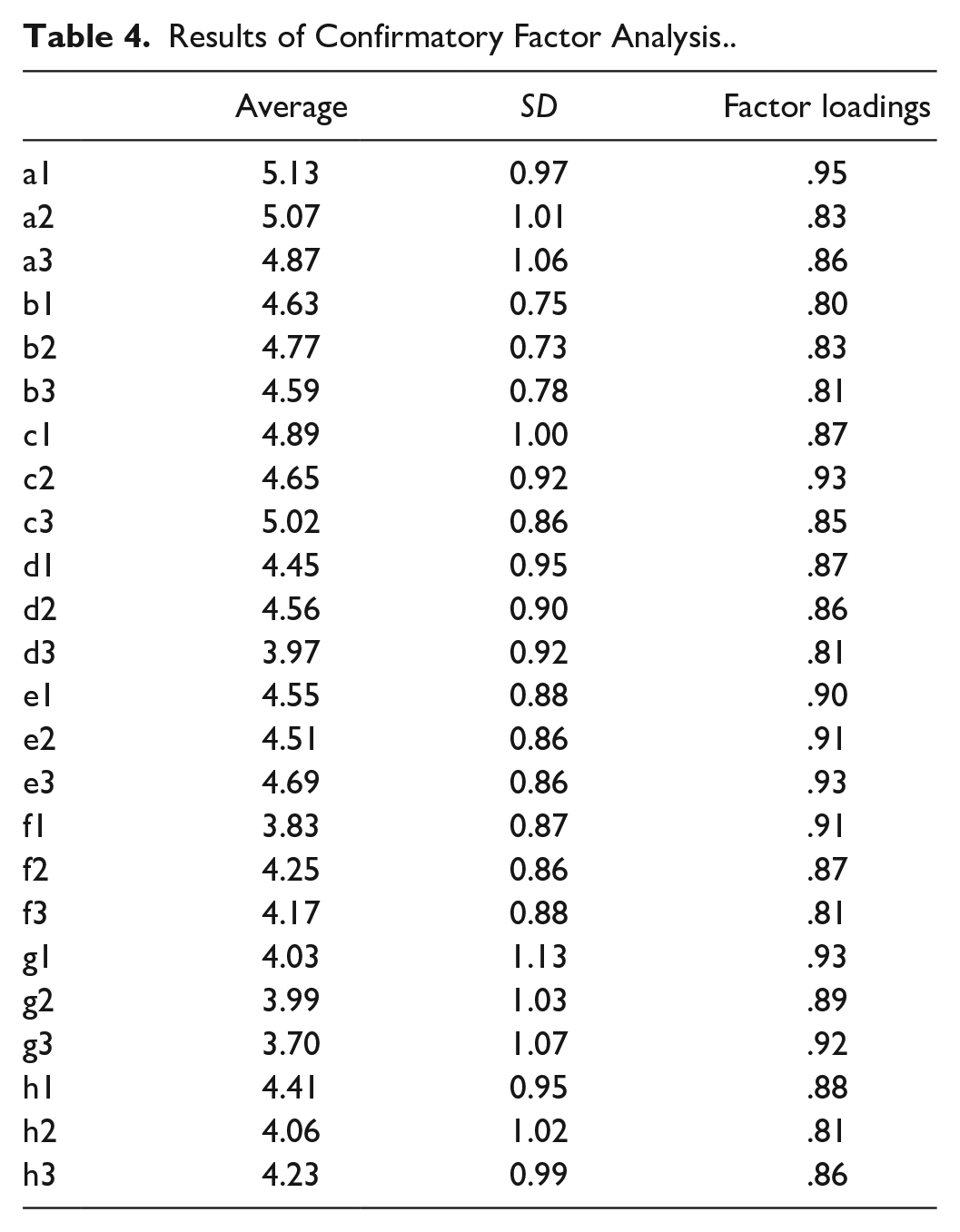
Second, according to Fornell and Larcker (1981), the convergent validity of the measurement model is ascertained when all observed variable loadings are greater than .7 and the average variance extracted (AVE) of all variables is greater than .5. Table 4 shows that the loadings of all observed variables are greater than .7, and the AVE is between .62 and .86, proving that the convergent validity of the observation model meets the statistical requirements.
Additionally, discriminant validity needs to satisfy both of the following criteria: the correlation coefficient between variables should be less than .85, and the square root of AVE of each variable should be greater than the correlation coefficients of other variables in the model (Fornell & Larcker, 1981). Table 3 shows that the correlations between variables and the square roots of AVE are located on the diagonal of the table, all satisfying the above two criteria and thereby proving that the measurement model has acceptable discriminant validity.
Meanwhile, the variance inflation factor (VIF) was calculated for all variables to prevent multicollinearity problems. According to Hair et al. (2006), a model suffers from multicollinearity problems when the VIF exceeds 10. Calculation showed that none of the VIF values in this study exceeded 4.3, confirming the absence of significant multicollinearity problems in the model.
Furthermore, it is necessary to confirm whether the study data had common method bias (CMB) because all of them were simultaneously obtained through questionnaires. Therefore, Harman’s one-factor test is recommended by Podsakoff and Organ (1986). This test showed that the first factor accounted for only 33.7% of the overall variance, which indicated that no single factor could significantly influence the overall variance of the model. Meanwhile, CMB may affect data validity when the correlation coefficient among constructs exceeds .9, according to Pavlou (2005). Table 3 shows that the correlation coefficient between any two latent variables is less than .9, suggesting that CMB was not significant in this study.
Results
To gain insights into the effect of each latent factor on teachers’ usage intention for VR technology, a bootstrap method was adopted to analyze the significance of the influence path of each variable and the explanatory power of the structural equation. The bootstrap method used repeated sampling of valid sample data for statistical analysis, with a sample size of 500 in this study. Figure 2 shows the structural equation modeling results.

Structural equation modeling results.
Teachers’ Attitude Toward the Usage of VR Technology
The results showed that usage satisfaction had no significant effect on the continuous usage intention of elementary and secondary school teachers for VR technology, suggesting that hypothesis 1 should be rejected. TTF had a significant effect on the continuous usage intention for VR technology in elementary and secondary schools, which supported hypothesis 2.
The regression model revealed that the perceived usefulness and ease-of-usage of VR technology in elementary and secondary school teachers had significant positive effects on the usage satisfaction with VR technology, which supported hypotheses 3 and 4. Additionally, the contribution of perceived usefulness to usage satisfaction was greater than that of perceived ease-of-use.
Quality Factors
As far as quality factors are concerned, the regression model analysis showed that service quality and system quality had a significant effect on perceived ease-of-use. Further, information quality and system quality had a significant effect on perceived usefulness. These results supported hypotheses 5b, 5c, 6a, and 6b. Moreover, information quality, system quality, and service quality all had significant effects on TTF in VR-supported classroom teaching, which supported hypotheses 7a, 7b, and 7c.
The effect of information quality on perceived ease-of-use was not significant; thus, hypothesis 5a was not supported. Further, the effect of service quality on perceived usefulness was not significant; thus, hypothesis 6c was not supported.
Additionally, the explanatory power of the model was measured in terms of R2. The R2 for continuous usage intention was .0561—continuous usage intention explained 56.1% of the variance in users’ continued engagement behavior. In other words, the model used in this study explained most of the variance in teachers’ intention to use VR technology, thus demonstrating that the model had strong explanatory power in general.
The Further Exploration of the Results
Since some of the empirical results is inconsistent with previous studies, in-depth exploration to validate the findings is necessary. According to Morse (1991) and Ivankova et al. (2006), the mixed-methods sequential explanatory design can be handy when unexpected results arise from a quantitative study, that is, use qualitative data analysis to refine and explain those statistical results by exploring participants’ views in more depth.
Followed Hershberger and Kavanaugh (2017), we utilized follow-up telephone interviews to perform the qualitative analysis. A random sample of 30 teachers who participated in the questionnaire survey was selected for the interviews; among them, 18 interviewees are females. A total of 21 participants are elementary school teachers, while others are junior middle school teachers. The teaching subjects of these participants cover almost all subject areas in basic education, such as Chinese, mathematics, English, science, politics, etc. The interview questions were semi-structured around teachers’ attitudes toward VR technology usage in the classroom, such as “Are you glad to use VR technology actively in classroom teaching? Why?” “What is the biggest obstacle/ disadvantages/advantages to using VR devices in classroom teaching?” These teachers were interviewed individually, and each phone interview lasted for about 30 minutes. We spent 3 days finishing all these telephone interviews.
Discussion
Major Findings
This study analyzed the influencing mechanism of Chinese elementary and secondary school teachers’ satisfaction with and intention of using VR technology through an intention-to-use model that integrated TAM and ISSM. Regression analysis of the questionnaire results led to some findings worth discussing as follows.
First, the empirical results confirmed a positive relationship of perceived ease-of-use, perceived usefulness, and TTF with usage satisfaction. This finding is consistent with previous research on teachers’ attitudes toward using new types of IT, and it highlighted the critical impact of perceived usefulness on teachers’ usage satisfaction (Nair & Das, 2011; Scherer et al., 2019). This implies that making more teachers aware of the value of VR technology in improving pedagogical effectiveness and boosting students’ academic achievement may be the key to increasing teachers’ acceptance of VR technology. Additionally, TTF had a significant effect on teachers’ continuous usage intention, which was consistent with the results of the TTF model (Faqih & Jaradat, 2021). As predicted, if teachers can use VR technology to create highly interactive and immersive simulation learning environments that support teaching tasks effectively, they are likely to continue using VR technology for teaching.
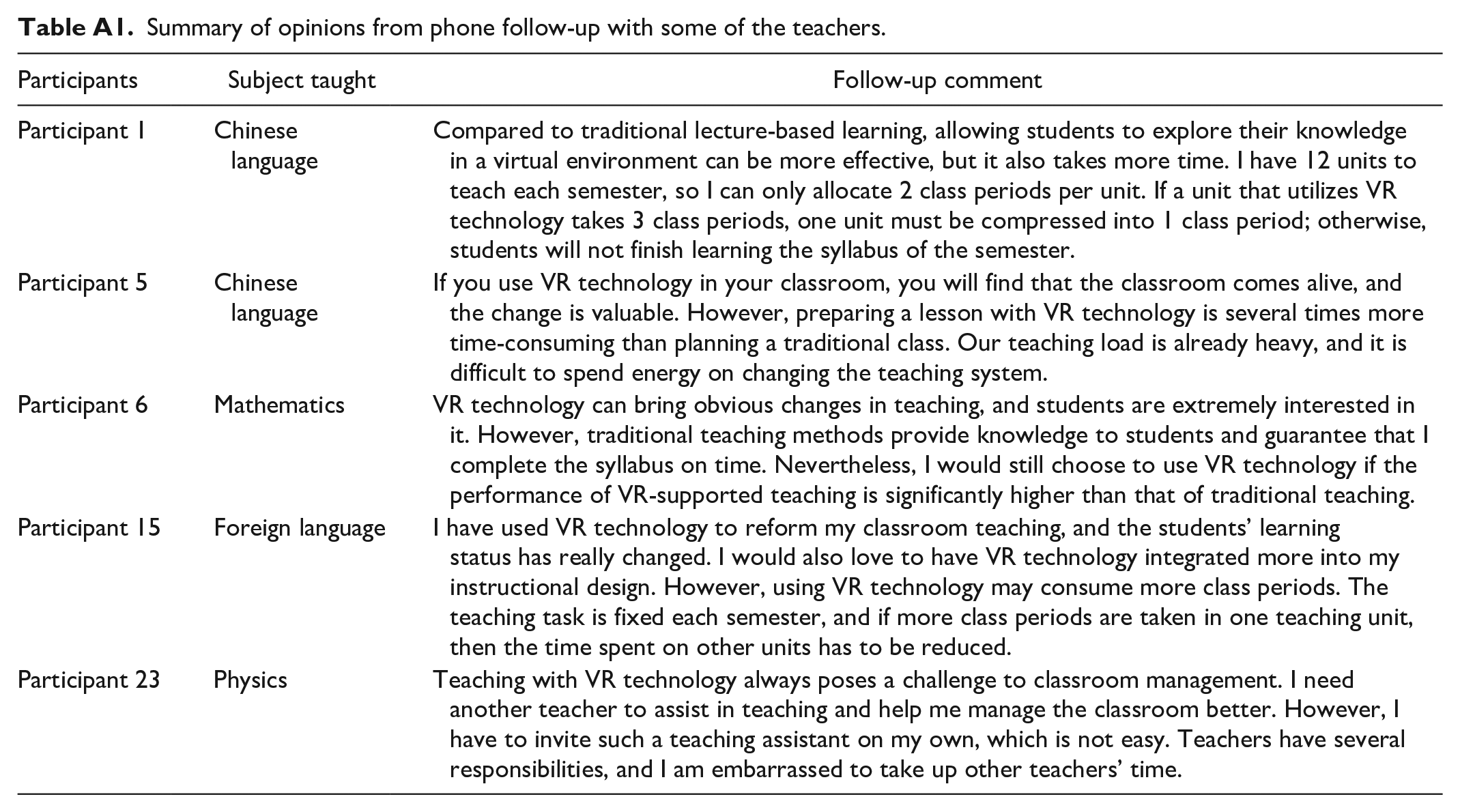
Furthermore, this study showed that teachers’ satisfaction with the usage of VR technology did not strengthen teachers’ continuous usage intention, which is contradictory to the TAM results and previous researches (Cabero-Almenara et al., 2018; Ho & Huang, 2009; Nagy, 2018; X. Wang et al., 2019). We employed a follow-up telephone interview to discuss this finding further. The interview results confirmed that teachers’ satisfaction with the usage of VR technology did not effectively lead to their continuous usage intention. Part of the interview content is shown in Table A1 (see Appendix). The follow-up revealed that “time cost” was the most important obstacle to teachers’ continuous usage intention for VR technology. Teachers’ busy work schedule and fixed schedule of teaching progress prevented them from implementing teaching reform, although they acknowledged the effectiveness of VR. This is consistent with our speculation that teachers’ continuous usage intention for VR reality may be negatively influenced by the traditional education management system. It also echoes the findings of Li et al. (2019) that the innovative integration of VR technology and educational teaching requires rational instructional design and the creation of a diverse, flexible, and effective support system and educational ecosystem for VR-based teaching. The results imply that educational ecosystem support is likely to be an important factor influencing teachers’ continuous usage intention for VR technology, which will be investigated in detail in the future.
The analysis of the relationship of quality factors with respect to perceived ease-of-use, perceived usefulness, and TTF also led to some important findings. The regression model supported the hypothesis that “the information quality of VR technology will positively influence teachers’ perceived usefulness” but rejected the hypothesis that “the information quality of VR technology positively affects teachers’ perceived ease-of-use,” which contradicts most ISSM studies. In general, the better the quality of information presented by IT, the easier it is for users to use the technology (C. C. Chen & Tsai, 2019; Martono et al., 2020). A possible explanation for this is that during the VR-based teaching process, the information quality of VR technology is first perceived by students, not teachers. Therefore, the information quality of VR technology may not have a significant impact on teachers’ perceived ease-of-use. Conversely, service quality was the most important influencing factor of perceived ease-of-use. This is shown by the observation that teachers’ perceptions of the ease-of-usage of VR technology in its pedagogical application depend on whether they have received adequate technical training and whether there is a timely response mechanism in the event of problems.
Notably, unlike perceived ease-of-use, perceived usefulness was most significantly correlated with information quality, while service quality did not have a significant effect on perceived usefulness. This suggests that teachers’ judgment of the usefulness of VR technology is likely to be based primarily on the quality and applicability of VR technology itself. However, external technical support does not influence teachers’ judgment of the pedagogical effectiveness of VR technology. This result may imply that teachers are ready to invest some learning costs to use the technology.
Nevertheless, there is another possible explanation for the above observation. Teachers have a pronounced sense of curiosity and novelty for VR technology as an emerging technology. Therefore, they may blindly exaggerate its role or use VR technology only for creating a teaching atmosphere. Thus, they lower the expectation of its pedagogical effectiveness or ignore the real application value of VR technology as they selectively use it for a predetermined purpose. This is a caveat that especially concerns the pedagogical application of VR technology. When using new technologies such as VR technology in pedagogical scenarios, stakeholders should always maintain a rational understanding of the new technologies and adhere closely to the fundamental purpose of “using technology to promote pedagogical reforms and enhance pedagogical effectiveness.” They should focus the research and practice of VR technology on VR-induced structural and functional changes of various teaching elements. Meanwhile, VR technology providers should also actively strengthen communication with schools and researchers to take advantage of VR technology fully in optimizing teaching practice. This would help resolve the existing issues of teaching practice and meet the existing needs of teachers and students.
As for the predictors of TTF, it was observed that information quality, system quality, and service quality of VR technology promoted TTF in the pedagogical application of VR technology, which was consistent with previous findings (Goodhue & Thompson, 1995; Isaac et al., 2019). This suggests that quality factors of VR technology affect the fit between VR technology and pedagogical needs, which is an integral part of generating positive teacher expectations for the subsequent usage of VR technology. Focusing on the information quality stability of VR system and providing technical and professional support for teachers’ classroom application of VR technology are highly likely to strengthen teachers’ positive expectations for VR technology usage and promote their continuous usage intention for VR technology. This further proves that the ability of VR technology to produce truly measurable changes in pedagogical effectiveness is a key factor influencing teachers’ intention to continue using this technology. Measuring the association between teachers’ expectations of VR technology effectiveness and teachers’ continuous usage intention could be a focus of future studies.
Theoretical and Practical Significance of the Study
The present findings are beneficial for promoting classroom application of VR technology in several aspects. It was unexpectedly observed that teachers’ satisfaction with the usage of VR technology did not positively influence their continuous usage intention. However, follow-up interviews confirmed that the obstacles to teachers’ continuous usage intention for VR technology stemmed from limitations of time and the difficulty in circumventing the curriculum management requirements. This indicates that pedagogical ecology must be reformed in a way that supports the usage of VR technology. Meanwhile, the present findings confirm that TTF significantly influences teachers’ continuous usage intention, which provides a guideline for future efforts toward promoting the pedagogical application of VR technology in classrooms. It is necessary for future studies to further promote the construction of pedagogical application model for VR technology. Such construction may include the following components: (1) formulation of operational rules for the pedagogical application of VR technology, development of VR-based teaching models for different subject categories and knowledge types, and compilation of exemplary teaching cases corresponding to various teaching models; (2) improvement of the fit between various virtual environments and pedagogical needs based on professional support for teachers’ teaching practice of VR technology, which will have an important impact on teachers’ continuous usage intention.
Furthermore, the influence of perceived ease-of-use and perceived usefulness on teachers’ satisfaction with VR technology usage has been confirmed. However, with respect to technology quality, less consideration has been given to addressing which factors influence teachers’ perceived ease-of-use and perceived usefulness (Abd & Mohd, 2019; Fussell & Truong, 2021). With quality factors (information quality, system quality, and service quality) as antecedents, the present results show that perceived usefulness is mainly influenced by system quality and that perceived ease-of-use is mainly influenced by service quality. Therefore, technology providers should strengthen the awareness of knowledge classification and take advantage of different characteristics of VR technology, such as immersion, interaction, and embodiment. The purpose is to develop teaching resources to meet teaching objectives related to content knowledge (learned by remembering), methodological knowledge (learned by doing), and valuable knowledge (learned by understanding), respectively. This would help teachers develop multiple approaches to optimize the teaching process. Meanwhile, a highly responsive training and problem-solving mechanism should be set up to dispel teachers’ fear of difficulty in applying new technologies, which is important to enhance their satisfaction in using VR technology. A lower-cost, easier-to-produce, and more accessible SVVR technology is currently gaining more attention from researchers and teachers. This VR technology replaces costly 3D animations with 360° human-recorded real-world environments and makes VR highly feasible for adoption by teachers. The design and implementation of SVVR in school education will be an essential research direction for the application of VR technology in teaching in the future (Jong et al., 2020).
Additionally, the present findings reveal that information quality does not play a positive role in generating perceived ease-of-use and that service quality is not associated with perceived usefulness. These findings, which are inconsistent with previous studies, deserve future in-depth research, which will aim to examine whether teachers’ expectations of value influence their perceptions of value.
Conclusion
The determinants of Chinese elementary and secondary school teachers’ continuous usage intention for VR technology were investigated using a model integrating TAM, ISSI, and TTF. Given the limited number of studies exploring technology quality and teachers’ perceptions of technology use, this study sought to address this issue from a comprehensive aspect. The results indicated that quality systems (information quality, system quality, and service quality) have different impacts on teachers’ perceived usefulness and ease-of-use and that teachers’ perceptions of VR technology usage affect their usage satisfaction. However, due to the limitations of the existing teaching environment, teachers’ usage satisfaction does not directly affect their continuous usage intention. Further, quality system is a strong predictor of TTF, while TTF has a direct impact on teachers’ continuous usage intention for VR technology. The findings will enrich the literature on the post-adoption behavior of the teachers who are VR technology users, provide more insights into the antecedents of technology quality, and help technology providers and school administrations improve their technology quality and instructional reform support systems.
Limitations and Future Work
This study had some limitations. First, due to the cutting-edge nature of VR technology, the number of VR devices that a school can currently purchase is not large. Further, the number of teachers who have used VR technology is limited, thereby leading to some limitations in the selection and tracking of the study population. Therefore, when examining factors influencing teachers’ usage intention for VR technology, focus was placed on the technology itself while ignoring teachers’ own characteristics. Nevertheless, factors such as teachers’ education level, professional title category, overall quality, and discipline background may have an impact on their acceptance and adoption of VR technology, which should be considered in future studies. Second, gender could not be included as a moderator variable in this study because of the overwhelming number of female teachers in elementary and secondary schools. Finally, the perceived ease-of-usage of VR technology in this study showed a small effect. This cannot be ruled out as an artifact that stems from the following fact: VR technology is an emerging technology and thus leads teachers to maintain a certain degree of tolerance toward its use out of curiosity. In the follow-up research, this limitation can be overcome by increasing teachers’ use time or implementing certain interventions to eliminate possible interfering factors.
Footnotes
Appendix
Summary of opinions from phone follow-up with some of the teachers.
| Participants | Subject taught | Follow-up comment |
|---|---|---|
| Participant 1 | Chinese language | Compared to traditional lecture-based learning, allowing students to explore their knowledge in a virtual environment can be more effective, but it also takes more time. I have 12 units to teach each semester, so I can only allocate 2 class periods per unit. If a unit that utilizes VR technology takes 3 class periods, one unit must be compressed into 1 class period; otherwise, students will not finish learning the syllabus of the semester. |
| Participant 5 | Chinese language | If you use VR technology in your classroom, you will find that the classroom comes alive, and the change is valuable. However, preparing a lesson with VR technology is several times more time-consuming than planning a traditional class. Our teaching load is already heavy, and it is difficult to spend energy on changing the teaching system. |
| Participant 6 | Mathematics | VR technology can bring obvious changes in teaching, and students are extremely interested in it. However, traditional teaching methods provide knowledge to students and guarantee that I complete the syllabus on time. Nevertheless, I would still choose to use VR technology if the performance of VR-supported teaching is significantly higher than that of traditional teaching. |
| Participant 15 | Foreign language | I have used VR technology to reform my classroom teaching, and the students’ learning status has really changed. I would also love to have VR technology integrated more into my instructional design. However, using VR technology may consume more class periods. The teaching task is fixed each semester, and if more class periods are taken in one teaching unit, then the time spent on other units has to be reduced. |
| Participant 23 | Physics | Teaching with VR technology always poses a challenge to classroom management. I need another teacher to assist in teaching and help me manage the classroom better. However, I have to invite such a teaching assistant on my own, which is not easy. Teachers have several responsibilities, and I am embarrassed to take up other teachers’ time. |
Corrections (January 2023):
Edits have been made under the section
Declaration of Conflicting Interests
The author(s) declared no potential conflicts of interest with respect to the research, authorship, and/or publication of this article.
Funding
The author(s) disclosed receipt of the following financial support for the research, authorship, and/or publication of this article: This research is funded by The Philosophy and Social Sciences Research Project of Universities in Jiangsu Province, China (Project No.: 2021SJA0856); The Fundamental Research Funds for the Central Universities of China (Project No.: JUSRP121087).
Research Involving Human Participants and/or Animals: Ethical Approval
This article does not contain any studies with human participants performed by any of the authors.
