




Abstract
This study seeks to contribute to the incipient pool of research on graduate attributes (GAs) by reporting on a study of the GAs of Omani English language teacher (ELT) education programs and the role being played in this area by the Oman Authority for Academic Accreditation and Quality Assurance of Education (OAAAQA), formerly known as Oman Academic Accreditation Authority (OAAA). The study was qualitative and examined stakeholders’ perspectives and aspirations concerning the graduate attributes used in English language teacher education programs in Oman during and after the COVID-19 pandemic. The data for the study was generated by (1) reviewing the pertinent literature, including OAAA’s documents and reports, and (2) interviewing online seven experts and practitioners from ELT programs in Oman. The findings reveal that the participants have diverse views of the GAs. Additionally, higher education institutions (or HEIs) encountered several common challenges with the mapping, actualizing, teaching, and assessing of GAs. Moreover, the existing GAs still need to be reviewed to fit the dynamic requirements of the labor market. The findings of the study have the potential to guide and support English teacher education providers in Oman in developing, reviewing, aligning, and mapping their GAs more effectively and impactfully.
Keywords
Introduction
The focus on education policies and curriculum studies has shifted from the content of education to its outcome; as a result, the students have become a college’s product (El-Saharty et al., 2020; Mansingh & Reddy, 2021; Matu & Paik, 2021; Scott & Willison, 2021). Consequently, institutions are now practically mandated by quality assurance authorities to fine-tune their processes and operations (the means) in light of their desired output (the end), which is none other than their graduates (Scott & Willison, 2021). Consequently, “graduate attributes” (GAs) can no longer be left out of the planning. Graduates must now be able to demonstrate that they have acquired attributes such as a life-long learning attitude and aptitude, an innovative thrust, and employment skills. No doubt including GAs as an integral part of Higher Education (HE) has the potential to prepare graduates to acquire the necessary personal and professional skills needed for employment. Higher education institutions (HEIs) have accepted and responded to this expectation both by defining a list of desired GAs and requiring that these be embedded in their programs (Al Hinai et al., 2020; Belwal et al., 2017; Bitzer & Withering, 2020; Gurukkal, 2019; Hill et al., 2016; Mansingh & Reddy, 2021; Wong et al., 2021). This development has given rise to several issues concerning the conceptualization, teaching, and assessment of GAs, for instance, questions about the efficiency of GAs to accommodate global changes. It has also transpired that HEIs have at times been rather “casual” about GAs, not only in Oman, where the current study took place, but also elsewhere as if GAs were a mere administrative matter rather than an academic one potentially bearing upon the very design, implementation and evaluation of the curriculum, the resources allocated to it, and the needs of the pertinent stakeholders (Matu & Paik, 2021; Scott & Willison, 2021).
The overall goal of the higher education system is to offer the nation qualified graduates who are ready to enter the workforce with the necessary skills and competencies that meet the needs of the 21st century. However, employers’ concerns about the current HEIs’ ability to adequately prepare their students to cope with today’s rapidly changing world are widely reported in the literature. For example, Mansingh and Reddy (2021), in their systematic review study that provided literature about GAs for job employability, indicated that there is a mismatch between workplace needs and higher education output in South African higher education settings. The authors encouraged HEIs to consider preparing students for a competitive South African job market as well as making them employable internationally as organizations are adopting modern technological tools for their recruitment and selection procedures (Mansingh & Reddy, 2021). Similarly, research on GAs reveals that, while universities in Australia and the United Kingdom excel at teaching content-related knowledge, their graduates lack the practical skills required by the industry (Jackson, 2012).
Since 1970, the higher education system has grown significantly in the Sultanate of Oman in terms of both student and institution numbers. As a result, significant efforts have been made and resources invested in creating high-quality HEIs that can produce graduates that meet the labor market’s expectations. Belwal et al. (2017), in their study about graduate attributes, reported that according to students’ perceptions of employers’ selection criteria, the five most important employability skills in Oman are computing abilities, the capacity to work in groups, English language competency, prior training, and the graduate’s identity. However, research has shown that there is a mismatch between the competencies that graduates develop and achieve throughout their academic study and the capabilities that the labor market expects and demands in Oman and the Gulf regional states (Al Hinai et al., 2020; Belwal et al., 2017; Matu & Paik, 2021; Rizwan et al., 2021). Universities and colleges across the Sultanate have been accused of failing to provide students with the adequate English language proficiency, communication, and other skills required by employers (see Al-Mahrooqi, 2012a, 2012b; Al-Mahrooqi & Denman, 2018). For instance, officials from the Ministry of Education in Oman described the English language teaching (ELT) preparation programs in Oman as insufficient and unsatisfactory as they do not adequately prepare student teachers to make decisions and reflect on their teaching and learning practices (Al-Issa, 2005, 2008). Furthermore, many researchers have consistently reported on the lack of adequate English language proficiency among Omani graduates (e.g., Al-Issa, 2007, 2014; AL-Lamki, 2009; Al-Mahrooqi & Denman, 2016; Alrawas, 2014). The literature suggests that one of the key challenges impacting graduates’ employment in Oman and other Gulf regional nations is the skills gap between graduates and occupational requirements (Al Hinai et al., 2020; El-Saharty et al., 2020; Matu & Paik, 2021). In Oman, researchers have attributed the high unemployment rate among individuals under the age of 30 to the graduates’ skills gap (Al Hinai et al., 2020; Al-Mahrooqi & Denman, 2018; Belwal et al., 2017). For instance, several researchers reported that Omani graduates’ ability to obtain suitable jobs was impeded by their limited English language abilities (Al-Issa, 2007, 2014; Al-Lamki, 2009; Al-Mahrooqi & Denman, 2016; Alrawas, 2014). Belwal et al. (2017) suggested that HEIs in Oman are unable to develop their graduates’ attributes. Their study concluded that the insufficient communication between HEIs, alumni, and employers in Oman had hampered the development of the needed attributes among graduates.
Therefore, it is highly important for the HEIs to effectively develop and implement their academic programs to match the world’s widely recognized vocational requirements for the future job prospects of their graduates. They need to raise their students’ knowledge and awareness of such requirements, encouraging them to develop their abilities and become increasingly open and aware of the labor market’s needs and trends (Al Hinai et al., 2020; Al-Mahrooqi & Denman, 2018; Belwal et al., 2017). Holmes et al. (2018) in their study of GAs among engineering students concluded that graduates’ employability skills improve considerably when effective approaches integrate academic programs with technical industry skills (Holmes et al., 2018). This implies that to eliminate the skills gap between the HEIs’ educational output (graduates) and the labor market’s expectations, research should be conducted into how stakeholders from both sides (higher education and the labor market) conceptualize GAs and the challenges HEIs encounter while seeking to establish and implement them. Furthermore, given the global impact of the COVID-19 pandemic, colleges must play an effective role in assisting graduates in acquiring the new professional requirements and adapting the curricula to better prepare their graduates for the challenges of changing industries accelerated by the COVID-19 pandemic (Mansingh & Reddy, 2021; Memon et al., 2021; Miani et al., 2021)
Taking into account these research gaps, this study explores the perspectives of stakeholders from higher education and the workplace on GAs and their alignment with the current workplace’s needs and expectations. The paper will discuss employers’ concerns about the quality and readiness of Oman’s HEI’s ELT (English language Teaching) graduates, and the current efforts in higher education to develop programs that respond better to the demands of the labor market.
The following are the primary objectives to be addressed in this paper: (1) to identify the current GAs in ELT preparation programs in Oman and understand how they are developed and implemented, (2) to identify the main challenges in establishing, promoting, and implementing GAs, and (3) to determine how responsive the existing GAs in ELT programs are to trendsetting changes such as the COVID-19, job market dynamic needs, other international GAs, and the OAAAQA’s accreditation standards.
This paper primarily answers the following questions: (1) What are the existing GAs in the ELT programs in Oman, and how are they developed, conceptualized, and understood by EFL teachers in the Omani ELT programs under the study? (2) What are the main challenges encountered by English as a Foreign Language (EFL) teachers in ELT programs for the promotion, teaching, assessment, and review of GAs? (3) To what extent are the current GAs in ELT programs responsive to trendsetting changes such as the COVID-19 pandemic, the jobs market dynamic needs, other international equivalents GAs, and the OAAAQA’s accreditation principles?
Conceptualizing and Defining Graduate Attributes
In the literature about higher education, different terms have been used to describe the skills that graduates are expected to have developed and acquired upon the completion of their undergraduate studies. The most commonly used terms are graduate or generic attributes; soft, transferable, or employability skills; and core capabilities, competencies, qualities, or outcomes. Some of these attributes have become ubiquitous, such as critical thinking, leadership and teamwork, communication, research, an inquiring mind, information and digital literacy, and personal skills.
Words such as skills and attributes have been used interchangeably in the literature and discourse on GAs. However, Nagarajan and Edwards (2014) argued that they are not synonymous. Skills are usually more practical and refer to qualities related to communication, time management, and teamwork. By contrast, attributes are broader than skills and include more abstract qualities, such as loyalty, honesty, commitment, and integrity. These attributes are considered desirable by employers (Nagarajan & Edwards, 2014; Smith & Do, 2018; Wong et al., 2021).
The most commonly used definition of GAs is the one proposed by Bowden et al. (2000): “[GAs are] the qualities, skills, and understandings [that] include but go beyond the disciplinary expertise or technical knowledge that has traditionally formed the core of most university courses. They are qualities that also prepare graduates as agents of social good in an unknown future.” (p. 3).
Bowden et al. (2000) also described GAs as: “the qualities, skills, and understandings a university community agree its students would desirably develop during their time at the institution and, consequently, shape the contribution they can make to their profession and as a citizen” (p. 3).
Their definition implies that GAs are more comprehensive than merely “employability” since HEIs would need to develop their graduates’ academic, citizenship, and career competencies. Bowden et al. (2000) identified three principal arguments for why GAs should be considered and given priority in the academic programs offered by universities. First, GAs ensure that educated citizens are well equipped and prepared to function and contribute effectively to their communities and not only in possession of disciplinary knowledge and technical skills. Second, GAs prepare the graduates to successfully cope with the changing nature of their societies and the world. Third, GAs meet the demands of the labor market, which is dynamic and requires not only disciplinary knowledge and expertise but also other sets of skills and qualities that determine whether individuals will be successful candidates for the jobs.
For Hill et al. (2016), GAs are “orientation frameworks” that state the ideal educational outcomes that graduates have to attain by the time they complete their undergraduate studies. Consequently, curriculum design, teaching, and assessment practices must be driven and informed by GAs or, said otherwise, must reflect the HEI’s core outcomes. GAs represent the purpose of higher education and the contribution of HEIs to society (Albalooshi, 2013). They are the product of a mutual consensus between HEIs, a diverse variety of stakeholders, and international good practices (Albalooshi, 2013; Green et al., 2009; Hill et al., 2016).
Many HEIs, for example in Austria, Great Britain, the USA, and the Gulf Cooperation Council (GCC), mandate their academics to include GAs in their curriculum documentation such as course descriptions. Accreditation bodies normally ask that GAs be mapped to learning outcomes and assessments. However, this does not mean that HEIs are always successful in achieving these GAs because, despite the existence of GAs, the whole process and the necessary mechanisms remain uncertain (Albalooshi, 2013). As a result, doubts may be cast about the existing GAs’ impact on instruction. Students often focus only on getting the desirable marks and grades while remaining unaware of the GAs and their social significance (Nagarajan & Edwards, 2014). Consequently, the process of conceptualizing, developing, designing, and implementing GAs within, across, and beyond the curriculum is an important issue that has been discussed in the literature on higher education.
The Importance of Graduate Attributes
The higher education market has contributed to the establishment of graduate attributes. Employers’ increasing demands for highly trained labor and the shift to a knowledge-based economy have prompted governments and higher education institutions worldwide to assign universities with producing an employable graduate workforce. (Hill et al., 2016; Wong et al., 2021). As a result of the higher education market, universities have been prompted to justify their worth and relevance, particularly to students. GAs are increasingly being used by universities in Australia, New Zealand, and the United Kingdom to market their vision to potential students, highlighting the sets of skills and competencies that their graduates will gain throughout a degree (Hill et al., 2016; Wong et al., 2021). For students, GAs represent the set of skills and qualities that they should possess by completing their academic program (Hill et al., 2016; Scott & Willison, 2021; Wong et al., 2021). A degree is no longer sufficient for employers to hire graduates (Gupta et al., 2020; Scott & Willison, 2021). Employers’ decisions to hire graduates are not only based on the knowledge they possess but also on their practical competencies. Employers prefer graduates with practical and 21st-century skills such as critical thinking, problem-solving, and communication (Mansingh & Reddy, 2021; Scott & Willison, 2021). Furthermore, Atef and Al Balushi (2017) in their study found that establishing GAs is important for students in boosting their awareness and understanding of the wide range of potential job opportunities. Their study also indicated the value of GAs in generating new career paths that have not been considered previously (Atef & Al Balushi, 2017). Moreover, research has connected these skills to advantages that transcend beyond academic contexts and outcomes, such as enhanced professional success, positive interpersonal interactions, and improved mental health and overall well-being (Mansingh & Reddy, 2021; Matu & Paik, 2021; Scott & Willison, 2021; Wong et al., 2021).
Contextual Background
The Gulf Cooperation Council (GCC), which consists of six member countries, namely Bahrain, Kuwait, Oman, Qatar, Saudi Arabia, and the United Arab Emirates (UAE), has made significant progress in shifting its economy away from oil and gas dependence toward an environment that promotes the growth of a knowledge-based economy based on investments of human capital. As a result of this transition, the GCC has entrusted higher education with the mission of providing employable citizens for the workplace (Gross & Ghafar, 2019; Matu & Paik, 2021). Due to this shift and the increasing demand from employers for highly-skilled labor, the GCC countries have prioritized training and education. It is worth mentioning that the GCC countries were among the first to join the World Bank’s Human Capital Project, which aims to promote human capital investments through education, training, and health, all of which are critical components for successful individuals, employment, and society (El-Saharty et al., 2020; Matu & Paik, 2021). The need to strengthen HEIs’ roles in promoting the development of skills that are relevant to today’s labor market and social situations to meet the labor market expectations is a consistent theme in GCC higher education literature (Al Hinai et al., 2020; Al-Mahrooqi & Denman, 2018; Belwal et al., 2017; El-Saharty et al., 2020; Matu & Paik, 2021). Although the GCC region has experienced significant growth in higher education, particularly in terms of providing the labor market with competent and work-ready graduates, employers’ concerns about the quality and readiness of higher education graduates to enter the workforce is still a key issue in the region (Belwal et al., 2017; Gupta et al., 2020; Matu & Paik, 2021). As a result, the GCC countries have prioritized the establishment of GAs on their agenda to ensure the development of basic technical, interpersonal, intrapersonal, and other work-related skills. (Belwal et al., 2017; Gupta et al., 2020; Matu & Paik, 2021).
In the Sultanate, the Oman Authority for Academic Accreditation and Quality Assurance of Education (OAAAQA) is in charge of establishing the overall quality framework for Oman’s higher education institutions, as well as monitoring and evaluating their performance. OAAAQA stipulates in the institutional standards assessment manual (ISAM) that HEIs should ensure that academic standards are set at an appropriate level for the award. They should clearly define the GAs and learning outcomes that all students should attain upon completion of their degree programs. These GAs should be benchmarked internally and externally in consultation with stakeholders and the labor market. There should be a clear mechanism for assessing and reporting students’ achievement of these attributes. Moreover, GAs should be embedded within the degree programs and reviewed regularly based on the feedback received from the labor market and other stakeholders so that their effectiveness may be realistically measured.
In response to calls for accountability and quality assurance processes, great efforts have been made by HEIs to develop GAs that articulate and reflect their institutional purposes. Since it is believed that there is a correlation between GAs and quality assurance measures (Yorke & Harvey, 2005), both are used to evaluate the effectiveness and success of academic programs and redefine curriculums to integrate GAs.
In the Omani case, the OAAA has clearly stated that academic standards need to be maintained through the effective implementation of HEIs’ well-managed plans for the “design, delivery and assessment of all students learning by coursework program” (OAAA, 2016, p. 33). In other words, HEIs have to adopt effective policies and procedures to develop their programs and, thus, meet the national accreditation requirements. GAs have been identified by the OAAA in its accreditation standard 2 (Students learning by coursework programs) as an important indicator of good practice deserving of academic accreditation. HEIs in Oman have responded to this expectation by establishing and identifying lists of the intended generic graduate attributes for each academic program in terms of knowledge and understanding skills, intellectual skills (e.g., analytic and thinking skills), practical skills, subject-specific skills, and life-long learning skills. Students from all academic levels are, therefore, expected to have attained these attributes or skills by the end of their programs. Furthermore, the OAAAQA maintains that the process for assessing the extent to which the students have attained these qualities need to be clearly identified and effectively implemented.
These attributes reflect the Omani qualification framework as well as the institutions’ vision and mission and the stakeholders’ expectations including the students themselves and the labor markets. According to OAAAQA, the development of GAs should be informed not only by the Oman qualification framework but also by using internal and external benchmarks and labor market’ feedback and expectations. It is important to emphasize here that employers and professionals are important stakeholders in any academic program’s design and development; therefore, their feedback should be highly considered to ensure that the program is relevant to the current labor market’s needs (Oman Academic Accreditation Authority, 2016).
GAs are communicated to the stakeholders, particularly students and staff, and effectively incorporated into the academic programs. Most of the HEIs in Oman specify lists of GAs that are informed by OAAAQA’s guidelines and suit the expectations of students and labor markets’ needs. Therefore, most of the GAs identified and listed by HIEs in Oman have addressed, to some extent, similar skills which are related to knowledge, critical thinking, and practical and lifelong learning. Having said that, however, there is a varying degree of difference between HEIs. This is because GAs are also informed by the HEIs’ mission and vision which vary from one HEI to another and from one program to another. The GAs are available on some of the HEIs’ websites and some are embedded within the HEIs’ mission and vision. To ensure the effectiveness of GAs, they need to be regularly reviewed within the program. The feedback of the graduates, staff, employers and other stakeholders should be taken into account in the GAs’ reviewing process. The OAAAQA considers identifying and assessing GAs, which are in line with Oman’s qualification framework, an important indicator for any HEIs’ to be successfully accredited.
Although GAs is an important aspect of any program’s design and development, as shown in the above overview, there is, generally, an apparent paucity of research on GAs at the national level in Oman. Furthermore, there are very limited guidelines regulating their development, particularly regarding the ELT programs, except for the general guidelines issued by the OAAAQA. In other words, although the OAAAQA has maintained that higher education providers need to establish well-defined GAs that are in alignment with international good practices and the expectations of students and the labor market, the regulations and the process through which these attributes are established have not been discussed and clarified. Similar issues were also reported in other GCC states. For example, “In Bahrain an attempt to discuss and debate GAs at the national level has so far not taken place, nor are there any guidelines or regulations governing their establishment” (Albalooshi, 2013, p. 27). By identifying the factors and the challenges that contribute to the GAs establishment and implementation in ELT programs in Oman, this study seeks to fill a gap in the GCC higher education literature regarding GAs development.
The Challenges
Despite the growing importance of GAs, research has highlighted that their development and implementation can often be challenging (Bitzer & Withering, 2020; Green et al., 2009; Ipperciel & ElAtia, 2014; Mansingh & Reddy, 2021; Matu & Paik, 2021; Scott & Willison, 2021; Wong et al., 2021). Although HEIs seem to have accepted their new vocational role, there is a great deal of uncertainty about how these GAs should be identified, described, and integrated into their curricula (Matu & Paik, 2021; Scott & Willison, 2021). As a result, GAs have become an important issue in quality assurance and curriculum planning in HEIs (Belwal et al., 2017; Matu & Paik, 2021; Scott & Willison, 2021; Wong et al., 2021). HEIs think differently about GAs, and this affects their teaching and assessments. This lack of conceptual clarity negatively impacts the effective implementation of GAs. How can GAs be effectively and impactfully integrated into the curricula if the HEIs are unsure about what GAs are meant to be and do as a whole and across disciplines (Green et al., 2009; Hill et al., 2016; Ho et al., 2014; Moalosi et al., 2012). Although it is widely accepted that students’ development of GAs should be embedded into the curriculum, teachers have reportedly struggled to integrate them due to a lack of time, resources, and confidence (Hill et al., 2016; Wong et al., 2021). Research has also shown that teachers do not know how to develop learning outcomes and teaching and assessment practices that are aligned with the expected GAs (Green et al., 2009; Hill et al., 2016; Ho et al., 2014; Nagarajan & Edwards, 2014; Wong et al., 2021). Furthermore, if it is not clear what GAs are meant to be and do, the educational system will logically fail to raise students’ awareness about the importance of GAs. Lack of awareness can easily lead to a lack of motivation to acquire the intended GAs (Bitzer & Withering, 2020). Wong et al. (2021) emphasized the relevance of students’ motivation in developing graduate attributes, rather than considering it as a separate component from their degree programs. Moreover, in some cases where the GAs had been integrated and listed in the courses, students still found that the courses had not supported them well enough to turn the GAs into personal learning targets (Carew & Therese, 2007). For example, Griffin and Coelhoso (2019) assessed the perceptions of female university business students in the UAE about employability skills. Their study indicated that areas such as critical thinking, self-management, intercultural skills, and taking initiative are not sufficiently addressed in the curriculum and this impedes students’ awareness and acquisition of these skills.
Although GAs are generic and so can be used in any discipline, research has revealed that the teaching and learning of GAs are discipline-specific (Jones, 2009a, 2009b; Wong et al., 2021). For example, Jones (2009a, 2009b) found that the interpretations for the same attributes (e.g., critical thinking and problem solving) varied across the five disciplines (economics, history, law, medicine, and physics) that were included in her study. Her findings imply that the disciplinary culture in which GAs are introduced and taught has a significant impact on GAs’ conceptualization. This implies that graduate attribute development and implementation should be considered and contextualized within specific disciplines. Besides teachers, students and employers have different perceptions of GAs, too (Green et al., 2009; Hill et al., 2016). Research has indicated the importance of involving different stakeholders in the development of GAs, including teachers, employers, alumni, and students (Belwal et al., 2017; Mansingh & Reddy, 2021; Matu & Paik, 2021; Wong et al., 2021). Although curricula and graduate attributes are commonly assumed to be developed in collaboration with alumni and industry to bridge the gap between HEIs’ outcomes and industry needs, research findings suggest that this gap continues to exist due to the limited interaction between these parties (Belwal et al., 2017; Mansingh & Reddy, 2021; Matu & Paik, 2021; Wong et al., 2021). This collaboration is also important for the students to acquire the necessary graduate attributes required for employment (Mansingh & Reddy, 2021).
This collaboration was further reinforced following the outbreak of COVID-19 when transitioning to an online mode of delivery was the best option left for students to continue studying due to social isolation and lockdown policies (Mansingh & Reddy, 2021). The pandemic has caused significant disruption to the global education system, particularly in higher education. Shifting to an online education mode has significantly limited face-to-face social interaction. This could have an impact on the development and acquisition of relevant required skills such as teamwork, emotional intelligence, interpersonal skills, and communication among students. The post-covid industry has had new expectations about graduates. Technological literacy and the ability to work remotely are the emerging skills required by the post-covid industry(Mansingh & Reddy, 2021; Memon et al., 2021; Miani et al., 2021; Zakaria et al., 2020). Miani et al. (2021) investigated the perspectives of Australian undergraduate tertiary aviation students about the aviation sector and the abilities needed to succeed in the post-COVID-19 period. The students indicated the need for additional educational support and opportunity from the institution to improve their skills and knowledge, particularly in the areas of operational pandemic and outbreak management (Miani et al., 2021). Therefore, it’s important to understand how labor-market and higher education institutions view the pandemic’s impact on the development of GAs. This understanding will enhance the development of GAs in a way that responds to the changes and challenges brought by the pandemic, as well as ensure that employers have confided in the competencies and abilities of graduates.
Methodology and Study Design
This study adopted a qualitative methodology with a case study approach because this provides opportunities to gain a thorough understanding of real-life situations that enhances the validity and reliability of the research and its findings (Denscombe, 2010). Additionally, qualitative methods can provide an in-depth understanding of the researched topic and can offer rich data to answer the questions raised by the study. The chosen approach befits the nature of the current study as it focuses on the research questions and helps to explore the topics in greater depth (Dornyei & Taguchi, 2010)
The study seeks to contribute to the incipient pool of research on GAs by reporting on a study of the GAs in Omani English language teacher (ELT) education programs and OAAAQA’s role in this area. In answering these questions, the study will interpret some Omani decision-makers perspectives on graduate attributes (GAs) in the five English language teacher preparation programs in Oman and inventory their views and perspectives.
The main methods employed for generating the data are semi-structured interviews and the analysis of the relevant institutional and OAAAQA documents to complement the data gained through the interviews. Interviews were employed because they are recognized as “a very good way of accessing people’s perceptions, meanings, and definitions of situations and construction of reality. They are considered as one of the most powerful ways we have of understanding others” ((Kvale & Brinkmann, 2009, p. 168).
This study utilized a purposive sampling procedure (Hammersley, 2008). Sampling is usually done to study a representative sub-group of a precisely defined population to make inferences and draw a conclusion about the whole population. There are no rules for sample size in qualitative research as the sample size usually depends on what the researcher wants to know and the purpose of the inquiry and whether the sampling strategy supports the purpose and rationale of the study (Patton, 2002, p. 244). Purposive sampling entails studying information-rich cases and yields insights and in-depth understanding rather than empirical generalizations (Patton, 2002, p. 230). The used sampling aimed at capturing and describing the central themes across the case being studied (Patton, 2002, p. 235).
Seven participants were interviewed, all of them Omanis with substantial experience in the field of English language teacher education programs. The participants were chosen based on the following criteria. Five were full-time professors from EFL teacher preparation programs in Oman and two were English language experts from the Ministry of Education Oman, which is the main recruiter for ELT/TESOL graduates. They had all obtained their doctorate degrees from overseas universities. Their participation in this study was voluntary (Table 1)
Profile of the Interviewees.

Note. The order of items in this table does not correspond to the ordinal codes assigned to the participants in this article, namely P1, P2, P3, etc.
For this study, the researchers arranged the interviews in advance at agreed-upon times outside the participants’ working duties during the academic year 2020 to 2021.
The interviews were conducted virtually and audio-recorded after obtaining the participants’ permission to do so. All the participants signed a consent form and were promised confidentiality and anonymity (see Appendix A). Consequently, no person or HEI is named in this paper. The collection of institutional documents included the study plan and a list of GAs in each program. These documents supported and supplemented the interview data. The review of these documents enabled us to compare and contrast the five teacher preparation programs in terms of GAs and objectives. All ethical aspects were taken into account and appropriate measures were taken to ensure compliance with ethical principles. The interviewees were given absolute control over the recording process. All interviews were conducted in English and subsequently transcribed and coded, and the same was done with the information in the documents provided by the interviewees (see Appendix B).
The data analysis started with the transcription of the interviews. We read the written transcriptions several times in order to familiarize ourselves with the data, get an overall picture and understanding of each participant’s views, and identify the main themes, codes, and sub-codes. All the words and utterances related to the study questions were considered.
The data analysis was done manually and undertaken through the identification of themes and codes following Braun and Clarke’s (2006) five phases of thematic analysis: “familiarising myself with my data,” “generating initial themes,” “searching for themes,” “reviewing themes,” and “defining and naming themes”. The interviews were all conducted at times chosen by the interviewees to avoid inconveniencing them. The patterns and themes that emerged from the analysis were related to the research questions. The findings are not necessarily generalizable for the whole population, but they do provide an account relevant beyond this study, for instance, to other similar contexts and circumstances.
The codes were rewritten and refined to assure their relatedness and appropriateness. Once the data were categorized and coded, the researchers moved systematically on to the analysis process guided by the three main refined themes, namely: (1) how GAs are conceptualized and developed in the Omani ELT preparation programs, (2) the challenges encountered by EFL teachers in ELT programs in promoting, teaching, assessing, and reviewing GAs, and (3) the extent to which the current GAs in ELT programs are borne in mind responsive to the COVID-19 pandemic, the jobs market dynamic needs, international equivalents, and the OAAAQA’s accreditation principles
In qualitative research, trustworthiness criteria can be operationalized through different strategies and techniques. To decrease threats to trustworthiness, the researchers employed a variety of strategies that assisted them to describe research findings in a way that authentically represented the meanings as described by the study participants. Further, the researchers utilized member-checking techniques to sustain data and research credibility and trustworthiness. Member checks, sometimes known as respondent validation, are considered the most important step that can be taken to foster the credibility of a study (Lincoln & Guba, 1985) as they improve the accuracy of the data by checking whether or not the participants consider that their words match what they intended to say (Shenton, 2004). This study has benefitted from the constructive feedback and comments offered by and/or actively sought from two academics (Ph.D. holders) at UTAS, Rustaq, who had the relevant experience of ELT education to provide insights or specific expertise. Additionally, the levels of trustworthiness were enhanced by giving the research participants opportunities to refuse to participate in the study, to ensure that the sessions of data collection involved only those who were willing to take part in the study (Shenton, 2004, p. 66).
The codes were defined, reviewed, described, and rewritten to assure their relevance. Table 2 below shows some examples of codes.
Examples of Codes.
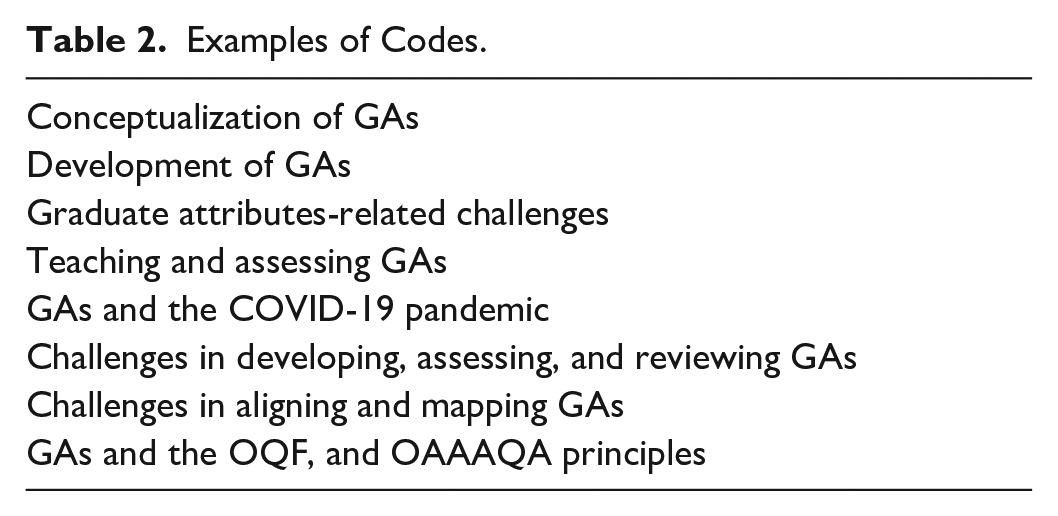
After preparing the list of codes of participants’ interviews, typical and representative interview transcripts along with the two lists of codes were sent to a second coder/rater with the request to try out the codes on these two transcripts. Then, a meeting was conducted with the second coder to calculate the percentage of inter-rater reliability and to discuss and resolve our coding disagreements. A mathematical equation was used for calculating the inter-rater reliability percentages and the precise. The percentages of the agreement and disagreement set at 75% between the two coders were considered. Subsequently, the above final codes were refined, revised, and modified accordingly.
Findings
This part undertakes the analysis of the study findings according to the emerging themes and the research questions, namely:
What are the existing GAs in the ELT programs in Oman, and how are they developed, conceptualized, and understood by EFL teachers in the Omani ELT programs under the study?
What are the main challenges encountered by EFL teachers in ELT programs in promoting, teaching, assessing, and reviewing GAs?
To what extent are the current GAs in ELT programs responsive to trendsetting changes such as the COVID-19 pandemic, the jobs market dynamic needs, other international equivalents GAs, and the OAAAQA’s accreditation principles?
Conceptualization and Development of GAs in the Omani ELT Programs
The data revealed that in one of the colleges, GAs are seen as competencies or abilities: “This is my understanding of graduate attributes. There are, let’s say, competencies. What they can do. Either in knowledge, for example, domain or in skills or even in values as well. And attitudes come into that, for me, when you talk about attributes (P3).”
An interviewee from another college described their way of conceptualizing GAs as a more holistic pedagogical project: “(. . .) we think about what we want our graduates to be after their graduation. This is quite obvious, linked to the mission and vision of the HEI and the program (P5).”
Another participant expressed a similar view.
“(. . .) the graduate attributes should be based on what you expect the teachers to be. What do you expect them to be after graduation? What qualities they should have and what competencies they should have? So in other words, graduate attributes should be based on what makes a good teacher or an excellent teacher, right? So what are the characteristics of a successful or good teacher at school there? And based on that, we can think of the graduate attributes and outline them somewhere and ask the teaching staff members to follow them or to base their teaching on them (P2).”
Another interviewee mentioned work ethics, which was also a personal target.
“In general, the most obvious thing we notice is work ethics. Exactly. From generation to generation, we see that there should be more emphasis on ethics in the preparation programs. I don’t know. I’m not sure if this happens. Because this is important. The ethics and the attitudes these graduates come out with is very important (P1).”
This second pedagogical approach focuses on the graduates’ being and not merely on their doing. The former approach might lead to a view of the graduates predominantly as the workforce, while the latter might evoke more personalist perspectives. Different angles would, of course, have consequences not only for the items to be included on a list of GAs but also for instruction and assessment.
Another interviewee highlighted the need for GAs to be responsive to sudden changes in the labor market and to be representative of all the stakeholders’ needs.
“The pandemic brought so many things that we have to re-think for our graduates. What is the labor market expecting from our English teachers? What is the labor market expecting from a maths teacher and so on, blah, blah, blah? The good thing about, I mean what I noticed working closely with SQU, they are very good with working with the labor market. It’s not only the labor market I believe, and I told them this, it should be all of them. Students should, I mean, participate in the process, what they believe about such graduate attributes and what they think might be difficult for them to learn in terms of the knowledge and skills we are expecting from them to achieve as graduates by the end of the program (P7).”
Another interviewee reinforced the view that the conceptualization process should involve as many stakeholders as possible.
“Right, yes. Of course, those are staff members, I would say, students, or even students, the graduate students there, alumni. Those students who have graduated have started working at school there. And the teachers at school, even the teachers at school there. Plus, we should not ignore teachers and senior teachers at schools there. And even the administrators at schools there, because a graduate, it’s a complete picture, right. It’s not only the English language. Okay, yes, it’s the English language, teaching it, etc., but also how do you deal with others, this and that, how to interact with others at school. Yes, you know it, okay? (P4).”
In short, GAs should be a product of consensus between HEIs and their stakeholders (Albalooshi, 2013; Green et al., 2009; Hill et al., 2016).
Another important criterion for contextualizing GAs was autonomy and lifelong learning. Given that these characteristics imply a way of being, not only doing, they could be classified as personalist GAs.
“I think we should build independence in our students. We should prepare them to be knowledge seekers, so we give them this thing that they have to search for knowledge. They’re knowledge seekers, so they’re not recipients of the knowledge, but they have to be open to being knowledge seekers. If you give them these skills, it will be very marvelous that they have this skill to be knowledge seekers, knowledge builders, skill seekers, and so forth. You are giving them the skills to be independent (P5).”
Another aspect of GAs is that they must be envisaged globally, and curriculum-wide. As one of the interviewees underlined, helping students attain the GAs is the task of the whole curriculum, not of every single component.
“The challenges were maybe it wasn’t that straightforward to match a learning outcome to a graduate attribute. (. . .) And of course, some learning outcomes or some undergraduate attributes cannot be matched to the learning outcomes of a particular course, because at the end of the day the graduate attributes are the complete picture (P2).”
The idea of GAs as overarching targets has repercussions for curriculum design since components such as courses, modules, seminars, etc. become intertwining pieces of a mosaic-like learning-and-teaching project.
Another interviewee brought up the institutional dimension of GAs as they have to be fitting within the being and doing of the HEI as concretized in its vision, mission, and programs.
“When designing the graduate attributes, first of all, we need to look at the vision, mission, learning, general objectives of the program and the learning outcomes of the program, and to state our learning, to state them in a way that they should be observable, teachable. P6).
Additionally, GAs should be articulated in a way that makes it possible to teach, learn, and assess them as constitutive elements of the various components of the degree plan. Each program should be a unified whole facilitating the attainment of the desired results. In other words, the input, throughput, and output must all be in sync. Consequently, GAs concern not only the graduates but the whole HEI.
All of the interviewees agreed that insofar as GAs are goals, the HEIs have to be able to gauge whether or not these targets are being reached. Therefore, GAs have to be specific, clear, and concise enough to be measurable. They also have to neatly match the learning outcomes of the program, that is, be fit for purpose. There must be a manifest and defensible link between the learning outcomes and the GAs.
During the interviews, it was also mentioned that GAs need to remain up today or, in other words, contextually relevant and meaningful.
“Yes, very important. Setting graduate GAs it’s not enough. You need to update them from time to time and visit or revisit them from time to time because we have to keep updated with what’s going on. Also, you have to update what’s going on in the country’s development. Oman, for example, if the graduates- if they’re going to work in Oman, Oman, in this year, it’s not like 10, 20 years ago, so we need to update. (P7).”
The same participant elaborated on his/her answer by positing the government’s long-term plans and visions as objective points of reference to gauge to what extent GAs are relevant and meaningful for the Sultanate’s development.
Another interviewee pointed to the COVID-19 pandemic as a clear example of programs failing to prepare graduates that are up to the new realities.
“Also – this is my belief – you need to map them with also the market needs so you will have graduates who can work or fit very well in the markets. I’ll give you an example, whether English teachers graduating, teacher graduates. For example, for this time, the coronavirus pandemic, we came to realize that there’s the need for using technology (P7).”
Finally, a participant considered future needs as an essential criterion for the articulation of GAs.
“What you need, we need to consider that also for the future. Technology is very important now as something to describe the graduates. They need to be familiar with technologies and use technologies in their teaching and also in the students’ learning. Very important to update this with the new technology, especially now (P1).”
Technological and digital literacy will be a vital attribute of good English teachers in the years to come, for example, familiarity with teaching and learning platforms, software, and learning management systems.
Challenges
This part undertakes the challenges encountered by EFL teachers in ELT programs in promoting, teaching, assessing, and reviewing GAs.
One of the participants spoke of difficulties with articulating GAs that are in sync with the program and, conversely, the design of programs that help attain the GAs.
“There is a real problem with the graduate attributes, yes and with the learning outcome of the program or with the aim of the program. If these were stated properly, I mean taught properly through the program and assessed properly I believe that we would not need all these millions of hours we are putting into in-service education and training of teachers, because anyway, we are expecting those teachers to be at least 70% ready (P2).”
The main challenge concerns the need to find ways of infusing the GAs into the learning outcomes and properly assess them.
Responding to the changing nature of the labor market was another one of the challenges for HEIs trying to articulate meaningful GAs.
“Graduate attributes are dynamic and the teaching profession itself is dynamic. So, the attributes should be dynamic as well. They are dynamic, of course, because it’s not only the shift, let’s say, to online teaching and stuff, but also every day there are new things in the teaching profession. So, these attributes need also to work along with these updates in the teaching profession (P5).”
Another participant made the same point.
“And, for example, at a time if you discover that the weight is on knowledge more than the values, or the skills, or you have tried to strike a balance between these things. But frankly speaking, as far as I know, I have been here for two years, the program coordinator at the university. During that time, for three years we haven’t touched the graduate attributes, even the learning outcomes, or the program outcomes, but sometimes we change the learning outcomes without changing the program outcomes. Of course, there is a kind of alignment (P3).”
When this continual updating of GAs does not happen, the graduates run the risk of not being sufficiently ready to join the changing labor market (Green et al., 2009; Ho et al., 2014; Ipperciel & ElAtia, 2014; Moalosi et al., 2012). The teaching profession is dynamic, and HEIs need to review and align their GAs accordingly to fit the changing needs of the labor market. The COVID-19 pandemic has made this more difficult, and newly graduated teachers need to be up to the challenges.
Another interviewee stated, after summarizing most of the ideas set out above, that one of the challenges for conceptualizing GAs is the lack of collaboration across levels and institutions.
“You mean that when even starting from the very beginning the graduate attributes that should be matching the learning outcomes, objectives of the program, vision and mission of the program itself and then its execution, those graduate attributes should be stated in a way that all should be involved, the stakeholders, the market, the industry, the students themselves even as actual, you could say, practitioners in this process, the faculty before the students, all should be part of this process (P5).”
The same participant elaborated further on this idea.
“We need to bridge this gap between the Ministry of Education and the administration of higher education where you need to sit together, and you need to ask them. Now, for example, according to the pandemic, we changed our curriculum in the Ministry of Education. Are you aware of the changes? No. Assessment. Are you aware of those things? No. What do you expect from the Ministry of Education from our graduates? What do you want our graduates to be equipped with, as skills, knowledge, context-specific values, and context specific-requirements according to the pandemic? (P5)”
The gap between the English teaching programs and the Ministry of Education (the main employer) ought to be seen as worrying. No country can turn into a knowledge economy, which is Oman’s 2040 target, without smooth, flexible, decentralized, and effective mechanisms for cooperation between the HEIs and the labor market. Their mutual collaboration is necessary for bridging the gaps and developing labor-market-responsive GAs (Belwal et al., 2017; Bridgstock, 2009; Green et al., 2009; Hill et al., 2016; Ho et al., 2014; Ipperciel & ElAtia, 2014; Moalosi et al., 2012; Nagarajan & Edwards, 2014; Rowe, 2016).
Another challenge is the lack of effective, critical, and systematic reflection on and evaluation of the GAs on the part of the faculty. An interviewee worded this idea as follows.
“Critical reflection on practice. (. . .) We see that teachers are struggling either in the way of thinking reflectively or thinking critically. And also in the way of documenting this thinking. They don’t have the skills of documenting such critical reflection or critical thinking. How to do it? They always ask how to do it. What to write (P4).”
Subsequently, another participant expressed his/her concerns as follows.
“One I think very important is the evaluation of the current graduate attributes, because you can’t come up with a new one unless you assist with what’s going on. All program Mission, Vision, and Values need to be reviewed before reviewing its graduate attributes. One of the challenges is maybe to assess the market needs. We need to look at the market needs. By market needs, I mean we need what is the trend of education in Oman now. Are we going only face to face or are we going on blended learning and maybe sometimes online learning or e-learning? (P2)
How can the faculty enact their program in the spirit of the GAs and empower the students to become the right kind of graduates while they are unable to reflect on the GAs and the process and come to a useful evaluation? Such a review of the GAs should be reflective, comprehensive, and effective. It ought to be carried out in light of the program’s mission, vision, and values and response to the changing needs not only of the labor market (the vocational thrust) but also of the students and their societies (the pedagogical thrust).
Graduate Attributes, the OQF, and OAAAQA Principles
This section looks at the extent to which the current GAs in ELT programs are thought to be responsive to trendsetting changes, such as the COVID-19 pandemic, the jobs market dynamic needs, and other international equivalents GAs, and the OAAAQA’s accreditation principles.
A participant stated that their GAs were being reviewed in light of Oman’s 2040 Vision and other national documents.
“Yes. We have started this year. We are in the process of reviewing and developing our programs. And we are considering Oman Vision 2020 to 2040. We are considering an educational strategy, I think. The national education strategy and the national education philosophy. So, we are trying to review our training programs in light of these three documents. So, yes, Oman Vision 2040 is there. We are aware of its components and its criteria regarding education, yes (P1).”
Another participant indicated that quality assurance documents constituted an important criterion for GAs.
“We have a quality assurance handbook, which contains details of graduate attributes for different levels, for postgraduate students and also for undergraduate students. Develop these attributes, then from that, we have the objectives out of those. We call them COL. Learning outcomes are related to the graduate attributes. From these learning outcomes, we start to develop our courses by having course objectives, the content, and then assessment (P3).”
This point was underlined by another participant: “I believe we’ve covered the majority of the things, but again I would say as a final comment or advice before you review your programs go back to the OAAAQA’s Oman qualification framework and see what is expected from, let’s say you are an English teacher, what is expected from an English language teacher holding such a qualification, a degree education in English? (P6)”
Another interviewee referred to Oman’s qualifications framework, especially in programs with a mixed intake.
“I believe in graduate attributes and according to my later work with the OAAA, it’s mainly related to the Oman Qualification Framework. In the in-service programs, we receive those teachers who already have their degrees. We just try to equip them with these skills that we do believe, and we know from our observation of those teachers that they are making them (P2).”
Finally, a participant pointed to international practices as another one of the criteria being used in the field for articulating GAs.
“I mean looking at international practices, they have very close relationships between schools and higher education institutions. The graduates, the student graduates, I mean one of the very good things about practices in the UK and the States is those teachers who graduate from an institution like Rustaq or SQU or Nizwa or whatever, when he or she goes to a school he is followed up by the institution, not only left there (P4).”
Discussion
The study was significant as it provided data about the perspectives and perceptions of the stakeholders of English as a foreign language in the Omani context which is considered the first study to investigate such an important topic. Based on the interviews, the documents presented by the interviewees, and the available literature on GAs in teacher preparation programs, the following observations can be made. This research contributes in several ways. Most importantly, it looks at GAs and examines experts’ perspectives on them that might help improve their development, provision, and assessment.
Conceptualization of GAs in the Omani ELT Programs Under the Study
Examining the participating stakeholders’ views about the existing graduate attributes in the English language teacher education programs, evidence from the data suggests that HEIS and their staff have different views about what GAs should encapsulate and how they are to be developed, mapped, aligned, and assessed. There seem to be two different perspectives, which we have termed “vocational” and “pedagogical.” Combining both of them, GAs ought to be cascaded from the personal and professional qualities of a good teacher, which include but are not limited to competencies, knowledge, and skills. The HEIs could also focus on qualities that will presumably help the graduates live up to emerging challenges in the teaching profession, such as digital literacy and information literacy skills (Nagarajan & Edwards, 2014), in society at large (such as artificial intelligence and fake information), and their sphere. Additionally, the findings of this study are similar to those of other studies which suggest that the development of the GAs should be generated and articulated in a dialogue with other stakeholders (Green et al., 2009; Hill et al., 2016; Ho et al., 2014; Moalosi et al., 2012). This suggests that developing, mapping out, aligning, and assessing graduate attributes is not an easy task as it requires collective efforts from both internal and external stakeholders to operationalize and materialize them more effectively and purposefully. The majority of the participants in the sample of this study have recognized and acknowledged the importance of graduate attributes, but they conceptualize them differently. These views are in line with (Albalooshi, 2013; Bowden et al., 2000; Green et al., 2009; Hill et al., 2016; Nagarajan & Edwards, 2014; Wong et al., 2021)
The Main Challenges Among EFL Teachers in ELT Programs Regarding GAs
Arguably, the graduate attributes issue is complex and multifaceted as one of its essential aspects is involved as stakeholders when developing these attributes which is not an easy task we believe. Our findings revealed a range of challenges related to teaching, assessing, mapping, reviewing, and adjusting GAs within ELT programs. These difficulties are not only about execution but also planning, background knowledge, motivation, and mechanisms. These findings corroborate other studies (e,g., Green et al., 2009; Hill et al., 2016; Ho et al., 2014; Moalosi et al., 2012; Nagarajan & Edwards, 2014; Smith & Do, 2018). Another challenge is that GAs run the risk of not being sufficiently updated to meet the changing labor market. It was remarkable the majority of the participants in this study acknowledged the challenges related to developing, teaching, assessing, mapping, and reviewing graduate attributes.
The Extent of the Current GAs’ Responsiveness to Trendsetting Changes (e.g., COVID-19)
The COVID-19 pandemic had a global damaging impact on the global economy and education in general. It has tectonic changes in the lives of people and also in the higher education landscape in particular. Evidence from the data showed that the ELT programs in question still need to work hard to tailor their GAs and learning outcomes to meet the OAAAQA principles, the Omani qualifications framework, Oman’s Vision for 2020 to 2040, and the COVID-19’s realities. These findings are supported by others such as (Belwal et al., 2017; Bridgstock, 2009; Green et al., 2009; Hill et al., 2016; Ho et al., 2014; Ipperciel & ElAtia, 2014; Moalosi et al., 2012; Nagarajan & Edwards, 2014; Rowe, 2016). The OAAAQA highlighted the importance of reviewing and revising graduate attributes in each program to meet the requirements and the changing needs of the students and the dynamic labor market. It was evident from the data that involving all stakeholders in the process would help in developing graduate attributes that are more responsive to the uncertain future of the workplace.
Conclusions, Implications, and Recommendations
The qualitative approach employed facilitated the thematic analysis used to gauge and synthesize the perspectives of seven stakeholders on GAs. Five were from the existing English language teacher education programs in Oman and two from the Ministry of Education (MoE), the main employer of English language teachers in the country. The data was gathered via semi-structured interviews.
The first research question addressed how GAs are conceptualized in the five Omani ELT programs under study. The findings indicated that the participants hold different views on the GAs and how they should be developed, aligned, mapped, and assessed. Nevertheless, all the participants recognized the importance and value of having adequate GAs. It transpired that the GAs did not always result from a consultation process involving stakeholders such as the students, alumni, and employers.
The second research question addressed the challenges in developing, mapping, aligning, teaching, and assessing GAs. A range of challenges and difficulties were reported concerning teaching and assessment, balancing knowledge, skills, and attitudes, combining vocational and pedagogical targets, aligning GAs to learning outcomes and the vision, mission, and objectives of the program, meeting the labor market dynamic needs, and bridging the gap between the English teacher education providers and the employers, in particular the Ministry of Education.
Finally, the outcomes of the third research question show the extent is the current GAs in ELT programs are responsive to trendsetting changes such as the COVID-19 pandemic, the jobs market dynamic needs, and other international equivalents GAs, and the OAAAQA’s accreditation principles.
The conclusions which can be drawn from this study are several. The findings from this qualitative study might help in the development of graduate attributes and their impact on the graduates’ future employability and lifelong education. The potential solutions to the GAs issues would be addressing the reported challenges and prioritizing them in teaching and assessment.
The approach used in this study could be extended to cover the views and practices of other teacher education programs in Oman and the region. This could be of great value and add insights to the development of the English language teacher education programs and quality assurance practices. Based on the study findings, the study suggests future research and directions in the graduate attributes in the teacher education programs with wider scope and focus. This study has some limitations which need to be acknowledged. The first is that the findings are not claimed to be representative of the experiences of all higher education stakeholders in Oman or other contexts. Therefore, the findings of this study are specific to a relatively small number of participants in the context in question. However, the findings can be transferred to other similar contexts. The findings can illuminate and help in generally understanding graduate attributes in teacher education programs of study in various EFL educational contexts. Second, the study relied exclusively on interviews to collect data. Finally, the study looked into graduate attributes in teacher education programs only rather than in other disciplines. Based on the study findings, this study highlighted many possible further directions. The current study focused on some stakeholders’ views on graduate attributes in teacher education programs in Oman. Further research in GCC might be undertaken to confirm the results and extend knowledge of the topic under investigation. The study also suggests there is a need for employing mixed methods as such would offer helpful insights for academics and decision-makers regarding the GAs.
Footnotes
Appendix A
Appendix B
Declaration of Conflicting Interests
The author(s) declared no potential conflicts of interest with respect to the research, authorship, and/or publication of this article.
Funding
The author(s) received no financial support for the research, authorship, and/or publication of this article.
