




Abstract
Burnout, recognized as a psychological syndrome, stems from enduring reactions to emotional and interpersonal obstacles at work. It highlights the tension experienced by individuals within the broader framework of their interactions with their jobs. This phenomenon has attracted considerable attention across diverse professional sectors. With the Middle East’s rapid expansion of tertiary education and reliance on both local and expatriate educators, a thorough understanding of burnout becomes essential. This study aims to investigate the burnout levels experienced by university instructors in Oman and to explore the relationship between their profiles and the three burnout components: Emotional Exhaustion (EE), Depersonalization (DP), and Personal Achievement (PA). Using the adapted Maslach Burnout Inventory (MBI) questionnaire consisting of 22 items, a survey was conducted on a sample of 149 instructors with individual characteristics from public universities in Oman. Regarding burnout, the results showed a moderate level of DP (6.7) and PA (34.8), and a low level of EE (21.5) based on the overall scores. Through bootstrap multiple regression analysis, the results showed that instructors who have lower educational qualifications, lack training support, or are native to the region typically experience higher EE than their counterparts. Male instructors with lower educational qualifications, lower incomes, and local citizenship generally exhibit higher levels of DP compared to their counterparts. Female instructors tend to display higher levels of PA than their male counterparts. These findings highlight burnout in Omani university instructors, guiding future studies to pinpoint causes and tailor interventions in an evolving educational landscape.
Introduction
Burnout, characterized as a psychological syndrome stemming from prolonged responses to ongoing emotional and interpersonal work-related pressures, has garnered substantial attention across a wide range of environments. This phenomenon has significant implications not only for individual well-being but also for the effectiveness and sustainability of various professions. Among these, the field of education stands out as an arena where burnout can have profound consequences. Instructors, who play a pivotal role in shaping the future of societies, are particularly susceptible to experiencing burnout due to the unique demands of their profession. Previous research has highlighted a substantial prevalence of burnout among instructors (García-Carmona et al., 2019; Molero Jurado et al., 2019) and examined burnout levels both before and during the COVID-19 pandemic (Martínez-Líbano & Yeomans, 2023; Voss et al., 2023). Some studies have investigated burnout levels, risk factors, and prevention strategies in various regions and contexts, such as in Europe, South America, Asia, and Africa. It is essential to note that instructor burnout is a global issue, exhibiting unique regional and cultural variations. However, there exists a noticeable dearth of research focusing on Middle Eastern countries. Moreover, while existing studies have employed demographic variables to examine how individual characteristics—such as marital status, number of children, age, and teaching experience—and organizational factors, including teaching level and workload, influence burnout levels (Jamshidirad et al., 2012; Mukundan & Ahour, 2011; Nur Sakinah et al., 2012), there remains a notable scarcity of research involving both expatriate and local instructors.
In order to analyze the determinants of burnout in Oman, one has to pay attention to the fact that expatriate teachers in this country form an important part within the education system. This increased dependence on foreigners, especially in academia, presents a situation where aspects like acclimatization, workload, and even work and family equilibrium may contribute to the rate of burnout, even further.
The National Center of Statistics and Information states the population of Oman as 5,166,000 of which 2,929,000 are Omani, while the rest, 2,237,000, are expatriate (Statistical Year Book, 2024). This indicates that over 40% of the population comprise non-natives, the majority of whom are Egyptian, Palestinian, Tunisian, Jordanian, Indian and Sudanese (Al-Jardani, 2017). Most non-Omani teachers stay for 4 years and are then replaced by other expatriates as the education system cannot cope with the increase in population which has led to the opening of new schools and colleges. The importance of English is stressed by the government and industry leaders and is considered a prerequisite if an Omani wants a white-colored job (Al-Busaidi, 1995). Additionally, as English is taught from kindergarten to university level, there is a huge demand for English language teachers. As the country is still in the process of “Omanisation” (Al-Issa, 2002), (which means, a gradual replacement of expatriates with capable Omanis), it still needs to seek supplies of English teachers at all levels from primary to tertiary level. The number of expatriates in Oman increased from 1,732 in 2014 to 2,022 in 2018 (National Centre for Statistics and Information, 2024). The report published by the Ministry of Higher Education (2020) states that over half of the academic staff working in the universities within Oman are not Omanis. This indicates the increased demand for overseas teachers in the country, especially in technical areas where the local infrastructure is still developing. The consistent growth indicates an increasing reliance on expatriates to support Oman’s labor market and economic development. These figures and facts also show Oman provides a suitable case for studying burnout among expatriates.
This study seeks to address this gap by investigating the levels of burnout among university instructors in Oman, focusing particularly on the correlation between demographic characteristics and burnout components. Specifically, this research will explore how demographic variables like gender, education levels, types of occupation, local or expatriate status, income levels, marital status, and affiliation with private or public institutions are related to the three components of burnout: Emotional Exhaustion (EE), Depersonalization (DP), and Personal Achievement (PA). This approach aims to provide a comprehensive understanding of burnout levels in diverse instructor populations, offering insights that are crucial for developing targeted intervention strategies.
Literature Review
Teaching, with its person-centered and demanding nature, is known as a profession prone to high stress, involving daily interactions with various stakeholders like students, parents, and colleagues, each having different demands. The occupation inherently requires daily emotional involvement and a high degree of responsibility, as explained by Dorman (2003), making it an extensively researched field regarding burnout, a syndrome resulting from chronic workplace stress. Burnout, as defined by Maslach (1982), has three interrelated dimensions: emotional exhaustion, depersonalization, and a lack of personal accomplishment, impacting both the individual educators and the organizational ecosystem negatively. Emotional exhaustion manifests as fatigue and a lack of energy to invest in work; depersonalization is evident when an instructor maintains only formal relationships with students, and a reduced feeling of job satisfaction and negative self-perception characterize inefficacy. It’s considered the logical outcome when the stressful demands exceed the individual’s ability to cope, impacting physical and mental health, reducing professional efficacy, instigating cynicism, and above all, mental exhaustion (Maslach et al., 2001). The consequences are detrimental, affecting life quality, and causing a plethora of health issues, including depression, anxiety, sleep disorders, and physical ailments, as discussed by various researchers including Grossi et al. (2003) and Peterson et al. (2008).
The burnout phenomenon is measured using the Maslach Burnout Inventory (MBI), a tool based on the three-dimensional structure introduced by Maslach, however, the conceptualization and measurement methods of burnout, including the use of MBI, have been subjects of criticism and debate (Burke et al., 1996; Schaufeli, 2017). The debates often revolve around the inclusion of inefficacy as a dimension of burnout, the overlap of burnout with other psychological conditions such as anxiety and depression, and whether emotional exhaustion is the central or only dimension of burnout (Bresó et al., 2007; Bianchi et al., 2015). Despite the ongoing discussions and differing viewpoints, there’s a consensus on the severe impact of burnout on instructors in previous studies, which span various countries, showcasing the universal aspect of this dilemma. The investigations into burnout extend globally, elucidating its pervasive nature and the multitude of its manifestations among instructors in different parts of the world.
Regarding European countries, a notable study from Germany by Kohnen and Barth (1990) surveyed 122 instructors, revealing that 28% exhibited no or only minor symptoms of burnout, while 43% displayed medium symptoms, and a concerning 28.7% suffered from severe symptoms. Similarly, a study by Quattrin et al. (2010) explored burnout levels among instructors in an Italian region, uncovering substantial emotional exhaustion in a significant proportion of the participants. Further contributing to this body of knowledge, Akhtar Malik (2019) disclosed a gender disparity in stress symptoms, with female instructors displaying more than males, and associated burnout with increased sick leave among university instructors in Finland. Meanwhile, Shackleton et al. (2019) focused on the tangible aspects of the school environment in the UK and their consequent influence on instructor burnout. In a comprehensive review of the literature, Mota et al. (2021) synthesized prevailing insights on burnout among Portuguese instructors, ranging from basic to secondary education. Lastly, a 2022 study by Kalamara & Richardson applied latent profile analysis (LPA) to gain a nuanced understanding of burnout in a cohort of Greek instructors.
Concerning North American countries, for example, in the United States, the reported burnout rates of instructors seem even higher. According to Pines et al. (1991), about 50% of all instructors wanted to give up their jobs. Factors contributing to burnout include standardized testing pressures, student behavior challenges, and administrative demands. Researchers have explored the impact of burnout on instructor retention rates and the development of instructor well-being programs to address these issues. A recent study by Valosek et al. (2021) found that meditation is effective in improving burnout and associated resilience, psychological distress, and fatigue factors.
In South American countries, namely Brazil, Argentina, and Chile, etc., significant challenges arise due to socioeconomic disparities, contributing to heightened levels of burnout among instructors. For instance, Ramos et al. (2023) conducted a study on burnout syndrome across various teaching levels amid the COVID-19 pandemic in Brazil. Their findings showed that instructors in basic education experienced more pronounced burnout compared to those in higher education during this period. Additionally, the study concluded that early childhood education warrants distinct classification and consideration due to its unique needs. In countries across Africa, studies pertaining to burnout reveal that instructors frequently encounter elevated levels of burnout. This is attributed to factors such as excessive workloads, insufficient salaries, and a lack of types of equipment.
In Asian countries, such as China, Malaysia, and India, instructor burnout is a common concern. The Asian context presents unique stressors, including intense competition in education systems, pressure to meet academic standards, and societal expectations. For example, Li et al. (2020) found a prevalence of burnout of 53.4% in Chinese instructors. Additionally, Mukundan and Ahour (2011) explored burnout in female instructors in Malaysia, discovering that the number of children, level of teaching, age, and teaching experience were significant burnout indicators, whereas marital status and workload did not significantly relate to burnout syndrome.
While extensive research has been conducted on instructor burnout in various global contexts, there seems to be a lack of focused studies investigating burnout among expatriate and local instructors in the Middle East and in Oman in particular. This region houses a diverse expatriate instructor population due to its international academic collaborations and the influx of foreign educational institutions, making it crucial to understand burnout dynamics within this unique demographic. The contrasting cultural, social, and professional expectations and norms between local and expatriate instructors can potentially create distinct stressors and burnout experiences that warrant dedicated exploration. Research in this area is imperative to comprehend the contextual nuances and varied manifestations of burnout within the region, providing insights that can inform tailored interventions and support mechanisms. The current study aims to fill this gap and the research questions and objectives are as follows.
Research Questions
What are the burnout levels experienced by university instructors in Oman based on the three components of burnout: Emotional Exhaustion (EE), Depersonalization (DP), and Personal Achievement (PA)?
To what extent do Oman instructors’ profiles (gender, education levels, types of occupation, local or expatriate status, income levels, marital status, and affiliation with private or public institutions) correlate to the three components of burnout?
Research Objectives
To investigate the burnout levels experienced by university instructors in Oman based on the three components of burnout: Emotional Exhaustion (EE), Depersonalization (DP), and Personal Achievement (PA).
To explore the relationship between Oman instructors’ profiles (gender, education levels, types of occupation, local or expatriate status, income levels, marital status, and affiliation with private or public institutions) and the three components of burnout.
Methods
Participants
We invited 300 university instructors teaching at universities in Oman to respond to the questionnaire. The response rate was approximately 50% after two follow-ups. Ultimately, a total of 149 university instructors teaching at universities in Oman took part in this survey. All of them possess considerable teaching experience (M = 14.9 years, SD = 10.12). A concise overview of participants’ characteristics is provided in Table 1.
Demographic Information of Participants.

Instruments
To assess the level of burnout experienced by instructors, we employed the Maslach Burnout Inventory (MBI) Educators Survey (1986), which comprises 22 items with a Likert Scale from “never,”“a few times per year,”“once a month,”“a few times per month” to “once a week,”“a few times per week,” and “every day.” This questionnaire is composed of three dimensions, namely Emotional Exhaustion (EE), Depersonalization (DP), and Personal Accomplishment (PA). The MBI defines burnout syndrome as encompassing (a) elevated levels of EE, (b) elevated levels of DP, and (c) reduced levels of PA. In the present study, we conducted reliability tests on the MBI instrument. Our findings indicate that the instrument is highly reliable, as demonstrated by a Cronbach’s alpha of .777, thereby satisfying the recommended threshold of reliability established in the literature.
Data Collection Procedures
To measure instructors’ burnout levels, the adapted burnout self-test questionnaire was sent to 149 university instructors teaching at universities in Oman. They responded to each question based on their experiences. Answering all of the questions took roughly 15 mins. The responses were collected by using online Google Forms, from which the researchers could obtain the results in an Excel file. Data deduction and refinement were also performed by removing invalid and missing data from the results. To know the levels of burnout from the three dimensions, the scores were added for each dimension and compared with the scoring results interpretation of the Maslach Burnout Inventory (MBI).
Data Analysis Procedures
Before conducting data analysis, the data was subjected to an examination to ensure that it was devoid of outliers or respondents with a uniform response pattern. The criterion for the removal of participants was established as those whose mean score on the survey was greater or less than three standard deviations This procedure resulted in the removal of three participants who displayed a consistent pattern of selecting the same response option for all items in the survey.
One of the primary objectives of this study is to investigate the level of burnout among instructors employed at public universities in Oman. To achieve this, we assessed the participants’ burnout levels in three subscales: Emotional Exhaustion (EE), Depersonalization (DP), and Personal Achievement (PA). Based on the adapted questionnaire from Maslach et al. (1996), the range of scores and the corresponding burnout levels are described as follows:
For EE, a score that is less than or equal to 21.85 is indicative of a low level of burnout, reflecting relatively minimal symptoms of emotional exhaustion. A score ranging between 21.86 and 37.28 denotes a moderate level of burnout, suggesting a notable presence of emotional depletion and necessitating intervention or adaptive strategies to mitigate further deterioration. Lastly, a score of 37.29 or above is categorized as high, signaling severe emotional exhaustion which requires immediate and substantial intervention to restore emotional equilibrium and prevent long-term psychological distress.
For DP, a score of 3.57 or below corresponds to a low level of burnout, indicating minimal signs of depersonalization. A score within the range of 3.58 to 7.85 is indicative of a moderate level of burnout, reflecting a significant level of impersonal response to others, and may necessitate intervention to alleviate symptoms. A score of 7.86 or higher represents a high level of burnout, showcasing a critical level of depersonalization that demands immediate and comprehensive intervention to rectify interpersonal functioning and mitigate the risk of severe psychological repercussions.
For PA, a score of 33 or below represents a high level of burnout, symbolizing a substantial deficit in feelings of accomplishment and efficacy. Scores ranging between 34 and 39 signify a moderate level of burnout, indicating a moderate sense of personal achievement, and may require intervention to enhance feelings of professional fulfillment. Lastly, a score of 40 or above corresponds to a low level of burnout, reflecting a healthy sense of accomplishment and effective professional engagement, illustrating a positive perception of personal achievement in their respective field.
Results and Discussion
Burnout Level of Instructors in Oman
To evaluate the burnout level among the participants, we computed their total scores based on their responses to the questionnaire statements. The summary of burnout levels among instructors in Oman is shown in Figure 1. The resulting outcomes are presented in Table 2.

Summary of burnout levels among instructors in Oman.
Overall Scores of Burnout among Instructors in Oman.

Table 2 delineates the overall scores of burnout among instructors in Oman, focusing on three pivotal dimensions: Emotional Exhaustion (EE), Depersonalization (DP), and Personal Accomplishment (PA). The overall score for EE is 21.5 (SD = 12.41), placing it on the threshold of low-level burnout. This implies that, generally, instructors exhibit minimal symptoms of emotional exhaustion. For DP, the overall score is 6.7 (SD = 6.40), corresponding to a moderate level of burnout. This suggests a pronounced presence of impersonal responses and a detached attitude toward the recipients of care or service from the instructors, potentially necessitating intervention. The PA overall score is 34.8 (SD = 8.98), pointing to a moderate level of burnout in personal accomplishment. This demonstrates that instructors, in general, are grappling with moderate feelings of competence and success in their professional interactions, indicating a possible need for strategies aimed at boosting their sense of professional fulfilment. These scores across the dimensions emphasize the complex and multifaceted nature of burnout among instructors and point out the domains requiring consideration and remedial action.
Item Analysis of the EE
To further explore the data, we carried out an item analysis of the Maslach questionnaire. Table 3 below presents the data for the EE items. The items recording a higher mean score were presented first in the table (i.e., in descending manner).
Instructors’ Rating of the EE.

Table 3 provides a concise presentation of instructors’ rating of Emotional Exhaustion (EE). The items in the table are methodically ordered from highest to lowest mean scores to exhibit the prevalent feelings of burnout among instructors. “I feel I am working too hard on my job” emerges as the most resonant sentiment with a mean score of 3.36, suggesting a notable strain perceived in their professional role, indicating a pressing concern in their work environment. The descending order reveals a gradual reduction in the mean scores, reflecting a spectrum of emotional states, with sentiments of being “worn out” and feeling “emotionally exhausted because of my work” presenting as significant yet lesser concerns, with mean scores of 2.86 and 2.50 respectively. On the opposite end of the spectrum, interactions with people, and the inherent stress, are perceived as less burdensome, with mean scores of 1.90 and 1.80 for “working with people the whole day is stressful for me” and “working with people directly puts too much stress on me” respectively. These scores highlight that, although interpersonal interactions do induce some level of stress, they are not the predominant contributors to the emotional exhaustion felt by the instructors.
Item Analysis of the DP
Table 4 details the levels of Depersonalization (DP) experienced by instructors, as part of a burnout analysis.
Instructors’ Ratings of the DP.

The most prominent concern for instructors is the emotional hardening due to their jobs, with a mean score of 1.73, suggesting a potential shift in emotional disposition and responsiveness. Additionally, a perceived attribution of blame from colleagues is evident, holding a mean score of 1.58, indicating possible tensions within professional relationships. Meanwhile, items indicating a lack of concern or impersonal attitude toward students are rated lowest, revealing that, despite the various strains, a substantial level of detachment or indifference toward students is less common.
This table provides critical insights into the emotional and interpersonal ramifications of teaching. The gradual emotional hardening and perceived blame from colleagues expose a crucial aspect of workplace dynamics, potentially signaling a need for organizational intervention to address emotional well-being and inter-professional relationships. Despite the evident strains, the lower mean scores associated with impersonal treatment and lack of concern for students are reassuring, highlighting a retained level of professional integrity and commitment to student welfare. However, the overall depiction of depersonalization in the profession necessitates proactive strategies and supports to counteract the detrimental impacts of such burnout dimensions, fostering a healthier, more empathic, and supportive professional environment for both educators and students.
Item Analysis of the PA
Table 5 delineates Instructors’ ratings of Personal Achievement (PA), a critical dimension of burnout.
Instructors’ Ratings of the PA.

It reveals a predominance of high mean scores, with the highest, 4.82, attributed to the ability to create a relaxed atmosphere with students, implying a strong sense of professional efficacy and positive interactions with students and colleagues. Furthermore, understanding colleagues’ actions and feeling happy after working with them also secure high ratings, suggesting satisfying interpersonal relationships within the professional environment. However, the lowest score, 3.73, is associated with a relatively lower sense of accomplishment. It suggests a possible need for more tangible recognition of achievements and support to enhance the feeling of fulfillment and accomplishment in their roles. Focusing on reinforcing this sense of personal achievement can serve as a crucial component in mitigating burnout, by enhancing intrinsic motivation and job satisfaction among instructors. It emphasizes the necessity to develop interventions that not only reduce stress and emotional hardening but also augment the experiences of accomplishment and efficacy in the teaching profession.
Relationship Between Participants’ Profiles and the EE
The study assessed the relationship between participants’ profiles (i.e., sex, qualifications, academic position, teaching experience, workload, status (local vs. expatriate), income, class size, and training support) and the EE measure using regression analysis. Before conducting the analysis, we made certain that the data did not violate the assumptions of normality, linearity, multicollinearity, or homoscedasticity. The statistics obtained from Tolerance and VIF indicated that the data does not have multicollinearity issues because the tolerance value of the model was above .10 and the VIF value was less than 10. Table 6 shows the descriptive statistics results for EE.
Descriptive Statistics Results for EE.
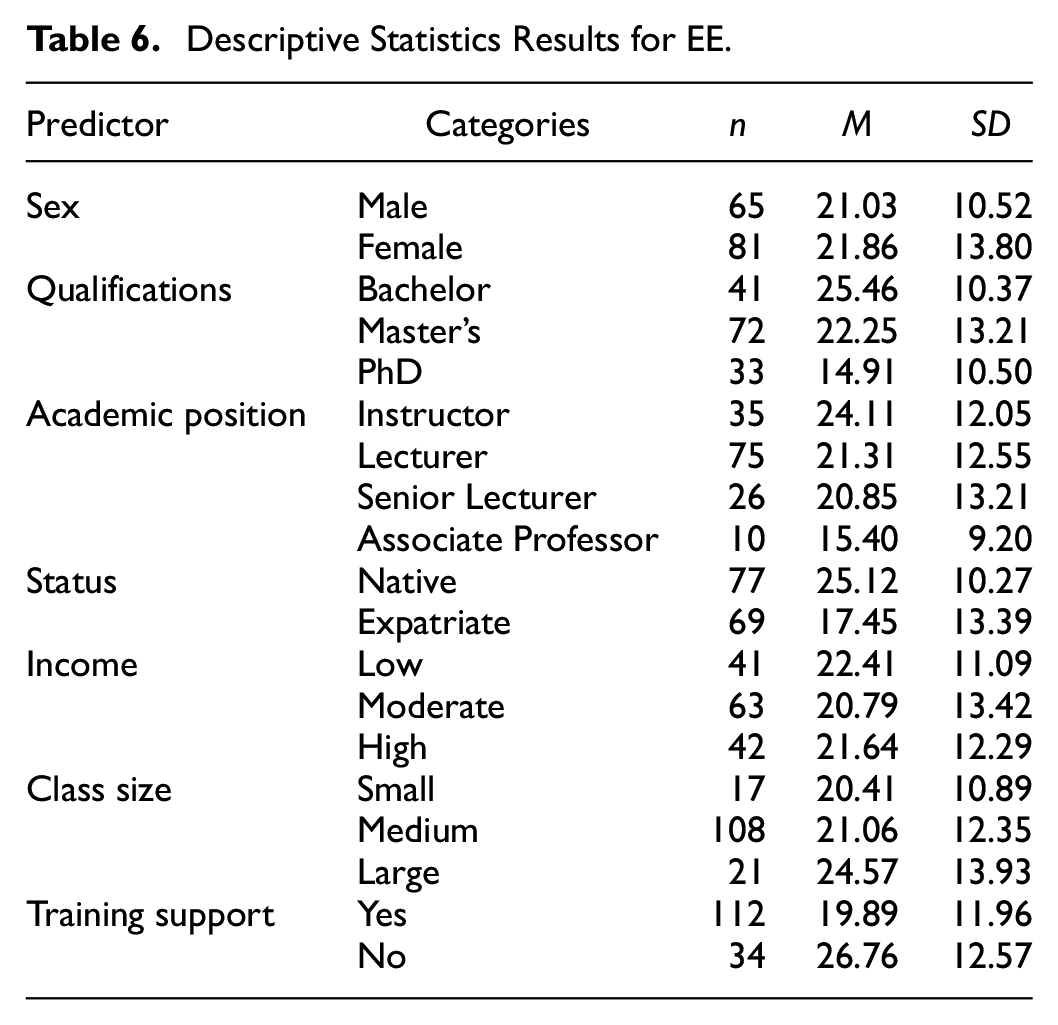
From the descriptive statistics in Table 6, we can see that there are differences in the average EE scores across different groups. For example, while males and females have similar EE scores (M = 21.03 for males, M = 21.86 for females), other factors show larger differences, such as qualifications, where participants with PhDs reported much lower EE (M = 14.91) compared with those with Bachelor’s degrees (M = 25.46). The regression analysis in Table 7 further highlights key predictors of EE.
Results of Bootstrap Multiple Regression Analysis between Participants’ Profiles and the EE.

Notes. R 2 = .20; F-test = 3.668 (p = .001).
Standard error bootstrapped (BCa).
Significance tests bootstrapped (BCa).
The results show that certain demographic and professional variables are significantly related to emotional exhaustion (EE), a key aspect of burnout. The overall model was significant (F (9, 135) = 3.668, p = .001), explaining 20% of the variance in EE. Specifically, three predictors emerged as significant:
Qualifications: There is a significant negative relationship between educational qualifications and EE (B = −4.123, p = .013). This means that as qualifications increase, emotional exhaustion decreases. For instance, those with a PhD reported significantly lower burnout compared to those with only a bachelor’s degree.
Status (Native vs. Expatriate): Status is also a significant predictor, with expatriate instructors reporting lower EE compared to their native counterparts (B = −7.422, p = .006). This suggests that expatriate instructors are less likely to experience emotional exhaustion.
Training Support: Training support has a positive and significant effect on EE (B = 5.252, p = .028). Instructors who reported receiving training support also reported higher levels of emotional exhaustion. This result might seem counterintuitive, and further analysis could explore whether this reflects the nature of the training or other related factors.
Other variables such as sex, academic position, teaching experience, workload, income, and class size were not significantly related to EE in this model, indicating that they do not have a strong predictive effect on burnout when considering the entire group of participants.
In summary, the results suggest that having higher qualifications, being an expatriate, and receiving training support can predict levels of emotional exhaustion among university instructors, with qualifications and status being protective factors, while training support is associated with higher exhaustion.
Relationship Between Participants’ Profiles and the DP
The analysis of the relationship between participants’ profiles and depersonalization (DP), a key aspect of burnout, yielded significant results. Table 8 provides descriptive statistics for DP, showing that certain groups report higher levels of DP than others.
Descriptive Statistics Results for DP.

For instance, males report a higher average DP score (M = 8.45) than females (M = 5.27), and participants with only a bachelor’s degree show higher DP (M = 11.29) compared to those with a PhD (M = 3.30). Similarly, native instructors report more DP (M = 9.03) than expatriates (M = 4.06).
Using the forced entry method in multiple regression, we tested the relationship between participants’ profiles and the DP.
The multiple regression results in Table 9 indicate that the overall model was significant (F (9, 135) = 6.975, p = .001), explaining 32% of the variance in DP among instructors. Four key variables emerged as significant predictors of DP:
Results of Bootstrap Multiple Regression Analysis Between Participants’ Profiles and the DP.
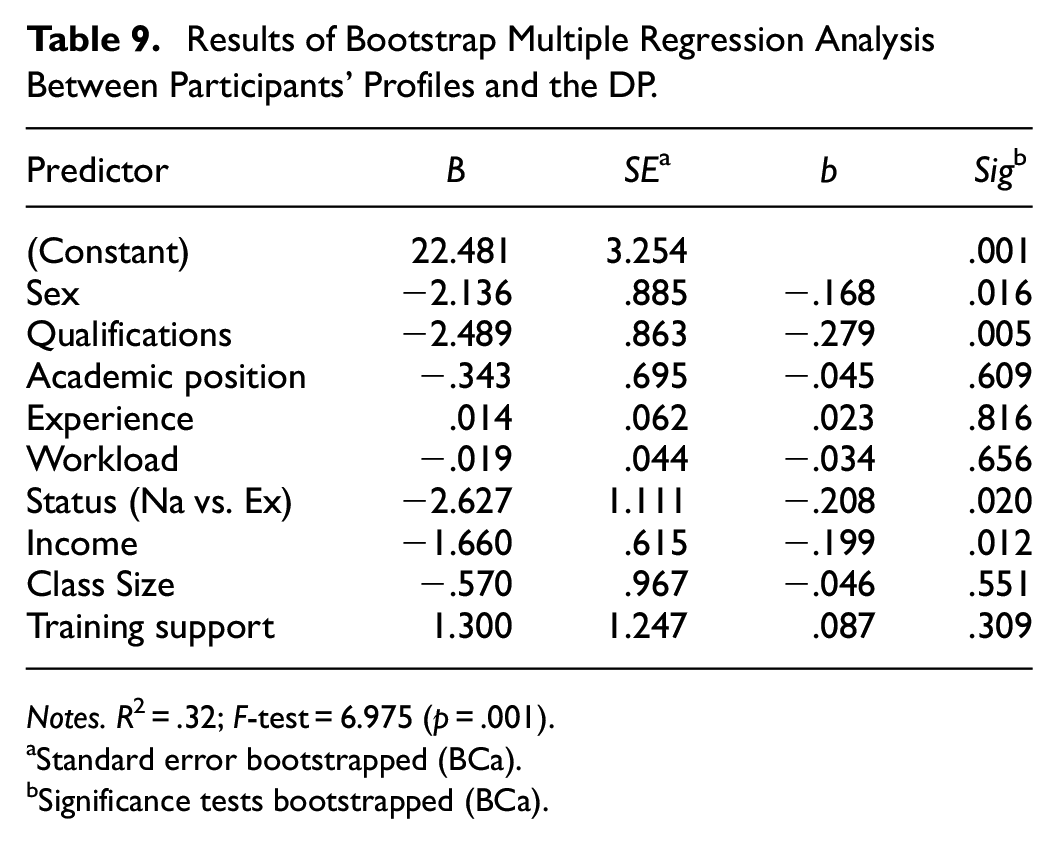
Notes. R 2 = .32; F-test = 6.975 (p = .001).
Standard error bootstrapped (BCa).
Significance tests bootstrapped (BCa).
Sex: There is a significant negative relationship between gender and DP (B = −2.136, p = .016), meaning that female instructors tend to report lower DP than their male counterparts.
Qualifications: Higher qualifications are significantly associated with lower levels of DP (B = −2.489, p = .005). Those with advanced degrees, particularly PhDs, experience less depersonalization compared to those with lower qualifications.
Status (Native vs. Expatriate): Status also plays a role, with expatriate instructors reporting significantly lower DP than native instructors (B = −2.627, p = .020). This suggests that expatriates tend to feel less detached or emotionally distant from their work.
Income: Higher income is associated with lower DP (B = −1.660, p = .012). Instructors with higher income levels report feeling less emotionally detached or depersonalized in their roles.
Other variables such as academic position, teaching experience, workload, class size, and training support were not significant predictors of DP, meaning they do not have a strong influence on this burnout component.
In short, the results suggest that being female, having higher qualifications, being an expatriate, and earning a higher income are all associated with lower levels of depersonalization among university instructors. These findings emphasize the protective effects of these factors against emotional detachment in their professional roles.
Relationship Between Participants’ Profiles and the PA
Table 10 provides descriptive statistics for PA, showing that female instructors report higher average PA scores (M = 36.65) compared to male instructors (M = 32.49). Similarly, expatriate instructors report higher PA (M = 37.73) compared to native instructors (M = 32.17). In terms of qualifications, those with a PhD report the highest PA (M = 37.54), while those with a Bachelor’s degree report the lowest (M = 29.51).
Descriptive Statistics Results for PA.

The regression analysis conducted between participants' profiles and personal accomplishment (PA), another component of burnout, yielded significant insights (Table 11).
Results of Bootstrap Multiple Regression Analysis Between Participants’ Profiles and PA.

Notes. R 2 = .21; F-test = 3.890 (p = .001).
Standard error bootstrapped (BCa).
Significance tests bootstrapped (BCa).
The results of the regression analysis, presented in Table 11, indicate that the overall model was significant (F (9, 135) = 3.890, p = .001), explaining 21% of the variance in PA among instructors. However, the only significant predictor in this model was sex:
Sex: There is a significant positive relationship between gender and PA (B = 3.001, p = .048), indicating that female instructors are more likely to report higher personal accomplishment than male instructors. This suggests that female instructors feel more competent and effective in their roles compared to their male counterparts.
Although the overall model accounted for 21% of the variance in PA, no other variables, including qualifications, academic position, status, income, class size, workload, experience, or training support, were significant predictors. This suggests that, after controlling for other factors, gender is the most important factor in predicting levels of personal accomplishment among instructors.
To sum up, while gender is a significant predictor of personal accomplishment, with females experiencing higher PA, other demographic and professional variables did not significantly influence instructors’ sense of achievement in their work.
Discussion
The current study investigated the burnout levels among university instructors in Oman and explored the relationship between their profiles and the three burnout components, namely, Emotional Exhaustion (EE), Depersonalization (DP), and Personal Achievement (PA). Based on our results, on average the instructors indicated moderate levels of burnout. These results are consistent with those of the previous research findings done in other parts of the world, like Europe (e.g., Kohnen & Barth, 1990; Quattrin et al., 2010).
Interestingly, as our results in Table 7 showed, besides education and training support, the instructors’ status as local or expatriate is a significant predictor of their burnout. In the present study, the result suggests that instructors with lower levels of education (i.e., Bachelor’s) exhibit a higher degree of EE than instructors with higher levels of education (Master’s or PhD). This phenomenon could be attributed to the idea that higher educational levels potentially equip instructors with better-coping mechanisms, strategies, and a broader network of peers, which in turn provide better support. Moreover, those with higher qualifications might receive more respect and value from students and colleagues, thus reducing the emotional strain on them. Surprisingly, local instructors exhibit higher levels of EE than expatriate instructors, which could be attributed to the heightened societal and institutional expectations placed upon them, despite their familiarity with cultural and societal nuances. Given their deeper roots in the community, they might be subjected to more scrutiny and bear additional responsibilities beyond their teaching roles. Expatriate instructors, on the other hand, might operate with a different set of expectations. Being from outside the local context, they might be afforded certain leniencies or privileges, and their experience might be somewhat buffered by their temporary status in the country. They might also form close-knit support groups, providing an external system of support that might be different from what local instructors have.
The positive correlation of training support with EE underscores the importance of proper training for educators. Without adequate training and support, instructors can often feel overwhelmed, underprepared, and ill-equipped to handle their responsibilities, leading to heightened levels of stress and burnout. Proper training not only imparts essential skills but also instills confidence, which is crucial for effective teaching and managing classroom dynamics.
For other variables like marital status, the current study aligns with the result of a previous study, which found no significant difference in the EE scores between married and unmarried instructors in the Malaysian context (Mousavy & Nimehchisalem, 2014).
The negative correlation between Sex and DP (Table 9) suggests that male instructors with lower levels of educational background, lower income, and local citizenship tend to experience higher levels of DP than their counterparts. In many cultures, men are traditionally seen as primary breadwinners and are under immense pressure to provide for their families. According to Van Horn et al. (1997), male teachers’ burnout was significantly affected solely by attentiveness. Hence, those with a lower educational background and income might experience heightened stress due to financial constraints or perceived inadequacies in fulfilling the societal role. Such pressures could amplify feelings of disillusionment and detachment from work, contributing to DP.
The negative correlation between instructors’ qualifications and DP (Table 9) may influenced by a confluence of factors. Cultural norms in the region deeply revere higher education, bestowing greater societal respect and recognition upon those with advanced degrees, which can enhance self-worth and reduce feelings of detachment. Higher qualifications often bring more rigorous pedagogical training and professional efficacy, which can decrease the chances of feeling disillusioned with teaching. Additionally, advanced degrees can offer instructors better job security and professional autonomy in academic institutions, leading to reduced work-related stressors. The extended networks that come with higher academic pursuits can also provide essential support systems. Furthermore, the financial stability associated with advanced qualifications in the region might play a role in mitigating feelings of depersonalization. These intertwined cultural, educational, and economic factors collectively contribute to the reduced DP among highly qualified instructors in Oman.
The negative correlation between instructors’ local or expatriate status (Table 9) suggests that local instructors, deeply rooted in their home contexts, often grapple with established cultural norms and institutional hierarchies. These frameworks may, at times, overlook their consistent efforts, causing feelings of being undervalued. Expatriate instructors, bringing a wealth of diverse teaching methodologies and international insights, often find themselves at the receiving end of various motivational incentives. As Fletcher and Bailyn (1996) posit, dominant incentives such as adventure, life change, and family considerations play pivotal roles in expatriation decisions, aligning with the broader notion that careers often intertwine with personal lifestyles, seamlessly bridging home and work life. In practical terms, these incentives manifest as attractive compensation packages, opportunities for professional growth, and unique life experiences. Such benefits not only elevate their overall job satisfaction but also serve as protective layers against the adverse effects of burnout. Institutions, in their bid to globalize, may sometimes place a premium on expatriate educators, offering them resources, opportunities, and recognition that bolster their professional journey. The consequential disparity in the treatment can inadvertently exacerbate feelings of DP among local educators. This dynamic underlines the importance of balancing motivation incentives to ensure that both local insights and international expertise are equally cherished and rewarded. Such a balanced approach is essential to cultivating a thriving academic community where every educator feels valued and motivated.
Our results also indicated that female instructors show higher levels of PA than their male counterparts (Table 10). Historically, women in the region have had to navigate a labyrinth of gender-based expectations and roles, both within their personal spheres and professional domains. This might instill in many female instructors an amplified drive to assert their competencies, leading to a pronounced emphasis on personal achievement. Their journey in the academic realm, often dotted with efforts to transcend societal preconceptions, could imbue them with a heightened sense of accomplishment when they overcome challenges. Furthermore, as many Omani academic institutions endeavor to rectify gender imbalances and promote female participation, there’s a growing impetus for women to rise to the occasion. This landscape might encourage female educators to seize opportunities, fortify their academic contributions, and thereby accentuate their PA levels. Simultaneously, the community-centric ethos typical of Middle Eastern societies could offer female instructors an enriched tapestry of support. The collective strength of family and community networks might provide a resilience buffer, aiding them in steering through professional terrains with added confidence and purpose.
The teaching of English in Oman, particularly at the tertiary level, heavily relies on expatriate educators. As it was mentioned above, about half the population of English teachers in Oman are expatriate, who play a crucial role in shaping the country’s education system, bringing with them global expertise and diverse pedagogical approaches. However, they also face significant challenges, including cultural adjustment, job insecurity, and isolation, which can contribute to higher levels of burnout.
Conclusion
This study delved into burnout levels of university instructors in Oman, focusing on the three dimensions of burnout including Emotional Exhaustion (EE), Depersonalization (DP), and Personal Achievement (PA). Utilizing the adapted Maslach Burnout Inventory, responses from 149 instructors from public universities revealed distinct patterns related to demographic factors. Specifically, the data indicated moderate levels of DP and PA and low levels of EE. Instructors with lower qualifications or native to the region typically faced higher EE. Additionally, local male instructors, particularly those with lower qualifications and incomes, showed elevated DP levels, whereas female instructors reported higher PA. The study significantly illuminates educator burnout in the academic context in Oman, uncovering factors that influence this phenomenon in a rapidly changing educational landscape like Oman.
One of the pivotal nuances this research has brought to the fore is the differential burnout levels among local and expatriate instructors. The unique challenges and experiences that come with being an instructor in a foreign land can have profound implications on expatriates’ emotional and psychological well-being. Conversely, local instructors, deeply intertwined with the societal and cultural fabric of Oman, can face pressures and expectations that might be distinct from their expatriate counterparts. The data suggests that local instructors, especially males with fewer qualifications and lower incomes, tend to experience higher burnout levels in the form of Depersonalization. This emphasizes the importance of considering not just the professional and educational background of educators, but also their cultural and societal contexts. The Middle Eastern academic environment, with its blend of local and global educational ideologies, further accentuates the significance of understanding these burnout dynamics. Institutions need to be cognizant of these differences, tailoring support systems and interventions that address the unique needs and challenges faced by both local and expatriate educators.
The current study had a relatively small sample size which reduces the generalizability of its results. It also focuses on only one country, Oman; therefore, to enhance our understanding of educator burnout in the Middle East, future studies could investigate participants from other countries in the region, including Saudi Arabia, Jordan, and the United Arab Emirates.
Footnotes
Acknowledgements
None
Declaration of Conflicting Interests
The author(s) declared no potential conflicts of interest with respect to the research, authorship, and/or publication of this article.
Funding
The author(s) received no financial support for the research, authorship, and/or publication of this article.
An Ethics statement
The authors acquired permission from the University of Soltan Qabus before collecting the data from the staff, who signed consent forms.

Data Availability Statement
Data sharing not applicable to this article as no datasets were generated or analyzed during the current study.