




Abstract
This study presents a thorough examination of the psychometric properties of the Czech version of the Sport Multidimensional Perfectionism Scale-2 in adolescent athletes. Factorial structure, external validity, and internal consistency were evaluated using a cross-sectional design. In addition, three-month temporal stability was also assessed. The cross-sectional study sample consisted of 243 respondents (50.2% females; mean age 16.40 years). Factorial structure of the Sport-MPS-2 was examined using exploratory factor analysis, evidence for external validity was based on bivariate and canonical correlations with Big Five Inventory-2 (short) and Sport Anxiety Scale-2. The longitudinal part of the study was performed on a subsample of 96 participants. Factorial structure in our sample fully corresponded to the structure suggested by the authors of the instrument. Internal consistencies of subscales were satisfactory. Regarding external validity, Doubts about Actions and Concern over Mistakes were positively related to sport anxiety, and positive relationship was found also between Concern over Mistakes and Negative Emotionality. No substantial relationships were found in case of subscales constituting perfectionistic strivings. Temporal stability of Sport-MPS-2 over three months was satisfactory. The Czech version of Sport-MPS-2 can be considered a reliable instrument for assessing perfectionism in sport in the adolescent population.
Introduction
Perfectionism is considered as a relatively stable personality trait which consists of several facets. Even though different scholars emphasize different features of this concept, there is a general agreement that the core symptoms of the phenomenon are striving for flawlessness and setting excessively high personal standards (Frost et al., 1990). Stoeber and Otto (2006) summarized the results of previous perfectionism research and concluded that there are two general dimensions, which they labelled perfectionistic strivings and perfectionistic concerns. It is important to differentiate between these two dimensions, because they tend to show a different relationship with psychological constructs (Stoeber et al., 2020). It has been repeatedly reported that perfectionistic concerns are associated with indicators of psychological maladjustment (Stoeber et al., 2018). In the case of perfectionistic strivings, the relationships to external variables are more complex. As Gotwals et al. (2012) conclude succinctly in their systematic review, strivings in sports are predominantly adaptive, but this trend is only apparent under the assumption that the negative influence of concerns is controlled. Although the dual conception of perfectionism has become fairly well established in the literature, as Hill (2016) points out, perfectionistic strivings and perfectionistic concerns should be studied together, as neither dimension is sufficient to capture perfectionism perfectly.
From the developmental perspective, adolescence is regarded the key period when individual differences in perfectionism develop (Damian et al., 2013). In this context, Stoeber and Childs (2011) point out that parents, personality (conscientiousness in particular), and also a genetic component play a crucial role in the development of perfectionism during childhood and adolescence. They also found that perfectionistic concerns in adolescence are associated with higher levels of depression, anxiety, and other emotional and somatic complaints. In contrast, the dimension of perfectionistic strivings was linked to indicators of subjective well-being and psychological adjustment such as academic confidence, academic achievement, peer acceptance, and many others.
Perfectionism and External Variables
Competitive activities like sports create pressure on individuals to perform perfectly and thus it is not surprising that perfectionism is a prevalent characteristic in elite athletes. Manifestations of perfectionism, which can both support and impede sports performance, were identified by Stoeber (2011), who reviewed research findings regarding perfectionist strivings and perfectionist concerns in the context of the athlete’s emotions, motivation, and performance. Stoeber (2011) found that the two perfectionistic dimensions possess different patterns of associations to external variables. While perfectionistic concerns were linked to competitive anxiety, fear of failure, and avoidance goal orientations, perfectionistic strivings showed positive associations with self-confidence, or performance in training and competitions. Stoeber (2011) concluded that perfectionism in sport cannot be considered as a strictly negative characteristic undermining athletes’ performances, but more as a construct with a dual nature.
The nature of the relationship between sports anxiety and perfectionism was examined by Stoeber et al. (2007). On a variety of samples from different sports and of different age compositions (adolescents and young adults) they obtained consistent results showing that negative reactions to imperfection (as a core component of perfectionistic concerns) are closely related to competitive anxiety. At the same time, striving for perfection was unrelated to anxiety. Gotwals et al. (2010) added further novelty to the sports anxiety-perfectionism discussion by utilizing Stoeber and Otto’s (2006) conceptualization of healthy and unhealthy perfectionism. Gotwals et al. (2010) hypothesized that a combination of high perfectionistic strivings and high concerns should result in generally heightened sports anxiety, while an athlete exhibiting a combination of high strivings and low concerns should experience lower levels of anxiety. They found that perfectionistic strivings accompanied by perfectionistic concerns were positively related to all factors of competitive anxiety (somatic anxiety, worry, and concentration disruption). On the other hand, healthy perfectionism in athletes, where perfectionistic strivings are not associated with negative emotional symptoms, precluded concentration disruption caused by anxiety.
Perfectionism is a concept that is also intertwined with personality traits. From the perspective of the Big Five theory, perfectionism can be described as an extreme manifestation of conscientiousness and is closely connected to neuroticism, especially when high expectations are not met (Costa & McCrae, 1988). As with sports anxiety, the relationship of personality traits to perfectionism is affected by the dual nature of the construct. The dimensions constituting perfectionistic concerns are closely connected to neuroticism, while dimensions in the background of perfectionistic strivings are positively associated with conscientiousness. This pattern of relationships has been repeatedly confirmed by many studies (e.g., Rice et al., 2007; Sherry et al., 2007; Stoeber et al., 2009).
Another external variable considered in relation to sports perfectionism is gender. Relevant literature does not provide a clear consensus on gender differences with regard to the dimensions of perfectionism. While some studies (Anshel & Eom, 2002; Dunn et al., 2012; Stoeber & Stoeber, 2009) found no substantial differences in any dimension, other researchers reported differences mainly in the sense that males scored higher in relation to perfectionistic strivings and lower for perfectionistic concerns. More specifically, Anshel et al. (2009) found that adolescent girls experienced greater pressure from parents, and boys were characterized by a higher level of the organization factor. Similarly, in Rasquinha et al. (2014), males scored higher on the perfectionistic strivings second-order dimension, which consists of personal standards and organization.
Sport Multidimensional Perfectionism Scale
Contemporary research utilizes a multidimensional approach to the measurement of perfectionism, and in the field of sport psychology, one of the most popular measures is the Sport Multidimensional Perfectionism Scale (Dunn et al., 2006). The Sport Multidimensional Perfectionism Scale (Sport-MPS) is a sport derivative of the Multidimensional Perfectionism Scale by Frost et al. (1990; Frost-MPS). The authors of the Sport-MPS (Dunn et al., 2006) originally created an instrument intended to measure perfectionism among football players (MPS-Football; Dunn et al., 2002). In comparison to MPS-F, due to the concerns regarding face validity Dunn et al. removed two scales of Frost-MPS (Doubts about Actions and Organization) and added two newly hypothesized perfectionism dimensions. The final instrument thus contained 30 items distributed into six subscales: Concern over Mistakes, Personal Standards, Parental Expectations, Parental Criticism, and the newly added Coach Expectations and Coach Criticism. Based on exploratory factor analysis the authors suggested collapsing the three parental subscales and the two coach subscales into Perceived Parental Pressure subscale and Perceived Coach Pressure subscale, respectively. In 2006, Dunn et al. (2002) published a validation study which established construct validity of the instrument and verified its four-factor structure. Wording of the items was altered to be suitable for sports in general and thus the scale was renamed Sport-MPS.
Developers of the Sport-MPS instrument repeatedly acknowledged certain limitations in content-related validity due to under-representing the multidimensionality of the perfectionism construct resulting from omitting the Doubts about Actions and Organization subscales from the instrument (e.g., Vallance et al., 2006). For this reason, Gotwals and Dunn (2009) decided to develop a revised version of the instrument. The Sport-MPS-2 consists of all 30 original items of the Sport-MPS, supplemented with twelve items evenly distributed into the Doubts about Actions and Organization subscales. In their study, Gotwals and Dunn (2009) established content-related validity and structure-related validity evidence of the twelve newly developed items. On top of that, their study (N = 251; 46% females; average age 21.70 ± 2.35 years; intercollegiate varsity team sports) demonstrated that the instrument has expected latent dimensionality, that is, six proposed factors (Concern over Mistakes, Personal Standards, Perceived Parental Pressure, Perceived Coach Pressure, Doubts about Actions, and Organization) were clearly differentiated and adequately represented by respective items. A follow-up study (Gotwals et al., 2010) further confirmed structurally-related validity of the instrument on a sample of 263 intercollegiate volleyball players (average age 20.02 ± 1.63 years; 52% females) and also brought new evidence about its external validity by assessing its relations to the components of competitive trait anxiety. Gotwals et al. (2010) found out that Sport-MPS-2 enabled the differentiation between healthy and unhealthy perfectionism orientations. On one hand, high Concerns over Mistakes, Doubts about Actions, and Perceived Coach Pressure were positively related to all competitive trait anxiety components, while on the other hand, Personal Standards and Organization were negatively related to concentration disruption. The long-term developmental process of the instrument was completed by a thorough investigation of the higher-order latent dimensionality (Dunn et al., 2016). Based on the analyses of eight independent samples, the authors concluded that the six subscales of the instrument were hierarchically organized into two highly interpretable factors labelled perfectionistic strivings and perfectionistic concerns. Perfectionistic strivings in sports are associated with strivings for perfection and are characterized by setting (Personal Standards) and fulfilling (Organization) high standards of performance and training standards (Stoeber, 2012). Perfectionistic concerns reflect concern over making mistakes, fear of negative evaluation by others (operationalized by Perceived Coach and Parent Pressure), and feelings of discrepancy between one’s expectations and performance/preparations (Doubts About Actions).
Although the original developers of the instrument reported satisfactory psychometric characteristics in several (above mentioned) studies, results of adaptation studies in different cultural contexts were less conclusive. Nascimento et al. (2015) adapted the instrument into a Brazilian sport context with a sample of 395 male (53%) and female adult (average age 22.53 ± 5.92 years) athletes (competitors at the Paraná State Open Games) from a range of individual and team sports. Nascimento et al. (2015) performed a series of exploratory and confirmatory factor analyses resulting in establishing a final model with adequate characteristics. This model, however, consisted only of 24 items (in contrast to 42 original items) distributed into four dimensions; Organization and Personal Standards were collapsed into one factor interpreted as perfectionistic strivings, and the Perceived Coach Pressure factor was omitted entirely (due to low item factor loadings in EFA). Nascimento et al. (2015) also reported an acceptable level of short-term (7 days) temporal stability. Somewhat better characteristics of Sport-MPS-2 in a Mexican sport context were reported by Pineda-Espejel et al. (2017). Their sample consisted of 420 adolescent and adult athletes (55% females; average age 21.63 ± 3.83 years) from different sports, competing at university, state, and national levels. Their model consists of six original factors, but to achieve sufficient model fit they needed to remove six items (two items from Personal Standards, two from Perceived Coach Pressure, one from Doubts about Action, and one from Organization). In a follow-up study, Pineda-Espejel et al. (2018) confirmed the structure of six independent factors on a sample of 222 youth and adult athletes (50% females; average age 20.14 ± 3.69 years) from various sport disciplines, but also reported problems with the reliability of Perceived Coach Pressure and unconvincing evidence of criterion validity based on the investigation of relationships to somatic anxiety components.
Cultural Differences
Given that the relevant psychometric studies provide ambiguous information on the internal factor structure of the Sport-MPS-2, the potential sources of these differences need to be discussed. From a general point of view, three main causes of the different results can be considered: sample characteristics, language, and cultural differences. In terms of sample composition, the studies differed most in terms of the sports disciplines that were included. While the studies by the original authors of the method (Gotwals & Dunn, 2009; Gotwals et al., 2010) focused on team athletes, in subsequent studies (Nascimento et al., 2015; Pineda-Espejel et al., 2017, 2018) the authors analyzed data from athletes competing in different—team and individual—sport disciplines. However, this factor does not seem to be able to fully explain the internal structure differences found, as the studies by Pineda-Espejel et al. (2017, 2018) essentially confirmed the original proposed factor structure and, conversely, Nascimento et al. (2015) could not confirm this structure on a similar sample.
On the basis of the previous research, it is not possible to fully untangle the effects of the remaining two factors, that is, linguistic, and cultural differences. Although a procedure for determining the effect of culture over and above language has been proposed (Bonicatto et al., 1998), this procedure is dependent on available data on the psychometric properties of instruments from culturally different countries which share the same language. Regarding the influence of culture, two groups of sociocultural mechanisms that influence perfectionism across ethnic groups were identified as being the most important (DiBartolo & Rendón, 2012). The first group of mechanisms is based on differences in the level of the collectivism dimension, and, more specifically, it has been speculated that interdependence (i.e., duty to group) as a characteristic of a collectivist cultures is capable of altering the nature of the construct of perfectionism. According to Yoon and Lau (2008), the cultural orientation of interdependence may increase maladaptive perfectionism tendencies and moderate the relationship between perfectionism and external variables. The second group of mechanisms behind cross-cultural differences in perfectionism according to DiBartolo and Rendón (2012) is connected to parenting styles. Relevant studies provide evidence of cultural conditioning of the relationship between parenting styles and perfectionism. A number of studies have focused on comparing different American ethnic communities in terms of the association between parenting styles and manifestations of perfectionism. For example, it was found that authoritarian parenting styles and maladaptive perfectionism is moderated simultaneously by ethnicity (Asian vs. Caucasian in America) and gender (Kawamura et al., 2002) and that the pattern of relationships between the perfectionistic dimensions of parents and their offspring is conditioned by cultural (African American vs. Caucasian American) affiliation (Rice et al., 2008).
The current state of knowledge does not allow us to make assumptions about the cultural conditioning of parenting styles between Czech and Canadian culture. However, according to Oyserman et al. (2002), Central European countries (which include Czech Republic) are different to North and Latin/South American countries in the levels of collectivism and therefore, on a general level, it can be expected that cross-cultural differences may play a role in the adaptation of the instrument to the Czech cultural context.
To conclude, Sport-MPS-2 covers all relevant aspects of perfectionism in sport, but it seems to be susceptible to the cultural context and/or language variations. Apparently, more studies on different samples of athletes are needed to adequately evaluate its psychometric properties. The purpose of this study is to contribute to the discussion on the measurement of perfectionism in athletes in different cultural contexts. More specifically, this study focuses on the assessment of the psychometric characteristics of the Czech version of the Sport-MPS-2; namely its factorial structure, external validity, and reliability in the sense of internal consistency and temporal stability. Although previous psychometric studies are mostly based on research samples covering developmental periods of adolescence and young adulthood, the present study focuses exclusively on adolescence, as this developmental period represents a key period in the development of perfectionism (as described in the introduction) and also in the formation of sporting careers.
Method
Procedure
Instruments used in our study were administered as a part of a questionnaire battery that contained a broad spectrum of instruments focused on demographic, social, psychological, and sport-related characteristics. Sport related instruments (SAS-2 and Sport-MPS-2) were translated into Czech using a four step procedure consisting of: (a) forward translation by a professional familiar with psychological terminology, (b) back translation by an independent translator, (c) resolving inconsistencies in a team of study authors and the two translators, and (d) pre-testing on a sample of 10 adolescent athletes focused on clarity and unambiguity of items. In the case of BFI-2 a standardized Czech adaptation of the instrument was available.
The data collection process consisted of two waves. In the first wave, the battery was administered using a paper/pencil questionnaire in school settings (autumn 2018) and the administration took 90 minutes. The data collection was supervised the whole time by a trained administrator (an undergraduate student of psychology), who was available to answer any questions regarding questionnaire content. The follow-up data were obtained after three months using a computerized questionnaire administered in a controlled environment (university laboratory with a trained supervisor selected from among doctoral students of psychology). Approval for the project was obtained from the Institutional Board of the Institute of Psychology, Czech Academy of Sciences. Participation in the study was voluntary and all participants (and their legal representatives) provided written informed consent prior the data collection. All data were analyzed anonymously.
Sample
A total of 251 adolescent athletes recruited from a sport-focused high school participated in our study. The school is located in Brno (the capital of the South Moravian Region) and it plays an important role in the Czech Republic’s system of care for talented youth. The school’s mission is to provide opportunities to successfully combine educational activities with the development of sporting talent and intensive specialized sports training. It represents a typical educational institution that recruits elite athletes of various sports disciplines from the region. Therefore, it can be argued that our sample sufficiently represents the population of elite adolescent athletes in the Czech Republic.
Only cases with fewer than 1/3 missing answers in any of the instruments used were included. The sample consisted of 243 respondents (50.2% females) in the age range from 14 to 19 years (M = 16.40, SD = 1.31). Participants were actively training for their sports, either individual (most frequently athletics, swimming, and tennis; 58.8% participants) or team (most frequently volleyball, basketball, and football; 41.2% participants). The majority (97.1% of participants) trained a minimum of three times per week. Participants competed at the recreational (4.1% of participants), regional (14.4%), national (49.4%), and international (32.1%) levels. The follow-up subsample was limited to respondents participating in the longitudinal part of the project and consisted of 96 participants (56.3% females, Mage = 16.30 years, SD = 1.30).
Instruments
Sport Multidimensional Perfectionism Scale 2 (Sport-MPS-2; Gotwals & Dunn, 2009). The instrument reflects the multidimensional nature of perfectionism with both intra- and inter-personal components. It contains 42 items that measure six proposed dimensions of perfectionism in sports; namely Personal Standards (PS, 7 items), Concern over Mistakes (COM, 8 items), Perceived Parental Pressure (PPP, 9 items), Perceived Coach Pressure (PCP, 6 items), Doubts about Actions (DAA, 6 items), and Organization (Org, 6 items). The items are rated on a 5-point scale from 1 = strongly disagree to 5 = strongly agree. The Czech translation of the instrument is available in the Appendix.
Sport Anxiety Scale-2 (SAS-2; Smith et al., 2006) represents a brief multidimensional measure of cognitive and somatic trait anxiety in sport performance settings. Fifteen items are evenly distributed into three subscales; Somatic Anxiety (SAS_SA), Worry (SAS_W), and Concentration Disruption (SAS_CD). The rating scale is 4-point from 1 = not at all to 4 = very much. The internal structure of the instrument in our data was evaluated using confirmatory factor analysis (maximum likelihood estimation with robust standard errors and a Satorra-Bentler scaled test statistic). With regard to the criteria suggested by Little (2013), the three factor model showed an acceptable fit to the data (χ2 = 210.23, df = 87, p < .01; CFI = 0.93; RMSEA = 0.08, 90%CI [0.07, 0.10]). Cronbach’s α values for individual scales were α > .8.
Big Five Inventory 2 short (BFI-2-S; Soto & John, 2017). The scale is theoretically grounded in the Big Five personality theory and assesses individuals’ levels of Extraversion, Agreeableness, Conscientiousness, Negative Emotionality, and Open-Mindedness. Each domain is covered by six items with a 5-point rating scale ranging from 1 = disagree strongly to 5 = agree strongly. Except for Open-Mindedness, all domain scales showed sufficient internal consistency (Cronbach’s αE = .75, αA = .73, αC = .72, αNE = .78, and αOM = .63). The Czech version of the BFI-2-S was standardized on a large sample of adolescents and young adults. Detailed evaluation of the Czech adaptation was published in a psychometric study by Hřebíčková et al. (2020).
Data Analysis
Prior to the main analyses, we inspected the rate of missingness in our data on both the intra-individual and inter-individual levels. After removing eight cases with substantial missingness in the first wave (see the Sample section), the maximum rate of missing values in individual vectors was 2.3% and there were no more than 1% of missing values in any of the items. Due to the computer assisted data collection process, there were no missing answers at all in the second wave. We used the expectation-maximization algorithm to impute missing values in the first wave dataset. The rate of missingness in our dataset can be considered inconsequential (Schafer, 1999; Tabachnick & Fidell, 2019).
In all analyses, we combined male and female data into a single dataset. To assure appropriateness of this decision we tested the assumption of homogeneity of variance-covariance matrices. This assumption was not violated (gender: Box’s M = 1,236.49, F(903, 174,958) = 1.12, p = .007) in terms of the generally recommended significance level .001 (Hahs-Vaughn, 2016).
Initially, we examined the latent dimensionality of Sport-MPS-2 using CFA (maximum likelihood estimation with robust standard errors and Satorra-Bentler scaled test statistic). Since the obtained set of indices (χ2 = 1,453.86, df = 804, p < .01; CFI = 0.87; RMSEA = 0.06, 90%CI [0.06, 0.07]) did not fully meet the required criteria (as suggested by Little, 2013), we subsequently decided to use the EFA technique for assessing the factorial structure of the instrument. This decision is further supported by the fact that the available evidence on the cross-cultural stability of the instrument’s structure is inconsistent. The number of factors to be retained in EFA was determined by the combination of four techniques (Parallel Analysis, Optimal Coordinates, Velicer’s Minimum Average Partial Test, and Comparison Data). To be able to compare our results with those of the original authors of the instrument, we used Principal Axis Exploratory Factor Analysis followed by oblique rotation (Direct Oblimin). EFA results comparation was performed using Procrustes matching technique described by Korth and Tucker (1976), which makes possible the computation of factor congruence coefficients reflecting the similarity between pattern matrix in our data and matrices reported by Gotwals and Dunn (2009, p. 86) and Gotwals et al. (2010, p. 425). Because higher-order latent dimensionality of the Sport-MPS-2 could theoretically be expected, second-order structure was also examined by performing EFA on a factor intercorrelation matrix. To assess direct relationships between variables and higher order factors, the Schmid-Leiman solution was calculated (Schmid & Leiman, 1957) using SPSS syntax script provided by Wolff and Preising (2005).
The external validity of Sport-MPS-2 was assessed on the basis of bivariate relationships between perfectionism dimensions, sport anxiety, and personality using Pearson’s correlations. Given that all constructs measured are of a multidimensional nature, the relationships between personality and perfectionism, and perfectionism and anxiety were additionally examined using canonical correlations, as in Gotwals et al. (2010). Canonical correlations examine the relationships between two sets of variables, while allowing the variables within these sets to be recombined, thereby providing a unique insight into the structure of multivariate relationships. When reporting the results of canonical correlations, we followed the recommendation by Tabachnick and Fidell (2019) to interpret only canonical correlations higher than .30. The same threshold was applied for interpreting correlations between variables and canonical variates. Internal consistency of the instrument was assessed using Cronbach’s α and McDonald’s ω coefficients. Intraclass correlation (ICC2.1) was used to establish test-retest reliability, the strength of agreement for the ICC2.1 values was classified according to McDowell (2009): poor ≤ .40, moderate = .41 to .59, good = .60 to .74, and excellent > .75. Gender differences were analyzed using a multivariate analysis of variance (MANOVA) with Bonferroni correction to avoid the inflation of Type I error.
Results
Exploratory Factor Analysis of the Sport-MPS-2
The Kaiser-Meyer-Olkin test (KMO = 0.811) and Bartlett’s test of sphericity (χ2 = 4,393.16, df = 861, p < .001) indicated that our data are suitable for factor analysis. Several techniques were used to determine a sufficient number of factors to be extracted. Optimal Coordinates (Raiche et al., 2013), Parallel Analysis (Raiche et al., 2013), and Velicer’s Minimum Average Partial Test (Velicer et al., 2000) agreed on a six-factor solution, only Comparison Data index (Ruscio & Roche, 2012) suggested seven factors as the most appropriate. These results together with theoretical expectations led us to accept the six-factor solution. Together, extracted factors explained 43.85% of the instrument’s variance. Table 1 shows a pattern matrix for an oblique six-factor solution.
Pattern Matrix for EFA (Principal Axis Factoring With Oblimin Rotation) of Sport-MPS-2.

Note. Factor loadings ≥│0.30│ are in bold. Factor loadings ≥│0.30│ on unintended factors are in round brackets. Factor loadings <│0.30│ on intended factors are in square brackets. The polarity of pattern loadings on factors 4, 5, and 6 were reversed to improve the interpretability of results. PPP = perceived parental pressure; Org = organization; DAA = doubts about actions; COM = concern over mistakes; PS = personal standards; PCP = perceived coach pressure.
In general, pattern coefficients convincingly demonstrate clear distinctiveness of all factors. In the case of the first three factors reflecting PPP, Org, and DAA domains, only the intended items possessed factor loadings higher than the 0.3 threshold. However, four items distributed between the three remaining factors yielded problematic structures of pattern coefficients. Item 24, which theoretically belongs to the COM factor, appears not to be explained by the six-factor EFA solution. Item 1 had the highest loading on the intended factor PS, but this loading does not reach the 0.3 threshold. The PS factor also contains item 8, which besides its highest loading on the intended factor also showed substantial cross-loading with the COM factor. Similarly, item 30 had the highest loading on the intended factor PCP, but also substantial loading on factor PS.
At the bottom of Table 1 are presented coefficients of factor congruence with studies by Gotwals and Dunn (2009) and Gotwals et al. (2010). In both cases we found considerable similarity between our EFA solution and the other two studies. Factor congruence coefficients ranged from .84 to .95 and the overall congruence coefficients were .91 and .90, respectively.
Second-Order Factor Analysis
Factor intercorrelation coefficients from the previous analysis (summarized in the upper part of Table 2) were used as an input for second-order factor analysis (Principal Axis Factoring with Direct Oblimin rotation). Results of second-order EFA (lower part of Table 2) clearly shows a separation of the dimension perfectionistic concerns characterized by high loadings of the first-order factors PCP, PPP, DAA, and COM, and the perfectionistic strivings dimension determined by PS and Org. The intercorrelation between strivings and concerns was close to zero (r = .08). When applying the Schmid-Leiman solution, two second-order factors accounted for 32.7% of the variance (16.2% for strivings, 16.5% for concerns). For all items, factor loading was higher on the intended second-order factor.
First-Order Factor Correlation Matrix and Second-Order Factor Solution (Principal Axis Factoring, Direct Oblimin Rotation).

Note. PPP = perceived parental pressure; Org = organization; DAA = doubts about actions; COM = concern over mistakes; PS = personal standards; PCP = perceived coach pressure.
Reliability—Internal Consistency and Temporal Stability
Our results clearly support sufficient internal consistency of individual scales (see Table 3). In all cases (across both waves), Cronbach’s α and McDonald’s ω coefficients were higher than .75. The test-retest reliability for the subscales of the Sport-MPS-2 was moderate (PS), good (Org, DAA, COM, PCP), and excellent (PPP).
Reliability of Sport-MPS-2 (Internal Consistency and Temporal Stability).

Note. PPP = perceived parental pressure; Org = organization; DAA = doubts about actions; COM = concern over mistakes; PS = personal standards; PCP = perceived coach pressure.
External Validity—Relationships Between Perfectionism, Personality, and Anxiety
Table 4 summarizes the Pearson correlation coefficient values for the relationship between perfectionism domains, sport anxiety domains, and personality domains. The correlations show that the strongest relationships to external variables are exhibited by the COM and DAA domains. Both domains are positively related to all domains of sport anxiety, and the COM domain is additionally quite closely related to negative emotionality.
Bivariate Relationships Between Perfectionism, Personality, and Anxiety.
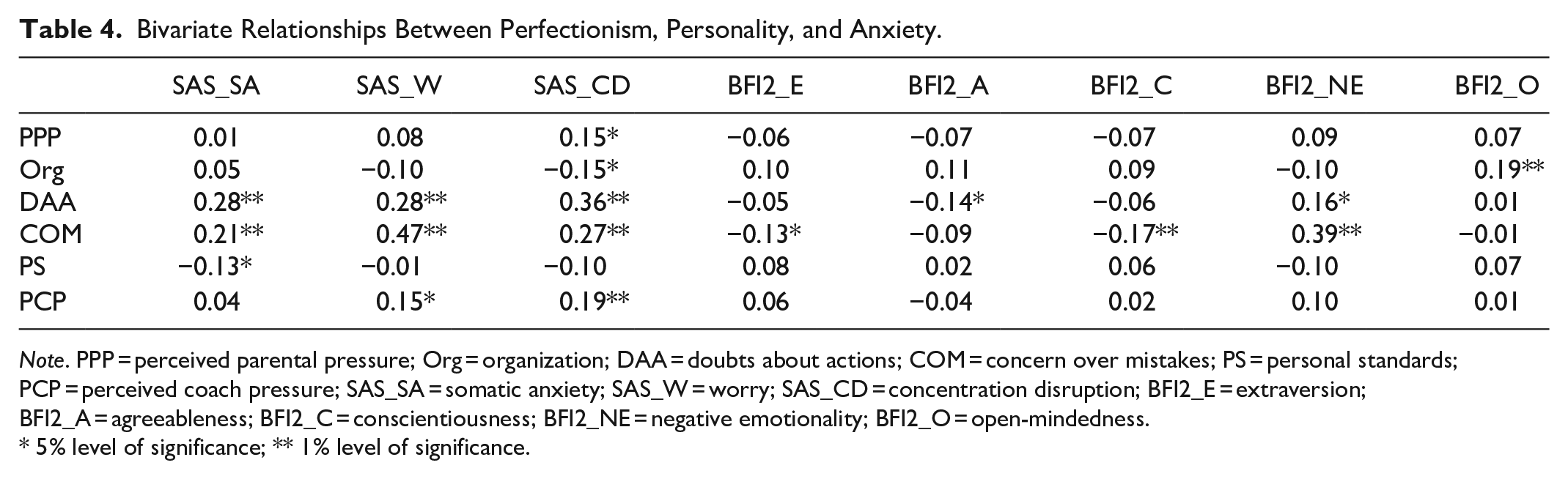
Note. PPP = perceived parental pressure; Org = organization; DAA = doubts about actions; COM = concern over mistakes; PS = personal standards; PCP = perceived coach pressure; SAS_SA = somatic anxiety; SAS_W = worry; SAS_CD = concentration disruption; BFI2_E = extraversion; BFI2_A = agreeableness; BFI2_C = conscientiousness; BFI2_NE = negative emotionality; BFI2_O = open-mindedness.
* 5% level of significance; ** 1% level of significance.
In the next step, two canonical correlation analyses were performed between (a) a set of variables defining basic personality traits (Big Five) and a set of variables reflecting perfectionism dimensions and (b) a set of variables reflecting perfectionism dimensions and a set of anxiety variables.
In the case of personality, the first canonical correlation was .50 (with all canonical correlations included, F(30, 930) = 3.09, p < .001). The remaining four canonical correlations were effectively zero (subsequent F tests were not statistically significant). With a cutoff correlation of .30 the variables in the personality set that were related with the first canonical variate were extraversion, conscientiousness, and negative emotionality. Among the perfectionism dimensions, COM and DAA correlated with this canonical variate. The results indicated that low negative emotionality (r = −.96), high conscientiousness (r = .43), and high extraversion (r = .37) were related to low COM (r = −.78) and low DAA (r = −.34).
In the case of the relationship between perfectionism and sport related anxiety, two canonical correlations were significant and higher than the .30 threshold, that is, .60 and .30 [F(18, 662) = 8.65, p < .001; F(10, 470) = 3.76, p < .001]. The first variate was associated with DAA, COM, and PCP on the side of the perfectionism variable set, and with all anxiety variables (SAS_SA, SAS_W, SAS_CD). Low COM (r = −.77), low DAA (r = −.58), and low PCP (r = −.32) were connected to low anxiety in general (rSAS_W = −.94, rSAS_CD = −.75, rSAS_SA = −.57). The second variate was comprised of ORG, PS and DAA, and SAS_SA. High Org (r = .46) accompanied by high DAA (r = .40) and low PS (r = −.46) were connected to high SAS_SA (r = .81).
Descriptive Statistics and Differences According to Gender and Type of Sport
The descriptive statistics and results of the analysis of variance for Sport-MPS-2 domains are summarized in Table 5. The overall multivariate statistics revealed gender differences across domains of perfectionism (Wilks’ λ = .88, F(6,236) = 5.15, p < .001, partial η2 = .12). A comparison of means regarding gender revealed few differences in some of the domains. More specifically, males scored significantly higher in the Organization and Personal Standards domains, while females scored higher the Doubts about Actions domain.
Descriptive Statistics for Sport-MPS-2 Domains and Differences According to Gender.

Note. PPP = perceived parental pressure; Org = organization; DAA = doubts about actions; COM = concern over mistakes; PS = personal standards; PCP = perceived coach pressure.
Bonferroni. adjusted alpha level of .002 per test (.01/6).
p < .008 (.05/6).
Discussion
The study presented is one of the first attempts to adapt the Sport Multidimensional Perfectionism Scale-2 into a different cultural context. Sport-MPS-2 was originally developed using a sample of intercollegiate athletes (Gotwals & Dunn, 2009), but later it was successfully used in populations spread across the whole period of adolescence (Dunn et al., 2016), even from the age of ten years old (Sapieja et al., 2011). Sport-MPS-2 is a multidimensional measure which includes the individual characteristics of athletes (e.g., personal standards, concerns, and doubts) but reflects also pressures from their social surroundings (mainly parents and coaches). This study was focused on adolescence, because this developmental period represents a crucial phase, when adolescent athletes explore and construct their self-identities and learn how to find a balance in relations with important others (Stambulova et al., 2015).
Results of our study can be concisely summarized in three points: (a) the Czech version of Sport-MPS-2 demonstrated appropriate factorial structure in the adolescent population; (b) the identified factors grouped together in expected second-order factors and formed two theoretically postulated general dimensions of perfectionism—perfectionistic strivings and perfectionistic concerns; (c) the Czech version of the instrument showed a sufficient level of external validity and reliability in the sense of internal consistency and temporal stability.
When investigating factorial structure, we followed the same analytical procedures as used in the original studies describing the development and validation of the instrument. Visual inspection of EFA factor loadings revealed a high degree of similarity between our results and the results of Gotwals and Dunn (2009, p. 86) and Gotwals et al. (2010, p. 425). We applied a more formal test of the similarity between factor pattern matrices and confirmed high congruence with both mentioned studies. Regarding individual items, we identified four problematic items which showed low factor loadings on the intended factors (item 1 from PS and item 24 from COM) or unintended cross-loads (item 8 from PS with cross-load on COM and item 30 from PCP with cross-load on PC). We suggest that the low functionality of these four items should not be ascribed to cultural differences or age differences in research samples, because very similar problems were also reported in the original studies performed on samples of intercollegiate athletes. More specifically, Gotwals and Dunn (2009) identified low factor loading in the case of item 1 and cross-load in the case of item 30, and Gotwals et al. (2010) detected cross-load in the case of item 8. However, we still recommend using the full set of items in the Czech version in future studies in order to obtain more information about the stability of these results. In the context of other Sport-MPS-2 adaptations, we can conclude that the Czech version successfully follows the originally proposed six-factor structure as well as the Mexican adaptation (Pineda-Espejel et al., 2017). In contrast, the adaptation for the Brazilian sport context (Nascimento et al., 2015) utilizes only a small number of the original items distributed into four factors. Although the authors of the Brazil adaptation note that further studies are necessary to verify the stability of this result, they discuss the insufficient level of talent development programs in Brazil as one possible source of these differences, since one of the most affected dimensions in this adaptation is Perceived Coach Pressure. Previous studies provide a strong rationale for the existence of two generalized dimensions of perfectionism (Stoeber, 2011; Stoeber & Otto, 2006). Given the fact that Sport-MPS-2 measures a broad spectrum of perfectionism factors, it provides a possibility to empirically verify the assumption about their hierarchical organization (Dunn et al., 2016). Our study provided further evidence that Concerns over Mistakes, Perceived Coach Pressure, Perceived Parental Pressure, and Doubts about Actions together form a higher-order latent dimension of perfectionistic concerns, while Personal Standards and Organization reflect perfectionistic strivings.
External validity was assessed using two criteria—sport anxiety and personality traits. Bivariate correlation analysis revealed that the DAA and COM dimensions included in perfectionistic concerns were positively related to all aspects of sport anxiety (Somatic Anxiety, Worry, and Concentration Disruption). At the same time, the relationship between COM and Negative Emotionality was revealed and substantial relationships with external criteria were not observed for the dimensions constituting perfectionistic strivings. The latter result is especially worthy of note, as it is theoretically expected that personal standards (a key subdimension of perfectionistic strivings) should be strongly related to conscientiousness (e.g., Rice et al., 2007; Sherry et al., 2007; Stoeber et al., 2009). However, most of the research that has examined this relationship has not been conducted on athletes and thus has not used a domain-specific instrument to measure perfectionism. One of the few studies that reported this relationship in a sport setting was the study by Waleriańczyk and Stolarski (2021), in which the authors found a relatively weak positive association between conscientiousness and perfectionistic strivings. A major difference between this research and our study lies in the composition of the research sample, as Waleriańczyk and Stolarski (2021) focused on individuals in middle adulthood. We believe that the reason for the absence of a conscientiousness-perfectionistic strivings relationship can be explained by two factors, namely, the domain specificity of perfectionism and, at the same time, the adolescent age of the respondents in our study. It is well known that the period of adolescence is characterized by higher dynamics in personality development (Soto et al., 2011) and that the maximal stability of personality is not reached until the age of 30 (Costa & McCrae, 1994), which could have led to the differences in findings.
Using canonical correlations, we found that three of the four factors constituting perfectionistic concerns (COM, DAA, PCP) were clearly connected to all components of sport anxiety. Gotwals et al. (2010) interpreted a similar pattern of relationships as unhealthy perfectionistic orientation. This interpretation is further supported by our results, which connect internally driven perfectionistic concerns (COM, DAA) to negative emotionality, introversion, and low conscientiousness. These findings, in a more recent conceptualization of perfectionism (that abandons the “healthy” and “unhealthy” labels), are consistent with the assumed relationships for pure evaluative concerns perfectionism as suggested by Gaudreau and Thompson (2010). In contrast to other studies (Gotwals et al., 2010; Pineda-Espejel et al., 2018), we did not identify the pattern of a combination of high perfectionistic strivings, low perfectionistic concerns, and low sport anxiety reflecting Gaudrau’s and Thompson’s (2010) pure personal standards perfectionism subtype. Instead, we revealed that somatic anxiety might be strengthened by highly organized training behavior accompanied by high uncertainty about this behavior in combination with a low level of sport ambitions. While this result lacks support in relevant literature, we might only speculate that in an adolescent population personal standards do not fulfill their healthy role in relation to anxiety. We encourage researchers to include this issue into future research projects since the explanation of the interaction effect of dimensions of perfectionism is important both from theoretical and practical perspective.
Internal consistency of the subscales in the instrument was generally satisfactory (higher than 0.75), which is in concordance with other relevant studies (Gotwals & Dunn, 2009; Gotwals et al., 2010; Pineda-Espejel et al., 2017, 2018). Temporal stability of the Czech version can be generally considered as adequate based on McDowell’s (2009) criteria. We can directly compare our results to the study by Nascimento et al. (2015) who reported higher ICC coefficients (between .76 and .85). This difference in results is explainable by the difference in the delay between measurements. Nascimento et al. (2015) focused on short-term stability (seven days), while in our study a three-month interval was used. It is worth mentioning that Personal Standards showed notably lower temporal stability (on the boundary between moderate and good) in comparison to other dimensions. Since no other study reporting long-term temporal stability is available, we cannot decide whether this result stems from relatively lower internal consistency in our data (especially in the follow-up measurement) or whether it should be ascribed to the naturally lower stability of this particular dimension.
Regarding gender differences, Stoeber (2012) summarized relevant evidence and concluded that the majority of studies did not find substantial gender differences in either perfectionistic strivings or in perfectionistic concerns. However, in line with Rasquinha et al. (2014), we found that males scored higher than females in both subdimensions of perfectionistic strivings (small to medium effect sizes). Moreover, females scored higher than males on the Doubts about Actions dimension (between a small and a medium effect size). In our opinion, this difference can be ascribed to the general gender difference in emotionality in adolescence, as numerous studies have confirmed higher anxiety in adolescent females (e.g., Ivanović & Ivanović, 2018; Ohannessian et al., 2017).
This study has several limitations. First, the factorial structure was assessed by an exploratory instead of a confirmatory approach (the motivation for this decision is thoroughly described in the Data analysis section). Therefore, our evidence for the factorial structure should be considered as a first step in the validation process and future research is needed to confirm psychometric characteristics of the Czech version of Sport-MPS-2. Second, the heterogeneity of our sample regarding type of sports included can be considered a limitation. However, the instrument itself is designed to be sport-unspecific and thus the heterogeneity should not significantly alter its structure and psychometric characteristics, as was evident in other studies using either homogenous (e.g., Gotwals et al., 2010) or heterogenous (e.g., Gotwals & Dunn, 2009; Nascimento et al., 2015; Pineda-Espejel et al., 2018) samples. Third, our study lacks evidence of criterion-related validity, which would allow a more detailed evaluation of the functionality of the individual Sport-MPS-2 dimensions in the Czech adaptation if a suitable multidimensional instrument was used as the criterion. Finally, it is important to note that our sample size was relatively small given the total number of items on the instrument. Considering the above-mentioned limitations, we feel obligated to encourage other researchers to validate the intercultural stability of Sport-MPS-2 factorial structure on larger samples.
Footnotes
Appendix
Sport-MPS-2 Items.

| Subscale | CZ-Sport-MPS-2 | |
|---|---|---|
| 1 | PS | Když si pro sebe nestanovím ty nejvyšší standardy, nejspíš skončím jako druhořadý sportovec. |
| 2 | COM | Stačí, aby se mi soutěž (závod, utkání apod.) jen trochu nepovedla, a pro mě je to stejně špatné, jako bych prohrál/a úplně. |
| 3 | DAA | Obvykle cítím nejistotu ohledně toho, jestli mě můj trénink dobře připraví na soutěž. |
| 4 | PPP | Moji rodiče mi v mém sportu stanovují velmi vysoké standardy. |
| 5 | Org | Pro soutěžní dny mám svou rutinu, kterou se snažím dodržovat. |
| 6 | PCP | Myslím si, že mě můj trenér kritizuje za to, že v soutěži nedělám všechno úplně perfektně. |
| 7 | PPP | Mám pocit, že v soutěži nikdy nedokážu naplnit očekávání svých rodičů. |
| 8 | PS | Nenávidím, když nejsem nejlepší ve všem, co se týká mého sportu. |
| 9 | Org | Mám a dodržuji svou předsoutěžní rutinu. |
| 10 | COM | Když neuspěji v soutěži, mám pocit, že jsem zklamal jako člověk. |
| 11 | PPP | Pouze výjimečný výkon v soutěži je v mé rodině považován za dostatečně dobrý. |
| 12 | DAA | Většinou si nejsem jistý vhodností své předsoutěžní přípravy. |
| 13 | PCP | Pouze výjimečný výkon v soutěži je pro mého trenéra dostatečně dobrý. |
| 14 | DAA | Jen zřídka mám pocit, že mě můj trénink plně připraví na soutěž. |
| 15 | PPP | Moji rodiče mají vždycky vyšší očekávání ohledně mé budoucnosti ve sportu, než mám já. |
| 16 | COM | Čím méně chyb v soutěži udělám, tím více lidí mě bude mít rádo. |
| 17 | PS | Je pro mě důležité být zcela kompetentní ve všem, co ve svém sportu dělám. |
| 18 | Org | Dodržuji předem naplánované kroky, jak se připravit na soutěž. |
| 19 | PPP | Myslím si, že mě moji rodiče kritizují, protože v soutěži nedělám všechno úplně perfektně. |
| 20 | DAA | Před soutěží jen zřídka pociťuji spokojenost se svým tréninkem. |
| 21 | PS | Myslím si, že ve své každodenní tréninkové aktivitě od sebe očekávám vyšší výkony a lepší výsledky než většina ostatních sportovců. |
| 22 | PCP | Mám pocit, že nikdy nemůžu úplně dostát standardům svého trenéra. |
| 23 | PS | Mám pocit, že ostatní sportovci mají na sebe nižší nároky než já. |
| 24 | COM | Je správné být naštvaný, když v soutěži udělám chybu. |
| 25 | PPP | Mám pocit, že v soutěži nikdy nedokážu dostát nárokům svých rodičů. |
| 26 | PCP | Můj trenér pro mě v soutěži stanovuje velmi vysoké standardy. |
| 27 | Org | Dodržuji rutinu, abych se před soutěží dostal do dobrého mentálního nastavení. |
| 28 | COM | Pokud je v soutěži někdo (až už člen mého týmu nebo soupeř) lepší než já, cítím, že jsem do určité míry zklamal. |
| 29 | PPP | Rodiče očekávají, že budu ve svém sportu excelentní. |
| 30 | PCP | Můj trenér ode mě vždy očekává dokonalost – v tréninku i v soutěži. |
| 31 | DAA | Zřídkakdy cítím, že jsem v přípravě na soutěž trénoval dostatečně. |
| 32 | COM | Pokud nebudu v soutěžích pořád dobrý/á, lidé mě nebudou respektovat jako sportovce. |
| 33 | PS | Ve svém sportu mám extrémně vysoké cíle. |
| 34 | Org | Vytvářím si plány, které určují, čeho chci v soutěži dosáhnout. |
| 35 | PCP | Zdá se mi, že se můj trenér nesnaží chápat, že občas můžu udělat chybu. |
| 36 | PS | Stanovuji si vyšší výkonnostní cíle než většina sportovců v mém sportovním odvětví. |
| 37 | DAA | Většinou mám potíže rozhodnout, jestli už jsem na soutěž trénoval dost. |
| 38 | PPP | Zdá se mi, že se moji rodiče nesnaží chápat, že občas můžu v soutěži udělat chybu. |
| 39 | COM | Lidé si mě budou méně vážit, když se v soutěži dopustím chyb. |
| 40 | PPP | Moji rodiče chtějí, abych byl ve svém sportu lepší než všichni ostatní. |
| 41 | Org | Nastavuji si plány s nejdůležitějšími strategiemi, které chci v soutěži použít. |
| 42 | COM | Stačí jedna moje jasná chyba v jinak dobré soutěži, abych se cítil/a ze svého výkonu zklamaný/á. |
Note. Item numbering corresponds to Table 1 in Gotwals et al. (2010, p. 425). PS = personal standards; COM = concern over mistakes; PPP = perceived parental pressure; PCP = perceived coach pressure; DAA = doubts about actions; Org = organization.
Declaration of Conflicting Interests
The author(s) declared no potential conflicts of interest with respect to the research, authorship, and/or publication of this article.
Funding
The author(s) disclosed receipt of the following financial support for the research, authorship, and/or publication of this article: This work was supported by the Czech Science Foundation (Grant No. GA18-17783S).
Ethical Approval
The research project was approved by the Institutional Board of the Institute of Psychology, Czech Academy of Sciences. .
Informed Consent
Participation in the study was voluntary and all participants (and their legal representatives) provided written informed consent prior the data collection. All data were analyzed anonymously.
