




Abstract
We examined how perfectionistic people conceptualize perfectionism and narrate life events using thematic analysis. Participants included 20 university students who qualified as highly perfectionistic based on cutoffs on the Almost Perfect Scale–Revised (n = 6 adaptive, n = 14 maladaptive). Participants completed a qualitative interview. Using thematic analysis, we identified five themes regarding participants’ conceptualization of perfectionism. The most common themes supported prior theory (high personal standards, performance is never good enough), along with a few comparatively understudied themes (being neat and orderly, feels superior to others, gets caught up in the details). We also identified five themes in a life narrative interview (relationship success, relationship problems, agentic redemption, agentic contamination, and academic success), which provided insight into how young, perfectionistic university students create meaning and identity through autobiographical narratives. “Relationship success” themes were most central to adaptive perfectionists, whereas “agentic redemption” themes were most central to maladaptive perfectionists.
Perfectionism has been variably described as striving for flawlessness, high standards for performance, and the tendency to be excessively critical regarding self-evaluations of behavior (Flett & Hewitt, 2002; Frost, Marten, Lahart, & Rosenblate, 1990; Hewitt & Flett, 1991; Stoeber & Otto, 2006). Numerous quantitative analyses on perfectionism demonstrate positive correlations between perfectionism and psychopathology, particularly anxiety, depression, and eating disorders (Boone, Soenens, & Luyten, 2014; Kawamura, Hunt, Frost, & DiBartolo, 2001; Klibert, Lamis, Naufel, Yancey, & Lohr, 2015; Luo, Forbush, Williamson, Markon, & Pollack, 2013). Although extensive quantitative (numerical) research on perfectionism exists, there is comparatively little qualitative (nonnumerical) research. The present study used a qualitative design analyzed using thematic analysis (Braun & Clarke, 2006) to develop a greater understanding of how perfectionistic individuals define and are affected by their perfectionism.
What Is Perfectionism?
Perfectionism is frequently conceptualized as a multidimensional construct, with variation in its conceptualization among researchers (Flett & Hewitt, 2002; Frost et al., 1990; Hewitt & Flett, 1991; Slaney, Rice, Mobley, Trippi, & Ashby, 2001; Stoeber & Otto, 2006). One popular approach uses factor analysis to combine many different perfectionism measures into two latent dimensions. For example, Stoeber and Otto (2006) proposed two latent variables, which each represent a “family” or “constellation” of subtraits derived from an array of different research traditions. Perfectionistic Strivings includes demanding perfection of oneself, achievement striving, and having high personal standards. Perfectionistic Concerns, often conceptualized as the more maladaptive dimension, includes excessive concern over mistakes, doubting the quality of one’s actions, self-criticism, a feeling of falling short of one’s own high standards, and feeling others demand perfection of oneself. Some authors suggest that categorical personality types can be derived from these two dimensions, with three-category models being common, including (a) nonperfectionists, who have low levels of both dimensions; (b) adaptive perfectionists, who have high levels of Perfectionistic Strivings and low levels of Perfectionistic Concerns; and (c) maladaptive perfectionists, who have high levels of both perfectionism dimensions (e.g., Rice & Ashby, 2007).
Various studies have identified positive relationships between perfectionistic concerns, perfectionistic strivings, and numerous psychopathologies, such as depression, anxiety, and eating disorders (Asseraf & Vaillancourt, 2015; Wade, Wilksch, Paxton, Byrne, & Austin, 2015). Similar findings have been found for categorical perfectionism models. For example, Gnilka, Ashby, and Noble (2012) found that anxiety was highest for maladaptive perfectionists and lowest for adaptive perfectionists, with nonperfectionists falling somewhere in between. By further examining how these dimensions manifest within qualitative data, we hope to better understand the impact of perfectionism in the lives of highly perfectionistic people.
Qualitative Research on Perfectionism
Although considerable quantitative research on perfectionism exists, the body of qualitative research is much smaller (Mackinnon, Sherry, & Pratt, 2013). Speirs-Neumeister (2004) used inductive data analysis to examine what factors contribute to the development of Socially Prescribed and Self-Oriented Perfectionism. Socially Prescribed Perfectionists described being subjected to authoritarian parenting styles and witnessing parental perfectionism. These individuals displayed preconceived expectations of their parents having demanding expectations for them, their self-worth as being dependent on achievement, and a fear of disappointing others. In addition, participants suggested parental perfectionism, experiencing mastery of early academic experiences without effort, and a lack of previous experience with academic failure were precursors to Self-Oriented Perfectionism.
Egan, Piek, Dyck, Rees, and Hagger (2013) used qualitative analysis to explore perfectionists’ motivation to change their standards and cognitions after failure. They conceptualized negative perfectionists as a clinical sample whose perfectionistic behavior functioned as negative reinforcement (Slade & Owens, 1998). Athlete perfectionists were the comparison group. High negativity perfectionists demonstrated more dramatic, catastrophic, and negative reactions when having experienced negative consequences (Egan et al., 2013). Moreover, negative perfectionists tended to make negative internal attributions of failure, whereas the athletic group made more external attributions (e.g., blaming the weather).
Mackinnon et al. (2013) conducted a longitudinal mixed quantitative and qualitative analysis exploring whether perfectionists expressed increased themes of agency (power, status, achievement, self-mastery) and difficulties in the domain of communion (friendship, support, mutual dialogue, togetherness). First-year university students completed a semistructured autobiography interview (McAdams, Hoffman, Day, & Mansfield, 1996) and questionnaires at the beginning and end of term. Themes of agency within the narratives were positively correlated with Perfectionistic Concerns, Perfectionistic Strivings, and Perfectionism Cognitions. However, dimensions of perfectionism were uncorrelated with themes of communion.
Merrell, Hannah, Van Arsdale, Buman, and Rice (2011) conducted a qualitative analysis to assess the thoughts and feelings of 14 maladaptive perfectionists using the consensual research paradigm (Hill et al., 2005; Hill, Thompson, & Williams, 1997). There were a number of common themes (e.g., stress about perceived academic inadequacy, avoidant coping, interactions with loved ones, and perfectionism) providing insight into how maladaptive perfectionists express their feelings through narrative.
Life Narratives
Most personality research focuses on traits (i.e., features of personality that remain stable across time and contexts) using self-report questionnaires and quantitative analysis. However, some have criticized this narrow focus, suggesting that life narratives (i.e., autobiographical stories about one’s life) are essential to understanding the whole person. McAdams and Pals (2006) proposed an integrative model of personality that incorporates other features beyond traits. This model describes three core features of personality: (a) dispositional traits (traits that change little across contexts and time), (b) characteristic adaptations (context-specific responses to life events, such as goals and values), and (c) life stories (how one narrates autobiographical events). Unlike other personality theories, it highlights the importance of autobiography when understanding personality.
Most researchers have focused on correlates of trait perfectionism (Cruce, Pashak, Handal, Munz, & Gfeller, 2012; Page, Bruch, & Haase, 2008; Stoeber, Otto, & Dalbert, 2009) and how these traits interact with aspects of perfectionists’ goals, values, and motivations (Clark, Lelchook, & Taylor, 2010; Rice, Richardson, & Clark, 2012; Stoeber et al., 2009). However, research on perfectionists’ life narratives is sparse. Examining these narratives will provide a novel perspective into the lives of these individuals, and how their perfectionistic traits manifest within their autobiographical narratives. Thus, the study of highly perfectionistic individuals using McAdams’s (2008b) Life Narratives Interview is likely to advance our understanding of perfectionism.
The Current Study
Research exploring how perfectionists narrate their lives is sparse. Existing qualitative research has important limitations. Prior qualitative research has not generally asked participants to define perfectionism. Instead, researchers have either defined perfectionism for the participants (Egan et al., 2013) or focused on auxiliary issues such as achievement goals (Speirs-Neumeister, 2004) or stress and coping (Merrell et al., 2011). Moreover, (Egan et al., 2013; Merrell et al., 2011; Speirs-Neumeister, 2004) and has not compared and contrasted the experiences of adaptive versus maladaptive perfectionists. To address these gaps, the present study asked both adaptive and maladaptive perfectionists to define perfectionism and to describe whether they viewed it as a positive or negative influence in their lives. We also compared the overall life themes of adaptive and maladaptive perfectionists using the Almost Perfect Scale–Revised (APS-R) cutoffs (Rice & Ashby, 2007), which represents a novel contribution to the literature.
Prior research has also tended to eschew broader metatheoretical issues in personality psychology (cf. Mackinnon et al., 2013). McAdams and Pals (2006) asserted that developing a complete understanding of the individual’s narrative identity is crucial for understanding the whole person, and a core component to studying personality. Therefore, by examining life narratives, the current study will develop a better understanding of the “whole perfectionist.” The present study is thus also in line with a broader theoretical perspective in personality psychology that advocates for the integration of life narratives into research on human personality.
The present study examined the narrative identity of highly perfectionistic individuals, using a combination of open- and closed-ended interview questions and utilizing thematic analysis (Braun & Clarke, 2006). Our research questions were as follows:
These questions were left open-ended to allow for fortuitous findings and to decrease chances for preconceived researcher biases to influence the data interpretation (Maxwell, 2009).
Method
Selection Criteria
Our selection criteria were based on cutoff scores on the APS-R (Rice & Ashby, 2007; Slaney et al., 2001). Eligible participants were required to meet cutoff scores for an adaptive or maladaptive perfectionist. Adaptive perfectionists had to score 42 or higher on the Standards subscale and less than 42 on the Discrepancy subscale. Maladaptive perfectionists had to score 42 or higher on both the Standards and Discrepancy subscales. Participants were administered the APS-R twice, once during prescreening via an online survey, and again when arriving at the lab. When determining eligibility for the study based on Rice and Ashby’s (2007) cutoff scores, we calculated the average of prescreening and laboratory scores on the APS-R. Two participants did not meet eligibility requirements after arriving at the lab (i.e., their average perfectionism scores were lower than the cutoff of 42). These two participants were omitted from the analysis. A third participant was classified as an adaptive perfectionist at prescreening but was reclassified as a maladaptive perfectionist after the APS-R was readministered in the lab. This participant was retained as a maladaptive perfectionist. All other participants had the same perfectionism classification they were assigned at prescreening. Our goal was to collect data from 20 participants, with an equal number of adaptive and maladaptive participants. Due to difficulty in finding participants who met the criteria for adaptive perfectionism, more maladaptive than adaptive perfectionists were actually recruited.
Given our selection criteria, mean scores on Standards were high for adaptive perfectionists (M = 46.58, SD = 2.91) and maladaptive perfectionists (M = 47.14, SD = 1.90). Mean scores on Discrepancy were high for maladaptive perfectionists (M = 71.48, SD = 10.32), but not for adaptive perfectionists (M = 29.00, SD = 5.13). Although Rice and Ashby’s (2007) cutoff scores are well validated, they were normed on an American population, rather than a Canadian population of students. Mean Discrepancy scores from the mass testing pool collected at Dalhousie University during the same year as the present study (n = 858, M = 47.85, SD = 14.14) tended to be larger than the sample from the southeastern United States (n = 1,532, M = 39.80, SD = 15.22) reported in Rice and Ashby (2007). Indeed, the mean Discrepancy scores at Dalhousie University exceed the cutoff for maladaptive perfectionism suggested by Rice and Ashby (2007). This may suggest a social context of heightened perfectionism at Dalhousie University.
Participants
Twenty perfectionistic participants (six adaptive, 14 maladaptive) were recruited from the student population at Dalhousie University via flyers and online advertisements. This student sample was primarily young (Mage = 20.02 years, SD = 2.67) and female (n = 15), with participants reporting their ethnicity as Caucasian (n = 14), Asian (n = 5), or Caribbean (n = 1). They had a variety of university majors, with the most common being psychology (n = 7). Moreover, four participants (all maladaptive perfectionists) indicated that they were currently receiving treatment from a mental health professional.
Materials
APS-R
The APS-R is a 23-item scale that measures facets of perfectionism. In the present study, we used two subscales from the APS-R: Standards (“I have high standards for my performance at work or at school”) and Discrepancy (“I often feel frustrated because I can’t meet my goals”). Participants responded to items on the APS-R using a 7-point scale ranging from 1 (strongly disagree) to 7 (strongly agree). The APS-R has high reliability, demonstrating high internal consistency for each of the subscales (Standards: α = .85, Discrepancy: α = .91; Slaney et al., 2001). The APS-R also has excellent sensitivity and specificity when used as a categorical measure using cutoff scores (Rice & Ashby, 2007).
Perfectionism interview questions
There were three sections of interview questions used to address our two research questions. In the first section, we used a combination of open and closed-ended questions to assess participants’ understanding of perfectionism. The specific questions were as follows: (a) How would you define perfectionism or perfectionistic people? (b) Do you think you are a perfectionistic person? Why or why not? (c) Do you know anyone other than yourself who is a perfectionistic person? Why do you think they are perfectionistic? (d) What are the best things about someone being a perfectionist? (e) What are the worst things about someone being a perfectionist? These author-generated questions were adapted from a prior qualitative study on perfectionism (Rice, Bair, Castro, Cohen, & Hood, 2003).
Life narrative interview
The life narrative interview is a shortened, semistructured interview that was created by using questions from McAdams’s (2008a) life story interview. We asked participants about nine critical life events from this interview: a high point, a low point, a turning point, a mistake story, a drinking story, a positive childhood memory, a negative childhood memory, a parent story, a same-sex friend story, and “other important person” story. A high point is a moment in which participants experienced positive emotions, such as joy, excitement, happiness, inspiration, or deep inner peace. A low point is an event in which participants experienced negative emotions, such as despair, disillusionment, fear, or guilt. A turning point is an episode in which participants undergo an important change in the way they understand themselves. A mistake story is a story where a person feels he or she made the wrong choice. The two childhood scenes (positive and negative) are similar to high and low points, but must occur during childhood or early adolescence. The mistake story was author generated, following the same framework as the questions developed by McAdams (2008a). The final three relationship narratives were adapted from previous studies conducted by Mackinnon, Nosko, Pratt, and Norris (2011) and Mackinnon et al. (2013). A relationship defining scene is an event or experience with a particular individual that “illustrates what the relationship is all about.” We asked about relationship defining scenes in three domains: (a) a parent, (b) a same-sex friend, and (c) any other important person not discussed so far. 1
Procedure
This study has received ethics approval from the Dalhousie University University Health Sciences Research Ethics Board (Health Sciences Research Ethics Board, 2015-3540). To participate in the study, participants initiated contact via email after viewing an advertising flyer (n = 15), an online ad (n = 3), or hearing about it via word of mouth (n = 1). One person declined to indicate how he or she heard about the study. All participants were prescreened by completing an online version of the APS-R and were admitted into the study only if they met Rice and Ashby’s (2007) cutoff scores for adaptive or maladaptive perfectionists (see “Selection Criteria” section).
Participants came into the lab for approximately 2 hr. The session was conducted in a single, closed room, with only the researcher and participant to ensure the participant’s privacy. Participants first read and signed a consent form. Next, participants completed pen and paper questionnaires, including not only the APS-R but also other measures not reported on in this article. Following the questionnaires, the researcher turned on the audio-recording device and read aloud the instructions on the interview protocol. The participant was given the opportunity to ask questions before beginning both sections of the audio-recorded interview. A paper containing question prompts asked during each of the descriptions of the participants’ critical life events was provided to the participant as a reference. The prompts consist of the following: “what happened, where it happened, who was involved, what you did, what you were thinking and feeling, what impact this experience may have had upon you, and what this experience says about who you were or who you are.” During the interview, the researcher did not lead the participants’ responses, only prompting them to elaborate if the researcher felt the participant had not fully responded to the question. All participants provided consent to use anonymous quotations. Finally, participants received a debriefing form and were compensated. Compensation consisted of one of three options: (a) $40(CAD), (b) two bonus points to be administered toward qualifying psychology courses via the online undergraduate participant pool in the Department of Psychology and Neuroscience at Dalhousie University, or (c) a combination of $20(CAD) and one bonus point.
The audio-recorded data were transcribed into text format in Microsoft Word, by the first and third authors. Any information that could have been linked back to the participant, or could have led to their identification (e.g., names, places, dates), was removed from the transcripts during this process. All qualitative data analysis used the transcribed interviews.
Qualitative Analysis Strategy
We used inductive thematic analysis to analyze the interview questions. Thematic analysis involves open-ended qualitative analysis to summarize the content of the raw interview data (Braun & Clarke, 2006). The researcher begins the analysis by familiarizing himself or herself with the raw data (the transcript), generating initial codes within the written or spoken data, and coding sections of the transcript for theoretically interesting features (Braun & Clarke, 2006). The codes summarize each data item. The researcher is then required to assemble these diverse codes into holistic themes, which summarize the data in a meaningful way (Braun & Clarke, 2006). They review the themes to ensure that they have accounted for all of the codes, proceeding to name and define each theme until the data are concisely and completely summarized.
Inductive thematic analysis involves describing data with as few preconceptions as possible (Braun & Clarke, 2006). A preconceived notion of what themes to expect may bias the results, either causing the researcher to miss fortuitous findings, or to unintentionally manipulate the presence of a predicted theme within the data (Maxwell, 2009). To reduce bias, we did not attempt to predict the qualitative results of the study beforehand and instead sought to describe the data in rich detail. Participants did not provide feedback on transcript accuracy, nor the final analysis.
Research Team and Reflexivity
The first author, a female Caucasian who was an undergraduate student at a Canadian university at the time of the analysis, conducted this project as part of her honors thesis. She was trained in thematic analysis by the second author and had experience conducting thematic analysis once before in the nonprofit sector. The first author conducted all of the interviews and did much of the thematic analysis and writing. The second author, a male Caucasian university instructor with a PhD in experimental psychology, supervised the first author’s honors thesis. Although his specialization is primarily in quantitative statistics, he has also published two studies using thematic analysis in the context of mixed-methods designs. The second author was involved in all aspects of the research design, analysis, and writing. He also audited the thematic analysis, resolving any discrepancies in interpretation through discussion. The third author, a female Caucasian paid research assistant, transcribed the majority of the data and was currently completing her undergraduate degree in psychology at the time the study was being conducted. She also assisted with writing and editing the final manuscript for publication.
Participants had no relationship with the interviewer (first author), but knew she was completing her honors thesis. As the study was cross-sectional, participants knew there would be no further interaction with the first author following the interviews, and participants were assured that their responses would be anonymous and confidential. Thus, there was no preexisting relationship with participants that might bias results; however, it is possible that the lack of a preexisting relationship may have resulted in some participants being more reluctant to fully disclose their feelings during the interview. Moreover, the first author was not fully blinded to participants’ perfectionism subgroup status, which could have influenced the interview. The participants did not interact with the second or third author.
We not only ascribed to epistemological constructivism (i.e., people construct narratives within a sociocultural context) but also assumed the narratives reflected real lived experiences (ontological realism). This is consistent with prior research using McAdams’s (2008b) life narrative interview, and can be broadly categorized as a “psychosocial” approach to studying autobiography (Smith & Sparkes, 2008). We preferred thematic analysis (Braun & Clarke, 2006) to language-based approaches such as discourse analysis (Barker, Pistrang, & Elliott, 2016) because it is more compatible with our ontological realist stance and our emphasis on the individual rather than broader societal issues (Smith & Sparkes, 2008). We preferred thematic analysis to narrative analysis (Barker et al., 2016) because the perfectionism questions did not produce data that were in narrative form (i.e., stories with a clear narrative arc). Thus, thematic analysis was preferred as an approach that could analyze responses to both the perfectionism questions and the life narrative interview.
Although all attempts were made to remain unbiased during the thematic analysis, it is worth noting that the second author comes from a theoretical tradition that assumes perfectionism is a maladaptive risk factor for psychopathology, which may bias interpretation to the extent that such a bias is in turn passed on to his supervised students. Specifically, his training can be traced back to the Hewitt and Flett (1991) tradition of measurement and research, which comes with its own assumptions about the definitions and correlates of perfectionism. Moreover, the second author tends to ascribe to a two-dimensional model of perfectionism (i.e., perfectionistic concerns vs. perfectionistic strivings; Stoeber & Otto, 2006), which is commonplace in Canadian research on perfectionism. Finally, the classification system created using the APS-R cutoff scores (Rice & Ashby, 2007) contains implicit assumptions about the well-being of participants. That is, “adaptive” perfectionists are thought to have positive well-being, whereas “maladaptive” perfectionists are thought to have adjustment difficulties and mental health problems. Indeed, a value judgment is built directly into the construct names through the use the adaptive versus maladaptive labels. This may have influenced the qualitative analysis toward portraying adaptive perfectionists more favorably, and maladaptive perfectionists more unfavorably. Attempts were made to bracket and set aside such assumptions as a core part of thematic analysis (Braun & Clarke, 2006). However, any such attempt is liable to be imperfect, and readers are encouraged to keep our assumptions and biases in mind when interpreting the qualitative analysis.
Results 2
Thematic Analysis of Perfectionism Questions
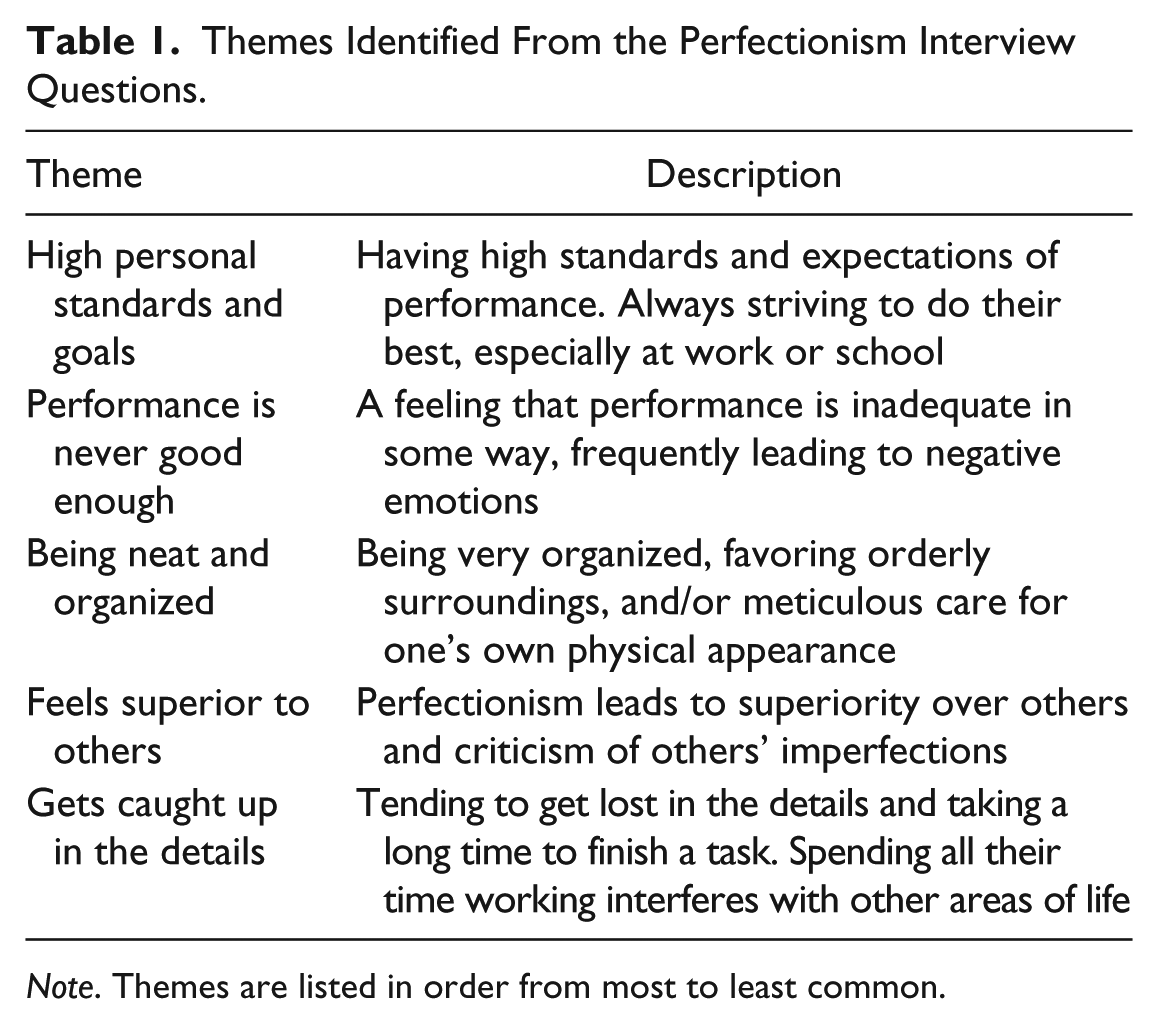
We combined data from the five perfectionism questions together into a single section before analyzing with thematic analysis. This section of the interview was divided into 166 data items, which were in turn collapsed into five themes. A full list of all these themes and their descriptions are presented in Table 1. 3 The prevalence of all themes (i.e., the proportion of participants who endorsed a given theme at least once), split by perfectionist status, sex, ethnicity, and whether or not they were seeking mental health treatment, is contained in Supplementary Table 1. Participants’ subgroup status is indicated as maladaptive perfectionists (MP) or adaptive perfectionists (AP) throughout this section to facilitate comparison. However, because there were not many differences between the responses of adaptive versus maladaptive perfectionists in this section of the interview, we describe the themes overall when collapsed across all participants.
Themes Identified From the Perfectionism Interview Questions.
Note. Themes are listed in order from most to least common.
The “high personal standards and goals” theme was the most common theme. This theme consisted of high expectations and standards for one’s own performance, working very hard on tasks, and demonstrating a good work ethic. For example, Participant 11 (MP) described the best thing about being perfectionistic as “. . . you want to make sure that it [work] is the best it possibly can be . . .” Although participants often described these as “high goals,” it was also quite common to highlight the strong work ethic of perfectionistic people, particularly when asked to describe what is best about perfectionism.
We called the second largest theme “performance is never good enough.” Here, perfectionists described feeling dissatisfied when their performance was inadequate in some way, usually leading to negative emotions. For example,
Feeling like you’re never good enough leads to a lot of feelings of unworthiness and loneliness because you retreat . . . I ended up dropping lots of courses in high school because I just felt I wasn’t good enough to even sit in the room and learn the material because I couldn’t learn it as fast as others. (P3, MP)
Although the above quote is an unusually self-punitive example, this theme always involved a subjective sense of failing to reach high standards, with negative emotions such as shame, anger, or depression.
Although the majority of participants described perfectionism using these two themes, there were also a number of smaller themes endorsed by comparatively few participants. The most common of these small themes was “being neat and organized,” which refers to a preference for organization and orderly environments. For instance, one participant described his or her mother as a perfectionist:
Um, I think my mom is perfectionist (chuckles) [laughs] like cause she always wants everything in the house clean, like looks perfect . . . if there’s something like just moved like, five centimeters away from its own place like she would just yell at me. (P12, MP)
In this example, we can see not only a preference for order but also displeasure with disorder. This theme also contained instances where participants were overly meticulous in caring for their physical appearance.
Another theme was “feels superior to others.” This theme had both positive and negative features. For instance, participants indicated that perfectionism can lead to objectively superior performance and praise from others, usually when describing what is “best” about perfectionism. However, participants also described perfectionists as the sort of people who are highly critical of others. For example, one participant describes her father as perfectionistic because “. . . if I get a good grade that is an A average but there’s one, B+ or A– or something then he would still complain about that and ignore the rest of it . . .” (P7, MP). So this theme is fundamentally social in nature, suggesting that some perfectionistic people seek praise for their agentic accomplishments, and criticize others for failing to reach high standards.
Finally, a few participants also described a tendency to “get caught up in the details.” In this theme, participants described perseverating on small details in tasks, resulting in work taking longer than expected. Typically, participants would suggest that this detail-oriented trait was likely to interfere with other areas of life, such as social relationships. For example, “spending a lot of time on things, so you don’t have a lot of time for other things . . .” (P20, AP). Overall, this theme appeared somewhat reminiscent of obsessive compulsive personality traits.
Thematic Analysis of Life Narrative Interview
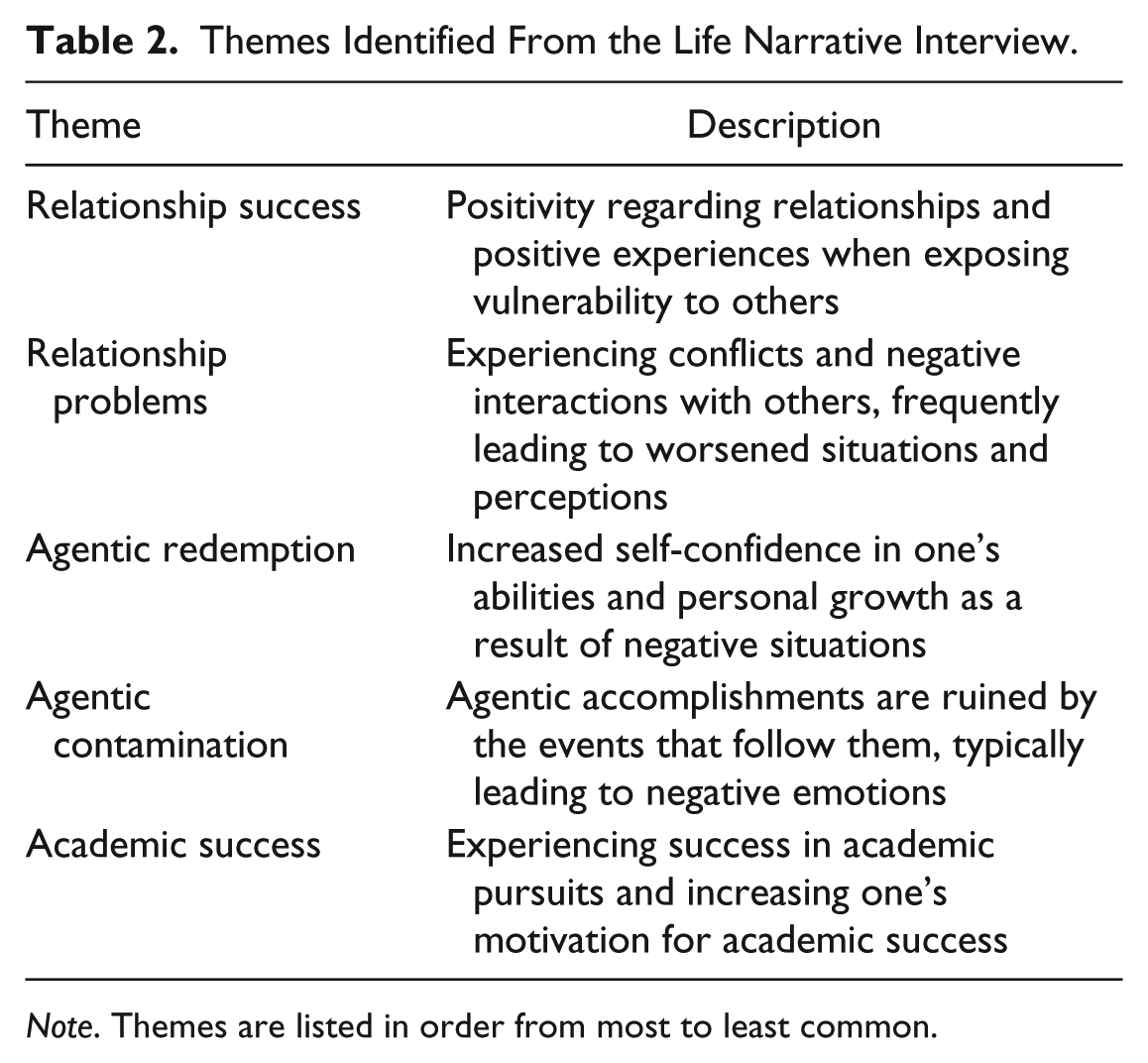
The life narratives interview consisted of 544 data items. Of these items, 31 were highly idiosyncratic or uncodable, and were coded as “miscellaneous.” The remaining data items were distilled into five themes, which are presented in order from most to least common. See Table 2 for a full list of all five themes and their descriptions. The prevalence of all themes split by selected demographic variables is contained in Supplementary Table 1. Again, there were no clear differences between the responses of adaptive versus maladaptive perfectionists in this section of the interview; thus, we describe the themes overall when collapsed across all participants.
Themes Identified From the Life Narrative Interview.
Note. Themes are listed in order from most to least common.
Theme 1: Relationship success
The largest theme was relationship success, that is, positivity regarding relationships and accepting aid from others. Although the nature of the relationships varied across participants (e.g., friends, family, romantic partner), these moments of appreciation for one’s loved ones were treasured as positive memories by all participants. Nonetheless, agentic concerns (i.e., personal power and accomplishment) served as the contextual backdrop for many of these stories. For example, P15 describes a feeling of interpersonal closeness after writing a letter to her grandparents, but is also proud when the letter was read in front of others:
. . . my grandmother decided to read the story to my entire family, and I guess it just made me feel really good that she thought that it was important enough to share with the other members of my family. . . . I just feel proud that my grandparents know that they’ve made such a difference in my life. (P15, AP)
Although the relationship is clearly quite intimate, the participant chooses to emphasize agentic concerns (i.e., feelings of pride, public acknowledgment) when telling the story. These agentic concerns may reflect a narrative expression of perfectionism.
At other times, participants described reaching out to others in times of need. For example, P18 failed to make his high school hockey team and described it as a devastating low point; however, he felt closer to his mother after expressing vulnerability for one of the first times in his life:
Yeah like, made me, realize not to give up. Keep working harder, and, you know like I’m, I’m not like openly emotional but that time I think that was like the first time I cried that much in front of my mom. So that, that made me realize like, that I should be open with my emotions with family and friends because they can help. (P18, MP)
This story is deeply entwined with agentic concerns despite the stated importance of relationships. The negative emotions are described as alien and uncharacteristic, and result directly from a failure to meet high standards. Yet despite this negativity, the participant has an important moment of self-understanding: Expressing vulnerability to loved ones is okay and might even be helpful. Throughout these stories, relationship success stories are treasured precisely because they are rare, or unusual, in the lives of perfectionists. They are fleeting moments that many participants struggle to recreate:
The paradox of me always feeling alone but then never asking for help is kind of like a um, perpetuating cycle . . . If I’m never asking anyone for help or never letting them know that I need them then how, like of course I’ll always be alone. (P6, MP).
The relationship success theme often followed this general format, whereby participants lead a life narrowly focused on agentic concerns, yet have brief, meaningful moments where the importance of close relationships is brought to the forefront of their awareness.
Theme 2: Relationship problems
The second largest theme was relationship problems, where participants described relationship conflict and other negative interactions with others. Sometimes, conflict was overt with social negativity perpetuated by the participant, often as a result of holding others to high standards. For example, one participant recalls being angry at her younger sibling for exposing her other infant sibling to her cold virus:
I was just shouting after her and, even though she was already crying I was just standing there and making her cry even more. (P22, AP)
The majority of stories with an “overt conflict” subtheme involved very direct and aggressive behaviors on the part of the perfectionist that brought him or her into conflict with others, while a small number contained aggressive instigation by others.
At other times, participants described how a mistake ruined successive interactions with others. This pattern is characteristic of the black-and-white thinking of many perfectionistic people. For example, one participant described the consequences of revealing a friend’s secret to others:
. . . I feel really bad about it ’cause it kinda destroyed our trust between us and after that, I never can talk to her again ’cause she is really—I heard she is really mad about it. (P12, MP)
These moments of shame and regret about causing friction with others appeared within the majority of participant narratives within the sample.
At other times, this sort of relationship contamination centered on the betrayal and wrongdoing of others. In many cases, participants described becoming less trusting of others. For example, a participant recalled repeatedly defending a friend’s honor, only to discover that the friend had been lying:
. . . it taught me not to put my head on a block for anyone. Even the people you think you know the most. (P22, AP)
Overall, it was relatively common for participants to describe becoming less trusting and more cautious of others when friends failed to meet their expectations within the relationship.
Theme 3: Agentic redemption
The next two themes centered on positive and negative aspects of agency (i.e., achieving goals and personal power by focusing on the self as separate from others). The agentic redemption theme included increases in self-confidence and personal growth, generally after a challenging negative event. In many stories, the focus was on independence. For example, one participant described the impact of moving away to university:
. . . helped me grow to be the person I am now. I think that’s really when I became an adult and started thinking for myself and I stopped listening to what other people wanted me to be. (P17, MP)
Other stories focused on personal growth through adversity, where participants found a silver lining in negative situations (i.e., using events as growth opportunities). One participant described how he or she chose a program that aligned with his or her passions, despite his or her parents’ disapproval, saying “I think that’s made me a lot stronger, in my convictions and in my decisions that I make personally because it’s clearly been the right choice . . .” (P19, MP). These stories were common and often focused on freedom from parental control, a natural consequence of the young, university student sample.
Theme 4: Agentic contamination
The agentic contamination theme involved strong negative emotions, where agentic accomplishments were ruined by events that followed. In some stories, participants experienced negative emotions or regret after a perceived failure. For example, one participant described his experiences writing a book as a low point:
I was happy, but I went back and I started doing the editing process of, you know, making stuff that wasn’t good better and . . . then somewhere in the realm of editing and improving it, I decided that it was unsalvageable and not worth keeping and I deleted all the copies that I had of it. . . . I’ve described it to a lot of friends that it was, one of the worst decisions I’ve ever made . . . (P11, MP)
Here, there is evidence of rigid black-and-white thinking, with errors contaminating the entire manuscript, along with intense regret following the rash decision to delete everything.
At other times, agentic accomplishments were ruined by situational concerns outside the participant’s control. For example, one participant described how he or she felt after not making the provincial team when other teammates did:
I just remember feeling really left out, and sad . . . I was thinking that I wasn’t good enough and inferior. (P20, AP)
The perception of not being “good enough” appeared a number of times, and appeared to be a common sentiment when participants were faced with failure to achieve a goal.
Theme 5: Academic success
The final theme was academic success, which centered on either achieving a goal or on increased motivation to work hard and strive for academic success. Sometimes, the focus was on achieving an academic goal, and included feelings of triumph and accomplishment after hard work. For example, one participant described achieving his or her goal of becoming valedictorian:
. . . it made me realize that I can achieve my dreams, no matter how far-fetched it is, and it made me realize that all of my hard work that I’ve put in all throughout high school was finally rewarded through this honorary title. (P18, MP)
Here, public recognition and reward for hard work is emphasized. Other stories within this theme centered on an individual’s motivation to work hard and strive for academic success. For example, one participant described how he or she had been fairly indifferent toward academic achievement before deciding to put more effort into school:
. . . it actually started to make me feel good in the fact that I was getting better grades, and so I actually started enjoying this work and learning this stuff . . . really made me see education differently and that’s the point where I decided to go to university. (P4, AP)
In general, this theme involved experiencing academic success, with participants expressing positivity and inspiration to work hard.
Comparing Adaptive Versus Maladaptive Perfectionists
Our final analysis compares adaptive versus maladaptive perfectionists in terms of their overall life theme; specifically, their response to the question, “Looking back over your entire life story with its events, scenes, and challenges, do you discern a central theme, message, or idea that runs throughout the story? If so, what is the major theme in your life?” This final question allows us to determine which of the themes that emerged from our thematic analysis are most central to the narrative identities of participants.
The overall life themes of adaptive perfectionists were notable for their positivity and optimism, with every story ending on a positive note. Indeed, the theme that cut through most of these stories was gratitude for good relationships. Participants felt like they were “lucky,” that they had the support they needed to succeed, and that nothing truly bad had happened in their own life. Three of six adaptive perfectionists described the protective effect of social support in their own lives. For example,
I’ve always had people to help me get through things. . . . The theme of my stories is that, really having people to help you through and um, that you’re not actually alone. (P2, AP)
These stories seem to suggest that the negative events in their lives were buffered by a strong social support network. Although one adaptive perfectionist described striving for excellence as a core life theme, he or she also stressed the importance of personal relationships:
I guess a major theme for me would be, being the person you want to be . . . every day like, I strive to be, I strive to do my best um, whether that be academically or just the personal relationships we make. (P8, AP)
Indeed, all but one of the participants described positivity in their relationships as an overall theme that summarizes their life story. 4 Thus, the “relationship success” theme appears to be most central to the narrative identities of adaptive perfectionists in this sample.
In contrast, the stories of maladaptive perfectionists are characterized by struggle, negative emotions, and agentic striving. The life themes of the maladaptive perfectionists thus tended to incorporate two major components: (a) a preoccupation with negative life events and (b) a tendency to strive for self-improvement as a means to cope with those events. That is, when making sense of the negative events in their life, maladaptive perfectionists tended to focus on how they could improve themselves, rather than reaching out to others for help. Seven of 14 maladaptive perfectionists described a life theme consistent with this pattern. For example, one participant describes striving to improve despite her perfectionism:
Even though I feel . . . like the world is crashing down around me a lot, it hasn’t, through everything, and that must say something about, how dumb perfectionism is (laughs) to be honest (laughs) I didn’t know how to say that eloquently but perfectionism it’s dumb, and it has ruled my life for too long and it still rules my life but I wanna change it. (P3, MP)
It is notable that many of these participants (six of 14) specifically described the negative role of perfectionism in their life, many times striving to improve themselves without outside assistance. In this story, the participant describes a stressor (lack of parental support) and how she improves her own self-knowledge without any help from others:
I have doubts about myself all my life. What is happening is you know, I don’t really have a supporting environment as a child, and I’m constantly being doubted and, I don’t want to be the best, I have to and then now I choose to be . . . but the thing was no one helped me. So, self-discovery is really self-discovery (laughs), I have do everything by myself.
Overall then, “agentic redemption” was considered the central theme in the lives of half of our sample of maladaptive perfectionists. However, it is worth noting that one participant described the unifying theme in her life as “fear of losing control . . . not being able to control every aspect of my life” (P19, MP), which is most consistent with the agentic contamination theme.
However, there were some maladaptive perfectionists (five of 14)
5
who described communal themes as most central to their lives, rather than agentic themes. Two participants described themes of “relationship success,” much in the same way as the adaptive perfectionists (e.g., “no matter how bad it is, there is always someone who can stand with you,” P12, MP). The other three participants displayed themes more consistent with the “relationship problems” theme. Indeed, one participant concisely described the core theme in his life as “loneliness or insecurity” (P5, MP). Another described the perfectionistic standards of her parents as having a negative effect on her life:
I think um, I kind of, I try to be, kind of perfect for my parents. . . . So I think uh, I kind of let my parents decide a lot of things for me, and kind of walk all over me and kind of push me to be, a little too much, I-I couldn’t handle everything. (P17, MP)
These three “relationship problems” stories are distinct from the more positive communal themes that emerged for almost all of the adaptive perfectionists. Nonetheless, though a minority of maladaptive perfectionists described communal themes as central to their life, most focused on themes of “agentic redemption,” which stands in contrast to the communal “relationship success” stories told by adaptive perfectionists.
Discussion
Perfectionism Interview Questions
We generated five themes from participant responses to our perfectionism interview questions. The two most common themes bore similarity to the APS-R Standards and Discrepancy subscales, respectively. In the “high personal standards and goals” theme, participants described perfectionism as striving to be the best, flawless, and/or to meet and maintain very high standards for their performance (particularly work or school performance). In the “performance is never good enough” theme, perfectionistic people were defined by participants as people who thought their efforts were inadequate and experienced strong negative reactions when failing to meet or maintain their high, and often unrealistic, standards. That these two themes emerge strongly is perhaps not surprising, given that participants were preselected to be high in Standards and/or Discrepancy and had all completed the APS-R prior to completing the interview. Thus, these two themes may be seen as triangulating qualitative evidence to support the validity of these perfectionism dimensions.
The remaining themes were less common and consistent across participants. In the “being neat and organized” theme, participants described perfectionists as having a preference for orderly environments and meticulous care of personal appearance. This theme mirrors item content not only of the APS-R Order subscale but also of the Frost et al. (1990) Multidimensional Perfectionism Scale (MPS) Organization subscale. Even though most researchers at present would consider orderliness to be a separate construct from perfectionism (Stoeber & Otto, 2006), this feature of perfectionism remains relatively common in lay descriptions of perfectionism. Moreover, the present study also found that meticulous care of physical appearance was sometimes described as a feature of perfectionism, which does not appear often in perfectionism questionnaires but does arise in the item content of Hewitt et al.’s (2003) Self-Promotion subscale of perfectionistic self-presentation.
The “feels superior to others” theme referred to instances where perfectionism led to feelings of superiority and competence (typically in response to praise) and criticism of others’ imperfections. This theme is perhaps closest to Hewitt and Flett’s (1991) Other-Oriented Perfectionism dimension, or the more recently developed narcissistic perfectionism latent factor (Nealis, Sherry, Sherry, Stewart, MacNeil, , 2015). Finally, participants also described a feature of perfectionism as a tendency to “get caught up in the details,” where participants tended to perseverate and focus on minute details in tasks, often to the detriment of other areas in their life. This perhaps most closely resembles Frost et al.’s (1990) Doubts About Actions subscale, which is a facet of the broader Perfectionistic Concerns dimension (Stoeber & Otto, 2006). Overall then, the qualitative responses were generally representative of the perfectionism dimensions covered by a wide array of perfectionism scales currently in use. However, it is worth noting that some commonly discussed features of perfectionism, such as parental criticism and expectations (Frost et al., 1990), were generally absent from the way participants defined perfectionism (although participants did mention parental criticism occasionally in the life narrative interviews).
In general, adaptive and maladaptive perfectionists tended to give relatively similar responses to the perfectionism questions when asked about their definition of perfectionism, along with the best and worst things about being a perfectionist. Most participants described the best thing about being a perfectionist with responses that fell into the “high personal standards and goals” theme and the worst parts as falling into the “performance is never good enough” theme. However, some small differences were noted. When participants were asked if they believed they were a perfectionist, all but one maladaptive perfectionist agreed, whereas the adaptive perfectionists were unsure. Similarly, when asked whether they knew anyone else who was a perfectionist, adaptive perfectionists tended to focus their responses on the “high standards” and “being neat and orderly” themes, while maladaptive perfectionists tended to focus on “performance is never good enough,” “being neat and orderly,” and “feels superior to others” themes. Thus, it seems that elevations in both the Discrepancy and Standards subscales were important for self-identifying as a perfectionist, and that the subgroups did slightly influence how other perfectionistic people were defined (i.e., with perfectionism in others being defined more closely to their own perfectionism subgroup status).
Life Narratives
In the life narrative interviews, we identified five themes. In the relationship success theme, we observed patterns of appreciating and valuing others and successfully reaching out to others for aid. This theme is similar to communion subthemes of love/friendship and care/help described by McAdams et al. (1996). In fact, every participant within the study expressed valuing close, intimate relationships. Although this might seem strange in light of research linking perfectionism to social disconnection (Sherry, Mackinnon, & Gautreau, 2016), the prominence of these themes likely represent a developmental trend toward valuing interpersonal relationships in young adulthood (Mackinnon et al., 2011). Although all participants demonstrated a strong appreciation for close relationships, the manner in which they described these events gave the impression that these bonding moments were rare or surprising. Adaptive perfectionists tended to describe relationship success as a central theme that cut across their whole life. In contrast, few maladaptive perfectionists described relationship success as a central, unifying theme in their life story. Thus, the adaptive perfectionists (but not the maladaptive perfectionists) framed their life story as a developmental success: They were happy with their relationships, and felt loved and supported.
Within the relationship problems theme, stories involved conflict with others and relational contamination. Here, consistent with the social disconnection model (Sherry et al., 2016), we observed difficulties in the domain of communion. Many participants expressed a difficulty controlling their emotions and being confrontational. A number of participants described instances where a friend betrayed or neglected them in some way, causing the participant to become less trusting and more cautious around others—participants frequently described such events as a personal mistake of being “too trusting.” For instance, one participant stated, “I think it says I was more naïve before, whereas now I am a little bit more confrontational, a bit less trusting” (P1, MP). The general prominence of this theme is in line with prior theory that links perfectionism to heightened conflict and social disconnection from others (Sherry et al., 2016). However, only a few maladaptive perfectionists (and no adaptive perfectionists) regarded relationship problems as central in their life story. Thus, although social disconnection may be the mechanism by which some perfectionists experience negative affect, these narrative themes were not universal. Nonetheless, maladaptive perfectionists can be partially distinguished from adaptive perfectionists by the way they narrate communion. That is, adaptive perfectionists interpret their relationships as successful, whereas maladaptive perfectionists tend to highlight their loneliness and relationship problems.
The agentic redemption theme included examples where participants gained a more positive outlook on situations and became more self-assured and confident in their abilities. This self-assurance in one’s abilities (i.e., agency) was also identified and discussed by McAdams et al. (1996). It seems intuitively reasonable that highly perfectionistic people would choose to tell their life story in such a way that emphasizes agentic achievement, and is indeed consistent with a prior mixed-methods research by Mackinnon et al. (2013) using a similar life story interview. McAdams, Reynolds, Lewis, Patten, and Bowman (2001) have long discussed the adaptive qualities of the redemptive script, and originally identified this pattern in the lives of healthy, highly generative people. In this sample, perfectionistic people make agentic meaning out of their suffering; despite the negative consequences in their life, their perfectionistic strivings are also perceived as a strength, and participants’ optimism regarding future self-improvement is admirable. It is notable that many maladaptive perfectionists (but no adaptive perfectionists) tended to use themes of agentic redemption as the central unifying theme in their lives. Adaptive perfectionists recognized others as resources who successfully provided support through tough times. In contrast, maladaptive perfectionists tended to withdraw from others and focus on self-sufficiency and self-improvement in response to stress. That is, adaptive perfectionists stressed the importance of communion, while maladaptive perfectionists emphasized agentic success. These approaches are analogous to Horney’s (1950) neurotic needs of moving toward others (adaptive perfectionists) and moving away from others (maladaptive perfectionists), and may suggest distinct interpersonal styles in these two groups.
The agentic contamination theme included examples where agentic accomplishments were ruined by the events that followed it, leading to negative emotions. These increases in negativity and regret directed toward oneself were also evident in some of the themes in the perfectionism questions, as well as prior research on perfectionism (Egan et al., 2013; Hewitt & Flett, 1991). Moreover, the theme bears resemblance to McAdams et al.’s (2001) contamination scripts, which is a common depressogenic narrative script (Adler, Kissel, & McAdams, 2006). This theme further demonstrates the tendencies of perfectionists to be extremely self-critical and to experience negative emotions when they fail to reach their high standards. However, agentic contamination themes were not useful for differentiating between adaptive and maladaptive perfectionists. Indeed, both adaptive and maladaptive perfectionists described feelings of “not being good enough” when faced with agentic failures. It is possible that these themes are driven by APS-R Standards—a feature that both types of perfectionists share. Perfectionistic students had a decidedly internal attributional style—When they failed to accomplish a goal, they blamed themselves rather than other people or the situation. These stories also seemed consistent with self-discrepancy theory (Higgins, 1987), wherein participants described a discrepancy between their ideal and actual selves, which in turn led to depressed affect. For perfectionistic people, moments where one falls short of one’s own high standards are inevitable. However, agentic contamination themes were comparatively rare, and only one participant (a maladaptive perfectionist) described such themes as central to his or her life story. Nonetheless, such themes may be relevant in a clinical sample of perfectionists who suffer from mental health problems.
Our final theme was academic success. Within this theme, participants discussed instances where they triumphed at achieving an academic goal, with an emphasis on working hard to achieve their goals. Many participants described early childhood memories where parents would stress the importance of academic excellence. This theme is consistent with the long-held idea that parental perfectionistic standards are an important risk factor for the development of perfectionism in children (Frost, Lahart, & Rosenblate, 1991). Most participants expressed sentiments of victory and triumph, as though all their hard work was paying off by achieving a goal. These moments of victory appeared to be pivotal in increasing participants’ determination to strive for excellence. However, the academic success theme did not differentiate between adaptive and maladaptive perfectionists in the present sample because no participant described academic success as a central theme. Although academic success was important for both adaptive and maladaptive perfectionists, it did not seem central to their narrative identity.
Limitations
This study had limitations. The sample was a small, young, university student sample of perfectionists. Thus, the results do not necessarily generalize to the population. Cutoff scores on the APS-R used to define adaptive and maladaptive perfectionists were normed on samples from the United States (Rice & Ashby, 2007); however, evidence from our mass testing survey (see “Selection Criteria” section) suggests that Discrepancy scores may be higher among Canadian students or at least at our institution specifically. Thus, using these cutoff scores may have produced more classification errors in a Canadian context, and some participants may have been misclassified. Our qualitative analysis provided insight into the ways in which perfectionists conceptualize perfectionism and how they narrate their own lives. However, a drawback to using qualitative analysis is that it is more difficult to determine cause and effect relationships. Moreover, although attempts were made to limit preknowledge of participants prior to the interview, the first author was not fully blinded to which perfectionistic subgroup participants were in. This may have introduced bias during the interview. Future researchers may wish to use double-blind procedures to further minimize bias in the interview process. Moreover, although thematic analysis does provide a structured framework for interpreting qualitative data, it is a comparatively basic qualitative technique. Future researchers may wish to incorporate methods such as grounded theory or discourse analysis. Also, future research might consider incorporating a nonperfectionistic “control” group to provide a comparison between how nonperfectionistic and perfectionistic individuals differ in how they interpret and narrate events in their lives. Such a control group might help differentiate features central to perfectionism from other features of identity (e.g., student status, age).
Conclusion
Clinicians often conduct therapy by talking to the client, attempting to glean information as to potential underlying disorders and belief systems through dialogue. By analyzing and identifying how perfectionists conceptualize perfectionism, and how they tend to describe and focus on specific life events, our results may help to identify perfectionists within clinical practice. Moreover, it may help clinicians develop a better understanding of perfectionistic clients. By examining the narrative life story of participants, the current study sought to develop a better understanding of the “whole perfectionist.” Perfectionistic university students saw perfectionism as a double-edged sword, with both positive and negative aspects in the lives of themselves and others. Qualitative analyses also revealed great focus on interpersonal relationships and academic achievement. There were highs and lows, and participants were complex and idiosyncratic. Nonetheless, themes of perfectionism pervaded the narratives, and the themes presented here may prove useful and informative for clinicians seeking to identify perfectionism from autobiographical narratives.
Footnotes
Acknowledgements
Logan Nealis and Samantha Firth are thanked for their research assistance.
Declaration of Conflicting Interests
The author(s) declared no potential conflicts of interest with respect to the research, authorship, and/or publication of this article.
Notes
Supplementary Material
The supplements for the article are available online.
Author Biographies
References
Supplementary Material
Please find the following supplemental material available below.
For Open Access articles published under a Creative Commons License, all supplemental material carries the same license as the article it is associated with.
For non-Open Access articles published, all supplemental material carries a non-exclusive license, and permission requests for re-use of supplemental material or any part of supplemental material shall be sent directly to the copyright owner as specified in the copyright notice associated with the article.
