




Abstract
Organizations are under pressure to explore innovative sustainability practices that will enable organizations to handle the deteriorating issues of biodiversity and social inequality. Stern and Dietz’ model offered a set of values with which organizations can create sustainability. This study’s main purpose was to explore how Stern and Dietz’ model underpin the various dimensions of workplace spirituality and organizational citizenship behavior to accomplish corporate sustainability. To achieve the objective of the study, the previous literature was reviewed to construct a conceptual framework. This conceptual model is comprised of three phases egoistic, social altruistic, and biospheric. Based on prior literature, various dimensions of workplace spirituality and organizational citizenship behavior were underpinned to accomplish corporate sustainability. Even though this concept sets out basic guidelines. However relevant knowledge should be regarded in order to reconcile these steps in different instances. This article provides a systematic review of the Stern and Dietz value model to achieve various aspects of organizational sustainability. A constructive framework was developed to create corporate sustainability by incorporating workplace spirituality and organizational citizenship behavior into the context of the Stern Dietz’ value model. Theoretical and practical implications are also discussed in this study.
Keywords
Introduction
The aim of the study undertaken is to craft the relationship between Stern and Dietz’s value model and corporate sustainability, this relation describes the ways of implementing corporate sustainability by workplace spirituality and organizational citizenship behavior, and these factors identify the stages of corporate sustainability. Such phases set out the prognostic role of corporate sustainability and sustainability operation. Organizations consider sustainability to be a top priority due to the rapid growth of the global population, environmental degradation, pollution, and the depletion of natural resources (Boons et al., 2013). Organizations performed sustainably when they embrace all the ecological, social, and economic aspects of the Triple Bottom Line (TBL) at the same time (Dao et al., 2011). In the recent era, firms are under stress to incorporate sustainable measures to address the issues of ecological deterioration, growing socio-economic disparity, and resource scarcity (Lu & Zhang 2016; Mitchell & Walinga 2017). Nowadays, many business scholars are trying to explore the different factors and perspectives that support or enhance corporate sustainability. Nevertheless, the study’s focus is to discuss corporate sustainability in Stern and Dietz’s value model perspective.
As for as, Stern and Dietz’s value model is concerned it addresses the three primary value orientations: biospheric, social-altruistic, and egoistic. Stern and Dietz argue that the world is more concerned with individuals with a biosphere and social-altruistic value orientation. Values are derived from the world of people (Ericson et al. 2014), and spirituality in the workplace increases the importance of workers’ self-transcendence and encourages them to engage in programs to support people (Giacalone & Jurkiewicz, 2003). Spirituality causes spiritual awakenings and perceptions of interconnectedness (Zsolnai & Illes, 2017, p. 106). Besides, spirituality in the workplace offers workers with wisdom of purpose and intent (Milliman et al., 2017). Researchers believe that a sense of purpose and intent is linked to pro-social values (Ryan & Deci, 2000).
Stern and Dietz’s value model was used from his value basis study assumed Initial evidenced based measures of a concept which connects values, beliefs, attitudes, and behavior within a preferential construction framework that promotes the initiation of personal environmental standards. This research focuses on (i) How Stern and Dietz’s value model granulates corporate sustainability? (ii) How Factors of OCB affects the process of corporate sustainability? (iii) How Factors of Workplace Spirituality affects the process of corporate sustainability?
Stern and Dietz’s Value Model
Stern and Dietz’s model basically based on the Schwartz (1994) model which defined values, such as freedom, equality, and preserving the climate, as ideals that direct an individual or social institution to accomplish desired goals. The third dimension of Schwartz (1992), that is, discussed in the paper is the self-enhancement versus self-transcendent dimension. This dimension represents how much someone values others’ interests instead of their benefit (self-enhancement). So, Schwartz (1992) model discussed that moral norms could be triggered by the social-altruistic values only. On the other hand, Stern and Dietz (1994) asserted that egoistic or biospheric values can also articulate moral norms. Thus, Stern and Dietz (1994) hypothesized that pro-environmental action commitments would be more robust when environmental conditions have high personal stakes (in the egoistic value orientation), when people are personally informed about the harm to others or to the natural environment (in the social-altruistic direction) or when nature is threatened (in the biospheric orientation).
Stern and Dietz’ model has been suggested three pillars to be significant in the environmental domain (De Groot & Steg, 2009). Altruistic values inspire individuals to optimize success for other human beings’ welfare. The biosphere is a guiding paradigm which focuses on the interests of non-human species and the biosphere. The egoistic values are based on the individual, such as personal wealth, strength, and fame (De Groot & Steg, 2008). Individuals who accumulate pro-environmental activities will also experience immediate adverse effects of different costs. These reductions will still create the long-term beneficial cost benefits that will be passed on to society and the environment. Based on the fundamental premise that altruism and biosphere values are positively linked to pro-environmental attitudes, intentions, and behaviors, it is found that altruistic and biospheric values are related to pro-environmental attitudes, intentions, and behaviors (Bouman et al., 2018).
For this purpose, the study explores the loop of corporate sustainability to process through a series of events, which focuses on fundamental steps taken for implementing corporate sustainability. The model has been categorized into loops of organizational citizenship behavior, workplace spirituality, and corporate sustainability. This process is being initiated through Stern and Dietz’s (1994) value model three steps value model denoting the step-by-step phases of biospheric, social-altruistic, and egoistic, so employees are being involved instructed regarding the issues related to implementing corporate sustainability.
Workplace Spirituality and Corporate Sustainability
Workplace spirituality is being researched as strongly philosophic and personal constructions (Garg, 2020; Iqbal et al., 2018). According to Gibbons (2000) most of the academics concurred that spirituality in the workplace sheds light on the sense of wholeness, connection, and deeper values. Ultimately, workplace spirituality examines the meaning of individual’s existence, the worth of relationships with colleagues and other individuals related to the workplace, cohesion in one’s personal beliefs, and workplace environment (Iqbal & Hassan, 2016). Further, workplace spirituality recognizes that people have a unique inner self, which nurtures slowly due to meaningful work (Ashmos & Duchon, 2000). Neal and Bennett (2000) have studied spirituality at three different levels; the individual, group, and organization. In terms of workplace spirituality, the three core dimensions are meaningful work (individual level), sense of being part of a community-based community (group level), and aligning with the organization’s values.
Sustainability is multi-faceted and contains multiple profound personal and spiritual themes (Stead & Stead, 2014). The Pak-EPA (2015) considers sustainability as an inclusive philosophy, embracing “human and nature” by establishing and preserving the conditions under which they will live in sustainable harmony. Spirituality is viewed as being harmonious with self, the environment, and society (Pandey & Gupta, 2008). In his debate regarding “land ethics.” Leopold (1949) asserted that connections between individuals and the ecosystem must be spiritual. Further, Schumacher (1977) suggests that society must move toward a more organic and spiritual consciousness to promote sustainability. Dhiman (2016) asserted the link between spirituality and sustainability and claimed that in the long term, just a human identity embedded in perpetual tune with nature, a life founded on moral and spiritual consciousness, would preserve the sanctity of the earth. Studies suggested spirituality that integrates people and Earth makes it easier to maintain the planet’s sanctity in the long run (Emerich, 2011). Researches have shown that discovering humans’ capacity for nurturing the spiritual side of human life also affects. How people perceive the environment and promote their belonging with environment as well as other humans, which leads to responsible and pro-social attitudes, and their promotion of social justice (Astin et al., 2005). Dhiman (2016) argues that the absence of spirituality in humans contributes to them becoming materialistic and ultimately oppressing all living creatures. In summary, sustainability requires people’s ability to build spiritual values of interconnection, compassion, cooperation, and a harmonious lifestyle that contributes to the benefits of society, nature, and others (Dhiman & Marques, 2016).
So, to explore the relationship between workplace spirituality and corporate sustainability in context of Stern and Dietz’s value model the study undertaken has discussed each dimension of workplace spirituality separately in three different phases.
Organizational Citizenship Behavior and Corporate Sustainability
Because of its effect on work units’ competitiveness and versatility, OCB has received substantial scholarly interest (N. P. Podsakoff et al., 2009). The essence of OCB has long been discussed and in particular, its dimensionality (P. M. Podsakoff et al., 2003), which was analyzed by using subsequent seven dimensions: helping behavior, sportsmanship, organizational loyalty, organizational compliance, individual initiative, civic virtue, and self-development (P. M. Podsakoff et al., 2000). Scholars have consolidated different OCBs to construct a single multidimensional model that incorporates activities of a similar nature. The prosocial and proactive citizenship behavior are the most interesting aspects of this paper (Van Dyne et al., 1994). An affiliated nature characterizes prosocial behaviors: they are aimed at supporting peers within the community of co-workers and nurturing collaborative relationships. Rather than waiting to be pressured to adapt, proactive workers take on leadership characteristics that consistently aim to increase the change happening within the company or workgroup.
When analyzing OCBs, ecological concerns usually appear to be neglected, while some policies that encourage corporate greening suggest citizenship behaviors. Obviously, individual recycling programs, waste separation at the source, water and energy conservation steps, and recommendations for improving sustainable practices are often focused on voluntary efforts not recognized by formal management structures (Boiral, 2005). Ecological practices are a form of prosocial behavior mostly in context that they aim to foster welfare, create value for the organization, and community as a whole. Nevertheless, it is still essential to research the essence of these activities, their influences to the various types of organizational citizenship behavior, their organizational significance, and their consequences for organizations’ environmental management (Ramus & Killmer, 2007).
All categories of OCBs may be geared toward environmental concerns, benefiting organizations, and their staff and society in general and the preservation of ecosystems, helping, sportsmanship, loyalty and compliance behaviors, individual projects, and self-development. Using the concept of Organ et al. (2006) as guidance, it is possible to describe environmental OCBs Specific as well as conditional cultural behaviors that are not clearly acknowledged through the proper incentive arrangement and contribute to enhancing the efficacy of organizations’ ecological management. Examining pro-environmental practices while taking into account organizational citizenship behavior provides an opportunity for one to reconsider this idea from a less anthropocentric aspect, and one more in accordance with society’s ecological concerns.
The OCB research is focused firstly on an anthropocentric context that completely disregards ecosystems’ vulnerability and the environmental effects of economic activities, despite primarily focusing on altruistic behavior. Considering the array of management philosophies, challenging the anthropocentric viewpoint is at the core of focusing on corporate sustainability (Wesley & Vredenburg, 1996). These discussions have concentrated on thinking about how to protect the sustainability of the environment. According to Wesley and Vredenburg (1996) focus on business performance or job satisfaction indirectly perpetuates false assumptions regarding the right to use natural resources forever to fulfill socio-economic requirements. Considering ecological concerns, Peloza and Hassay (2006) stated that OCB focuses on prosocial conduct that seems to have a more significant effect on sustainable development.
In addition, various studies of organizational citizenship behavior provides an insight on the societal and environmental advantages which appear to be ignored by their more conventional method. Environmental OCBs may lead to improve the living standards of neighboring communities, mitigating or preventing stakeholder pressure, and improving an organization’s image or reputation. Furthermore, workers and organizations’ environmental engagement will increase sense of belonging and glory, therefore inspiring them at job (Boiral, 2005).
Ultimately, workers are often people who may be exposed to adverse effects arising from the release of toxins within or outside the work environment. Environmental pollution can cause many health problems for individuals and society as a whole. However, regardless of their advantageous impact, ecological OCBs assume people voluntary activities outside the usual standards originate in standardized job duties. The compensation scheme of a company does not clearly acknowledge. For this reason, it is essential to analyze the environmental impact of non-profit and volunteer organizations under the voluntary and non-obligatory perspectives put forward by OCB literature.
To explore the relationship between workplace spirituality and corporate sustainability in the context of Stern and Dietz’s value model, the study has discussed each dimension of workplace spirituality separately in three different phases.
Conceptual Model Development Process
As it was discussed earlier that Stern and Dietz’s model have been suggested three pillars to be significant in the sustainability domain (De Groot & Steg, 2009). Altruistic values inspire individuals to optimize success for other human beings’ welfare. The biosphere is a guiding paradigm which focuses on the interests of non-human species and the biosphere. The egoistic values are based on the individual, such as personal wealth, strength, and fame (De Groot & Steg, 2008). So, in order achieve the objective of the study three phases were developed on the basis of Stern and Dietz’s model. In these phases, it was discussed on the basis of previous literature that how a specific behavior asserted by Stern and Diet generate, support, and promote the favorable environment to flourish the dimensions of workplace spirituality and organizational citizenship behavior which create a particular factor/component of sustainability which leads to corporate sustainability cumulatively.
Egoistic Phase
Organizations performed sustainably when they embrace all the ecological, social, and economic aspects of the Triple Bottom Line (TBL) at the same time (Dao et al., 2011). Egoistic behavior focuses on enhancing personal wealth and profit (Stern & Dietz,1994), which means this construct of Stern and Dietz’s model leads to Economic or Profit dimension of sustainability. So, in this phase study undertaken has discussed that how Egoistic behavior asserted by Stern and Diets’s model underpin the meaningful work (dimension of workplace spirituality) and conscientiousness (dimension of organizational citizenship behavior) to generate the economic aspect of Corporate sustainability.
People with egocentric values are less concerned about the environment and are more likely to support environmental protection if the costs are perceived as minimal. From an economic point of view, certain kinds of environmental factors (e.g., air pollution) are to be valued because they provide a “added value” to the people who can benefit from them. The monetary equivalent of material benefits implicitly measures this “value” gained to other people in society (Stern & Dietz, 1994).
The prevailing business paradigm follows the aims of egoism, self-enhancement, and materialistic knowledge of person, resulting in a decline in social prosperity and severe environmental degradation. Many researchers found materialistic values that permeate the business world cultivate materialistic behavior (Zsolnai & Illes, 2017). There was no significant effect of material rewards to increase employees’ pro-social behaviors but the financial status of an organization (Zibarras & Ballinger, 2011). Egoistic behavior enable a superior working environment for employees.
According to Iqbal et al. (2018) Workplace spirituality is something to make a deeper wisdom in what one does at job. In other words the way of people to interact with each other is known as spirituality. The expediency of spirituality is an expression of individuals’ inner truths and desires (Ashmos & Duchon, 2000).
Work is more than a challenge or exciting activity; it should also include its basic objective, living one’s dream, presenting one’s personal life needs, and contributing to others (Arnold et al., 2007). Unlike other vocations, work requires meaning and identity as a workplace (Iqbal et al., 2018). Apart from other factors, this construct’s main focus is on personal needs, personal dreams, and personal benefits, etc. Employees who want to achieve their financial objective do their best in order to improve their organization’s financial status. Ultimately, this dimension leads to the economic perspective of corporate sustainability.
People with an egoistic value orientation at the workplace will prioritize their own pros and cons (Garg, 2020). Egoistic values entail the aim of securing personal wealth or power (De Groot and Steg, 2008). So it depicts that egoistic behavior generates a sense of meaningful work.
Further, conscientiousness is a higher level of performance than required by the organization, like complying with laws and restrictions, avoiding unnecessary leaves, and spend overtime to complete the task (Podsakoff & MacKenzie, 1997). Conscientiousness is an attribute indicating the extent to which an individual engages in responsibility as opposed to acting under his or her own power. If the employee is very conscientious, this means that he’s really responsible and requires less supervision (Podsakoff & MacKenzie, 1997). The two main and consistent OCB dimensions are altruism and Conscientiousness (Bouman et al., 2018). Conscientiousness indicates that a person has good organizational and self-discipline skills, and is responsible and dedicated. Organ (1988) described it as a as an efforts and dedication to job which increases the legal standards, like perform duty overtime etc. It is worth noting that Kidder and McLean Parks (2001) argued that men are more concerned about the conscious attitude as they prefer equity or want to earn more.
The conclusion of the literature given above pertains that conscientiousness indicates that employees work hard, take extra duties, and perform their overtime duties to get monetary benefits which definitely improves the financial conditions of an organization. Ultimately, this dimension leads to the economic perspective of corporate sustainability. As discussed earlier, it’s an egoistic behavior that encourages employees to think only about their own interests, so it could be concluded that egoistic behavior helps generate the sense conscientiousness.
Altruistic Phase
Organizations performed sustainably when they embrace all the ecological, social, and economic aspects of the Triple Bottom Line (TBL) at the same time (Dao et al., 2011). Altruistic values inspire individuals to optimize success for other human beings’ welfare (Stern & Dietz, 1994). Which mean this construct of Stern and Dietz’s model leads to Social or People dimension of sustainability. In this phase, the study has discussed how altruistic behavior asserted by Stern and Dietz’s model underpins the sense of community (dimension of workplace spirituality) and altruism (dimension of organizational citizenship behavior) to generate the economic aspect of corporate sustainability.
Heberlein (1977) contends that people may act under the moral Philosophies just like this Credo: “Do unto others as you would have them do unto you” (Heberlein, 1977). By applying those values, people select phenomena based on how beneficial they are for human groups, such as the community, ethnic group, nation-state, or all humanity. (Stern & Dietz, 1994). Empathy is instilled in workers by altruistic values, that is, altruism in response to another’s pain, need, or distress (De Waal, 2008)
Stern and Dietz suggest that people with social-altruistic value orientation have a more strongly-developed concern for their neighbor population’s wellbeing. Values are accepted from the surrounding environment and workplace, which really improves workers’ sense of self-transcendence values and inspires them to engage in activities that help other people (Giacalone & Jurkiewicz, 2003). To create a compelling sense of community and altruism in organizations, a review of Altruistic values is recommended as a remedy in literature.
Sense of community involves interactions among a workforce that fosters interconnectedness (Jurkiewicz & Giacalone, 2004). It can also be seen as a value of being happy with the community (Rezapouraghdam et al., 2019). The dimension portrays the level of the relationship among peers (Milliman et al., 2003). This construct is measured as wisdom of social belongingness (Ashmos & Duchon, 2000). This spirituality notion is exist at group level and reflects how relations are created among coworkers. It focused on the idea that employees perceive them as intertwined and that they found certain sort of spiritual connection among them (Milliman et al., 2003). Spirituality in the workplace is premised on the idea of esprit de corps. The workers mutual links are developed on the basis of various level like emotional, spiritual, and mental. In fact, a more profound sense of connection between staff extends from support, genuine care, and freedom of expression to the community’s essence (Iqbal et al., 2018).
In contemporary management studies, sense of community includes organizational trust, social cognition, self-efficacy, responsibility, and accountability. According to Naylor et al. (1996), sense of community can be created by having shared values, empowerment, feedback, communication, accountability, growth and development, and friendship. Researchers found that employee values groups where they feel part of a community (Miller, 1998). So, by this literature, it can be concluded that sense of community refers to work for the betterment of peers and society, which definitely leads to the social aspect of corporate sustainability.
According to Organ’s (1988) definition, it recognizes “individual behavior that is discretionary, not directly or explicitly recognized by the formal reward system, and in the aggregate promotes the efficient and effective functioning of the organization.” Organ (1988) identified five dimensions of OCB: conscientiousness, sportsmanship, civic virtue, courtesy, and altruism. These five dimensions include such organizational behaviors as being helpful to co-workers, being a good employee, following company policy, and getting involved with fellow employees.
Altruism generally refers as helping others (Organ, 1988). Altruism means helping other members of the organization to carry out their tasks. For instance, voluntary assistance to new employees, assisting overloaded staff, supporting absent staff, guiding staff to carry out difficult tasks, etc. Smith et al. (1983) described altruism as voluntary behaviors in which an employee render services to a person with a specific issue in order to accomplish his or her assignment in a workplace under odd circumstances. Altruism refers to being helpful to others in an organization. P. M. Podsakoff et al. (2000) have shown that altruism is significantly linked to performance assessments.
The conclusion of literature given above pertains that sense of community and altruism indicates that employees interact with each other, build a strong relationship with their peer and management, and work to better society, which definitely achieve the moral obligation of an organization. Ultimately, this dimension leads to the social perspective of corporate sustainability. As discussed earlier, it’s a social-altruistic behavior that encourages employees to think about their neighbor population’s interests like peers and society, so it could be concluded that social-altruistic behavior helps to create the sense of community and altruism.
Biospheric Phase
Organizations performed sustainably when they embrace all the ecological, social, and economic aspects of the Triple Bottom Line (TBL) at the same time (Dao et al., 2011). The biospheric attitude is a guiding paradigm which focuses on the interests of non-human species and the biosphere (Stern & Dietz, 1994). Which mean this construct of Stern and Dietz’s model leads to Environmental dimension of sustainability. In this phase, the study has discussed how Stern and Dietz’s model’s biospheric behavior underpin the alignment (dimension of workplace spirituality) and civic virtue (dimension of organizational citizenship behavior) to generate the environmental aspect of Corporate sustainability.
The behavior that may encourage worker to conform to organization values and particularly pro ecological integrity is biospheric, as Stern and Dietz concluded that individuals with a biosphere value orientation can focus mainly on the potential costs and benefits for the ecosystems and the biosphere as a whole, whether they are pro-environmentally or not.
The emergence of a new value orientation might just be that individuals perceive concepts using their impact on the environment or the biosphere. It is like the “New Environmental Paradigm,” which emphasizes the importance of beliefs over values (Stern & Dietz, 1994), and incorporates effects on humans as well as non-human species and the biosphere. Biospheric values can be interpreted as a moral obligation that has the potential to affect moral altruism (Schwartz, 1994).
Workplace spirituality offers employees a deep sense of alignment between individual values and the organization’s mission (Iqbal & Hassan, 2016). This dimension perceives the interaction of workers with a substantial organization’s goals. It signifies the idea that an individual’s ultimate goal is to contribute to the greater society and planet. Alignment also indicates that managers and employees from the same organization are compatible in beliefs, attitudes, and expectations, and the organization is interested in the welfare of its employees and community (Ashmos & Duchon, 2000; Milliman et al., 2003). As Van Dierendonck (2004) stated, Spirituality inspires people to do their job in a way that is beneficial to others. People want to join an organization that aims not only to be a good corporate player but also to be an organization with a high sense of morality or dignity and contribute a substantial chunk to the well-being of workers, clients, country, and the planet. So, by this literature it can be concluded that alignment refers to work for the betterment of planet and society which definitely leads to the environmental aspect of corporate sustainability.
Civic virtue refers to someone’s volunteer work and respect for their civic duty toward their organization. Civic virtue indicates that an individual who dutifully participates in, is actively involved in, and is concerned about the company’s life. Civic virtue represents concern to the whole organization. One should actively participate in organized events and track organization environments for threats and opportunities. Such behaviors occur whenever workers deem themselves to be part of the organization (Podsakoff et al., 2000). Civic virtue involves the subordinate participation in political life and the maintenance of organizational administrative roles (Deluga, 1998). The employees must stay up-to-date and take part in organization affairs (Organ, 1988). This dimension of OCB emerged from Graham’s (1991) findings which stated that employees have responsibilities regarding their citizenship in the organization. Employees who have these behaviors wish to be part of an organization and accept its responsibilities (Podsakoff et al., 2000). Another study found that civic virtue enhances high quality of service and hence reduces customer complaints (Walz & Niehoff, 1996).
As it can be found in the above literature, there is no clear understanding that these two aspects (alignment and virtue) are clearly related to environmental concerns. This relationship may therefore be observed if literature is discussed in-depth in the context of biospheric attitude. As alignment refers, an employee’s primary objective is consistent with their organization’s goal and mission. So if the organization’s goal or vision is environmental conservation, it is certainly a practice that will bring environmental sustainability to the employee’s attention. In addition, if workers are educated in biosphere behavior, they will obviously strive to complete each assignment that promotes environmental practices. As civic virtue refers to work for organizational moral obligation and for the betterment of the society, these objectives can also be achieved by promoting environmental sustainability. Additional employees can improve their societies by looking at environmental issues that undoubtedly contribute to a corporate sustainability ecological outlook.
Conclusion
Different researchers have given many theories to underpin the relationship between workplace spirituality, organizational citizenship behavior, and corporate sustainability. However, Stern and Dietz’ model was used in this study, explaining how corporate sustainability is created through workplace spirituality and organizational citizenship. As Hubbard (2009) identified corporate sustainability as an approach to maintain economic, social, and environmental aspects of a product, business, or service, there is no doubt about the importance of corporate sustainability. It is to be executed because, organization needs to sustain. The study of Rezapouraghdam et al. (2019) explores workplace spirituality’s active role in enhancing corporate sustainability. Further, a significant role of organizational citizenship behavior to promote corporate sustainability was also found by Daily et al. (2009). In every step of the study; the role of workplace spirituality and organizational citizenship behavior was found to enhance corporate sustainability. Study undertaken discussed the literature to dig this relationship in context of Stern and Dietz’ model. As the basic purpose of study undertaken was to find that how the set of workplace spirituality and organizational citizenship behavior generate the dimensions of corporate sustainability. So, as depicted in the conceptual model (Figure 1) developed based on literature, there are three constructs or dimensions of corporate sustainability: economic, social, and environmental. In outer circle of the model (egoistic phase) it can be seen that the Economic dimension of corporate sustainability can be generated by consciousness and meaningful work in the existence of egoistic behavior asserted by Stern and Dietz’ model. Likewise, in middle circle of the model (social altruistic phase) it can be observed that the Social dimension of corporate sustainability can be generated by sense of community and altruism in the existence of social altruistic behavior asserted by Stern and Dietz’ model. Similarly, in inner circle of the model (biospheric phase) it can be observed that the environmental dimension of corporate sustainability can be created by alignment and civic virtues in the existence of biospheric behavior asserted by Stern and Dietz’ model.
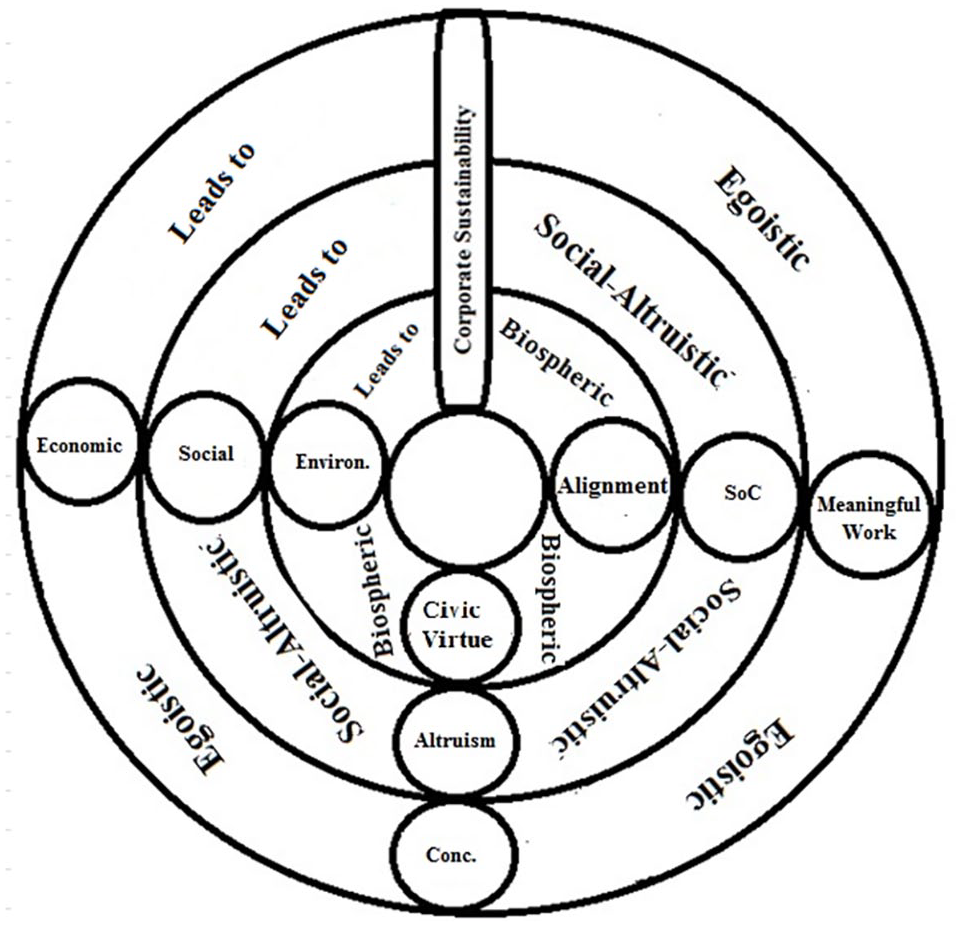
Conceptual model.
So, overall findings of this study shows that Stern and Dietz’ model underpin the workplace spirituality and organizational citizenship behavior to enhance corporate sustainability.
Theoretical Implications
The findings of this study have few implications to advance model. This study helps to advance the value model of Stern and Dietz in order to understand and explain how workplace spirituality and organizational citizenship behavior contribute to corporate sustainability in the context of the value model of Stern and Dietz. On the basis of the findings of the study, it is suggested that a set of values offered by Stern and Dietz’ model is very important to initiate corporate sustainability in any organization. While applying the Stern and Dietz vale model, egoistic values can underpin the consciousness and meaningful work to initiate corporate sustainability. Further it is also suggested on the basis of the findings of the study that social-altruistic and biospheric values can underpin the sense of community and altruism and alignment and civic virtue respectively to initiate corporate sustainability.
Practical Implications
Study undertaken offers some key suggestions to leaders and managers on creating workplace spirituality and organizational citizenship behavior and leveraging it for superior sustainability performance to beat rivals in the markets. It is suggested that promotion of corporate sustainability is beneficial to firm to earn good image in the eyes of stakeholders, as the later has become more demanding and pressurizing firms to go green in all its process, products, and/or services (Singh et al., 2020). This study suggests that the firm should emphasize and reinforce egoistic, social altruistic, and biospheric behavior necessary to initiate the work place spirituality and organizational citizenship behavior. Work place spirituality and organizational citizenship behavior are essential for acquiring, developing, and sustaining corporate sustainability. Therefore, it is suggested that set of values asserted by Stern and Dietz’ (1994) should be applied to make employees think and initiate corporate sustainability. So, the firm should invest in adopting Stern and Dietz’ model practices and considering it as strategic asset to channel human potential toward corporate sustainability.
Limitations and Directions for Future Research
Study undertaken has its own limitations and directions for future research have been presented. First, previous literature has discussed seven dimensions of organization literature, but study undertaken has discussed three dimensions underpinned by Stern and Dietz’ model. Therefore, the study suggests that future research should extend our conceptual research framework to all organizational citizenship behavior dimensions. Second, this study specified a set of two constructs for creating one specific construct of corporate sustainability while in literature, it was observed that these dimensions could generate more than one dimension of corporate sustainability. As a result, it is proposed to the researchers that they can advance our research model to the effect of these dimensions on the rest dimensions of corporate sustainability, Third, this study has used Stern and Dietz model to underpin the relationship between workplace spiritualty, organizational citizenship behavior, and corporate sustainability, So the researcher can use any other model or theory like RBV (Barney, 1991) or the AMO theory (Appelbaum et al., 2000; Guest, 2011) to test this relationship.
Footnotes
Declaration of Conflicting Interests
The author(s) declared no potential conflicts of interest with respect to the research, authorship, and/or publication of this article.
Funding
The author(s) received no financial support for the research, authorship, and/or publication of this article.
