




Abstract
This article focuses on the psychocultural perceptions and social interactions among a sample of 58 Chinese immigrant women in the Maricopa County, the metro area of the city of Phoenix, Arizona, and the manner in which they are able to negotiate multiple identity markers that in part influence and define their capacity to achieve and maintain self-referential growth. The sample of Chinese women living in the Phoenix area not only apply the metaphor of the phoenix to themselves, but also reference this mythical bird in their social media ID, clubs names, and themed events, and include it in oral traditions passed on to children. In comparison, they reject, negotiate, or resist the stigma and stereotypes attached to the “dragon” symbol which often convey qualities of overpowering and irrational oppression. Instead, they associate themselves with the heuristic of the phoenix as a tool for self-empowerment, virtue, well-being, and ethnic- self-representation. These spontaneous reconstructions of ethnic symbols and metaphors based on traditional cultural consensus allowed immigrants to develop cultural self-confidence because they believed that they had eliminated the possibility of discrimination, and eventually contribute to feasible solutions of silent symbolic violence.
Introduction
Metaphors tell the story of immigration (Cunningham-Parmeter, 2011). The dislocation of immigrants, interrelated with the concept of “crossing boundaries” (Ahmed, 1999, p. 330), has led to far-reaching metaphorical extensions (Arcimaviciene & Baglama, 2018). Popular rhetoric about immigration often operates by constructing symbolic and metaphoric representations of immigrants that concretize the social problem and connote particular solutions (Cisneros, 2008, p. 569). In turn, as metaphors drawn from these source domains are systematically recruited to conceptualize individuals’ experiences (Lizardo, 2009), immigrants create an ethnic identity for themselves and produced knowledge about self and others through metaphorical self-representation.
However, symbols and metaphors have meaning only within a given cultural context (Duck, 1994). As Bourdieu (1990, p. 128) pointed out, communication and cognition, recognition and even feeling inevitably could produce symbolic violence, which is the positioning of some knowledges as neutral, scientific and objective by rendering others invisible, subjective, and cultural (Dlamini et al., 2018). Social interactions and cultural exchanges between immigrants and the host society form an unconscious complicity and consent (Harrington et al., 2015) that, in essence, reveal the exercise of symbolic power and the resulting symbolic violence (Torres & Ubeda, 2015). This form of violence is particularly powerful since it structures meaning and experience within a culture, influencing “people’s feelings and motivations by formulating coherent conceptions of the general order of existence” (Bell, 2009, p. 66). The semiotic system thus establishes a neutral, objective, and silent violence.
For this reason, many researchers draw an analogy between immigrants and “the best container for all kinds of metaphors,” to illustrate the fact that they are often targets and victims of symbolic violence (Charteris-Black, 2009; Shannon & Escamilla, 1999), and are usually systematically attacked and treated with hostility (Smarick & LaFree, 2012), through both policies and public opinion. Bourdieu (2003) conceptualized such a given cultural context as a “field,” and pointed out that, once a symbol is transplanted to a new field, it will inevitably result in misrecognition and condescension. For immigrant groups, their proprietary national culture as well as related cultural elements, symbols, and metaphors unavoidably suffer symbolic violence consisting of such misrecognition and condescension in tandem with their transnational migration.
Asian migration and specifically Chinese migration is overshadowed by more contemporary popular sentiment toward Latinx communities in the USA. However, historically Chinese migration was just as prominent and to a great degree just as contested. Historically, the Chinese played an integral part in developing the “unsettled interior” (Murray & Solliday, 2007, p. 8) of the country represented by Arizona, while forced to live and work in a restrictive environment shaped by discrimination and segregation. It is generally understood that the arrival of early Chinese pioneers coincided with mounting Euro-American antagonism, meeting immigrants with some unfair treatment as a result (Lister & Lister, 1989). Fong (1980) asserted that the lack of consciousness and strategies of resistance are the main reason the Chinese in Arizona experienced anti-Chinese sentiment in the 19th and 20th centuries. More recently Chinese communities have experienced a similar social phenomenon in the midst of the COVID global pandemic.
Under these circumstances, some contemporary Chinese immigrant women living in Phoenix metro area, Arizona, believe that the iconic Dragon totem advocated by the Chinese has been misunderstood in Western culture. They worry that using it as a self- and ethnic- representation may reinforce potential stereotypes. As an alternative, they created a multifaceted Phoenix symbol to refer to their ethnic identity, female identity, geographic location, and positive connotations extracted from Eastern and Western myths so as to hope avoiding symbolic violence to the utmost extent. Without overt collaboration, these participants use the same symbol as a way to carry out social communications and the construction of social networks, and also use the same meaning system and cultural outlook to evaluate the corresponding results and cultural products.
In thinking about how to solve the problems of invisible discrimination and symbolic violence caused by the incompatibility between immigrants’ ethnic identity and that of the host society, it is necessary to reexamine what symbols and derivative metaphors its members use instinctively to represent their group. This work illustrates a case in which a group of immigrants tacitly uses the alternative ethnic cultural marker—the phoenix—to metaphorize and symbolize their personal fates and ethnic identity by integrating it into daily life. This phenomenon is a response to symbolic violence, a type of power structure that results in the internalization of humiliations and legitimations of hierarchy (Lee, 2010, p. 113), and provides a defense against such an invisible but irresistible form of violence. We are not suggesting that the use of the symbol is constant but of sufficient importance in making a contribution to an identity, among others, and in part why they are able to shape the Chinese community.
Their doing so exemplifies the immigrants’ spontaneous creation and display of specific conceptual metaphors as a means of resisting unconscious stigma and symbolic violence toward them as well as promoting racial justice. To achieve this goal, two research questions had to be answered: First, in the process of the communal and social capital accumulation, how do Chinese cultural symbols and the metaphorical content behind them affect women’s consciousness and behavior? Second, how do they construct and revitalize the history and culture of their transplanted collective?
The Influence of Field and Context on Symbols and Metaphors
Lakoff and Johnson (1980b, p. 4) identify metaphors as an approach to understanding one thing in terms of another, since “our ordinary conceptual system, in terms of which we both think and act, is fundamentally metaphorical in nature.” According to their theory, conceptual metaphors are not just an aspect of language, but a fundamental part of human thought (Gibbs, 2011). However, all metaphorically used words, meanings, and expressions are highly culture-dependent, as they vary considerably across different cultures, languages, and social contexts (Kovecses, 2010). This argument is also reflected in Duck’s (1994) opinion that, metaphors, signs, symbols exist within, and gain meaning from, culture; therefore, they have meaning only within a specific cultural context.
Similarly, Bourdieu (1996) apprehends the importance of the specific cultural environment. He proposes that symbols produce the power to construct a hegemonic version of reality, so that symbols can give rise to violence and discrimination. Symbolic violence naturalizes the discourse about things and legitimates the domination system (Recuero, 2015). Symbolic power maintains its effect through the recognition of power relations situated in the social matrix of a given field; each field prescribes its particular values and possesses its own regulative principles (Bourdieu, 1992). These principles delimit a socially structured space in which agents struggle, depending on the position they occupy in that space (Bourdieu, 1992, p. 17). Roland Barthes divides the meaning of analogy and semiotics into two levels: denotation and connotation. Denotation is the fundamental meaning of a symbol, that is, everyone, regardless of nationality, religion, race, gender, or age, will usually reach a consensus with respect to their understanding of its meaning. Connotation refers to the cultural elements that must be decoded in a specific cultural context that otherwise may result in different, or even opposite, interpretations. On account of these distinctions, some researches have pointed out that the approach of Bourdieu and Barthes can be considered “having been not only eminently on the right track and ahead of its time, but also a still relatively underexplored source of fundamental insights into the relation of culture, action, and cognition” (Lizardo, 2009, p. 14). Their discussions of metaphors and symbols are essentially an anticipation of the Lakoff-Johnson conception of metaphor (Gibbs, 2011).
Although many conceptual metaphors appear in a wide range of languages (Kovecses, 2010) with universal denotations, there are still a large number of signs, symbols, and metaphors that have specific connotations, application ranges, and cultural limitations. The symbols and metaphors used by some immigrants as self- and ethnic- referral markers transgress their original cultural and geographical boundaries due to the changes in the fields the users occupy, and provoke disagreement, conflict, and misunderstanding (Bosman, 2019). A mismatch between dominant culture and identity symbols of immigrants can lead to their placement of the symbols in resocialized space, which is humiliating and damaging to immigrants (Kayaalp, 2016; Zine, 2001). The most typical example is veils worn by female Muslim immigrants. The veils serve as an outward sign of a Muslim identity, but are often been associated with terrorism by the host culture, and, so have become a symbol of oppression and the violence toward Islamic culture (Blakeman, 2014).
Chinese immigrants are also plagued by such symbolic violence. The Chinese consider the dragon as a symbol of power, authority, and good luck (Chen, 2018). Many Chinese immigrants rely on this symbol and its extensive metaphors in their everyday lives to give cues about their culture, identity, and emotions to the people with whom they live and interact (Le Poire & Yoshimura, 1999). They describe themselves as “descendants of the dragon” (Sleeboom, 2002); compare their parental expectations and parenting to “wishing for dragon children” (Wu & Singh, 2004); metaphorize their achievement of difficult as “jumping the Dragon Gate” (Craig, 2020; Curtis et al., 2018); and celebrate folk sports at festivals in terms of dragon themes, such as Dragon Boat and Dragon Dance (Harrison et al., 2012). However, the symbol of the dragon in Western cultures is an embodiment of arbitrariness and offensiveness (Babbage, 2020). As described in Revelations 12:9, “the great dragon was hurled down-that ancient serpent called the devil, or Satan, who leads the whole world astray.” A collective concern of overseas Chinese immigrants is that the negative connotations of the dragon metaphor in Western culture has produced stigmatization and misunderstandings about Chinese culture (i.e., Kelly et al., 1993; Prasso, 2005; Wang, 2007). Therefore, Chinese immigrants have experienced ambivalent feelings with respect to their application of ethnic metaphors, storytelling, and symbolic representation. The dislocation of this East Asian symbol not only reproduces and reinforces systemic racism, but also generates various racialized identity, racial solidarity amongst Chinese immigrants (Cui & Worrell, 2019).
In response to this, linguists and other experts in researching metaphors hope to solve the problem caused by the incompatibility between the fields of immigrants and that of the host society through the reprocessing of conceptual metaphors. The former proposed to translate the Chinese dragon as “Loong” in order to avoid the stigma of the word “dragon.” They believe that, instead of allowing others to interpret the symbols of their ethnic culture, it it is better to abandon the dragon metaphor that merely strengthens the stereotyped thinking that dominates by Western media, and, so, mitigate the misunderstanding toward the Chinese (Chen & Jiang, 2013; Huang, 2006; Lu, 2017; Yan, 2013). Scholars who study metaphors continue to ask whether the dragon is a suitable symbolic and metaphorical representation for China (Huang, 2006). They have attempted to create hybrid symbols and stories, such as “the Celtic tiger and hidden dragon” (Yau, 2007), “the Chinese dragon and eagle of Anáhuac” (González, 2013), and “the dragon brings the golden coins to the host country” (Wang, 2007), and believe that by offering them to the media they could promote racial equality and influence how Chinese immigrants re-create their identify (Cui & Worrell, 2019).
However, these scholars also admit that such methods are not effective enough because the dominant structures of symbolic violence reach so deeply into the understanding (Chambers, 2005; Lu, 2017). Under the premise of lack of cultural capital such as support from recreational media, art and literary, changes to an image or linguistic translation may make the new symbol or metaphor “the next stigmatized dragon” (Huang, 2006). When these new metaphors and symbols are not extracted from collective habitus or cognition, they are unable to eventually become linguistic conventions. In this light, exploring how immigrants spontaneously explore strategies to avoid cultural misunderstandings in these dilemmas may contribute to feasible solutions of symbolic violence.
From Dragon to Phoenix: Chinese Immigrants in Phoenix and the Use of the Iconic Phoenix
Early emigration of the Chinese to Phoenix was, for the most part, to the West Coast they settling in San Francisco and other areas in California (Tintle, 2016). Hundreds of Chinese moved from California to Phoenix as employed laborers for the construction of the Southern Pacific Railroad between 1860s and 1880s (Fong, 1980). The 1880 US Census indicated that of the 1,630 Chinese in Arizona, 850 were railroad laborers. They not only contributed to the Southern Pacific Railroad project, one of the most significant transitory rail lines on the west coast, but also initiated a new route of migration within the US, which brought them into Arizona’s towns provided them with better opportunities for employment (Chen, 1923). Since the 1880s, more and more Chinese immigrants have moved to Arizona from California, especially from San Francisco because of prejudice and exclusionary laws represented by the Chinese Exclusion Act of 1882 (Tintle, 2016), so as to avoid penalties such as imprisonment or deportation (Fong, 1980). Some other sojourners traveled to the city of Phoenix to join successful established members of their clan (Rogge, et al., 1992).
This migration route of moving from other states to Arizona is reflected in both public and private archives as well personal narratives. The earliest historical record of such Chinese migration route was an obituary of an Arizona Chinese pioneer Tie Wong published in “Arizona Daily Star” in March 7, 1940 (Figure 1). The obituary explains that Wong was “a native of China,” and he came to the United States while he was young and spent several years living in California first. Later, he traveled eastward to Arizona with the influx of pioneer settlers and miners who sought to search precious materials in 1880s. As “Arizona Daily Star” reported, “Wong lived in various parts of Arizona, including Tombstone during its boom-town heyday, Prescott and Tucson, finally coming to Phoenix in around the 1900s.”

The obituary of Arizona Chinese pioneer Tie Wong, Arizona Daily Star (March 7, 1940).
Akin to Wong, Participant 5′s father-in-law initially settled in San Francisco, California instead of Arizona. She recounts that (see Figure 2),
“Upon arriving in San Francisco in 1907, he [. . .] worked as chef in various Chinese restaurants. This was not a passion of his, he earned a living like so, just to survive. He did not like it, so he came to Phoenix when Arizona was still a Territory around 1909-1910, and worked for some relatives, saving enough to eventually start his own business in Phoenix.”

The family genealogy book of Participant 5.
In many ways these two migration stories are the template of most Chinese pioneers in Phoenix, and also highlight the incentives to migrate from traditional destination sites to adjacent localities like Phoenix. In essence a combination of economic and popular sentiment leveraged Arizona’s developing communities as an attractive site for beginning again.
However, since the late-19th-century, the coming of Chinese pioneers arose local Euro-American males’ anxiety over job insecurity, anti-Chinese sentiment gradually grew. In some cases, strong sentiments were translated into violent action (Hu-DeHart, 1980). It is recorded that Euro-Americans wielded big sticks, assaulting Chinese laborers in several Arizona cities and towns throughout 1880s to 1910s (Lister & Lister, 1989, p. 57). In the face of anti-Chinese sentiment, some Chinese immigrants have developed coping strategies and even prepared for armed resistance. “Despite appearances, an anxious vulnerability surrounded Euro-American parades and a smoldering resolve permeated Chinese silence” (Cheung, 2002, p. 40). Arizona Chinese militias trained secretly and formed some self-defense organizations, such as the Chee Kung Tong (Active Justice Society) and the Chinese Masonic Lodge. During the closed-door meetings, Chinese miners, farmers, laundrymen, cooks, and railroad workers “acted as warriors during elaborate martial rituals” (Cheung, 1988), believing that such martial training empowered themselves to enact resistance. Some capable immigrants and associations successively provided support and shelter for latecomers. According to documents collected by the Arizona Chinese Historical Association, in the early 20th century, a man named Kangzhong Yu once ran a “Citi Restaurant” on Central Avenue in Phoenix. As one of the few Chinese entrepreneurs who could maintain a good relationship with the political and business circles at the time, he provided many Chinese newcomers to Phoenix with restaurant job opportunities and residences. A mutual support organization, Ying On Association, acted as an important buffer zone for early Chinese people in the pioneering era, and helped the new arrivals adjust to the local conditions in Arizona. Many of the members joined this association as to seek refuge from threats of unfair and discriminatory business practices.
From the history of the Chinese community in Arizona, this community already arrived here to live and work when Arizona was still a territory. In the face of huge financial pressure, they explored employment that were available to engage in so as to support themselves and their families in the midst of loneliness, discrimination, and injuries. They have participated in the construction of South Pacific Railroad, the local mining industry, and the service industry. By their diligent work, they have won the reputation of working hard and long hours as well as living frugally, but have also left the impression of “making accommodations to American life styles only as necessary for existence or to accomplish certain economic goals” (Lister & Lister, 1989).
After a century of growth, as US Census Bureau reported in 2018, the population peaked in recent years at 27,187 Chinese immigrants, 14,137 of them were women. As society progresses, blatantly anti-Chinese sentiments and violent attacks on Chinese immigrants have become history forever. Yet as a part of collective memory and trauma, many immigrants are always unconsciously looking for ways to avoid stereotypes, cultural misrecognition and condescension. Upon facing the potential hostility and strangeness of the local society, these immigrants hope to let the locals understand their harmlessness by organizing Chinese cultural activities.
To achieve this goal, they reject, negotiate, and resist the stigma and stereotypes attached to the “dragon” symbol that too often designates an overpowering and irrational image of oppression. Instead, they associate themselves with the heuristic of the phoenix as a tool for self-empowerment, virtue, well-being, and self-representation. Instead, they associate themselves with the heuristic of the phoenix as a tool for self-representation, virtue, well-being, and resistance to invisible symbolic violence. A fact overlooked in the exploration of resisting symbolic violence is that the Chinese national totem system is composed of two gendered symbols: dragon and phoenix. The dragon is the embodiment of masculinity, while the phoenix is paired with the dragon as a symbol of femininity. The phoenix, along with the dragon, not only symbolizes auspiciousness, heralding a glorious period of peace and prosperity for the people and the country, but also uniquely represents the beautiful virtues, roles, and responsibilities of women. Although images of both the dragon and phoenix are revered and appreciated, the role of the latter as a symbol of the Chinese is little known. In the East, the connotations of the phoenix is the virtue of benevolence, righteousness, propriety, wisdom and sincerity of women, while in Western cultures it refers to sun, immortality, and rebirth. There are subtle connotative differences between the phoenix in the Eastern and Western fields, but in both the phoenix is the embodiment of positive metaphors. Given that the phoenix is a positive symbol in both the East and the West, in the two-way process of outward community building and inward self-motivation, a group of Chinese immigrant women living around Phoenix, Arizona, combine the Eastern and Western connotations of the phoenix, and creates a fourfold conceptual metaphor of phoenix, which not only conceptualizes their personal immigration experience, femininity, ethnic identity, and geographic location, but also provides them a sense of security and cultural confidence.
Methods
This research relies on a qualitative approach. The data is drawn from an ethnographic study conducted in the Maricopa County, the main part of the Phoenix metro area in the state of Arizona, within the USA, from January 2021 to October 2021. the Arizona State University’s Institutional Review Board issued ethical approval for this study.
Study Sample and Recruitment
Reviews of community-based research suggest that community engagement is crucial to achieving successful recruitment and the increased enrollment of participants (Sapienza et al., 2007). The authors have undertaken a community engagement strategy to approach, identify, and recruit qualified participants. Such a community engagement included participation in community events, contact with community organizations, interactions with community members, and media outreach. The sampling technique is a combination of probability-based sampling and non-probability sampling, that employed emails, texts, and Wechat (a Chinese popular multi-purpose messaging and social media platform).
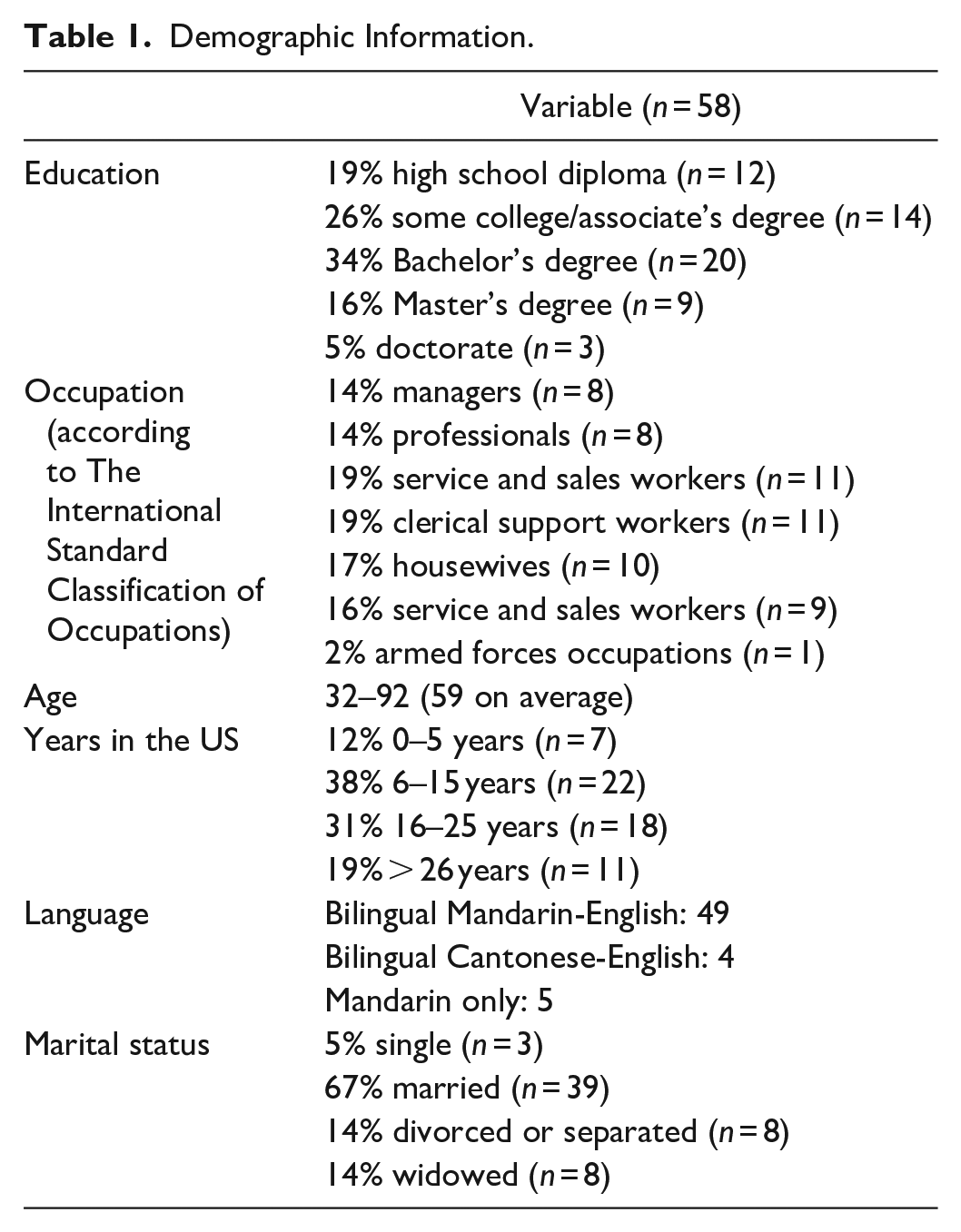
All the participants were advised that they had the right of withdrawal unconditionally from the study. They are also informed that their name or any other personal identifier would not be identified. The selected participants met four criteria: all were women; all were born in China; all were current residents of the Phoenix metro area, Arizona; and all displayed or discussed the symbolic and metaphorical phoenix (the mythical bird) in a positive way either on social media or in face-to-face communication. In total 58 participants were recruited (see Table 1). Their ages ranged from 34 to 92 (Mean = 59; SD = 14.4). Their residency in Phoenix ranged from 3 to 73 years (Mean = 21 years; SD = 16.3). At the time of the interview, 39 of the interviewees were married, 8 were divorced, 8 were widowed, and 3 were single. The following table summarizes the main characteristics of this sample. In order to ensure anonymity, the participants were identified numerically as Participant 1 through Participant 58. The names of their friends and families, those which the participants mentioned, have also been systematically modified and replaced with pseudonyms.
Demographic Information.
Data Collection and Qualitative Analysis
The qualitative data collection was collective through 58 semi-structured interviews. The virtual interviewing platforms Zoom and WeChat were used. The interviews lasted between 47 and 230 minutes, and they consisted of four main components: demographic information and personal experiences, their understanding of the Phoenix as a symbolic and metaphorical object, their strategies for establishing metaphorical connections between the Phoenix and themselves, as well as their social networks and community engagement. The interviews, of which 50 were conducted in Mandarin and 8 in English, were audio-recorded, and then transcribed verbatim. To ensure the consistent transcription of the interviews, the 50 Mandarin interviews were translated into English by a professional translator.
The English-language transcripts were then uploaded to NVivo for coding. Following the suggestion of Mackey and Gass (2005), the data coding was repeated two different times (Time 1 and Time 2) to guarantee reliability and validity. The Time 1 was conducted by by the second author during the first half of 2021. Interview transcriptions were coded applying the principles of thematic analysis, which is a method for systematically identifying, organizing and offering insight into patterns of meaning across a data set (Terry et al., 2017). To ensure the accuracy, the first author repeated the coding process in October, 2021 (Time 2). The first author also repeatedly examined the data and the manuscripts coded. The results in Time 1 and Time 2 are mostly consistent.
The codes were refined and reviewed, and then mapped into three interrelated main thematic categories: (1) metaphorizing personal experiences with the phoenix; (2) metaphorizing women’s roles with the phoenix; (3) metaphorizing the local Chinese community with the phoenix. To ensure the rigor of the analysis, the coded transcripts were checked by a research assistant who was trained qualitative research training. Following the review of the research assistant, references that did not fit the themes were imported back into the original interview transcript as to ensure that the participants’ accounts were represented accurately.
The Phoenix as a Self-referral Marker: Rebirth and Transmigration
Individuals’ stories are “something people live by” (McAdams, 1993). Through storytelling people explore existential issues, construct their identities, and understand themselves and others (McAdams, 2019). In storytelling, life-stories, event-stories, tropes, and metaphors are closely connected since life-stories are a collection of event-stories that also include many tropes and metaphors (Sandberg, 2016). The metaphors that stories contain can be a window to pre-existing systems of self-interpretation and self-representation. Twenty-four of the participants in the sample were found to have created personal legends and stories with the phoenix as a metaphorical object, which was considered an element in making their life stories worth narrating.
The participants used the word “phoenix” in their social media IDs and nicknames as means to metaphorize themselves. Some of them draw an analogy between the Western version of the phoenix metaphor that centers on immortality and rebirth with some of their more extraordinary experiences, such as vehicle accidents, immigration, remarriage, bereavement, and the like. Others assert that the fact of their living in Phoenix is predestined, and their connection with the symbol phoenix is a sort of oracle. Such a metaphorical representations of intangible but evocative experiences are unconsciously linked to their personal emotions and self-identification (Charteris-Black, 2009, p. 100). Participants’ concerns with transformation are revealed by giving names such as “fire phoenix” or “phoenix nirvana” to their social network IDs to reference their image as someone reborn from their ashes; others merely reference the ambiguity of the name phoenix as both a city and a divine bird, calling themselves “desert phoenix” or adding the word phoenix directly in front of their name.
Rebirth
Eight participants, who embraced the rebirth symbolism of the phoenix, use the moniker “phoenix” to represent themselves in order to condense and generalize the various ups and downs they have encountered, their capacity to overcome difficulties, and their complicated emotions after surviving a disaster.
Participant 4: “I had a serious car accident in 2015. It took me three years to recover. I lost my job because of this long convalescence. [. . .] I didn’t get much compensation. [. . .] In my most difficult time, a dance school invited me to be a dance teacher. This opportunity saved me. That’s why my WeChat username is “Phoenix Nirvana.” It is a metaphor for my rebirth in all aspects. I almost died; my right leg was broken; I lost my job and I was broke. But I am still alive, I still can dance. I am a phoenix, since I came back from the hell. I was reborn from the ashes of death, and survived those times of desperation.”
Participant 8: When I was in Taiwan, I was a docent teacher. After I arrived in the United States, my only job opportunity was to wash dishes in a Chinese restaurant. That was the time I least want to recall. My clothes were oily and dirty every day; my boss scolded me, and my hands were cracked from washing dishes from morning to the midnight. I felt as though I was a washing machine instead of a real person. I was dead inside during those years. [. . .] 17 years later, we owned our own restaurant. The first day sitting in my restaurant, I recalled my experiences—from being a teacher to a dishwasher and then to have my own business—the only feeling that came to my mind was that my story is similar to the myth of the phoenix, being reborn from death.
The two accounts related above summarize the reasons why these participants use the phoenix to refer to themselves on social networks. They believe that the two major events of “near death” and “rebirth” in their lives are consistent with the connotation of the metaphor of the phoenix. The first event, immigration, as a psycho-social-geographical transition that involves a series of losses and changes (Lee, 2010), brings them a sense of rebirth. As Richwine (2018) indicated, educated immigrants are always at risk of ending up holding jobs for which they are overqualified based on their paper credentials. For highly-skilled immigrants, engaging in mismatched low-skill jobs brings them a sense of humiliation and grief. Repetitive jobs with low pay and status wear down their energy and enthusiasm. This is the reason why Participant 8 was reluctant to recall her days working as a dishwasher, and described herself feeling as “died inside.” They regarded their overcoming a series of difficulties brought immigration as a process of rebirth. The second event, recovery from a serious car accident and the ability to get back on track likewise brought about a sense of rebirth. They cherish their lives after experiencing physical and spiritual rebirth, and hope to extract some special meanings from their unique life stories. Therefore, they identify their experiences with that of the phoenix, in order to abstract, beautify, and symbolize their sufferings.
In addition to reliance on the phoenix metaphor to generalize their perceptions of life and death, as well as the ups and downs brought about by immigration, the participants also expressed other emotions and feelings using this symbol. Participant 15 recorded her heartbreaking moment on social networks when the politician she supported was about to step down (see Figure 3): “A sad day for democrasee! And in effect, the end of a true Republic (but perhaps it never was?).” Then, she immediately mentioned the metaphor of the phoenix and added a picture of the phoenix aurora to inspire and console herself with the idea that such a hard moment is only temporary: “On the other hand, the universe always responds in kind. Where there is ending (death), there is beginning (rebirth). And what a beautiful Phoenix aurora that is.”

Participant 15’s post on WeChat.
This text illustrates another rationale for using the phoenix to metaphorize themselves. They believe that the metaphor of death and rebirth derived from the phoenix respectively symbolizes endings and beginnings more generally. The myth of the phoenix’s resurrection from the dead and the philosophy contained therein inspires the belief that all losses, ends, and regrets are in tandem with the hope of restarting. This is their strategy for self-encouragement and self-soothing. As the innermost thoughts shared by Participant 15:
“If I take a look at a picture of the phoenix or say something like ‘you can start again’ to myself, I will have the illusion that I have been restored from frustrations. This action makes me feel that there is still hope in my life. This type of new start is cheap and overused, but it can still save a small part of my spirit. This is probably one of my survival tips.”
Transmigration
Some participants tend to worship the phoenix as a totem. They believe that the phoenix is a divine totem and a symbol of a deity. This understanding stems from an assertion that they have a special destiny related to the phoenix, or that their lives are protected and guided by this divine bird. Connecting an individual’s life with the divinity of a certain symbol essentially represents problem-stricken individuals’ yearning to seek external help (Tseng, 2014). They have had great expectations in their own lives, hoping to have an extraordinary life, but ended up being ordinary people who were not recognized by others. Under these circumstances, they explored a fatalistic connection between themselves and the phoenix. In the process of constantly telling others their metaphorical life stories, they are nourished by the surprise or admiration of other people, which dispels their depression, validates the value of their life to others, and produces the satisfaction of being recognized.
Participant 2: “I inexplicably love to collect old objects related to the Chinese experiences in Phoenix. I wrote articles about Chinese immigrants in Phoenix by researching these objects. [. . .] I always believe that the reason why I am so obsessed with this thing that neither makes money nor gains reputation is that my previous incarnation was as a Chinese railway worker who came to Arizona to build the transcontinental railroad. I became a ghost after I died tragically beneath a train. So after my rebirth, I was destined to return here to find my remains, to find the history of myself and my companions.”
Participant 12: “When I was young, a fortune-teller told me that in my previous incarnation, I was a white bird who stole the flames of the sun because I yearned for the light. I think that’s why I reside in Phoenix in this life. I have lived in many cities all over the world, but finally made my home in Phoenix. This is not my deliberate choice; I believe this is my destiny. [. . .] I am a very ordinary person, but every time I tell my story to others, they find my destiny is amazing.”
These women have created unique stories with the theme of the phoenix as a metaphor for their lives, believing that they are destined to live in Phoenix and have a great mission. Such understandings are rooted in their fatalistic and predestined worldview and slight dissatisfaction with the status quo in their lives. They imagine that they have had a previous incarnation in which they had great but unfinished goals. The regret has become their obsession, compelling them to pursue their goals in their present lives. Such fatalistic life-stories are used on the one hand to explain specific personal experiences and events that lack a clear rationale, such as their choice of distinctive hobbies, their choice of where to settle, and instances of sudden good luck, so as to provide them with a reasonable explanation for their life circumstances. On the other hand, they also use this storytelling as a means to justify specific discourses and systems of meaning exclusive to them (Bowman, 2009). Mazzei and Jackson (2009) pointed out that in some cases people are eager to tell their novel and fantastic stories in order to surprise others, which in turn generates narrators a sense of accomplishment of to the narrator. In the life story of Participant 2, who related a story about being a railroad worker in a previous life, she created an exclusive sacred connection between her and the city of Phoenix, and found a reasonable explanation for her hobby of writing articles about Chinese immigrant history. With the help of continuously declaring their unique destiny to other people, satisfaction, a sense of mission, and a sense of belonging to Phoenix are created that offset frustration and depression.
Metaphorizing Women as Phoenix: Nesting and Flying
On account of the feminine aspects represented by the phoenix in Chinese culture, many participants are observed to have a predilection for using “phoenix” in the names of women’s associations, activities, and clubs. They are not limited to the metaphorical connotation of the phoenix per se, but also draw on other associations of the phoenix as a fabled bird, such as flying and nesting, in order to express their praise for women’s achievements and roles in the making of the Chinese community.
The Phoenix Flies
An important annual celebration of the Chinese community in Phoenix is the beauty pageant. It can be traced back to 1970 and has always served as an economic and cultural cornerstone of the formation of the Chinese community in Phoenix (Zhang, 2018). The phoenix has always been the only symbol and mascot in this 50-year-old event about women’s power, beauty, and history in the Chinese community. As displayed in Figure 4, the winner of the pageant champion is called Miss Phoenix, and the logo for this event is a blue phoenix with red borders.

Phoenix Chinese beauty pageant 50th anniversary poster.
King-O’Riain (2008) pointed out that beauty queens are symbolic representations of collective cultural identities and that beauty pageants are fields of active cultural and social production. This ethnic pageant was founded to raise funds to put on the National Day of the United States (related by Participant 16). The only selection criteria for the beauty pageants contestants from 1970 to 1973 was their fundraising ability. The contestant who raised the most donations for the National Day Gala would be selected as the Miss Phoenix (related by Participant 16). As a result, the beauty queens are considered “of high gold content” (Zhang, 2018, p. 7). Such an strategy has brought in sufficient activity funds for the effective association of the entire Chinese community, the recruitment of initial supporters and sponsors, and the successful creation of local traditions like the events and festivals represented by National Day Gala and beauty pageants. The popularity and influence of these events exemplify the pioneering cultural and economic contributions of women to the entire Chinese community (Cunningham et al., 1995). The moniker and the representative name of the beauty queen, “phoenix,” has surpassed any gender limitations and become a popular cultural symbol throughout the Chinese community. This has laid the foundation for its subsequent utilization as a representation of the entire Chinese immigrant group in Phoenix.
The creativity of using the phoenix to refer to and metaphorize Chinese women in Phoenix stimulated the passion of artists and writers to enrich the metaphorical connotation of this symbol. Contemporary articles and reports tracing the history of the Chinese beauty pageant in Phoenix make extensive use of various metaphors related to the phoenix. The headline for a news report of the first Chinese beauty queen in Phoenix (Zhang, 2018) was “The first time a phoenix flies.” This metaphor combines the location of this Chinese community, the winner of the “Miss Phoenix,” and the image of the phoenix. In addition, another linguistic metaphor —flies—was added to enlarge the its heuristic and metaphorical connotation:
“In Cantonese, ‘ticket’ and ‘fly’ are homophonic. ‘Theater ticket’ could be called ‘theater fly’; ‘buying tickets’ is also called ‘buying fly.’ Wendy is the first Chinese Miss. Phoenix. She raised the most funding, so of course, this is ‘the first time a phoenix flies’” (Zhang, 2018, p. 13). “The Chinese pageant in Phoenix has attracted worldwide attention. [. . .] The chairman of the Federation of Overseas Chinese led the contestants to visit the Phoenix Satellite TV station. This is the first time for the contestants of the beauty pageant in Phoenix to visit a Chinese TV station. [. . .] Our phoenixes flew to the platform of Phoenix” (Zhang, 2017, p. 28).
The Phoenix Nest
Three women’s clubs use “phoenix” to metaphorize their identity as Chinese woman in Phoenix. In order to emphasize the identification with this metaphorical representation, these women’s clubs superimpose the extra metaphor of “nesting” on that of the phoenix: Phoenix’s Nest Club, Phoenix’s Tea Nest, and Phoenix Having Nests. Participant 3 explained her reason for choosing this name for her women’s club:
“Don’t you think I am smart in doing so? You know, the dragon and phoenix are a pair of Chinese national symbols. The phoenix represents women and the dragon represents men. We happen to live in a city named Phoenix. As we are phoenixes living in Phoenix, the phoenix is the nest with dual meanings.”
Another organization that specializes in providing for the mutual exchange of real estate market information among real estate-owning women uses the concept of “nest” to deepen the symbol of the Phoenix punning their geographic coordinates and female identity. The founder, Participant 42, named the real estate-themed club “Phoenix Having Nests.” This moniker not only superimposes the metaphor between the nest onto that of the phoenix, but also incorporates “Youchao (Having nests [有巢氏]),” one of the four ancestors who is the inventor of houses and buildings in China’s ancient mythology. Participant 42 explained:
“Every Chinese immigrant knows the four ancestors of our nation, Shennong (Divine Farmer [神农]), Suiren (Fire Maker [燧人]), Fuxi [伏羲], and Youchao (Having nests [有巢]). Do you get my point? We live in Phoenix, and we are Chinese women owning estates. “Having nests” is a good metaphor for the fact that we are estate-owing women living in Phoenix, and also a great homophony of the name of our ancestors, expressing that we will not forget our ancestors and history.”
This multifaceted metaphor contains a fivefold chained of identifiers: female identity—the city’s name—nest—house and home—the name of the Chinese ancestor—ethnic culture. The efforts of these participants in creating such a complex and interlocking metaphor system embody the role of the symbol of the phoenix in shaping the social capital and social network of Chinese women. These participants, especially the founders of women’s clubs, hope that the display of the phoenix- symbols and metaphors can generate an unspoken communication and connotation. They anticipate that, by sharing of the same cultural background and historical knowledge, other Chinese immigrant women may directly understand the multifaceted metaphors and homophony of the phoenix embedded in the club names and commend this wonderful cultural creativity. The social mechanisms that underlie the motivation of individuals to join a specific community organizations are self-categorization, social identification, and similarity attraction (Lau & Murnighan, 1998; Thatcher & Patel, 2012). Therefore, they hope this metaphorical creation will stimulate other women’s recognition of cultural identity and interest in joining in the clubs, which will eventually strengthen the friendship among women and increase their influence in the community.
In turn, the members of these clubs certainly recognize the metaphorical application of using the phoenix to refer to women. They call each other “phoenix” and metaphorize the recruitment of new members as “phoenix coming back to her nest.” In their daily social interactions, they liken the happy mood of participating in club activities by saying “it’s very comfortable to stay in the phoenix’s nest” (related by Participant 24).
Immigrants always move through confusing and contradictory experiences of belonging and rejection (Gonzales et al., 2013). These participants, they deal with identity, sense of belonging, and role definition by metaphorzing their women’s identity as phoenixes. Several participants, through their leadership and inventiveness, have used the multiple metaphors for the phoenix, and eventually persuade them to participate in social activities and build a “phoenix’s nest” together. In their phoenix nests, they use various extended allusions of the phoenix to praise and comfort one another the provision of a virtual place to restore their identity and sense of belonging.
Metaphorizing the Chinese Community in Phoenix
Based on the widespread acceptance of metaphorical phoenix brought about by the beauty pageant, along with concerns about the stigma associated with the dragon symbol, the entire Chinese community has a predilection for using the phoenix to symbolize and metaphorize themselves in Phoenix. Such a predilection is directly reflected in its use for logos, mascots, the names of many associations, competitions, and community events organized by Chinese immigrants (Figure 5).

Examples of the display of the Phoenix symbol among Chinese immigrants in Phoenix.
Since many activities are not only for Chinese people, but for all the local residents in Phoenix, “how to balance Chinese and American cultural elements, so as to maintain the strong cohesion of Chinese people while encourage people of other culture background to attend” (remarked by Participant 50) is a challenge for organizers. They believe that an appropriate strategy to solve the dilemma is to use elements that “can be directly understood by outsiders, but also display the crucial contents of Chinese culture.” Many participants name events with the word “phoenix” and use this fabled bird as a logo and mascot. Participant 43 offered the following reasons for why she named a composition contest after the phoenix:
“There are three main benefits. First, the concept of the phoenix is common to China and the United States, and there is no ambiguity—unlike the dragon. If we draw a dragon on an advertising poster, other people might find it scary. That might make them think we are doing some pagan rituals. Second, even if they don’t get the meaning of the phoenix as a universal totem and symbol, they is a high probability that they understand the geographical connotation, and presume that we simply used the name of our city. Third, I think most Chinese people can understand the dual meaning we want to express when they hear the name of our event, namely, the Chinese living in Phoenix.”
This verbatim account explains well why community leaders are willing to embed the image and metaphor of the phoenix in community events. Mainly, because the Eastern and Western conceptions of the phoenix are mythological similar, using it as an event logo, mascot, or name can minimize the possibility of cultural misunderstandings while still highlighting the ethnic identity of Chinese immigrant. On the other hand, it contains an ingenious pun that connects a Chinese national symbol with the geographic residence of these immigrants. The participants anticipate that all the Chinese immigrants in Phoenix can immediately apprehend the multifacted metaphor of the phoenix. In doing so, they believe they can ensure that Chinese immigrants generate a subtle, tacit understanding and sense of cultural pride without the need for overt confirmation of their understanding of this multi-layered metaphor. Such metaphoric creation and extension has constructed a sense of belonging to both the city and to the local Chinese community. As Participant 22 described it:
“Phoenix is different from any other city. Listen to my pronunciation: New York, ‘Niu Yue [纽约]’, doesn’t it sound like a European colony? As for Los Angeles, Luo Shan Ji [洛杉矶], it sounds like a Mexican city, right? But if you hear the name of ‘Phoenix’, Feng Huang [凤凰], it definitely sounds like a Chinese city.”
They participants have explored the peculiarities of the phoenix as a symbol with respect to its pronunciation and imagery, combined these with the metaphors and myths of the phoenix, and thereby engendered a credible, logical, and well-founded sense of belonging to Phoenix, the exotic city away from their true hometowns.
Metaphorization as Resistance to Symbolic Violence
Symbols and metaphors only exist within, and gain meaning from, a specific cultural context, often providing contextual keys that help create and communicate the meaning of a situation or relationship (Duck, 1994). As first generation immigrants are not attuned to the dominant norms, values, knowledge, non-verbal codes, and signs of the host culture (Kayaalp, 2016), they inevitably have “feelings of exclusion and experiences of marginalization” (Barwick & Beaman, 2019). In particular, the exclusive signs, symbols, metaphors, and myths of ethnic identity and culture of some immigrant groups are incompatible with mainstream perceptions, which can arouse people’s negative attitudes toward them.
Because the dragon is often perceived a negative symbol to Westerners, the metaphor of “Chinese as descendants of the dragon” naturally caused public fears that linked Chinese immigrants to the threatening forces in the 1920s (Hagan et al., 2008), which further became an excuse to rationalize anti-Chinese sentiment (López-Calvo & Chang-Rodríguez, 2014). Although exchanges between Eastern and Western cultures have been extremely frequent in the past 200 years, and mutual understanding has continued to deepen, the mismatch between Western and Eastern conceptions of the dragon has never been resolved. The reason lies in that the interpretation of any symbols or metaphors is a form of habitus or even instinct, which is how society becomes internalized in individuals in the form of lasting dispositions, or trained capacities and structured propensities to think, feel and act in determined ways, which then guide them (Wacquant, 1992). Western culture’s resistance to dragons is an established habit, while self-metaphrozing as a dragon is instinctual for the Chinese. Today, the Chinese immigrants and their ethnic mass media still frequently identify themselves as “descendants of the dragon” (Huang, 2016). Although many Chinese immigrants refuse to see it as a self-referential marker, they employ the phrase, “expecting my child to become dragon” to describe their own expectation of their children’s future (Leung & Shek, 2011). In this study, although Participant 43 thinks that using the dragon as the mascot of a community event may scare others, she still instinctively put a sticker of a dragon on her homemade wedding poster to express her hopes for a happy marriage (see Figure 6).

Participant 43’s homemade wedding poster.
An approach to solving the invisible violence of symbolic power cannot basically rely on recent innovation in manipulation of symbol or metaphor because recognizing a symbol and the metaphors behind it as identity markers requires a long period of intergenerational accumulation. Moreover, a symbol that can surpass the level of the individual to rise to that of a group identity marker is highly dependent on cultural consensus. As Duck (1994) argues, “Individuals create something of their own meaning systems, yet draw on cultural conventions to do so” (p. 55). The cultural conventions are the basis for an organic mechanism of interaction and the formation of organizational relationships to their own cultural membership. This is why a nation or a community uses similar solutions to meet the same challenge, or arrive at the same way of thinking about solutions to problems.
These self-evident, subconscious but logical, instincts are the noumenon of culture. In thinking about how to solve the problem of invisible discrimination and symbolic violence caused by the incompatibility between immigrants’ ethnic identity and that of the host society, it is necessary to reexamine what symbols and derivative metaphors its members used instinctively to represent their group. For the 58 participants in this study, the phoenix metaphors used to refer to ethnic identity, female identity, geographic location, and positive connotations extracted from Eastern and Western myths are perfectly integrated; they represent Chinese women in Phoenix, while avoiding symbolic violence to the utmost extent. Without overt collaboration, these participants use the same symbol as a way to carry out social communications and the construction of social networks, and also use the same meaning system and cultural outlook to evaluate the corresponding results and cultural products. They use the metaphors of rebirth and transmigration related to the phoenix to embody special events and experiences in their lives and to name women’s clubs. They do so to find a cultural and psychological support for women’s groups and their social participation in the large-scale community events that not only highlight Chinese cultural elements but also strengthen their attractiveness to other groups. In this process, the participants’ frequent use of symbols that reflect specific visual and auditory meanings and cultural connotations represent the cultural consensus that exists within the ethnic group. This consensus is reflected in a few principle aspects.
The first of these aspects is the use of the phoenix for self-representation. Whether it represents rebirth, femininity, or ethnicity, is deeply rooted in the minds of the participants. After experiencing difficulties in life, they easily internalized the idea that they were reborn from the ashes and became the phoenix nirvana. In the contexts of family and community, they also instinctively display this symbol as a cue to their identity marker or their expectations. Almost every participant believed that they had invented the multifaceted metaphor of the phoenix, and were deeply proud of their intelligence and originality. But, owing to the underlying shared culture and knowledge, the connotations, similes, and tropes of the phoenix they created were very similar.
The second reason consensus is achieved is that every participant is confident that other Chinese can immediately comprehend the metaphors they created. Understanding the connotations of a metaphor is highly dependent on the audiences’ comprehension, knowledge, and esthetics (Wilson & Sperber, 2012). They envisage that a similar background and common transnational experiences may enable other Chinese immigrants to understand the multifaceted self-referential metaphor of the Phoenix. Individuals rely on verbal, nonverbal, and visual communication in their everyday lives to transmit cues about the people in their environment and with whom they are interacting (Le Poire & Yoshimura, 1999). The presumption that other people can understand their metaphorical expressions forms a special type of communication. It invisibly affects the direction of collective action of this group of people and defines the range of strategies they will employ. They gain satisfaction and happiness from special kind of silent communication obtained through using the symbols and metaphors of the phoenix.
A third basis for consensus is the belief that creating these metaphors initiates a way to resist the symbolic violence and stereotyping to which they are subjected. They assert that using the dragon as a logo for community events will cause discomfort to others who are not familiar with Chinese culture. In contrast, using the phoenix can minimize the misunderstanding or disregard of outsiders while enhancing the interactions between the local Chinese community and other residents. Although there is no clear evidence that directly supports the truth of such an assertion, these participants did attribute the success of the community events and the increase in the number of attendees to the use of the phoenix symbol and the metaphorical meanings it encapsulates. They envisage that, regardless of the cultural background of the persons who attend their events, they will not misunderstand the connotation of the phoenix to any degree. This kind of self-suggestion indeed strengthened their self-confidence in promoting and displaying their national culture.
The phoenix, a cultural symbol and metaphor that has positive meanings in both Eastern and Western cultural fields, is used as an identity marker by the participants of this research because it carries multiple metaphorical characteristics, integrates community resources, increases public participation, and even reduces misperceptions from mainstream society has about them. In essence, its widespread use reflects the role of cultural consensus and habitus in shaping the immigrants social actions and cultural development of Chinese immigrants. Due to the overlap and compatibility of the connotations of the phoenix in Eastern and Western cultures, it has become a cultural concept that everyone can use to show the positive light and to replace the irrational stereotype represented by the dragon.
This article illustrates a case in which a group of immigrants tacitly uses the alternative ethnic cultural marker—the phoenix— to metaphorize and symbolize their personal fates and ethnic identity by integrating it into daily life. This phenomenon is a response to symbolic violence, and provides a defense against such an invisible but irresistible form of violence.
Conclusion
This article has focused on the psychocultural perceptions of a sample of 58 Chinese immigrant women in Maricopa County’s metro area around the city of Phoenix, Arizona, and the manner in which they are able to negotiate multiple identity markers that influence and define their capacity to maintain self-referential growth, and achieve an understanding of their ethnic identity, culture and personal achievements. This metaphorical association is closer to the manner in which they enhance their lives individually as well as those of their families and social networks. This form of communication turns clear cultural symbols into implicit references without losing the content they try to express. Instead, the multiple superimpositions of homophony, similes, tropes, and puns have deepened and strengthened their expressive capacity.
For most people, metaphor is a device of the poetic imagination and the rhetorical flourish—a matter of extraordinary rather than ordinary language (Lakoff & Johnson, 1980a, p. 453). What they want to say, what they can’t say, and the words on the tips of their tongues, are all folded into the metaphors of the phoenix. In this way, these immigrants gain a deeper self-consciousness as they become socially active and are able to exert more influence within their own communities by expanding their social capital. Often, the symbol of the phoenix is closely aligned to reciprocal relations, conceptions of self-worth, relations with others, expressions of worth and value, and, importantly, the transmission of such actions and values to succeeding generations. The symbol, as applied in individual and group narratives, provides an insight into how Chinese women’s social capital is made manifest through a cherished symbol of group cohesion and network alliances.
The phenomenon of redirecting emphasis from the dragon to the phoenix as a symbol of ethnic self-reference is the result of cultural consensus generated by group instinct; it is also the participants’ unconscious and subconscious avoidance of symbolic violence. It is not suggested that the use of the phoenix symbol is ubiquitous, but it is accentuated in their daily lives. By employing it, they generate an architecture of self-worth, standing, reputation, and leadership that promotes, strengthens, and supports psychocultural well-being. This particular metaphorization and symbolization contributes to their resistance to the symbolic violence through the creation of their own powerful self-referential narratives and knowledge that serve to re-shape the Chinese community.
Footnotes
Declaration of Conflicting Interests
The author(s) declared no potential conflicts of interest with respect to the research, authorship, and/or publication of this article.
Funding
The author(s) disclosed receipt of the following financial support for the research, authorship, and/or publication of this article: This article is supported by National Social Science Fund Unpopular and Unexpected Research of China (Project No. 21VJXT007).
Ethical Approval
This research was approved by the Institutional Review Board of Arizona State University (IRB ID: STUDY00013066). All participants agreed to be interviewed in this study and signed consents were obtained.
