



Abstract
The hukou transfer intentions (HTI), as an essential indicator of migration behaviors, is of great significance to the urbanization development and the citizenization process of China’s floating migrants. Although extant studies have devoted extensively to the influence factors of HTI, their spatial differences and multi-level determinants are comparatively under-researched. Based on the China Migrants Dynamic Survey (CMDS) data in 2016, we employed the spatial analysis method to discover a remarkable spatial disparity of HTI among cities of different sizes and found that HTI is affected by individual-level and city-level factors using a multilevel model. Besides city sizes and economic development levels, city amenity factors and housing prices also positively impact HTI. The cross-level interactions also indicate the greater preference of older, higher-educated, and wealthier floating migrants for larger cities than their counterparts, and the greater preference of older, higher-educated, and longer-term floating migrants for cities with higher housing prices than their counterparts, implying an accelerated agglomeration of talent with more social capital in leading cities. Several policy implications can be drawn from the discoveries of this study.
Introduction
In the wake of rapid urbanization, massive trans-regional migration has lasted for more than 30 years in China, exerting remarkable influences on social and economic development (Gu, Liu, & Shen, 2020). Internal migration in China can be divided into permanent migration with hukou (household registration status) transfer and temporary migration without hukou transfer (floating migrants). The reason is that the policy of the hukou system has broadly categorized the individuals as “rural” or “urban” citizens in China (Adams & Gaetano, 2010; Chan, 2009; Gu, Liu, & Shen, 2020; Hu et al., 2002; Wang, 2005). According to the birthplaces, this residence register system could limit people’s free migrating rights, leading to inequalities among individuals. These benefits include rights of employment (residents without local hukou have limited employment opportunities and lower salaries), housing purchase (people without local hukou cannot purchase housing in Beijing, Shanghai, or other large cities), social welfare (including social subsidy and medical care) and formal education for their children (access to public schools), etc. (Gu et al., 2021; Liu, Wong, & Liu, 2013; Shen & Huang, 2003; Solinger & Hu, 2012). Therefore, hukou becomes a significant identity symbol and influences the vested interests of the floating migrants in China, resulting in serious social problems. In the context of promoting the people-oriented new-type urbanization, China’s current hukou system has hindered the development of urbanization, making the hukou system reform more imperative.
Apart from the hukou system’s policy constraints in destination cities, the floating migrants’ hukou transfer intentions (HTI) also add to the problem. The floating migrants do not seem eager to transfer their hukou from origin regions to destination regions. Thanks to the recent progress of hukou system reform, the requirements of obtaining local hukou for the floating migrants in some regions have been gradually relaxed to bring the same social benefits to the floating migrants as urban residents have accepted, to facilitate the social integration process of floating migrants. Along with the reform of China’s hukou system since 2013, the new “residence permit” regulation has been proposed to abolish hukou in small and medium-sized cities while retaining substantial restrictions in megacities and gradually easing restrictions in large cities (Afridi et al., 2015; Zhao, 2014). One underlying assumption in the hukou system reform is that the floating migrants need to have local hukou, enabling them to access all sorts of resources of the destination cities. As long as they obtain hukou of the destination cities, not only can they acquire a fair share of the public service resources there, but also the problems they face like employment income, children education, social insurance, housing security, and social integration in destination cities, will be smoothly solved. However, a surprising fact proved in some relevant studies is that the floating migrants are not as enthusiastic about transferring their hukou to the locality as the public has expected (Chen & Fan, 2016; Tao et al., 2015). Though China has been promoting the hukou system reform in recent years, the hukou system restrictions on the access of the floating migrants to urban social welfare have not been eliminated (Chan, 2021; Dong & Goodburn, 2020; Gu, Liu, & Shen, 2020; Zhang & Hoekstra, 2020), especially in the megacities and megalopolises. Consequently, with the continuing process of hukou system reform, it is essential to be well aware of the natural attitude of floating migrants towards hukou conversion and the factors affecting their HTI, which will provide practical decision support for further hukou system reform and floating population management in origin and destination regions.
Hukou transfer intention is regarded as one kind of settlement intention of the floating population (Gu et al., 2021; Gu, Liu, & Shen, 2020). Various factors affect the hukou transfer intentions of the floating migrants, including the individual characteristics and the factors of destination cities, leading to the diversification of HTI and its determinants in different cities. Although extant research has devoted extensively to the determinants of HTI, relatively fewer studies systematically investigate the spatial differences of HTI and its determinants (individual and city-level factors), especially the effects of the interaction between individual and city-level factors on HTI. Based on the data of a national survey of the floating population in 2016, this paper will provide insights into the following three confusions employing the spatial analysis method and the multilevel model: (1) Are there regional differences in HTI of the floating migrants? (2) What factors significantly affect the desires of floating migrants to transfer their hukou from the original city to the destination city? (3) How do the influences of individual characteristics on HTI change with different characteristics of cities?
This paper proceeds as follows: In Section 2, the related literature is systematically reviewed to address these issues. In Section 3, the research design is proposed with the selection of models and variables. In Section 4, preliminary results are detailedly demonstrated. In Section 5, a further study also acts as a robustness analysis to take into consideration the roles of city amenity factors and housing prices in affecting HTI. Finally, we put forward concluding remarks and policy implications in Section 6.
Determinants of Hukou Transfer Intentions
Since its formal implementation in 1958 to divide rural and urban permits where people are allowed to live and work, the hukou system has become a tool for controlling resource distribution and monitoring rural-urban migration (Gu, Ling, et al., 2020). Therefore, some scholars viewed hukou as “an internal passport” (Bao et al., 2011). Under this system, hukou typically restrains a Chinese citizen from relocating freely to other regions and limits related economic and social benefits. Though this hukou system has experienced gradual reforms since the 1980s, the de facto residents lacking local hukou in destination cities are still denied urban citizenship and benefits that normally accompany it (Chan, 2009). Examples of these limitations include restricted access to subsidized public housing, public education, health care, pension, and unemployment benefits, even rights of voting, purchasing housing, or applying for vehicle registrations (Gu, Ling, et al., 2020; Lao & Gu, 2020). The current hukou reforms aim at abolishing the dual structure of rural and urban hukou, guided by the principle of “fully removing barriers for migrants to settle in towns and small cities, orderly relaxing restrictions on settling in medium-sized cities, establishing reasonable criteria for obtaining hukou in large cities, and strictly controlling the population sizes of megacities”(Zhang & Hoekstra, 2020). However, the mismatch between migrants’ preference for large cities and hukou reforms’ emphasis on medium-sized and small cities and towns has weakened the reforms’ effectiveness (Chen & Fan, 2016).
As obtaining local hukou in destination cities is very important for the floating population, it is assumed that all floating migrants will be eager to give up their original hukou and obtain local hukou if possible, while there is a distinct difference between the fact and this expectation. To provide possible explanations for this paradoxical phenomenon, many scholars have conducted studies on the influence factors on settlement intentions of the floating population. The settlement intentions can be divided into three categories: most studies focus on hukou transfer intention and residence intention (short-term vs long-term settlement intention), and housing ownership intention (housing purchase action) is another type of intention closely associated with hukou transfer intention, revealing the capability and inclination to settle down in the destination city permanently (Song & Zhang, 2020; Tao et al., 2015; Yang & Guo, 2018). In some cities, purchasing a house in the locality even becomes a precondition to obtaining local hukou. The settlement intention is based on the willingness of the floating migrants to stay in the destination area for a long time, while the intention to convert hukou to the destination area if possible, is a more complicated decision linked to institutional factors, especially the trade-off between benefits attached to urban and rural hukou and related social welfare provisions (Huang et al., 2018; Lao & Gu, 2020; Li & Liu, 2020). Therefore, the hukou transfer intention is greatly different from the settlement intention and much lower than the settlement intention (Li & Liu, 2020).
In general, there are various factors influencing hukou transfer intention, which could be generalized into the following categories empirically: personal attributes, migration features, household characteristics, economic factors, social elements, and geographic factors (or city-level variables). Regarding personal attributes, for the sake of human capital investment, younger, unmarried and more educated migrants are more willing to settle down in the destination cities (Hu et al., 2011; Huang et al., 2018; Zhu & Chen, 2010). Concerning migration features, migrants with more migrant work experience, longer residence time and shorter flow distance may have stronger desires to obtain local hukou (Fan, 2011; You et al., 2018; Zhang & Hoekstra, 2020). Besides, a migration decision is often determined by the family to maximize economic revenues and reduce risks; thus, having more family members in the destination city usually leads to a long-term settlement plan (Yang et al., 2016; You et al., 2018; Zhu & Chen, 2010). Moreover, economic factors act as a strong incentive for migrants to convert their hukou (Chen & Liu, 2016; Chen & Wang, 2019), and social elements also play an essential role (Chen & Liu, 2016; Fan, 2011; Tan et al., 2017; Xie & Chen, 2018; Zhang et al., 2015), including social network, social participation, social security status, and living conditions. Rural resources and attachments (rural homestead, rural contracted land, rural social insurance, family at hometown) are closely associated with hukou transfer intentions (Chen & Fan, 2016; Hao & Tang, 2015; Li & Liu, 2020).
Following the pull-push migration theory, the contextual factors of origin and destination cities also exert influences on the willingness of floating migrants to acquire urban hukou (Chen & Wang, 2019; Liu et al., 2018; Wang & Shen, 2021; Zhu & Chen, 2010) because different cities have different attractiveness and barriers of urban hukou (Liu & Wang, 2020). These factors include economic development, wage levels, employment opportunities, the industrial structure, living costs, and public services, the variations of which are closely associated with city sizes. Floating migrants are more willing to convert their hukou to larger cities, while larger cities (especially megacities) have stricter restrictions on hukou acquisition (Zhang & Hoekstra, 2020). Therefore, the destination city size is an important determinant of floating migrants’ hukou transfer intentions (Hao & Tang, 2018; Liu et al., 2018). Focusing on the effects of city sizes, Liu and Wang (2020) employed a multilevel model to investigate the between-city variability in the HTI of floating migrants in China and revealed that migrants have a stronger intention to settle down in larger cities than in smaller cities. Economic factors of cities have long been the main factors influencing HTI, while city amenity factors have begun to play an increasingly important role, such as air quality (Li et al., 2020; Liao & Wang, 2019; Zhao et al., 2021). The housing factor is also a significant factor determining hukou transfer intention (Liu et al., 2017; Xie & Chen, 2018), consisting of housing price, access to formal housing, housing ownership, housing expenditure, and housing support, while few studies focus on the effect of housing price on HTI. A change in the housing price will impact floating migrants’ ability to settle down in the destination city, and housing prices are found to be negatively related to floating migrants’ permanent settlement intentions (Chen et al., 2020; Dang et al., 2019).
It is worth noting that the hukou transfer intentions of the floating population in China present different features in geographical space (Gu, Liu, & Shen, 2020; Lao & Gu, 2020; Lin & Zhu, 2016). This spatial heterogeneity of HTI among cities are caused by the differences in city characteristics, such as economic development levels, wage levels, public services, the strictness of local hukou policies. As the city size has a marked impact on HTI (Liu & Wang, 2020), we propose the first research hypothesis(H1): There exist remarkable spatial differences in hukou transfer intentions of floating migrants, which vary significantly across cities at different locations and with different sizes.
The determinants of hukou transfer intentions incorporate individual characteristics and city-level variables. Floating migrants are heterogeneous groups with different individual characteristics, but even floating migrants with the same characteristics may have varied hukou transfer intentions under different contextual factors at the city level. Therefore, the effects of individual characteristics on HTI will vary significantly across cities with different features, which can be demonstrated by the cross-level interactions in the multilevel model between the individual-level variables and the city-level variables, such as the educational attainment level and urban population size (Liu & Wang, 2020), the education attainment level and wage level (Dang et al., 2019). Liu et al. (2018) investigated how the effects of individual characteristics (age, occupation, employment, income) on the settlement intention changed with different characteristics of cities (urbanization rates, city sizes, location of cities). Hence, we propose the second research hypothesis (H2): Hukou transfer intentions of the floating migrants are both affected by individual and city-level factors, and the effects of individual characteristics change with the features of destination cities. This hypothesis will be examined by introducing interaction terms between individual-level and city-level variables into the multilevel regression model.
Data and Methodology
Data Description
The individual-level data employed in this study comes from the China Migrants Dynamic Survey (CMDS) in 2016, initiated by the National Health Commission of China. Based on the multi-stage stratified PPS (probability-proportional-to-size) sampling technique, this survey is undertaken in destination areas with a high concentration of floating population in 31 province-level units in China, containing 169,000 records of the floating population aged over 15 in the destination region of in-migration (county, district, or city), who have been residing here for over 1 month without local hukou. Due to the multi-stage sampling method, the collected survey data presents a hierarchical structure. The lower-level sample units (such as the individual level) are nested in the upper-level sample units (such as the city level). Therefore, the HTI of different individuals from the same city may have a certain correlation (intragroup homogeneity), while those from different cities may have intergroup heterogeneity, that is, spatial disparity.
The Multilevel Model
Considering the cluster effects of the research data, this study will employ a multilevel model designed for observations nested within geographical areas. The HTI of the floating migrants is strictly related to the individual factors and the context of the destination cities, such as the geographical location and the level of economic development. The intergroup heterogeneity and intragroup homogeneity of HTI at the city level cannot satisfy the prerequisites of equal variance and the independence of stochastic variables required by the classical linear model. Thus, we use the multilevel model to analyze the relationship between the variables that characterize hukou transfer intentions of individuals (level 1), and those characterize destination cities (level 2), which can rectify the situation mentioned above because the non-independence of observations existing in the multilevel data can be tested with the intra-class correlation coefficient (ICC). If the ICC of data sets or intragroup variance statistics is significant (Dunnett’s test), the multilevel linear model will be appropriate as an analytical tool. Focusing on the prefecture-level cities, we draw on the city-level variables in 2016 from China City Statistical Yearbook 2017 and China Urban Construction Statistical Yearbook 2016. We exclude samples lacking individual-level or city-level variables, making the final effective sample size be 139,755, covering 282 prefecture-level cities.
Since the dependent variable is the HTI of the floating migrants (1 if the migrant intends to transfer hukou to the locality when he is eligible for obtaining local hukou, otherwise 0), the equation of the multilevel logistic model is demonstrated below:

where
The ICC denotes the intra-class similarity or aggregation; for example, the floating population from the same city will share similar characteristics compared with the floating population from different cities. The higher the ICC is, the larger the ratio of intercity variance to intracity variance is, indicating that the floating population within the same city has more similar HTI than those in different cities. It is essential to employ the multilevel model.
Variable Selection
The dependent variable (HTI) is the intention of floating migrants to obtain local hukou in destination cities, measured by the question in the survey: “Are you willing to transfer your hukou here if you satisfy the requirements of hukou acquisition?” HTI is set to 1 if the response of this question is “yes”; otherwise, the dependent variable is set to 0.
Based on the literature review, the independent variables are divided into individual-level variables and city-level variables. The individual-level variables consist of personal attributes, migration features, household characteristics, economic factors, social elements and housing conditions, which are collected from the CMDS data in 2016. The city-level variables comprise city sizes, the proportion of the tertiary industry, GDP per capita, and city locations, deriving from China City Statistical Yearbook 2017 and China Urban Construction Statistical Yearbook 2016.
The first group of individual-level variables represent demographic characteristics, including gender, marital status, age, and educational attainment. Gender and marital status are represented as dummy variables (male = 1 and married = 1). Age is a continuous variable measured by the actual age of floating migrants. The education attainment level (Education) is divided into four levels (1–4): elementary school and below, junior high school, senior high school, and college and above, respectively. The second group of individual-level variables present migration features, including residence duration, flow range, and flow reason. Residence duration is captured by four dummy variables: 0 to 3, 4 to 6, 7 to 11, and ≥12 years. Three dummy variables (intra-city, intra-provincial, and inter-provincial) are employed to measure flow range, that is, migration distance. Flow reason is controlled by including three dummies: seeking work and doing business, accompanying flow, and other reasons.
Household characteristics are measured by the accompanying family members, including the following types: none(alone), only spouse, only children, only parents, only brothers and sisters, and more than one kind. Economic factors consist of the industry type (including primary industry, secondary industry, tertiary industry, and unemployed) and the monthly income signified by the actual number. Social elements are composed of social insurance and medical insurance, set to 1 if the floating migrants are insured. Variables of housing conditions incorporate housing type (including free housing, rental housing, and purchased housing) and housing purchase (including in the locality, in other regions, and no housing purchase).
Regarding the city-level variables, city size is captured by the permanent population of urban districts, which is a relatively reasonable measurement consistent with the city size classification standard of the State Council of PRC. The tertiary industry proportion and GDP per capita are represented by their actual numbers. Three dummies are introduced to measure city locations: eastern region, central region, and western region.
Empirical Findings
Spatial Disparity of HTI
The survey data included 282 prefecture-level cities in 2016, lacking the following cities: Fushun, Fuxin, Mudanjiang, Yichun, Huai’an, Suqian, Heze, Maoming, Sansha, Shangluo, Changdu, and Shannan. The floating migrants having HTI account for only 37.79% at the prefecture-level, indicating that the floating migrants are not eager to transfer their hukou to the destination cities.
Regarding the regional disparity, the eastern region has the highest HTI (47.77%), followed by the western region (30.78%), while the central region falls behind other regions (26.48%). The recent economic development of inland China has not significantly driven the growth of HTI of the floating migrants, meaning that the cities in central and western regions are less attractive for permanent migration than those of the eastern region.
To further grasp the spatial differentiation characteristic of HTI at city level, we divide 282 prefecture-level cities into 5 categories according to the city size classification standard of the State Council of PRC (Figure 1): the first level covers 12 cities with the highest HTI, among which the eastern cities take up the highest proportion (58.33%), including Beijing, Shanghai, Tianjin, and Xiamen, mainly at the highest administrative level (municipalities directly under the central government), dominated by megacities, megalopolises, and large cities; the second level contains 22 cities, among which the eastern cities account for 54.55%, covering main cities of China (several important provincial capital cities and three cities specifically designated in the state plan), dominated by megalopolises and large cities; the third level is composed of 58 cities, mainly large cities, incorporating main provincial capital cities, Chongqing and Ningbo, with 43.10% occupied by eastern cities; the fourth level comprises 101 cities, primarily large cities and medium-sized cities, including the rest provincial capital cities and ordinary cities, nearly evenly distributed in the eastern, central, and western regions; the fifth level consists of 89 cities with the lowest HTI, dominated by the undeveloped medium-sized and small cities, and the cities in the central region take up the largest proportion (46.07%).

The spatial pattern of migrants’ HTI of China’s prefecture-level cities.
The spatial pattern of HTI at the prefecture-city level presents the following characteristics:
First, besides geographic location, city size, and administrative level also significantly affect HTI: cities with a larger population and a higher administrative level are more attractive for migration with hukou conversion. From the perspective of the city size, the floating migrants having HTI in megacities (Beijing, Shanghai, Shenzhen, Guangzhou, and Chongqing) account for 66.12%, followed by the counterparts in megalopolises (44.74%) and large cities (34.16%), while floating migrants intending to transfer hukou in medium-sized and small cities only take up 24.43% and 25.63%, respectively. From the perspective of the administrative level, the floating migrants having HTI in municipalities (Beijing, Shanghai, Tianjin, and Chongqing) account for 67.67%, followed by the counterparts in sub-provincial cities (49.37%) and ordinary provincial capital cities (35.94%), while floating migrants who intend to transfer hukou in ordinary prefecture-level cities only take up 27%.
Second, the floating migrants in coastal urban agglomerations (Beijing-Tianjin-Hebei urban agglomeration, Yangtze River Delta urban agglomeration, and Shandong Peninsula urban agglomeration) have relatively high HTI, while there exist salient internal differences in each urban agglomeration. For example, only Beijing and Tianjin have the highest HTI in Beijing-Tianjin-Hebei urban agglomeration, and the rest of the cities belong to the third to the fifth levels, implying the siphonic effect of the central cities draining population from neighboring cities. Likewise, the attraction for permanent migration in the Yangtze River Delta urban agglomeration is dominated by the central city Shanghai. Besides, the floating migrants in the north are more willing to transfer their hukou to the locality than those in the south. Pearl River Delta urban agglomeration is less attractive for permanent migration than the other coastal urban agglomerations, as the main attraction center for the enormous floating population. The cities within this urban agglomeration with the highest HTI include Zhuhai (55.89%), Shenzhen (55.78%), Yunfu (51.28%), and Guangzhou (50.62%). None of them belongs to the first level.
Third, important provincial capital cities and some medium-sized and small cities with good resource endowments in inland China also present specific attractions for permanent migration. Since most cities in central and western regions have a small population and a relatively low socio-economic development level, they are less attractive for permanent migration. Nevertheless, the proportions of floating population having HTI in several cities are more than 59% (with the highest intentions), such as Zhongwei (82.90%), Jiuquan (61.29%), Hebi (60.00%), and Karamay (59.26%), which have superior traffic locations and excellent resource endowments. Moreover, several crucial provincial capital cities in inland China belong to the second level, including Xi’an (47.19%), Wuhan (47.13%), and Urumqi (47.07%). The possible reason for high HTI in those cities is that they are the main destination cities of the intra-provincial floating migrants, and intra-provincial floating migrants are more inclined to obtain local hukou than inter-provincial floating migrants. Those cities ought to be further cultivated in the process of hukou system reform and new-type urbanization.
The hot spot analysis method (Getis-Ord Gi*) is also employed to detect the agglomeration region of high values (the hot spot area) and the agglomeration region of low values (the cold spot area). The results are demonstrated in Figure 2 that the main hukou attraction region is concentrated in the eastern coastal region around the capital (Beijing-Tianjin-Hebei urban agglomeration and part of Shandong Province), and the main hukou exclusion region is concentrated in the central region (Hubei, Hunan, and Jiangxi Provinces). Based on the above analysis, the first research hypothesis has been verified.

Hot spot analysis of HTI.
Multilevel Logistic Regression Results
After describing the spatial disparity of HTI at the city level, we will further discuss the reasons for it, that is, the determinants of HTI at the individual and city levels, and how the effects of individual-level variables on HTI change with different characteristics of destination cities. This study’s selected dependent variable is the HTI of the floating migrants, and the independent variables are composed of the individual-level and the city-level variables. The descriptive statistics of all variables are demonstrated in Tables 1 and 2.
Descriptive Statistics of Categorical Variables.

Descriptive Statistics of Continuous Variables.

Female and married floating migrants are more inclined to settle down in the cities. The floating migrants tend to convert their hukou with the increasing residence time in the destination cities regarding the migration features. The types of flow range in order of importance are inter-provincial, intra-provincial, and intra-city, with their hukou conversion willingness in the same sequence. The dominant flow reason is the economic incentive (seeking work and doing business, taking up 83.47%), while its HTI is lower than accompanying flow. About 66% of the floating migrants are family floating migrants, bringing along spouses, children, parents, and other relatives. Besides, the floating migrants are primarily employed in the tertiary industry (59.60%), who are more likely to settle down in destination cities than those in the secondary industry. As for social elements, only 25.06% and 21.02% of the floating migrants are covered by local social insurance and medical insurance, respectively, and they have more inclination than their counterparts. The rental housing type is the most common in floating migrants, taking up 62.51%, while the floating migrants who have purchased houses in the locality have the strongest HTI. Concerning the city-level variables, there still exists a certain distinction in the floating migrants’ HTI among different destination regions. The eastern region has the largest proportion of floating migrants intending to obtain local hukou, followed by the western and central regions.
We also introduce several interaction items into the multilevel logistic model to reveal the relationship between city-level and individual-level variables. Before being added to the model, these interaction items between city-level and individual-level variables are verified by the Chi-square test in the cross-table analysis (the significance level is .001), indicating interaction effects between them. Table 3 presents the results of three regression models with different sets of independent variables. Model 1 only includes individual-level variables, Model 2 incorporates individual-level and city-level variables, and Model 3 introduces interaction items based on Model 2. Compared to the other two models, Model 3 has the smallest −2Log likelihood. The LR test also proves that Model 3 has the best goodness of fit and the strongest explanatory power among all models. Consequently, we only discuss the regression results of Model 3, for it includes all the explanatory variables in Model 1 and Model 2.
Multilevel Logistic Regression Results for the Determinants of HTI.

Note. GDP per capita and monthly income are transformed into the logarithm form. By calculation, ICC of the data is 0.155, showing that 15.5% of the variance is composed of the intercity variance. The ICC value is not close to 0, meaning that the spatial disparity of hukou conversion intentions among cities cannot be ignored.
p < .1. **p < .05. ***p < .01.
First, we examine the effects of individual-level variables on the HTI of the floating migrants. The HTI of the floating migrants is closely associated with their personal attributes, with female, married, older, and more educated members of the floating migrants being generally more willing to settle down in the destination cities than their counterparts. It is noteworthy that our effect of age is not consistent with some previous studies (Liu et al., 2012; Yue et al., 2010). One possible cause is that the older floating migrants stay longer in destination cities, accumulate more work experiences, and social capital, thus are more inclined to remain (Liu et al., 2018).
Migration features also play an essential role in affecting settlement tendency. Compared to the long-distance migration (flow range of inter-province), the short distance migration (flow range of intra-city and intra-province) increases the probability of settling down for the floating migrants. Moreover, a longer residence duration corresponds to a greater willingness to live permanently in destination cities. The p values of flow reasons are not statistically significant, so their effects can be ignored here. Regarding household characteristics, floating migrants are generally more prone to making a permanent settlement plan with the augment of accompanying family members (Zhu & Chen, 2010). Floating migrants accompanied by children have the strongest aspiration to convert hukou to the locality, for they have to consider the education issues of offspring in the destination cities.
Economic factors contain industry type and monthly income. Floating migrants employed in the tertiary industry have a stronger desire to transfer their hukou than those employed in the secondary industry. It is probably because the second industry’s floating migrants are mostly engaged in low-paying jobs demanding heavy physical labor (such as manufacturing and construction industries), thus lessening the likelihood of their settlement. A higher income level encourages the floating migrants to settle down, which is in line with extant studies (Liu et al., 2018; You et al., 2018).
Regarding social elements, floating migrants covered by local social insurance and medical insurance are more determined to obtain local hukou in destination cities. The living conditions are also of vital importance to enhancing HTI. The hukou conversion intentions are relatively high for individuals residing in purchased housing in the locality and low for those in rental housing and free housing. Like previous studies, we observe that better housing conditions correlate with floating migrants’ permanent settlement plans (Liu et al., 2017; Xie & Chen, 2018).
Second, we further investigate the influences of city-level variables. In terms of spatial location, the regional difference of HTI is significant. The floating migrants in the eastern region are more inclined to acquire local hukou than those in the central and the western regions, considering the relatively higher economic development level in the eastern region. City sizes also matter in affecting HTI. Cities with a larger population usually provide more job opportunities, higher wages, and better public services due to the scale economy effect, thus attracting an enormous floating population. Also, cities with a higher proportion of the tertiary industry and higher GDP per capita are more attractive. According to the Petty-Clark theorem, in the wake of the economic development and the average income growth, labor forces will transfer from the primary industry to the secondary industry and then the tertiary industry (Clark, 1940). Therefore, the tertiary industry’s development in destination cities is closely related to the attraction for the floating migrants, owing to its relatively stronger absorption capacity for employment, better working conditions, and higher job stability than the secondary industry. GDP per capita is an important indicator to measure the effects of regional economic development on the HTI of floating migrants. It has a positive regression coefficient, implying that the floating migrants living in a developed region are more willing to convert their hukou to the locality.
Third, we also introduce several interaction items between individual-level variables (education, age, and income) and city-level variables (location, city size, and GDP per capita) into the multilevel model to explain how the influences of individual characteristics on HTI change with different features of cities. Compared with Eastern region × Age, Central region × Age and Western region × Age both have adverse effects on HTI, indicating that age in the central and western regions has much stronger negative effects on HTI than in the eastern region. This means that the older floating migrants in the western and central regions are more likely to return to their hometowns because these regions’ economic and social development levels are not high enough to attract them to settle down permanently. Taking the “Eastern region × Income” category as a reference, the effect of income level on hukou conversion intentions in the western region is 0.945 times that of the reference group, while the central region’s effect is not significant. This implies that the economic incentive is still a dominant driving force for the floating migrants who flow into developed regions since the income level is much stronger in the eastern region than in the western region. City size × Age has a positive effect on permanent migration tendency, indicating that age in larger cities has a greater influence on HTI than it does in smaller cities. One possible explanation is that the older floating migrants are more concerned with, the higher medical service levels in larger cities and thus more determined to settle down. City size × Income also positively affects HTI, demonstrating that income in larger cities has stronger effects on hukou conversion willingness. Probably, floating migrants in larger cities usually bear higher living costs, making income more pronounced. GDP per capita × Age has no significant effect. GDP per capita × Education and City size × Education both have significant positive effects on permanent migration willingness, indicating that education attainment in developed and larger cities has a greater impact on HTI. The probable reason is that human capital’s advantage becomes much more critical in developed large cities, which offer more high-tech jobs requiring high education attainment levels. With a higher education attainment level, floating migrants are much more difficult to be replaced in the job market, so they have more opportunities to get a higher income and better social welfare and become better integrated into the developed cities. In conclusion, the second research hypothesis has been confirmed.
Further Study and Robustness Analysis
As mentioned before, with the improvement in the living standards, the floating migrants have begun to consider city amenity factors in the settlement decision-making, among which the housing price is a critical determinant closely related to the city size. Larger cities usually have higher housing prices, for a larger population means a greater housing demand. However, few studies are focusing on the effects of city amenity factors on HTI (Liao & Wang, 2019), especially the housing price. Hence, we will conduct a further study considering the city amenity factors and employing the housing price as the proxy for city size to test the robustness of the model. The city amenity factors consist of Housing price, Amenities, and Shopping. The average housing prices of cities (Housing price) are collected from the Anjuke Website, a leading service platform of real estate information in China. A common factor captures the public service level (Amenities) through the factor analysis method (KMO value = 0.519), including the following variables: the number of teachers, the number of schools, the education expenditure per capita, the number of doctors per 10,000 inhabitants, the number of hospital beds per 10,000 inhabitants (Yu et al., 2019). The retail sales of consumer goods per capita (Shopping) are calculated by dividing the total retail sales of consumer goods by the city population size. Except for housing prices, the other variables are gathered from China City Statistical Yearbook 2017.
The regression results are demonstrated in Table 4. Model 4 only includes the individual-level variables, Model 5 contains both the individual-level and city-level variables, and Model 6 introduces the cross-level interaction terms into Model 5. The regression results of Model 6 are basically consistent with those of Model 3, confirming the robustness of the model. The city amenity variable (Amenities) has significant positive impacts on the hukou transfer intentions, manifesting the great demands of the floating migrants for quality public services, while the consumption level (Shopping) has weak negative effects. An increase in the housing prices will drive up HTI, indicating that the floating migrants are inclined to obtain urban hukou of larger cities with a higher economic development level and a higher housing price. This indicates that the advantages of higher economic development levels (higher wage levels, more employment opportunities, and better urban amenities) in larger cities have outweighed the disadvantages (higher living costs, especially the expenditure on housing) in attracting the floating migrants (Dong & Zhou, 2016; Song & Zhang, 2020). However, some studies discovered that high housing prices play a negative role in the process of settlement decision (Chen et al., 2020; Dang et al., 2019), and Zang et al. (2015) revealed that the impact of housing price on the settlement willingness is uncertain due to the welfare dissipation effect and the expected wealth effect.
Regression Results of the Further Study on Determinants of HTI.
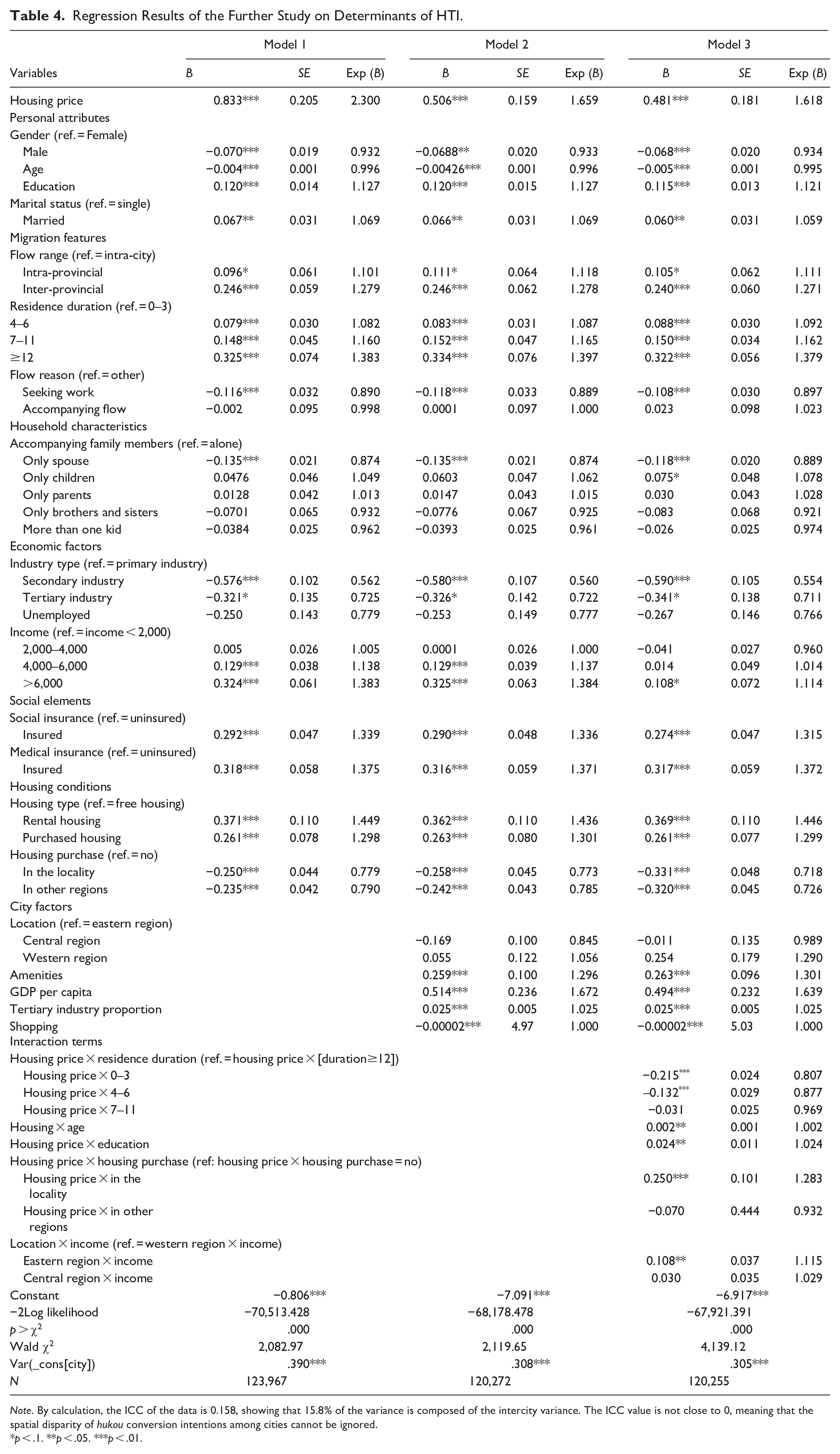
Note. By calculation, the ICC of the data is 0.158, showing that 15.8% of the variance is composed of the intercity variance. The ICC value is not close to 0, meaning that the spatial disparity of hukou conversion intentions among cities cannot be ignored.
p < .1. **p < .05. ***p < .01.
Focusing on the effects of housing price, we introduce several interaction terms between the housing price and individual-level factors into the model to discuss how the effects of individual characteristics on HTI change with the housing price. Compared with Housing price × (duration ≥ 12), Housing price × (0–3) and Housing price × (4–6) both exert negative impacts on HTI, demonstrating that the housing price will have a less negative influence on the HTI of floating migrants who spend more time in the destination cities. The floating migrants staying longer in destination cities may accumulate more work experience, social capital, and savings, which encourage them to purchase housing in larger cities and are thus more determined to settle down. Housing price × Age and Housing price × Education both have positive effects on HTI, reflecting that older and higher educated floating migrants tend to obtain urban hukou in cities with higher housing prices. The possible reason is that these floating migrants are more prepared to purchase housing in the destination cities with a certain amount of savings and a higher income level and thus more willing to obtain local hukou. In comparison with Housing price × No housing purchase and Housing price × Housing purchase in other regions, Housing price × Housing purchase in the locality has significant positive effects on HTI. It is evident that purchasing a local house with a higher price signifies a larger investment in settlement and a higher likelihood to transfer their hukou to the locality. In addition, compared with Western region × Income and Central region × Income, Eastern region × Income positively affect the hukou transfer intentions, indicating that the monthly income level in the eastern region has much stronger positive effects on HTI than it does in the western and central regions. Floating migrants with a higher monthly income level in the eastern region are more prone to local hukou acquisition since they have a higher capacity to cover the high living costs and live a decent life in the more developed eastern region.
Discussion and Conclusions
Drawing on the national data of the China Migrants Dynamic Survey in 2016, this study analyzes the spatial disparity of HTI through the spatial analysis method and its determinants using the multilevel model. The main discoveries are summarized below.
Above all, there exist remarkable spatial differences in HTI. Floating migrants in the eastern region have the strongest HTI. Besides geographic location, city size, and administrative level also positively influence hukou conversion willingness. The coastal urban agglomerations (Beijing-Tianjin-Hebei urban agglomeration, Yangtze River Delta urban agglomeration, and Shandong Peninsula urban agglomeration) are more attractive for permanent migration tendency, with evident internal differences of HTI within each urban agglomeration. Compared with the other coastal urban agglomerations, the floating migrants in Pearl River Delta urban agglomeration have relatively lower hukou conversion intentions, implying that its role as the main national attraction center for the floating migrants has been weakened (Lao & Shen, 2015). Besides, several cities in inland China also exhibit specific attractions for permanent migration.
What is more, hukou conversion willingness is both affected by individual-level and city-level factors. The individual-level variables in this study contain personal attributes, migration features, household characteristics, economic factors, social elements, and housing conditions. Their effects on hukou conversion intentions are consistent with extant studies. It is noteworthy that floating migrants employed in the tertiary industry, accompanied by children, covered by local social insurance, and in better housing conditions are more willing to transfer their hukou to the locality. The city-level variables contain spatial location, city size, GDP per capita, and the tertiary industry proportion. The influences of city location and city size are in line with the spatial characteristics of HTI. Cities with a higher level of GDP per capita and a higher proportion of the tertiary industry are more developed, thus are more attractive for permanent migration. The effect of GDP per capita is pronounced, while the role of the tertiary industry deserves concern and further investigation, which will provide scientific evidence for the population decentralization of megacities through industrial transfer. The city amenity factors also significantly influence HTI, and higher housing prices contribute to stronger hukou conversion intentions.
Finally, the effects of individual characteristics on permanent migration willingness will change with the features of destination cities. The income level, age, and education attainment of floating migrants independently contribute to the HTI, but their effects are more strengthened in more developed/larger cities than in less developed/smaller cities. The residence duration, age, education attainment, and housing purchase independently stimulate the HTI, but their impacts are stronger in cities with higher housing prices. These findings help understand the HTI of floating migrants and predict the future rural to urban migration.
The contributions of this study lie in the following aspects: the spatial pattern of HTI is unveiled through the GIS spatial analysis method; a multilevel model is employed to detect different effects of individual and contextual factors on HTI, which is a reliable method to decompose the variations of HTI into multiple levels and to produce correct statistical inferences on model parameters; besides city sizes and economic development levels, city amenity factors and housing prices have also been taken into consideration as the determinants on HTI; how the effects of individual-level variables on HTI vary with city-level variables are detailedly revealed by the interactions between different individual-level and city-level factors.
Generally speaking, the effects of individual and city-level variables are basically consistent with extant studies (Lao & Gu, 2020; Li & Liu, 2020). Concerning the city-level factors, this study discovers that hukou transfer intentions of the floating migrants are positively influenced by the city sizes, economic development levels, the city amenity factors, and housing prices. The finding of the effects of housing prices on HTI is consistent with several studies (Dong & Zhou, 2016; Song & Zhang, 2020) while contrary to others (Chen et al., 2020; Dang et al., 2019). It provides new insight into the influencing mechanism of housing prices on HTI, that is, a trade-off between the profits(economic returns and social welfare) and the costs of the floating migrants who have decided to migrate to larger cities with higher housing prices. In this study, the housing price is much closer to a proxy of city size. Though a few studies have employed the multilevel model to examine the between-city variability in hukou transfer intentions and the effects of the city-level variables on the relationship between individual-level characteristics and HTI (Dang et al., 2019; Huang et al., 2018; Liu et al., 2018), they have only discovered a significant interaction between the educational attainment level and the city size (Liu & Wang, 2020). This study further unveils the greater preference of older, higher-educated, and wealthier floating migrants for larger cities than their counterparts and the greater preference of older, higher-educated, and longer-term floating migrants for cities with higher housing prices than their counterparts, indicating an accelerated agglomeration of talent with more social capital in leading cities.
Several policy implications can be drawn from the discoveries of this study. The marked differences among different cities in terms of HTI and its determinants imply that different cities ought to formulate different policies according to local conditions, in terms of industrial development and transfer, hukou system reform and public service equalization, to help floating migrants better integrate into local society. Since the accompanied children, social insurance coverage and housing conditions all matter in enhancing HTI of floating migrants, it is essential for governments of destination cities to implement measures to create more favorable education conditions for children of floating migrants, ensure that floating migrants are all covered by local social insurance, and improve their living conditions by providing safe and sanitary housing through multiple channels. Besides, this study shows that larger cities with a higher GDP per capita in the eastern region are more attractive for permanent migration. Large cities (high-level cities) usually have higher levels of social and economic development, well-developed infrastructure, better public services, more employment opportunities, whereas these considerable benefits can only be enjoyed by people with local hukou, making more floating migrants intend to obtain local hukou. To address this mismatch between the trend of floating population migrating to larger cities and strict hukou system restrictions on larger cities (especially megacities), governments should guide the orderly flow and reasonable distribution of floating population among different cities with the human-centered approach. Since city amenities also play a non-negligible role in attracting floating migrants, it is feasible to promote the equalization of public services in large cities to benefit floating migrants and increase the attractiveness of small and medium-sized cities by promoting the public services and infrastructure facilities and creating a livable urban environment. As it is revealed that there are also some medium-sized and small cities in inland China with relatively high proportions of the floating migrants wanting to transfer hukou, these cities should be cultivated to attract floating migrants and agglomerate industries at their full potential, in order to relieve population pressures on large cities, by providing more space of employment and living for floating migrants outside large cities.
Meanwhile, due to the influential role of the tertiary industry in attracting floating migrants, less developed cities should attach more importance to the development of the tertiary industry, so do the megacities in the process of functional dispersal. Furthermore, considering that the positive effects of educational attainment, age, and income on HTI have been intensified in larger cities, the migration policy formulation needs to consider the characteristics of different groups of floating migrants. Finally, China’s hukou system reform has to be further advanced to gradually remove a series of social benefits attached to hukou in all cities, making the floating migrants share social resources equally throughout the country.
Footnotes
Declaration of Conflicting Interests
The author(s) declared no potential conflicts of interest with respect to the research, authorship, and/or publication of this article.
Funding
The author(s) disclosed receipt of the following financial support for the research, authorship, and/or publication of this article: This research is funded by the Beijing Social Science Foundation of China (Grant No.21JJC028). Many thanks are also due to the suggestions from anonymous reviewers.
