




Abstract
This study analyzes the key attributions of the Assad regime’s failure to end the protracted Syrian Civil War. It analyzes why it has taken the Assad regime so long to win back most of its territory despite tremendous support from Iran and Russia against fragmented oppositions who received jaded, half-hearted Western assistance. The article adopts a corpus-based, thematic analysis approach and uses primary and predominantly secondary data to examine Syrian domestic politics, as well as regional and global geopolitics. It explores how the three main geopolitically related themes contribute to the state of Syria as of mid-2018. The findings point toward several issues, including the regime’s dire manpower shortage, a severe lack of economic and social wherewithal, and Assad’s hard, inflexible stance on negotiations in addition to his corruption and brutality, which are among the key reasons for the current state of the Syrian conflict.
The conflict in Syria has been going on for almost a decade. What started in the spring of 2011 as a demonstration asking for reform descended rapidly into a violent civil war, and it drew in regional forces and extra-regional involvement. Unlike other Arab uprisings, Syria’s uprising turned into the prolonged quagmire of a civil war. The rebel forces have so far been ineffective in toppling the Assad regime. There has been a fierce sectarian contest between the Shiite forces led by Iran and the Sunni camp backed by Saudi Arabia, Turkey, and Qatar; the entry of the Islamic State (ISIS) into Iraq and Syria; Kurdish fighters’ participation; and Western and Russian military intervention. The Assad regime has received strong external support from Iran and Russia and indirect support from China. Their support has enabled the Syrian forces to maintain control over key populated areas, regain some lost territories, and resume a position of strength to negotiate for peace, should it choose to do so.
Meanwhile, the Syrian rebels were fragmented with the regional backers themselves divided, which resulted in not having a coherent strategy while simultaneously fighting ISIS. Moreover, Western support could be seen as lackluster even after the usage of chemical weapons by the Assad forces. The Western forces have also seemed to shift their focus to fighting ISIS. Despite all of these obstacles for the opposition, either the Assad regime could not end the armed rebellion or it seemed to be taking a long time to end it.
Could the key factors be within Syria’s internal politics or through regional or even global geopolitics? The analysis clearly indicates a strong argument that Syrian domestic politics contributed more to Assad’s inability to end the conflict. Likewise, regional geopolitics prevented Assad’s ability to end the conflict but at a lower scale. However, global geopolitics favored Assad’s survivability. Thus, the highest contributing level in descending order is domestic politics, followed by regional geopolitics and global geopolitics.
To determine the reasons behind the current state of Syria, an analysis was conducted by examining Syrian domestic politics, followed by regional geopolitics and last, global geopolitics. According to the arguments on the factors in each level of analysis, this article can determine how each political situation level has helped or prevented Assad from ending the rebellion.
Limitations of the Study
As the Syrian War is ongoing at the time that this article is written, this study does not aim to predict the outcome of the conflict and does not give a detailed chronology of the events. It is also limited to the period from 2010 (the start of the Arab Spring) to the middle of 2018. It focuses on why the Assad regime took a long time to regain its territories and is unable to end the armed rebellion in the Syrian Civil War. It does not attempt to independently study whether by remaining in power thus far, Assad has already been successful or otherwise.
Literature Review
A review of the literature on the Syrian conflict reveals a few key areas commonly used as approaches to discussion. These areas are domestic politics and regional and global geopolitics that either affect or support the warring sides. The literature review in this article takes another approach by grouping the discussion under four key headings, namely, the (a) Assad regime, (b) Syrian rebels, and (c) external support for the Assad regime, and (d) external support for the Syrian rebels. These are the key areas that contribute to the survivability of the Assad regime and why it took the Regime a long time to win back its territories in the Syrian Civil War.
The Assad Regime
The Assad regime’s own forces comprise different armed groups that operate independently alongside the presence of foreign fighters. The structure is increasingly civilianized and privatized, and it lacks centralized control.
Landis predicted that the regime would survive until 2013. Of course, Assad survived well beyond 2013, but many regional and opposition leaders predicted Assad’s downfall in a matter of months. The article “Why the Assad Regime is likely to survive to 2013” focused on Assad’s survivability, whereas most of the other literature addresses the opposition, ISIS, and outside intervention. Emphasized in Landis’ study were four reasons to back his prediction, namely, the regime’s strength (militarily), the opposition’s weakness, foreign intervention, and sanctions and economic decline (Landis, 2012). The regime’s strength lies in the loyalty of its command, with key posts filled by loyal Alawites and Baathists. Historically, the regime has also shown resilience by its willingness to resort to brutal measures to stay in power.
After multiple observations of the fall of the dictators in Tunisia and Egypt, discussions about Assad revolved around these dictators’ intentions to execute harsh responses. These dictators had executed harsh responses soon after the uprisings broke out beginning in March 2011. The Assad regime particularly framed the uprisings as terrorist campaigns led by Islamist extremists (Heydemann, 2013). The regime has also filled the upper ranks of the military and security apparatus almost entirely with stubbornly loyal Alawites. The regime uses a network of informal nonstate actors with family or sectarian ties that could carry out functions without scrutiny or accountability.
From the above review, it is evident that a gap exists in terms of explanations regarding why despite the portrayed strength of the regime and the support given to it, no detailed explanation has been given to clarify the incapability of the Assad regime in defeating the rebels. This aspect merits further scrutiny.
Syrian Opposition
A detailed analysis of Syrian’s fragmented opposition indicates that the Free Syrian Army’s failure led to the proliferation of many other groups. Cooperation among these groups has so far not reflected any solidarity, cohesion, or a centralized command (Abboud, 2016). Efforts have been made to unite them but have not yet worked.
Likewise, Hokayem (2013) wrote about fragmented armed oppositions and pointed out key differences between the Syrian opposition and the Libyan opposition. The author emphasized the key attributes of the Assad regime and how they were used to defy many predictions of Assad’s downfall. These attributes include cohesion, effective strategies, military adaptation, and proven regime security methods.
In addition to the above points, Abboud (2016) also wrote about how ISIS has fought against both the regime and the Syrian opposition. ISIS has managed to gain control over large swathes of the country and the economic levers of the civil war. Its control of the oil and gas fields and supply routes that linked the rebels’ reinforcement route was a significant achievement. This show of strength brought in increasing intervention from regional and international powers. How has ISIS’s involvement in the Syrian issue weakened or strengthened Assad? This has not been adequately discussed by the author in his work, which poses a gap in the literature in need of further analysis.
External Support for the Assad Regime
The interplay between the regional powers present in this conflict, namely, Iran that is supporting the regime and on the other side, Saudi Arabia and Qatar that favor the opposition, was consistently highlighted by Hokayem (2014). Their support has fused into this conflict, with elements of identity politics (sectarian) and geopolitics (regional hegemonic contest) clearly evident between Iran and Saudi Arabia. Iran’s entry into the conflict quite clearly has the intention to salvage a beleaguered ally of 30 years with the ultimate aim of preserving its influence in the Levant. An interesting point raised is that there were signs of division among the elite in Tehran on the merits of staunchly supporting Assad as it cost Iran US$15 billion to US$19 billion in direct support to the regime between 2011 and 2014, aside from hampering its détente with the West.
Along the same lines, Abboud (2016) discussed the same issue of regional powers’ involvement. He touched on how Hezbollah’s support is significant to the regime’s survivability. Nonetheless, their involvement was not primarily due to sectarian reasons (although this was not unimportant) but rather due to secure arms supply routes from Iran through the regions in Syria that were compromised by the rebels’ control.
The Syrian conflict is more than just a sectarian contest between Saudi Arabia and Iran but rather is a reflection of “shifting geostrategic dynamics.” Interestingly, scholars have pointed out that only 37% of Iranians support Tehran’s backing of the Assad regime (Berti & Paris, 2014). This is an important fact that much of the literature does not highlight. How can the Iranian government sustain its support of an unpopular cause and for how much longer?
Rogers and Reeve (2015) pointed out that the Russian air strikes were mostly targeted against rebels rather than ISIS, which indirectly enabled ISIS to gain ground against the rebels. Again, this leaves open the question on the relationship between the strong backing for regime forces and their incapability to end a civil war.
In an article entitled “Armed Conflict in Syria: Overview and U.S. Response,” Blanchard, Humud, and Nikitin (2015a) opined that although Russian intervention supported the weakened Assad regime, the intervention might have instead improved unity among the opposition and attracted more recruits to join the anti-Assad cause. In this light, it is important to further examine how this intervention might have indirectly strengthened the rebels. Nonetheless, Russia’s intervention was based on the invitation of the incumbent government and on the pretext of attacking ISIS. This gave the Russians greater legitimacy compared with the United States’ intervention.
All of the issues above need to be examined further to gauge how sturdy, durable, or “endless” the external support to Assad was and to link the answers to the other question of why the Assad regime could not capitalize on the significant support given to it to defeat the divided rebels.
External Support for the Syrian Rebels
The divergences between Saudi Arabia and Qatar that significantly impacted the armed opposition’s coherence were a puzzle. Why they, the Sunni powers of the Middle East, could not put aside their differences and focus on removing the Shiite obstacle that comes in the form of the Assad regime.
Many in the West have deemed that Sunni extremism poses a greater threat than Shiite radicalism. This remark may also need further research to link it to explain the arguably tame Western interventions toward toppling Assad (Hokayem, 2014).
Harkey’s (2014) essay entitled “Turkey’s Syria Predicament” is a deeply researched review of Turkey’s involvement in this conflict that included the facilitation of arms, supplies, and fighters into Syria. Turkey faced a dilemma with ISIS fighting the Kurds; Ankara wanted to see the Kurds weakened, but ISIS’s entry invited regional and Western intervention that dragged Turkey along. The article also emphasizes the differing priorities between Ankara and Washington in addressing the conflict, especially with ISIS’s entry. This is a useful point of argument for further research to examine the extent of unity or division among the rebels’ external backers.
The dividing of Sunni backers into two regional camps, namely, the Pro-Muslim Brotherhood (Qatar and Turkey) and Anti-Muslim Brotherhood (Saudi Arabia), led to repercussions on the diverging support for the opposition (Berti & Paris, 2014). This view echoes what Hokayem wrote in his essay as indicated above. Another interesting point that this article highlights is that the instability and polarization in Syria had meant trouble for the West as it provided a breeding ground for radicals and extremists. In the absence of a strong alternative to Assad either from the regime or the opposition, the West might be reluctant to depose Assad and instead prefer to negotiate with him as only a strong leader (just as Saddam Hussein before) can supress radicalism, which seems to be a greater threat than a secular dictator. Could this explain the somewhat abated support given by the West throughout the conflict?
Hokayem identified the good relations that Turkey and Qatar had with Syria just before the uprising. These countries miscalculated the fact that they had leverage to press Assad for minor political reform. They underestimated Assad’s resolve to brutally crush the Syrian uprising. Assad refused the mediation and saw it as undermining his regime’s rule. Before long, events moved swiftly with Turkey overturning its policy of zero problems with neighbors to soon become a transit ground for the flow of arms and fighters. Saudi Arabia and Qatar soon armed the Syrian opposition, but they seemed to lack an understanding of Syria’s terrain, society, and expertise to conduct intelligence operations. Iran saw this as an opportunity to strengthen its position, and it thus steadfastly backed Assad. In short, the unpreparedness of Turkey, Saudi Arabia, and Qatar played a role in widening the scope and in prolonging the conflict, which benefited Assad.
In addition, the Arab League’s failure to broker peace in late 2011 also played a role. The Arab League adopted a resolution that condemned violence and called for dialogue. This was soon violated by the Syrian regime, which was consequently isolated by the Arab League. Part of the failure was because the Syrian opposition was too divided to pose a strong, united front to negotiate with Assad. Why did Assad not use his position of strength to negotiate with a divided counterpart to attain more gains rather than agreeing to a peace agreement?
Yassin-Kassab and Al-Shami (2016) in their book Burning Country emphasized the United States’ duplicity as they only openly intervened when ISIS attacked Syria. The United States not only attacked ISIS but also other Islamist groups that fought against Assad. What astounded the frustrated Syrians was that the United States did not engage with Assad’s forces who were brutal to the populace—the root cause of the conflict—but instead, vehemently attacked the Jihadists, that is, the symptoms. This surely proves that to the United States, the Jihadists were their greater priority, even as the civil war went on.
Blanchard, Humud, and Nikitin (2015b) also discussed the attacks on ISIS by the US-led coalition. Although the Syrian opposition that fought ISIS welcomed the attacks, they also questioned why the United States did not want to take military action on government forces that were also committing atrocities.
A dilemma that the United States faced is that greater, more offensive campaigns against ISIS might take pressure off Assad’s forces, whereas the collapse of Assad’s forces may enable extremists to bring mayhem. The United States’ program to train and equip the opposition also came under scrutiny following reports that the weapons provided to the opposition might have fallen into the extremists’ hands. The lack of the United States’ effective response toward the Russian attacks on anti-Assad forces also caused criticism that demanded greater and less restrictive U.S. commitment. This hesitance, as opposed to Russia’s decisive intervention, also made it less appealing to the opposition and their regional backers who demanded the United States to train the rebels for offensive operations against the regime. All of these issues indicate that Assad is supported strongly enough but is still incapable of winning. This issue merits further scrutiny as to its linkage to Assad’s incapability to end the rebellion.
In the monograph, “Syria and the Islamic State, The Project on Middle East Political Science,” Schulhofer-Wohl stated that the United State’ hesitancy to coordinate regional backers and provide effective and timely financial and military support was central to the fragmentation and radicalization of the rebels. This echoes Blanchard et al.’s view that the West, especially the United States, is indecisive, is selective, and only gives piecemeal support to the cause, which contributed to the fragmentation and proliferation of the armed rebels. This view could be further analyzed as this shows another gap in explaining how Assad is incapable of ending the rebellion despite the hesitant U.S. support.
The United Nations Security Council’s (UNSC’s) permanent members were divided on the issue, with Russia and China being consistently supportive of the Assad regime, whereas the remaining three countries favored a regime change. United Nations (UN) Special Representative Kofi Annan’s proposed peace plan in 2012 failed partly due to its exclusion of Syrian representatives and the dearth of support from key regional players. Another UN Special Representative, Lakhdar Brahimi, also proposed a peace plan in 2014. It was also botched due to the divisiveness of the Syrian opposition, which caused insufficient representation. This further proves the extent of the opposition’s division that the Assad regime could have exploited, but it did not exploit it due to its inability to defeat the opposition politically.
Theoretical Framework
This article looks at a few concepts relevant to the Syrian conflict, namely, civil war, proxy war, regime security, and neorealism.
Civil wars have been described as conflicts with three criteria, specifically, (a) fighting between agents of the state and organized, nonstate groups that seek to take control of the government, regional power, or change government policies through violence, (b) at least 1,000 people were or have been killed over the course of the conflict, with a yearly average of 100, and (c) a minimum of 100 were killed on both sides (including civilians attacked by rebels; Fearon & Laitin, 2003).
Civil wars have also been seen as conflicts that result in at least 1,000 battle-related deaths per year (Collier, Hoeffler, and Söderbom, 2004). In Collier et al.’s study, the mean or average duration of a civil war is approximately 7 years. They also argued that the duration of civil wars is related to the ethnic fractionalizing of the warring parties. Polarized societies generally cause longer civil wars as the costs of coordinating a rebellion in very diverse societies are extremely high.
As the Syrian Civil War arguably also constitutes a proxy war, it is also essential to look at it in terms of the proxy war concept. The key components of a proxy war as expounded by Mumford (2013) are a (a) provision of manpower, (b) provision of material, (c) provision of financial assistance, and (d) provision of nonmilitary assistance. He also identified three consequences that result from a proxy war, namely, (a) dependence in the long run between the benefactor and the proxy, (b) elongation and/or intensification of the original war, and (c) conflict that spills over beyond the initial boundaries or that causes unintended blowback for the participants once a war ends.
In relation to the application of the Proxy War concept, as the Syrian conflict is seen to be affected both regionally and globally by the system’s structure, Kenneth Waltz’s theory of neorealism is also referred to. This theory suggests that the structural or international system rather than human nature determines the anarchical nature of states and that anarchy prevents states from cooperating with one another. Thus, states seek their interests according the logic of self-help. This results in states wanting to maximize power and, in turn, causes an imbalance of power. The uncertainties of other states’ future intentions lead to a lack of trust among states, and this gives rise to security dilemmas. Thus, the key concepts of structuralism, balance of power, and security dilemmas are deemed to be best to describe not only the fighting between the regime forces and the opposition but also the dynamics of the regional and international actors involved in this civil war.
In relation to this research paper, the structural system of Middle East geopolitics has caused anarchy and security dilemmas and, in turn, competition and the balancing of power. First, geopolitics in the form of the Arab uprising phenomenon that has toppled one dictator after another forced Assad to give his all to remain in power (which is his primary interest and security dilemma). Second, the sectarian divide results in regional bipolarity where offensively competing and balancing powers fight through their respective proxies in the Syrian Civil War. Consequently, the international community is also dragged into this divide, with Russia on one side supporting Assad and the United States and European states on the other side supporting the opposition.
Third, as this study also inevitably examines regime survivability, it is appropriate to consider the concept of weak states “insecurity dilemma.” This concept of insecurity is self-perpetuating whereby every regime’s effort to secure its security (survivability) provokes greater resistance. The state fails to convince its population that armed resistance is wrong or counterproductive. It also fails to physically disarm and control its rivals. This, in turn, creates an insecurity spiral, that is, armed groups engage in self-help strategies. In this weak state context, the ruling elite use the government machinery primarily to continue their rule. Therefore, the concept of “state security” and “regime security” becomes indistinguishable.
For clarification, this article operationalizes the “ending the rebellion” terminology to mean “ending major fighting between regime forces and rebels” either by the “victory of regime forces defeating the rebels to then continue the regime rule over all of Syria” or “resorting to concrete negotiations between both sides of combatants in peaceful conditions.”
Application of the Corpus-Based Methodology
Three main themes were identified from the literature. To confirm these themes, the study corpus, including the transcripts of interviews of prominent leaders by international media, books, monographs, essays, journals, and news, was compared with a reference corpus. Significant keywords were then compared against the themes or results obtained from the interviews.
These main themes identified from the literature as appropriate to address the issues are domestic Syrian politics and regional and global geopolitics. To confirm the significance of these themes, 117 files (study corpus) of approximately 1.8 million tokens including the transcripts of interviews of prominent leaders by international media were contrasted with a reference corpus. The results show that there is a corresponding relationship of keywords and themes, that is, domestic politics, regional geopolitics, and global geopolitics.
The results are shown below to illustrate the significance of the keywords generated by running the articles against the reference corpus by using Wordsmith (a corpus tool). The highlighted keywords are the keywords deemed to be related to at least one of the themes.
Data Collection
The primary data used in this study were from face-to-face interviews and via email. The subjects targeted for the interviews were diplomats, analysts, and academic experts. All interview questions were first validated to determine whether the set of questions were understandable, answerable, and relevant.
The bulk of the resources for the research are secondary data from books, monographs, essays, journals, and news that were later compiled and converted into text files to form the study corpus.
Study Corpus
In all, 117 files were used to form the study corpus; the size of the corpus is approximately 1.8 million words, and the reference corpus is the Reuter Corpus Volume 1 (RCV1). RCV1 is an archive of manually categorized newswire stories made available by Reuters Limited for research purposes. To generate a keyword index (for the words that are unusually frequent in a study corpus), a study corpus is compared with a huge reference corpus. The primary data used in this study were from interviews (face-to-face or email). The main targets of these interviews were diplomats, analysts, and academic experts. However, the bulk of the resources for the research are secondary data from books, monographs, essays, journals, and news. News on war is in abundance in the media (Ibrahim, 2010; Ibrahim, Mustaffa, Ahmad, Kee, & Mahmud, 2013). The collection of data was conducted through library research in Kuala Lumpur, Malaysia. Some secondary data were also obtained from the Internet.
Data Analysis
Ashaari and Maideen (2017) proposed that identifying themes is a useful procedure to identify the key factors of an issue. In this article, the themes of this research were derived from a survey of the relevant literature and interviews, where arguments are generally and consistently grouped into similar themes. The significance of the themes is then confirmed by using the corpus-based methodology. The study corpus, that is, articles and interview transcripts, is run for keyword significance against a reference corpus (or general corpus) to check whether the words or phrases, metaphorical or otherwise (Ibrahim & Mohamad, 2005), that comprise the themes are unusually frequent and significant. High log likelihood statistics are a good indication of significance. Words are checked for the appropriate themes by examining their occurrences in the context of the articles (the concordance function in a corpus analysis) and confirmed by using the UCREL semantic tagger for themes.
Corpus Analysis Results
The output of the corpus analysis in Table 1 indicates the significance of the keyness index (column g). This confirms the significance of the geopolitical themes, whether domestic, regional, or global, in terms of the key players and their roles. Column b shows the frequency of the top 100 keywords in the study corpus. Column e shows the frequency of the keywords in the reference (general) corpus. Column g shows the keyness or significance of the keywords. These keywords’ relevance to each theme is highlighted in columns h, i, and j.
Keyness of Themes.

The significance of the shaded regions are in column g. Column g showed keyness or significance of the keywords. This is a confirmatory measure to the findings from the interviews etc. The shaded regions are the ones deemed related to at least one of the themes i.e. domestic, regional or global geopolitics, and selected for discussion. ‘X’ indicates where the keywords fit into the 3 themes.
Discussion
The geopolitical factor is indeed crucial in the analysis of the Syrian Civil War from domestic to regional and global politics.
Regarding the proxy war concepts explained by Mumford (2013), regional and international backers of both warring sides have clearly provided manpower, materials, financing, and even nonmilitary support such as propaganda. As to the consequences of this proxy war, at the time of this writing, the civil war is still going on, but it can already be seen that the dependence between the benefactor and the proxy is prolonging and even intensifying the conflict from its original clashes, as evidenced by the use of chemical weapons, ISIS’s entry, Russian intervention, and Turkey’s increasingly active participation. Although the fighting has yet to spill beyond Syria’s boundaries, there is clearly a “spill in” with regional countries involved in some way. Moreover, although the conflict is still ongoing, unintended blowbacks have already occurred, for example, terrorist attacks in Western cities, the downing of a Russian airliner, the refugee crisis in Europe, and so on.
The Syrian conflict fits into the concept of a civil war as expounded by Collier et al. (2004), as the casualties recorded are certainly considerably above 1,000 deaths per year. At the time of this writing, the Syrian Civil War has already exceeded 5 years and will most likely reach the 7-year average duration of civil wars. More importantly, the polarization of the warring parties, especially among the rebels, contributes to prolonging the conflict. Coordinating the rebels is certainly a key challenge as their fragmentation is the foremost issue of the conflict. This conflict also meets the three criteria of a civil war as described by Fearon and Laitin (2016), with fighting between the government regime and the rebels who seek to remove Assad from power. As to the number of deaths on both sides, the conflict has more than met the requirement of 100 deaths annually.
The Middle East’s enduring structural divide between the Sunnis and Shiites and the power rivalry between Saudi Arabia and Iran are featured more distinctly in this conflict compared with other Arab Spring rebellions. This shows that neorealism is indeed central to driving the outcomes of this conflict. Such structural conditions are so strong that the Syrian uprising of 2011, which was initially not seen as sectarian in nature, quickly morphed into a prolonged civil war strongly characterized by sectarianism. At a global level, neorealism is evident in the “East–West” rivalry, that is, with the United States and Europe on one side and Russia and China on the other. This relationship is also manifested in the Syrian Civil War: first, in Russia and China’s veto against Western-sponsored proposals to the UN to take actions against Assad regime and second, with the Western states supporting the rebels and Russia’s direct participation in its support of Assad. This divide has continued throughout the civil war and even hindered meaningful efforts to end it through peaceful negotiations. Such is the influence of the international structural system on this conflict.
Overall Effects of Syria’s Domestic Politics on the Civil War
Bashar Assad’s regime attempted a reform but has yet to succeed. The regime was corrupt with cronyism and bias toward the Alawites and was thus further losing support from Syria’s Sunni majority. It reacted brutally to the 2011 uprising, forced increasingly more people to be opposed to the regime and alienated the regime internationally. Assad’s hard stance in rejecting any talk of power transition has effectively closed any possibility of ending the conflict through negotiation. The regime forces have lost significant manpower due to casualties, defections, and draft dodgers. This makes it difficult for the regime to capitalize on the effective Russian aerial attacks by launching massive ground offensives to defeat the rebels.
Previous patterns of minority rule in the Middle East have demonstrated that such regimes will fight to the bitter end; thus, the Assad regime will also fight to the maximum and bring everyone down with it. Therefore, the regime is not interested in stepping down as this would be suicidal. This would close the door for the consideration of power transfer negotiations or alternatively, asylum arrangements; therefore, a requirement that Assad steps down would only protracts the conflict. The regime’s brutal strategy includes the use of chemical weapons and air attacks on civilian localities, which further alienates it from the populace and, in turn, hampers its recruiting efforts.
The number of rebels of at least 100,000 is sufficiently large to extend the conflict, although it may not be a factor in a decisive win. In addition, the rebels comprise as many as 1,000 groups, which means that they can attract a wide spectrum of sectors that range from urban seculars to extremists to join their fight to further use the virtually endless supply of rebel manpower to thus prolong the conflict. The economy before the war was bad enough for the Syrian people. The sanctions and damages caused by the fighting have further devastated the Syrian economy and social services, which makes it difficult for the regime to conduct decisive military campaigns and to rule controlled areas effectively. The regime’s brutal strategy of targeting medical facilities and the civilian population is also not helpful in winning mass support and recruiting youth, which thus protracts the ongoing civil war.
The opposition’s composition of various groups also makes it difficult for the Assad regime to satisfy their needs, should the regime wish to make reforms or negotiate seriously. More recently, the rebels have proved that they can unite operationally through evidence of some progress on the battlefields. If such cohesiveness continues, it will make it more difficult for the regime forces to defeat the rebels.
The bad and unjust economic situation prior to the civil war has further deteriorated with the addition of sanctions and conflict. Effectively, the Syrian economy is terribly damaged, which makes it difficult for the Assad regime to control the state and finance its counter-insurgency campaigns.
Assad’s stubbornness in not considering a power transition through peaceful negotiation narrows the chance of ending the rebellion through peaceful means. Moreover, narrating or framing the conflict as an act of counter-terrorism also restricts the common ground for negotiation.
The only few key arguments from the perspective of domestic politics in support of the regime is first, the badly fragmented opposition. Second, the opposition leadership is in exile, incoherent, ineffective, or cannot agree on a political strategy. Without continuous cohesiveness and coordination, the rebels stand little chance of toppling Assad.
A comparison is made of the arguments on Syria’s domestic politics, whether they tilted toward helping Assad to end the rebellion or made it harder for him to end it. A tabular format is used below (Table 2) for the ease of comparison of the above arguments.
Comparison of the Arguments on Syria’s Domestic Politics.
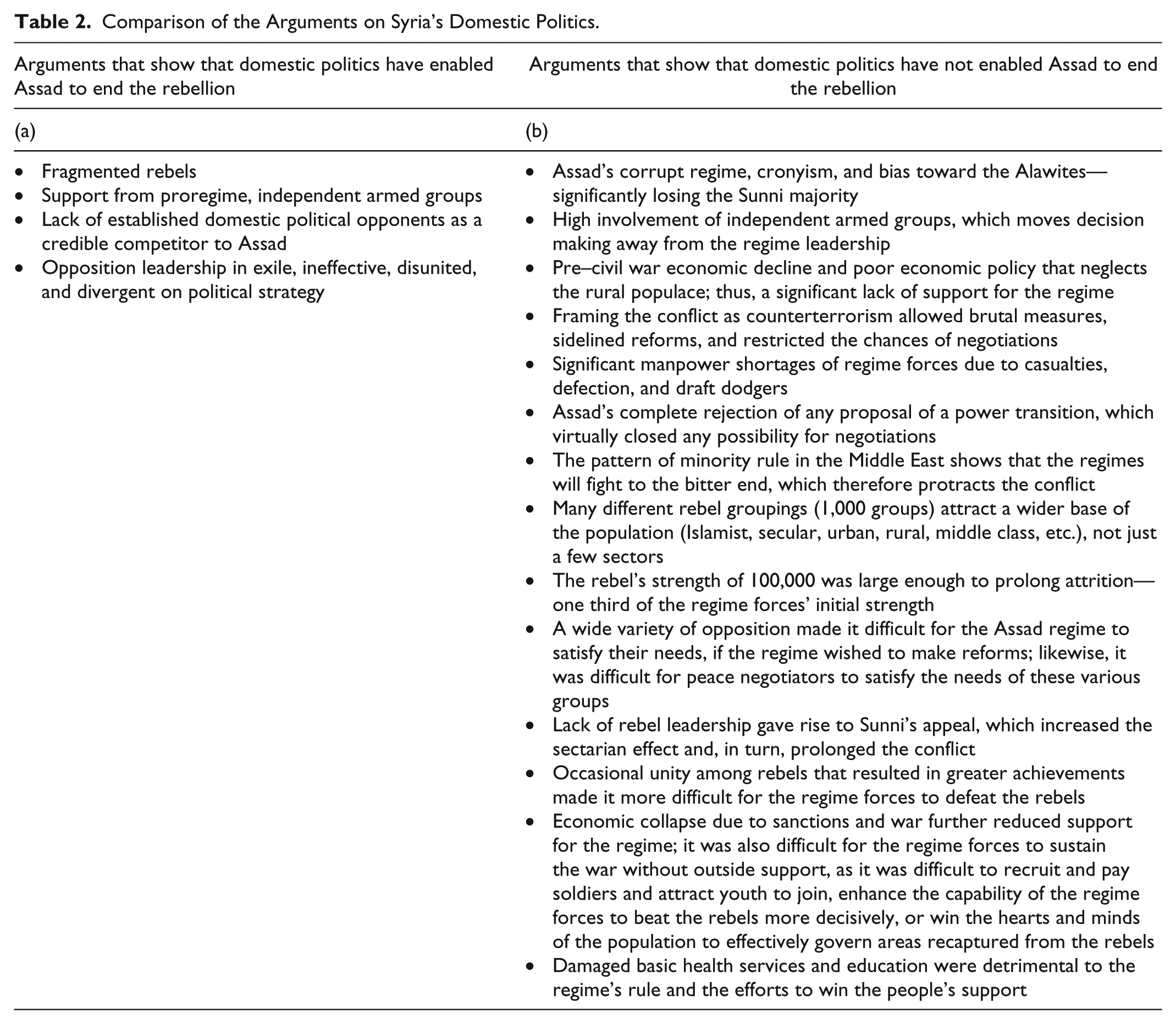
Although the opposition’s fragmentation was a significant weakness that Assad should have capitalized on, there were other overwhelmingly greater arguments that occurred in Syria’s domestic politics that could have prevented Assad from being able to end the rebellion. In particular, the dire manpower shortage and lack of economic and social facilities made it extremely difficult for the Assad regime to seize the opportunity.
Regarding the insecurity dilemma, the regime suppressed the development of credible opposition, including resorting to the use of brutal measures. The Arab Spring that saw the fall of many Arab dictators provoked greater resistance as seen through growing protests. Eventually, the regimes failed to convince the population at large that armed resistance is counterproductive, which caused the armed groups to resort to self-help (not cooperating with the government) to achieve their demands for reforms. Indeed, the regime elites used all the government machinery available to maintain rule, including the use of chemical weapons and barrel bombs. From the Syria government’s view, the security of its state was equivalent to the Assad regime’s security, that is, they were indistinguishable.
Overall, Syria’s domestic politics have contributed more to the Assad regime’s inability to end the armed rebellion.
Although this section has focused on domestic politics, the international structural system has greatly affected the internal politics of Syria. Both sides have relied heavily on outside powers to be able to wage war effectively. The realist nature of the structure provided immense effects to each warring side. In fact, the neorealist or structural nature was the main driver that led to the morphing of the protests into a violent, prolonged civil war.
As the conflict was considered to be a form of a “proxy war” played by competing outside powers who took sides to support the regime or the rebels, it is worth examining how the geopolitics surrounding Syria has affected this conflict. The next section will discuss whether the regional political situation and involvement as a whole actually helped Assad to end the rebellion or was otherwise.
Overall Effects of Middle East Geopolitics (Regional) and Interventions on the Civil War
There are three key regional forces shaping the Syrian conflict, namely, the Arab Spring, sectarianism, and ISIS. The Arab Spring, particularly the downfall of Mubarak (Stacher, 2013) and Gadhafi, gave rise to Saudi Arabia’s prominence. This enables Saudi Arabia—the leading power against Shiites and the West’s close ally—to interfere in the Syrian conflict, which, in turn, brings in its sectarian nature. The success of the Arab Spring in toppling other countries’ dictators has inevitably made Assad very unpopular internally and internationally, especially with his brutal reactions to the 2011 uprising.
The shift to a sectarian divide from the initial political uprising has caused an unlimited supply of fighters for each side to thus prolong the conflict. In the Sunni majority region, supplies of rebels (who are mostly Sunnis) are much more, which therefore makes it more difficult for the Assad regime to win.
One of Assad’s greatest supporters is Iran, which provided enormous assistance in the form of arms, training, financing, political support, and even military personnel. However, signs of Iran’s exhaustion can be seen from its offer of asylum to Assad. In addition, Iran also has other commitments, particularly in Yemen. However, Hezbollah also sends its fighters to fight for Assad.
On the rebels’ side, Saudi Arabia, Qatar, and Turkey provide significant support by sending arms, financing, and political propaganda, in addition to being entry points to Syria. Unlike the regime’s side, the supply of arms to rebels is limited for fear of the sophisticated weapons falling into extremists’ hands.
Regional support for the rebels increased following Russia’s attacks, with a supply of antitanks and proposed supply of anti–air weapons. Moreover, recently, the rebels’ cohesion has shown improvements as indicated by some combined operations conducted by different rebel groups.
Saudi and Qatar’s diverging interests in their support for the rebels have led to fragmentation, which makes them less effective militarily. This is in addition to the West’s restriction of the supply of arms to the rebels, whereas the regime faces no such restriction from Russia or Iran. The Saudi–Qatar split also means more difficulties for negotiation mediators to meet these backers’ demand (through their proxy opposition groups), even if Assad agrees with the mediators’ proposals.
ISIS’s invasion of part of Western Syria, aside from adding another battlefront, increases Assad’s difficulty to regain control of the state and inadvertently displays the regime’s weakness. ISIS, unlike the rebel groups, will never be featured in negotiations and likely has no interest in them. This closes the opportunity for Assad to regain the ground lost to ISIS through negotiations. Thus, military action is the only option left against ISIS.
Nonetheless, ISIS’s intervention has resulted in a shift of focus to this new threat, especially following a string of ISIS terror attacks on Western cities. Likewise, ISIS’s entry helps justify Russia’s intervention, which is also used to attack moderate rebels. ISIS also fights against the Syrian rebels and indirectly helps Assad to defeat the rebellion. However, ISIS has considerable income coming from the sale of oil, taxation, extortion, and the black market, enabling it to sustain the conflict and, in turn, preventing Assad from reuniting all of Syria’s territories.
The arguments for both sides on whether regional geopolitics as a whole cause more problems for Assad or otherwise looks more balanced compared with the arguments from the point of view of domestic politics. However, regional geopolitics leads to more protraction overall, where neither side is poised to win decisively.
From a regional geopolitical perspective, both sides of the argument on whether the Middle East’s geopolitics and interventions have helped the Assad regime in ending the rebellion are tabulated in Table 3. Synthesized from the above arguments, the comparison is as follows.
Comparison of the Arguments for Middle East Geopolitics and Interventions.

Note. ISIS = Islamic State.
Although there are strong arguments to suggest that regional geopolitics have enabled Assad to end the rebellion, overall, the situation in the Middle East has shaped the conflict into a protracted one with hardly any clear indication that Assad can end it. Iran’s support is enormous and vital but has begun showing signs of exhaustion. Meanwhile, the rebels’ regional backers, although they have different agendas, have continued to provide significant supplies to match Iran’s support to thus enable the rebels to fight a protracted war; however, it is highly unlikely that they will be able to overthrow Assad. The rebels are fragmented but have proven that they can unite on certain occasions. The sectarian nature of the conflict favors the rebels (volunteers) as there are more Sunni Muslims in the region. ISIS’s involvement has affected both sides, but it has considerable capacities to sustain the conflict, which therefore denies Assad the complete regaining of Syrian territory.
Regarding neorealism, the Middle East’s structural system, particularly the growing sectarian (Sunni–Shiite) divide, not only became the catalyst of the conflict at the beginning but also has sustained it. The involvement of regional backers also fits very well into the key components of the proxy war concept. Regarding these components, the benefactors (backers) have provided manpower, material, financing, and nonmilitary assistance to their respective sides. As to the consequences, they caused backer-proxy dependence, the prolonging of the conflict and its spilling over boundaries, for example, the ISIS attacks outside Syria.
Overall, regional geopolitics does not favor Assad as someone able to end the rebellion.
The Syrian conflict is so complex that it is inadequate to analyze regional geopolitics alone. Powers beyond the region immensely influence both sides and have significantly shaped the outcome of the conflict. Global geopolitics certainly affects the Syrian issue.
Overall Effects of Global Geopolitics and Interventions on the Civil War
Western states especially the United States have supplied arms, nonlethal aid, and training to the rebels. However, the arms supplied are limited to not include advanced weapons, especially anti–air weapons, due to the concerns that extremists may receive them. The West has also imposed the same restrictions to the arms supplied by the rebels’ regional backers.
Western sanctions contribute to the Assad regime’s difficulty to be effective militarily or to rule the provinces under its control. The West’s resistance to include Assad in peace negotiations has narrowed the room for Assad to choose to end the rebellion through negotiations.
The West’s involvement in this conflict is inconsistent and lackluster. There seems to be lack of political will to intervene directly, even after chemical weapons were used, to the dismay of the rebels. Understandably, one reason for this is the United States’ fatigue from the War on Terror.
Russia’s intervention in this issue is very significant. Military air attacks have helped Assad’s regime forces to regain ground. It also makes it more complicated if the West later chooses to attack the regime forces for fear that it may trigger a direct confrontation with the Russians. Russia’s intervention with Assad’s invitation ostensibly against ISIS is difficult to dispute and indirectly helps improve Assad’s image. Politically, Russia alongside China has vetoed proposals at the UN to take military actions against Assad.
However, the Russian intervention can also be seen in the light of geopolitical and domestic reasons such as to project Russia’s image if not its power. Thus, the intervention is not entirely for the benefit of Assad’s victory at all costs. Russia’s early withdrawal can also be taken as a sign of unwillingness to be militarily engaged for a long time period. Russia even criticized Assad’s intention to recapture the entire country as unrealistic. Thus, there is a possibility that Russia would eventually phase out Assad.
Moving to negotiations, Geneva I failed due to a lack of international seriousness seen through the exclusion of Assad and the rebels in the negotiations. Then, Geneva II met the same fate because it lacked inclusivity, especially on the rebels’ side, along with the lack of international political will, the lack of offers (carrots), and the United States’ ambivalence. An initiative to have localized ceasefires called “Local Freeze” also did not work for nationwide peace negotiations due to a loophole that allowed combatants to simply shift to other localities to fight. Meanwhile, Moscow’s proposal for a peace negotiation is clearly biased toward Assad and was therefore also unaccepted.
Overall, global geopolitics only slightly favors Assad to end the rebellion.
The arguments on whether global geopolitics has helped Assad to end the rebellion or otherwise are summarized in Table 4.
Comparison of the Arguments for Global Geopolitics and Interventions.

Note. ISIS = Islamic State; UN = United Nations.
The comparison here is also somewhat balanced. Russia’s political firmness was backed by its considerable military intervention, and in contrast, the lack of Western political will to intervene directly can be seen as not only tremendously favoring Assad but also providing a good chance for Assad to win. The sanctions have affected both sides of the fight but have affected Assad more, as a sitting government must prove to be able to provide adequate economic and social services. The supply of arms and training without advanced weapons did not give a significant advantage for the rebels to win, whereas Assad has enjoyed a virtually unrestricted supply of arms. The elusive peace negotiations actually favored Assad who had everything to lose and, in any case, reject any proposal for a power transition—which is the central pillar for any negotiation to move forward.
Thus, overall, global geopolitics are deemed to slightly favor Assad in ending the rebellion.
Conclusion
The Syrian Civil War is an important, complex, yet unique conflict that merits scrutiny and will in the future be a classic civil war to be studied, similar to the Spanish Civil War. For now, as the conflict is still ongoing and is quite fluid, not many scholarly books have been written about it.
The conflict between the Assad regime and the Syrian people is largely contained within the Syrian border; therefore, it is aptly categorized as a civil war. However, the conflict has caused enormous “spill in”: forces and material and political support have “poured in from the region and globally on a scale had not been seen recently.”
It is difficult to single out or even zoom in on any particular aspects of the conflict to determine the main reason(s) for the Assad regime’s incapability to end the conflict despite the seemingly obvious tremendous support that it enjoys, whereas the rebels are not only fragmented but are receiving divided regional backing and lackluster Western support. This study addresses the problem statement by examining the domestic, regional, and international levels of analysis. Notwithstanding the interrelation among these levels, this approach can at least identify which level contains stronger arguments on Assad’s incapability of ending the civil war.
As seen at the regional and international levels, the geopolitical forces and intervention are quite balanced in either the support of Assad’s success or his incapability of ending the rebellion. The arguments almost cancel each other out. At the regional level, the arguments for Assad’s incapability just slightly outweigh the support of Assad’s success, and vice versa for the global level. The divide is more distinct at the domestic level, where the arguments for Assad’s incapability far outweigh the support of Assad’s success.
It can be seen that the Assad regime is willing to go all the way to remain in power, regain control of the entire country and end the rebellion. The regime does not show any interest in peaceful negotiations that discuss a power transition, which thus severely restricts progress through negotiations. It can be argued that the regime is willing to commit brutal and unlawful measures to end the rebellion as has already been proven with the regime’s use of chemical weapons and barrel bombs on civilian sites. Syria’s brutal response to Western sanctions, especially the alleged usage of chemical weapons (nerve agent sarin gas) in August 2013 at Ghouta constituted a war crime according to the UN. The death toll has risen from more than 1,000 to 4,000 casualties. This has strengthened the West and their regional allies’ resolve to topple Assad. However, even after the use of chemical weapons, the West did not resort to attacking Assad’s forces directly. Geopolitics at the global level generally favors Assad. Assad has framed the conflict as merely counterterrorism and not a civil war, which gives it space to take virtually any measure against the rebels and allows it to brush aside the demands for reform or a change in the government. If Assad has sufficient means to push back the rebels and rule Syria as before, he will certainly do so at all costs. Therefore, why, then, does Assad still fail?
This study therefore broadly deduces that the regime’s own lack of manpower, effective command, inadequate economic and social means, and the tendency of its brutal dictator who comes from the ethnic minority to fight to the bitter end that act as the principal causes of Assad’s incapability to end the civil war. Arguably, because of this, Assad could not ride on Russia’s enormous direct military intervention and Iran’s virtually limitless support to win militarily or negotiate peacefully. It appears that the recent win in Aleppo is far from a victory. For this reason, the regime cannot capitalize on the fragmentation of the rebels, the divergence of regional backers and the lack of political will from the West. No solution to ending the war is in sight, although a federal solution may be viable (Ibrahim, 2017). Thus, without the adequate means for Assad to decisively win, the war can only be prolonged.
There is clearly a need to scrutinize more deeply or focus academic studies on the Assad regime to help end the quagmire, as this study has identified the regime as the lynchpin of the solution. By extension, it infers for diplomats a closer examination of the regime’s mind-set or psyche that drives not only domestic behavior but also foreign policies. These findings also further prove that brutal dictators from ethnic minorities tend to fight to the last to thus destroy everything instead of negotiating a compromise or choosing to flee.
Clearly, there are strong arguments that Syrian domestic politics has contributed more to Assad’s failure to end the conflict. Likewise, regional geopolitics has been preventive of Assad’s ability to end it but at a lower scale. However, global geopolitics has favored Assad’s survivability.
Footnotes
Declaration of Conflicting Interests
The author(s) declared no potential conflicts of interest with respect to the research, authorship, and/or publication of this article.
Funding
The author(s) disclosed receipt of the following financial support for the research, authorship, and/or publication of this article: The authors received financial support for the research and authorship of this article from Universiti Kebangsaan Malaysia Research Grant coded GUP-2017-079.
Author Biographies
 .
.