




Abstract
This paper assesses whether and to which extent the COVID-19 pandemic, which represents a scenario of high moral intensity, is influencing the moral reasoning of top CEOs (chief executive officers) in the paradigmatic case of the automotive industry and how this moral reasoning relates to their CSR response to the crisis and their CSR plans in the long run. To this end, we took the CEO letters before and after the pandemic outbreak of the top 15 automotive companies, and applied Weber’s method to conduct a moral reasoning categorization, along with an examination of their CSR approach and initiatives. The results show a predominant moral paralysis among these CEOs, where positive reactions addressed are philanthropic in nature and more likely to be a transient response to the crisis, rather than a sustained long-term improvement of their CSR rooted in a significant moral approach enhancement. Furthermore, CEOs at the lowest stages of moral reasoning, primarily focused on their own business and immediate stakeholders, are less likely to highlight these philanthropic initiatives. The outcome evidences the convenience of addressing CSR from the lens of moral reasoning, and it further draws the attention of the scientific community, companies and their top management, stakeholders, and society to the relevance of investigating and considering the moral reasoning of top management in large corporations and its implications.
Introduction
Beyond the already existing economic, social, and environmental challenges, the COVID-19 pandemic is shaking the foundations of our society and affecting us at all levels. With an ongoing unprecedented sanitary crisis and a looming global economic recession that may expose even more the existing socioeconomic disparities, the moral obligation that businesses have to society, stressed by corporate social responsibility (CSR; Swanson, 2008), looks more relevant than ever.
Yet not everything seems like bad news. Since the pandemic outbreak, we have seen multiple initiatives in public and private spheres to help others and respond to emergencies. That is probably due partly to increasing expectations and closer scrutiny of stakeholders and society (He & Harris, 2020; Manuel & Herron, 2020), demanding that institutions and organizations act more independently as moral agents (Tengblad & Ohlsson, 2010). In particular, businesses and their top management are expected to speak out publicly, to address today’s challenges, and to be decisive at solving them.
The new scenario could boost the urgent transformation required to tackle the diverse and critical challenges ahead by adopting a more genuine and authentic CSR (Brammer et al., 2020; He & Harris, 2020). In this respect, a number of works have addressed business CSR and its initiatives since the COVID-19 outbreak (Ebrahim & Buheji, 2020; García-Sánchez & García-Sánchez, 2020; He & Harris, 2020; Leonidou et al., 2020; Mahmud & Hasan, 2021; Manuel & Herron, 2020), while CSR is intimately linked to business ethics (He & Harris, 2020; Rodriguez-Gomez et al., 2020).
According to the 2021 Edelman Trust Barometer report (Edelman, 2021), none of the leaders’ groups from societal institutions considered (government, businesses, NGOs, and media) are trusted to do what is right, in general dropping in trust scores. Thus, their ethical or moral behavior is increasingly under question. Nonetheless, businesses get the best trust score among the four studied. Besides, although there is no unanimous consensus in the literature, the vast majority of research agrees from different perspectives on how the moral reasoning of top managers relates to their ethical or moral behavior and decision making—see, for example, Kohlberg (1964), Rest (1979), Trevino (1992), Rest (1984), Jones (1991), and Christensen and Kohls (2003), which are positively associated with their own performance (Avolio & Gardner, 2005; Brown & Treviño, 2006) and business performance (Johnson, 2019; Shin et al., 2015). In turn, poor moral reasoning has been connected with scandals or crises of companies (Amernic & Craig, 2013; Amernic et al., 2010; Garcia-Ortega et al., 2019), and even to global crisis (Amernic et al., 2010).
Moreover, today’s situation, under the COVID-19 pandemic and its immediate consequences, represents a high moral intensity scenario as defined by Jones (1991), presented as a mediator in the adopted stages of the moral decision-making process, a unique opportunity to empirically assess the possible influence of this exceptional context in the moral reasoning and moral decision-making of business leaders. It is probably still too early to seek a definitive answer since we are yet under the shock and the immediate effects of the pandemic, and a longer time frame perspective would be required. However, after more than 1 year, we are in a position to examine whether significant changes are in sight. For sure, it is high time to call the research community attention to this issue and foster the debate about it.
Hence, we find it of deep interest to investigate whether and to which extent the moral reasoning of business top management, and in particular their Chief Executive Officers (CEOs), those who lead company behavior and performance at the highest level, ultimately responsible for all company activities (Waldman & Yammarino, 1999), has shifted right after the COVID-19 pandemic outbreak, considering the benefits this possible evolution could bring for the prospects of business and society, along with the subsequent correspondence with their specific CSR initiatives in response to the crisis and with their long-term CSR approach, whereas no research was found in the literature from such a perspective.
For this aim, we take the paradigmatic case of the automotive industry, where its top players represent some of the largest companies worldwide, with an incontestable weight and influence in the global economy and expected to establish practices and norms that other companies are likely to follow (Paul, 2008). It is indeed one of the most globalized sectors, immersed in the Industry 4.0 transformation, highly exposed to society and tightened up by strict regulations, facing huge competition, cost pressure, and new forms of mobility (Garcia-Ortega et al., 2019). At the same time, it is striving to be more sustainable (Stoycheva et al., 2018; Sukitsch et al., 2015; Wells, 2013). Besides, the echoes of the scandals of the last decade still resonate, with the moral integrity of their CEOs under constant scrutiny (Amernic et al., 2010). On top of that, it is one of the sectors most severely hit by the crisis, with an important decline in demand and profits (Mohr et al., 2013), which may in turn limit their resources and put even more pressure on their moral decision-making, CSR, and overall business approach. Garcia-Ortega et al. (2019) examined the moral reasoning in the discourse of top CEOs in this industry to evidence various interactions and implications and found that it had unevenly evolved across CEOs and companies with a certain positive trend, while still most of them were not reaching the desirable higher stages. In sum, the automotive industry is found of great interest as a pool for our research; on the one hand, since it comprehends some of the most relevant companies worldwide facing the assembly of contemporary challenges already existing before the COVID-19 outbreak, whereas at the same time it is being badly hit by the pandemic; on the other hand, there is a comprehensive previous research in the field of the moral reasoning of their top CEOs covering the earlier years before the pandemic as a valuable starting background for our assessment, with significant room to enhance their moral reasoning under such scenario of high moral intensity.
Thus, we present in Section 2 our literature discussion and research questions. In Section 3, we define our sample and describe our methodology to assess the CEO’s moral reasoning through their letters, as well as their CSR approach, comparing the CEOs’ discourse right before and after the COVID-19 pandemic outbreak. Then, in Section 4, we present and discuss the results of our assessment. Finally, conclusions are presented in Section 5 as well as the theoretical and practical implications for businesses, while, in Section 6, we comment on the limitations and future research.
For the main contributions, at the theoretical level, this paper questions the issue-contingent model of Jones (1991), since an overall lack of evolution in the moral reasoning within the group of CEOs examined is ascertained, in a kind of a widespread “moral paralysis” (Schwartz, 2016), and contributes to link and relate their moral reasoning with their moral decision-making and their CSR approach and reactions in front of such an exceptional scenario. At the practical level, this lack of evolution involves a more transient CSR response to the crisis rather than a sustained long-term approach rooted in a significant moral approach enhancement. Furthermore, this research evidences the relevance of examining the moral reasoning of CEOs as a means for companies, their top management, and stakeholders to make better-informed decisions in their respective roles.
Literature Discussion
The Role of the CEO, Their Moral Reasoning, and Their CSR Approach
The CEO as a referent
The literature widely appraises the CEO’s power and leverage over the organization, stakeholders, industry, society, and their relevance and prominence within top management. In the view of many scholars, and especially of those defenders of the upper echelon theory, the CEO has growing power and influence (Amernic et al., 2010; Quigley & Hambrick, 2015), with a central role within top management (Thomasson, 2009), ultimately responsible for all company activities (Waldman & Yammarino, 1999), decisive to its success or downfall, and even leading to global financial crises (Amernic et al., 2010). Likewise, CEOs are exposed to society and fulfill a promotional function for their companies (Hyland, 1998). In particular, CEOs from the largest companies are part of the elite, public figures, and even celebrities (Lovelace et al., 2018). Due to their salient leverage, they may be considered referents and “influencers” not only within their industry, raising mindsets, standards, and expectations, but also across society and all its relevant actors, through their communication, rhetoric, and acts.
The CEO as a moral manager and their moral behavior
Some scholars consider the CEO as the most important leader within senior management (i.e., Thomasson, 2009). Leaders represent role models for their followers (Treviño et al., 2003), who tend to imitate their leaders, whether their influence is good or bad (Ho & Lin, 2016; Kaptein & Wempe, 2002; Lasthuizen, 2008). When followers sense an appropriate ethical leader behavior, the leader reinforces their leadership (Akker et al., 2009). Treviño et al. (2003) defined the role of a leader as that of a moral manager whose proactive efforts may both positively and negatively influence the behaviors of their followers. Leader behavior influences the ethical culture of an organization (Grey, 2005; Hood, 2003; Kalshoven et al., 2013) and also conditions the decision-making processes across their organization (Jackson et al., 2013; Kish-Gephart et al., 2010). Besides, literature relates ethical leadership and moral behavior to CEO performance (Avolio & Gardner, 2005; Brown & Treviño, 2006) and business performance (Johnson, 2019; Shin et al., 2015). The importance of a leader’s moral behavior converges indeed from different perspectives among the most popular leadership theories, which have in common the concern for the well-being of others, even at personal expense, or in other words, transcending their own interests for the common good (Dhiman, 2017).
The CEO moral reasoning and its communication
Pettifor et al. (2002) presented moral reasoning as the ways in which individuals decide whether a course of action is morally right, for example, evaluating different venues of action and considering ethical principles when defining their position on an ethical issue. Moral reasoning is positively related to moral behaviors (Kohlberg, 1964; Rest, 1979; Trevino, 1992), necessary for moral decision-making (Rest, 1984). The moral tone at the top, understood as the more or less ethical atmosphere created by the leadership in an organization (Garcia-Ortega et al., 2019; Mahadeo, 2006), is intrinsically linked with the moral reasoning of CEOs (Garcia-Ortega et al., 2019; Weber, 2010), and seen as one of the key factors in leadership’s contribution to business success (Tourish et al., 2010). Higher levels of moral reasoning have been related to leadership performance, associated. for example, with positive leadership behaviors (Turner et al., 2002), or with emotional self-control (Orth et al., 2010), which is an ingredient for achieving success (Muraven et al., 1998). In the same venue, Kulkarni and Ramamoorthy (2014) propose that “Leaders in higher stages of moral development are more likely to transfer best practices in moral reasoning than those in lower stages” (p. 25). Likewise, a wrong or unappropriated tone or poor moral reasoning is sometimes behind the scandals, crises, and collapse of companies (Amernic & Craig, 2013; Amernic et al., 2010; Argandoña, 2012; Arjoon, 2000; Garcia-Ortega et al., 2019; Staicu et al., 2018) and may even scale to a global financial crisis (Amernic et al., 2010). In turn, CEOs’ moral reasoning tends to be enhanced in front of scandals seeking for reputation or trust recovery (Garcia-Ortega et al., 2019).
Moreover, Spraggon and Bodolica (2015) presented how moral reasoning may shape governance mechanisms in an organization and help to understand the decision-making process better. Besides, the tone at the top decisively influences the workplace climate, integrity values, moral principles, and competence of employees (Amernic et al., 2010; Bruinsma & Wemmenhove, 2009; Staicu et al., 2018). Furthermore, as advanced at the beginning of this section, the CEOs of the top companies are benchmarks that can influence positively or negatively their peers, stakeholders, and society.
The CEO, as a moral manager, must be able to convey and embed their values through their behavior, but also through their moral reasoning and its communication, communication which is essential to align and drive the organization (Murray, 2013), to keep stakeholders engaged and to achieve the right performance toward goals. Together with modeling through visible actions and using discipline and incentives, communicating about ethics and values completes the notion of a moral manager (Trevino et al., 2000). Leaders conveying a higher level of ethical values show a greater ability to make the right decisions (Christensen & Kohls, 2003), while Trevino and Brown (2004) linked the effectiveness of ethical management with the transmission of the relevance of ethical standards. In the same venue, Weber (2010) stated that leaders must be individuals of moral character, communicating the importance of good values to the company. At the same time, the moral character shown by a manager is one of the three legs together with the logic and the emotion for effective communication (Shanahan & Seele, 2015).
The public discourse of CEOs and their letters
The public discourse of CEOs is a leadership tool to persuade (Shanahan & Seele, 2015), impregnate the whole company and stakeholders with their message, convey values, set mindsets, align purpose, and inspire action toward results (Thomas et al., 2006). Within CEO public discourse, CEO letters or statements are a key part of companies’ annual reports (Hyland, 1998), yearly expected by stakeholders (Amernic et al., 2010; Weber, 2010), being the most read section (Fuoli & Paradis, 2014; Toppinen et al., 2015). The letters offer a unique glimpse into the minds of CEOs (Yadav et al., 2007), hard to obtain by other means. They are voluntary, not subject to predetermined mandatory rules (Abrahamson & Amir, 1996), and thus the moral tone may naturally emerge. CEOs may choose their content, structure, approach, ideology, or rhetoric without constraints apart from the scrutiny of their stakeholders, financial analysts, regulators, or journalists (Smith & Taffler, 2000). Through them, CEOs may communicate freely, targeting their audience or focusing on specific groups, drawing and modulating the attention to certain topics, sharing and interpreting information and issues through their lenses (Amernic & Craig, 2006). CEOs also use them to promote a positive image of the company (Hyland, 1998) or to gain or recover legitimacy, credibility, reputation, or trust (Beelitz & Merkl-Davies, 2012; Connor, 2010; de-Miguel-Molina et al., 2019). The letters are in fact a rich source to investigate the leadership style, ethical approach, CSR approach, mindset values, and rhetoric of CEOs (Abrahamson & Amir, 1996; Amernic & Craig, 2007; Amernic et al., 2010; Craig & Amernic, 2018; de-Miguel-Molina et al., 2019; Gatti & Seele, 2015; Mäkelä, 2013; Marais, 2012; Van Alstine & Barkemeyer, 2014; Weber, 2010). Far from a mere introductory presentation, letters are indeed a powerful strategic communication tool for CEOs to exercise their leadership. In all, the letters of CEOs represent a valuable source to assess their moral reasoning and CSR approach (Garcia-Ortega et al., 2019; Weber, 2010).
Assessing the moral reasoning of CEOs through their letters. The Kohlberg’s theory and Weber’s method
How to assess the moral reasoning of CEOs in practice? James Weber devised a method to examine the moral reasoning of CEOs through their letters based on the so-called Kohlberg’s (1973, 1981, 1984) theory (Colby et al., 1987). Laurence Kohlberg, along with his associates, further developed the work of Piaget (1997), resulting in Kohlberg’s theory, one of the prominent theories in the cognitive moral development field, which leans on moral reasoning as a major factor in moral behavior. In particular, Kohlberg’s theory addresses the human reasoning processes and how individuals tend to evolve to become more advanced in their moral judgments and identifies six development stages, the next more adequate at responding to moral dilemmas than its predecessor. These stages are grouped into three levels of morality, and each level contains two stages, the second one of each level representing a more advanced and organized form of reasoning than the first one. Table 1 synthesizes this classification along with their basic description:
Levels and Development Stages According to Kohlberg’s Theory.
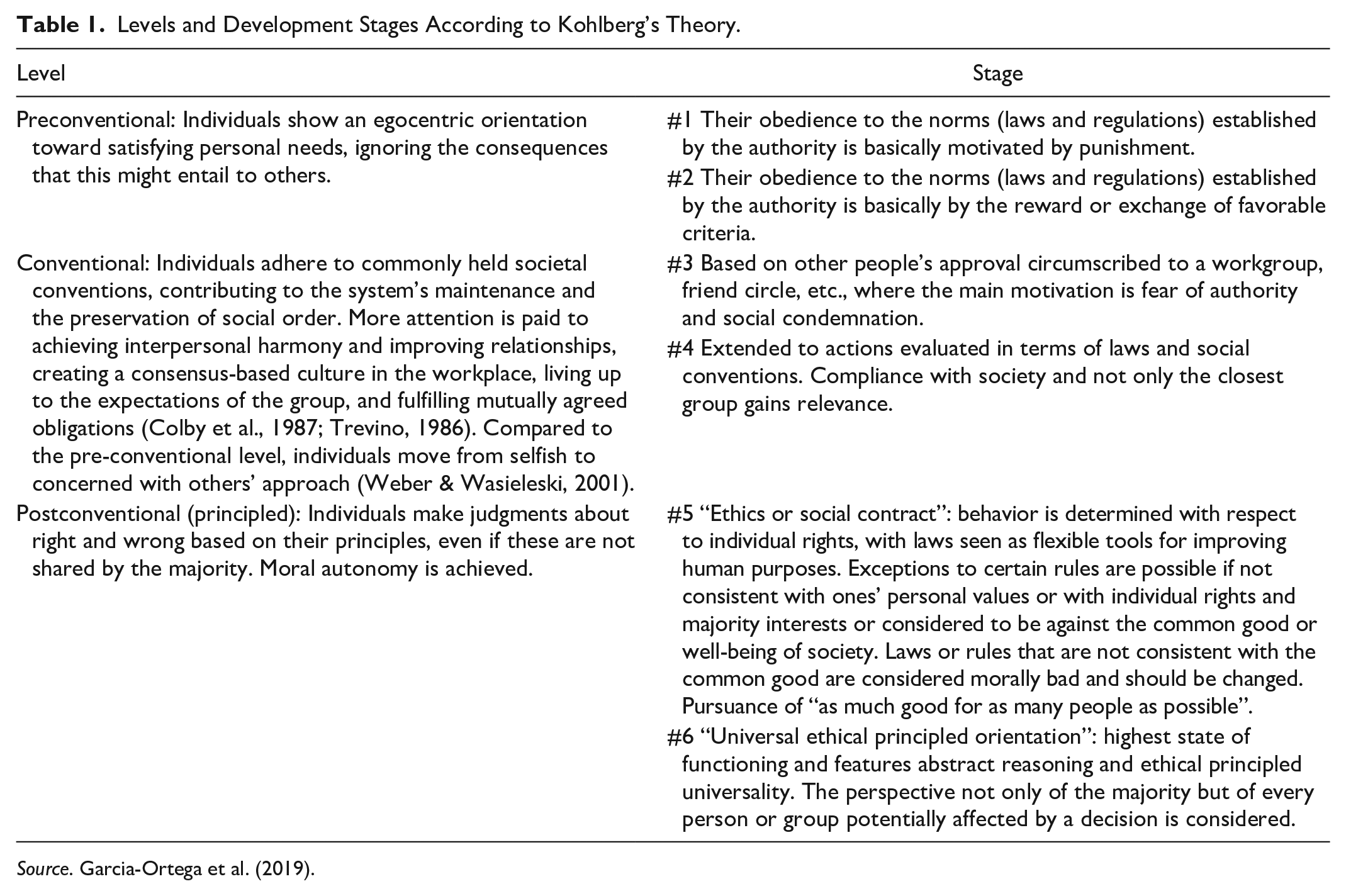
Source. Garcia-Ortega et al. (2019).
Besides, the different stages of moral reasoning should be regarded as cumulative sets of governance tools not mutually exclusive, developed as a manager attains higher stages (Caniëls et al., 2012), with lower stages prone to complement higher ones (Spraggon & Bodolica, 2015).
Kohlberg’s theory is one of the most widely appraised and recognized theories of its realm (Belgasem-Hussain & Hussaien, 2020), not exempt from criticism (Carpendale, 2000; Gilligan, 1977, 1982; Harkness et al., 1981), which in turn helped to its further enhancement (Colby et al., 1987). Many scholars have shown the interest of this theory by relating the managerial performance with their moral development (McCauley et al., 2006; Peterson & Seligman, 2004), by identifying a more responsible, consistent, and predictable moral behavior for people at higher stages of moral reasoning (Crain, 2015), or as a predictor of potential business dysfunctions and scandals (Garcia-Ortega et al., 2019). In fact, a series of works have relied on this theory in the last years from different approaches and purposes, many of them in the business and managerial context (i.e., Belgasem-Hussain & Hussaien, 2020; Chavez, 2003; Daniels, 2009; Doyle et al., 2013; Franklin, 2010; Galla, 2007; Garcia-Ortega et al., 2019; Hoover, 2010; Hyppolite, 2004; Kipper, 2017; Lin & Ho, 2009; Morilly, 2013; Weber & Elm, 2018; Weber, 2010).
Weber (1991) adapted Kohlberg’s theory to the business context with the aim of enhancing the predictability of managerial ethical behaviors. He empirically tested a method particularly devised for the measurement of a manager’s moral reasoning, dispensed with the unnecessary aspects that could hinder the achievement of results, and thus obtained and tested a simplified method without significant loss of reliability. This adaptation resulted in an abbreviated scoring guide to assess and categorize into Kohlberg’s stages the moral reasoning of managers through their written discourse, the so-called Weber’s method, adopted in their research by Weber (2010), Kipper (2017), or Garcia-Ortega et al. (2019). Table 2 presents this guidance for the manager’s moral reasoning stage assessment, enriched with further clues by Garcia-Ortega et al. (2019) and a further clarification by the authors based on Kohlberg’s theory to complete the indicators in stage #6.
Guidance for Stage Assessment of Moral Reasoning.
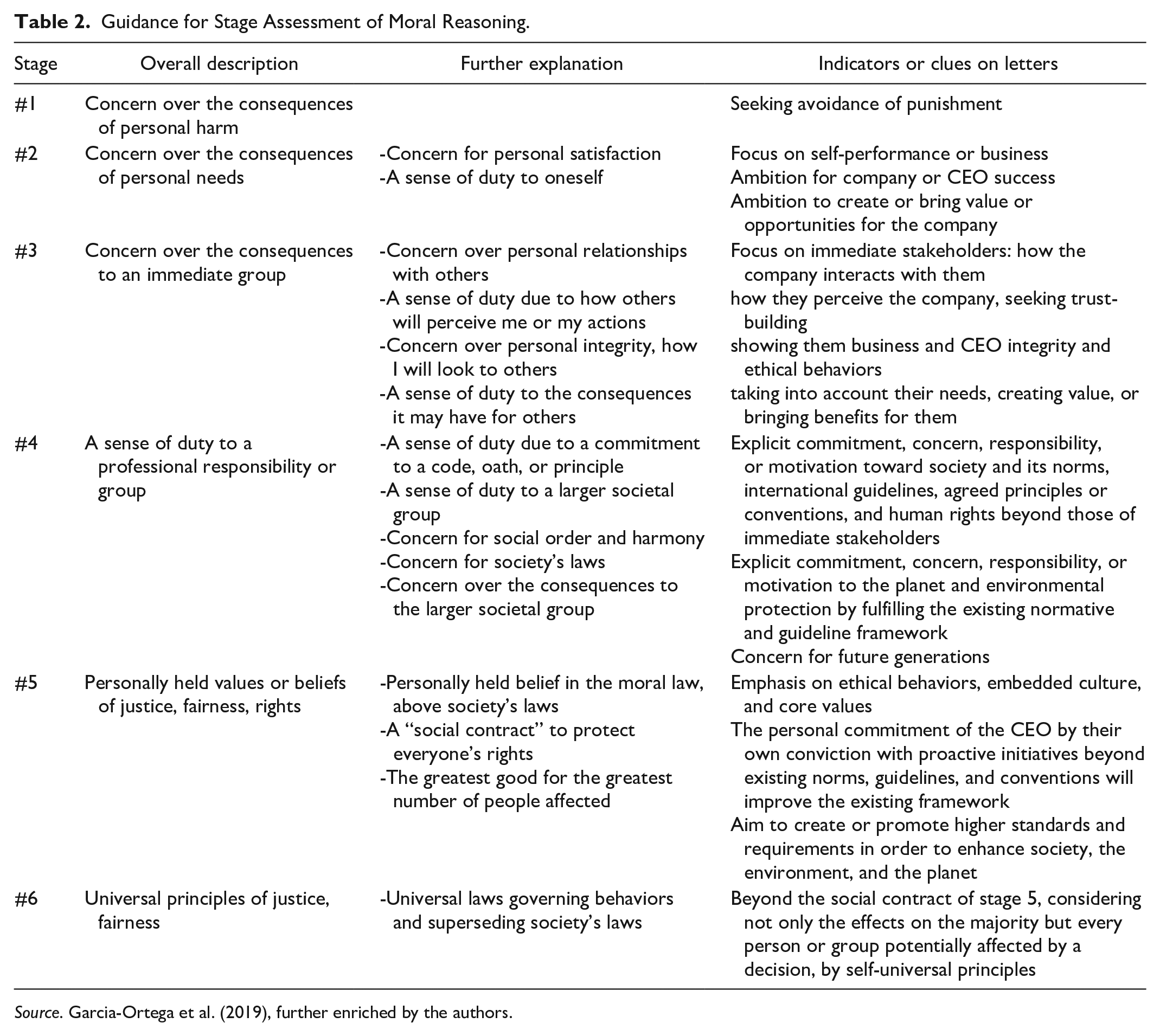
Source. Garcia-Ortega et al. (2019), further enriched by the authors.
The CEOs’ moral reasoning and their CSR approach
CSR embodies the moral obligation that business has with society (Swanson, 2008), which is strongly influenced by top-level managers (Waldman & Siegel, 2008). In this sense, moral leadership represents a key driving force for CSR (Swanson, 2008). Thus, behind the CSR approach, there can be varying motivations related to different stages of moral reasoning of senior management. Aguilera et al. (2007) classify these motivations into three main categories, related to some of the stages of moral reasoning of Kohlsberg’s theory. The first category of motivations is the self-interest or instrumental motivation for the own company benefit or survival, quite coincident with stage #2 of moral reasoning. The second category is at the relational level, aiming to benefit the relationships of the company with internal and external stakeholders, i.e., seeking for reputation, legitimacy, credibility, or trust toward a social license to operate (de-Miguel-Molina et al., 2019), linked to stages #3 and #4. The third category of motivations is the moral imperative to do what is right, for the good of society, which is more related to stages #5 and #6. These strategic and ethical motivations for CSR are usually combined, as shown by the shared value concept (Porter & Kramer, 2006).
The Concept of Moral Intensity and the COVID-19 Pandemic
Jones (1991) developed the issue-contingent model with the concept of moral intensity as a mediator in the stages of the moral decision-making process. Moral intensity, defined as the ‘extent of issue-related moral imperative in a situation” (Jones, 1991, p. 372), comprises a series of dimensions: magnitude of the consequences, temporal immediacy, social consensus, proximity, probability of effect, and concentration of effect. Subsequent studies found diverse degrees of correlations of these dimensions with the moral decision-making stages, with a certain coincidence to point to the social consensus as to the most influential one (Lincoln & Holmes, 2011). More recently, Schwartz (2016) enriched Jones’ theory with further contributions, among them two more components affecting the moral decision-making process: issue importance and issue complexity, which could be, on the other hand, negative mediators, causing for example a kind of “moral paralysis” (Schwartz, 2016).
Regardless of the components and dimensions found more or less influential in literature, a disaster of the proportions we are living with the COVID-19 pandemic and its immediate consequences represents a scenario of high moral intensity, importance, and complexity for businesses for obvious reasons: the scale of the sanitary and economic crisis and its immediate and global consequences, with many lives lost and many others at risk, lots of families and businesses struggling or even going bankrupt (He & Harris, 2020), the likely higher societal expectations (Manuel & Herron, 2020), the uncertainty and lack of previous experience on handling this catastrophe and a long etcetera. At the same time, the pandemic represents an opportunity for businesses to rethink their CSR approach (He & Harris, 2020), perhaps boosted by an enhancement in the moral reasoning of their senior management brought about by this high moral-intensity scenario.
Research Questions
All in all, assessing the moral reasoning of CEOs of top companies through their discourse is found of particular interest as a shaper of mindsets, values, and behaviors across their organizations and also among their peers, external stakeholders, and society as a whole, as a tool to predict their moral behaviors and decision-making and those of their followers leading to right or wrong decision-making, and ultimately, as a key factor in a company’s performance, success, failure, or collapse, as a predictor of future scandals, or even global crisis.
On top of that, the relevance of the moral reasoning of CEOs of top companies is even more accentuated nowadays in the complex and critical scenario we are living in, in a high moral-intensity context. Such context might (or might not) have an overall effect on the moral reasoning and mediate in the entire moral decision-making process, which in turn may influence the CSR and general business approach through various motivations. In this context, the automotive industry represents a case of particular interest for this research, having to deal with the urgency to respond to society emergencies and financial constraints in the short-term caused by the pandemic, while at the same time is immersed in an unprecedented transformation with huge environmental and societal challenges which require a long-term approach instead.
Considering all the above, and to the best of our knowledge, there is no work in the literature addressing the potential influence of such high moral-intensity scenario over the moral reasoning of CEOs, their CSR approach, and the possible correspondence among them for any industry, including the automotive industry in particular. Hence, we find of deep interest to put the following research questions:
RQ1. Is the pandemic actually giving a new impulse to the top CEOs in the automotive industry toward the principled level of moral reasoning?
RQ2. Are CEOs addressing specific CSR initiatives in response to the crisis in their discourse? Is there a correspondence with a change in their moral reasoning?
RQ3. After the pandemic outbreak, are CEOs presenting a relevant change in their long-term CSR approach? Is there a correspondence with a change in their moral reasoning?
Considering the CEO letters as a valuable source to address these questions, we will assess the moral reasoning underlying the discourse of CEOs in their letters and how they refer to their CSR initiatives and plans right before and after the pandemic outbreak. In the next section, we describe the data and methodology followed for such an aim.
Data and Methodology
This section describes the data and assessment process followed in order to answer our research questions.
Data
For our research, we selected the same sample of Garcia-Ortega et al. (2019), with the top 15 automotive companies in terms of vehicle production during 2017 (Table 3), being the latest updated classification published by the International Organization of Motor Vehicle Manufacturers, comprehending firms from Europe, America, and Asia, all of these companies being global players. During our research time frame, some of these companies have just merged or are in the process of, but they still kept separated structures and governance and continue to be among the top largest vehicle producers worldwide. Hence, we adhered to this classification, which in turn allowed us to take advantage of the previous research outcome on the same database and get a broader perspective.
Ranking of Companies Involved in Vehicle Production Worldwide in 2017.

Source. OICA—International Organization of Motor Vehicle Manufacturers.
FCA + PSA merged into Stellantis during 2020.
The data source consisted of the introductory messages of the top management, either of the CEO or the chairman or president in their absence, in the form of letters or statements which have clear authorship, included in the annual reports of the 15 companies listed in Table 3. These reports are publicly available on their websites, which jointly or separately cover financial, social, and environmental issues.
In particular, we analyzed what we call pre-covid and post-covid letters, meaning respectively the letter or statement issued in the latest annual report published before the pandemic outbreak declaration by the World Health Organization on March 11, 2020, and the letter or statement issued in the first annual report published right after. Pre-covid letters are thus those included in the annual reports published either during 2019 or before March 2020, and post-covid letters are those included in the annual reports published end of March 2020 onwards. In some of the annual reports, the exact date is not stated, but their classification was evident by its reference or not to the pandemic.
Assessment Methodology
For the moral reasoning assessment of selected letters, we adopted Kohlberg’s stages of moral development theory (Colby et al., 1987) further adapted to the business context by Weber (1991), presented in our literature discussion. We applied a qualitative and interpretive approach based on the cycle’s “individual deep review plus joint-discussion confirmatory analysis.” The individual approach of each of the authors with diverse backgrounds granted various perspectives which enriched the interpretive process.
The coding categorization was carried out in several steps, combining the criteria of Weber (1991, 2010), Krippendorff (2018), and Garcia-Ortega et al. (2019). Firstly, from our systematic reading of letters, we prepared a matrix in which the rows gathered the contents of each letter grouped in sentences or paragraphs collecting the same idea, and the columns contained a list with the indicators for detecting the stages in those letters, according to Table 2. In a second step, each of the authors individually identified each of the indicators found in each letter in the matrix. Then, the individual coding results from each author were jointly compared and contrasted again by the three authors to ensure both reliability and validity, so there was a final coincidence at the stage/s identification (Krippendorff, 2018). In order to award a final letter score, the letter assessment was carried out by weighing the assembly of contents categorization of our first approach, shaped with an integrated assessment of the whole letter with the aim to sense overall CEO communicative intentions (Sznajder & Giménez-Moreno, 2016) and moral tone. Through a close reading technique (Amernic & Craig, 2006), we considered the overall rhetoric, the reiteration or emphasis on certain ideas or messages, the actual meaning beyond mottos or slogans, or to which extent certain reasonings could undermine others (Garcia-Ortega et al., 2019). Again, this overall assessment of each letter was carried out in two steps, individual plus collective assessment, sharing and discussing separate findings and complementing each other’s views to finally reach a consensual final stage/s categorization, with some illustrative examples shown in Table 4. This qualitative and interpretive assessment is surely subject to bias, but since our primary aim was to find out any shift in moral reasoning, we granted the adequacy of such comparison by applying the same methodology and criteria to the different letters.
Examples of Moral Reasoning Assessment Carried Out on CEO Letters.
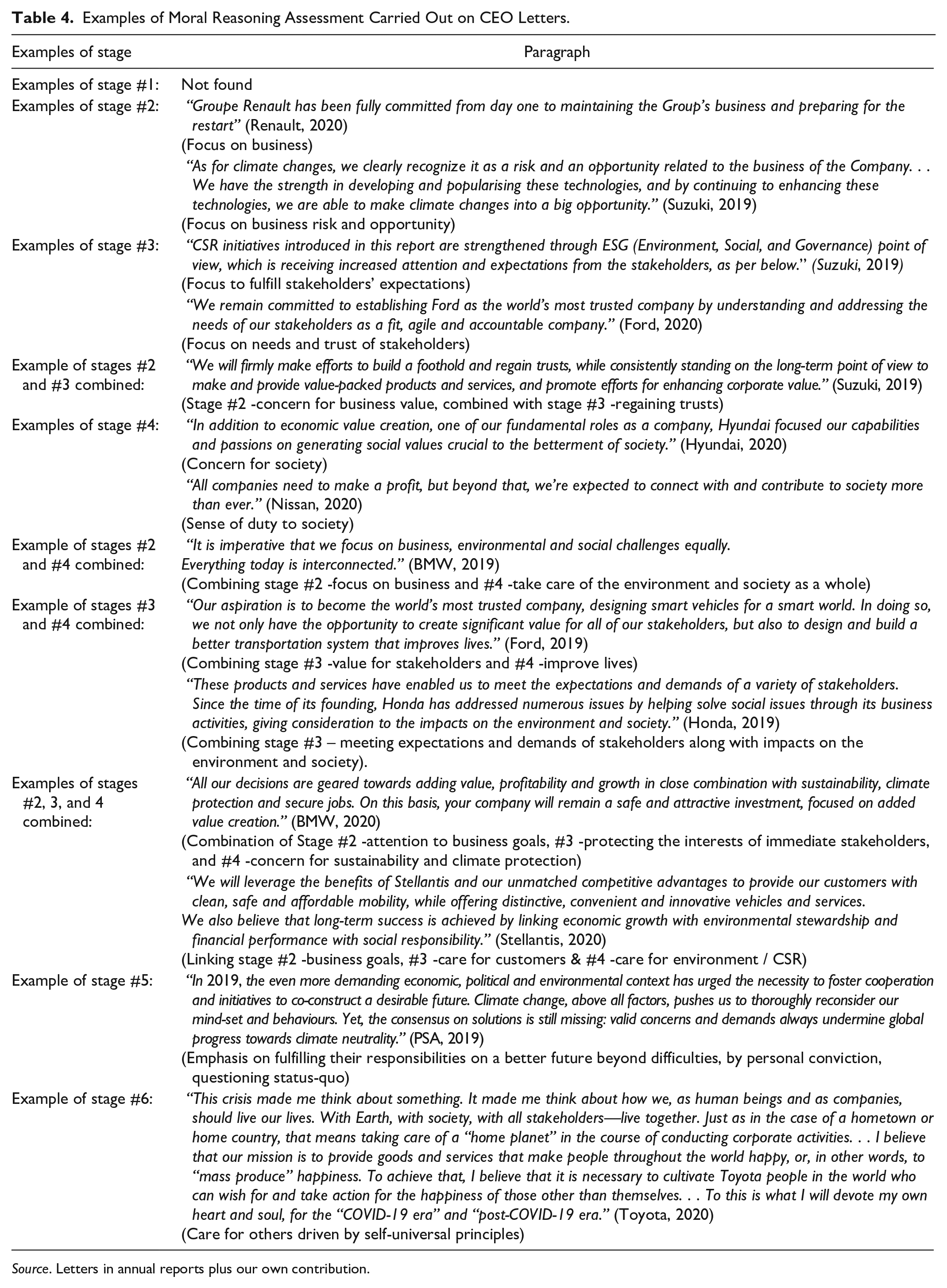
Source. Letters in annual reports plus our own contribution.
Moreover, we directly identified and classified the contents in the letters in relation to the specific CSR initiatives addressed by the CEOs in response to the crisis as well as those concerning their CSR long-term approach.
Results and Discussion
We open this section by listing in Table 5 the results of our assessment of the letters in relation to their moral reasoning before and after the pandemic outbreak (columns 2019 and 2020), with examples already given in Table 4, including the results from Garcia-Ortega et al. (2019) (columns 2015–2018) to get a more comprehensive picture of the evolution over the previous 5 years.
Summary of CEOs and Other Top Executives Signing the Letters With Stage Categorization.
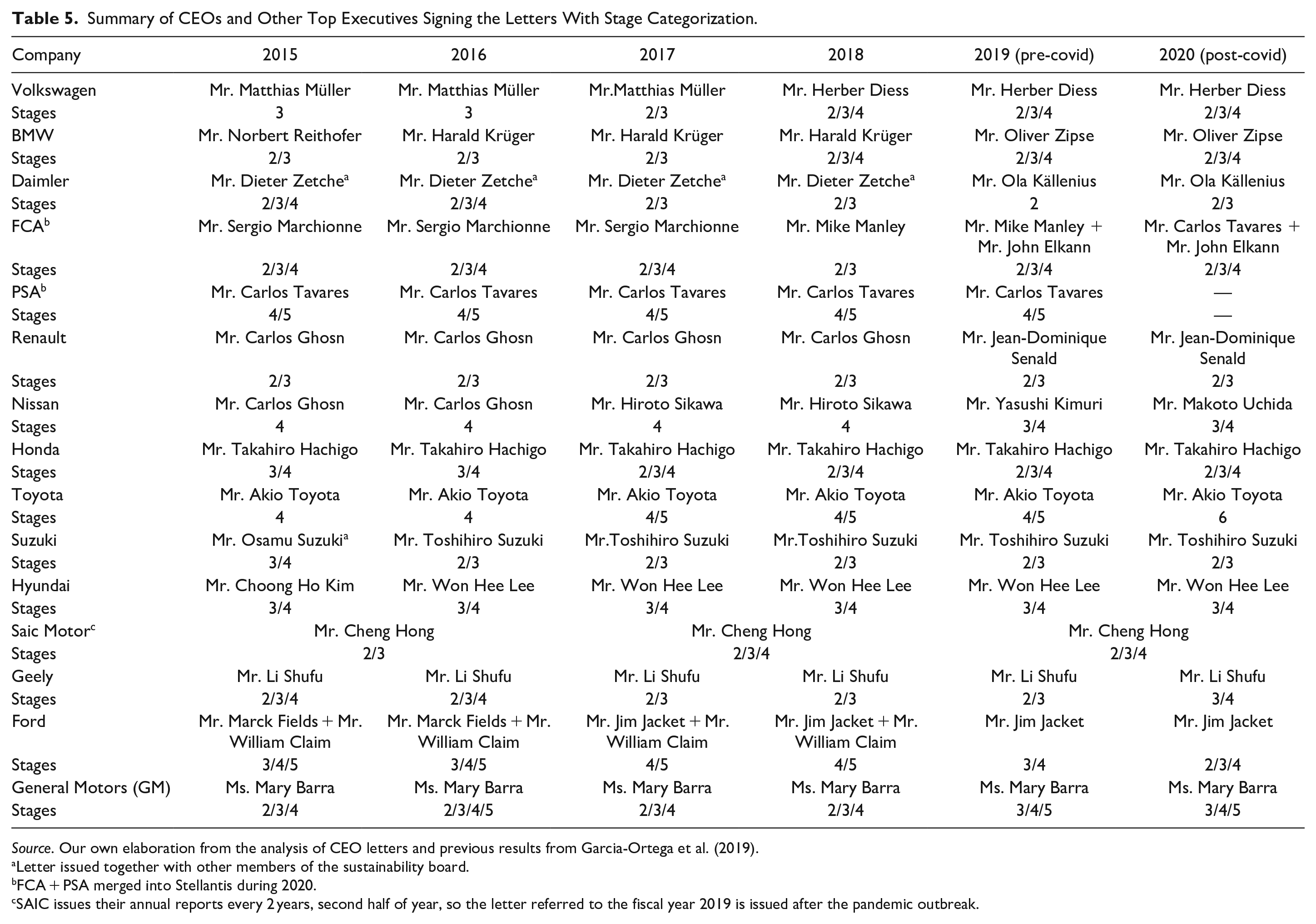
Source. Our own elaboration from the analysis of CEO letters and previous results from Garcia-Ortega et al. (2019).
Letter issued together with other members of the sustainability board.
FCA + PSA merged into Stellantis during 2020.
SAIC issues their annual reports every 2 years, second half of year, so the letter referred to the fiscal year 2019 is issued after the pandemic outbreak.
Additionally, we hereunder provide some extracts of letters in relation to our RQ2, showing examples of philanthropic actions highlighted by some CEOs after the COVID-19 outbreak:
The commitment and solidarity FCA’s people have shown when providing much needed assistance around the world – building two fully equipped field hospitals in Brazil and one in Argentina; making and repairing ventilators; Producing face masks and face shields, with a daily production of some 23 million masks in Italy; providing vehicles and ambulances to first responders; and donating over 15 million meals to school-age children to help end childhood hunger in the United States – is a true testament to their extraordinary spirit, courage and perseverance. (Stellantis, 2020) Our efforts in education are just one part of our wider corporate social responsibility. This year, for example, Geely Holding Group partnered with the Li Shufu Charity Foundation, to continue promoting the Geely “Timely Rain” project, targeted poverty alleviation project. Over the past five years, Geely has invested more than 680 million RMB (104 million USD) to help impoverished families across ten 10 provinces and 20 regions throughout China. More than 30,000 households were lifted out of poverty with our assistance. Geely Holding Group also set up a special 200 million RMB (30 million USD) fund specifically to help fight the covid-19 pandemic and will continue to support recovery efforts both in China and globally. (Geely, 2020) As COVID-19 infections spread, many monozukuri companies have started to produce medical face shields and protective gowns, as well as masks and other items. We, too, are making medical face shields in the United States using 3D printers, and we have extended such efforts to other parts of the world, including in Japan and Europe. Furthermore, when it comes to items that we cannot produce on our own, such as ventilators, we are providing support by applying TPS to improve productivity. (Toyota, 2020)
And herewith some illustrative extracts in relation to our RQ3 from CEOs referring to a relevant change in their overall CSR approach after the COVID-19 outbreak as follows:
At the same time, the Board of Management made far-reaching decisions and significantly stepped up the pace of transformation at the BMW Group. (BMW, 2020) In response to the threat of climate change and urgency to do more and act faster, we have established new targets to accelerate our sustainability goals, detailed throughout this report. (General Motors, 2020)
Thus, in Table 6, we compile the main outcome of our assessment in relation to our three research questions discussed in the next subsections.
Compilation of Results in Relation to Our Research Questions.

Source. Own elaboration from the analysis of CEO letters.
FCA + PSA merged into Stellantis during 2020.
Discussion in Relation to Our RQ1
As a first outcome of our assessment, we find as an answer to our RQ1 that the top CEOs in the automotive industry mostly stay at the conventional level of moral reasoning through their letters, with a quite stable level over the last years, with no big changes. Three of them only reach stage #3 (concern over the consequences to immediate stakeholders), and just two of them attain and keep the principled level, leaning on their personally held values or beliefs.
After the pandemic outbreak, the CEOs in our sample still rarely reason through their letters at a principled level. That implies that they are not questioning the existing status-quo and rules by an explicit self-moral conviction, nor fostering greater momentum across and beyond their industry to address the problems and challenges of our society more proactively. A possible explanation is that the present crisis severely hitting the sector with a drastic reduction in sales, combined with the already strict regulations and ongoing deep transformation, limits the room for maneuver for CEOs, who have had more than enough striving to follow existing targets.
Two of our CEOs appear indeed to take a step forward in their moral reasoning after the pandemic outbreak. Geely’s CEO, yet at the conventional level, reaches stage #4, while Toyota’s CEO attains stage #6, the highest one on the moral reasoning ladder, explicitly reacting to the COVID-19. Moreover, Garcia-Ortega et al. (2019) found that in front of a company scandal, CEOs neither adopted a principled level through their discourse in response, and they just tended to address more attention to stakeholders (stage #3). This is also the case of Daimler’s CEO under this exogenous crisis. Thus, the top CEOs in the automotive industry are not prone to adopting a principled level in front of a crisis, whether it has internal or external causes.
Besides, Ford’s CEO shifts to moral reasoning more present at stage #2 after the pandemic outbreak, probably influenced by the crisis context, and with the only exception of Geely’s CEO, they all keep or reinforce their existing focus on business economic performance and survival.
We also have the case of the PSA and FCA merge consolidated during the pandemic, where two of their former top managers jointly issued their letter after the pandemic outbreak, the first one coming from stages #4 to 5 and the second one from stages #2 to 3 to 4. As a result, stage #5 is abandoned, and thus in this particular case, the crisis does not boost a higher moral response either.
Discussion in Relation to Our RQ2
Regarding our RQ2, in response to the crisis, as collected in Table 6, we find that in half of the cases CEOs explicitly refer to initiatives of philanthropic nature, mostly sanitary material donations and production of ventilators or protection equipment or support for it, and in some case monetary donations to address the problems of the most vulnerable or more affected collectives. Moreover, four of them explicitly allude to ensuring safe and healthy working conditions, as the other main group of initiatives found in reaction to the crisis. Remarkably, six CEOs do not include any comment to on such responses in their discourse.
CEOs reaching at least stage #4 are significantly more likely to refer to those initiatives, independently of the country or region, whereas none of the three cases staying at stages #2/3 after the pandemic address any of them in their letters. Regardless of whether their companies were actually more or less active in these philanthropic initiatives, this fact leads us to think that this is not in the main focus of attention or priorities of these CEOs (Amernic & Craig, 2006). In other words, showing a concern to comply with a wider group of stakeholders and society at large is a positive sign in relation to how CEOs will push their companies to react in front of external contingencies, and it shows as well how the assessment of moral reasoning of CEOs may be one indicator to predict the reaction of a company in front of contingencies. Moreover, the two CEOs attaining stage #5 do emphasize these initiatives as a sign that moral reasoning stages above #3 favor the attention or relevance given by CEOs to these positive responses.
Following Aguilera et al. (2007) classification of motives to engage in CSR initiative, neither instrumental motives related to business performance (stage #2) nor relational motives linked to the closest groups (stage #3) are enough in our context for CEOs to highlight these philanthropic initiatives in response to the crisis. Rather relational motives beyond the closest groups of stakeholders, considering the needs of a wider group of stakeholders (Harrison et al., 2020) and society at a large (stage #4), and deontological motives or moral convictions (stages #5 and 6) lead our CEOs to give more explicit support or importance to them. In addition. the type of CSR reactions and some of their motives, with the consideration of a wider group of stakeholders, society at large, and the most vulnerable or affected collectives, regardless of their direct influence on business, are coincident with the findings of García-Sánchez and García-Sánchez (2020) and Manuel and Herron (2020) who addressed the case of Spanish companies and large international corporations mostly based in the USA respectively.
Discussion in Relation to Our RQ3
In recent years before the pandemic outbreak, several of our companies have renewed their top management, reoriented their business strategies, established new alliances or merges (i.e., FCA + PSA, Renault + Nissan), or even reconsidered their purpose, culture, and values (i.e., Ford or Nissan), to enhance competitiveness, to better face transformational and sustainability challenges ahead related to new technologies and new regulation framework, or in relation to recent scandals (Garcia-Ortega et al., 2019). Meanwhile, in line with the findings of Gatti and Seele (2015), and contrary to Matten and Moon (2008), within this specific sector, their CSR is found relatively uniform, independently of the country of origin, probably as a result of the existing global framework under the 2030 Agenda (United Nations, 2019).
After the pandemic outbreak, we find that three of our CEOs (BMW, Geely, and GM) talk about stepping up or accelerating efforts in their CSR goals and the required transformation. Two of these CEOs have either positively evolved their moral reasoning (Geely) or are reasoning at high stages (General Motors), and none of them are at the bottom of the ranking. Thus, a certain correlation with their moral reasoning is also observed.
Another group of CEOs at various stages of moral reasoning below the principled level pay special attention to ensuring the viability of their companies by increasing efficiency or reducing costs (Volkswagen, Daimler, Renault, Nissan, or Ford). In some cases, they follow the logic to keep supporting their CSR initiatives, but no one backs down on their CSR goals, probably also because they have no other choice but fulfilling the 2030 Agenda and new regulation framework.
Thus, beyond the contingent response of companies in front of immediate emergencies, no significant changes for better or worse in their CSR approach or essence are found. CEOs insist -despite the economic crisis—on the need to persevere in the existing CSR plans and keep existing targets mainly governed by the Sustainable Development Goals (SDGs) within the 2030 Agenda. This continuity at CSR plans is consistent with the dominant stable level of moral reasoning.
Conclusions
This paper is aimed to assess whether and to which extent the COVID-19 pandemic, which represents a scenario of high moral intensity (Jones, 1991), is influencing the moral reasoning of top CEOs in the paradigmatic case of the automotive industry, and to investigate how this moral reasoning relates to their CSR response to the crisis and their CSR plans in the long run. It evidences at the same time the relevance of approaching CSR from the lens of moral reasoning, apart from its implications on the ethical decision-making process and overall ethical performance of companies (Garcia-Ortega et al., 2019; Weber, 2010). After carrying out a thorough revision of the literature to appraise the influence of CEOs, their role as a moral manager, their moral reasoning, and their CSR approach, as well as the concept of moral intensity in order to establish our research questions, we qualitatively examined and applied Weber’s method to the CEO letters right before and after the COVID-19 outbreak for our purpose.
From our results, one of our main conclusions is that the present scenario of high moral intensity is not generally bringing a significant evolution—neither involution—in the moral reasoning of the CEOs in the automotive industry, mostly reasoning at the conventional level, where the issue importance and complexity may be causing a “moral paralysis” (Schwartz, 2016). This outcome is more aligned with Kohlberg’s cognitive development theory and somehow contradicts the issue-contingent model of Jones (1991). Besides, addressing the concept “tone into the top” introduced by Garcia-Ortega et al. (2019), the internal factors such as embedded culture and core values or scandals are more decisive than exogenous factors to influence the moral reasoning of CEOs.
Our assessment leads us also to infer that the positive reactions of these companies are more likely to be a transient response to the crisis in line with Gao and Hafsi (2017), rather than a substantial and sustained long-term improvement of their CSR rooted in a significant moral approach enhancement. This is indeed well reflected by the overall continuity of the CSR approach, along with the responses to the crisis with a philanthropic, non-structural, and short-term nature. This response is found, however, driven not only by the concern over the consequences to the immediate groups (stage #3), like customers, shareholders, or employees, but also to the sense of duty to a broader group of stakeholders and to society at large, either to respond to rising expectations of stakeholders and society (stage #4), as argued by He and Harris (2020) and Manuel and Heron (2020), or by personal moral conviction of CEOs reasoning at the principled level (stages #5 and 6).
A more extended moral enhancement is possibly constrained by the industry and overall context, with already existing challenging targets to fulfill and the economic crisis ahead, which limits the revenues and available resources of companies, jeopardizing the capacity to set more ambitious CSR goals (de-Miguel-Molina et al., 2016).
Besides, we have provided further clues on the logic of moral reasoning assessment and its utility to predict the attitude of CEOs in front of an external crisis; for example, how CEOs reasoning at lower levels (stages #2 and 3) are less likely to highlight philanthropic initiatives in their discourse, and that higher stages of moral reasoning favor them. These clues can be of help for companies, their top management, and stakeholders to make more informed decisions.
In all, our research offers a picture of the moral reasoning of top CEOs in the automotive industry and unveils some relations with their CSR approach in the present scenario, while contributing to further complement and explain previous findings on CSR responses after COVID-19 from this moral reasoning perspective. In particular, as a main theoretical contribution, this research disputes the issue-contingent model of Jones (1991), with the moral reasoning of CEOs not prone to rapidly evolving even under such a unique and exceptional scenario. Additionally, this paper intends to further call the attention of the scientific community, businesses and their top management, stakeholders, and society to the relevance of addressing the moral reasoning of top management in large corporations and its practical implications.
Limitations and Future Scope of Research
The first limitation in our research is the only consideration of CEO letters in their communication. At the same time, literature highly appraises their significance, and it allows us to apply an existing, proven methodology and eliminate the bias of comparing other communication channels unevenly used by CEOs in time and form. Further research may, however, investigate different sources.
The second limitation is the qualitative nature of our assessment, which involves a degree of subjectivity and bias, mitigated by the separate assessment put in common by the three authors. Anyhow, since we intend to identify trends rather than obtaining accurate figures, we find our methodology suitable for our aim.
Thirdly, we have identified through our literature discussion the relation between moral reasoning and moral decision-making. However, CEOs might pretend to show in their interest high stages of moral reasoning (Dodd, 2003) in a kind of a moral washing (Alvesson & Einola, 2019), and thus, with a lack of correspondence with their moral decision-making or their behavior. Nonetheless, in our research, the predominant absence of a principled level of moral reasoning leads us to discard a great deal of it. Anyway, new research could further focus on this aspect.
Moreover, a longer time perspective will allow contrasting the further evolution of the moral reasoning of CEOs and their CSR initiatives.
Finally, considering that companies with higher revenues or in better economic position may be more prone to address their moral obligation to stakeholders and society and thus their CSR (de-Miguel-Molina et al., 2016; Swanson, 2008), and that the nature of the business may have an influence (Boutin-Dufresne & Savaria, 2004), future research could compare these results on the one hand with other industries also severely hit by the crisis, and, on the other hand, with industries not so affected or even benefitted by the situation, in order to assess whether industry context and available resources have indeed an influence on the moral reasoning of CEOs and their CSR approach in front of this crisis.
Footnotes
Acknowledgements
We are grateful for the means provided by our Department of Management to ease our research works.
Declaration of Conflicting Interests
The author(s) declared no potential conflicts of interest with respect to the research, authorship, and/or publication of this article.
Funding
The author(s) received no financial support for the research, authorship, and/or publication of this article.
