




Abstract
Aristotle argued that emotions should be controlled according to the principle of moderation to realize virtue (human excellence). This study examines moral education in Korea, which is grounded in the ethics of Aristotle and values reason in moral judgment. The advantages and disadvantages of specific approaches are analyzed by categorizing moral philosophy and moral psychology studies based on their focus: reason or other factors. The roles of reason, emotion, and intuition in moral judgment are presented as the “integrated approach to moral judgment” in education. The results show that elements such as reason, emotion, and intuition influence moral judgment and interact with each other, allowing actors to make moral judgments that suit the situation. Methods for future moral education are suggested by presenting different processes that an actor must undergo and by introducing how to train them for moral quandaries.
Several theories delineate the way people handle moral questions. The theory of virtue, the theoretical foundation of Korea’s current moral curriculum, is one of them. According to this theory, when people face a moral dilemma, they think of the virtues associated with the situation, grasp the right human manifestation of the virtue according to the context of the situation, and then translate it into action. Korean moral education has applied this theory to design a moral curriculum and produce moral textbooks. The moral curriculum selected virtues judged to be necessary by members of society as the contents of moral education. To implement this moral curriculum, moral textbooks then selected the core virtue(s) for each unit and organized four classes, namely, understanding the virtue(s), the moral behavior related to the virtue(s), the moral judgment related to the virtue(s), and the moral emotion related to the virtue(s) (Ministry of Education in the Republic of Korea, 2019, p. 96). The moral curriculum defines integration as the basic principle of education (Ministry of Education in the Republic of Korea, 2019), with integration referring to the cognitive aspect of character (the understanding of value and moral judgment) + the emotional aspect + the behavioral aspect = the moral person. This raises the following question: Is a moral human being a creation of the sum of these aspects or the organic interaction between them?
Aristotle (2015) suggested that if one feels any emotion in a moral dilemma, one must follow the principle of moderation, on which rational thinking is based, to properly express that emotion. While an emotional response without an organic interaction with other elements of the body may not be morally appropriate in the context of the situation, the same is true of a rational response. Reason and emotion are both subject to the possibility of error, which leads to the question of why the moral curriculum teaches morality from a reason-oriented perspective.
Recently, neuroscience has revealed certain mechanisms responsible for human development and behavior. According to Joaquin Fuster (2002), the cognitive function of the prefrontal lobe, the development of which continues into late adolescence and early adulthood, is to contribute to the intellectual maturity of organizing recognition and behavior into goal-oriented actions. Owing to this characteristic of the prefrontal lobe, teenagers, unlike adults, lack the ability to exert top-down cognitive control over impulsive behavior (Albert et al., 2013, p. 116). These studies show that students may not be accustomed to controlling their own behavior and thinking about moral laws and moral human form.
The intersection of neuroscience and morality is also reflected in recent research trends. With the critical consideration of the theory of virtue, research on emotions and intuition is actively being carried out, breaking away from the focus on reason. In studies of moral emotion, the philosophy of David Hume is being reexamined based on the research of a neurologist named Damasio (2005), who revealed that moral judgments based on pure rational thinking do not lead to morally correct behavior. Haidt’s (2013) social intuitionist model suggests that reasoning is a process of the rationalization of moral judgment, arguing that other factors play a role in moral judgment. This move is an attempt to break away from the rational focus and analyze other factors involved in moral judgment, thereby promoting a more comprehensive understanding of the process.
The meaning of the drivers of moral judgment is the main cause or operating mechanism involved in moral judgment. Thus, a rational-centered approach implies setting moral principles and applying them to moral questions by placing importance on reason and deliberation when making moral judgments. This study analyzes the theories of Aristotle, Immanuel Kant, and Lawrence Kohlberg in relation to this approach. By contrast, an element-oriented approach suggests the main use of anti-rational elements, such as an immediate reaction to a moral situation, in making moral judgments—in other words, making moral judgments based on intuition or a feeling. In this regard, this study analyzes the theories of David Hume, Richard Hare, Jonathan Haidt, and Sabine Roeser. It examines the theories concerning the rational-oriented approach for moral judgment and those that value factors other than reason as moral judgment drivers, investigating their significance and limitations, to present an integrated perspective of the drivers of moral judgment and identify ways to apply these principles meaningfully to moral education.
A Rationalist Approach to Moral Judgment
Theoretical Review and Implications
The first influential advocate of the rationalist approach was Aristotle, who was concerned with people managing their feelings while facing moral questions. He classified virtue, which is human excellence, into intellectual and ethical elements. “Excellence is a state of character in which function or nature can be consistently well realized” (Aristotle, Ethica Nicomachea, trans. 2015, p. 456). Nussbaum (1995), who defended Aristotle’s conception of human nature, also argued that beliefs related to what is human within human concepts and beliefs can solve the problem of being human, and what is worth trying in human life also provides answers to this question. The practical wisdom associated with ethical virtues in the rational aspects of human beings allows the expression of their irrational views that are associated with the desire to be moderated. If one realizes moderation based on practical wisdom and exercises moderation, according to Aristotle, their feelings are governed by reason. In the end, the standard of moral correctness is defined not as norms or principles but as the right human form. As Hursthouse (2010) argued, norms and principles are difficult to apply to specific contexts. Similarly, morally associated words and actions are examples of emotions that are appropriately expressed through reason, based on the principle of moderation, and serve as a kind of “guide to conduct” for the actor. Eventually, emotional expression should be judged by reason.
Another scholar who saw reason as the main driver of moral judgment was Kant; he stated that there is “unconditional good” in any situation and that the “good will” in humans is “unconditional good” (Kant, 1785, 2015, p. 123). Here, “good will” is a feature of the will to act in accordance with duty (Maeng Ju-man, 2011, pp. 39–41). Kant argued that actions driven by this tendency are not morally valuable and noted that (1) emotions may not be expressed when they should be expressed and vice versa and (2) there is only action to satisfy the tendency, without concern about what is really right for human beings to do (Kant, 1785, 2015, pp. 130–131). Therefore, Kant understood moral reason as the will to establish an absolutely universal basis of morality, excluding emotional elements (Maeng Ju-man, 2014, pp. 203–204). Based on this, he created a moral code called the “categorical imperative,” proposing that people should follow it because of its universality and inevitability. Universality and inevitability are attributes that can only be obtained through reason. Kant concluded that only the act judged by reason, not by human emotions or desires, was moral. Nevertheless, the implication of Kant’s theory is that the appropriateness of moral judgment should be understood by considering whether there are problems when the actor’s own decision is applied to everyone under specific circumstances.
Kohlberg advocated the theory of stages of moral development, stating that the principles of good will, conscience, and justice can be implemented in special forms with qualitative differences depending on the stage of the development of moral judgment (Kim Jin, 2013, pp. 75–76). Criticizing value relativists, Kohlberg hypothesized that there is no philosophically neutral starting point in psychological research on morality and argued that fundamental moral principles are universal based on a longitudinal study of moral ideas. In this regard, people refrain from copying or implementing unethical and dangerous behaviors to avoid inconsistencies and negative consequences with moral standards and social norms (Harman & Thomson, 1996). This suggests that people impose certain standards on themselves. If an action is wrong in our society but allowed in others, they face a situation where they have to give up their moral views, which raises the prospect of moral or ethical relativism (Craig, 1998). In response, MacIntyre (1994) argued that while exploration styles and principles may depend on tradition, the ultimate purpose of exploration, namely, “truth” in theory and “goodness” in behavior, transcends tradition. Therefore, Kohlberg sought to approach moral psychology based on moral philosophy to avoid committing a naturalist error (an error that elicits justification from facts; Kohlberg, 1981).
The Shortcomings of a Purely Rational Approach to Moral Judgment
If reason is the main driver of moral judgment, when a person is asked why they help the needy, they should give either of the following answers: “I’ve come to help the needy because it’s beneficial to the world if I think other people should help them” or “I’ve donated enough money to help the needy because I have a way to help them.” However, moral judgment drivers in the real world may be emotional rather than rational. In this regard, Blasi (1999), in his paper on emotional and moral synchronization, asked why people tend to choose behaviors not from moral consideration when they do moral things, but instead perform habitual and inconsistent behaviors.
In addition to reason and emotion, the human brain performs a function called automatic information processing, which refers to the process of solving problems by paying little conscious attention to them. In an experiment to verify Jefferson’s interactive model, Haidt (2013) found that people successfully made moral judgments regardless of the amount of cognitive information generated while performing their tasks. This is not necessarily done through a deliberative process; rather, it may be accomplished through automated information processing functions, which can be applied to moral judgments. This automatic information processing function is described in educational psychology as the concept of automation: the ability to perform mental manipulations without awareness or conscious effort (Eggen & Kauchak, 2012, p. 303).
Damasio (2005) conducted an experiment on a person with brain damage and found that their rational ability was intact, while their emotional ability was lost and hence they could not make decisions. In general, people choose and concentrate on multiple options because of an overload of information processing in the brain; however, the person with brain damage examined all options using conscious and verbal reasoning only (Damasio, 2017, pp. 75–99). This can be considered in two ways. First, unlike Kant’s thinking, emotion can be an important factor in judgment, which can also be applied to moral judgment. Second, emotion is not just a reaction but a function in which certain beliefs are inherent, and emotion as a “judge” makes selection and concentration easier in judgment. This automation is one way to reduce cognitive load (Eggen & Kauchak, 2012, p. 303). The view that values reason as a moral judgment driver requires people to determine whether an act is right or wrong on a universal basis, given the moral situation. However, this is a different requirement from the way the human brain processes information and there is a limit to applying it to the real world.
Why then is reason considered to be an element superior to emotion in Aristotle’s, Kant’s, and Kohlberg’s theories? Aristotle argued that unlike other beings, only humans possess the unique function of reason. Therefore, if humans are superior to all living things, then it follows that reason is superior to the many factors in life (Aristotle, trans. 2015, p. 30). Nevertheless, ethics based on epistemological beliefs and biology diminish the logic of the superiority of reason. However, as there is a lack of research on the three theories reviewed above, the premise of these reason-oriented theories is likely to be epistemological beliefs rather than research-based evidence.
An Approach That Values Elements Other Than Reason as Drivers of Moral Judgment
Theoretical Review and Implications
Hume (2011) considered it his duty to refute the presumed superiority of reason over emotion found throughout moral philosophy. First, reason is not a direct basis for action because it is used to reveal abstract relationships between ideas or the causes and effects of events and therefore does not deal with reality. As such, Hume argued that reason should be but a slave to emotion and not covet any duties other than serving and obeying emotions (cf. Kim Da-som, 2015, p. 56). In fact, emotional thinking exists in an actor’s emotional state; therefore, it is not true or false in itself, and it may or may not be consistent with any facts behind it. As such, although assistance from reason is needed, it does not reveal that an idea derived from an emotion is wrong, but it does correct a belief if the cause of the emotion is wrong. Moreover, he explored the nature of virtue and discovered that one characteristic of virtue was utilization. According to Arrington (1998), Hume emphasized that the utility of social virtues is their ability or inclination to benefit society as a whole and that people praise these virtues because the results positively affect the true interests of humankind. As such, Hume emphasized the role of emotion in moral judgment by refuting the superiority of reason; however, it is questionable whether the right understanding of the interaction between reason and emotion was preceded by the focus on refutation.
Despite the aforementioned limitation, the implications of Hume’s theory are as follows:
(1) In the real world, emotional judgments can be more effective than rational judgments, given the limitations of brain function
(2) Reason determines whether the emotion produced as a response to external stimuli is appropriate for the situation
(3) Moral judgments should benefit everyone based on compassion
Like Hume, Hare (2000) emphasized the role of emotions in moral judgment. He believed that the theory of exploring conditions of truth in language and intuition was caught in the trap of culture and that the regulation of moral statements with elements of cultural immutability could lead to consensus among cultures (Hare, 2017, pp. 218, 219). For reference, Kant argued the “categorical imperative” to “act only according to that maxim whereby you can at the same time will that it should become a universal law” (Kant, 1785/2015, p. 165). In response, Hare (2000) judged that the word “will” simply means that the rules of will should be logically consistent and pointed out that Kant’s order could create a case of compliance with evil rules. He also judged in Kant’s dictation that the word “can” means the psychological possibility and argued that if one does not get away with it within the rules, even bad rules can be sought to become a universal law. Therefore, he pointed out that if our rules are motivated by universal law, they should be allowed from the perspective of empathy, stating, “We must be motivated to ensure that our rules are followed by anyone [an actor] who is going to be in this state” (Hare, 2017, p. 222). As such, Hare emphasized the role of emotion, pointing out the problem of pursuing universality without empathy.
Haidt, meanwhile, emphasized the role of intuition in the process of moral judgment. He supported Jefferson’s head-heart model of morality, which states that, “Emotion and reasoning reach moral judgment through different paths” (Haidt, 2014, p. 85). He concluded that moral judgments are sufficiently reached by automatic processes (intuition or emotion) rather than the two-way interaction between emotion and reasoning (Haidt, 2014, p. 94). He also argued that judgment and justification are separate processes and stated that the basis for his argument is nothing more than post-justification. Furthermore, he understood cognition and emotion as methods of information processing rather than independent working parts and divided the cognitive process into intuition and inference, thereby developing the social intuitionist model (Haidt, 2014, pp. 104–106) shown in Figure 1.

Haidt’s social intuitionist model.
While it is theoretically possible to derive a judgment from an inference, we must note the following points (the numbers in this paragraph correspond to the numbers in Figure 1): (1) intuition is the main cause of moral judgment; (2) inference occurs after judgment and provides the basis for post-justification (Haidt, 2014, p. 104); (3) when people around us object to our judgment, we present various reasons and arguments, which can change our minds as we develop new intuition (Haidt, 2014, pp. 104–105); (4) simply realizing that others like or dislike someone constantly affects us. This factor is called social persuasion (Haidt, 2014, p. 106). (5) This is rarely possible in reality (Haidt, 2014, pp. 103–104); (6) we sometimes ponder over a problem on our own to form a new intuition and change our minds and this is a process of personal reflection (Haidt, 2014, p. 105).
Moreover, Haidt (2013) found that emotional reactions are so quick and powerful that it becomes less possible to use reason later. They also revealed that intuition carries out a mission similar to moral judgment from the time of infancy, long before language, and reasoning ability appear. Therefore, Haidt (2013) demonstrated one aspect of how people solve moral problems in their daily lives by studying intuition, which has been under-addressed in existing moral psychology and moral philosophy studies. In addition, this research reexamined the role of reason in moral judgment and showed that it is somewhat different from its role in the past.
Haidt’s (2013) theory has the following implications:
(1) Intuition is the main cause of moral judgment, with inference taking place after judgment and providing the basis for justification.
(2) Moral intuition plays an important role in the development of morality, appearing from the beginning of the human development process, whereas the ability to deduce develops much later. Moral reasoning in the absence of moral intuition can have serious consequences on moral judgment such as the judgment of a psychopath.
(3) People should not aggressively criticize the moral judgments of other people; otherwise, they may defend their actions and reject the criticism. Efforts to approach others in a favorable manner are more likely to lead to a humble acceptance of criticism.
Roeser (2011) tried to examine emotions and intuition in an integrated manner, stating that emotional intuition is a belief in itself that is not based on any other belief and is not judged. This emotional intuition has the following characteristics:
(1) The value of moral propositions does not depend on the psychological and physical states of the actor, but the judgment in moral perception is expressed by feeling, which comes from universal moral principles.
(2) Intuition is a basic moral belief justified in a non-inferential way, given that making an inference is better when rationalizing one’s interests than one’s duty and that some moral actors cannot make inferences. Basic moral beliefs can be erroneous. However, it is important to translate beliefs into action.
(3) Intuition is what people believe through objective and moral reality. Without objective standards, moral judgment is difficult and intuition is a belief rather than a concept; therefore, it is not prone to naturalistic error.
Roeser (2011) combined emotions with intuition to develop the theory of emotional intuitionism, which begins by reinterpreting the role and status of emotion. She viewed emotions as an intentional response to the beliefs of the actor and asserted that they would be focused on their judgment of the world, which is easily overlooked by pure reason. In other words, if one feels distressed, one judges that they have done wrong, and in this respect, moral feeling is to feel value judgment (Roeser, 2015, p. 217). These moral feelings attract reflective activities such as imagination (sympathy) that consider the positions of other people. This means that if reason and emotion both have the potential for error in terms of epistemology, people’s moral perspectives should be critically examined based on emotions. As such, Roeser recognized emotional intuition combined with moral feelings as the driver of moral judgment.
The Shortcomings of Purely Intuitive or Emotion-Based Approaches to Moral Judgment
Roeser claimed that not all beings are complete in terms of being both emotional and rational. This paper attempts to break away from the discussions on rational or emotional superiority and instead sheds light on the relationship between these two factors from a novel perspective. This is because the argument over which elements are superior in situations where neither reason nor emotion is complete hinders a detailed analysis of the interaction between these two factors. Therefore, in this paper, the author attempts to establish an integrated approach to moral judgment by focusing on the interaction between these two factors: reason and emotion.
To this end, this paper clarifies the limitations of the theories that value emotion and intuition as a moral judge. As mentioned above, the human brain has an automatic information processing function (cf. Eggen & Kauchak, 2012). Since it would be overloaded in trying to determine every aspect of a moral question in a logical manner, it uses intuition or emotion to judge a moral situation (right or wrong) immediately. Here, if a judgment is made through emotion and intuition, it reflects many previous rational judgments that the actor has experienced. After all, judgment by reason is a prerequisite for a moral judgment to be made through emotion and intuition. However, if there is a problem with the prerequisite, the automation function formed by the accumulation of these experiences will inevitably be problematic. This problem cannot be solved by emotions and intuition, but, as Hume (2011) argued, by reason. Except for Hume (2011), a clear explanation of the factors that assess the adequacy of intuition and emotion is lacking.
This is closely related to whether intuition and emotion are appropriate as moral judgment drivers. People may have different intuitions and feelings about a moral situation, thus prompting proponents of ethical relativism to argue that people should respect different ideas. However, as Kohlberg (1981) pointed out, not all ideas are acceptable to society. Therefore, a standard for making moral judgments is required, which must be universal if it is to be accepted from a deculturized perspective (e.g., Craig, 1998; Harman & Thomson, 1996; MacIntyre, 1994).
An actor’s perception of a moral situation is not simple. According to Rest (1994), moral sensibility is an awareness of how our actions affect others. It involves recognizing the various possible correct actions and how each action can affect others. In this situation, the actor needs a comprehensive review of the factors inherent in the event based on their own reasoning.
An Integrated Approach to Moral Judgment and Its Application to Moral Education
Blasi (1995) pointed to the discrepancy between moral judgment and behavior under Kohlberg’s theory, arguing that factors other than moral judgment (by reason) are engaged in moral conduct. Although people at a high stage of moral development are more consistent in their judgment than those at a lower level, the degree of connection is incomplete (by reason). Subsequently, Narvaez and Rest (1995) proposed a four-part model of morality in this context. In the study of moral psychology, various factors involved in moral judgment have been analyzed. However, given that these psychological attempts do not lead to moral education, this paper discusses the mechanisms through which reason, emotion, and intuition are involved in moral judgment to assist in designing an education approach based on them. In addition, Darnell et al. (2019) suggested the four-component model of phronesis, pointing out that the four-part model of morality presented by Narvaez and Rest (1995) is not moral in itself. This highlighted the limitations of social science analysis. From a moral psychology point of view, the analysis of moral behavior is nothing more than observing it and grasping its characteristics. However, as MacIntyre (2007) pointed out, virtue, which corresponds to the content of moral education, can be found in practice and only experienced by practicing. In addition, as Hursthouse (2010) argued, virtue is a behavior of moral humans derived from the comprehensive consideration of emotions as well as rational thoughts in a situation. In other words, we do not judge it moral to simply imitate moral characteristics. We are beings who make optimal judgments by considering various factors in the situation we face. Therefore, to integrate moral judgment drivers, we must not only present human psychological processes, but also think about how these processes can be harmonized with virtue, which is the content covered in moral education (cf. Kohlberg, 1981). To this end, it is necessary to first look at Hare’s two-level theory of moral reasons. He categorized moral reasons into intuitive and critical levels. People adopt general principles to be used at the intuitive level by making moral reasons at this level and by evaluating, rejecting, and modifying intuitive principles at the critical level (Hare, 2017, pp. 233–246).
Based on Hare’s (2000) two-level theory of moral reason, one can think of moral judgments by dividing them into “routine” and “reflective” judgments. He defined the critical level as a judgment made by reflecting on whether the criteria used at the intuitive level are correct. However, it is clear that reason is involved in moral judgments because judgments are made through reasoning, as Haidt (2013) pointed out, and people become less impulsive as their frontal lobes develop, which influences behavior and leads their thinking to become more goal-oriented, as Fuster (2002) mentioned. Reason and emotion must interact because if moral judgments are made purely by reason, they can never produce the right results, as Hare (2000) and Damasio (2005) pointed out. Thus, moral judgments can be classified as those made through emotion and intuition, on the one hand, and those made through reason and emotion, on the other. People tend to react immediately in easy and simple moral situations, and according to Haidt (2013) and Roeser (2011), these immediate reactions are produced by emotion and intuition. Meanwhile, in difficult and complex moral situations, problems are solved through the interaction of reason and emotion. The standard for categorizing moral situations into easy and simple versus difficult and complex is the level of difficulty felt by the actor themselves. As Eggen and Kauchak (2008) claimed, the human brain’s automatic information processing function tends to automate the processes that it has frequently performed in the past. In other words, if moral judgments were previously made based on logical thinking, they are now made through automatic information processing.
However, it is erroneous to think that routine moral judgment occurs through emotion and intuition, meaning that there is no logical thinking in routine moral judgment. As explained earlier, the human brain uses automatic information processing to increase efficiency. If moral judgments about a situation are produced by the automatic information processing function, this is because moral judgments have been made through logical thinking in advance of the situation. However, no matter how many times moral judgment has been made and no matter how automatic its information processing function has been, an actor needs to continue to improve their moral judgments through reflective thinking, as Hare (2000) argued. In this regard, routine moral judgment risks falling into value relativism because it varies from person to person, as Kohlberg (1981) argued that not all ideas can be allowed.
If moral education aims to increase the effectiveness of an actor’s routine moral judgment by efficiently applying reflective moral judgment to routine moral judgment, moral education should specifically present to the actor what they should do in reflective moral judgment. Reflective moral judgment is used to judge whether routine moral judgment is appropriate in light of the situation, especially when an actor faces difficult and complex moral situations in the real world. Before this judgment is made, the actor should accurately analyze the situation as per the following processes:
(1) Think about who made one feel morally uncomfortable or who is morally uncomfortable with one’s words and actions.
(2) Analyze the other person’s words and actions and the reasons why they feel morally uncomfortable in the situation based on the given conditions or think about their words and actions that may have made others uncomfortable. In this regard, Maxwell and Reichenbach (2006) argued that the adoption of perspectives is not of moral value in itself, but it cannot be fully understood without reference to emotions as a tool of moral education. Moreover, according to Hoffman (2000), moral feelings create sentiments such as guilt and shame through the anticipation of harming others, serving as a counterweight to motives toward harmful intentions. Furthermore, moral feelings synchronize behaviors to alleviate expected pain (Batson, 1991; Davis, 1994; Eisenberg & Miller, 1987a, 1987b).
(3) Think morally correct words and actions based on the reasons one’s their thoughts. This is because as Hume (2011) stated, moral judgment is based on emotional reactions such as pain and pleasure; moreover, as Mayer (2004) mentioned, there is a lot of information in an actor’s emotions. In addition, Hare (2000) and Roeser (2011) clarified that in dealing with these emotions, moral judgment requires representation. Indeed, the right human in a moral act chooses their own words and actions while thinking about how to speak and act (Aristotle, 2015).
The rationale behind why not only reason but also emotion should be involved in moral judgment is that as Roeser (2011) said, there is a possibility of error in both reason and emotion. Sherman (1990) noted that thoughts often expressed in informal language can help emotions distort moral judgment. Therefore, the appropriateness of emotional responses is a subject that should be evaluated in terms of publicly available criteria of judgment, with a focus on practical wisdom considered as facts (Maxwell & Reichenbach, 2005). Thus, to make reflective moral judgments, an actor should use both the following criteria:
(1) As mentioned by Hare (2000), imagine that the words and actions one chooses make others feel better. This process is a way to move closer to what a moral human being says and does. The way to develop sympathy is by imagination, which is incorporated in exercises that consider other people’s views, and empathizing with these views is made possible through indirect identification, namely, exercises that diverge from self-centered thinking (Greene, 1995; Noddings, 1998; Nussbaum, 2003).
(2) Imagine how society would work if the words and actions one chooses, as mentioned by Hume (2011), are used by everyone in society.
Item (1) above refers to moral imagination in one’s relationships with others and (2) is moral imagination in one’s relationship with the community. Item (1) is a form of concrete imagination from the actor’s perspective compared with item (2), and this type of imagination simplifies sympathizing from the actor’s perspective because it is encountered in everyday life. Item (2) can be developed only when enough of item (1) is performed, but it helps broaden the scope of the application of routine moral judgments. Ultimately, moral judgment is correct only when the results of items (1) and (2) are positive. This can also be applied to difficult and complex moral situations. However, if the actor has enough experience in reflective moral judgment through their repeated encounters with certain situations, their brain will encourage them to engage in routine moral judgment in similar situations. At this point, imitation can help an actor with what they should do morally. Imitation is an educational strategy that guides emotions toward the normative criteria for appropriate emotional responses in a series of situations (Maxwell & Reichenbach, 2006); it is a habitual process that allows the voluntary expression of appropriate emotional responses (Steutel & Spiecker, 2004). Figure 2 presents the integrated approach to moral judgment based on previous research.

An integrated approach to moral judgment.
Based on this integrated approach to moral judgment, the composition of units and contents of classes by time are shown in Figure 3.
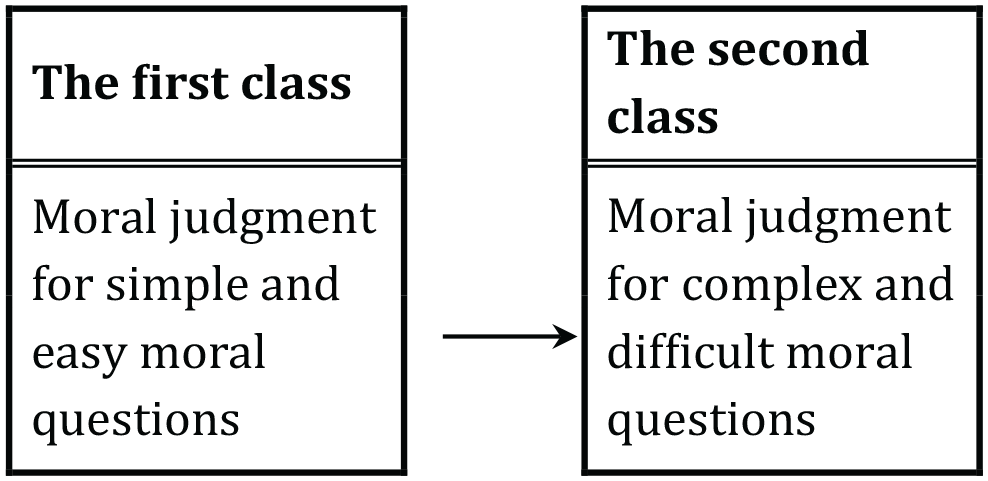
Composition of the classes based on an integrated approach to moral judgment.
In Korean moral textbooks, the drivers of moral judgment are largely divided into four categories—concepts, judgments, feelings, and behavior—focusing on one driver per class. This is a segmented approach to understanding moral judgment drivers, where students can make in-depth explorations of a single driver; however, in such a class, it is difficult to grasp the interaction between the drivers. The class composition described above is meaningful because when people face moral situations, various drivers involved in moral judgment interact, and the brain function operates differently depending on the level of difficulty of each moral situation. Table 1 shows the course procedure for each hour.
Contents of the Classes Based on the Integrated Approach to Moral Judgment.(a) First class: Moral judgment for easy and simple moral questions.

(b) Second class: Moral judgment for difficult and complex moral questions.

In conclusion, the two main implications of the integrated approach to moral judgment and moral classes based on this are as follows. First, Aristotle mentioned the following characteristic of virtues: To feel them at the right times, with reference to the right objects, toward the right people, with the right motive, and in the right way, is what is both intermediate and best (Aristotle, The Nicomachean Ethics, trans. 2009, p. 30). In other words, actors must consider numerous factors to make the optimal decision in the situation and decisions made by comprehensively considering these factors as well as the actions resulting from them are recognized as moral actions. Kristjánsson (2015) and Curzer (2012) also mentioned these features of practical wisdom as the constitutive function and integrative function. Although Aristotle viewed emotion as subject to reason, emotions should also be seen as a factor determining the situation from a standpoint equal to reason, as Hursthouse (2010) pointed out; this has also been confirmed in the theories of Hume (2011), Hare (2000), and Roeser (2011). The problem is that virtue is the content of Korean moral education. Ultimately, moral behavior is not simply performed by learning the components of moral human beings and their functions in a fractional manner, but by understanding and practicing how the components of moral humans interact in moral situations. In this respect, the integrated approach to moral judgment and moral classes based on this can promote an understanding of the psychological processes an actor should pass through in a moral situation.
Second, Weinert (1999) pointed out that the higher general knowledge and function, the less specific contributions they make in various situations and when solving problems in a specific or difficult context. The integrated approach to moral judgment and moral classes based on this provide students with actual moral problems and guide them to practice the psychological processes to pass through for moral behavior in these situations. By doing so, students can divide actual moral problems into easy and simple, on the one hand, and difficult and complex, on the other and act according to the difficulty level.
Conclusion
This paper discussed the moral judgment drivers dealt with in the moral education curriculum in South Korea and presented an integrated approach that can be applied to the education field. If the moral judgment driver is limited to reason, this creates a sense of distance from the real world, where moral judgment drivers are often emotions, similar to how the human brain processes information. Emphasizing the superiority of reason without providing any evidence that reason is superior to emotion is an epistemological assumption.
Despite its limitations, this work derived the following conclusions:
(1) The standard of moral right can be defined as the right human form.
(2) In reflecting on moral judgment, the appropriateness of moral feelings should be judged through reason.
(3) Moral judgments should be based on the circum-stances.
(4) Under certain circumstances, it is important to consider whether problems occur when an actor’s decision is applied to everyone.
(5) Universal ethics must exist.
(6) There should be a complementary relationship between moral psychology and moral philosophy.
In addition, from the examination of theories that seek to identify moral judgment drivers in factors other than reason, the following observations were made. These theories fail to identify factors to determine the appropriateness of intuition and emotion and thus have the potential to fall into an ethical relativist perspective and reveal limitations in prioritizing events in complex real situations.
Meanwhile, the theories that have been covered in this study have the following implications:
(1) In the real world, emotional judgments can be more effective than rational judgments because of the limitations of the brain’s function.
(2) Reason determines whether the emotion produced as a response to external stimuli is appropriate for the situation.
(3) Moral judgments should benefit everyone based on compassion.
(4) Universal law should be applied with perspective.
(5) Neither emotion nor reason is infallible in making the right judgment.
(6) Intuition is the main cause of moral judgment and inference takes place after judgment, providing a basis for justification.
(7) Moral intuition plays an important role in the development of morality, appearing from the early stages of human development.
(8) One should not aggressively criticize the moral judgments of other people.
This paper presents an integrated approach to moral judgment by combining the implications of rational and non-reason-oriented approaches to moral judgment based on Hare’s two-level theory of moral reason. According to this principle, people make daily and reflective moral judgments for easy and simple moral questions, on the one hand, and difficult and complex moral questions, on the other. Reflective moral judgment is also a process for verifying daily moral judgment. Based on this integrated approach, a 2-hour moral education class is proposed, where students are taught to verify daily moral judgments by employing reflection and apply reflective moral judgments when faced with difficult questions. In conclusion, the integrated approach to moral judgment and moral classes based on this examine the psychological processes that take place within humans until moral behavior arises organically and encourage practice so that students can apply them to real-world situations. This overcomes the problems of the current Korean moral curriculum and textbooks that examine the components of moral human beings segmentally.
Footnotes
Acknowledgements
This paper is based on the author’s thesis for his master’s degree.
Author Note
Hwan Namgung graduated in 2013 from Seoul National University of Education (major in Elementary Education) and completed a master’s degree in Elementary Moral Education at Seoul National University of Education in 2018.
Declaration of Conflicting Interests
The author declared no potential conflicts of interest with respect to the research, authorship, and/or publication of this article.
Funding
The author received no financial support for the research, authorship, and/or publication of this article.
