




Abstract
This paper investigates the discourse of public hanging of rapists on the social media space, that is, Twitter in Pakistan. It also examines how this discourse is interdiscursively related to the power relations particularly implicated in the discourses on religion and gender and the possible effects of this discursive struggle on society. By employing Critical Discourse Analysis (CDA) for analysis, this research uses Laclau and Mouffe’s Discourse Theory as theoretical framework. We conclude that the discourse approving death by hanging for the rapists is a device to propagate the power and the fear of the State. It has a “repetition induced effect” and implies sovereign’s exception; and women are silenced in their demands for justice against the patriarchal social structures which are responsible for crime against women’s body. It also reifies the patriarchal structures and controls societies through vengeance rather than reformative justice.
Introduction
On September 10, 2020, a woman was gang raped in front of her children on a motorway in the Punjab province of Pakistan. Within hours, the social media space was flooded with demands for public hanging of the rapists. Hashtag #HangTheRapist became the popular trend on social media, particularly Twitter, Facebook, and Instagram. A similar trend was observed in January 2018 when a 6-year-old child girl, Zainab, was raped in the same province and her dead body was found on a garbage dump. Since then, a heated debate has been underway in Pakistan about how to punish convicted rapists.
The demand for publicly hanging rapists became widespread with the rise in rape cases reported and publicized by the mainstream media, especially television, and social media. Soon the National Assembly and the federal cabinet of Pakistan approved two anti-rape ordinances on the definition of rape and awarding exemplary punishments to the convicts. Prime Minister Imran Khan expressed his views that to curb such incidents, the rapist should be given severe punishment, either public hanging or chemical castration. Similarly, the Standing Committee of the Senate of Pakistan passed a bill seeking public hanging of child sexual abusers. An analysis of these public discourses draws our attention to the hegemonic and counter-hegemonic discourses and their relation to power. We believe that the study of these discourses allows us to view the social media as a site of contestation where individuals exercise their agency by discursively challenging and resisting hegemonic discourses (Jan & Rehman, 2016).
This paper examines how the discourse of public hanging of rapists is used by the State of Pakistan through hegemonic intervention to consecrate “revenge” instead of reformative justice which can be used against “deviants of the State” and political opponents. It also investigates the power relations implicated in the discourses on religion and gender in Pakistan, and the possible effects of this discursive struggle and hegemonic practices of the State on the socio-political fabric of Pakistani society. We argue that Twitter users become unconscious conduits through which the State transmits its ruling ideas and establishes its regressive hegemony by making people passively accept their exploitative conditions in which they suffer violence and oppression without questioning the role of the State.
Many countries have abolished the death penalty and public executions. However, there are 18 countries across the globe where capital punishment still exists. Globally, one in every eight persons executed is a Pakistani citizen (Finch, 2019). According to Justice Project Pakistan’s data, 514 people have been executed in the country since 2014. Similarly, according to the Amnesty International global report 2020, Pakistan is among those eighteen countries that still practice capital punishment and in recent years there is a public clamor for the death penalty. With the increase in the number of executions in Pakistan, there is an alarming rise in charges which carry the death penalty. At the time of partition of India in 1947 when Pakistan was founded, only homicide and treason were punished with the death penalty (International Federation of Human Rights, Human Rights Commission of Pakistan [HRCP & FIDH], 2016). Today, according to the Human Rights Commission of Pakistan’s (HRCP) data, there are 27 offences that carry the death penalty. In the wake of the motorway gang rape case, there was an applaud for the military dictator Zia ul Haq regime’s (1977–1988) practice of public hanging of rapists. The Zia regime publicly hanged the rapist of a 10-year-old boy whose body remained hanging till the sunset. The justification for the execution was “utilitarian”—to prevent the crime by setting an example.
In 2007, a moratorium was imposed on the death penalty which was lifted in 2012. In 2014, hanging was used mainly for terrorism-related offences. However, within a few months the government used the death penalty for all capital offenses. According to HRCP and FIDH (2016), the use of the death penalty in Pakistan is arbitrary at its core and excessively ridden with abuses of authority and system deficiencies. Police coerces innocent people into confession by the use of torture, and courts rely on weak evidences in passing judgments. Besides these failings and violation of international human rights, the public display of punishment as a discursive practice has another dimension which needs to be addressed and which is the focus of this research paper. That is, the power relations implicated in the discourse of public hanging and the effects of this discourse.
Historically, the last two centuries have witnessed a marked shift from a revenge-based punitive justice toward a rehabilitative approach in the penal system. Foucault (1995) in his work Discipline and punish: The birth of the prison has traced this evolution. Prison and penology, as we understand them today, emerged in the 19th century. In the 18th century France, execution and corporal punishments were the major forms of sentence. The purpose of punishment was the establishment of guilt, and confession was the perfect proof. The truth of the body was extracted through judicial torture and public execution was the manifestation of the truth.
The presence of audience at the sight of execution was an important component, a witness of the whole political spectacle and of the terrorizing power of the sovereign. Sometimes the public actively took part in the whole show by insulting and attacking the condemned. However, as Foucault (1995) notes, sometimes public execution also turned the condemned into a hero and people started sympathizing with the criminal. People associated shame not with the crime but with the brutal act of execution. With the passage of time, reformists demanded that instead of vengeance, justice should punish. It was believed that no criminal was so vile that s/he did not possess her/his share of “human nature.” Thus, the focus shifted from the body toward the soul of the criminal.
According to Foucault (1995), these reforms cannot be attributed solely to the humanitarian concerns; new and physically/visibly less brutal techniques and mechanisms for effective social control of the individual and society started becoming available. Foucault (1995) employs Bentham’s panopticon as a metaphor to refer to the carceral culture that emerged afterwards. The spatial formula of panopticon was to be organized around the “gaze” of a central authority, an omnipresence gaze, “seeing without being seen,” the threat of which makes the inmates internalize the gaze. In the panoptic, what was being restored was not a juridical subject but a docile “individual subjected to habits, rules, orders, an authority continually exercised upon him [sic] and around him [sic] and which he [sic] must allow to function automatically in him [sic]” (Foucault, 1995, p. 128).
Discourse, Social Rupture, and Closure
Using Laclau and Mouffe’s (1985) discourse analytical technique, we argue that the discourse for public hanging of the rapist in Zainab’s and the Motorway cases reveals a social rupture which initiates a discursive struggle on social media and in the society at large about the modes of punishment and the order of society. The hegemonic discourse which strives to achieve punishment of the rapist is the discourse of power which an ideological State like Pakistan monopolizes. A conservative opinion reinforces the State’s manipulative power which works through its absent presence in the discursive power of society. The public opinion is weaponized to make draconian laws, which are then used against dissidents of the State.
Following Gramsci, as used by Laclau and Mouffe (1985), hegemony, in this case, is achieved through public consent as expressed on social media and in the form of public demonstrations and protests. The frequent use of public executions in Pakistan reveals that the State perpetually struggles to muster public support for its legitimacy of rule. The legitimacy is sought by the use of signs and symbols from Islamic Law and Sharia, in a symbiotic interdiscursivity. Although deterrence is considered as one of the core effects and reasons presented for public hanging, the death penalty is a ceremonial expression and manifestation of the State’s power. A deconstruction of discourse reveals the truth effects of the discourse, for which we refer to Foucault’s insights on the relations of power implicated in the practices of public punishment.
In this paper, we have used the term discourse as defined by Foucault (1972). For Foucault (1972), discourse is the way things are discussed in a particular way at a particular time in history by blocking out alternatives or other possibilities. No discourse is a permanent or closed entity, a timeless form, but certain set of statements which are accepted as meaningful at particular historical junctures. A discursive event seeks to achieve a closure in the wake of a social rupture, which itself is an event that “opens up a tear in the social fabric and exposes the weave” (Wagner-Pacifici & Watner-Pacifici, 1994, p. 18). If a community’s fundamental values and belief system are challenged, a social crisis follows the social rupture (Nakagawa, 1993), and there arises a need to make sense of the event and to seek a closure. The process of making sense of the event, sewing the rupture and restoring the social order is a political process of constructing a social reality (Mumby, 1993) through meaning-making.
The power to control the meaning and achieve a closure is predicated on the nature of social relations which determines and limits what can be said and done within the communities (Lemke, 1995). The discourse which produces a closure comes from different private and public institutions, social groups, and an increasing number of media outlets. Zainab’s murder case in 2018 and the motorway gang rape incident in 2020 are the discursive events selected for this paper. The events and the ensuing discourses led to a discursive struggle at the level of social and political, which problematized the social fabric of society. Through a hegemonic intervention, a semblance of closure is produced in the form of a policy and legislation on the mode of punishment.
A Theory of Discourse
To build our argument, we have used the Discourse Theory of Laclau and Mouffe (1985) mainly drawing from their work Hegemony and Socialist Strategy. Laclau and Mouffe’s (1985) discourse constitutes not only language but all social phenomenon without distinguishing between discursive and non-discursive. In the tradition of poststructuralism, their Discourse Theory posits that discourse meaningfully constructs social reality, which is always contingent. Every discourse is formed and transformed in a contact and struggle, a discursive struggle, with other discourses. Therefore, the aim of discourse analysis is to map out the process(es) in which some fixation of meaning is achieved as a result of this struggle (Jorgensen & Phillip, 2002).
According to Laclau and Mouffe (1985), all signs in a discourse are moments and they gain their meaning in a differential relationship with all other signs. The signs whose meanings are not yet fixed are elements which have multiple potential meanings and are polysemic. Nodal point is the privileged sign around which other signs are arranged. The discourse is established as a totality in the process of articulation where the signs are positioned as moments in relation to each other and to the nodal point. Through articulation, signs are arranged such that a new meaning emerges. The social acceptance of the new meaning depends upon level of hegemonic practice or hegemonic intervention. Every discourse is about political struggle of reducing the possibilities, that is, reducing the other possible meanings a sign could have. It is the attempt to arrest the sliding signifiers. Discourses attempt to transform elements into moments of their own and to achieve a closure, a temporary fixation of the meaning.
In a discursive struggle for fixation of meaning, a social antagonism occurs when different discourses collide. Laclau and Mouffe (1985) use Gramsci’s concept of hegemony to address the problem of social antagonism. They argue that antagonism is dissolved as the result of a hegemonic intervention. Hegemony creates a “consensus” and transforms power into reality where power relations remain hidden and unquestioned. Instead of using force, it takes techniques of persuasion to establish hegemony. Through hegemony, the dominant class tries to persuade and convince the subaltern that its interests are the interests of all (Ashcroft et al., 2007). By giving their consent, the subaltern and the dominated groups take part in their own oppression and subordination (Boggs, 1984).
Laclau and Mouffe’s (1985) discourse is pertinent to deconstruct and understand the social as a discursive construction. However, as Jorgensen and Phillip (2002) have noted, their theory does not include enough practical tools for textual analysis. Therefore, we have supplemented Laclau and Mouffe’s discourse theory and method with Norman Fairclough’s (1989) Critical Discourse Analysis (CDA) and his three-dimensional framework as a methodology. Foucault’s discourse analysis is used for analyzing the effects of the discourse of public hanging of the criminals. In Fairclough’s view, every communicative event or discursive event has three dimensions: text, discursive practice, and social practice. Corresponding to these three dimensions, there are three stages of CDA: description, interpretation, and explanation. In the descriptive stage, the linguistic features (such as vocabulary, grammar, rhetorical features, modalities, and themes of text) are systematically analyzed. In the second stage of interpretation, relation between the discourse, its production, and consumption are interpreted. Since discourse is not merely regarded as text, other features of discourse such as intertextuality/interdiscursivity are examined. The third stage, explanation, is concerned with “the relationship between interaction and social context with the social determination of the process of production and interpretation, and their social effects” (Fairclough, 1989, p. 26). In this stage, factors like power, democracy, culture, ideology are taken into account in order to explain the interplay between socio-cultural context of the text/discourse and production and consumption of discourse.
In this study, a discourse analysis of tweets in the context of demand for public hanging of rapists is presented. Studies, such as Qadeer (2016), Kugelman (2012), and Pahore et al. (2021) have shown that in the last few years a significant rise has been observed in the use of social media in Pakistan. It has become popular in use among people of all ages, using it through laptops, desktops, mobile phones, iPad, and tablets frequently. Kugelman (2012) identifies different ways social media space is used for communication; it amplifies and break the stories ignored by traditional media, disseminates information regarding protest campaigns and social movements, advocates for the social cause, promotes humanitarian efforts by advertising and coordinating initiatives, and as a mode of communication between politicians and public. Social media offer a source for examining social data on a wide range of topics, on a greater scale and over a short period of time. We have used tweets of social media users as data for analysis. Twitter provides a convenient source of data on user’s behavior and opinion about an issue.
We collected tweets with #Hangtherapist, #Hangingoftherapist, and #JusticeforZainab in January 9 to 10, 2018, February 6 to 10, 2020, and September 9, 2020 and October 9, 2020. The search period was strategically chosen. For each search period, tweets immediately after the discursive event selected for this research represent the high time for a discursive struggle before the closure is produced. In January, Twitter users responded to and expressed their views on Zainab’s murder. In February 2020 after a rape incident in Nowshera city of the Khyber-Pakhtunkhwa province, a resolution was passed by National Assembly demanding the public hanging of the convicts, and in September 2020 a debate on public hanging occupied the social media space in the wake of the motorway rape incident.
Our data comprises 735 tweets. Twitter’s advanced search option was used to collect the tweets manually. These tweets were then compiled into an excel document. A separate excel sheet was prepared for each discursive event. Columns on the excel sheet included: (a) tweet ID, (b) username, (c) tweet text, (d) tweet type (whether original post or retweet), (e) number of retweets, (f) mentioning (any particular trend or twitter posting), and (g) name. The first step of the analysis involved “a long preliminary soak” (Hall, 1975, p. 15) in the text by studying complete tweets that discussed punishment for rapists. This step was followed by a close reading to identify exemplars for analysis. The exemplars are rich for analyzing the hegemonic and counter hegemonic discourses. They reveal the social rupture through the event and contain high level of interdiscursivity which we were looking for analysis.
Zainab’s Murder Case
On 9th January 2018 6-year-old Zainab’s body was recovered from a trash dump in Kasur city of the Punjab province. About 24 years old Imran Ali was arrested on 23 January on charges of rape-and-murder of Zainab. Through DNA testing, Ali was found involved in this as well as at least seven other rape cases. An Anti-Terrorism Court (ATC) ordered death sentence for Ali, who challenged this conviction in the Lahore High (LHC). The LHC and later the Supreme Court of Pakistan rejected his appeal and on October 10 the President of Pakistan also rejected his appeal for clemency. The same day he was hanged in Kot Lakhpat jail in Lahore, provincial capital of the Punjab, after a 4-day trial inside the prison.
The rape-and-murder of Zainab initiated a discursive struggle on social media and hashtag #JusticeforZainab became a popular trend. Social media users discussed the wider social problem of sexual harassment and particularly the rape and murder of children. Prominent personalities from media, politics, sports, and people across the world expressed their sorrow, shock and disgust on Twitter. The hashtag also highlighted other cases of sexual harassment of minors which had not received much attention before. The twitter users urged the government to take an immediate action against the perpetrators of the crime; some demanded public hanging of the rapist. Soon two other hashtags also became popular #HangTheRapist, #MakePakistanPositive. This hashtag likely emerged because too many cases of rape within a short period of time seriously impacted the image of the country.
The following are the exemplars in the case of Zainab’s rape-and-murder case.
Data 1
“Shocked, Disgusted and feeling sick to the core! What a shameful day for us, Zainab’s killers must not only be hanged, they should be given such exemplary punishment that people should remember the lesson forever. Pakistan rulers we’re waiting for action!” (Afridi, 2018).
Data 2
The condemnable & horrific rape & murder of little Zainab exposes once again how vulnerable our children are in our society. This is not the first time such horrific acts have happened. We have to act swiftly to punish the guilty & ensure that our children are better protected (I. Khan, 2018).
Data 3
From Sumbul to Zainab, we expressed anger at every incident. Our anger won’t change anything if we aren’t willing to change as a society. These cases are directly linked with upbringing and social behaviour, change them! #JusticeForZainab (Lakhani, 2018).
Data 4
I am really lost for words. . .. 7 year old Zainab we all feel sorry for you, we all feel ashamed, we all are gutted. . .. hope those animals who disrespected are caught and hanged! (Akram, 2018).
Data 5
“This is just another grave act in line with brutal civilization practices. Societies act in a balanced way. Barbarism is not the answer to crimes [. . .] this is another expression of extremism.” (Hussain, 2020).
دینا کی تاریخ میں یہ سب ہو چکا ہے، اس طرح کی سزائیں قبائلی معاشروں میں ہوتی ہیں جہاں انسان اور جانور ایک برابر ہیں، مہذب معاشرے مجرموں کو سزا سے پہلے جرم روکنے کی تدبیر کرتے ہیں، اس طرح کی سزاؤں سے معاشرے بے حس ہو جاتے ہیں اور سزا اپنا اثر کھو دیتی ہے، [Translation: Such incidents have happened throughout the history. Such punishments are given in tribal societies in which humans and animals are equal. In civilized societies, prevention (of a crime comes before punishment. Such punishments desensitize society and punishment loses its efficacy.]
Data 6
Replying to Hussain’s tweet another MP, A. M. Khan (2020) from the ruling PTI party tweeted
اللہ الحق ہے اور اس کا حکم الحق ہے- اسلامی سزاؤں کو ظلم وبربریت کہنے والے خودظالم ہیں دوسرا قبائلی معاشرہ دنیا کا سب سے مہذب معاشرہ ہے جہاں عورت کی عزت، بڑوں کا ادب اور پختون ولی ہے۔ جہاں سر قربان کیا جاتا ہے لیکن عزت نہی- مجھے فخر ہے اپنےقبائلی معاشرہ پہ [Translation: Allah (God) is true, and His command is true. Those who call Islamic punishments as barbaric are cruel themselves. Second, tribal society is the most civilized in the world in which women are respected, elders are respected, and Pakhtoonwali (Pashtun code of life) exists; where life is sacrificed, and honor is not. I am proud of my tribal society.]
Data 7
“As a human and as a Muslim I strongly support the resolution passed in assembly today.” (Shah, 2020).
In March 2020, the Parliament of Pakistan passed the Zainab Alert Bill. Under the new law, which set a minimum of 10 years sentence and a maximum of life imprisonment for the offenders.
The Motorway Rape Incident
On September 09, 2020, a woman was gang raped in front of her children on the Lahore–Sialkot motorway in the Punjab province. On September 12, activists and organizations working for the rights of women and marginalized groups and people from all walks of life organized and participated in protests held countrywide and demanded reforms in justice system. Within hours of the incident, the social media space became crowded with the demand for public hanging of the criminals involved in this heinous act. Hashtag #HangTheRapsit became the most trending on Twitter, Facebook, and Instagram. Exemplars of the demand for public hanging after this incident are given here:
Data 8
“I will always count on your statement that Pakistan will be “Riasat e Madina” and if you don’t hang these monsters raping and killing children and women in the open nothing can ever be changed . . . just make one example. Public execution is what I demand” (F. Khan, 2020a).
Data 9
Rape cases are increasing day by day, in This Islamic country no one is safe either she is women or a child. Hang the rapist in public and cut their organ into pieces. They have no right to live any more. Even hell is not enough for them . . . (Kamran, 2020).
Data 10
“Okay, let’s say we hang them. Who will you hang? Those convicted by court, right? Less than 4% of those accused of rape get convicted in Pakistan. Many don’t report. Those who do, for many police won’t file FIR, only kacha parcha.” (Brohi, 2020).
Data 11
Is this really an Islamic state? Can we call ourself Muslims? Death sentence is the only punishment for these savages. What are we waiting for ???? Speechless (@Leo__weirdo, 2020).
Data 12
“If you dont support the public hanging of rapists then I m sorry, you’re as pathetic as those rapists”!!! (Mysh, 2020).
Data 13
“Here we go again. Public hangings. The man convicted for Zainab’s murder was hanged. Has that stopped child molestation, rape, murder? It never does. All you do with these demands is satiate your outrage. Does nothing for victims/survivors and the living, who remain targets” (Aziz, 2020).
Data 14
. . . a trial in such cases are useless. it should only be execution every Friday after the Jummah prayer. That’s RIASTE E MADINA for me (F. Khan, 2020b)
Data 15
Please bring back capital punishment. So these animals can be stopped from causing such corruption in our lands. Attaching the name Islamic won’t make Pakistan a muslim land, following the teachings, rules, and regulations will (Malik, 2020).
Data 16
تاریخ گواہ ہے کوئ بھی شخص چاہے عورت ہو یا مرد، بڑا آدمی ہو یا چھوٹا جب اسنے قدرت کا قانون یا انسان کا بہتر محاشرے کے لیے بنایا قانون توڑا اسکو نقصان ہوا ہے۔ مثلاً یہ عورت اگر آدھی رات کو بچوں کوساتھ لیے، پٹرول بغیر کار موٹروے پر چلانےکا قانون نہ توڑتی تو شاید رسوای سےبچ جاتی [Translation: History is witness that any person, be a woman or a man, an elite or a common, has violated the law of nature or a social reformative law, has suffered loss. For example, if this woman had not broken the law by driving on the motorway, along with her children, without petrol, perhaps she could be safe from this disgrace.]
These tweets reflect the discursive struggle on social media regarding the punishment for rape convicts. In November 2020, the government of Pakistan responded to the events and the public demand by approving two ordinances in principle in the federal cabinet: Anti-Rape (Investigation and Trial) Ordinance, 2020, and the Pakistan Penal Code (Amendment) Ordinance, 2020. The proposed laws aimed to be a deterrent and modified the definition of rape by including transgender and gang rape within the purview and allowed chemical castration and public hanging of the convicts (Raza, 2020).
Analysis and Discussion
As a first step of analysis, we focus on the use of grammar and vocabulary in the exemplars. Besides indicating the group identities, the use of pronouns in the text transforms the subject of discourse into positions (Laclau & Mouffe, 1985). For Foucault, “the ability to govern in the state is the capacity to create a spectrum of relations which position people in order to make the system function effectively” (Maboloc, 2016). Our contemporary modern society is a scaffold, and the social media space itself is a scaffold “which symbolizes the positioning of individuals in the actual scheme of things” (Maboloc, 2016, p. 150). On the scaffold of social media (including our institutions that are the same theater) the body is subjected to condemnation by the malevolent and angry crowd. The crowd rejoices the condemnation to death of a human being who belongs to the “other side of the spectrum” (Maboloc, 2016), for example, the transgender, the homosexual, the rapist, undocumented migrants, refugees, rights activists, and the marginalized.
The pronoun which is most commonly used in these exemplars is “we” (e.g., data 1, 2, 4, and 11) and “our.” (e.g., data 2, 3, 11, and 15) The use of “we” represents how the particular user of social media places him/her in the society. It also represents his/her conception of society. The particular user considers his/her opinion as opinion of the general public, that is, his/her fellow countrymen. It shows a hegemonic intervention in the discourse where the will or opinion of one is shown to have a consent of all/many living in the same society. The use of “we” gives a semblance of society, unity, and democracy where the voice of an individual user represents the demands of the majority. In data 1, “Pakistani rulers, we are waiting for action” shows the democratic demand and expectations of citizens from the government. The demands articulated through public voice indicate that only those governments have legitimated right to govern which protect their citizen (Figure 1).

Pronouns used in the exemplars.
However, a closer analysis of the tweets reveals that the use of “we” and “our” does not indicate a sense of unity, oneness and social cohesion. Rather in data 2, 3, and 4 the same pronouns indicate the social rupture and “exposes” the rupture in we-ness and the social fabric, as Laclau and Mouffe (1985) argue the “society is impossible.” A problematique in the society is exposed by these discursive events. However, the discursive struggle demands a hegemonic intervention to sew the tear in the social fabric.
The use of pronouns “I” and “we” indicate the identification of the protagonist with a group or a process of group formation (Jorgensen & Phillip, 2002). “We” as individuals have several identities (as decentered selves). In a particular situation, only certain identities are put forward and made conspicuous. Laclau and Mouffe (1985) argue that group formation is political. In group formation, “the other” of the Self is excluded. Here, the social media users constitute their identity through a logic of equivalence (Laclau & Mouffe, 1985) by contrasting them with the rapists as well as those who do not support public hanging. An important element of group formation is representation, which represents the general will of the group and a particular understanding of the society (Jorgensen & Phillip, 2002). In all the exemplars selected for this analysis, the use of pronouns to indicate the Self and its “other” shows the collective identity, its representation, and the subject position of the social media user in the particular discourse. To represent the “other,” group pronouns such as “those,” “their,” “these,” “them,” and “you” are used.
Through the use of pronouns “I” and “we” the twitter users identify themselves as rational subjects (for instance data 2, 7, 8, and 11). Rationality and authority to judge remains with the masculine, powerful men in the society, and the criminal act is associated with the irrational behavior of a particular individual. That person is presented as having acted out of emotional impulse or lack of reason, for which he has to be punished to have acted defiantly. Moreover, the State (assumed as a rational actor and an authority to punish) is called to control the deviant behavior.
The vocabulary of these exemplars was also found rich for analysis of hegemony. The social media users used the words from the lexicon of State and religion, whereas the whole glossary selected to hail the criminal shows their inhuman status—“animals,” “monsters,” “savages,” who are expendable and reduced to their bare life. Interestingly, a similar lexicon is used in data 5 to declare the act of public hanging as brutal and barbaric. (It shows that no discourse is fixed as the signs in the discourse are arbitrary.) The use of a particular vocabulary suggests the justification for the demand for public hanging as the criminals are reduced to their zoe, and hence are deprived of their right to life. Using high modality, the social media users in these tweets assign themselves the status of judges as is evident in exemplar 7 which says “Hang the rapist in public and cut their organ into pieces. They have no right to live any more. Even hell is not enough for them.”
In the second step of analysis, we interpret the discourse in terms of its intertextuality. Jorgensen and Phillip (2002) argue that interdiscursivity/intertextuality occur when different discourses are articulated together, and the text/discourse draws on elements from other text(s)/discourse(s). In an intertextual chain, the text draws from earlier texts and contributes to a historical development and change (Fairclough, 1992). At the production level, different discourses draw from a common pool of meaning and the symbiosis of these discourses together produces a dominant discourse in which subject positions and subjectivities are constituted and disciplinary mechanisms are pronounced. At the consumption level, the social conditions and the relations of production of discourse determine acceptance by its audience (Figure 2).
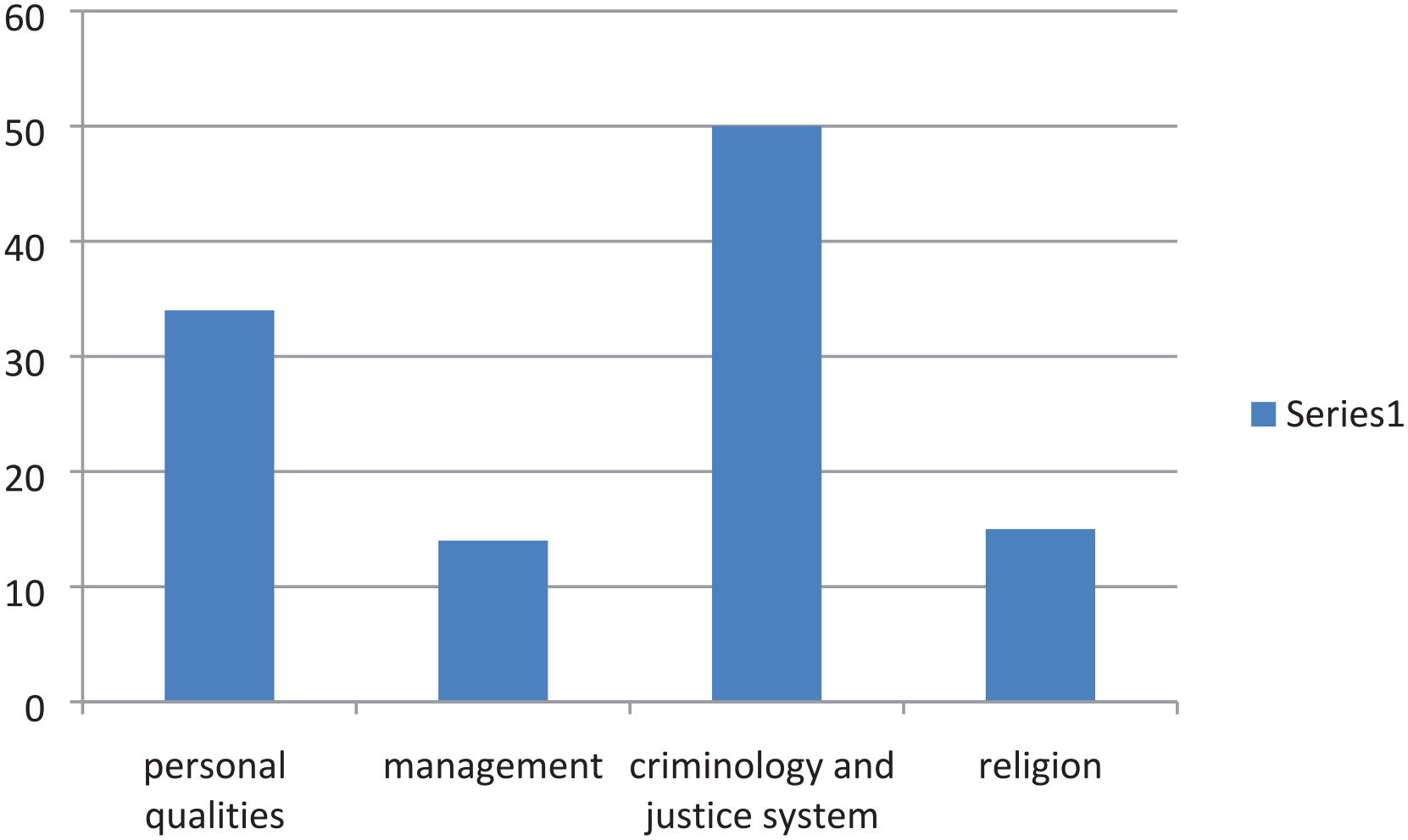
Interdiscursivity in the exemplars.
The exemplars contain a high degree of interdiscursivity, which according to Fairclough (1992), is associated with change of the social order. There are elements from the discourse of personal qualities—“shocked, disgusted and feeling sick to the core,” “sorry,” “ashamed,” “gutted,” “pathetic.” The text also draws on the elements from the discourse of management (“should be given such exemplary punishment that people should remember the lesson for ever,” “ensure that our children are better protected,” “cases are directly linked with upbringing and social behavior, change them!”). The elements from the discourse of criminology and justice can be seen such as “Hang the rapist in public and cut their organ,” “even hell is not enough for them,” “convict,” “FIR,” “punishment,” “public hanging,” “murder,” “trial,” and “execution.”
Most importantly, this discourse contains elements from religio-politics and is entwined with the power relations in a patriarchal society. While the social media users demanding the public hanging identify themselves and the State as rational, the victims are silenced as their demands are rarely expressed. Hence, women and children (most of the victims) are associated with irrationality, emotionalism and lack of authority in the patriarchal society. They are silenced and it perpetuates the violence which was committed by the rapist men who committed this act with a perception of week role and position of women and children against the rational powerful masculine men. Women’s lack of identity, rationality and authority are reified and reinforced (as evident from data 16). Similarly, the twitter users’ demand (data 9) and the government’s decision to chemically castrate the rapist suggest that the act was committed out of some sexual impulse and the solution lies in de-sexing the culprit. This perspective denies the power relations inherent in the rape culture and demand for public hanging or chemical/physical castration. Moreover, as UN human rights chief Michelle Bachelet says castration violates international human rights law (UN News, 2020). Through imposing the death penalty or castration the convict is brought outside the realm of bios and reduced to its zoe as the body belongs to the State since the moment of birth (Agamben, 1998) and the State has the right to expose the body to death and to the extent of assigning sex to the body.
The radical–liberal feminist perspective on rape posits rape as an assault motivated by power rather than a personal act of sexual gratification (McPhail, 2016). Brownmiller (1975), a feminist scholar, argues that: “Rape is not a crime of irrational, impulsive, uncontrollable lust, but is a deliberate, hostile, violent act of degradation and possession on the part of a would-be conqueror, designed to intimidate and inspire fear . . .” (p. 15). For her, it is a political problem rather than a physical one. In her book Against Our Will: Men, Women, and Rape, she argues that rape is fundamentally related to the patriarchal domination of women. Sanday’s (1981) cross cultural study on rape distinguishes between “rape prone” and “rape free” societies. She found that rape prone societies are characterized by “male social dominance, interpersonal violence, and subjugation of women.” On the other hand, “rape free” societies are associated with “respect for women authority and near absence of interpersonal violence.” MacKinnon’s (1989) normative heterosexuality perspective posits that violence against those with less power is eroticized as sexual pleasure to maintain a sexual/gender hierarchy and female subjugation is ensured. Scully’s (1990) theory of social construction emerged with her work with convicted rapists. Her work relates rape with normative masculine practices. Rape becomes a way for men to achieve masculinity. McPhail’s (2016) feminist framework plus (FFP) asserts that rape is “a political, aggregate act whereby men as a group dominate and control women as a group,” and “a very personal, intimate act in which the body of a singular person is violated by another person(s)” (p. 323).
The twitter data selected for this paper also contains elements from religious discourse (data 6, 7, 8, 9, 11, 14, and 15). The tweets also indicate the deviance from the social norm which the users of social media set at the level of ideological (see data 3, 7, 8, 11, and 15). In data 8 “I will always count on your statement that Pakistan will be “Riasat e Madina” and if you don’t hang these monsters,” in data 14 “trial in such cases is useless. It should only be execution every Friday after the Jummah prayer.” “That’s RIASTE E MADINA for me” and in data 15 “. . .attaching the name Islamic won’t make Pakistan a Muslim land, following the teachings, rules and regulations will,” the social media users expect from their fellows in faith (including the authorities as subjects of religious ideology) to hang the criminals. Here the “religion” is used as the master signifier or what Lacan (1977) refers to as the symbolic register. The tweets refer to the repressive state apparatus (RSA) and particularly the ideological state apparatus (ISA) of the Riasat e Madina. In contrast to RSAs, the ISAs are nonviolent and function primarily and predominantly by ideology, but they also function secondarily by repression. The ISAs use suitable method of punishment and disciplining not only “their shepherds but also their flocks” (for instance, school, church, and family). Althusser (1971) argues that the ISAs function through interpellation in which individuals become subjects of the ideology. Through interpellation, individuals are assigned identity, subject positions and particular expectations about their behavior (Althusser, 1971). In these tweets, the expectations from the subject of ideology are expressed. The subject of ideology internalizes the expectations set at the level of ideological as the ideological process of recruiting subjects starts even before an individual is born (Althusser, 1971). The tweets become the conduits of an oppressive state which uses both ideological and repressive apparatuses to mold and control the subjects according to its own interests.
In the last few years, the trend toward a political identification mediated through religion has got salience in Pakistan. Public sentiments are aroused and support for the regime is achieved through the religious semiotics of power. The demand for public hanging should not be taken outside this context. Back in 1980s during Zia’s regime which is being applauded for public hanging of a rapist, the public outcry for hanging the rapist was embedded in the socio-political environment. After the overthrow of Raza Shah Pahlavi in 1979, Pakistani newspapers ran headlines of death sentences in Iran and Ayatollah Rohullah Khomeini doing “nashta [breakfast]” of “dozens” of convicts (Ijaz, 2020). These news headlines aimed at creating acceptance for the Zia’s regime practicing similar executions, the biggest being that of Z.A Bhutto in April 1979 (Ijaz, 2020). The military government of Zia wanted to make the public believe in his sincerity regarding the implementation of Sharia. It was a practice then that the crowd gathered to witness the death penalty and shout in jubilation “Islam Zindabad [long live Islam]” and “Allah-o-Akbar [God is the greatest]” (Hasnain, 2018a). Similarly, during recent public outcry for public execution of the rapist, the reference to Sharia and invocation of Riasat-e-Madina set the norms at the level of ideological and the legitimacy of the government as custodian of moral and political authority is established through naming.
Implications
In this section, the semiotic function and the effects of the discourse on public hanging of rapists are discussed. Firstly, we argue that public hangings are a display of the State’s power. States display their power through military parades, war games, military exercises, and political processions. These are all rituals and the simulacra of State’s power (Baudrillard, 1994). These performances of power underscore the asymmetry between the power of the individual and that of the State. At the consumption end, the discourse and practice of public hanging is a marketing tactic for the communication of the State power. In the hyper-real world of simulacra, in modern consumer societies where nothing is unmediated, State power is mediated through public hanging of the offender. In the past, when only print news was available, murder and execution pamphlets were distributed to attract audience. The pamphlets were popular with the public and were useful to the State. The pamphlets often included criminal biographies, the penance (or lack of it) done by the offender/deceased, the manner of execution told in gory details, offender’s last speeches and usually a moral lesson in the end. These pamphlets served as a text and a commodity (Redmond, 2007).
In a society where billboards sell products of capitalist economy and States, the violent display of power at the scaffold is replaced by subtle forms of distribution and consumption of power of a capitalist State. However, the use of public hanging in the contemporary societies manifest the tension between the demands of civilized and subtle techniques of power in the modern nation states and a desire for the strict punishment of those defying State’s power. The States upholding the practice of public hanging use it as a publicity mode, a billboard, an advertisement for its power. Through the crowds during public punishment the crime of the condemned is spread in the community via gossip. Along with the publicity of the crime, the fear of the State also circulates in the society. In Afghanistan under the Taliban between 1996 and 2001, citing Sharia, Taliban officials would carry out stoning, lashing, amputation and executions in public places such as stadiums, squares, and schools (Hadid & Dell, 2013). The sports grounds of Kandahar and Kabul were notorious for the spectacle of public punishment with thousands attending the event. To ensure a large gathering, the Taliban would publicize the event on loudspeaker. The purpose was to target not just the criminal but spread the terror of the Taliban rule in the society.
Pamphlets used in the past presented the execution as the inevitable result of sinful acts of the offender. In the Foucauldian model, the theater of punishment was in fact dramatization of State’s power over “disobedient” subjects. It was literally State beating the undisciplined and the disobedient child into submission through mutilation or mortification of the body. As publicized in the pamphlets, and through the final speech, it was the behavior of the offender and disobedient citizen that legitimized the act of the State. The early modern performance of execution was like a morality play in which “justice, humility and the threat of death displayed in order to warn and edify spectators” (Smith, 1996, p. 241). The reason of the State is propagated and established as the offender is incapable of self-reflection and correction of his/her behavior. The State emerges as the moral agent and the rightful administrator of executing punishments. Thus, the act of public hanging combines religious, military, and political authority in a dramatically visceral event that could be repeatedly performed. The practice will attain what Unkelbach et al. (2019) call “repetition-induced truth effect.” Once established as a norm through repetition, the authority and right to publicly execute the rapist is likely to be used in other cases. The raison d’état of the State can use it against political opponents. The act of the offender becomes seriously punishable if it goes against the so-called national interests.
Another effect of power which we observe in the repeated instances of public hanging is the sovereign’s exception. We explain this in light of Agamben’s (1998, 2005) two seminal works Homo Sacer and State of Exception. Agamben (1998) argues that the state of exception, which was meant to be used provisionally, has become a normal paradigm of contemporary governments. He makes a point that in suspending the constitution “the sovereign stands outside the juridical order and nonetheless belongs to it” (Agamben, 1998, p. 17). Through public hanging of the criminals, sovereign’s impunity is encouraged, and the sovereign brings himself [sic] outside the constitution and sets aside the right to life given by the constitution. Article 14(1) of the Constitution of Pakistan establishes the inviolability of the dignity of person. Any punishment which violates the inviolability of human dignity must not be acceptable. Besides, Pakistan is a signatory to International Convention against Torture which bars inhuman, degrading, and cruel treatment or punishment. Through the discourse of public hanging, or for that matter only hanging, of the rapist the State appropriates public approval of inhuman act which can be extended to political activists or prisoners of conscience.
Thirdly, we argue that public hanging is more than retributive. Solomon (2015) quotes Jeffery Fagan, a professor of law at Colombia University: “Executions serve only to satisfy the urge for vengeance. Any retributive value is short-lived, lasting only until the next crime” (p. 10). The urge for vengeance is based on the idea that the violence inflicted on the body must match the intensity and atrocity of the crime, the body of the condemned cause [to the sovereign] (Maboloc, 2016). In Pakistan, the Qisas and Diyat Ordinance of 1990 has strengthened the legitimacy of the death penalty and has put the debate on it in the context of revenge and retribution (Hasnain, 2018b). The State is called upon to take revenge as the act is considered a crime against the State, an act to disrupt the state of order. The principle of retribution upholds an equivalent punishment. Howsoever heinous a crime might be, public hanging is not an equivalent punishment. For punishment to act as a deterrent, it should be slightly in excess of the crime (Sheridan, 1981).
The public punishment, however, massively exceeds the crime and this excess proceeded from the unlimited powers at the hand of kings (Sheridan, 1981) in the past and now from the State. The demand for public hanging of the rapist suggests that demand for vengeance outweighs the desire for justice. Before the final act of hanging, the offender is put in jail for an anticipated period where s/he has to live in poor conditions. Moreover, the punishment is excessive as it is meant not only for the offender but also for public consumption: it instills fear of the State in their minds and reduces the human dignity not only of the criminal but also of the viewers. The spectators are reminded of the fact that the body belongs to the State and they are reducible to legal subjects of the State (Ashfaq, 2018) devoid of any humanity.
Fourthly, rather than having a retributive element, the desire and the practice of public hanging speak a language of revenge. Even Prime Minister Imran Khan supported public hanging and chemical and physical castration of rapists. He is aware that public hanging will adversely cost Pakistan its GSP-plus trade status. Islamic law does not prescribe physical or chemical castration; hence the Council of Islamic Ideology has overruled it. The desire for revenge may represent the personal instinct of a person but have negative effects on society. It creates a tension with the democratic society where the justice system is based on principles. Sanity demands governments to resist responding to public sentiments and to pacify the mob demands.
Finally, in discursive struggle the discourses which are dislodged and silenced are: demand for equality of treatment by women, demand for protection of women and meaningful reforms in the criminal justice system. Once justice is served on the basis of “eye for an eye,” the aggrieved party cannot ask for more. Women are silenced in their demands for justice against the patriarchal social structure which are responsible for crime against women’s body. It implies reifying the patriarchal structures and control societies through vengeance rather than justice.
Conclusion
The purpose of this study was to examine how the discourse for public hanging in the wake of rape cases in Pakistan emerged as a hegemonic discourse on social media, which pushed to the periphery the demands for equality of treatment by women, protection of women, and meaningful reforms in the criminal justice system. This study also established how this discourse is interdiscursively related to the power relations implicated in the discourses on religion and gender in Pakistan. Through the discourse of public hanging of the rapist the State appropriated public approval of an inhuman act which can be extended to political activists or prisoners of conscience. A civil rights movement—the Pashtun Protection Movement (PTM)—has been campaigning against enforced disappearance of people in the tribal districts of Pakistan, where armed forces have been engaged against pro-Taliban militants. This discourse of hanging and hegemonic intervention of the State by giving it a legal cover has serious consequences for those who raise their voice for their constitutional and human rights.
We argue that the desire for revenge may represent the personal instinct of a person, but it has negative effects on society. It creates a tension with the democratic society where the justice system is based on principles and not on the whims of individuals. When the State, through hegemonic intervention, consecrates one particular discourse, it dislodges and silences other voices. Once justice is served on the basis of “eye for an eye,” the aggrieved party cannot ask for more. Women are silenced in their demands for justice against the patriarchal social structure which are responsible for crime against women’s body. It implies reifying the patriarchal structures and control societies through vengeance rather than justice.
Footnotes
Acknowledgements
We are thankful to Rahman Ullah and Azmat Khan for assisting us in collecting the data and proof reading the manuscript.
Declaration of Conflicting Interests
The author(s) declared no potential conflicts of interest with respect to the research, authorship, and/or publication of this article.
Funding
The author(s) received no financial support for the research, authorship, and/or publication of this article.
Ethical Approval
This study does not involve any human or animal subject.
