




Abstract
In the domain of aesthetic preference, previous studies focused primarily on exploring the factors that influence aesthetic preference while neglecting to investigate whether aesthetic preference affects other psychological activities. This study sought to expand our understanding of time perception by examining whether aesthetic preference in viewing paintings influenced its perceived duration. Participants who preferred Chinese paintings (n = 20) and participants who preferred western paintings (n = 21) were recruited to complete a temporal reproduction task that measured their time perception of Chinese paintings and of western paintings. The results showed that participants who preferred Chinese paintings exhibited longer time perceptions for Chinese paintings than for western paintings, while the participants who preferred western paintings exhibited longer time perceptions for western paintings than for Chinese paintings. These results suggested that aesthetic preference could modulate our perceived duration of painting presentation. Specifically, individuals perceive longer painting presentation durations when exposed to the stimuli matching their aesthetic preferences.
Introduction
In the past several decades, researchers have mainly focused on exploring the factors that influence aesthetic preference, such as culture (Souief, 1971), experiential background (Konecni, 1979), environment (Ma & Ma, 2005), individual characteristics (Chokron & De Agostini, 2000; Pugach et al., 2017), and stimulus characteristics (Martindale et al., 1990; Wang & Lin, 2018). However, few studies have investigated whether aesthetic preference affects psychological activities, especially in terms of time perception. Thus, the aim of our current research was to examine the effects of aesthetic preference on individuals’ time perception.
Time perception reflects one’s subjective experience of the passage of time (Eisler, 1975; Fraisse, 1984; Zakay & Block, 1997). Unlike objective time, which progresses linearly, ample evidence has been found that time perception is unstable and can be distorted, both by variations in the external environment and by an individuals’ internal mental state (Droit-Volet & Meck, 2007; Gautier & Droit-Volet, 2002; Gil & Droit-Volet, 2009; Lake et al., 2016; J. Shi & Huang, 2017; Tian et al., 2018).
The circumstantial evidence suggests that aesthetic preference may affect time perception. Within the domain of time perception, temporal distortions are mostly explained by pacemaker-accumulator models that postulate the existence of an internal clock, a pacemaker-accumulator device for processing temporal information (Gibbon et al., 1984; Treisman, 1963; Zakay & Block, 1997). In short, time perception is determined according to the number of pulses generated by an arousal-related pacemaker and counted by an accumulator through the closing of an attention-controlled switch/gate. Increasing arousal results in pacemaker acceleration; the greater the attention allocated to timing, the greater the accumulation of pulses. Therefore, arousal and attention are considered to be the two main mechanisms leading to temporal distortion (Droit-Volet & Meck, 2007; Lake et al., 2016). Empirical research has found that participants’ preferred stimuli induce higher arousal relative to nonpreferred stimuli (Mcnamara & Ballard, 1999; Schäfer & Sedlmeier, 2011; Walters et al., 1982). Moreover, stimuli preference has also been shown to modulate attention: non-preferred stimuli processing requires additional attention, as compared with preferred stimuli (Murata et al., 2015), while a higher preference is generally associated with higher attention performance (Hutt, 1975); it is easy to maintain attention on preferred stimuli, as compared with non-preferred stimuli (Richards, 1997). Consequently, it is resonable to infer that time perception would be modulated by aesthetic preference according to pacemaker-accumulator models.
Importantly, some factors related to aesthetic preference have been shown to affect time perception. Gil et al. (2009) investigated how liked and disliked foods affect time perception. Participants were instructed to compare the duration of presented images of foods that they perceived as like or dislike. The results showed that participants perceived duration to last longer for liked foods than those for disliked foods; Ogden (2013) used images of different faces to explore the effects of attractiveness on time perception and found that participants perceived duration to last longer for attractive faces than those unattractive faces. Similary, Arantes et al. (2013) obseverd that females’ time perceptions increased when an attractive male face was presented unexpectedly. Tian et al. (2019) found that both men and women experienced longer time perceptions for attractive opposite-sex faces than for unattractive opposite-sex faces. These results indicate that participants’ preferred stimuli prolong time perception and implied that aesthetic preference in general might distort time perception.
To examine whether aesthetic preference affects time perception, we compared differences between western and Chinese aesthetic preferences in time perceptions of painting presentations. We chose western and Chinese aesthetic preferences because: (a) both are common, due to globalization; (b) their related stimuli (e.g., western and Chinese paintings) are fundamentally different in terms of pictorial perspectives, trajectories of abstraction, spatial information, and pictorial subjects, allowing them to be easily distinguished by participants (Bao et al., 2016; Masuda, 2003; Masuda et al., 2008). Specifically, individuals who preferred western or Chinese paintings were selected as participants, with classical western and Chinese paintings adopted as materials, and a temporal reproduction task that was widely used in previous studies was used to measure their time perceptions of those paintings (Rattat & Droit-Volet, 2012). This study hypothesized that, for participants who preferred Chinese paintings, time perception would be longer for Chinese paintings than for western ones, whereas for participants who preferred western paintings, time perception would be longer for western paintings than for Chinese ones.
Method
Participants
Two-hundred participants were recruited from Southwest University in Chongqing, China. They were required to assess their painting preferences, Chinese versus western, using two 9-point scales (from 1 = “not at all” to 9 = “extremely”). We used each participant’s ratings for Chinese paintings minus their ratings for western paintings to calculate the score of aesthetic preference (SAP). Thus, a score greater than 0 indicated a preference for Chinese paintings, and a score less than 0 indicated a preference for western paintings. The top and bottom scoring 10% were allocated to the Chinese painting preference (CPP) group and western painting preference (WPP) group, respectively. There were 20 participants in the CPP group (11 female, mean age = 20.40, SD = 2.30 years, mean SAP = 5.25, SD = 1.25), and 21 participants in the WPP group because several participants scored the same (13 female, mean age = 21.95, SD = 3.04 years, mean SAP = −5.20, SD = 1.15). Informed consent was obtained from all individual participants included in the study.
This sample size is consistent with that of previous studies (Ogden, 2013; Tian et al., 2019), and an a priori power analysis indicated that a sample above 34 would have adequate power (1–β ≥ 0.80) to detect a medium effect, ηp2 = 0.06 (Faul et al., 2007).
Apparatus and Materials
The experiment was run and recorded using E-Prime 1.1 (Psychological Software Tools, Pittsburgh, PA, United States) on a Lenovo computer. The stimuli were presented using a 17” LCD screen (4:3, 1,024 × 768 pixels, 60 Hz), and responses were recorded via keyboard.
Paintings were selected using the results of a test in which 27 auxiliary participants (17 females, mean age = 31.11, SD = 5.89 years; mean SAP = .19, SD = 1.67) rated the typicality of 40 Chinese paintings and 40 western paintings (size: 480 × 320 pixels). These participants were art professionals (e.g., art teacher, art dealer, and artists). Typicality was rated on a 9-point scale (from 1 = “atypical” to 9 = “typical”). Mean typicality scores were used to select the paintings. The 12 most typical Chinese paintings (M = 8.44, SD = 0.15) and 12 most typical western paintings (M = 8.37, SD = 0.30) were selected as materials, including landscapes, people, animals, insects, and still life. An independent-sample t-test showed no difference in typicality between Chinese and western paintings, t(22) = 0.66, p = .52.
Procedure
The experiment lasted approximately 30 minutes, spanning two phases. Phase 1 was dedicated to measuring time perception using a temporal reproduction task. Phase 2 aimed to check manipulation by asking participants to evaluate the preference of each painting. Throughout the experiment, participants were seated in a quiet and well-lit room at a distance of 60 cm from the screen, which subtended less than 16° of the horizontal and vertical visual angles.
Phase 1 consisted of 125 trials, including 12 × 5 × 2 = 120 experimental trials and 5 practice trials (which used one additional painting). At the start of each trial, a fixation cross “+” was presented on the screen, lasting between 500 and 750 ms. This was immediately followed by a painting, which was presented for a variable duration of 1,000, 1,500, 2,000, 2,500, or 3,000 ms. Subsequently, a question mark appeared on the screen, cueing the participant to reproduce the duration of the painting. This remained on the screen either for 3,000 ms or until the participant responded by pressing the spacebar for a duration equivalent to that of the painting’s initial presentation. A gray rectangle (size: 480 × 320 pixels) would appear at the beginning of the spacebar press and remain on the screen until the participant released the spacebar. The inter-trial interval was 3,000 ms (Figure 1). The trial order was randomized across participants.

Schematic illustration of a single trial in the temporal reproduction task.
In phase 2, participants were asked to rate the preference of each painting, using a 9-point scale (from 1 = “not at all” to 9 = “extremely”). The order of paintings was also randomized across participants. To prevent participants from determining the purpose of the experiment, phase 2 was always conducted after phase 1.
All procedures performed in studies involving human participants were in accordance with the 1964 Helsinki declaration and its later amendments or comparable ethical standards. This study was approved by the local ethical committee of Southwest University (China).
Statistics
The average reproduced durations of each experimental condition were used for statistics. Some previous studies computed Tratio, that is, the ratio of reproduced duration to stimulus duration: Tratio = (Treproduced − Tstimulus)/Tstimulus, for statistics (e.g., Angrilli et al., 1997; Mioni et al., 2016) because most of them aimed to investigate the difference between time perception and stimulus duration. As the current goal was to compare the time perception of different stimulus, the average reproduced durations would be more appropriate for statistics.
All statistical analyses were performed with SPSS Statistics 22.0 (IBM, Armonk, NY). The assumption checks (i.e., Independence of observations, Normality, and Homogeneity) showed that current data were suitable for analysis of variance (ANOVA) test. Greenhouse–Geisser correction for ANOVA tests was used whenever appropriate. Post hoc testing of significant main effects was conducted using Bonferroni method. Significant interactions were analyzed using simple effects model. Partial eta-squared (ηp2) was reported to demonstrate the effect size in ANOVA tests, where 0.05 represents a small effect, 0.10 indicates a medium effect, and 0.20 represents a large effect.
Results
Manipulation Check
A repeated-measure ANOVA test was performed on the preference ratings, with painting type (Chinese or western) as a within-subject factor, and with group (CPP or WPP) as a between-subjects factor.
These findings revealed a significant interaction of painting type by group, F (1, 39) = 258.25, p < .001, ηp2 = 0.87. Simple effect analysis showed that in the CPP group, the ratings for western paintings (M = 6.04, SD = 0.42) were lower than for Chinese paintings (M = 7.13, SD = 0.46, p < .001); in contrast, in the WPP group, the ratings for western paintings (M = 6.93, SD = 0.61) were higher than for Chinese paintings (M = 5.97 SD = 0.68, p < .001). Neither the main effect of groups nor the main effect of painting type was significant, F values < 1.00, p values > .32, suggesting that the manipulation of aesthetic preference was effective.
The Reproduced Duration
A repeated-measures ANOVA was performed on the reproduced duration, with stimulus duration (1,000, 1,500, 2,000, 2,500, and 3,000 ms) and painting type (Chinese or western) as within-subject factors, and with group (CPP or WPP) as a between-subjects factor. The average durations reproduced under each condition are presented in Figure 2.
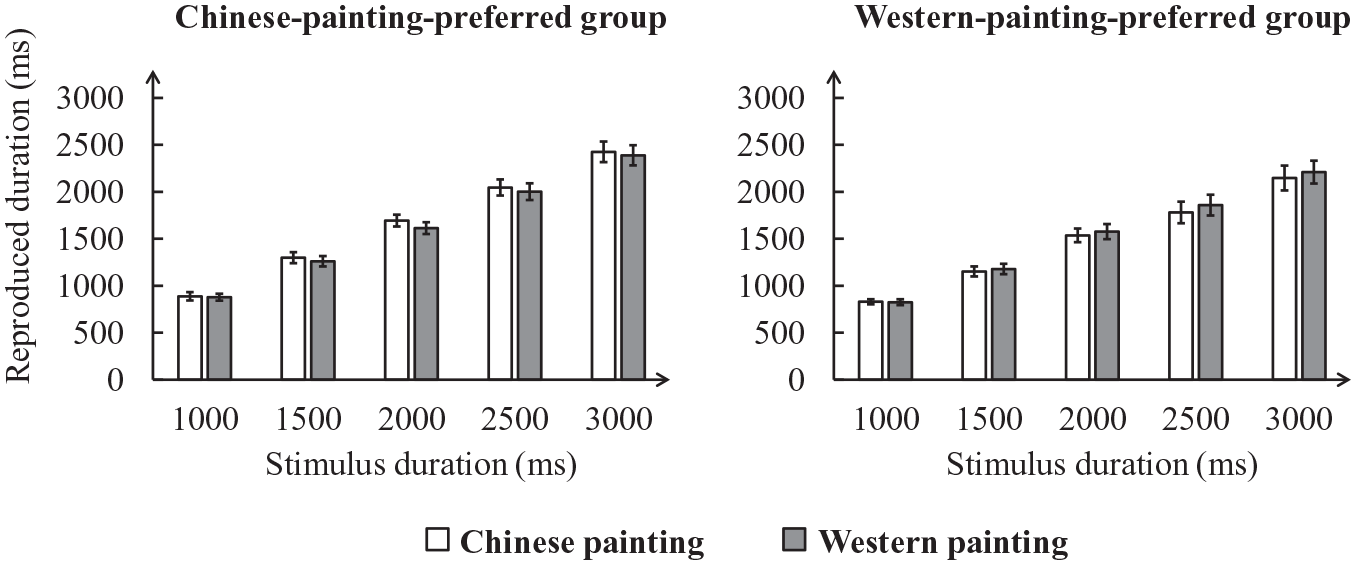
Average reproduced durations for each condition.
A significant main effect of stimulus duration was found, F (1.25, 156) = 323.34, p < .001, ηp2 = 0.89. Post hoc analysis revealed that the reproduced durations for all conditions were different from each other, p values < .001 and that the reproduced durations increased with the stimulus durations. Neither the main effect of painting type (p = .92) nor that of group (p = .17) was significant.
These findings also revealed a significant interaction of painting type by group, F (1, 39) = 41.93, p < .001, ηp2 = 0.52. Simple effect analysis showed that in the CPP group, the reproduced durations for Chinese paintings were longer than those for western paintings, p < .001; in the WPP group, the reproduced durations for Chinese paintings were shorter than those for western paintings (p < .001, Figure 3). The interaction of stimulus duration by group (p = .25), the interaction of stimulus duration by painting type (p = .75), and the three-way interaction of stimulus duration by painting type by group (p = .29) were insignificant.

Average reproduced durations for Chinese and Western paintings in the CPP and WPP groups.
Discussion
The goal of this study was to explore whether individuals’ aesthetic preferences affect their time perception. To achieve this goal, we recruited participants who prefer Chinese paintings (CPP) and participants who prefer western paintings (WPP), and we used a temporal reproduction task to measure their time perception of Chinese paintings and of western paintings. In line with our hypothesis, the results showed that the participants of the CPP group reproduced longer durations for Chinese paintings than for western paintings, while the participants of the WPP group reproduced longer durations for western paintings than for Chinese paintings. Taken together, the current findings suggested that individual time perception elongates upon exposure to preferred stimuli.
In the domain of temporal psychology, ample evidence has shown that our time perception is often distorted, rather than perceived veridically (Droit-Volet & Meck 2007; Lake et al., 2016; Matthews & Meck, 2016). Previous studies using foods and facial images have revealed that participants’ favorite stimuli prolong their time perception (Arantes et al., 2013; Gil et al., 2009; Ogden, 2013; Tian et al., 2019). However, human preferences for food and faces are highly consistent (Cunningham et al., 1995; Rozin & Fallon, 1987). This might result in potential bias due to consistent features. Unlike such studies, this study used Chinese paintings and western paintings as materials, allowing us to use the same material to manipulate preferences, thereby avoiding the bias caused by the stimulus features. The results of both the CPP and WPP groups showed that time perception dilates when the painting type matches aesthetic preference, suggesting that the previous findings of preference on time perception are repeatable.
As reported in the Introduction, a temporal dilating effect may be mainly induced by the mechanisms of arousal and attention (Droit-Volet & Meck, 2007; Lake et al., 2016). According to the pacemaker-accumulator model, increasing arousal results in pacemaker acceleration; the more temporal pulses are accumulated, the more attention is allocated to timing. Both mechanisms would result in a temporal dilating effect (Gibbon et al., 1984; Treisman, 1963; Zakay & Block, 1997). Some studies found that participants are aroused when exposed to preferred stimuli (Mcnamara & Ballard, 1999; Schäfer & Sedlmeier, 2011; Walters et al., 1982); others observed that it is easy to process and maintain attention on the preferred stimuli (Hutt, 1975; Murata et al., 2015; Richards, 1997). These mechanisms allow us to accelerate our internal clock and to allocate more attention to timing. Thus, we infer that both the arousal and the attention mechanism may contribute to the temporal dilating effect of preferred stimuli.
Temporal distortion is thought to allow us to adaptively respond to environmental changes (Cicchini et al., 2012; Z. Shi et al., 2012). For example Dirnberger et al. (2012) found that emotional stimuli perceived as longer in duration were also subsequently remembered better. Thus, we cannot simply regard the temporal distortion as a byproduct of other cognitive processes although the relationship between distortions of time perception and subsequent behaviors remains largely speculative (Lake et al., 2016). Since the preferred stimuli are often associated with the approach motivation (Elliot, 2006), one possible meaning of temporal dilating effect of preferred stimuli is that the temporal dilating may allow us to have more subjective time to mobilize an approaching response.
Furthermore, although most previous studies investigated aesthetic processing at the conscious level, recent studies have used facial attractiveness and painting type to manipulate preference, observing that aesthetic processing can occur subconsciously (Hung et al., 2016; Shang et al., 2018). Since the current temporal reproduction task required only time-relevant processing rather than aesthetic processing, the current findings may indicate that if acute awareness of aesthetic preference is not a prerequisite, then aesthetic preference can still affect time perception. This offered a possible cause for the salient influence of aesthetic preference on human activity.
Three limitations of this study and directions for future research should be noted. First, although our results showed that aesthetic preference affects time perception, the mechanism is unclear. As discussed above, arousal and attention induced by aesthetic preference may be important to this effect. Future research should explore both potential mechanisms. For example, the arousal could be investigated using physiological or even self-report measures (e.g., Angrilli et al., 1997); the attention could be investigated using the dual-task paradigm that includes temporal task (e.g., Macar et al., 1994). Second, our results were analyzed from the 10% top and bottom polar of 200 participants. This method of analysis is likely to overestimate the effect size in the whole population (MacCallum et al., 2002; Preacher et al., 2005). Future research should reinvestigate the current topic in a continuous sample. Third, we selected typical Chinese paintings and western paintings as experimental materials, but these two types of paintings have differences in emotional expression and visual characteristics, and these differences may have potential systematic effect on the experimental results. Future research could test the current findings under the strict control condition. Fourth, this study used different types of paintings to manipulate aesthetic preference. However, the painting type is just one aspect of aesthetic preference, and the cognitive processing of painting has been found to be different from other stimuli (Chatterjee & Vartanian, 2016; Rolls, 2017). Future research should use other materials (e.g., music and landscape photo) to verify the repeatability of the current results.
Conclusion
In conclusion, this study provides evidence that aesthetic preference affects time perception. Specifically, participants who preferred Chinese paintings perceived duration to last longer for Chinese paintings than those for western paintings; in contrast, participants who preferred western paintings perceived duration to last longer for western paintings than those for Chinese paintings. These findings suggest that individual time perceptions last longer upon exposure to their preferred stimuli.
Research Data
dataset for Aesthetic Preference and Time: Preferred Painting Dilates Time Perception
dataset for Aesthetic Preference and Time: Preferred Painting Dilates Time Perception by Lingjing Li and Yu Tian in SAGE Open
Supplemental Material
materials – Supplemental material for Aesthetic Preference and Time: Preferred Painting Dilates Time Perception
Supplemental material, materials for Aesthetic Preference and Time: Preferred Painting Dilates Time Perception by Lingjing Li and Yu Tian in SAGE Open
Footnotes
Availability of Data and Materials
The data and materials of this study are available from the corresponding author on reasonable request.
Declaration of Conflicting Interests
The author(s) declared no potential conflicts of interest with respect to the research, authorship, and/or publication of this article.
Funding
The author(s) received no financial support for the research, authorship, and/or publication of this article.

Supplemental Material
Supplemental material for this article is available online.
References
Supplementary Material
Please find the following supplemental material available below.
For Open Access articles published under a Creative Commons License, all supplemental material carries the same license as the article it is associated with.
For non-Open Access articles published, all supplemental material carries a non-exclusive license, and permission requests for re-use of supplemental material or any part of supplemental material shall be sent directly to the copyright owner as specified in the copyright notice associated with the article.
