




Abstract
The study investigated head teachers, and, education administrators’ view of the Home Grown School Feeding Program and the associated sociodemographic variables. The study adopted a descriptive cross sectional design. Fifty-four government owned primary schools in Ebonyi State, Nigeria, participated in the study. Head teachers and education secretaries completed a paper-and-pen questionnaire and described their perception about Home Grown School Feeding Program impact on pupil registration, presence, retention, dropout, and the problems that may be associated with the program implementation. SPSS version 23 was used to interpret the data. Results showed that head teachers perception on HGSFP was good on its effect on pupils’ enrolment, attendance, retention, and dropout. Nonexistence of lawful framework and strategy for sustenance of HGSFP, insufficient funding, inability to monitor food preparation, inadequate teaching space and equipment to deal with extra admission were challenges perceived. Sociodemographic factors such as age, sex, education level, and location were not significant (p > .05). Head teachers perception was good though they have their concerns on aspects of implementation. Program implementation agencies should improve funding, monitoring, and educational infrastructure for the smooth running of the program.
Introduction
Education is advocated as a basic individual obligation. Globally touted as the most critical factor for achieving sustainable development. In January 2005, the Hyogo structure for action was adopted in 168 countries to promote education by government and civil society to in all stages of the nation. As a result, governments placed enormous monetary and human capitals to enhance education in various countries through the institution of the School Feeding Program (UNESCO, 2010).
Although many countries have made remarkable progress toward the universalization of primary education, many children still cannot complete this relevant level of education as a result of too much poverty, wars, disasters, HIV, and AIDS, and those stigmatized on the basis of culture, creed, and sex (UNESCO, 2017; World Bank Report, 2020). Development, goal number four puts emphasis on access to quality inclusive education and promotion of lifelong learning opportunities for all as the first target of the fourth SDG is to ensure that all children, without discrimination based on gender complete quality free primary and secondary education by 2030 (UNESCO, 2017). To achieve these goals implies ensuring school attendance and improving quality of education.
It is an accepted social safety net in approximately all countries. It is a government-sponsored Program meant to feed a smallest portion of the pupils to improve results related with learning and diet (Alderman & Bundy, 2012). It provides the prospect to profit the agriculturalists and manufacturers in creating an organized, anticipated request for their harvests, in so doing building the market and the supporting organizations. The idea behind the program is recognized by the Millennium Hunger Task Force as a prompt effort to combat poverty and malnutrition (The PCD, 2012). It has interventions that envelop many objectives such as: increase in school enrolment, attendance, decreasing dropout, developing cognition in addition to learning success (WFP, 2016); boosting dietary status of pupils; financial earnings of parents (those whose children are eating food) and farmer households (those that provide the food) (Aurino et al., 2016; Bundy et al., 2018); and small enterprise development-generating revenues for food provision (Gelli et al., 2016; WFP, 2019).
School Feeding Program is the provision of prepared or raw foods to school children and is implemented in two ways: firstly, is in-school feeding food given at school to reduce immediate hunger, and secondly the one to take home as a condition for school attendance (Aliyar et al., 2015; Jomaa et al., 2011; Yendaw & Dayour, 2015). Severe and prolonged hunger affect pupils’ admission to school, concentration, behavior during lesson, and learning outcomes (WFP, 2015). It adversely affects brain development and hampers their chances of academic success later in life (WFP, 2009). Globally reports showed that 66 million pupil go hungry daily and 23 million are hungry in Africa including Nigeria (FAO, 2012; WFP, 2015). Reports showed relationships on meals taken in school as it relates to academic performance and reduction in gender inequality by attracting girls to schools (UNICEF, 2005). Also, instead of keeping children at home to work or take care of their family members parents are motivated to send them to school (WFP, 2010; World Bank, 2012).
According to history, school feeding started from the mid-19th century due to the aftermath effects of both the industrial revolution and of World War II (Bryant, 1913; Burnett et al., 2008, Evans & Harper, 2009). Due to economic crises which made most people unable to meet food costs, therefore affected the school children (Burnett & Dalton, 2013; FAO, 2005). In 1790, the first known school feeding program was established by Benjamin Thompson (also known as Count Rumford) in Europe in Munich, Germany. The introduction of food for needy children in schools later in the 1800s diffused throughout Europe (FAO, 2005). The global economic crisis brought about social problems. Especially poverty, hunger, chronic health diseases, and food shortage in many developing countries. The situation led to adopting some strategies to tackle this problem by the World Food Program (WFP, 2006) and other global associations.
However, in 2003, a new Partnership for Africa Development (NEPAD), together with the United Nations World Food Program (WFP), the Millennium Hunger Task Force, and the Comprehensive Africa Agriculture Development Program (CAADP), launched a pilot Home Grown School Feeding and Health Program (HGSFHP) in 12 countries. For now, Côte d’ivoire, Ghana, Kenya, Mali, and Nigeria are implementing the Program. HGSF is common in Africa, with many countries continually asking development partners for support. Food are supplied by local famers in sub-Saharan Africa to support government action to deliver government sustainable school feeding. This is done through a new program launched by the Partnership for Child Development (PCD) partly sponsored by the Bill & Melinda Gates Foundation and is result oriented based on objective and capability for the designing and running school feeding programs connected to indigenous farm produce (The PCD, 2012).
In Nigeria, the implementation of Home Grown School Feeding was initiated in 2004 in 12 states of the federation from all the geopolitical zones. The present day (NHGSFP) began in 2016. Reports of NHGSFP (2017) showed that more than 300 million school meals were provided for over 7.5 million school children in 46,000 government owned primary schools in 22 states. The program cost N70 per day for a child, and it enhances pupils’ health and learning outcomes, using locally produced crops by small scale farmers (Drake et al., 2016).
Presently in Nigeria, coverage for the school feeding program is only one million (2%). However, The national recently rolled out the re-strategized national Home Grown School Feeding program targeted at about 5.5 million Nigerians in the first year (Greenbarge Reporters, 2016; NPowerNG, 2018; The PCD, 2019). Also in Nigeria in an attempt to reduce the number of out-of-school children, the Federal Government of Nigeria in 2016 launched the Home Grown School Feeding Program, in public primary schools to feeds pupils in primary 1 to 3, in 22 states as a form of social protection net at N70 (0.17 USD) for food per pupil daily. Thought states are free to feed up to primary 6. It is an inter-sectoral collaboration that encompasses various ministries such as education, health, justice, agriculture, and budget and planning, and relevant stakeholders. Currently, over nine million pupils drawn from 54,619 schools are benefiting from the scheme, and with the participation of 80,000 farmers and engagement of over 102,097 cooks across 26 states in the country. The program is not without some hitches that have sprung up from management and delivery of meals to pupils, massive corruption, anomalies, politicization, poor quality control, absence of transparency and accountability (Okunola, 2021).
Similar studies were conducted by authors as McCann and Ames (2007), who stated that cognitive function may be affected due to iron deficiency. Gelli et al. (2007) reported increased school enrolment due to provision of food in schools supported by the Food for Education (FFE) program up to 28% for girls and 22% for boys in the first year, and the given of take-home foods also seemed to reduce the dropout rate of girls, especially in the higher classes. Also, eating food in school is a good way to ensure vital nutrient to the pupils which in turn helps promote their academic performance, attendance, and enrolment, compared to non-beneficiary schools (Munyiri, 2010; Mkanyika, 2014; Yendaw & Dayour, 2015; Sanya, 2015; Manful et al., 2015; Taylor & Ogbogu, 2016). Though the major challenge facing the implementation of HGSFP was the rising cost of food commodities (Weru, 2011).
However, school feeding differ in high-income countries where guidelines and standards are in place to combat rising levels of overweight and obesity, and to model healthier lifestyle habits of each income group. While in low-income countries, there is a gap in terms of guidance on nutrition standards and menu composition. For instance in Kenya studies showed that the majority of schools have implemented the primary school feeding programs as attested by 53% of the teachers, 88% of the head teachers, and 61% of the pupils. However, 70% of funding for the school feeding program come from the community and this has rendered the initiative less effective as most of the parents in the targeted schools have limited resource (Kiilu & Mugambi, 2019).
Also the implementation delivery of services, and nutritional content of foods also differ considerably between countries and income groups. Therefore, provision of scientific guidelines on nutrition standards to middle and low income countries, who have newly established or are planning to start school feeding, has the possibility to significantly enhance and improve the quality of service and the life of millions of children globally.
The current study investigated the head teachers and education secretaries’ perception of HGSFP in Ebonyi State, Nigeria. The findings will contribute to the importance of school feeding program to the community, ministry of education, government, and program implementers.
Theoretical Framework
This study was guided by the incentive theory of motivation propounded by Kendra Cherry, incentive theories state that the motivation behind ones’ action or behavior is attracted by external benefits, such as money, rewards, appreciation, or other incentives. The theory stipulates that people are attracted to actions that offer desirable incentives and indifferent about behaviors related to undesirable incentives (Sincero, 2012).
This theory underscores the rationale behind the school feeding program and increased enrolment in school as those who went to school and received a good meal or snack will quickly tell others at home. Physiological, social, and cognitive factors play a role in the type of incentives people find motivating. For instance, one is more likely to be motivated by food when hungry than when full (Nevid, 2013).
Research Hypotheses
Age was not significant in the perception of head teachers and education administrators on HGSFP
Sex was not significant in the perception of head teachers and education administrators on HGSFP
Level of education was not significant difference in the perception of head teachers and education administrators on HGSFP
Location was not significant in the perception of head teachers and education administrators on HGSFP
Methods
Study Design and Setting
A cross-sectional research design was employed as in the study of Taylor and Ogbogu (2016) in public primary schools in Osun State. This study took place in randomly selected LGAs in Ebonyi State, Nigeria.
Study Population
The study population was 1087 head teachers in government-owned primary schools practicing HGSFP.
Ethical Approval
Ethics committee of the Department of Nursing, Faculty of Health Science Ebonyi State University, Abakaliki gave ethical approval for the research.
Sample and Sampling Technique
A multistage sampling was used to select 54 head teachers and six education secretaries. Firstly, dividing the state into three senatorial zones: secondly randomly selecting seven local government out of 13 namely, Abakaliki, Izzi, Ezza South, Ikwo, Afikpo-North, Afikpo-South, and Onicha LGAs, and lastly, 54 schools which translate to 5% of government schools. Seven education secretaries from the selected LGAs were included in the study making 61 respondents.
Sample Size Determination.

Data Collection Instrument
A self-administered questionnaire titled “Questionnaire on Headteachers Perception of HGSFP in Ebonyi state (QHPHGSFP)” was used. The instrument has four sections: 1, 2, 3, and 4. Section 1 contain information on sociodemographic characteristics, 2, and 3 on respondents’ perception, and 4 on problems associated with the program. We modified the instrument of Taylor and Ogbogu (2016) after reviewing their literature.
Data Analysis
SPSS version 23 was used for statistical analysis and descriptive statistics (frequency and percentages), and inferential statistics (chi-square) used to test the hypotheses at p < .05.
Limitation of the Study
The project was self-sponsored though authors surmounted by individual contributions and serious commitment to actualize the work.
Results
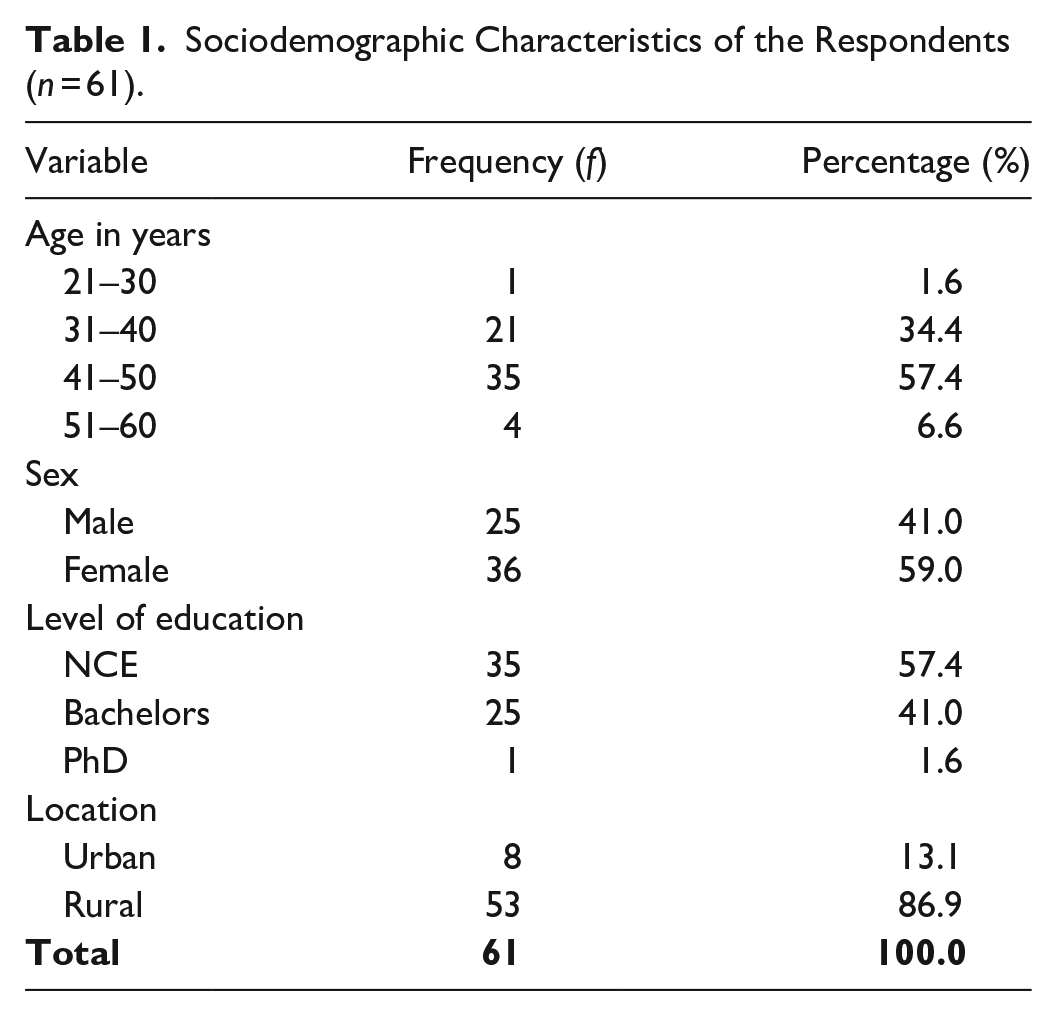
Results revealed that out of 61 respondents, those within 21 to 30 years were lowest in number 1 (1.6%), 51 to 60 years were 4 (6.6%), 31 to 40 years 21 (34.4%), and a majority of them were 41 to 50 years 35 (57.4%). It further showed that most of the respondents were females 36 (59.0%), while 25 (41.0%) were males. Based on their level of education, NCE 35 (57.4%), bachelors 25 (41.0%), and PhD 1 (1.6%). The majority of the respondents’ dwell in the rural area 53 (86.9%), while few are urban dwellers 8 (13.1%) (Table 1).
Sociodemographic Characteristics of the Respondents (n = 61).
The results of Table 2 showed that the respondents described the enrolment rate in their school before introduction of HGSFP as very low 6 (9.8%), low 31 (50.8%), high 20 (32.8%), and very high 4 (6.6%). Their perception on attendance were very low 7 (11.5%), low 33 (54.1%), high 13 (24.6%), and very high 6 (9.8%). A majority perceived retention rate as low 34 (55.7%), high 13 (21.3%), very high 7 (11.5%), and very low 7 (11.5%). They described dropout rate as very low 13 (21.3%), low 16 (26.2%), high 28 (45.9%), and very high 4 (6.6%). The head teachers rating of HGSFP from the highest to the lowest were high 30 (49.2%), very high 22 (36.1%), low 6 (9.8%), and very low 3 (4.9%) (Table 2).
Head Teachers’ Perception Before the Introduction of HGSFP.

The result of Table 3 revealed the perception of teachers after the introduction of HGSFP. The responses elicited from the following items were: provision of food in your school increases pupil’s enrolment respondents (Yes 59 [96.7%]; No 2 (3.3%)), provision of food in your school increases pupil’s class attendance (Yes 54 [88.5%]; No 7 [11.5%]), provision of food in your school reduces pupil’s dropout rate (Yes 53 [86.9%]; No 8 [13.1%]), retention of children (Yes 58 [95.1%]; No 3 [4.9%]), the food served is adequate (Yes 29 [47.5%]; No 32 [52.5%]), food varieties for students are changed regularly (Yes 57 (93.4%); No 4 (6.6%)], benefiting parents (Yes 55 [90.2%]; No 6 [9.8%]), (Table 3).
Head Teachers’ Perception After the Introduction of HGSFP.

Moreover, on the factors associated with HGSFP, the responses elicited from the following items were: Food poisoning may occur (Yes 11 [18.0%], No 39 [63.9%], Not Sure 11 [18.0%]), Government/donor withdrawal supports (Yes 22 [36.1%], No 31 [50.8%], Not Sure 8 [13.1%]), Lack of lawful framework and guidelines to support the HGSFP (Yes 37 [60.7%], No 18 [29.5%], Not Sure 6 [9.8%]), Insufficient funding (Yes 33 [54.1%], No 24 [39.3%], Not Sure 4 [6.6%]), Heavy workload for teachers (Yes 17 [27.9%], No 40 [65.6%], Not Sure 4 [6.6%]), Lack of monitoring and supervision of the food preparation to determine the quality of food and the surroundings (Yes 43 [70.5%], No 16 [26.2%], Not Sure 2 [3.3%]), and Inadequate teaching space and furniture to handle with more pupils (Yes 43 [70.5%], No 14 [23.0%], Not Sure 4 [6.6%]) (Table 4).
Head Teachers’ Perception of Factors That may be Associated With HGSFP.

Tables 5 to 8 below showed statistics chi-square (χ2), frequencies, and percentages among respondents concerning age, sex, level of education, and location. There was no significant difference in their perception based on the sociodemographics of age, sex, education level, and location (p > .05).
Percentages and Chi-Square Responses of Head Teachers on Their Perception of HGSFP Based on Age (n = 61).

Percentages and Chi-Square Responses of Head Teachers on Their Perception of HGSFP Based on Sex (n = 61)

Percentages and Chi-Square Responses of Head Teachers on Their Perception of HGSFP Based on Level of Education (n = 61).

Percentages and Chi-Square Responses of Head Teachers on Their Perception of HGSFP Based on Location of Residence (n = 61).

Discussion
The study results showed that out of 61 respondents, 30 (49.2%) rated HGSFP high. The finding agrees with a previous study conducted by Munyiri (2010). Head teachers reported that prior to program introduction, there was a low enrolment 31 (50.8%), attendance 33 (54.1%), retention 34 (55.7%), and high dropout 28 (45.9%), which was supported by Vermeersch and Kremer (2004) and WFP (2010). Additionally, they perceived decreased pupils’ dropout 53 (86.9), increased enrolment 59 (96.7%), attendance 54 (88.5%), and retention 58 (95.1%) after the introduction of HGSFP and is in line with the findings of McCann and Ames (2007), Gelli et al. (2007), Munyiri (2010), Weru (2011), Mkanyika (2014), Muriithi (2014), Sanya (2015), Aliyar et al. (2015), Yendaw and Dayour (2015), Taylor and Ogbuogu (2016), and Manful et al. (2015). Contrastingly, Desalegn (2011) and Buttenheim et al. (2011) reported less increase in enrolment, attendance, and dropout in school.
Besides, the respondents stated that the food served was inadequate 57 (93.4%), though had varieties 32 (52.5%). Similarly, Lambert et al. (2007), Munyiri (2010), Okunola, (2021), and Hopkins and Gunther (2015) reported that meals served were not meeting nutritional standards. Also, 55 (90.2%) of the respondents perceived that parents benefit, which agrees with the result of Bundy et al. (2009). Some of the challenges listed were: the absence of a legal framework and policy 37 (60.7%); insufficient funding 33 (54.1%); inability to effectively monitor the food preparation to ascertain the quality of food and the environment 43 (70.5%) and insufficient classrooms and furniture to cope with increased enrolment 43 (70.5%). Studies of Weru (2011), Lagbo (2012), Muriithi (2014), Day et al. (2015), Sanya (2015), Amoran et al. (2016), and Taylor and Ogbogu (2016) also reported the same challenges.
Age, sex, level of education, and location has no significant difference in perception of head teachers on HGSFP (p > .05).
Limitations
There was no baseline study that evaluated the program before the introduction of HGSFP. We do not know to what extent the program increased enrolment, attendance, retention, and reduced dropout rates. The head teachers and education secretaries interviewed may not have represented the views of head teachers from other schools not included. The reason is because only public school head teachers were interviewed.
Implications of the Study
Due to schools societal, policy, and economic limitations, not all schools are participating in HGSP, and non-beneficiary schools is likely to find difficult to participate in the program. For policy, the government and relevant stakeholders should scale up the program to non-beneficiary schools, adequate funds provided to the schools as the number increases. Based on our findings, the program was not monitored effectively to improving healthy food preparation and eating habits. In practice a domestic framework which is outlining the best method to carry out the HGSFP based on state peculiarities should be put in place to monitor program execution, to complement the existing legislation of feeding only primary 1–3 pupils and budget to improving school feeding monitoring. The quantity of food should be increased by creating school farms to augment the government’s contribution. Also, the introduction of legal nutritional regulations should be in place to check food nutritional quality. There should be an acceptable model put in place to ensure continuity of the program for instance, it should be domiciliary at state ministry of education and not in governor or presidency office. Subsequent research should be conducted on the impact of HGSFP to the local farmers.
Conclusion
In conclusion, the study showed that head teachers’ perception was good though they expressed concern over challenges like, lack of a lawful structure and strategy, insufficient funding, inability toward effectively monitor program implementation, insufficient classroom to cope with the increased enrolment. Sociodemographics were not significant with their perception. Program implementation agencies should improve funding, monitoring, and educational infrastructure for the Program’s smooth running.
Footnotes
Acknowledgements
The authors acknowledge the head teachers and education secretaries who participated in the project and shared their opinions with the research team.
Declaration of Conflicting Interests
The author(s) declared no potential conflicts of interest with respect to the research, authorship, and/or publication of this article.
Funding
The author(s) received no financial support for the research, authorship, and/or publication of this article.
Ethics Statement
This study was approved by the Institutional Review Board of the Ebonyi State University, Abakaliki.
