




Abstract
Passion for work is an important individual factor related to the quality of working life. Flow at work is an optimal experience in which the individual is immersed in, loves and enjoys the work. The aim of the study is to investigate the relationship between passion for work (harmonious and obsessive), flow at work (as a mediator) and exhaustion in a sample of Italian nurses. About 270 nurses participated in the study: this profession is characterized by intrinsic motivation but is also subjected to fatigue and distress. The results show that harmonious passion increases flow at work which, in turn, decreases exhaustion; moreover, flow mediates the relationship between harmonious passion and exhaustion. Obsessive passion has no significant effect on flow at work, but directly increases exhaustion. The study shows that harmonious passion and flow at work contribute to alleviate exhaustion, while obsessive passion instead increases feelings of distress.
Introduction
Nursing profession is attracting the attention of scholars because the health care sector is beset by problems, such as the growing demands of health and an aging workforce, increasing workloads, absenteeism or stress, and the resulting intention to leave the profession (Duhoux et al., 2017; Heinen et al., 2013; Martínez-Zaragoza et al., 2017; Pyrillis, 2013; Zito et al., 2013). Not surprisingly, these are some of the critical issues that can affect workers’ perceptions of well-being and enhance both psychological and physical distress among healthcare workers such as nurses (Chan et al., 2013; Zito et al., 2016; Zito, Colombo et al., 2015).
The nursing profession in any country, regardless of its socio-economic development, is considered essential and indispensable for the prevention of disease and the alleviation of suffering during and after the treatment of any disease, including COVID-19 (Buheji & Buhaid, 2020). Given the challenges of the pandemic and its impact on healthcare workers, who are exposed to several additional stressful events, it is critical to understand the psychological impact of this unprecedented health emergency.
Given these considerations, research on psychological issues in nursing is important, both in terms of promoting the health of the workforce and contributing to the quality of a service of primary collective importance.
Within the theoretical framework of Positive Psychology (Lopez et al., 2018), studies to promote quality of work life focus on aspects of worker growth (Bakker & Schaufeli, 2008), the positive aspects of the human experience (Seligman, 2008) and what leads people to live more meaningful lives. This includes the flow experience, which contributes to the development of new skills (Csikszentmihalyi, 1975, 1990) and thus a sense of mastery and participation in activities (Luthans, 2002) that promote individual growth (Delle Fave & Bassi, 1998). Moreover, studies on this topic have focused not only on the organizational aspects that can reduce discomfort, but also on the individual aspects that can influence perceptions of psychological well-being.
Among the individual factors that can influence personal perceptions of well-being at work, passion for work is identified as important (Lavigne et al., 2012; Vallerand et al., 2003). Being passionate about one’s work implies investing time in one’s job, which affects performance (Eisenberger et al., 2005), perceptions of self-efficacy, goal achievement and also the perception that job failures or successes are on the same level as personal ones.
The aim of this study was to investigate the relationship between passion for work and flow at work, on the one hand, and exhaustion, on the other, in a sample of Italian nurses.
Flow: An Optimal Experience
Csikszentmihalyi (1990) considered flow as a mental state of consciousness or an inner experience that comes from engaging in an activity that is perceived as pleasurable, in which one is completely immersed so that everything else falls away. Flow is considered a desirable autotelic experience that occurs in situations and activities in which people focus their attention on realistic goals (Csikszentmihalyi, 1990, 1997). People can be in a flow state when their attitudes and skills are above average (Csikszentmihalyi, 1975, 1982, 1990) and enable them to respond appropriately to challenges. When people have the necessary attitudes and skills, they can have optimal experiences, acquire and develop new skills, and increase their self-worth (Bakker & Schaufeli, 2008; Waterman et al., 2003).
Flow has been shown to occur in many leisure activities, such as playing sports (Harmison, 2006), engaging in the performing arts, making music (Tietze, 2008), dancing, and participating in reflective activities (Catley & Duda, 1997; Csikszentmihalyi, 1990). In addition, authors have suggested that flow may also occur at work (Bakker, 2008; Csikszentmihalyi & LeFevre, 1989; Demerouti et al., 2012). However, evidence (Csikszentmihalyi & LeFevre, 1989; Haworth & Hill, 1992; Nielsen & Cleal, 2010) suggests that people are more likely to experience flow at work than in their leisure time.
Bakker (2008) operationalized the flow experience related to work (flow at work) and described it as a “short-term peak experience characterized by three main components: absorption, work enjoyment, and intrinsic work motivation” (p. 401). Total immersion in a work activity is called absorption. During absorption, people lose track of time and what is happening around them. The term “work enjoyment” refers to experiencing happiness at work. Intrinsic work motivation is defined as performing a job activity with the intention of experiencing pleasure and fulfillment (Vallerand, 1997). Workers who are driven by the intrinsic aspects of their jobs are indeed more interested in their work and desire to accomplish more (Deci & Ryan, 1985).
Passion for Work
Vallerand and colleagues proposed the dualistic model of passion (Vallerand & Houlfort, 2019; Vallerand et al., 2003). This theme has emerged as an important concept in the literature, and its application has helped to understand pathways to a better life (Curran et al., 2015; Marsh et al., 2013). Vallerand et al. (2003) define passion as a love of an activity that a person considers very important and to which he or she actually devotes considerable energy and time. Therefore, a passionate activity is extremely significant in a person’s life and can become a crucial part of his or her identity (Carpentier et al., 2012; Mageau et al., 2009).
The dualistic model of passion (Vallerand et al., 2003) states that a person can have either a harmonious or an obsessive passion for an activity, depending on the manner and situation in which the activity is adopted in the person’s identity.
Harmonious passion is defined by significant involvement in a passionate action; it occurs when an individual has autonomously internalized an activity as part of his or her identity. This autonomous internalization occurs when a person is free to engage without external pressure because he or she values the activity. This type of internalization generates the motivation to participate in an activity that is meaningful to a person but not central to his or her identity (Vallerand & Houlfort, 2019). While a person may feel a harmonious passion, engaging in the activity that elicits that passion has implications that are consistent with other aspects of that person’s life. Moreover, recent findings by Wan et al. (2021) have supported that harmonious passion for work increases organizational citizenship behavior.
Obsessive passion occurs when the internalization of an activity as part of a person’s identity is controlled. Obsessive passion is characterized by intrapersonal or interpersonal pressures and contingencies associated with an activity (e.g., emotional states related to social recognition or self-esteem or uncontrollable enthusiasm for the activity) that compulsively cause a person to pursue the activity in question. Because it is a passionate activity, the person enjoys it, but it is as if he or she is compelled to engage in it because of the internal forces and connections that control it. This type of passion involves an intense commitment that is beyond the individual’s control. This lack of control makes the activity so pervasive and can lead to conflict with other aspects of personal life. Obsessive passion causes conflict between the passionate activity and other areas of life and causes rigid engagement and persistence (Seguin-Levesque et al., 2003). Therefore, the two forms of passion (harmonious vs. obsessive) can be distinguished according to how a passionate activity is accepted as part of one’s identity (Vallerand et al., 2003). For this reason, the harmonious and obsessive dimensions are on a continuum and are positively correlated.
The concept of passion is also related to work activity, as highlighted in several studies (Donahue et al., 2012; Lavigne et al., 2012; Marsh et al., 2013; Vallerand & Houlfort, 2003), indicating the fundamental role of this topic in industrial and organizational psychology. Indeed, work is an essential and ongoing activity in a person’s life that requires both time and energy. According to Vallerand and Houlfort (2003), work can be an important part of a person’s life and contribute to his or her self-definition and identity. Therefore, the dualistic model of passion can be applied to the work experience in addition to other activities, and Lavigne et al. (2012) note that it is critical to consider both dimensions to understand a person’s engagement in their work. In addition, passion for work may also be an important individual factor that can affect perceptions of well-being or stress (Lavigne et al., 2012; Vallerand et al., 2003), and thus the quality of work life.
Like vigor, dedication, and absorption, concepts that also appear to be related to work engagement described as a state of mind (Schaufeli & Bakker, 2004), harmonious passion is considered a type of work involvement (Schaufeli et al., 2002) that can promote positive work outcomes (Schaufeli et al., 2008). However, the second type of passion - obsessive passion - can be detrimental to psychological well-being (Pollack et al., 2020), even if it is characterized by a strong commitment and dedication to a beloved activity. While there are some similarities between the above constructs and the concept of passion, there are also significant differences.
Studies have shown that harmonious passion can reduce emotional exhaustion and increase job satisfaction (Carbonneau et al., 2008; Pollack et al., 2020). Harmonious passion for one’s work is associated with job satisfaction, pleasant feelings, and low psychological difficulties (Spehar et al., 2016; Vallerand et al., 2010). Finally, it has been shown to be associated with job satisfaction and low emotional exhaustion. In contrast, obsessive passion is associated with high levels of conflict, which in turn is associated with increased emotional exhaustion (Vallerand et al., 2010).
The Present Study
Within the theoretical framework of Positive Psychology, the present study intended to examine the relationship between passion for work, flow at work, and exhaustion in a sample of 270 nurses. Nursing is a profession characterized by intrinsic motivation but also fatigue and distress. Several studies describe exhaustion as a long-term consequence of strain and experiences with excessive job demands (Demerouti et al., 2001) that affect individuals energy use and the performance behaviors at work (Halbesleben & Bowler, 2007). Furthermore, exhaustion is related to emotional job demands, particularly in health operators. Several studies have shown that exhaustion affect worker performance and turnover intentions (Cropanzano et al., 2003; Wright & Cropanzano, 1998), as well as absenteeism (Deery et al., 2002), all of which are organizational problems.
While nursing is a profession characterized by a high level of job demands in terms of tasks and relationships with suffering patients, it is also an engaging and motivating profession (Bringsén et al., 2011; Martínez-Zaragoza et al., 2017; Zito et al., 2019; Zito, Bakker et al., 2015). The nursing profession is subject to what Csikszentmihalyi (1997) called the “work paradox”: on the one hand, nurses report positive experiences of satisfaction and pleasure related to a high level of motivation; on the other hand, they report fatigue and a desire to quit their work. This ambivalence seems to be due, in particular, to the type of relationship individuals establish with their work and the way they perceive the purpose of their work (Arnold et al., 2007), which could also affect their perception of job demands and resources.
Aspects that most often prove critical and demotivating include a lack of variety and professional challenge, interpersonal conflict in the workplace, patient and pain management, workload, and work pressure that leads to stress and discomfort. The pandemic has further highlighted the stressful and demanding nature of nurses’ work and the long-term effects of stress and anxiety related to work pressure and COVID-19 on nurses’ job performance and job satisfaction, leading to frequent absenteeism and turnover (Labrague & de Los Santos, 2021). For this reason, it is important to recognize the importance of supporting motivational dynamics that can reduce perceptions of work fatigue and exhaustion, promote quality of work life, and enhance the service provided (Nayeri et al., 2009).
Therefore, we have articulated the following hypotheses:
Hypothesis 1. Harmonious passion for work has a negative relationship with exhaustion.
Hypothesis 2. Obsessive passion for work has a positive relation with exhaustion.
Hypothesis 3. Flow at work has a negative relation with exhaustion.
Hypothesis 4. Harmonious passion for work has a positive relation with flow at work.
Based on the flow theory and its absorption dimension, we hypothesize a positive relationship between obsessive passion for work and flow at work:
Hypothesis 5. Obsessive passion for work has a positive relation with flow at work.
Therefore, the present study also aims to investigate the mediating role of flow experiences in the relationship between harmonious and obsessive passion and exhaustion (Forest et al., 2011; Lavigne et al., 2012; Philippe et al., 2009; Vallerand et al., 2003).
Hypothesis 6a. Flow at work mediates the relation between harmonious passion for work and exhaustion
Hypothesis 6b. Flow at work mediates the relation between obsessive passion for work and exhaustion
Figure 1 shows the conceptual model and the expected relations.

Conceptual model.
Methods
Participants and Data Collection Procedure
The study was conducted in a North-West Italian hospital and involved a sample of nurses. Each participant received a questionnaire from the researchers along with a cover letter explaining that participation in the study was voluntary and unrewarded, guaranteeing anonymity and confidentiality of the data, and providing instructions on how to complete the questionnaire. Finally, participants were asked to sign the informed consent. Each participant sealed the completed questionnaire in an envelope provided by the researchers and returned it to the collection boxes.
About 436 nurses received the invitation to complete the questionnaire and 313 completed it (response rate 71.8%). During data cleaning, 43 incomplete questionnaires were excluded, resulting in a final sample of 270 respondents, representing 61.9% of the nurses participating in the study.
Ethical Statement
The Hospital’s Board of directors reviewed and approved the research project. The study did not require medical treatments or other procedures that might cause psychological or social discomfort in participants, so no further ethical approval was required. The study was conducted in accordance with the Helsinki Declaration (World Medical Association, 2001), the conceptual model and expected relationships were defined, and data protection was carried out in accordance with Italian state regulations. The Department signed an agreement guaranteeing anonymity and confidentiality in the collection, analysis, and publication of the data. Participants did not receive any reward and voluntarily participated in the study.
Instruments
The demographic component of the questionnaire assessed both personal (gender, age, and children) and professional aspects (time allocation, weekly working hours, and seniority in the organization) of the participants.
Furthermore, the questionnaire considered the following scales:
Data Analysis
Data analysis was performed using SPSS 25 and included descriptive statistics, Cronbach’s alphas (α), and correlations (Pearson’s r) between all variables. A Structural Equations Model was estimated using MPLUS 7 (Muthen & Muthen, 1998) to assess the relationship between the variables and the mediation of flow at work between harmonious passion, obsessive passion, and exhaustion. The relationships between variables and hypotheses were specified a priori, leading to the choice of a partial mediation model (James et al., 2006).
The following were used to assess the goodness of fit of the model: the Chi-square value (χ2), the Comparative Fit Index (CFI), the Tucker-Lewis Index (TLI), the Root Mean Square Error of Approximation (RMSEA), and the Standardized Root Mean square Residual (SRMR). As recommended in the literature (Kline, 2016): values of RMSEA smaller than 0.08 indicate an acceptable fit; CFI and TLI values greater than 0.95 indicate a good fit. The SRMR has a range from 0 to 1, with a cut-off criterion of 0.08, with higher values indicating poorer fit to the empirical data, and values lower than 0.05 indicating an excellent fit.
The latent variables of the model (harmonious passion, obsessive passion, and flow at work and exhaustion) were operationalized by a parceling method: the indicators of all latent variables are parcels (aggregate-level indicators comprised an average of two or more items). In the Structural Equations Model all parcels reported significant loadings (p < .00). Moreover, ML estimator and standardized data were considered.
From a methodological standpoint, the sample size (N = 270) is adequate for the structural equation model performed in this study, in accordance with methodological recommendations that prescribe a minimum sample size of 100 or 200 (Boomsma, 1985) and assume that samples that are not too large will provide accurate estimates (Boomsma, 1987).
Results
The majority of the participants were female (91.80%), in line with the particular professional sector, had children (65.90%), and a mean age of 43 years (SD = 8.60). Regarding professional characteristics, most respondents had a full-time employment contract (81.60%), worked an average of 36 hours per week (SD = 6.10), and had an average job seniority of 15 years (SD = 9.70).
Looking at the scales’ psychometric characteristics, the Cronbach’s alphas ranged from .73 to .91 and were satisfactory (Nunnally, 1978). Moreover, a test to exclude multicollinearity was also performed: the data showed VIF values between 1.3 and 2.4 (tolerance between 0.41 and 0.74) which, according to James et al. (2013) are under the value of 5 and they are not cause of concern. However, in this study the parceling method has been applied: it allows to avoid the violation of normality assumptions reducing Type I and Type II errors in the model estimation (Bakker et al., 2012; Little et al., 2002; Yang et al., 2010).
As for correlations (Table 1), all variables show significant relationships with each other. In particular, flow at work is strongly and positively correlated with harmonious passion (r = .79), with obsessive passion (r = .54), and negatively correlated with exhaustion (r = −.53). Moreover, harmonious passion and obsessive passion show significant and negative correlation with exhaustion: harmonious passion shows a higher correlation (r = −.45) than obsessive passion (r = −.17).
Means, Standard Deviations, Cronbach’s alphas, and Correlations (Pearson’s r).

Note. Cronbach’s alphas are on the diagonal (between brackets).
p < .01 level.
The estimated structural equations model (Figure 2) shows very good fit indices: χ2(21) = 77.15, p < .001, RMSEA = 0.08; SRMR = 0.05; CFI = 0.96; TLI = 0.93. Furthermore, the χ2/df ratio is 3.67, included in the suggested range between 2 and 5 (Kelloway, 1998), indicating a good fit to the data.
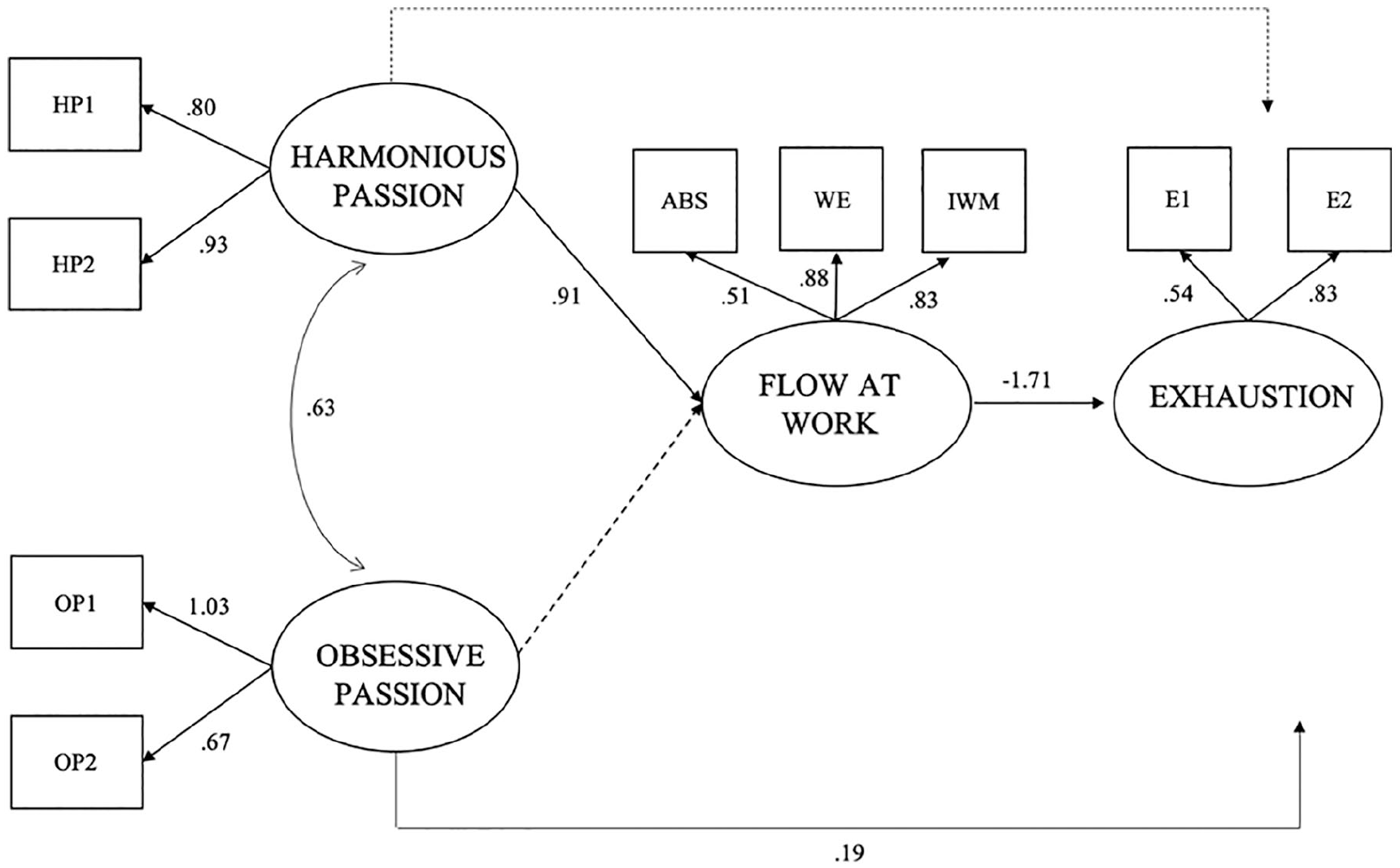
Estimated structural equations model.
The model displays that the relation between harmonious passion and exhaustion is not significant, Hypothesis 1 is not confirmed. Obsessive passion is positively associated with exhaustion (β = .19), Hypothesis 2 is confirmed. Moreover, flow at work is highly and negatively associated with exhaustion (β = −1.71), confirming Hypothesis 3. Harmonious passion is highly and positively associated with flow at work (β = .91), Hypothesis 4 is confirmed. Obsessive passion is not significantly related to flow at work and Hypothesis 5 is not confirmed.
As for the indirect effects achieved in the model estimation, the expected negative association between harmonious passion and exhaustion is increased by the mediation of flow at work (β = −1.54; s.e. = 0.04; p < .000), confirming Hypothesis 6a. The association between obsessive passion and exhaustion through the mediation of flow at work is not significant, not confirming Hypothesis 6b.
Discussion
This study addressed the particular situation in the healthcare sector, such as the growing demands of healthcare and the aging workforce, the increasing workload, absenteeism or stress, and the resulting intention to leave the profession. As highlighted, this does not only affect Italian nurses, but is considered as a cross-national problem, expressed in various studies by a decrease in the well-being of workers and an increase in the psychological and physical distress in healthcare workers, such as nurses (Chan et al., 2013; Zito et al., 2016; Zito, Colombo et al., 2015). To ensure the quality of working life and nursing service, it is important to recognize these aspects. We also argued that studies on this topic have not focused only on the organizational aspects that can reduce discomfort, but also need to consider the individual aspects that can influence perceptions of psychological well-being. Therefore, we identified a model that focuses specifically on the perception of well-being at work, both from the side of optimal experience, and from the personal and passionate standpoint. The main objective of the present study was to deepen the understanding of the relationship between the dualistic model of passion (Vallerand et al., 2003) and flow at work (Csikszentmihalyi, 1990) in a sample of Italian nurses. Specifically, the study examined the relationships between the two dimensions of passion (harmonious and obsessive passion) and worker exhaustion and explored the mediation of flow at work in the relationship between passion and exhaustion.
Based on the results, it is possible to confirm some of the hypotheses. Harmonious passion for work was strongly and positively associated with the experience of flow, consistent with studies suggesting a positive relationship between passion and flow at work (Vallerand & Houlfort, 2003). In this study, harmonious passion for work appeared to protect workers from exhaustion by enabling the frequent occurrence of flow experiences, a finding consistent with the suggestions of Vallerand and Houlfort (2003).
Moreover, a significant and direct relation was shown between obsessive passion and exhaustion, but not with flow. This result confirms that passion for work can have positive effects on psychological health, but it should remain a controllable activity and be consistent with the other elements of one’s life.
In the present study, experiencing flow at work was found to reduce exhaustion and play a mediating role in the relationship between harmonious passion and exhaustion, a finding that is in accordance with studies indicating the mediating role of passion in burnout dynamics (Forest et al., 2011; Lavigne et al., 2012; Philippe et al., 2009; Vallerand et al., 2003).
The results suggest that harmonious passion, along with flow, contributes to reducing exhaustion, whereas obsessive passion exacerbates feelings of malaise. The results highlight how flow experiences can be a protective factor against exhaustion; this protective effect works synergistically with harmonious passion experiences.
The results of the present study are consistent with several studies that have linked optimal experiences at work with passion and burnout (Lavigne et al., 2012; Vallerand et al., 2010), underscoring how the experience of harmonious passion facilitates flow experiences, which in turn reduce exhaustion. In general, these studies define harmonious passion as an “antidote” to burnout by promoting flow experiences (Vallerand et al., 2010).
An interesting point to note is the positive correlation between obsessive passion for work and flow at work. As might be expected, this result is not entirely surprising and can be explained by the absorption side of flow at work. More specifically, a person who has developed an obsessive passion for his or her work will perceive his or her work as important and will be devoted to and absorbed in it. These aspects are among the characteristics of flow at work (Bakker, 2008) and agree with the assumption that a high workload or commitment, both typical of nurses, may lead to greater absorption in work, which is one dimension of the construct of flow at work (Bakker, 2008). This finding is an important point because it opens another perspective on the nursing profession. Although nursing is a profession characterized by a high risk of burnout and intentions to leave the profession (Zito, Bakker et al., 2015), nurses often report high levels of engagement in their work and positive experiences of satisfaction and pleasure; these experiences are associated with high levels of motivation and thus represent the so-called work paradox (Csikszentmihalyi, 1997). The reasons for the ambivalence between involvement and burnout seem to lie in the nature of the relationship individuals establish with their work and in the way they perceive work to be highly significant (Arnold et al., 2007).
The estimated structural equations model used in this study did not confirm the negative impact of obsessive passion on flow dynamics. It is crucial to note this result. Therefore, it is important to consider and monitor aspects of obsessive passion and its impact on the individual’s well-being and malaise. It may be that individual has internalized the belief that his or her work is important, perhaps too important compared to other life domains, or that he or she likes, loves, or is satisfied with it. In the long run, however, such obsessive passion could conflict with other aspects of life, undermining people’s health and well-being.
Conclusions and Practical Implications
The results of the study show the importance of a balanced engagement with one’s work, which helps to increase the likelihood of optimal experiences and decrease negative experiences in the work context
It seems important to make workers aware of the risks associated with an obsessive relationship with their work. Indeed, obsessive passion is a predictor of exhaustion, which has been shown to be related to turnover intentions (Babakus et al., 1999; Cropanzano et al., 2003; Wright & Cropanzano, 1998) and absenteeism (Deery et al., 2002). Organizations should encourage and facilitate research on harmonious passion for work, as such passion can lead to optimal experiences that protect against exhaustion. Organizations should encourage their employees to adopt a harmonious passion, as this may lead them to experience flow more often and consequently experience fewer burnout symptoms than in work environments that facilitate the adoption of an obsessive passion.
Furthermore, healthcare organizations should seek to increase the likelihood that workers experience flow at work by promoting Positive Psychology Interventions at work (Donaldson et al., 2019), which aim to ensure the availability of work resources that can facilitate the experience of flow (Bakker & Schaufeli, 2008; Emanuel et al., 2016; Zito, Bakker et al., 2015) and promote physical well-being (Bakker & Demerouti, 2007; Demerouti, 2006). Such resources can activate a virtuous cycle that fosters positive experiences that help workers develop their own enduring personal resources (Salanova et al., 2006).
The findings of this study highlight the need to invest in preventing stress and promoting health in organizations, especially in the context of the outbreak of COVID-19. To encourage flow experiences among hospital staff, the work environment should provide a combination of challenges and opportunities to apply high-level skills. In addition, employees must have an accurate understanding of their own capabilities and be confident that they can handle the demands of a task by making appropriate choices and having the desire to get it done. Therefore, listening space is needed to uncover nurses’ unpleasant emotions and highlight the positive aspects of their work, such as its purpose and meaning under adverse conditions. This would strengthen the response of health care workers and enable organizations to provide safe and robust care in the future.
In addition, strong leadership can enhance nurses’ engagement in their job. In this regard, nursing administrators can play a key role for the health care workforce.
Limitations and Future Research
This study has several limitations. First, the results cannot be generalized due to the small sample size and the inclusion of a single organizational context. This study could be replicated in other organizations to identify trends in passion dynamics and fluctuations in flow experiences. However, consistent with previous research (Zhu et al., 2021), our findings are important for healthcare professionals who are expected to work to protect public health during the pandemic.
Second, the present study used a cross-sectional research design that does not allow for causal relationships among variables (Podsakoff et al., 2012). In future research, diary studies and longitudinal designs would be necessary to draw conclusions about the causal relationship proposed in our study model and could contribute to a better understanding of nurses’ passion for their jobs and experiences of flow in their work.
The use of self-report questionnaires is another limitation of this study. The use of such questionnaires may potentially bias the results, as the observed data may be artificially inflated due to the tendency of respondents to answer consistently. Future research should consider other methods of data collection (e.g., qualitative interviews) to corroborate the relationship patterns reported in the current study.
In this study, we only considered exhaustion as an outcome. Future studies could examine the relationship and influence between obsessive passion and negative outcomes such as work-family conflict or negative spillover between work and personal life. The effects that obsessive passion might have on the relationship between work-life balance dynamics should be carefully considered.
Similar to previous studies (Landay et al., 2022), we hope that our findings could stimulate future research to capture the extent to which the role of passion might predict concrete and important outcomes in nursing.
Moreover, future studies could also uncover fluctuations in flow and passion among workers, considering different job tasks and differences across hospital units. This would be observed through a multi-group analysis, which allows analyses to be conducted among different categories simultaneously.
A harmonious love for work, according to our article, leads to a state of flow at work that seems to protect against fatigue. It has also been argued that an obsessive passion for work is detrimental to workers’ psychological well-being. Thus, the article highlights the importance of deepening research on passion and flow in the work context to understand workers’ psychological well-being.
Footnotes
Declaration of Conflicting Interests
The author(s) declared no potential conflicts of interest with respect to the research, authorship, and/or publication of this article.
Funding
The author(s) received no financial support for the research, authorship, and/or publication of this article.
Ethical Statement
The Hospital Board reviewed and approved the research project. The study required no medical treatments or other procedures that could trigger psychological or social discomfort in the participants, so no further ethical approval was required. The study was carried out, and the conceptual model and expected relationships were defined according to the Helsinki Declaration, and data protection was carried out in compliance with the Italian country’s regulations. The Department of Psychology of the University of Turin has signed an agreement that guarantees anonymity and confidentiality in the collection, analysis, and publication of the data. Participants did not receive a reward and volunteered to take part in the research.
