



Abstract
Blended learning is fast becoming the new normal and increasingly considered an integral part of program offers within higher education (HE) institutions. Although there is a general consensus about online and physical face to face components, which constitute a framework for blended learning models. There are variances on how these components should be combined, established, and delivered. Empirical evidence on teachers’ perceptions of these elements is also limited. This qualitative study used focus groups to gather teacher perspectives of blended learning models, which produced three major themes related to professional development, student success, and blended courses. A sample of teacher from this group was most relevant to the study because they were involved in the implementation, and iterations, of blended learning at their HE institution for three semesters. Their experiences and perceptions provided highly relevant insights on what constitutes an effective blended leaning model. This study confirms previous empirical claims on the importance of professional development in increasing teacher efficacy. But also reveals the role of self-learning, informal communities of practice and their impact on changing teacher perceptions, which in turn improve efficacy. The study also highlights effective communication, course materials, course design and how blended learning environments are set-up, as crucial elements of an effective blended learning model. Teachers perceived these elements as the biggest influences on student success. This study provides important insights for educational institutions seeking to establish or improve their blended learning strategy and enhance student experience.
Introduction and Context
The Higher Colleges of Technology (HCT) is the largest higher education institution in the United Arab Emirates (UAE). With over 23,000 students spread across 16 modern campuses dotted around the country, HCT plays an integral role in the UAE’s educational ecosystem and is considered a leader in applied and technological education. The General Academic Requirement Division (GARD) is represented in all 16 campuses. General Studies is one of the three sub-divisions within GARD, it provides students with academic support and prepares them for their degree programs. As students undertake their degree programs they also complete General Studies courses that further enhance their academic and personal development (Higher Colleges of Technology [HCT], 2020).
In 2017, the General Studies (GS) division at HCT undertook an ambitious strategic change and piloted different blended learning models. GS aimed to enhance student learning experience, innovate curriculum delivery to address the challenges and opportunities posed by the fourth Industrial Revolution and improve efficiency. These changes also reflected the HCT’s evolving strategy which sought to provide students with greater choice, autonomy and tailor education to individual student needs.
General Studies ran small scale pilots which experimented with different delivery models between 2017 and 2018. The pilots were data driven which also informed iterations from one semester to another. A model was adopted across the division at the end of 2018, fully implemented in the first semester of 2019. In order to facilitate this strategic change all GS courses were standardized and cross-listed at the end of 2017, on HCT’s learning management system, Blackboard Learn (BBL). This paper focuses on teacher perception of this technology transition and adoption.
At the beginning of the 2018 academic year (September 2017) General Studies experimented with two distinct delivery models;
Fully online delivery where students from any of the 16 campuses could enroll onto a course. Each course within General Studies has three credits and a four-hour requirement, which is equally split. Students attended 2 hours face-to-face (F2F) online classes using the collaborate function on Blackboard Learn (BBL). The remaining 2 hours were online independent studies which prepared students for the F2F classes, best described as flipped classes (Figure 1).
The second delivery model piloted a blended approach with students physically attending F2F classes (on campus) and taking flipped classes online. This delivery model was introduced incrementally. For example, in the first semester of 2018 students still physically attended 4 hours of F2F classes and flipped class were offered as supplementary online components. In the second semester of 2018 a consolidated version of the blended learning model was applied to three different courses. Three teachers who taught four classes each, across two campuses, were involved in this pilot. Thus, a total of 12 different classes with over 250 students were involved in this phase of the pilot. Unlike the first phase this pilot had one-hour asynchronous online flipped class, 2 hours F2F class and 1-hour online tutorial each week. In the, short, summer semester of 2018 (May to June 2019) the pilot was extend to all courses across General Studies (Figures 2 and 3).

Phase 1 fully online model semester 1, 2018.

Phase 1 blended learning model semester 1, 2018.
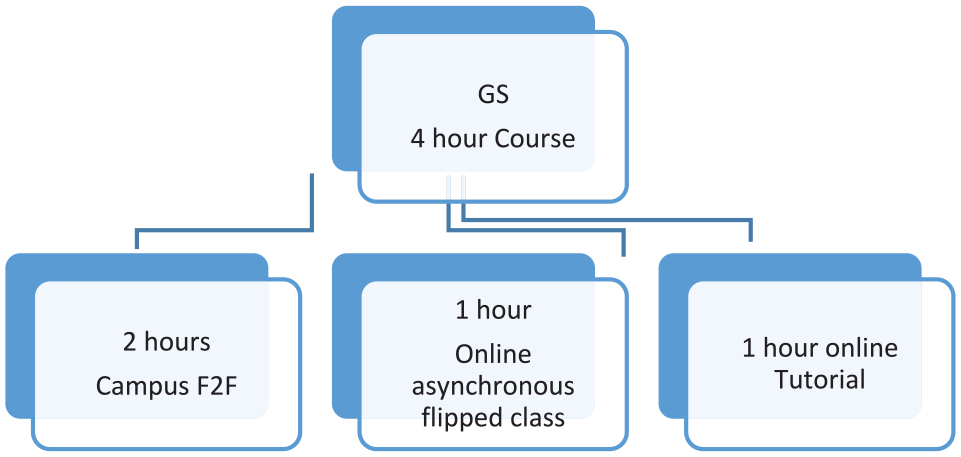
Phase 2 blended learning model semester 2, 2018.
Data from the second phase was analyzed and used to make further iterations. The first semester of 2019 (September 2019) an adjusted blended learning model was offered across General Studies courses. This included 1 hour of asynchronous flipped class, 2 hours of physical F2F classes, and 1-hour synchronous online tutorial. This model was further iterated in the second semester of 2019 (January 2020—Figure 4), which comprised to 2 hours physical F2F classes and 2 hours of asynchronous online flipped classes.

Established blended learning model semester 2 2019 .
Blended Learning
In the search for an effective blended model the General Studies Division experimented with a number of small-scale pilots, some of which were iterated from one semester, or phase, to another. Models tested can be categorized as enhancing, blended, hybrid, or online (Garrison & Kanuka, 2004). Extensive work went into studying each phase and making adjustments to enhance student learning experience. The blended learning (BL) model finally adopted and implemented was a result of four iterations.
In their comprehensive analysis of institutional drivers and barriers to BL adoption in higher education, Porter et al. (2016) identify three stages of institutional adoption and implementation. The journey General Studies took in implementing an effective blended model and its increasing levels of maturity would indicate it currently sits at stage three. For example, the pilots enabled GS to establish strategies, structures and support that deliver an effective BL model that is reliable and in line with student needs (Porter et al., 2016).
This particular paper focuses on teacher perceptions of moving from a traditional delivery model to a BL model. By capturing teacher perceptions and what influenced these over an extended period, this study provides a unique perspective of the factors which teachers perceived as challenges and aids to implementing BL.
The term blended learning has evolved along with technological advancements and how we apply these within the educational context. In the not so distant past the term blended could have included self-paced, remote, and part-time learning models (Hogg & Doig, 2012). Synonymous with terms such as e-learning, virtual learning, and online learning, blended learning has emerged as the front runner in describing a mode of learning that is increasingly considered the new normal (Dziuban et al., 2018; Hrastinski, 2019). A concise definition of blended learning lacks consensus but in broad terms these delivery models combine online and F2F teaching (Garrison & Kanuka, 2004; Graham, 2006).
The various variations in which online and F2F methods are combined has meant that the term blended learning is loosely used to describe a wide range of these models. However, the different measures of face to face and online learning, and what classifies a course as blended, still vary. For example, Graham and Robison (2007) classified, courses that included a 25% or above component of online learning as blended. Whereas other studies focus on the qualitative aspect of the blend and whether it led to greater student success (Hiasat, 2018). More importantly, the same study highlighted that although a number of courses were blended the pedagogical strategies did not change. Therefore, an important differentiation was identified between BL models that seek to either enhance or transform students’ learning experience (Garrison & Kanuka, 2004; Graham & Robison, 2007). In highly technology-driven educational contexts, the later has to be an institutional goal.
Along with the measures that classify courses as blended, the terms that constitute blended learning, F2F and online, are often convoluted. For example, the most widely used definitions of blended learning either define BL as a combination of F2F instruction with computer-mediated instruction (Graham, 2006) or as “the thoughtful integration of classroom F2F learning experiences with online learning experiences” (Garrison & Kanuka, 2004, p. 96). In blended classrooms today elements such as F2F instruction, computer mediated, or online experiences are interchangeable. For example, online can further devolve into live streaming, F2F, or static online content. The latter being more akin to a flipped classroom. Whereas F2F in a physical classroom often includes online learning experiences and students who have joined remotely. Therefore, it is important to make a differentiation between BL models that included physical and virtual classrooms (Hrastinski, 2019). The differences here have huge implications for pedagogical strategies and essentially constitute courses, and student experiences, that are radically different in nature (Porter et al., 2016).
The wide variations of blended learning are not the main focus of this paper and therefore have not been granted an in-depth focus. Literature shows that blended learning is still evolving (Hogg & Doig, 2012; Hrastinski, 2019) and therefore empirical enquiry is served better when the focus is context specific (Aspers & Corte, 2019; Creswell, 2014). In the researcher’s context the broad definition that describe blended learning as a combination of online and F2F delivery would suffice. The specific nature of how these two elements are combined have been outlined in the previous section.
As the BL model at the HCT evolved, different combinations were tested, however, upon maturity a 50/50 combination was adopted. One of the reasons for adopting this combination was students’ learning needs at the institution. Again a deeper outlook on this aspect has been discussed in an upcoming paper (White et al., 2020). However, it would suffice to mention that students at HCT are second language learners, have a varied range of academic ability and have diverse secondary education background. Therefore, a blend that provides effective individual support, whilst encouraging independence was adopted (Hiasat, 2018).
Previous studies have highlighted the effectiveness of in-class F2F instruction in relation to student development, support, and group accountability. These studies also present online sessions as equally important, as they work in tandem to support students’ skills, independence, and individual accountability (Collopy & Arnold, 2009; Ghafar, 2020; Hiasat & Pollitt, 2019). Student accountability in blended learning is a major challenge for teachers, however, if addressed it fosters students’ self-efficacy and increases the likelihood of student success (Collopy & Arnold, 2009; Gonzalez, 2020). At HCT blended learning courses were designed to ensure basic knowledge and background content was provided to student in the online (flipped) session. The F2F sessions were primarily designed as workshops where students applied their learning and demonstrated competences in meeting specific learning outcomes. These elements combined should establish a robust blended learning model that complements student needs in the HCT and wider UAE context. However, success of these models is also heavily dependent on teachers’ perceptions (Frazer et al., 2017; Hiasat & Pollitt, 2019; Porter et al., 2016).
Teacher Perceptions
This paper adopts the constructivist approach to understand teacher perceptions and how they impact blended learning. Although there are many variations in the constructivist outlook on psychology and philosophy, at its core constructivism is based on an assumption that knowledge accumulation is mapped to a process of construction. Individuals construct this knowledge based on inputs of, distinct personal and shared experiences, interventions, interactions and their context. This construction process influences how individuals act and behave in different situations (Fosnot, 2013; Gerstenmaier & Mandl, 2001).
The constructivist view would suggest teacher perceptions of new blended learning initiatives are determined primarily by two constructs. These would include the teacher’s existing knowledge or previous experiences related to blended learning, and the new sensory experiences whilst interacting with the phenomenon (Gerstenmaier & Mandl, 2001). Clinical evidence confirms the interplay of what “I already know” and what “I am experiencing” now, effects on how I perceive things and ultimately behave (Snyder et al., 2015). Positive perceptions are more likely to lead to better engagement and increased success. These perceptions can be influenced by a number of factors. However, within the educational context professional development is widely accredited as the main factor in improving perceptions and teacher self-efficacy when it comes to new initiatives, like blended learning (Gardner et al., 2019; Hattie & Anderman, 2019; Porter et al., 2016; Ross & Bruce, 2007).
Despite central role of perception in influencing behavior, we need to acknowledge the challenges in measuring and interpreting perceptions, which punctuates the issue of reliability. Furthermore, these perceptions do not always lead to expected correlations. For example, a longitudinal study of 75 state schools in Idaho, United States, found that positive teacher perceptions did not necessarily have a positive correlation with student outcomes (Scott et al., 2014). Nevertheless, teachers were the primary actors in constructing and implementing blended learning within this context.
These and other afore mentioned discrepancies call for further investigation. Significant work has been done on institutional adoption and implementation of online learning, and teacher perceptions. However, empirical knowledge is still lacking when it comes to what influences teacher perception over a prolonged period of time. Specifically, the perceived challenges and solutions of teachers at the forefront. Unraveling their perceptions as they traversed this journey can potentially provide the most reliable insights when it comes to determining key challenges and opportunities in establishing blended learning models (Gerbic, 2011; Porter et al., 2016).
Methodology
This study adopted a qualitative approach and an online focus group, conducted through Blackboard Learn Collaborate, to collate experiences of teachers who were using a common blended learning approach to deliver class. This study employed purposeful and criterion-based sampling techniques to ensure relevant perspectives were included to enhance credibility and utility (Filstead, 1979). In order to provide a narrower focus, the study homed in on teachers who were directly involved in delivering blended learning classes at the same higher education institute. Purposeful sampling helped identify participants and sought volunteers from a group of teachers that were directly involved in the BL initiative and whose experiences were relevant to the study (Creswell, 2014). Criterion sampling helped qualify participants and ensured the most suitable participants were invited to participate, which also added to the credibility of the research. This approach ensured a credible sample was employed whose experiences were highly relevant and most suitable in answering the research question (Creswell, 2014). This approach also provided a deeper understanding of critical issues affecting teachers (Flick et al., 2004), enabling the consolidation of findings and justification of conclusions (Denzin & Lincoln, 1994).
As the BL initiative was being led by the General Studies (GS) division, teachers from this division were invited to participate on a voluntary basis. The main criteria required the sample to have taught using the BL model for at least two semesters. A request for volunteers was sent to GS teachers across all HCT campuses. A total of 16 teachers responded, out of whom ten could attend the focus group at a common free time. This study adhered to the British Sociological Association’s code of ethics (BSA Statement of Ethical Practice, 2017). As the part of the approval process to collect data on campus, the institution’s Applied Research Committee reviewed the proposal and approved the ethics clearance on the basis that there was little or no risk involved to human participants.
Research Questions
This study aimed to understand teacher perceptions of BL and what influenced these perceptions. The study also aimed to explore teacher perceptions of key challenges and opportunities related to blended learning in a higher education institution and how the perceptions may be addressed through teachers’ perspectives. Some of the sub-questions included:
What were teachers’ perceptions of their own abilities and did these change over time?
What are teacher perceptions of BL and its impact on student learning?
What are some of the key challenges and opportunities in implementing BL, and how can these be overcome?
Focus Group
An online, informal focus group was held on Blackboard Learn Collaborate. This platform was deliberately chosen to minimize technical and logistical issues because participants were using the platform on a daily basis and could join from anywhere in the country. Ten participants were invited from across the 16 different HCT campuses. Nine attended the hour and a half focus group.
The prompts included:
How confident were you in own ability to use BL. Did these confidence levels change over time? Which factors influenced confidence levels?
What was the impact on course design and delivery when you adopted BL?
How did BL impact your teaching and student learning?
What are the main challenges and opportunities?
Does it enable students to develop skills such as collaboration, communication?
Procedure
Focus group questions were used as prompts only and did not need strict adherence. Participants were allowed to discuss issues they felt were most pertinent within a specific area. At times the researchers interrupted to refocus the conversation, sought clarification or delve deeper. However, the conversations were participant led. As specialist experts, participants were able to provide context-rich and highly relevant information. Discourse analysis was used to draw out the most relevant themes. Due to word constraints, only a limited number of excerpts were included, but sufficient to involve the reader in the meaning making process (Creswell, 2014).
Before outlining the themes, is it important to mention the online focus group, which delivered noteworthy advantages. It enabled participants from geographically dispersed sites across the country to take part in the research. The fact that all participants frequently used Blackboard Learn Collaborate (BBLC) and were appropriately familiar with it, meant that unlike previous studies, no technical difficulties were faced (Kite & Phongsavan, 2017). The online aspect of the focus group also allowed for on-time start and finish. The video recording made the transcription process easier. Most importantly, the researchers felt there was a fair distribution of time allocated to whoever wanted to contribute. Conversations were not dominated by specific participants, which can potentially be an issue in focus groups. Instead there was a timely transition from one research question to another. The raise hand function within BBLC also ensured every contribution was collected. The whiteboard function within BBLC was also used so participants could add thoughts, key words before or after a question had been covered, or indeed without interrupting another participant. Overall, these factors indicate that an online focus group was an efficient qualitative research tools (Luke & Goodrich, 2019).
Findings and Discussion
Three major themes and seven sub-themes emerged from the focus group. These themes represent sign posts, where most participants agreed on a discussion point. Given the nature of discussions the themes highlighted below are focused upon teacher and their ability to affect student success.
Theme One: Training and Professional Development
The theme of training and professional development (PD) includes sub-themes of preparedness and confidence. Participants emphasized the role formal and informal PD played in improving teaching practice and developing confidence of teaching in a BL environment. Self-paced, learning by doing, and learning within small professional groups was also highlighted as an important avenue for teachers to learn and enhance their teaching practice. Participants specifically commented on the impact of formal PD opportunities on their blended learning classes.
Teacher Preparedness
F1: PDs really helped me hone my skills and actually made me aware that what I did during the pilot session at the beginning was not as effective, because I started doing PDs on Nearpod and stuff like that. So I think, teachers need to have that training right from the get go and need to be made aware.
Participants also provide important insights on the balance between informal self-learning and formal professional development (PD). The benefits of informal PD, one to one in particular, have been highlighted in previous studies (Porter et al., 2016). However, there were interesting comparisons between informal learning at the beginning of the BL initiative, which is then supported by formal PD. The formal PD sessions were offered once the BL model and technology tools were established. This staggered approach was recognized in the focus group. Participants also highlighted the importance and need for ongoing informal learning opportunities within professional groups or community of practice.
F1: teachers have acted as we’ve always acted you go into the staff room. Hey, how do you do X, y,z?, I can’t do Y.
F1: I’ve been part of a WhatsApp group, which has been very supportive. So in a way we’ve been like the students. We’ve given ourselves a support group and I’ve found that teachers always do that.
D1: (informal) when **** and **** they did the training for us, on Microsoft office and one drive that really helped me in the classroom for collaborate.
K1: We both learnt something while giving that workshop, those other tips and tricks. It’s that community of practice and that is totally underrated.
Professional development had a direct impact on teacher practice within the classroom. This aspect is heavily emphasized in existing literature (Gerbic, 2011; Hiasat, 2018; Ross & Bruce, 2007). However, the excerpt below dives deeper and highlights an additional dynamic that contrasts reliance on self-learning and formal professional development. One of the participants was asked why they thought they were doing well until they had training.
F1: at the beginning I was sharing documents, like word documents. I was doing all the work eliciting from the students, busy typing up the answers. . . And then I realized (after PD), “Oh, hang on a minute. I need to be doing stuff like quizzes so I can actually see them or doing the work and I’m sitting back and then I can give feedback.” So it did improve. Quickly, but at the beginning I didn’t have the tools or the knowledge.
Informal learning opportunities do provide value. Participants felt strongly about learning from peers, recognition of these informal channels and the value they add to their own practice whether related to technology or content knowledge. The sub-theme of teacher preparedness highlights the impact of formal and informal professional development opportunities. These opportunities had a direct impact on classroom practice. Teacher were able to resolved specific issues which emerged from the transition to a blended learning model. Teacher were better prepared to deal with issues such as technology integration and student engagement after professional development activities. Interestingly, participants emphasized the balance between formal and informal training, with both elements adding value at different stages of implementing the blended learning model.
Teacher confidence
The sub-theme of teacher confidence is directly linked with teacher training and PD, but also with repetition and learning by doing. Once participants had the tools though formal or informal PD their confidence developed as they adapted and applied different teaching and learning strategies.
M1: I’m much, much more confident now I agree with **** about the quality of training that we got. . . we were exposed to new ideas and different ways to do things.
L1: I’ve gained a lot of confidence teaching online. . .. that was a really good learning experience for me, especially with the tech PD.
N1: my confidence has just gone up from one semester to the next, just by doing it literally, and learning new skills and just practicing it every day. So I feel a lot more confident.
Taking part in PD and using training materials within the same blended learning environment as the students meant teachers had to overcome the same challenges students would have potentially faced. This developed highly relevant competencies. Improvements in competencies seem to directly impact teacher confidence and their ability to deliver BL. But there were contrasting views here and a variety of perspectives.
A1: I think most people’s confidence in using the platform has gone up, but I would say the frustration has gone up as well. . . Yes. I was very confident when it was my platform and I was in control of it, but I have problems trying to find out where things are myself. I’m sure the students are still getting confused (different set-up of courses) . . . it affects my confidence
Participants shared different experiences depending on the type of course and campus. The last comment also highlights issues related to standardization, which is an important tenet of the BL (Zanjani et al., 2016). But in this case the negative impact on teacher confidence stems from the uncertainty of relying on others and inconsistencies that still remain among some courses. Interestingly, participants encompassed all of these as part of their own learning journey, at the end of which they felt capable of deliver effective BL classes.
Theme Summary
The finding here emphasizes the importance of establishing an effective PD strategy that supports teachers as they adopt BL. Specifically, a blend of PD based on formal training, recognition of informal self-learning and establishment of communities of practice. Overall, PD needs to equip teachers with the technological tools available to support teaching and learning. The findings here point to important links between PD, teacher preparedness, and confidence and teacher efficacy (Gardner et al., 2019). A blend of PD with opportunities for self-learning and access to communities of practice improved teacher preparedness and confidence. A combination of these both led to greater teacher efficacy. Interestingly, participants indicated this greater efficacy also impacted students, highlighting a symbiotic relationship between teacher and student confidence. At its core highly relevant, yet flexible and in line with teacher needs, PD enabled teachers to have positive experiences of BL. Regardless of previous experiences with BL, teachers’ new positive interactions with BL led to positive perceptions.
Theme Two: Student Success
A major talking point in the focus group was around students, with sub-themes of student motivation and preparedness. Student motivation within the BL context was connected with a range of factors, for example, year of study and course. Participants discussed a variety of issues that effected student ability to succeed in the BL classrooms. This is an important issue for institutions aiming to implement or enhance their BL models.
Student motivation
In Higher Education the issue of student motivation is different when compared with secondary and to a lesser extent tertiary education. Nevertheless, student motivation is important in regard to student engagement and task completion. The focus group revealed motivation to engage in independent blended learning activities inside and outside the classroom seem to vary according to gender, age, and year of study. Student motivation was also linked to choice and option to take different blended learning courses.
A1: my students were mainly fourth year students. . . who wanted to graduate. So they had a real reason for being involved and making sure they did a good job. . . So it was a lot easier to work with them when I did flipped stuff.
A1: I gave them some work (first year students), which is important for me to give feedback for the test. And none of them did it. I wouldn’t have had that problem with year three year four students.
N1: may be because I’m at a woman’s college, but I find that students are very engaged. I find them working very hard.
D1: I’ve really noticed a big difference. Older students actually will do the flipped work much more than younger students. . . we actually do attach a grade to it to motivate them. . . because for certain students, unless they’re highly motivated, they’re never going to do it. . . flipped classes sets them up to do better in the F2F class. So that’s been very advantageous.
Participants recognized that a carrot and stick approach was easier to apply to senior graduating students. Overall, it was interesting to note that earlier apprehensions about adopting a BL approach had dissipated, with the focus now firmly on improving the system. In this case student engagement. As with the previous theme this would indicate the organization is moving from early implementation (Stage 2) to maturity and growth (Stage 3) (Porter et al., 2016). For example, one of the participants mentioned “(H1) when we started online teaching, I really wondered if these students would do well. And I think they did much better than I had expected.” This better than expected performance was linked to students having choice, but also links with earlier comments about students having more control over their educational experience as the BL model evolved. These small success and positive experiences also seem to have a positive effect on teacher perceptions.
Student preparedness
The sub-theme of student preparedness focused on students’ ability to undertake blended learning. This is a combination of academic and technical abilities that essentially enable students to access blended learning and adapt to this mode of learning.
D1: I think we need students to actually receive class training as well. So they know where to look in Blackboard. They know how to operate in an online classroom.
L1: They don’t read emails. That was really my biggest challenge. And also with technology that they need to be better prepared to use the technology. For example, I’ve had five different incidents of students telling me, miss, I can’t open the exam, so I have to go to IT, and this and that, IT said, no, the exam is available. I go to **** and it turns out the student was trying to access the wrong exam.
N1: I just desperately want to say something, is it that students don’t know what to do, or we’re not telling them clearly enough? I think a lot comes back to us.
This segment was rich in context driven experience of teachers and the challenges they face. As in previous studies there are key lessons related to preparing students for BL. Student training and effective orientation were highlighted as important tenets in communicating expectations and preparing students (Zacharis, 2015). Participants also highlighted deficiencies in the courses and materials and their impact on student ability to succeed in blended learning. These will be discussed further in the next theme “courses.”
K1: I’m trying to embed more of that in the beginning, but students not showing up in the first week are usually the ones that are not with it. And they are usually the ones who drop out.
A1: students are still getting confused as to between courses, it affects my confidence and it affects the students obviously.
H1: And there are students who were weaker and I can somehow compare because I had quite a few of them in level 1 when we were doing blended learning. And many of them are my students again for level 2. They have improved.
These excerpts reveal valuable narratives and counter narratives around student preparedness and how this impacts students and teachers. Ineffective course design, lack of standardization and a mismatch between course requirements and student abilities comes across as a leading factor in diminishing student preparedness (White et al., 2020). BL models require autonomous students; therefore, time has to be dedicated to train them (Schober & Keller, 2012; Zacharis, 2015). As the last comments (H1) emphasizes student do get accustomed over time. But the lack of timely student preparedness has far reaching consequences on student success, attrition and confidence. Interestingly, the lack of student confidence impacts teacher confidence leading to a downward spiral. Most importantly, a lack of timely student preparedness further disadvantages the weakest or least motivated students. This is last point is a reoccurring issue and will be discussed in next sub-theme.
Student support
At times conversations in the focus group implied that weaker students were being disadvantaged by the BL model. Therefore, participants were explicitly asked whether they were able to differentiate and individualize learning, provide feedback and support learning in the same way as they had done previously. To which all participants unanimously shock their heads in disagreement. This is contrary to extensive empirical data which suggested the opposite (Gerbic, 2011; Kintu et al., 2017).
F1: weaker students or students who are not motivated, they’re the ones who are not benefiting because they don’t do the work. They don’t understand it maybe, or they’re not interested. So they come to class not prepared. . . how to catch those students, how to get those students to come to your extra online tutorials?
H1: In a normal, a classroom setting a lot of them would wait for last minute. And it would become very, very difficult for you to give proper feedback to those students. Same thing is still going on.
N1: I’m able to gage because I get loads of comments in the chat box of collaborate. Probably more so than I would in a F2F class. we have regular Nearpod quizzes and I can just track the students.
L1: the biggest challenge was student literacy and technological literacy. Their ability to follow guidelines and procedures, and the fact that many of them, especially the weaker ones, just don’t read emails. So aside from that hour and 40 minutes that I have with them in class where I’d have to cover so many things, it’s very hard to keep in touch with them. . . If there’s another way where we can be more accessible to the students, like some kind of a chat feature?
Students not following instructions is not a new phenomenon, but, there is also an interesting counter narrative here. Is it the case that we have to change? May be the traditional communication methods do not apply and it is no longer the case that students have to conform to our way of doing things because our way is not the way of the world, today or tomorrow. We are discovering the new normal almost every month (Dziuban et al., 2018). When these students get into the world of work they will not be doing things the way we do. Indeed, we have stopped doing things the way we did. And therefore, maybe we have to conform to the way our students do things and learn from them, especially when it comes to effective communication.
Theme Summary
This theme unraveled rich and contextually relevant teacher experiences. Context here is important as many of the student issues highlighted exist because HCT caters for second language students with diverse social and academic backgrounds. Participants highlighted factors like age, gender, year of study, course design and the teacher’s own efficacy. However, participants also shared strategies to overcome these issues, which indicates a high level of maturity in the implementation of blended learning (Porter et al., 2016).
As with previous studies, participants acknowledged the role training, course design and indeed the teacher in preparing students for blended learning and academic success (Hrastinski, 2019; Kintu et al., 2017; Porter et al., 2016). However, one of the most interesting outcomes of focus group pointed to the ineffectiveness of current communication methods. Again a point that may be especially relevant to HCT and wider UAE context. The challenge of adopting effective communication methods is not separated from blended learning. But, in this brave new world, learning from students and adopting their ways of communication requires a paradigm shift from schools and teachers.
Lastly, participants expressed concerns about potentially disadvantaging weaker students. Although the above excerpts would suggest the inability to differentiate learning is more likely linked to poor course design rather than blended learning (Dziuban et al., 2018). This is also seemed to be linked to standardization rather than blended learning per se. Standardizing courses and running them centrally means teachers have to relinquish control which they are reluctant to do (White et al., 2020). Teachers use creativity to design and deliver classes. This art of teaching is somewhat lost in the rigidness of standardization.
Theme Three: Blended Courses
How courses were managed and delivered also appeared as an important component of focus group. This was further split into sub-themes of course design and materials. Participants outlined a number of issues relating to course effectiveness and its impact on student learning. Standardization was also highlight by participants. Despite active measures to ensure standardization, participant’s highlights anomalies between different courses. In regards to design, assessment strategies and course specific policies.
Course design
Course design here relates to different components of the course such as scheme of work, assessments, and delivery mode. Course set-up relates to how the course is organized on Blackboard Learn (BBL). Participant’s courses are designed to deliver 50% F2F and 50% flipped independent-study. Participants connected student ability to understand the course set-up and design with student success. Interestingly, ability and knowledge of the subject did not surface in the conversation.
A1: I think a lot of the student confusion is linked to the fact that course structure and delivery is different in different courses, nothing’s in the same place. There’s no standardization. I find it confusing. So I imagine it’s a terrible problem with students.
K1: The flipped classes also must be properly integrated with the main class. . . the whole course needs to tell a story and it needs to make sense.
A1: I do think that those flipped classes need to be very simple. . . it should be a very quick, easy thing.
The sub-theme of course designs provided important insights into the flipped classes and the role they play. Course set-up on BBL was also brought up, as well as consistency issues regarding student experience. This sub-theme also links with an earlier theme of students. The ability of students to effectively interact with the course was linked with their motivation and preparedness. Interestingly, conversations notably lacked mention of issues relating to F2F classes. This might indicate there are no significant issues within the F2F sessions.
Course materials
Conversations related to course materials were quite enthusiastic. This was clearly an issue where, again, there were inconsistencies between courses and participant’s experiences. Participants mainly commented on the appropriateness of class materials and their suitability for a BL. Some participants also took ownership and recognized that the responsibility of designing effective materials lay with them. But, at the same time participants also highlighted the need for consistent design and appropriate time resources needed to develop such materials.
K1: materials needs to be really, really engaging. These are young people and we can’t give them bland, boring materials. It’s got to be engaging and funky and all those kinds of things. Otherwise, they’re not going to engage. And part of it is design and content design and the design of the materials itself.
M1: flipped materials were not really made for students to do it on their own. They were meant to be like F2F. So, the quality of the flipped material, that’s our part.
N1: no one really wants to hear it, but I don’t believe the problem is the students. I believe the problem is us and the material that we are giving them.
H1: We have some extremes. . . flipped materials are either not related to what we’re doing or we’re just repeating the same thing in class. If you’re giving students a five page PDF, they’re not going to read it. . . we will have to do part of it with the flipped class it’s been learning curve for us all the time.
F1: I think to develop good flipped materials; you need people who have been given downtime. Like you need people to actually develop proper materials. Those are the ones that work best where people have thought very carefully. “What’s the need here? What did the students need to know on their own before we can actually teach them in the online F2F class?”
Conversations about course materials focused on their appropriateness for BL. But unraveling these conversations also indicates the organization is going through a transition and although we may think we have successfully managed the transition—we are in fact right at the beginning and a whole new pedagogical field is developing right in front of our very eyes (Dziuban et al., 2018; Hrastinski, 2019; Porter et al., 2016).
Theme Summary
Participants recognized that limitation of course design and that materials needed further development. More importantly how teachers needed to develop these materials. This understanding has come from their own learning and experience as they live through this transitional phase. Participants seem to question their own practice. Simply updating, re-writing, or relying on tried and tested approach may not be an option anymore. In relation to other themes this increased level of self-efficacy seems to have developed as a direct result of professional development focused on developing course design and materials (Ross & Bruce, 2007).
Conclusions
Effective blended learning models are highly context-bound. This explains the verity of variations and applications of BL across Higher Education (HE). Certain elements or their combination works well for students and the HE institutions, whilst others do not. Therefore, educational institutions starting out on a BL initiative should adopt an evidenced based approach, use pilots and experiments to establish a model that works best within their own context. The sophistication and maturity of the blended learning model being used within HCT, and the extent of implementation would indicate the highest stage of institutional adoption (Porter et al., 2016). This is particularly evident from how teacher perceptions changed, over time, in relation to adopting blended learning, their efficacy and impact of student success. The model proposed below seems to have emerged as a relevant model for the HCT context. Teachers play a central role in effective BL implementation (Figure 5).

Key factors blended learning implementation.
Professional development, opportunities for self-learning, access to informal communities of practice, positive experiences, and successes can change and have a positive influence on teacher perceptions. This came across as an important factor that ensures BL is accepted and teachers are activity engaged in its development and implementation. Positive teacher perceptions also seem to improve teacher efficacy which in-turn lead to improvements student confidence and the BL initiative itself. The element of PD is well documented, but further research is needed on the impact of self-learning and on-going informal communities focused on BL. The roles these elements play in problem solving, teacher support and organizational learning seem to be context specific, but also crucial for organizations seeking to establish BL.
One of the major concerns highlighted in this study is the danger of disadvantaging weaker students. And one reason for this was related to the inability of students to fully understand course design and set-up. Therefore, student orientation and training must focus on understanding courses design and access. Communication was another barrier for students. Organizations need to re-think formal communication methods, which also needs further inquiry. For example, should organizations include WhatsApp in their communication mix or should each course have an Instagram page that student’s follow? An investigation on developing an LMS application that also serves as a social media platform would also be useful.
True transition to effective BL adoption must include course materials that are fit for purpose. F2F and independent study materials must reflect learning goals and students’ ability to meet those goals. This is one of the core influences on student motivation and engagement, and an essential component to their success. Course materials and assessments for F2F and online classes are inherently different. Differentiating these elements is one of the biggest challenges for higher education institutions. Publishers also have a responsibility here to develop materials that are more suited to online and BL environments. Similarly, effective course standardization that is consistent across the organization in regards to course design and set-up, is also an important factor in effective implementation of blended learning.
Footnotes
Authors’ Contributions
This paper is part of a larger study and reports on the specific elements of teachers’ perspectives. The whole team was involved the conception and design of the study in particular GD and HH. WM and TW were heavily involved in the data collection. WM made significant contributions to data analysis, TW and NS substantively revised the final paper.
Availability of Data and Materials
Most of the data analyzed during this study are included in this published article. The datasets used and analyzed during the current study are also available from the corresponding author on reasonable request.
Declaration of Conflicting Interests
The author(s) declared no potential conflicts of interest with respect to the research, authorship, and/or publication of this article.
Funding
The author(s) disclosed receipt of the following financial support for the research, authorship, and/or publication of this article: Partially funded by the Higher Colleges of Technology in the form of downloads for researchers from their normal teaching duties.
