




Abstract
Criminology is undergoing a process of innovation and experimentation with the rise of social media. Although police have traditionally been the locus of legal enforcement, ordinary citizens are increasingly afforded opportunities to participate in crowdsourced investigations. In this article, we explore the emerging field of crowdsourcing criminology and its relationship to newsmaking criminology, public criminology, and the reshaping of news as infotainment (popular criminology). Drawing on a case study of a missing person named Emma Fillipoff, and our experience of involvement in the development of a television (TV) documentary dedicated to help finding Emma, we examine the process of crowdsourcing in practice and how it may oscillate between infotainment and public criminology inspired by academic evidence. Crowdsourcing criminology represents both a theoretical and an applied shift in our research focus and paves the way for a host of new projects that strive to reveal the strategies and techniques that define and characterize crowdsourced investigations.
Keywords
Introduction
Criminologists are beginning to examine the internet in new and innovative ways, as well as analyze how traditional theories might be adopted to understand criminal interactions that take place in the online world. As a networking environment, the internet provides new avenues to explore criminal interactions as well as opportunities to digitally drift into crime (Clarke, 2004; Goldsmith & Brewere, 2014). As a response, criminologists and sociolegal researchers are increasingly turning their attention to the role of social media in topics such as crime consumption (Wood, 2018), cyberhate (Williams & Burnap, 2016), cyberbullying (Broll, 2014), justice-seeking (Wood, Rose, & Thompson, 2019b), and public surveillance (Boyle & Haggerty, 2009; Gilliom & Monahan, 2013; Lyons, 2015). Online networks and digital technologies are also providing members of the general public opportunities for civilian policing engagement whereby citizens participate in online crowdsourced investigations of crime cases (Huey et al., 2013; Powell et al., 2018; Trottier, 2014; Yardley et al., 2018).
In this article, we build on research in crowdsourcing and social media by linking the construct of public criminology (Burawoy, 2005; Loader & Sparks, 2010) with the emerging field we refer to as crowdsourcing criminology. Crowdsourcing criminology represents a field of scholarship that examines the ways in which online communities and other sources of media provide ordinary citizens opportunities to participate in crowdsourced investigations. It also involves the exploration and analysis of the strategies and techniques that define and characterize crowdsourcing in everyday practice. The role of public criminology involves going beyond the academy in a way that engages the general public on issues related to social justice, crime, deviance, and policy. Drawing on Turner’s (2013) examination of the different styles of public criminology, we suggest that individuals undertaking crowdsourcing criminology projects should consider engaging in “informed and constructive deliberations (with each other and with the wider public)” and be open-minded about “the ‘value’ of different ways of representing, constructing, and knowing reality” (p. 163). 1
We begin by first connecting the origins of crowdsourcing in business technology to the discipline of criminology and then provide a brief literature review on past public participation in crowdsourced crime-solving. Next, we discuss our methodology and the role that a crowdsourcing approach inspired by public criminology might play in missing person cases. In particular, we describe how we were approached by the Canadian Broadcasting Corporation (CBC) to assist in the development of a crowdsourcing investigative documentary of a missing person case. The goal of the documentary was to draw on the power of social media 2 and crowdsourcing to help find Emma Fillipoff, who went missing two years earlier from the city of Victoria, British Columbia, Canada. Third, we discuss our findings, which were based on a 1-day field study attempting to trace the last known routes of Emma Fillipoff. The purpose of the fieldwork was to provide information and details that could be used in the documentary to encourage the public to help find Emma by engaging in the crowdsourcing activities that were to take place on social media after the documentary aired. Fourth, we analyze the form and content of the TV documentary that eventually aired. Here, we discuss the missed opportunities for crowdsourcing when senior producers in the final stages of production opted for a more infotainment approach instead of the originally planned crowdsourcing criminology approach that would engage the public through social media. Finally, we discuss the implications of this case for understanding the process of crowdsourcing in practice and its relationship to both infotainment and newsmaking criminology.
Crowdsourcing: From a Business Idea to Way of Doing Criminology
The term “crowdsourcing” was coined in 2005 by Jeffe Howe and Mark Robinson (Howe, 2006) as a business model that distributes work through a network of individuals who are independent from the business. Crowdsourcing is based on the understanding that information obtained from many observers will be closer to the truth than if it were to be gathered by only one individual. The idea is based on concepts such as “the wisdom of crowds” and “collective intelligence” (Brabham, 2013) and assumes that in certain situations “a group can solve a problem more effectively than an expert, despite the groups’ lack of relevant expertise” (Goodchild & Glennon, 2010, p. 233). According to Brabham (2008), crowdsourcing has the potential to influence “the way we solve our world’s most pressing social and environmental problems” (p. 76). However, in the field of criminology, the idea of crowdsourcing has often been met with a critical response compared with the more positive endorsements of crowdsourcing in the fields of technology and business. Part of the reason for this skepticism is that in criminology the idea of crowdsourcing is often associated with crime-related “infotainment” as opposed to academically informed “newsmaking criminology” (Barak, 1988, 2007). 3
The idea of newsmaking criminology was introduced in 1988 by Gregg Barak and focused on the potential public role that criminologists could play in demystifying popular images of crime-related phenomena. Barak argued that criminologists should take advantage of various mass communication outlets “for the purposes of interpreting, informing and altering the images of crime and justice, crime and punishment, and criminals and victims” (Barak, 2007, p. 191). Although Barak (1994) acknowledged that criminologists would face challenges when attempting to engage in newsmaking criminology other scholars have been less enthusiastic, such as Greek (1994) who wondered whether it was truly possible to “use the media to bring the findings of criminological research to a larger audience and [to] enlighten the public . . .” (p. 280). In a critique of Barak’s newsmaking criminology, Buckingham (2004) argues that criminologists will also face structural challenges that are beyond their individual control because in practice there “is a privileging of conventions associated with more sensational forms of journalism over accepted standards of scholarship, and fair and accurate reporting of scholarly research” (p. 270).
The tendency toward infotainment rather than academically informed newsmaking criminology leads to a focus on entertainment over academic substance and is increasingly common as news companies compete for viewers (Buckingham, 2004; Surette & Otto, 2002). There are many subtle and direct consequences of an infotainment approach to crime-related news. For instance, victims are often exploited by the consumerist nature of the news, as media programs take individual stories and transform them into stereotypical packaging for easy public consumption (Thussu, 2007). As Surette (2015) notes, “the feel with infotainment media is that you are learning the real facts about the world; the reality is that you are getting a highly stylized rendition of a narrow, edited slice of the world” (p. 19).
While debates continue in academia on both the benefits and limitations of newsmaking criminology (cf. Iliadis et al., 2019; Murray, 2017; Reinsmith-Jones et al., 2015; Turner, 2013), we suggest that there is value in examining the process of crowdsourcing in criminology and its relationship to both infotainment and newsmaking criminology. Indeed, “networked technologies have enhanced opportunities not only for people to consume cases but to participate in collective investigations and create their own representations” (Yardley et al., 2018, p. 5). While TV shows like America’s Most Wanted, which had aired for more than two decades, allowed for real-time participation of viewers, how might public criminologists draw on the more recent power of social media to facilitate the growing participation of the general public in the evolving field of crowdsourcing criminology? For example, how might a crowdsourcing criminology approach help victims in missing person cases as well as their family and friends who may be searching for them?
Public Participation in Crowdsourcing Criminology
The ways in which members of the public take part (often anonymously) in trying to solve crimes have led scholars to use terms such as cyber-vigilantism (Smallridge et al., 2016), digilantism (Jane, 2017; Nhan et al., 2017), digital activism (Bennett, 2012), digital criminology (Powell et al., 2018), viral justice (Wood, Rose, & Thompson, 2019b), and websleuthing (Yardley et al., 2018). These particular ways of engaging networked involvement in crime-solving practices all provide a different lens and a contribution to the model of crowdsourcing criminology. Two examples that are often discussed among criminologists when examining how crowdsourcing may be drawn upon to help solve crimes are the Vancouver Hockey Riots of 2011 and the Boston Marathon Bombing of 2013.
After the Vancouver Canucks lost the Stanley Cup hockey finals to the Boston Bruins on June 15, 2011, violent and destructive riots broke out in downtown Vancouver, Canada. During the riots, police cars were torched and stores’ windows were smashed and their contents were looted. Given the rise of mobile technologies, such as smartphones, many civilians were able to document the riots through photos and video footage. These pictures and videos quickly circulated through social media outlets. In particular, public Facebook pages were created by citizens and provided a mechanism for people to post pictures and videos of the riot, which, in turn, helped the police identify and prosecute offenders. According to Trottier (2014), although riots in Canada are not uncommon, “they have always had a degree of anonymity; they were never this visible. Yet in 2011, they yielded an unprecedented amount of social media content” (p. 89). In this case, crowdsourcing emerged as a problem-solving model within the crime scene of the hockey riots (Dunsby & Howes, 2019). The policing of the hockey riots was unique because, unlike traditional policing approaches, social media and crowdsourcing provided tools for ordinary citizens to engage in crowdsourced investigations. In other words, the line between citizen and traditional policing had been blurred (Arvanitidis, 2016; Schneider & Trottier, 2012).
On April 15, 2013, the Boston Marathon was sabotaged when two homemade bombs exploded near the finish line, resulting in the deaths of three people and injuries of more than 100 people. In an attempt to find the perpetrators, the Federal Bureau of Investigation (FBI) turned to the citizens for help, once again introducing the method of crowdsourcing in criminology (Marx, 2013). The FBI appealed to citizens on two occasions. The first time was to ask for any photos or footage of the Boston Marathon, and the second appeal was to help in identifying two people from a photo that was submitted. Members of the public also took matters into their own hands by creating websites for tips and by publicly participating in a website created by the FBI (cf. Tapia & LaLone, 2014). With the help of public attention on the issue, the two suspects (brothers) were eventually caught. The older brother was killed in a shootout with the police, whereas the younger brother was caught and subsequently charged and convicted. Although misinformation was circulated as a result of public participation, the public still played an important role in helping the FBI solve the case (Markowsky, 2013).
Scholars examining crime-related crowdsourcing activities, however, have pointed out several drawbacks to crowdsourcing criminology in practice (Powell et al., 2018; Trottier, 2017). The main concern is the false identification of an individual who may suddenly find that they are being shamed and defamed on social media. For example, Nhan et al. (2017) found that several innocent people were falsely identified during crowdsourcing activities that took place on the social media outlet Reddit following the Boston Marathon bombings. In contrast to traditional policing approaches where the identities of suspects are released at strategic moments during investigations, in online crowdsourcing activities the names of people are often publicly made available during brainstorming online conversations. To counter falsely accusing individuals, Cassa et al. (2013) suggest that “classification strategies and filtering approaches” be implemented in screening the information obtained (p. 4). The risk of false information may be decreased by the development and improvement of police tactics in this area as their use of social media sites for surveillance and policing purposes increases (Schneider & Trottier, 2012).
These types of crowdsourcing activities, which often spontaneously occur after a sensational event and/or injustice, are often referred to by scholars as digital vigilantism and “generally dissipate quickly as the initial furore of the initiating event fades into memory” (Smallridge et al., 2016, p. 63). However, in other cases, the crowdsourcing activities of crime-related groups are more organized, such as online pedophile hunters who “collect and relay information on actual or potential online crimes to law enforcement” (Huey et al., 2013, p. 85). One organized crowdsourcing crime-related group that has received a lot of media attention is “Creep Catchers” whose mission is to deter child sexual abuse. Members of this group pose online as minors in an attempt to lure child predators out in public. During the initial meetup (which they film), they confront the alleged offender and then publicly shame the individual by posting the video online. In 2016, one Creep Catchers group (based in British Columbia, Canada) lured and filmed a Royal Canadian Mounted Police (RCMP) officer trying to meet a 14-year old girl. Although they originally named the wrong officer in their public shaming video (the false identification problem), the video did help contribute to the correct RCMP officer eventually being charged (Mangione, 2018).
In addition to approaches that focus on crowdsourcing in criminology as a form of digital vigilantism, we posit that crowdsourcing criminology may also be informed and inspired by public criminology. For instance, while being mindful of potential negative consequences, such as the false identification problem and other issues noted in our literature review, how might a crowdsourcing criminology approach help victims in a missing person case as well as their family and friends who may be searching for them?
Method
In this section, we describe a case study of a missing person named Emma Fillipoff and how we were invited by CBC’s The Fifth Estate to participate in an investigative documentary that was initially designed to draw on social media and crowdsourcing to search for Emma. Our participation was novel because we were partially involved in the creation of the documentary and therefore gained insights into the making of a representation into a missing person case. The crowdsourcing project originally put forth by the CBC was both innovative and unique, and illustrated the possibility of meaningful public criminology. Our involvement in the project involved the use of multisited ethnography (Marcus, 1995), in particular team-based fieldwork (Becker et al., 1961), where field notes were gathered to collect information that could be used in the documentary. The approach we took to both data collection and data analysis, described in more detail below, represented an exploratory project that required a grounded methodological approach (Bourdieu & Wacquant, 1992; Charmaz, 2006; Garfinkel, 1964; Glaser & Strauss, 1967).
A Case Study of a Missing Person
The last time 27-year-old Emma Fillipoff was reportedly seen was in the evening on November 28, 2012, in Victoria, British Columbia, Canada. According to the police, she was standing barefoot outside the iconic waterfront Fairmont Empress Hotel visibly distressed and alone. An acquaintance who was walking by spotted Emma in this condition and out of concern contacted the police. When the police arrived, they spoke to Emma for an extended period of time but decided that she did not need to be detained. The police officers departed and became the last people to officially report seeing Emma. Her mother, Shelley Fillipoff, had been worried about Emma’s mental state after some concerning phone conversations with her daughter and was already on a plane to visit her daughter who had moved several years earlier from the province of Ontario to British Columbia, Canada. Shelley arrived in Victoria that night but could not find her daughter. Emma had been staying at a women’s shelter but never returned that evening. Her vehicle, a van that she appeared to use as storage, was found near The Empress Hotel with all her belongings inside it, including her laptop, camera, library books recently borrowed, clothes, and her passport. A prepaid credit card that Emma bought earlier that day was reported to have been found 10 km away at the Juan de Fuca Recreation Centre in the city of Colwood (Hooper, 2017).4,5
After Emma became classified as a missing person, her mother began distributing posters, offered monetary rewards for information, and created social media sites. 6 Yet, despite involvement from local community, friends, strangers, and the police, there were no substantial leads in Emma’s case. In an effort to make progress and not let her daughter’s missing person case go cold, Emma’s mother reached out to the CBC investigative documentary program The Fifth Estate. The producers of the TV show agreed to join the search by dedicating their resources to the production of a 1-hr episode titled Finding Emma that aired on November 7, 2014. 7 As part of the project, The Fifth Estate proposed a unique crowdsourcing technique of reaching out to the public for help in the case prior to the airing of the episode.
Rather than wait until the program was finalized before asking the public whether they had any information on Emma’s whereabouts, the CBC offered its viewers an earlier opportunity to engage in the missing person case itself and the documentary by retracing Emma’s last known steps. The following appeared on CBC’s The Fifth Estate website (see Figure 1):
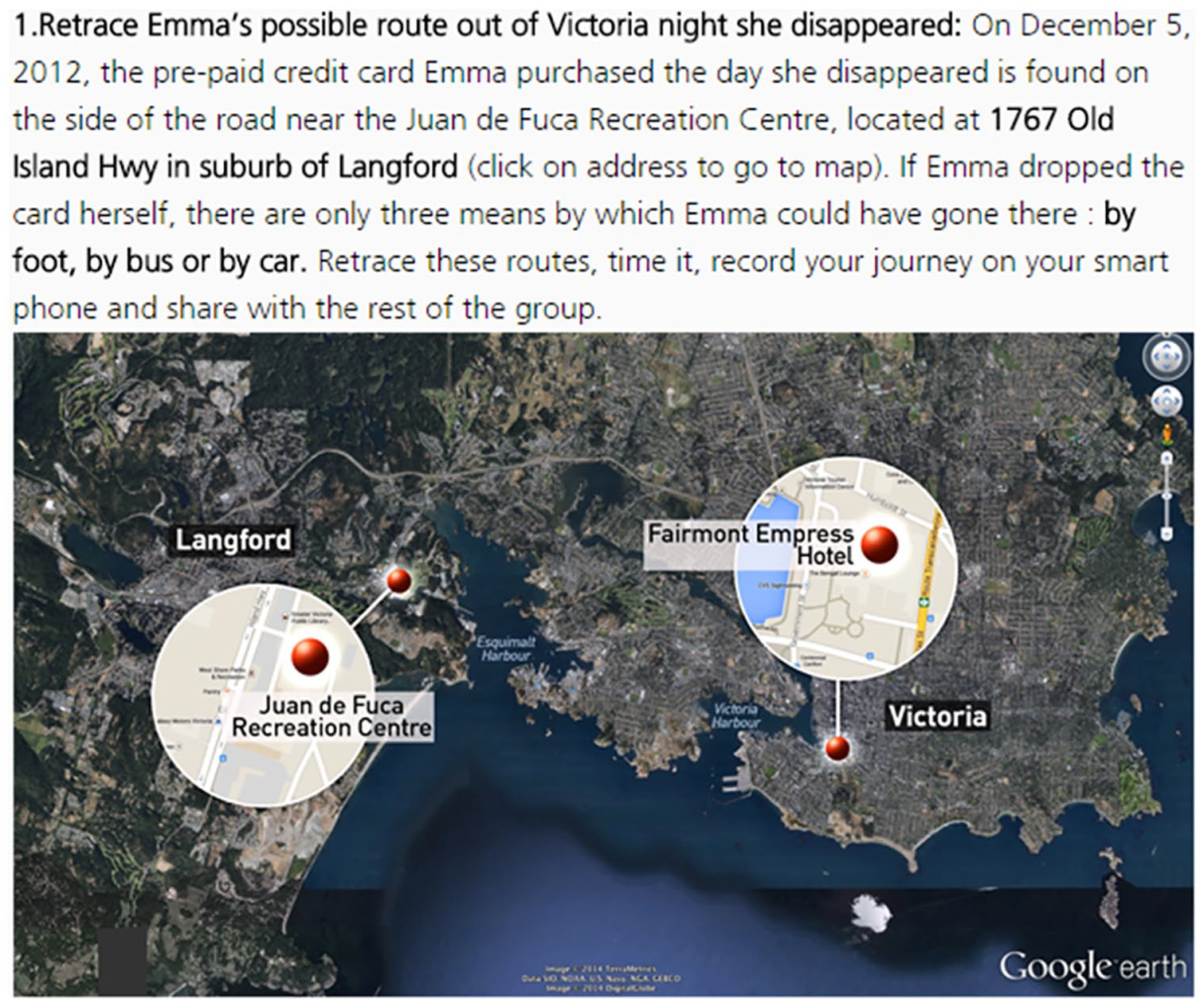
Canadian Broadcasting Corporation’s The Fifth Estate invites the public to help in a missing person search prior to the airing of the episode.
At this point in the process, the CBC reached out and directly invited us (a professor and students in an undergraduate criminology class at the University of Victoria) to participate in their crowdsourcing investigation. 8 In total, nine criminology students and one professor took part in the missing person project. We were asked to engage in the following three forms of fieldwork (as proposed by the CBC in Figure 1): (a) collect field notes while walking by foot from The Empress Hotel to the Juan de Fuca Recreation Centre (10 km), (b) collect field notes while riding the bus from The Empress Hotel to the Juan de Fuca Recreation Centre, and (c) collect field notes while driving by car from The Empress Hotel to the Juan de Fuca Recreation Centre. The CBC also requested that they film us while we engaged in fieldwork. Students were also instructed to take detailed field notes as well as record their trip on their smartphones.
On October 8, 2014, a CBC cameraman from The Fifth Estate met us in front of The Empress Hotel in downtown Victoria, in the exact spot where Emma Fillipoff was last reported seen standing barefoot and confused almost two years earlier. 9 While being filmed, we discussed the three possible pathways that Emma might have taken, as outlined in Figure 1 (from where she was last seen by the police and where her prepaid credit card was found 10 km away). We also discussed possible scenarios, for instance, the opportunities that might have been presented had a motivated offender crossed paths with Emma in her vulnerable state. We also acknowledged that it was possible that she might have run away or perhaps even have taken her own life. 10
Students were then broken into three teams. One group observed and took notes while traveling on the bus (four students), the second group walked the entire 10-km distance to the Juan de Fuca Recreation Centre (three students), 11 and the third group made observations while driving a car (this latter group consisted of four members: two students, the professor, and the CBC cameraman). As the car group arrived first, they spent additional time observing the surrounding areas of the end point (the Juan de Fuca Recreation Centre). After all three separate journeys were finished, the entire group was once again filmed by the CBC. In a manner similar to a focus group (cf. Krueger & Casey, 2009; Morgan, 1988), we collectively discussed our observations, as well as the benefits and potential of the media using crowdsourcing as a way to unearth new clues about missing persons.
Data Analysis
Initially, when we began the project, we considered the fieldwork to be an exercise in applied (community-engaged) public criminology with real potential benefits for both the missing person and her family. 12 Despite the systematic approach we took in our field research, it was only after the documentary aired that we decided to formally write about the process of crowdsourcing in practice. The final documentary, which aired on TV, contained very little on crowdsourcing or on public criminology supported by academic evidence; rather, it resembled a traditional sensationalized infotainment format. The original plan put forth by the CBC to engage audiences through social media and crowdsourcing shifted during the late stages of production from newsmaking criminology to an infotainment approach. As a result, and by following the principles of the grounded theory approach (Charmaz, 2006; Glaser & Strauss, 1967), we discovered that our participation in this TV documentary revealed important insights about newsmaking criminology and crowdsourcing in practice. These insights led us to conduct two different data analyses.
Our first analysis focused on the field data we collected leading up to the documentary. After collecting the field notes taken during the fieldwork and obtaining the audio transcripts from the video footage taken by the CBC, we conducted an inductive thematic analysis (Guest et al., 2012). All field data were coded and analyzed with the assistance of Atlas.ti, a qualitative data analysis software program (cf. Friese, 2014). By engaging in data analysis of both our field data and the CBC video footage that did not air, we analyzed how this missing person case could have been approached using crowdsourcing. In other words, by examining the information that did not make it into the finished TV documentary, we provide a backstage glimpse into the tensions that exist between infotainment and newsmaking criminology.
The second analysis we conducted was a qualitative content analysis (cf. Elo & Kyngas, 2008) of the TV documentary (what was actually aired). Similar to our field data, we also coded and analyzed the TV documentary with the assistance of Atlas.ti. The content analysis of the documentary revealed several themes as well as the following three infotainment techniques: (a) selectively creating a narrative, (b) omitting facts that are legally relevant, and (c) presenting information out of context.
Findings From the Field
In our analysis of the field data, it became clear that the geographical possibilities of where Emma might have gone after she was last seen at The Empress Hotel were extensive. However, our examination of the various geographical possibilities did point to the importance of targeting different crowdsourcing audiences within specific investigations. In this particular missing person case, important crowdsourcing audiences included tourists by The Empress Hotel where Emma was last seen, the businesses along the possible routes she might have taken, and the numerous visitors near the Juan de Fuca Recreation Centre in Colwood. In addition, our field work revealed that more follow-up investigative fieldwork would be needed to gain insights into the routine activities and local knowledges inhabiting those geographical spaces. A routine activities approach (Cohen & Felson, 1979) helps to explain victimization by focusing on three elements that, when they come together in time and space, increase the opportunity for foul play: a motivated offender (in this case: unknown), a suitable target (in this case: Emma was last seen alone, barefoot, confused, and living in a shelter), and a lack of capable guardian.
Geographical Possibilities
The most striking observation of retracing the possible journey that Emma might have taken from The Empress Hotel to the Juan de Fuca Recreation Centre was the vast geographical possibilities. To begin, there were many different choices for leaving The Empress Hotel. If Emma was a passenger in a car, then which parking lot or side street did she depart from when leaving? Or, if Emma took the bus, then did she depart from the closest bus stop (behind The Empress Hotel) or did she walk to another location? Each group observed and documented the different routes that Emma could have taken and the side trails that she could have found herself on. As one student member of the bus route team commented, The main thing I noticed was once we had gotten off the bus right here in the Colwood area [close to the Juan de Fuca Recreation Centre] is that the Galloping Goose Trail [a 60 kilometer hiking/biking trail that begins in downtown Victoria] was literally five feet in front of the bus stop . . . a big pathway for people who are travelling on bike or on foot.
The original end point, the Juan de Fuca Recreation Centre, was now reconceptualized as a secondary potential starting point for whoever dropped Emma’s prepaid credit card (whether that was Emma or someone else), leading to more geographical possibilities. When all the team members were standing at the end point debriefing (with the CBC continuing to film), comments were also put forth on all the different destinations that existed for each bus route leaving the Juan de Fuca Recreation Centre, such as the airport, nearby towns, and ferries. In addition, the walking group team observed several different forests and bodies of water, noting that there were certain areas where they felt someone could quickly disappear, especially at nighttime. As one walking team member stated, “there were so many possible side trails that she [Emma] could have gone down.” Overall, it became clear that the geographical possibilities of Emma’s journey after she was last seen at The Empress Hotel were very broad. While such variation could be interpreted as discouraging, the group found it useful when inductively discussing ways to use crowdsourcing in Emma’s missing person case. For instance, these geographical observations suggested that crowdsourcing might need to be reconceptualized to take into account the potentially different crowdsourcing audiences within specific cases.
The Crowdsourcing Audience
The different possible routes of Emma’s journey from where she was last seen at The Empress Hotel to where her prepaid credit card was found increase the number of people who might have seen her during that time frame—a population we refer to as the crowdsourcing audience. The crowdsourcing audience consists of all the people who may have information on Emma because they could have come across her during that time given their physical proximity. If these audiences were reached by The Fifth Estate, there was the potential that a memory of seeing Emma could be triggered. During the fieldwork exercise, three different crowdsourcing audiences were identified: the tourists outside of The Empress Hotel, those who visited or worked at the multiple businesses along the route, and the numerous people near or the users of the Juan de Fuca Recreation Centre.
Crowdsourcing audience: Tourists
As the group gathered outside The Empress Hotel, one of the first observations was that the area was heavily populated with tourists taking photos. This raised two points that the research group had not discussed prior to physically spending time in the exact spot where Emma was last seen. First, of all the people who may have seen Emma on November 28, 2012, it is very likely that some of them were tourists who eventually left Victoria. The city of Victoria is a popular tourist destination, and most visitors to the city spend some time visiting the inner downtown harbour where The Empress Hotel is located. This means that people across Canada, and international visitors, could have a memory of Emma from the evening that she went missing. As one student researcher stated, this is probably the most publicized tourist area of Victoria. There are parliament buildings right behind us, and general street traffic and pedestrian traffic all around us. If someone was in a distraught state, I think that people would be more aware of it.
Second, as the research group observed so many different tourists taking photos in front of The Empress Hotel, it is likely that there could be footage of Emma in the background. As one student noted, “right here, is a really public area where she could have been sitting and lots of people all around would be taking photos.” By suggesting that tourists may unknowingly possess information (either through memory or in the form of a picture/video), the crowdsourcing audience was expanded from local people who frequent the downtown Victoria area to those who were visiting Victoria during that particular week. This insight, in turn, suggested the need for national and even global broadcasting of this particular missing person case, precisely what the CBC proposed in their plan to use crowdsourcing in the Finding Emma documentary.
Crowdsourcing audience: Businesses along the route
The members of the car driving group noticed how quickly the demographics changed while driving from The Empress Hotel to the Juan de Fuca Recreation Centre. For example, at The Empress Hotel there were many tourists in front of the building, but then within a few blocks it appeared mixed (tourists, employees, locals, homeless people, etc.) and then the neighborhoods became more residential. As one student in the car group noted, this really spoke to me . . . this isn’t an issue that only addresses people that are down by The Empress [Hotel] where she first went missing, or right outside where this credit card was spotted. It’s an issue that involves the entire area, because anybody in the Victoria area at any point in time could have seen Emma, could have interfered with her, could have been involved, or could have helped in the situation.
As the members of walking group moved more slowly, they were able to take better notice of the various establishments and businesses along the route. One student inquired about the possible video footage of Emma that might exist in these places: if she stayed along the road like we did, there were so many different gas stations, convenience stores. I’m guessing all of them have running cameras . . . I just wonder whether she’d ever show up on any of those tapes.
The walking group team also noted that people in these establishments (employees or customers) may have observed or had a social interaction with Emma. As one member of the group reflected, “it could have been possible that Emma stopped to grab something to eat or use the bathroom. During this point, a worker in the gas station may have noticed Emma’s odd behaviour.”
The members of the bus route group also made observations that led them to notice different possibilities had Emma opted to take the bus. First, they observed a pattern of the bus filling up and emptying out during certain points from The Empress Hotel to the Juan de Fuca Recreation Centre. The more popular exit destinations they suggested might provide an idea of where Emma may have gotten off the bus as well as the specific times in which a passenger on the bus may have seen her. As one bus group team member observed, the bus quickly filled up as we were moving through the downtown core of Victoria, however not many people had gotten off. [But] as soon as we arrived to Uptown mall [the halfway point], many individuals exited the bus and many [new people] had gotten on the bus as well.
This group also suggested that if Emma did take the bus, it is a route with the highest likelihood of social interaction with strangers as people must sit very close together and appeared to be looking around at each other. In other words, there is the possibility that someone noticed Emma in her distraught state or even talked with her.
Crowdsourcing audience: The Juan de Fuca Recreation Centre
Initially, both The Fifth Estate and the research team only considered The Empress Hotel and the three possible traveling routes as areas of focus for this particular fieldwork. However, once the team reached the Juan de Fuca Recreation Centre, it became apparent that there were many other geographical possibilities and crowdsourcing audiences. As one member of the car group stated, “this is a very high volume area. Even without a sporting event, there would be hundreds of people walking through here.” In addition to the numerous people who may have been at the centre during the week Emma went missing, there were many different activities that one could be engaged in at the recreation centre, thereby increasing the crowdsourcing audience from users of the recreation centre to anyone in the area. Another member of the car driving team noted, Beside the centre is a major bus bay, and across the street there are many fast food places that Emma may have gone in. Behind the centre there is a park, a dense forest, people walking their dogs, children playing, soccer pitches, volleyball and tennis courts, a BMX track, a golf course and more. After exploring the area around where Emma’s credit card was found we now realize how many people could have been around the night she went missing, and could possibly have some information.
It became clear that the Juan de Fuca Recreation Centre was not an end point for the group’s journey. Rather, the visitors to the recreation centre and those living or working nearby all represent potential crowdsourcing audiences—groups that could be strategically reached out to through the crowdsourcing television efforts of The Fifth Estate.
Local Knowledge and Routine Activities
By engaging in this missing person field research, the research team gained valuable insights into local community knowledge, in particular why Emma, if she was the one who dropped her credit card, would have traveled 10 km from The Empress Hotel to the Juan de Fuca Recreation Centre. Prior to the field research, group members were baffled at why Emma, who was living in a shelter, might travel 10 km from downtown Victoria to the Juan de Fuca Recreation Centre. Yet, when in the field, one group member overheard a homeless person near The Empress Hotel “say to another person he sometimes sleeps in the [nearby] park but often he’ll get a coffee in Langford at the McDonalds,” which borders the city of Colwood near the Juan de Fuca Recreation Centre. Furthermore, as the entire group collectively brainstormed at the end point, another member added that she may have been out here because downtown closes [earlier] . . . so if it’s the middle of the night and you’re cold, it’s easier to go on the bus out to some McDonalds out here that’s open 24-7 and have a coffee there, than the one downtown which closes earlier.
By tapping into local knowledge, particular routines, which seemed unlikely when examining the case back at the university, seemed quite possible when in the field.
This leads us to consider an additional crowdsourcing audience: the homeless population in the area. Those living on the street could have important local knowledge pertaining to relevant geographical spaces, as well as insights about Emma herself given that at the time of her disappearance she was living in a women’s shelter. Homeless individuals may have also observed Emma wandering the streets in a questionable state of mental health. However, most homeless individuals do not possess technology and their participation in social media may be limited, thereby creating a digital divide in opportunities to participate in crowdsourced investigations (Selwyn, 2004). Thus, additional research is needed on how to successfully engage those living on the street in crowdsourcing investigations of missing persons.
By physically traveling (by foot, car, and bus) the possible routes of a missing person, the research team were able to make observations about the local areas and gather insights along the way that would most likely not have been possible by simply looking at a map. For instance, one of the walking group members stated that she began to wonder about the possibility that Emma might have hitchhiked: The walk itself took such a long time; I was like, by now, I would be hitching. If it was cold, November, I had a bunch of stuff on me . . . I would have hitched a ride or tried to find a bus that took me here if that was my destination, or, you know, maybe ask somebody for help.
13
The walking group all agreed that by actually walking the 10 km, they not only felt the exhaustion of the journey, but also an attraction to certain areas along the way. They discussed and compared some of the choices they might have made had they been in Emma’s position. By sharing these insights, first with the members of their own group and then later with the entire team, more ideas began to surface regarding what could have happened to Emma.
Whereas a map may show walking trails or a road, it does not incorporate important routine features such as the lighting of the area, the flow of traffic, the activities occurring, and other factors that can increase or decrease the risk of victimization in the area. These collective discussions led the research group to look to the relevance of routine activity theory (Cohen & Felson, 1979) in relation to the case of Emma. While re-tracing the last known possible last steps of Emma, the walking group members noted that in certain areas along the way there was poor lighting and many of the outdoor spaces were far from the public eye. These physical elements, such as lighting and visibility in public spaces, speak to the possible absence of capable guardians in Emma’s situation if she walked a similar path. Drawing on routine activity theory, the group noted that the absence of capable guardians against a violation could have increased the potential of Emma becoming a high-risk preferred target. 14 While the routine activity approach is sometimes accused of victim-blaming, in particular in sexual assault cases, we suggest that it has practical value in missing person cases where investigations require knowledge of routines that could have led to opportunities for victimization. In other words, instead of victim-blaming, our field research highlighted social situations that may have increased Emma’s vulnerability to victimization, thus encouraging those looking for her to acknowledge the possibility of foul play along with other possible outcomes.
The TV Documentary: From Newsmaking to Infotainment
The documentary that was eventually shown on TV contained very little crowdsourcing and instead resembled infotainment. In addition, the documentary appeared to close the case as there was a subtle and inductive narrative put forth that Emma most likely chose to run away and start a new life. We argue that this narrative turn was a by-product of the episode becoming more focused in the late stages of production on infotainment and less on public criminology. In our analysis, we found that the documentary neglected key issues related to gender and mental illness and failed to reach out to the public for assistance as originally planned. We also observed the following three infotainment techniques in the documentary: (a) selectively creating a narrative, (b) omitting legally relevant facts, and (3) and taking information out of context.
Infotainment Technique: Selectively Creating a Narrative
In the documentary, the narrator/host was a celebrated journalist who presented information, as well as passed subtle judgment, within a backdrop of entertaining mood-setting effects. The documentary also included a “panel of experts” that provided comments based on their readings of a “case file” provided to them. Their comments were selectively drawn upon to help structure the narrative being put forth by the host. At the beginning of the episode, the panel of experts put forth four equally plausible scenarios: homicide, kidnapping, suicide, and intentionally running away. However, as the show proceeded, there developed a gradual narrative by the host that Emma might have made a rational decision to run away. To help initially create this perception, the host drew on a quote by a police officer on the panel who stated that in any police investigation there’s three things you look at. You look for the body and what evidence does it show you, we don’t have that. You look for the crime scene, we don’t have that. We don’t know where she went missing. All we have is the history of the victim, so we have to go on the history.
The host of the show then proceeded to dissect Emma’s earlier life history: her diary entries, her relationship with her parents, how she dealt with her parents’ divorce, and her decision to move almost a decade earlier to British Columbia from Ontario. In contrast, far less time was spent on Emma’s vulnerability at the time she went missing and how this would have increased her risk of victimization, given that she may have been suffering from a mental health breakdown while standing barefoot all alone in the city at night.
Rather than discuss how Emma’s situation could have created an opportunity for a motivated offender (and thus the need for crowdsourcing), the documentary continued to dramatize elements of Emma’s past to subtly feed the gender narrative of a “troubled girl” who likely ran away. Three cold cases of missing persons who chose to run away and start a new life were used to support a narrative that Emma might have also rationally decided to run away: Lucy Johnson, who disappeared from her home in Surrey, BC in 1961, and was presumed dead. Fifty-two years later she was found living in Whitehorse, where she had started a new life. Or Jack Morrison who slipped out of Canada undetected in 1968 and began a new life in the US; he eventually came back home forty-two years after he disappeared. Then there was the high profile disappearance of Julie Bureau. The fourteen year old walked out of her parents’ home in Quebec and disappeared, triggering a desperate search by her parents. She was found three years later, just one hundred kilometres from her family home, she had run away and lived on the streets or in strangers’ homes, anywhere but with her parents.
Other explanations, in particular the potential for foul play or suicide, were downplayed. However, early in the episode, another panel expert, a forensic psychologist, stated that “the day of [her going missing] I think it is quite likely she was having some sort of psychotic break.” Similarly, at the halfway point of the documentary, the narrator also stated that “although Emma was never diagnosed her diaries do reveal her mental health was deteriorating.” Nonetheless, throughout the documentary, Emma’s mental health condition just prior to her going missing and how it would have increased her vulnerability to foul play were not fully developed. At one point, the host contradicts his earlier comments about Emma’s deteriorating mental health by selectively using the following quote of another panel expert to suggest that she might have run away to start a new life: What if we flip it on its head, what if she is actually a highly intelligent woman, which I think that we all agree that she is quite intelligent, she’s well read, she’s been a chef, so this is a smart person . . . What if she’s developed enough skills to throw everybody off? What if she’s developed the skills and capabilities to disappear?
At this point, the documentary inserts both rational choice and individual responsibility upon an individual whose capacity at the time to make such decisions safely was arguably compromised according to witnesses. And, most importantly, it served to close the case for the viewers, as it presented Emma as a person who more than likely wanted to be left alone in her “new life.” In other words, viewers were not actively encouraged to engage in the crowdsourcing missing person exercise used to promote the episode. At the end of the documentary, viewers were left with the feeling that this was a very sad story and that she may have, in fact, run away.
Infotainment Technique: Omitting Facts that are Legally Relevant
There was little attention given in the documentary to the man who found and subsequently used Emma’s prepaid credit card after she went missing. The following comment, which appeared rushed, was provided by the host: One week later [after she went missing] the card was used to buy cigarettes. Police traced it to a man who said he found it near this trail outside Victoria, 20 kms from the inner harbour where she was last seen. He too was given a polygraph and cleared by police.
Surprisingly, rather than expand upon this very suspicious and real event where someone found and used the prepaid credit card of a missing person, the host chose instead to downplay the incident. Instead, the host simply stated that the man was cleared via a polygraph, and we never hear about him again during the documentary. This omission we suggest is problematic. To begin, the use of the polygraph test should not be an unquestioned reason to cease discussion. Although they might provide a high rate of success (Nelson & Handler, 2013), there is enough room for error that they are not admissible as evidence in criminal courts. The fact that someone was in possession and illegally using the credit card of a missing person suggests potential foul play or an opportunity to learn more details about the case that could assist in narrowing down the geographical possibilities and potential crowdsourcing audiences. In addition, the exclusion of the man who used Emma’s prepaid credit card from discussion in the episode is odd given that questions have surfaced as to whether the man actually found the prepaid card where he said he found it. It has been alleged that the man now claims he does not remember where he found it.
Although we learn very little from the documentary about the circumstances surrounding the man who used Emma’s card, the host does spend a lot of time questioning a young man who also moved from Ontario (where Emma grew up) to Victoria, British Columbia, Canada. This individual allegedly had romantic feelings for Emma back in Ontario and appeared to some viewers as rather harmless. Yet, in the documentary, the host was shown interviewing the young man in a way that may be more typical of a police interrogation. Despite already being cleared by the police too through the use of a polygraph test, the host of the show implied that there was still need for further attention on this particular individual regardless of the polygraph results. In total the documentary provided 15 minutes of airtime (24% of the show) on this individual as opposed to only 30 seconds (1% of the show) on the man who became an immediate suspect because he used Emma’s prepaid credit card. This fed into a dramatized narrative of a man hopelessly in love and chasing a woman, rather than analyzing the empirical reality that someone had Emma’s credit card right after she went missing.
Infotainment Technique: Presenting Information Out of Context
In the documentary, several aspects of Emma’s life appeared to be taken out of historical context to fit with the narrative of a troubled young female who may have chosen to run away. For instance, the host paid close attention to Emma’s diary journal writings about her parent’s divorce almost a decade earlier: Emma needed a haven from the growing turmoil in her life. Her parents were going through a really tough separation, and she needed to get away from it. And she did get away, Emma left Perth, Ontario shortly after her eighteenth birthday, feeding her need to travel, and escape the confines of a small town, and the conflict at home.
The above comment by the narrator was then followed up with a quote from Emma’s personal journal writing: “my parents’ marriage in shambles, my father turning to me, my mother hating us both for his doing so, and me, always a good listener, too nice to say that it hurt me too.” By focusing on the divorce of her parents, viewers were subtly encouraged to place at least partial responsibility upon the parents, in particular her mother, for any of the later troubles in Emma’s life. The documentary also made it seem that Emma had a tendency to run away from her problems. This narrative, in our view, contributes to an unfavorable presentation of the relationship between Emma and her mother. Whether or not it is accurate is not the point here, but rather that the conclusion is drawn based on the select writings of a teenager who was describing in her diary the emotions she felt during the divorce of her parents almost a decade earlier.
The documentary also presented conversations between Emma and her parents out of context. For instance, at one point, the host states “in fact [prior to her going missing], Emma, hadn’t spoken with her mother in quite some time,” leading viewers to regard the relationship as problematic. After the airing of the episode, negative and defamatory comments appeared on social media criticizing the mother for not being in touch with her daughter. In response, Emma’s mother felt forced to put up the following post on Facebook: I feel the need to correct something said on the 5th [Fifth] estate as it has been driving me crazy—Mark Kelley [the host] said Emma hadn’t been in touch with me for about one year prior to her disappearance. This is not accurate; Emma and I were in touch via email quite regularly just not by phone.
Within 6 days, the above post had 320 likes, 136 comments, and 26 shares highlighting the reach of social media and the potential impact that crowdsourcing criminology, the one originally put forth by The Fifth Estate, might have had in this missing person case. Instead, by suggesting (incorrectly) that Emma’s mother was not speaking to her daughter aligned with the narrative that Emma’s mother might have pushed her to run away to secretly start a new life. The fact that the mother was socially shamed on social media suggests that the viewers of the documentary did recognize the narrative being put forth by the host of the episode. The documentary continued the development of this narrative by sharing the following example of Shelley speaking to Emma 4 days before her disappearance:
But on November 24th, shortly before Emma would disappear, Shelley remembers being woken up by a phone call in the middle of the night.
and it was Emma, and she was in tears, and she said I want to come home, and I said absolutely honey, you can always come home, you always have a home.
The next day Emma called back telling her mother; “I don’t know if I can face you,” it turns out Emma was living in a women’s shelter . . . for two whole days the two went back and forth until Shelly “unilaterally” decided to fly to Victoria.
Without discussing further the social stigma that Emma might have felt living in a women’s shelter or the mental health struggles that might have contributed to her living in a women’s shelter, the host of the documentary instead chose to make what we observed to be a passive aggressive comment about the mother. Even though the host revealed that the mother and daughter were speaking prior to her disappearance, the host boldly stated that Shelley “unilaterally” decided to go see Emma as if the mother did something wrong. Again, this particular statement by the host resulted in additional negative social media comments against Emma’s mother. It also highlights that the choices made in what to share in either infotainment or newsmaking criminology can have real consequences for the families of missing persons in the form of anonymous online comments. Rather than depict a concerned mother and a daughter who may have been experiencing a mental health breakdown, the narrative put forth by the documentary gave the impression that the mother may have pressured her daughter, leading Emma to choose to disappear.
The power of the news media to define as well as distort victimization influences who can legitimately claim victim status and therefore garner public support (Christie, 1986; Greer, 2017). As Dowler et al. (2006) note, “the media frequently hold female victims responsible for their victimization while reducing or mitigating the perpetrators responsibility” (p. 841). The result is a “semi-educated gloss on the news [that] is achieved by reducing complex legal and social relations to misleading and inaccurate soundbites” (Buckingham, 2004, p. 270). By implying or leaving the impression that Emma most likely chose to run away and start a new life, the documentary contributed to a style of gendered victim-blaming that is common in infotainment. Rather than aiding the mother in a search for her daughter, the episode neglected the intersectional issues of gender and mental health that may have influenced Emma’s vulnerability. In addition, the opportunity to recognize the disproportionate number of cases of Indigenous women who go missing or are murdered in Canada was also ignored. According to Stillman (2007), mainstream media plays “a vital role in constructing certain endangered young women as valuable ‘front-page victims’ [worthy victims], while dismissing others as disposable [unworthy victims]. This tendency of mainstream media, Stillman notes, is referred to as ‘the missing white girl syndrome.”
In the Finding Emma documentary, the narrator/host and all five panel experts were white males, and none of them were locally involved in Victoria where Emma went missing. Although this is not necessarily problematic, given the circumstances of Emma’s case it might have been helpful to have a more inclusive panel, including experts who might have been able to comment on issues of mental health, homelessness, and gendered victimization. In addition, it might have been beneficial to have drawn on the field-level expertise of these panel members as opposed to simply asking them to comment on a case file and then selectively using quotes from them to support the chosen plot of the narrator/host. Although Emma was living in a women’s shelter and possibly suffering from a deterioration in mental health at the time of her disappearance, the subtle narrative put forward was that Emma may have rationally decided to run away (opposed to that simply being one of several possibilities). In addition to missing the opportunity to address the interconnecting issues of mental health, homelessness, and missing persons, this chosen narrative essentially closed the door on public crowdsourcing in this case.
Conclusion
Crowdsourcing criminology represents both a theoretical and an applied shift in research focus and paves the way for a host of new projects for academics as well as opportunities for ordinary citizens to participate in crowdsourcing investigations. Although there is a vast criminological literature on media representations in their finished form, our study was unique because we were partially involved in the creation of the documentary and gained insights into the making of a representation into a missing person case. In other words, our study connected popular criminology and the academy (Hayward & Presdee, 2010; Rafter, 2007; Seltzer, 2007/2010). The crowdsourcing project originally put forth by CBC’s The Fifth Estate was both innovative and unique, and illustrated the possibility of meaningful public criminology. However, the shift during the production of the documentary from a crowdsourcing approach guided by newsmaking criminology to an infotainment approach resulted in the general public no longer being offered a meaningful opportunity to participate in Emma’s case. We argue that the main reason for the missed opportunities for crowdsourcing in the documentary was because it shifted to infotainment. To mitigate the deleterious effects of infotainment, we suggest that crowdsourcing investigations incorporate a public criminology approach that values different ways of knowing, constructing, and representing reality (Turner, 2013).
By comparing what we found during our field research with the documentary that eventually aired, we were able to identify missed opportunities for crowdsourcing that might help inform future missing person crowdsourcing projects based on newsmaking criminology. For instance, our field research revealed that crowdsourcing in criminology needs to be reconceptualized to take into account the potentially different crowdsourcing audiences within specific cases and the expertise and assistance they may offer when included in public criminology cases. In addition, drawing on routine activity theory (Cohen & Felson, 1979) may prove useful for capturing less visible local knowledges that exist across different geographical spaces. These local knowledges, we argue, could potentially be shared through various social network sites and social media platforms in a crowdsourced investigation. However, we must be mindful that the choices made in what to share with the general public can have negative consequences for families of missing persons in the form of defamatory online comments and harmful social media shaming. Future considerations should be given then to the ethical dilemmas and questions that arise when the general public is encouraged to participate in crowdsourced investigations.
Overall, our study points to the need for more research on the process of crowdsourcing in practice and how it may oscillate between infotainment and public criminology supported by academic evidence. Future research on crowdsourcing criminology might also benefit from considering the quality of group input. For instance, does it matter how many people participate? Does the manner in which instructions are provided contribute to more or less valuable information? Are certain reporting systems better than others? Which social networking sites and/or social media tools should be drawn upon? What are the advantages and limitations of each platform for crowdsourcing criminology? What considerations should be made for the data management and analysis of tips and information in crowdsourcing investigations? And, finally, does the manner in which tips and information are responded to affect the willingness of individuals to report tips and information in the future? 15
Footnotes
Acknowledgements
A special thank you to all the criminology students from the University of Victoria who participated in this project: Brett Armbrust, Morgan Grist, Meagan Marsh, Kendra Pomfret, Roxy Feraru, Hannah English, Katherine Janota-Bzowski, and Mirna Trogrlic. We are also grateful for the assistance provided to us by Anne MacLaurin, Ronna Syed, and Leah Wilson. And, finally, we would like to express our condolences to the family and friends of Emma Fillipoff, who, at the time of this publication, is still missing.
Declaration of Conflicting Interests
The author(s) declared no potential conflicts of interest with respect to the research, authorship, and/or publication of this article.
Funding
The author(s) received no financial support for the research, authorship, and/or publication of this article.
