




Abstract
The idea of “normal” in schools is problematic. It arbitrates the way educators think about ability, achievement, and behavior. Normal implies a hierarchy of student abilities, suggesting that some can achieve and some cannot. For students who cannot achieve at the same rate as their peers, they are blamed as many assume the problem is the child. Students who deviate from normal are often characterized as different by race, language use, socioeconomic status, or perceived ability. This has historically led to educational inequities. Equating difference with deficits is problematic as US schools are growing in diversity daily. Drawing from Cultural Historical Activity Theory (CHAT), I argue that revealing the historical and cultural practices inherent in the activity of US schooling will help us find productive ways to change the activity of schools. I share findings from a qualitative case study conducted with 10 practicing educators who explored how an ideology of normal functions in their own schools. Through their work to make the ideology of normal visible, they acknowledged the importance of radically altering heritage practices that label and marginalize difference. Then, the conceptualization of what normal means can change to something more encompassing of the diversity of learners.
When I was a special education teacher, I avoided the teacher’s lounge because it often was a place of negativity about my students. As a teacher educator, I guide my candidates to approach the teacher’s lounge cautiously. Listen to what is said and be prepared to make your own educated decisions; engage when you are ready to act as an agent of change. As a scholar, I gravitate to this space because this is the litmus test of a school’s culture. The activity that happens in this space reveals the culture of a school and can unconsciously drive the outcome of the entire operation. Within this space, the ideology of normal that can be deeply rooted within every space of a school has the potential to be revealed, but also holds the essence of productive change.
Recently, I overheard two White, female educators talking in the teacher’s lounge about a student who was clearly annoying them. These two educators work in an elementary school in a high poverty, working class community in the Midwest with a large population of English learners. As they talked, one picked up the magazine Teaching Tolerance that was sitting on a table in the lounge. She looked at it, tossed it back on the table, and then stated, “I guess they just want us to be tolerant of those kids!”
This one statement delineates a boundary of normalcy. Who belongs and who does not? Who is worthy of getting good instruction and who is not? Much of the ways in which educators perceive of and talk about students comes from the way normal is conceptualized, historically and within the cultural context of schools. Drawing from Leonardo’s (2003) description of ideologies as a “constitutive worldview” (p. 210), the way in which individuals conceptualize their experiences, I argue that an ideology of normal perpetuates inequities in education, applied to groups of students characterized by race, language usage, socioeconomic status, and perceived ability (Annamma et al., 2013). Some of these educational inequities include the achievement gap (Bohrnstedt et al., 2015; Ladson-Billings, 2006; Noguera & Yonemura Wing, 2006), English only movements in schools (Borden, 2014; Gutiérrez et al., 2002), disciplinary and youth incarceration rates (Annamma et al., 2019; Mendez & Knopf, 2003), and disproportionate representation of students of color in special education and White students in gifted education (Ford, 2012; Harry, 1994). Those who are not deemed normal—the non-normal—were most often the students I taught. They were diverse and exceptional students who were labeled by their non-normality: learning disabled, English learner, attention-deficit, hyperactive, emotionally disturbed. Each label brought stigma and often meant a pull-out setting for instruction meant to normalize, yet the non-normal who were my students were not often welcomed back into the mainstream of normalcy. They were too diverse.
The statement I overheard is actually quite complex because it both reveals the ideology of normal in action, but also holds the potential of what could be—“they just want us to be tolerant.” As a scholar and teacher educator, my goal is to reveal the ideology of normal for educators, help them explore how it is perpetuated through the activity of schools, consider how it impacts the outcomes of students who fall outside the perceived boundary of normal, and to examine how that ideology can be changed to be more open to the diverse ways in which students engage in their worlds, particularly around learning. Revealing an ideology of normal then makes visible the hegemonic practices in schools that marginalize and segregate based on notions of difference. In this paper, I first explore the history of normal and how it has become part of the culture of school. I then utilize Cultural Historical Activity Theory (CHAT) as a case study framework to explore the ideology of normal with 10 practicing educators, seeking ways to facilitate positive changes in their schools. I argue that revealing how this ideology works, we can better see how damaging it can be for those deemed non-normal, and work to be more encompassing of the diverse ways our students engage in schools.
Understanding Normal
In his seminal essay, Davis (2010) argues that normal, as currently conceptualized, serves to push humanity toward an ideal. Yet, that is not the way normal has always been conceptualized.
The History of Normal
While developing his theory on mathematical probabilities in 1720, de Moivre accidentally discovered the continuous probable distribution of measurements (Freedman et al., 2007). Gauss, who published a monograph in 1809, took up de Moivre’s work and described the visual representation of a statistically “normal” distribution of measurements in the shape of a bell (Stigler, 1986). Achenwall coined the term “statistik” in 1749 to describe the use of data that was collected to develop policies about people, wealth, and resources (Gallagher, 2010). Nearly 150 years after de Moivre’s discovery, the rise of industrialism combined with growth in governmental policies promoted a need to measure and account emerging population growth (Davis, 2010). The field of statistical measurement was born, and Gauss’ normal distribution curve became common place. Not long after, Quetelet applied the theory of the normal distribution of numbers as a statistical measurement tool to the emerging field of social sciences (Freedman et al., 2007).
The Gaussian, normal distribution curve creates a shape that is symmetrical around the middle and has two tails that extend off to both sides. The total area represented under the curve equals 100% (Figure 1). The central point on the curve, which is the most frequently occurring value, is often represented as zero for statistics, but can represent other values depending on what is being measured (Freedman et al., 2007). For example, intelligence quotients have a mid-point value of 100. Values falling at ±1 SD equal 68% of the total area under the curve; at ±2 SD, the area is 95% (Freedman et al., 2007). Within the field of education, the normal distribution curve is often used to measure attributes such as achievement, ability, and discipline and behavior problems.
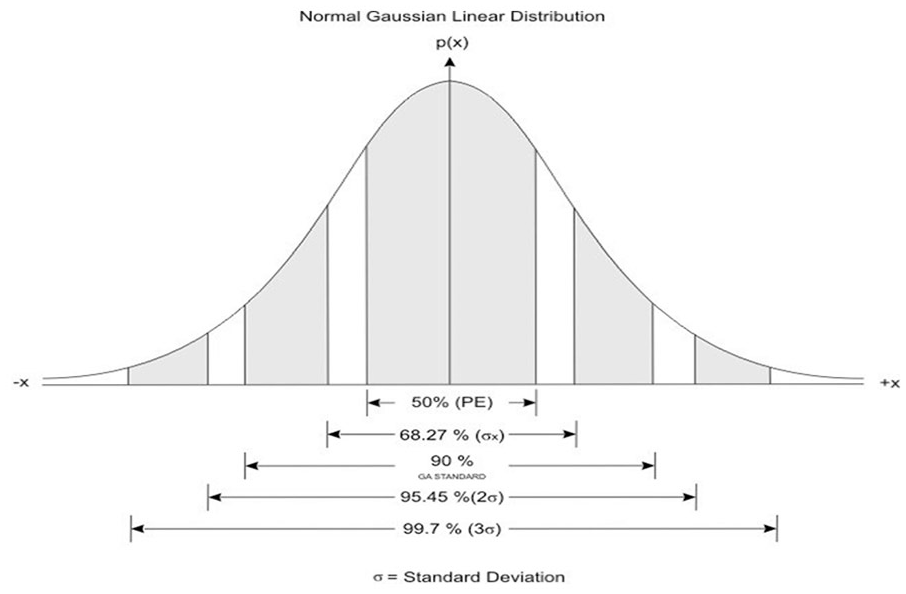
Image of the normal distribution curve.
The normal distribution model is generally accepted as mathematical, statistical fact. As Fendler and Muzaffar (2008) noted, “There is a widespread belief that things of the world distribute themselves according to a model depicted by the normal curve” (p. 63). The Gaussian, normal distribution curve is a reliable and valid statistical measurement tool for measuring the distribution of random events. Yet, it has become accepted as objectively measuring humans and their characteristics. As Dudley-Marling and Gurn (2010) have argued, this is erroneous. Human behaviors such as intelligent or ability are not random. Using bell curve thinking, we then assume that some individuals will achieve at a higher rate, most will be about average, and some will fail miserably (Fendler & Muzaffar, 2008). Furthermore, this way of thinking normalized the logic that average or normal is good. Quetelet himself wrote: “If an individual at any given epoch of society possessed all the qualities of the average man, he would represent all that is great, good, or beautiful” (Stigler, 1986, p. 171, as cited from Athenaem review, 29, August 1835, p. 661).
Looking closely at how the normal distribution curve has been used historically shows how “normal” has come to mean “good” or “desirable.” Before the industrial era, the word normal was defined differently. Then, it meant a carpenter’s square (e.g., in mathematics, a right angle is considered normal; Davis, 2010). Normal, as it is now defined, appeared in dictionaries around 1840 to 1860 (Davis, 2010). This coincided with the use of statistics in the social sciences, what Hacking (1990) called the “taming of chance” (p. 10). Now, phenomenon in the social realm, such as human characteristics, could be measured to find predictable patterns. Normal and average became a balanced middle ground. Quetelet’s “l’homme moyen” (average man) was a perfect example, a human being with perfectly average physical and moral characteristics (Davis, 2010). The average, or normal, thus became the ideal (Davis, 2010). This becomes problematic for those who are not deemed average or ideal. The non-normal is viewed pathologically; someone who needs to be remediated or healed back to normal.
In a normal distribution curve, the two ends represent the values that “deviate” from the norm or center. “Deviation” is a term used by statisticians to represent a numerical measurement separate from the normal distribution, the standard deviation. As Gallagher (2010) has argued, individuals who were not seen as normal were assumed to need to be cured or rehabilitated back to normal. And, historically, the normal distribution curve as used in the social sciences puts forth ideas such as Social Darwinism, the survival of the fittest, and the eugenics work of Galton in the late 1800s who hinted at the idea of hereditary genius (Stigler, 1986). To achieve a sense of normal meant progress and development, an idea put forth by eugenics which was a pseudoscience that touted the idea of refining humanity through breeding in desirable characteristics and qualities and breading out the abnormalities.
The problem with an ideology of normal is that it creates boundaries, often based on binaries of us/them—straight/gay, rich/poor, Black/White, male/female, English speaking/non-English speaking—all of which are embedded in ideologies of power, fear, and marginalization (Davis, 2010). That which is deemed outside the boundary of normal is relegated to the “other” category. Open a news source today and you see “othering” happening frequently—hatred and violence toward groups characterized by race, religion, sexual orientation, political values, and language use. This is problematic because it denies acknowledgement of unique ways of knowing and thinking. And, as Wendell (2010) noted, “When we make people ‘other,’ we group them together as the objects of our experience instead of regarding them as fellow subjects of experience with whom we might identify” (p. 345).
The History of Normal in US Schools
The ideology of normal has historically been perpetuated through the cultural practices in institution of US schooling as students are identified, labeled, sorted, and segregated. Understanding the history of US schooling can help to “make visible the taken-for-granted, hegemonic practices occurring today that continue to perpetuate the ideology of normal” (Moore, 2013, p. 20).
US schooling has historically set out to produce normal—defined as moral, literate, and patriotic-citizens. Puritans schools, in early US history, worked to “produce virtuous individuals” (Jeynes, 2007, p. 6). Compulsory schooling started in Massachusetts following the General School Law of 1642, also known as the Old Satan Deluder Act (Jeynes, 2007). This law promised for the education of all students, but specifically emphasized how important it was for all students to read the Bible. Following the Revolutionary War, schooling was still devoted to firming up moral character, but now focused on the nation’s desire to build commerce, specifically agriculture and shipping (Tyack, 1974). During this time, tracking began with students moving into two specific pathways: the rich paid for schools that excelled and the poor were offered free schooling that built moral character (Jeynes, 2007). As the number of immigrants arriving in the US increased during the industrial revolution, schools became more complex. As Bowles and Gintis (2011) noted, capitalism offered a perfect solution. Schools could be run more efficiently, especially in larger, urban areas, by using corporate bureaucratic organizational patterns (Tyack, 1974). While today’s schools continue to reflect many of these management patterns, more traditional ideals are being replaced with evolved ideas of how students learn (e.g., problem-based learning, student centered learning, and situated cognition; Calfee, 2012). Yet, normal is still defined by who can and who cannot achieve in schools (McDermott et al., 2006). Furthermore, those who are not viewed as normal are then identified as special education, sorted, and often pulled away from their “normal” peers and placed in segregated settings.
The ideology of normal, which is sustained by schools continued use of a normal distribution model used as a statistical tool to measure students in schools, pits students against other students, creating a hierarchy of perceived abilities that are then assumed to fall along the bell-curve (e.g., intelligence, ability, achievement, and behavior). As Moore (2013) noted, “That which is normal is deemed good, that which is above is even better, and that which is below is undesirable” (p. 23). Brantlinger (2001) suggested that hierarchies are interdependent: “domination depends on subordination” and “winners need losers” (p. 2). McDermott et al. (2006) argued that the American educational system is competitive in nature which then shapes itself into hierarchies, placing more value on success and how quickly it is achieved in school. Students who are not quick to achieve success are then seen as incapable or lazy. Furthermore, this hierarchy of abilities and characteristics arbitrarily creates a binary, where the “perception of a normal learner concomitantly creates the perception of a deviant or abnormal learner” (Moore, 2013, p. 23). Most often in schools, students who are seen to deviate from the norm are the ones who are different, by race, cultural values, language use, or even perceived ability (Annamma et al., 2013). As McDermott et al., (2006) wrote:
For 150 years, the West has been rife with rumors about intelligence, primitive minds, and inherited genius, all differentially distributed across kinds of people by race, class, gender, and national character. The rumors have encouraged oppression by explanation: Some can, some cannot, and this is why some have and some have not. (p. 13)
For the students who are seen as deviating from the norm, assumed to be on the bottom end of the normal distribution curve, real consequences occur for them in schools which adversely impact their academic and social outcomes.
McDermott et al. (2006) argued that the American educational institution functions on a capitalist, factory model of education. Schools operate to reproduce the segregated and hierarchical patterns that exist in society. A capitalistic educational system “privileges those students who are prepared to manage the specified type of academic structure, who possess the cultural capital that schools assume, and who can, therefore, operate within the range of expected behavior” (Baglieri & Knopf, 2004, p. 526). Those who seemingly lack these assets are often tested, identified, labeled, and placed into special education. Yet we are not doomed to perpetuate the ideology of normal. Leonardo (2003) noted, ideology “is determining of people and is determined by people; ideology both structures and is structured by social practices” (p. 210, emphasis my own). Ideology should not be seen as static and constraining. Making it visible is key to developing “conscientization” (Freire, 2008, p. 67), critical awareness about conceptualizations of normal and how they can change over time to become more encompassing of diverse ways of being.
Putting Theory into Practice: Cultural Historical Activity Theory
Cultural Historical Activity Theory (CHAT) is a theory of object-driven activity. It explains how individuals are involved and engaged in the purposeful, collective activity around them. CHAT is useful in explaining how unrelated opposites, dialectics, are essentially connected (Roth & Lee, 2007). Moore (2013), stated, “In a dialectical relationship, neither part can be analyzed or understood without considering the role of the other parts” (p. 40). I utilize CHAT in three ways. First, CHAT is useful in understanding dialectical relationships, such as the relationships between theory and praxis that happens in everyday human activity (Cole & Levitin, 2000). CHAT theoretically guides my understanding of how the ideology of normal has developed over time (historically) and situated within cultural practices in society at large and within US schooling. I also use it as an analytical tool for how we can change how the idea of normal is enacted in schools. Second, CHAT is useful in exploring how learning and development occurs dialectically for the individual as well as the collective. Culture, our “social inheritance” (Cole & Levitin, 2000), and how it develops over time, are woven together because the individual engages in action within collective cultural activity (e.g., play, work, and learning). As described above, the ideology of normal in US schools developed over time through the specific cultural practices that happen within the individual and collective activity system of US schooling. And, it will continue to evolve. Third, CHAT is useful in examining the dialectical relationship between epistemological and ontological aspects of human development. Scribner (1985) explained how Vygotsky talked about the use of history to explain human development. In doing so, she defined ontogeny as the development of an individual, biologically and culturally, over their own lifetime. Yet, ontological development is absolutely a part of epistemological development: higher psychological functions and the development of knowledge (Scribner, 1985). The knowledge and beliefs of educators develops over time across their lifetimes, is not static but always evolving, and is inherently connected to their cultural practices and the collective activity in which they engage.
My goal is to make visible the hegemonic practices in schools that marginalize and segregate based on notions of difference. To achieve this, I use CHAT to better understand how educators’ function (e.g., learn, engage, and develop) inside the activity system of schools. In particular, I want to understand how individual educators take on an ideology of normal as part of their collective activity in schools. As Leont’ev (1978) suggested, cognitive development happens as an individual is engaged with a collective of others in activity that serves a particular, societal purpose. Neither the views of the individual nor the views of the collective can be fully isolated from the other as they are dialectically connected. Leont’ev (1978) argued that the activity of humans builds consciousness; consciousness does not exist outside of the substantial, practical processes of life. The human activity of labor, mediated by tools (e.g., both physical and ideational) which is situated historically and culturally, pushes humans forward, and in time transforms the human as well as the surrounding world (Freire, 2006). And as Gutiérrez and Vossoughi (2010) noted, concepts, which are mediating artifacts, are useful in engaging in the activity. The concept of normal has been serving as a mediating purpose historically in schools (Moore, 2013).
Leont’ev (1978) described activity as occurring within a system that involves a subject (individual) who is working toward the object which is the purpose of the activity (Figure 2). Activity is not to be seen as a snapshot moment in time that has a finite beginning and ending point, but a complex and developing purpose in society (e.g., work, play, and learning; Roth & Lee, 2007). As the subject engages in the activity, what they are doing and thinking is mediated by the activity system factors: rules for engaging in the activity, the division of labor of those involved in the activity system, the community of other individuals involved in the system, and meditational tools commonly used in the activity (Cole, 1996).
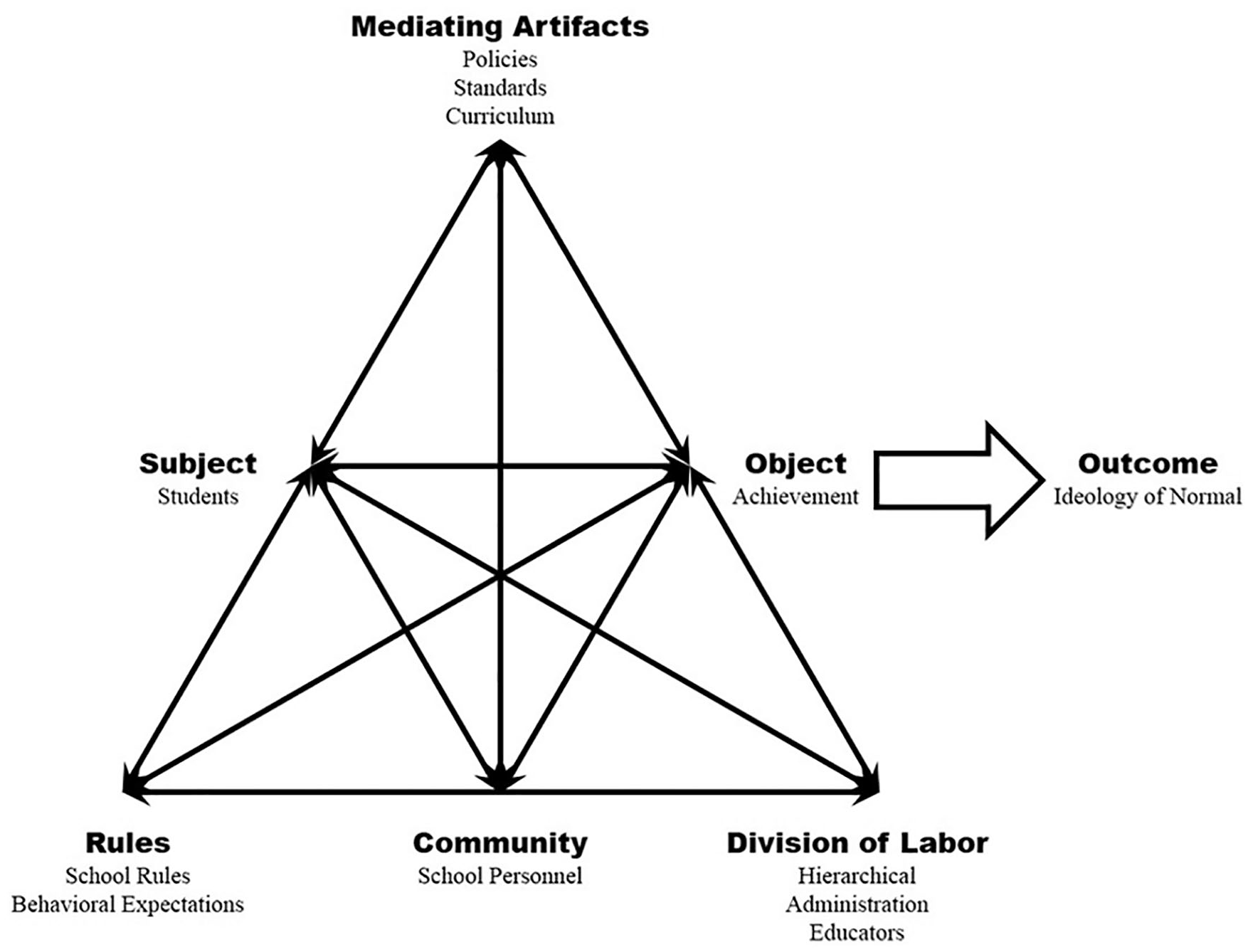
Activity system of school.
Case Study
I explored the activity system of US schooling with the help of 10 practicing teachers recruited from a graduate level course I taught on collaboration (Moore, 2013). This qualitative case study explored the following research questions:
How does the activity of school perpetuate an ideology of normal?
In what ways can educators shift the activity of school to change the outcome?
Participants and Setting
The case study was conducted over the course of one semester with a group of practicing teachers taking graduate coursework to earn endorsements to teach special education. Ten participants were recruited from the course. While all 15 candidates in the course completed the same activities, data was collected at the end of the course from only the 10 consenting participants, per Institute Review Board approval. Of these 10 teachers, 7 were general educators and 3 were special educators; 5 identified as Hispanic and 5 as White; and 2 identified themselves as English learners with Spanish as their first language. Names of all participants have been changed to ensure confidentiality.
The course was designed to engage participants in critically reflecting on how normal is conceptualized in schools and how they could work collaboratively in their schools to change the concept of normal to be more encompassing of diversity. Participants were assigned critical literature (see Table 1) to read prior to class, then engaged in guided small group discussions about the topic during class time, followed by individual written reflections.
Critical Readings for Class Sessions.

Data Collection and Analysis
During the course, candidates in the class were placed into small groups for discussing assigned readings. The 10 participants were placed into the same two small groups of five so that their discussions could be audio-recorded for later analysis. Data collected included audio-recordings of small group discussions and written reflections. At the end of the class, audio-recordings were transcribed for analysis.
Data was analyzed using inductive and deductive coding (LeCompte & Schensul, 1999). Initial deductive coding, based on the research questions, was coded into thematic categories based on the activity theory diagram (e.g., mediating artifacts, rules, community, and division of labor). Inductive open coding using Glaser and Strauss’ (1967) constant comparative method was then conducted for emerging themes related to the ideology of normal as situated within CHAT across groups and over time during the semester.
At the beginning of the course, I shared my journey as a special educator grappling with understanding of how my students were labeled and treated as different, based solely on their differences from normal students. Then, with their help, I used Leont’ev’s (1978) activity system diagram to map the activity of their schools, looking for instances of the ideology of normal.
Removing the Veil: Educators Make the Ideology of Normal Visible
Davis (1995) wrote:
Only when the veil is torn from the bland face of the average, only when the hidden political and social injuries are revealed behind the mask of benevolence, only when the hazardous environment designed to be the comfort zone of the normal is shown with all its pitfalls and traps that create disability - only then will we begin to face and feel each other in all the rich variety and difference of our bodies, our minds, and our outlooks. (pp. 170–171)
Through our work together, my teachers and I knowingly and willingly removed the veil to get a good look at how the ideology of normal functions in our schools in which we worked. We agreed that the basic purpose of school is for students (Subject) to achieve (Object; see Figure 2). Yet, we found that achievement for students is mediated by the nodes of activity within the system. For some, achievement is relatively easy—the system works. For others, and most often for the ones who fall outside the boundary of normal based on race, language use, sexual orientation, gender, and/or perceived ability, the ideology of normal may hinder achievement. Below, each node of the activity system is discussed using examples collected from the case study.
Mediating Artifacts
Mediating artifacts in the activity of school include national and state policies (e.g., ESEA and IDEA) as well as local policies (e.g., state standards, standardized assessments, and curriculum) which mediate achievement by attempting to normalize students to grade level standards. As participants noted, there is nothing wrong with benchmarking achievement—we expect students to achieve at established levels and rates. And, as Fawn commented, “The reality is that we need certain skills to be a successful society. If we are going to space, we need people who have the science and math skills to make that happen (Session 2, Whole Group Discussion).” However, as Melanie argued, schools should not be “a meat grinder—churn the wheel and perfect sausages come out (Session 3, Group 1).” Participants acknowledged that standardized thinking follows a linear progression, which translates into hierarchies of who can and who cannot achieve (McDermott et al., 2006). Mediating artifacts clearly serve a valuable purpose in schools in helping students achieve, but may mask unique skills and talents of some. Thinking differently about mediating artifacts of schools holds the potential to broaden an ideology of what is normal.
A primary mediating artifact for special education is the Individualized Education Program (IEP) for providing individualized instruction to meet student’s needs. Consistently across both groups, the importance of individualizing instruction, based on the guiding IEP document, emerged. In most cases, participants indicated a belief that the IEP provided positive support for students. However, it did serve as a marker for difference. As Kristen was discussing a student with autism who was functioning at or above grade level, she lamented, “I didn’t want him on an IEP because he didn’t need it. Why put him and his family through the added label, the added trouble, having his friends know he is ‘different’ if he doesn’t need to be on a different educational pathway (Session 10, Group 2)!” Her group agreed, yet returned to the purpose of the mediating artifact. The IEP individualizes instruction, for giving “those kids that need it—for getting them where they need to be (Sharon, Session 2, Group 2).” In other words, remediation.
Rules
Rules in school mediate normalcy and are most often founded on behavioral expectations. Often, rules come from mediating artifacts. For example, an IEP document mandates the amount of time a student receives special education services. Other rules are posted as mediating artifacts in classrooms. In “heritage schooling” (Kalantzis & Cope, 2012, p. 29); classrooms were arranged with desks in a row facing the front. As Foucault (1979) argued, this allowed for surveillance. A teacher can easily monitor student behavior from the front of the classroom, looking down rows. Consequently, in heritage schooling, acceptable behavior means following the rules (e.g., face forward, raise your hand, and do your work quietly), which in turn, mediated achievement. While the physical arrangements of classrooms has changed, surveillance continues. Melanie described a young African American boy in her class who was energetic. In the teachers’ lounge, her colleagues had warned her about his behavior at the beginning of the year, “He won’t stay in his seat. He is always pestering other student groups. You’ll struggle with him (Class Session 2, Group 1).” Instead, Melanie found him to be an engaged and enthusiastic learner, regardless of his movement around the classroom. As Noguera (2003) noted, the behavior of African American boys is often interpreted as problematic or deviant instead of viewed as a diverse way of engaging and learning. Rules certainly serve a purpose and schools cannot safely function without them. Yet, rules founded on an ideology of normal negatively mediate achievement for some students. In Melanie’s school, teachers had already formulated an opinion of this student as deviating from the norm based on his inability to follow the unwritten rules (e.g., stay in your seat).
Community
Community in the activity of schools is school personnel (i.e., general educators, special educators, administrators, para-professionals, and staff). Community is guided by mediating artifacts, such as standardized testing and/or curriculum, and linked to rules particularly in regards to roles played in the school. For example, para-professionals will enforce rules during recess or lunch duty. In particular, how the community talks about students and their families can support achievement or reinforce an ideology of normal. As Jenae described:
When there are comments that are destructive, and decisions that are being made based on untruths, based on complete bias – and the whole notion of I’m not going to leave my comfort zone. This is my vision of who you are and that’s not going to change. I don’t want to know who you are. Your mom’s a crack addict. That’s who you are. Or, you’re undocumented, or you’re lazy, or you’re just a behavior problem (Session 3, Group 1).
Ideological assumptions and teacher’s beliefs about students is the underlying foundation for talk that happens in schools. When the community of the school engages in negative talk, which happens both informally (e.g., in the lounge, at lunch, and in the hallway) or formally (e.g., in meetings), teacher’s beliefs can become “broadcast” across the group (Horn, 2007). As Scribner (1997) noted, belief systems are the byproducts of our culture and are spread across the culture through social processes, such as talk. The larger community surrounding the school can also influence the ideology of normal, especially if the cultural values of educators are significantly different from those of the community external to the school. As Sleeter (2016) has noted, most educators are White, middle class. Thus, as Moore (2013) noted, “their cultural values reflect the dominant culture; and notions of achievement (and normal) are regulated by these dominant values” (p. 218). As Harry and Klingner (2006) noted, even teachers of color adopt talk in schools that reflects the dominant cultural values. Difference, then, is featured predominately and the ideology of normal is mediated by both the community of the school and the community surrounding the school. Consequently, those students who are perceived of as different—by race, cultural values, or the language that they speak-stand out (Moore, 2013).
Division of Labor
The division of labor in schools reflects a hierarchy, with policy makers at the top who out rank administrators in the middle, who then out rank educators and make decisions for them, who then put those decisions into practice in their classrooms of students. Thus, students are at the very bottom of that division of labor hierarchy. The division of labor node is guided by mediating artifacts (e.g., special educators enact the IEP). The surrounding community is stratified by the division of labor, denoting who takes on which role in schools. And, rules reinforce the division of labor, particularly in regards to who writes and who reinforces the rules. For those students who are capable of achieving success in schools, minimal time is spent in concern. However, for students who struggle to achieve, an alarm is sounded and attention is dedicated to remediate, fix, and normalize them, which in turn, identifies the source of the problem to be within the child. My participants found that pressure is exerted on teachers, by policy makers and administrators, to ensure that all students achieves at grade level. For example, in talking about enforcing normal, Robin stated in her group, “If we don’t have x number of children fit the bell curve, fit what is proficient, we lose our job” (Class Session 2, Group 2). Furthermore, pressure is exerted to cover the curriculum in a set period of time, which makes differentiating instructional practices for diverse populations challenging (Tomlinson, 2017).
Outcome
The outcome of the current activity of many schools is unfortunately a continued perpetuation of an ideology of normal. In my study, my participants noted that academic ability and acceptable behavior were the most visible characteristics that identified a student as being either within or outside perceived normalcy. Furthermore, as local cultural practices within the school, these characteristics reproduce an idea of normal that is consistent with larger, macro processes of US schooling and society. In my participants’ own words, those who fall “underneath,” those who are not part of the “majority,” those who “should” be able: these are symptoms of the abnormal. Normal in schools should be broad and not based on opposites. Normal is diversity: students come to school with lots of ways of thinking and knowing, all of which should be valued and recognized.
In the activity system of school, more attention is given to those students who fail to achieve a thinly defined idea of normal. Brantlinger (2001) argued that students who are identified as abnormal are then labeled with stigmatizing names (e.g. struggling, disabled, at-risk, and behavioral problem) and sent to separated locations to receive their education (e.g., special education rooms, low tracks). As Macedo and Martí (2010) argued, the negative focus on difference is dehumanizing, stigmatizing, and disqualifies students from being fully accepted in school and society. Instead, the activity of school should be re-envisioned. Differences in how students learn and engage in schools should be valued. The work of educators, as Gutiérrez et al. (2009) argued, should be to re-mediate the learning environment, not the child. Schools should pull from the strengths and diversities of all students.
Conclusion and Implications
By using CHAT as a framework to discuss the ideology of normal in my graduate level course on collaboration, participants had an opportunity to unveil how iniquities are created and perpetuated in their schools. Making visible the existence of an ideology of normal that situates difference (e.g., race, language use, behavior, and ability) as problematic helped my participants consider ways in which they could act as agents of change in their own schools to shift the outcome (ideology of normal) to something more encompassing and accepting of diversity. When educators are given the tool (CHAT) to truly see how their school engages in the activity of othering (ideology of normal), they are empowered to advocate for their students through policy changes (mediating artifacts) and equitable rules, better equipped to seek out positive changes in how the community of school talks about and engages with students, and prepared to utilize a division of labor to mobilize a different outcome—one that recognizes and values diverse ways of knowing and being. As Bethany noted in a written reflection, “I am the change that I want to see. I am recognizing my own problem with jumping to conclusions – with listening to the talk in the teacher’s lounge and accepting it as truth. I can advocate for my students. That’s NOT who they are. That’s NOT all that they are capable of. I have the power” (Session 8, Group 1).
Limitations of this study include the small number of participants as well as the length of the case study only encompassing one semester. However, there are some suggestions which can be implemented, both in teacher education programs or in schools. First, the use of small groups to engage in reading and discussing critical literature can be easily implemented in coursework or as professional learning communities in schools. While such forums may be limited based on the direction of the conversation, engaging in reading study groups holds the potential to reveal an ideology of normal in schools. Over a longer period of time, small group discussions or professional learning communities can purposefully address areas of concern within schools that will target reformed outcomes. Second, using CHAT as an explicitly utilized tool of exploration within a school can help educators see how each part of the activity of schooling may be marginalizing students. This then holds the potential to activate change in the activity of school.
The current ideology of normal is the cause of inequality in US schools and society. It exists because of unexamined, accepted ways of thinking and talking about what is normal and what is not which then reinforces a hierarchical notion of ability and assumed success in schools (Moore, 2013). Specifically, the current activity system of US schools identifies difference based on these hierarchies as a problem. This is done by finding perceived deficits in students who are perhaps less successful (e.g., standardized assessments, grade level curricula, and behavior), and then working diligently to remediate or fix them to become more normal. Students who “fall outside of normal are most often the students who are considered different, based solely on issues of race, language or perceived ability” (Moore, 2013, p. 207). As Banks and Banks (2016) argued, as US schools are growing in diversity daily, it is a problem to equate difference with deficits. Furthermore, equating difference with deficits blames the student because the problem is perceived to be within the child (e.g., reading deficit, writing deficit, and language deficit) while failing to take into consideration the ways educators can make schools more responsive to diversity (Harry & Klingner, 2006). Instead, the activity of US schools should recognize and value the diverse ways of knowing and learning in which students engage in order to “figure out how to better release and propel individual talents through instructional arrangements” (Dewey, as cited in Danforth, 2008, p. 50). Yet, by making this visible through critical reflection and dialogue such as what occurred in this case study, educators are potential points of resistance and change toward more equitable outcomes in schools for diverse and exceptional students.
The ideology of normal is an outcome of the ways in which US schools have operated historically. It is preserved through local practices that happen in schools. Operating as an ideology, notions of normalcy are infused in how teachers think, and become broadcast through actions in schools. Brantlinger (1997) argued that ideology facilitates one’s understanding of the world around us. Foucault and Rabinow (1984) argued that ideologies falsely hint at universal truths. The idea of what is normal and what is not has become so deep-seated in US schools, particularly in terms of who is capable of achieving and who is not (McDermott et al., 2006), that teachers unconsciously believe in such notions of normalcy. Yet, the ideology of normal as it currently exists is not stationary, but changeable. “Nudging” educators by showing them how normalcy is functioning in schools can perhaps urge them to initiate points of resistance and transformation within their own schools. In my work with my 10 practicing teachers, I found that they recognized possible changes they could make in their own schools so that the ideology of normal could be converted into something more positive and inclusive for their diverse learners.
As Cole and Griffin (1986) have argued:
Educational failure is done in the classroom, it is done at home, it is done on the way from the classroom to home, it is done in the workplace, it is done everywhere. It is systemic. If you’re going to make a difference, you’re going to have to be able to do it at many different levels of the system. (p. 117)
Eliminating an ideology of normal will require shifting educator’s thinking about diversity in learners. It will require shifting the ways teachers talk about their students and think about how students engage in learning. It will require us to reorganize the activity system of schools. To get there, we must openly and collaboratively work to make visible the ways that cultural practices, local and institutionalized, mediate the ideology of normal within the activity system of school. And, we must be willing to fundamentally question existing practices in order to develop new ways of engaging in the activity of school.
Footnotes
Declaration of Conflicting Interests
The author(s) declared no potential conflicts of interest with respect to the research, authorship, and/or publication of this article.
Funding
The author(s) received no financial support for the research, authorship, and/or publication of this article.
Ethical Approval
This research was approved by the IRB at University of Colorado-Boulder.
