




Abstract
Despite increased diversity on campuses worldwide, research has documented a lack of intercultural interaction among university students. Culturally mixed groups have been found to be a promising means of promoting the rich, repeated contact necessary for intercultural interaction, but hardly any studies of local students’ perceptions of such groups have been conducted in the newly internationalized universities in Asia. Through the lens of an expanded model of investment, this study analyzes reflective journals and interviews with Taiwanese college students to examine their perceptions and experiences of culturally mixed groups. Findings indicate that the majority resisted non-native to non-native speaker intercultural interaction in these groups. This resistance was driven by their pro-standard English ideologies, traceable to the earliest stages of their English education, which promoted native-speaker models and unrealistic imagined communities of native-like speakers.
Keywords
Introduction
With the internationalization of higher education, the increased diversity of student populations provides valuable opportunities for students to learn from one another (Poort et al., 2019; Tamam & Abdullah, 2012). Yet, even in large numbers, the presence of international students is not by itself sufficient to promote meaningful intercultural interaction (Byun & Jung, 2019; Deygers, 2018; Leask, 2009), as both local and international students prefer to work with peers from their own cultures (Peacock & Harrison, 2009; Strauss & Young, 2011). This preference appears even stronger among international students than among those from their host countries (Arthur, 2017; Page & Chahboun, 2019).
To foster on-campus intercultural interaction between local and international students, researchers have called for purposefully designed collaborative-learning experiences (e.g., Rose-Redwood & Rose-Redwood, 2013). One type of such experience is participation in culturally mixed groups (CMGs): a means of learning in which, through discussion, two or more students from divergent cultural and linguistic backgrounds work together on set tasks (Cotton et al., 2013; Volet & Ang, 2012). To date, however, the majority of CMG research has been conducted in Western/English-speaking countries, and thus, English communication within the focal CMGs has been between native speakers (NSs) and non-native speakers (NNSs) of that language. Therefore, such research has largely ignored questions of how CMGs might impact multicultural and multilingual classrooms elsewhere, notably in Asia, where their use is still a novelty at the college level and where NNS-NNS rather than NS-NNS communication tends to be the norm when English is the language of the classroom.
Researchers in non-Anglophone countries have generally agreed that NNS-NNS interaction provides students—particularly local ones—with nonthreatening forums in which to use English as a lingua franca (ELF) and broaden their conceptions of English (e.g., Kuteeva, 2019). However, in most English-medium instruction (EMI) university classrooms in Asia, the special characteristics of NNS-NNS interaction in English have gone unrecognized by teachers and learners alike, despite its increasing prevalence (Ke, 2016; Sung, 2016). Accordingly, if educators are to leverage NNS-NNS interaction or student diversity as rich resources for local students’ English learning or global-competence development, a clear understanding of the factors that encourage or hinder local students’ active engagement in CMGs will be needed.
Accordingly, this study aims to gain insights into the NNS-NNS intercultural interaction experiences of Taiwanese college students in CMGs, taking Darvin and Norton’s (2015) expanded model of investment as the theoretical lens. This model, built upon Norton’s (2001, 2013) concepts of investment and imagined community, reflects the historically and socially constructed relationship of learners to the target language and their often ambivalent desires to learn or practice it (Gearing & Roger, 2018). Thus, the Taiwanese participants’ perceptions and experiences of CMGs are linked to broader social contexts, and their feelings about NNS-NNS intercultural interaction to their imagined current or future membership of specific linguistic communities. The present study is guided by two research questions:
Literature Review
Proposed Means of Promoting Intercultural Interaction in Higher Education
Intercultural interaction does not occur simply because local and international students share a campus or classroom. Rather, fostering it requires intentionally structured collaborative-learning experiences (e.g., Rose-Redwood & Rose-Redwood, 2013), of which CMGs are a prominent example. CMG participation provides multiple benefits including increased opportunities to interact with peers from different cultures, better intercultural-collaboration skills, higher course satisfaction, and better learning outcomes (Cotton et al., 2013; Summers & Volet, 2008).
Most CMG research has reported that home students’ perceptions of international students’ insufficient English proficiency are a critical factor in the paucity of intercultural interaction. However, such research has been conducted primarily in NS inner-circle countries such as the United Kingdom (e.g., Montgomery, 2009) and Australia (e.g., Kimmel & Volet, 2012; Volet & Ang, 2012). In the same settings, NNS international students described feeling inferior to or devalued by NS local students, and frequently withdrew from participation in CMGs because they lacked confidence that they would understand English colloquialisms and/or be able to make themselves understood (Volet & Ang, 2012). In NS-NNS interaction in CMGs, NNS international students were often seen as comparatively quiet and passive, characteristics generally ascribed to their lower English proficiency (Kimmel & Volet, 2012). In short, NS-NNS interaction in CMGs appears to prompt those on both sides of the linguistic divide to pay more attention to English accuracy and standard pronunciation, which has the effect of further sharpening their language differences and setting up unequal power relationships detrimental to NNS international students’ English-speaking confidence.
Intercultural Interaction in Taiwanese Universities
Research findings on NNS-NNS intercultural interaction in Asian universities provide an interesting contrast to the previously cited studies. For example, typical EMI university classrooms in Taiwan comprise a majority of local students and a minority of NNS international students, with the former being noted as passive and quiet in class and shy about speaking English when interacting with peers from other cultures, and the latter regarded as more active in classroom interactions (e.g., Lin, 2018; Tsou & Chen, 2014). Among Wang’s (2019) participants, this reflected that the NNS international students accepted ELF for intercultural communication, and thus experienced little or no anxiety about whether the English they produced was native-like or not, whereas their Taiwanese counterparts conceptualized classroom English as a foreign language (i.e., EFL) and insisted that if their interaction was to count as intercultural, it must be conducted in standard, native-like English. Given the acknowledged potential of NNS-NNS interaction in EMI university classrooms to transform students from EFL learners to ELF speakers in non-Anglophone countries (Ke, 2016; Lin, 2018; Tsou & Chen, 2014; Wang, 2019), it is important to ascertain the reasons for Taiwanese students’ ideological insistence upon the production of standard English.
Some research on local Taiwanese students’ EMI classroom experiences has suggested a need for new tasks, such as intercultural group work, that can foster their intercultural awareness (e.g., Huang, 2018; Lin, 2019). Yet, some studies have highlighted that NNS-NNS interaction between local and international students in Asian universities is never free from tensions and conflicts, in part because such interaction is power-laden and shaped by wider social contexts, such as race, ethnicity, and local students’ pro-standard English ideologies. Local Korean students sampled by Kim et al. (2014), for example, complained that NNS international students from developing countries, including Mongolia and Turkey, spoke strongly foreign-accented, nonstandard varieties of English that contributed to intercultural communication breakdowns. Similarly, Byun and Jung (2019) noted that local Korean students and professors preferred working with their co-nationals or students from Western countries over working with NNS students from Southeast Asia. Clearly, if NNS-NNS interaction and student diversity are to be leveraged as rich resources for local students’ English learning and/or global-competence development, a clearer understanding of factors that encourage or hinder local students’ active engagement in intercultural groups such as CMGs is needed.
Theoretical Framework
Investment and imagined community
Norton’s (2001) concept of investment revolves around each learner’s ambivalent desires to learn and practice English as these relate to broader social contexts. Such contexts can include imagined as well as actual communities, with the former defined as “groups of people, not immediately tangible and accessible, with whom we connect through imagination” (Norton, 2013, p. 8). Other researchers have sought to provide detailed explanations of how Norton’s concepts of investment and imagined community interact at the level of individual language learners. De Costa’s (2011) study of a Chinese immigrant student in Singapore, for example, found that her investment in learning standard English was shaped by her vision of an imagined community closely linked to a future executive position in a big international company, which she assumed would favor “people who can speak English well” (p. 227). This, in turn, prompted her to eschew other varieties of English in classroom interactions, and to seek opportunities to practice speaking standard English rather than what she called Singlish. Similar studies have likewise demonstrated the important role of personal agency in students’ investment in learning English, and especially how their resistance to certain types of classroom communication is conditioned by their imagined future communities/affiliations (Chang, 2011; De Costa, 2011; Liu & Tannacito, 2013; Norton, 2001).
As such, Norton’s (2001, 2013) concepts of investment and imagined community are highly applicable to the central concern of the present study, that is, local Taiwanese students’ resistance behaviors during intensive NNS-NNS intercultural interaction conducted in English. If an individual perceives his or her intercultural CMG experiences as failing to facilitate membership or fuller membership of an imagined and desired linguistic community, it is reasonable to expect that he or she will be unlikely to invest in that CMG.
Expanded model of investment
Partly spurred by recent increases in students’ international mobility, Darvin and Norton (2015) developed the expanded model of investment illustrated in Figure 1. It locates learner investment at the intersection of capital, ideology, and identity and can provide a window into how skills, knowledge, and resources possessed by learners of various nationalities are valued differently.
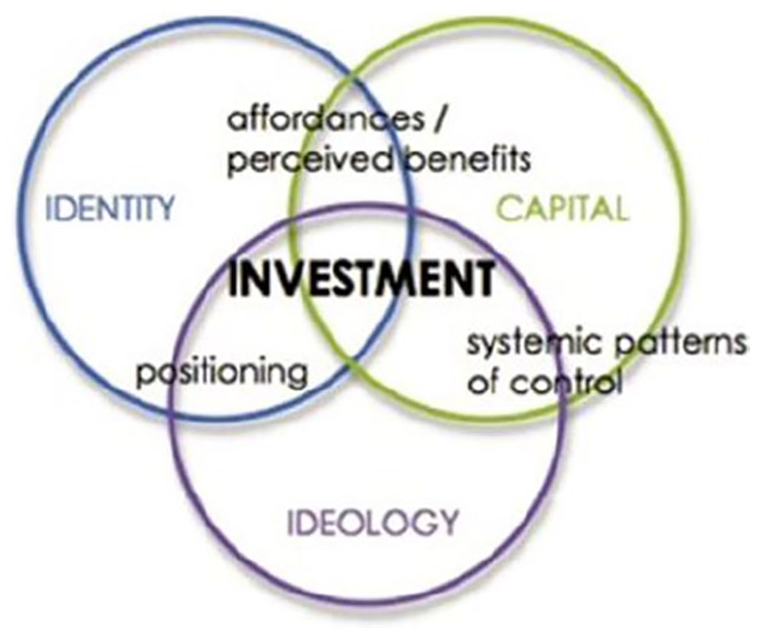
Darvin and Norton’s (2015) model of investment.
Influenced by Bourdieu’s (1991) work on forms of power, Darvin and Norton (2015) define capital as having material, cultural, and social forms. When learners invest in learning a target language, they hope for solid returns on their investment, often in a different type of capital from the one they invested. Such considerations will be central the present study’s data analysis. In addition, it will use the term linguistic capital, defined by Bourdieu (1977) as a form of embodied cultural capital, to describe the various language resources available to each participant and the value those individuals associate with each resource. This should help account for why certain language resources pertaining to international students (e.g., their mother tongues or accents) can be valued, or devalued, in CMGs.
Ideology comprises “dominant ways of thinking that organize and stabilize societies while simultaneously determining modes of inclusion and exclusion” (Darvin & Norton, 2015, p. 44). In any learning context, specific groups’ dominant ideologies can help explain why learners’ linguistic or cultural capital is valued or not. Language ideology that privileges standard English causes many Asian students to view standard English, and especially American English, as imbued with more power than local varieties (e.g., De Costa, 2011; Liu & Tannacito, 2013; Sung, 2016). Thus, the present study attempts to understand, at an ideological level, why certain forms of linguistic and/or cultural capital are valued differently by local Taiwanese students, and how this differential valuation influences their CMG investment.
Last, identity is defined as “how a person understands his or her relationship to the world, how that relationship is structured across time and space, and how the person understands possibilities for the future” (Norton, 2013, p. 45). From such a standpoint, identity is multiple, contradictory, mutable, and a site of struggle defined by ideologies and desires competing across time and space. Identity is central to the current study’s exploration of how local Taiwanese students’ day-to-day CMG investment decisions are connected to both their pasts and their desired futures.
In short, Darvin and Norton’s (2015) model and its three key elements provide valuable insights into why—and where—language learners can be ambivalent about learning and using their target language (Ballinger, 2017; Gearing & Roger, 2018; Palm et al., 2018). Here, Darvin and Norton’s model will be used to tackle questions of how and why individuals may be ambivalent about their investments in learning and using English in CMGs, with ambivalence defined as the tension between their feelings that their investments in intercultural interaction in CMGs will, and will not, result in their accumulating various forms of capital.
Method
The Research Context
An 18-week undergraduate EFL conversation course with a special focus on intercultural interaction was designed and delivered by the researcher from mid-September 2018 to mid-January 2019. Its 35 Taiwanese students were randomly divided into seven CMGs of equal size, to which one randomly chosen international student was then added. Thus, each CMG had six members, of whom one was from overseas, to realistically represent the ratio of international to local students on most Taiwanese university campuses. Table 1 shows which students were assigned to which CMGs, with the Taiwanese students identified by code numbers and the international ones by their countries of origin. Each CMG met for 2 hr per week, with the researcher present in each case, and was required to complete cross-cultural activities. Because power in any given CMG could easily default to its Taiwanese majority, the cross-cultural activities were designed to highlight or reinforce the international students’ status as subject-area experts on their home countries, to be consulted at every stage of the activity. It was expected that this structure could empower international students to perceive themselves as experts and to generate resources that home students might not be aware of, and at the same time, break down the barriers that so often prevent CMGs becoming environments of mutual support and respect (Ke, 2016).
Assignment of Participants to Culturally Mixed Groups, Showing the Taiwanese Participants’ Test of English for International Communication Scores.
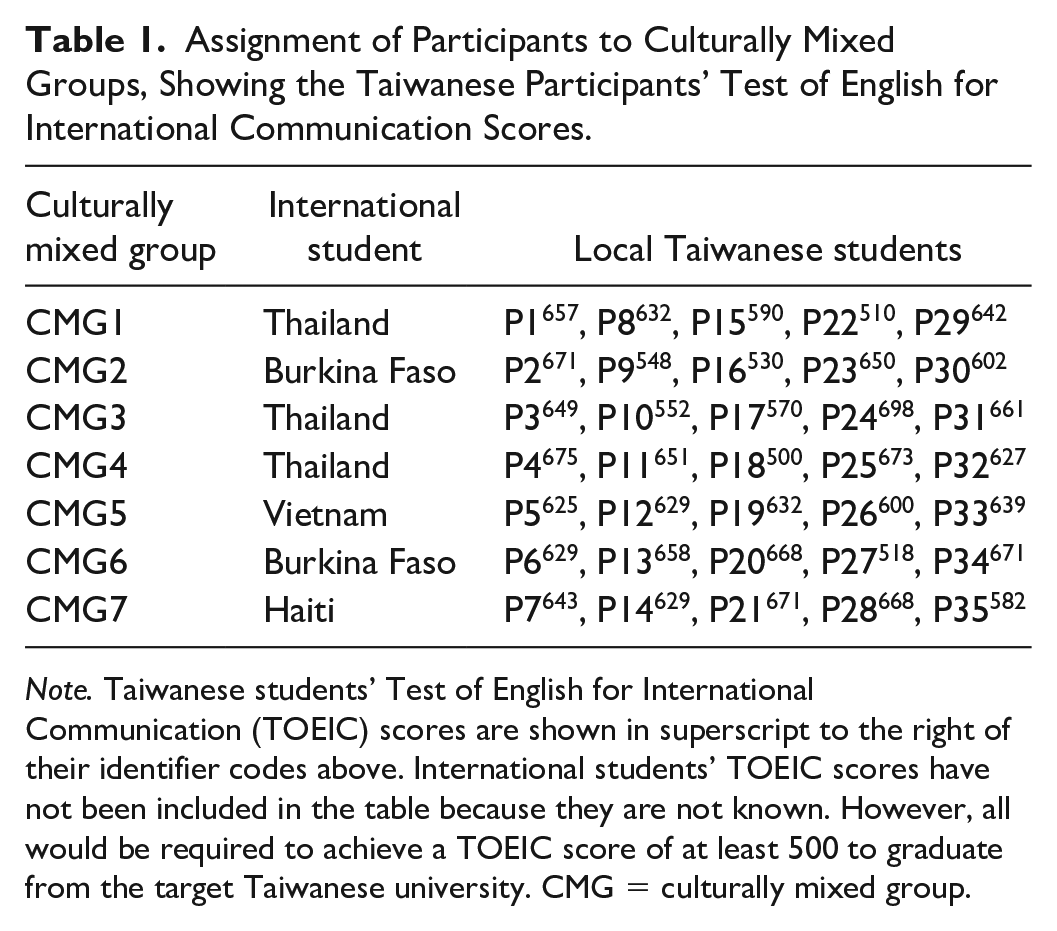
Note. Taiwanese students’ Test of English for International Communication (TOEIC) scores are shown in superscript to the right of their identifier codes above. International students’ TOEIC scores have not been included in the table because they are not known. However, all would be required to achieve a TOEIC score of at least 500 to graduate from the target Taiwanese university. CMG = culturally mixed group.
The course—a requirement for freshman English majors but open to non-English majors and other grade levels—was taught at a national university of science and technology in southern Taiwan, chosen due to its sustained growth in international student recruitment: up 323% from 2007 to 2017 (Department of International and Cross-Strait Education [DICSE], 2018). In line with the Taiwanese government’s New Southbound Policy (Ministry of Foreign Affairs, 2017), the target university provided full scholarships and English programs aimed at recruiting more students from Southeast Asia, especially Thailand. In addition, its department of Tropical Agriculture and International Cooperation was attracting an increasing number of NNS students from around the world, notably Africa. Together, African and Southeast Asian students made up 78% of the university’s 291-strong international student body in 2017 (DICSE, 2018). At the time of the study, NNS international students attended English-language courses, including EFL conversation courses, on a strictly voluntary basis; however, most chose to do so due to the prevalence of EMI at the university.
Participants
The 42 research participants included 35 Taiwanese English majors taking the above-mentioned 18-week EFL conversation course. All of them signed a consent form regarding their participation in the research, which was explained to them as an exploration of their learning experiences and NNS-NNS intercultural interaction in CMGs. Most had high English proficiency, with the Taiwanese group’s average score on the Test of English for International Communication (TOEIC) being 621 (Table 1). The seven NNS international students—of whom three were Thai, one Vietnamese, two Burkinabè, and one Haitian—also participated on a voluntary basis. Their TOEIC scores (if any) were not available, but their self-reported English proficiency levels ranged from pre-intermediate to intermediate. For the Taiwanese and international students alike, English had been the most important foreign language at school, with the former starting to learn it no later than the third grade and the latter generally at a similar age. However, the researcher observed that the latter group’s overall English ability was comparatively poor, despite only three of the Taiwanese students having visited majority English-speaking countries.
The Researcher’s Role
In qualitative research, the researcher’s role as the primary data-collection instrument necessitates the identification of personal values, assumptions, and biases at the outset (Creswell, 2009; Merriam, 2009). My perceptions and understanding of intercultural interaction in higher education have been shaped by my personal experiences, both as an EFL instructor working with both local and international students in Taiwan and as a researcher focusing on facilitating these groups’ intercultural interaction. Being an insider of the target course, as its teacher, I had privileged access to an emic perspective of student and classroom life through constant contact, all forms of student work, and immediate gathering of formal and informal student reflections. I also kept anecdotal notes recording students’ immediate responses to cross-cultural activities, as a means of reflecting on teaching and learning in a real-world classroom context. My special understanding of my context and role enhanced my awareness, knowledge, and sensitivity to many of the challenges and issues encountered by both groups of students during cross-cultural activities, and assisted my work with the data as my research progressed.
Data Collection
Reflective journals
As a component of their grade for the semester, the Taiwanese students were required to turn in reflective journals about their CMG experiences and perceptions, prompted by sets of questions provided by the researcher at the end of each of the class’s five cross-cultural activities. A summary of each such activity is presented in Table 2. As shown in Table 3, the teacher-researcher asked the same five questions about all five activities, plus one additional question—“Please evaluate your comprehension level of international students’ presentations about their home countries”—in regard to the first one, Planning an itinerary. Thus, there were 26 journal-prompt questions in all. Of the 175 assigned reflective-journal entries (i.e., 35 Taiwanese students × 5 cross-cultural activities), 169 were turned in via an online platform and collected for analysis.
Summary of Cross-Cultural Activities.

Note. CMG = culturally mixed group.
Teacher-Researcher’s Journal-Prompt Questions.

Note. CMG = culturally mixed group.
Semi-structured interviews
To minimize any perceptions of coercion, each participant was interviewed only after final course grades had been calculated and released. All 35 Taiwanese students were interviewed one-on-one by the teacher-researcher, and each interview session lasted 1 to 2 hr. The semi-structured interview questions aimed to elicit the students’ key perceptions of the intercultural communication that had occurred during or as a result of their CMGs’ cross-cultural activities. They were asked to describe their own and fellow CMG members’ interaction behaviors, specifically focusing on English-language learning and speaking practices and the reasons underlying such practices. In line with the research purpose, they were also asked to describe the roles of English in both their histories and their future plans. Each interview was conducted in Mandarin, the students’ first language, on the grounds that this was a language in which they felt comfortable expressing themselves, and was audio-recorded and transcribed for analysis. A complete list of interview questions is provided in supplemental Appendix I.
Data Analysis
Before applying Darvin and Norton’s (2015) model of investment to the data, I followed Merriam’s (2009) recommended procedures to code the students’ reflective journals and interview data: reviewing and carefully reading through all written reflections and interview transcripts, and identifying recurrent issues and emergent categories and themes. These issues, categories, and themes were then cross-checked against the teacher-researcher’s notes and memoranda, with the aim of generating insights into the participants’ perceptions and experiences of CMGs with NNS-NNS intercultural interaction. Eventually, this process allowed the teacher-researcher to identify recurring themes and patterns related to the participants’ ambivalent attitudes toward such CMGs and interaction. Broadly speaking, these were organized into benefits—that is, aspects that led participants to feel that participating in CMGs was worthwhile—and costs: aspects that led them to feel that participating was not worthwhile. The recurrent themes and patterns, as further scrutinized in light of Darvin and Norton’s expanded model, served as building blocks for constructing the teacher-researcher’s understandings, interpretations, and descriptions of how the participants perceived themselves and one another within CMGs, and of how wider social contexts influenced their investment in speaking and/or reluctance to speak English with their fellow CMG members. Finally, a member-checking procedure (Merriam, 2009) was conducted, whereby the teacher-researcher’s summaries of the preliminary findings were sent to the participants for their corrections and other feedback, based on their subjective perceptions of the CMG experience.
Findings
The first two phases of analysis, covering capital and ideology, revealed the participants’ selection of investment in NNS-NNS intercultural interaction in their CMGs, thus enabling the researcher to answer RQ1. While some Taiwanese participants associated their investment in CMGs with linguistic capital, the majority resisted NNS-NNS interaction, especially with international students. Their resistance seemed to be rooted in pro-standard English ideologies, including strong opinions about which variety of English should be used and who the “legitimate” English speakers in English-conversation classrooms are. The third phase of analysis, covering identity, helped to explain the role of imagined communities in the participants’ investment in CMGs, and thus enabled the researcher to answer RQ2. Most of the Taiwanese participants envisioned that speaking “good” English, conceived of as native-like pronunciation, could help them gain important career opportunities in international companies or airports. Indeed, their imagined communities of employees in such settings seem to have been the main driver of their sustained investment in attaining native-like English pronunciation. Their long pursuit of such pronunciation and near-native English competence was traced to the earliest stages of their English education, which promoted native-speaker models and unrealistic imagined communities of native-like speakers.
Capital
Of this study’s 35 Taiwanese participants, 10 (P15 and P22 from CMG1; P9 and P16 from CMG2; P10 and P17 from CMG3; P18 from CMG4; P26 from CMG5; P27 from CMG6; and P35 from CMG7) were invested in speaking and learning English with their fellow CMG members, due to the returns they expected in the form of capital. That is, these 10 local English majors acknowledged the value—in terms of augmenting their own legitimacy as global citizens—of meeting international students, and of communicating with CMG members from diverse linguistic and cultural backgrounds who spoke multiple varieties of English. This viewpoint also provided the local students with a level of comfort about their own self-perceived “imperfect” English, and thus boosted their confidence about speaking English in their CMGs.
Perceived capital as global citizens
P9, to name one typical example, highlighted that CMGs offered local Taiwanese English majors who had never been abroad opportunities to meet foreigners from diverse backgrounds and to have real-life intercultural encounters: I have never been to foreign countries or met foreigners before. In CMGs, I can meet students from other countries and listen to their different styles of English in face-to-face conversations. Especially now, English is the international language used by different people in this global village. This can help me become a global village member. [P9, CMG2, IN]
Five Taiwanese participants from CMG2, CMG6, and CMG7 said they appreciated that their CMGs allowed them to meet foreigners from faraway countries: in these cases, Burkina Faso and Haiti. P16 explained that this allowed her to learn more not only about foreign languages and cultures, but also about forms of English she had never heard before, not just the handful of already familiar forms used in neighboring countries (e.g., Thailand English).
We can expand our horizons and learn something new, such as their home countries and culture. In particular, we have international students from African and Latin American countries, not just from those foreign countries we are already familiar with, such as Thailand or Vietnam. Talking with them, I feel like a global village member. [P16, CMG2, IN]
The responses to the reflection question “Please talk about your experiences of intercultural interactions in Taiwan. Have you met and talked with foreigners in Taiwan?” were particularly interesting. Only 10 Taiwanese participants—the same10 who valued their CMGs most highly—acknowledged that their CMGs with NNS international students offered them opportunities to talk with foreigners, with the other 25 appearing to intuitively define “foreigners” as NSs from majority English-speaking countries, such as their former teachers from school or after-school language programs, whom they frequently mentioned in other contexts. Examples of students’ responses to this question are provided in supplemental Appendix II.
Perceived capital as confident English speakers
Another view shared by the 10 most pro-CMG participants was that when attending English group discussions with their co-nationals in previous semesters, they had often felt awkward, unconfident, or even “out of place.” This was because their co-nationals tended to use accuracy—defined narrowly as closeness to native-like pronunciation—as a yardstick for judging others’ English proficiency. P18 described how fellow Taiwanese constantly commented on their peers’ English levels and on how closely their oral-English production resembled NS norms. This, she said, exerted pressure on those with self-perceived “imperfect” accents or disfluent English speech.
Taiwanese people are so judgmental. If you cannot speak English correctly or speak it with a strong accent, Taiwanese people will think your English proficiency must be low. This kind of negative evaluation makes people frightened of speaking English. So I would not want to speak English with other Taiwanese students even in the English conversation courses in our department. [P18, CMG4, IN]
It is important to note here that the English proficiency levels of these 10 participants, including P18, were low-intermediate to intermediate, with an average TOEIC score of 550, whereas the other 25 Taiwanese participants scored an average of 650. The former subgroup’s confidence about speaking English was boosted considerably in the CMGs with those of more varied ability and multiple accents, and—as they saw it—greater tolerance of imperfection. Seeing how different varieties of English could be used effectively by the international students helped P18 to prioritize intelligibility over linguistic accuracy, and to build up her confidence in using English for intercultural communication: Unlike the Taiwanese students’ negative evaluation, the international students appear to be patient and willing to listen to my slow English speaking. Although some international students themselves have strongly accented English, they can still be good English speakers in our group discussions. This also made me feel comfortable about using my slow accented English to speak in my group. [P18, CMG4, IN]
The 10 most pro-CMG participants also highlighted that their CMGs had the potential to liberate them from the label of being Chinese NSs, as English was the only language they shared with their non-Taiwanese fellow CMG members. As P17 explained, Without international students, we would only use Mandarin to conduct our group discussions in previous English-conversation courses. But now we have international students in our CMGs. To interact with these students and help them understand what we are saying in our CMG discussions, we feel that we should use English. [P17, CMG3, IN]
Ideology
As discussed above, a large minority of the Taiwanese participants felt they had gained capital from their investment in learning and speaking English in CMGs; nevertheless, 71% (n = 25) questioned the returns that might come from such investment and were either unable or unwilling to accommodate their international CMG partners’ nonstandard patterns of English pronunciation. This lack of accommodation was seemingly rooted in these Taiwanese students’ strong opinions about which variety of English should be used and who the “legitimate” English speakers in English-conversation classrooms are.
Lack of accommodation toward multiple varieties of English
The majority of the Taiwanese participants expressed frustration about interacting with NNS international students due to the difficulty of understanding the latter’s spoken English. P3’s comments typified this subgroup’s attitude that the NNS international students were to blame for the failure of intercultural communication within their CMGs.
Frankly, I cannot understand these international students’ strongly foreign-accented English. It is too different from our familiar standard American English. It’s very difficult for us to understand their accented English, not to mention have intercultural communication with them. [P3, CMG3, IN]
Similarly, P6 complained that the CMG as actually experienced violated Taiwanese students’ expectations that in such groups, they would learn and speak standard varieties of English such as American or British English, so as to facilitate their interaction with NSs in the future.
At first I thought I could learn how to communicate with foreigners by participating in CMGs. But my CMG members were either Taiwanese students or [ . . .] from non-native English speaking countries. Especially those non-native international students have strong foreign accents when speaking English. I can hardly learn to speak correct English or to communicate with foreigners in CMGs. [P6, CMG6, IN]
In short, the CMGs with NNS international students did not fulfill the majority’s expectations. The international students’ strongly foreign-accented English, which participants claimed was incomprehensible, delegitimized the former’s credentials as English speakers/users. Thus, the majority of Taiwanese not only failed to accommodate to the NNS students’ communication, but resisted investing in learning or speaking English in CMGs themselves.
Pedagogical concerns about conforming to native-speaker norms
Many Taiwanese participants raised concerns about their NNS-NNS intercultural communication experiences in the focal CMGs. Chief among these was that they needed NS models and immediate correction from NS teachers if they were to achieve their goal of learning standard English. The potential benefits of learning (or even learning about) any variety of English other than American or British was broadly ignored, and the participants appeared generally to assume that the proper role of EFL learners was to look up to NS teachers and accept their modeling and corrections.
The majority of the Taiwanese participants who held such views also exhibited notably resistant behaviors. For example, P1 in CMG1 complained that CMGs were not helpful and focused on what she perceived as negative aspects of international students’ non-native varieties of English: [NNS] are just like other Taiwanese students because they are not waiguoren [foreigners], despite the fact that they can share information about their home countries or cultures. Waiguoren should be native English speakers who are valid and better-qualified English speakers. Speaking English with waiguoren is the best way to learn English. [P1, CMG1, IN]
As mentioned above, a majority of the Taiwanese participants had come to rely upon immediate correction and feedback from NSs as the chief means of enhancing their English-speaking proficiency. However, the focal CMGs not only contained no NS members, but also did not provide any correction or feedback. Many of the Taiwanese participants could not see beyond this lack of correction from NSs, and thus could not acknowledge any benefits of the intercultural communication they were engaging in.
I would still prefer to have English conversation courses with native-speaking teachers who could correct my English speaking errors. But now, my CMG members couldn’t correct any of my English speaking errors in grammar or vocabulary because they were not quite certain. In our CMGs, they thought my spoken English was okay and could not tell me how to speak English correctly. [P23, CMG2, IN]
Identity
Expectation that following native-speaker models will yield “good English.”
In Taiwan, English is not compulsory until third grade, and only one class per week is offered in third and fourth grades. However, less than a quarter of the Taiwanese participants (n = 8) had started their English language education at that point, with the remainder having started earlier because their parents believed they could get a head start if NS teachers inculcated them with “accurate” and “authentic” English. For instance, P12 in CMG5 noted that his parents had sent him to a bilingual kindergarten because they expected him “to imitate how the native speaker teachers speak English and learn to speak good English with that beautiful accent.” Similarly, P1 described her early start in English-language education as follows: I was sent to bilingual kindergarten at the age of five or six. We had three to six hours per week of English courses co-taught by the native speaker teachers and local Taiwanese teachers. My parents hoped that I could learn to speak good English from native speaker teachers. [P1, CMG1, IN]
These and other participants further noted how their early start in English-language education with NS teachers helped them learn “good English,” including native-like pronunciation; and that their confidence when speaking English was dependent on how closely their English speech resembled NS norms, as well as how well NSs understood them. Various participants, including P23, asserted that learning to speak English like a native was a key indicator of their English proficiency improving.
I felt motivated to learn English when having English conversations with the native speaker teachers. It’s great to know that I can understand their English. And amazingly, they can also understand my English. So I feel like I can really speak English well. [P23, CMG2, SRJ]
Imagining speaking “good English” in future jobs
When asked why speaking English like NSs was important, most participants said that “good” English, conceived of as native-like pronunciation, could help them fulfill their dreams, including studying abroad (n = 2), securing good jobs in internationally orientated companies (n = 12), and securing international airport jobs (n = 11). In other words, they closely and clearly linked the “right” type of English with their entry to imagined communities of successful employees. P15, for instance, said, Only if I can learn to speak good English will it be possible for me to get jobs in international companies. Those companies would have better pay. But they would need me to speak good English with foreigners. [P15, CMG1, IN]
Moreover, as their English-language education throughout their lives had increasingly emphasized learning native-like English pronunciation, the participants’ desire to adhere to NS norms and speak with NS accents appeared to have become stronger, underpinning and sustaining their investment in learning to speak English. However, while they believed such investment could bring them important career opportunities, they seemed to overlook the global reality that many varieties of English are used for intercultural communication among “foreigners,” not least in international business and tourism.
Discussion
The themes that emerged from this study’s examination of local Taiwanese students’ reflective journals and interviews about their CMG perceptions and experiences are examined collectively below, in relation to each of this study’s research questions.
RQ1: The “How” and “Why” of Investment in Culturally Mixed Groups
In line with previous research that applied Darvin and Norton’s (2015) expanded model of investment to language-learning settings (Ballinger, 2017; Gearing & Roger, 2018; Palm et al., 2018), the present study’s analysis revealed its participants’ broadly ambivalent attitudes toward using English for NNS-NNS intercultural interaction in CMGs. Although clear arguments both in favor of and against doing so existed side by side in the data, the latter predominated. Such ambivalence could be explained by the tension between the participants’ feelings that their investment in intercultural interaction in CMGs would, and would not, result in their accumulating various forms of capital (Bourdieu, 1977, 1991; Darvin & Norton, 2015).
The 10 participants with relatively low English proficiency (i.e., P9, P10, P15, P16, P17, P18, P22, P26, P27 and P35) exhibited markedly greater willingness to invest in their CMGs than did their higher achieving peers, because the former associated their active investment in CMGs with the capital they felt they needed to become confident English speakers and global citizens. The 10 lower proficiency Taiwanese participants reported that initially, they had limited or no courage about speaking English, due to their inability to produce standard English and the previously discussed unequal power relationships in NS-NNS interaction. In keeping with prior findings by Kimmel and Volet (2012), Montgomery (2009), and Volet and Ang (2012), these 10 participants all reported having been silent in other EFL conversation courses, due to worries that their co-nationals would negatively evaluate their English as nonstandard. But through their participation in the CMGs, they came to perceive NNS international students and themselves as legitimate English speakers, thereby gradually building their self-confidence about speaking English.
As well as increasing such confidence, this subgroup’s investment in NNS-NNS intercultural interaction in CMGs boosted their willingness to accept linguistic diversity and helped them to develop the type of positive, adaptive ideology about English that various prior researchers have dubbed ELF awareness. This ideology is marked by an increased sense of ownership of English, particularly in EFL contexts (Huang, 2018; Lin, 2019; Tsou & Chen, 2014). In accordance with the findings of previous studies conducted in non-Anglophone countries (Kuteeva, 2019), NNS-NNS interaction between local and international students was here found to be strongly beneficial to some English language learners’ confidence about speaking English. As such, the present study’s findings complement those of the existing literature on the potential of NNS-NNS interaction to boost local EFL students’ use of ELF (Ke, 2016; Wang, 2019). This is rather remarkable, given that the 10 participants who benefited the most from such interaction had both relatively low English proficiency and persistent anxieties about their production of English.
However, the same CMGs, with the same NNS-NNS intercultural interaction, failed to generate the capital expected by the majority of Taiwanese participants, who resisted using English in them. They prioritized learning standard English, either American or British, and expected NS waiguoren to be in their CMGs and to model standard English for them. The gap between such expectations and the reality in the CMGs not only disappointed this participant subgroup, but also led them to question the returns that might accrue from their investment in learning and speaking English in CMGs. These implicit pro-standard English ideologies that enshrined NS accents and native-like pronunciation remained central to these participants’ decisions about how much to invest in speaking and learning English in CMGs—confirming previous studies’ findings that Asians studying in their own countries tend to see themselves as deficient EFL learners, and to look up to NSs as experts on linguistic norms (De Costa, 2011; Lin, 2018; Liu & Tannacito, 2013). Pro-standard English ideologies also seem to impact on how learners construct and negotiate their language identities in relation to their interlocutors, whom they often define in terms of a native/non-native dichotomy (Kim et al., 2014; Lin, 2018; Sung, 2016). The present findings again seem to align with previous CMG researchers’ arguments that intercultural interaction between domestic and international students is power-laden and shaped by larger social contexts, including language ideologies (Byun & Jung, 2019; Kim et al., 2014).
RQ2: Imagined Communities and Their Impact on Investment in Culturally Mixed Groups
The role of imagined communities (Norton, 2001, 2013) in local Taiwanese students’ decisions about how much to invest in their CMGs underlines the complexity of grafting CMGs with NNS-NNS intercultural interaction into current curricula. Previous studies have documented the paradoxes and complexities in local students’ perceptions of and responses to such interaction (Byun & Jung, 2019; Kim et al., 2014); yet, the scope of such analyses has been limited to the local students’ immediate experiences of working in intercultural groups, in isolation from their personal histories and future aspirations. It is important to note here that a majority of my participants, that is, those with the highest English proficiency, resisted CMGs in lieu of assimilation into their imagined communities of NSs and native-like speakers. In their lives up to the point of the study, this majority and their parents had invested heavily in their acquisition of native-like English pronunciation. Based on this sustained investment in and positive perceptions of their own English as being NS-like, this subgroup seemed to identify more strongly with their imagined communities than the low-achievement subgroup did, and the strength of this attachment to imagined communities of NSs and employees in international companies or airports could have been the main reason for their sustained investment in pursuing native-like English pronunciation. As analysis of the present study’s data makes clear, however, the majority’s resistance to CMGs with NNS-NNS interaction cannot be entirely attributed to their ideological insistence upon the production of standard, native-like English (cf. Byun & Jung, 2019; Kim et al., 2014). Rather, some of it can be explained by lack of desire to invest in such CMGs, whether due to anticipation of a poor return in the future (i.e., failure to obtain high-paying, glamorous jobs) or to their prior histories of English-language learning. As the CMGs did not support the majority’s needs to join their imagined communities, it resisted learning and speaking English in them. And through its resistance, the majority also displayed its preference for standard English as the norm for pedagogical purposes in the EFL curriculum, as has previously been found with most Asian EFL learners (De Costa, 2011; Lin, 2018; Liu & Tannacito, 2013). As such, they seemed to overlook the sociolinguistic reality of the multiple varieties of English used in international airports and companies, which they would need to comprehend and accommodate if their career dreams were fulfilled. To bridge the gap between the majority’s resistance to CMGs and such sociolinguistic reality, English-language learners should be guided to understand language ideologies and power relations, instead of being allowed to blindly pursue models of perfect English (Ke, 2016; Sung, 2016).
On a theoretical level, this study makes some important contributions to the underresearched topic of Taiwanese college students’ investment in CMGs with NNS-NNS intercultural interaction. This study chose to investigate this topic in terms of capital, ideology, and identity because students’ classroom resistance is often misinterpreted or presumed to be an index of low academic performance (e.g., Huang, 2018). Importantly, participants who exhibited the strongest resistance were not “problem students” with low English proficiency. Rather, the resistors’ proficiency was high, and their resistance was driven largely by their pro-standard English ideologies connected with their pasts and futures. This phenomenon echoes prior researchers’ claims that language learners’ nonparticipation or resistance can be interpreted as active agency, negotiated as part of their joining imagined communities or denying membership of such communities to specific others (Chang, 2011; Darvin & Norton, 2015; De Costa, 2011; Liu & Tannacito, 2013; Norton, 2001). That is, when a learning context impedes or appears to impede imagined community membership, a learner will exercise his or her agency to invest less or even resist it.
The findings of the present study could also have practical implications, especially in terms the circumstances of and reasons for local students’ resistance to CMGs with NNS-NNS intercultural interaction, and therefore, the running of such groups. The above findings regarding resistance underline the complexity of implementing CMGs in real-world college classrooms. This study has made it abundantly clear that forming CMGs that include NNS international students in college EFL courses is not, by itself, an effective method of preparing local Taiwanese students either for ELF use or intercultural interaction. The majority of the sampled Taiwanese students who primarily sought native-like spoken English and resisted CMGs had among the best English proficiency levels, and seemed to identify with NSs based on their positive perceptions that their own English speech was akin to that of NSs. In their long-term pursuit of native-like English pronunciation and near-native English competence, these proficient English-language learners seemed to overemphasize accuracy and to maintain a fixed mentality that native-like English pronunciation and sufficient linguistic knowledge would automatically enable them to communicate with foreigners. It should also be noted that, while a lack of perceived capital or accommodation toward NNS international students’ nonstandard patterns of English pronunciation was certainly part of the picture, a complex set of larger social contexts—for example, local students’ pro-standard English ideology, race, ethnicity, and their imagined communities of NSs—could also have played a part. The teacher’s role is critical in developing local students’ awareness of the undercurrents of native-speakerism that are commonly identifiable in local students’ English-learning pasts, including but not limited to their EFL textbooks and traditional EFL curricula with NS norms.
Another point worth noting here is that promoting CMGs with NNS-NNS intercultural interaction should not replace modeling of pronunciation, which is popular in EFL conversation classrooms. While linguistic knowledge and skills are undoubtedly very important, it is clear that existing EFL curricula have placed little emphasis on issues that may arise from oral communication between interlocutors from different cultural and linguistic backgrounds (Ke, 2016; Kuteeva, 2019; Lin, 2019). Researchers have highlighted that the communicative strategies required for ensuring understanding among speakers from such diverse backgrounds should not be taken for granted, even by NSs or advanced learners of English. Students, including those who perceive themselves as proficient English-language learners, need to become attuned to others’ varieties of English and to take responsibility for mutual understanding. Nevertheless, chronic inattention to such matters has rendered EFL curricula broadly unrealistic as preparation for entry into the global community that the English language underpins. Proficient learners’ imagined communities, in which everyone speaks perfect NS-like English, are more of a fantasy than a sociolinguistic reality. If their real goal is to work in an international environment, then their imagined community needs to be populated with NNSs as well as NSs.
Recognizing and accepting different English varieties therefore can and should be a starting point for local EFL learners’ development of awareness of the role of English as a global language and lingua franca. The present study’s analysis shows that CMGs with NNS-NNS intercultural interaction were an effective means of fostering some local Taiwanese students’ intercultural learning and intercultural awareness. Members of this participant subgroup, despite their relatively low English proficiency and limited real-world experience of intercultural communication, expected to have future opportunities to meet foreigners and experience different varieties of English, and essentially utilized their CMG interactions as practice for such future encounters. In a globalized world, with universities in the Asia Pacific region recruiting ever-increasing numbers of NNS international students, CMGs with NNS-NNS intercultural interaction have the potential to liberate local EFL learners—particularly those with low English proficiency and low confidence about speaking English—from the label of “deficient English speakers,” and enhance their self-confidence about using English for communication.
Conclusion
This study has taken an important step toward explaining how and why students’ investment in English-language interaction with their fellow CMG members is influenced by larger social contexts, including dominant language ideology and their imagined communities. Although the goal of achieving native-like levels of competence in all areas of English by EFL learners is justified and welcome, they should not seek to achieve it by isolating themselves from different varieties of English or from NNS-NNS interaction; and the populations of their imagined communities should include some NNSs if such communities are to reasonably reflect their future international workplaces. Because the number of NNS international students has increased dramatically in Taiwan in recent years, NNS-NNS interaction in English is commonplace on Taiwanese college and university campuses, and—resistance notwithstanding—CMGs featuring NNS-NNS intercultural interaction are among the best means of preparing EFL learners for their inevitable encounters with the varieties of English these international students speak. To fulfill Taiwanese students’ needs, aspirations, and desires for their future lives, teachers should consider utilizing CMGs with NNS-NNS interaction as a venue for local students’ functional application of their linguistic knowledge in authentic intercultural-communication contexts. The present findings regarding how issues around ideology, capital, and identity can impact EFL learners’ investment in English-language learning and their engagement in intercultural interaction should also inform the designs of new, richer CMG learning tasks. It is hoped that these insights, in turn, will encourage universities with increasingly diverse student populations and their faculty members to reformulate curricula in ways that will prompt both international and Taiwanese students to increase their investment in CMG-based English-language classroom practices.
One limitation of this article is that its findings were based on the local students’ viewpoints only, in a relatively small number of CMGs associated with a single university course. As such, the participants’ experiences and perceptions may have been idiosyncratic, and thus of only limited generalizability to other educational levels, course subjects, CMG contexts, CMG sizes, and so forth. Future studies should examine levels of investment and resistance not only among local students but also among their international classmates, using more data sources and a larger number of more diverse participants over a longer period. It is also possible that some of the observed attitudes toward “imperfect” NNS English were influenced by student-student differences in English-language ability, which unfortunately could not be measured due to a lack of data on the international student participants’ TOEIC scores. Therefore, future research designs should ensure that there is sufficient data on home and foreign students’ respective pre-existing English proficiency levels, so that meaningful comparisons between these two groups can be made.
Supplemental Material
APPENDIX – Supplemental material for Intercultural Interaction in English: Taiwanese University Students’ Investment and Resistance in Culturally Mixed Groups
Supplemental material, APPENDIX for Intercultural Interaction in English: Taiwanese University Students’ Investment and Resistance in Culturally Mixed Groups by Shu-Wen Lan in SAGE Open
Footnotes
Acknowledgements
The author appreciates the constructive and insightful comments from the editor and reviewers.
Declaration of Conflicting Interests
The author(s) declared no potential conflicts of interest with respect to the research, authorship, and/or publication of this article.
Funding
The author(s) disclosed receipt of the following financial support for the research, authorship, and/or publication of this article: This work was supported by the Ministry of Science and Technology in Taiwan (grant no. MOST 105-2410-H-020-012).

Supplemental Material
Supplemental material for this article is available online.
Author Biography
References
Supplementary Material
Please find the following supplemental material available below.
For Open Access articles published under a Creative Commons License, all supplemental material carries the same license as the article it is associated with.
For non-Open Access articles published, all supplemental material carries a non-exclusive license, and permission requests for re-use of supplemental material or any part of supplemental material shall be sent directly to the copyright owner as specified in the copyright notice associated with the article.
