




Abstract
A built environment with high-quality esthetic expression can positively contribute to key agendas of urban development. Environmental design is the design of physical environments that mainly respond to people’s behavioral needs and sensory preferences based on environment–behavior relations. Practitioners in this industry often work on esthetic quality improvement. Although previous studies have provided valuable knowledge about important elements of built environment esthetic expression, limited research efforts have been devoted to building a systematic framework that comprises key evaluation elements with high local adaptability and the influence relationships among them. The standards and preferences of esthetic expression in environmental design scheme evaluation are context-based. Providing an effective way to clarify evaluation elements with high local adaptability and the relationships among them may help reduce ambiguity, enhance consensus, and increase efficiency in the decision-making process. Therefore, this study adopted the esthetic expression evaluation of environmental design in China as an example and produced a hybrid decision analysis model by integrating the fuzzy Delphi method (FDM), exploratory factor analysis (EFA), analytic hierarchy process (AHP), and decision-making trial and evaluation laboratory (DEMATEL) method to evaluate the esthetic expression of environmental design schemes. A hierarchical evaluation framework composed of 5 dimensions and 18 evaluation elements was constructed in this study. The key design elements under each dimension and the influence relationships among them were also identified. This paper offers insights into the theoretical investigation and practical development of a systematic evaluation of the esthetic expression of environmental design schemes.
Keywords
The planning and design of urban physical environment are highly important in providing benefits for communities and society. Parks, squares, streets, and other urban open spaces provide the public with an important connection to nature and can positively affect the quality of people’s lives (Douglas et al., 2017). Built environments with high-quality esthetic expression can contribute positively to key agendas of urban development, such as improving city image and place identity (Karimimoshaver & Winkemann, 2018), improving destination attraction (Zhu et al., 2020), and promoting residents’ mental health (Gobster et al., 2019). Based on such demands, environmental design disciplines that aim to improve urban environmental quality are on the rise. Environmental design refers to the design of physical environments that mainly respond to people’s behavioral needs and sensory preferences based on environment–behavior relations. Practical activities involve a series of processes for the visual improvement of the spatial interface (Zhang, 2020) in the form of large-scale private sector development projects, public conservation of the environmental quality of communities, and low-cost neighborhood improvements (Nasar, 1994). This practice often requires the integration and re-creation of cross-domain visual-esthetic quality-related knowledge and information (Cho, 2017). Milburn and Brown (2003) pointed out that research work is involved from the beginning to the end of this type of design practice process. This may be because from the initial concept generation to the final plan, designers expect to be able to efficiently and accurately improve the design plan to incrementally approach their design concept (or goal). Evaluation research can play a vital role in improving the design scheme. Even before the design, based on the field investigation and the collection of relevant background data, the development orientation and feasibility of the project can be further clarified through evaluation and analysis (Chen et al., 2019; Zhu et al., 2017). In the design process, evaluation research can directly affect the generation of design concepts and clarify the role of concepts within the venue. After the completion of the design practice, the “utility,” “performance,” “value,” and other attributes of the design results can be evaluated and analyzed (Afacan & Erbug, 2009; Leskovar et al., 2019).
Among all the performance aspects of environmental design, the esthetic expression of the design scheme plays an essential role in performance evaluation (Heathcott, 2019; Lang, 2017; Yang, 2019; Zandieh et al., 2016). However, the evaluation of esthetic quality throughout the design process are very challenging to achieve efficient scheme communication and management. This is largely related to the characteristics of esthetic expression. First, it is accepted that the judgment of the esthetic expression of art design practice is qualitative and subjective, that is, it is a matter of taste. The traditional definition of esthetics in the arts typically refers to a perception of beauty or the sublime that engenders intense feelings. Cuthbert (2006) indicated that “an esthetically pleasing experience . . . provides pleasurable sensory experiences, a pleasing perceptual structure and pleasurable symbolic associations.” esthetic quality depends on people’s subjective perceptions and an intuitive ability to experience esthetic appreciation (Lang, 2017). Given these characteristics, many studies of visual assessment have aimed to provide methods and tools to assist communication within the design team or between the design and developer teams in the design management process (Gobster et al., 2019). Such visual assessment tools (e.g., Gjerde, 2011; Kalinauskas et al., 2021) provide a more “objective” way to express the esthetic views of different stakeholders by reducing ambiguity, uncertainty, and conflict. Second, esthetic perception is context based. Different regional circumstances; social and economic contexts; and embedded cultural knowledge, norms, values, and practices all influence esthetic perception and evaluation preferences. Therefore, knowledge of key factors gained from an empirical study conducted in a particular part of the world can be difficult to generalize and feed back to the entire environment design industry. Previous empirical studies have been conducted in different areas, such as the United Kingdom (Hoyle et al., 2017), Lithuania (Kalinauskas et al., 2021), Iran (Jahani & Saffariha, 2020), and Bangladesh (Ferdous, 2013). Some assessment studies directly established their new frameworks using evaluation elements summarized in previous literature or classical theories, which may lead to applications that are unsuited or poorly adapted to local regions (Lin et al., 2020; Zhu et al., 2017). Therefore, the question of how to generate elements with high local adaptability in regions such as China can be associated with multiple-attribute decision-making (MADM). Third, some previous studies have shown that esthetics can be quantified (Canter, 1969; Kasmar, 1968; Qin et al., 2016). Training the weights of criteria is a necessary discussion when priority generation is required in the evaluation decision-making process (Cho, 2017; Christensen & Ball, 2016; Demirkan & Afacan, 2012). However, existing weight training methods are mainly based on the methodological assumptions of independent criteria, which might lead to ignoring the systematic relationships among elements. The complex logical relationships (e.g., hierarchical relationships and cause-effect relationships) among the elements of environmental design require further clarification (Chen et al., 2019). Clarifying the system structure of these evaluation elements can reduce the risk of inefficiency in the overall scheme improvement resulting from negligence that is referred to as “treating the symptoms but not the disease” (which means attending to certain elements with the worst performance and highest weight and losing sight of elements in influential relationships with them; Tzeng & Shen, 2017; Xiong et al., 2021; Zhu et al., 2020).
In summary, although previous studies have provided valuable knowledge about important elements of built environment esthetic expression, limited research efforts have been devoted to building a systematic model with high local adaptability that contains the key evaluation elements and the influential relationships among them. Therefore, providing an effective way to clarify evaluation elements with high local adaptability and the relationships among them may help to reduce ambiguity, enhance consensus, and increase decision-making efficiency in the decision-making process. Therefore, this study adopted the esthetic expression evaluation of environmental design in China as an example and produced a hybrid MADM model by integrating the fuzzy Delphi method (FDM), exploratory factor analysis (EFA), analytic hierarchy process (AHP), and decision-making trial and evaluation laboratory (DEMATEL) method to evaluate the esthetic expression of environmental design schemes. By using the proposed hybrid MADM model, we can obtain the following outcomes: (i) the evaluation elements with high local adaptability, (ii) a hierarchical evaluation framework with both element and dimension levels, (iii) the weight of each dimension, and (iv) the dominant influential relationships among the evaluation elements in each dimension. This study extends the research on the esthetic expression of environmental design schemes in two major aspects. First, it extends empirical evidence for the evaluation framework from an expert perspective in China. Second, for relevant practitioners or decision-makers, it provides an improved and hybrid MADM methodology tool that has the advantages of efficient communication and design scheme improvement by considering both the local context and a system perspective.
Elements of Esthetic Expression in Environmental Design
Since the end of the 20th century, an increasing number of studies have focused on exploring the physical characteristics and visual qualities of urban environments as well as how urban spaces affect user perceptions and behaviors. These characteristics and qualities include architectural elements, landscape design, and morphology as well as features related to environmental safety, management, and the site environment (Jeong et al., 2015; Loukaitou-Sideris & Banerjee, 1993; Özgüner & Kendle, 2006). The interfaces between urban space and human response/behavior are clearly multidimensional, and a range of visual, morphological, and esthetic qualities are essential to a successful urban built environment. In terms of human visual input needs, the urban environment is perfectly equipped to generate a set of visual inputs of varying complexity defined by different levels of visual order (Lozano, 1974). In addition, the different visual inputs are not conflicting or exclusionary; on the contrary, they are complementary and must be combined in the same environment. Lang (1987) proposed that both formal and symbolic environmental variables have a direct bearing on the study of esthetics. This somewhat artificial division accepts a difference between the structure and content of forms (Nasar, 1997). Formal esthetics emphasize the structure of forms, while symbolic esthetics emphasize the content (or meaning) of forms.
Based on a review of relevant literature in the fields of esthetics, environmental psychology, and urban design, Gjerde (2011) summarized environmental design elements influencing esthetic perception, and established an analytical framework that provides a list of design characteristics (i.e., complexity, order, scale, human scale, and cleanliness) for questionnaire survey and streetscape assessment tools. He further argued that the two most fundamental formal factors influencing esthetic judgment are order and visual interest, which tend to be fuzzy and complex. If the overall shape of the built environment of the city is consistent and has prominent architectural facade constituent elements, it can enhance the sense of order in the scenery, thus providing people with an esthetic and pleasant experience (Askari & Soltani, 2018). Stimulation of interest must be managed to ensure that visual perception does not tax the mind. Moderate stimulus levels generate positive esthetic experiences until they reach a certain level at which pleasure begins to diminish (Nasar, 1994). Ferdous (2013) summarized the following five physical elements that can influence people’s esthetic preference: (i) a good sense of enclosure, (ii) the height of the surrounding enclosure, (iii) good coverage by vegetation, greenery, and natural elements; (iv) inclusion of water features and fountains; and (v) the presence of monuments or sculptures. Wang et al. (2019) applied a direct rating approach to explore the effects of the characteristics of urban green spaces in China on esthetic preference and found that the number of trees and the presence of flowers, water, and fish had a large impact. Jahani and Saffariha (2020) used an environmental modeling approach to analyze 11 landscape characteristics in 200 urban parks in Iran and found that those with more trees, water bodies, flowers, and decoration and fewer buildings tended to attract citizens and alleviate mental stress. Ferdous (2013) conducted a study in eight plazas and designed urban open spaces in Bangladesh to examine the relationship between visual characteristics and esthetic response and found that a positive esthetic response was linked to specific visual characteristics: (i) a “partially open” surrounding enclosure, (ii) “low height” of the surrounding enclosure, (iii) a “moderate amount” of water features, (iv) “quite a lot” of vegetation, and (v) a “moderate to great amount” of monuments and sculptures. Hoyle et al. (2017) conducted an empirical study in the United Kingdom, found that three planting variables had a significant independent main effect on participants’ perceptions of esthetic qualities: species character, vegetation community, and percentage of flower cover.
In summary, previous studies have provided valuable knowledge about the important elements of environmental esthetic expression. Table 1 provides a list of 20 elements identified from the literature that could evaluate the quality of esthetic expression in environmental design.
Evaluation Elements.

Performance Evaluation Methods of Design Schemes in Relevant Disciplines
In relevant disciplines, design selection and refined decisions are often based on the perceptual impression assessment of consumers or audiences for the corresponding design purpose (Crilly et al., 2004; Kalivoda et al., 2014; Li & Weng, 2018). The exposure duration and frequency of the scheme in the design process affects the audience’s esthetic appreciation. Especially in the field of automotive design, Coughlan and Mashman (1999) suggested that design evaluation protocols that rely on a one-time evaluation may provide misleading information to designers and design decision-makers about consumer enthusiasm for a given design over its production lifetime. In recent years, the focus of relevant research has gradually shifted to exploring how to improve the scheme in the design process based on its performance evaluation (Cheshmehzangi, 2016; Lin & Twu, 2012; Tu & Chiu, 2015; Wey & Wei, 2016; Yuan & Lee, 2013). To quantitatively evaluate design creativity, Yuan and Lee (2013) applied the Consensual Assessment Technique to evaluate the creativity quality of product design outcome, and then applied the Spearman Rank Correlation Coefficient to calculate the correlation between the factors in design process and the creativity quality of design outcome. Ranjan and Chakrabarti (2017) proposed an evaluation approach that included two indicators: (i) a measure of the design’s novelty and (ii) a measure of the degree of requirement satisfaction (DRS) of the design. It may be possible for designers to use this method as a guiding tool during the design process to help achieve relatively creative results. In the field of urban design, computational fluid mechanics (CFD) has been developed and applied in urban environment simulation to evaluate the multi-spatial environmental performance of integrated urban design at different scales and stages of the process (Cheshmehzangi, 2016). Si and Li (2010) established an objective and comprehensive evaluation model for green space landscape design schemes and proposed optimization suggestions for the design schemes based on the evaluation results. Afacan and Erbug (2009) highlighted how a heuristic method of usability evaluation can be introducted to current building design practices to conform to universal design principles. Previous research has described how MADM methods from the field of operations research have been applied to evaluate the performance of design schemes in the environment–relevant disciplines such as landscape, building, and product design (Lin & Twu, 2012; Tu & Chiu, 2015; Wey & Wei, 2016). Hence, it seems to be a good attempt that advanced methods are introduced to solve the evaluation problems in the similar issue (i.e., esthetic expression of environmental design schemes) from the field of operations research.
Methods and Data Collection
This section is divided into thre
Methods
To solve the research problems, this study selected four quantitative analysis techniques from the field of operations research to form a hybrid MADM model. In this field, MADM models are often used to environmental evaluation, such as evaluation of urban and rural construction levels (Lee & Lim, 2018) and environmental satisfaction evaluation (Obayomi & Ogunbayo, 2021). The main analysis process included the extraction of evaluation criteria, the construction of an evaluation framework, the training of criteria weights, and the building of influential relationships among the criteria (Li et al., 2021; Lo & Liou, 2018; Meng & Li, 2020; Shao et al., 2019; Xiong et al., 2021; Zhang et al., 2021).
First, the fuzzy Delphi method (FDM) was used to extract the evaluation elements with local adaptability from the esthetic expression of environmental design. This method has been widely used in planning and evaluation research in related fields, such as regional governance, community management, and landscape architecture (Assumma et al., 2019; Liu & Li, 2020; Wang & Yeo, 2017). Compared with the traditional Delphi method, the fuzzy technique presents certain advantages, such as the possibility of (i) reducing the number of surveys, (ii) completely expressing the expert opinions, (iii) using rational experts to meet the demand, and (iv) making time and cost savings.
Second, to construct a hierarchical evaluation framework, EFA was used to determine the essential structure of multivariate observational variables and process them for dimensionality reduction. In MADM methodology, EFA makes it possible to identify new and more general comprehensive factors (common factors) by analyzing the relationship between the observed variables and reflecting the affiliations and basic structure of the original data (Tzeng et al., 2007). Numerous related studies have shown that EFA technology can play a significant role in establishing data structures and eliminating correlations among evaluation elements. In particular, when researchers want to clarify abstract conceptual structures, such as the composition characteristics of imagination (Hsu, 2019) and esthetic perception and preference components (Mukai, 2014), they will conduct EFA to classify the criteria/factors and then clarify some independent dimensions in the framework. Therefore, in this study, it was reasonable to apply EFA to classify evaluation elements and extract mutually independent dimensions.
Third, to clarify the priority of the dimension levels, AHP was applied to train the relative weights of dimensions. The application of this analysis technique relies on expert domain knowledge through pairwise comparisons of dimensions. The AHP method is often used to train the relative importance of evaluation elements (Saaty, 1988). It has been applied to various types of urban built environment quality evaluation research (e.g., Jamali, 2012; Liu & Li, 2020; Yao et al., 2020). Therefore, in this study, it was reasonable to apply AHP to indicate the difference in the importance of the dimension layers.
Finally, there are complex influential relationships among the various evaluation elements in each dimension. Clarifying these relationships may help to further define the influential root elements (Tzeng & Shen, 2017). The decision making trial and evaluation laboratory (DEMATEL) method responds to the requirement to identify priorities from a systematic perspective, rather than by “treating symptoms but not the disease” (Zhang et al., 2021). To construct the influential relationships among evaluation criteria, DEMATEL has been widely applied in the evaluation and improvement of physical environments, such as green open spaces (Li et al., 2021), medical buildings (Xiong et al., 2021), and tourist attractions (Zhu et al., 2020). Consequently, in this study, DEMATEL was introduced in the last step of this hybrid MADM model to build a systematic framework providing a key discussion basis for the in-depth analysis of evaluation elements to explore how to improve the esthetic expression of environmental design from a systematic perspective.
The overall research design of the proposed model and the key steps of data collection and data analysis of the above four techniques are summarized in Figure 1. Detailed descriptions of each method are provided in the following paragraphs.

Research process and analytical techniques.
Steps of the Four Techniques
Fuzzy Delphi method (FDM)
The FDM used in this study integrated expert opinions by means of “double triangular fuzzy numbers” (Jeng, 2001), and tested whether expert cognition showed a consistent convergence effect by using the “gray zone verification method.” The concrete steps are as follows.
Step (F1)
The “most conservative cognitive value” and the “most optimistic cognitive value” given by all experts to each element i are statistically analyzed, and the extreme value outside “2 times standard deviation” is eliminated. Then, the minimum value
Step (F2)
Based on the calculation results of Step (F1), the three-angle fuzzy number
Step (F3)
Testing whether the opinions of the experts are consistent through three-angle fuzzy number value deviation. If there is no overlap between the two triangular fuzzy numbers, that is,

If there is an overlap between the two triangular fuzzy numbers, that is,

If
Exploratory factor analysis (EFA)
EFA is a dimension-reducing method of multivariate statistics that explores the latent variables from manifest variables. The main procedure is described in the following steps.
Step (E1)
Find the correlation matrix
Step (E2)
Find the eigenvalues
Step (E3)
Consider the eigenvalue ordering
Step (E4)
According to Kaiser (1958), the varimax element is used to find the rotated factor loading matrix, which provides additional insights for the rotation of the factor axis.
Step (E5)
The factor refers to the combination of manifest variables.
Analytic hierarchy process (AHP)
The AHP is a comprehensive framework that is suitable for situations in which people make multi-objectives, multi-criteria, and multi-actors decisions with or without certainty for any number of alternatives (Saaty & Rogers, 1976). The procedure used to obtain the weights is described as follows:
Step (A1)
Compare pairwise the relative importance of factors and obtain a
Step (A2)
Check the logical judgment consistency using the consistency index
Step (A3)
The normalized eigenvector of the largest eigenvalue
DEMATEL method
The DEMATEL method is an analytic technique of relationship structure, and it can determine the critical aspects/criteria of a complex structure system. In this study, we use the DEMATEL method to obtain the influential network relationship map (INRM) of the relevant evaluation elements (Lin et al., 2006). The main procedure of this method is described in the following steps.
Step (D1)
Establish the direct influence relation matrix

Step (D2)
Constitution of the average direct influence relation matrix

Step (D3)
Examine the consensus. The value of consensus can be estimated by equation (5), which represents the consensus level of expert’s opinions, and a value of less than 5% (i.e., a confidence level above 95% represents a good adequacy of data collection. Conversely, if a value larger than 5% is obtained, the first phase should be repeated to verify whether the way of data collection was correct and whether the number of experts is sufficient.

Step (D4)
Formulate the normalized average direct influence relation matrix


Step (D5)
Construct the total influence relation matrix



Step (D6)
Generate an illustration of INRM. The total influence relation matrix


Data Collection
This study adopted the esthetic expression evaluation of environmental design in China as an example. As shown in Figure 1, the proposed MADM model consists of four techniques: FDM, EFA, AHP, and DEMATEL.
First, a fuzzy Delphi questionnaire was designed based on a list of 20 elements identified from the literature (Table 1). The questionnaire measurement was carried out by a group of 10 experts working in mainland China, Hong Kong, Macao, or Taiwan (See Appendix - Questionnaires - Table A1). Each of the experts had more than 8 years of working experience and had participated in related industries and academia in the field of environmental design. Six were associate professors in environment art design teaching and scientific research, and the other four were architectural outdoor environment designers. The fuzzy Delphi survey consisted of two parts. In the first part, a structured interview technique was conducted to check the semantic representation of each criterion. Based on the descriptions of these elements in the list, the respondents were invited to present decision-making details of esthetic expression of recent participating environment design cases. The researchers made some adjustments in the definition of expression based on the degree of difference in understanding between the respondents and the researchers for each element. In the second part, the expert interviewees were asked to assess their level of agreement for each element on an 11-point scale (0 = strongly disagree and 10 = strongly agree), to extract the key evaluation elements based on expert consensus. The FDM used in our study integrated expert opinions by using the “double triangular fuzzy numbers,” as provided by Jeng (2001). Jeng suggested an 11-point scale to assess experts’ level of agreement, and this usage has been continued in subsequent studies (e.g., Li et al., 2021; Zhang et al., 2021).
Second, for EFA, each questionnaire provided different levels of identification options using a 7-point Likert scale (1 = strongly disagree and 7 = strongly agree), based on the method of prior research (e.g., Elizabeth & Chang, 2018). A total of 188 designers and scholars majoring in environmental design were invited, and 187 valid questionnaires were collected. The characteristics of the participants are shown in Table 2.
Personal Characteristics of the EFA Participants.

Third, for the AHP survey, following the measurement process of Saaty (1988), this study used a 1 to 9 linear scale, which is considered the AHP standard. As shown in Table A2 (See Appendix - Questionnaires - Table A2), for pair-wise comparison, that is, the relative importance of one factor over another, was conducted using a “scale of relative importance.” The assigned quantitative values were determined from the specified scale. The assigned value depends on the choice of scale. For example, when a value of 3 is assigned according to the 1 to 9 scale, it indicates moderate importance of one factor over another. For the DEMATEL survey, a 5-point scale of 0 (no influence) to 4 (high influence) was applied (See Appendix - Questionnaires - Table A3). In the data collection operation, with respect to which question form is easier to understand than ANP for experts, DEMATEL only requires pair-wise comparisons of the criterion level by asking questions, such as how much influence criterion A has on criterion B in determining the degree using a scale of 0 (almost no influence) to 4 (highest influence). This scale has been used in other research as well (e.g., Li et al., 2021; Zhang et al., 2021; Zhu et al., 2017). The AHP and DEMATEL questionnaires were distributed to experts who had previously answered the fuzzy Delphi questionnaire, and nine valid questionnaires were collected. The collected quantitative data were processed using the AHP and DEMATEL techniques, and the relative weights between the various structures in the evaluation framework were clarified. Then, the dominant influential relationships among the evaluation elements in each dimension were defined.
Results and Discussion
FDM is applied to exclude elements that are inapplicable to the evaluation of the esthetic expression of environmental design to improve the validity of the selected design elements. Based on “double-triangle fuzzy numbers,” the “gray zone verification method” can effectively test whether the experts’ opinions demonstrates consistent convergence (i.e., reaches a consensus). The statistical results are shown in Table 3, and the expert consensus value of each evaluation element is listed in the rightmost column. The threshold value in the analysis of expert consensus values was determined by identifying the steepest slope in the line chart, based on the FDM results of each element in descending order. As shown in Figure 2, the steepest slope is identified as a line connecting
Fuzzy Delphi Statistical Analysis Results.

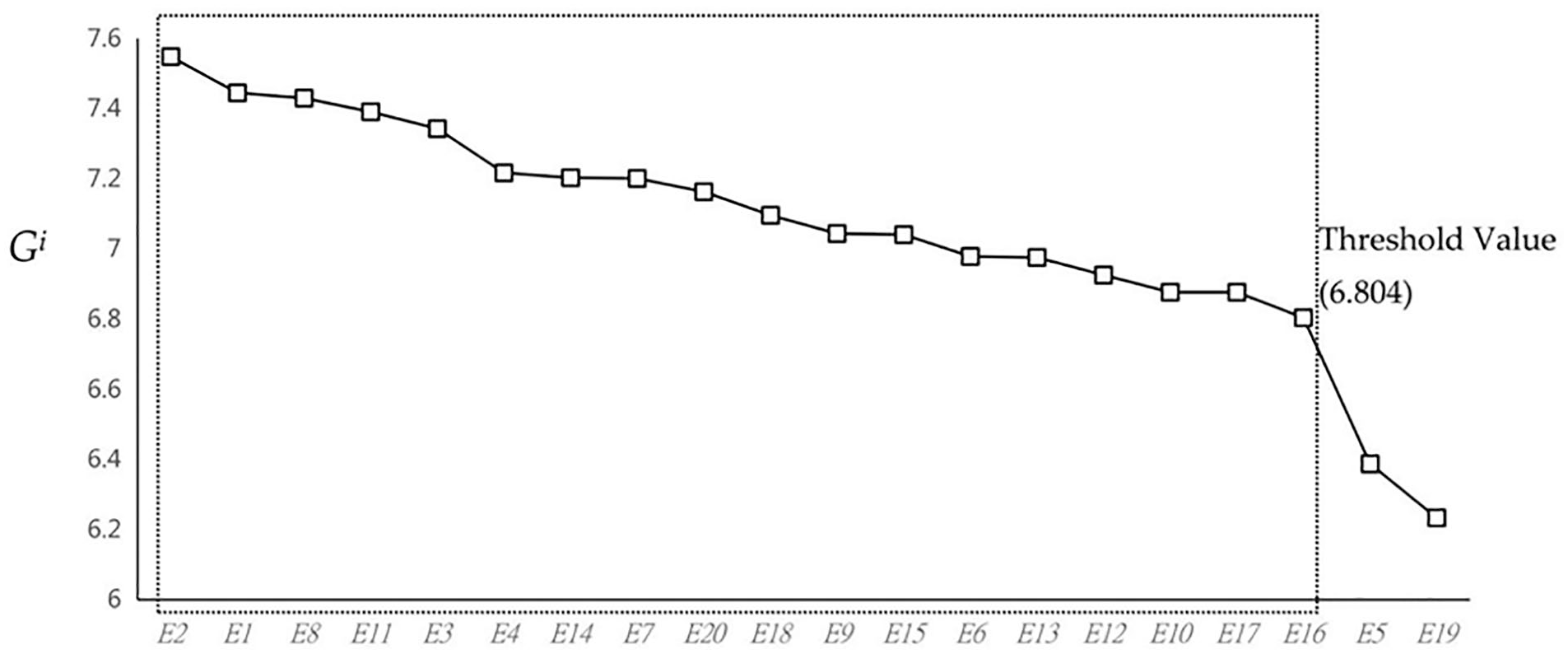
Scatter plot of expert consensus values of evaluation elements.
EFA was conducted to analyze and test the factor structure using the principal components analysis method and maximum direct axis to delete the problem of factor loading of less than 0.5, by choosing the characteristic value greater than 1. The criteria for factorability were analyzed and met. The correlation coefficients was over .30, and the Kaiser-Meyer-Olkin (KMO) measure of sampling adequacy was 0.870, which means EFA is proper approach to be used for this research. In Table 4, the results show that the scale could explain the variation of 67.890, and the overall consistency reliability (Cronbach’s α) was .901. Through factor analysis, this study found that 18 evaluation elements could be divided into five dimensions: affiliated functional facilities (
Exploratory Factor Analysis Summary Table of Evaluation Elements.

Table 4 shows that there are four environmental design elements under the common factor (D1) related to the following in the urban environment: enclosed or semi-enclosed structures used to divide different functional spaces; the form and structure of node details matching the environmental intent; landscape sketches with visual attraction for citizens to carry out cultural and recreational activities; and urban furniture that meets the needs of daily use and conforms to the beauty of form. In the daily urban landscape, the aforesaid elements are generally transformed into landscape walls, corridors, fitness and recreation equipment, and other facilities matching the needs of public services through environmental design. Therefore, in this study, the common factor D1 is named as “affiliated functional facilities.” As Li (2017) emphasized, the esthetics of the urban environment are reflected in the form, material, and functional beauty of ancillary facilities and landscape sketches in the area. Environmental design must focus on the material form and appearance of landscape facilities and the integration of esthetic value and functionality to improve the esthetic quality of the overall landscape.
Through EFA analysis, the second common factor generalized in this study was related to the presentation of scenario memory clues in the urban environment. Under the joint action of urban sculpture, publicity and guidance systems, decorative components, and site sound, the narrative of urban daily landscape may be highlighted to illustrate the urban memory and set off the site atmosphere. The esthetic performance of the urban environment covers the consideration of visual perception and includes community life memory and political and cultural factors that are inseparable from ecological and resource conditions (Menatti & Heft, 2020). As a player in the urban environment, esthetic preference is related to the narrative of landscape, local attachment, and historical and cultural factors as perceived and encountered (Hägerhäll et al., 2018).
The common factor (D3) was “visual perception information” and was composed of four design elements: light and shadow, color, material texture, and visual picture proportion in the urban environment. The environmental design elements generalized under the D4 dimension involved three design elements: moving line order, plane composition, and dynamic spatial organization in the urban environment. In previous studies, the above seven elements were also regarded as the main constituent attributes of urban design formal esthetics (Nasar, 1994). Nia and Atun (2016) analyzed the influence of various constituent attributes of urban design formal esthetics on people’s perception through qualitative research and proposed a design thinking model to clarify the influence mechanism, finding that each esthetic response to the environment was derived from the communication between meditation, sensory desire, and direct participation.
In Table 4, the three landscape elements from the natural environment are generalized under common factor D5. Previous studies have shown that people’s esthetic response to the urban daily landscape is mainly divided into five dimensions, among which naturalness is widely regarded as an important criterion (Chon & Scott Shafer, 2009). In many practical projects, environmental designers use and rectify the natural resources of the site, such as plant configurations, the aquatic environment, revetment, and landform, to improve the esthetic performance of the urban landscape and endow the site with visual attraction. Environmental designers may integrate natural elements with buildings and landscape structures through more systematic thinking and create new topography and natural intervention methods in buildings. Haupt (2016) considered that the penetration of natural elements into architectural space gives people an impression of the continuity of space and surrounding areas, blurs the boundaries between different spatial attributes, meets people’s esthetic needs, and helps shape the visual points of interest of the site.
The AHP was conducted to train the relative weights of the dimensions. A consistency test was conducted to verify the rationality of the weights: CI [0.044]; CR = 0.040 < 0.10. Therefore, the judgment matrix had satisfactory consistency, indicating that the weight set obtained by the AHP was reasonable. Figure 3 shows that natural landscaping elements (

Analysis results of relative weights among various dimensions.
The DEMATEL technique was applied to clarify the dominant influential relationships among the evaluation elements in each dimension. The confidence level of some experts’ opinions reached more than 95% (97.64%), and the consensus degree was tested. As shown in Figure 4, for the esthetic expression of environmental design, under the
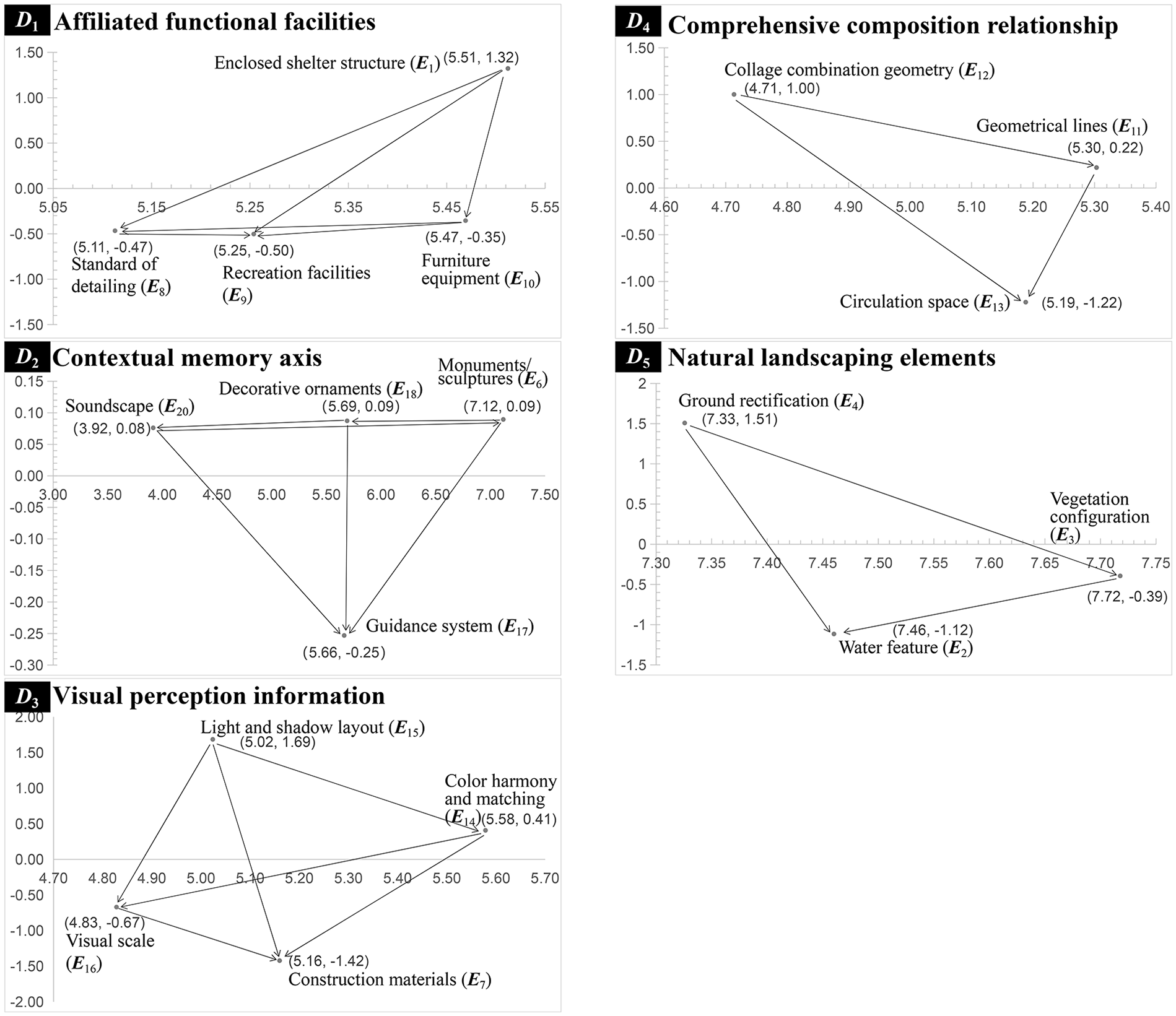
The influence network relation map.
Conclusion
In this study, a hybrid MADM model integrating the fuzzy Delphi method, EFA, AHP, and DEMATEL method was proposed to explore the factors associated with the esthetic expression of environmental design. Based on the methodological characteristics of the four techniques, the four main outcomes of the proposed model were: (i) evaluation elements with high local adaptability, (ii) a hierarchical evaluation framework with both element and dimension levels, (iii) the weight of each dimension, and (iv) the dominant influential relationships among the evaluation elements in each dimension. To show the operation of each part and the superiority for solving the corresponding problem, analyses of survey data on esthetic expression of environmental design schemes from an expert perspective in China were presented. The findings suggest that natural landscaping elements are more likely to increase the quality of esthetic expression. Under this dimension, ground rectification was the most dominant design element, followed by vegetation configuration, from the perspective of experts with extensive practical or research experience.
This study makes significant contributions to current scholarly literature. First, the meager knowledge of key factors gained from empirical studies conducted in various parts of the world reveals that ways to generate elements with high local adaptability for evaluating the esthetic expression quality of environmental design schemes remain poorly understood. Therefore, the FDM and EFA techniques were combined in a hybrid MADM model to address this issue. This study also extended empirical evidence of the evaluation framework from an expert perspective in China. Second, existing weight training methods are mainly based on the methodological assumptions of independent criteria, which could lead to ignoring the systematic relationships among elements. A systematic perspective is important to esthetic expression because of interactive and even contradictory relationships among elements. This study represents one of the first attempts to fill this important gap by exploring a systematic decision-making model that combined the AHP and DEMATEL techniques, which are more likely to help designers systematically weigh the pros and cons of improvement strategies based on the results of the evaluation, so that the design scheme can achieve benign continuous improvement while reducing the risk of inefficiency of overall scheme improvement.
This study had several limitations. First, in the invisible aspects of cognition, judgment, and comprehension, the powerful meanings attached to the way people understand the built environment are also important. Gjerde (2011) considered that people not only evaluate the nature of the activities they understand to take place within, but are also influenced by the degree to which they can imagine themselves being able to participate in those activities. This study attempted to establish an evaluation framework based on elements of the built environment. Thus, the complex reaction mechanism of individual cognition based on biophysical and experiential human characteristics and the invisible aspect of cognition in environmental esthetics may be ignored. Second, the results of the case in China tend to be framed within the destination context; however, some of the findings of this methodology have transferability. Third, the weight analysis of each dimension in the evaluation framework was accomplished using an analysis technique that assumed that various dimensions were independent of one another. This means that the dominant influential relationship between the evaluation elements across the dimensions was ignored. Therefore, in the future, the DANP technique of the independence hypothesis between the unbound elements (dimensions/elements) can be applied to assign the influence weight for each evaluation criterion by clarifying the dominant image relationship between the evaluation elements.
Footnotes
Appendix
Declaration of Conflicting Interests
The author(s) declared no potential conflicts of interest with respect to the research, authorship, and/or publication of this article.
Funding
The author(s) disclosed receipt of the following financial support for the research, authorship, and/or publication of this article: This study is funded by the “Zhuhai Philosophy and Social Science Planning 2021-2022 Topic” (No. 2021YBC184), and the Faculty Research Grant (FRG) of Macau university of Science and Technology (No. FRG-22-002-FA). This work was partially supported by the Guangdong Provincial Philosophy and Social Sciences “13th Five-Year Plan” 2020 Disciplinary Co-construction Project (GD20XYS41), the 2020 Youth Art Creation Talent Funding Project of the National Art Foundation, No.: 2020-A-06-(101)-532 and the 2019 Guangdong Province Philosophy and Social Sciences “Research on Innovation Competitiveness of Design Industry in Guangdong-Hong Kong-Macao Greater Bay Area” (GD19CYS15), the 2020 Yangcheng Young Scholars Project of the “13th Five-Year Plan” for the Development of Philosophy and Social Sciences in Guangzhou (2020GZQN24).
Ethical Approval
This study does not involve “human subject research.” Data in this study were not obtained through intervention or interaction with individuals or groups, or using personally identifiable information. The research ethics review is not applicable.
