




Abstract
In this article, a study is presented that analyzed the effect of implicit and explicit prejudice, egalitarian values, and the type of a discussion host on the expression of prejudice in a group discussion. A total of 91 Norwegians from two towns were randomly assigned to 1 of 17 group discussions with a topic that made it likely that immigrants in Norway would be discussed. Six discussion groups had a Norwegian hosts; 11 had a non-Norwegian host. The number of positive and negative statements about immigrants made by each individual as well as the ratio of negative to total statements was regressed on implicit prejudice, explicit prejudice, egalitarian value orientation, discussion host type, and their interactions. It was controlled for age and gender of the participants. In discussion groups with non-Norwegian hosts, the number of negative and positive statements about immigrants was lower, but the effect was stronger for negative statements. Strong egalitarian values reduced the number of negative statements, whereas strong explicit prejudice reduced the number of positive statements.
Keywords
Introduction
In most contemporary societies, the prevalent societal norm is that the open expression of ethnic prejudice is unacceptable. Research about prejudice and discrimination shows clearly that the expression of ethnic prejudice is sensitive to norms in the social context (e.g., Dovidio & Gaertner, 1986; Gaertner & Dovidio, 2005; Sherif, 1973; Sherif & Sherif, 1969; Zitek & Hebl, 2007) and the individual’s motivation to express prejudice (e.g., Fiske & Taylor, 1991; Gaertner & Dovidio, 2005; Greenwald & Banaji, 1995). Societal norms such as egalitarianism provide an external motivation for individuals to regulate the expression of prejudice by initiating actions that encourage tolerance and the welfare protection of all (Schwartz, 1999, 2007). Compared with other nations, egalitarianism is a strongly promoted norm in Scandinavian countries, in particular Norway, which traditionally score high in international value studies on this particular value orientation (Hernes & Knudsen, 1992; Schwartz, 2007; Tjelmeland & Brochmann, 2003). In the case of Norway, equal rights and even equal distribution of resources among all members of society are among the most defining aspects of culture and open expression of prejudice is strongly sanctioned by society (Gullestad, 2002; Schwartz, 2007). However, this does not mean that Norwegians are free from ethnic prejudice. Subtle expression of prejudice and occasionally even violent acts against immigrants are common phenomena (Hernes & Knudsen, 1992). The question we are trying to answer in this article is, whether societies such as the Norwegian through their history of developing and promoting egalitarianism strongly reduced their prejudice against immigrants or whether the strong embracement of egalitarian values just shifts the expression of prejudice from more open and blatant forms to subtleties. In the following sections, we will briefly introduce the relevant concepts used in the present study, distinguish between implicit and explicit prejudice, present previous findings about the role of norms and values suppressing expression of prejudice and discuss the effect of the audience on the expression of prejudice.
Prejudice and Discriminating Behavior
Discrimination and open expression of prejudice are the last step in a long chain of social cognitive processes: The starting point for any kind of discrimination or prejudice is social categorization. Through the process of social categorization, an individual will categorize oneself and others as belonging to a particular group based on the appearance of shared similarities (Tajfel, 1978). Memberships to groups create divisions between the in-group (“us”) and the out-group (“them”) and members of groups will consequently evaluate out-group members no longer as individuals but based on ascribed characteristics of the social group they belong to (Macrae & Bodenhausen, 2000), which is referred to as stereotyping.
Greenwald and Banaji (1995) define stereotyping as “a socially shared set of beliefs about traits that are characteristic of members of a social category” (p. 14). Stereotypes can be understood as schemata that are cognitive structures that store simplified expectations we have about the world around us including other people and their behavior (Fiske & Taylor, 1991). Through prior knowledge about group members stored in schemata they have an impact on how people perceive, process, and respond to information about these group members (Dovidio & Gaertner, 2010). Stereotypes often have a cognitive component as well as an affective (Fiske & Taylor, 1991). When an evaluation (like vs. dislike) is attached to a stereotypical trait or behavior, the stereotype becomes a prejudice (Crandall, Eshleman, & O’Brien, 2002). Such as other attitudes, prejudices have a cognitive (beliefs), an affective (evaluation), and a conative (behavioral disposition) component (Dovidio & Gaertner, 1986). The conative dimension of a prejudice directly links to discrimination, which has been defined as “a selectively unjustified negative behaviour toward members of the target group or less positive responses to an outgroup member than would occur for an ingroup member in comparable circumstances” (Dovidio & Gaertner, 2010, p. 1085). Prejudice can be openly expressed as discrimination by either showing negative behavior or by withholding positive behavior toward members of the discriminated group, that is, the out-group.
Implicit Versus Explicit Prejudice
However, the expression of prejudice can also be suppressed if the social context does not allow the expression. This potential suppression of the expression of prejudice makes it necessary to differentiate between implicit and explicit prejudice: Whereas explicit prejudice is consciously controlled and a person can decide not to express it if the situation seems to make it inappropriate, implicit prejudice is activated automatically from memory on encountering the attitude object and is not filtered by the suppression mechanisms in the same way. Brauer, Wasel, and Niedenthal (2000) review the literature about implicit and explicit prejudice and summarize two approaches to the distinction between the two: In one theoretical tradition, implicit and explicit prejudice are treated as two measures of the same thing, hence the prejudice level a person has toward a group of people. The only difference apart from methodological issues (different data collection methods lead to low correlation between implicit and explicit measures) is that the explicit prejudice is filtered by self-presentational concerns that affect all kind of self-reports. A second theoretical tradition that is referred to as the dissociative approach (Devine, 1989) assumes that implicit prejudice has its roots in cultural stereotypes that are internalized early in life. Internalized stereotypes then can be activated automatically by mere encounter of a member of the group the stereotype applies to. However, by making personal experiences with members of the stereotyped group and by collecting new information people are able to form their individual expectations about people from other groups and which would then form the basis for explicit prejudice or nonprejudice.
In their study, Brauer et al. (2000) distinguish further between explicit prejudice and two components of implicit prejudice: Explicit prejudice is expressed in questionnaires and behavior and can be controlled if a person feels the need to do that. Implicit prejudice has the two components automatic activation and automatic application. Even if people do not automatically apply a stereotype to a group, they might still have access to the stereotype and be able to activate it. If prejudice is only automatically activated it does not necessarily express in behavior whereas automatic application would lead to uncontrollable expression.
The distinction between explicit and implicit prejudice means that measures of explicit prejudice that can for example be questionnaire items might not reflect the participants’ “true” level of prejudice if he or she did control the expression of prejudice. This further means that implicit prejudice can only be measured indirectly through methods that make it either impossible for a person to control the expression of prejudice or that hide the aim of the measurement. A common indirect method of measuring implicit attitudes or prejudice is the Implicit Association Test (IAT; Greenwald & Banaji, 1995).
Egalitarianism as a Moderator of the Expression of Prejudice
Scandinavian societies and Norway in particular have been shown to have high levels of egalitarianism in their cultural self-definition (Gullestad, 2002; Schwartz, 2007). Egalitarianism is defined as a cultural value orientation that preserves the social structure of a society by promoting individual values such as equality, social justice, responsibility, help, and honesty (Schwartz, 1999). Individuals will embrace several value orientations at the same time, although their relative importance in a decision-making situation is depending on personal experiences, social structure, culture, and the motivational goal the value expresses (Schwartz, 2007; Schwartz & Bardi, 2001, 2003).
Studies have shown that people with high levels of egalitarian value orientation express less implicit and explicit prejudice than people with low levels. Monteith and Walters (1998) argue that people with high egalitarianism scores feel morally obliged to temper the expression of prejudice. Dasgupta and Rivera (2006) show that participants with strong implicit prejudice against gay people and weak self-reported egalitarian beliefs as well as weak self-reported ability to control their discriminating behavior toward gay people showed a behavioral bias toward a confederate in an experimental session who they assumed was gay. However, participants with strong implicit prejudice but strong egalitarian beliefs or strong ability to control suppressed the expression in the experimental session. Johns, Cullum, Smith, and Freng (2008) show that people who actively embrace egalitarian values are even able to suppress the expression of implicit racial prejudice to some degree. They assume that the level at which one embraces egalitarian values can lead to an automatic activation of egalitarian goals that then inhibit prejudiced thinking also at the unconscious level. In this case, egalitarian values will function as an internal reference point, guiding people to behave accordingly. Gullestad (2002), however, proposes a fundamentally different interpretation of the relation between egalitarianism and prejudice. She concludes that understanding egalitarianism as “being equal” (as opposed to having equal rights) encourages people to seek out other people who are alike or compatible to themselves. People that are not perceived compatible due to cultural differences tend to be ignored. This would lead to less active discrimination by people with strong egalitarian values, but also less attention to people that are perceived as unequal.
Audience Effects on the Expression of Prejudice
Research shows that not only egalitarianism is a potential moderator of the expression of prejudice but also the social context. Blanchard, Lilly, and Vaughn (1991) find that a confederate who opposed racism strongly also impacted how other participants suppressed expression of racism. Moreover, Fazio, Jackson, Dunton, and Williams (1995) find effects of the race of the administrator of a questionnaire measuring the degree that racial prejudice is explicitly reported. In a first round, they measured explicit racial prejudice of their participants in a rather anonymous mass survey. In a second session, a confederate of the researchers who was either Caucasian or Afro-American welcomed the participants and asked them to answer a questionnaire which also included an explicit racial prejudice measure. The confederate stated that he needed to type in the data from the questionnaire to make it salient that he will see the answers to the questions. Whereas with a Caucasian confederate the level of expressed prejudice was comparable with the anonymous mass survey, the participants suppressed the expression of prejudice in the Afro-American confederate condition considerably.
Several studies address the difference between an external motivation to suppress prejudice and the internal motivation (e.g., Devine, Plant, Amodio, Harmon-Jones, & Vance, 2002; Plant & Devine, 2009). Whereas, internally motivated people are able to reduce their level of prejudice, or at least succeed in suppressing its expression even in implicit measures, externally motivated people only suppress their expression of prejudice that is perceived by others.
The Present Study
This study builds on the findings described in the sections above: Implicit and explicit prejudice make discriminating behavior more likely, egalitarian values make it less likely, and the types of audience moderates the relation between implicit prejudice and its expression in a social situation. It is further assumed that the moderating effect of egalitarian values on the prejudice—discrimination link is dependent on the type of audience. To test these assumptions, we analyzed the discriminating behavior of native Norwegian participants in two types of group discussions with a topic that makes it likely that immigrants become the focus: One type of group discussions had a Norwegian host, one a non-Norwegian. In line with Johns et al. (2008), we predict that a non-Norwegian host activates the norm opposing prejudice more strongly and thus expect less discriminating behavior of people with strong implicit preferences for Norwegians. An important novel contribution of this study is that different forms of discriminating behavior are systematically measured and the effects of the predicting variables on each of them are compared. As discrimination can have different forms (e.g., saying negative things about immigrants vs. not saying positive things vs. not being comfortable to say anything at all) several operationalizations of discriminating behavior in group discussions were used: (a) the number of negative statements about immigrants made in the discussions, (b) the number of positive statements about immigrants, (c) the percentage of negative statements in all statements. We predict that people with strong and weak prejudice as well as weak and strong egalitarian values have different strategies to react to a social context where discrimination is less acceptable: Some might be more careful with negative statements, some might compensate with more positive statements, some might be reluctant to say anything fearing to say “something wrong.” Getting more insight into the drivers behind these strategies is an important contribution to research of discriminating behavior.
Method
Sample
The study was based on a convenience sample of participants that were recruited by one of the authors by posters and signup sheets distributed in a Norwegian University college (Lillehammer) and a smaller Norwegian city (Moelv). The authors acknowledge that the sample is not representative for the Norwegian population. Initially 97 individuals volunteered to participate in the study. Six participants were eliminated from the data set: One participant left the experiment before the discussion group started, 1 participant needed so much time for Part 1 of the study that he or she could not participate in the second part, 1 participant withdrew consent after the debriefing and 3 participants were not born in Norway and were excluded to avoid a bias in the data. That resulted in a final sample of 91 participants. The mean age in the sample was 37.9 years (SD = 19.9) with a range from 18 to 81 years. In all, 54.9% of the participants were female, accordingly 45.1% male. As the video camera malfunctioned during one of the discussion groups, data from the discussion are missing for 8 participants.
Measures
In addition to sociodemographic data, four different measures were applied in the study: (a) an IAT measuring latent preferences for Norwegian names over non-Norwegian names as a measure of implicit prejudice toward immigrants in Norway, (b) the Blatant and Subtle Prejudice scale by Pettigrew and Meertens (1995) to measure explicit prejudice, (c) the Egalitarian Value scale by Katz and Hass (1988) to measure how much a participant embraced egalitarian values, and (d) a quantification of overt expression of negative or positive prejudice in the group discussion as a behavioral measure.
IAT
The IAT is an instrument developed by Greenwald and Banaji (1995) and Greenwald, McGhee, and Schwartz (1998) that aims to measure implicit preferences for target words from two categories, in our case Norwegian and non-Norwegian names. The 19 evaluative adjectives used for the test were taken from Nordtug (2008), the 20 names were taken from the list of most popular names in Norway. Only names that could be nonambiguously categorized into Norwegian and non-Norwegian were chosen for the test. The mean IAT score was M = .67 (SD = 0.37), which can be understood as a strong preference for Norwegian names over non-Norwegian (Greenwald et al., 1998). A comparison between the test scores of the first and second test half indicated a rather low correlation (r = .54, p < .001). Thus, all analyses reported in the “Results” section were also calculated with a sample where all participants have been excluded who had a difference between the two test halves outside the range of −.50 to .50. In this reduced sample of 73 participants, the correlation between the test halves increased to r = .76 (p < .001) but the pattern of results remained unchanged. Therefore, we decided to use the complete sample for analysis.
Blatant and Subtle Prejudice Scale
For this study, a Norwegian version (Haugen, 2002) of the scale by Pettigrew and Meertens (1995) was used that consisted of 18 items (2 items from the Threat and Rejection subscale were excluded because they were too U.S. specific). The Traditional Value subscale was not analyzed further because value orientation was measured with a separate scale. The remaining 14 items were subjected to a factor analysis and internal consistency of the resulting factor subscales was tested with Cronbach’s alpha. The factor analysis revealed unclear loadings of two “threat and rejection” items and one intimacy item. Consequently they were excluded from further analysis and the remaining 11 items showed the expected clear loading structure. The resulting subscale scores were then subjected to an additional factor analysis that revealed that they all loaded on one second-order factor. Thus, a total mean score of the 11 items was calculated (α = .69) for the purpose of this study. The mean scale score was M = 3.48 (SD = 0.77) on a 7-point scale with higher values indicating more prejudice.
Egalitarian Value scale
The Egalitarian Value scale used in this study is a Norwegian translation of the Humanitarianism−Egalitarianism scale presented by Katz and Hass (1988). It originally consists of 10 items. The items were translated into Norwegian by two independent translators and disagreements between the translations were resolved in a discussion between the two translators. All 10 items were subjected to a factor analysis that revealed three factors (one factor with only 1 item loading on it). This item was excluded and the two remaining factors were treated as subdimensions of egalitarianism. For this study, the scores on the two subscales were again subjected to a factor analysis revealing that they were loading on one underlying second-order dimension. Consequently, a total mean score was calculated for the remaining 9 items (α = .75). The mean score on this Egalitarianism scale was M = 6.12 (SD = 0.74) on a 7-point scale, indicating that the participants scored on average very high on egalitarianism.
Observation of open expression of prejudice
The behavior regarding the expression of prejudice against immigrants in the group discussions was quantified according to the following procedure (Verkuyten, 2001): Two independent raters inspected the video material and counted for each participant how often he or she made a positive or negative statement about immigrants or immigration during the discussion group. Positive statements were defined as statements including sympathy or empathy for immigrants, the expression of egalitarian values with respect to immigrants, or the perception of immigrants as a valuable resource (as workers or as a source of learning about new cultures). Negative statements were defined as statements about negative impacts of immigration on the labor market, criminality connected to immigrants, the depletion of society’s resources, a loss of Norwegian culture, lack of knowledge about Norwegian language, lack of integration, and an expression of a wish for stricter immigration laws. The numbers provided by the two raters strongly correlated (positive statements interrater correlation: r = .80, p < .001, N = 83; negative statements interrater correlation: r = .88, p < .001, N = 83). For the analysis, the values provided by the two raters were averaged. Across all participants the average number of negative statements was M = 3.36 (SD = 3.66) with a range from 0 to 19.5. The average number of positive statements was M = 2.52 (SD = 2.03) with a range from 0 to 9. As the absolute number of statements varies also with how much a person in general contributes to a group discussion, the ratio of negative statements to all statements given about immigrants was calculated. This percentage of negative statements was on average 52.80% (SD = 30.63, range = 0%-100%).
Procedure
The study was conducted on six evenings in October and November 2010 in a secondary school in the small Norwegian city and in the University college of Lillehammer. After the participants indicated their willingness to participate they were invited to one of the locations and received general information about the study. They were informed about their right to withdraw and part one of the study started. In the computer room each participant conducted individually the IAT and answered a questionnaire that contained the items from the Blatant and Subtle Prejudice scale, the items for the Egalitarian Value scale, and sociodemographic questions. The computer software Inquisit 3 (www.millisecond.com) was used to conduct the first part of the study. The questionnaire items were presented in randomized order and for half of the participants the IAT was performed before the questionnaire, for the second half the order was reversed. After the first part of the study was finished, the participants were randomly distributed on three rooms where they were supposed to take part in a group discussion with the topic “the role of Siv Jensen and her progressive party in Norwegian politics.” The topic was chosen because Siv Jensen is a highly controversial person in Norway leading a populist right wing party (“fremskrittsparti”). Discussing this topic made it likely that the topic of immigration will be touched without bluntly suggesting it.
The hosts for the discussions were waiting in the rooms for the participants invisible for the participants in other discussion groups. Initially three experimental conditions were planned: One set of six discussion groups had a Norwegian host, one set of six groups had a European host, and one set of six groups had an African host. The hosts were chosen based on their ethnical appearance. The Norwegian host was a stereotypical Norwegian with blond hair and blue eyes. The European host was intended to provoke an ambivalent context within the discussion setting. The host was Dutch/Indonesian that meant that she looked more Indonesian (darker skin color) however spoke with a Dutch accent. Dutch immigrant groups are generally positively viewed in Norway. The African host spoke Norwegian, however with a very heavy “immigrant” accent. All hosts were trained in advance on how to conduct themselves and all were given a basic script to follow. The script gave instructions as to how to lead the discussions as well as how to respond to different reactions of the group. The discussion hosts were instructed not to ask explicitly about immigration-related topics. The discussions were recorded on video.
As no differences could be found in initial analyses between the European and the African host, the two conditions were joined. In one discussion group with the African host, the camera malfunctioned so that data are available for six group discussions with a Norwegian host (n = 30) and 11 group discussions with a non-Norwegian host (n = 53). After about 20 min, the hosts were instructed to end the discussions and the participants were debriefed, fully explaining the aim of the study and explicitly mentioned again the possibility to withdraw. One participant made use of that possibility and this person’s data were deleted immediately. In total, both parts of the study took about 1 hr. The study was evaluated and cleared by the data protection agency at the Norwegian Social Science Data Service (NSD) and the National Research Ethical Committee for Social Science and Humanities (NESH).
Results
Three different regression analyses were conducted to test the hypotheses formulated above. The data were scanned for outliers on all variables but none of the cases qualified as an outlier. The analyses were conducted with MPLUS 6.1 (Muthén & Muthén, 1998-2010) because the program offers the option to compensate for the partly dependence of the data points due to the clustered structure of the data collection (in 17 discussion groups): The behavior of individuals will likely be influenced by other people’s behavior in the group discussion, which means that the data of one person is not totally independent of the behavior of another participant in the same group discussion. Not compensating for this dependence that violates the assumptions of a standard regression analysis would result in an underestimation of the standard errors that in turn increases the likelihood of false positive results. MPLUS uses a Huber-White sandwich estimator to calculate robust standard errors in cases where the assumption of unrelated residuals is violated.
As the experimental groups were relatively small, it could not be controlled that age and gender were balanced between the groups. Thus, the two variables were entered as control variables in the analysis. Consequently, in the three regression analyses, each dependent variable (number of negative, number of positive and percentage of negative statements) was regressed on the experimental condition, the explicit prejudice score, the preference for Norwegian names in the IAT, the egalitarian value score, gender, age and the interactions between IAT score, values, explicit prejudice, and experimental condition. Table 1 and Figures 1 and 2 display the results of all three regression analyses.
Regression of the Number of Negative and Positive Statements in the Group Discussion on Explicit Prejudice, Implicit Prejudice (IAT), Egalitarian Values, Gender, Age, and the Interactions (N = 83).

Note: IAT = Implicit Association Test.
p < .05. **p < .01. ***p < .001.

Estimated means for a number of negative and positive statements in the discussion groups lead by Norwegians compared with non-Norwegians assuming average scores on all other predictors (N = 83).

Estimated means for percentage of negative statements in the discussion groups lead by Norwegians compared with non-Norwegians assuming average scores on all other predictors (n = 82).
As can be seen in the table, the average number of negative statements is substantially lower in the discussion groups with a non-Norwegian leader, but also the average number of positive statements is reduced. The percentage of negative statements in all statements is higher in groups lead by a Norwegian host. Controlled for the other variables, the implicit and explicit prejudice measures have no significant impact on the number or percentage of negative statements. Participants with strong explicit prejudice do however make significantly fewer positive statements. The stronger the egalitarian value orientation, the lower is the average number of negative statements participants make in the discussions. None of the tested interactions reached the level of significance and also the expected direction of the relation could only be found in 7 out of 12 interactions. Of the control variables, gender did not have a significant impact on the dependent variables, but older people made more negative statements, especially in relation to the total number of their statements. In all, 43.6% of variation in the number of negative statements is explained by the combination of tested variables. Explained variation in the number of positive statements is 20.2%. A total of 40.4% of variation in the percentage negative statements is explained by variation in the combination of tested predictors.
Figure 1 shows a comparison between the estimated number of positive and negative statements of a hypothetical member of the discussion groups with average values on all other predictors. It can be seen that the number of positive and negative statements is generally higher in the discussion groups with Norwegian host. This effect is, however, more distinct for negative statements. An analysis of variance with repeated measurement confirms significant main effects of the valence of the statements (positive vs. negative) and the experimental conditions as well as a significant interaction (see Table 2).
Repeated Measurement ANOVA With the Valence of Statements (Positive vs. Negative) as Within Subject Factor and the Experimental Group (Norwegian vs. Non-Norwegian Discussion Leader) as Between-Subject Factor (N = 83).
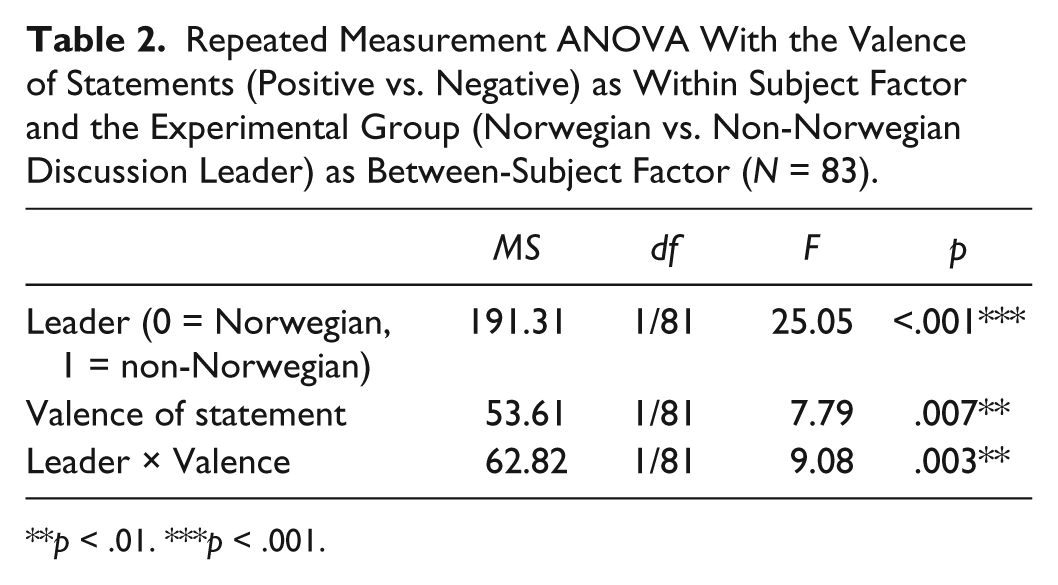
p < .01. ***p < .001.
Discussion
In the analyses, some of our hypotheses were confirmed whereas especially the moderation hypotheses could not be shown empirically as expected. We did find strong support for the audience effect on the expression of prejudice, however, with an interesting interaction with the type of statements (positive vs. negative). We furthermore found support for the effects of explicit prejudice as reported in a questionnaire and the reluctance to make positive statements about immigrants in a group discussion. Egalitarian values were shown to reduce the number of negative statements about immigrants.
In discussion groups with non-Norwegian hosts, participants expressed less negative prejudice against immigrants, which confirms findings by Johns et al. (2008) and Fazio et al. (1995). Against our expectations the number of positive statements about immigrants was not higher, but also significantly lower in discussions with non-Norwegian hosts. This effect was however significantly less distinct than for the positive statements. It seems that in discussions with non-Norwegian hosts positive and negative statements about immigrants are suppressed, but to a stronger degree if they were negative. At least some people seem to avoid saying anything about immigrants in these discussions, maybe to avoid saying something that might be experienced wrong. The results confirm a strong effect of the context.
People with strong egalitarian values make less negative statements in the discussions, the direction of the impact of implicit and explicit prejudice is in the expected direction, but so small that it is not statistically significant. For the number of positive statements, the effect of explicit prejudice is as predicted (more explicit prejudice in the questionnaire equals less positive statements in the group discussions), but even if the effects of egalitarian values and implicit prejudice have the expected directions, they are again too weak to become significant with the given sample size. For the percentage of negative statements in all statements about immigrants all three predictors have an effect in the expected direction, but all three are too small to be significant. The patterns of results consistently point into the direction we expected, but strong enough effects can only be found for some of the predicted effects. These have, however, an interesting implication: Whereas people with strong egalitarian values suppress negative statements but do not make significantly more positive statements, people with stronger explicit prejudice do not make more negative statements, but say less positive things about immigrants, which can be interpreted as a more subtle and socially acceptable expression of prejudice. It appears that in a strongly egalitarian society like the Norwegian, expression of prejudice finds its expressions in a specific form: People who do express strong prejudice in a questionnaire situation, express that in a discussion situation first of all by not saying positive things about immigrants, not so much by saying more negative things, whereas people with strong egalitarian values manage to control their expression of negative statements but seem to compensate by not saying anything more positive either.
None of the predicted interactions is significant. The pattern of results is too inconclusive to dare an interpretation. Some of the interactions go into the expected directions while others do not. In general, it seems like the complex moderation hypotheses cannot be confirmed based on our data: The effects of egalitarian values, implicit and explicit prejudice as well as context seem to be independent from each other. However, this might also be due to limited statistical power, as the detection of two- and even three-way interactions requires more power than the detection of main effects.
Age has a significant positive effect on the number and percentage of negative statements, but not on the number of positive statements. Older participants are more likely to discriminate openly than younger participants. Maykovich (1975) could also show that older Americans were more racially prejudiced than younger. A possible explanation might be that older Norwegians have a longer experience of times when Norway was to a large extent ethnically homogeneous than younger Norwegians. Immigration to Norway of a relevant size started later than in other European societies (Gullestad, 2002). However, the clear age effects may also be due to a small sample size, where very few older participants with strong prejudice could make the difference, even if a check for outliers did not detect any cases.
Finally, the weaknesses of the study shall be named. First, the sample of participants was not a representative sample for Norway. Due to necessity of research efficiency a convenience sample had to be used, which in addition had to be relatively small. Both aspects reduce the generalizability of the found results. A larger sample would most likely lead to a higher likelihood of detecting the moderating effects. Some participants stated that they experienced the term immigrants used in the questionnaires as ambivalent, because Norway hosts immigrants from very different countries and cultures. Whereas some immigrants are experienced as rather alike (e.g., immigrants from Western Europe) others are experienced as very different (e.g., immigrants from Muslim countries). However, the study showed that the participants reacted to the discussion host in a subtle way: They both limited their positive and negative statements and rather preferred not to talk about immigrants at all than saying something that might be perceived as offensive. The behavior of the participants suggests that living in a country with strong egalitarian values does not necessarily reduce people’s level of prejudice, but rather makes them avoid touching the topic when confronted with an immigrant.
Footnotes
Declaration of Conflicting Interests
The author(s) declared no potential conflicts of interest with respect to the research, authorship, and/or publication of this article.
Funding
The author(s) received no financial support for the research and/or authorship of this article.