




Abstract
The collapse of the Indonesia authoritarian regime in 1998 further elevated the role of the local level groups including Forest Farmer Groups (FFGs) in rural development. This research aims to describe changing the role of FFGs due to the formalization process of development which established them as the only partners at the local level. Taking the case of forest farmer groups in three chosen villages by anthropologic approaches, formalization of development policies to push forest farmer groups from purely serving the role of development agent to fulfillment of legal conditions for a project to run, giving rise to bribery and other corrupt behaviors. Policies stating that farmer groups are the only grassroots partners eventually forces development agents to hire these groups as partners only for capturing and controlling the program by elites both locally and outside villages. Reflecting on the issue above, it is necessary to revisit the development formalization policy pertaining to forest farmer groups’ involvement as to their relevance or irrelevance, especially in the case of forest resources management and rural development on the micro scale. In addition, a model of forest farmer group organizational improvement as well as human resources, especially in terms of rules and succession to make the groups more dynamic and responsive to social environment changes. This research is limited to changes in the role of FFGs in forest management, while the resources they manage will continue to increase in line with government policies to involve them in projects outside forest management.
Introduction
Forest Farmer Groups (FFGs) are important actors in social foresty programs especially in Indonesia since around 1970s in their role as mediator of forest management interests and local communities (Djamhuri, 2012; Kartasubrata & Wiersum, 1992; Nomura, 2008; Peluso & Poffenberger, 1989; Wambura et al., 2007; Wahyudiyati & Irawanti, 2015, 2016). Despite the many changes it has gone through in terms of both definition and social forestry administration (Dove, 1995; Fisher et al., 2019; Sahide et al., 2016), forest management with full involvement of the community constitutes the basic idea of social forestry, in which case forest farmer groups remain a primary institutional element at the local level (De Royer et al., 2018; Diniyati & Achmad, 2020; Dove, 1995; Pratiwi & Suzuki, 2017; Wahyudiyati & Irawanti, 2015). FFGs are the local level groups, which is founded to bridge forest management interests to the community, especially with regard to manpower mobilization and forest security safeguarding aid (De Royer et al., 2018; Peluso, 1992; Wahyudiyati & Irawanti, 2015).
As community representatives, group members of FFGs reserve the right to accessing non-timber forest produces and even private forest development programs as well as other rural development project provide provide by government, business sector or NGOs (Moeliono et al., 2017; Rustinsyah, 2015). Therefore, FFGs occupy a critical position in forest management on the grounds that, operationally, it is them, rather than local governments such as village governments, that are legitimized by law to be directly involved (Maryudi et al., 2016; Nurrochmat et al., 2016; Ota, 2018). This position grew more formidable in the aftermath of the reformation era around 1997 when civil movement reinforcements initiated by NGOs and numerous other social activists left sizable impacts on forest management, in which case local institutions, including farmer groups and village governments, assumed more significant roles (Moeliono & Dermawan, 2006; Nurrochmat et al., 2016; Purnomo et al., 2021a; Purnomo et al., 2021b; Wittmer & Birner, 2006). Centralized forest management patterns are acknowledged as one of the culprits of deforestation, demanding changes of management patterns in the direction of greater participation (Moeliono et al., 2017; Peluso, 1992). Communities living in forest vicinity which formerly were considered low-cost sources of labor and were limited in their access to forest resources now have become an integral part of forest planning and management (Fisher et al., 2019; Harbi et al., 2018; Peluso, 1992).
The role of FFGs become more important in light with the transformation of Indonesia political model that changed from centralism to decentralism through direct elections drives local politicians to make populist policies by means of increasing grants for the community in amounts (Gonschorek, 2020; Rajasekhar et al., 2018; Sugiyanto et al., 2018). Even to legalize these populist policies in the forest sector, the government of Indonesia established a legal umbrella with Regulations of the Ministry of Home Affairs No. 32 of 2011 and No. 14 of 2016 on the Mechanism of Grant Giving, especially for such community organizations as NGOs and farmer groups, including FFGs, if they are legally recognized (Alatas et al., 2019; Warren et al., 2016). This policy will potentially cause a change to or at least increase the number of actors playing in the forestry sector, including not only SFC but also local governments and even members of the House of Representatives (DPR). Thus, the increased number of actors involved in forest management automatically shifts the role of forest farmer groups from formerly moderating SFC to local communities and local governments into serving political brokerage functions.
Meanwhile, after the 1998 economic crisis, populism policies through formalization process of development administration forced all project activities involving the community to go through registered formal institutions. This formalization scheme is one of the strategies the government chose to increase the development institutional capacity to facilitate the state’s policy-making process (Devas, 1997; Kenyon, 2007; La Porta & Shleifer, 2014). Not only the government, private sector, and donors but also the community as partner must be involved to acquire permit from the government if one is to initiate a public project. This policy allows the flow of resources into groups, hence shaping novel social interaction patterns, particularly when it comes down to the role of the elites. Normatively being legitimized and given power to control their members, these groups are at risk of being misused for elite interests in many aspects, including in natural resources management (Lukas, 2016; Robbins, 2000). Where in the timber industry entrepreneurs “rent legalities” (Maryudi & Myers, 2018) from other entrepreneurs who are with certificates, then, in this case, it is groups which are rented to keep them in control of various projects for their own interests.
Despite the vital role FFGs play in moderating the interests of multiple parties, research on FFGs development as social organizations which assume an important role in social forestry itself is relatively small in size. Most of the research focus on farmer livelihood or farmers group economy activities under social forestry project (Kaskoyo et al., 2017). In this context, the micro-sociological approach through the analysis of how forest farmer groups grow and develop, including how they become part of power and value contestation in the fight for natural resources at the local level, on the other hand, are still minimal (Nomura, 2008). This micro-sociological approach will provide perspectives in far greater detail on how forest farmer groups as social institutions transform from time to time with local and national political dynamics, one of which is the changes in forest management policies. The findings of this research can be a reference for policy makers in reorienting the role of groups in the implementation of project development, whether to be the only mediator at the grassroots level, or only as an alternative.
Theoretical Framework
Group role in corrupt activities in natural resources management is played through two main activities, namely “elite control,” which refers to domination of information flow and elite legitimation to control the course of a project or program, and “elite capture,” which refers to elite activities in dominating all decisions in program planning and implementation (Alatas et al., 2019; García-López, 2019; Lucas, 2016). To gain access to certain resources, which, at times, are limited, farmers often engage in bribery with facilitation from local institutions (Porras et al., 2019). Smith (2018) reveals that an elite often uses his/her power to determine which group is given the right to a program and which is not, and even many abroad nominate their own NGOs or family-run NGOs as winners at tenders (Carrick-Hagenbarth, 2016; Kenyon, 2007). This is what is known by channeling project, in which elites direct who will receive benefits to ensure that their interests are facilitated through which elites make sure that projects flow into their own networks despite not meeting the formal requirements to be eligible as beneficiaries (Lucas, 2016; Smith, 2018).
Natural resources management systems (NRM) trapped in elite capture and elite control give way to easy unilateral profit taking while it considered corrupt behavior (Arnall et al., 2013; Lucas 2016; Williams, 2021). The entrenched corrupt in NRM, be it in the form of bribery for acquisition of special facilities or in the form of power abuse to open up opportunities for certain groups, sets a fertile ground for corruption (Smith, 2018; Warren et al., 2016). Elites can be group members or group leaders who have great influence in the group who tend to be trusted by group members as their representatives when dealing with outsiders. Elites in this sense include elites outside the group such as village heads or formal or informal community leaders, including government or private project implementers and politicians, but in this research we limit them to those from within the group. Corruption becomes normal after going through three stages, namely normal activities becoming habits, habits attaching to NRM process, and eventually habits becoming routines capable of passing down to next generations (Prabowo & Cooper, 2016). Corrupt behaviors usually are also integral to social interactions in the community, earning them social legitimation (Kasyanov et al., 2018; Williams, 2021). This involves, for instance, involvement of forest farmer groups in various projects, although technically they are not needed as the activities are not directly related to their tasks; this involvement is only for the interest of project legality.
At the same time, groups also serve as agents of corrupt activities normalization as they have the ability to influence their members’ behaviors. The process of corruption normalization involves the following three: institutionalization, rationalization, and socialization (Prabowo & Cooper, 2016). Institutionalization goes through three stages from initial act or corrupt activity in the experimentation phase, to embedding corruption, and to routinization in the community. As for rationalization, it involves attempts of logical denial that their activities cause them to be guilty. As a result, social punishments on these activities are weak or even nonexistent. Corrupt activities such as mediating trading social forestry land, channeling project from government, NGO, private sectors, and politician for cashback payments will become “acceptable” that mentioned by Gault (2017) a process of institutionalization takes place. Upon acceptance, corruption goes into the socialization phase in which new group members are co-opted with corrupt values and then taken into incrementalism, before finally coming into full acceptance of the corrupt activities (Prabowo & Cooper, 2016). The corruption normalization model built by Prabowo and Cooper (2016) can be seen in Figure 1.
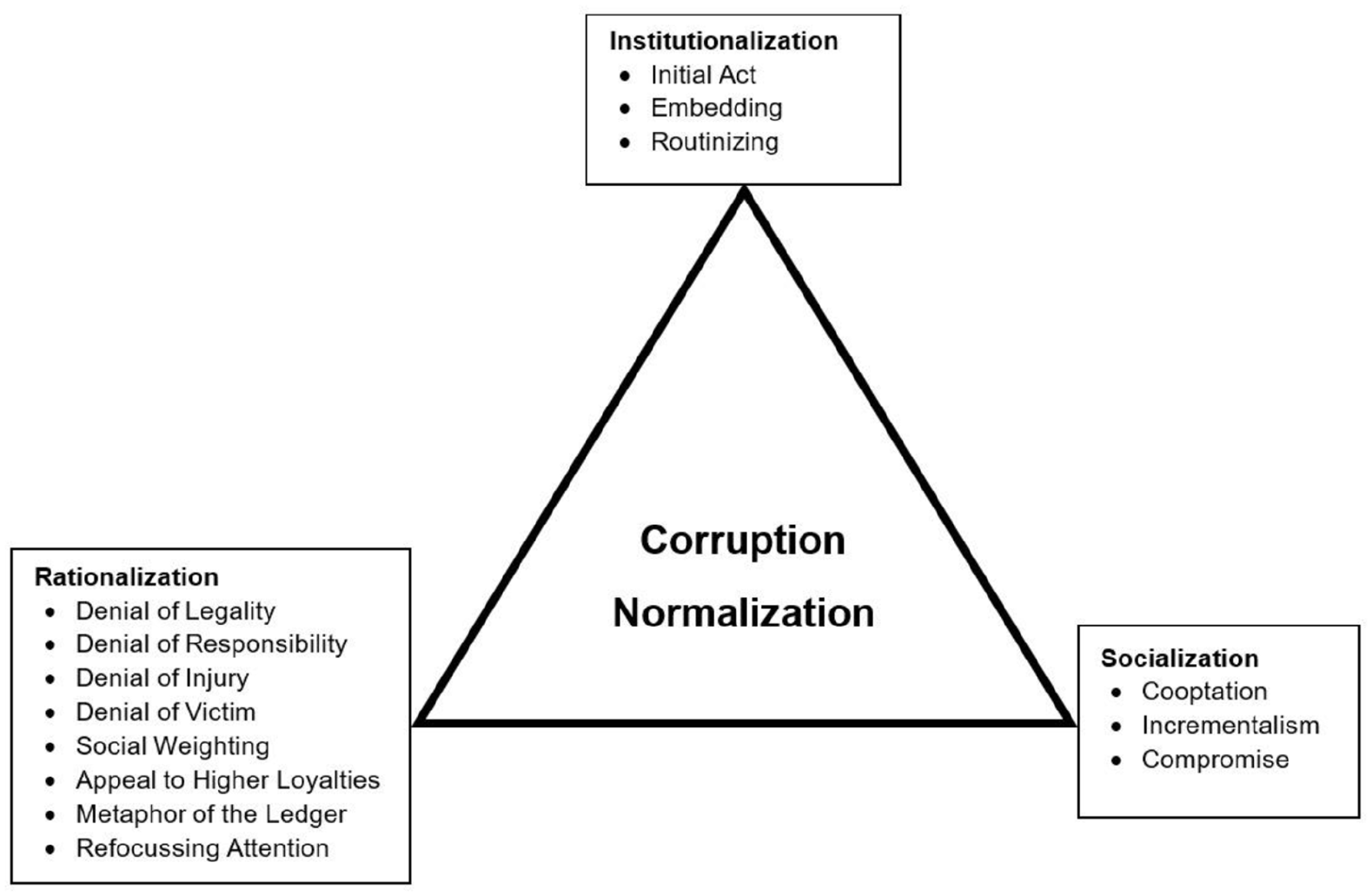
Corruption normalization model (Sources. Prabowo and Coopers, 2016).
It is in this context that forest farmer groups shift from previously being a channel between community interests and development media to being a mediator of corruption processes in natural resources management. De Klerk (2017) uses the statement “the devil makes me do it” to describe one’s psychological aspect when one is forced to conduct a corrupt act by his/her organization despite his/her personal refusal. It is also through groups that corrupt behavior habituation takes place more easily because groups, especially small ones, are capable of directing their members when they come into connection with each other in an established network, when the organization culture is established, and when the status or position of each member is concretely shaped (Harrington & Fine, 2000). In this context the values developing within groups facilitate the members’ corrupt behaviors exhibition despite already constituting violation (Kobis & Carter, 2018).
Groups enable their members to form expectations about possibilities that occur when they commit certain acts as they establish a recognition of shared experiences, and the acceptance of a value will encourage the members to practice it (Cislaghi & Heise, 2019). Fine (2012) adds clarity to the analysis of groups through categorization of groups into being group, bonding group, and belong-to group, which, respectively, refer to an individual identifying him-/herself as part of a group, as being bound to it, and as being moved to conduct a collective act as a group. Corrupt acts, including bribery and power abuse, will be easier to slip into normal habits if they are accepted as in-group habits (Gault, 2017).
To have a look at how group transformation takes place, this research employed three main roles of forest farmer groups as a case: (1) mediators of access distribution and forest tenurial right; (2) channeling in building eco-tourism project; and (3) channeling development programs and other various programs or by private and grant from politician. Specifically, this research fully focuses on using the “elite capture” and “elite control” concepts and at the same time the micro-sociological approach to analyze how groups become active agents in the normalization process of a variety of activities. How groups become active agents in a corruption normalization process will also be studied to give a more detailed picture that transformation is not only a role reposition but also a process of building group values to become permissive behaviors. This research thus makes the group as a unit of analysis which is institutionally an active agent involved in the management process, but at the same time we also analyze how the group becomes a channel for various projects hijacked by the elite both internally and externally to gain unilateral advantage.
Methods
This research is comprised of two parts. First, it specifically analyzes group changes from time to time and how they grow and develop amidst the communities in their social, economic, and political roles as an integral part of rural forest communities in general. In this part historical materials such as scientific publications, both journals, and governmental reports, on the early stage of group development in the 80s are used. During this embryonic phase, green revolution became a main strategy especially as source of food and source of economic growth after nearly two decades of Indonesia’s entrapment in a prolonged political conflict. To gain an empirical picture, we conducted in-depth interviews with ten FFGs leaders or former leaders no younger than 50 years old under the assumption that players of their ages were knowledgeable about the dynamics FFGs in the past and presence. At the same time, we also interviewed ten State Forest Company (SFC) retirees to draw a comparison with and verify the information provided by the farmer group leaders. Meanwhile, our research was conducted in three villages, which are around state forests and national parks where forest farmer groups have received various programs from the private sector, government, as well as NGOs both nationally and internationally. Details of the research location can be seen in Figure 2.

Research location.
In the second stage, we explore data and analyze the FFGs current activities in relation to their traditional and auxiliary functions when the local and national political scenes are undergoing some changes. With the existing power configuration today, the groups’ social positions, including their economic and political roles, especially in institutional relations between groups and villages, are to be explained. As we have recognized, government regulations’ requirement that all government and private projects must involve farmer groups has given these farmer groups an extremely strategic position. Data on such changes were acquired through in-depth interviews with village leaders, officials at the regency level, and group leaders. In such circumstances, FFGs play a role in almost all government and private programs related to forestry, not only in a social forestry framework as SFC partners, but broadly as a formal group that can be anyone’s partner for channeling projects. Therefore, this research does not only look at FFGs from the perspective of forest management stakeholders, especially social forestry, but also their role as channeling projects for other projects. The numbers of informants and categories are detailed in Table 1.
Categories of Respondents and Sampling Techniques.

Meanwhile, to focus on how transformation takes place, we conducted analysis on four recent activities involving forest farmer groups: (1) the groups’ roles in facilitating gain of tenurial right, as well as the way in which right transfer, both in-, and between-villages, occurs; (2) their roles in managing tourism concession areas which has been developing rapidly in Indonesia within the last ten years; and (3) their involvement in channeling government, private, and various other institutional projects. This case would clearly demonstrate how groups transform from institutions which were designed by the government as agents of development into institutions as they are currently.
To answer all the research questions, we carried out data analysis using the following three strategies: (1) thematic analysis to explore some of the cultural changes the groups experience from time to time, especially after the enactment of the development formalization policy; (2) content analysis to explore the groups’ roles in various projects by the government, private companies, international entities, and political parties; and (3) statistical description to describe the size of the groups’ roles in resources management, especially in tenurial relations with SFC. Thematic analysis has the ability to answer the question of how the groups’ internal institutional changes happen as well as the question of the social environment and policies driving these changes from time to time (Vaismoradi & Snelgrove, 2019). These change milestones are able to describe not only how groups change but also the dominant factors that influence such changes, allowing the context in which the groups’ detailed roles in natural resources management to be seen clearly.
Content analysis is used to analyze in more detail the groups’ roles in natural resources management as active agents or merely as objects of other agents (Erlingsson & Brysiewicz, 2017). This analysis also answers whether “elite capture” and “elite control” do take place as we have hypothesized in the theoretical framework section. The patterns in which elites “capture” and “control” various projects from outside the villages would provide us with a picture of the groups’ most recent roles whether they remain serving as agents of development as the first time they were established or whether they play other roles. Meanwhile, statistic description was made to provide empirical and numerical evidence as to whether the findings from the content analysis and thematic analysis are correct. These three analysis strategies would assist us in describing the context of the changes, the forms of the changes, and the groups’ behaviors and current positions in village resources management.
Results
Indonesian Forest Farmers Groups: Historical Review
The existence of forest farmer groups as well as other community groups is inseparable from the critique of the village development in the 70s which was deemed extreme in its top-down approach, causing diminishment of local communities’ participation (Chambers & Ghildyal, 1985; Norton and Alwang, 2020; Pauker, 1968). Therefore, there arose some development approach alternatives with a greater attention to the aspirations of local communities as subjects of development, leading to the emergence of an array of alternative concepts such as the “putting the last first” and “small is beautiful” concepts as approaches which were considered more participative and giving a greater priority to local aspirations (Schumacher, 2011; Thorbecke & Van Der Pluijm, 1993). Theoretically speaking, group approaches were introduced into considerable fame in the 90s by Cohen and Uphoft (1980) before finally spreading all around the world, including Indonesia, as primary approaches. Food crop farmer groups, especially in paddy cultivation under the green revolution scheme, received more attention, and this attention later extended to FFGs as well as other groups in the fishery and plantation sectors. At the same time, around the 80s, the paradigm of forest management altered, in which case involvement of communities living around forests became compulsory in order to preserve the forests and improve the communities’ welfare, despite with continuously questionable effectiveness (Fisher et al., 2019; Thompson, 1999).
Systematically and more operationally speaking, Cohen and Uphoff (1980) formulated how to involve local communities in development through development institutional approaches where community groups such as local communities and even farmer groups become an integral part of development (Cohen & Uphoff, 1980; Uphoff, 1992, 1993). In Indonesia, this strategy was adopted in mass extention (Bimas) movement in the green revolution framework to meet food demand (Hansen, 1971; Murai, 1977; Rieffel, 1969; Roekasah & Penny, 2006). There are two types of groups, namely groups established at the initiative of the state to support their development program as well as independent groups formed from community initiatives. In Indonesia these independent groups are usually institutions that regulate natural resource governance such as Subak to regulate water in Bali Surata et al., 2021), Sasi to regulate fish harvests in Nord Sulawesi (Argeloo and Dekker, 1996), and Awig-Awig to regulate forest governance in Lombok (Satria et al., 2006) and many more. These institutions are also mobilized by the government to support their programs although it is not as intensive as the groups they initiate such as FFGs. Basically, organizations at the grassroots level provide assistance for agents of development to mobilize resources, spread information, and serve as agents of empowerment doubling as media for capturing the communities’ aspirations (Abdul-Rahaman & Abdulai, 2018; Shigetomi, 2004).
Besides, groups also serve as media for individuals to learn with their peers and for raising local leadership beyond normal social processes such as village leadership. There is no suprising when rural development project in developing countries including Indonesia make use groups as an important local institution to succeed farmer field schools (van den Berg et al., 2020). After the success of these group approaches, as marked by food self-sufficiency in 1984, not only in the food crop agriculture sector, but also in the fishery and forestry sectors were groups developed (Limenta & Chandra, 2017). In the forestry sector, especially on Java Island, FFGs are the main agents in social forestation programs as an integral part of forest area management by SFC. Over three million hectares of forest land on Java Island makes up state forests, 99.6% of which is fully managed by SFC for wood production from trees such as teak, pine, and mahogany (Djamhuri, 2012). Due to the limited number of employees, social forestation is chosen as one of the strategies to manage the forests. Aside from being effective, forest farmer group involvement in forest management also receives support from the government as it is considered helpful to them in development, particularly in terms of employment in villages.
After the era of authoritarianism, the face of farmer groups in Indonesia changes with the evolution of populist politics and the increase in the communities’ political awareness as a result of the political education provided by NGOs and other civil society groups (Parker, 2018; Sitorus, 2019). Around forests, after the reformation era in 1998, community groups, including farmer groups, became into numerous tenurial conflicts due to weakened central government control over forest oversight (Maryudi et al., 2016). The shift in political policies had implications for the stability of forest management at the local level, where conflicts between forest management and village communities strengthened (Thung, 2019). The post-reformation conflicts reflect not only the reinforcement of local community groups but also expression of the lengthy forest management centralism (Maryudi et al., 2016; Moeliono & Dermawan, 2006).
At the same time, populist policies after the 1998 reformation give a room for the communities to access government programs which at times are nowhere near strategic and intended only to maintain political legitimacy through provision of subsidies and social aids for community groups, including farmer groups (Ganie-Rochman & Achwan, 2016). Because social aids only open a new arena for corruption after the reformation, the government stipulated that social aids must only be distributed to legal entities in 2011 through Regulation of the Minister of Home Affairs No. 32 of 2011. Although they are specifically aimed at regulating aids from the government budget, private institutions and NGOs turn out to also apply the same policy when distributing social adis or initiating certain projects. Since then, farmer groups, including forest farmer groups, vie for legality form them to get involved in social aids distribution in various other programs. Detail aspects of changes in farmer groups that promoted by government of SFC since the 70s to 2020 depicted in Table 2.
Aspects of Changes in Farmer Groups Since the 70s to 2020.
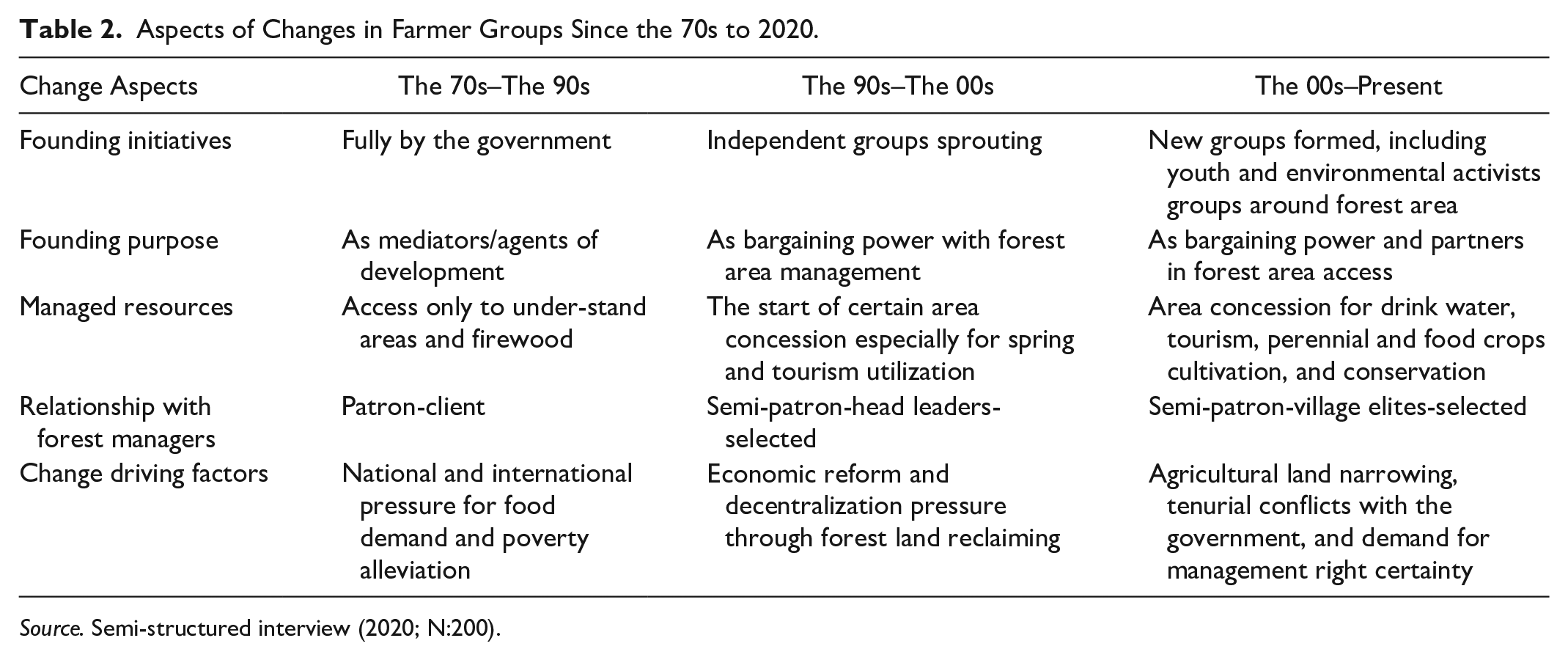
Source. Semi-structured interview (2020; N:200).
Farmer groups are among the most sought after by multiple parties, not only the government, for the success of its programs, but also politicians, for the purpose of winning political favor; even private parties take advantage of them to introduce their products or Corporate Social Responsibility (CSR) object (Pasaribu et al., 2020; Tirtosudarmo, 2010). Recent social forestation policy allows farmers who join FFGs an opportunity to manage production forests within a long term of up to 30 years, with right of 12.7 million hectares being nationally targeted to be distributed by 2024 (Erbaugh, 2019). By 2020 alone, the government targeted that a total of 1,709,289 hectares of forest land be given management permit especially for area utilization for agricultural cultivation (Fisher et al., 2019; Rakatama & Pandit, 2020). FFGs in Indonesia are interest groups which are entitled to communal management right and are expected to suppress tenurial conflicts and leave a wider economic impact on village communities in general (Erbaugh, 2019). Such a vital position and the large amount of resources involved coupled with the formalization policy opened up opportunities for elite groups to reap the benefits unilaterally. FFGs ended up being trapped as mediators for external parties, be it the government, private sector, or politicians who wanted to get benefits unilaterally by taking advantage of the elites.
Case Studies
To Facilitate “Illegal” Transfer of Land Management Right
Normatively, land management right is only given to farmers surround forest who join FFGs. If outsiders from outside village are to access it, permit from the field official or the group leader is then required, which of course can be achieved with some bribery. The group leader will usually get some money from the seller of the land management rights in the amount ranging from 3% to 5% of the selling price. Land management right is acquired by a group member if he/she participates in the tree felling or harvest process as a kind of compensation or “wage,” despite not officially expressed in regulations. Land management right is actually temporary in nature, with a term of no more than three years, and is only allowed for planting annual plants before the primary plants, usually hardwood, reach a certain height. The fact in the field is that, this land management right usually extends for a long time, even for tens of years. On highly productive land, such a behavior is commonplace, on which officials take no measure, allowing farmers to enjoy much freedom.
This prevents groups, which are supposed to supervise such a corrupt behavior, from performing their function well and causes prolonged connivance in the field. Because land management can be performed for a long period of time, transfer on land management right is common in areas which are fertile and in the proximity of road infrastructure. In response to this case, a cultivator A who had sold his right twice said:
Compensation for forest clearing usually requires primarily Pak A (village leader) acknowledgement. This is especially the case in times of urgent needs such as member of family is sick, marrying a child off or conducting “selamatan” for a deceased member of family. We can’t sell our cultivated land if we don’t have to, especially to people outside the village.
The percentages of land management right to which had been transferred both to fellow members and village outsiders are provided in detail in Table 3.
Numbers of FFGs Members Who Had Transferred Their Land management Right within the Last 3 Years.

Source. Processed primary data (2020, N: 335).
FFGs role in land management right transfer is indirect. However, at the start of the right transfer, FFGs holds a vital role as a gateway to participation in the harvest process as a condition to gain the right; farmers must register as FFGs members and establish intimacy with the group leader or an SFC official, especially if they are not members of the local community. In other words, FFGs role is vital because it determines who is entitled to cultivation land after the harvest process. Because membership is governed by the group leader, FFGs role in the early phase is critical. Right transfer usually occurs a year after management by the first holder because the official and group control has relatively become lax. FFGs usually are aware that this practice is illegal, but they usually let this practice happen between members and non-members. Group leaders even frequently mediate the trade of this right with village outsiders to control the cultivation land as excuse.
Group elites play the role of facilitators and at the same time insures that the right will not be questioned in the future. The process of normalizing land management right trade starts with recognizing it as normal activities, transforming into a habit, followed by the habit getting attached to the natural resources management process, and ends with the habit turning into a routine which can even be passed down to the next generations. Groups’ role is not restricted to just routine right transfer as abovementioned, but also mediating the division of the three million hectares of social forest land. With the enactment of Regulation of the Ministry of Environment and Forestry No. 83 of 2016, social forestry policy became massively implemented particularly ahead of the 2019 presidential campaign.
In the field, FFGs holds a crucial role as it determines the verification of who is entitled to a social forestry program, to select who is entitled and who is not, especially in the case of village outsiders, is decided in groups, giving them this important right. As in regular forestation activities, in social forestation programs groups also let right transfers to happen although such a violation is punishable by a criminal sanction. FFGs do not actively play a role in the transaction process, but they facilitate farmers’ access to the right in the beginning and let it happen should a right trade occur. If someone is going to sell land in a forest area he will tell the group leader so that he knows the chronology of the land to avoid disputes in the future. In the case that the person does not have a potential buyer, the group leader will look for a buyer with a compensation of a certain amount of money. In the case that the land being sold is not too expensive and the group leader has the money, he will buy it and then resell it at a higher price. Because this activity is illegal, the term used is not selling land but compensation for land clearing to avoid formal legal regulations. Especially for buyers from outside the village, the treatment of group leaders is stricter and the price is more expensive.
To Facilitate Access to Forest Area for Tourism
Within the framework of a social forestry program, FFGs in addition to cultivating land under the main trees for agriculture within a certain period of approximately 2 to 3 years, they can also request access to certain areas within the forest for limited economic activities such as tourism and the extraction of non-timber forest products (NTFP). All forest utilization must involve a cooperation agreement, where FFGs serve as managers and SFC only assists and supervises, lest the management strays from the cooperation agreement. The management of tourist destinations is handled by FFGs after they receive a mandate from SFC. Cooperation with local communities through FFGs is expected to not only maintain the security of the forests but also improve the farmers’ welfare, for which SFC as a government-owned company is responsible. Although economically these farmer groups are not profitable—even some officials felt that the human resources quality of these farmer groups is poor—cooperation must still be established in order to comply with the prevailing regulations.
When the tourism area profits are small, and when the FFGs are still able to manage the area with minimal investments, cooperation does not require a third party. Take the case in the famous tourism forest areas in the southern part of Malang where the tourist visit number has been increasing sharply within the last ten years for example. In this case, SFC would add investors, especially those who are profitable economically. To this point, farmer groups usually no longer have control. They will usually serve to meet the formal requirement of cooperation with farmer groups. Usually farmers agree on a certain portion of profits, but in no way are they involved. Members or leaders involvement is personal in nature, rather than collective, as they receive wage. The forest area concessions given to forest farmer groups to be used as tourism areas are as can be seen in Table 4.
Forms of Tourism Area Management Cooperation.

Source. In-depth interview with managers (2020; N = 40).
In some tourism areas for which cooperations with investors have been established, company owners turn out to be local elites or officials’ family members. In areas in which the investments made are small, local players play the dominant role, but where the investments are big, it is players from regency- or even province-level offices who have the dominant role. Such a way of authority assignment is extremely neat, causing no internal tension in the community because local investor involvement will serve as a symbol of companies’ partiality for the community. Busy areas with ticketing income of 5 to 10 million rupiahs per day must be managed by investors, in which case farmer groups are positioned as parties which cooperate with SFC only for the purpose of formality or legality. They are given a special portion without having to participate in the management—and they lack the skills and money to make investments, besides—so it is deemed far more advantageous. As compensation, usually SFC would clear another part of the forest land for the group members to plant food crops.
This pattern of corruption in the management of tourist areas is very different from brokering government programs or facilitating the sale and purchase of land in forest areas where local officials ask for levies outside the official agreement. There are two types of levies, namely levies on area managers, namely FFGs, and traders who sell in the area if visitors are crowded, especially on weekends or holidays. The collection of levies is carried out by the merchant coordinator and the managing coordinator with the recognizing of the FFGs chairman. The levy is in addition to the place rent as stated in the official agreement between the traders and the SFCs. The levy to the tour manager is carried out by local officers to the managing coordinator when there are crowded visitors. The managers of tourist areas usually do not give tickets to some visitors so that the ticket money does not enter as official receipts. All group members know this is an illegal activity, but let it go, including the SFC officers. If the money from the ticket is not enough, the manager usually uses money for the toilet or parking which is usually not included in the cooperation agreement.
Become a Channel Project for the Government, Private sector, and Politicians
Formalization policy declare that the only the local community groups that have legal status are eligible for various government programs, private aids, or grand from politician in which FFGs are among the groups most ready for formalization because they are well-organized and deemed representatives of farmer communities surround forest areas. In many cases, if the aids take the form of activities, farmers would be invited to attend socialization once or twice and given allowance, while the leaders would be given money and group cash in certain amounts. The tool aids given usually of poor qualities and are unfunctional, making it impossible to use them, but the farmers are obliged to sign the receipt proofs. There is this impression that farmer groups are only used as a program proceed laundry mechanism because they are taken advantage of by external parties while the material they receive is far lower than the proposed amount. A manager said:
The other day it was a success team, Pak. . . A member of the House of Representatives came offering an empowerment program, but the group must return 40% of the amount written in the proposal document. After calculation, we found it still profitable so we accepted the offer. The members are full aware of this, but they understand that it is the norm these days.
Some farmer groups revealed that when they accept a socialization program from a member of the House of Representatives, both at the central and local levels, they usually must return a kickback of 40% to 50%, depending on the negotiation. If a group refuses, the local mediator would turn to another group he/she considers willing to cooperate. In many cases, the groups patronized by officials are extremely popular and often frequented by visitors because they are deemed cooperative. They also frequently get involved in various government formal activities, still because they are considered cooperative. Usually they will be given an aid in the form of fruit seeds in half of the amount for which they signed the agreement, and sometimes in bad quality in that. The group leaders would usually tell their members, “Although it is falling short of the agreed proposal, it is better to accept what amount is available than never getting any aids at all or never getting anything like this anymore.” Statement B (62 years old) one of the senior group administrators said;
“We never got money before, we were always asked to plant trees for days without paying a penny. We heard that there was money for making holes, stakes, fertilizers, as well as maintenance costs but we never received all of them. Now everything is transferred directly to the group account even though there are costs for the bosses (program owners) we still get money at least for planting costs.”
Other than politicians, private companies also do the same due to the government’s pressure to use farmer groups with formal legality as beneficiaries of CSR provisions. Aid programs in the form of cows, fruit seeds, fertilizers, seedlings, and production instruments such as tractors and work capital are provided for groups either as grants or as interest-free loans. If the aids are in the form of grants, as are the form politicians and the government take for their aids, private companies often ask kickback too, albeit less in amount than the amounts asked by politicians and the government. The most common case is that they are given facilitation by local mediators in their needs fulfilment in the field, although in regulatory terms it is not allowed by the companies. Such a practice has become a deeply rooted habit in Indonesia not only among forest farmer groups but also other groups.
Outside parties, whether members of the DPR, companies, or government officials will come to the group leader to offer a program accompanied by a local liaison, usually a success team of politicians or members of certain parties or local people who are trusted by the company. In this phase, the objectives, timing, and who are involved are usually described in detail, including cash back that must be returned to the project owner. Usually the group leader will discuss with his small team (the elite group) to discuss the agreement, especially the cash back, whether the amount is accepted or not. If accepted, there will be a large meeting to socialize the program by bringing all parties including the village government. If the money has been transferred to the group’s account, the local liaison will immediately take the cash back from the group leader, some of them even accompany the group leader to withdraw the money from the bank to ensure the cash back is given. Forms of the programs penetrating into the research areas and the roles of farmer groups can be seen in Table 5.
Groups’ Sole Formality Role in Various Development Projects.

Source. In-depth interview with managers (2020; N = 40).
Discussion
When seen from the research results, signs of elite capture and elite control have been detected after post-crisis decentralization when populism drove the state through groups to contribute a range of social aids directly (Ganie-Rochman & Achwan, 2016). It is plain that groups which initially only bridged the government’s interests for the success of its various development programs and accommodated their members’ aspirations have turned into economic actors for partnering with multiple parties in their program implementations by the elites members. Group elites hijacked and are accostumed to broker the various projects set to be implemented in the field, taking some personal advantages while at the same time assisting outside parties to enjoy their own share of benefits. In the case of social aids from members of the House of Representatives, for instance, it is clear that only groups which are willing to pay cashback are given access to programs. These politicians apparently have established a network that touches groups, allowing sound control over their activities.
In case of FFGs, elites of groups members as rent-seeking agents not only is caused by their dominant position but also is pushed by formalization in the channeling of both government and private programs as well as grant from politician. As a contact person as well as a decision-making, they use their position to monopolize information and resources so that not all group members know about the transactions that occur. Setiawan and Rizkiah (2017) mentioned the strategy of formalization or “legalization” shape groups as if become the only one that have legality to access programs (Setiawan & Rizkiah, 2017). In line with Zimmerman (2001) and Kumi and Copestake (2020) those situation called as formalization and bureaucratization in natural resources management in which it will increases legal certainty and encourages transparency, but are highly susceptible to abuse. In some cases, for the fulfillment of the legal standards, business players trade certificates to meet the standards set by the purchasers as it is ineffective in terms of time and cost when arrangements must be made in an unassisted way (Maryudi & Myers, 2018).
The development formalization that is intended to reduce corruption turns out to open up new opportunities for the actors to derive one-sided benefits. This is termed as the “dark corner” of formal organizational relationships (Ganie-Rochman & Achwan, 2016). From this point shift arises, where FFGs initially operate as institutions that accommodate various agricultural development interests but later hijacked by elit and turn into mediators of various interests related to the village in both agricultural and political aspects (De Weerd & Klandermans, 1999). Instead of enhancing groups’ institutional capacity and building a transparent tradition, formalization has open up a gap for the trade of organizations’ legal aspects, or trapped by elite control and elite captures. Formalization proved that the group elites who enjoyed the largest part of benefits from various projects initiated by private companies, the government, or any other actors by taking advantage of the groups’ legality. In reference to elite capture and elite control, forest farmer groups are no more than the extention of SFC’s arms in matters of low-cost manpower and other parties’ legality needs fulfillment.
Formalization of tourism concession area management, for instance, should not be performed by old managers that it will influence rights as well as long-established social relationships. In the case of land management right trade, groups serve as information sources and a kind of “insurer” for purchasers that they will not be expelled from the land they have purchased. Playing this role, group elites will receive a certain amount of reward from the former right holders. This habit has been institutionalized, in which case everyone who holds a right must pay an annual fee through a group, which Prabowo and Cooper (2016) refer to as a corruption normalization process. FFGs not only mediator of government and private projects but also provide a source of legitimacy for other corrupt activities in natural resources management (Gault, 2017; Jancsics, 2019). FFGs become an important agents in the normalization process of various corrupt activities, causing such activities to appear normal and left unpunished socially or tolerated.
The next question is whether the role of the group is a natural process in which individual interests are unilaterally represented by the elite or based on cost benefit calculations? If we look at previous times where resources were fully controlled by government officials or outsiders and very little flowed downward, then no matter how small the resources they get, the better. FFGs before the 1998 reform rarely managed resources as they are now where they only became an extension of the government to socialize its programs. Resources are usually held by the project owners while the group acts as a mobilizing medium. Resource control as it is today is still considered better than in the past even though they have to provide cash back that is quite large up to 50% of the program value, especially projects that are non-physical/infrastructure development such as planting, training, internships, or activities related to human resource capacity. Another advantage is the addition of the network and trust of the program owners so that they will continue to be involved in their various activities in the future. So it is clear that the cost benefit is also a consideration for the group elites who still accept the project because it is considered more profitable.
Conclusion
So there are three causes of the shift in the role of FFGs, namely (1) the policy of formalizing participation in development which causes groups to become the only agents at the local level, (2) an increase in the number of managed resources that encourage corruption, and (3) weak human resources so that they are easy to control by elites. The fall of the authoritarian regime in 1998 changed development policies in Indonesia to become more participatory in which groups communities including FFGs are considered as the most effective mediators. The formalization of the group’s role makes the group as if the only media so that all activities related to development must involve them, even though the relevance is sometimes small. The “dark corner” of formalization is apparent, in which case groups’ involvement is only a token of legality. In other words, they are “rented” as a form of legitimacy by investors who partner with forest officials especially in tourist objects of high economic value.
FFGs used by elites, elites from groups, and elites from outside, to gain personal benefits from managing various government and private projects, as well as grants from politicians. The actual actors are in fact the companies that are in association with local elites or forest officials. Formalization policy makes groups part of the corruption process both as actors and as media for the corrupt behavior normalization process. Thus, FFGs presently are not only agents of development in relation to forests but also “targets” of multiple parties if they are to make projects in relation to forestry or otherwise, in which case the larger part only serves legality purposes. Control over projects are fully held by village elites and project owners, while forest farmer groups only serve the legality function.
Meanwhile, the group’s acceptance of these “illegal” activities is not only the ambition of the individual elites to gain unilateral benefits, but also the consideration of cost benefits. The pre-reform regime in 1998 did not give local groups the chance to manage resources, let alone projects directly, so that the current conditions are considered better by them. This also seems to have caused the normalization of corruption to be easily formed among members even though they know the activity is illegal. FFGs have as actors transformed from development agents at the start of being hijacked by their elites to become agents of brokering projects, which in the end became a place for normalization of illegal acts.
Those finding give lesson that it is necessary to conduct re-evaluation of formalization policy with involvement of forest farmer groups as the only one institution to whether it is still relevant today, especially for micro-level natural resources management. We recommend changing the role of FFGs from being the only formal partner at the grassroots level to an alternative so that other informal and functional groups that are also in the community need to be involved. In addition, improvement of forest farmer group organizational capacity such as human resources, especially in terms of rules and succession mechanisms, to avoid monopolizing by certain groups and to make the groups more dynamic and responsive to social environment changes.
Footnotes
Acknowledgements
The authors gratefully acknowledgment for the financial support from the Brawijaya University Research Bureau and Community Services.
CRediT authorship contribution statement
Declaration of Conflicting Interests
The author(s) declared no potential conflicts of interest with respect to the research, authorship, and/or publication of this article.
Funding
The author(s) disclosed receipt of the following financial support for the research, authorship, and/or publication of this article: This research had support from the Brawijaya University ere and had no financial support from the donor or others institution.
