




Abstract
Small businesses are vital in developing countries. Usually, the marketplaces in the most impoverished areas are subsistence marketplaces, and small businesses are frequently created as the only form of subsistence for the entrepreneur and their family. These businesses working in subsistence marketplaces have distinct marketing needs. These businesses may require leadership to use their marketing capabilities to be competitive. This paper analyzes the mediation of marketing capabilities and leadership as sources of competitive advantage in subsistence small businesses using a partial least square technique and timber industry data from a region in Argentina. This paper confirms that transformational leadership and marketing capabilities are a source of competitive advantage in subsistence small businesses. In particular, leaders use marketing capabilities to generate a competitive advantage.
Introduction
The marketplaces in the most impoverished areas of developing countries are usually subsistence marketplaces (Facca-Miess & Santos, 2014). Small businesses in these markets are frequently the only form of subsistence for the entrepreneur and their family (Schoar, 2010). These companies are known as Subsistence Small Businesses (SSBs).
Latin-American subsistence markets have unique characteristics, combining two types of customers. These combine the typical subsistence marketplace—the bazaar (Paul Dana, 2000)—with a classic market relationship to customers (Dana, 2019). Consequently, SSBs require particular marketing capacities. Möller and Anttila (1987, p. 1) note two points relevant to marketing by small manufacturing companies: “Marketing can be regarded as one of the key problem areas in the management of small manufacturing firms; and the scope of marketing is often misunderstood by small manufacturers who regard marketing from an operational, sales-oriented perspective.” Unfortunately, these remain valid for SSBs in the forestry sector (Sanchez Badini et al., 2018).
Marketing capabilities include the entrepreneur’s ability to interact with customers and suppliers and the instruments that define the company’s entry into markets. Marketing abilities may generate better performance (Sanzo et al., 2012). However, SSBs are oriented to the short term (Jaouen & Lasch, 2015), limiting their marketing orientation (Didonet et al., 2020), and conditioning their marketing capabilities. In addition, the customers with whom SSBs work in a subsistence marketplace are regular (usually with limited resources) or sporadic customers. SSB’s marketing is oriented to relationships and is not usually based on well-developed marketing strategies. As a result, the effect of marketing on performance is questionable.
SSBs may need leadership to be competitive (Dunne et al., 2016; Jardon & Martínez-Cobas, 2019; Koryak et al., 2015; Lekhanya, 2015; Miles & Morrison, 2020; Wang, 2005; Yan & Yan, 2013). In particular, transformational leadership is essential in generating competitive advantage since it organizes and aligns the company’s resources with its objectives (Punjaisri et al., 2013).
Previous studies have analyzed leadership in small businesses. For example, Mendoza-Ramírez and Toledo-López (2014) study the specific strategic orientation of the subsistence entrepreneurs in Oaxaca, Mexico. Zapalska et al. (2015) examine the conditions for the success of leaders in small Polish tourism businesses. Lekhanya (2015) studies the interrelation between leadership and corporate governance in South African small and medium enterprises (SMEs). However, there is little literature on leadership in SSBs (Jardon & Martínez-Cobas, 2019).
The leadership of SSBs is possibly distinct; subsistence entrepreneurs usually have little training, and their business knowledge is usually based on experience (Jaouen & Lasch, 2015). These businesses are usually made up of the entrepreneur’s family members, so the entrepreneur’s leadership of the SSB is closely associated with their prestige within the family. The combination of a family business and a subsistence marketplace creates specific conditions that may bring into question the potential effect of the entrepreneur’s leadership on competitive advantage (Mandongwe & Jaravaza, 2020). This paper aims to extend the existing literature by analyzing the impact of marketing capabilities and leadership on the competitive advantage of SSBs.
The interaction between leadership and marketing capabilities has been studied using different approaches (Acquaah & Agyapong, 2015; Agyapong et al., 2015; Bucic et al., 2017; Koryak et al., 2015; Mu et al., 2018), but their interaction in SSBs has not been examined. In particular, SSBs may require transformational leadership to create and orient their marketing capabilities to be competitive. This paper examines whether leadership is a precondition for taking advantage of marketing capabilities in SSBs. Mu et al. (2018) study the moderation effect of transformational leadership on the effect of outside-in marketing capability on firm performance. Agyapong et al. (2015) study the mediation of cost and differentiation leadership on the effect of marketing capabilities on performance. Acquaah and Agyapong (2015) show that marketing capability moderates the relationship between competitive strategy (cost leadership and differentiation) and performance for MSBs in Ghana. However, the mediation effect of marketing capabilities is not studied. Leadership affects performance in SSBs (Jardon & Martínez-Cobas, 2019), but it is not known whether this effect is direct or through marketing capabilities.
The second objective of this work is to analyze the characteristics of the marketing capabilities of SSBs, to explore whether their leaders use marketing to generate competitive advantage.
Knowledge of the interaction between marketing capabilities and leadership may lead to the improved competitiveness of SSBs (Drolet & LeBel, 2010) from the point of view of management and regional political actions. SSBs are usually at the base of the pyramid and contribute to the livelihood of families in poverty (Christensen et al., 2010). Therefore, improving their competitiveness will increase the wealth of the areas in which they operate. SSBs are extremely common in the forestry industry, especially in developing countries (Peltoniemi, 2013). This study contributes to the achievement of the United Nations (UN) Sustainable Development Goals (SDGs) (UN, 2019).
This paper studies the fundamentals of leadership and marketing capabilities in SSBs by establishing models and hypotheses. The methodology is discussed below. This is followed by the results and a discussion of these. The paper then concludes and sets out the study limitations and suggestions for future research.
Theoretical Structure
Entrepreneurs in small businesses in developing countries are motivated to support their families (Adam & Pettenella, 2013; Schoar, 2010). Owner-managers often have little formal education (London et al., 2010), and their decisions are based on intuition, personal experience, and business sentiment (Jardon & Susana Martos, 2012). Given this lack of training, they have little market orientation (Jardon et al., 2007) and have difficulty evaluating the costs of products (London et al., 2010). In addition, they are inclined to be individualists, not participating in associations, and limiting their cooperation with competitors.
SSBs tend to operate at the frontier of the formal and informal sectors and often belong to the latter (Schoar, 2010), exposing their rivals to unfair competition. SSBs face difficulties in obtaining financing and public aid. The workers in these companies are usually unqualified (Adam & Pettenella, 2013; Jardon et al., 2007).
SSBs engage in two forms of behavior depending on the type of customer. Relationships with their usual customers are based on the bazaar model (Paul Dana, 2000), and those with other customers are a classic market relationship (Dana, 2019). Their marketing strategies are mainly focused on finding market opportunities, sometimes using opportunism. Their primary focus is on production (Drolet & LeBel, 2010).
Furthermore, timber SSBs face limited competition; timber is a mature industry with significant economies of scale. SSBs are very small and therefore are highly dependent on dominant customers. This influences the entrepreneur’s decisions, such as those concerning the choice of equipment, the duration of contracts, and rates (Mäkinen, 1997).
Being competitive requires a sustainable competitive advantage, usually associated with the product or service and the market or clients (Porter, 1985). As Bridoux (1997, p. 9) explains, “Competitive advantage is a superior differentiation and/or lowers costs by comparison with the marginal (break-even) competitor in the product market.” The behaviors of SSBs conditions their competitiveness.
Leadership in SSBS
Leadership is central to the competitiveness of small businesses (Koryak et al., 2015). Renko et al. (2015) define entrepreneurial leadership as influencing and directing the performance of group members toward the achievement of the organization objectives; this entails identifying and exploiting business opportunities. Mu et al. (2018) suggest that transformational leadership has four behavioral dimensions: inspirational motivation, idealized influence, intellectual stimulation, and individualized reflection.
Inspirational motivation involves articulating a compelling vision of the future. With idealized influence, leaders engage in actions that allow them to gain respect, cultivate pride in the organization, and discuss core values and beliefs. Intellectual stimulation involves stimulating followers by questioning assumptions and encouraging creativity, imagination, and intellectual curiosity. Individualized consideration emphasizes paying attention to the needs of followers and showing empathy, appreciation, and support for their initiatives and views. Transformational leadership is the leadership style most effective in influencing firm performance (Foss & Lindenberg, 2013; Judge & Piccolo, 2004).
The specific characteristics of SSBs introduce some nuances to these dimensions. For example, inspirational motivation is reduced to a short-term vision to maintain the company in the future. With idealized influence, leaders show concern for the situation of their followers, and try to orient them toward the company’s objectives. Scholars redefined intellectual stimulation to mean a curiosity for the resolution of day-to-day operational problems (Aragón-Correa et al., 2007). Individualized consideration is combined with a certain paternalism, manifesting in a real preoccupation with workers (Hoon Song et al., 2012).
The concept of transformational leadership is of particular interest in SSBs since the owner-entrepreneur is usually the leader and manager of the company. Owner-managers usually establish a hierarchical structure in which they seldom share decision-making (Jardon & Martínez-Cobas, 2019). Consequently, an essential characteristic of leaders is their ability to delegate and teach their subordinates to make decisions and assume the associated risks (Ketelhöhn, 2006). This paper considers integrity and the ability to motivate and delegate as characteristics of transformational leadership in SSBs.
The literature suggests that effective leadership generates competitive advantage (Bryant, 2003; Hitt & Duane, 2002; Hoon Song et al., 2012; Ketelhöhn, 2006; Renko et al., 2015). Leadership, which is rare and difficult to imitate, is included in the company’s human capital (F-Jardon et al., 2013).
How leadership is exercised is conditioned by the specific characteristics of the entrepreneur; leadership elements that work in one company might be more challenging to implement in another. In small businesses, leadership is essential to improve competitiveness. Decisions are usually those of the owner, and their capacity to manage and organize resources and capabilities is essential to achieve better performance (Hitt & Duane, 2002). Better organization can generate more value for the company. Leaders in such companies know how to delegate, increase the motivation of workers, make it easier for them to know the company’s objectives, carry out the tasks of every moment more effectively, and achieve greater competitiveness.
In particular, the competitiveness of SSBs is linked to the capacity of the leader to adapt. How the company is managed must be adapted to the specific circumstances and to variations in the environment in which it operates (Levene & Higgs, 2018). Leadership is also manifested in relationships with customers and suppliers. When there is inspirational leadership, these relationships are more fluid, facilitating trust, and consequently increasing the company’s competitiveness. Inspiring motivation in SSBs improves relationships with customers and suppliers, thereby increasing sales. Consequently, the following hypothesis is presented:
H1: Transformational leadership generates a competitive advantage in SSBs.
Marketing Capability in Subsistence Small Businesses
The dynamic-capabilities view of marketing highlights the importance of marketing to improve competitiveness (Lin & Tsai, 2016). Marketing capability is “a combination of mid-level marketing activities and higher-level marketing capabilities, necessary for marketing strategy development and execution” (Najafi-Tavani et al., 2016, p. 5061). Marketing capabilities include market sensing, engaging with customers, and linking with partners (Mu, 2015).
According to Mu et al. (2018, p. 38),
Market sensing refers to the ability of a firm to anticipate future evolution of markets and detect emerging opportunities based on information collected from its business ecosystem. Customer engaging refers to the ability of a firm to create long-term intimate relationships with customers. Partner linking refers to the ability of a firm to interact with partners and orchestrate the resources and capabilities of partners in value creation
Thus, as has been noted previously, marketing capabilities are vital for organizations (Day, 1994).
SSBs usually have little strategic vision; they are invariably oriented toward short-term economic benefits (Jaouen & Lasch, 2015), and they do not typically exhibit organizational learning (Jardon & Susana Martos, 2012). They have difficulty developing marketing capabilities, as they are not marketing orientated (Didonet et al., 2020). The marketing capabilities of small businesses in the timber industry are rudimentary, and specific to these companies, are more oriented toward the product than to the customer (Wolfe, 2000). For example, marketing sensing is shown in the capacity to detect opportunities in local markets. Entrepreneurs know their product’s characteristics, the culture of the territory, and local preferences and use this knowledge to take advantage of opportunities. Engagement with customers means the capacity to relate to customers, creating friendly relations, usually through the customer loyalty system. Partner linking is a consequence of relationships with colleagues and institutions and facilitates marketing activities.
Vorhies and Morgan (2005) suggest that marketing capabilities directly affect competitiveness. Marketing knowledge and skills allow a company to understand the preferences of customers and the actions of competitors allowing it to innovate and offer better products than its rivals (Ripollés & Blesa, 2012). Marketing capabilities enhance customer relations, increasing the exchange of knowledge, which is a source of innovation and competitiveness (Lin et al., 2006). SSBs usually lack a marketing strategy (Toledo et al., 2010), but clients’ knowledge of local markets and products helps these companies identify opportunities.
Marketing capabilities imply an excellent knowledge of markets and the promotion of new ideas (Calantone et al., 2002). The exchange of knowledge combined with new ideas increases the possibility of developing new products and services, thus improving competitiveness. In addition, marketing capabilities enable a company to adapt to customers’ demands and meet competitive pressures (Tan & Sousa, 2015). Market sensing enables the company to detect and anticipate opportunities (Mu, 2015). It can adapt its capabilities to new needs, for example, by planning new product features (Wiles et al., 2012) and new sales areas, or by meeting relations to see if they can help to increase competitiveness.
There are a few ways for SSBs to capture their market. They tend to focus on local markets and on the products they ordinarily sell. However, when they develop marketing capabilities, they can adapt their products according to the needs of regular customers. To a certain extent, these clients participate in the strategic decisions of the SSBs, since they comment on product limitations and boost marketing capabilities, for example, by suggesting ideas for new product features. Customer participation helps allocate marketing resources and adjust marketing strategies to meet changing needs (Mu, 2015). Interaction with customers makes it easier to adjust the functional capabilities of the company and the needs of customers, providing better products and services than the competition.
The underlying premise of customer participation is that the company can create value for the customer (Day, 2011). Interactions with customers help the company adjust its marketing mix. They are, therefore, able to reduce the mismatch between their functional capabilities and the expressed and latent needs of customers, to provide products and services that improve those of competitors (Mu, 2015). Relationships with colleagues generate knowledge and information that can be used to assess performance and review existing practices and strategies. As a result, the company is more likely to seek new ideas to anticipate possible problems and explore possible marketing activities (Levitt & March, 1988) to improve performance. These customer interactions are manifestations of superior marketing capabilities. We, therefore, propose our second hypothesis:
H2: The marketing capabilities of small-scale timber businesses increase their competitive advantage.
Leadership and Marketing Capabilities
Transformational leaders tend to absorb, generate, and exploit new ideas (Foss & Lindenberg, 2013). Therefore, they are more prepared to detect emerging changes in technology and customer demand. In addition, they are more able to respond to market changes by using the company’s resources. In this way, they improve market knowledge, customer participation, and relationships with their colleagues (Day, 2011) and, as a result, the company’s marketing capabilities. In addition, transformational leaders foster a climate of open and creative support in generating, sharing, and acting on the knowledge acquired through market detection, customer participation, and interaction with colleagues (Judge & Piccolo, 2004). This, in turn, increases the company’s marketing capabilities.
Finally, through idealized influence, transformational leaders involve their employees in the company’s strategic objectives so that their efforts are aligned with the company’s strategies (Hoon Song et al., 2012). Consequently, employees strive to solve problems and, at the same time, feel more motivated to seek emerging opportunities (Judge & Piccolo, 2004). With transformational leadership, the company is more likely to respond to market changes and take advantage of market openings based on market knowledge, customer participation, and relationships with colleagues. Therefore, we propose our third hypothesis:
H3: SSBs with transformational leaders are more likely to generate marketing capabilities.
SSBs usually operate in small local markets in competition with larger companies with superior resources (Viswanathan et al., 2010). A bottleneck may emerge in these markets, making it even more important for SSBs to develop their marketing capabilities. The SSBs participate in a double market, as previously mentioned. Leadership helps SSBs adapt their specific strategy for each market type to the client. To succeed in that process, SSBs need marketing capabilities; they need to understand their clients better and take advantage of the sometimes-limited opportunities that the (actual) market presents.
When marketing capabilities are lacking, a leader’s performance may decline, and the company may be unable to generate a sustainable competitive advantage. Leadership generates a competitive advantage because leaders can manage and organize the company’s resources and capabilities to generate more value for the customer. Without marketing capabilities, that knowledge can be misrepresented, making it difficult for leaders to generate competitiveness. In addition, the competitiveness of the SSB is linked to the adaptive capacity of the leader, which requires a strong knowledge of the market—knowledge that is limited when they do not have marketing capabilities. If they lack these capabilities, the effects of transformational leadership remain internal and do not produce external effects that foster a competitive advantage. Consequently, we propose our fourth hypothesize:
H4: Marketing capabilities mediate the effect of transformational leadership in SSB performance.
Figure 1 depicts the model and hypotheses.
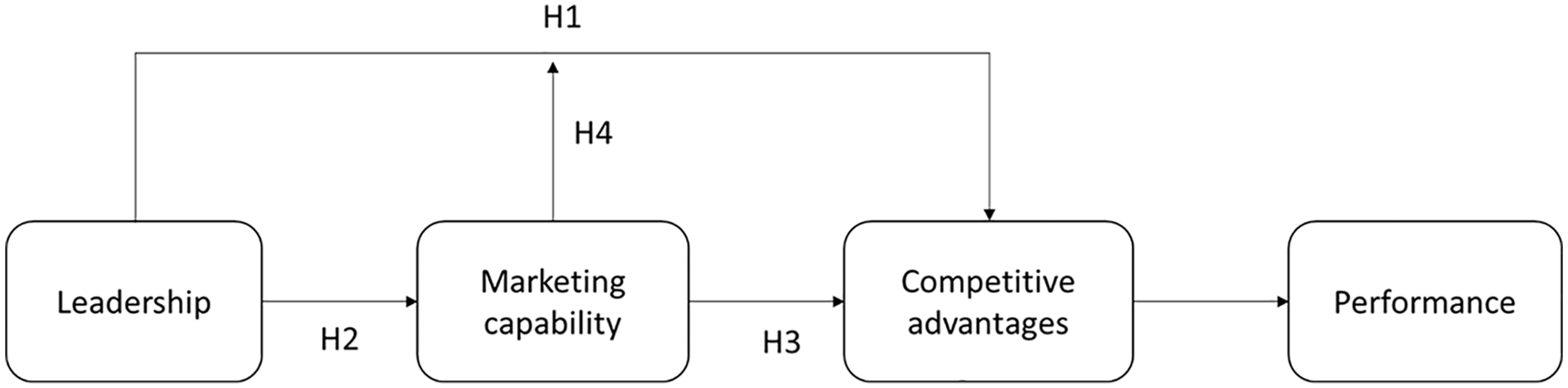
Model and hypotheses.
Material and Methods
Data
The province of Misiones in Argentina produces (Freaza, 2000) forest and agro-industrial goods. It is a wooded region with subtropical forests and varied species. Timber is one of the most critical resources of the territory. The fertile land and climate facilitate rapid tree growth; the growth rate is double that in the rest of the country.
The census of the Argentine Federation of the Wood Industry and Related Industries (FAIMA) in 2010 reported that there were 660 sawmills, 140 furniture factories, and 171 joineries and other manufacturers operating in Misiones. The companies are essentially SMEs (95%), lacking training in managing or exploiting existing resources. The forest industry is usually oriented to the internal market.
The sample of 212 owner-managers was selected proportional to the business’ concentration in the territory, with an error of 3%. A structured survey in Spanish (see translation in Online Supplemental Appendix) was sent to the entrepreneurs in October 2015. For 2 months, the interviewers then visited the entrepreneurs to appease any doubts and assist them in completing the survey. The response rate was 78.5%. A goodness of fit test was carried out to control for the bias of non-response, confirming that the sample was adjusted to the population. Finally, 189 surveys were performed, at which point the error rate increased to 3.2%. The final sample included 30% of microenterprises (fewer than five workers), 60% of small companies (between 5 and 25 workers) and the remainder with more than 25 workers. The researchers also made several visits to the region in 2012, 2015, and 2018 to analyze the behavior of the companies.
Measures
The questionnaire followed previous papers (Jardon & Susana Martos, 2012), based on the scales found in the literature (Hitt & Duane, 2002). There are various measures of leadership in the literature, and these also differ between types of leadership (Bass & Avolio, 2000; Heimann et al., 2020; Jackson, 2005, 2020; Jing, 2018; Rafferty & Griffin, 2004). Given the features of subsistence entrepreneurs (limited strategic knowledge), it seemed convenient to look for items that would measure the main characteristics of that leadership, that is, inspiration, motivation, and delegation, measured in a Likert scale of 1 (totally disagree) to 5 (totally agree), according to the degree of agreement with the statement (see Table 1). Marketing capabilities were measured by asking the entrepreneurs whether they are better positioned than their competitors concerning seven items (see Table 1) evaluated on a Likert scale ranging from 1 (totally disagree) to 5 (totally agree). Competitive advantage was measured by asking about the company’s position relative to its competitors, using a scale ranging from 1 (not important) to 5 (very important). The researchers used company size, measured by employment, as the control variable (Clarke et al., 2011). To measure performance, they introduced a question about the growth of sales (Kirkwood, 2009).
Measures of Variables.

Econometric Methods
The paper analyzes linear relationships between structural variables. There are two main methods to achieve this. One is based on covariance analysis (Hair et al., 2006). However, this method requires hard assumptions, especially concerning the conjoint normal behavior of the variables used, which is difficult as the variables were measured on a Likert scale. Another concern is the use of a partial least squares (PLS) technique. This method makes a direct estimation of structural relationships using least-squares techniques. This minimizes the variance of all dependent variables and avoids problems such as the identification of parameters in the covariance model. An assumption of normality in the distribution of the variables is not required (Chin, 1998). The researchers used the PLS method since it is more flexible and less constrained by these assumptions than other available techniques.
The PLS technique validates the estimation using the average variance extracted (AVE), Dillon-Goldstein’s rho (DG), and Cronbach’s alpha (CA) as criteria. The AVE measures the variance captured by a latent construct. DG analyzes the homogeneity of the blocks, and the CA is based on the analysis of average correlations among the items referred to as a single aspect from a single administration of the questionnaire. The cut-off points for AVE, DG, and CA is 0.5, 0.7, and 0.6, respectively. The discriminant validity is studied using a cross-loading matrix (Chin, 1998; Nunnally & Bernstein, 1994).
The paper analyzes the mediation effect of marketing capability, and two models were necessary. The first is used to investigate the effect of leadership on competitive advantage. The second model introduces marketing capabilities to test their mediation effect. Performance is introduced in the last path of the model to check competitive advantage. The bootstrap methodology is used to validate the model (Efron, 1979). The calculation was carried out using R Ver. 3.64, based on the PLS-PM package (Sanchez, 2013).
Empirical Results
The research aimed to prove the hypotheses related to the process of generating performance through leadership. The model tested hypotheses related to the mediating effect of marketing capabilities. The reliability and unidimensionality of the constructs were assessed using DG and CA. The convergent validity was checked with the AVE. Table 2 shows that the constructs fit the criteria and they are correct. The discriminant validity is observed in the cross-loadings, where the main diagonal has the highest values.
Reliability.

The structural equations model presents two types of equations: internal equations to measure the latent variables and external equations to measure the latent variables. Loadings determine the internal equations (see Table 2). Table 3 sets out the external equations.
Internal Models.

p < .01. ***p < .001.
The estimation results of Model 1 (see Table 3) show that transformational leadership affects competitive advantage, which subsequently affects performance (Bryant, 2003; Hitt & Duane, 2002; Hoon Song et al., 2012; Ketelhöhn, 2006; Renko et al., 2015). This performance is not affected by size. These results confirm Hypothesis 1.
When marketing capabilities are introduced (see Model 2), these affect competitive advantage (Day, 2011; Mu, 2015), confirming Hypothesis H2. These capabilities subsequently affect performance. The effect of leadership on competitive advantage disappears. Model 3 was then estimated. In this model, leadership affects marketing capabilities (Hoon Song et al., 2012; Judge & Piccolo, 2004), confirming Hypothesis H3. However, the effect of leadership on competitive advantages disappears, confirming Hypothesis 4. Performance is not affected by size (Björkdahl & Börjesson, 2011). The mediation effect was verified with an Aroian Sobel test (T = 2.83, p = .00046) (Preacher & Leonardelli, 2010).
Discussion
This paper confirms that marketing capabilities are a mechanism for leadership to increase the competitiveness of SSBs, as proposed by Koryak et al. (2015). The results indicate that leadership of SSBs affects competitive advantage; this is in keeping with Punjaisri et al. (2013) and Foss and Lindenberg (2013). The findings also accord with the classical tradition of strategic leadership. They indicate that leadership is a source of competitive advantage, as it forms part of the human capital of the company (Bryant, 2003; Hitt & Duane, 2002; Hoon Song et al., 2012; Renko et al., 2015). In this respect, SSBs are no different from other companies.
SSBs do not face the dilemma of choosing between long-term and short-term strategies (Didonet et al., 2020) since they are only oriented to the short term (Jaouen & Lasch, 2015). Their marketing capabilities are limited, but they are still necessary for competitiveness. This accords with previous studies referring to other types of companies (Acquaah & Agyapong, 2015; Agyapong et al., 2015; Najafi-Tavani et al., 2016; Tan & Sousa, 2015); although the characteristics of the marketing capabilities in SSBs present some differences (Coelho & Ferreira, 2017; Wiklund et al., 2009), these characteristics do not determine the effect.
Leadership increases marketing capabilities in SSBs. This finding accords with Judge and Piccolo (2004); transformational leaders foster a climate of open and creative support to generate, share, and act on the knowledge created through market detection, customer participation, and interaction with colleagues.
Finally, the results show that these marketing capabilities mediate the effect of leadership. Sanzo et al. (2012) study the mediating effect of marketing capabilities for organizational learning. This research shows that they are also mediators of leadership. Consequently, the results highlight the importance of market knowledge, relationships with colleagues, and other agents (Mu et al., 2018) to guide leadership efforts more efficiently to generate competitiveness. This fact may be associated with their operating in the bazaar (Dana, 2011), where relationships take on greater importance than other aspects of the company’s competitiveness.
The paper contributes to the previous literature in two essential respects. First, it indicates that both transformational leadership and marketing capabilities in SSBs are a source of competitive development. This aspect in such companies has not been studied, especially in developing countries. The paper indicates that classical elements of the leadership theory (Judge & Piccolo, 2004) and the dynamic capabilities view (Teece, 2009) are valid for subsistence markets. However, some of the concepts must be adapted.
In terms of marketing capabilities, the study highlights the importance of relationships with external agents and internal marketing processes as a channel for those relationships, for example, concerning motivation and delegation of leadership. Second, it shows that leadership needs marketing capabilities to generate a competitive advantage. In this sense, it contrasts with some previous studies (Mu et al., 2018), pointing out that relational capital is essential in subsistence markets. However, it complements the results of other research in these markets (Dana, 2011; Toledo-López et al., 2012; Viswanathan et al., 2019). Following Sanzo et al. (2012), it could be said that the main factor in the study of marketing capabilities is market orientation. This orientation is rare in SSBs (Mendoza-Ramírez & Toledo-López, 2014). Consequently, this paper contributes to the literature in showing that leadership is an antecedent to marketing capabilities.
The analysis helps explain the subsistence markets of Latin America, their unique characteristics, and elaborates strategies and policies that are appropriate to these markets (Mendoza-Ramírez & Toledo-López, 2014).
Managerial and Political Implications
The paper presents a series of factors that could help to improve the functioning and management of SSBs. First, it shows that transformational leadership is essential in SSBs. Therefore, political action should be aimed at fostering transformational leadership that generates growth. Transformational leadership, associated with managerial capital, should play an educational role for the benefit of subsistence entrepreneurship (Bruhn et al., 2010).
According to the results, transformational leadership is necessary to generate a competitive advantage in SSBs. The managers of these companies should be oriented toward transformational leadership that improves their companies’ competitiveness. In this regard, training policies should be oriented to organizational and strategic management (Anand et al., 2006). Transformational-leadership learning is especially needed in the case of the owner-manager to determine the company’s organizational structure and strategy (Jardon et al., 2007).
The training of transformational leaders requires joint action by social agents. For example, business consultants should encourage such leadership (Bruhn et al., 2010) through direct training in business schools or coaching (Dolores Vidal-Salazar et al., 2012). In the same way, political action, especially the formation of business schools in the relevant regions, should be oriented toward developing strategic leaders; this might result in the increased effectiveness of SSBs. Training institutions should promote entrepreneurial competencies to professionalize SSB managers (Kantis et al., 2002).
Marketing capabilities directly affect competitive advantage; they are the mediator between transformational leadership and competitive advantage. Thus, managers must prioritize their way of exercising leadership and orient themselves to create marketing capabilities in the face of other secondary aspects. In the same way, consultants and social actors should help SSB entrepreneurs exercise transformational leadership and create marketing capabilities to be competitive (Bruhn et al., 2010). This study suggests the importance of helping these companies enter new markets and improve their marketing capacity through support and promotional policies, such as joint promotion of local brands (Pietrobelli & Rabellotti, 2004).
Consultants and support agents for SSBs should consider these aspects when designing strategies or advising entrepreneurs in decision-making, thus indicating that learning to be a transformational leader and being oriented toward markets is essential if the entrepreneur’s firm is to succeed.
SSBs operate in subsistence markets in situations with scarce resources. Consequently, any improvement that helps create wealth and employment means increasing the possibilities of reducing poverty, thus contributing to the first objective of the UN’s SDGs (UN, 2019).
Conclusions
The relationship between leadership and marketing capabilities in SSBs has not been widely studied, though it is considered important in the marketing literature (Day, 2011; Mu, 2015; Mu et al., 2018).
This paper studied first the importance of leadership in creating competitive advantage in SSBs, confirming that transformational leadership is a source of competitive advantage (Dunne et al., 2016; Jardon & Martínez-Cobas, 2019; Zapalska et al., 2015). This result agrees with previous studies on the meaning of strategic leadership (Hitt & Duane, 2002), whose arguments are valid for SSBs. Next, it shows that marketing capabilities are also a source of competitiveness for SSBs; this is congruent with the previous literature (Day, 1994; Lin & Tsai, 2016; Mu, 2015).
Previous studies have studied the moderating effect of leadership on marketing capabilities (Mu et al., 2018). However, this study shows the mediating effect of marketing capabilities regarding leadership in generating competitive advantage. It points out the importance of these capabilities if leadership is to produce significant effects.
The present research used data from a specific region and sector, and therefore, any generalizations must be made with caution. The variables were measured using subjective items. This could limit the validity and scope of the results, but the answers point up information about the entrepreneurs—the analysis used cross-sectional data. Future research should use panel data to check the evolution of the results. In addition, complementary variables could be used in related studies.
The study has implications for future research; its subject could, for instance, be explored in other locations and industries. The study shows the importance of leadership in the competitiveness and growth of small businesses in developing countries, complementing previous literature about subsistence markets (Dana, 2019; Elaydi & Harrison, 2010; Schoar, 2010; Viswanathan et al., 2019) and opening possibilities in other markets and sectors.
Supplemental Material
sj-docx-1-sgo-10.1177_21582440221079935 – Supplemental material for Leadership and Marketing Capabilities in Small Businesses of Subsistence Marketplaces
Supplemental material, sj-docx-1-sgo-10.1177_21582440221079935 for Leadership and Marketing Capabilities in Small Businesses of Subsistence Marketplaces by Carlos M. Jardon and Xavier Martinez-Cobas in SAGE Open
Footnotes
Appendix
Descriptive Statistics. .

| Variable | Mean | Std. Dev. | Correlations | ||||||||||||||||||
|---|---|---|---|---|---|---|---|---|---|---|---|---|---|---|---|---|---|---|---|---|---|
| hc10 | hc1 | hc2 | hc3 | VRC1 | VRC2 | VRC3 | VRC4 | VRC5 | VOC2 | VOC9 | VSF1 | VSF2 | VSF3 | VSF4 | VSF5 | VSF6 | PG1 | PG2 | |||
| hc10 | 2.99 | 0.96 | 1.00 | ||||||||||||||||||
| hc1 | 3.24 | 0.95 | .59 | 1.00 | |||||||||||||||||
| hc2 | 3.34 | 0.83 | .56 | .40 | 1.00 | ||||||||||||||||
| hc3 | 3.50 | 1.00 | .38 | .47 | .26 | 1.00 | |||||||||||||||
| VRC1 | 3.25 | 1.62 | .05 | .07 | .05 | −.03 | 1.00 | ||||||||||||||
| VRC2 | 3.59 | 1.38 | .11 | .07 | .06 | .03 | .45 | 1.00 | |||||||||||||
| VRC3 | 3.76 | 1.15 | .18 | .25 | .22 | .29 | .41 | .39 | 1.00 | ||||||||||||
| VRC4 | 3.26 | 1.64 | .20 | .30 | .16 | .11 | .52 | .38 | .47 | 1.00 | |||||||||||
| VRC5 | 3.78 | 1.17 | .16 | .22 | .08 | .02 | .43 | .40 | .39 | .52 | 1.00 | ||||||||||
| VOC2 | 3.79 | 1.07 | −.03 | .10 | .07 | .02 | .40 | .26 | .36 | .39 | .61 | 1.00 | |||||||||
| VOC9 | 3.86 | 1.23 | −.02 | −.04 | −.03 | −.10 | .44 | .54 | .45 | .48 | .56 | .46 | 1.00 | ||||||||
| VSF1 | 3.75 | 1.20 | −.01 | .03 | .04 | −.09 | .46 | .54 | .39 | .54 | .73 | .61 | .78 | 1.00 | |||||||
| VSF2 | 3.75 | 1.34 | .22 | .19 | .16 | .00 | .52 | .43 | .43 | .59 | .76 | .54 | .61 | .74 | 1.00 | ||||||
| VSF3 | 3.84 | 1.22 | .18 | .16 | .24 | .07 | .45 | .42 | .45 | .51 | .56 | .50 | .54 | .71 | .82 | 1.00 | |||||
| VSF4 | 3.42 | 1.25 | .18 | .28 | .16 | .16 | .47 | .48 | .49 | .55 | .68 | .54 | .56 | .76 | .57 | .63 | 1.00 | ||||
| VSF5 | 3.05 | 1.65 | .00 | .04 | .00 | −.09 | .48 | .26 | .29 | .42 | .35 | .37 | .31 | .39 | .57 | .41 | .28 | 1.00 | |||
| VSF6 | 3.53 | 1.22 | .25 | .31 | .11 | .08 | .42 | .43 | .52 | .64 | .58 | .39 | .55 | .58 | .52 | .54 | .68 | .21 | 1.00 | ||
| PG1 | 3.19 | 0.64 | .12 | .15 | .12 | .05 | .23 | .11 | .31 | .43 | .47 | .28 | .28 | .41 | .40 | .35 | .34 | .19 | .42 | 1.00 | |
| PG2 | 2.64 | 0.87 | −.23 | −.37 | −.20 | −.10 | −.09 | −.12 | −.22 | −.31 | −.05 | .00 | −.10 | −.18 | −.19 | −.19 | −.24 | .09 | −.25 | −.05 | 1.00 |
Declaration of Conflicting Interests
The author(s) declared no potential conflicts of interest with respect to the research, authorship, and/or publication of this article.
Funding
The author(s) received no financial support for the research, authorship, and/or publication of this article.

Supplemental Material
Supplemental material for this article is available online.
References
Supplementary Material
Please find the following supplemental material available below.
For Open Access articles published under a Creative Commons License, all supplemental material carries the same license as the article it is associated with.
For non-Open Access articles published, all supplemental material carries a non-exclusive license, and permission requests for re-use of supplemental material or any part of supplemental material shall be sent directly to the copyright owner as specified in the copyright notice associated with the article.
