




Abstract
Major conspiracy theorists propose that problem–reaction–solution (PRS) functions as a mechanism for constructing and exaggerating social problems to garner populist support for the implementation (imposition) of laws that society would normally deem unacceptable. To evaluate this supposition, 248 participants recruited through convenience sampling, completed measures assessing PRS, statistical bias, emotion-based reasoning (EBR), and belief in the paranormal. Structural equation modeling revealed differential relationships existed between components of statistical bias, EBR, and belief endorsement (PRS and paranormal). Specifically, proneness to conjunction error predicted PRS, whereas misperception of randomness and to an extent EBR best explained belief in the paranormal. These results indicated that respondents were willing to accept PRS scenarios as legitimate and validate PRS-proposed solutions based on rational rather than emotional appeal.
The prominent conspiracy theorist, David Icke, contends that problem–reaction–solution (PRS), known also as order out of chaos, is a device used by the powerful, social ruling elite to manipulate and shape public opinion with the intention of gaining approval for the implementation of societal controls (Icke, 2003, 2005, 2007, 2010) He posits that PRS involves three discrete, but interrelated phases (Icke, 2010). Initially, dominant individuals, groups, and/or organizations covertly engineer or exploit a problem to legitimize the enactment of laws, rules, and restrictions. Then, via an unquestioning media, the issue is broadcast, amplified, and popularized. Bringing the problem to the forefront of public attention arouses a strong social demand for action (reaction), which advances acceptance of a “predetermined” solution (Icke, 2005, 2010). According to Icke, PRS via this process instigates social change, legitimizes centralized power, and increases hegemonic authority (Icke, 2003, 2005, 2007, 2010). Concomitant with Icke’s theorizing, many conspiracy theorists view PRS as a propaganda technique and a powerful form of mind manipulation (Chomsky, 2002; Robertson, 2016).
Indeed, Chomsky (2002) contends that the role of the media is to misinform rather than inform. Chomsky (2002) posits that the media, via a continuous flood of distractions and insignificant information, generates representations of the world, which are divorced from reality. These inaccurate depictions divert public attention away from potentially negative changes advanced by political and economic elites. An important strategy within the PRS process is to forward problems, and then provide solutions (Lincenyi & Tamene, 2013). Specifically according to Chomsky (2002), the media focuses on an issue (problem) to evoke a strong audience reaction with the intention of gaining acceptance for a preset solution. For instance, manufacture an economic crisis, to curtail social rights and reduce public services. Within this context, the “problem” produces anxiety, which motivates support (gains public consensus and general consent) for the preordained solution. Hence, fear and anxiety are key drivers within the PRS process (Lincenyi & Tamene, 2013).
A contemporary, real-world example of PRS is a false (black) flag operation (McMinn, 2017). This is a covert plan, designed to deceive by mendaciously attributing actions to entities, groups, or individuals (Icke, 2005). A classic, frequently cited illustration is Operation Northwoods (1962) (see Durham, 2014; Knight, 2008), where U.S. military officials planned self-directed attacks on the American state with the intention of blaming Cuba (Knight, 2008). The U.S. officials involved believed that perceived Cuban culpability would provide justification and support for an otherwise publicly unacceptable conflict between the two countries (Durham, 2014).
A key feature of the final phase of PRS is that the stated resolution is typically unduly radical (Icke, 2003). Accordingly, moderation of the solution in the face of significant opposition appeases critics, creates a false impression of reasonableness, and provides a platform for the introduction of further measures (Icke, 2003). Within conspiracy canon, PRS exists concurrently with “the totalitarian tiptoe” (Icke, 2003, 2007). This term denotes the notion that the stealthy, systematic implementation of linked, minor changes over time incrementally produces major social transformation (Icke, 2003, 2007).
Although, the precise lineage of PRS is unknown, researchers often ascribe the origin of PRS to various ancient figures or events (i.e., Roman Emperor Diocletian) and philosophical doctrines (Hegel, 1812; see Fichte, 1794, in Neuhouser, 1990). In this historical context, PRS comprises three stages equivalent to those subsumed within PRS: thesis (intellectual proposition, problem), antithesis (negation of the proposition, response to thesis), and synthesis (resolution of tension between proposition and reaction, resolution). These steps derive from Heinrich Moritz Chalybäus misinterpretation (Carlson, 2007) of Hegel’s dialectic (Mills, 2005; Stewart, 1996). The exact source and academic status of PRS is unclear and beyond the remit of this article, which generally views PRS as a form of faulty inferential thinking. More precisely, as the tendency to validate proffered suboptimal solutions based on limited evaluation of objective evidence.
Considering the cognitive bases of PRS further, in some circumstances, endorsement of the proposed solution derives from a chain of reasoning related to the reaction to the solution, and then the solution to the reaction. In this context, PRS endorsement follows valid inferential reasoning rules and does not denote problematic reasoning (Faust, 1984). Within propositional logic, the modus ponens describes a rule of inference given the validity of a set of premises (Johnson-Laird, Byrne, & Schaeken, 1992). Modus ponens applies to the reasoning embodied in many PRS scenarios. In these cases, problems in reasoning arise only when the premises related to an argument, or its conclusions are either unfounded or inappropriately presented as valid. From a conspiratorial perspective, issues arise because solutions derive from premises fashioned by those in charge of constructing and/or maintaining social reality, rather than the rules of logic (e.g., Althusser, 2014; Eagleton, 1991).
For example, terrorism is a major threat to personal and societal well-being (problem). An appropriate reaction to this statement is to express concern for potential victims (response). In this instance, a proportionate government or state-regulatory reaction is to insist that citizens are in need of protection (solution). Stated in formal logical terms, this equates to a modus ponens form of argument, if A (a terrorist attack occurs) then B (the state needs to intervene to protect citizens). Acceptance of this statement arises from the observation that the solution cogently follows the problem. However, the reaction, in this instance, does not actually prescribe the solution. In this context, ideological state apparatuses may influence belief systems at a societal level (Althusser, 2014). This process advocates certain “normal” and “natural” solutions and rejects others. Thus, conspiracies arise when individuals question prevailing views and consider that proposed solutions mask real objectives. In this example, increased surveillance is advocated and normalized.
Typically, problems defined by the PRS framework are general and proposed solutions specific. Hence, solution acceptance originates not from logical deduction per se, but rather the perception of resolutions as “rational.” Accordingly, ideology influences perception of what is appropriate (Chomsky, 2002). Conspiracies arise when theorists posit causes and solutions that differ from those recommended by current ideological practices.
Furthermore, the inherent emotive content of PRS scenarios (i.e., fear, anxiety, and anger) may undermine critical evaluation of premises and solutions by facilitating affective rather than analytical consideration of arguments. Consequently, solutions derived from PRS scenarios often receive less critical scrutiny (see Pham, 2007). Moreover, within PRS scenarios, structure places an emphasis on issue resolution (solution focus) rather than logic (Icke, 2003, 2007). This is consistent with everyday dilemmas that spontaneously induce emotional responses and are generally resolved via affect-driven decision making (Haidt, 2001).
Affective decisions are inherently less analytically evaluative because they are automatic and use fewer cognitive resources (Epstein, 1990). In support of the supposition that affect influences appraisal of information creditability, previous work reports that emotional rather than rational appeal informs validation of beliefs (Epstein, Pacini, Denes-Raj, & Heier, 1996). This applies also to belief in the paranormal (Dudley, 2000; Irwin, Dagnall, & Drinkwater, 2012). Furthermore, research suggests that affective appeal plays an important role in the acceptance of pseudoscientific claims (Lindeman, 1998). This notion draws on Irwin’s (2009) definition of paranormal belief as, a proposition that has not been empirically attested to the satisfaction of the scientific establishment but is generated within the nonscientific community and extensively endorsed by people who might normally be expected by their society to be capable of rational thought and reality testing. (pp. 16-17).
PRS endorsement, at least superficially, shares key features with belief in the paranormal. Particularly, PRS validation defies logic, ensues in the absence of supporting scientific evidence, and occurs within individuals who are typically capable of reality testing. To facilitate comparisons with belief in the paranormal, a measure of paranormal belief was included alongside PRS within this article. A further advantage of including belief in the paranormal is that the construct is also associated with flawed probabilistic reasoning (Dagnall, Parker, & Munley, 2007; Wierzbicki, 1985).
To date, there has been no psychological examination of PRS. Certainly, the authors are not aware of any psychological studies. The present study bridged this gap in the literature and was congruent with the recent surge of interest in conspiratorial ideation and its potential societal importance. The lack of research into PRS reflects the fact that psychological researchers and publications are often reluctant to consider the legitimacy of phenomena that is located outside traditional academic literature. Investigation of PRS is required because the concept frequently surfaces within conspiracy theory narrative and is widely disseminated by pseudoscientists (Icke, 2003, 2007). Therefore, it is vital to assess the psychological legitimacy of PRS and its potential social impact. Acknowledging this important omission, the present study examined the extent to which wrongly inferred causation and affect-driven decision making explained endorsement of PRS scenarios. Correspondingly, measures of probabilistic reasoning ability (susceptibility to statistical bias), paranormal belief, and emotion-based reasoning were included.
It was important to incorporate reasoning measures because recent studies have demonstrated that endorsement of unconventional beliefs (i.e., paranormal and conspiracy theories) is associated with statistical bias (Dagnall, Denovan, Drinkwater, Parker, & Clough, 2017; Dagnall, Drinkwater, Denovan, Parker, & Rowley, 2016; Dagnall, Drinkwater, Parker, & Rowley, 2014; Dagnall et al., 2007). Explicitly, misperception of chance best predicts belief in the paranormal (Dagnall et al., 2007), whereas propensity to conjunction error most strongly explains endorsement of conspiracy theories (Brotherton & French, 2014; Dagnall et al., 2017). Belief in the paranormal relates also to conjunction (Rogers, Davis, & Fisk, 2009; Rogers, Fisk, & Lowrie, 2016; Rogers, Fisk, & Wiltshire, 2011); however, the effect is weaker and largely attributable to misperception of chance (Dagnall, Drinkwater, et al., 2016; Dagnall et al., 2014). Hence, misperception of chance is associated with both dimensions of the Revised Paranormal Belief Scale (New Age Philosophy [NAP] and Traditional Paranormal Beliefs [TPB]), whereas conjunction correlates only with Traditional Paranormal Beliefs. Acknowledging preceding work, both perception of randomness and proneness to conjunction fallacy were included as measures of statistical bias.
The current research article assessed the degree to which PRS endorsement was explicable in terms of statistical bias and emotion-based reasoning. Due to a dearth of previous work in the area of PRS, hypotheses were exploratory and tentatively stated. Accordingly, conclusions about PRS endorsement derived from consideration of intervariable relationships. Specifically, this study reasoned that different outcomes would indicate which psychological factors best explained PRS. If validation arose from wrongly inferred relationships between argument premises, then a stronger relationship would be evident with statistical bias (vs. emotional-based reasoning). With regard to specific statistical biases, the nature of PRS problems suggested that proneness to conjunction (vs. perception of randomness) would most strongly predict endorsement. This predication arose from the observation that PRS acceptance involves associative linking of components (problem, reaction, and solution), so that the premises appear rationally connected.
Alternatively, a stronger association with emotional-based reasoning (vs. statistical bias) would indicate that PRS solution ratification derived from the affective appeal of statements, although acceptance of PRS solutions and belief in the paranormal appear to share key characteristics (defiance of logic, validation of notions without scientific evidence, and attributable to subjective interpretation). The two constructs also differ. For instance, PRS content refers to real-world everyday topics and issues, which people regularly encounter and widely discuss across a range of political and social fora. Paranormal beliefs, in contrast, are more esoteric and abstract. Hence, the authors anticipated only a weak positive correlation between the two factors.
Method
Participants
Two hundred forty-eight respondents from the Manchester Metropolitan University, Faculty of Health, Psychology and Social Care, and the local community completed measures. Age ranged from 18 to 71 years (M = 26.65, SD = 9.77). The sample comprised 180 females (73%), age range = 18 to 71 years (M = 25.94, SD = 9.51); and 68 males (27%), age range = 20 to 59 years (M = 28.51, SD = 10.24). The majority of participants were students (72%). Within the student group, 86% were undergraduates and 14% postgraduates. If potential participants were younger than 18 years of age, or declared they had previously studied heuristic bias, involvement discontinued. These were the only exclusion criteria.
Materials and Procedure
PRS
Ten scenarios featuring a range of contemporary issues (illegal downloading, adult Internet material, criminal record checks, CCTV surveillance, DNA database, countries supporting terrorism, airport security, movement of foreign nationals, monitoring emails, and global warming) assessed propensity to PRS. Each scenario comprised two statements. The first specified an issue (problem) and related it to a major social concern (reaction), and the second advocated an action (solution). For example, “crime is a regular feature of everyday life (problem), we are all potentially victims (reaction). To protect society and the individual CCTV and routine surveillance are necessary (solution).” Following consideration of each scenario, respondents recorded their agreement to the proposed solution on a 7-point Likert-type scale, ranging from 1 = strongly disagree to 7 = strongly agree. Hence, possible score on the PRS scenarios ranged from 10 to 70, high scores denoted high levels of support for advocated solutions. In this study, alpha reliability of the PRS measure was satisfactory (α = .86) with an acceptable mean interitem correlation of .38. Clark and Watson (1995) suggest that an acceptable mean interitem correlation falls between .15 and .50.
Emotion-based reasoning
The six-item subscale of the Cognitive Biases Questionnaire (CBQ; Peters et al., 2014) assessed emotion-based reasoning. The subscale functions as a standalone measure indexing the degree to which emotional rather than rational appeal informs decision making (Irwin et al., 2012). For each item, respondents read a short vignette and endorsed one of three options, the option best describing how they felt about the situation. Responses were rated on a 3-point scale (1 = absence of bias, 2 = presence of bias with some qualification, and 3 = presence of bias). For example, “Imagine you are watching the news on TV about a recent disaster, and you find yourself feeling guilty.” Responses to this item in accordance with the response scale were, “It’s normal to feel guilty when a disaster has happened to someone else”; “I wonder why I feel guilty, maybe I’m unwittingly responsible in some way”; and “I feel guilty I must be responsible in some way.” Overall, scores ranged from 6 to 18, with high scores indicating presence of bias. The CBQ possesses good psychometric properties (test–retest reliability and Cronbach’s α = .89). In this study, alpha was slightly below the threshold of .7 (α = .63); however, the scale possessed a satisfactory mean interitem correlation of .22.
Belief in the paranormal
The Revised Paranormal Belief Scale (Tobacyk, 1988; Tobacyk & Milford, 1983) is the most commonly used measure of paranormal belief (Goulding & Parker, 2001). It assesses belief in the paranormal via completion of 26 self-report items. Items appear as statements (e.g., “There is a devil”) and respondents designate agreement on a 7-point Likert-type scale (ranging from 1 = strongly disagree to 7 = strongly agree). Statements index seven dimensions of paranormal belief: traditional religious belief, psi, witchcraft, superstition, spiritualism, extraordinary life forms, and precognition. The Revised Paranormal Belief Scale is a conceptually and psychometrically satisfactory measure of paranormal belief possessing adequate reliability and validity (Tobacyk, 2004).
The nature and number of the belief dimensions, however, have received criticism (Lawrence, 1995a, 1995b; Lawrence, Roe, & Williams, 1997). Consequently, Lange, Irwin, and Houran (2000) performed a purification of the Revised Paranormal Belief Scale, which identified a superior two-factor solution based on belief function (individual vs. social). This comprised New Age Philosophy (NAP) and Traditional Paranormal Beliefs (TPB). NAP contains 11 items evaluating belief in psi and survival of bodily death. The factor reflects the degree to which beliefs impart control over external events (Irwin, 1992). TPB possesses five items measuring belief in the devil, witchcraft, heaven, and hell. TPB regulates social and cultural factors (Goode, 2000). Calculation of NAP and TPB scores requires item recoding (0-6; see Lange et al., 2000), higher scores reflecting paranormal belief. Subscale scores, following Rasch transformation, range from 6.85 to 47 for NAP and 11.16 to 43.24 for TPB. The Revised Paranormal Belief Scale demonstrates excellent internal reliability, Cronbach’s alpha = .94 and its subscales possess good internal reliability (NAP, α = .88 and TPB, α = .82; Dagnall, Denovan, Drinkwater, Parker, & Clough, 2016). In this study, alpha reliability of the total scale was high (α = .94) with a satisfactory mean interitem correlation of .37. Similarly, TPB and NAP subscales possessed high reliability (α = .82 and α = .89, respectively), with satisfactory mean interitem correlations of .48 and .44.
Probabilistic reasoning tasks
Arnott’s (1998, 2006) taxonomy of decision biases places judgments of chance (perception of randomness and conjunction) within a common statistical bias category. Participants completed 10 probabilistic reasoning tasks, five items assessing each bias type. Hence, scores for each bias ranged from 0 to 5 and the overall score was 0 to 10. To facilitate comparisons, raw scores appear alongside proportions; these represent the number of correct responses calculated as a fraction of percentage-hit rate. High scores indicate higher levels of probabilistic reasoning ability (absence from misperception of randomness and conjunction error). Problems have featured within several previously published studies (Dagnall, Drinkwater, et al., 2016; Dagnall et al., 2014; Dagnall et al., 2007).
Perception of randomness
Items assessed participant’s ability to judge accurately the likelihood of strings and sequences. For example, “imagine a coin was tossed six times. Which pattern of results do you think is most likely? (a) HHHHHH, (b) HHHTTT, (c) HTHHTT, (d) all equally likely.” Overall scores indicate the degree to which participants base judgments on an understanding of probability. The scale possessed an acceptable mean interitem correlation of .15. Items derived from Kahneman and Tversky (1973).
Conjunction fallacy
Problems comprised single component events (A&B) and a conjunction (both events co-occurring, AB). Instructions directed participants to select the most likely, probable outcome from the alternatives. Conjunction occurred if participants selected (A&B). For example, “two football teams (Team A and Team B) are playing in a local derby. What is the most likely outcome?: (a) Team A scores first, (b) Team A scores first and wins, (c) Team A scores first and loses, (d) Team A scores first and the game is drawn.” Problems derived from the seminal work of Tversky and Kahneman (1982, 1983; that is, heart attack, Linda problem, cause of war, and outcome of sporting events). As with the perception of randomness scale, the measure possessed a satisfactory mean interitem correlation of .17.
Perception of randomness and conjunction items appeared within a single section and randomization determined item order.
Procedure
Potential participants read the study outline. If they provided informed consent, instructions directed them to work systematically through the materials booklet. Guidelines asked participants to answer questions honestly and complete items at their own pace. The booklet contained five sections: personal information (always first), PRS, emotion-based reasoning, paranormal belief, and probabilistic reasoning tasks. To avoid order effects, order of measures rotated across participants. On conclusion of the booklet, participants were debriefed.
Prior to testing, the researchers obtained ethical approval for the study as part of a research project examining relationships between anomalous beliefs and statistical bias.
Results
Data Analysis Strategy
Data analysis progressed through a sequence of related phases. Initially, data screening and examination of descriptive statistics confirmed normality of scores. Then, confirmatory factor analysis and composite reliability evaluated measurement adequacy. Finally, structural equation modeling (SEM) investigated relationships between problem types (statistical bias: perception of randomness and conjunction fallacy), thinking style (emotion-based reasoning), paranormal belief (Traditional Paranormal Beliefs and New Age Philosophy), and PRS.
Two models tested the hypothesis that problem types, although correlated and similarly associated with emotion-based reasoning, would differentially predict belief in the paranormal and PRS. Noting that Traditional Paranormal Beliefs and New Age Philosophy possess different functions (Lange et al., 2000), models examined each paranormal factor independently; Model 1 tested Traditional Paranormal Beliefs and Model 2 New Age Philosophy. This approach was consistent with previous research (e.g., Dagnall, Drinkwater, et al., 2016).
The chi-square statistic, the standardized root mean square residual (SRMR), and root mean square error approximation (RMSEA) assessed model fit. For chi-square, a nonsignificant result is preferred. However, interpretation requires caution because chi-square is sensitive to sample size and tends to overreject good models (Tanaka, 1987). For SRMR and RMSEA, values of .05 indicate good fit, values between .06 and .08 denote satisfactory fit, and .08 to .10 marginal fit (Browne & Cudeck, 1993). For reporting RMSEA, the 90% confidence interval (90% CI) was included. The comparative fit index (CFI) was also used because it is less sensitive to sample size, with values greater than .86 indicating marginal fit (Bong, Woo, & Shin, 2013), above .90 satisfactory, and .95 or higher good fit (Hu & Bentler, 1999). Model comparison used Akaike information criterion (AIC; Akaike, 1974), with lower values indicating superior fit.
Descriptive Statistics
Examination of the correlation matrix revealed important intermeasure relationships: a weak positive correlation between problems (perception of randomness and conjunction fallacy) and negative associations between emotion-based reasoning and problems (see Table 1). Relationships between beliefs (paranormal and PRS) and statistical bias varied as a function of problem type. Specifically, perception of randomness significantly negatively correlated with belief in the paranormal, but not PRS. Contrastingly, conjunction performance correlated negatively with overall belief in the paranormal, Traditional Paranormal Beliefs, and PRS.
Scale Descriptive and Intermeasure Correlations.

Note. Statistical bias, overall number of probabilistic reasoning bias problems solved; PR = perception of randomness; CF = conjunction fallacy; EBR = emotion-based reasoning; RPBS = Revised Paranormal Belief Scale; NAP = New Age Philosophy; TPB = Traditional Paranormal Beliefs; PRS = problem–reaction–solution.
p < .05. **p < .01.
Overall, perception of randomness was more strongly associated with belief in the paranormal and conjunction fallacy with PRS. With regard to paranormal dimensions, only Traditional Paranormal Beliefs correlated weakly with PRS. Emotion-based reasoning correlated positively with belief in the paranormal; there was no association with PRS.
Confirmatory Factor Analysis
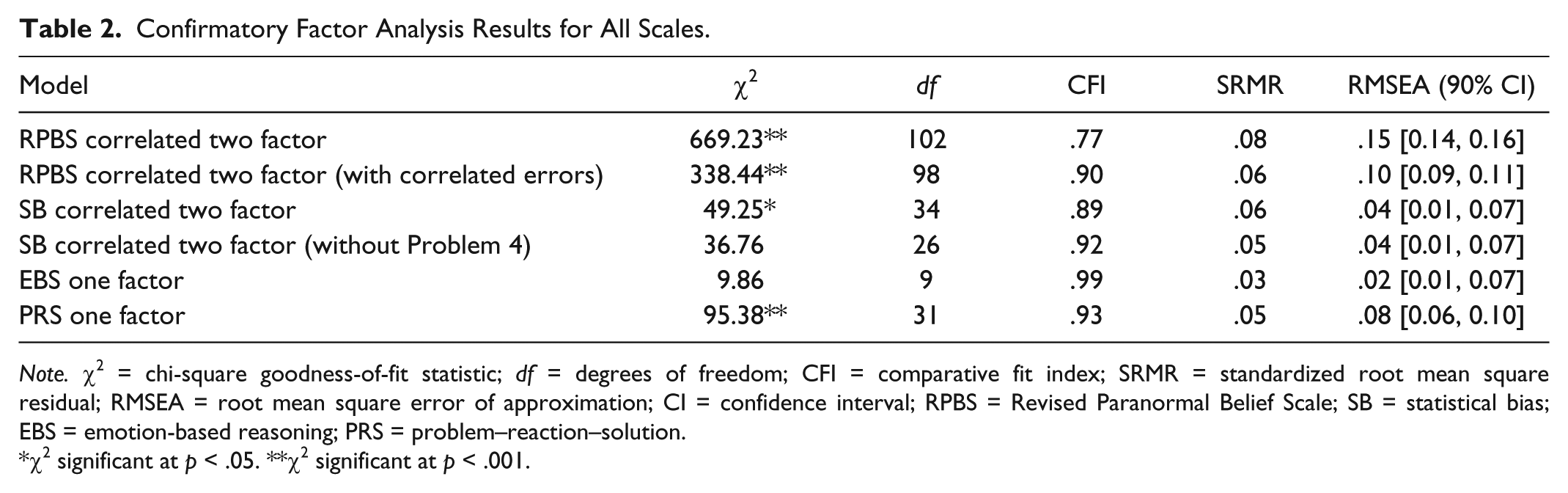
Measurement model assessment involved testing a priori scale factor solutions (see Table 2). Previous research indicated that belief in the paranormal, Traditional Paranormal Beliefs, and New Age Philosophy (Lange et al., 2000); and problems, perception of randomness, and conjunction fallacy (Dagnall, Drinkwater, et al., 2016) possessed correlated two-factor solutions. Thinking style (emotion-based reasoning; Peters et al., 2014) and PRS have unidimensional factor structures.
Confirmatory Factor Analysis Results for All Scales.
Note. χ2 = chi-square goodness-of-fit statistic; df = degrees of freedom; CFI = comparative fit index; SRMR = standardized root mean square residual; RMSEA = root mean square error of approximation; CI = confidence interval; RPBS = Revised Paranormal Belief Scale; SB = statistical bias; EBS = emotion-based reasoning; PRS = problem–reaction–solution.
χ2 significant at p < .05. **χ2 significant at p < .001.
Analysis reported unacceptable fit for the Revised Paranormal Belief Scale, χ2(102, N = 248) = 669.23, p < .001, CFI = .77, SRMR = .08, RMSEA = .15 (90% CI = [0.14, 0.16]). This outcome concurred with existing research reporting unacceptable to marginal fit for the two-factor solution (Dagnall, Drinkwater, et al., 2016). A review of modification indices indicated that correlating specific within-factor error terms (Items 5 and 12, 7 and 14, 14 and 21, and 8 and 22) improved fit, χ2(98, N = 248) = 338.44, p < .001, CFI = .90, SRMR = .06, RMSEA = .10 (90% CI = [0.09, 0.11]). Allowing error terms to correlate, despite risking chance capitalization (MacCallum, Roznowski, & Necowitz, 1992), aided interpretation because the item combinations were consistent with subscales of the original Revised Paranormal Belief Scale seven-factor model (Tobacyk, 2004), in particular, spiritualism (Items 5 and 12), precognition (Items 7, 14, and 21), and traditional religious belief (Items 8 and 22). Byrne (2013) cautions against correlating within-factor error terms without a clear justification. In this instance, a clear rationale existed.
The correlated two-factor model for statistical bias reported satisfactory data–model fit, χ2(34, N = 248) = 49.25, p = .044, CFI = .89, SRMR = .06, RMSEA = .04 (90% CI = [0.01, 0.07]). Factor loadings revealed that Problem 4 loaded poorly onto perception of randomness (loading of .35). Removal of this item resulted in a slight improvement in data–model fit, χ2(26, N = 248) = 36.76, p = .079, CFI = .92, SRMR = .05, RMSEA = .04 (90% CI = [0.01, 0.07]). The one-factor emotional-based reasoning model reported good data–model fit, χ2(9, N = 248) = 9.86, p = .362, CFI = .99, SRMR = .03, RMSEA = .02 (90% CI = [0.01, 0.07]). Similarly, the one-factor model for PRS possessed satisfactory data–model fit, χ2(31, N = 248) = 95.38, p < .001, CFI = .93, SRMR = .05, RMSEA = .08 (90% CI = [0.06, 0.10]). These findings showed that measures were consistent with their underlying theoretical structures. Furthermore, all factor loadings were positive and statistically significant, and all but three items (Item 23, Revised Paranormal Belief Scale = .27; Item 16, emotion-based reasoning = .27; and Item 10, PRS = .30) demonstrated factor loadings greater than the minimum threshold of .32 (Tabachnick & Fidell, 2001).
Reliability Analysis
Traditional measures of internal reliability (i.e., Cronbach’s α) typically over- or underestimate scale reliability within a latent modeling context; hence, composite reliability provides a more rigorous assessment of internal consistency (Raykov, 2002). Values above .60 are satisfactory (Diamantopoulos & Siguaw, 2000). New Age Philosophy and Traditional Paranormal Beliefs demonstrated satisfactory composite reliability (ρc = .89 and ρc = .81, respectively), as did emotion-based reasoning (ρc = .62), and PRS (ρc = .85). Perception of randomness and conjunction fallacy had composite reliability below .60; however, results were close enough to be deemed acceptable (ρc = .57 and ρc = .56, respectively).
Model Evaluation
Fit indices for Model 1, Traditional Paranormal Beliefs (see Figure 1), revealed satisfactory data–model fit, χ2(392, N = 248) = 536.12, p < .001, CFI = .92, SRMR = .06, RMSEA = .04 (90% CI = [0.03, 0.05]). Inspection of structural paths indicated that perception of randomness had a significant negative effect on Traditional Paranormal Beliefs (β = −.36, p = .002), conjunction fallacy had a significant negative effect on PRS (β = −.43, p = .002), and emotion-based reasoning had a significant positive effect on Traditional Paranormal Beliefs (β = .20, p = .04). Emotion-based reasoning demonstrated a significant moderate negative correlation with perception of randomness (r = −.36, p = .003) and conjunction (r = −.37, p = .003). Perception of randomness revealed a significant positive correlation with conjunction fallacy (r = .25, p = .038).
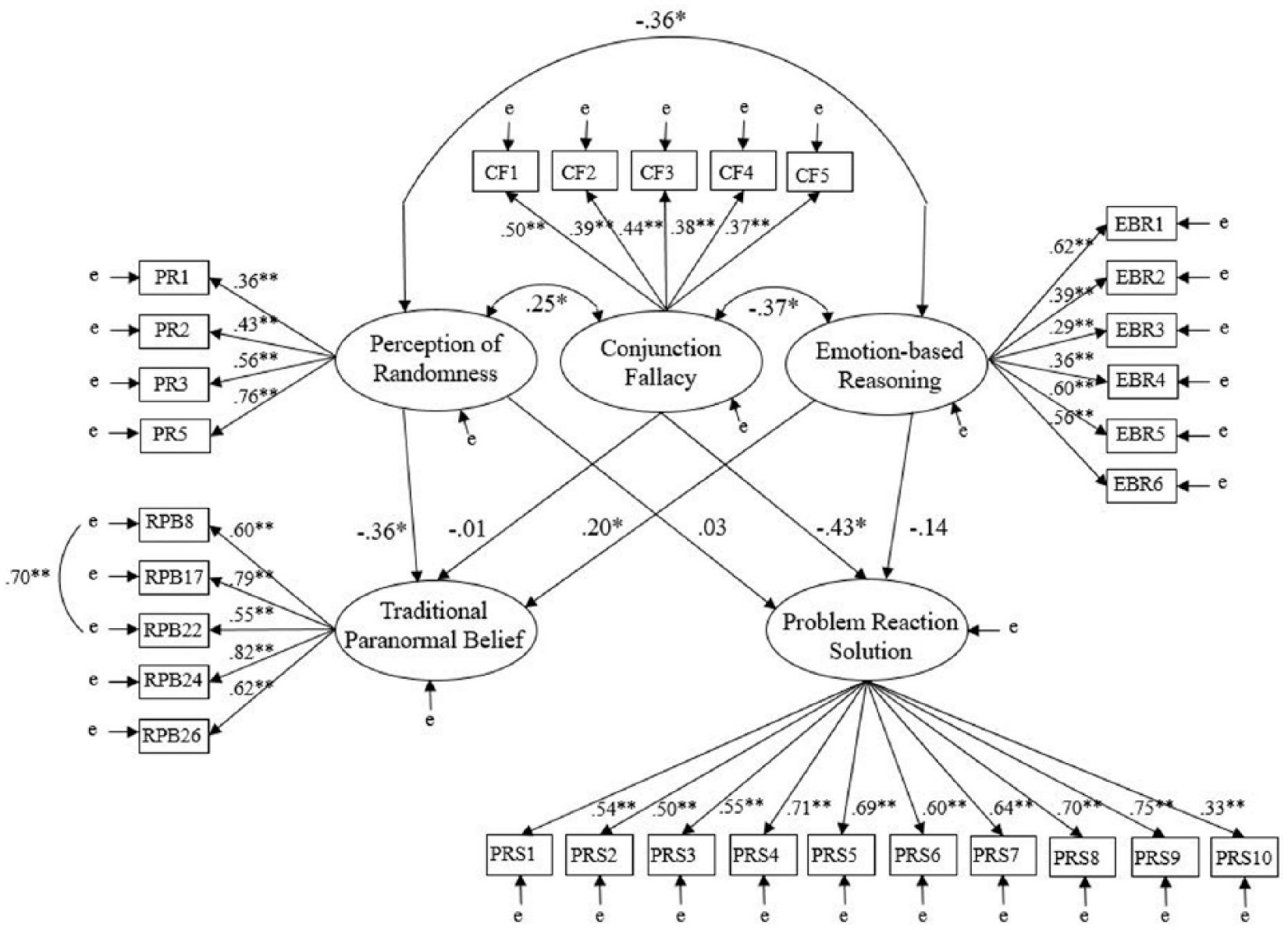
Model 1: Relationships of Conjunction Fallacy, Perception of Randomness, and Emotion-Based Reasoning with Traditional Paranormal Beliefs and Problem-Reaction-Solution.
Model 2, New Age Philosophy (see Figure 2), demonstrated satisfactory fit, χ2(580, N = 248) = 859.95, p < .001, CFI = .90, SRMR = .07, RMSEA = .04 (90% CI = [0.03, 0.05]). Structural paths indicated that perception of randomness had a significant negative effect on NAP (β = −.37, p < .001), and conjunction fallacy had a significant negative effect on PRS (β = −.46, p = .002). As with Model 1, emotion-based reasoning demonstrated a significant moderate negative correlation with perception of randomness (r = −.45, p < .001) and conjunction fallacy (r = −.41, p = .002). In contrast to Model 1, the observed relationship between emotion-based reasoning and paranormal belief was not significant (in this instance, New Age Philosophy). Perception of randomness and conjunction fallacy were positively correlated, but this relationship was above the significance level of .05 (r = .22, p > .05).

Model 2: Relationships of Conjunction Fallacy, Perception of Randomness, and Emotion-Based Reasoning with New Age Philosophy and Problem-Reaction-Solution.
Inspection of AIC specified that Model 1 provided superior data–model fit compared with Model 2 (Model 1, AIC = 742.12; Model 2, AIC = 1,103.95).
Results supported the notion that although positively related, components of statistical bias (perception of randomness and conjunction fallacy) possessed differential relationships with belief in the paranormal and PRS. Poorer performance on perception of randomness tasks predicted paranormal belief, but not PRS. Contrastingly, propensity to conjunction fallacy explained PRS, but not belief in the paranormal. Emotion-based reasoning correlated with statistical bias and positively predicted Traditional Paranormal Beliefs.
Discussion
Endorsement of PRS scenarios correlated negatively with statistical bias; higher levels of PRS validation were associated with poorer performance on probabilistic reasoning tasks. There was, however, no correlation between PRS and emotion-based reasoning (EBR). This differential pattern of relationships indicated that PRS substantiation arose from the rational appeal of presented propositions rather than their affective content. Consideration of individual biases revealed that only proneness to conjunction fallacy predicted level of PRS endorsement. There was no association between perception of randomness and PRS validation.
The predictive relationship between proneness to conjunction and PRS suggested that endorsement of PRS solutions derived from the tendency to deduce incorrectly reciprocal connections between scenario components (problem, reaction, and solution). This assertion was supported by the fact that respondents reported moderate levels of agreement with proposed solutions (M = 4.81, SD = 1.19). This signified that scenarios appeared coherent to the extent that the recommended solutions followed logically from the presented premises. This notion concurred also with Aristotle’s Laws of Association (Ross, 2014). Principally, the law of contiguity, where ideas or events presented closely in time and space seem causally linked.
Clearly, PRS solutions possessed intuitive appeal. The issue was that inferences (stated solutions) did not necessarily follow logically from the presented premises. Specifically, other conclusions were permissible. Accordingly, PRS endorsement represented a form of truncated reasoning or bounded rationality, whereby respondents agreed with the proposed solution because it provided an “acceptable” solution to the problem outlined (Simon, 1955). In this sense, PRS scenarios mirror real-world dilemmas, where decision making and problem solving, due to internal (mental; for example, cognitive processing limitations) and external constraints (environmental, for example, time), represent a mixture of pragmatic expediency. People use best available (vs. optimal) solutions because information is incomplete and resources are limited. From the perspective of conspiracy theorists, ideological bias and selective presentation of evidence drive solution advocacy rather than logic (Chomsky, 2002).
The inclusion of a measure of paranormal belief alongside PRS enabled this article to determine whether the two constructs shared conceptual similarities. The reasoning being that believers in the paranormal placed less emphasis on objective (vs. subjective) evidence when forming conclusions. This study, however, found few, if any, similarities between PRS and belief in the paranormal. PRS only weakly correlated with belief in the paranormal; the two constructs shared 3% variance.
In contrast to PRS-related findings, perception of randomness best predicted belief in the paranormal, which was only associated weakly with conjunction fallacy. This outcome concurred with earlier studies, which outlined stronger relationships between perception of randomness and belief in the paranormal (Dagnall, Drinkwater, et al., 2016; Dagnall et al., 2014). Congruently, perception of randomness correlated negatively with both New Age Philosophy and Traditional Paranormal Beliefs, whereas conjunction proneness correlated only with Traditional Paranormal Beliefs. Clearly, PRS endorsement and paranormal belief validation derive from different cognitive processes. These findings support recent work by Dagnall et al. (2017), which directs that specific anomalous beliefs are explained by different cognitive-perceptual factors.
The belief in the paranormal findings replicated previous work and was consistent with the notion that conjunction (in the context of belief in the paranormal) functions as an indirect measure of perception of randomness (Dagnall, Drinkwater, et al., 2016; Dagnall et al., 2014; Rogers, 2014), explicitly, the view that conjunction fallacy represents a particular instance of misperception of chance. For example, thinking about a friend who simultaneously suddenly rings. The inference that this event is paranormal derives from two processes: a failure to appreciate probability (misperception of randomness) and the attribution of causation to specific paranormal forces or powers. The second stage of this process manifests as a conjunction fallacy. In this instance, a typical paranormal explanation may be that the call arose from telepathic communication (extrasensory perception [ESP]) between the two people. Hence, conjunction error is most likely in situations where attributional processes assign event occurrence to “precise” paranormal agents or causes.
Overall, these findings support the notion that propensity to statistical bias is predictive of flawed reasoning and belief in the paranormal; however, the importance of specific biases varies as a function of problem structure and belief type. Hence, whereas conjunction error explains PRS endorsement, misperception of randomness best predicts belief in the paranormal. This conclusion concurs with recent work on validation of conspiracy theories, which established that conspiratorial ideation was associated with a domain-general susceptibility to conjunction error (Brotherton & French, 2014; Dagnall et al., 2017). Noting this, subsequent research may wish to investigate relationships between PRS endorsement and conspiracy theory acceptance. This would reveal whether inclination to conjunction undermines critical thought across different applied problem domains. This could extend to include consideration of whether “the totalitarian tiptoe” (Icke, 2003, 2007) is a legitimate psychological phenomenon and determine its relationship with PRS. These notions are important because they inform psychological understanding of how the general population perceives social and political dilemmas and accepts potential solutions.
Finally, EBR correlated negatively with statistical bias components and positively predicted belief in the paranormal. Thus, tendency to statistical bias was concomitant with an emotion-based thinking style. In addition, correlations delineated similar associations between EBR and Revised Paranormal Belief subscales. The finding that EBR was associated with belief in the paranormal was consistent with earlier research. For example, Irwin et al. (2012) observed that people typically endorsed paranormal beliefs based on emotional, rather than rational appeal. Similarly, Sappington (1990) demonstrated that heightened emotion-based reasoning increased participants’ judgment of phenomena as paranormal. In the context of PRS, the current scenarios may have lacked sufficient detail to produce strong affective responses. Consequently, future studies could provide additional emotional content. For example, include detailed case studies outlining actual instances where issues have caused real-world consequences. This would afford a better understanding of the role of emotion-based reasoning in PRS scenario processing. An added advantage is that dual-processing models, such as cognitive–experiential self-theory (CEST; for example, Epstein, 1990) will then be more applicable to PRS. CEST differentiates between experiential (subjective) and rational (analytical) processing.
Finally, consequent research should examine the degree to which PRS links to cognitive-perceptual variables, such as illusory causation (the belief that a causal connection exists between two unrelated events; Matute et al., 2015) and jumping to conclusions (the tendency to make hasty decisions; Huq, Garety, & Hemsley, 1988). This will help to inform the cognitive-perceptual basis of the relationship between PRS and proneness to conjunction fallacy.
Footnotes
Declaration of Conflicting Interests
The author(s) declared no potential conflicts of interest with respect to the research, authorship, and/or publication of this article.
Funding
The author(s) received no financial support for the research, authorship, and/or publication of this article.