




Abstract
Global electricity consumption has increased dramatically in the past few decades, resulting in many countries considering energy efficiency as the only solution to tackle issues related to energy and pursue sustainable development goals. However, there is a shortage of studies at the household level on the propensity to use energy-efficient appliances (EEA), especially for developing countries, which have great potential for EEA adoption and usage. Besides, young consumers form an important part of developing countries’ population as well as the next generation of consumers. Yet studies examining their inclination toward more sustainable products such as EEA remain scarce. This study employs data gathered from a survey questionnaire among 240 young Pakistani consumers to explain EEA adoption by focusing on extended version of the theory of planned behavior (TPB), incorporating additional variables such as self-expressive benefits, utilitarian environmental benefits and moral obligations. The results show that utilitarian environmental benefits significantly influence attitudes, whereas self-expressive has an insignificant influence on attitude. Along with this study found moral obligation also has an insignificant impact on subjective norms. Finally, the study revealed the impact of purchase intention of EEAs on the purchase behavior of EEAs. Therefore, the results of this study present a novel understanding for Pakistani policymakers should pay more attention on shaping consumer attitudes, social values and perceived behavioral control, which will eventually drive energy-efficient appliance purchasing behavior.
Keywords
Introduction
At present, environmental problems are more prevalent indispensable for taking measures to reduce them. One of the most contributing sectors to this ecological situation is the energy sector (Dincer, 2000). Therefore, it is essential to balance the amount of energy used and the ecological damage caused by misuse of energy consumption (Neves & Oliveira, 2021). Greater energy efficiency is seen as an essential way to achieve the global goal of reducing energy consumption and combating climate change, and this could be achieved by improving and accelerating the deployment of energy-efficient appliances (Rezaei & Ghofranfarid, 2018). Better energy efficiency be able to reduce fossil fuel utilization and CO2 emissions (Mills & Schleich, 2013). Tan et al. (2017) claimed consumers who use energy-efficient products could diminish the harmful environmental impact of energy consumption. It is also better for the economy and the environment to buy energy-efficient products. A current study showed that household appliances are accountable for 70% of CO2 emissions, while televisions, refrigerators and air conditioners are accountable for 50% of CO2 emissions (Wang et al., 2017).
Pakistan is the sixth-largest country on the planet with a populace of 208 million (Worldmeters, 2018) and is confronting a rigorous energy crisis that has significantly impacted economic development and prompted unsteadiness (Iqbal et al., 2019). The lack of energy has led to a GDP loss of up to 4% in Pakistan. However, it is expected that upcoming energy needs for industrial purposes will increase by 3.8%, and energy needs for domestic use will increase by a staggering 9% (Rafique & Rehman, 2017). High spending on electrical and electronic products for industrial, commercial, and household purposes has increased energy utilization (Ali et al., 2019). Also, 85% of new users have been added to the market in the last 15 years, and the number is predicted to triple by 2050 (Rafique & Rehman, 2017). Overall, a growing population, improvements in living standards, urbanization, and an increasing middle-class are growth multipliers for energy requirements. Therefore, energy efficiency and energy-saving have become a top priority in the development policy of Pakistan with the adoption of a comprehensive energy efficiency plan (Memon & Hussain, 2018). However, past research underscored that Pakistani consumers are less inclined to buy EEAs, and that, generally, the country is in the initial stages of ecological transformation (Ali et al., 2019; Aslam & Ahmad, 2018). Understanding how consumers behave when it comes to energy-saving products is critical for policymakers, producers, and retailers (Waris & Hameed, 2020). The vast research on energy-efficient behavior has already been conducted in industrialized regions including the United Kingdom Netherland, Germany, Switzerland, United States of America, and Australia (Abrahamse & Steg, 2009; Ek & Söderholm, 2010; Gadenne et al., 2011; Niemeyer, 2010), or in emerging economies including China, South Korea, Malaysia, India, and Vietnam (Jain & Kaur, 2006; Jeong & Kim, 2015; Tan et al., 2017; Wang et al., 2019). However, it would be essential to study purchasing behavior for the EEA in developing countries, as electricity demand in these countries is assessed to ascend by 30% in 2040 (International Energy Agency, 2017).
Therefore, better consideration of the determinants of Pakistani consumers’ EEA behavior is of great importance as it allows for more precise devising of marketing and commercial strategies to promote EEA adoption. Extant research exploring consumers’ adoption of EEAs has provided valuable insights in understanding the role of principles, beliefs, and individual norms in determining consumer purchase intention and behavior (Ha & Janda, 2012; Nguyen, 2018; Wang, Zhang et al., 2014). Nonetheless, among these examinations, less-concentrated research on how green psychological benefits influence consumers’ adoption toward EEA, though comprehensive research suggested that green benefits are important factors that encouraged consumers toward environment-friendly consumption (Liao et al., 2020). Besides, tangential research suggested that perceived moral obligations played a substantial role in forming the consumers’ environmental intention (Al Mamun et al., 2018). Therefore, to fill the literature gap, this research has expanded TPB theory to include definite kinds of benefit (i.e., utilitarian environmental benefit and self-expressive benefit) as precursors to attitudes and moral obligations as precursors to subjective norms to investigate consumer purchase behavior of EEA.
Furthermore, this study focuses on young consumers (generation Y) since the attitudes and opinions of young people have been relatively unobserved since the start of the ecological progress (Wray-Lake et al., 2010). The definition of the Generation Y group varies a lot, but overall, they are between 18 and 34 years old and are also more aware of the environment than previous generations (Sheahan & Sheahan, 2005). Of all the consumers of environmentally friendly products, baby boomers were the main target of environmentally friendly marketers (Wray-Lake et al., 2010). However, the Generation Y cohort has recently started to earn more purchasing power, which has attracted the attention of marketers, executives, and researchers altogether (Brosdahl & Carpenter, 2011). Marketers estimate that the Millennial market possesses approximately $200 billion in purchasing power (Heo & Muralidharan, 2019). Generation Y individuals face more financial constraints than previous generational cohorts, though they are motivated to consume environmentally friendly products (Jain & Kaur, 2006). Pakistan is the home to the world’s largest millennial population and ranked second in South Asian countries in terms of the young population (Bari & Najam, 2017), about 80% of the population is less than 40 years old, and roughly one third (i.e., 35%) of the population belongs to Generation Y, defined as being aged 15 to 35 years old (Okoya et al., 2017). Past research mentioned that research on Generation Y’s propensity to purchase sustainable products remains scarce (Mirjat et al., 2018; Wray-Lake et al., 2010), despite their large number, rising (purchasing) power, and their role as future leaders in the world. Therefore, the objective of this research is to provide further insight on Millennials’ purchase decision-making processes toward EEAs, which is an important area that has acknowledged very little attention from researchers by addressing the following questions of the study;
What drives Millennials’ behavior to purchase EEAs?
What is the impact of incorporating additional variables pertaining to purchase benefits and perceived moral obligations into the TPB to predict Millennials’ purchase intention and behavior of EEAs?
Understanding the determinants predicting Pakistani consumers’ behaviors to purchase EEAs may illuminate past topical research on EEA adoption in young and developing economies segments. Besides, the results may facilitate managers’ and policymakers’ efforts toward the development of sustainable strategies.
Theoretical Background
TPB framework examines the predictors that influence behavioral decisions. As per the TPB, person behavior results from behavioral intentions, whereas intentions are the result of an person’s attitude, subjective norm, and perceived behavioral control (Ajzen, 1991). In principle, TPB assumes greater the behavioral intention, the greater the likelihood of executing a particular behavior. TPB has been used in many research areas within environmentally sound behavior, including in low-consumption appliances (e.g., Ali et al., 2019; Wang et al., 2019). Though, regardless of considerable support, there have been lots of criticisms of this model. The main criticism relates to including additional variables to improve explanatory and predictive power (Davies et al., 2002; Ertz et al., 2017; Wang, Liu et al., 2014). Indeed, some researchers have developed an argument that the TPB framework does not adequately explain variance in intentions and behaviors (Ajzen, 2002; Rhodes & Courneya, 2003). Ajzen (1991), admitted that TPB permits adding extra variables that can significantly explain the behavior. Consequently, several investigators have proposed embracing novel variables that are noteworthy in the logic that they can notionally influence behavior to have an enhanced explanatory power for TPB (Kaffashi & Shamsudin, 2019; Rezaei & Ghofranfarid, 2018; Senger et al., 2017; Sreen et al., 2018; Tan et al., 2017). Therefore, in addition to the classic TPB variables, the proposed framework in this research also accounts for other extra variables such as utilitarian environmental benefits and self-expressive benefits. In addition, it rehabilitates a classic TPB construct, namely moral obligations as a precursor to the subjective norm, to improve the TPB’s predictability further (Figure 1).

Proposed research model.
Hypothesis Development
Attitude and Purchase intention
The term “attitude” is defined as a state of mind and a psychological perception learned and formed through experience founded on an individual’s attitude toward people, situations, and objects (Ivancevich et al., 2008). As per TPB, attitudes indicate how positively or negatively a person evaluates behavior (Hill et al., 1977). Several studies underscored the significance of attitudes in energy-saving behaviors (Abrahamse & Steg, 2009; Gadenne et al., 2011; Tan et al., 2017; Wang et al., 2017). More recently, Wang et al. (2019) established that attitudes positively impact consumers’ intention to purchase energy-saving products. Likewise Ali et al. (2019) showed the impact of specific contributors and inhibitors on attitudes toward energy-saving products and how those attitudes positively impact intentions to buy energy-saving products. Therefore:
H1: Attitudes of young consumers toward energy-efficient appliances has positive influence on purchase intention of EEAs.
Utilitarian Environmental Benefits and Attitude
Consumers were aware that products with environmentally well-matched properties offered extra benefits over traditional options (Sriram & Forman, 1993). Clark et al. (2003) believe that people who have adopted energy-efficient products are more environmentally friendly as utilization has lowered future energy expenditure and reduced reliance on oil. Meanwhile, utilitarian environmental benefits influence consumer attitudes positively and encourage consumers to use environment sustainable products (Hartmann & Apaolaza-Ibáñez, 2012). The belief was that consuming energy-efficient appliances would reduce air contamination from energy generation, which would extend the progress of the natural ecosystem and health of all persons by dropping CO2 emissions. Ayadi and Lapeyre (2016) reported that modern consumers worldwide are aware of products’ environmental benefits and features more than the former generation. Based on these arguments, we propose that the utilitarian environmental benefits of EEA can enhance the attitude of the young consumers’ toward EEA. Hence, we propose that
H2: Utilitarian environmental benefits positively influence attitudes of young consumers toward EEAs.
Self-Expressive Benefit and Attitude
Self-expression focused on consumers’ psychological wants for communal expression and external self-worth (Keller, 1993). Consumers always look for benefits to increase personal satisfaction in showing environmental concerns to others (Hartmann & Apaolaza Ibáñez, 2006). The altruism theory suggested that the willingness of consumers to participate publicly stems from their social acceptance, reputation, and ability to sacrifice resources (Barclay & Willer, 2007; Van Vugt et al., 2009). Most consumer goods were of symbolic importance, often affecting purchase and consumption (Sirgy, 1985). Griskevicius et al. (2010) revealed that motives on social status would guide consumers to select environmentally friendly products (e.g., green products, energy-efficient appliances) over traditional alternatives. Based on the literature, this study implicit that energy-efficient appliances would affect the psychological benefits and the experience to help consumers become socialists and environmentally conscious, which would result in them having to pay more for the environment and society. Therefore, this study assumed that the benefits of self-expression could positively affect consumer attitudes toward energy-efficient appliances. As such, the following hypothesis suggested that:
H3: Self-expressive benefits positively influence attitudes of young consumers toward EEAs.
Attitude as a Mediator
Past researches have reported that attitude mediates the buying intention of environmental-friendly products (Afroz et al., 2015; Al Mamun et al., 2019). Gadenne et al. (2011) further showed that environmental norms, drivers of environmental behavior, and social/community influence are significant predictors of environmental behavior attitudes, which impact environmental behaviors. However, the mediation effect of attitudes between these different variables and environmental behaviors has not been tested. Likewise, Ali et al. (2019) investigated the impact of the technology readiness index (TRI) variables, including optimism, innovativeness, insecurity, and discomfort, on attitudes, which influence intentions. They established that the two former variables positively contribute to attitude formation while the latter inhibits positive attitudes toward purchasing energy-saving products. Attitudes in turn significantly impacted intentions to buy energy-saving products. However, no formal interaction analysis established the mediating influence of attitude on purchase intention. The current study examines the influence of utilitarian environmental benefits and self-expressive benefits on EEAs’ purchase intentions through attitude. Therefore:
H4: Attitude toward energy-efficient appliances mediates the connection between utilitarian environmental benefits and purchase intention of EEAs.
H5: Attitude toward energy-efficient appliances mediated the connection between self-expressive benefits and purchase intention of EEAs.
Subjective Norm and Purchase Intention
Subjective norms generally express the degree of approval or disapproval of certain behaviors by people, society or other important persons (Sultan et al., 2020). As per the TPB framework, subjective norm (SN) refers to a person’s feeling of societal stress regarding whether or not a person should do something (Finlay et al., 1999). Numerous studies have tinted the significance of subjective norms to energy-saving behavior (Ha & Janda, 2012; Tan et al., 2017; Wang et al., 2019). Li et al. (2020) expressed that societal pressures, such as subjective norms, are even more visible in the circumstance of Asian culture. When faced with new things, it is easier for Pakistani consumers to be affected by the words and actions of others and to change their original views and initial intention. We, therefore, assume that subjective norms influence consumer buying intentions.
H6: Subjective social norm among young consumers has a positive and direct relationship with the purchase intention of EEAs.
Influence of Moral Obligations on Subjective Norms
The term “moral obligations” states to a person’s sense of responsibility for engaging in or abstaining from particular activities (Beck & Ajzen, 1991). Moral obligations show that a person is committed to environmentally mindful behavior (Bamberg et al., 2007; Stern, 2000). Empirical evidence found in previous studies found a significant relationship between moral obligation and eco-friendly intention (Han et al., 2017; Onwezen et al., 2013; Stern, 2000). Scholars have yet to investigate the influence of relationships on energy-efficient appliance buying behavior among young customers in emerging economies such as Pakistan. Hence the following hypothesis is proposed.
H7: Moral obligations of young consumers on energy-efficient appliances have a positive influence on subjective norms.
Role of Subjective Norm as a Mediator
The direct effect of moral Obligations (MB) on subjective norms (SN) is examined in this paper, with the approach taken in this study conceptualizing the effect of SN on the intentions to purchase energy-efficient appliances. Therefore, SN was assumed to mediate the connection between MB and intention to purchase energy-efficient appliances. TPB stated that “available information” transmitted the impact of person and environmental aspects toward the intentions (Ajzen, 1991). As this study integrates moral obligations into the original TPB, it is assumed that it improves the based model’s analytical power (Beck & Ajzen, 1991). Consequently, these constructs had an indirect impact on intention, which was mediated by the underlying model’s variable subjective norms.
H8: Subjective norms mediate the influence between moral obligations and purchase intention of EEAs.
Perceived Behavioral Control
Perceived Behavior Control (PBC) defines the degree to which an individual observes a willingness to connect in a particular kind of behavior (Ajzen, 1991). PBC has been explored as a significant antecedent of behavioral intentions in the context of green consumption (Chen & Tung, 2014; Wu & Chen, 2014). A stronger behavior control should increase the consumer’s eagerness to an assured behavior (Ajzen, 1991). PBC is also distinguished in the green literature as the ease or difficulty of executing a specific behavior (Bamberg et al., 2007). Research-oriented more specifically toward energy-saving behaviors by Wang, Liu et al. (2014) or energy-saving intentions Alam et al. (2014) came to similar conclusions. Closer up, PBC has been found to considerably impact consumers’ intentions to purchase energy-efficient products at the household level (Ali et al., 2019; Tan et al., 2017). Conversely, Wang et al. (2019) assert that behavioral controls would negatively affect consumers ’purchases of energy-saving devices. The reason for this is that when purchasing energy-saving products, accurate data on energy consumption is difficult to obtain or to use energy efficiency assessment information, which restricts them from making precise judgments and therefore feeling able to buy energy-efficient products. Though, the hypothesis was invalidated, indicating that, in addition to information specificity, PBC is substantially associated with intentions to purchase EEAs. Indeed, in addition to intention, studying PBC is valuable to predict behavior directly. As part of eco-friendly products, it has been empirically confirmed that consumer PBC influences adoption intention and behavior (Wang et al., 2016). Al Mamun et al. (2019) established that PBC is a fundamental determinant of intention and behavior. Thus, grounded on literature, this study formed the consequent hypotheses:
H9: Perceived behavioral control among young consumers has a positive influence on purchase intention of EEAs.
H10: Perceived behavioral control among young consumers has a positive influence on purchase behavior of EEAs.
Influence of Purchase Intention on Purchase Behavior of EEAs
TPB formulates intentions as the instant pursuer of a particular behavior (Ajzen, 1991). Therefore, it can be said from TPB that one’s intention of energy-efficient appliances can determine energy-efficient purchasing behavior in the current context. The TPB agrees that inner intentions control a greater probability of engaging in a specific behavior (Ajzen, 1991), and intentions notably forecast behavior (Liñán et al., 2011). Tan et al. (2017) establish that personal moral norms, perceived behavioral control, subjective norms, and attitudes manipulate Malaysian consumers’ intention to adopt energy-efficient appliances. Although many researchers have the same opinion on the capability of intentions to forecast certain behavior significantly (Al Mamun et al., 2018; Polonsky et al., 2014; Swaim et al., 2014). Unconvincing results from the studies available suggest that the relationship between purchase intention and purchase behavior needs more research dissemination. Consequently, the following hypothesis is proposed by this study:
H11: Young consumers’ purchase intention influences purchase behavior of EEAs.
Mediating Role of Purchase Intention as a Mediator
The purpose of this study was to explore the effect of attitudes (ATT), subjective norms (SN), and perceived behavioral control (PBC) on the purchase intention of EEAs. In addition, this study addressed the significant positive influence of the intention on the actual purchasing behavior of energy-efficient appliances. Therefore, this study logically expects that the purchasing intention of EEAs will communicate the impact of ATT, SN and PBC on the energy-efficient appliances purchase behavior. The TPB acknowledges that intention events must fully convey “the effects of constructs that serve as predictors” on subsequent actions (behavior) (Ajzen, 1991). Consequently, in conformance with TPB, one might argue that, in the current context, intention toward energy-efficient appliances (EEAs), as a predecessor of purchase behavior and a function of attitude, subjective norms, and perceived behavioral control, can mediate the impact of attitude, subjective norms, and perceived behavioral control on energy-efficient appliances purchase behavior. So, the subsequent hypotheses have been developed:
H12: Purchase intention of EEA mediates the influence of ATT on purchase behavior of EEA.
H13: Purchase intention of EEA mediates the influence of SN on the purchase behavior of EEA.
H14: Purchase intention of EEA mediates the impact of PBC on purchase behavior of EEA.
Methodology
The respondents to this survey were Pakistani consumers aged 18 to 34 who were involved in buying energy-efficient appliances and were concerned about energy-efficient appliances. This makes sure that respondents had some information and interest in the product category, which improved the ability of the self-reporting method to predict actual purchasing behavior. The study was targeted at educated young consumers as they can easily respond to the survey. In addition, the concept of the EEAs and their consumption in young consumers are increasingly accepted. About 270 questionnaires were distributed, and after a content screening, 240 a total was eventually retained, which constitutes a response rate of 89%, excluding incomplete responses and extreme outliers. The respondents’ participation was completely voluntary, and no incentive or reward was provided before or after the interview. Because obtaining a complete sampling frame is difficult, the convenient sampling technique was used. This type of sampling is appropriate because it allows for the outcome to be generalized. The minimum sample size, according to Rahi (2017), should be between 200 and 500 responses. As a result, 240 usable questionnaires were appropriate to evaluate the data. Table 1 shows the demographic information for the respondents. Overall, 41% of the samples were female, 59% were male, and with 45% aged 18 to 23 and 61% aged 24 to 29. Besides, 25% were between 30 to 34 years old. Most respondents had a master’s degree (41%), while 40% had a bachelor’s degree. Only 19% held a doctorate or a higher degree. In terms of income level, about 21% of the respondents belong to the income group of 50,001 and 100,000 PKR. 28% have a monthly income less than 50,000 PKR, and another 51% earned more than 100,001 PKR per month.
Respondent’s Profiles.

Research Instrument
Construct measurement items have been adopted from the past literature. Attitude toward energy-efficient appliances was taken from Ha and Janda (2012); items for subjective norms were adapted from Nguyen et al. (2018), while items for PBC adapted from Alam et al. (2014). The additional variables incorporated into the extended TPB framework were also measured on a three-item scale. The items for self-expressive and utilitarian environmental benefits were borrowed from Hartmann and Apaolaza-Ibáñez (2012), items for moral obligations originated from the study of Al Mamun et al. (2018). Purchase intentions of energy-efficient appliances were measured through the four-item scale taken from Wang et al. (2019). Finally, purchase behavior was measured using the three-item scale recommended by Afshar Jahanshahi and Jia (2018) and Mostafa (2007). A structured questionnaire considered for the study and 5-point Likert scale is used in all scales (e.g., 1 = strongly disagree to 5 = strongly agree). The exact phrasing of each item can be found in Appendix A.
Results
This section describes the PLS-SEM that was conducted to analyze the conceptual model with SmartPLS 3.0. PLS-SEM can handle more complex models easily, simply, and very (Astrachan et al., 2014). In addition, when attempting to compare variance explained on dependent variable indicators, the PLS-SEM outperformed CB-SEM by a significant margin (Hair et al., 2017). The analysis was performed in two parts. In the first phase, the measurement model is tested using SmartPLS to ensure the above-mentioned measurement scales’ validity and reliability. Then, the structural model was analyzed to test the hypothetical relationships using SmartPLS’s two-step analysis process.
Measurement Model
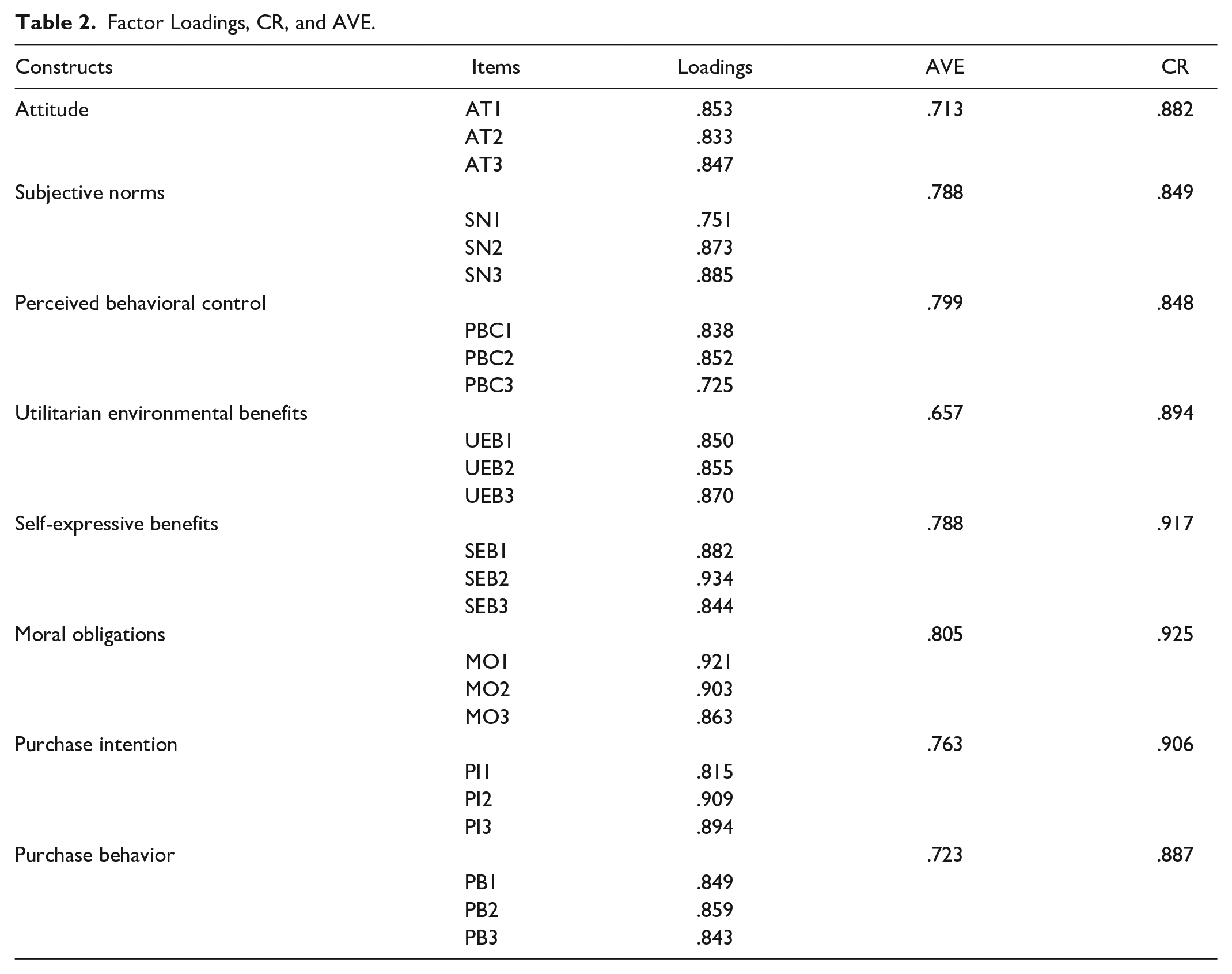
Convergent validity was assess using factor loadings, average variance extracted (AVE), and composite reliability (CR), as revealed in Table 2. All factor loadings were in the range of .658 to .925, that ensures convergent validity in accordance with the proposed criteria (Tabachnick & Fidell, 2007). In addition, all AVE and CR values are between .848 to .925 and .657 to .805, which further guarantees convergent validity and reliability as per criteria of Hair et al. (2013).
Factor Loadings, CR, and AVE.
Discriminant validity was considered using the criterion projected by Fornell and Larcker (1981). The square root of the AVE for a given indicator should be greater than all correlations of that construct with other construct. As revealed in Table 3, all constructs meet this standard. Similarly, the HTMT ratio was estimate using the HTMT.90 criteria established (Hair et al., 2013). Table 3 revealed that HTML values for all construct values were less than the .90 limits, which meet the HTMT.90 criteria. Consequently, the discriminant validity requirements were met for all constructs.
Discriminant Validity and Heterotrait-Monotrait Ratio (HTMT).

Common Method Bias
The present study results in us collecting data from the same respondents for independent and dependent variables; In this study, there is a possibility of common method bias, predictor variables that may cause common method bias (CMB) (Podsakoff et al., 2003). Harman’s one-factor test, a non-rotated exploratory factor analysis, was therefore performed to rule out CMB. If a single factor in this test fails to explain the majority (50%) of the variance, then CMB in the data collected is not a problem. In this study, the single factor successfully demonstrated 33.4%, which rules out CMB problems. Therefore, CMB may not be a problem for this study.
Structural Model Evaluation
Since the measurement model was consistent and valid, the structural model was evaluated in the second step of the analytical procedure. As part of the structural model evaluation, the directionality and significance of the hypothetical pathways were assessed using beta coefficients and t statistics. In addition, the R2 values anticipated the amount of the variance that was explained in each one predicted construct of the proposed model (Hair et al., 2013).
The results (see Table 4) indicated that utilitarian environmental benefits (β = .348; t-value = 6.154; p-value <.01) has a positive impact on attitude, while self-expressive benefits had non-significant impact on attitude (β = .078; t-value = 1.682; p-value >.01). The R2 value is .433 explained the degree of variance, signifying a 43.3% percent variation in the respondents’ attitude explained by utilitarian environmental benefits and self-expressive benefits. Further, moral obligations showed insignificant association with EEAs purchase intention among young consumers.
Relationships.

The results of this study found attitude (β = .510; t-value = 9.464; p-value <.01), subjective norms (β = .102; t-value = 2.459; p-value <.05) and perceived behavioral control (β = .224; t-value = 4.318; p-value <.01) had a positive significant relationship with young consumers’ purchase intention of EEAs. The R2 value of .501 indicates that 50.1% of the variation in respondents’ purchase intention toward EEAs could be explained by ATT, SN, and PBC levels. The findings showed PBC (β = .129; t-value = 2.390; p-value <.05) and young consumers’ purchase intention of EEAs (β = .224; t-value = 4.318; p-value <.01) both had significant impact of purchase behavior of EEAs. The findings showed that utilitarian environmental benefits had (p-value <.05) a significant indirect effect on young consumers’ purchase intention of EEAs, while self-expressive benefits had (p-value >.05) an indirect non-significant effect on young consumers’ purchase intention of EEAs. In addition, this study found that moral obligations also had (p-value >.05) an indirect non-significant impact on young consumers’ purchase intention of EEAs. The results further showed that ATT and PBC had considerably positive (p-values >.05) and indirect influences on young consumers’ purchase behavior of EEAs, implying that EEA purchase intention had a mediating effect between ATT, PBC and the purchasing behavior of young consumers in the EEA.
Discussion
Given the viable solution that energy-efficient appliances offer to alleviate the increasing pressures of carbon emissions from the energy sector and the vital context of its mass acceptance, consumers’ intentions. This TPB model extended, and the research hypotheses proposed in this study had been tested to determine the factors that influenced both purchase intention and purchasing behavior toward EEA among young consumers. The study discovered that utilitarian environmental benefits have a significant positive impact attitude of young consumers toward EEAs. These results support the previous literature that environmental benefits positively increase consumer self-confidence in environmentally friendly products (Ek, 2005; Hartmann & Apaolaza-Ibáñez, 2012; Wüstenhagen & Bilharz, 2006).
This indicates that the ecological benefits of EEAs, such as energy-saving and environmental excellence, shape young consumers’ attitudes toward EEAs. However, the impact of self-expression benefits does not significantly influence attitudes toward EEAs. However, the findings are similar with preceding studies (Griskevicius et al., 2010; Hartmann & Apaolaza-Ibáñez, 2012). It further illustrating that status motives only raise the aspiration for environmentally friendly products when consumed publicly, but not privately. Hence, Pakistani consumers do not see any benefits for energy-efficient appliances related to their need for social recognition and reputation. Concerning moral obligations, the construct has a non-significant relationship on subjective norms; results supported previous studies (Al Mamun et al., 2018, 2019; Bobek & Hatfield, 2003). The findings suggest moral standards are necessary to forecast negative behavior such as dishonesty, stealing, and deception. Purchasing energy-efficient appliances are positive and visibly satisfactory behavior that is not dependent on moral obligations. Therefore, findings suggest that young consumers’ purchase intention for energy-efficient appliances is positive and rational, which could not need to be determined by their moral obligation to social recognition.
This research revealed a significant relationship between ATT, SN, and PBC and the purchase intention of EEAs. Young people’s intention to buy EEAs was found to be better predicted by their attitude. This finding is constant, with past studies reporting that attitudes have the highest impact on intentions (Ali et al., 2019; Ha & Janda, 2012; Tan et al., 2017). Among the TPB predictors’ subjective norms has less impact on the purchase intention of EEAs. This is consistent with previous literature on studies in the Asian context (Wang et al., 2019; Wang, Liu et al., 2014; Zainudin et al., 2014). Young consumers’ purchase decisions may be influenced by the advice and recommendations of individuals closest to them, for instance, family members and friends. However, the results disagree with recent precedent research that establish a non-significant impact of subjective norm on intentions (Ali et al., 2019). Overall, these results could suggest that societal pressures to use sustainable or green products could not be strong enough to influence purchasing decisions in emerging economies. Perceived behavioral control follows attitudes toward the impact on intentions to purchase EEAs. Consistent findings across the globe and across age groupings (Ali et al., 2019; Tan et al., 2017; Wang, Zhang et al., 2014). According to the findings, young Pakistani customers are more keen to buy EEAs if they consider that this particular purchase is not too difficult to use and are hence eager to participate in the buying habit. The results further represent that PBC and purchase intention of EEAs significantly determined the purchase behavior of EEA. In line with the available literature (Al Mamun et al., 2018; Bobek & Hatfield, 2003). The finding suggests young consumers’ perceived ease of purchase behavior, and their purchase intention of EEAs, notably predicted their purchase behavior of EEAs. TPB empirically supports this result and confirms that both PBC and BI are fundamental determinants of actual behavior (Ajzen, 1991). In addition, the purchase intention of EEAs has significantly determined the purchase behavior of EEA, findings in line with previous research of Al Mamun et al. (2019).
As for mediation, the attitude was found to have a significant mediation impact on the relationship between utilitarian environmental benefits and purchase intention of EEAs; this confirms past research that the impact on pro-environmental intentions to EEA purchase, occurs through attitude (Hartmann & Apaolaza-Ibáñez, 2012; Ritov & Kahnemann, 1997). It indicates that the environmental benefits of EEAs enhance young consumers’ attitudes, which finally induces the young consumers’ purchase intention toward EEAs. At the same time, our study found that attitude does not significantly mediate the relationship between self-expressive benefits and purchase intention of EEAs. It indicates that young consumers in Pakistan believe that EEAs do not enhance their social reputation. Nevertheless, SN failed to mediate between Moral obligations (MB) and purchase intention of EEAs, confirmed by the significant indirect effect of subjective norms between moral obligations and purchase intention of EEAs, indicating that Pakistan is a collectivistic and religious society, so young Pakistan consumers individualistic are not required to influence their purchase intention of EEAs. Finally, as hypothesized, Purchase intention of EEAs did mediate the relations of ATT, SN, and PBC with purchase behavior of EEA; our findings suggested purchase intention of EEA successfully mediate in relation between attitude and purchase behavior of EEAs, perceived behavior control and purchase behavior of EEAs, while it purchase intention of EEAs non-significant mediating effect in the relation between SN and purchase behavior of EEAs, this it does not fully support affirm the notion (TPB framework) proposed by Ajzen (1991). The findings suggest that social pressure does not encourage young consumers to choose energy-efficient appliances in developing economies, Liobikienė et al. (2016), also comment on this, that subjective norms are the only variable that depends largely on economic development. It means that financial criterion tends to outweigh the ecological criterion. So, it does not affect consumers as much as other variables because it is not a strong social norm.
Theoretical Contribution
This research contributes to the current literature on purchasing behavior and past modern research on energy-saving appliances in some illuminating ways. First of all, the study is unique since it investigates Generation Y, a segment that remains largely under-investigated in sustainability research despite its increasing importance and potential (Wray-Lake et al., 2010). Besides, indifference to parallel studies that expand the TPB to look at EEA purchase from a technology willingness viewpoint by Ali et al. (2019), this study proposes to reshape our views by proposing that a solution to unlock pro-environmental behavior, is by having (especially young) consumers perceive benefits in such behavior. Therefore, the study significantly expands the scope of the TPB by examining some key variables which have not been studied substantially so far, such as utilitarian environmental benefits, self-expression benefits, and moral obligations. While both benefit types have been in corporate as predictors of attitudes toward energy-efficient appliances, moral obligation is a precursor to the subjective norm. Pakistan is an attractive market for environmentally friendly products, owing to its young eco-conscious population and developing economy. This study aimed to gain a deeper insight into the buying behavior of millennial when buying energy-efficient devices in this particular developing market. The notional implication of this study arises in terms of energy-efficient appliances that young consumers consume in Pakistan, whereby empirically, TPB has been supported (Ajzen, 1991), which extends the scope and benefits of the approach. This study contributes to past research and presents unique insights relevant to managers and policymakers involved in EEAs. The consumption of energy-efficient appliances is still in its nascent stages in Pakistan. The current study recommends that government and environmental policymakers consider a series of measures to foster EEAs’ purchase behavior among Generation Y.
Implications for Managers and Policymakers
To a certain extent, the results of this study make an academic contribution to the knowledge base and offer important findings that are important for the state and the manufacturers of energy-efficient appliances. Given the high impact of attitudes on intentions, policymakers should incentivize producers, importers, and sellers of energy-efficient products to endorse and promote EEAs positively. Such incentives will improve consumers’ perception and attitudes toward EEAs, making them even more likely to intend the EEAs purchase. Reducing the price of EEAs may also be a solution to improve attitudes. However, EEAs remain expensive in Pakistan because they are imported from developed and emerging economies. One option could be to demonstrate how EEAs may save energy and money in the long run (Belz & Peattie, 2012). Another solution might be to encourage the domestic production of EEAs to keep the prices low and affordable. Heightened levels of attitudes will further facilitate the influence of perceived benefits on intentions. Perceived behavioral control (PBC) was found as the second strongest variable. Therefore, EEAs must be widely distributed in most locations, saving time and effort while offering additional opportunities to purchase EEAs. Also, retailers should promote EEAs using clear communication. Clarity of information should further be coupled with ease of access to EEAs in-store. Finally, authorities and business developers need to associate more substantially the utilitarian (i.e., energy and money savings) sentiment that can be derived from an act of EEA purchase to entice, respectively utilitarian environmental benefits.
Limitations and Future Directions
This study has paid attention to young consumers from one developing country, which indicates that the survey results may not be representative of other generational cohorts, such as generation Z (from similar developing countries), or from other countries, especially more developed ones (even with the same generational cohort of Generation Y understudy). Replication studies may therefore be needed in other generational groups and other regions of the world. Besides, this study has only explored energy-saving products. Research is needed to examine young consumers’ perspectives on other aspects of sustainability, such as recyclable products and electric vehicles. Future studies may examine whether results from this study may be replicated in other key developing economies such as Iran, Afghanistan or Kazakhstan. Longitudinal research can also be used to track variations in young consumers’ attitudes and behavioral purchases over time. Finally, social and demographic variables on different segments of consumers on their buying intentions and behaviors should also be examined.
Footnotes
Appendix

| Constructs | Measurement Items |
|---|---|
| Attitude | “Environmental protection is important to me when making purchases of appliances” |
| “Energy-efficient appliances are important to save natural resources that would be used for producing energy, e.g., coal, water” | |
| “If I can choose between energy efficient and conventional appliances, I prefer energy efficient appliances” | |
| Subjective Norms | “Most of the people who are important to me think that I should buy energy-efficient appliances” |
| “Using energy-efficient appliances is a social trend” | |
| “People whose opinion I respect would buy energy-efficient appliances instead of conventional ones” | |
| Perceived behavioral control | “I am confident that I would use energy-efficient appliances even if it is slightly more expensive” |
| “I have the knowledge resource that improves my ability to use energy-efficient appliances” | |
| “I am confident that I would use energy-efficient household appliances even if another person advises me to use non-energy-efficient appliances” | |
| Utilitarian environmental benefits | “Energy-efficient appliances respect the environment” |
| “Energy-efficient appliances help to prevent global warming” | |
| “Energy-efficient appliances do not pollute the environment” | |
| Self-expressive Benefits | “Energy-efficient appliances help me to express my environmental concerns” |
| “Buying energy-efficient appliances demonstrate me to my friends that I care about environmental conservation” | |
| “Energy-efficient appliances help my friends perceive me to be concerned about the environment” | |
| Moral Obligations | “I feel it is a moral obligation to purchase energy-efficient appliances in fulfilling my responsibility to the environment” |
| “I feel it is a moral obligation to purchase energy-efficient appliances although they are expensive” | |
| “I feel it is a moral obligation to purchase energy-efficient appliances for environmental protection” | |
| Purchase Intention | “I prefer to buy products with lower energy grade (low energy consumption)” |
| “I will buy appliances that consume less electricity” | |
| “I will choose energy-efficient appliances when I buy appliances” | |
| Purchase Behavior | “I have switched products such as energy-efficient appliances for ecological reasons” |
| “I switch to other versions/brands of electrical appliances that are more energy efficient” | |
| “When I have a choice between two equal products, I purchase the one less harmful to other people and the environment” |
Declaration of Conflicting Interests
The author(s) declared no potential conflicts of interest with respect to the research, authorship, and/or publication of this article.
Funding
The author(s) received no financial support for the research, authorship, and/or publication of this article.
