




Abstract
Cooperative learning, cultural intelligence and learning English as a foreign language (EFL) represent important concepts in contemporary education, particularly in a diverse environment where students need to collaborate with individuals from different cultural backgrounds. This study aimed to investigate the interrelationships among cooperative learning, cultural intelligence, EFL motivation, achievement, and grade point average (GPA). The previously developed and validated questionnaires were used for data collection, while convenience sampling was applied to select 211 participants studying at a high school level. A Confirmatory Factor Analysis was performed to determine the reliability and a Structural Equation Modeling approach was employed to test the measurement and the hypothesized model. The results showed that cooperative learning positively predicted students’ cultural intelligence and EFL motivation, which was a significant predictor of EFL achievement. Furthermore, cooperative learning negatively predicted EFL achievement, and insignificantly predicted GPA, while cultural intelligence insignificantly predicted both GPA and EFL achievement. These results may contribute to a broader understanding of the relationship between the investigated constructs, and may help instructors design effective classes that will imbed key components of cooperative learning and increase students’ motivation, cultural intelligence, and learning success.
Introduction
Engaging students in cooperative learning, which involves sharing information, ideas, experiences, feelings, attitudes, and perspectives regarding a specific assignment, may result in various positive outcomes if performed appropriately. Cooperative learning encourages students to motivate one another to learn, to improve their social and interpersonal skills, and capabilities to work collaboratively. Furthermore, effective cooperative learning implementation can improve student motivation and achievement (Chen, 2021), strengthen interpersonal relationships, and build positive attitudes about instructional materials (Johnson & Johnson, 1994). Neo et al. (2012) argue that cooperative learning can be used to teach students collaboration skills, thereby better preparing them for the job market through the development of critical thinking, communication, and organizational abilities. However, cooperative learning projects must be cognitively challenging and include higher-order thinking activities in order to be successful (Ross & Smyth, 1995).
Participating in cooperative learning activities may not always result in positive outcomes (Johnson & Johnson, 1990; McWhaw & Schnackenberg, 2003). Students in the groups typically come from a variety of cultural backgrounds, with different personal characteristics, experiences, knowledge, and ability levels, all of which can be a source of difficulty, if not addressed properly. Individual rivalries and diversity among group members, for example, can cause collaboration problems, requiring teachers to guide students toward cohesive work, which is essential for the group success. Thus, there is a need for clear guidelines to minimize communication and collaboration difficulties and to maximize group work efficacy and productivity.
Cross-cultural collaboration has become a necessity in contemporary society and requires instructors’ particular attention. Students must interact with culturally diverse individuals almost every day, whether in person or online. In the context of the Balkan peninsula, notably Bosnia and Herzegovina, cultural diversity has been a cause of ethnic hate, particularly throughout the 1990s. There is an urgent need to develop and enhance cultural intelligence and intercultural competencies as the critical skills that would enable diverse students to collaborate successfully to achieve academic, cultural, economic, and other types of progress. In essence, in many societies, “the severe challenges facing cross-cultural teams are how to achieve good task performance, how to eliminate cultural barriers, and how to promote effective cooperation among multicultural team members” (Tu et al., 2019, p. 1).
Teaching strategies and instructional materials are critical factors influencing multicultural teams’ effectiveness. Concerning the teaching and learning of EFL in Bosnia and Herzegovina, most textbooks and other teaching materials are primarily published by international publishers such as Pearson, Oxford, Cambridge, Simon & Schuster, etc. They contain culturally responsive content and serve as excellent tools for the development of cultural intelligence. Students can learn about diverse cultures from various locations in Bosnia and Herzegovina and from around the world (Bećirović & Brdarević-čeljo, 2018). Cultural intelligence (CQ) may assist in the development of positive relationships and success in culturally diverse settings. This type of ability is particularly important for those working cooperatively on different tasks, as a group with a high level of cultural intelligence is capable of managing complex tasks in a cross-cultural environment. Likewise, the cultural intelligence of group members may influence the group’s success (Tu et al., 2019). Given the importance of fostering cooperation, particularly among students from diverse cultural backgrounds such as Bosnia and Herzegovina, and the fact that EFL materials incorporate various cultural elements, it is important to investigate the relationship between these constructs. Thus, this study aims to investigate interrelationships among cooperative learning, cultural intelligence, EFL motivation and achievement, and grade point average (GPA).
Literature Review
Cooperative Learning
The theoretical framework for this research is Johnson and Johnson’s (1994) cooperative learning model, which consists of five components: positive interdependence, individual accountability, promotional interaction, interpersonal skills, and group processing. In contrast to many other teaching approaches in which students passively receive information (knowledge) from teachers or other sources, this learning approach enables students to actively constructs their knowledge throughout the learning process. Cooperative learning is “the instructional use of small groups so that students work together to maximize their own and one another’s learning” (Johnson & Johnson, 1990, p. 69). Thus, cooperative learning is a teaching strategy that organizes learning as both academic and social experiences.
According to Neo et al. (2012), cooperative learning is a student-centered teaching strategy in which students are enabled and encouraged to construct their own knowledge and develop the organizational, communication, and teamwork skills necessary for success in the world beyond the classroom. To ensure that cooperative learning is a success, it requires “establishing positive interdependence among group members; facilitating promotive interaction; encouraging individual accountability; explicitly teaching the appropriate social skills; and, encouraging groups to reflect on both the processes involved in managing the task and interacting with their peers” (Gillies, 2016, p. 51). Therefore, students can only attain their learning objectives if they are encouraged and guided to collaborate effectively in order to achieve them (Johnson & Johnson, 2002).
Gillies (2016) notes that social skills such as attentive listening, articulating thoughts and resources, constructively discussing other people’s opinions, taking responsibility for one’s own actions, and democratic decision-making are critical for students’ interactions during group discussions. Students who participate in cooperative learning build their social skills, exchange information, improve their attitudes toward learning, and acquire the teamwork abilities essential for productive and successful engagement. In addition, cooperative learning may increase student satisfaction with their learning (Buchs & Maradan, 2021; Chen, 2021; Maxwell-Stuart et al., 2018; Yanti, 2021).
The first and most critical component (Tran, 2013) of Johnson and Johnson’s (1994) cooperative learning model cooperative learning is positive interdependence. It implies that the success of every member of the team is contingent upon the success of others (Neo et al., 2012, p. 860). Johnson and Johnson (2009) argue that cooperative learning activities are impossible when students work in teams without positive interdependence. In such teams, students collaborate to accomplish a group activity by sharing their objectives and contributing to the task’s accomplishment. Each student should understand their position and responsibilities within the group because if one student does not participate in and support the assignment, the entire team suffers.
Individual accountability relates to the fact that each group member is accountable for their contribution (Neo et al., 2012). It is considered by the extent to which the team’s performance is determined by the individual contributions of each of its members (Tran, 2013). Each team member should be held accountable and rewarded for their contributions to task accomplishment. Individual team members’ performance should be graded or rewarded with points. Furthermore, individual accountability will rise as people become more aware of it. When members of a group are aware of their responsibilities and are convinced that their success is contingent on their participation, they are more driven to maximize their contribution.
Promotive interaction suggests that “each member or learner is encouraged to interact with the team by helping each other, solving problems, providing constructive feedback, supporting and encouraging one another” (Neo et al., 2012, p. 860). This form of promotive interaction may aid in the building of commitment among group members (Johnson & Johnson, 1989). It implies engagement in which students are encouraged to help one another by orally communicating ideas, sharing information, understanding, and contributing to problem-solving, and developing new and distinctive solutions. However, the quality of this relationship is determined by the classroom atmosphere. An instructor should create and maintain a positive learning environment, build trust, and encourage students to collaborate constructively and successfully.
Interpersonal skills imply that each individual has the chance to discuss their thoughts and feelings to the group and to rectify any disputes that arise appropriately and constructively (Neo et al., 2012, p. 860). However, when a group is composed of students who lack social skills, the efficacy of the group’s work is questioned (Johnson & Johnson, 2006; Lynn Brown, 2021). Thus, for the group to work well, students should have a sufficient level of communication, group, and social skills, which can be innate, taught and learned (Neo et al., 2012; Saunders-Wyndham & Smith, 2020). According to Killen (2007), these abilities must be taught. Therefore, for a group to function well, its members must listen respectfully, give and accept constructive criticism, and be open to new ideas (Tanner et al., 2003). In contrast, if these abilities are not taught, the outcome of group work is rarely effective (Slavin, 1996).
Group processing means that each participant or student is permitted to develop good positive relations with the other group members by assisting and empowering each other (Neo et al., 2012, p. 860). Additionally, group processing entails group members discussing and reflecting on what works and what does not work and what might be done to increase group effectiveness. Furthermore, group processing may help cultivate healthy relationships, improve working skills, analyze and provide feedback on performance, evaluate students’ contributions, and praise and encourage group accomplishment (Johnson et al., 1994). Class teachers monitor this group process and acknowledge each group member’s unique contribution.
Along with the components described above, there are additional aspects that teachers should consider while adopting this teaching technique. According to Cohen (1994), cooperative learning is more effective when students work in diverse groups of four or fewer individuals instead of homogenous and larger groups. However, cooperative learning entails much more than group projects. Lynn Brown (2021) adds that other important factors are: a student’s age which determines their ability to learn cooperatively; teacher training which is critical for successfully implementing this teaching and learning approach, and student preparedness which directly impacts cooperative learning’s success or failure. As such, cooperative learning might also be employed in EFL classrooms where it leads to improvement in students’ English skills, ability to form new relationships with their classmates, oral presentation skills, self-confidence, willingness to accept responsibility, ability to respect, and offer alternative points of view (Alghamdy, 2019).
Cultural Intelligence
Earley and Ang (2003) developed the concept “cultural intelligence” (CQ), which they define as “an individual’s capacity to operate and govern successfully in culturally varied environments” (p. 337). Cultural intelligence is especially critical in multicultural societies marked by ethnic, religious, racial, and national diversity. Culturally diverse settings exist everywhere in today’s globalized world, whether real or virtual, and both require cultural intelligence to coexist peacefully, manage well, and work successfully. Cultural intelligence is a subset of intelligence concerned with the capacity to comprehend, reason, and act successfully in culturally diverse contexts (Ang et al., 2007, p. 337). One of the theoretical frameworks for this investigation is cultural intelligence theory.
According to Tu et al. (2019), cultural intelligence theory may aid in establishing common, ground and the developing efficient communication, as well as enhancing group performance and avoiding cultural conflicts. School systems are required to cultivate these capabilities through various formal and informal curricula and prepare students to engage actively and successfully in school and other social activities as adults (Bećirović & Hurić– Bećirović, 2017). In this regard, by using several samples from various countries and time periods, Ang et al. (2007) developed and validated the Cultural Intelligence Scale (CQS), which may be used to assess and improve students’ cultural intelligence. CQS is based on their four-dimensional conceptualization of cultural intelligence, which includes metacognitive, cognitive, motivational, and behavioral components (Earley & Ang, 2003). These factors are addressed here as they are critical when interacting with people from various cultural backgrounds and because they provide the theoretical basis for this study.
Ang et al. (2007) point out that metacognitive CQ“reflects mental processes that individuals use to acquire and understand cultural knowledge” (p. 338). Additionally, this aspect of CQ is associated with higher-order cognitive processes (Ang et al., 2007). Cultural awareness is critical for effective communication and collaboration between people from diverse cultural backgrounds. It can assist in the development of intercultural awareness, effective interaction planning, and successful interrelations with individuals from diverse cultural backgrounds.
Cognitive CQ“reflects knowledge of the norms, practices, and conventions in different cultures acquired from education and personal experiences” (Ang et al., 2007, p. 338). Curricula for various school subjects around the world usually include content about cultural norms, religious beliefs, holidays, dressing, and so on. In terms of teaching materials for EFL, they also offer a plethora of materials depicting cultures from all over the world (Yaman & Bećirović, 2016).
According to Ang et al. (2007), motivational CQ“reflects the capability to direct attention and energy toward learning about and functioning in situations characterized by cultural differences” (p. 338). It denotes a level of preparedness and enthusiasm in learning about different cultures and interacting in a multicultural setting in order to attain various goals. Although such interest might be extrinsic, motivational CQ indicates an innate desire to study and function effectively in multicultural settings.
Behavioral CQ“reflects the capability to exhibit appropriate verbal and non-verbal actions when interacting with people from different cultures” (Ang et al., 2007, p. 338). This type of cultural intelligence entails the capacity to use cognitive, metacognitive, and motivational CQ in interactions with individuals from diverse cultural backgrounds. To demonstrate these values, one must possess a diverse behavioral repertoire and the ability to adapt behaviorally to the circumstances. This adaptation encompasses both verbal and non-verbal cues while communicating with people from diverse cultural backgrounds.
EFL Motivation
Global interest in EFL demands educational programs that both inspire and nurture students’ motivation to study English (Vonkova et al., 2021). Motivation to learn English as a second language (ESL) or EFL is on the rise in regions where English is used as the lingua franca and efficient communication is important in global business, policy, and diplomacy (Stünbaş & Üstünbaş, 2022; Woodrow, 2017). In addition, motivation plays a vital role in all students’ activities and it influences the extent of invested efforts and success level (Ahmetović et al., 2020).
Instructors’ motivation equally offers enormous potential for designing instructional ways to stimulate learning (Nagle, 2021). Therefore, instructors play a critical role in EFL and other subject-specific learning. When students positively perceive their professors’ motivational activities, their self-efficacy and intrinsic motivation rise, as does their performance in English (You et al., 2016).
Numerous attempts to define motivation have been undertaken using a variety of models and theories, including the “socio-educational model (Gardner, 1985, 1988; Gardner & Smythe, 1975), expectancy-value theory (Wigfield et al., 1998; Wigfield & Eccles, 2000), and self-determination theory (Ryan & Deci, 2000)” (H. J. Liu, 2015, p. 1165). While Dörnyei (1990) describes second/foreign language motivation as a multifaceted concept. On the other hand, Brown and Gonzo (1994), on the other hand, define motivation as the degree to which individuals make decisions about (a) a goal to pursue and (b) the effort they will expend to achieve the goal. Motivation is a significant component influencing students’ willingness to devote time to foreign language learning (Oxford & Shearin, 1996), as is the proclivity to strive for goals (Johnson & Johnson, 1979).
Schmidt and Watanabe (2001) discuss EFL motivation from both a practical and theoretical perspective. From a practical standpoint, they claim that the majority of second and foreign language instructors recognize the importance of student motivation, desire to learn more about it, wish to improve motivation in any manner they can, and hope that teaching materials and techniques encourage learning (Schmidt & Watanabe, 2001). Likewise, Stünbaş and Üstünbaş (2022) indicate that pleasant language learning experiences are associated with a high level of ideal L2 self or a favorable future self-image. From a theoretical standpoint, the professional literature on EFL motivation has largely concentrated on learning second and foreign languages in the traditional sense, that is, learning a language associated with a culture other than one’s own or that one claims as part of one’s ethnic background (Schmidt & Watanabe, 2001).
In A review of recent research in EFL motivation: Research trends, emerging methodologies, and diversity of researched populations, Vonkova et al. (2021) revealed that there is a shortage of standardized EFL motivation surveys for various EFL abilities such as reading, listening, writing, and speaking, as well as questionnaires for specific demographics, primarily preschoolers and primary school students. As a result, this study’s theoretical framework for investigating EFL motivation is based on Schmidt and Watanabe’s (2001) well-known framework of motivation, strategy use, and pedagogical preferences in foreign language learning. Four components of that framework were used in this study: intrinsic motivation, interest in foreign languages and cultures, expectancy control, and motivational strength.
Intrinsic motivation refers to the “enjoyment of language learning” (Schmidt & Watanabe, 2001, p. 312). It is demonstrated when we take action for the sake of the action’s inherent benefits (Stünbaş & Üstünbaş, 2022; Vonkova et al., 2021). According to Yu (2019), regardless of students’ L1, a significant association was revealed between levels of intrinsic motivation and physical, emotional, and psychological relationships with the L2 community. Students who are intrinsically motivated to study English show excitement and enjoyment for the subject. Students’ feelings, that is, positive emotions, increase intrinsic motivation following a successful task (Trigueros et al., 2020). Conversely, students are extrinsically motivated to do something when they expect external rewards.
Interest in foreign languages and cultures refers to general interest rather than interest in a specific language (Schmidt & Watanabe, 2001). Likewise, interest in foreign languages and cultures may be motivated by professional considerations, such as living and studying/working in another country (Dörnyei, 1990). This component is associated with attitudes toward other languages and cultures and cultural intelligence, which is one of the target factors included in this study.
The expectancy dimension relates to the anticipated outcome. Schmidt and Watanabe (2001) observe that this dimension encompasses a variety of distinct characteristics, such as self-confidence, optimistic thinking, and determination. Positive expectations encourage individuals to focus on execution and subsequent performance (Trigueros et al., 2020). Prior experiences with language learning (whether positive or negative) might serve as a source of motivation for language learners during the learning process (Stünbaş & Üstünbaş, 2022) and may affect students’ learning expectancy.
Motivational strength is the final component associated with EFL motivation within this study. This dimension encompasses items indicating students’ intention to devote their utmost attention to EFL study (Schmidt & Watanabe, 2001, p. 317). While motivation is a powerful learning force, the first step toward harnessing its strength recognizes the connections between its constituents and language learning outcomes (Nagle, 2021).
Recent Studies
Recent research demonstrates a high interest in cooperative learning, EFL motivation, cultural intelligence, and learning outcomes as critical elements of contemporary education. These studies aid educators in developing and implementing effective educational practices that maximize students’ potential and development. Hence, studies have proved that cooperative learning significantly improves EFL motivation (Moghaddam & Heidari, 2018; Nazari et al., 2021). They have also shown that cooperative learning has a significant positive effect on intrinsic motivation (Lynn Brown, 2021; Ning & Hornby, 2014) but not on other dimensions of motivation in a tertiary-level EFL classroom. Cooperative learning also significantly impacts EFL learners’ achievement (Yanti, 2021), oral skill performance (Moghaddam & Heidari, 2018), vocabulary learning (Gashti, 2021; S. H. J. Liu & Lan, 2016), self-efficacy (Saunders-Wyndham & Smith, 2020) and critical thinking skills (Nazari et al., 2021). Moreover, cooperative language learning empowers EFL learners to be brave enough to speak in the target language by offering a democratic, peaceful and non-threatening setting (Zhou, 2012). It increases solidarity, respect, and tolerance (Rabi’ah et al., 2021) and enhances student working relationships, social skills, and class participation (Yanti, 2021). A further study conducted by Awada and Gutiérrez-Colón (2019) proved that cooperative learning through blogs helps reduce students’ apprehension about intercultural communication. J. Yang et al. (2014) revealed that cross-cultural online collaborative learning through web 2.0 technology improves cross-cultural competency. Furthermore, research has shown that cooperative learning also improves motivation and achievement in areas other than EFL, such as research methods among tertiary level students (Tran, 2019), and physical education (C. Yang et al., 2021).
Similar findings have been obtained regarding the relationship between motivation and students’ success in the EFL classroom. Thus, Bećirović (2017) found a significant impact of EFL motivation on EFL achievement in the high school context. In a study carried out by Yu (2019) among Mainland and Hong Kong Chinese students, it was found that motivation significantly impacted student success in L2 in both research populations, with Mainland students showing lower motivation. Likewise, Hermessi’s (2023) study showed that intrinsic orientation, attitude toward L2 and L2 learning experiences, and self-efficacy had the highest impact on achievement.
Another important variable mentioned already earlier in this paper is cultural intelligence, which has recently received attention in the educational context. For instance, Hartini et al. (2017) researched the effects of cultural intelligence on students’ engagement in academic and non-academic issues, focusing on international students studying in Malaysian universities. Collins et al. (2016), on the other hand, proved that the CQS scale is valid in educational settings and that principals’ levels of cultural intelligence had a significant impact on Latino students’ achievement scores in eighth-grade math and languages, whereas there was no evidence that teachers’ cultural intelligence was predictive of student achievement. Likewise, Phuong-Mai et al. (2009) conducted experimental research on the effects of culturally adapted curricula on student work. They discovered that the group whose program has been culturally adapted appeared to be exerting additional effort and derive greater enjoyment from cooperative educational activities (Phuong-Mai et al., 2009). Khan et al. (2020) also carried out research to determine the effects of emotional intelligence and cultural intelligence on the academic performance of undergraduate, graduate, and postgraduate students studying abroad, with cultural adjustment having a significant impact on their educational success. Likewise, cultural intelligence was discovered to be a predictor of intercultural communication self-efficacy (Wawrosz & Jurásek, 2021) and cognitive engagement (Poort et al., 2023). Vedadi et al. (2010) discovered a strong correlation between cultural intelligence and its various dimensions, such as CQ of knowledge, strategy, motivation, and behavior, and managerial achievement.
Previous research suggests that the relationship between cooperative learning, motivation, and achievement is an ongoing and important research topic in EFL classrooms. However, research of this nature has not yet been conducted in the high school EFL context of Bosnian and Herzegovinian, and Balkan Peninsula. Additionally, the relationship between cultural intelligence and cooperative learning has only received scant attention. Furthermore, no previous research has been conducted on the relationship between students’ cultural intelligence, EFL motivation, achievement, and GPA. Thus, by incorporating cooperative learning, EFL motivation and achievement, cultural intelligence, and GPA into the model and testing it using Structural Equation Modeling (SEM), this research may make unique theoretical and practical contributions to this field.
The Present Study and Hypotheses
The purpose of this study is to investigate the interrelationships among cooperative learning, cultural intelligence, EFL motivation and achievement, and GPA in the context of high school education in Bosnia and Herzegovina. More precisely, the study examines the effects of cooperative learning on students’ cultural intelligence, EFL motivation, and EFL achievement and GPA, as well as the impact of cultural intelligence on EFL achievement and GPA. Based on the previous literature review, we developed and tested the model presented in Figure 1. More specifically, the following hypotheses have been tested:
H1a. Cooperative learning positively predicts cultural intelligence;
H1b. Cooperative learning positively predicts EFL motivation;
H1c. Cooperative learning positively predicts EFL achievement;
H1d. Cooperative learning positively predicts GPA;
H2a. Cultural intelligence positively influences EFL achievement;
H2b. Cultural intelligence positively influences GPA;
H3a. EFL motivation positively predicts cultural intelligence;
H3b. EFL motivation positively predicts EFL achievement.
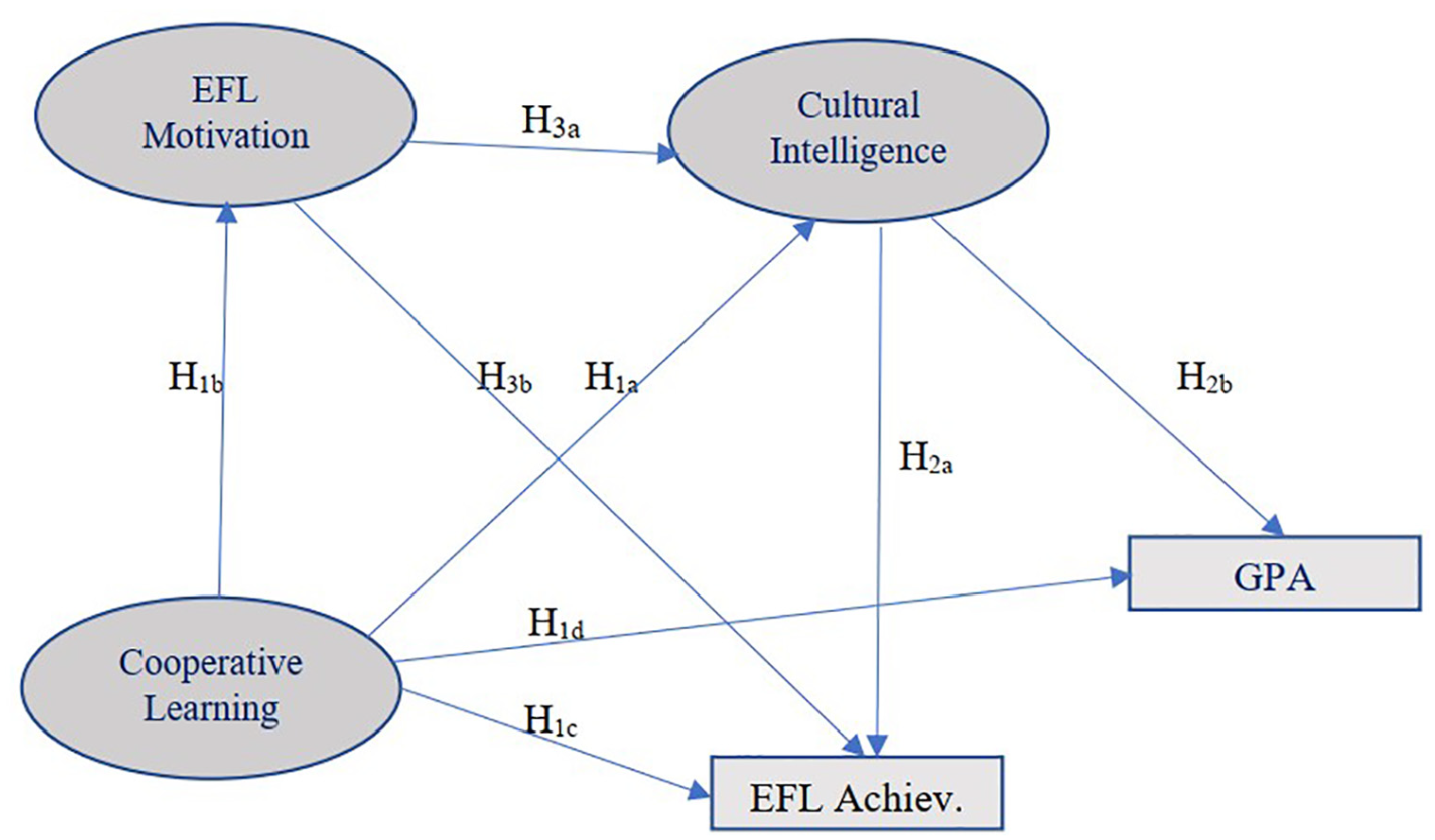
The hypothesized model of the associations between cooperative learning, EFL motivation, Cultural intelligence, EFL achievements and GPA.
Methodology
Participants
The research sample is composed of 211 high school students attending three schools in Bosnia and Herzegovina. One school is fully private and located in Canton Sarajevo. The research sample from this school consisted of 69 students from this school (N = 69; 32.7%). The second school, located in Zenica-Doboj Canton, is public and subsidized by the state. A total of 73 students from this school were included in the research sample (N = 73; 34.6%). The third school is fully public and located in Central Bosnia Canton. The research sample included 69 students from this school (N = 69; 32.7%). Convenience sampling was used in the process of participants selection. There were 49 first grade students (23.2%), 67 second grade students (31.7%), 57 third grade students (27%), and 38 fourth grade students (18%). Of the total of 211 students, 76 were female (36%) and 135 were male (64%). Their ages ranged from 14 to 18 (M = 16.2; SD = 0.93).
Instruments
The first part of the instrument was used to gather demographic data: gender, age, overall GPA, EFL achievement, grade level and the school the students were attending. The data on the overall GPA and EFL achievement represent final grades assigned by school instructors and recorded in the official school documents. The lowest, (failing) grade in the Bosnia and Herzegovina high-school system is 1 and the highest grade is 5. All survey items were rated on a five-point Likert scale, ranging from 1 = “strongly disagree” to 5 = “strongly agree”. The surveys were developed and validated by previous studies and showed an acceptable level of reliability and validity. Furthermore, reliability and validity were examined and confirmed by the data, collected from high school students in Bosnia and Herzegovina. The scores are reported within the following sections.
Cooperative Learning
Cooperative learning was investigated by the survey developed by Neo et al. (2012), based on Johnson et al. (1994). The survey is composed of 23 items and includes five subscales which, based on their experience, assess students’ self-perceived interdependence (e.g., “I was able to share the load of the work with my group members”), personal accountability (e.g., “I was aware exactly of what my part in the group was”), promotive interaction (e.g., “Interaction among group members helped me to obtain a deeper understanding of the subject”), interpersonal skills (e.g., “Working cooperatively with my group is less stressful”), and group processing (e.g., “I enjoyed working with my group members as a team”). A Confirmatory Factor Analysis (CFA) was conducted to assess how the collected data fit the model. The results showed an acceptable model fit: χ2 (102) = 187.7 (p < .001), RMSEA = 0.063, PCLOSE = 0.064, CFI = 0.943, AGFI = 0.859, goodness of fit index GFI = 0.906, TLI = 0.925. Furthermore, the results of measuring the internal consistency reliability by Cronbach’s alpha showed high reliability for all the items α = .92. and all subscales showed an acceptable level of reliability: positive interdependence α = .72, personal accountability α = .75, promotive interaction α = .75, interpersonal skills α = .73, and group processing α = .80.
Cultural Intelligence
Cultural intelligence was assessed by the survey developed and validated by Ang et al. (2007). The survey instrument contained 20 items and 4 subscales: metacognitive CQ (e.g., “I adjust my cultural knowledge as I interact with people from a culture i.e., unfamiliar to me”), cognitive CQ (e.g., “I know the rules for expressing non-verbal behaviors in other cultures”), motivational CQ (e.g., “I am confident that I can socialize with locals in a culture i.e., unfamiliar to me.”), and behavioral CQ (e.g., “I vary the rate of my speaking when a cross-cultural situation requires it”). The results of a CFA showed a quite unsatisfactory model fit. Factor loadings were inspected and due to low factor loadings, three items were excluded from the analysis: one from behavioral CQ, one from cognitive CQ and one from motivational CQ. A CFA was performed again, and the model fit improved to an acceptable level: χ2(94) = 167.8 (p < .001), RMSEA = 0.061, PCLOSE = 0.110, CFI = 0.942, AGFI = 0.870, goodness of fit index GFI = 0.910, TLI = 0.925. Cronbach’s alpha for all items was α = .89, and for the subscales it was as follows: metacognitive CQ α = .79, cognitive CQ α = .75, motivational CQ α = .76, and behavioral CQ α = .80.
EFL Motivation
In order to assess the students’ EFL motivation, we used the survey constructed by Schmidt and Watanabe (2001). The survey on students’ EFL motivation was composed of 20 items and included 4 subscales: intrinsic motivation (e.g., “When class ends, I often wish that we could continue”), interest in foreign languages and cultures (e.g., “This language is important to me because it will broaden my world view”), expectancy control (e.g., “I’m certain I can master the skills being taught in this class”), and motivational strength (e.g., “I often feel lazy or bored when I study for this class”). A CFA was conducted to check how the collected data fit the model. The CFA results showed an acceptable model fit: χ2(67) = 135.2 (p < .001), RMSEA = 0.070, PCLOSE = 0.029, CFI = 0.935, AGFI = 0.867, goodness of fit index GFI = 0.916, TLI = 0.912. The overall internal consistency reliability was quite high α = .86 and subscales showed acceptable reliability: intrinsic motivation α = .76, motivational strength α = .69, interest in foreign language and culture α = .84, and the expectancy control α = .64.
Procedure
Before data collection, the institutional review board approved the research proposal. Informed consent was obtained from relevant ministries of education, school authorities, and the students themselves. The participants were informed about the purpose of the study and how to complete the survey. Additionally, the participants were informed that anonymity and confidentiality were guaranteed and that participation in the study was voluntary. The survey took approximately 15 to 20 min to complete and this was done on school grounds during regular classes.
The survey was administered to the students of three high schools in Bosnia and Herzegovina. One of them was founded and is financed by the state; one is fully private, founded by international educational organizations; one is a religious school subsidized by the government. Private schools must follow a minimum of 80% of the curriculum developed and approved by the Ministry of Education, allowing schools to only change up to 20% of the official curriculum. However, these changes need to be approved by the Ministry of Education.
Data Analysis
The collected data were analyzed by using Statistical Package for the Social Sciences (SPSS) version 26.0. Firstly, means, standard deviations, and frequencies were calculated. A Pearson Correlations was performed to examine the relationship between dependent variables. In order to examine how well the model fits the data, a CFA was performed by using AMOS 26. Composite reliability (CR) and average variance extracted (AVE) were applied to assess the reliability and validity of the measurement model. For validation purposes, the maximum likelihood estimation method was applied (Arbuckle, 2011). Furthermore, AMOS 26 was used to test the structural model. After the validation of the measurement model, a structural equation model (SEM) was tested, to assess the hypothesized interrelationships among latent constructs, namely cooperative learning, cultural intelligence, EFL motivation and achievement and GPA. Thus, according to Hair et al. (2010), several indices were regarded, as follows: χ2/df, root mean square error of approximation (RMSEA), comparative fit index (CFI), Tucker–Lewis index (TLI), the goodness of fit index (GFI), adjusted goodness of fit index (AGFI), and PCLOSE. A great model fit to the data would be obtained by insignificant Chi-square test results, a CFI and a TLI greater than 0.95, SRMR < 0.09, RMSEA < 0.10, and PCLOSE > 0.05. The same number of participants (N = 211) was adopted for testing the measurement and hypothesized model.
Results
Preliminary Analyses
The results of the descriptive analysis in terms of means and standard deviations (SD) are presented in Table 1. The normality distribution of dependent variables was examined by skewness and kurtosis. The results of testing the normality distribution are also presented in Table 1, showing that the majority of skewness and kurtosis results are within the acceptable range from −1 to +1 (Hair et al., 2010), indicating that there are no significant deviations of all constructs from the normal distribution. All Cronbach alpha (α) values are above .80, showing high internal consistency reliability. The scores of Pearson correlations among the constructs are presented in Table 2. The outcomes of correlation analysis show significant correlations between all constructs at different strength levels except the correlation between expectancy control and interpersonal skills.
Descriptive Analysis, Normality and Reliability.

Pearson Correlations Among Observed Variables of Cooperative Learning, Cultural Intelligence and EFL Motivation.

Correlation is significant at the .01 level (two-tailed).
Correlation is significant at the .05 level (two-tailed).
Testing the Measurement Model
The proposed measurement model consisted of five latent factors, namely cooperative learning (five observed variables), cultural intelligence (four observed variables), EFL motivation (four observed variables), EFL achievement and GPA. After performing a few modification indices, the outcome of the measurement model showed an acceptable model fit to the data despite the significance of the Chi-square result, χ2(74), p < .001, RMSEA = 0.073, PCLOSE = 0.010, CFI = 0.95, IFI = 0.95, TLI = 0.924, GFI = 0.912, which were in accordance with the cutoff model-fit criteria proposed by Hair et al. (2010, p. 654). The factor loadings (standardized coefficients, β) ranged from 0.55 to 0.92, and the lowest standardized loading was 0.55 for an observed variable of motivational CQ and the highest was 0.92 for metacognitive CQ (Table 3). To conclude, the results showed that the proposed measurement model in the current research has a proper factor structure and acceptable convergent validity.
Regression Weights for the Measurement Model (Group Number 1—Default Model).

Note. Statistical significance: *p < .05. **p < .01. ***p < .001.
Testing the Hypothesized Model
By following the hypothesized model and based on the good fit of the measurement model to the data, the path model was examined by applying the maximum likelihood estimation approach. A structural equation model (SEM) analysis was performed to assess cooperative learning as a predictor of students’ cultural intelligence, EFL motivation, EFL achievement and GPA. Cultural intelligence was used as a predictor of the students’ EFL achievement and GPA. Furthermore, EFL motivation was examined as a predictor of cultural intelligence as well as EFL achievement. Chi-square statistics and a few fit indices were conducted to assess the fit of the model to the data. Even though the Chi-square result was significant, GFI, TLI, SRMR, and RMSEA were acceptable with the thresholds to model-fit criteria (Hair et al., 2010). The results of the structural model were that the data showed a good fit to the path model with χ2 (76), p < .001, RMSEA = 0.075, PCLOSE = 0.006, CFI = 0.942, GFI = 0.906, TLI = 0.920.
The results showed (Figure 2) that cooperative learning (β = .48, p < .001) and EFL motivation (β = .35, p < .001) significantly predicted the students’ cultural intelligence. The findings also indicated that cooperative learning (β = .50, p < .001) significantly predicted EFL motivation. As for the EFL achievement, EFL motivation (β = .72, p < .001) was a significant predictor. Surprisingly, cooperative learning (β = −.35, p < .001) was a negative predictor of EFL achievement and an insignificant predictor of GPA (β = −.111, p = .275). Moreover, cultural intelligence insignificantly predicted GPA (β = .11, p = .320) and EFL achievement (β = −.09, p = .358).

Structural model of the relationship between cooperative learning, EFL motivation, Cultural intelligence, GPA, and ELL achievements.
Discussion
The purpose of this study was to examine interrelationships among cooperative learning, cultural intelligence, EFL motivation and achievement, and GPA in the context of high school education in Bosnia and Herzegovina. Specifically, the study sought to determine the impacts of cooperative learning on students’ cultural intelligence, EFL motivation and achievement, and GPA, as well as the effects of cultural intelligence on students’ EFL achievement and GPA. Examining cooperative learning is always important because its successful implementation can result in a variety of positive outcomes. This instructional approach is particularly critical in culturally diverse communities, where the capacity to respect and accept people from diverse cultural backgrounds, and the ability to work in teams, are essential for social harmony and all kinds of progress.
The first hypothesis, which stated that cooperative learning positively predicts cultural intelligence, was supported. Our results are in line with related studies such as J. Yang et al.’s (2014), who find that cooperative learning improves students’ cross-cultural competencies and one study conducted by Awada and Gutiérrez-Colón (2019), which demonstrated that cooperative learning via blogs could help students overcome their fear of intercultural communication. Other studies also suggest that cooperative learning significantly influences students’ social development (Johnson et al., 2014; Lou et al., 2006; Yanti, 2021), interactions with other group members, and their respect for the assignment contributions of others (Gillies, 2016). Moreover, studies show that cooperative learning in an EFL classroom improves students’ working relationships, class involvement, achievement (Gillies, 2016; Yanti, 2021), solidarity, respect and tolerance (Rabi’ah et al., 2021). Similarly, a study conducted by Neo et al. (2012) showed that students who engaged in cooperative learning recognized the need for respect, communication, sharing, and tolerance as essential components of collaboration and the project’s success.
Considering that Bosnian and Herzegovinian society comprises various cultural and ethnic groups, these findings are promising and encouraging. Bosnia and Herzegovina is located in the heart of Europe and it presents an intersection of diverse cultural groups, where East meets West. Due to the mix of religions, Sarajevo, the capital of Bosnia and Herzegovina, is frequently referred to as the European Jerusalem. In essence, the cultural diversity in the Balkan peninsula, including Bosnia and Herzegovina, has so far been the cause of bigotry, particularly during the 1990s. The importance of these results lies in the fact that engaging students in cooperative learning significantly improves students’ cultural intelligence. This implies that such school activities may lead new generations to social cohesion and harmony. There need to strengthen cultural intelligence that enables people to understand, respect and accept culturally diverse people is enormous. Thus, when considering the difficulties in various aspects of human functioning caused by cultural diversity in Bosnia and Herzegovina, such a teaching approach should be strongly encouraged and supported.
The hypotheses that cooperative learning positively predicts students’ EFL motivation and that EFL positively predicts students’ EFL achievement were also supported. These findings are in line with other studies that previously demonstrated the significant effects of cooperative learning on students’ motivation (Alghamdy, 2019; Bećirović et al., 2022; Gashti, 2021; S. H. J. Liu & Lan, 2016; Lynn Brown, 2021; Moghaddam & Heidari, 2018; Nazari et al., 2021; Neo et al., 2012; Ning & Hornby, 2014; Quinn, 2006). However, some studies have indicated that cooperative learning improves only intrinsic motivation (Lynn Brown, 2021) but not other aspects of motivation (Ning & Hornby, 2014). Additionally, recent research has suggested that studying English in a supportive classroom environment increases students’ motivation and engagement (Oga-Baldwin & Nakata, 2017), intrinsic motivation, achievement (Joe et al., 2017; You et al., 2016) and EFL skills (Alghamdy, 2019). Similarly, Gillies (2016) proved that when the five components of cooperative learning (described in this study) are embedded in group work, they increase students’ motivation and responsibility for achieving their own and group goals.
These findings are particularly important for high schools since research has shown that EFL motivation and achievement decline at this age (Bećirović, 2017) due to the transition from elementary to high school (Gillies, 2016). On the other hand, the research findings of Trigueros et al. (2020) also indicated that high school failure is mostly caused by students’ lack of motivation but, in their case, as a result of the educational establishment’s inability to respond to students’ interests. Thus, students’ engagement in cooperative learning may help resolve these issues and increase students’ EFL motivation and achievement at the high school level.
The hypothesis that predicted positive effects of cooperative learning on EFL achievement was refuted. Interestingly, the findings indicated that cooperative learning had a direct negative influence on EFL achievement while improving students’ EFL motivation, which had a positive effect on EFL success. Furthermore, our results showed that cooperative learning did not have a significant effect on students’ GPA. These results contradict the studies indicating that cooperative learning improved students’ achievement in the multimedia learning environment (Neo et al., 2012), academic and social developments (Johnson et al., 2014; Johnson & Johnson, 2002; Slavin, 1996) and engagement in the online environment (S. H. J. Liu & Lan, 2016). Furthermore, our findings are not in line with the findings of Lou et al. (2006), who discovered that cooperative learning through discussion by using the media had a significant effect on students’ achievement. Moreover, in her qualitative study, Quinn (2006) also revealed that cooperative learning positively impacts students’ achievement. However, she exposed students to real-life problems that could positively impact their motivation and achievement. Other studies also demonstrated that cooperative learning positively influences learning vocabulary (Gashti, 2021), oral skill (Moghaddam & Heidari, 2018), critical thinking (Nazari et al., 2021), and self-efficacy in the EFL classroom (Saunders-Wyndham & Smith, 2020). Possible explanations for discrepancies in research findings include the fact that people from different cultures cooperate in different ways (Phuong-Mai et al., 2009) and that major complicated relationships exist between culture and the social components of cooperative group activity (Ghahraman & Tamimy, 2017). Furthermore, it is critical to strike a balance between the prudent, gradual application of cooperative learning approaches and sensitivity to various forms of diversity (Sharan, 2017).
Several other factors can have an impact on the effects of cooperative learning on learning outcomes. The impacts of cooperative learning are dependent on teaching strategies and the quality of relationships and communication among students and between students and instructors. This is confirmed by Sharan’s (2017) claim that cooperative learning does not have an automatic effect, and just putting students in groups in any situation does not guarantee success. Additionally, according to Gillies (2016), it is widely accepted that students do not always collaborate during group work, and groups must be organized in such a way that the five critical components of successful cooperation are evident. Similarly, King (2002) believes that an instructor’s role is crucial and students will rarely engage in cooperation unless they are encouraged to do so.
Additionally, group size, the type of student grouping, the type of assignment (Cohen, 1994) and the quality of interactions are critically important (Shachar & Sharan, 1994) for the effectiveness of cooperative learning. Neo et al. (2012) found that by working in small teams, students improved “their teamwork skills, interpersonal skills, and their understanding of the role of individual responsibility within a team” (p. 858). In fact, if students work in groups of four or fewer people, if groups are heterogeneous based on students’ abilities and if the tasks given require collaboration, they are more likely to succeed (Cohen, 1994). Furthermore, in order to make cooperative learning successful, an instructor is expected to create a supportive classroom atmosphere (Trigueros et al., 2020; Vonkova et al., 2021) and conducive conditions for collaboration among students and to establish and maintain trust and confidence among students. Considering that students’ emotions influence their success (Saito et al., 2018), group cohesion plays an important role. However, competition among group members should be avoided. Groups should be structured so that each student has a group role and responsibility to contribute to the group outcomes. Moreover, students should be cognitively engaged (Mašić et al., 2020); for example, they should be asked thoughtful questions and engaged in working on real-life problems, with the five components of cooperative learning being embedded in cooperative learning and mediating the group success. If these conditions are not ensured, significant outcomes of cooperative learning will rarely be achieved. Considering other studies that have shown positive effects of cooperative learning on student achievement, the possible causes of insignificant results in our study could be the teaching strategies used by Bosnian and Herzegovinian EFL instructors. These EFL instructors should receive training on the effective implementation of cooperative learning in foreign language teaching.
The findings supported the hypothesis predicting positive effects of EFL motivation on students’ cultural intelligence, which revealed that EFL motivation had a significant positive influence on students’ cultural intelligence. This may be due to the fact that the majority of EFL textbooks used in the Bosnian and Herzegovinian education system incorporate a variety of elements that foster cultural intelligence, intercultural understanding, sensitivity, and competencies. In fact, the majority of EFL textbooks used in Bosnian and Herzegovinian schools are published by international publishers. They include chapters effectively presenting various cultures across the globe and are also enriched by modules depicting various local cultural issues such as religious and national holidays, traditional festivals, and garments (Harris et al., 2011, 2012). Such teaching materials promote cultural diversity and positively influence students’ cultural intelligence.
However, the hypotheses stating that cultural intelligence positively predicts students’ EFL achievement and GPA were not supported. Thus, the results show that cultural intelligence neither positively nor negatively influences students’ EFL achievement and GPA. Our results are not in line with those presented in Taherkhani and Karbakhsh (2018), who reported a positive association between cultural intelligence and L2 (second language) achievement, or those obtained by Rafie et al. (2016), who found that cultural intelligence significantly affected students’ performance on an IELTS listening module. However, studies show that the context and classroom environment play a critical role in students’ achievement (Joe et al., 2017; Rizvić & Bećirović, 2017).
Students differ for a variety of reasons, including abilities, knowledge, experiences, and cultural differences. Research into the relationships among cooperative learning, cultural intelligence, EFL motivation and achievement, and GPA in today’s global society is highly important. When implementing cooperative learning, teachers must consider various factors to ensure its effectiveness and positive learning outcomes. Considering the positive effects of cooperative learning on EFL motivation and cultural intelligence in this study, this approach to teaching and learning should be encouraged, particularly in multicultural communities where positive human relationships should be maintained and improved. Furthermore, given the contradictory findings regarding the effects of cooperative learning on EFL achievement and GPA, it is clear that implementing cooperative learning does not guarantee positive learning outcomes. Thus, instructors should consider multiple factors such as the quality of students’ interactions and communication, classroom atmosphere, group size, type of assignment and grouping, and the role of the teacher. Furthermore, teachers must incorporate the five critical components of successful collaboration and provide a positive learning environment conducive to success.
Conclusion
This study showed that engaging students in cooperative learning significantly influences students’ cultural intelligence, which is essential for successful cooperation. The significance of these findings stems from the fact that students in contemporary education interact with others from diverse cultural backgrounds almost daily, both in traditional classrooms and in a digital environment. Thus, cooperative learning might be an effective tool for promoting cultural diversity and strengthening intercultural skills and competencies, which should enable young generations to collaborate successfully, particularly in diverse settings such as Bosnia and Herzegovina.
Cooperative learning in EFL classrooms may produce multiple positive effects. In our study, this teaching approach was a significant predictor of the students’ EFL motivation, which significantly predicted students’ EFL achievement and cultural intelligence. Such significant interconnectedness among these constructs could be attributed to the fact that EFL curricula and teaching materials in Bosnian and Herzegovinian school systems include various cultural elements from Bosnia and Herzegovina and other parts of the world. Such teaching approaches may improve human relationships, especially in ethnically divided settings such as Bosnia and Herzegovina and the entire Balkan peninsula, where relations between different groups of citizens deteriorated dramatically during the 1990s.
Even though the results of our study showed that cooperative learning was an insignificant predictor of the students’ achievement, other investigations carried out in specific teaching conditions have indicated that this teaching approach may significantly improve students’ success. These findings suggest that students’ engagement in cooperative learning alone will not result in positive outcomes unless the five components of cooperative learning are embedded in the teaching approach and other teaching conditions discussed in the preceding sections are met.
Our results, indicating that cultural intelligence was an insignificant predictor of students’ EFL achievement and GPA, imply that students may improve their cultural intelligence through various experiences in and out of school but this does not necessarily guarantee a higher academic achievement.
The results of this study may contribute to a broader understanding of the relationship among cooperative learning, EFL motivation and achievement, cultural intelligence and GPA. Additionally, given that previous research has examined relationships between cooperative learning and a variety of related constructs but not with cultural intelligence, and between cultural intelligence and a variety of related constructs but not with EFL achievement or GPA, this study makes a unique scientific contribution. Moreover, the findings of this study may assist instructors in developing effective classes that incorporate the five components of cooperative learning and improve students’ motivation, cultural intelligence, and academic success.
Concerning the limitations and suggestions for further research, an experimental or quasi-experimental study could be conducted with students’ engagement in cooperative learning on a specific project and investigated constructs within this study could be measured before and after the experiment. By conducting such a study, the influence of plausible confounding and extraneous variables such as the time of working on the task, the type of task, teachers’ experience, age, gender, teaching methods, and materials could be controlled or considered. Furthermore, according to Cook and Campell (1979), participants tend to report what a researcher expects from them to report in questionnaires or report positively on their experience, competencies, and performance. In order to avoid such tendencies and to get more accurate data, students’ cooperative learning could be observed by a researcher or a teacher as it was done in our research on EFL achievement and GPA.
Footnotes
Declaration of Conflicting Interests
The author declared no potential conflicts of interest with respect to the research, authorship, and/or publication of this article.
Funding
The author received no financial support for the research, authorship, and/or publication of this article.
