




Abstract
Informal workers in developing countries are exposed to various occupational hazards that may cause accidents, injuries, or diseases. Personal protective equipment (PPE) can be an essential tool for preventing workers from exposure to these hazards. Despite the widely acknowledged benefits of PPE usage, many informal automobile artisans in Nigeria do not use PPE. This study examines factors that predict PPE usage among these artisans, particularly their occupational risk perception. This cross-sectional study adopted a multistage method to select 632 automobile artisans (mechanics, panel beaters, painters, and vulcanizers) in Osun State, Nigeria. A questionnaire was used to obtain information on the dependent variable (the use of PPE) and the independent variables (occupational risk perception and risk tolerance). STATA 14 was used for the multivariate logistic regression analysis. Workers who perceive themselves at high risk of occupational health problems are more likely to use PPE (odds ratio [OR] = 2.1, p = .03), as are those who are very worried about getting accidents/illnesses (OR = 2.6, p = .03) or believe that these health problems are preventable (OR = 2.3, p = .01). Contrary to expectation, workers who experienced accidents/illnesses in the past are less likely to use PPE (OR = 0.3, p = .00) than those who did not. The established positive relationship between occupational risk perception and PPEs’ usage provides information to various stakeholders for designing safety programs that can reduce exposure to the occupational risks for informal automobile artisans in Nigeria.
Keywords
Introduction
Due to rapid urbanization and industrialization, automobile repair workers have become one of the largest occupational groups in many developing countries (Ojo et al., 2017). The growing demand for services of this occupational group in these countries is due to the increased use of older vehicles (about 10–15 years old) supplied by industrialized countries. As these old fuel-guzzling vehicles are shipped into developing countries to avert recycling (Nwachukwu et al., 2011), they enter a “second life cycle” of continuous engine and body works: parts replacement and engine overhauling until they approach a “final end of life” (after about 10–15 years) (Nwachukwu et al., 2010). During this second life cycle, engine and transmission oil are more contaminated by fine metal particles due to increased wear and tear (Nwachukwu et al., 2010), which usually results in the frequent breakdown of vehicles making the services of automobile artisans invaluable.
In Nigeria, most of the artisans responsible for vehicle maintenance and tire repair are working in the informal sector of the economy. Their workshops are scattered all over the major cities. In providing their services, these workers carry out tasks like draining fuel or handling dangerous substances that regularly expose them to dust, lead, used auto lubricants, exhaust fumes, or petroleum products (Adejumo et al., 2017; Ndugboe et al., 2014). Several studies among car repair workers demonstrated that the exposure to these hazardous substances was associated with an increased prevalence of health problems, such as cardiovascular, urinary, brain, respiratory, and skin diseases (Adejumo et al., 2017; Ndugboe et al., 2014). Many studies have shown that personal protective equipment (PPE) can protect workers against occupational health problems (Elewon, 2018; Johnson & Motilewa, 2016). PPE includes any equipment worn by workers to minimize exposure to the workplace, physical, chemical, electrical, or mechanical hazards (Tanko & Anigbogu, 2012) that can cause accidents, injuries, or diseases. PPEs that have been recognized as particularly useful for automobile mechanics are leather gloves (hand/arm protection against burns when working on hot surfaces) and steel-toed shoes (foot and leg protection). Others are long-sleeved non-dacron shirts (torso protection); a hard hat (head protection); goggles (eye protection); earplugs (hearing protection); and a half-face respirator (respiratory protection) (University of Maryland Center for Environmental Science [UMCES], 2011).
The use of PPE is not very wide spread among informal automobile artisans in Nigeria. For example, Adejumo et al. (2017) reported that 91.9% of the automobile mechanics in a Lagos metropolis did not use PPE while carrying out repairs. Likewise, Ojo et al. (2017) reported that only 3% of the car painting workshops in Ile-Ife possessed a respirator with a filter. As compared to car repair artisans who use PPEs, those who do not have been found to report more health problems such as headaches, tiredness (Adejumo et al., 2017), burns, dizziness (Elewon, 2018), hearing impairment, eye injuries, and cuts (Sabitu et al., 2009).
Previous studies have shown that PPE usage among informal workers is affected by factors such as length of service, having received preservice training for work and awareness of hazards at work (Marahatta et al., 2018). Other factors include socio-demographic characteristics of the workers (Lombardi et al., 2009; Tadesse et al., 2016). However, to date, there have been only a few studies that focus on the role of the workers’ risk perception in explaining the use of PPE (Lombardi et al., 2009; Tadesse et al., 2016), and none of these studies were conducted in Nigeria. To the best of our knowledge, this article is the first study to focus on the role of risk perception in explaining the use of PPE among the large group of automobile artisans in Nigeria who make up the largest part of Nigeria’s informal sector (National Bureau of Statistics Nigeria, 2020). Hence, reducing health and safety problems among this group will be a significant step toward occupational health and safety (OHS) management in the country.
Theoretically, this study is rooted in two theoretical perspectives: The psychometric paradigm of risk and the protection motivation theory (PMT). According to the psychometric paradigm, risk is defined as a measure of the probability and severity of adverse effects (American Chemical Society, 2015; Rundmo & Nordfjaern, 2017). Risk perception is the “extent to which an individual discerns a certain amount of risk, while risk tolerance is the worker’s willingness to accept a certain amount of risk” (Lehmann et al., 2009; National Safety Council, 2014; Oppong, 2015). The two concepts differ but are related. For instance, the lower the hazard a worker believes to be inherent in a specific situation, the more likely that worker is to engage in risky behavior related to that hazard (Oppong, 2015). Thus, an artisan is less likely to wear protective equipment if he perceives the activity to be associated with lower risk. Slovic and Weber (2002) suggest that an individual’s risk perception depends mainly on intuitive, emotional, and direct judgment. This direct risk perception can be measured by asking people’s opinions with questions like “how risky do you think this hazard is?” (Liu et al., 2013). In other words, direct risk perception can be a good reflection of an individual’s overall perceptions of risk. This perception can be influenced by different components of risk (Xia et al., 2017). It is common to distinguish two components of risk: probability and severity (Jani, 2011). People are likely to perceive a risk as greater if its probability is considered to be higher and its consequence more severe. Most people’s perception of risk is determined by the severity of the outcomes of risky events they encounter every day (Öhman, 2017) and by past experiences of injuries/accidents (Öhman, 2017; Slovic & Weber, 2002). For instance, Öhman (2017) found that previous experience is a strong predictor of risk perception. In the workplace situation, Portell et al. (2014) reported that a feeling of dread/severity characterized the risk perceived by Spanish health workers. In addition, people are also likely to accumulate an impression of risks based on frequent occurrences, irrespective of the consequences (Xia et al., 2017). Thus, individuals’ general risk perception is also influenced by the likelihood of risk (Lam et al., 2007). Subjective risk perception can thus be measured by multiplying the perceived probability of a risk and the perceived severity (American Chemical Society, 2015; Rundmo & Nordfjaern, 2017). Based on these ideas, we formulated the following hypotheses.
In addition, PMT posits that other factors such as threat and coping appraisals can be relevant for risk perception and risk tolerance (McGinty et al., 2010). Threat appraisal concerns the process of evaluating the components of hazards that are relevant to an individual’s perception of how threatened s/he feels. The greater the perceived threat, the more likely the individual is to be motivated to protect himself/herself. For instance, Rundmo and Moen (2007) found that judgment of the severity of a hazard’s consequences was associated with anticipated worry. On the other hand, coping appraisal refers to coping response to the appraised threat. Arezes and Miguel (2008) reported that an individual’s risk perception is one of the factors that predict the use of PPE among industrial workers in Portugal. However, people who take risks may feel adequately protected from harmful consequences because they underestimate their susceptibility to harm, which could also be a sense of overconfidence (Fu et al., 2017). Based on this reasoning, our other hypotheses are:
Several scholars have tested some parts of these theories, especially as it concerns PPE use in the workplace (Brewer et al., 2004; Damalas et al., 2019). However, no available literature was found on the effect of risk perception on PPE use among automobile artisans, especially in Nigeria. This study intends to fill this gap in the literature.
Materials and Methods
Study Design and Participants
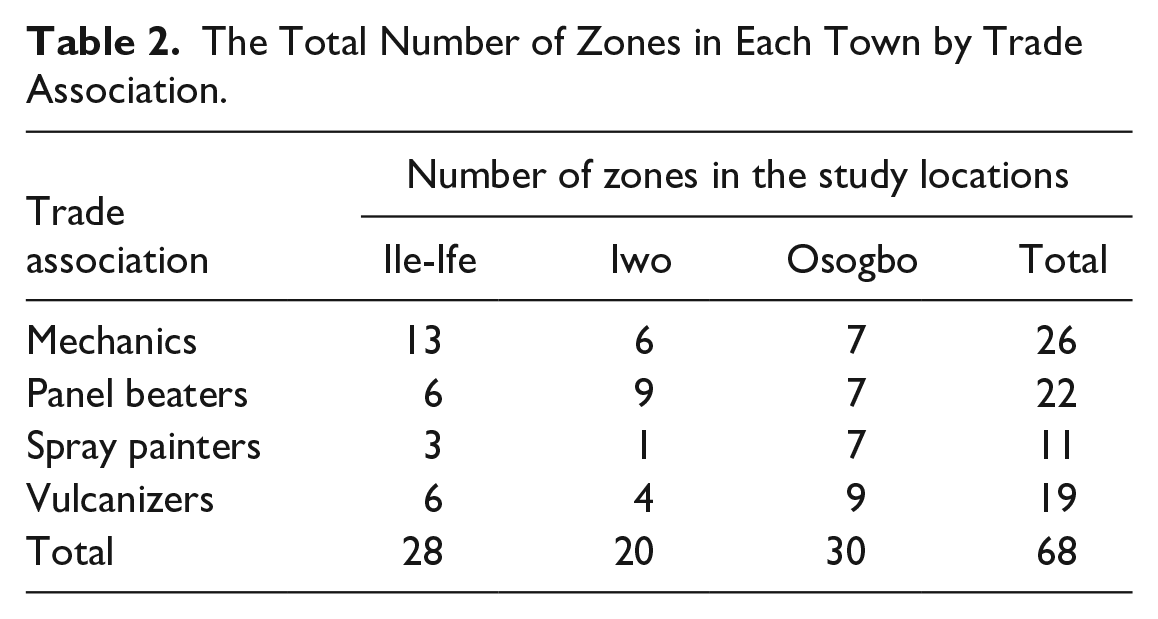
This study was conducted in three towns (Ile-Ife, Iwo, and Osogbo) in Osun State, Nigeria. Like in Osun State, the majority of the inhabitants of these three towns belong to the Yoruba tribe, speak the Yoruba language and are familiar with Yoruba cultural and religious traditions. A multi-stage sampling technique was used by which we selected 632 automobile artisans (panel beaters [156], mechanics [235], vulcanizers [190], and painters [51] from the three study locations. The sampling frame consisted of all automobile mechanics, panel beaters, painters, and vulcanizers in Ile-Ife, Iwo, and Osogbo. The total population size was 4,089, which was reported to us by the chairmen of the various trade associations of automobile artisans in the state (Table 1). The (informal) automobile artisans in Osun State and elsewhere in Nigeria are strictly organized in associations based on their respective trade and in different units or zones within the town for administrative purposes (Table 2). The sample size was calculated using an online calculator (Creative Research Systems, 2012); the level of confidence was 95%, the tolerance level allowed was 0.05%, and the confidence interval was 4. A sample that is proportionate to each subgroup’s population was recruited, adjusting for a 10% nonresponse rate.
Distribution of Automobile Artisans by Trade Association and by Town of Operation.

The Total Number of Zones in Each Town by Trade Association.
Osun State was chosen because the automobile artisans there operate mainly in the informal sector workplaces along the road and not in structured mechanic villages like their colleagues in big cities like Lagos and Ibadan (Lagos and Oyo States, respectively). Osun State comprises three senatorial districts (Osun West, Osun East, and Osun Central). One town was selected from each district: Ile-Ife in Osun East, Iwo in Osun West, and Osogbo in Osun Central. The three towns are major regional centers in Osun State with many vehicular activities. The second step involved selecting four different types of artisans: mechanics, painters, vulcanizers, and panel beaters. These different artisanal groups were chosen because they conducted the most common jobs in car repair and they comprise homogeneous artisanal groups. Our sample was drawn from a list of members of their respective trade associations. Participants were drawn in proportion to the groups’ population using a stratified sampling technique to ensure an equal representation of the groups based on their population size. The inclusion criteria included being an active artisan, master, journeyman, or apprentice. The exclusion criterion included being retired—or having ceased working.
Data Collection
The study is part of a larger doctoral study of OHS management among the informal automobile artisans in Nigeria. The survey among the artisans took place between October and December, 2017, after a pilot in September, 2017. The interviewer composed a semi-structured questionnaire that was prepared through a literature review and the responses to a prior qualitative study among the automobile artisans. The questionnaire included questions on age, educational status, length of work experience, training duration, income, marital status, perception of occupational risk, risk tolerance (acceptance), knowledge about PPE, and current frequency of use of PPE. The questionnaire was pretested in a location different from the study locations on 24 participants to check the study tool’s reliability and validity. The pretest for risk tolerance (acceptance) was deemed necessary because it was adapted from a questionnaire that was used in a developed country (Weinstein, 1987). The pretest showed that the respondents understood the questions as they provided valid answers to them. Face-to-face interviews were conducted by trained fieldwork assistants after obtaining the signed written informed consent from the participants. During the data collection, the investigator monitored and gave regular supportive supervision to the research assistants both on the spot and at the end of each day’s activity. The monitoring was done to ensure the quality of the data collection process. The data were collected as a one-time measurement. Ethical approval for the study was obtained from the Health Research Ethics Committee, Institute of Public Health, Obafemi Awolowo University, Ile-Ife, Nigeria, with HREC number IPHOAU/12/764.
Measures
Dependent variable
The dependent variable is the use of PPE. A list of identified PPEs by the study participants in a prior qualitative part of this study was presented to the respondents. The list contained nine items (gloves, overall clothing, foot protection, hard hat, goggles, welding helmet, earplugs, nose cover, and mask). These items were also similar to what other researchers had identified as useful PPEs for automobile workers (Elewon, 2018; Johnson & Motilewa, 2016; UMCES, 2011). The respondents were asked to identify PPEs they deemed useful for their job from the 9-item list. Next, they were asked to tick the ones they possessed and to indicate the frequency of their current usage of these PPEs, varying on a 4-point scale from “rarely used” to “regularly used.” For the analysis, “rarely used” and “seldom used” were combined to create a single category called “rarely used” for ease of interpretation. An aggregate score for each of the categories for PPE use was calculated by summing the scores for each category of PPE (rarely, sometimes, and regularly used). This aggregate score ranges from 78 to 403.
Independent variables
The independent variables are risk perception and risk tolerance. Risk perception was measured qualitatively by asking the respondents: “Mention seven hazards that are associated with your work.” Next, they were asked, “What is the likelihood of occurrence of the hazards?” with four answering categories from 1= “never” to 4= “always.” Finally, they were asked “What are the consequences of occurrence?” with five possible answers ranging from 1= “negligible” to 5= “extreme.” All the hazards mentioned were categorized into six domains (fire, fall/slip, equipment handling, unsafe operation environment, chemical petrol handling, and psychosocial hazards). The score for perceived risk was calculated by multiplying the likelihood of occurrence by the consequences. That is,

This score ranges from “1” to “20.” The scores were further reduced to three levels: low risk = 1 to 6, medium risk = 7 to 9, and high risk = 10 to 20. Finally, a composite variable called “risk” was generated by aggregating the answers for the six separate domains. For instance, all the responses on “low risk” from the six domains were summed together to have a composite “low risk” variable; the same thing was done for “medium-” and “high-” risk levels.
Validated instruments from previous studies (Weinstein, 1987) were adapted for this study population to measure risk tolerance. Three items were used for measuring this concept: they are perceived vulnerability, coping appraisal, and preventability of the hazard. To assess perceived vulnerability, respondents were asked: “How much do people worry about getting a work-related health problem?” measured on a 4-point scale from 1= “not at all worried” to 4= “very worried.” To measure coping appraisal, the artisans’ perception regarding the preventability of workplace health hazards was assessed with the question: “Can workplace injuries and illnesses be prevented”? The response category was dichotomized to 0 = “no” and 1 = “yes.” To measure threat appraisal, the respondents were asked if they had experienced a work-related injury in the past. The response category was also dichotomized to 0 = “no” and 1 = “yes.”
Control variables
The questionnaire contained seven items about the respondents’ socio-demographic characteristics, including age, educational status, marital status, income, occupation, length of work experience, and training duration. These socio-demographic characteristics were used as control variables to separate their effects from those of the explanatory variable of interest.
Statistical Analysis
All the questionnaires were reviewed for accuracy and completion before analysis. All analyses were performed using the statistical software Stata 14 package. Descriptive statistics were used to list outcomes for PPE needed, PPE possessed, and PPE usage. Bivariate analysis was done to test the relationship between dependent and independent variables. A relationship was regarded as statistically significant and was included in the final multivariate analysis (ordinal logistic regression) to determine the predictors of PPE usage. Ordinal regression logistics was used because the outcome variable was ordinal. The odds ratio was reported.
Ordinal Logistic Regression
Ordinal logistic regression was used to model the relationship between an ordinal outcome variable and one or more explanatory variables. The mathematical expression is:

I = 1 . . . k, j = 1, 2, . . . ., p−1
where ∝ j is the outcome and the threshold associated with the severity of the outcome j levels, β1 is the unknown parameters to be estimated, Xi is the sets of explanatory variables, I = represents the individual, j = number of levels in the categorical outcome, and p = number of explanatory variables.
Results
Social Demographic Characteristics of the Respondents
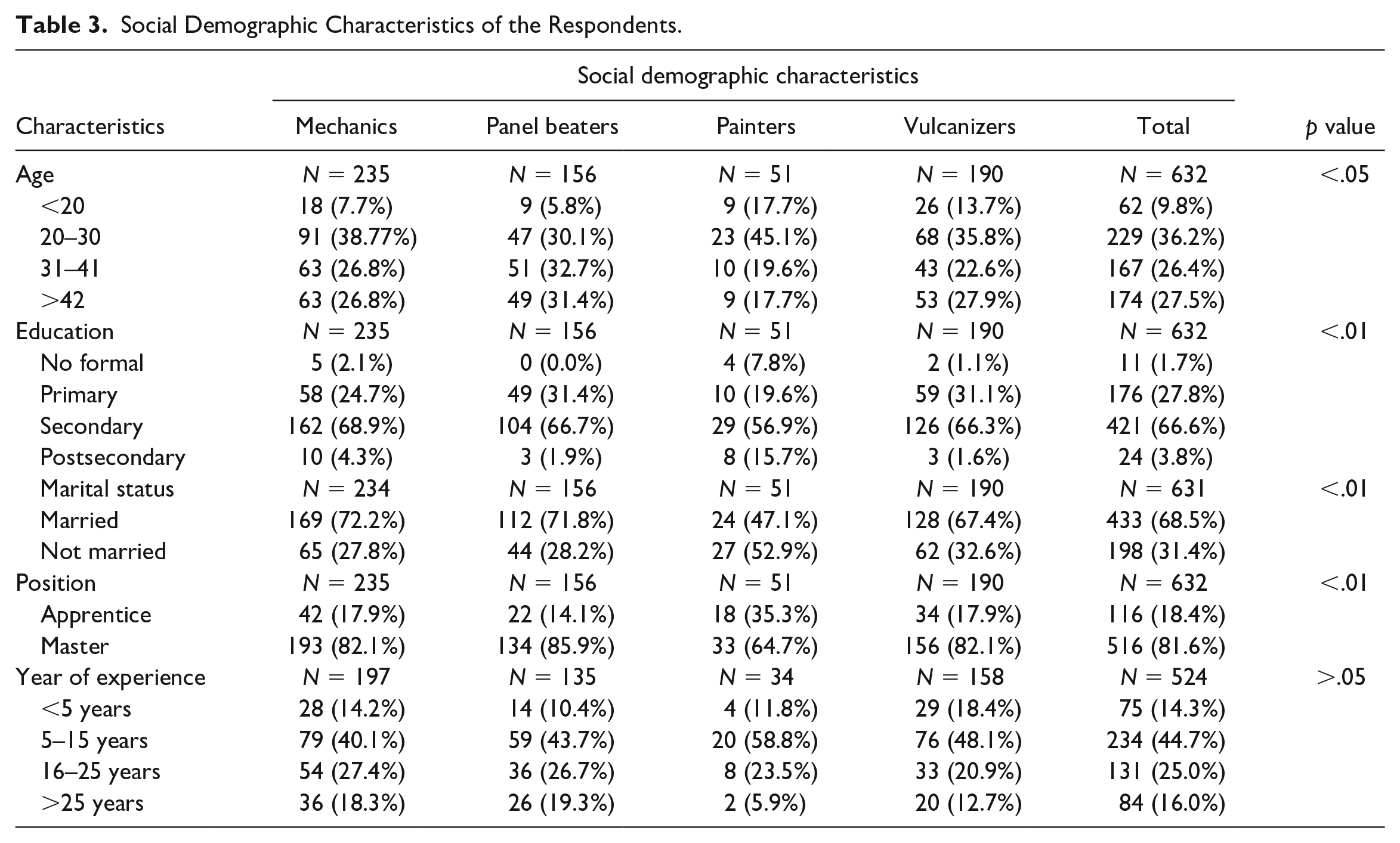
Table 3 describes the socio-demographic characteristics of the study participants. In all the groups, except panel beaters, higher proportions of the artisans were between age brackets 20 to 30 years, had secondary education (66.6%), and were masters (81.6%). The majority was married (68.5%) and had 5 to 15 years of work experience (44.7%). Years of work experience did not show a significant association with occupation; however, other variables are significant at <.05.
Social Demographic Characteristics of the Respondents.
Descriptive Statistics on PPE Need, Possession, and Use
Table 4 shows that the three major PPEs identified as being needed in the automobile workshop are overalls, gloves, and foot protection, mentioned by 95%, 69%, and 59% of the respondents, respectively. The least-mentioned PPE is a welding helmet, which was mentioned by only 5.4% of the respondents as necessary. Out of the 601 (95%) respondents that identified an overall as necessary, 544 (86%) actually possessed one, and 65% of those who possessed overalls were wearing it regularly. Also, 42% possessed gloves out of the 69% of respondents who identified them as necessary, and 32% of those who possessed gloves use them regularly. Out of 59% of artisans who identified foot protection as being needed, 34% possessed this, while only 35% of those who possessed this protection use it regularly.
PPE Need, Possession, and Use by Automobile Artisans in Osun State, Nigeria.

Note. PPE = personal protective equipment.
Hypotheses Testing
Table 5 presents the results of bivariate ordinal logistic regressions to test associations between risk perceptions and the use of PPE; PPE use is described in terms of overall score use. The artisans who held the perception that activity often leads to harm were more likely to use PPE regularly than those who did not hold this perception (odds ratio [OR] = 2.4, p = .02). Therefore, hypothesis 1a is supported by the results. No significant relationship was found between the perceived severity of the consequences of an event and PPE use. Therefore, hypothesis 1b is rejected. When combining the likelihood and severity of a risk, those artisans with high and moderate risk perceptions were more likely to use PPE regularly than those who perceived they were at a low-risk (OR = 2.8, p = .00, and OR = 2.1, p = .02, respectively). Hypothesis 1c is therefore confirmed. The results also show that artisans who had experienced work-related accidents/injuries previously were less likely to use PPE regularly than those who had not (OR = 0.5, p = .00). Thus, hypothesis 2 is rejected.
Bivariate Ordinal Logistic Regression of the Relation Between Risk Perception and PPE Usage Among Informal Automobile Workplace in Osun State, Nigeria.

Note. OR = odds ratio; PPE = personal protective equipment; RC = reference category.
p < .05. **p < .01.
Moreover, artisans who were very worried about getting work-related injuries/illnesses were more likely to use PPE regularly than those who did not worry about this (OR = 2.4, p = .01). This result supports hypothesis 3. Finally, artisans who perceived work-related injuries/illnesses as preventable were more likely to use PPE regularly than those not believing in the preventability of these health problems (OR = 2.5, p = .00). This result corroborates hypothesis 4.
The Joint Effect of Independent Variables and Socio-Demographic Characteristics on the Dependent Variable
The results shown in Table 5 may be related to other characteristics of the respondents, such as their age, marital status, training, work experience, occupation, educational attainment, and income. Therefore, Table 6 shows the joint effect of risk perception and social-demographic characteristics of the artisans on PPE use. After controlling for the effect of social-demographic characteristics, the indicators for risk perception (OR = 1.9, p = .03; OR = 2.1, p = .03), perceived vulnerability (OR = 2.6, p = .03), perceived preventability of health hazards (OR = 2.3, p = .01), and past experience of injury/accident at the workplace (OR = 0.3, p = .00) are still significantly associated with the use of PPE among the group. Of the control variables, only an intermediate work experience (5–15 years) is significantly associated with PPE use (OR = 2.1, p = .03).
Joint Effect of Risk Perception, Risk Tolerance, and Social Demographic Characteristics on the Use of PPE Among the Automobile Artisans.

Note. OR = odds ratio; PPE = personal protective equipment; RC = reference category.
p < .05. **p < .01.
Discussion and Conclusion
Discussion
This study addressed a critical gap in the literature on the relationship between risk perception and PPE usage among informal automobile workers in a developing country. We found that 99% of the respondents identified at least one PPE as being needed in their work. While 93% of the artisans possessed at least one PPE, most of this group (70%) said they also used their PPEs regularly. The most commonly used PPE were overalls. Possibly artisans may also wear overalls so that other people can identify him as a professional (Rasheed, 2017), rather than as a means of preventing occupational hazards alone. This finding concerning the use of overalls corroborates a study conducted among auto technicians in Uyo, Nigeria, by Johnson and Motilewa (2016). They reported that the most frequently used PPE among the artisans are overalls (96.7%), boots (95.4%), and gloves (92.7%). It is also consistent with a study carried out by Elewon (2018) among automobile artisans in Port Harcourt, Nigeria, who reported that 60% of the artisans were using any kind of PPE. Likewise, Sambo et al. (2012) reported that the most familiar known safety devices among automobile mechanics in Zaria were overalls (85%), boots (83%), and rubber gloves (80%). Thus, it can be argued that these three PPEs are most often perceived by artisans as helpful in protecting them from harm at the workplace. Meanwhile, fewer artisans identified the other PPEs we assessed as being needed in their work. This result corroborates studies that reported low usage of PPEs like helmets, earplugs, and goggles among automobile workers (Johnson and Motilewa, 2016; Saliu et al., 2015; Umoren et al., 2016).
The most important finding of this study is that artisans’ perception of occupational risk is associated with the use of PPE. The higher the risk is thought to be, the higher the chances are that the artisans will use PPE (OR = 1.9, p = .03; OR = 2.1, p = .03). This result supports the view that an individual’s perception of a threat’s degree is a key component in changing their health behavior (Ferrer & Klein, 2015). The analysis also shows that the perceived likelihood of the occurrence of a hazardous event is much more important for the use of PPE than the perceived severity of the event (Lam et al., 2007; Xia et al., 2017). The perception that the probability of the occurrence of an adverse event is high will, therefore, motivate the worker to use PPE more than the perceived severity of the consequences. In other words, knowledge of a hazard and fear of the threat tend to spur the artisans to protect themselves from the hazard. This result is consistent with the findings of Arezes and Miguel (2008). They reported that a worker’s fear of losing hearing capacity would make him or her use hearing protection.
Moreover, the findings also indicate that the artisans’ perception of the degree to which they are vulnerable to occupational health problems is associated with their regular use of PPE. Artisans who are very worried about getting health problems are more likely to use PPE. This result corroborates the PMT, which postulates that the greater the perceived threat, the more the individual is likely to be motivated to protect himself (McGinty et al., 2010). This result is also in agreement with a Norwegian study by Rundmo and Moen (2007). They found that judgment of the severity of a hazard’s consequences is associated with anticipated worry, which in turn predicts demand for risk mitigation.
Furthermore, this study found a positive effect of perceived preventability of workplace injury on the regular use of PPE. This result suggests that the artisans’ coping appraisal motivates them to use PPE. However, in contrast to the findings of Öhman (2017) and Gucer et al. (2003), this study found a strong negative relationship between one’s previous experiences of a workplace injury and PPE usage. The explanation might be that the experience of workplace injuries in the past may have increased the worker’s risk tolerance, thereby increasing their sense of control of the hazards; which may, in turn, lead to maladaptive coping responses toward the hazard. Acquisition of knowledge related to occupational risk could have increased their self-confidence in dealing with the threats. As Hameed and Arachchilage showed, self-confidence can increase workers’ acceptance of risk (Hameed and Arachchilage, internet).
Another explanation might be that workers who experienced an accident in the past may have been using PPE at that time (adequately or not). However, this could not be tested in our study. Moreover, artisans’ high-risk perception might lead to maladaptive behavior (Floyd et al., 2000). For example, in the qualitative study reported by the authors of this study (Afolabi et al., 2021), artisans who had experienced severe accidents at the workplace often perceived preternatural forces as the cause of the accident; hence, there is nothing they can do to prevent such occurrence. It can then be argued that even though the worker had experienced a work-related injury in the past, the cognitive process that prevention is beyond his control will make him tolerate the risk and thereby discourage him from using PPE.
In addition, another theoretical perspective that might be relevant in this discussion, though it was not measured in this paper, is the locus of control (LOC) theory. LOC is a construct based on the personality traits of the workers (Iselin et al., 2019). It focuses on the belief of whether or not one’s outcomes depends mainly on one’s own actions (internal LOC) or on factors not under one’s own control (external LOC). It can then be reasoned that workers with internal LOC might be the ones that are motivated to use PPE because they believe their own behavior can affect the outcome. While workers who actually had experienced work-related injuries may not use PPE because they may attribute the accidents that led to these injuries to the workings of preternatural (external) forces which are beyond the control of individual themselves. Given the importance of hazard perceptions, it is relevant to test the LOC theories in further studies.
Furthermore, the analysis found a strong association between the duration people was working (5–15 years) and the regular use of PPE. This result resonates with a study by Marahatta et al. (2018). They reported that length of service is one of the factors that affect PPE usage. However, our study shows no significant relationship between PPE usage and worker with shorter careers <5 years or longer careers >15 years of working experience. The only plausible explanation could be that the novice workers might decide to start using PPE only after experiencing a work-related problem. We did not find a relationship between occupation and PPE usage; perhaps, the list of PPEs presented to the artisans is general. Different professional groups might have specific PPEs that are relevant to them from the list.
Conclusion
In this study, we explored the relationship between occupational risk perception and the use of PPEs. We also explored the effect of perceived vulnerability, coping appraisal, and preventability of occupational health problems on the use of PPEs. The descriptive statistics concluded that overalls are the most regularly used PPE identified by the informal automobile artisans in Osun State, Nigeria. Furthermore, workers’ risk perception plays a significant role in the use of PPE at the workplace, as those with high-risk perception are more likely to use PPE regularly than workers with low-risk perception. Likewise, workers who are very worried about getting work-related injuries, and those who perceive workplace injury to be preventable are more likely to use PPE. Contrary to previous studies, our study reported that those artisans with previous workplace injuries are less likely to use PPEs. The study also supports PMT’s threat appraisal that the greater the perceived threat, the more the individual is likely to protect himself.
We can see this study’s implication is two-fold; vis-a-vis training and policy implications. Organizing frequent training and seminars that will increase the artisans’ awareness of their work’s hazardous effect on their health might encourage PPE usage. OHS professionals and government can conduct training and seminars. Also, policymakers can make policies that will ensure the use of PPEs among the artisans.
Strengths and Limitations
This study’s strength is that it provides vital information on factors that may affect the PPE use among the understudied population in a developing country. The relevant policymakers can use the information in promoting the use of PPE at work. The information is beneficial because there is a paucity of literature on PPE usage determinants among automobile artisans in Nigeria. Furthermore, this study’s results may help the relevant stakeholders like policymakers, researchers, and health and safety practitioners design significant OHS programs in the automobile workplace. These programs may emphasize the effective use of other PPEs that can reduce health hazards in the sector. Moreover, training that will increase the artisans’ risk perception might be helpful.
A limitation of this study is that it depended on workers’ subjective reporting, which might be biased in some cases. Also, the frequency of PPE usage was limited to current use. Furthermore, it is crucial to be aware of the predictive limitations of cross-sectional studies. The data do not allow distinguishing cause and effect of the factors observed and the use of PPE. Nevertheless, it shows that there is a strong correlation between risk perception and the use of PPE. Finally, future studies exploring the association of occupational risk perception on informal workers’ safety behavior in developing countries can benefit immensely from using both qualitative and quantitative research methods.
Footnotes
Declaration of Conflicting Interests
The author(s) declared no potential conflicts of interest with respect to the research, authorship, and/or publication of this article.
Funding
The author(s) disclosed receipt of the following financial support for the research, authorship, and/or publication of this article: F.J. Afolabi received a grant (#DVC/AC/37A/AFO) from Tertiary Education Trust Fund (TETFUND) under Academic Staff training and Development for her PhD studies at the University of Amsterdam, Netherlands. TETFUND was not involved in the study design, data collection, analysis, and interpretation or reporting of the data. For the remaining authors, none were declared.
