




Abstract
While the relationship between decentralization and service delivery is underpinned by a set of normative theoretical assumptions, yet not only does the empirical evidence concerning this so-called relationship to date remains inconclusive at best but our understanding of the causes of ineffectiveness of decentralization initiatives with respect to service delivery is also striking. This article attempts to contribute to the debates concerning the relationship between decentralization and service delivery through an analysis of decentralization measures undertaken by the Government of Pakistan during the early 21st Century with the announced aims of improving the efficiency and responsiveness of government as well as the delivery of public services. Notwithstanding a decade of decentralized service delivery, wellbeing outcomes across districts in Khyber Pakhtunkhwa province demonstrated remarkable discrepancy such that while some districts witnessed considerable amelioration in their respective composite indices, others experienced a marked deterioration, thus calling into question the normative assumptions that undergird the relationship between decentralization and service delivery. This article seeks to explain this outcome through a comparative case study of two localities in Khyber Pakhtunkhwa province viz districts “Swabi” and “Lower Dir,” both of which had witnessed marked deterioration and amelioration in wellbeing outcomes, respectively, in the ex-post of implementation of the Devolution Plan. Data for the study were collected through in-depth interviews and focus group discussions. The results demonstrate that political dynamics such as the nature of relationship between district governments and the provincial government, extent of political polarization prevalent within or among different levels of the local government system, and the role of bureaucracy turn out to be important factors that ostensibly account for the deterioration of wellbeing outcomes in Swabi district over the course of a decade of implementation of the local government system. The findings suggest that political factors have overshadowed technical considerations in terms of explaining the discrepant outcomes of decentralized service delivery across the two localities.
Keywords
Introduction
Over the past few decades, decentralization has played out as the linchpin of institution building efforts of international development organizations and has been adopted and implemented ubiquitously, in one form or another, by a large number of countries across Latin America, Africa, and Asia, a phenomenon often also popularly dubbed as the “fashion of our time” (Manor, 1999: 1) or the “quiet revolution” (Campbell, 2003). The propensity toward decentralization is generally regarded to have been spurred by the somewhat bleak outcomes of commandist/centralized approaches to development (Bardhan, 2002; Manor, 1999). While decentralization is generally considered as a panacea to cope with a plethora of development issues, nevertheless, good governance (Faguet, 2014; Ribot, 2001; Smoke, 2003), improved efficiency (Azfar et al., 2001; Ribot, 2001; Smoke, 2003), improved equity (Bossert et al., 2003; Smoke, 2003), better service delivery (Ahmad et al., 2005; Azfar et al., 2001) and poverty reduction (Katsiaouni, 2003; Khan, 2013; Steiner, 2007; Von Braun & Grote, 2000) and so on often stand out as the most frequently touted goals of most decentralization initiatives.
It is imperative to point out that from among a set of such diverse goals, service delivery concerns often stand out to overshadow all other considerations. Even at times when other considerations loom large, service delivery continues to serve as an implicit motivation underlying almost all decentralization initiatives (Shah & Thompson, 2004). The impetus for fostering decentralized service delivery ensues from the perceived inefficiencies associated with centralized provision of basic services. For instance, critics of centralized provision of services argue that public spending by central governments hardly reaches the intended beneficiaries (Ahmad et al., 2005), that the distribution of such spending usually follows a skewed pattern (Faguet, 2004) and is, more often than not, also prone to widespread corruption, misappropriation, and misuse (Bardhan & Mookherjee, 2000). Proponents of decentralization, on the contrary, maintain that the transfer of political, administrative, and financial powers to the lower levels engenders amelioration in the delivery of services in at least three important ways: allocative efficiency, productive efficiency, and cost recovery (Azfar et al., 1999; World Bank, 2001).
While the theoretical arguments concerning equity and efficiency have come under greater empirical scrutiny (see, for instance, Bardhan, 2002; Prud’Homme, 1995), still such arguments signify the existence of a potent link between decentralization and service delivery. However, it is interesting to note that empirical evidence concerning the relationship between decentralization and service delivery to date remains inconclusive at best (Ahmad et al., 2005; Ghuman & Singh, 2013; Liwanag, 2019; Shah et al., 2004). For instance, findings from a number of studies (see Faguet, 2004; Kaufmann et al., 2002; Regmi et al., 2010) undertaken across a range of countries suggest that decentralized institutional arrangements help facilitate efficient delivery of services. Contrast to this, some studies (Conyers, 2007; Joshi, 2013; Robinson, 2007) have found a lack of positive correlation between decentralization and service delivery, while still others maintain that decentralization may serve to create opportunities for engendering improvement in service delivery. Nevertheless, such opportunities, in and of themselves, may not be sufficient and hence their effectiveness with respect to improved service delivery is often contingent upon a variety of auxiliary factors (Cabral, 2011; Chattopadhyay, 2013; Liwanag & Wyss, 2019; Moses, 2001; Sow & Razafimahefa, 2015). Similarly, with a particular reference to the case of Pakistan which constitutes the foci of this article, discrepancies among scholars prevail with respect to the effects of decentralization on service delivery. For instance, some studies evince substantial improvements in government responsiveness, and hence, the provision of basic services such as education, health care, street paving, roads, water supply, and sanitation and rural electrification (Ahmed & Lodhi, 2016; Aslam & Yilmaz, 2011; Hasnain, 2010), while others (Ansari et al., 2011; I. A. Khan & Ghalib, 2012; Salman, 2009) transpire that little if any improvement has taken place in terms of service delivery.
It is interesting to note that international development agencies put an overarching emphasis on the design of decentralization schemes. Consequently, the ineffectiveness of decentralization is often intertwined with an idiosyncratic set of technical factors such as the lack of a strong political will (Blair, 1997; Smoke, 2003), devolution of inadequate powers and financial resources (Basta, 1999; Ford, 1999; Jütting et al., 2005; Manor, 1997; Ribot, 2004) and lack of reliable accountability mechanisms (Agrawal, 1999; Manor, 1997, 1999; Ribot, 2004). It is, however, imperative to state that political and social dynamics prevalent at local levels of governance also mediate with and affect both implementation as well as outcomes of decentralized institutional arrangements and hence the delivery of services. For instance, decentralization reforms may be driven, inter alia, by political considerations purported to entrench the powers and prerogatives of politicians (Shah & Thompson, 2004). Similarly, the functioning of decentralized institutions is not only prone to mediation by authorities at higher levels of government but is also substantially shaped by social forces prevalent within specific social settings (Manor, 1999).
This article seeks to contribute to the debates concerning the relationship between decentralization and service delivery through a comparative case study of local governments’ performance across two localities of Khyber Pakhtunkhwa (KP) province of Pakistan viz districts Swabi and Lower Dir. Despite a decade of decentralized service delivery in the ex-post of implementation of World Bank’s supported decentralization reforms (Devolution Plan 2000), wellbeing outcomes across both districts demonstrate marked discrepancy such that while Swabi district has experienced remarkable deterioration in both its Multiple Deprivation Index (MDI) as well as Human Development Index (HDI), Lower Dir district has witnessed considerable amelioration in such indices 1 over the course of a decade or so. Given that reforms undertaken in the two districts were identical in formal terms, both districts should have simultaneously witnessed amelioration in their respective HDI and MDI. The observed discrepancy thus calls into question the relationship between decentralization and service delivery and serves as the empirical aspect of the study.
The article is divided into three major sections. The first section provides an overview of the origin and implementation of the DP. The second section delineates the empirical analysis. This section not only underscores service delivery constrains which both districts share in common but also takes stock of key differences in the institutional development of the districts: the malfunctioning of councils in Swabi District and the subsequent deterioration in service delivery in the district. It also explores sources evidencing the relatively better performance of Lower Dir with respect to service delivery. The final section concludes the article.
The Origin and Implementation of Devolution Plan
On the turn of the new millennium, the new incumbent dictatorial regime of General Musharraf in collaboration with international financial institutions, most notably the World Bank and IMF, pursued a comprehensive package of reforms under the rubric of Poverty Reduction Strategy Papers (PRSP) initiative with the announced aims of reinvigorating the economy, governance, and human resource development and reforming the existing social protection system. Of the raft of measures, Devolution Plan (DP) stands out as a key reform measure purported to foster the efficiency and responsiveness of government and to help improve the delivery of basic social services. The promulgation of the DP spurred the establishment of National Reconstruction Bureau (NRB), an institution saddled with the onerous task to design the requisite institutional arrangements to set in motion implementation of the DP per se. The DP entailed the decentralization of political, administrative, and fiscal powers to the lower levels of government.
Political decentralization paved the way for establishment of a three-tier (district, tehsil, and union) local government system (LGS). This was followed by competitive local elections for the purpose of filling positions of power at union, tehsil, and district levels. Measures pursued under Administrative decentralization substantially overhauled the pre-existing administrative structure, a reminiscent of the colonial era. The Division as an administrative unit stood abolished. Each District Department was now headed by an Executive District Officer (EDO), who was assisted by the District Officers (DOs) and the Deputy District Officers (DDOs) at sub-district levels. Furthermore, the laws underlying the substitution of the post of Deputy Commissioner (DC) with District Coordination Officer (DCO) privileged the district nazim to serve as the head of District Administration. Under the new designation, the DCO conceded his powers as district magistrate and/or district collector. Responsibility for exercising such powers was, thus, conferred to the district nazim (Mezzera et al., 2010). Administrative decentralization also accrued in devolution of key service delivery functions from provincial to the local governments. It is, however, interesting to note that the devolution process unfolded in an indecisive manner. For instance, in some cases such as health and education sectors, service delivery functions were only partially devolved while other sectors such as irrigation, police, mines and mineral development, and industrial and labor regulation remained entirely within the ambit of provincial government (World Bank, 2004).
Similarly, prior to the DP, local governments in Pakistan were receiving only nominal financial assistance (only 5% of their total expenditure) from provincial governments. Fiscal decentralization paved the way for local governments to exercise substantial leeway both over expenditure responsibilities as well as the expansion of their respective tax nets. In the ex-post of implementation of DP, local governments received the bulk of their revenues from provincial governments. Moreover, the DP also ensued in establishment of a Provincial Financial Commission (PFC) to help facilitate equitable and transparent distribution of resources between the province and the local governments and the local governments inter se (Paracha, 2003). The PFCs in each province devised a formula-based mechanism for the distribution of financial resources among different levels of government.
The new service delivery framework that emerged in the wake of establishment of the DP combined key elements of different variants of decentralization. It reinvigorated both accountability mechanisms as well as the role of key actors (such as politicians and policy makers) directly involved in service delivery through radically transforming the existing incentive structure. Nazimeen and service providers took center stage in the overhauling process. The framework emphasized citizen’s voice, managerial powers, and provincial efficiency incentives (budgetary certainty, autonomy in budget preparation, and incentives for local revenue raising) as the key motivating factors purported to render service delivery more efficient. The incentives on the part of service providers were sought to be instigated through citizen/client power and the managerial powers granted to Nazimeen and other senior staff (Figure 1; World Bank, 2004).

Key incentives under the Devolution Plan.
Research Design and Methods
In the ex-post of implementation of the DP, all districts across the KP province had demonstrated remarkable discrepancies between 2001–2002 and 2009–2010 in terms of amelioration and deterioration in their respective HDI and MDI. While some districts had witnessed considerable improvement in their respective HDI and MDI, others had witnessed marked deterioration in their respective HDI and MDI. The observed (discrepant) outcomes calls into question the normative theoretical assumptions underpinning the relationship between decentralization and service delivery and constitute the empirical puzzle of the study. The selection of districts Lower Dir and Swabi was driven, inter alia, by two important factors. First, over the course of a decade of decentralized service delivery, Swabi district had experienced considerable deterioration in its MDI while its HDI score had remained stagnant. Lower Dir district, on the contrary, had witnessed amelioration in both its HDI and MDI. The observed amelioration and deterioration in each of the two cases was striking and hence warranted their selection as the potential cases or localities for this study. Second and perhaps an equally important determinant underlying the selection of these localities relates to the nature of political affiliations of elected heads of each level of the LGS in these districts with the mainstream political parties in power at the provincial level.
A comparative case study approach was employed to examine the observed inconsistencies across the two districts. A case study refers to “the detailed examination of an aspect of a historical episode to develop or test historical explanations that may be generalizable to other events” (George & Bennett, 2005, p. 5). It may entail a comprehensive analysis of a single case (Bryman, 2004) or a relatively small number of cases (Gomm et al., 2000). Case studies are undertaken by scholars within the interpretivist/qualitative tradition in anticipation to achieve rigor and depth either through a detailed examination of a case or through probing the causal mechanisms that underlie the putative causal relationship between the independent and the dependent variables (George & Bennett, 2005). Case study researchers may employ a variety of methods for data collection (Rohlfing, 2012) including both quantitative methods (Yin, 1989) as well as qualitative methods (Stake, 1995). Similarly, in a case study, data may be collected through using multiple sources of evidence such as documents, archival records, interviews, observations, physical artifacts, and so on, (Creswell, 1998; Rowley, 2002). Each source demonstrates unique strengths and limitations. None of them can serve as a complete source of evidence in its own right. However, when used in tandem with each other, different sources of evidence may complement each other (Rowley, 2002; Yin, 1989).
Data collection for the present study entailed an extensive field trip undertaken between October 2013 and May 2014 in selected districts of KP province. Primary data were collected primarily through “semi-structured in-depth individual interviews” and in a very few cases also through “focus group discussions” from respondents with diverse backgrounds. The average duration of an interview ranged from 40 to 60 min and in some cases also exceeded 1 h. Apart from government officials, identification and selection of respondents in the rest of categories were carried out through a snow ball process. In majority of the cases, respondents’ interviews were recorded through a mobile device. In cases where circumstances restrained audio recording, responses were recorded as hand written notes in a diary. Table 1 outlines both the categories of respondents interviewed as well as the total number of interview conducted within each category in both districts during the fieldwork. Among the different categories of respondents, elected representatives of local governments demonstrated a high degree of responsiveness, whereas government officials (bureaucracy), at large, acquiesced to share information. The number of participants in almost all focus groups ranged from 5 to 7. The arrangement as well as conduct of focus group discussions was relatively an arduous task. Focus group discussions were demanding in terms of both mustering people with diverse backgrounds and routines in a timely fashion as well as keeping them adhere to the key debates.
Categories of Respondents Interviewed During the Fieldwork.

Note. CCB = Citizen Community Boards.
Key sources of secondary data included both local and national newspapers as well as published and unpublished documents, for example, minutes of the councils’ meetings and the communiqués issued by Provincial Government from time to time. Such data shed light on the nuts and bolts of institutional arrangements established under the DP such as the LGS comprising the district, tehsil, and union councils; the functioning of councils; budgetary information; and other related issues. Retrieval of secondary data, more often than not, played out to be a relatively more ambitious task as public officials were circumspect of sharing secondary information and would do so only with acquiesce.
Empirical Analysis
Service Delivery Constraints Which Both Localities Share in Common
This article aims to explain discrepant wellbeing outcomes observed across two localities viz Swabi and Lower Dir districts in KP province of Pakistan in the ex-post of the DP. Impediments to effective service delivery across both districts abound and may broadly be categorized into technical and political factors. This section encapsulates the technical factors responsible for adversely affecting service delivery. However, since both districts share such service delivery constraints in common, it is difficult to establish that these factors could account for the observed discrepancy in wellbeing outcomes across the two districts.
First, budgetary data for the years 2001–2002 through to 2010–2011 transpires that increases in development shares of each of the two districts over the course of time turn out to be nominal at best as compared to increases in their respective salary (a fourfold increase observed in each case) and non-salary (a sixfold increase in each case) shares. Table 2 delineates budgetary information for the two localities.
Lower Dir and Swabi Districts–Budgetary Information (PKR Millions).
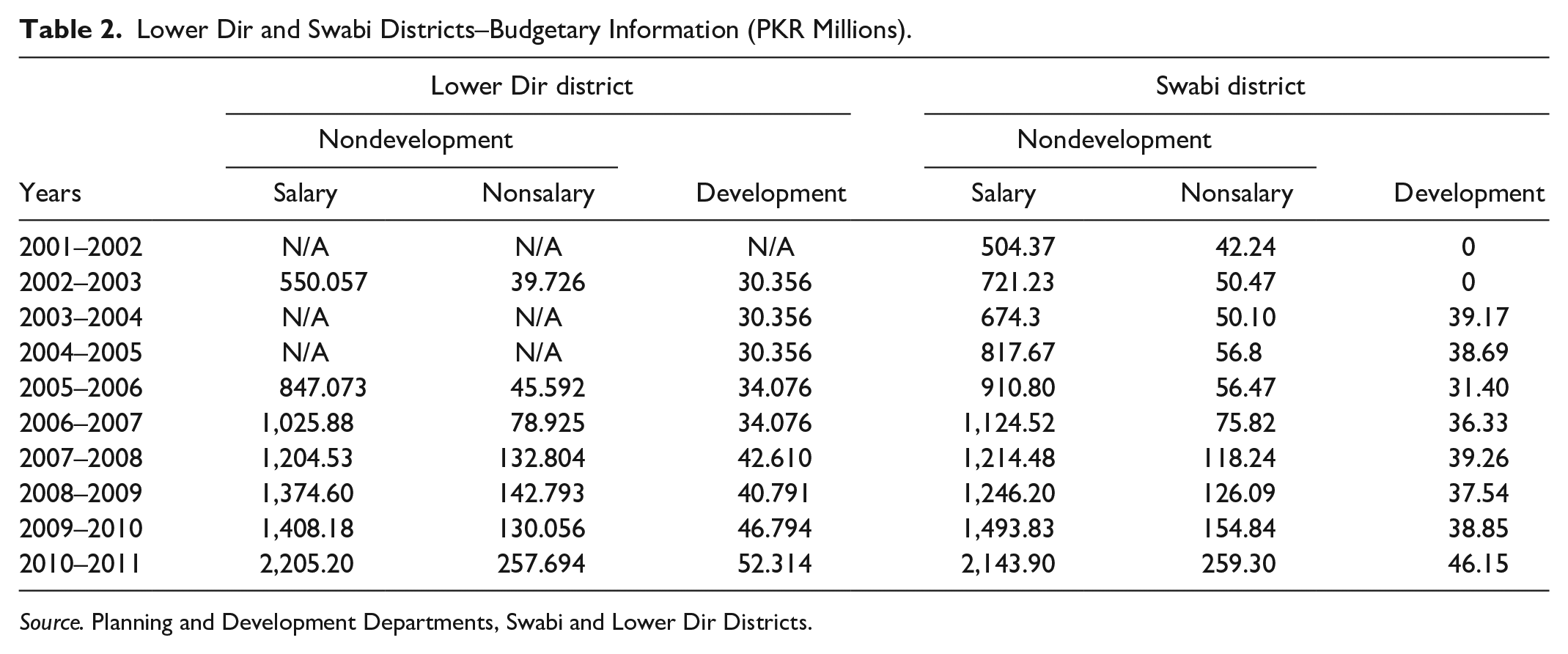
Source. Planning and Development Departments, Swabi and Lower Dir Districts.
What ostensibly appears to account for the discrepancies pertinent to increases in development and nondevelopment shares is the lack of capacity of local councils to utilize development funds in an efficient and timely manner. Data retrieved from Planning and Development Department of each of the two districts concerning utilization of development funds serve as a testament to this. For instance, in district Swabi, the overall lapses in development funds for the years 2003–2004, 2005–2006, 2006–2007, and 2009–2010 turn out to be Rs. 114.82 millions, whereas in district Lower Dir total lapses for the years 2002–2002, 2007–2008, and 2008–2009 amount to Rs. 68.19 millions. The amounts lapsed in each of the two districts are colossal. The amount lapsed during a particular year was subsequently carried over to the next year for utilization against development schemes. The institutions responsible for overseeing local governments’ performance with respect to service delivery were also skeptical of the low utilization of funds by local governments and the annual reviews conducted to appraise funds’ utilization reverberates such concerns.
A second problem concerns the lack of discretion over the preparation of annual budgets. The first two budgets (for the years 2001–2002 and 2002–2003) were prepared by provincial government because local government officials were novice to effectively deal with budget-related issues. Furthermore, given the directives of provincial government, it was incumbent upon district governments to expend their development funds on completing the ongoing schemes that had been initiated under provincial ADPs. Consequently, district governments could barely initiate their own development schemes, at least during the first 2 years of their tenure.
Although district governments were skeptical of receiving predetermined budgetary figures from the province, they eschewed taking issue with provincial government in anticipation of exercising greater leeway over their budgets in future. Such expectations were, however, quickly dashed since provincial government’s discretion over district government budgets became ingrained throughout the two tenures of the LGS. For instance, salaries of public officials of line departments continued to be disbursed through Account-I, notwithstanding, in the ex-post of implementation of the DP, provincial government was liable to substitute its Account-I with Account-IV to pave the way for disbursement of salaries through district governments. This issue lingered on until at least 2007–2008. During this entire period, provincial government retained control over the salary and non-salary budgets of devolved departments.
A third key problem ubiquitously manifesting itself across the two districts is pertinent to the types of projects undertaken by district governments. Even through, district governments were liable to allocate the bulk of their total development funds to schemes within the education, health, and roads sectors. An overview of sector-wise allocations under the district governments in Swabi and Lower Dir for various years (Table 3) evince that spending on other sectors (such as DWSS) overwhelms spending on the education and health sectors. In the case of both districts, the Annual Development Programs (ADPs) undertaken during different years failed to comply with the statutes that inherently informed the utilization of development funds by the district governments. For instance, in the case of Lower Dir District, under ADP 2004–2005, both the education and health sectors received only Rs. 0.688 million for a total of 12 projects. Similarly, in ADP 2009–2010, the health sector received Rs. 5.8 million for a single scheme, while no allocation was made for undertaking schemes in the education sector.
Annual Development Programs (ADPs)—Lower Dir and Swabi Districts (PKR Millions).
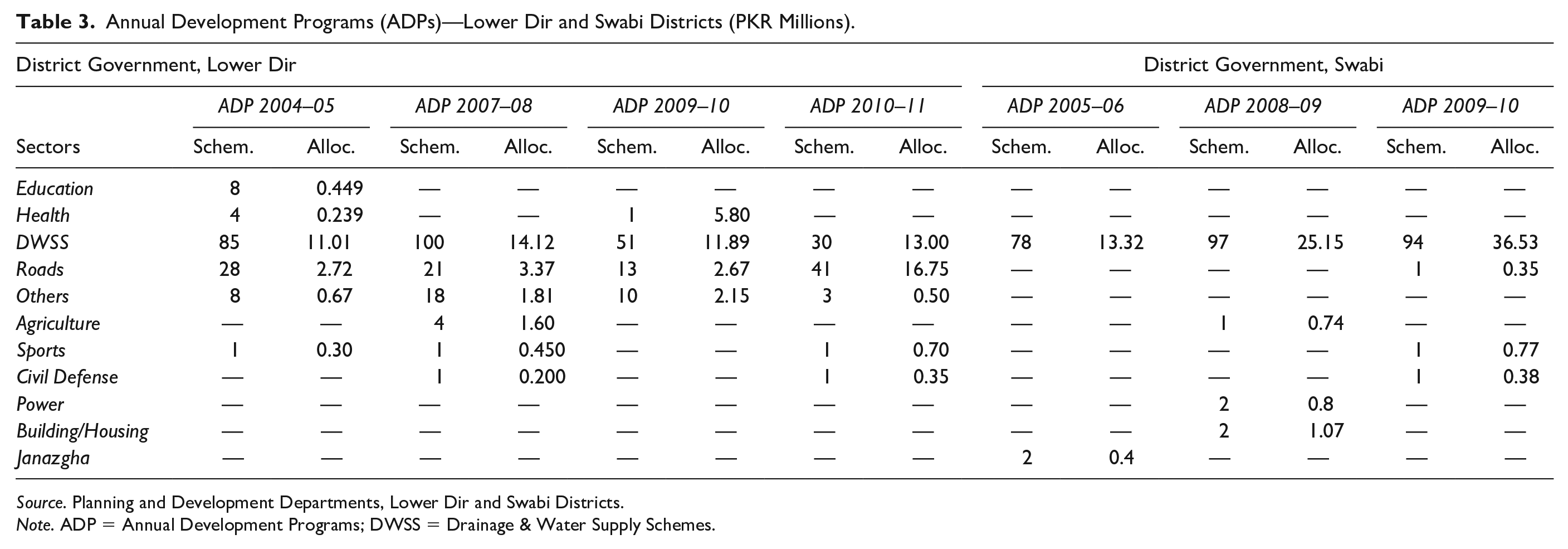
Source. Planning and Development Departments, Lower Dir and Swabi Districts.
Note. ADP = Annual Development Programs; DWSS = Drainage & Water Supply Schemes.
For the remaining ADPs for the years 2007–2008 and 2010–2011, both of these sectors were entirely overlooked. What is interesting to note is that DWSS (Drainage & Water Supply Schemes) projects, which inherently fell within the purview of the tehsil council, occupied center stage in the district ADPs, with respect to both the number of schemes (266) and the allocation of funds (Rs. 50.02 million). The case of Swabi District demonstrates the worst case scenario in terms of resource allocation for both the education and health sectors. In ADPs for the years 2005–06, 2008–09 and 2009–10, these sectors were overlooked altogether. The DWSS in this case also played out as having outweighed other sectors in terms of both number of projects (269) and allocation of funds (Rs. 75 million).
How then can we account for the adroit evasion by the district governments of their respective expenditure liabilities? Essentially, two important factors spurred district governments into revising their spending priorities. First, the rules governing utilization of development funds had swiftly become a technical morass. During the first 2 years, on the directives of provincial government, large chunks of district development budgets were drained into ongoing schemes initiated under provincial ADPs. The amount of development fund left over from these ongoing schemes could not suffice initiation of independent projects by district governments.
Most importantly, the politics of spending also made a botch of the sector-wise allocation formula. At local levels, issues such as water supply, drainage, the paving of streets, and so on, often come to overshadow issues in other sectors (education, health etc.). Schemes such as the installation of a hand pump for a household, the paving of a street in a particular locality, and so on, typically provide local politicians with substantial political leverage as compared to schemes generally perceived as a common good, such as the construction of a school or a basic health unit building. In the current case, patronizing clients by executing small-scale projects constituted an intrinsic political survival strategy of the elected representatives of local councils.
A fourth problem shared by both districts relates to revenue generation. The fiscal decentralization initiative bestowed upon each level of local government substantial leeway over generating revenues through tax collection and the expansion of the tax net within their respective jurisdictions. While tax collection in both districts continued to take place on a routine basis, it is difficult to establish whether the existing tax bases of the local governments in both districts showed any signs of improvement. Overall, local councils demonstrated utter reluctance to toe the line with respect to the statutes concerning the expansion of the tax nets. Consequently, the tax net base of local councils largely remained stagnant over the two tenures of the LGS.
In addition to the aforementioned problems, a fifth problem concerned the process of the formation and registration of Citizen Community Boards (CCBs) across the two districts, which was said to be too sluggish. Most importantly, the registration process of CCBs seems to have been heavily influenced by the Nazimeen. Anecdotal accounts from the field suggest that the majority of the CCBs were either constituted by nazimeen themselves or had, at the very least, the backing of nazimeen. Such CCBs often overshadowed rival CCBs in terms of access to financial resources and so on.
Factors Accounting For the Discrepant Outcomes Across the Two Districts
The case of Swabi District
As discussed earlier, during the ex-post of devolution, Swabi District witnessed considerable deterioration in its ranking with respect to MDI and HDI, even though the financial resources received by Swabi District over the two tenures of LGS were substantially greater than those of Lower Dir District. As no other sources of variation were apparent, the observed deterioration in MDI indicators in Swabi District suggested the possibility that a decline in service delivery standards might have contributed to the observed outcomes. On this basis, the comparative study undertaken probed the hypothesis that the politics and functioning of local councils and bureaucracies involved in service delivery affected service delivery and MDI outcomes.
An analysis of Swabi District has revealed three salient points in this connection. First, since their inception in August 2001, local governments in Swabi District remained adrift owing to severe political polarization within their ranks. Moreover, such polarization prevailed at different levels within the LGS (both tehsil and district levels) and, throughout the period of study, profoundly shaped decisions regarding the distribution of resources, the formation of monitoring committees, the tendering of contracts, and the like. Second, in respect of an extension of this political polarization, the provincial government’s interventions in Swabi District—seen in its attempts to influence the postings/transfers of employees, its interference in the development schemes of local councils and its periodic stoppage of funds—appear to have adversely affected the functioning of the LGS.
Finally, public officials in line departments in Swabi District all too often appear to undertake their functions in an intrepid manner. Apart from being defiant to comply with the mandate of local councils in matters pertinent to postings/transfers, public officials of line departments in Swabi District also seem to have set a precedent of perpetual absenteeism from councils meetings, something that has had pernicious implications for the delivery of services. The discussion below provides a more detailed account of these factors and their implications for the service delivery mechanism established under the DP.
Political polarization
Despite the existence of a ban on the entry of political parties into local elections, political parties in Swabi District instead greeted local elections as an opportunity to flex their muscles, and even managed to establish their presence within local councils by resorting to subterfuge as a means of access. The struggle to occupy positions of power played out rather dramatically during the second phase of local elections, which entailed indirect elections for the district and tehsil nazimeen and naib-nazimeen. Consequently, the establishment of the LGS, which was purported to empower ordinary men and women, served as little more than an arena for the power struggles of different political parties. Throughout KP province, political parties were virtually controlling the functioning of local governments. The presence of parties in local councils may either turn out to be prolific or may serve as a potential source of increased polarization and hence adversely affect the functioning of those councils.
In the tehsil council of Swabi District, polarization was evident from the outset. Those who had secured power at the tehsil level were reportedly holding private meetings. Members of the opposition perceived the conduct of such meetings as a willful attempt to bypass the newly established council. Consequently, during the very first session of the council, some members of the council walked out from the session as a means by which to censure of the tehsil nazim and naib-nazim for holding private meetings with members of the councils. 2 Such polarization remained unabated at least until the end of the first tenure of the LGS. A key fallout of such polarization, and which served as a potential source of instability and tumult, was the excessive use of votes of no confidence against political rivals. Swabi District stands among those districts that experienced a relatively high number of no-confidence cases.
The no-confidence motion that subsequently swept across the entire district was inherently spurred by the perpetual absenteeism of the naib-nazim of the tehsil council of Swabi. The nazim had set himself to sail on two boats at the same time by being ubiquitously employed in the United Arab Emirates (UAE) while also serving as the convener of the council. His prolonged absence gave rise to two important issues. First, the opposition took issue with his leave of absence, which had been approved by the house. Many perceived this grant of leave as a contentious issue and as not falling within the purview of the said house, and demanded that the district nazim provide justification for the Nazim’s prolonged absence. However, the justification offered by the district nazim proved unconvincing. This led the opposition to query the legal status of the caretaker convener.
According to the statutes of NWFP-LGO 2001, if any member of the council remains absent for three consecutive sessions without a genuine reason, his or her membership shall stand abolished. There upon, the position of tehsil naib-nazim should be regarded as vacant and be filled by way of a by-election within 30 days of the occurrence of the vacancy. Until such time as the vacancy is filled through by-election, members of the council may elect a naib-nazim from among its members by a majority vote (Section 156 of NWFP LGO 2001). The second issue, which exacerbated the situation, relates to the conduct of the election process for the officiating tehsil naib-nazim. Events such as this typically appear on the agenda of the specified session of the house and details are conveyed beforehand to the council members. However, information concerning the proposed election for the officiating tehsil naib-nazim had been deliberately eschewed from the agenda. Thereby, majority of the members could not cast their votes in the election for the officiating tehsil naib-nazim.
The opposition, however, rebuked the conduct of the election by boycotting the council as well as embarking on a hunger strike, and simultaneously moved a motion of no confidence against the tehsil naib-nazim on July 30, 2003 on the grounds that the nazim had made a botch of his responsibilities as an elected representative and that he was also involved in misappropriation of public resources. Although the motion ended in failure due to the absence of the accused nazim on the day of the no confidence vote, it spurred an unremitting series of no confidence motions, resulting in the brutal exploitation of “Sections 84 and 85” of the ordinance in pursuit of dislodging or disqualifying political rivals.
Accordingly, within 1 month, the opposition of the tehsil council of Swabi moved another no confidence motion against the tehsil nazim. This motion proved consequential in that it opened up windows of opportunities for pervasive floor crossing. Being circumspect of the threat posed by the perceived floor crossing, the mainstream party managed to emancipate a significant number of its members by taking them on a lavish tour along with their families to the district of Swat days before the no confidence vote. They were brought back on the date of the no confidence vote to cast their votes. In addition, since the motion had also served to ruffle the feathers of the district nazim, he pursued, as an act of reprisal, a raft of no confidence motions against naib-nazimeen at union council levels. In a tit for tat manner, the opposition also instigated no confidence motions against its rivals. The motions ultimately culminated in the dislodging of three opposition naib-nazimeen (members of the tehsil council) from their offices and resulted in thwarting the opposition’s campaign against the tehsil nazim. While the no confidence motion against the tehsil nazim turned out to be an ignominious failure, it did serve to entice the brutal exploitation of Sections 84 and 85 in the Swabi District which ultimately resulted in the ousting of numerous nazimeen from their offices. Anecdotal accounts also suggest the prevalence of a more or less similar pattern of political polarization at the district level (district council) as well. The persistence of such polarization had ramifications both for the formation and functioning of monitoring committees as well as the distribution of funds, both of which turn out to be important determinants of service delivery.
Defiant bureaucracy
Similarly, notwithstanding the devolution of administrative powers, public officials of line departments appear to have enjoyed a great deal of independence in carrying out their functions. Their attitude alludes to a lack of compliance with council decisions, particularly with respect to the delivery of services, and represents something with which local councils have, all too often, had to contend with. Most often, this non-compliance, and hence non-cooperation, manifests as a reluctance of public officials to participate in council sessions. Such sessions served as a feedback mechanism among various actors (citizens, nazimeen, and public officials), particularly with respect to the delivery of services. A lack of participation of public officials in such meetings, thus, signifies a lack of coordination between the decision makers and the service providers which might have had repercussions for the delivery of services, per se.
The issue of absenteeism emerged at the very outset; it perpetuated throughout the two tenures of the LGS and was exacerbated further toward the end of their second tenure. For instance, during the second session of the district council of Swabi, held on October 29, 2001 (that is, shortly after the establishment of the LGS), no official from WAPDA attended the session, even though the house had scheduled a debate for assessing the performance of WAPDA. Similarly, the district information officer responsible for covering the proceedings of the sessions was yet to take up the role. The speaker of the house requested the DCO, who attended the session, to give directives both to the WAPDA officials and the district information officer, to ensure their future attendance. 3
The issue, however, remained far from being settled. On one occasion, when the house deliberately ceased its proceedings in response to the perpetual absenteeism of public officials, the speaker denunciated the attitude of public officials by declaring, they (public officials) neither attend the council’s sessions nor do they recognize the status of this honorable house. The resolutions approved by the council once submitted to the EDOs of relevant departments are being snubbed altogether. As such, most of the resolutions, all too often, stand as redundant.
4
Following on from his remarks, the speaker left the house and the remaining members followed suit to signify their condemnation of the perpetual absenteeism of public officials. During the same session, the house also took a unanimous decision to bring the issue to the attention of the DCO by submitting a formal complaint.
However, such measures proved ineffective from the outset and engendered little if any change in the attitude of the public officials. As such, absenteeism continued to prevail, even though it had ensued in numerous walkouts and the passing of many dozens of resolutions. At times, the issue of absenteeism also prompted the postponement of district council sessions. Public officials behaved rather more intrepidly as the deadline of the constitutional protection of the LGS approached. For instance, during 2009, session 25, which was scheduled to take place on October 8, 2009, was postponed because the session saw a complete absence of public officials of line departments from the said session. This provoked the district nazim so much so that he avowed to malign the Annual Confidential Reports (ACRs) of any public officials who remained absent from the re-scheduled session.
While absenteeism ostensibly appears to be a flimsy issue, it does have key implications for the decentralized delivery of services. For instance, absenteeism was found to be a key impediment to the managerial powers of decisions makers (nazimeen). In a similar vein, it also obstructs the efficient flow of information, particularly between the decision-makers and the service providers. This signifies that, in practice, service delivery in Swabi District corresponded little to the service delivery framework established under the DP. That is, under the guise of decentralization, service delivery continued to take place in the same fashion (that is, in a centralized manner). Similarly, public officials have also come to demonstrate a great deal of discordance in terms of their acknowledgment of the jurisdiction of the district council, particularly with respect to the postings/transfers of employees. On a number of occasions, they have deliberately attempted to bypass the district government by carrying out postings/transfers mainly on the directives of provincial government, despite the fact that, in the ex-post of the DP, they served primarily as employees of the district government.
Provincial government mediation
Swabi District is generally regarded as the hub of the Awami National Party (ANP). The August 2001 local elections, however, resulted in a major setback for the ANP, which rendered it in opposition both at district and tehsil levels. Since its infancy, the district government of Swabi maintained very close relations with the center. The district had had the privilege of hosting visits of prominent figures from the center such as General Musharraf, the prime minister and the KP governor, all of whom bestowed upon the district significant amounts of grants. Such visits, thus, served as a potential source of both political and financial leverage for the district.
However, Mutahida Majlis-e-Amal (MMA), an alliance of religious parties, which took over the reigns of provincial government in the aftermath of the 2002 general elections, had little if any representation in the local councils of Swabi District. 5 The relationship between local councils in Swabi District and provincial government thus largely remained strained. The acrimony played out as a pretext for provincial government to meddle in local council affairs in a heavy handed manner, by interfering in matters related to the postings/transfers of employees, the blockade of funds and the deliberate closer of offices of nazimeen.
In the wake of the establishment of the LGS, municipal/town committees stood abolished and were substituted by Tehsil Municipal Administration (TMA). The functions as well as the resources of municipal committees thus remained within the TMA’s jurisdiction in the ex-post of devolution. Some of the urban union councils had established their offices within TMA buildings with the approval of the tehsil nazim. However, in the wake of the establishment of provincial government in 2002, the newly elected MPAs in Swabi District approached the Minister of Local Government insisting for evacuation of these offices. On the directive of the DCO, the concerned Tehsil Municipal Officer (TMO) dislodged the nazimeen by locking all the concerned offices. 6 This was perceived as an act of mediating brazenly in local council affairs and offered implications in terms of rendering the councils dysfunctional for a considerable period of time. 7
The situation deteriorated further when parliament members deliberately mediated with projects falling within the purview of local councils. For instance, on one occasion, construction work on a mega project (a road) was halted because a local MPA had raised serious concerns about the quality of the materials being used and lodged a formal complaint to the relevant ministry. This ultimately led to the suspension of the Sub Divisional Officer (SDO) overseeing the project in question. Consequently, an enquiry was undertaken to probe the allegations. While the enquiry acquitted the concerned SDO, it also accrued in the permanent cessation of the project. A key fallout of this for Swabi District was the lapse of a huge amount of development funding. In addition, at times parliament members also appeared to be obsessed with the idea of appropriating local council projects for the purpose of political maneuvering and did not feel shy to capitalize on the inauguration ceremonies of local councils’ projects by fixing plaques carrying their names. 8 Even the Chief Minister (CM) of the province demonstrated a predilection to becoming embroiled in the political maneuvering of development projects in Swabi District. 9
In addition, the posting and transfer of employees played out as a recurrent theme of discussions in the meetings of the district council of Swabi. Although the issue ostensibly appears to be a bone of contention between bureaucracy in line departments and members of the district council, a close scrutiny of statements made by council members signifies that the decisions governing such postings/transfers were inherently driven by the directives of provincial government. This phenomenon has been most prevalent in the education and health sectors. For instance, the appointments of Scale 4 employees in the education sector heralded the beginning of such mediation. At the outset, the provincial government sought to undertake appointments through the constitution of a committee comprising the EDO (Education), who was to act as chairman, the DCO, the district nazim (or his delegate), and other members of the council.
This committee, however, stood redundant since the HRDO constituted another committee through which to oversee the same appointments. The HRDO neither consulted the district nazim during the formation of the new committee nor included the district nazim (or his delegate) as a member of the committee. Members of the district council, thus, took issue with the re-constitution of the committee arguing that, since the Education Department stood devolved in the ex-post of devolution, the district government could not be set aside in decisions governing the posting/transfer of employees of BPS-1-16. Some members criticized the local political leadership of the MMA, and the incumbent MPAs and MNAs, for mediating the appointment process by exploiting their political leverage as a means by which to coerce public officials in the Education Department. 10 Notwithstanding the resentment emanating from the appointments of Scale-4 employees in the Education Department, postings/transfers remained a contestable issue in the years that followed.
The case of district Lower Dir
The discussion in the “second section,” that underscores common impediments to service delivery across the two districts, establishes that service delivery in Lower Dir District is not without its challenges. Lower Dir District should, therefore, not be conceived of as an ideal locality where citizens can expect perfect certainty or efficiency with regard to the provision of basic social services under the newly established decentralized service delivery framework. However, it is important to point out that, despite commonalities between the two localities with respect to some key issues concerning the delivery of services, Lower Dir District overshadows Swabi District with respect to certain factors (political polarization, the role of bureaucracy and inter-governmental relationships) which, as argued earlier, presumably accounts for the deterioration in the delivery of services and hence the observed corrosion in wellbeing outcomes in the case of Swabi District. Nonetheless, it is important to note that the discussion that follows—which aims to identify key factors accounting for the relatively greater performance of Lower Dir District in terms of wellbeing outcomes—establishes that Lower Dir was comparatively free of the political tensions observed in Swabi District, in opposition to the “smoking gun” evidence of the sources of divergence in divergent outcomes observed.
Political polarization
Contrast to Swabi District, where provincial government mediation in local council affairs is deemed heavy handed, the inter-governmental relationships between the district government of Lower Dir and the provincial governments of both the MMA and ANP are largely benign in nature. What ostensibly accounts for these somewhat smooth relationships is the level of political affinity between these different levels of government. The districts of Lower and Upper Dir are both generally regarded as the hubs of Jumat-e-Islami (JI) politics. The JI was able to form a majority government at the district and tehsil levels by outclassing its political rivals in the 2001 local elections. Prior to the 2002 general elections, which subsequently culminated in the establishment of the national and provincial assemblies, the JI, in concert with other mainstream (religious) parties, constituted the Mutahida Majlis-e-Amal (MMA). Despite being essentially spurred by the 2001 U.S.-led occupation of Afghanistan, the MMA subsequently evolved into a political alliance and secured a sweeping victory in the 2002 general elections across the KP province. The new incumbent government of the MMA in KP province was thus largely represented by two parties, viz, the JI and the Jameat Ulemai Islam (JUI). A JI leader, a native of Lower Dir District and the then provincial “Ameer” of JI (and who currently leads the party from the front), was designated under the MMA government as the senior cum finance minister of KP province.
Lower Dir District therefore displays an edge over Swabi District, particularly with respect to its close political affiliation with provincial government. This turns out to be an important factor accounting for the lack of any viable mediation by either the provincial government or the public officials of devolved departments, at least during the first tenure of the LGS (that is, until 2005). This, in tandem with the huge mandate achieved by the JI by its sweeping of the 2001 local elections in Lower Dir District, had a stabilizing effect on the workings of the local councils. As such, and in contrast to Swabi District, local councils in Lower Dir demonstrated a certain degree of cohesion since neither tier of the LGS ever witnessed any kind of vote of no confidence movement throughout the two tenures of the LGS. More importantly, the close political affinity with the provincial government provided the requisite impetus for local councils to execute their mandates with rigor and with a certain degree of independence.
Docile bureaucracy
Despite its close affinity with provincial government, Lower Dir District does not turn out to be completely devoid of bureaucratic impedance. However, it is imperative to state that in cases where there have been any viable attempts by public officials to refuse to toe the line, the late district nazim (who was a renowned politician and an age-old parliamentarian) would intrepidly turn the tables on them. Anecdotal accounts from the field, thus, suggest that the JI’s government became tough on public officials who sought to transcend their jurisdictions, as specified under the DP, and consequently any attempts so made to illicitly bypass the district council have come up against serious impedance.
For instance, shortly after implementation of the LGS, the district council of Lower Dir received an amount of approximately Rs. 25 million from the provincial government for undertaking of development schemes under the Khushal Pakistan Program (KPP). Notwithstanding the marked changes in the rules of the game governing the functioning of district government during the ex-post of the DP, the DCO made a deliberate attempt to bypass the district council by wittingly consulting only officials of relevant line departments for the submission of their inputs concerning the utilization of the aforementioned funds. The issue remained unknown for some time, even to the district nazim, the head of the entire district government. However, upon cognizance, the district nazim summoned the DCO and questioned his jurisdiction with respect to the planning and execution of development schemes. The issue was lambasted during proceeding of district council and whipped annoyance among elected members into a stratosphere that it ultimately resulted in the transfer of the said DCO from Lower Dir.
Another example concerns the punitive transfer of yet another DCO who ordered appointment of personnel to the Levies Force without taking into account the formal procedures in place; that is, the positions were filled without being formally advertised and without consultation with the district council during the process of appointment. Yet again, the district government was quick to respond. The district nazim summoned the DCO and asked him to clarify his position with respect to evading the district rules of business concerning the postings and transfers of employees. Being aware of the limits of his jurisdiction under the DP, the DCO sought to defuse the situation by attempting to reach a compromise with the district government by agreeing not to bypass the district government in future. Yet again, the district nazim showed reluctance to reach any compromise with the DCO and arranged for his punitive transfer from district government through his political affiliates (the JI) in provincial government by way of retribution for transcending his jurisdiction. A third instance pertinent to the punitive transfer of the top cadre of bureaucracy is the transfer of District Police Officers (DPOs) by the district nazim.
Provincial government mediation
Political affinity unquestionably provided an edge to the district government of JI in Lower Dir in its struggle to gain an upper hand over bureaucracy in terms of executing its functions with a certain degree of independence. As such, it was able to confront situations involving potential mediation by public officials in the council’s affairs. This political affinity did, however, suffered a major setback with the advent of the Pakistan People’s Party Parliamentarians’ (PPPP) success in the 2005 local elections (during the second tenure of the LGS) in Lower Dir district.
There is evidence to support the allegation that the JI’s representatives in the corridors of power at provincial level resorted to the employment of a set of tactics similar to those delineated in the case of Swabi District to downplay the local government led by its political rivals. For instance, the relationship between the tehsil nazim 11 and the Tehsil Municipal Officer (TMO) in tehsil Samarbagh deteriorated to the point of no return soon after the establishment of local councils during the ex-post of the 2005 local elections. Public officials came to be regarded as acting primarily on the directives of the JI’s elected leadership in provincial government, with little if any regard for the council’s decisions. The lack of a working relationship between the tehsil council and the line departments was largely perceived as a ramification of mediation by the senior minister of JI, who came under scrutiny in one of the district council’s sessions for knowingly being involved in paralyzing the tehsil council of Samarbagh. 12
The perceived antagonism of JI’s leadership toward the district government of PPPP also manifested as mediation by the senior minister and other parliament members of the JI in development schemes undertaken by local councils. For instance, the senior minister was scrutinized by the council’s members for impeding the construction of a 100-km-long highway under the Dir Area Support Program (DASP). In a similar vein, the union nazim, Shahi Khel, underpinned the mediation of JI local political workers in his UC development schemes through the submission of a formal complaint to the concerned JI’s MPA, as well as to the district nazim and the DCO.
The case of Lower Dir District thus reveals that when mainstream political parties have ubiquitous representation at both local and provincial levels, the level of political affinity between these different levels of government becomes an important determinant of how efficiently and independently the local governments in question might execute their function. That is, the type of regime at the provincial level and the functioning of the local government system are closely intertwined.
Discussion
The past few decades have witnessed the emergence of a voluminous literature on decentralization and its potential effects on a variety of outcomes of interest such as participation, representation, transparency and accountability, governance, macroeconomic management, and service delivery. Interest in such issues continues to haunt scholarship to this day and has prompted both development agencies and scholars alike to keep probing the effects of decentralization on outcomes of interest in different settings. One of the key issue areas that has received much attention from scholars around the world concerns the relationship between decentralization and service delivery.
This so-called relationship is undergirded by a set of normative theoretical assumptions. For instance, it is argued that decentralization improves the delivery of public services through promoting (a) allocative efficiency, (b) productive efficiency and accountability, and (c) cost recovery (Azfar et al., 2001). In addition, the effectiveness of decentralization is often also circumscribed to a set of technical issues such political will (Blair, 1997), adequate powers and financial resources (Basta, 1999; Ford, 1999; Jütting et al., 2005; Manor, 1997; Ribot, 2004), and reliable accountability mechanisms (Agrawal, 1999; Manor, 1997, 1999; Ribot, 2004). Critics, however, argue that institutional arrangements extant at the lower levels of governance are often prone to capture by elite groups (Bardhan & Mookherjee, 1998) and the prevalence of narrow interests (World Bank, 2000). Hence, the manner in which local governments undertake their functions is not only prone to mediation by authorities at higher levels of government but is also substantially influenced by social forces prevalent within specific social settings (Manor, 1999). Furthermore, local governments are also relatively less capacitated than the central government (Prud’Homme, 1995).
Interestingly, empirical evidence concerning the effects of decentralization on service delivery turns out to be inconclusive at best (Ahmad et al., 2005; Shah et al., 2004). A large number of studies which establish a negative relationship between decentralization and service delivery tend to emphasize the salience of technical factors in explaining the ineffectiveness of decentralization. The analysis undertaken in this article illustrates that the effect of decentralization on service delivery is contingent. Service delivery across the two districts is constrained by a combination of both technical as well as political economy factors. However, political and social dynamics such as levels of political polarization, the role of bureaucracy and the nature of the relationships between district governments and provincial governments prevalent at lower levels of governance turn out to overshadow technical considerations in terms of mediating with the functioning of local councils charged with overseeing service delivery, thus contributing to divergent outcomes of institutional reforms.
This study emphasized explaining discrepant wellbeing outcomes by comparing two localities viz districts Lower Dir and Swabi through an analysis of data for the period since 2001–2002 to 2009–2010. The year 2009–2010 marked the beginning of the end of the DP and hence the waning of the LGS upon the expiry of the legal protection bestowed upon it under Schedule Six [(Article 268 (2)] of the 1973 Constitution of Pakistan. Following the demise of the DP, local government elections remained in abeyance for several years. The next local government elections were held on May 31, 2015 by the provincial government of Pakistan Tehreek-e-Insaaf (PTI) under the Local Government Act 2013. At large, the number of studies exploring the relationship between decentralization and service delivery in Pakistan is colossal while those emphasizing decentralized service delivery in KP province particularly in the ex-post of the demise of the DP, however, remains few and far between. The most notable of these studies include Rahim (2017), Nawaz et al. (2017), and Afteb (2019). These studies have focused on the effects of decentralization on outcomes of interest in health and education sectors. Their findings signify the existence of a robust relationship between decentralization and service delivery.
Conclusion
The assumptions informing the equity and efficiency logic that underpin the service delivery framework established under the DP are noteworthy. However, the perceived wisdom that the decentralization of political, administrative, and fiscal powers invariably serve to unleash the requisite incentives for an efficient delivery of services through engendering budgetary certainty, discretion over budget preparation, increases in locally generated revenue, the promotion of citizen’s voice, managerial powers, and so on, is not emblematic of either of the cases of the two concerning localities. In essence, owing to the demonstrable limitations common to both localities with respect to service delivery, they have found common ground in terms of debunking these core assumptions. For instance, local government development budgets across the two localities were too stringent, due to the nominal increases in the overall development shares of KP districts in the provincial allocable amounts over the years and the inability of local councils to generate their own revenues. Similarly, district governments across the two localities seem to have enjoyed little if any discretion over their budgetary priorities. In addition, while the non-existence of village councils across the two districts represented a significant impediment to increasing the citizen’s voice, the jurisdictions of local councils nevertheless remained adrift in the face of the complicit relationship between provincial entities and the public officials of devolved departments.
As such, despite the surge in the number of development schemes and the somewhat uniform distribution of resources in the ex-post of the DP, the effects of the decentralized service delivery on wellbeing outcomes across the two localities turns out to be divergent at best. The analysis concerning the relationship between decentralized service delivery and outcomes of interest across the two localities, thus, suggests that the extent to which local councils might undertake their service delivery obligations in an efficient and rigorous manner is not contingent so much on the design of the decentralization schemes, per se, but rather, to a greater extent, on the political dynamics that prevail within and/or around the local councils. An important factor that ostensibly accounts for the observed discrepancy pertinent to the functioning of local councils across the two localities is the level of their respective political affinity with the provincial government. This factor represents an important determinant of the level of mediation of provincial government and public officials in local government affairs and has resulted in key implications for the delivery of services and the associated wellbeing outcomes.
Footnotes
Declaration of Conflicting Interests
The author(s) declared no potential conflicts of interest with respect to the research, authorship, and/or publication of this article.
Funding
The author(s) disclosed receipt of the following financial support for the research, authorship, and/or publication of this article: The author(s) received financial support/funding for the research as part of his PhD research at City University of Hong Kong from the Research Grants Council (RGC), Hong Kong SAR.
