




Abstract
This study proposes a novel approach for measuring political polarization using a user-activity-based model. By exploiting data from comments, user activity in this study is defined based on features such as coverage, duration, and enthusiasm. To determine these features, we collect information on the activities of users from South Korean YouTube channels. Notably, the collected data of the model contains approximately 11 M comments from more than 600 K users based on 37 K videos of 77 YouTube channels. To handle the big data collection, we deploy a web-based platform called TubePlunger to collect video information (e.g., comments, replies, etc.) automatically from YouTube channels. The output of the model reveals that the users are strongly polarized because the number of neutral users is very small (approximately 8% of the total). We then applied this model to the other channels in the testing dataset to define polarization with a bias percentage and to visualize the user activity distribution. The experimental results show that there are 30 fully polarized YouTube channels (16 left-wing channels and 14 right-wing channels) with a measured bias ratio higher than 70%. Our method of analyzing social network data based on user activity provides the foundation for polarization analysis that can be applied to fields other than politics.
Introduction
Polarization in countries with a multiparty system is not an uncommon political issue. It is widely regarded as an integral aspect of politics. It usually refers to an ideological interaction among parties. A significant issue associated with measuring polarization is the lack of consistency in defining this term and the quantifying the degree of polarization. In general, the term polarization is used to suggest that the political spectrum has divergent ideological views. Political polarization has serious implications in the lives of people, and its essence is still not fully understood (Morales et al., 2015). In politics, the polarization happens in tendencies, opinions, or thoughts, with many aspects and it exists in a numerous forms. Furthermore, political polarization has the ability to appear under user activity both online and offline; user activity can be collected and analyzed further. There has been considerable research on this topic from different points of view.
In multiparty systems, political bias assumes a straightforward form. For instance, political parties differentiate themselves from each other and embrace increasingly different ideological positions; thus, a compromise is often impossible. In assessing polarization in multiparty systems, this finding has led to a focus on ideological distance (Kam et al., 2017). In addition, the ideological gap between the left-wing and right-wing was considered. However, increasing attention has been paid to less extreme forms of activism that may precede involvement in political activity (Bright, 2018).
Online social networks have seen an explosive growth over the last decade (Nguyen & Jung, 2020; Nguyen, Nguyen, & Jung, 2020). Individuals now use social networking platforms to obtain news and information instead of using conventional outlets. Therefore, traditional media, including radio, broadcast, television, and print, have been partly replaced by YouTube, Twitter, and Facebook (Amedie, 2015). YouTube is an important online video platform for discourse and the exchange of opinions and knowledge. The website allows anyone to be a content creator and to participate instantly in a trending debate or conversation instantly. Therefore, YouTube has become a critical news source. By exploiting this platform’s numerous benefits, governments and politicians have established accounts, resulting in the formation of politically homogeneous communities that are connected by the same ideology (Effing et al., 2011). Apart from the official channels of politicians or parties, YouTube has many loosely associated groups of channels and personalities. They include performers, vloggers, and essayists, and they usually publish personal discourses or speeches to share particular political opinions. YouTube also provides an online political debate space for sharing and propagating events, speeches, or campaigns. The content of each sharing video and the corresponding comments from users result in the YouTube channel obtaining a political bias. Political bias in the media occurs when the media emphasizes particular points of view, conveys selected information to further their own political view, and presents only information favoring their own political opinion (Haselmayer et al., 2017). The media also show social leaders discuss political issues with a bias toward their own political view (Strömberg, 2004). Media polarization also influences the decisions of people, as well as public opinion. Thus, an understanding of user activity and recognition of the degree of political bias in these channels is necessary for both governments and politicians, especially during elections. In this study, YouTube was used as a platform for experiments to better understand political polarization.
This study aims to improve the understanding of user activity by measuring political polarization on YouTube. In particular, we propose a model to determine user activity on YouTube channels using data collected via an API key. The first result of the model is the percentage of users of the channel that are left-wingers or right-wingers. In addition, our model also reveals the user activity distribution of each channel based on three features: coverage, duration, and enthusiasm. We apply the proposed methodology, which can measure the degree of political polarization based on user activity, to the YouTube channel in South Korea. The results from our model reveal the differences in activity between online communities in a YouTube channel. South Koreans are shifting toward a moderate political identity based on the results of a survey on national political identity conducted by the combination of Hankyoreh and the Korean Social Science Data Center (Lee, 2016). Therefore, political attitudes remain comparatively moderate (Kim et al., 2012). However, this study provides evidence of political polarization. The abundance of media options reduced the percentage of less enthusiastic and less partisan electors and increased the polarization of elections (Prior, 2013).
Nevertheless, the evidence of a causal link between more partisan messages and changing attitudes or behaviors is ambiguous at best (Prior, 2013). The determination of the bias that discriminates expression in politics and its outcome is inhibited by measurement issues. The segment of society that can be biased is high, even though only a few individuals access one-sided information. There is no clear indication that biased media cause ordinary South Koreans to become more polarized. Korean political parties are mainly divided into two groups: those that support the left-wing (liberal) and those that support the right-wing (conservative; Steinberg & Shin, 2006). For these independent Korean groups, to gain political support, lawmakers, voters, and the government need to consider the ideas and actions of users. In addition to the standard outlets that we already know belong to the left-wing or right-wing, there are still several other channels with vaguely expressed political stances. In this study, we assume that there is an intense polarization in YouTube users between the left-wing and right-wing. The political bias of a channel can be determined by viewing videos or reading associated comments. However, this method is time-consuming because of the large number of videos. Using the bias percentage obtained from the results of the proposed model, the political bias of YouTube channels can be determined without considering the content of the videos and comments.
Political polarization also has negative consequences in terms of creating an extreme political ideology, which restrict discussions and exchanges with the opposing side. Therefore, understanding this polarization is the first and essential step in the progress of democratic consolidation. Additionally, being cognizant of political cleavage will help governments and leaders of parties in decision-making. Our findings can provide information to researchers, governments, and politicians who strive to understand user activity in the context of politics. Democracy has made society more polarized with increased disagreement when there were many conflicting opinions. Understanding user activity in the context of politics, governments, and politicians has some advantages, such as having the appropriate strategies in management or dominating debates. This is also an interesting and potential topic for researchers to mine user behavior and observe their characteristics. With the exploration of social networks, we try to exploit YouTube, which has a considerable amount of user activity data, as our data source in this study. The current study examines two research questions that emerged from prior research in the area of big data analytics as follows.
RQ (1): How polarized are the online political communities on YouTube?
RQ (2): Is there any political polarization in other kinds of online communities on YouTube?
We examine whether political bias exists on YouTube, even though most people maintain that they are well balanced. In particular, we chose South Korean YouTube channels as the data source for the experiments. The study not only contributes to the determination of the degree of political bias but also the representation of user activity distribution in YouTube channels. In addition, the output results from the proposed model were used to classify the channels into left-wing and right-wing without considering the content of the videos and comments. This study proposed a novel method of measuring the level of polarization in political YouTube channels and other kinds of YouTube channels without considering the content of videos as well as the content of comments by our hypothesis with the bias score for each channel. Additionally, we suggest a new way of analyzing user activity data from YouTube in comparison with relevant studies. There are many articles researching political polarization, but most of them focus on other social networks such as Twitter or Facebook; there are few studies focusing on YouTube. In addition, we show the user activity distribution corresponding to the left-wing and right-wing in each channel to provide new observations of a comprehensive view. The proposed method can be applied to other types of social networks using the three features of coverage, duration, and enthusiasm. In this study, we assume that there is intense polarization between the left-wing and right-wing YouTube users in South Korea. Moreover, users tend to watch, share, and discuss their ideas and opinions only on the YouTube channels that they support.
The remainder of this paper is organized as follows. The background and related works on political polarization and user modeling are briefly discussed in the next section. In the subsequent section, the goals and challenges of big data on user activity are reviewed, followed by a review of user activity modeling to understand political polarization. Experimental results are then analyzed and explained. In the final section, we present our conclusions and directions for future research.
Background and Related Work
Polarization is one of the most well-known and discussed issues in countries with multiparty systems. It is a social phenomenon associated with extreme and contradictory positions as individuals align their views, with few people maintaining neutral or moderate opinions based on a sociological perspective (Garibay et al., 2019). Therefore, the evaluation of diverse matters, such as politics and religion, results in separation over time. According to the Law of Group Polarization: Like polarized molecules, group members become even more aligned in the direction they were already tending (Sunstein, 1999). Several recent studies have explored the conceptualization and quantification of polarization, or the prediction of the political bias of social media users. For example, Malouf and Mullen (2007) used many current natural language processing techniques to learn how to identify users of a US political discussion site. Preoţiuc-Pietro et al. (2017) attempted to construct a fine-grained model that could classify the political ideologies of US Twitter users into seven groups using a manually labeled dataset. Dalton (2008) presented a relationship between the magnitude of a district and its polarization-variance-based calculation. Curini and Hino (2012) discussed some contradictory findings after investigating the theoretical effects on the polarization of electoral systems and heterogeneity. Layman et al. (2006) compared the prevailing session with previous political time and studied partisan transformation theories to examine the theoretical and experiential literature on party bias and partisan movement. In South Korea, Park et al. (2011) examined methods for predicting political parties in South Korean news articles using the sentiment trends of active commentators. Moreover, Joo et al. (2016) recommended a model to recognize political bias using document embedding and deep learning algorithms in South Korean news articles.
Many individuals worldwide use social media to express thoughts and ideas about their daily lives, as well as their general ideas and opinions. Digitalization and mediatization have changed how we connect and engage in political debates over the past few decades. Political debates may have traditionally taken place during lunch breaks or around the dinner table. These debates have entered the world of public, computer-mediated communication, owing to the rise of digital social media. The increasing role of digital media in structuring public relations is related to the current concern about the growth of divisive political discourse (Van Aelst et al., 2017). The increasing exposure to interactive political talks on social media has shifted academic attention to the potentially polarizing impact of organizations. This practice is based on a conventional emphasis on polarization as the product of political, ideological, and partisan identities (Settle, 2018). Scholars have developed new approaches to analyze the polarization of digital media. Statistical methods are generally used to extract social network structures, semantic content, emotions, and other properties from rich social media data. In this era of big data, political polarization can be detected in various ways. Digital traces of collective human activity can be used to identify and quantify various phenomena, such as polarization. Groeling (2008) examined political bias by contrasting situations in which newscasts announced presidential approval ratings, calculated based on their polls for Bill Clinton and George W. Bush. Polarization of attitudes due to divergent views in partisan media is a common consequence in the Receive-Accept-Sample model. Zaller’s hypothesis, which has recently been applied to the study of media effects, has provided empirical examples of viewers attitudes polarization (Levendusky, 2013). In addition, Groseclose and Milyo (2005) proposed a novel method for rating media outlets and congress members. In news coverage and congressional records, they used the relative frequency of references to various studies to connect outlets and lawmakers. Political segregation has already been observed in political blogs and YouTube. Recent research has demonstrated that the most influential and politically engaged users communicate mostly with their allies, leaving no space for real dialogue and cross-ideological interactions. However, separation does not inherently mean division, because it is impossible to consider two different groups of individuals that hold the same viewpoint to be polarized. Therefore, to polarize society, the views of the two classes should also be contradictory or opposed. In the later part of this paper, we describe how to adapt our methods to online data obtained from YouTube to quantify political polarization. Experiments were conducted on YouTube channels because they offer an exciting environment for polarization research. Moreover, YouTube reflects a wide range of diverse modes of communication, from individual to conventional mass media.
Relevant to user modeling, the huge amount of data obtained from social networks has motivated researchers to explore user behavior in terms of a specific domain. Using information on the number of followers, the number of retweets, and the number of mentions that were collected from Twitter, researchers in one study calculated the power of Twitter users (Cha et al., 2010). To create a user interest model, Stoyanovich et al. (2008) used the tags created and the users’ social friends. Additionally, Benevenuto et al. (2009) used clickstream data for user behavior comparisons among different social media. Papagelis et al. (2011) showed the causality between individual behavior and social influence after examining user information. The experiments were conducted on YouTube to examine user behavior. To explore customer satisfaction and understand user behavior on this website, the relationship between content viewing, content production, and YouTube addiction has been investigated by Balakrishnan and Griffiths (2017). Preoţiuc-Pietro et al. (2017) found that a highly correlated relationship was shared by four popularity metrics from view count, number of comments, number of ratings, and number of favorites. YouTube users transfer more information and have longer thinking times than typical web workloads based on the length of the session, inter-transaction times, and the types of content transmitted by users (Gill et al., 2008).
In this study, we focus on exploiting data from user activity on social networks, or in YouTube, particularly. As South Korea is a democratic republic country, researching polarization in politics is also an interesting topic. The mentioned relevant studies serve as sources of reference for us to identify the direction for our research with the purpose of adding a new way of exploring user activity on social networks without spending a huge amount of time considering the contents. We developed a model for measuring the degree of political bias by exploiting user activity in a channel without considering the content of videos and comments. The model includes three features (which are coverage, duration, and enthusiasm) to explore the meaning of user activity on YouTube. We applied the model to a South Korean political YouTube channel case study to better understand user behavior and explore specific research questions.
Big Data on User Activity
Significant quantities of data are created by and about individuals, items, and interactions, thereby creating a big data era. Big data provide a contemporary society with potential experiences that have been conducted in several studies. In terms of politics, there are classifying the political ideologies of US Twitter users into seven groups by a fine-grained model (Preoţiuc-Pietro et al., 2017), recognizing political bias using document embedding and deep learning algorithms in South Korean news articles (Joo et al., 2016), or exploring customer satisfaction and understand user behavior on this website, the relationship between content viewing, content production, and YouTube addiction (Balakrishnan & Griffiths, 2017). Moreover, big data generate a variety of challenges for data scientists. In the case of small-scale data, big data have significant potential to uncover subtle community variations and unimaginable interactions. However, the massive sample scale and enormous complexity of big data present specific statistical and mathematical difficulties, including constraint optimization and storage, noise deposition, spurious correlation, incidental endogeneity, and measurement errors (Brady, 2019). In particular, there are challenges in terms of data analysis and interpretation. The first difficulty is integrating the datasets into a platform for research. This creates holes, and incorrect responses and observations may be obtained if this problem is ignored. In addition, with the exponential growth in data, online social networking (OSN) has generated an enormous demand for massive data scientists and massive data analysts (Bello-Orgaz et al., 2016). In the incorporation of methods and technologies, big data analytics is a key term for collecting and administering large structured and unstructured data in real time. Big data analytics operates on the entire dataset to sample conventional data analysis systems (Jung, 2017).
In the past decade, the number of web users worldwide has increased (Bradshaw, 2001) and is closely associated with the success of online social networks such as Facebook, Twitter, and LinkedIn. Individuals may participate directly in these networks, create their own networks of friends, and share their views, insights, knowledge, experiences, and perspectives (Nguyen, Hong, Jung, & Sohn, 2020). They can also discover and transmit information using different formats, including words, images, audio, and videos. Social interaction creates a huge amount of information, making it a user activity resource. Each user interaction on a social network is stored and considered to be personal data; this allows us to analyze and understand user behavior in a specific domain. At present, most major social networking platforms operate by storing and recalling user behavior. This results in the generation of a large amount of user activity data that are stored online and are easy to crawl in different ways. Understanding and analyzing user activity on social networks has many benefits with respect to formulating data models (Piccialli & Jung, 2017). More importantly, interactions between humans and non-human artifacts have significantly increased the productivity of data scientists. Big data analytics can build on the knowledge of a crowd, reveal patterns, and deliver best practices.
Research on social influence has become widespread in society (Saulwick & Trentelman, 2014). The high-level purpose of studies on social influence is to respond to questions such as (1) Who can be influenced? (2) Is someone willing to control someone else? (3) Who is prone to influence? (4) Why is a specific community attractive to users? (5) Who are the most relevant social network users? The core concept of social influence analysis is to determine how the influence of any user can be calculated, and how the most active users of social networks can be defined. To this end, we aim to understand user activity in social networking to generate an appropriate model. Specifically, we focus on exploiting user activities on YouTube, which is one of the most visited websites for online video sharing. In addition, YouTube has been the most relevant mass media in the last decade, which warrants scrutiny from academics (Bärtl, 2018). YouTube maintains accurate logs of all user experiences and openly shares some of the results, which significantly increases the quantitative analysis capacity.
Modeling User Activity for Understanding Political Polarization
Political Polarization Landscape in South Korea
Political polarization is common in democratic societies and has become a topic of academic debate. It took several centuries for democratic politics to emerge in the West. In South Korea, democracy was introduced in 1948, even though the foundations were quite weak (H. Kang & Yang, 2020). Korean democracy has emerged from a less than ideal start, as the basic rights and freedoms of individuals have been abused . There has been much debate during the late stages of the dynasty on the modern institutional system, legislative development, constitutional implementation, and republican law. The Provisional Government of the Republic of Korea chose republican democratic governance as the fundamental framework for the future government of Korea after the 1st March Movement, 1919, (Suh, 2007). This event marks one of the first public displays of Korean resistance during the Japanese occupation of Korea. The day is commemorated as a public holiday in South Korea. Of the many political parties in South Korea, some were short-lived, whereas others split from or merged with other parties. In general, the parties can be split into four main left-to-right ideological spectra named progressive, liberal, centrist, and conservative.
South Korea has attained partial democracy with direct presidential elections since 1987. In terms of politics, both the governments and the National Assembly have taken a higher level of responsibility to appearing clean to the public eye and providing social welfare. Some organizations that provide services related to social issues such as the environment, human rights, or minority issues are politically oriented by engaging in public debates. Specifically, the emergence of democracy has made society more polarized with the airing of increased disagreement when there are many conflicting opinions. More importantly, political flux and instability derived from the current “transitional politics” have aggravated the political polarization. An absolute majority of Korean voters are concerned about the growing polarization in their country.
South Korea has made considerable progress in creating a democratic political structure, considering its relatively brief history. The development of the partisan division between the left-wing (liberal) and right-wing (conservative) characterizes the current Korean political system (Steinberg & Shin, 2006). Conservatives are typically more concerned with economic development and market principles, whereas liberals are more concerned with the fair distribution of income and human rights. Conservatives were in power in the government during the repressive regimes from 1948 to 1987, and they retained a parliamentary majority. The conservative and liberal have taken turns in forming the government approximately every 10 years over the last three decades since South Korea’s formal democratization in 1987, whereas centrist and progressive parties have constituted minorities in the parliament. Over the decades, many political parties in South Korea have started and then disappeared and that changed their names and their leaders, but left-wing and right-wing have remained as the most prominent ones.
It is generally acknowledged that democracy is supported by the young and liberal middle class in the southwest of South Korea, whereas conservatism is typically advocated by the old and conservative upper or working classes in the southeast. Regional competition between the southwest and southeast is deeply ingrained in South Korean politics. However, many experts maintain that regionalism, especially in the southeast, has weakened since the last general election in 2016 (H. Kang & Yang, 2020). Currently, political divisions in South Korean society seem to be more influenced by age and ideology than regionalism. Conflicts between the younger and older generations are deepening with respect to the issues of housing, jobs, childbirth, pension, and so on. In terms of human rights issues concerning refugees and homosexuality, South Korean politics is divided more by left–right ideological positions (W. T. Kang, 2008). Political polarization also has negative consequences in terms of fostering extreme political ideologies that limit debates and exchanges with opposing viewpoints. As a result, comprehending this polarization is the first and most important step toward democratic consolidation. Additionally, being aware of political divisions will aid governments and party leaders in making decisions.
Comparing the perceived polarization with the relationship between different news sources may not help to generalize the results of one country to another socio-political context. All media systems have their own relationships with political systems; hence, the same media platform can play different roles in providing information to citizens of different countries (Yang et al., 2016). Partisanship is the most prominent ideological driver of polarization within research, and with the appearance of digital epoch, there are contributions to polarized political scene from ideological elements on the OSNs (Guan et al., 2021). Both partisanship and polarization are concentrated in Western countries, and South Korea is a non-Western country, but South Korea is still severely respected by Western scholars through social movements under the influence of democratic change. In addition, South Korean social movements have gained strong political influence by focusing on causal factors such as the composition of key political actors during the transition and the dynamics of relationships between social movement groups (Kwak, 2012). By choosing South Korea as a particular case and proposing the analysis of user activity in YouTube channels of this country, we aim to supplement our understanding of the deep ideological divides present not only in Western democracies but also in Eastern ones.
In this study, we assume that there is a strong polarization between the two political camps, left-wing and right-wing, in the Korean YouTube channels. This means that most of the users who interact on YouTube tend to focus on and support channels that are affiliated with their political bias. To prove this hypothesis, we propose a model to better understand user activities on YouTube channels. The channels used for the experiments were mainly focused on political issues. This model is then used to classify channels into conservative and liberal groups. Moreover, the level of user activity in each channel corresponding to each political bias was measured using this model.
Modeling User Activity
Individuals have become more biased and extreme in their opinions owing to the explosion of partisan news media platforms and strong partisanship. As a result, there are differences in user activity in OSN. After extensive viewing of certain videos and leaving comments, some users exhibited an intense fervor in their support of specific channels. In contrast, they do not stay long or are unwilling to interact with channels with opposing views. Thus, exploring and understanding user behavior in OSNs is extremely important in terms of the demands of governments and politicians. One of the main challenges is to analyze and understand an enormous dataset because users exhibit different actions on YouTube. These actions include not only viewing but also assigning like or dislike ratings, leaving comments, and subscribing. In this study, we proposed a model to investigate the extent to which users engage with YouTube channels. The three features in the model are coverage, duration, and enthusiasm, which are defined as follows.

where


where

where

These features were used for the experiments in this study to show to the extent possible the activity of YouTube users after we observed the characteristic of our database. Coverage is the number of videos on which a user has left the comment(s). Duration is the period in which a user is active on YouTube in the context of this study. Enthusiasm is the total number of comments a user makes. Each user has a different way of using YouTube, as well as a different way of showing their interaction with YouTube channels. There are users with high scores for all three features, and there are users with high scores in one or two of them. Therefore, we attempt to determine the engagement of a user by using these three features.
According to these three defined features, all users of the 71 YouTube channels of the testing dataset were modeled based on their activity. The results were then used to measure the degree of polarization of each channel and to classify these channels into left-wing and right-wing groups. As a result, the differences between the two political biases in each channel were discovered. For example, considering a new
Step 1: Dividing users of
Step 2: Obtaining each feature value of all users corresponding to the left-wing and right-wing groups for the given
Step 3: Identifying the political bias and the degree of polarization associated with a given
User Activity Modeling.

To separate the list of users (

where

where n is the number of user in
The next step involves applying the proposed model to

The overall procedure for user activity modeling is presented in Algorithm 1.
Experiments
Data Collection
As one of the most popular media for OSNs, YouTube is used to share and disseminate information in various domains. YouTube allows users to perform numerous activities, such as uploading, viewing, commenting on, sharing, and rating videos. Although most content is created by individuals, media corporations or official organizations also share content in partnership with YouTube and develop a social impact. In this section, we describe the method used to collect and organize the data retrieved from YouTube. A crawler function was created to perform the task. We used the YouTube API to retrieve the required data, such as comments, user information, and video statistics identified by the requested parameters. However, the API has its limitations, and the number of videos and comments increases every hour owing to enthusiastic user activity. These restrictions lead to delays or failures with respect to the collection of datasets and affect the results.
To address the aforementioned issues, we built a system called TubePlunger to collect data (Tran et al., 2020). TubePlunger was developed using the model-view-controller (MVC) model to address security problems and handle multiple tasks involving large datasets using the Java programing language (Nguyen & Jung, 2020). In addition to overcoming these challenges, the system performs additional tasks related to our research purposes. Currently, the TubePlunger platform performs the following functions: (i) collecting and storing data from designated YouTube channels, (ii) presenting detailed information for each video (e.g., number of corresponding comments, publishing date, status of collection, and details of the comments), (iii) analyzing time-series statistics of the current data, and (iv) presenting the experimental results of our research. The details of the processing functions in the TubePlunger system are described as follows.
First, the data crawler function collects information related to videos that were published a day ago from the designated channels and stores them in the database. The corresponding comments on these videos were retrieved and saved a week after their publication date. This function is repeated every day according to a schedule; hence, the size of our dataset continually increases. In addition, this method of data collection requires the user to have sufficient time to debate and express their opinions about the videos. Moreover, the number of required retrieval videos should not exceed the API limit.
Second, the system updates the status of each video and each channel to present the details of the current dataset. The comments associated with the acquired videos are displayed on the dashboard of the system with detailed information (e.g., username, comment content, comment time, number of likes, and number of replies). The pending videos that are labeled as “collecting” or “waiting” temporarily cannot reveal any information, except for the title and the published day.
Third, after updating the dataset using information related to the videos, comments, and users according to the channel, the system obtains time-series statistics for the changes in user activity.
Finally, the experimental results of the system are stored and presented.
We aim to collect comments posted by Koreans on YouTube channels, wherein users expose and exchange political opinions, to better understand their activity. First, we searched YouTube channels to identify those that share topics related to Korean national politics. For searching political Youtube channels, we used the word “jeongchi” (in hangul) at the searching box as well as filtered the results for only “Channel” in “Type.” Therefore, more than 50 channels were found, and most of them discussed news related either to left-wing (liberal) or right-wing (conservative). In addition, to explore whether polarization exists in other types of channels, we used the “Explore” function in YouTube. When click on “Explore,” Youtube will list trending videos based on IP location (South Korea in this case). We obtained more than 40 channels from the trending videos, which mostly talked about life news or entertainment. There are rules of filtering are defined when searching YouTube channels for the experiments. When observing the results after applying the method of searching, there are many channels with a small number of subscribers or that have a few videos. Therefore, these channels have less interaction compared to channels that receive more than 5,000 subscribers or more than 50 videos. A lower interaction means less data. Therefore, we decided to remove them, and we obtained a total of 71 channels in the testing dataset. Using this method, the system collected approximately 7.5 million rows of comments from these channels. Each row of a comment contains corresponding information such as the username, comment id, comment content, number of likes, number of replies, video ID, and channel ID. The total number of usernames after removing duplicates was 430,788.
Experimental Design
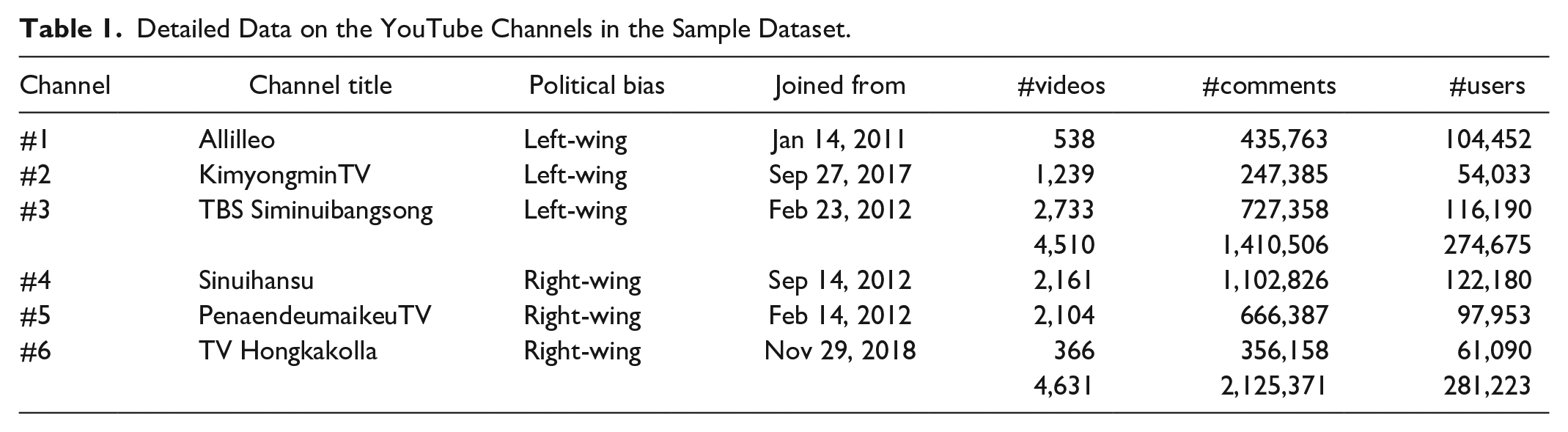
Before conducting the experiments, we had an interview with three experts from Department of Politics in Seoul National University. They have suggested the list of channels as the representations of left-wing and right-wing in an accurate way and we have chosen the most common channels in both sides. Subsequently, three official channels representing the left-wing and three official channels for the right-wing were identified. These channels have a large number of subscribers and frequently upload videos. Consequently, they are effective for political communication and have become one of the official channels for conveying political news. Information regarding these official channels is provided in Table 1. We used these channels as a sample dataset to evaluate our hypothesis. The 71 other channels were used to create the testing dataset to examine the accuracy of the hypothesis, as well as the reliability of the model proposed in this study. Table 2 presents information about the 71 channels used in the testing dataset for the experiments.
Detailed Data on the YouTube Channels in the Sample Dataset.
About 71 YouTube Channels in the Testing Dataset.

In this study, we assume that there is intense polarization in YouTube users between the left-wing and right-wing. Moreover, users tend to watch, share, and discuss their ideas and opinions only on the YouTube channels that they support. To prove this assertion, after grouping the six aforementioned YouTube channels into left-wing and right-wing, we conducted username extraction from their comments for each group. Each username in our dataset was considered a user. Subsequently, we defined the number of common users who left comments in both left-wing and right-wing channels, based on the intersection of these two groups.
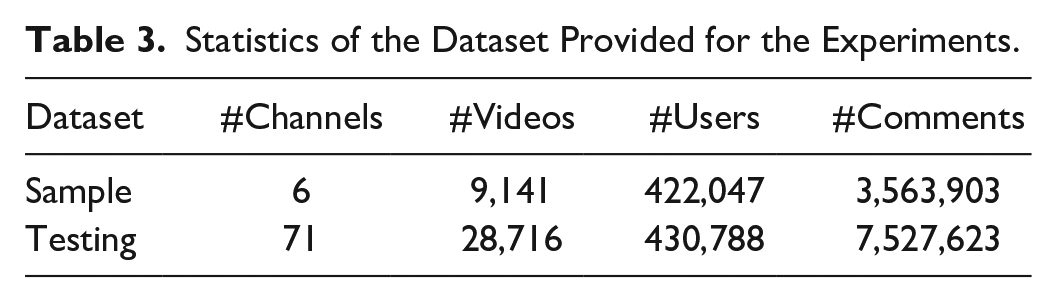
The number of users in the left-wing and right-wing groups after removing the duplicates were 182,984 and 193,842, respectively, whereas there were only 35,221 common users. The results show that the number of common users was small in comparison with the number of users in each group. In particular, the number of common users accounted for approximately 8. The testing dataset contained 71 channels, both personal and organizational, that discussed South Korean politics. There are more than thousand channels in the political domain. However, these 71 channels met the restrictions in the filtering step. Table 3 provides information on the dataset. There were 77 channels in total, with 37 K videos, 600 K users, and more than 11M comments, which were obtained from the Korean political YouTube channel case study. The main issues in this study were the classification of a channel as a left-wing or right-wing channel, visualization of the distribution in user activity to better understand their behavior, and measurement of the degree of political bias in each channel. After the list of users for each channel was obtained and the proposed model was applied, the experimental results are presented in the next section.
Statistics of the Dataset Provided for the Experiments.
Experimental Results
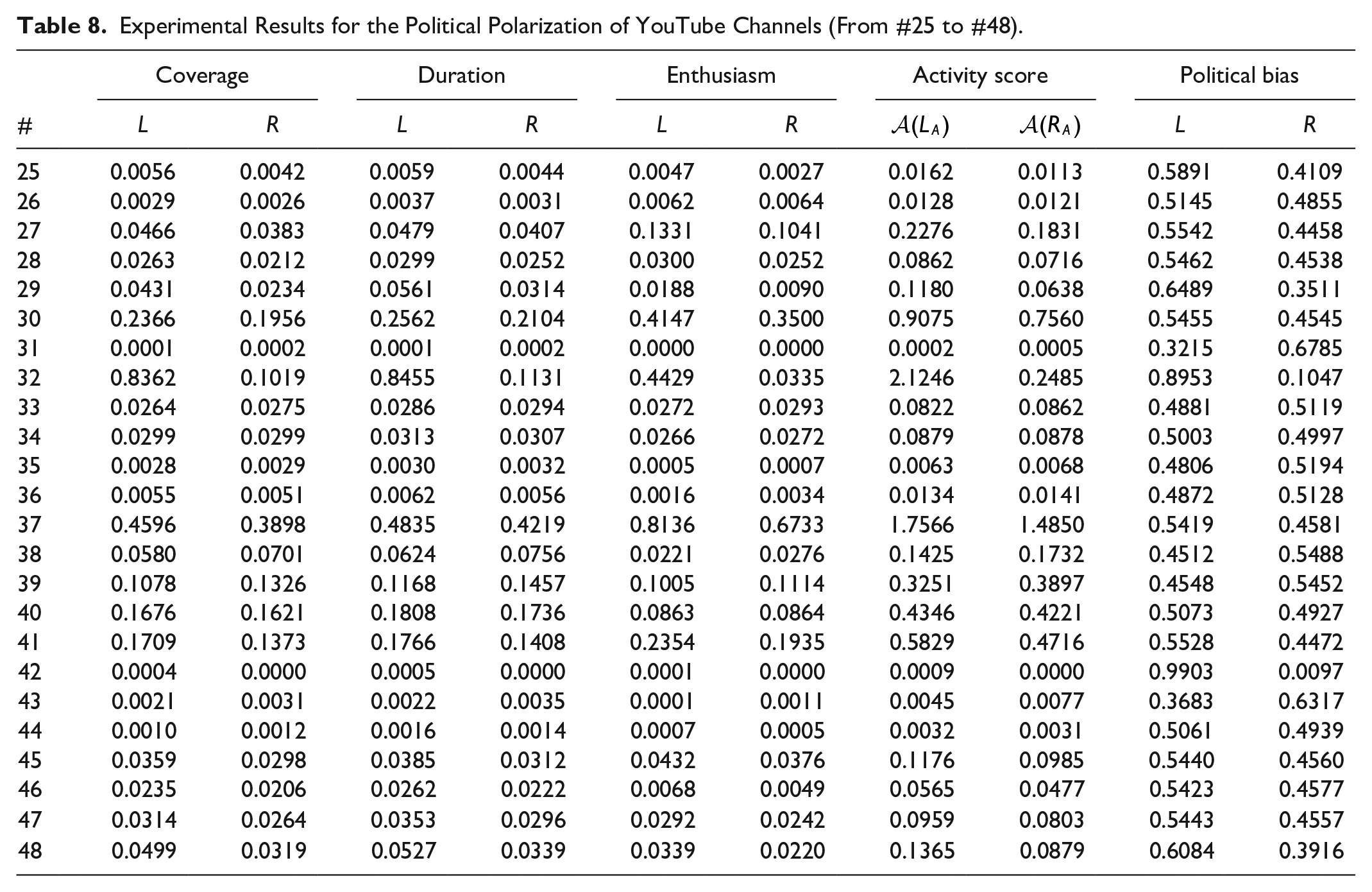
Tables 7 to 9 present the scores calculated after normalizing for the three features of coverage, duration, and enthusiasm for the 71 channels in the testing dataset after applying the proposed model. The higher the score of a channel, the higher is the degree of user activity in that channel. After obtaining the scores of all the features, activity scores
Each channel has activity scores corresponding to the left-wing and right-wing, based on the preceding formula. The last two columns present the bias value of the support associated with a channel for the left-wing and right-wing (rounding off to the second decimal place). The political bias values were obtained based on the final activity scores of the left-wing and right-wing in each channel. The gap between the left-wing and right-wing scores indicates the degree of political bias in the channel. Based on the table, more than 87% of the channels exhibited consistency in all three features. Therefore, if a channel is categorized as left-wing, its scores for all three features of left-wing are higher than those of right-wing. The greater the disparity between the scores, the stronger was the political bias of the channel. The nine channels that did not exhibit consistency in the scores of the three features were mostly the channels in the middle. Consequently, users of left-wing channels exhibited better energy based on higher enthusiasm scores. Moreover, users of right-wing channels were more proactive in terms of coverage and duration.
Figures 1 and 2 reveal the distribution of user activity in the log-scale charts of channel Channel A News (Korea) and TVCHOSUN News, respectively. These two channels support the conservative. The user activity of the right-wing group, which is presented in red, is much stronger than that of the left-wing group for all coverage, duration, and enthusiasm. Figures 3 and 4 illustrate the user activity distribution in the log-scale charts of two channels in the middle, SBS News and Korean News, respectively. As these two channels do not have any polarization in terms of politics, the degree of activity between left-wing and right-wing users is the same. Therefore, which political bias has stronger activity in these channels cannot be determined. Figures 5 and 6 present the distribution of user activity in the log-scale charts of channel Jeongchichodan and KBS 1Radio, respectively. It is evident that user activity corresponding to left-wing is stronger than that of right-wing activity for all three features as Jeongchichodan and KBS 1Radio support the liberal. According to the results, 35 channels support the left-wing, 33 channels promote the right-wing, and 3 channels are in the middle.

User activity distribution of channel Channel A News (Korea) in the log-scale chart based on three features: (a) coverage-based, (b) duration-based, and (c) enthusiasm-based.

User activity distribution of channel TVCHOSUN News in the log-scale chart based on three features: (a) coverage-based, (b) duration-based, and (c) enthusiasm-based.

User activity distribution of channel Korean News in the log-scale chart based on three features: (a) coverage-based, (b) duration-based, and (c) enthusiasm-based.

User activity distribution of channel SBS News in the log-scale chart based on three features: (a) coverage-based, (b) duration-based, and (c) enthusiasm-based.

User activity distribution of channel Jeongchichodan in the log-scale chart based on three features: (a) coverage-based, (b) duration-based, and (c) enthusiasm-based.

User activity distribution of channel KBS 1Radio in the log-scale chart based on three features: (a) from channel 1 to 24, (b) from channel 25 to 48, and (c) from channel 49 to 71.
Table 4 illustrates the descending polarization percentages of the channels belonging to the left-wing. Approximately 45% of the channels exhibited strong polarization in the left-wing group when the percentage of bias was higher than 70%. Korea Breaking News, Jeoneollijeum Tokeusyo J, Daesgeul Ilgeojuneun Kijadeul, JKgongsig, and KBS 1Radio are the channels that exhibit the highest bias in politics of more than 90%. Table 5 illustrates the descending polarization percentage of the channels that belong to the right-wing. Approximately 40% of the channels exhibited extreme polarization in the right-wing group, because the percentage of bias was higher than 70%. Ulijeongchiilggi is the most polarized channel with 95% bias for conservatives. Hwangjangsuui Nyuseubeuliping, TV Baijin, Jeongchisepo, Choitub, Hankuk Sisanyuseu, and JeongchitaunTV are extreme right-wing channels given that the percentage of bias is higher than 90%. Table 6 presents the polarization percentages of the three channels in the middle with no polarization. However, channels with a gap of less than 10% between the left-wing and right-wing can also be considered as middle channels. Therefore, approximately 21 channels can be considered middle channels because they do not exhibit much bias, based on the results of our model. Most of these channels discuss general daily news, documentaries, or entertainment. As they are mostly created by national broadcasting systems, they should maintain a balance in the sharing of information instead of expressing strong political bias like individual channels.
Bias Percentage to Liberal of Left-Wing Channels.

Bias Percentage to Conservative of Right-Wing Channels.

Middle Channels.
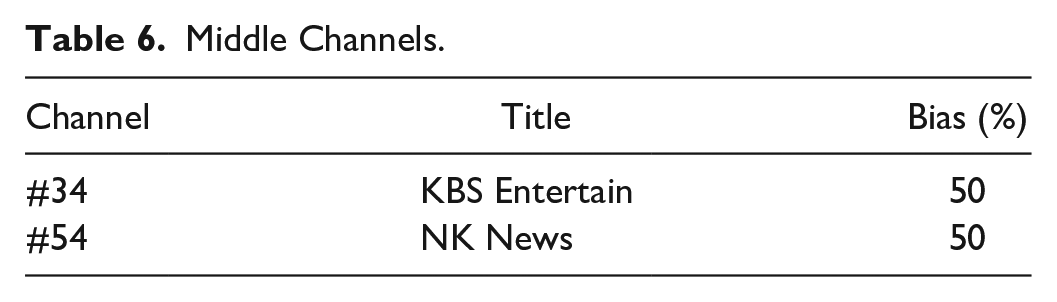
Figure 7 presents the experimental results for the measurement of political bias. The blue represents the left-wing, and the red is indicative of the right-wing. To respond to skewness toward large values, we decided to use the log-scale chart to present the classification results for the 71 YouTube channels in the testing dataset, which are shown in Figure 8. The blue nodes (squares) denote left-wing channels, whereas the red nodes (circles) denote right-wing channels. Tables 7 to 9 present the detailed experimental results for the 71 YouTube channels of the testing dataset. Columns 8 and 9 present the average scores for users
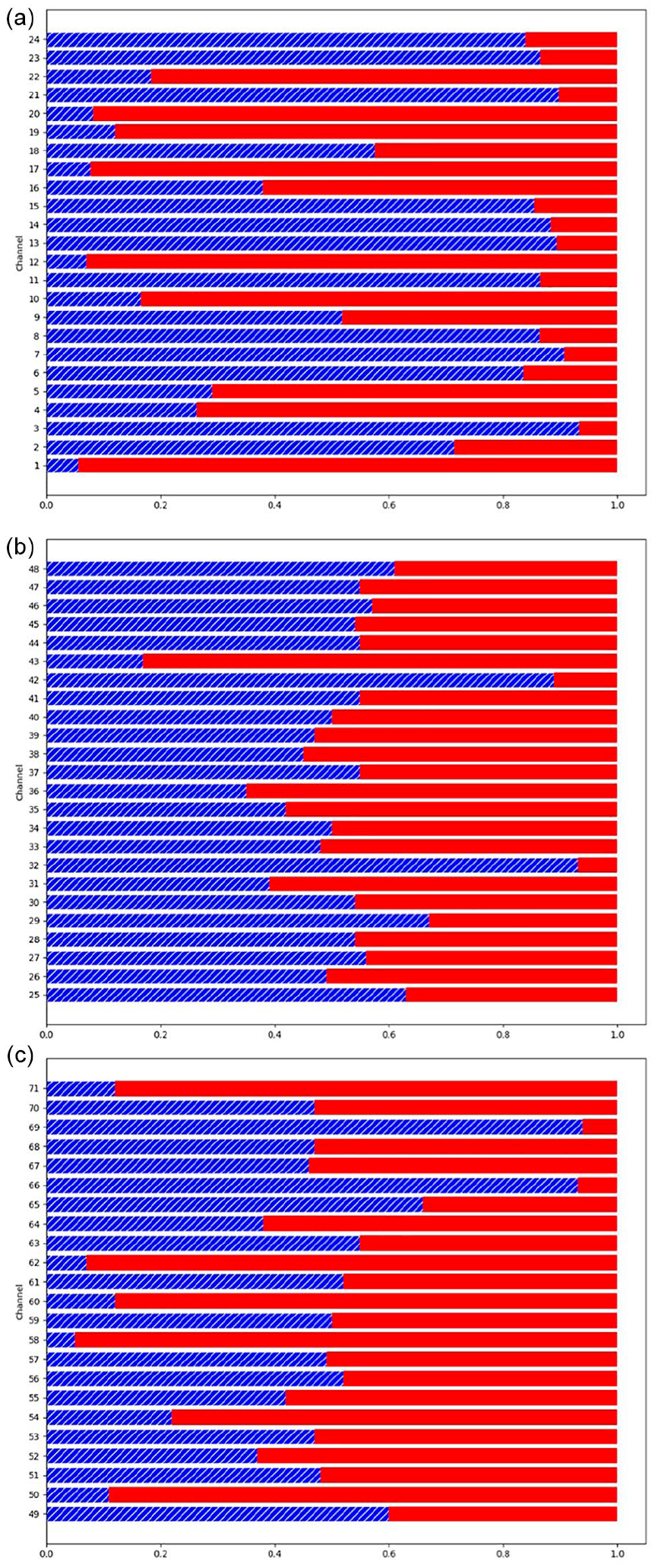
Percentage of the political bias labels predicted for the 71 channels in the testing dataset. The blue and red colors present the left-wing and the right-wing, respectively.

Classification results for the testing dataset (71 YouTube channels) in the log-scale chart.
Experimental Results for the Political Polarization of YouTube Channels (From #1 to #24).

Experimental Results for the Political Polarization of YouTube Channels (From #25 to #48).
Experimental Results for the Political Polarization of YouTube Channels (From #49 to #71).

Conclusion and Future Work
We proposed a user-activity-based model using data from YouTube, one of the most popular video-sharing platforms, to explore political polarization. By applying the proposed model, we exploited the implicit meaning of user activity to better understand bias in online users. Using coverage, duration, and enthusiasm as features, the model yielded outputs to examine the research questions. We conducted experiments based on a case study of Korean political YouTube channels. To collect daily data, the TubePlunger system was built using the MVC model to address issues related to the API’s key limitations and security problems. The data were split into a sample dataset with six official channels, which were the channels attributed to known political bias, and an experimental dataset with 71 channels of various types. First, we extracted the usernames from the sample dataset, which are considered political supporters, corresponding to the left-winger and right-winger lists. These two lists were then considered representative lists of left-wingers and right-wingers. Second, the lists of usernames obtained from the 71 channels in the testing dataset were matched to the representative lists to filter the usernames needed for the model input. Finally, we applied the model to measure political polarization and user activity distribution in each channel. The experiments were processed using a dataset that included 77 channels, 37 K videos, 600 K users, and more than 11 M comments, obtained from the study of the Korean political YouTube channels.
In this study, we attempted to answer two research questions. We extracted usernames from six official channels in response to RQ (1). After dividing them into left-wing and right-wing groups, there was a small portion of common users who left comments in both left-wing and right-wing channels, based on the intersection of these two groups. Notably, the number of common users only accounted for 18% of the number of left-wingers, 19% of the number of right-wingers, and only 8% of the number of users in the entire sample dataset. Therefore, based on this case study on Korean YouTube channels, it was determined that there is intense polarization in the political communities on YouTube. In response to RQ (2), data from 71 Korean YouTube channels were used for the proposed model in the experiments. As a result, in the other categories of online video channels, there is still a political bias, depending on the channel. The channels that usually posted videos on politics or topics related to politics had a stronger degree of political bias than entertainment channels. Some channels also hosted videos on news about politics, but they exhibited less polarization because they were national channels. In addition, the experimental results do not classify the channels according to their beliefs; however, they reveal the devotion of users that follow a channel, corresponding to the left-wing and right-wing groups. The final results illustrate the consistency in user activity distribution in all three proposed features of most channels without an understanding of the content of the comments. Based on the results of this study, the proposed model can be used in other online sharing platforms that have many political communities such as Facebook or Twitter with the same original hypothesis and customized features depending on its characteristics.
This study had several limitations. First, there are some cases of different users having the same username. Our current experiment only considered usernames without identifying the exact users. This flaw leads to inaccurate measurement of user activity. Second, not all users who commented on videos in a particular channel were talking about political issues. The proposed model does not consider the content of comments or the content of the videos. Hence, in the next step, we need to remove videos that are not related to political topics. Third, the current version of the proposed model is not fully able to identify accurate supporters because we do not consider the sentiment of comments.
Future work should consider determining the weight of each feature to improve the performance of the model. Furthermore, the model should be upgraded by adding new meaningful features to guarantee greater output. Analysis of the sentiment and content of videos, as well as comments, is an accurate way to obtain a comprehensive perspective on user behavior in OSNs.
Footnotes
Declaration of Conflicting Interests
The author(s) declared no potential conflicts of interest with respect to the research, authorship, and/or publication of this article.
Funding
The author(s) disclosed receipt of the following financial support for the research, authorship, and/or publication of this article: This work was supported by the Ministry of Education of the Republic of Korea and the National Research Foundation of Korea (NRF-2019S1A5A2A03052591).
