




Abstract
Considering the importance of agri-food exports for Nigeria in the face of dwindling revenue from its oil exports. Therefore, this study provides empirical insights on the determinants and potential of agri-food exports from Nigeria to 70 major trading countries between 1995 and 2019 by applying a Stochastic Frontier Analysis (SFA) on a gravity model. We also estimate a variety of techniques, including the fixed effects, Ordinary Least Square (OLS), Pseudo Poisson Maximum Likelihood (PPML), and Heckman models to confirm the robustness of our results. We show that the economic size (GDP) of Nigeria and its trading countries, importers’ population, EU membership, ECOWAS membership and contiguity stimulate agri-food export. Also, we show that bilateral distance, domestic population, exchange rate, language, and landlocked adversely affect agri-food exports. The potential for agri-food trade expansion exists with mostly world biggest economies (including China, the USA, Brazil, India, Russia, Japan, and EU countries) and Nigeria’s border countries. Policy directions for agri-food export expansion are provided.
Introduction
The agri-food sector plays a vital role in Nigeria’s economy and contributes to 6.6% of the country’s total merchandize trade (i.e., between 1995 and 2019). Although the figure seems to be meager, but the trade value has substantially improved. For instance, it increased to 131.77 billion USD in 2008 from 20.56 billion USD in 1995 and then 181.64 billion USD in 2011, before dropping to 119.71 billion USD in 2019 (UNCTAD, 2020).
Also, the sector is vital for ensuring food security among the Nigerian populace (Owoo, 2021). In Nigeria, almost 60% of the population live in rural areas and directly or indirectly depend on agri-food for their survivals (Abdullahi, Aluko et al., 2021; Osabohien et al., 2019). Between 1995 and 2018, the sector engrosses 42.86% of the country’s total labor force (World Bank, 2020). Moreover, it serves as an imperative base of foreign exchange earnings and helps other sectors to drive their growth process.
The Nigerian agri-food sector is faced with huge challenges ranging from subsistence agriculture, lack of modern farm inputs, poor access to finance, insecurity, rapid urbanization, population growth, among others (Abdullahi, Shahriar et al., 2021; Verter et al., 2020). Despite these, the sector remains key to Nigeria’s economic development. It remains the largest non-oil export, the second major contributing sector in GDP earnings and has occupied a prominent position in the economic policy formulation of the country (Abdullahi, Zhang et al., 2021). Recently (from 2015 to 2019), Nigeria’s agri-food sector accounted for 11.69% of the total agri-food exports from the Economic Community of West African State (ECOWAS) and ranked 3th after Cote D’Ivoire and Ghana which accounted for 46.66% and 25.60%, respectively (UNCTAD, 2020).
Trade serves as a major ingredient for the economic integration and growth. Similarly, a country’s economy can develop by utilizing its available trade potential (Jiang et al., 2021). Trade quantitatively expands the economy and is a key source of foreign exchange earnings (Ali et al., 2020; Emam et al., 2021). Nigeria is among one of the major supplies of crude oil in the international market. However, the country has been hit hard in the global oil market due to the uncertainty of the global oil prices (Adika, 2020; Ding et al., 2020). Therefore, in its efforts to diversify its economy, Nigeria have intensified efforts to shift away from over-reliance on crude oil and its commodities by investing in agriculture production and exports (MBNP, 2017).
We are able to offer empirical evidence on the factors and opportunities for Nigeria to boost income from the agri-food export as a consequence of our comprehensive work. The fact that the agri-food sector has gained a lot of attention from the Nigerian government and industries in recent decades is one of our motivations for becoming involved. The contribution of our work to the current literature is as follows. First, it is the first study on agri-food exports covering Nigeria and its major exporting nations. Second, identifying the factors that influence agri-food export trade and countries where further export growth is possible will help guide the country toward a sustainable, long-term economic path. Third, we used several estimation techniques in testing the relationship, including our baseline model (the stochastic frontier gravity model (SFGM)), the fixed effects, ordinary least square (OLS), the Poisson pseudo maximum likelihood (PPML) and the Heckman model. This paper applied these techniques to confirm our result’s robustness, control the time-invariant factor that may affect the relationship and controls for heteroscedasticity that may exist in the gravity model, and deal with the zero trade flow problem, if not addressed, may create a selection bias.
The layout of the paper is structured as follows. The next section focuses on the overview of the Nigerian agri-food sector. Section 3 reviews relevant empirical studies. We discuss the methodology used in this study in section 4. Next, we present the findings and discusses them in section 5. Finally, in section 6, we conclude the paper and offer policy recommendations.
Nigeria’s Agri-Food Export Trade: An Overview
Nigeria’s agri-food sector is one of the primary sectors of the economy (Abdullahi, Zhang et al., 2021; Zdráhal et al., 2019). A close look at Figure 1 shows that the portion of agricultural revenues in Nigeria’s GDP slightly decreases from 25.49% in 1995 to 21.91% in 2019, however, the sector contributed the highest (36.97%) share in 2002. Similarly, the share of agricultural employment decreases from 50.08% in 1995 to 35.1% in 2019 (World Bank, 2020). This might be due to Nigeria’s diversification of its revenue sources, which has resulted in abandoning this sector thereby causing a drop in bilateral agri-food trade. Other causes include the rapid growth of non-agricultural sectors like oil and services sectors, rural-urban migration as well as the country’s rapid population growth (Abdullahi, Aluko et al., 2021). Table 1 shows the performance of the Nigerian agri-food industry during the study period. The table also shows that the share of food imports and food exports accounted for 15.4% and 2.2% of overall Nigeria’s imports and exports respectively. Sadly, Nigeria recorded a negative turnover in its agri-food sector throughout the study period (see Table 1).

Nigeria’s GDP and share of agriculture in GDP, 1995-2019.
Performance of the Nigerian Agri-Food Sector.

Source. Authors’ calculation using data from UNCTAD.
Figure 2 shows major Nigeria’s agri-food import markets and the major destinations of Nigeria’s agri-food products. Based on the average value (1995–2019), the United States of America is the top Nigeria’s trading partner in agri-food trade (imports and exports) with an annual market value of 825.39 billion USD, followed by the Netherlands, Brazil, the United Kingdom and Thailand with the values of 522.64, 389.54, 232.83, and 229.91 billion USD, respectively. Similarly, these five countries together with China and Ireland are also the top import markets for Nigeria, and they accounted for 50.26% of total Nigeria’s imports. The major Nigeria’s agri-food destinations are the Netherlands, Germany, Vietnam, India and France, and they accounted for 45.54% of total agri-food exports during the study period. According to the UNCTAD (2020), cocoa, spices, crustaceans and invertebrates fish, chilled or frozen, fixed vegetable oils, fruits and nuts, oil seeds and oleaginous fruits are the major agri-food products exported from Nigeria.
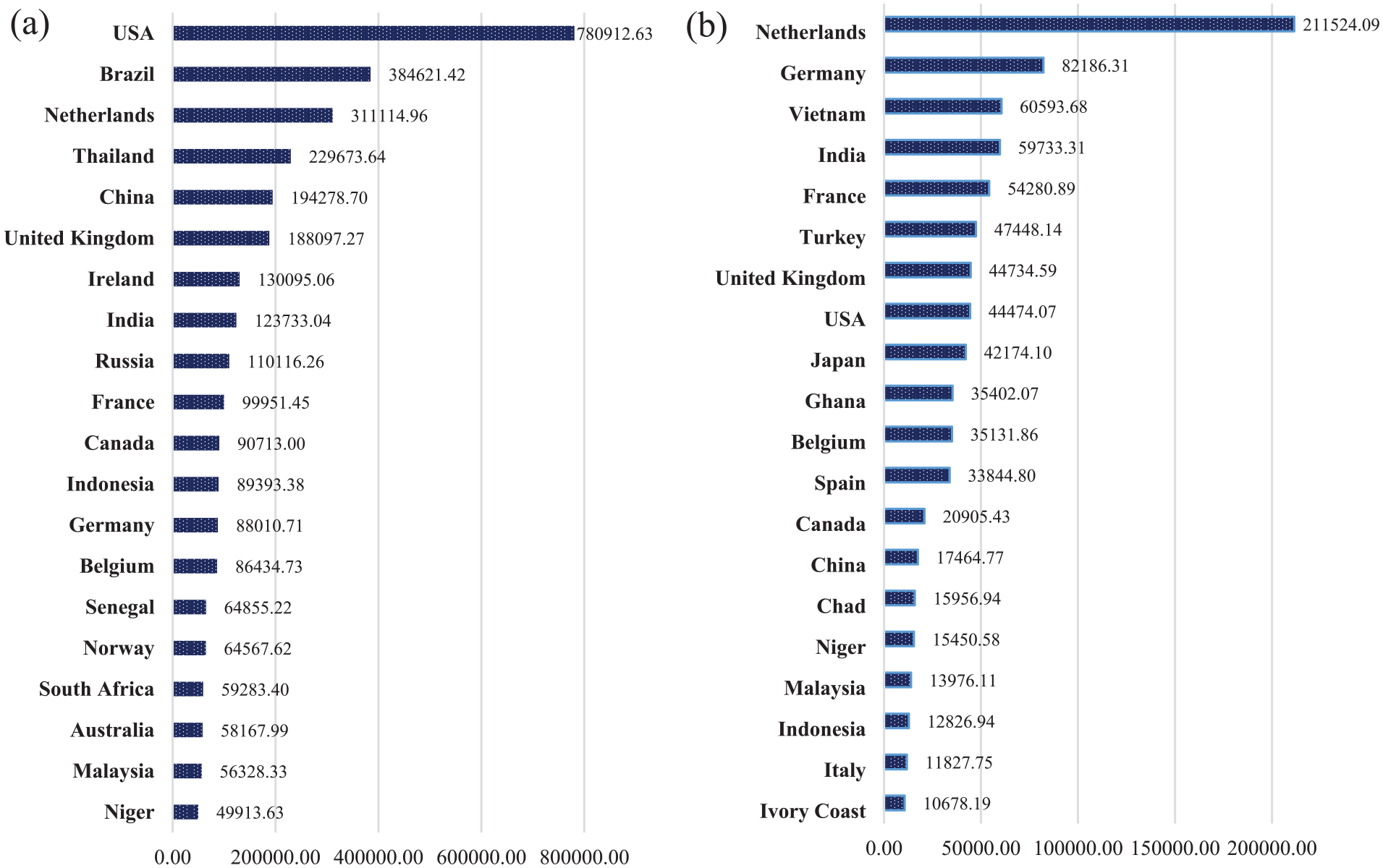
Nigeria’s top ten imports markets and its destination, mean, 1995–2019: (a) imports (1,000 USD) and (b) exports (1,000 USD).
Review of Related Empirical Literature
Traditionally, the trade potential has signified the variation between estimated and actual trade values (Nilsson, 2000). Export led growth strategists have often attempted to explore export affecting factors and growth because, without an in-depth understanding of the economic environment of that country and the output of export-supporting factors, the export strategy will not succeed (Dadakas et al., 2020). This section reviews some previous studies on agriculture and agri-food export trade potential using the gravity equation. For example, Abdullahi, Aluko et al. (2021) examined the determinants, efficiency and potential of agri-food export between Nigerian and the European Union (EU) countries using the SFGM. The study shows that agri-food export between Nigeria and its EU counterparts is determined by both the economic size and income of Nigeria and its importing nations, bilateral exchange rates, and distance. The study further shows that Nigeria scored a relatively low efficiency and has a huge potential that is yet to be tapped with the EU countries.
Hajivand et al. (2020) employed the Stochastic Frontier Analysis (SFA) on a gravity model, to examine the Iranian agricultural export potential using a panel of 38 countries, from 1982 to 2017. The results show that the partners’ GDP and the Iranian population influence the country’s agricultural export. The results also show that the country exhausted 69% of its trade potential with its trading partners.
On the other hand, Nguyen (2020) also applied the SFGM to study Vietnamese agricultural exports with particular preference to rice and coffee exports. The study showed that the effect of “behind the border” limits is statistically significant and Vietnam’s exports of these commodities may not be able to attain their full potential. The research also emphasizes the importance of increasing exports of these commodities to the Association of Southeast Asian Nations (ASEAN) and the EU.
For the period 2000 to 2016, Sapa and Droždz (2019) investigated the determinants of Poland’s agri-food exports to non-EU countries. According to the research GDP and agricultural value-added promote trade between Poland and non-EU countries. Meanwhile, the detrimental effects of Poland’s geographical distance and historical situation are evident.
Aguirre González et al. (2018) employed the OLS version of the gravity model to examine the factors affecting the Nicaraguan agricultural exports. The results indicated that Nicaragua’s trading partners’ population, per capita GDP of Nicaragua and that of its trading partners, and the exchange rate affect the country’s export. Also, the results show that bilateral distance is an obstacle to the country’s export.
Barma (2017) analyzed the efficiency of India’s agricultural export flows using the SFGM. Using a panel dataset consisting of 112 countries over the period 2000 to 2013. The study finds that inefficiency exists in trade and suggests that export efficiency assists in articulating the future trade policies for the expansion of the country’s agricultural exports. Braha et al. (2017) used the PPML estimation technique to show that the geographical distance, exchange rate, price stability, and trade liberalization all influence Albania’s agricultural export during the 1996 to 2013 period.
To investigate the factors and possibilities of Pakistan agricultural exports expansion, Atif et al. (2017) employed the gravity model with the SFA. They found that the country’s agricultural exports are positively determined by both the importers’ and exporter’s GDP, the exchange rate, common border and colonial links. The study demonstrates that Pakistan has a lot of potentials that are yet to be exploited, particularly with its neighboring countries, European and Middle Eastern countries.
Crescimanno et al. (2013) used a 1996 to 2010 panel dataset to investigate the key drivers of Italian agri-food exports to non-EU Mediterranean partner countries. The study identifies many characteristics favorably connected with Italian agri-food exports, which includes trading partner country’s wealth, geographical proximity, colonial and historical ties, and the agricultural sector’s lack of prominence in some partner nations. Shuai (2010) investigated the Sino—US agricultural trade potential using the gravity model with the fixed-effects model approach. The study shows that China and the United States have varied potentials for agri-exports due to regional differences.
In the past, many scholars have carried out empirical studies to examine the commodity-specific gravity equation of the factors affecting exports of agricultural commodity of different emerging economies. For example, Abdullahi, Shahriar et al. (2021) studied the factors affecting Nigeria’s cocoa exports using the gravity equation in three different versions (Generalized Least Square [GLS], PPML and the Heckman models). The study shows that GDP, per capita GDP, exchange rate, distance, EU, WTO, landlocked, and colonial ties are significantly associated with the Nigerian cocoa export flows. The study also highlights the possibilities of cocoa exports expansion to Nigeria’s trading partners.
In a similar vein, Kea et al. (2019) provided a case study of the Cambodian rice industry using a panel dataset spanning the 1995 to 2016 period. The study also uses the GLS, PPML, and the Heckman models to examine the factors affecting rice exports. The study shows that the exchange rate, historical links and agricultural land reforms stimulate rice exports.
Nsabimana and Tirkaso (2020) examined coffee export performance in Eastern and Southern Africa using the static and dynamic versions of the gravity model. The findings show that coffee exports are mostly determined by the population size of both exporting and importing countries, geographical distances, and income. They suggested that exporting nations in these regions might increase coffee exports because their findings demonstrated that the countries are failing in terms of their full potential on the international market.
Shahriar et al. (2019a) investigated the factors affecting China’s meat exports, with a particular preference to pork, specifically in exploring the role of Belt and Road Initiative (BRI). The study shows that the impact of the BRI is positively significant, indicating that a larger-scale project of the BRI would stimulate China’s exports in its meat industry. Furthermore, the GDP, Chinese language, WTO membership, and the country’s land area significantly affect China’s pork exports.
Bose et al. (2019) examined the factors that influence Oman’s fish exports to the EU, focusing on the relative importance of border rejections and domestic bans. The results for the period 2000 to 2013 show that domestic export bans, domestic structural changes, and exchange rate instabilities, rather than border rejections, have affected fish export trade to EU markets.
Many scholars have used panel data to study the factors impacting agricultural export and potential for different nations, as evidenced by the existing literature. However, this study differs from previous research. We did not focus on agricultural exports in general but instead chose agri-food exports as a dependent variable using panel data from 1995 to 2019, estimated using a variety of gravity equations that have never been investigated in a single study. To the best of our knowledge only Abdullahi, Aluko et al. (2021) did similar research. However, this study improves on Abdullahi, Aluko et al. (2021) by extending its scope beyond EU countries. It focuses on Nigeria’s agri-food exports to major trade partners across the world. By doing this, this study provides a more comprehensive evidence which would guide better agri-food export trade policy formulation.
Methodology
In international trade literature, the gravity model has become the most popular to ascertain how certain factors influence trade flows (Boughanmi et al., 2021). The linear form of the traditional gravity model can be written as follows:

The specification of the extended gravity model for the measurement trade flows (Anderson & van Wincoop, 2003; Gros & Gonciarz, 1996; Nilsson, 2000) is written as follows:
Where Xijt is the bilateral agri-food export trade flows between Nigeria and importing country for a given period of time (t = 1995–2019), (j = 1, 2, 3, 4. . .. . ..70), GDPit and GDPjt denote the economic size of both countries, Distij is the geographical distance between the capital city of Nigeria and the capital city of importing country.

Where Xijt, GDPit, GDPjt, and Distij have the same definition as above. POPit and POPij are the population of the respective countries that capture factor endowments in the exporting country and consumption patterns in the importing country (Barma, 2017). In addition, equation two includes the time-invariant explanatory variables vector (distance, landlocked, language, contiguity), Zij; the time-variant trade-stimulating (GDP, per capita GDP, population) and trade stimulating variables (EU, ECOWAS, colony) vector, Xijt; and the error term, εijt.
Usually, forecasts trade flows for countries of interest use the parameters of the gravity model calculated for a group of countries that best reflect normal trade ties. The main weakness of this method is that the trade boost potential is expressed in terms of the sample average rather than the maximum amount feasible for a given pair of trading partners. It can be difficult to calculate trade potential against average expected values because the predictive capacity of the gravity model decreases as the year of the inserted values gradually deviate from the sample average (Abdullahi, Aluko et al., 2021). This is because when the inserted values are equal to the historical average, the width of the confidence intervals is smallest but extends sharply and thus increases the regression prediction error-as the inserted values differ from the mean of the sample.
However, the gravity equation of trade determinants defines the trade frontier under the SFA approach. The resulting frontier trade levels, that is, the potential maximum trade level for a given bilateral trading pair, are influenced by a random error term that can be positive or negative, allowing the stochastic frontier trade level to differ from the deterministic part of the gravity equation. For each bilateral trading pair, observed trade levels can then be measured against this frontier trade level in order to determine the potential for trade expansion. A detailed exposition of this approach is given in the next subsection.
The Gravity Equation Estimated Using SFA
The model was developed separately by Aigner et al. (1977) and Meeusen and van Den Broeck (1977). The SFA defines a development frontier in its conventional application describing the maximum output that can be achieved from a given amount of inputs.
In SFGM, the actual trade Tijt trade potential



Where Xijt denotes the established variables influencing the actual trade level in a gravity equation, including GDP, per capita GDP, distance, landlocked, etc. α is a vector of unidentified parameters. Vijt represents a random noise that indicate the estimation deviation caused by uncontrollable factors, such as statistical error, and obeys the normal distribution with a mean value of 0. Uijt denotes a trade non-efficiency term, which is independent of random noise. It measures the factors affecting trade resistance which are not included in the model, including government policy, tariff level, and so on.
Time-Varying SFGM
In this study, we established a time-varying SFGM by changing the conventional model of gravity (equation (2)) into a time-varying SFGM to estimate Nigeria’s agri-food export trade flows. The specific equation for our study is written as follows:

In equation (6), all the trade determinants are the same as the equation two. However, the error term εijt has been separated into two segments, that is, the two-sided error element. Vijt indicating the statistical noise due to the measurement error and a one-sided inefficiency element, Uijt indicating the measure of trade performance. While the former term is implicit to follow a normal distribution, Vijt ∼ (0, σv2), as is typical of the conventional gravity specification. The latter term Uijt is implicit to be distributed independently of the random error and the regressors. A nonnegative random variable representing technical inefficiency (the existence of trade potential), this one-sided inefficiency component can identify the degree to which observed levels of trade deviate from the maximum possible. Due to Multilateral Resistance (MTR) (Anderson & van Wincoop, 2003), which is often unnoticeable or hard to quantify, these deviations from the maximum trade level can occur. Trade resistance may, in effect, lead to an inefficient level of trade performance.
Equation (6) is expressed as a pool of frontier whereby the parameter values are obtained via maximum likelihood estimates (Aigner et al., 1977; Ravishankar & Stack, 2014). In order to justify the use of the SFGM, estimates are generated for the variance of the composed error term, σ2 = σv2 + σu2, and the ratio of the standard deviation of the inefficiency component to the standard deviation of the random error component λ = σu2/σ2. An additional test for the existence of trade efficiency in the model is carried out by means of a null hypothesis one-sided likelihood ratio (LR) test, H0 = σu2 = 0, against the alternative, H0: σu2 > 0. A failure to reject the null hypothesis implies a drop of the SFA model and consideration of an alternative model (Battese & Coelli, 1988). The full model specification of agri-food exports influencing factors for Nigeria is specified as follows:

The excijt is the bilateral exchange rate in Naira to the importing country’s currency. The exchange rate is included to capture the trade impact of currency price fluctuations, inspired by the gravity model derived by Bergstrand (1985), which specifically includes an exchange rate index to account for location-dependent trade costs. The dummies included in equation (7) capture the effect of the EU, ECOWAS, common language, landlocked, colony and contiguity on Nigeria’s agri-food exports. The dummies take a value of “1” if a country is EU, ECOWAS, shares a common language with Nigeria, landlocked, colonial ties or if a country a shares border with Nigeria, while “0” if otherwise.
In order to further confirm the robustness of our estimation, we consider alternative estimation techniques. In this paper, we considered the fixed effects model (based on the Hausman test), OLS, PPML, and Heckman models estimation techniques. In the gravity model, the FE technique accounts for unobservable variability and governs the MTR phenomenon (Head & Mayer, 2014; Shahriar et al., 2019b). It, however, does not estimate the time invariant variables of the gravity equation, as the averaging with transformation excludes such variables. Normally, in the estimation, variables such as distance and contiguity are omitted. The OLS yields a two-sided residual function with an average function. It also yields reliable estimates for slope parameters; a reliable estimate of the intercept is achieved by adjusting the intercept so that all residuals are non-positive (Greene, 1982, 2005). The PPML and Heckman model are the best gravity equations to deal with a zero trade problem and perform better when compared with other gravity specifications (Gómez-Herrera, 2013; Shahriar et al., 2019b). In addition to solving the problem of zero trade, the PPML also addresses the problem of heteroscedasticity and multicollinearity. Santos Silva et al. (2006), Santos Silva and Tenreyro (2011) revealed theoretically how the problem of heteroscedasticity could cause biased results when estimating log-linearized gravity models and interpreting the elasticities.
Sample Size and Data Sources
The panel dataset consists of bilateral agri-food export trade from Nigeria to its 70 major agri-food trading countries over a period of 25 years, spanning from 1995 to 2019. These 70 countries are selected based on Nigeria’s annual average food export value. During the period chosen, the export value of the Nigeria agri-food to these 70 destinations accounted for almost 94% of the total agri-food export value of Nigeria. The dataset of this study, therefore, contain a total observation of 1750 (N = 70, T = 25). The sources of data for variables used and their units are mentioned in Table 2. Table 3 presents the descriptive statistics of the data. All the variables in the model are in natural logarithm except dummies and the dependent variable of the PPML model. The data is balanced and none of the variables deviates substantially from normal distribution. Also, no wide range between the minimum and maximum value of our observations.
Description and Source of Variables Used in the Study.

Source. Authors’ compilation.
Descriptive Statistics of the Variables Used in the Study.

Source. Authors’ calculation.
Results and Discussion
Determinants of Nigeria’s Agri-Food Export Trade
To identify the factors determining Nigeria’s agri-food export to its major trading countries, we estimate the model using the maximum likelihood estimator of the SFGM. Alternatively, we use the FE, OLS, the PPML and the Heckman model to confirm the robustness of the results obtained from the SFGM. The results of the estimations for the traditional and extended gravity model are presented in Tables 4 and 5, respectively. Both the LR test and the λ = 0.999 support the use of the SFGM. Similarly, based on the Hausman test, the FE model is preferred to the random effects model.
Regression Results of the Traditional Gravity Model.

Note. ***, **, and * indicate statistical significance at the 1%, 5%, and 10% level, respectively.
Source. Authors’ calculation.
Regression Results of the Extended Gravity Model.

Note. *** and ** indicate statistical significance at the 1%, and 5% level, respectively.
Source. Authors’ calculation.
In Tables 4 and 5, the coefficients of lnGDPit and lnGDPjt are positive and statistically significant. These findings indicate that an increase in the economic size of Nigeria and the importing countries would promote agri-food exports in Nigeria. For the distance variable, the coefficient is negative and statistically significant and this suggests that the kilometer gap between Nigeria and the importing country stifles agri-food exports from Nigeria. From Tables 4 and 5, the signs and significance of lnGDPit, lnGDPjt, and lnDisij follow theoretical expectations. The theoretical postulations of the gravity model suggests that the economic size (GDP) of both exporter and importer influences bilateral trade between countries while the distance between the countries hinders bilateral trade. Larger countries are expected to engage in more bilateral trade (Shahriar et al., 2019b). The farther apart countries are from each other, the less they are expected to trade, due to higher transportation costs associated with longer distance (Knoll et al., 2018; Liu et al., 2020).
Having established the applicability of the traditional gravity model, we extend the gravity model by adding other trade simulants (population of both importing and exporting countries, the exchange rate, EU, and ECOWAS memberships of the importing countries, common language, landlocked, common colony, and contiguity). As shown in Table 5, regarding other variables in the extended gravity model, the coefficient of POPit is negative in all models but statistically significant only in the SFGM, FE, and PPML estimations. An increase in Nigeria’s population causes its agri-food exports to reduce. Owoo (2021) argues that population is a major obstacle for increased food exports in Nigeria. This is because there is high demand for food products in the domestic market; thus, reducing the volume of food products available for exports. The coefficient of POPjt is positive and significant in all model. This shows that an increase in the population of importing country result in an increase in Nigeria’s agri-food trade. Barma (2017) documents a similar result for India and its agricultural products’ trading partners. The excijt is negatively and statistically significant in all models except in the FE estimation, although it maintained its negative coefficient. An increase in excijt results to a decrease of the Nigerian agri-food exports. This finding indicates that the appreciation of the local currency (Naira) against the importing country’s currency dissuades exportation of agri-food from Nigeria to importing countries. Currency appreciation makes agri-food exports costlier for importing countries. The depreciation of the Nigerian currency (Naira) would improve trade Igue and Ogunleye (2014).
The coefficient of EUjt dummy is statistically significant with positive sign in all the models. This finding implies that Nigeria’s agri-food export trade is boosted by trade engagements with countries with EU membership. This result is consistent with Kea et al. (2019), who show that EU membership plays a stimulating role in Cambodian rice export. The ECOWASj is positive and statistically significant in the OLS, PPML, and Heckman model estimations; however, it is positive but statistically insignificant in SFGM estimation. From this finding, it can be inferred that agri-food export trade in Nigeria is enhanced by other ECOWAS countries. This may be attributed to the ECOWAS trade liberalization scheme and the proximity of Nigeria to the ECOWAS members’ domestic markets. This finding contradicts Abdullahi, Shahriar et al. (2021), who find a negative effect of ECOWAS membership on Nigerian cocoa exports.
The coefficient of Languageij is negative in all models but only statistically significant in the SFGM estimation. This finding suggests that Nigeria’s agri-food export trade is likely to be less facilitated if it shares a common language with the importing country. Several studies reveal that a language is a tool for network and communication enhancing trade (Selmier & Oh, 2012; Shahriar et al., 2019a). Our finding opposes prior studies (Castillo et al., 2016; Fidrmuc & Fidrmuc, 2016).
We find that negative coefficients for the landlocked variable in all model, but only statistically significant in the OLS, PPML and Heckman model estimations. This finding supports that the volume of agri-food exports to landlocked countries tends to be lower relative to countries that are not landlocked (i.e., countries with seaports). Less trade costs are associated with exportation to countries with seaports. Trade costs have been shown to impact the composition of trade and the competitive advantage of a nation in exports (Milner & McGowan, 2013; Ravishankar & Stack, 2014). Landlocked countries tend to be disadvantaged in trade terms because of their geographical position (Irshad, Xin, & Arshad, 2018; Paudel & Cooray, 2018).
The coefficient of Contiguityij is positive and statistically significant, indicating that countries sharing borders with Nigeria (Cameroon, Benin, Chad and Niger) facilitate agri-food exports from Nigeria. Irshad, Xin, Shahriar, et al. (2018) document a similar results between Pakistan and its rice trading partner. Local trade networks and agglomeration patterns are shaped by contiguity, which resultantly structures economic activities (Carter et al., 2018).
Nigeria’s Agri-Food Export Trade Potential
The estimated potentials from the two models (traditional and extended) are almost similar with slight differences and are presented in Table 6. However, based on the extended model, it can be seen that, on the average, Nigeria’s agri-food export trade has an untapped potential of 583.70 yearly over the period 1995 to 2019, with its trading countries considered in this study. The top countries where Nigeria has the highest unexploited potential include China, the US, Brazil, India, Turkey, Russia and Japan, with an average potential of 12.93, 12.01, 11.68, 11.56, 11, 10.99, and 10.58, respectively. Such potential exists due to the economic and market size of the countries. Also, Nigeria has a relatively high untapped potential with neighboring countries such as Niger (10.29), Benin (10.11), Chad (9.93), and Cameroun (9.24). These potentials exist due to the geographical proximity and cultural similarities between Nigeria and its bordering countries. Irshad, Xin, and Arshad (2018) reveal that Pakistan has plenty of untapped potentials with its partners in rice exports and as such the country can perhaps decrease and increase foreign exchange earnings to cut the trade deficit by targeting countries calculated with high potential. Cyprus (5.53), Ireland (5.4), Lebanon (5.14), Namibia (4.98), and Estonia (4.9) are observed with the least potential for Nigeria’s agri-food exports.
Agri-Food Trade Potential.
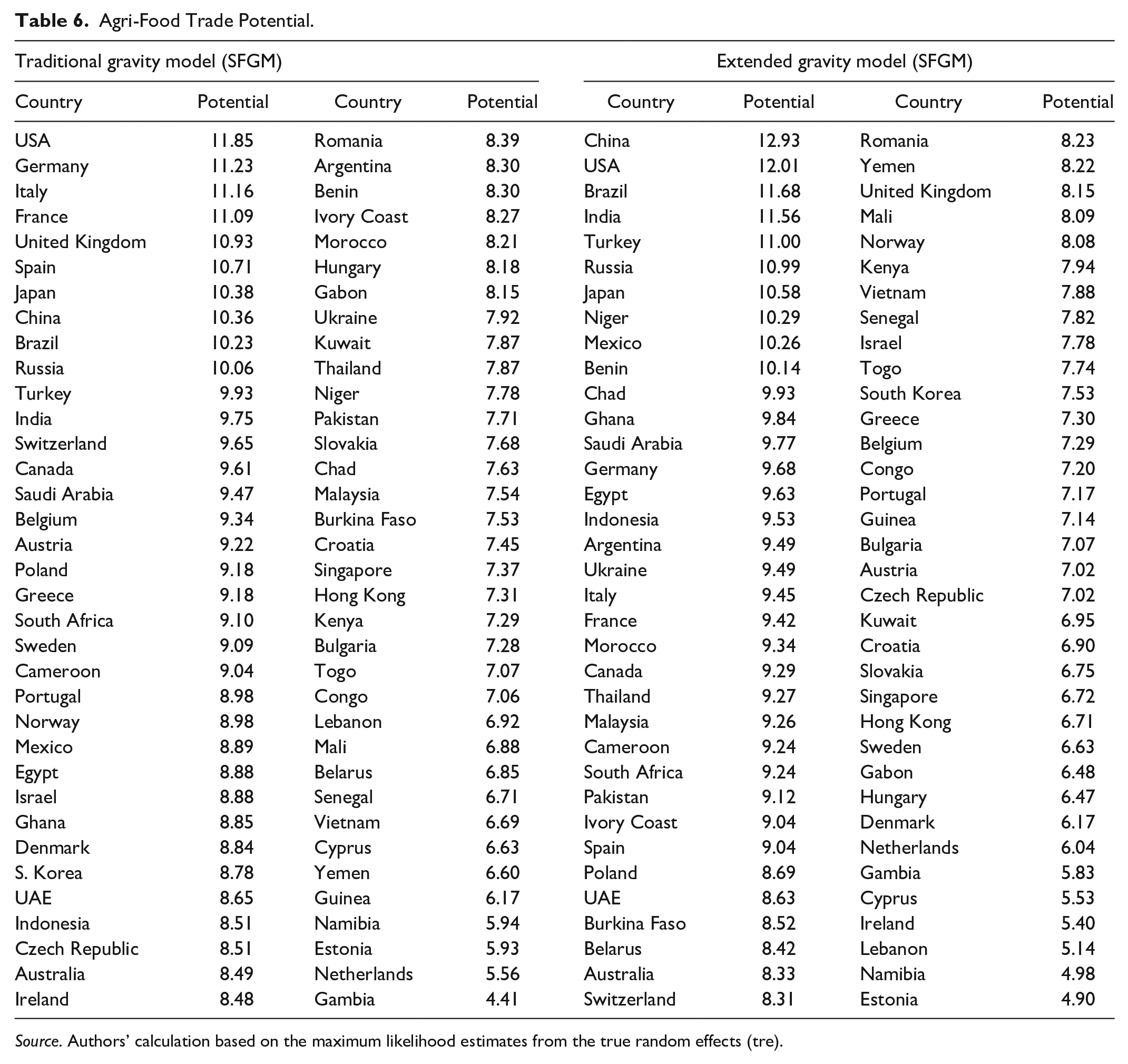
Source. Authors’ calculation based on the maximum likelihood estimates from the true random effects (tre).
Conclusion
The fall in demand for Nigeria’s oil exports and global oil price crash in recent years have spurred the Nigerian government to boost its non-oil revenue base, especially in the agricultural sector. On the back of this, we use the SFA on a gravity model along with an application of four analytical approaches, namely the fixed effects, OLS, PPML, and Heckman models to provide an empirical insight into the determinants and potential of agri-food exports in Nigeria with 70 trading countries between 1995 and 2019. By doing this, we bring novelty to existing literature. The following findings emerged based on a variety of estimators. We find that agri-food export trade in Nigeria is favorably determined by its economic size and that of its trading countries (importers) as well as the importers’ population, EU membership and contiguity. Also, we find that Nigeria’s agri-food export trade is adversely influenced by the distance between its capital city and importers’ capital city, its population, exchange rate, importers’ ECOWAS membership, landlocked nature of importers and common language. Moreover, we find that agri-food export trade from Nigeria to its major importing trading countries is sub-optimal and there is a relatively large potential that is yet to be exploited.
In line with these findings, we give policy directions to boost agri-food export trade in Nigeria. First, agri-food exports would be stimulated by formulating and implementing macroeconomic policies aimed at increasing the economic size (domestic productivity) of Nigeria. Second, the trade relationship between Nigeria and EU member countries should be strengthened. Third, Nigeria should engage in more agri-food export trade with ECOWAS members, especially with its bordering countries to overcome the high trade costs associated with distance and landlocked countries. Fourth, maintaining a relatively stable exchange rate would facilitate agri-food exports in Nigeria. Finally, Nigeria should increase its trade relations with China, the USA, Brazil, India, Russia, Japan, Benin, Cameroon, Chad, Niger, and EU countries calculated with high export potential.
Further research efforts are needed to add novelty to the existing body of knowledge by focusing on the agri-food imports of Nigeria. From a methodological point of view, future studies may focus on using a single gravity approach such as PPML to calculate export potential or other panel techniques, so that comparison could be made with our study.
Supplemental Material
sj-dta-1-sgo-10.1177_21582440211065770 – Supplemental material for Determinants and Potential of Agri-Food Trade Using the Stochastic Frontier Gravity Model: Empirical Evidence From Nigeria
Supplemental material, sj-dta-1-sgo-10.1177_21582440211065770 for Determinants and Potential of Agri-Food Trade Using the Stochastic Frontier Gravity Model: Empirical Evidence From Nigeria by Nazir Muhammad Abdullahi, Xuexi Huo, Qiangqiang Zhang and Aminah Bolanle Azeez in SAGE Open
Supplemental Material
sj-xlsx-1-sgo-10.1177_21582440211065770 – Supplemental material for Determinants and Potential of Agri-Food Trade Using the Stochastic Frontier Gravity Model: Empirical Evidence From Nigeria
Supplemental material, sj-xlsx-1-sgo-10.1177_21582440211065770 for Determinants and Potential of Agri-Food Trade Using the Stochastic Frontier Gravity Model: Empirical Evidence From Nigeria by Nazir Muhammad Abdullahi, Xuexi Huo, Qiangqiang Zhang and Aminah Bolanle Azeez in SAGE Open
Footnotes
Acknowledgements
The authors are grateful to the journal’s chief editor and anonymous referees for their tremendously useful suggestions on the earlier versions of our article. Surely, it has improved the quality of the article.
Declaration of Conflicting Interests
The author(s) declared no potential conflicts of interest with respect to the research, authorship, and/or publication of this article.
Funding
The author(s) disclosed receipt of the following financial support for the research, authorship, and/or publication of this article: This paper was supported by the Earmarked Fund for China Agricultural Research System (Grant Number, CARS-28).

References
Supplementary Material
Please find the following supplemental material available below.
For Open Access articles published under a Creative Commons License, all supplemental material carries the same license as the article it is associated with.
For non-Open Access articles published, all supplemental material carries a non-exclusive license, and permission requests for re-use of supplemental material or any part of supplemental material shall be sent directly to the copyright owner as specified in the copyright notice associated with the article.
