



Abstract
The aim of this study is to determine the knowledge level of primary school teachers with refugee student(s) present in their class related to classroom management and to determine whether this knowledge level varies depending on their gender, the type of school they graduated from, their seniority and whether they have received training in classroom management. The study group of this research, which is a survey model, is composed of 62 primary school teachers. In this study, “Classroom Management Knowledge Level Measurement Test” was used as a quantitative data collection tool while “Interview Form” was used as a qualitative data collection tool. Frequency, t-test, one-way analysis of variance, and Scheffe multiple comparison test were used in the analysis of quantitative data, and the descriptive analysis technique was used in the analysis of qualitative data. The results of the study showed that the knowledge level of teachers with refugee students(s) present in their class had low knowledge level related to classroom management, that their knowledge levels differed depending on their professional seniority and whether they have received training in classroom management, and that their knowledge levels did not vary depending on the type of school they graduated and gender.
Keywords
Introduction
Turkey has been facing one of the largest flock of migrants in its history due to its geographical location after wars and internal disturbances in the close neighboring countries as a result of pursuing moderate humanitarian policies toward opening borders to the people who have been victimized by the government. Some southern provinces in Turkey were forced to accommodate Syrian refugees twice as much of their population (Kızıl & Dönmez, 2017). According to the reports of the United Nations High Commissioner for Refugees (UNHCR) released in December 2020, Turkey hosts approximately 4 million refugees including 3,600,000 Syrians, 170,000 Afghans, 142,000 Iraqis, 39,000 Iranians, 5,700 Somalis, and 11,700 of other nations (UNHCR, 2020).
Refugee students have negative experiences in adapting to a different culture with different values, ethical principles, traditions, and customs from their own culture (Reid & Dixon, 2012). Causes such as cultural shock, lack of social support, language and communication-based barriers, longing for the country, and the feeling of loneliness can be considered as the main reasons for the problems of refugee students (Almurideef, 2016). Negative situations such as stress, physical pressure, feeling of exclusion, role confusion, and frustration experienced by refugee students (Kwadzo, 2014) may adversely affect the level of academic achievement, attendance, class adaptation, and social life of these students and make classroom management difficult for teachers. Instead of trying to solve all the problems at once with a magic classroom management strategy, what teachers need to do is to put the problems in order of importance and apply more realistic classroom management strategies. While determining the classroom management strategy to be implemented, priority should be given to solving the problems of refugee students within the boundaries of the school that negatively affect their educational activities. Among some of the important classroom management strategies are to adapt refugee students and help them to socialize and get rid of the feeling of loneliness, and regain their self-confidence.
Mass migration not only affects the refugee children but also incommodes the schools, students, and teachers of the guest country (Erdem, 2017). Physical deficiencies in schools caused by migration, crowded classes, dual education, lack of teachers, and unbalanced distribution create education-related problems (Şahin, 2012). Such adversities can cause serious behavioral problems for refugee students, resulting in negative effects on the classroom environment and other students. This requires teachers to be knowledgeable about classroom management, who take on tasks such as helping children cope with and adapt to traumas (Szente et al., 2006). Effective classroom management is particularly as important and necessary in classes including refugee students as in all other classes. Teacher attitudes and behaviors are of great importance for the adaptation of refugee students as teachers are crucial actors for refugees in learning cultural codes, having a change, acquiring literacy skills, learning a language, and adapting to the society (Şeker & Aslan, 2015).
Teachers are expected to take care of the students’ cognitive development as well as their affective development, to provide an effective learning-teaching environment by using time efficiently, to center the individual and social needs of the students, to have contemporary classroom management skills to prevent disciplinary problems that may occur, and to solve the problems in the most appropriate way. Therefore, teachers need to be knowledgeable about the relevant issue and constantly improve themselves to demonstrate problem-solving and effective classroom management skills. Classroom management knowledge and skills are among the most important skills that teachers should have to create effective education and training environments (Charles, 1996; Levin & Nolan, 1991; Wang et al., 1994). It can be said that this skill has become more important due to the presence of refugee students in the classroom. Because these students are different from the other students in the class in many ways, and this difference also differentiates the classroom management understanding and strategies of refugee students in their classrooms. It is possible to define classroom management as the activities of teachers to create an environment that facilitates and supports academic and social/emotional learning (Evertson & Weinstein, 2006). In other words, classroom management refers to all activities done by teachers to create orderly classrooms and to ensure the participation and collaboration of the students (Emmer & Stough, 2001). Classroom management is the management of all aspects of life in the classroom like an orchestra (Lemlech, 2011). As can be understood from the definitions, classroom management is not a teaching system but a systematic management understanding that organizes and coordinates the diversity and complexity of the classes.
When the definitions related to classroom management are examined, it is seen that different points are emphasized as well as similar concepts. Among these concepts, definitions such as creating suitable environments for learning, removing study barriers, controlling student behavior, ensuring coordination between student, teacher, program content and, method, and technique, creating positive learning environments, good management of resources, people and time in the classroom (Başar, 2016; Evertson & Neal, 2006; Sarıtaş, 2006; Taylor, 2009; Wong & Wong, 2018). On the other hand, some scholars report that classroom management is a broader framework that emphasizes learning-teaching activities, social communication, and classroom organization rather than a structure that focuses only on discipline (Henson & Chambers, 2002; Martin & Yin, 1997; Mok, 2005; Pasi, 2001).
Being the smallest unit of the education system, the classroom is a functional and special environment in which educational goals are transferred to one’s behavior. In this sense, it can be said that the classroom environment is where dynamic processes interact. Classroom management is the management of life in the classroom in harmony like an orchestra, which includes elements such as organizing resources, arranging the environment effectively, observing student development, and anticipating problems that may arise. Classroom management is not a teaching system, but a systematic method that coordinates the inevitable diversity, multiculturalism, and complexity of the modern classroom.
Classroom teachers with refugee students are expected to be aware of the managerial processes such as tolerating actions that cause problem, providing a healthy communication and interaction among all the students in the class, making conclusive decisions, providing coordination, planning activities, organizing goals, and evaluating the results. An effective educational activity requires an appropriate classroom environment, a qualified teacher, an effective management, cooperation among the school, the student, and the parent, and an orderly classroom environment with mutually determined rules. All teachers need to have knowledge and skills in classroom management to ensure that such an environment is created.
The quality of education depends largely on the quality of classroom management (Demirel, 2017; Evertson & Harris, 1992). Classroom management is the continuation of the required learning opportunities, processes, order, and environment and rules to realize learning (Brophy, 1988). Teachers fulfill the tasks of classroom management by arranging educational processes and carrying out these processes in line with the purpose (Wragg, 2001). In this context, teachers lacking effective classroom management skills may not be effective in the learning-teaching process, while having good classroom management knowledge and skills is what helps teachers to cope with many difficulties. Student success depends on the successful classroom management (Başar, 2016), and the teacher (Yılmaz, 2008). Classroom observations and teacher interviews show that most of the problems teachers experience in the classroom are due to teachers’ failure to use effective classroom management strategies (Evertson et al., 1981). An effective classroom management may help most of the problematic actions of refugee students to be prevented and to ensure their participation in classroom activities (Soodak, 2003). Primary school, which is accepted as the first step of education, has an important place in human life. In this respect, the education of refugee students at primary school are great importance. Refugee children at primary school age have serious problems in expressing themselves, communicating with their friends and teachers, and understanding lessons (Güngör & Şenel, 2018) as well as in reporting the problems they have experienced in school and sharing with their teachers and friends (Kasdemir, 2010). It can be said that teachers’ attitudes, management approaches, and knowledge about classroom management are closely related to refugee students’ adaptation and avoidance of negative effects. The literature review shows that previous studies were conducted on age groups older than those at a primary school age with a sample mostly comprised of Syrian students (Başak, 2011; Derman, 2010; Gürle, 2012; Özer et al., 2016; Polat, 2012; Sarıtaş et al., 2016). Lack of multidimensional studies on classroom management problems of primary school teachers with refugee student(s) in their classrooms indicates a gap in this area.
Teaching profession requires continuous self-development and training as huge and radical changes are taking place at an ever-increasing speed. Migration is among the factors that accelerate such changes. Teachers are supposed to keep up with innovations and educate students for the sake of a society that is open to innovations. Teachers are also supposed to prepare a productive educational environment in the classroom laden with students coming from different cultures and resolve conflicts. This requires teachers to have an effective classroom management competency. Since the proficiency levels of teachers in classroom management are so important, classroom management competencies should be determined in various ways and deficiencies in this area, if any, should be eliminated as only then can a qualified classroom management behavior be exhibited. Moreover, teachers of classes with refugee students are expected to develop not only strategies specific to these students but also general classroom management strategies including empathic and multicultural thinking, harmonizing the differences without destroying them, being unprejudiced and tolerant, remaining impartial, offering peaceful solutions, turning conflicts into opportunities, and socializing the individual while preserving individuality.
The fact that refugee students often experience problems such as exclusion, non-compliance with rules, being prone to fights and violence, and not being able to mix with host students requires teachers to implement classroom management strategies specific to these students. What is meant here is a specific classroom management approach that can meet the needs of refugee students and solve their problems rather than a general classroom management approach. Thus, teachers should be competent in issues such as coping with traumas, social adaptation, and developing a positive teacher/parent relationship. In addition, they should have a good command of their field, to use all lessons effectively, especially social studies and life studies lessons, foreign languages, and different cultures, be more planned and principled, lead effectively, communicate well, and manage time well.
This study is expected to provide the basis for studies on classroom management and refugee students while the results are also expected to contribute to studies on effective classroom management practices by drawing attention to teacher behaviors toward refugee students and the importance of effective classroom management. In this context, it is thought that this study will contribute to the field to given an insight to classroom teachers about classroom management, to enlighten them about effective classroom management strategies, and to determine methods and techniques. Problem solving can be used in classroom management. It is thought that this research is also important in terms of revealing the problems related to classroom management in the classrooms with refugee students in primary schools and giving ideas to educators, families, and policy makers about solutions to these problems and produce effective solutions. In addition, it is assumed that this study will contribute to intercultural dialog, international tolerance, social peace, and tranquility in classrooms and schools with refugee students, thanks to effective classroom management strategies to be implemented.
This study aims to determine the knowledge level of primary school teachers with refugee student(s) related to classroom management as well as to determine whether this knowledge level varies depending on their gender, the type of school they graduated from, their seniority and whether they have received training in classroom management (courses, seminars, etc.). For this purpose, the following questions were addressed:
What is the knowledge level of teachers with refugee student(s) in their class related to classroom management?
Is there a significant relationship between the knowledge level of teachers with refugee student(s) in their class related to classroom management and their genders?
Is there a significant relationship between the knowledge level of teachers with refugee student(s) in their class related to classroom management and the school they graduated from?
Is there a significant relationship between the knowledge level of teachers with refugee student(s) in their class related to classroom management and their seniority?
Is there a significant relationship between the knowledge level of teachers with refugee student(s) in their class related to classroom management and whether they have received training or not?
Method
Research Model
This study is a descriptive study in the nature of survey model. The survey model involves describing existing situations, events, individuals, or objects subject to research in their own conditions and as they are (Karasar, 2019). Using quantitative and qualitative research techniques together, the simultaneous transformational mixed method was used in data collection and analysis. The mixed method involves the researcher combining qualitative and quantitative techniques, approaches, and concepts within a study or successive studies (Creswell & Creswell, 2018). This study also made use of the phenomenological design, which is a research strategy carried out to reveal human experiences about a phenomenon (Creswell & Poth, 2018) and focuses on known phenomena without detailed knowledge and understanding (Yıldırım & Şimşek, 2018). Phenomenology is an appropriate research design for studies that aim to investigate phenomena that are not completely foreign to us and that we cannot fully grasp at the same time (Berg & Lune, 2019).
Participants
The study group consists of 62 primary school teachers working in primary schools located in Ordu (a province in Turkey) during the 2018 to 2019 academic year. The criterion sampling method was used to determine the study group. This method defined as the study of all cases that meet a predetermined set of criteria (Yıldırım & Şimşek, 2018), the criterion sampling method is to form the sample from individuals, events, objects, or situations with identified qualifications related to the problem (Büyüköztürk et al., 2018). This study was based on the selection criteria which involve being a primary school teacher and having refugee student(s). Therefore, all primary school teachers working in Ordu and teaching refugee students were included in the study. There are minimum two and maximum four refugee students in the classes of the participant teachers. In this study, 62 of the 402 primary school teachers working in Ordu city center were selected as a sample. The selected sample represents approximately 16% of the population. Demographic characteristics of the participants are given in Table 1.
Information Related to the Demographic Characteristics of the Participants.
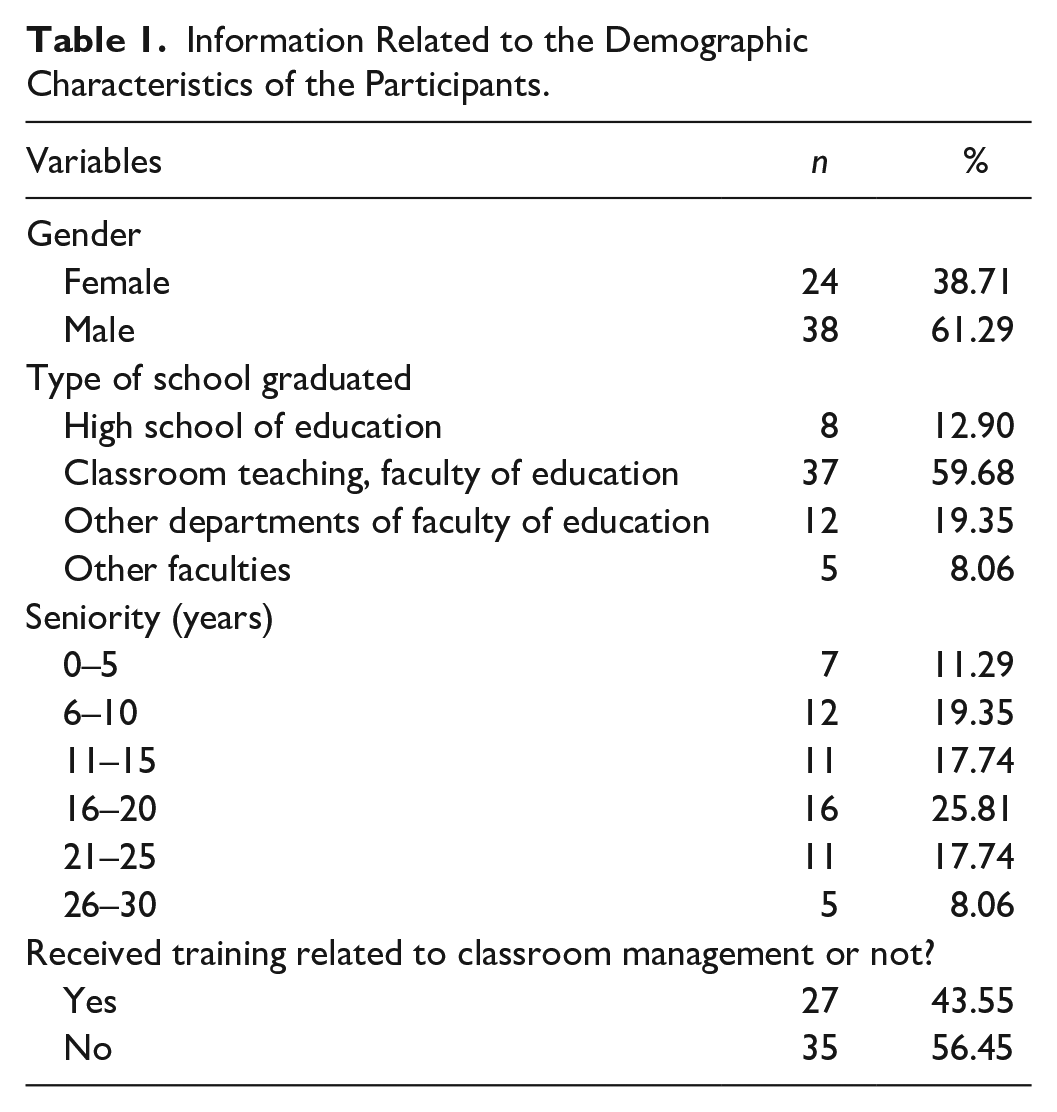
Table 1 highlights that the majority of the participants are male and graduates of the primary school teaching department of education faculties, have 16 to 20 years of professional seniority, and have not received training related to classroom management.
Data Collection Tools
Knowledge level measurement test
For quantitative data, the “Classroom Management Knowledge Level Test” was used to determine the knowledge level of teachers regarding classroom management. While developing this test, the related literature was reviewed, the relevant legislation was examined, and a multiple-choice trial form of 67 questions was developed based on expert opinions. The test was given to two faculty members who are experts in measurement and evaluation with their criticisms, opinions, and suggestions obtained independently. After being rearranged according to the opinions and suggestions of the experts and reduced to 57 questions, the test was pre-tested on 25 primary school teachers who were not included in the sample but had close characteristics. To ensure that the test complied with language rules, it was checked by two professors of the Turkish language and three Turkish teachers, and eight questions that were not understood or misunderstood by the participants were excluded from the test. After the pre-test and the language control processes were completed, the test was re-applied to 31 primary school teachers and the upper 27% and lower 27% groups were formed according to the data obtained from the application. Discrimination and difficulty indices of the items in the test were calculated according to the responses of the participants. As a result of the calculations, nine items with an item difficulty index below .45 and six items with an item discrimination index below .40 were excluded from the test. An item difficulty index of .30 to .50 and an item discrimination index of .40 and above indicates an increase in the validity and reliability of the test (Turgut & Baykul, 2015).
As a result of the corrections, the average item difficulty index of the final test, which consisted of 34 items, was calculated as .49 and the average discrimination index as .55. The reliability coefficient of KR-20 (Kuder Richardson-20) was calculated as .88. The test was divided into two equivalent parts/halves according to the single and double question numbers, and the reliability coefficient of the test was calculated by using Sperman-Brown’s split-half method. The split-half reliability coefficient was found as .84 while the reliability coefficient of the whole test was found as .89. The test was re-applied to the same participants 2 weeks later with the test-retest method, and the correlation between the scores of the participants was found to be .88. The Cronbach’s alpha reliability coefficient of the 34-item final test was calculated as .92. These calculated values indicate high values for the reliability of the test (Büyüköztürk, 2016; Tan, 2009; Tavşancıl, 2014; Tezbaşaran, 2008).
Interview form
As a result of the test, interviews were conducted with 15 primary school teachers who had a high (good or very good) level of knowledge about classroom management. These teachers were determined by the criterion sampling method, and good or very good scores from the test were set as the criterion for the selection of the sample. A semi-structured interview form consisting of open-ended questions was developed by the researchers to determine how teachers acquired knowledge about classroom management and what should be done to increase teachers’ knowledge levels about classroom management. The semi-structured interview forms consist of certain questions which the participants respond to as they wish with clear expressions of personal thoughts (Yıldırım & Şimşek, 2018). During the interviews, the teachers were asked two questions about how they acquired the knowledge related to classroom management and what should be done to enhance such knowledge. When preparing interview questions, the fitness for purpose and relevance to the sub-problems and to the clarity were what the researchers took into consideration. The draft interview drawn up after taking the opinions of two expert lecturers was tested on four teachers who were not included in the sample but had similar characteristics to solve the potential problems.
Data Collection
Quantitative and qualitative research techniques were used to collect data. The “Classroom Management Knowledge Level Measurement Test” was used as a quantitative data collection tool while the “Interview Form” was used as a qualitative data collection tool. The Classroom Management Knowledge Level Measurement Test developed by the researchers to determine the knowledge level of teachers about classroom management was distributed to the participants and applied under the supervision of the researchers. The test lasted 40 minutes.
During the interviews, teachers with a high knowledge level about classroom management were asked about how they acquired knowledge about classroom management and how teachers could increase their knowledge level about classroom management. The interviews made for about 10 minutes were held in a designated room at the school. The real names of the participants were not used due to the idea that it would not be appropriate in terms of work ethics and morals and teachers’ names were coded as T1, T2, . . ., T62.
The principles of scientific research and publication ethics were meticulously followed in the study; for this purpose, permission was obtained from the relevant institutions for the research and the participants were informed in detail about the research and signed the informed consent form. Protection of the biological, psychological, sociological, and legal assets of the participants and respect for their original were ensured and volunteerism was taken as a basis for participation in the research. Voice recordings of the participants were made and notes were taken by obtaining permission. The spaces, facilities, and devices provided for research were not used out of purpose; data and information obtained from individuals and institutions were used as permitted and as permitted, the confidentiality of this information was respected and the information was protected with precision. During the research process, the participants were not guided in any way and the researcher maintained the neutrality to the maximum. All research data were archived in a safe and easily accessible manner, and the research data were obtained by means of proven reliability and validity.
Data Analysis
Quantitative data analysis
Each scale was given 1 point for each correct answer and 0 points for every wrong answer, and those who scored between 0–4, 5–12, 13–21, 22–30, and 31–34 were grouped as “unknowledgeable,” “slightly knowledgeable,” “moderately knowledgeable,” “knowledgeable,” “very knowledgeable,” respectively. In the study, frequency, t-test, one-way analysis of variance (ANOVA), and Scheffe multiple comparison test were used to analyze the data obtained. The t-test was used to compare the means of the two groups and to determine whether there was a significant difference between them. Because t-test is a parametric test used to test the significance of the difference between two arithmetic means. One-way analysis of variance (ANOVA) was used to compare more than two groups. Because one-way analysis of variance (ANOVA) is a technique used to calculate the significance of the difference between three or more independent means in a normally distributed series. In this study, Scheffe multiple comparison test was used to compare group means as a result of analysis of variance. This test is a test that compares all possible linear combinations among many groups and can keep the margin of error under control.
Qualitative data analysis
In this study qualitative data obtained through interviews were analyzed by taking into account the similarities and closeness of the responses. The quantification of qualitative data occurs when the data obtained through interviews, observations, or document analysis are processed and converted into numbers or figures (Yıldırım & Şimşek, 2018). In the analysis of the qualitative data, the descriptive analysis approach was preferred. In the descriptive analysis approach, the data are summarized and interpreted according to the interview questions and direct quotations are made from the opinions of the interviewees (Yıldırım & Şimşek, 2018). The reliability of the data obtained from the study was performed through participatory confirmation, peer review, and intercoder reliability processes (Boyatzis, 1998; Creswell & Poth, 2018; Lincoln & Guba, 1985; Miles et al., 2020); The validity and reliability of the qualitative data was tested in the light of credibility, transferability, consistency, and validity criteria (Yıldırım & Şimşek, 2018). Tıo ensure the reliability of the interviews, the audio recordings of the interviews were analyzed at two different times and the agreement percentage in both analyses was determined as .88.
In addition, since the involvement of a peer expert in the research process allows for a more comprehensive data analysis (Lincoln & Guba, 1985), a faculty member took part as co-expert in the research, and the texts containing the opinions of the participants were examined separately by both researchers and co-experts, and productive discussions were conducted. To ensure the reliability of multiple coders in the research, in addition to the researchers, a teacher who holds a doctorate degree in the field of measurement and evaluation in education was assigned the role of the coder. The written texts prepared by the researchers and other coders for the analysis and classification of the participants’ responses were examined and compared, and an 86% of consistency/agreement was determined in the comparison. Since the speeches converted to written text were taken back to their owners and studied, the accuracy and validity of the data were strengthened (Silverman, 2006) and the audio recordings that were converted into written text and classified by the researchers were confirmed by the participants.
Findings
Knowledge Level of Teachers With Refugee Student(s) Related to Classroom Management
Table 2 presents data on the knowledge level of primary school teachers with refugee student(s) related to classroom management.
The Knowledge Level of Teachers With Refugee Student(s) Related to Classroom Management.

Table 2 highlights that 6.45%, 41.94%, 27.42%, 17.74%, and 6.45% of teachers are “unknowledgeable,” “slightly knowledgeable,” “moderately knowledgeable,” “knowledgeable,” and “very knowledgeable,” respectively. Furthermore, when unknowledgeable and slightly knowledgeable teachers are evaluated in the same category, the ratio of lack/deficiency of knowledge about classroom management is 48.39% and when knowledgeable and very knowledgeable teachers are evaluated in the same category, the ratio of being knowledgeable about classroom management is 24.19%. It was also found that the average score of teachers was 16.62, the highest score was 32, and the lowest score was 4.
The Relationship Between the Level of Knowledge About Classroom Management and Gender of Primary School Teachers With Refugee Student(s), the Type of School They Graduated From, Their Professional Seniority, and Whether They Received Training in Classroom Management
Data on whether there is a relationship between the knowledge level of classroom management and the gender of the primary school teachers who have refugee student(s) in their class are given in Table 3.
t-Test Results Related to the Relationship Between the Knowledge Level of Teachers With Refugee Student(s) in Class Regarding Classroom Management and Their Gender.

Note. p < .05.
Table 3 highlights that the knowledge level of primary school teachers with refugee student(s) does not differ significantly according to their gender (t(62) = 1.20, p > .05).
The data regarding whether the classroom management knowledge levels of primary school teachers with refugee student(s) differ according to the type of school they graduated is given in Table 4.
Analysis Results Regarding Classroom Management Knowledge of Teachers and the Type of School They Graduated.

Note. p < .05.
Table 4 reveals that the knowledge level of primary school teachers with refugee student(s) does not differ significantly according to the type of school they graduated (F(2,60) = .53, p > .05).
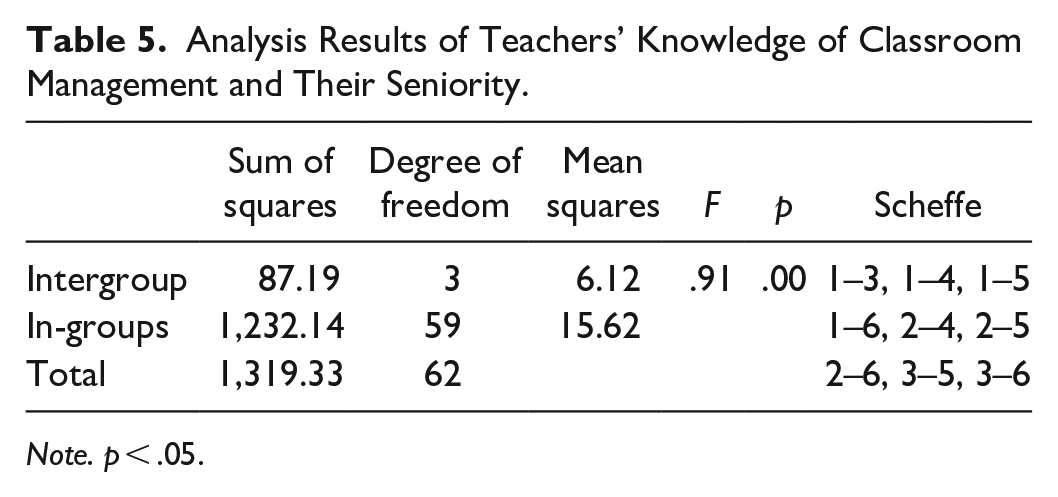
The data on whether the classroom management knowledge levels of primary school teachers with refugee student(s) show a significant difference according to their professional seniority is given in Table 5.
Analysis Results of Teachers’ Knowledge of Classroom Management and Their Seniority.
Note. p < .05.
Table 5 highlights that the knowledge levels of teachers with refugee student(s) differ significantly according to their professional seniority (F(4, 58) = .91, p < . 05). Since the variances of the groups are equal, the Scheffe multiple comparison test was applied to determine in which group the relevant difference occurs. As a result of the Scheffe multiple comparison test, there is a difference between teachers with seniority of 26 to 30 years and teachers with seniority of 0 to 5 years, 6 to 10 years, and 11 to 15 years and also between teachers with seniority of 21 to 25 years and teachers with seniority of 0 to 5 years, 6 to 10 years, and 11 to 15 years; Besides, there is a significant difference in favor of senior teachers between teachers with seniority of 16 to 20 years and teachers with a seniority of 0 to 5 years and 6 to 10 years and also between teachers with seniority of 11 to 15 years and teachers with seniority of 0 to 5 years. This shows that as the professional seniority of the teachers increases, their level of knowledge about classroom management also increases.
The data on whether there is a meaningful relationship between the classroom management knowledge levels of primary school teachers with refugee student(s) and whether they received training in classroom management or not is given in Table 6.
t-Test Results on the Relationship Between the Knowledge Levels of Teachers about Classroom Management and Their Training on Classroom Management.

Note. p < .05.
Table 6 highlights that the knowledge levels of primary school teachers with refugee student(s) differ significantly according to their training received in classroom management (t(62) = 1.05, p < .05).
Ways of Acquiring Knwoledge About Classroom Management for Teachers With Refugee Student(s) and What Should Be Done to Enhance Teachers’ Knowledge Levels
Data related to the interviews made regarding how primary school teachers with a high knowledge level about classroom management have acquired the relevant knowledge is given in Table 7.
Ways of Knowledge Acquisition of Teachers With a High Knowledge Level About Classroom Management.

Table 7 highlights that 33.33% of the primary school teachers acquired knowledge about classroom management with their professional experience, 20% with in-service training, 20% with a post-graduate education, 13.33% by means of their colleagues, 6.67% with curiosity and research, and 6.67% from inspectors during inspections.
Some of the explanations (interviews) of primary school teachers with a high knowledge level classroom management regarding how they acquired this information are given below:
The data on the interviews of primary school teachers with a high level of knowledge about classroom management on how to increase the knowledge level of teachers related to classroom management is given in Table 8.
Recommendations for Enhancing the Knowledge Level of Teachers Related to Disciplinary Actions and Penalties.

Table 8 highlights that the knowledge level of 33.33% of the participants about classroom management could be enhanced by means of university, 26.67% by means of in-service training, 13.33% by means of candidacy training, 13.33% by means of rewarding/incentive, 6.67% by means of technological support, and 6.67% by means of examination.
Some extracts of the suggestions/explanations of primary school teachers with a high knowledge level about classroom management related to what should be done to increase the knowledge level of teachers on this subject are presented below:
Discussion, Conclusion, and Suggestions
The aim of this study is to determine the knowledge level of primary school teachers with refugee student(s) related to classroom management and to determine whether this knowledge level varies depending on their gender, the type of school they graduated from, their seniority, and whether they have received training in classroom management. The results of the study showed that the knowledge level of teachers with refugee student(s) had a low knowledge level related to classroom management, that their knowledge levels differed depending on their professional seniority and whether they have received training in classroom management, and that their knowledge levels did not vary depending on the type of school they graduated and gender.
It was found that 6.45% of the teachers were unknowledgeable about classroom management and 41.94% of them were slightly knowledgeable. When the unknowledgeable and slightly knowledgeable teachers are evaluated in the same category, the ratio of lack/deficiency of knowledge regarding classroom management is 48.39%. This shows that the knowledge level of primary school teachers with refugee student(s) about classroom management is low (slightly knowledgeable and unknowledgeable). This result can be explained by the fact that the primary school teachers do not receive education related to the refugee students who have experienced serious traumas due to their migration, or that their competence to educate and manage them is not at the desired level. In addition, it can be said that inadequate intercultural interaction of primary school teachers about how to treat students with different cultural characteristics and inadequate training on these issues are also effective. Moreover, Uzun and Bütün (2016) reported that the teachers teaching refugee students believe that they felt inadequate in problem-solving and did not know how to help children. Güven and İşleyen (2018) reported that teachers failed to communicate well with these students and to exhibit an effective classroom management behavior due to language and cultural differences.
Akcaoğlu (2017) reported that teachers are not sufficient in multicultural education practices and multicultural classroom management strategies. Karaca and Doğan (2014) reported that teachers do not know how to deal with special difficulties and needs of refugee students and how to communicate with and treat refugee students. Roxas (2010) states that teachers are often short of the knowledge and experience of working with refugee students. Güner (2011) reported that teachers’ knowledge about classroom management was limited while Işıkgöz et al. (2018) suggested that primary school teachers are inadequate in classroom management and fail to use effective classroom management strategies.
Karaman (2016) found that teachers’ level of classroom management competence was low while Arslan (2016) concluded that teachers’ classroom management competencies should be improved. The rapid migration of teachers experienced in recent years in Turkey has created a situation for which teachers are not ready, causing them to be inadequate in identifying appropriate teaching strategies that affect teachers’ classroom management skills such as using appropriate teaching methods and techniques, selecting and using effective teaching tools and materials, and performing effective measurement and evaluation. The relevant study also found that there was no significant difference between the knowledge level and gender of the primary school teachers with refugee student(s). Among possible effects of this result are teachers’ occupational professionalism which excludes the gender factor, their responsibilities and obligations, and their behaviors with a non-emotional professional teacher consciousness in the approach toward all the attitudes and behaviors of the students. It can be stated that although gender-related obligations imposed by the current socio-economic structure are effective in terms of certain demographic characteristics, the fact that teachers perform their professions with equal feelings and thoughts regardless of gender ensures that the gender variable is not effective in terms of knowledge about classroom management. This result is supported by other studies. In the study conducted by Güner (2011), it was concluded that gender did not lead to a change in teachers’ knowledge level about classroom management. In the study conducted by Işıkgöz et al. (2018), it was stated that gender was not effective on the knowledge levels of primary school teachers about classroom management while in the study conducted by Karaman (2016), it was stated that teachers’ classroom management competencies did not show a significant difference depending on gender. In the study conducted by Kılıçoğlu (2015), it was found that the opinions and strategies of teachers about negative behaviors in the classroom did not show a significant difference depending on their gender. In the study conducted by Taşkaya and Uyar (2017), no significant relationship was found between the teachers’ qualifications in classroom management and their gender.
Another result of this study was that there was no significant difference between the knowledge level of primary school teachers and the type of school they graduated from. Though there are courses on classroom management in undergraduate programs, the lack of sufficient information about effective classroom management strategies to be applied in classrooms with refugee students may be the real reason for the relevant result. In addition, failure to update undergraduate programs in terms of content and lack of serious refugee student-related problems encountered by senior teachers also had an effect on the relevant result. A statement of one of the participants saying “More effective courses on classroom management should be put in education faculties and these courses should be given in practice by people who have expertise in the field. Universities must find ways to train good teachers in all aspects” is remarkable in this sense.
According to Bayındır (2001), teachers do not have sufficient knowledge and skills in classroom management due to the low level of credit for classroom management courses and insufficient content for teachers to learn effective classroom management strategies. In the study conducted by Taşkaya and Uyar (2017), no significant relationship was found between the competence of primary school teachers in classroom management and the type of school they graduated from. Karaman (2016) reported that there was no relationship between teachers’ graduation from education faculty or another faculty and their classroom management competencies, while Baburşah (2014) found no significant relationship between teachers’ classroom management tendencies and the type of school they graduated from. Guliyeva (2001) and Boldurmaz (2000) reported that teachers who graduated from classroom teaching did not have any advantages in the field of classroom management compared to teachers who graduated from other departments. Güner (2011) also reported that the type of school graduated did not lead to any change in teachers’ knowledge level about classroom management.
In this study, significant differences were found between the knowledge levels and seniority of the primary school teachers in favor of senior teachers. This result suggests that the higher the professional seniority, the higher the level of knowledge of primary school teachers regarding classroom management and as in many subjects, teachers “knowledge and skills related to classroom management” are often acquired through their professional lives, and there is a parallel increase between teachers’ professional seniority and their experience and knowledge acquisition rates regarding classroom management. Moreover, during the interviews, a significant portion of the primary school teachers with a high knowledge level about classroom management was acquired through their professional lives. This is manifested in the statements of one of the participants saying “In my working life, I encountered many problems regarding classroom management and I have learned about this by solving these problems with my own professional experience and trial-and-error” and of another participant saying “I learned a lot from my colleagues who are experienced in classroom management and thus, teaching is learned through experience.”
Kher et al. (2000) reported that teachers with low professional seniority were more unprepared for classroom management. Emmer and Stough (2001) emphasized that experienced teachers’ field knowledge constitutes a significant portion of the classroom management information and that inexperienced teachers are less confident about classroom management. According to Siebert (2005), teachers acquire knowledge of classroom management as their professional experience increases. Another study revealed that the increase in teachers’ seniority leads to a positive increase in the behaviors of classroom management (Guliyeva, 2001). Kulaber (2015) concluded that teachers with seniority of 21 years and more had higher knowledge level about classroom management.
In the study, it was found that there was a significant relationship between the knowledge level about classroom management and the education of classroom management among the class teachers with refugee student(s). This result suggests that training in classroom management increases teachers’ knowledge about classroom management. One participant said “I can say that my participation in the central and local in-service courses run by the Ministry provides information on this subject,” which supports the result. Işıkgöz et al. (2018) reported that there was a significant relationship between the knowledge level of primary school teachers about classroom management and their training in this subject. İra (2004) reported that the higher the level of teachers “education is, the more knowledge they have about monitoring and guiding students” behaviors. According to these results, it can be inferred that receiving training contributes positively to the teachers’ skills and competencies regarding classroom management.
The fact that classroom management is a basic concept covering both behavioral and instructional management requires teachers to have more knowledge in this sense. For, perceptions and behaviors of teachers in terms of practices can cause them to take approaches that affect both their students and themselves. In addition, it can be said that teachers who do not have knowledge about classroom management are not able to give their students the support they need. Therefore, it is important that teachers prefer to learn in line with contemporary management approaches based on scientific data instead of acquiring knowledge and skills related to classroom management through trial and error.
The existence of a meaningful relationship between teachers’ knowledge level about classroom management and their education in classroom management reveals that teachers should be educated, encouraged and supported to receive training. It is important for teachers with refugee student(s) in their classes to participate voluntarily in the works and activities carried out to meet the needs of refugee students in the school, to share information with teachers working in Temporary Education Centers (TEC), to recognize refugee students and to ensure effective classroom management.
Multicultural education seminars should be organized for teachers in order to provide an education in which the cultural elements of refugee students and the cultural elements of Turkish students are in harmony. And in order to improve the competence of prospective teachers regarding multicultural education, there should be courses related to multicultural education in teacher training institutions.
The content and running of classroom management courses in universities’ teacher training programs should be reconsidered and the main objective should be to teach effective classroom management strategies that teachers can use when they start their profession. In addition, in order to enable them to gain knowledge and experience, prospective teachers should be allowed to practice more in classrooms with refugee students.
Primary school teachers with refugee student(s) should be provided with effective in-service training on the implementation of classroom management strategies that prevent cultural conflicts, accelerate communication, develop empathy and facilitate intercultural harmony.
This study was limited to the participants selected by criterion sampling method in Ordu, Turkey. Conducting similar studies in other countries where refugee students are concentrated, in other provinces and with other sampling methods can make significant contributions to the field. Conducting different studies examining the knowledge levels of other branch teachers and preschool teachers who have refugee student(s) in their class, and school administrators who have refugee student(s) in their school, in terms of various variables, may also contribute to the literature.
Footnotes
Declaration of Conflicting Interests
The author(s) declared no potential conflicts of interest with respect to the research, authorship, and/or publication of this article.
Funding
The author(s) received no financial support for the research, authorship, and/or publication of this article.
