




Abstract
A scarcity of workers calls into doubt our capacity to support and care for an aging population. To gain a better understanding of the next generation of potential workers that will serve the aging population, 644 French-speaking students in grades 10 and 11 in the province of New Brunswick (Canada) were surveyed. The goals were to learn more about the attitudes, knowledge, and career interests that French-speaking, bilingual youth hold with respect to older adults. The participants’ responses indicate slightly positive attitudes toward older adults and little knowledge of this group. Results also showed that interest in a career working with older adults is primarily linked to holding positive attitudes toward them. By offering a deeper insight into young people’s perceptions of an aging population and contributing to a field lacking in research, the results of this study provide insight into measures that can be taken to ensure the future sustainability of the workforce for an aging population.
Keywords
Introduction
Population aging is a phenomenon that has made itself known worldwide. Among the Canadian provinces, New Brunswick has the highest proportion of older adults: 22.5% of the population is 65 years of age or older, a proportion that is expected to increase by 6% by 2036 (Statistics Canada, 2021). Interestingly, only 8% of Canada’s older adults live in long-term care facilities (Statistics Canada, 2017), and only 3% in the province of New Brunswick (Government of New Brunswick, 2012). The majority of this province’s older adults thus make their homes outside of care facilities and in the community. Additionally, the French-speaking population in the province of New Brunswick, and in Canada, is experiencing aging more acutely than their English-speaking counterparts (Bouchard et al., 2015) because of out-migration of adolescents to attend post-secondary institutions, and young adults and families leaving for employment (Office of the Commissioner of Official Languages, 2013).
Recent studies conducted by Dupuis-Blanchard et al. (2015) confirm that while older adults wish to age at home, services in French-speaking minority communities are not always provided with reasonable promptness, and sometimes not at all. In the context of aging in place, studies have shown that older adults are more likely to require home support services rather than medical or nursing care (Dupuis-Blanchard et al., 2015; New Brunswick Health Council, 2016). However, community organizations have struggled to recruit bilingual employees, and the retention of employees in general has proved to be problematic due to working conditions. Another recent study conducted by Thériault and Dupuis-Blanchard (2017) paints a worrying picture of the future workforce that will provide services to older adults in the community. The study finds that current employees had a mean age of 50 among the mainly female workers hired to provide home support services, and that few workers were under 30 years of age. Compensation is not far above the minimum wage, and the vast majority of workers must use their personal vehicle, often without being reimbursed for travel between clients (Thériault & Dupuis-Blanchard, 2017). Solutions are thus necessary to address the human resources needs of the aging francophone population but also the broader issue of the shortage of labor force in the home support sector. Despite recruitment and retention efforts and the creation of committees and round tables by the provincial government to study the issue of workforce replacement in the sector, few solutions have proved effective (Ministry of Long-Term Care, 2020; New Brunswick Nurses Union, 2020).
Accordingly, the overall goal of the study was to gain insight into the career intentions of the next generation of workers with four specific objectives: (1) describe and summarize the knowledge and the attitude that French-speaking high school students have toward older adults; (2) determine French-speaking high school students’ interest in a career with older adults; (3) identify the challenges and advantages of a career with older adults from the point of view of French-speaking high school students; and (4) collaborate with French high school career guidance counselors to support initiatives that would create aging sector job awareness amongst students. This article presents the results related to objectives one and two.
High school students in grades 10 and 11 were targeted in this study because they are often solicited by various sources about planning their post-secondary education and career aspirations (Gati & Saka, 2001). Given that adolescents are making career choices when in high school, gaining a better understanding of their views on aging and their awareness of career possibilities with older adults could provide critical knowledge on how educators, post-secondary institutions, and the labor force can recruit and retain much needed human resources in several sectors related to population aging. In addition, the study focused on French-speaking students in high schools because of the demand for bilingual or French-speaking employees in many aging sectors where the study was located (Thériault & Dupuis-Blanchard, 2017).
The literature on career choices or occupational aspirations provides an abundance of explanations and theories on the decision-making process. Particularly relevant is the work of Ginzberg (Lee, 2012) who was one of the first to suggest that occupational choice was part of the developmental process of children as young as 1 year of age. Ginzberg’s work encouraged others to study how experiences in childhood influence future career choices (Reed, 2008). As such, Gottfredson (1981) developed a model where four stages are proposed based on age categories from 3 years of age to 23 and where the social environment as well as cognitive development are considered important in perception of opportunities. One consideration relevant to the current study is that in stage four of Gottfredson’s approach, high school students could benefit from proactive shaping of their career choices by having their negative attitudes about certain careers challenged and acknowledging that prestige and gender considerations are important aspects for this age group (Cochran et al., 2011). It is also important to recognize the influence of earlier stages in the theory relating to social self-definition including social status related to occupation (Gottfredson & Lapan, 1997). Another relevant career choice approach or theory is Super’s developmental self-concept theory which consists of five life career stages including the exploration phase between the ages of 15 and 24 (Barrett & Tinsley, 1977). The exploration phase is characterized by making choices based on work experiences, classes, hobbies, and skills development opportunities. Most relevant to the current study is Gottfredson’s approach that career choices in high school students are influenced by their attitudes toward certain careers based on their prestige and gender influences.
Existing studies about high school students’ knowledge of careers in aging or views on aging are negligible as little has been published. A number of studies conducted in the latter half of the 20th century examined the knowledge and attitudes of young people regarding older adults (Glass & Trent, 1980; Haught et al., 1999; Ivester & King, 1977), as well as the improvement of knowledge and/or attitudes through positive intergenerational experiences and interactive sessions (Aday et al., 1991; Glass & Trent, 1980), but most of these stem from over 20 years ago when the realities of population aging were not at the forefront of society. Similarly, few recent studies have focused specifically on high school students. One study that surveyed Nigerian students between 10 and 18 years of age indicated that while they had some level of knowledge of older adults, they also held certain stereotypical ideas about them (Okoye, 2004). No studies have focused on high school students career choices in the field of aging.
The scant literature that does exist mostly examine career interests of university or college students with respect to older adults. Lun’s (2012) study found that taking a university-level course in gerontology led to increased knowledge and more positive attitudes among students and motivated them to consider a career in the field. Another study of college and university students concluded that those interested in a career working with older adults held more positive attitudes toward this group than their counterparts with no interest in aging-related careers (Robert & Mosher-Ashley, 2000). Although post-secondary students may be somewhat similar to high school students, the latter are faced with career decisions when levels of maturity and life experiences are not the same as those of post-secondary students who are already familiar with college or university program offerings.
Several authors have researched the various factors that influence knowledge and/or attitudes regarding older adults, as well as related career interests. Studies have confirmed that the quality of contact and experiences with older adults shapes attitudes, knowledge, and career interests with respect to the aging population. In addition, publications have shown that among high school students, educational programs with an intergenerational component have more promising results than planned lessons (Krout & McKernan, 2007; Scott et al., 1998). Hutchison et al. (2010) demonstrated that among students, positive experiences are associated with a desire for further interaction with older adults and a reduction of negative expectations surrounding this group. According to Augustin and Freshman’s (2016) study, regardless of the presence of fear, low self-confidence or a lack of desire to work with older adults among university students, those that had positive experiences with older adults had more positive attitudes toward them and were more interested in an aging-related career. Robert and Mosher-Ashley (2000) asserted that positive experiences can take the form of a work placement, volunteer work, or a summer job, among others.
Given the lack of data on the knowledge, attitudes, and aging-related career interests of high school students, there was a clear need for a current Canada-based study on the topic, especially in New Brunswick which is the only officially bilingual province in the nation and has the highest proportion of older adults. This study aimed to describe the knowledge, attitudes, and aging-related career interests of the province’s French-speaking high school students with the intent that understanding their knowledge and attitudes toward older adults could help us tailor better awareness programs about careers in aging. It also examines the various factors that influence the knowledge and attitudes of the students: interest in a career working with older adults, interest in student jobs, interest in working in rural areas and/or within the province, proximity to grandparents, level of contact with older adults (including visiting grandparents, helping grandparents, and volunteering and working with older adults), as well as participants’ sex, school year and age.
Methodology
Study Design and Sampling
A descriptive survey design was an appropriate approach in keeping with the objectives of this study. We used a non-probability convenience sampling strategy to recruit participants from a total of 4,280 grade 10 and 11 students (GNB, 2018) from all French-speaking high schools in the province of New Brunswick (Eastern Canada). A target sample size of 353 was deemed minimum using a sample size calculator. Inclusion criteria included: enrolled in a French-speaking high school; taking classes designated for students in grades 10 and 11; and parents had consented to the school that their child could take part in studies and/or surveys during the school year. Grade 12 students were excluded at the request of the schools, stating that these students were busy with activities related to their last year of high school.
Ethics approval was obtained from the authors’ university Research Ethics Board. Before students were recruited, a letter was sent to the province’s three francophone school districts requesting their consent for recruitment in all French speaking high schools. Once this was obtained, an email seeking student participants in grades 10 and 11 was sent to administrators of all francophone high schools in the province of New Brunswick. Schools were able to contact the researchers by email or telephone to communicate their interest in participating. The schools interested in participating in the study received a paper survey for each registered student (in grades 10 and 11) by mail, accompanied by instructions for conducting and returning the surveys. Teachers offered a paper survey to those students interested in taking part in the study based on the provided instructions. The first page of the survey included a brief statement about implied consent explaining that completing and remitting the survey indicated their consent to participate. Once completed, surveys were placed in a provided self addressed and stamped large envelope and sent to the principal investigator.
Measures
The survey for this study was developed based on existing validated questionnaires for evaluating knowledge and attitudes regarding older adults (Haught et al., 1999; Kogan, 1961) and according to the research objectives. Although Kogan’s scale has been criticized for its length and possible stereotyped statements (Hilt, 1997), some elements were retained for this study given the extensive use of the scale and its relevance to the study objectives. The survey was pilot tested with a group of 76 high school students in grades 10 to 12 after which the results of the validation, including students’ comments, were considered to improve the final version of the survey. The survey, divided into four sections, contained 53 questions, of which only 48 were retained for analysis based on the pilot test. The five elements removed were based on the pre-set criteria of having 50% or more of respondents not providing an answer to a survey element. The subject matter of the eliminated questions related to other elements in the survey and were therefore considered sufficiently represented in the overall survey. Questions were distributed in the following categories (refer to tables later in the article):
Section 1: Knowledge of Aging and Older Adults. Respondents’ level of knowledge of aging and older adults was measured by a series of 21 statements marked as true or false.
Section 2: Attitudes Toward Older Adults. Respondents’ attitudes toward older adults were measured by a series of 15 statements, to which they could respond: completely disagree, disagree, agree, and completely agree.
Section 3: Interest in a Career Working With Older Adults. Respondents were asked four questions regarding their preference, or lack thereof, for working with older adults once they enter the job market, their interest in working in a rural area and/or within the province and their interest in student jobs in the field.
Section 4: Sociodemographic Data. Respondents were asked eight questions regarding sociodemographic data such as sex, age, school year, proximity to grandparents, and visiting and helping grandparents, as well as volunteer and work experience with older adults.
Analysis
Data from the completed surveys was transferred to the SPSS version 21 software for analysis. A Cronbach’s alpha coefficient of .71 was obtained from the section measuring attitudes. According to Field (2013), values above .70 are acceptable. A Kuder-Richardson (KR20) score of .37 was obtained for the knowledge portion of the survey. KR20 is best to measure internal consistency where there are only two answer possibilities (Anselmi et al., 2019).
The section measuring knowledge was divided into several types: physical knowledge (four statements), psychological/cognitive knowledge (three statements), emotional knowledge (four statements), societal occupations knowledge (three statements), community knowledge (three statements), and sociodemographic knowledge (four statements). Responses were recoded as either correct (1) or incorrect (0). For the section measuring attitudes, responses were recoded as displaying either negative (1, 2) or positive (3, 4) attitudes.
Level of contact with older adults was measured from the total value accorded to the following variables: visit grandparents (0 or 1), help grandparents (0 or 1), volunteer work with older adults (0 or 1), and worked with older adults (0 or 1). Total value responses from 0 to 4 were possible, with a higher number indicating a stronger level of contact.
The One-Sample t-test was used to find the mean level of knowledge of each type, as well as the mean attitude value of each of the section’s statements. The t-test and the Pearson Correlation were used to measure the relationship of the study’s independent variables on its dependent variables, namely knowledge, and attitudes.
The strategy to deal with missing data from the sections measuring knowledge and attitudes was determined as: participants with more than two missing responses in these sections were excluded from the analysis of these variables. Those with only one missing response were assigned a value of 0 (value for incorrect response) for the knowledge section and for the attitudes section, they were assigned a value corresponding to their individual mean attitude value. It is unlikely that this approach had an impact on the results of this study given that a missing values analysis with Little’s test of Missing Completely at Random (MCAR) (Lee et al., 2021) was not significant χ2 = 171.818, DF = 142, p = .045.
Results
Study Participants
A total of 644 students from six French-speaking high schools across different parts of the province participated in the study which represented a response rate of 77% based on the total enrollment of students in grade 10 and 11 in those six schools (n = 836). The mean age of participants (N = 633) was 15.98 (SD = 0.68, age range: 15–18 years). The study’s sample was notably heterogeneous, being almost equally divided between gender and grade level. (Table 1). In addition, while the majority of participants held strong ties with their grandparents, they had little work experience with older adults. The participants (N = 586) displayed a moderate (M = 2.08, SD = 0.97) level of contact with older adults (help grandparents, visit grandparents, worked with older adults, volunteer work with older adults) and just over one third had volunteered or interacted with older adults other than their grandparents.
Participants’ Sociodemographic Characteristics.

Descriptive Statistics on Knowledge and Attitudes
The mean level of knowledge among students (N = 604) was 0.60 (SD = 0.11), a rather low result. However, certain types of knowledge displayed results significantly above or below the overall mean (Table 2).
Descriptive Statistics and Results of One-Sample t-Test Between Overall Knowledge Mean and Types of Knowledge Means.

In terms of participants’ (N = 622) attitudes, a statistical analysis of the One-Sample t-test found that the mean value (M = 2.92, SD = 0.35) differed significantly from the neutral value for attitudes, t(621) = 29.73, p < .001, 95% CI [0.39, 0.45]. Furthermore, certain statements displayed results that were markedly higher or lower than the overall mean attitude value of participants (Table 3).
Descriptive Statistics and Results of One-Sample t-Test Between Overall Attitudes Mean and Scale Items on Attitudes.

Source. Adapted from Haught et al. (1999) and Kogan (1961).
Note. Responses were coded as negative (1, 2) or positive (3, 4) attitudes.
Relationship of Study Factors on Mean Knowledge and Attitude Values
Results show a link between positive attitudes and a high level of knowledge among the students: r(588) = .24, p < .001.
The results of the t-test indicate relationship between several of the study’s independent variables and the mean attitude value recorded. Students who reported interest in working with older adults or no preference, in student jobs in the field, or in working in rural areas and/or within the province displayed more positive attitudes toward older adults than students who provided negative responses for these variables. What’s more, students with grandparents living nearby showed more positive attitudes toward older adults as a whole (Table 4).
Results of t-Test Between Students’ Attitudes and Independent Variables.

In terms of the mean level of knowledge, the only independent variable that displayed a relationship with the results was interest in working with older adults/no preference. Students (n = 207) that have such an interest (M = 0.615, SD = 0.107), when compared with students (n = 395) reporting no interest (M = 0.595, SD = 0.111), displayed a higher level of knowledge: t(600) = −2.07, p = .039, d = 0.18, 95% CI [−0.04, −0.001].
There was no relationship recorded between participants’ age and knowledge levels: r(594) = −.03, p = .475. However, results show an inverse correlation between participants’ age and attitude value: r(614) = −.09, p = .023. This is to say that older students displayed more negative attitudes.
In addition, students with a high level of contact with older adults displayed more positive attitudes: r(567) = .11, p = .011. However, this variable does not show a relationship with knowledge levels: r(553) = .03, p = .485. A summary of the significant results of the study are illustrated in Figure 1.
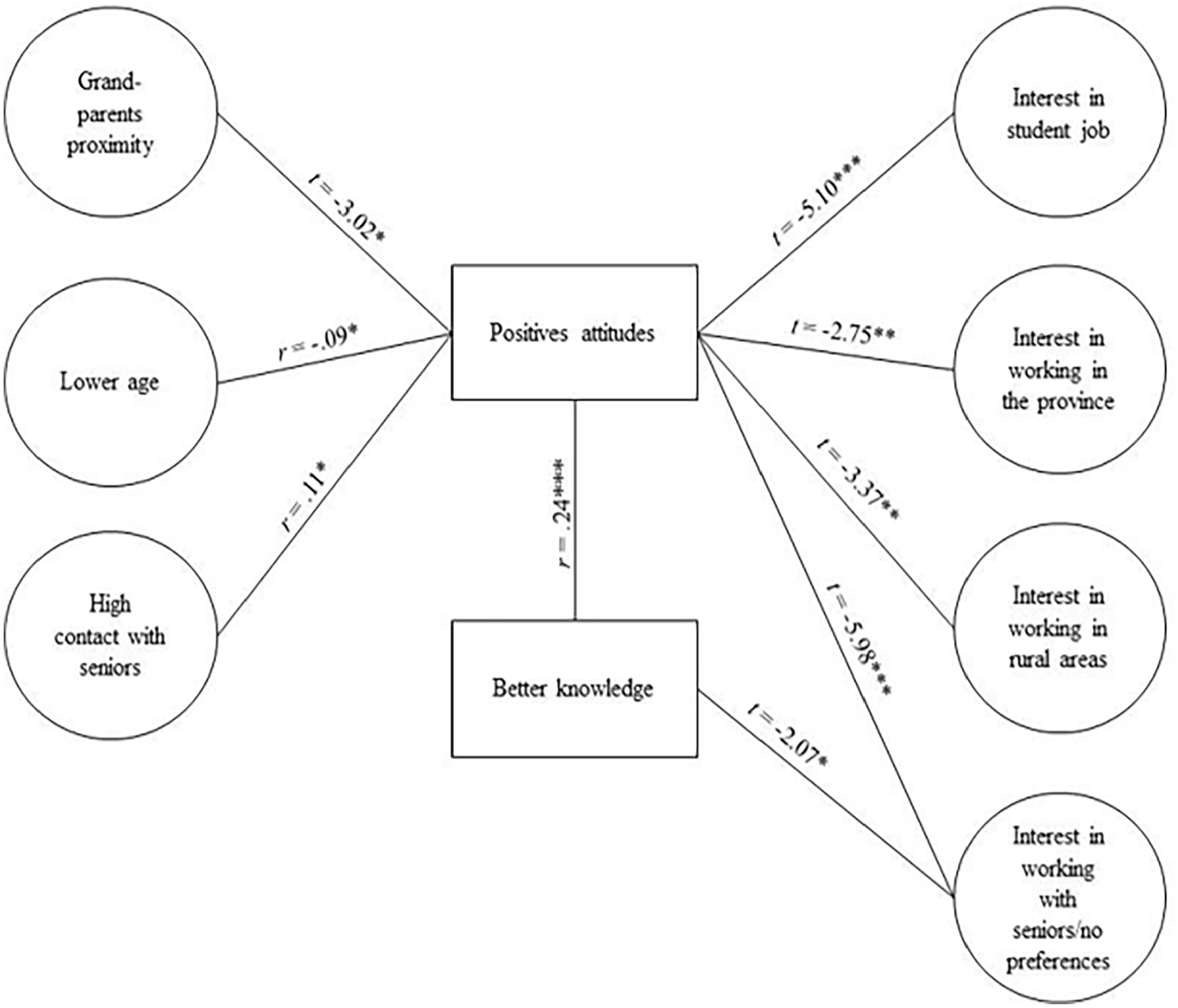
Summary of significant results.
Discussion
The goal of this study was to gain insight into the career intentions of French-speaking high school students in the context of planning for the next generation of workers in the field of aging, but also examining their knowledge and attitudes toward older adults. In general, most participants had integrated certain types of knowledge, namely physical and sociodemographic; however, they demonstrated a low level of emotional, societal occupations, and community knowledge amount of comprehension on aging, consequently maintaining certain stereotypical ideas about older adults. Comparatively to participants of Okoye’s (2004) study, students of this study displayed a low level of knowledge (M = 0.60, SD = 0.11) and attitudes that are more positive than negative (M = 2.92, SD = 0.35). A less recent study (Scott et al., 1998) also found a low level of knowledge, in this case among students in grade 12. In this instance, there is a commonality with Okoye’s (2004) study: both sets of participants showed a low level of knowledge related to societal occupations when asked to consider the following statement: “Most older workers cannot work as effectively as younger workers.” However, participants in Okoye’s study showed a comparatively weaker knowledge of their sociodemographic situation in their reactions to this statement: “Over 15% of the Nigerian population are now 65 years and above.”
In terms of participants’ attitudes, positive results were obtained from statements 2, 4, 5, 6, and 11 of the section. Attitudes toward the following statements were more negative than the overall sample: “It would probably be better if most old people lived in residential units with people of their own age,”“Most old people get set in their ways and are unable to change,”“One seldom hears old people complaining about the behaviour of younger generation,”“Most old people make excessive demands for love and reassurance.” The participants of Okoye’s (2004) study proved to hold similar stereotypes to those of this study’s participants, namely that “Most older people are set in their ways and are unable to change.” Another commonality exists with the studies of Glass and Trent (1980) and Ivester and King (1977), whose participants manifested attitudes toward older adults that were more positive than negative. These results provide awareness on the types of negative attitudes youth already have toward older adults and for which need to be addressed in the context of population aging and changing society’s views about aging.
One third of participants showed an interest in a career in the field of aging, with 34% reporting interest in working with older adults/no preference, and 36% reporting interest in a student job in aging. Results indicate a relation between more positive attitudes and interest in working with older adults/no preference and in student jobs in the field of aging, as well as in working within the province and/or in a rural area. However, better than average knowledge was only found among the participants who displayed interest in working with older adults/no preference. More positive attitudes were also found among younger students and those with grandparents living nearby.
In addition, more positive attitudes were found among students with a high level of contact with older adults (visit grandparents, help grandparents, worked with older adults, volunteer work with older adults). Earlier publications had already explored the link between contact with older adults and positive attitudes toward them, which can be explained by the influence of positive intergenerational experiences on younger people’s perceptions of older adults (Aday et al., 1991; Glass & Trent, 1980; Krout & Mckernan, 2007).
Although one third of participants showed some interest in a career with older adults, this study also confirms the importance of improving attitudes and knowledge toward aging and older people. Taking into consideration the different theories or frameworks on career choice, especially Gottfredson’s theory and the argument that career choices in high school students are influenced by their attitudes toward certain careers based on their prestige and gender influences, it is important to integrate notions of population aging in school curricula. There needs to also be recognition of the influences of parents, educators, and peers in career choice (Akosah-Twumasi et al., 2018). With population aging at its peak for the next 30 years or so and an increased demand for health care workers specializing in gerontology and geriatrics, it is imperative to gather knowledge on youth’s attitude toward aging so that ageist stereotypes may be addressed in anticipation of gaining interest for future work in the field. In fact, our study results confirm that a more positive attitude is related to interest in working with older adults. Based on local work force challenges, it is imperative for high schools to include content on population aging and have older adults involved in school activities, including intergenerational opportunities, to limit students’ negative attitude and create awareness around aging thus encouraging them to consider careers in the field. In fact, a number of researchers have suggested or called for the inclusion of aging-related material in school curricula (Krout & Wasyliw, 2002; Lucchino et al., 1997), while others have demonstrated that with respect to aging, there is a link between intergenerational experiences and an increased level of knowledge and interest, and more positive attitudes among students (Aday et al., 1991; Glass & Trent, 1980; Krout & Mckernan, 2007). Regardless of the specific strategy, action in schools is required to reduce ageism and to promote and raise awareness of aging-related issues. There are, however, authors that maintain that intergenerational experiences show better results than in-school lessons (Krout & McKernan, 2007; Scott et al., 1998).
Future studies related to these results will include focus group interviews with students to better understand quantitative results as well as research with high school guidance counselors. Research into implementing different interventions to change negative attitudes and increase knowledge are also suggested. With little research on the topic, it is essential to identify success stories for changing youths’ knowledge, attitude, and interest in aging.
Limits
Despite the large number of participants which is likely attributable to the paper survey being available in class, the study was limited by the difficulty in providing province-wide representation: francophone students from the Southwest and anglophone students as a whole were not included as participants. Although our sampling strategy was easy to carry out and was helpful in gathering useful data, it also had limits as students self selected if they wanted to take part in the study or not possibly basing their decision on their level of knowledge on the issue. We also do not know why some students agreed to participate while others did not. Although the results are limited by the methodology of the study and the low internal consistency for the knowledge section of the survey, gained understanding should serve as a springboard for additional research. It was also challenging to compare the study’s results with those of publications whose authors employed different evaluation tools and that was dated to the 1970s and 1980s. While the level of contact with older adults was measured as part of this study, the quality of experiences with older adults was not. The latter measure would have made for a very compelling inclusion in this study.
Conclusion
This study reveals that New Brunswick’s French-speaking high school students display slightly positive attitudes but little knowledge or interest toward older adults. It is important to note that interest in a career working with older adults is primarily a result of positive attitudes toward this group. Given the important role young people will play in meeting the future needs of an aging population, strategies must be put in place to increase their interest in the field of aging. As put forward by Augustin and Freshman (2016), one way of adapting to the needs of the aging population is to encourage youth to pursue a career caring for older adults, even in the face of challenges such as ageism and a lack of knowledge or interest.
New Brunswick has the highest proportion of older adults in the country, therefore confronting challenges related to population aging earlier than other parts of the nation and North America. The current reality dictates many of the challenges related to the labor force in the healthcare industry, specifically in-home support sectors. In a time where baby-boomers want to age in place, much of the labor force in the field of aging will be community-based; however, currently, aging at home can be challenging as a result of lack of human resources. By creating awareness of population aging and addressing false knowledge and negative attitudes toward older people, there is potential to recruit young, dynamic people interested in working with older adults. As a society, this needs to be one of our priorities or we will face serious human resource challenges in the near future.
Footnotes
Declaration of Conflicting Interests
The author(s) declared no potential conflicts of interest with respect to the research, authorship, and/or publication of this article.
Funding
The author(s) disclosed receipt of the following financial support for the research, authorship, and/or publication of this article: This work was supported by the Government of New Brunswick.
Ethical Approval
IRB approval from Université de Moncton Research Ethics Board (file #1516-042). Consent from each student consisted of the completion and remittance of the questionnaire. A paragraph at the beginning of the survey clearly explained that they could refuse to answer any question and that by completing and remitting the questionnaire, they were assenting their participation. Additionally, the school districts have written consent from the parents of each child in school to participate in surveys in which the school deems reliable. We confirm that the REB approved this form of consent.
