



Abstract
The psychosocial adaptation of international scholars is a growing area of inquiry in social sciences. Currently, almost 47,164 Pakistani international scholars are enrolled in various universities worldwide but there is a dearth of literature concerning their psychosocial adjustment. This qualitative inquiry focuses on Pakistani graduate and postgraduate international scholars’ insights concerning their adaptation practices in Dutch culture and society. The study is grounded in a sociocultural adaptation model. The primary data was collected through in-depth interviews with ten Pakistani international students who are currently registered in three Dutch universities. The seven central themes that emerged out of in-depth interviews were the perception of cultural disparity, linguistic challenges, limited interaction with host nationals, discrimination, difficulties practicing religious obligations, acculturation attitudes, and participants’ coping strategies applied during the adjustment process. The findings of the current study highlight both barriers and protective factors within the scope of theoretical assumptions and literature. The current study contributes to the gap in the available literature concerning Pakistani international scholars’ experiences. A limited number of studies have discussed acculturation practices of Muslim students and from a specific region. The present findings would be useful for Pakistani international scholars who intend to study abroad and the administration of the host universities receiving Pakistani international scholars to facilitate their adjustment to the new context.
Keywords
The trend to pursue higher education abroad is gaining popularity in various countries (Russell et al., 2010). Currently, international scholars represent 5.6% of overall enrollment in higher educational institutes in the OCED (The Organization for Economic Co-operation and Development) countries, that is, Australia, Canada, and Norway (OECD, 2018). A large number of scholars from the Asian region enter these countries for quality education (OECD, 2017). The Asian international scholars amount to 53% of the student population in higher education institutes all over the world, contributing positively to cultural diversity and supplement their economy through remuneration and accommodation expenditures (OECD, 2013).
Usually, upon arrival in the new environment, international scholars have a set of learning skills and behaviors acquired in the home country (Zhou, 2010). It follows that they are likely to experience a culture shock in the new environment (Javed, 2016), particularly, if the dissimilarities in home and host cultures are considerable (Tempelaar et al., 2013). These dissimilarities demand a significant effort from students to adjust and succeed in the new learning and social environment. As a solution, the previously learned behaviors and skills have to be unlearned (Carroll & Ryan, 2007; Janjua et al., 2011).
In Pakistan, the trend of scholars’ moving away to other countries for higher education became more evident with the support of the Higher Education Commission of Pakistan (HECP). With a growing trend of internationalization in higher education, the Higher Education Commission of Pakistan (HECP) provided grants to outstanding Pakistani scholars to study abroad. Pakistani scholars like other international students preferred Anglosphere or English-speaking countries for their permanent residence facilities, friendly visa policies and programs in the English language (Kayani et al., 2015).
On a global scale, 60% of the international students in the Netherlands are from Asia (Huberts & Coningh, 2017; Law, 2016). Pakistan has recently made a significant appearance in this scenario. In 2004, the Higher Education Commission of Pakistan (HECP) signed a memorandum of understanding (MOU) with NUFFIC, based in The Hague, the Netherlands for the award of Ph.D. scholarships to Pakistani scholars. This has opened up a new way for Pakistani international scholars pursuing admission to the Netherlands. Currently, 160 Pakistani international scholars are enrolled in different Dutch universities (Huberts & Coningh, 2017), representing a threefold increase to the number of scholars admitted in 2006 (Kelo et al., 2018; Nuffic, 2017). The growing number of Pakistani scholars being enrolled in Dutch universities predicts a higher number in the future (see Figure 1).

Number of Pakistani international scholars at universities in the Netherlands.
Purpose and Significance of the Study
The present study centers on Pakistani scholars for two principal reasons. First, Pakistani international scholars remain an understudied population even though Pakistan has been one of the top 25 countries and third among Muslim countries in all Asian countries in terms of students mobility. Since 9/11, negative practices against Muslims have been observed in non-Muslim countries (Tummala-Narra & Claudius, 2013). They encounter entry and existence level challenges including hard immigration checks, visa policies, rigorous employment conditions, and discrimination (OECD, 2013), which impose added challenges to the adjustment of these students. Under Islamophobia, derogatory behaviors toward Muslims have also been reported. These include screaming at people belonging to the Muslim community, howling negative words, and attacking their sanctuaries, etc.
The second reason to conduct this study is based on a published report, which stated that a considerate number of Pakistani scholars who were the recipient of a grant from HECP, returned to Pakistan without accomplishment of their respective degree programs that is, MPhil and Ph.D. due to educational and social adjustment challenges (Bashir et al., 2019; Haq, 2015).
The HECP sources acknowledged that 17% of these scholars were enrolled in Dutch universities (Haq, 2015). It was therefore realized that a study focusing on challenges of sociocultural adjustment faced by Pakistani international scholars in Dutch society is imperative.
The Theoretical Background
The current study focuses on acculturation, which broadly refers to the process of psychosocial adjustment. It draws upon the psychosocial acculturation theory of Searle and Ward (1990) and Berry et al. (1987) to comprehend the academic, social, and psychological acculturation practices of Pakistani scholars studying in the Netherlands. Berry’s model of acculturation (Berry et al., 1987, 2006) suggests that humans have to deal with a variety of situations in a new environment and their adjustment depends upon successfully tackling problems arising out of new situations. In the new environment, some issues cannot be resolved immediately, and if prolonged, acculturative stress can be a likely outcome (Berry et al., 1987). The resultant psychological distress can vary depending upon the specifics of the individual experiencing it and the dynamics of the situation. For instance, some individuals face the challenges with a spirit of managing them and develop greater self-esteem in the due course, which positively influences their mental health. On the contrary, some individuals falling short of managing the new challenges experience a negative impact stalling their further progress (Searle & Ward, 1990).
Berry et al. (1987b) added that acculturation strategies contribute to the psychological and sociocultural adjustment of international students. Acculturation strategies denote the degree of contact, international students desire to maintain with their host country, and home culture (Berry, 1997; Berry et al., 1987). Acculturation strategies have two major aspects; maintaining original cultural identity and developing interpersonal relations. These two aspects result in four types of acculturation attitudes, named as integration (maintenance of original cultural identity and interacting with host culture), assimilation (adopting the culture of host country than maintaining home culture), separation (maintenance of home culture and avoiding involvement with other cultures), and marginalization (neither wish to maintain contact with home culture nor interact with the host nation). Those individuals, who could also identify themselves with the host culture, tend to be better at sociocultural adjustment (Searle & Ward, 1990; Wang & Mallinckrodt, 2006; Ward & Rana-Deuba, 1999). Likewise, coping strategies and social support contribute positively to the sociocultural adjustment of international scholars (Berry et al., 1987). Overall, psychological adjustment defines as personal and mental wellness and could be studied under psychological and behavioral self-reports, personality, homesickness, loneliness, and social support (Ward & Kennedy, 1993).
Searle and Ward (1990) added to Berry’s model of psychological adjustment and introduced the second domain of adjustment that is, social adjustment (Searle & Ward, 1990). This refers to a person’s capacity to fit into society and can be studied under the social skills and social learning model (Kwon, 2013). This model emphasizes the importance of learning new skills in a new environment and developing positive relationships with the host nationals. Different cognitive variables are considered important in the psychosocial adjustment, such as cultural distance, language proficiency, duration of stay in the host country, attitudes toward the host nationals, and level of interaction with the host nationals (Searle & Ward, 1990). Additionally, acculturation strategies and coping strategies play a substantial role in sociocultural adjustment.
Smith and Khawaja (2011) have endorsed and recommended the psychological and social adjustment assessment models mentioned for the exploration of the acculturation experiences of students from different nationalities (Smith & Khawaja, 2011). The present study aims to explore the acculturation experiences of Pakistani scholars in light of the above-mentioned models.
An Overview of Sociocultural Adjustment of Pakistani Scholars
This section presents relevant literature on the sociocultural adjustment of international scholars in general and about Pakistani scholars particularly concerning the sub-themes of the Searle and Ward (1990) and Berry et al. (1987) theoretical model, namely, cultural distance, language proficiency, establishing friendships with host nationals, and use of acculturation strategies respectively.
Cultural distance is found to have a profound connection with the psychological and sociocultural adjustment of international scholars (Poyrazli & Grahame, 2007). The cultural distance refers to the perception of differences in values, behavior, and culture of the home and the host country (Mahmood & Beach, 2018). The results of a study revealed that students who choose foreign countries with similar culture and values to their home country, perceive less cultural distance in the new place, and hence experience fewer adjustment issues. However, in the case of greater disparity in culture and values of home and host country, students experience more challenges and the transition between more distant cultures may entail greater life changes and engender more distress (Bochner et al., 2001; Furnham & Erdmann, 1995; Searle & Ward, 1990).
The results of a study on Pakistani scholars studying at Australian universities showed that the perceived cultural distance had negative effects on scholars’ adjustment. According to Pakistani scholars, they observed a clear difference in the traditions and values of the home and host country. In the host country, they found men and women practicing equal rights, religion was an individual discretion instead of being a part of collective culture and a more pragmatic approach toward daily life. Pakistani scholars being practicing Muslims, faced difficulties with their religious practices particularly fasting. They were sometimes confronted with annoying questions from their fellow scholars, however, due to the open and flexible attitudes, these scholars managed to cope with these differences over time (Ayyoub et al., 2019).
Likewise, when students with dissimilar educational backgrounds enter the host country, there can be a possibility of an academic shock. It implies that students, who perceive more variance in the new learning environment, require more effort to change themselves, and therefore experience more stress and depression (Tempelaar et al., 2013). For instance, Staton and Jalil (2017) conducted a study on the educational experiences of Pakistani international scholars and found that even though the educational experience for scholars remained positive, they had to go through a transition period to adjust to student-oriented pedagogical practices (Staton & Jalil, 2017). The shift contributed to their academic and personal well-being but the transition demanded serious labor on their part.
The language proficiency of the host country is allied to sociocultural adaptation (Kwon, 2013; Sawir, 2005; Yeh & Inose, 2003 and academic adaption at host institutions (Kambouropoulos, 2014; Kwon, 2013). Language proficiency can be defined as the mastery and command over the language being practiced in the host country. Moreover, the Language proficiency of the host country facilitates a better level of interaction with host nationals (Kwon, 2013), associated with better sociocultural adjustment (Kwon, 2013; Swami, 2009). Jibeen and Khalid (2010), who conducted a study on Pakistani immigrants residing in Toronto, Canada, exposed that local language barriers accounted for a 6.34% variance among factors contributing to acculturative stress among Pakistani immigrants (Jibeen & Khalid, 2010).
Social networking or establishing friendships with host nationals also influences the cultural adaptation of international scholars (Kambouropoulos, 2014; Kwon, 2013). Swami (2009) revealed that establishing a friendship network with host nationals proved to be a strong predictor of sociocultural adjustment as it provided opportunities to students to better understand and adapt to the host culture (Swami, 2009). More specifically, Asian international students have trouble in establishing friendships with the host nationals, which do not arise in the case of co-nationals (Sato & Hodge, 2009, 2015). A study on Pakistani scholars showed that their social adjustment in the host country became much easier as host nationals (Chinese nationals) facilitated them by introducing markets (Noreen et al., 2019; Su, 2017).
Discriminatory behaviors toward culturally different groups cause adjustment difficulties (Duru & Poyrazli, 2011 and can result in lesser contact between people with a drastically different culture (Poyrazli et al., 2010). Discrimination can be exhibited in incidents of using verbal abuse, physical abuse, and social prejudice (i.e., fewer employment opportunities) (Poyrazli & Lopez, 2007; Smith & Khawaja, 2011). Students from Asian countries, in particular, face greater discrimination from students in European countries than students from other countries (Li & Gasser, 2005). Equally, stereotypical behaviors of host nationals toward a specific group of incoming students have been additional challenges encountered by international students (Constantine et al., 2005; Tummala-Narra & Claudius, 2013). Particularly, Asian international students reported more incidents of discrimination and prejudice behaviors (Poyrazli & Lopez, 2007; Smith & Khawaja, 2011). Such discrimination and negative attitudes have been seen as a hindrance to forming friendships, leading to social isolation (Tummala-Narra & Claudius, 2013), and, is negatively associated with sociocultural adaptation.
Coping strategies and support from family and friends play a vital part in the psychosocial adjustment of scholars. Coping strategies rely on the mental (resilient thoughts), social (building social networks), behavioral (open and positive attitude in face of obstacles), and familial means (seeking help from family and friends) that facilitate students in dealing with disturbing situations of the new environment (Smith & Khawaja, 2011). According to Berry, leaving the country behind and going to another country is a painful experience in itself. However, the use of coping strategies during this experience can reduce the problems associated with it (Zaumseil & Schwarz, 2014). This holds since coping ensures mental and practical efforts to solve problems in a new environment (Mesidor & Sly, 2016).
In the case of Asian international students who value family and social networking to a greater degree due to upbringing in a collectivistic culture, homesickness, and loneliness have been reported (Khawaja & Stallman, 2011). Similarly, Asian students received support from their co-nationals in the host country. In this way family, friends, and co-nationals contribute to their psychosocial adjustment. Equally, the duration of stay in the host country is allied to the psychosocial adjustment of international students. The literature indicates that the adjustment process is easy for those who live for a long time in the host country (Khawaja & Stallman, 2011). For example, students with longer stay developed better language skills, which enabled them to establish a social network (Wilton & Constantine, 2003 AQ: Reference Wilton & Constantine (2003) is not provided in the reference list. Please check and provide the reference in appropriate place.]), maintained and established a friendly attitude with host nationals, and experienced few psychological problems (Yusoff & Chelliah, 2010).
Concisely, the available literature has highlighted only limited aspects of the psychological and sociocultural acculturation practices of Pakistani scholars studying abroad. Moreover, these aspects are studied independently. Therefore, it is quite difficult to see a holistic perspective of the acculturation experience of Pakistani international scholars. Hence, there is a need to see the acculturation experience comprehensively by looking into the perception of academic and social life, interaction and communication with host nationals, acculturation preferences, and coping strategies applied to adjust to the new environment. The current study entails a holistic approach to offer insights into the acculturation experience of Pakistani scholars enrolled in Dutch universities. It highlights the challenges faced by them and brings to light the factors that contributed to coping with them.
Research Questions
Established on the theoretical framework of Searle and Ward (1990) and the available literature related to acculturation practices of international scholars, the subsequent questions are the focus of the current research:
What are the experiences of Pakistani scholars regarding educational and social life in the Dutch educational institutes and society?
What are the main challenges resulting in acculturative stress among Pakistani scholars?
What are the major supporting factors that facilitated the acculturation process of Pakistani scholars?
What are the specific attitudes of host nationals toward Pakistani scholars? Are these attitudes welcoming or discriminatory?
Did Pakistani scholars adopt a particular attitude/acculturation strategy to be adjusted in the host country? What are the coping strategies applied by Pakistani scholars in the initial phase of their study and the rest?
Methodology
Design of the Study
The present study was conducted using a qualitative research methodology. Qualitative research actively involves the participants to define research questions and to assess and interpret the data (Bengtsson, 2016). It contributes to comprehending the subjective experiences of individuals, emphasizing individuals’ sole opinions, and interpretations of real-life events (Ponterotto, 2013; Tummala-Narra & Claudius, 2013). Phenomenological qualitative studies are conducted under a theoretical framework that informs the researcher about problem statements and literature regarding a particular phenomenon (Creswell et al., 2007). The researcher uses this approach to collect data from people experiencing the phenomenon in focus to interpret and understand. The final written report documents people’s experiences, researcher’s reflexivity, clarity regarding the problem, and its contributions to literature (Creswell et al., 2007). Since in such qualitative research, the researcher himself serves the validity of the research, it was ensured that the results of the study are not contaminated by the predetermined assumptions and expected results of the study on part of the researcher. To ensure validity, two approaches were used. First, two researchers conducted all the interviews, one was a doctoral student (researcher himself), and the other was a Master’s student, who was a foreign researcher enrolled at a Dutch higher education institution. The foreign researcher interviewed the pre-designed interview guide established in light of the relevant literature. Besides, special attention was given to not ask leading questions. However, during the interviews of the participants, the scholars were probed and prompts were given in the light of the established literature related to the phenomena under study and related factors.
Research Site and Sampling Procedure
Selection of the participants
For the current study, a Pakistani scholar refers to a scholar who was studying in the Dutch universities, enrolled in a graduate or post-graduate program, is neither a Dutch citizen nor an immigrant and does not have a permanent residence in the Netherlands (Lillyman & Bennett, 2014). Therefore, those Pakistani students who were immigrants are excluded from the study. Their length of stay in the receiving country ranged from 6 months to 4 years (Constantine et al., 2005).
The study employed participants from three different universities in the Netherlands by using snowball sampling (Faugier & Sargeant, 1997). The information about Pakistani scholars was sought from the international students’ office after ensuring them about the privacy and protection of the data and its use for research purposes only. A detailed email was sent to all the participants to inform them about the research, to take their informed consent, and to allow them to ask anything, which needed further explanation. All scholars thus addressed, responded positively. The willing scholars were then called for the interview sessions via email to the researcher’s office as per their study schedule and convenience. An appreciation letter was offered to motivate the scholars to participate in the study and as compensation for their time. This procedure resulted in a pool of 15 participants; out of which, 10 were interviewed randomly on the list.
The participants were requested to complete a brief personal information form and an informed consent form. The personal information form required participants to report their age, gender, and length of stay, marital status, funding status (scholarship/self-finance), and type of discipline in which they were enrolled. These participants were enrolled in the graduate program (3), Master’s programs (4), and doctoral studies (3). They represented disciplines including biotechnology, social sciences, environmental sciences, agriculture engineering, and architecture. Most of the scholars were recognized as single (n = 9), while one student was wedded (n = 1) (see Table 1).
Demographic Information of the Participants.

Under the phenomenological method, the number of participants between 3 and 15 is considered sufficient. A sufficient number can also be reached in the light of a saturation point in a qualitative study (Creswell et al., 2007). In any research, the saturation point is achieved when an increase in number does not add new information. In the current study, the saturation point was reached with 10 participants.
Data collection and interview guide
Since phenomenological inquiry focuses to record the lived experiences of individuals, specific interview techniques are used to record a comprehensive viewpoint. For this, semi-structured interviews, informal interviews, and structured interviews can be used. Under Mouktas’s (1994) recommendation, Pakistani scholars were interviewed following a semi-structured interview guide. The interviewers opened up the interview with a brief introduction and with an introductory question: “can you share the story of your first day?” The qualitative guide revolved around semi-structured questions and statements as follows:
What rather related cultural experiences have you had concerning your academic and social life?
Did you experience any challenges adjusting to the western education and social system? If yes, please specify those challenges?
Are there any factors that facilitated your psychosocial adjustment in the host country?
What are the common attitudes of host nationals you have come across in general life?
What is your preferred attitude toward the host society in various spheres of life?
In case you come across acculturation challenges/stressful life situations, what strategies do you use to reduce the stress? All the interviews were conducted in English and audiotaped. The interviews spanned from 60 to 120 minutes. A comfortable setting was ensured along with the participants’ privacy. The transcripts of the interviews were made immediately after the interviews were over. To avoid any ambiguity, all the transcripts were sent to the scholars for review. In cases where further information was required, scholars were contacted and the information was obtained. Scholars were contacted a second time if there was a requirement for clarity.
Interview Data and Analysis
Keeping in view the significance of reflexivity in qualitative research (Tummala-Narra & Claudius, 2013); researchers immediately documented their understanding of the data analysis of data was carried out through thematic analysis (Maguire & Delahunt, 2017). Thematic analysis helps the researcher to perform quick coding on interview data, reduce text, classify prominent themes, and cluster them to comprehend the idea of the study (Maguire & Delahunt, 2017).
To ensure the validity of the research, two researchers performed data analysis independently (Bengtsson, 2016; Graneheim & Lundman, 2004). The coding was done separately and the themes were then compared. Further revisions resulted in additional and distinguished themes. These themes were classified into broader categories by resemblances and dissimilarities in the available data/transcripts. The themes and results were handed over to the third researcher, who checked the accuracy (Burnard, 1991; Downe-Wamboldt, 1992). After independently reading and discussing all the transcripts in detail, only mutually agreed themes and categories were retained. Some individual themes were also found however, they were not supported by the majority of the participants and thus excluded. The major themes and their sub-themes included adjustment challenges (perceived disparity in academic and social settings, language challenges and reserved attitudes of host nationals, and discrimination of host nationals) and factors that facilitated adjustment (integration attitude, social support, and coping strategies) (see Table 2).
Extracted Themes, Sub-Themes, and Percent Agreement Across Coders and Participants’ Responses and Frequencies (F).
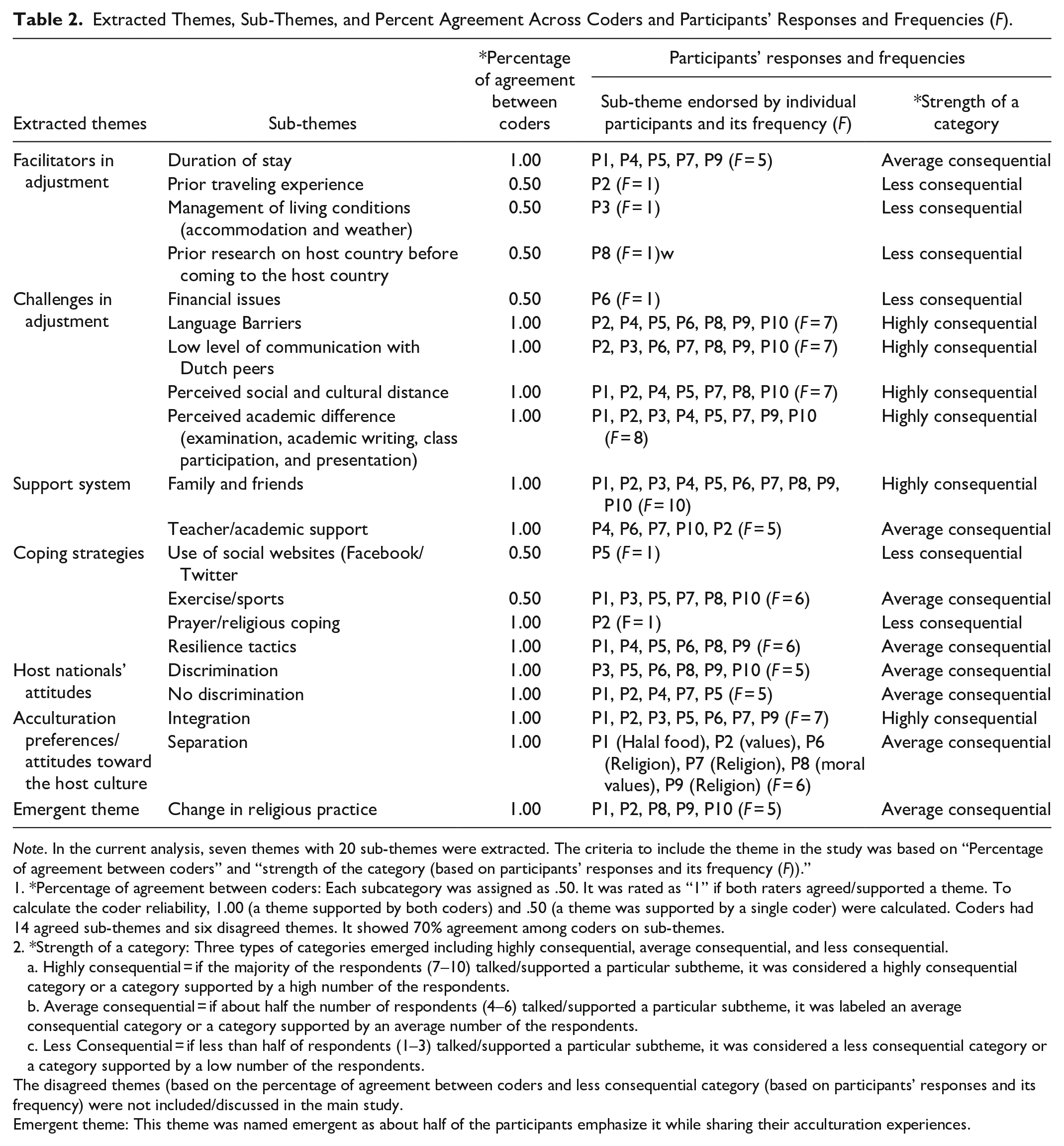
Note. In the current analysis, seven themes with 20 sub-themes were extracted. The criteria to include the theme in the study was based on “Percentage of agreement between coders” and “strength of the category (based on participants’ responses and its frequency (F)).”
*Percentage of agreement between coders: Each subcategory was assigned as .50. It was rated as “1” if both raters agreed/supported a theme. To calculate the coder reliability, 1.00 (a theme supported by both coders) and .50 (a theme was supported by a single coder) were calculated. Coders had 14 agreed sub-themes and six disagreed themes. It showed 70% agreement among coders on sub-themes.
*Strength of a category: Three types of categories emerged including highly consequential, average consequential, and less consequential.
a. Highly consequential = if the majority of the respondents (7–10) talked/supported a particular subtheme, it was considered a highly consequential category or a category supported by a high number of the respondents.
b. Average consequential = if about half the number of respondents (4–6) talked/supported a particular subtheme, it was labeled an average consequential category or a category supported by an average number of the respondents.
c. Less Consequential = if less than half of respondents (1–3) talked/supported a particular subtheme, it was considered a less consequential category or a category supported by a low number of the respondents.
The disagreed themes (based on the percentage of agreement between coders and less consequential category (based on participants’ responses and its frequency) were not included/discussed in the main study.
Emergent theme: This theme was named emergent as about half of the participants emphasize it while sharing their acculturation experiences.
Results
Challenges to Adjustment
Perceived cultural distance and challenges
The first question resulted in the perceived differences in social, cultural, and academic life. These differences were categorized under two categories that is, Perception of social differences and academic differences.
Perception of social and cultural differences
The participants noticed several differences between their native culture and receiving country’s culture. They revealed that the day they landed in the host country, their lives changed completely. The new life was full of responsibilities and they had to play different roles at a time. This was different from their home experiences where they were supported by parents until they complete their studies and start a new life. Their parents and senior members in a society guided them in every sphere of life. In the new life, essential support was missing, and they had to decide for themselves. The scholars had to deal with extreme weather and had to adjust with minimal student life in the evenings (See Table 3 for Participants’ quotes).
A Summary of Selected Themes, Sub-Themes, and Illustrative Quotes: Adjustment Challenges.

Perceived academic difference
Pakistani international scholars also perceived differences in pedagogical practices. They experienced this new academic setup as different, more practical, and quite interactive (n = 8). They expressed difficulties in the initial adaptation as differences in educational setup among their home and host country put them under stress, especially in the first semester. However, with time, they became familiar with the pattern and conformed to it. Teaching practices encouraged, them to break cultural resistance and adopt the academic format quickly (See Table 3 for quotes).
Language challenges
The participants of the study revealed that the Netherlands is a country where English has been widely practiced for academic purposes at higher education institutions. The participants did not report any difficulty in English language proficiency. They stated that English is an official language for academics in Pakistan, due to which they did not experience problems comprehending course content, lectures, and material in the class. However, they (n = 7) felt that insufficient knowledge of the Dutch language hindered to embrace of Dutch culture completely (See Table 3 for quotes). On the other hand, one student reported that he did not have trouble with the Dutch language due to the widespread use of English in the Netherlands (See Table 3 for quotes). Another student expressed his concern that he felt it was detrimental when some of his Dutch professors responded to Dutch students’ queries in the Dutch language (See Table 3 for participants’ comments).
Low level of communication with Dutch peers
The level of communication with the host nation is a reciprocal procedure, and it calls for the equal participation of host nationals to establish a friendship with incoming students. The participants of the study (n = 7) shared that Dutch nationals preferred their co-nationals to form their friendship network. For this reason, they had more international and co-national students in their friend circle than Dutch students. Talking about interaction with Dutch professors and students, students expressed their behavior as more professional rather than friendly. Besides, the Pakistani scholars assumed that the limited interaction of host nationals with them was a consequence of their marginalized attitude regarding participation in important social events of the host culture, that is, drinking, eating pork, and having intimate relationships with the opposite sex (See Table 3 for quotes).
Facilitators to Adjustment
Duration of stay
Students shared that their adjustment process was improving over time (n = 6). Especially after the first 3 months and one semester, scholars became familiar with the new environment and began to feel better in the new environment.
Support system
The participants of the study (n = 10) used a range of coping resources that made their adjustment easy to their host country. These coping resources include family/friends, teachers, and academic staff. These resources were further labeled as social support and academic support respectively.
Family and friends
The majority of the scholars shared that the emotional support they receive from their friends and family is their strength, which gives them the ability to fight the challenges that arise in the new environment. The scholars further revealed that they also seek the help of their co-nationals in the host country who are in the same position (See Table 4 for participants’ quotes).
A Summary of Selected Themes, Sub-Themes, and Illustrative Quotes: Facilitators to Adjustment.

Teacher/academic support
The participants exposed that for general life issues their support came mainly from family and friends, whereas for their academic problems, they preferred to get support from teachers, senior scholars, and co-nationals in a similar capacity (See Table 4 for participants’ quotes).
Coping strategies
The choice of coping strategies provided relief to Pakistani international scholars. The coping strategies include humor and positive thinking in response to new challenges. The majority of the participants (n = 7) considered religion as a great support to them. They had a strong belief that God will help them in difficult times (See Table 4 for participants’ quotes).
Host Nationals’ Attitudes
The Pakistani international scholars were asked about the attitudes of host nationals toward them or if they had encountered any experience of explicit or implicit bias in the Netherlands. About half of the participants (n = 6) reported different forms of discrimination. For instance, two participants highlighted the international scenario (including bombing, terrorist attacks, and Islamophobia) and the role of media in portraying a negative image of Muslims/Pakistanis. They also shared that they often receive queries and concerns for not following mainstream practices by strictly adhering to their religious rituals and obligations. One participant reported a negative incident with a faculty member. The international scenario affected all the Muslims residing all across the world. Another female participant shared a similar concern (See Table 5 for participants’ quotes). Another student shared her concern for the unavailability of prayer rooms on the campus. However, the remaining scholars (n = 4) considered the Netherlands as a tolerant country and did not report any significant incident of discrimination except a minor form of discrimination, that is, staring and gazing (See Table 5 for participants’ quotes).
A Summary of Selected Themes, Sub-Themes, and Illustrative Quotes: Attitude of Host Nationals.

Acculturation Preferences/Attitudes Toward the Host Culture
Based on Berry et al. (1987) idea on acculturation attitudes, participants were asked to reveal their acculturation preferences/attitude toward the host culture in various spheres of life, a majority of the participants (n = 8) preferred “integration strategy” that is, to maintain and adapt the home and host culture respectively in various aspects of life. The scholars said that they had an openness to the environment, values, and lifestyle of the receiving country. Scholars showed a willingness to become accustomed to the new environment to better register the current environment. Especially in the new lifestyle and its demands, the willingness to establish a social network with host nationals and participation in local festivals, etc., turned out to be helpful. The open and receptive attitudes toward the host society helped scholars to accept the new environment and contributed to their acculturation experiences positively (See Table 6 for participants’ quotes).
A Summary of Selected Themes, Sub-Themes, and Illustrative Quotes: Acculturation Preferences/Attitude Toward the Host Culture.

Change in Religious Practice (Emergent Theme)
Talking about experiences of acculturation, the scholars said that they lack enthusiasm in paying for their religious affairs. However, this is not the result of the restrictions imposed by the residential society, but the difference between the customs and traditions of the host and host countries’ practices and the educational pressures and engagements in the host institutes (See Table 7 for participants’ quotes).
A Summary of Emergent Themes, Sub-Themes, and Illustrative Quotes: Newly Emerged Theme.

Table 8 provides a quick overview of themes and subthemes included in the study. This section can be seen in five parts. It includes challenges to adjustment (total counts = 29), facilitators to adjustment (total counts = 32), host nationals’ attitudes of host nationals toward Pakistani scholars (total counts = 10), acculturation preferences of Pakistani scholars toward host culture (total counts = 13), and emergent theme supported by more than half participants (5). Few themes and sub-themes were further categorized based on participants’ comments. These include support system (categorized in “Social support” and “Academic support”), attitudes of host nationals toward Pakistani scholars (categorized in “Discrimination” and “no Discrimination”), and acculturation preferences of Pakistani scholars toward host culture categorized in “Integration” and “Separation.” Overall, the illustrative quotes of scholars emphasized adjustment over the challenges.
Frequency of Selected Themes and Subthemes.

Note. Number coding: 0 = a theme or a sub-theme not supported by the participant; 1 = a theme or a sub-theme supported by the participant. Major challenges (MC) in adjustment: PAD = perceived academic difference; PSD = perceived social distance; LCWDP = low level of contact with Dutch peers; LC = language challenge (un-proficiency in the Dutch language). Supporting factors (SF) in adjustment: SS = social support (family and friends); T/AS = teacher/academic support; RT = resilience tactics; P/RC = prayer/religious coping; DoS = duration of stay. Attitudes of host nationals toward Pakistani scholars: DIS = discrimination; No DIS = no discrimination. Acculturation preferences of Pakistani scholars toward host culture: INTE = integration; SEP = separation.
Discussion
The present study explored and contributed to the limited available literature regarding Pakistani international scholars’ acculturation experiences based on Ward and Kennedy’s (1993) and Berry et al. (1987) theoretical framework. The participants shared their adjustment experiences in terms of challenging (e.g., Perceived differences in academic and social life, language, the reserved attitude of host nationals and discrimination) facilitating (e.g., length of stay, coping tactics, social and academic support), incorporating (e.g., social and academic life), and separation (e.g., identities, morals) in the host society. The current study highlights some suggestions and implications for improving the psychosocial adjustment of Pakistani scholars and international scholars, in general, which are also presented along with the results.
The participants of the study observed cultural disparity between their native and receiving countries. However, they dealt with the differences with resilience and learned to adjust to the Dutch cultural patterns, which closely relate to the social learning paradigm. It has been identified in the literature that cultural disparities make Asian students experience greater social difficulties as compared to their European colleagues (Cao et al., 2016; Redmond, 2000; Sato & Hodge, 2009). Besides, the perception of academic differences in terms of course content, educational setup, and teaching styles are mainly reflective of disparities in Pakistani and Western education practices. The current results support Asian international students experience problems in adjusting to a more independent and less teacher-centered education system. The finding that teachers and supervisors served as a support to buffer the effect of academic challenges was also consistent with earlier ones.
The current study further revealed that proficiency in the English language enabled Pakistani scholars to adjust to academic institutions and maintain social contact with international colleagues and faculty. However, an inability to speak Dutch hindered them to form friendships with their Dutch peers. The majority of Dutch universities use the English language to deal with diversity and to promote internationalization, whereas the Dutch language is the official language (Booij, 2001; Law, 2016). Similarly, English remains the official academic language in higher education institutions in Pakistan even though Urdu as a national language is widely used for formal and informal communication in Pakistan (Sajid & Siddiqui, 2015). These results are in line with the finding that language barriers have an impact on establishing a relationship with host nationals and thus impede sociocultural adjustment (Andrade, 2006). The current results also suggest that in case the local language of the host country differs from incoming students’ native language, these students should get the basic knowledge of the host country’s language for better sociocultural adjustment. Realizing this, Pakistani scholars shared intentions to learn the Dutch language to socialize with Dutch peers and in Dutch society.
It was also found that the Dutch nationals preferred friendships with Dutch nationals. Consequently, Pakistani scholars had more co-nationals and international students in their friendship network as compared to their Dutch peers. The findings of this aspect can be seen in the existing literature, which exposed two possible factors for more “in-group contact” than “out-group contact.” These include insufficient knowledge of the host language (Hendrickson et al., 2011; Yamazaki et al., 1997), and social identity theory (Tajfel & Turner, 1986) that showed that more in-group contact or contact with co-national inhibits out-group or communication with host nationals. Moreover, Pakistani scholars’ strong cultural and religious identity hindered them to enter the already established Dutch nationals’ friendship network. These findings confirmed the available literature that exposed that Pakistani and other Asian students felt isolated and experienced difficulties to maintain relationships with host nationals due to social and cultural differences (Haider, 2013; Sato & Hodge, 2009). However, there is a need to conduct further research that identifies the behavioral patterns of both groups separately by considering Dutch students and inquiring about their preferences for establishing friendships as well. Overall, participants took this behavioral pattern of their Dutch peers positively.
In the acculturation process, discriminatory behavior as an obstruction to adjust in the host society, emerged as a theme. Half of the Participants mutually agreed that with bombing and attacks in the name of Islam and relative negative media broadcasting about Muslims, they felt discriminatory behaviors from host nationals and even faculty members. The findings were consistent with that of Stuart (2014) establishing that negative portrayal of media about Muslims provokes negative views about Muslims. Consequently, acculturation becomes challenging in an environment where religious orientation is a source of social tension (Stuart, 2014). Similar to the findings of another study conducted on Pakistani scholars, the participants of the current study were compelled to clear the misconceptions related to their nationality and ethnicity through their behavior and attitudes in the host culture (Haider, 2020).
The length of stay is positively associated with psychosocial adjustment among Asian international students (Kwon, 2013). The results of the current study have revealed that the participants with a longer duration of stay reported more adjustment. However, they showed concern with experiences associated with discrimination and change in religious practice patterns, even though; they did not experience any overt hindrance or threat from the host society to observe religious commitments. On the other hand, the newcomer students reported more challenges associated with perceived cultural and academic challenges and problems associated with the language of the host country. Both groups have similar opinions about interaction with host culture and selection of integration strategy as an acculturation attitude. This outcome of the current study, hence, demands to consider the effect of the duration of staying at the host country with another large and different sample to investigate whether this is ought to background variables or individual differences.
Social support from family/friends and coping strategies assisted the participants of the study to buffer the effect of acculturation challenges (Berry, 1997). They particularly relied on social networks, resilience tactics, and religious coping. The availability of the co-nationals in the Dutch higher education institutes facilitated their adjustment in the host country (Church, 1982; Hendrickson et al., 2011). The findings are justified as Asian international students due to identification with the collectivistic cultural background, value family needs over individualistic needs and rely more on social network and family to cope with stress (Smith & Khawaja, 2011; Tummala-Narra & Claudius, 2013). The current findings also confirm the earlier findings of Othman and Yousaff (Yusoff & Othman, 2011) who conducted a study to see the effect of social support on psychological and sociocultural adjustment. One hundred and fifty Asian students from Malaysia’s universities were selected. According to the results of this study that students who had access to social support reported better psychosocial adjustment than those who were deprived of social support or had less access to support resources. These findings are similar to existing literature that Asian international students utilize social support (family and friends) and academic support (foreign office, academic advisors, and international student’s associations) to expedite their adaptation process (Bertram et al., 2014; Gebhard, 2012). Furthermore, participants described their religion and their relation with God as significant support in adjusting to the host country (They engaged in religious practices to meet the challenges of adjustment). Indeed, support from religion has been strongly associated with the psychological adjustment of Muslim scholars (Tummala-Narra & Claudius, 2013). These findings are similar to existing literature that Asian international students utilize social support (family and friends) and academic support (foreign office, academic advisors, and international student’s associations) to expedite their adaptation process (Bertram et al., 2014). Furthermore, participants described their religion and their relation with God as significant support in adjusting to the host country. They engaged in religious observes) to cope with the challenges of adjustment. Indeed, support from religion has been strongly associated with the psychological adjustment of Muslim international students.
Another factor that contributed to Pakistani scholars’ adjustment was the “integration approach” adopted by the majority of Pakistani scholars. The results of the study indicated that Pakistani scholars showed a preference for a blending of home and host culture. The findings of the current study confirm the previous study conducted on Pakistani scholars (Haider, 2013), which provided insight into Berry’s acculturation strategies. The participants of the study did not limit their behavior to particular acculturation. Instead, scholars choose different strategies across different situations based on their gender, elements of the host culture, religious identity, and social class. Similarly, the results are in line with the finding that the preference for integration and use of their native language, customs, values, and religion as a coping strategy to adjust in the local country among Asian doctoral scholars (Sato & Hodge, 2009). The participants of the study chose “separation” and did not assimilate or acculturate the local norms into their religious aspects, moral values, and choice of halal food, which shows that individuals can apply multiple strategies during their acculturation process (Khawaja, 2016). For instance, one can keep religious and cultural aspects separate but integrated at work.
Reporting about their sociocultural adjustment experiences, one more theme, that is, “change in the religious practices” emerged from participants’ responses. They described a change in the pattern of their religious practices. However, this change is not associated with discriminatory attitudes of host nationals as cited in the literature (Tummala-Narra & Claudius, 2013). Instead, the participants attributed this change in religious practices to various challenges in the new environment e.g., difficulty in observing prayer on time due to strict class schedules, limited number and access to mosques, the missing Adhaan (call to offer prayer five times a day) and busy life where they had to manage an academic and personal life with all responsibilities. The results of the current study confirm the available literature, wherein, Asian Muslim students find it difficult to manage time and respond to the busy schedule of the new life in the host country due to academic burden and extreme self-dependent life (McDermott-Levy, 2011).
Implications, Conclusions, and Future Research Direction
The present study contributed to bridging the gap in the available literature regarding Pakistani international scholars’ experiences. Only a small number of studies have explored the acculturation experience of Muslim scholars and from a specific region. Available studies used to mix samples from diverse countries or have focused on Asian students in general. This study has focused on an underrepresented sample (Pakistani international students) from a specific country (Pakistan) at a particular state (the Netherlands). The study has gained rich, in-depth information about the acculturation practices of Pakistani scholars who have, until now, never been a focus of any inquiry.
Overall, the present study revealed that positive factors in adjustment include social support, length of stay, coping and integration strategies, whereas, negative factors include perceived cultural distance, limited interaction with host nationals, and negative experiences from host nationals. These findings confirm the results of similar studies (Brunsting et al., 2018; Duru & Poyrazli, 2007; Smith & Khawaja, 2011). Regarding the preference of acculturation attitudes, the majority of Pakistani international students showed a preference for home and host culture blended in various spheres of life; another finding was confirmed earlier (Haider, 2013). The importance of these findings is two-fold. First, it adds to the available literature that individuals can use multiple acculturation preferences side by side (Khawaja, 2016), instead of using one single strategy (Berry, 1997). Second, this finding shows a receptive and positive approach of Pakistani Muslim scholars who after the 9/11 incident, are at risk to face negative experiences. Besides, Pakistani scholars used the separation strategy concerning their religion and culture. These results also confirm the available literature on the issue.
This study further revealed that adapting to a new environment requires effort at both the individual and institutional levels. Particularly, the incoming scholars should be encouraged to explore the content, pattern, schedules, and scheme of courses before taking admission and moving to a foreign country. In the case of a memorandum of understanding (MOU), universities should exchange educational patterns to facilitate incoming students and promote their educational adjustment, which, in turn, can play a role in their socio-cultural adjustment. Equally, it is important to encourage the administrative staff, faculty, and students to appreciate diversity. Embracing differences across sex, religion, color, and language may help incoming students adjust to the new environment. For the said purpose, Multicultural workshops should be conducted for all administration, faculty, and students. This will help in developing a mutual understanding of issues.
The current study brought into light another significant finding that Muslim students find it difficult to perform their religious duties due to the absence of mosques, educational pressure, and differences in traditions and customs in home and host societies. Large-scale measures on part of host institutes and countries need to be taken in this regard. If this is not done, then staying in the guest country for 4 to 5 years and adopting an integration strategy in most aspects of life, may improve the adjustment of international students. However, if Muslim students cannot truly adhere to their religion and traditions, their adjustment can be negatively affected. In this regard, it is suggested to host institutes provide structural support (availability of praying rooms, short prayer breaks, etc.) to Muslim international students so they may fulfill their religious obligations with ease and gain religious satisfaction. The results of this study added that the international media should refrain from targeting any kind of religion and ethnicity, and especially all Muslims under Islamophobia. The media must take responsibility in this regard; otherwise, students may face problems in terms of employment and education.
Limitation and Future Directives
The presence of the researcher as an international student at the time of the study in the host country was the first limitation of the study. The subjective experiences of the researcher might have affected the results. However, member checks, triangulation, and peer debriefing methods were used to ensuring unbiased interpretation. The second limitation is that only Pakistani scholars participated in the research. Including the voices of more participants, particularly Dutch nationals and Dutch professors and to know about their experiences with Pakistani scholars, the current inquiry might have given a better projection suitable for developing policies. The third limitation is related to time constraints. An interview method was used to collect the data. However, more insightful data could have been achieved by conducting multiple interviews at different points of stay in the host country. However, this limitation was addressed by member check, sending transcripts to the participants for clarity, and follow-up brief in-person or telephonic interviews. All these limitations need to be addressed in forthcoming studies. Even though the results of the current study were in line with the applied conceptual framework, however, the attitude of host nationals toward Pakistani/discrimination and the use of multiple acculturation preferences over a single acculturation attitude require further research.
Footnotes
Declaration of Conflicting Interests
The author(s) declared no potential conflicts of interest with respect to the research, authorship, and/or publication of this article.
Funding
The author(s) received no financial support for the research, authorship, and/or publication of this article.
