



Abstract
Despite the plethora of empirical evidence on the associations between the third mission of academic scholars (i.e., academic engagement, academic commercialization, and public engagement) and their performance regarding two other missions (teaching and research), we have not known much about such relationships in the context of emerging countries such as Vietnam. To examine this problem, we delivered a survey with 245 Vietnamese academic scholars. Findings extracted from exploratory factor analysis revealed that the third mission of Vietnamese academic scholars might be divided into two distinct factors: (i) academic engagement and commercialization and (ii) public engagement and extra work. Subsequently, results of multiple regression revealed that while both academic engagement and commercialization, public engagement and extra work, as well as the interaction of these two factors, have positive impacts on research performance, only the second factor has a positive impact on teaching performance. This study extended the current mixed understandings on the associations among the three missions of academic scholars with evidence from an emerging country such as Vietnam. This study also provides implications for stakeholders, including policymakers, university leaders, and industry practitioners.
Introduction
Over the past decades, there has been a growing literature on the topic of “the third mission” of academic scholars, apart from their two traditional ones (i.e., teaching and research) (Klofsten & Jones-Evans, 2000; Ca & Hung, 2011; Wang et al., 2016). The third mission here may refer to the interaction or collaboration between universities and the industry or private sector (Davies, 2013; Galán-Muros & Plewa, 2016; Gulbrandsen & Smeby, 2005; Perkmann et al., 2013; Poliakoff & Webb, 2007), governments and policymakers (Willinsky, 2003), mass communication (Bentley & Kyvik, 2011) or virtual community (Salahshour Rad et al., 2019).
From the academic perspective, according to Grimpe and Fier (2010), motivations for scholars to be involved in the third mission may stem from two major sources: First, scholars’ desire to engage with external bodies to help them develop their career. Second, scholars may expect to gain additional resources such as funding or self-capacity development through external engagement.
From the non-academic perspective, different stakeholders have vested interests in requiring scholars to perform the third mission (Klofsten & Jones-Evans, 2000). Governments, industries, and societies are increasing regarding the academic sector as a component of the national and regional socio-economic sectors; this is a shift from the past view of the academic sector as “ivory towers” (Etzkowitz et al., 2000; Haeussler & Colyvas, 2011). The role of academic sector is to not only provide human resources to the labor market, but also to transfer knowledge and technology through means, including joint research (Kato & Odagiri, 2012), consulting (Perkmann & Walsh, 2008), and patenting (Azoulay et al., 2007).
Despite receiving growing attention from scholars, there appears the various point of view toward the concept of the third mission of academic scholars (Perkmann et al., 2013). For instance, Perkmann et al. (2013) regarded the third mission as the knowledge relevant to collaboration between academic scholars and non-academic stakeholders. This may be a formal collaboration (e.g., collaborative research, contract research, or consulting) or an informal one (e.g., ad hoc advice or an informal meeting) (Grimpe & Fier, 2010). In their seminal work, Perkmann et al. (2013) also emphasized the difference between academic engagement with a related concept, called academic commercialization, which may involve patenting, licensing, and spin-off.
However, while regarding the third mission of academic scholars as academic engagement and academic commercialization, Perkmann et al. (2013) involved industry or private sectors (Davies, 2013; Galán-Muros & Plewa, 2016; Gulbrandsen & Smeby, 2005; Perkmann et al., 2013; Poliakoff & Webb, 2007) or governments (e.g., Blagden, 2019; Willinsky, 2003) as collaborators with academic scholars. Nevertheless, the third mission of academic scholars may also be regarded as an interaction between academic scholars and the public in general (Davies, 2013; Neresini & Bucchi, 2011; Poliakoff & Webb, 2007). For instance, according to Poliakoff and Webb (2007), the engagement between academic scholars and the public may involve an academic scholar speaking on the radio or a scientist delivering a public lecture.
Given the above circumstances, the purpose of this study is to verify the relationship between the third mission with the two traditional missions of academic scholars (i.e., teaching and research). This is followed by an analysis of previous authors (Davies, 2013; D’Este & Perkmann, 2011; Galán-Muros & Plewa, 2016; Gulbrandsen & Thune, 2017; Klofsten & Jones-Evans, 2000; Perkmann et al., 2013; Poliakoff & Webb, 2007; Wang et al., 2016) who suggest investigating further the consequence of the third mission on research and the teaching performance of academic staff. Perkmann et al. (2013) noted that: “further research on the consequences of [external academic] engagement will allow policymakers to derive considered judgments as to what behaviors and organizational forms to promote, and under which conditions they are likely to further scientific and/or economic objectives.” (p. 432). In the light of this, it is worthwhile to reexamine such relations above (i.e., the third mission—research performance and the third mission—teaching performance) in the context of emerging countries such as Vietnam.
Literature Review
Related Studies on the Third Mission of Academic Scholars
As mentioned earlier, several prior studies have investigated the topic of the third mission of academic scholars and related issues. These studies may be divided into two streamlines: (i) the academic engagement and academic commercialization: the engagement between an academic scholar and a specified external entity, such as a firm or government; (ii) public engagement: the engagement between an academic scholar and the general public, through means such as mass media or social networks.
The former may be observed through several activities such as collaborative research (D’Este & Perkmann, 2011), sponsored research (Klofsten & Jones-Evans, 2000), consulting (D’Este & Perkmann, 2011), patenting and licensing (D’Este & Perkmann, 2011), working for or owning a private firm (Lin & Bozeman, 2006), and visiting lectures (Klofsten & Jones-Evans, 2000). The primary driver of these activities may be motivated by financial or non-financial objectives (Perkmann & Walsh, 2009). However (Perkmann et al., 2013) suggested that academic engagement and academic commercialization should be distinguished. These authors noted that the nature of academic engagement is collaborative, and the incentive of academic scholars to be involved in this activity is not necessarily finance-oriented. By contrast, commercialization often refers to establishing a new firm to earn financial benefits from knowledge creation. This conceptualization of commercialization is, indeed, similar to the concept of academic entrepreneurship as defined by Autio (1997), Doutriaux (1991), and Klofsten and Jones-Evans (2000).
The latter may involve a one-way communication between a member of the academic community (e.g., a professor who gives a talk on a T.V. show or writes an op-ed for a newspaper) or two-way communication (e.g., a professor who writes a scientific blog and interacts with his/her readers through comments). Previous authors employed other terms such as public outreach (see Crettaz von Roten, 2011) or public dialog (see Chilvers, 2013). These studies have also identified several of the main reasons why a scholar is motivated to be involved in public engagement. First, a scholar decides to engage with the public since they may think that it is part of their community duty (Poliakoff & Webb, 2007). Second, a scholar may publicly correct a media’s misleading report of a scientific finding. The Office of Science and Technology and the Wellcome Trust (2001) pointed out that, in many cases, the media will sensationalize a research finding; thus, the author of the respective finding must appear in the media to re-explain his or her research study. Third, public engagement is paramount for scientists who believe that having a positive appearance in the public sphere leads to positive perception and overall public support of scientists (Poliakoff & Webb, 2007). Some scholars aim to develop their reputation and legitimacy at a higher level through public engagement Watermeyer (2012). Fourth, according to Greenwood & Riordan (2001), some scientists simply feel intrinsically motivated to engage with the public. Fifth, some scientists regard public engagement as a way to learn about new issues or develop new perspectives, thus, enhancing their knowledge and capability (Davies, 2013).
The Relationship Between the Third Mission and the Research and Teaching Performance of Academic Scholars
Previous authors investigated the relationship between the third mission of the academic scholar and the other two traditional missions (i.e., research and teaching).
Regarding the third mission and its relationship with research performance, previous related studies provided mixed results. For instance, Lin and Bozeman (2006) found that the relationship between industry engagement and research performance might be represented as a U-shape form. Nevertheless, the bibliometric analysis of Godin and Gingras (2000) showed an insignificant linkage between these two variables. This finding is contrasted by a more recent study with 1967 tenured Norwegian professors (Gulbrandsen & Smeby, 2005). Specifically, this study revealed that in regard to research publications, professors who received industry financing tended to be more productive than colleagues who did not receive industry financing.
Similar to this first relationship, previous authors also found an ambiguous relationship between the third mission and teaching performance. Lin and Bozeman (2006) revealed that scholars who had industry experience supported their students better.
Similarly, using a dataset from 61 Chinese universities between 2009 and 2013, Wang et al. (2016) revealed that the relationship between academic engagement and teaching performance might be represented under a U-shape pattern, whereas the respective relationship between academic commercialization and teaching performance is an inverted U-shape. The authors also revealed that the interaction between academic engagement and academic commercialization positively impacted teaching performance.
Context of the Study: Vietnam’s Academic Sector
In the past, Vietnam followed the former Soviet model to separate the academic sector into two components: (i) higher education institutions, which focused on a teaching mission; and (ii) research institutes, which focused on a research mission (Tran et al., 2020). In recent years, the Law on Higher Education 2012 and its amendment in 2018 (Vietnam National Assembly, 2012, 2018), the Law on Science and Technology 2013 (Vietnam National Assembly, 2013), and the two aforementioned missions (i.e., teaching and research) have both been officially added to universities (i.e., university lecturers) and research institutes (i.e., research fellows). The third mission of the academic scholar seems to be overlooked in the current legislation. For instance, Circular 47/2014/TT-BGDĐT (Vietnam Ministry of Education and Training, 2014) specified the workloads in terms of teaching and research strictly for public university lecturers, but not for the third mission. Nevertheless, it is evident that there are growing demands from the government, private sectors, and the public to develop an academic sector that is more actively engaged in resolving daily problems (see Kinh te & Do thi Newspaper, 2015; Quynh, 2018). Given this insight, it is worthwhile to conduct a study on the third mission of academic scholars using empirical data from Vietnam.
Methodology
Procedures
Given the mixed conceptualization of the third mission of academic scholars, this study used exploratory factor analysis (EFA) with principal component analysis (PCA) to assess the above construct (Abdi & Williams, 2010). Next, confirmatory factor analysis (CFA), including multiple fit indices, factor loadings, Cronbach’s coefficient alphas, discriminant, and convergent validities, were employed to confirm the robustness of EFA findings (Hair et al., 1998). Additionally, multiple regression analysis was performed to assess the relationship between external academic engagement and research and teaching performance.
Instruments
In this current study, we adopted a positivism approach to assessing the university faculty’s perception in Vietnam toward the third mission and its relationship with research performance and teaching performance. A self-report questionnaire was sent to the participants. Since the topic with data from an emerging country such as has been under-researched in the past and the conceptualization of the related concepts is inconsistent, we developed our own questionnaires based on previous literature.
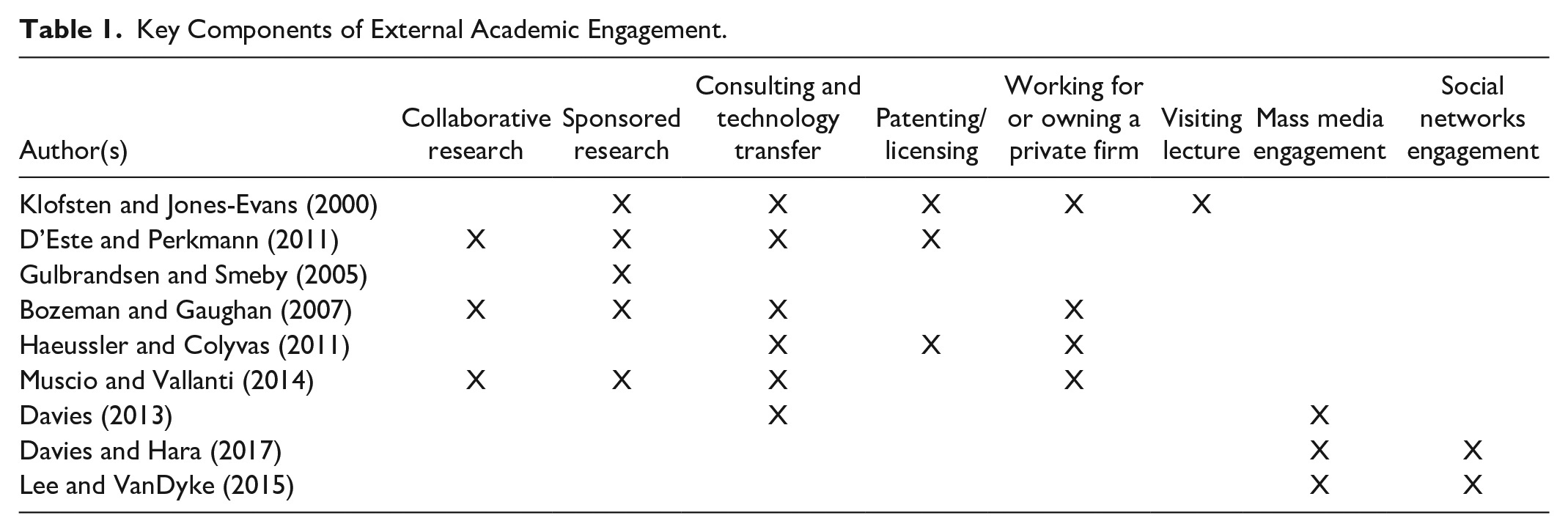
The questionnaire is composed of three parts. The first part is aimed at collecting personal information of the respective respondents, including gender, age, working experience in the academic sector, type and level of degree, professorship title, and ownership type of affiliation (see Table 2). The second information collected is in regard to the extent to which the respective respondent-lecturer externally engages in different aspects of academia. Specifically, each respondent was asked nine Likert 5-scale questions, which were in accordance with the frequent activities of the third mission of a university lecturer, which can be observed in the extant literature (see Tables 1 and 4). The last part of the questionnaire focused on gathering information regarding the research and teaching performance of the respondents. Specifically, each respondent was asked to self-evaluate their research and teaching performance from 1 (lowest) to 5 (highest). Vietnamese was used in the questionnaire to prevent any misunderstandings among the respondents.
Key Components of External Academic Engagement.
Sample
The university faculty in Vietnam were the target population of this study. Thus, a convenient method was employed to obtain sample data. A survey questionnaire was distributed directly by email to 1,000 of the co-authors’ colleagues from February to April 2020. After almost 3 months of data collection, the survey yielded 245 validated respondents, which implied a rate of return of 24.5%. According to MacCallum et al. (1999), because the EFA and CFA would be used to access the empirical data, a sample of at least 200 was satisfactory. Table 2 represents the results of this study’s participants’ profiles.
Demographic and Basic Information of Respondents.

Findings
Descriptive Findings
Table 6 represents the results of the means and standard deviations (SD) of selected items/constructs. Apparently, the sample of academic staff reported that they had low involvement in the third mission; specifically, the items means range from 1.790 (SD = 1.042) (AECO 3) to 2.350 (SD = 1.166) (PEEW 1). All are below the average (2.5/5). Compared to the third mission performance, the respondents self-rated their teaching and research performance at higher scores. Specifically, the mean value and its S.D. of research performance as self-rated by the respondents are 3.02/5 and 1.042, respectively. The corresponding figures for teaching performance are 3.57/5 and 0.945.
Exploratory Factor Analysis
EFA was performed with SPSS 26.0. Precisely, we followed the extraction method introduced by Heeler et al. (1977) to examine the relationship between the latent variables. As shown in Table 3, two factors extracted from EFA explain 62.574% of the variance. As shown in Table 4, eight items remained for further Confirmatory Factor Analysis in the next step. These eight items are divided into two constructs, which each have four items. Based on the contents of the respective items, the first construct (composed of the first four items) is named “academic engagement and commercialization” (AECO); the second construct (composed of the four other items) is designated “public engagement and extra work” (PEEW).
Results of Total Variance Explained.

Note. Extraction method: Principal component analysis.
Results of Rotated Component Matrix.

Note. One questionnaire item (you often have collaborative research with non-academic people) was eliminated due to low factor loading (smaller than 0.5).
Confirmatory Factor Analysis
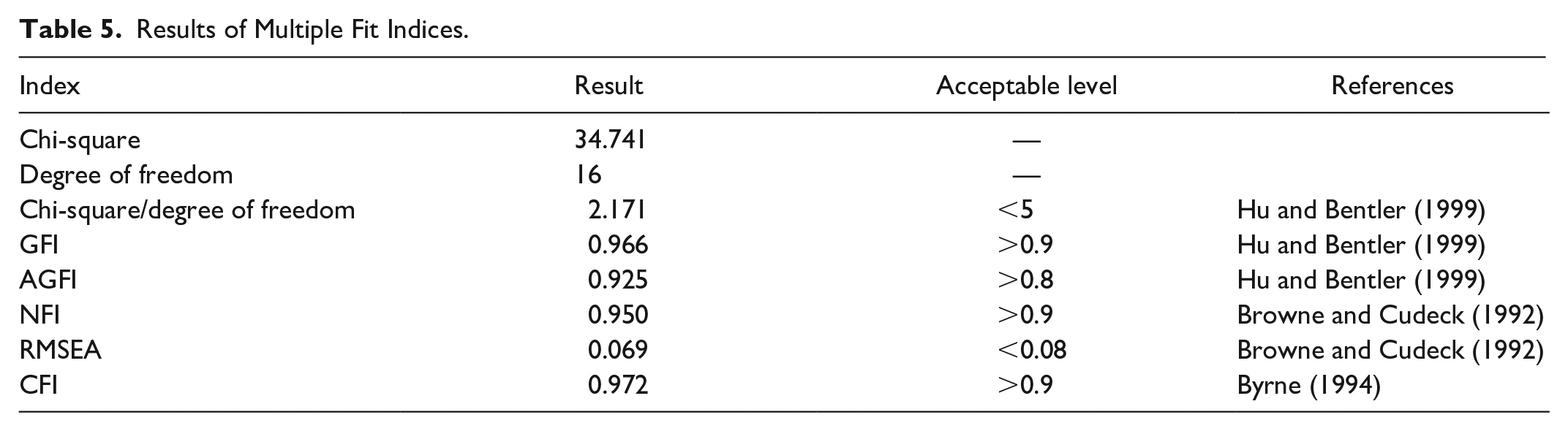
CFA was performed using AMOS 24.0 to verify whether the two-factor model, suggested in the previous step (EFA), is validated. Thus, multiple fit indices, which are composed of chi-square, degree of freedom, the goodness of fit (GFI), adjusted goodness of fit (AGFI), normed fit index (NFI), comparative fit index (CFI), root mean square error of approximation (RMSEA), and Bentler comparative fit index (BCFI), were taken into consideration (Hu & Bentler, 1999). As shown in Table 5, all the results are satisfied, according to the respective acceptable levels.
Results of Multiple Fit Indices.
Apart from multiple fit indices, convergent validity was estimated, using factor loadings, construct reliability (C.R.), and average variance extracted (AVE) (Hair et al., 1998). As evident in Tables 6 and 7, all of the results are satisfied, according to the respective acceptable levels: factor loading should be higher than 0.5 (Hair et al., 1998). The respective acceptable levels for C.R. and AVE are 0.7 and 0.5 (Hair et al., 1998).
Results of Factor Loadings, Mean, and Standard Deviation.

p < .001.
Convergent and Discriminant Validity.

Note. Figures representing in the diagonal and in italic are square roots of the AVEs.
To access the discriminant validity, we verified whether the square roots of AVEs are higher than the correlation estimates between two latent factors (Hu & Bentler, 1999). As indicated in Table 7, we obtained discriminant validity with the empirical results.
Results of the Regression Model
The results of the regression model with dependent variables are shown in Tables 8 and 9. Table 8 represents the respondents’ reports on research performance, and Table 9 represents the respondents’ reports on teaching performance. Model 1 in Tables 8 and 9 serve as the baseline model, including all control variables (i.e., gender, age, working experience in the academic sector, degree, and professorship). These control variables have remained in all other eight Models (2–5) of the analyses in both Tables 8 and 9.
Regression Results With Research Performance as Dependent Variable.

Note. AECO = academic engagement and commercialization; PEEW = public engagement and extra job.
p < .05. **p < .01. ***p < .001.
Regression Results With Teaching Performance as Dependent Variable.

Note. AECO = academic engagement and commercialization; PEEW = public engagement and extra job.
p < .05. **p < .01. ***p < .001.
In both Tables 8 and 9, Model 2 includes AECO and PEEW in the analysis. Whereas Model 3 gives the hypotheses that the third mission performance may be associated with research performance in a curvilinear pattern (U-shaped) (Muscio et al., 2016; Wang et al., 2016). Thus, we have included the squared terms of AECO and PEEW instead of AECO and PEEW into the computation.
In both Tables 8 and 9, Model 4, following Wang et al. (2016), takes into consideration AECO, PEEW, and its interaction effect of AECO × PEEW. Lastly, Model 5 in both Tables 8 and 9 includes AECO, PEEW, and their squared terms and the interaction effect of AECO × PEEW.
With the inclusion of the squared terms of AECO and PEEW in Models 3 and 4 in Tables 8 and 9, we expect to observe a curvilinear relationship between AECO, PEEW, and research and teaching performance (see Lin & Bozeman, 2006; Wang et al., 2016).
Results of the two baseline models
In Tables 8 and 9, Model 1 represents two contrasting results regarding baseline models of two regression analyses. Results observed in Model 1 in Table 8 indicate that, among selected control variables, many have significant effects on Research Performance, but the respective results in Model 1 in Table 9 reveal a different picture. Specifically, given the other variables’ constant, the female academic staff has a significantly lower impact on research performance than their male peers (β = −.452, p < .01). Academic staff between 31 and 40 and those between 41 and 50 have a significantly higher impact on research performance than their peers under 30 years old (β = 1.108, p < .05 and β = .971, p < .05, respectively). Regarding working experience, the empirical analysis reveals that academic staff with 6 to 10 years’ experience and 16 to 20 years’ experience have a significantly lower impact on research performance than their peers with under or equal to 5 years’ experience (β = −.912, p < .01, and β = −.692, p < .01, respectively). Regarding the role of degree and professorship, the empirical results indicate that academic staff with a lower academic degree (i.e., bachelor or master) would tend to have a significantly lower impact on research performance than their colleagues holding a higher degree (i.e., Ph.D.) (β = −.338, p < −.05). Meanwhile, academic staff holding a professorship title (professor or associate professor) tend to have a higher association on research performance than those without a professorship title (i.e., lecturer or assistant lecturer) (β = .676, p < .01).
Contrary to Model 1 in Table 8, the results of Model 1 in Table 9 reveal that only one control variable included in the baseline model was found to have a significant association with teaching performance. Specifically, the empirical results indicated that academic staff holding lower degree levels (bachelor or master) tend to have significantly lower teaching performance than their peers who hold a higher degree level (i.e., Ph.D.) (β = −.355, p < .05). All the other control variables, including gender, age, working experience in the academic sector, and professorship title, are found not to have a significant effect on teaching performance.
Results of Models 2 to 5 in Table 8: Research performance as dependent variable
Model 2 in Table 8 reveals that AECO has a significant impact on research performance (β = .324, p < .001), but that PEEW does not (β = .109, p = .062). However, when the interaction effect (between AECO and PEEW) was taken into consideration, as evident in Model 4 in Table 8, it appears that both PEEW and the interaction variable (AECO × PEEW) has a significant impact on research performance (β = .141, p < .05; β = .033, p < .05, respectively).
As observed in Model 3 in Table 8, these two square terms have a significant impact on research performance (β = .121, p < .01; β = .09, p < .05, respectively). However, when we include all possible independent variables into the analysis, including AECO, PEEW, their interaction (AECO × PEEW) and their square terms (Model 5, Table 8), the results reveal that AECO, PEEW, AECO × PEEW have a significant impact on research performance (β = .284, p < .001; β = .138, p < .05; β = .05, p < .05, respectively), but that the square terms of AECO and PEEW do not (β = −.08, p = .289; β = −.004, p = .944, respectively). Thus, we conclude that AECO, PEEW and their interaction variable (AECO × PEEW) have significantly direct and positive impacts on research performance, but that the square terms of AECO and PEEW do not. These three independent variables, along with the control variables, explain 32.3% of the variation of research performance (Model 4, Table 8).
Results of Models 2 to 5 in Table 9: Teaching performance as dependent variable
Like the baseline model (Model 1), all the other models in Table 9 (Models 2–5) yield insignificant results, except for the impact of PEEW on teaching performance in Models 2 and 4 (see Table 9). Specifically, we obtained the coefficients β pertaining to the relationship PEEW—teaching performance in Models 2 and 4 as follow: β = .16, p < .05, and β = .158, p < .05, respectively. The values of R2 in these two models are all equal to 13.7%, which implies a power of explanation of the variation of teaching performance of 13.7%. Thus, we conclude that among possible independent variables of teaching performance, only PEEW has a significant impact.
Discussion and Conclusions
Summary of the Empirical Results
Apart from the two “traditional missions” of academic scholars (i.e., research and teaching), the third mission (engagement with external bodies, i.e., firms, governments, and the public) has attracted increasing attention over the past decades. In this study, based on the results of a self-reported questionnaire with 245 university lecturers in Vietnam, we have examined the relationships between the third mission performance and some demographic factors with the other two missions’ performance. Empirical data was firstly performed with EFA, followed by CFA and multiple regression. Thus, there are three major findings from these analyses.
First, the EFA reveals that it may divide the third mission of university lecturers in the Vietnam context into two main constructs: “academic engagement and commercialization” (AECO) and “public engagement and extra work” (PEEW). Both these two constructs are composed of four items, as shown in Table 4.
Second, findings pertaining to the impacts of AECO and PEEW on research and teaching performance are mixed. Specifically, while both AECO, PEEW have as well as their interaction (AECO × PEEW) have a significant positive impact on research performance, only PEEW has a significant positive impact on teaching performance.
Third, regarding the impacts of included demographic factors, our empirical analysis also yields different results between their impacts on research and teaching performance. Specifically, it’s revealed that all demographic factors, including gender, age, working experience in the academic sector, degree, and professorship, have a significant impact on research performance, whereas only degree has a significant impact on teaching performance.
Academic Implications
This study contributes to the current knowledge surrounding the third mission of academic scholars in three aspects.
First, although there are various approaches to conceptualize the third mission of academic scholars in the extant literature: the third mission as collaborative research, sponsored research, consulting (see Gulbrandsen & Smeby, 2005; Lee, 2019; Liang & Liu, 2018; Perkmann et al., 2013; Wang et al., 2016); as patenting, licensing and spin-offs (see Davies & Hara, 2017; Perkmann et al., 2013; Poliakoff & Webb, 2007; Sciarelli et al., 2021; Wang et al., 2016) as public outreach, pubic dialog (see Davies & Hara, 2017; Lee & VanDyke, 2015; Schalet et al., 2020). These approaches rarely appeared simultaneously in a single study as per se. Specifically, the empirical evidence revealed that the third mission of academic scholars in the context of Vietnam might be divided into two dimensions: (i) Academic Engagement and Commercialization (AECO); and (ii) Public engagement and Extra Work (PEEW). The revelation of the former construct implies that in the Vietnamese academic context, academic engagement and academic commercialization seem to be intertwined together. This finding is in contrast to some prior works, such as Perkmann et al. (2013), which divides academic engagement and academic commercialization into two distinct concepts. In order to interpret this result, we should investigate the current level of innovation capability in Vietnam. According to Schwab (2019), the innovation capability of Vietnam is still modest, ranked 76/141 countries in the world. Given the low level of innovation capability, academic staff in Vietnam may regard academic engagement and academic commercialization (AECO) as a single activity rather than separate ones, as viewed by their peers from the developed world. The mean values of all items pertaining to AECO as shown in Table 6, also confirm this statement. The revelation of the latter construct (PEEW), which is composed of four items, is understandable since all these four activities require similar skills (such as communication) and require lower technical skills and competencies than AECO’s.
Second, this study revealed the impact of the two components of the third mission on the two other missions’ performance: research and teaching. Specifically, both AECO and PEEW significantly impact research performance, and the former having a higher impact than the latter. Together these two components also interact with each other to impact the research performance of the academic scholar. Contrary to the results pertaining to research performance, only PEEW was found to have a significant impact on teaching performance. These results imply that the more an academic scholar is involved in academic engagement and commercialization, as well as public engagement and extra work, the higher performance he or she may have in terms of research; whereas the more an academic scholar is involved in public engagement and extra job, the higher performance he or she may have in terms of teaching. Meanwhile, the variation of academic engagement and commercialization does not influence the variation of teaching performance.
Third, this study followed Wang et al.’s (2016) work to provide empirical evidence from an emerging country on the topic of the third mission of academic scholar and examine its relationship with research and teaching performance. As noted by Wang et al. (2016), prior literature is imbalanced since the main focus was primarily on developed countries. This work aimed to use the context of the Vietnamese academic sector to fill this gap.
Practical Implications
There are several practical implications that may be drawn from this work. First, since the empirical analysis confirmed the relationship between the third mission of academic scholars and their research and teaching performance, we suggest that universities in Vietnam implement policies to encourage their faculty further to involve themselves in activities with the non-academic sector. To larger or lesser extents, some university leaders or policymakers may be worried that the over-emphasis on academic staff may result in the deterioration of the traditional missions (i.e., teaching and research) (Brooks & Randazzese, 1999; Geuna & Nesta, 2004). However, empirical results from this study demonstrate a different tendency: the third mission may have positive impacts on the teaching and research performance of academic staff. Thus, appropriate initiatives, which aim to encourage the third mission and lead to enhanced research and teaching performance, are paramount for universities in Vietnam. In other words, as discussed in (Ho et al., 2019), entrepreneurial mechanisms among the academic sector as well as an entrepreneurial spirit among individual scholars should be encouraged and placed at the center of the higher education landscape in Vietnam. Some anecdotal evidence shows some pioneering universities in Vietnam have already implemented such programs, including the training program for innovation and entrepreneurship at the Vietnam National University-Hanoi (Huong Thanh, 2020), the launching of the technology transfer office at the Hanoi University of Pharmacy (Thanh, 2019), or the establishing of the spin-off enterprise at the Hanoi University of Science and Technology (Ta, 2018). Other universities can learn from the successes (or failures) of these above programs.
Second, since the extent to which the two different components of the third mission (AECO and PEEW) differ in their impact on research and teaching performance, appropriate policies should be implemented accordingly. For instance, since different faculty may have different behaviors in the third mission (for instance, one may focus on “academic engagement and commercialization” while another may focus on “public engagement and extra work”), this may lead to different outputs in terms of teaching and research. Thus, universities in Vietnam should implement different strategies for different types of academic staff in order to optimize their performance in all missions. It is also suggested that the government should abandon the current “one-size-fits-all” policy (Vietnam Ministry of Education and Training, 2014), which strictly regulates the workload of the academic staff among teaching, research, and the third mission. Universities should be given full discretion to manage and assign tasks to their academic staff according to their capabilities and interests (Trinh et al., 2020). In the same vein, the Ministry of Science and Technology may implement programs to encourage faculty scholars to involve more actively in the third mission. Lessons from Bayh-Dole Act in supporting university–industry cooperation in the U.S. (Carlsson & Fridh, 2003) or other countries such as China (Chen et al., 2016), Taiwan (Shen, 2017) may provide implications for Vietnam.
Limitations and Directions for Further Studies
As in many other studies, this one also has several limitations. First, since the data collection method was convenient, the generalization of the empirical result should be taken carefully. Further studies should try to avoid this caveat by using a more randomized data collection approach. Second, since all the measurements are self-reported and thus subjective, this may lead to less valid results. Further, studies should overcome this limitation by adopting real and objective data. For instance, rather than asking scholar-respondents to complete a self-evaluation of their research performance, future studies may employ actual data obtained from bibliometric datasets such as Scopus or Clarivate Web of Science to proxy the research performance of respective scholars. Nevertheless, accessing scientific databases like Scopus or Clarivate Web of Science in developing countries like Vietnam is not always easy. Given this circumstance, the use of public databases such as the Network of Vietnamese Social Scientists should be regarded as a feasible alternative (Vuong et al., 2018).
Footnotes
Acknowledgements
The authors would like to express their thanks to Vietnam’s Ministry of Education and Training for this sponsorship.
Author Note
Anh Nguyen Quoc is now affiliated to UCD Innovation Academy, University College Dublin, Belfield, Dublin, Ireland.
Hiep-Hung Pham is now affiliated to Personal Development Research Group, Catholic University of Murcia, Murcia, Spain.
Declaration of Conflicting Interests
The author(s) declared no potential conflicts of interest with respect to the research, authorship, and/or publication of this article.
Funding
The author(s) disclosed receipt of the following financial support for the research, authorship, and/or publication of this article: This paper is part of the project “Examining and proposing the formation and development of the model of technology transfer office,” No. CT.2019.07.02 under the program “Examining and proposing solutions to promote cooperation between higher education institutions and firms,” No. CT.2019.07 funded by Vietnam’s Ministry of Education and Training.
