



Abstract
Does delayed retirement crowd out the welfare of the workforce? To answer this question, a dynamic optimization framework is established to simulate the impact of delayed retirement on the welfare of the working population over time. Simulations are conducted based on practical and feasible parameters. Delayed retirement was found to improve the welfare of the working population rather than crowding it out. Furthermore, the results are robust against changes in parameters and modes of supporting elderly individuals. In terms of policymaking, it is suggested that such facts be shared with the public and that a delayed retirement plan be introduced as soon as possible to manage the pension and retirement wave caused by post-1960s baby boomers. However, to ensure that the delayed retirement plan does not lead to a reduction in the welfare of the working population, increases in fertility costs and the pension replacement rate should be appropriately controlled.
Introduction
As part of the generational changes in the population in China, the post-1950s and post-1960s baby boomers will gradually reach retirement age as the post-1990s and post-2000s baby busters gradually enter the labor market. This large-scale exit of older generations from the labor market and small-scale entry of the younger generation have resulted in a plummeting working population and a soaring aging population (see Figure 1). As a result, China’s economic growth rate declined from 10.3% in 2010 to 6.1% in 2019. China’s Pension Fund Actuarial Report 2019–2050, which was issued in 2019, noted that the current balance of the basic pension insurance fund for urban enterprise employees in China will begin to decline in 2023. In 2028, the current balance will be negative for the first time, at −118.13 billion yuan, and will ultimately decline to −11.28 trillion yuan in 2050. Two key population policies to alleviate the negative impact of the aging population on economic growth and pension security are the relaxation of birth control and the introduction of delayed retirement plans. In 2015, the fifth plenary session of the 18th Central Committee of the Communist Party of China introduced a comprehensive two-child policy, which is a major strategic measure in line with public opinion. This new policy was welcomed by most individuals, whether in academia, politics, ordinary families, or official sectors. However, the delayed retirement plan is unlikely to receive a warm reception when it is ultimately introduced. In a survey of 25,311 people conducted by the social survey center of China Youth Daily in 2015 on “What is your attitude toward delayed retirement?” 94.5% of respondents explicitly opposed a delayed retirement plan, only 3.2% supported it, and 2.3% were neutral or did not express any opinion. Another survey conducted by People’s Daily Online that polled approximately 450,000 netizens showed that 93.3% opposed the policy. Although the reasons for opposition vary from person to person, respondents in many surveys have expressed that postponing retirement will harm the interests of an overwhelming majority of people. Such a policy obviously lacks public support; postponing retirement has encountered resistance among ordinary people. What do academic scholars think about such a plan? Does delayed retirement truly crowd out workforce welfare?
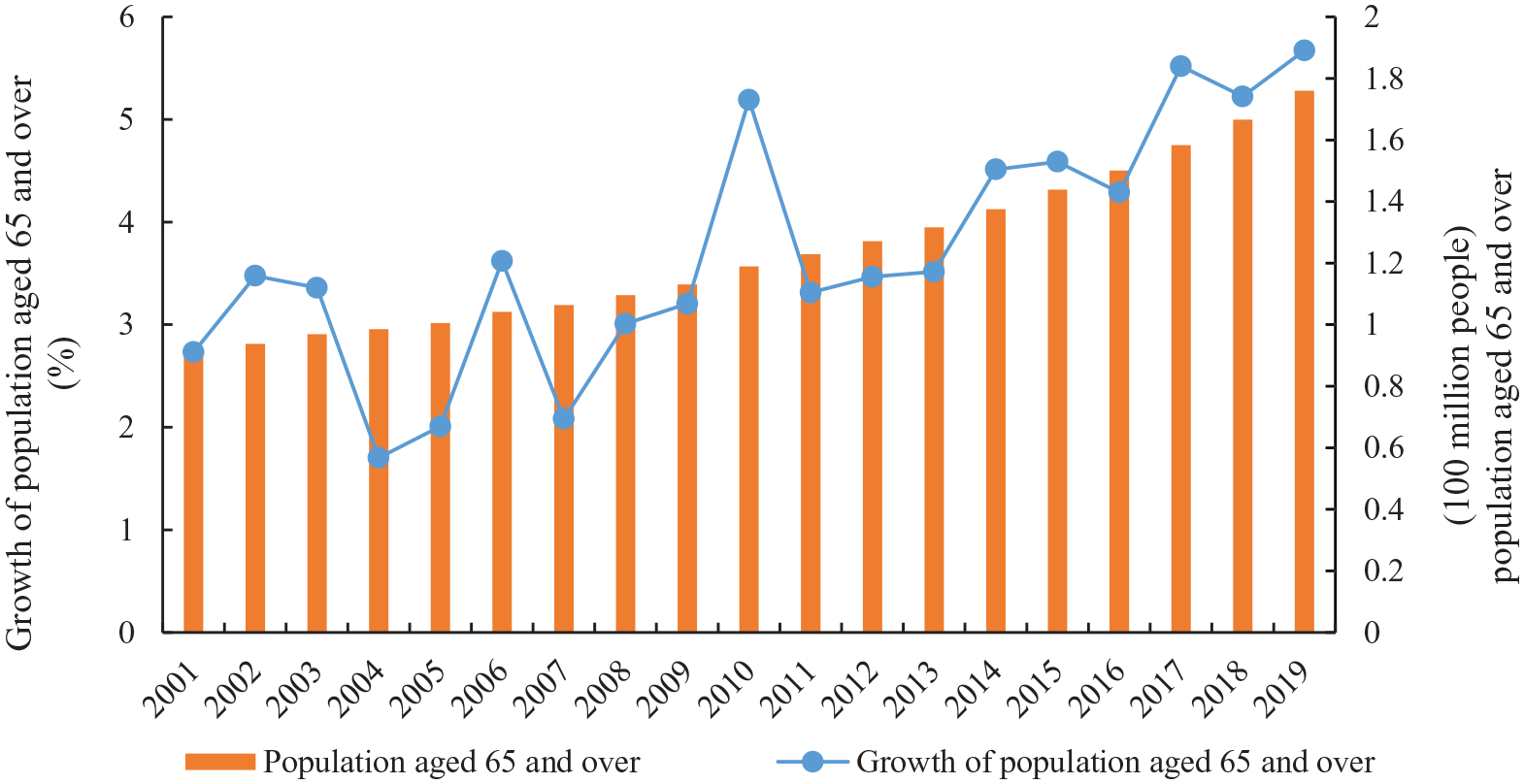
Population aging trends in China.
Despite the valuable achievements of existing studies, consensus is lacking over whether delayed retirement crowds out workforce welfare. Some scholars believe that delayed retirement crowds out workforce welfare, whereas others believe it would improve workforce welfare. This difference in opinion is because of differences in national contexts, measurements of welfare indicators, research methods, and model settings. In particular, the results of studies based on samples from other countries may not be generalizable to China, and existing research on China conflates the effects of delayed retirement with those of postretirement reemployment. In addition, to measure the welfare of the working population, most scholars use consumption in youth, consumption in old age, employment of the working population, after-retirement pension wealth of the working population, and per capita output or total social output rather than assess the comprehensive welfare of the workforce during the working period. Moreover, in terms of research methods, most research has adopted econometric methods, actuarial models, and overlapping-generations (OLG) models, but empirical research cannot effectively predict the future. Actuarial models ignore the influence of population structure on actuarial parameters, and the OLG model cannot adequately simulate the effect of delayed retirement on the welfare of the working population over the years. Finally, with respect to models, simulations have seldom considered the special context of China, where intergenerational support remains a societal convention and where reproduction and pension are investment behaviors but also reflect a kind of altruistic culture of kinship pleasure. Studies on the welfare effect of delayed retirement should not use a static conceptualization of the working population, as is often found in studies using the OLG model, but instead a dynamic conceptualization.
This paper intends to expand the literature in the following aspects. First, for the measurement of welfare indicators, this paper broadens the connotation of delayed retirement and uses the comprehensive welfare of the working population. Second, this paper establishes a dynamic optimization framework to simulate the impact of delayed retirement on the welfare of the working population over time. Third, after fully considering the context of China, the mainstream status of intergenerational support and the cultural attributes of childbearing and pension are fully considered in the model setting.
In short, the contribution of this study is that it establishes an extendable dynamic optimization model to simulate the impact of delayed retirement on the welfare of the working population over the years from the perspective of comprehensive welfare utility.
Literature Review
Scholars have undertaken in-depth studies from the perspectives of youth employment, pension after retirement, output, and comprehensive welfare, see table 1. From the perspective of youth employment, Gruber et al. (2009) conducted empirical studies using data from Canada and member countries of the Organization for Economic Cooperation and Development (OECD) and found that an increase in workforce participation among elderly individuals would significantly reduce the unemployment rate of young adults. In contrast, early retirement of elderly individuals would have a negative impact on the employment of young adults. Empirical studies by Börschsupan (2010) and Salem et al. (2010) in Germany and France, respectively. It was shown that that postponing retirement would increase total labor and, hence, total social output, which would increase the demand for labor, ultimately leading to a decline in the social unemployment rate. Kalwij et al. (2010) conducted empirical studies on 22 OECD member countries and found that continued employment of elderly individuals would not hinder the employment of young adults. Instead, there was some complementarity. The results indicate that, far from putting pressure on young adults’ job prospects, postponing retirement plans would actually boost their employment. Continued employment of elderly individuals will promote youth employment (Gruber & Milligan, 2010; Munnell & Wu, 2013). A small amount of empirical evidence shows that hiring older people crowds out the employment of young people. Based on Okun’s law, Michello and Ford (2006) conduct empirical studies using data from the United States and find that a delayed retirement policy would increase the unemployment rate in the United States, especially in sectors with a surplus workforce. Delayed retirement often puts some young adults out of work. Martins et al. (2009) argue that delayed retirement may not bring about the anticipated increase in employment opportunities. Given employment law and the lifelong employment system and staffing in government-affiliated institutions in some countries, adopting a delayed retirement plan may lead enterprises to employ fewer new individuals to alleviate pressure, indicating that delayed retirement may hinder the employment of a new workforce. Han (2020) shows that delayed retirement expands the employment of elderly workers (55–60 years old) but reduces the employment of young workers (15–29 years old), and this negative impact is particularly obvious in large companies or companies with a lower official retirement age. Therefore, it is necessary to take a gradual approach to minimize the negative impact of delayed compulsory retirement on employment.
Literature Summary.

Galasso (2008), Sánchez Martín (2010), Lacomba and Lagos (2010), Mastrobuoni (2009), Yu and Zeng (2015), Jin et al. (2016), Tian and Zhao (2018), and Yu et al. (2018) focused on pensions after retirement and discussed the impact of delayed retirement on pensions from the perspective of experience, theory, and actuarial analysis. They find that extending the statutory retirement age can effectively relieve the pressure of pension payments, reduce the level of pension deficit, and make the pension security system more balanced and sustainable. Tian and Zhao (2016) evaluate the effect of pension sustainability on delayed retirement by predicting the contributions, expenditures, and accumulated balances of basic pensions. Bongaarts (2004) explores the impact of population aging on the pension system of OECD countries and showed that most of these countries have pension systems that are not sustainable, which could be ameliorated by extending the retirement age. Blake and Mayhew (2006), Bovenberg (2003), and Breyer and Hupfeld (2010) also believe that extending the retirement age can improve the solvency of pension funds and effectively alleviate the pressure on pension payments caused by the aging population. Ren et al. (2019) believe that delaying the statutory retirement age policy will not only increase pension income but also reduce pension payments, which will have a cumulative effect on the size of the pension fund and, thus, relieve the pressure of pension payments. Although Zhao et al. (2018) and Wang et al. (2019) agree with this view, they also emphasize that delaying retirement will not fundamentally solve the pension payment crisis. Chen et al. (2020) also believe that a delayed retirement policy may not always have a positive and beneficial effect on alleviating the pension payment dilemma; the benefits represent approximately 15% of the total effects. Zhao et al. (2017) believe that combined policy options are more effective in improving solvency sustainability than relying solely on postponing the retirement age. Hanel (2010) argues that delayed retirement is a great benefit for retirement insurance because the benefit payment period is clearly reduced and the contribution payment period is extended. The effect of postponing retirement is greater for women than for men. In contrast, by applying an OLG model that considers human capital for Italy’s delayed retirement planning, Magnani (2011) finds that although delayed retirement can reduce the pension deficit in the short and medium terms, there is little effect in the long term. Haoran (2012) argues that a practice of motivating employees to retire early exists under China’s current old-age pension insurance system; hence, if a delayed retirement plan is to be implemented under the current pension system, it would not be conducive to improving welfare and accumulating pensions for elderly individuals. If a delayed retirement plan is introduced in the future with the aim of increasing pension wealth, the negative incentive mechanism of the current pension system must be eliminated. Miyazaki (2014) contends that although delayed retirement can increase the working population, this does not mean that raising the statutory retirement age will ease the pension payment crisis, especially in the long run, because delayed retirement causes individuals with low human capital to stay in the labor market for a longer period, thus reducing the average wage standard of society and the tax base. Based on a lifecycle framework, Lachance (2008) finds that long-term work still does not reduce the negative impact of the reduction in pensions. Tieding and Hang (2016) believe that delayed retirement can reduce the deficit; however, the effect is in an inverted U-shaped trajectory, which means that a longer retirement delay does not necessarily produce better results. Zou (2017) finds that delayed retirement would not only reduce the pension benefits of existing employees after retirement but also would increase the pension burden of new generations after retirement. Yang (2019) also believe that the delayed retirement policy does little to alleviate the pension payment dilemma.
From the perspective of output and comprehensive welfare, Echevarrı́a (2004) constructs a time-limited model of generational transition and infers that delaying the retirement age would increase human capital levels, the rate of return of human capital, and the proportion of the working-age population and eventually improve the economic growth rate. Zhang and Zhang (2009) believe that, in the long run, extending the statutory retirement age is conducive to increasing output because postponing retirement causes microfamilies to invest more in human capital. Lu et al. (2016) believe that delayed retirement has a positive impact on consumption and investment by increasing the labor force, thus promoting economic growth. Cremer and Pestieau (2003) argue that delaying retirement may foster redistribution among retirees and partially restore the system’s financial balance. İmrohoroğlu and Kitao (2012) find that delaying retirement for 2 years can significantly increase the labor supply and capital stock. Tianyu et al. (2016) perform simulations using a 75-period OLG model and find that postponing retirement only results in a loss of welfare for those who had reached the retirement age but had not retired, whereas the welfare of the remaining age groups is improved. Díaz-Giménez and Díaz-Saavedra (2009) find that a policy of delaying retirement for 3 years is sufficient to solve the sustainability of Spain’s pensions and can also improve the welfare level of the entire society. According to Feng (2017), delayed retirement usually increases future pension wealth; however, when using welfare indicators, including monetary wealth and leisure utility, to investigate delayed retirement plans, the improvement in welfare produced by delayed retirement was found to be less than the increase in total wealth. Specifically, delaying retirement by 5 years would damage the welfare of 71% of the male workforce and 6% of the female workforce. Fanti and Gori (2010) study the traditional growth theory model and conclude that delayed retirement would reduce pension benefits in the long run. Fanti (2014) further points out that increasing the statutory retirement age may reduce capital accumulation, which in turn would reduce the per capita income and pension benefits of the young. Geng and Sun (2017) believe that increasing the statutory retirement age increases the labor supply and reduces total output and capital stock.
Basic Model Framework
Model Construction
Although the traditional OLG model has advantages, it is based on a series of strict assumptions, such as survival in youth and old age and a lack of intergenerational support, which is quite different from reality. Therefore, we further improve the traditional OLG model and relax these assumptions.
Our model setting is based on the work of Barro and Becker (1989), Liao (2013), and Yang (2016). The population in each period is divided into three types: children, the working population, and the elderly population. Among these, the elderly population and children do not participate in production activities and social decision making. The consumption required by children is mainly supported by the working population, whereas the consumption required by elderly individuals comes from intergenerational support from their offspring and their personal savings. The working population participates in social production activities and makes social decisions on how to distribute the output of each period for the purposes of raising children, supporting elderly individuals, and saving and consuming to maximize the utility of the current period’s output.
The pooled pension account in the social old-age pension insurance system can be regarded as support from social offspring, whereas an individual pension account can be regarded as savings for one’s pension. Thus, the current model of providing for the aged in China can be viewed as a hybrid model of offspring support and elderly savings. Having children is not only an investment in one’s old-age care but also an altruistic effort to carry on the family line and enjoy family happiness, especially in China. Supporting elderly individuals is a responsibility and a social virtue. We have considered the altruistic nature and traditional virtues of raising children and supporting elderly individuals in China as well as the fact that raising children and supporting elderly individuals themselves may provide utility value and have decided that the utility of the working population in each period includes the utility value produced by consumption, savings, and child-raising and elderly support expenditures.
Unlike the OLG model, the model in this paper is optimized once a year to adapt to the changing population structure. In each period, not all of the working population becomes elderly individuals, and not all of the children become part of the working population; only one age cohort of the working population becomes elderly individuals, and one cohort of children becomes the working population. Decision makers no longer pursue the maximization of utility in their lifetime but the maximization of utility brought about by the output in each period. To guarantee the solvability and dynamics of the model, we interpret the utility maximization of the current output as the utility maximization of the current output from the current and the next period.
The total output in Period

The number of people of age

When setting the objective function, we learn from the practice of Barro and Becker (1989) and Yang (2016) and set the utility function of the workforce as a power function for each period. The elasticity of consumers’ intertemporal substitution and the discount factor are

Under the mode of providing for the aged by determining taxation by spending, which is similar to DB, the working population faces the decision of how to distribute the output of each period in consumption, savings, raising children, and supporting elderly individuals to maximize the utility obtained through the output of each period. The objective function and constraint conditions are as follows:

By obtaining the values of the parameters
Considering that wages and interest rates are determined by the production department, the C-D production function is introduced, which includes human capital with constant returns to scale. If total factor productivity, capital stock, capital contribution share, and human capital levels are recorded as

Under the general equilibrium condition, the production sector maximizes its profit when wages and the interest rate equal the output derived from labor and capital, respectively. In this first-order profit maximization condition, the share of capital contribution and total factor productivity are constant. Based on this population forecast, an exogenous labor variable is given.
To calculate wages and the interest rate, capital stock and human capital must be known. If the depreciation rate of capital stock is

The human capital level

Considering the different education returns at different education stages, especially the fact that elementary education returns are higher than higher education returns, we base our research on the practices of Yang and Fang (2014) and set

Based on the decisions made by the family and the producer sectors, under various delayed retirement plans and the mode of providing for the aged in which taxation is determined by spending with the feature of defined benefits, the decision faced by the working population in each period is how to distribute the income of each period for the purposes of raising children, supporting elderly individuals, savings, and consumption to maximize the utility of the output of the current period. To achieve this goal, the objective function and constraint conditions are as follows:
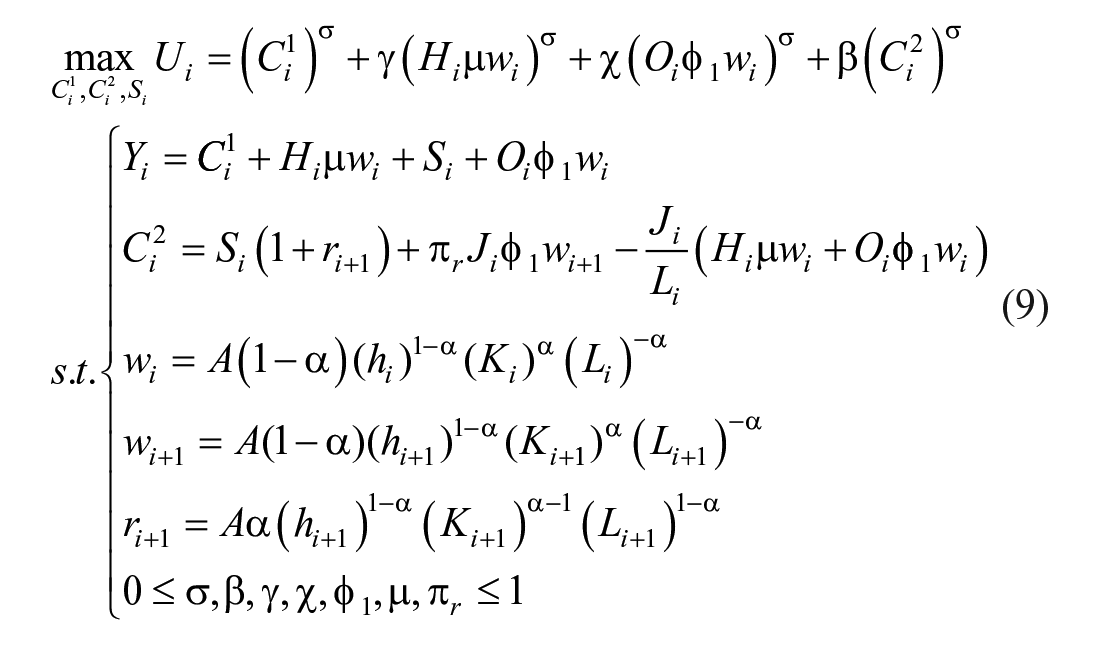
The value of the maximum objective function for each period is defined as the total workforce welfare
Following all of the above, the question of whether delayed retirement crowds out workforce welfare is answered by comparing the difference between workforce welfare under the delayed retirement policy and that under the current nondelayed retirement policy. This paper puts forward the following two hypotheses.
H1: Workforce welfare is greater under the delayed retirement policy than under the current system; that is, the delayed retirement policy improves workforce welfare.
H2: Workforce welfare is lower under the delayed retirement policy than under the current system; that is, the delayed retirement policy crowds out workforce welfare.
Parameter Setting
The population structure variables, capital stock, human capital level, and other parameters in the model are given. According to equation (9), the effects of different delayed retirement scenarios on workforce welfare over the years may be simulated, and the dynamic model can be realized through equation (6) of capital motion. It should be noted that this model is a nonlinear dynamic optimization; under this condition, there is usually no analytical solution. The numerical solution is obtained through the fmincon function for solving nonlinear optimization in the MATLAB toolbox. According to China’s national conditions and the relevant literature, the initial values and parameters of some variables must be predefined prior to simulation, see table 2. It should be further noted that to ensure the reliability of the simulation results and to avoid randomness of parameter setting, a sensitivity analysis is carried out for some of the core parameters that may affect the simulation results.
Setting of Benchmark Parameters.

Analysis of Simulation Results
According to the estimation of experts from the Ministry of Human Resources and Social Security of China, we define the current average age of those who retire from the labor market in China as 54 years old. Thus, the baseline scenario (BI) for maintaining the retirement system is given with the average age of those leaving the labor market of 54.
In addition, two other delayed retirement scenarios are set, specifically, gradually delayed retirement (GDR) and immediately delayed retirement (IDR). GDR means that every other year, a queue of people move out of the labor market, that is, with an annual delay of half a year. For example, in the first year, the 54-year-old queue retires from the labor market; in the second year, no one retires; and in the third year, the 55-year-old queue retires. In 2035, the 64-year-old queue will begin to retire from the labor market. After 2035, the age at which each queue begins to retire from the labor market is fixed at 64.
In IDR, the queue of 54-year-olds will retire in the first year. In the second year and thereafter, there is no queue to retire from the labor market. All of these people will wait to retire when they reach the age of 64. IDR has a much greater intensity than GDR. These scenario settings indicate that by 2035, the various delayed retirement plans will basically be complete, which is why the research interval is set in the 2015 to 2035 period. Regardless of whether GDR or IDR is used, the policy affects the number of working people and the number of elderly people, mainly by affecting the number of people who are about to retire, which eventually affects both income distribution and workforce welfare.
Basic Results
As shown in Figure 2, first, regardless of whether the scenario is BI with an unchanged retirement system, GDR, or IDR, future workforce welfare shows a tendency to increase, whereas the growth rate decreases. Second, compared with the baseline scenario, workforce welfare is higher under the delayed retirement system than under the unchanged retirement system, indicating that delayed retirement improves workforce welfare instead of crowding it out. Third, the larger the range of delayed retirement, the greater the improvement in workforce welfare. Therefore, H1 is confirmed.
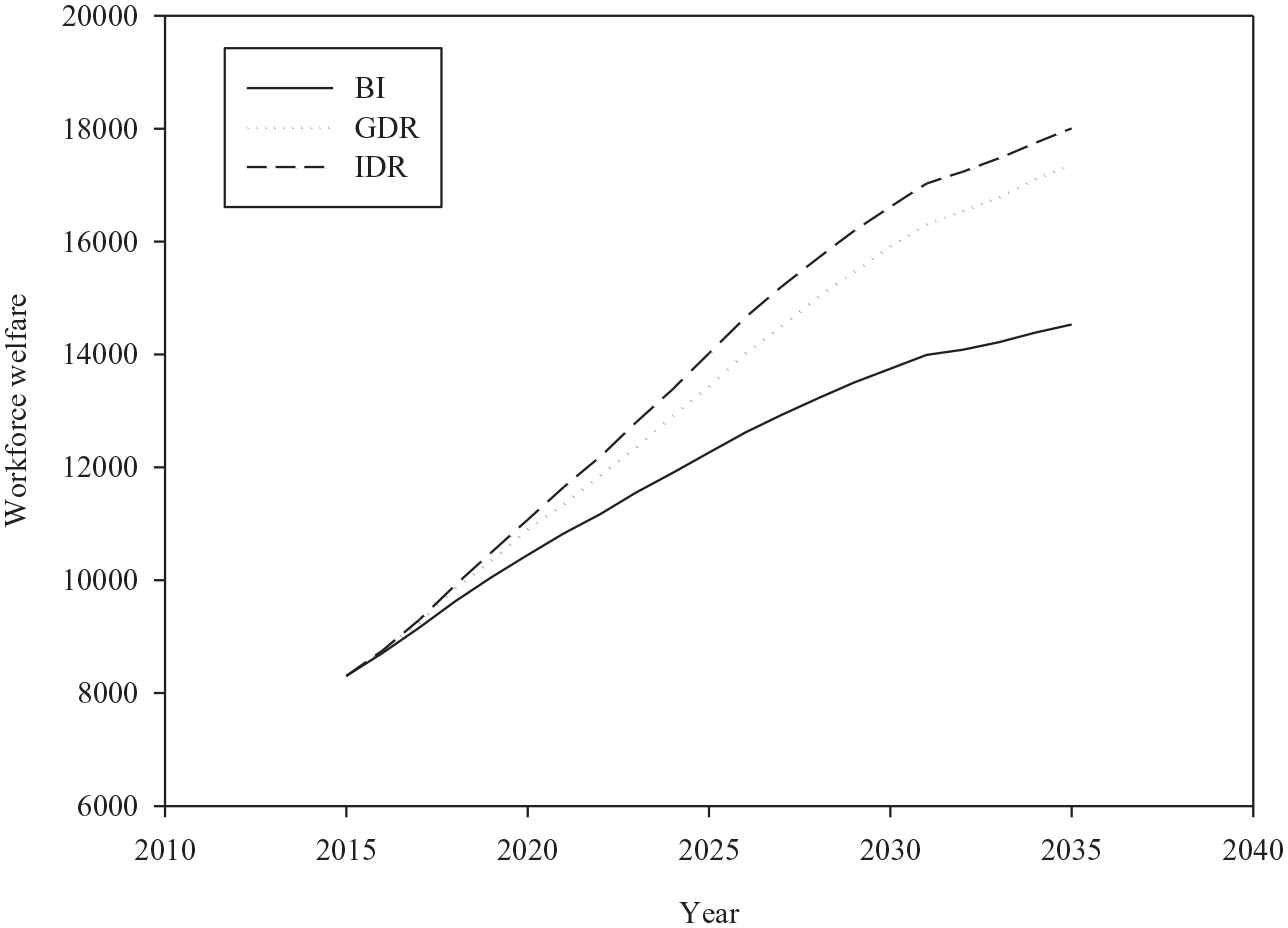
Impact of delayed retirement on workforce welfare.
Why does delayed retirement improve workforce welfare compared with the unchanged pension system? First, according to the formula for the working population’s responsibility for raising children and supporting elderly individuals, that is,

Impact of delayed retirement on per capita output.
Robustness Analysis
We next conduct a robustness analysis on some core factors that are likely to affect the conclusion; these include the elasticity of intertemporal substitution

Robustness analysis of elasticity of intertemporal substitution.
As shown in Figures 4 to 7, first, different elasticities of intertemporal substitution do not affect the relative results of workforce welfare under the three retirement scenarios, which is the core proposition of the present study. However, they affect the absolute values and the tendency characteristics of workforce welfare under the three retirement scenarios. For example, the greater the elasticity of intertemporal substitution, the greater the workforce welfare. Second, for different discount coefficients, these conclusions are still robust. Similarly, the value of discount coefficients affects the absolute value of workforce welfare under the three retirement scenarios. The higher the discount coefficient is, the greater the workforce welfare. Third, different weight coefficients for raising children and supporting elderly individuals do not affect the comparative results of workforce welfare under the three retirement scenarios. More importantly, they basically do not affect the absolute value and tendency characteristics of workforce welfare.

Robustness analysis of the discount factor.

Robustness analysis of the weight coefficient of the expenditure on raising children.

Robustness analysis of the weight coefficient of the expenditure on caring for elderly individuals.
Further Discussion
According to international standards, a country’s society is aging if the elderly population (those older than 65 years of age) accounts for more than 7% of the total population. This proportion was 12.6% in China in 2019, indicating that China is accelerating into an aging society. Under the mode of supporting elderly individuals with determination of taxation by spending, delayed retirement does not crowd out the welfare of the working population but, instead, improves its welfare. Given the change in generations, the working-age population is decreasing annually, whereas the elderly population is increasing sharply. To manage the aging population and promote future economic growth, China may implement pension system reform. Different pension systems may have different impacts on the welfare of the working population. To further ensure the reliability of our conclusions, we must answer the following question: If we change the mode of intergenerational support from determining taxation according to spending to determining spending according to taxation, will delayed retirement still crowd out workforce welfare?
According to the characteristics of determination of spending by taxation, the intergenerational support of the total elderly population by the working population in each period is a fixed proportion

As shown in Figure 8, first, under the scenario of determination of spending by taxation, regardless of whether the scenario is BI, unchanged retirement, GDR, or IDR, the welfare level of the working population in the future still increases; however, the growth rate decreases. Second, compared with the baseline scenario, workforce welfare is higher under delayed retirement than under the unchanged retirement system. In other words, delayed retirement does not crowd out workforce welfare but improves it. Third, the larger the range of delayed retirement, the greater the improvement in welfare for the working population, indicating that these conclusions are still robust if we change the mode of intergenerational support.

Impact of delayed retirement on workforce welfare under determination of spending by taxation.
Why does delayed retirement not crowd out workforce welfare under the determination of spending by taxation? First, from the perspective of the working population’s per capita burden of raising children and supporting elderly individuals

Impact of delayed retirement on per capita output under determination of spending by taxation.
Conclusion
To manage the problem of future aging and improve the financial status of the pension system, delayed retirement planning is being developed and may be introduced in due course. However, scholars, the government, and even the public still have concerns about whether delayed retirement will crowd out the welfare of the working population. To answer the scientific question of whether delayed retirement will crowd out the welfare of the working population, we must consider the Chinese context and establish a general equilibrium framework that can simulate the impact of delayed retirement on workforce welfare over time under the current mode of supporting elderly individuals by determining spending based on taxation. Simulations were conducted according to practical and feasible parameters, and the main findings are as follows. Delayed retirement does not crowd out workforce welfare; instead, it improves the welfare of the working population. This conclusion is robust not only to changes in important parameters but also to changes in the support of elderly individuals in the future. The mechanism of this improvement in workforce welfare is that delayed retirement increases per capita income, which in turn increases expenditures on consumption, savings, raising children, and supporting elderly individuals. Delayed retirement also reduces the burden of raising children and supporting elderly individuals for each working individual and, under the condition in which per capita income remains the same, increases the share of personal consumption and savings, thereby improving the welfare of the working population.
The policy implications of these conclusions are as follows. This is a critical period for achieving the two centennial goals. After 2015, to avoid the impact of the exit of China’s largest generation of post-1960s baby boomers from the labor market on social security and economic growth, we must make the public aware of our research finding that delayed retirement improves the welfare of working people. Doing so would correct the public’s ill-informed opinions and alleviate the concerns of scholars and government officials. To manage the future aging problem, relevant functional departments should formulate and implement delayed retirement plans in a timely manner. One mechanism by which delayed retirement improves workforce welfare is by reducing the burden of raising children and supporting elderly individuals when the cost of raising an individual child or supporting an elderly person remains unchanged. This effect is achieved by increasing the working population and reducing the size of the elderly population. The policy implication is that to improve the welfare of the working population by delaying retirement, we must strictly control the rise in fertility costs and the increase in the pension replacement rate during the process of delaying retirement.
The limitations of this study mainly lie in the following two aspects. First, the applicability of the model is weak because it adopts an ideal assumption that the country is in a closed state and does not consider the transnational flow of personnel. Second, China is a large, agricultural country with a large, rural population. There is a dual-track system between urban and rural areas, and differences in welfare between the urban and rural labor forces are not discussed in this paper. Therefore, one area of improvement for this study is to include leisure or other elements in the model settings. In addition, the differences between urban and rural areas can be further explored.
Footnotes
Acknowledgements
We thank the Yafeng Nie and Xiaoyu Zhang for their valuable suggestions. We thank the organizations mentioned above.
Author Contributions
Zhen Hu established the model and implemented in MATLAB toolbox; Zhen Hu and Hualei Yang analyzed the data and wrote the paper.
Declaration of Conflicting Interests
The author(s) declared no potential conflicts of interest with respect to the research, authorship, and/or publication of this article.
Funding
The author(s) disclosed receipt of the following financial support for the research, authorship, and/or publication of this article: This research was funded by the National Natural Science Foundation of China (No. 71873103), the China Ministry of Education of Humanities and Social Science Project (No. 18YJC790053), the China Postdoctoral Science Foundation (No. 2018M631212), the Social Science Foundation of Shaanxi Province (No. 2018S19), and Key Scientific Research Plan Projects of Shaanxi Provincial Department of Education(No.21JT044 ), and Improve the Public Science Quality Plan Project of Shaanxi Provincial Department of Science and Technology (No. 2021PSL102 ).
