




Abstract
Effective authorial voice in academic writing helps researchers establish the value of their scholarly contributions. However, constructing an authorial voice is challenging for many novice L2 writers. Through tracking multiple drafts of master’s theses written by two Chinese EFL (English as a foreign language) graduate students, this case study investigated changes in their authorial voices and the roles of advisor feedback in this process. We drew on three types of data: analysis of multiple thesis drafts for linguistic and content features of voice; advisor feedback on multiple drafts; and a questionnaire for the student writers’ understanding of authorial voice. The results indicate that the linguistic features of voice in their theses have remained largely unchanged, portraying them as unconfident student writers, but the content features have shown significant improvement, conveying authorial voices of novice researchers in the later drafts. Most of the student revisions followed their advisors’ feedback. The student participants’ questionnaire responses indicate their relative lack of awareness of the importance of language in voice construction. The results suggest that the authorial voice construction of the novice student writers is dynamic, developmental, and interactive with their advisors’ feedback over the thesis writing process. Pedagogically, other than feedback on content features of voice, classroom practitioners could also consider providing explicit instruction of and feedback on linguistic features to help students construct authoritative authorial voice in the academic context.
Keywords
Introduction
Thesis and dissertation writing has attracted increasing attention in recent years to understand how less experienced writers are acculturated into the academic community through this important writing task in their graduate life (Bitchener & Basturkmen, 2006; Botelho de Magalhães et al., 2019; Geng & Wharton, 2016; Morton & Storch, 2019; Peng, 2019). Many of those studies are on doctoral candidates; only a few have probed master students’ writing (Samraj, 2008; Sun, 2015; Xie, 2016). Although master students are far from being a full-fledged member of academia, how they compose their theses deserves more attention. Becoming a competent researcher means that one needs to take different voices of “arguer,” “researcher,” “interpreter,” “writer,” “recounter” (Bondi, 2012) to portray them more as knowledge contributors than transmitters.
While embarking on their academic journey, many graduate students face the challenge of conveying authoritative authorial voice in writing (Botelho de Magalhães et al., 2019; Dressen-Hammouda, 2014; Morton & Storch, 2019). In their critical review of empirical studies that examined the features of voice in academic writing, Stock and Eik-Nes (2016) pinpointed that many studies have followed Hyland’s (2008) framework to examine discursive linguistic features on voice construction; but the evaluation of voice is holistic, depending on the overall impression of content, structure, argument, language, etc. As few studies have investigated content features of voice, and fewer studies have tracked changes during the process of authorial voice construction, Stock and Eik-Nes (2016) called for more studies in those overlooked areas.
To address this call, our study examined the construction of authorial voice in the master’s theses of two Chinese EFL students (English as a foreign language) by tracking the changes of content and linguistic features of authorial voice in their multiple drafts. We drew on three types of data: students’ multiple thesis drafts; their advisors’ written feedback on their drafts; and a questionnaire for student participants’ understanding of authorial voice construction. Such triangulated data could shed light on novice L2 writers’ voice construction and the roles of advisor feedback to help us conceptualize voice construction as a dynamic developmental process. Novice L2 student writers also engage in an interactive process as they co-construct their authorial voices with their advisors.
Literature Review
Authorial Voice
Authorial voice is essential for writers to establish the importance and contribution of their ideas. It is “how we position ourselves in relation to our communities” (Hyland, 2008, p. 6) to represent who we are (personal choice) in the respective community (social choice). Strategic deployment of voice features helps academics “construct themselves as competent disciplinary members who have something worthwhile to say” (Hyland, 2015, p. 33); but developing an effective disciplinary voice to evaluate others and engage with readers can be challenging based on the writer’s background and experiences (Botelho de Magalhães et al., 2019; Jwa, 2018; Tardy, 2012).
Can graduate students demonstrate the expected authorial voice in research writing? The results are conflicting. L2 graduate students in some studies were able to develop researcher voices by enacting academic criticism, arguing for the importance of their work, and modifying claims with hedges, boosters, and evaluative language (Cheng, 2006; Geng & Wharton, 2016; Tardy, 2005). However, Chinese graduate students in Xie (2016) lacked critical voices in evaluating others. Two doctoral candidates in Botelho de Magalhães et al. (2019) struggled to develop their authorial voices as researchers through their graduate life. These could result from different training contexts (Peng, 2019), lack of instruction on language features of voice, and advisors’ limited understanding of voice (Zhang & Zhan, 2020).
Linguistic Features of Voice
Authorial voice could be seen through the interactional process of how authors position themselves in relation to readers, other researchers, and topics under discussion for authorial presence, contribution, and evaluation. Many studies on textual analysis of voice features followed Hyland’s (2008) framework to examine stance (how writers position themselves) and engagement (how writers engage readers). Our study focuses on stance features of self-reference, hedges, boosters, and attitude markers.
Self-reference: In writing, one can use “I,” “we,” “my paper,” “this paper,” and “the author” to highlight or hide the writer presence. Hyland (2002) revealed that language learners tended to avoid “I” in their writings and choose more impersonal references such as “paper” and “author.” This could be related to the learners’ culture background. For example, Chen (2020) noted that Chinese academic writers preferred “we” and “the author,” “the paper,” “the writer,” and “this study” instead of “I,” even in single-authored articles. Ivanič (1998) explained that avoiding first person pronouns created a sense of objectivity but detached writers from the text and readers. In the humanities, first person pronouns can be used to construct writer identity and voice, since “writers who present themselves as knowledge-makers are also positioning themselves as having property rights, as contributors to the fields” (p. 308).
Hedges and boosters: Hedges “help writers present statements with appropriate accuracy and caution. . . express the correct degree of their certainty to their claims” (Koutsantoni, 2006, p. 23). Boosters perform the opposite function of enhancing confidence and certainty. As useful means to express authorial voice, both could address issues of study limitations, author knowledge, justification of claims, and support of findings. Many empirical studies indicated that L2 student writers have not mastered these features to create the expected researcher voice in modifying or enhancing their ideas (Bitchener & Basturkmen, 2006; Koutsantoni, 2006).
Attitude markers: Attitude markers “indicate the writer’s affective, rather than epistemic, attitude to propositions” (Hyland, 2008, p. 10). It is how authors express their opinions by “commenting on and evaluating the text material” (Gillaerts & Van de Velde, 2010, p. 130). L2 writers have demonstrated various problems in evaluating others and themselves (Geng & Wharton, 2016; Gillaerts & Van de Velde, 2010; Hyland, 2008; Jou, 2019).
Content Features of Voice
Authorial voice is dispersed in writing, rather than simply clustered around certain language features. Zhao (2013) observed that raters relied more on “the idea and content-related dimension” (p. 208) to evaluate voices in EFL argumentative writing. PhD supervisors in Morton and Storch (2019) judged voices in student writing holistically. To them, voice is “located in complex configurations of lexical, grammatical, organizational, and material dimensions” (p. 16). Journal reviewers in Matsuda and Tardy (2007, p. 243) also examined knowledge, theoretical lens, rhetoric moves, argument, syntax, careful editing, etc. to gauge authorial voices of submitted manuscripts. Therefore, Stock and Eik-Nes (2016) called for more attention to content features of voice, such as “reasoning and argumentative strategies, breadth of knowledge, clarity, or uniqueness of a central point, or how writers use others’ voices to create their own disciplinary voice” (p. 97).
Advisor Feedback
While working on the milestone thesis project, graduate students are in the academic acculturation process to become accepted members in their respective communities. This writing process helps them develop expertise in “reasoning and persuasion, their grasp of subject matter issues, and their ability to shape an argument using the conventions of their field” (Hyland, 2013, p. 241). Advisors and supervisors, portrayed as “‘prey’ searchers, managers, manuscript correctors and masters” (Lei & Hu, 2015, p. 32), play key roles in this process.
Written feedback from advisors is “arguably the most important source of input on what is required or expected of thesis-writing students” (Bitchener et al., 2010, p. 79). Advisors focus more on macro issues of content and structure than language issues (Bitchener et al., 2010; East et al., 2012; Hyland, 2013). Advisors’ concerns with “the rhetorical, genre level features of argument and disciplinary persuasive logic” outweigh those for “grammatical accuracy” (Hyland, 2013, p. 244). In their study of 35 supervisors in three disciplines, Bitchener et al. (2010) investigated the supervisors’ written feedback on content, genre, organization, argument development, and linguistic accuracy and appropriateness. For content and organization, those advisors provided feedback on gaps in theory and sources, irrelevance or significance of materials, arguments, chart drafting, format, section links, etc. For language issues, those advisors primarily focused on linguistic accuracy by providing reformulations and corrections for persistent grammar problems. Only one third of their feedback on language were on voice, stance and writing style. From the opposite perspective, students in East et al. (2012) reported receiving written feedback in literature relevance, presentation of the work, finding literature, and suggestions on research methodology; specific and overview comments on organization, cutting irrelevant materials; vocabulary, grammar, spelling, punctuation, and appropriate language use. Studies on students and advisors showed similar results of feedback. Students found direct feedback on the organization of their writing and less direct feedback challenging their thinking to be more helpful. Language feedback was “appreciated” but “secondary to feedback that challenged the students intellectually” (p. 7). Analyzing the functions of feedback, Kumar and Stracke (2007, p. 464) coded written feedback on PhD dissertations into referential (editorial, organizational, and content matters), directive (suggestions, questions, and instructions) and expressive functions (praise, criticism, opinion), with referential feedback on organization and content prevailing in faculty comments. However, advisor practices may not always match student expectations. For example, Salter-Dvorak’s (2017) study revealed a mismatch between what a L2 graduate student wanted from the advisor (argument development) and what the advisor focused (other aspects).
Although studies on voice construction are abundant, how students develop skills to properly construct their authorial voices in the academic context has been overlooked. Other than Dressen-Hammouda (2014) and Morton and Storch (2019), only two studies in Stock and Eik-Nes (2016) review article investigated the developmental issue of authorial voice. Many textual analysis studies on voice features only examined the final written products, ignoring the changes between drafts in the writing process (e.g., Geng & Wharton, 2016; Koutsantoni, 2006; Xie, 2016). The lack of tracking voice-related features dynamically, the focus on linguistic features rather than casting a broader net on voice construction in writing, and the primary interest in doctoral candidates have all prevented us from understanding how master-level graduate writers learn to construct authorial voice through their thesis writing process.
In trying to understand the dynamics of authorial voice construction of novice L2 writers and how advisor feedback affects student writers’ voice development in the writing process, in this article, we examined multiple thesis drafts of two Chinese EFL graduate students as well as their advisors’ feedback from a longitudinal perspective rather than only analyzing their final texts. We hope to uncover the interactive nature of voice construction between student writers and their advisors from a developmental point of view. The study was guided by two research questions:
Do the linguistic and content features of authorial voice in two novice L2 writers’ theses change over multiple drafts? If so, how do students develop such a voice?
What do their advisors focus on in their written feedback? What role could the advisor feedback play in developing students’ authorial voice in the thesis writing process?
Methodology
Research Context and Participants
We collected data in a master’s program in English at a comprehensive Chinese university. In this program, students are required to complete 28 to 30 credit hours before defending their thesis proposals. An academic writing class on research writing is required for all graduate students before they compose their theses. The school implements a very stringent thesis review system: a trial thesis defense, plagiarism check, external blind review of 30% of theses, and the final defense. Therefore, both thesis writers and advisors take this seriously.
To address the research questions, we focused on two cases—two Chinese graduate students enrolled in the master’s program. Case study method was chosen as the study required investigation of the cases over time with detailed, in-depth data collected from multiple sources (Creswell & Creswell, 2018). The focal students in this study, Lit (male, age 23) and Lin (female, age 24) (pseudonyms for literature and applied linguistics), were typical in their cohort: they started graduate school right after receiving their bachelor’s degree in English. Both students took an academic writing class with the second author and had publications in Chinese journals. Participants in the study were selected based on a convenience sample. Convenience sampling, for its practicability, is a commonly used sampling strategy in second language research (Creswell & Creswell, 2018; Dornyei, 2007). Prior to data collection, participant consent forms for this study were obtained from both students and their advisors.
Data Collection
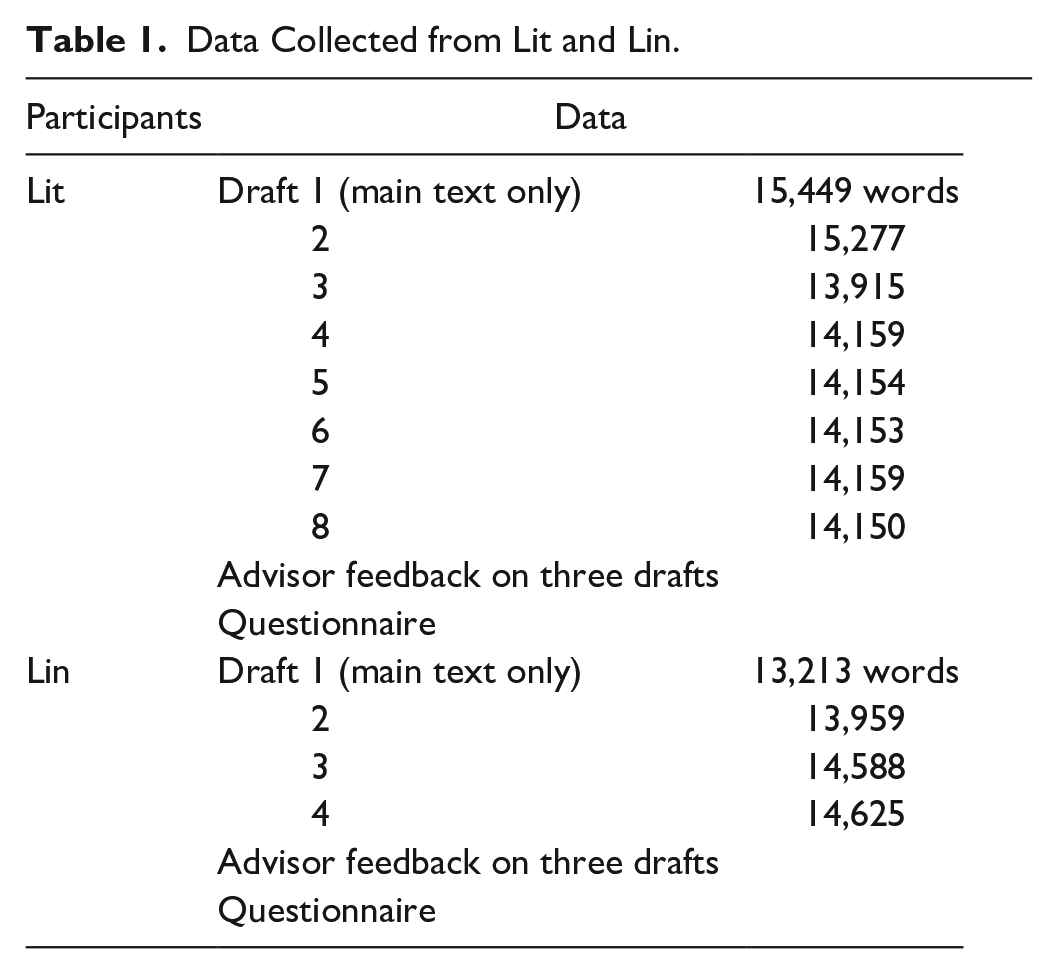
The data were collected when the participants were composing their master’s theses. Lit composed eight drafts of his thesis over 7 months and received detailed feedback from his advisor on three drafts. Lin spent more time on data coding/analysis and constantly consulted her advisor during this process. She composed four drafts over 8 months and received detailed feedback from her advisor on three drafts. When there was no advisor feedback, Lit worked on grammar issues on his own. We were only able to collect advisors’ written feedback on student drafts. Unfortunately, face-to-face interactions between the two students and their advisors were unavailable.
In order not to affect their writing, after they submitted their final versions of their theses, we gave Lit and Lin an English questionnaire to investigate their awareness of authorial voice construction. The questionnaire included excerpts from published research articles and student writings in the humanities, and they were invited to judge the voices of those writing samples and explain their reasons. Table 1 presents the data collected for each participant.
Data Collected from Lit and Lin.
Data Analysis
Lit’s thesis was a literature analysis of a novel in five chapters: introduction, three chapters of analysis, and conclusion. Lin’s thesis, in the introduction-methodology-results-discussion format, examined argumentative elements in Chinese EFL writing. Separately, we coded the linguistic features of voice into self-reference, hedges, boosters, and attitude markers (based on Hyland, 2008); and content features of voice into structure, ideas, and citation (based on Morton & Storch, 2019; Zhao, 2013). We coded advisor feedback into three major categories: comments on grammar accuracy, linguistic features of voice, and content features. Our coding was more than 95% in agreement. We discussed those initial disputes in our coding and reached an agreement on them.
Depending on what is modified in the theses, we categorized boosters and hedges into novel (the novel), self (Lit’s study), research (the research field), analysis (character analysis) for Lit’s thesis, and self (Lin’s study), research (the research field), and student (student essays examined) for Lin’s thesis. Some examples are provided here.
1. The novel
2. the last chapter. . .
3. she (a character) is
4. argumentative writing has
5.
Following Hyland (2005), we examined attitude verbs (such as praise, describe, question), sentence adverbs (such as amazingly, sadly), and adjectives (such as ground-breaking, careless) as attitude markers, when these words show writer “attitudes, opinions, or stances toward the construed propositions or research entities” (Xie, 2016, p. 1). Occasionally, we found nouns as attitude markers, such as “the
6. This novel
7. . . . the
8. this study (her study)
9. Toulmin did
10. Some
We tracked structural changes (moving paragraphs or sentences around, adding or deleting sections); idea changes (adding or deleting ideas, relevance between ideas, significance of ideas); source changes (citation format, adding or deleting sources) as content features of authorial voice. We coded advisor comments into content feedback of ideas, structure and citation, and language feedback of grammar and voice-related features. We also related advisor feedback to specific changes Lit and Lin made in their revisions.
Findings
This section first reports a normalized count (per 1,000 words) of the three focused linguistic features in student theses, and content features of voice in ideas, structure, citation, then connects those changes to advisor feedback. Finally, the questionnaire data are discussed in terms of student participants’ understanding of authorial voice construction.
Self-Reference
Table 2 presents Lit’s personal self-reference “I,” “my” and impersonal self–reference “paper,” “thesis,” “research,” “chapter” over eight drafts. Only words referring to the author or the writing were counted. Sentences such as “X’s paper, more research is needed” were excluded.
Normalized Frequency of Self-Reference in Lit’s Thesis (Per 1,000 Words).

Lit initially used several personal pronouns of “I,” “my,” which were later deleted. His use of “paper” increased while that for “thesis,” “chapter,” “research” decreased in later drafts. Lit’s frequent use of “paper” seemed to convey more of a writer voice than a researcher voice.
Table 3 presents self-reference in Lin’s thesis over four drafts. Again, only words referring to the author or the writing were counted.
Normalized Frequency of Self-Reference in Lin’s Thesis (Per 1,000 Words).

Lin did not use personal pronouns of “I,” “my” at all. Instead, she used “study” and “researcher” more in later drafts. This change could reflect her growing voice of a “researcher” rather than a “writer.”
Hedges and Boosters
Hedges and boosters, when used properly, could help writers establish the voice of experienced scholars, savvy to make claims persuasively and reasonably. Inappropriate hedges and boosters will make writers sound arrogant, unconfident, unknowledgeable, or biased. Table 4 presents the hedges and boosters in Lit’s thesis over eight drafts.
Normalized Frequency of Hedges and Boosters in Lit’s Thesis (Per 1,000 Words).

Lit did not change hedges for “novel,” but he hedged more for “self,” “research,” and “analysis” over drafts. Overall, Lit used more boosters to praise the novel, but not much for his own paper. He rarely hedged his claims on the novel but hedged more over time when referring to his own paper and talking about limitations of his research. This did not contribute to a confident researcher voice.
Lin’s hedges and boosters over four drafts are presented in Table 5. Lin used more hedges in later drafts. Several hedges were used on the scope of her study, and more hedges were on future studies and pedagogical suggestions. She only used boosters once to talk about her own study in Draft 4 but used more boosters for the research field. Her use of boosters remained consistent over drafts. When referring to her study, Lin used more hedges but almost no boosters, suggesting a lack of confidence in her researcher voice.
Normalized Frequency of Hedges and Boosters in Lin’s Thesis (Per 1,000 Words).

Attitude Markers
Table 6 presents Lit’s attitude markers. Lit’s positive evaluations of “novel,” “research” were quite consistent over his drafts, and he evaluated his own work slightly more positively in the later drafts. His neutral evaluations of all four groups started dropping at Draft 3, then remained stable. The negative evaluations of “self,” “research,” and “analysis” increased more noticeably in Draft 3. Lit’s attitude toward the novel was mostly positive. His attitude toward his own study and the research field was mostly neutral, with some positive evaluation of the importance of his own work and the research field and negative evaluation of the limitations in the research field. Overall, Lit deployed a more neutral evaluation, which is common in research articles, and he showed more positive attitudes than negative attitudes in total, suggesting a voice of agreement with others.
Normalized Frequency of Attitude Markers in Lit’s Thesis (Per 1,000 Words).

Table 7 presents the attitude markers in Lin’s thesis. The most noticeable change was a sudden drop of positive evaluations of research in Draft 4. Lin remained neutral toward her own study. For student work, she showed a mixture of positive, negative, and neutral attitude for good and not-so-good essays. For the general research field, she positively evaluated the importance of the field but kept a neutral tone to present the theory and other studies and mentioned weaknesses to warrant the need for more studies. Overall, she showed predominately neutral attitudes in her thesis.
Normalized Frequency of Attitude Markers in Lin’s Thesis (Per 1,000 Words).

The three focused linguistic features in the two participants’ multiple drafts did not show significant changes. Judging from these features, we primarily hear the voice of student writers, not skillful at expressing evaluation, or arguing for the contributions and limitations of their studies. Next, we will discuss content features of voice to see whether a similar conclusion can be drawn.
Content Features of Voice in Lit’s Thesis
Lit’s thesis showed meaningful changes in Drafts 2, 3, and 8 in structure, ideas, and citations. Drafts 4 to 7 were basically the same with grammar corrections. It will be less meaningful to present the content changes in all drafts quantitatively, so we select some important changes in his revisions in those areas for a qualitative analysis.
Structure: Lit has presented a complete structure from the beginning: title page, abstract, key words, content, introduction, three chapters of analysis, conclusion, bibliography, and acknowledgment. In the main body of the three analysis chapters, he analyzed some characters chronologically. This structure was not changed over his drafts. He followed a template in writing introduction and conclusion. The limitations and further study section in his first draft was copied from a sample master’s thesis with his own note “to fill the space.” He changed the content of that part in Draft 2. Other structural changes included breaking down some paragraphs to different paragraphs, combining some paragraphs into one, and moving paragraphs around. Those changes did not significantly alter the thesis structure.
Ideas: Lit made more changes here. For example, in Drafts 1 and 2, when he introduced the novelist, he included her personal life, which was deleted later. This showed better audience awareness. Another meaningful change was in the conclusion-summary section. This part in Drafts 1 and 2 was identical to his abstract in language expressions. In Draft 3, Lit started by highlighting the research methodology and contributions of his paper, followed by a lengthy discussion of the novel, its content, historical background, and research angles. In Draft 8, Lin further changed this section and presented the focus of his analysis, findings and uniqueness of his study. This change added weight to the value of his study in the conclusion.
Another change worthy of discussion is the final limitation and suggestion part. In Draft 2, Lit did not address the limitations of his own study, and only discussed gaps in the research field, his approach and provided vague suggestions for further studies. After making changes in several drafts, in Draft 8 he addressed the weaknesses of his own thesis and connected suggestions for future studies to some of those limitations. Figures 1 and 2 illustrate this change.

The limitations and further studies section in Lit’s Draft 2.

The limitations and further studies section in Lit’s Draft 8.
Citations: Most of Lit’s citations were in the literature review section. No year or article information was provided for any source in his earlier drafts. In Draft 3, Lit provided researcher credentials, article titles, and year information. However, some information on the researcher credentials seemed unnecessary as it was on the administrative roles of those researchers. He kept those details in the final draft. Figure 3 illustrates this point. In Draft 3, he started to use footnotes, but was not consistent in this practice. It was unclear why he used footnotes for some sources, but not for others. In addition, not all of his in-text citations were listed in the bibliography; not all entries in the bibliography were used in his thesis. Although Lit fixed some of these issues in the final version, this mismatch between in-text citations and bibliography still remained. Lit’s citation practices actually hurt his voice as a serious researcher to a certain extent.

Illustration of citation issues in Lit’s Draft 8.
Content Features of Voice in Lin’s Thesis
Lin made apparent changes in all drafts, especially in ideas and structure. We select some insightful instances to analyze how those changes have enhanced Lin’s authorial voice to justify the validity and value of her study.
Structure: Lin made structural changes in all drafts, including the overall structure of the thesis and sectional changes in different chapters. Due to space constraint, we only present the major structural changes in her first and final drafts in Table 8.
Lin’s Major Structural Changes in Drafts 1 and 4.

The above changes helped Lin organize her thesis in a more logical way. Readers could perceive the theoretical underpinning of her study and connections between her sources easier; reorganization of data analysis created a clearer thread to discuss the data and answer her research questions directly; the separation of data analysis and discussion enabled her to explain the results in a deeper way; moving scoring rubrics and sample student essays to appendices helped the text to focus on theory and her study. She also made some minor structural changes: she put the limitations of her study, which originally occurred in several paragraphs, into one; and divided pedagogical suggestions, which originally occurred in one paragraph, into several.
Ideas: Lin continued to enrich various parts of her thesis. For example, she added details of participants and justified why they were chosen; provided more information on data collection methods, data coding, and intercoder reliability; briefly explained each table of quantitative data; created short paragraphs at the beginning and end of several chapters to introduce and summarize those chapters; added theoretical implications of her study (Figure 4 illustrates this addition) and suggested more teaching activities. Those changes made her study more convincing and acceptable to fellow researchers and enhanced the validity of her study. She also deleted some less important information. One example was when introducing Toulmin model, she mentioned that “the book became a best-seller and was never out of print,” which was later deleted. Such a deletion showed her better awareness of scholarly audience.

Adding theoretical implications of her study in Lin’s Draft 3.
Citations: Lin initially did not put year and page information for many cited sources. She also failed to use sources to support many claims, when the inclusion of sources could enhance the strength of her statement. Those were corrected in later drafts. On several occasions, she included multiple sources in one parenthesis to support the importance of a topic or to present common findings, which needs to be fine-tuned. For example, in her early drafts, she mentioned that Toulmin model has inspired studies, and listed several sources in one parenthesis. In Draft 3, she divided the different areas of study into research on argumentative writing, teaching, and critical thinking and separated those sources into three parenthetical references. Figures 5 and 6 illustrate this change. She seemed to put all sources she could find in the bibliography in her early drafts but removed some entries that were not discussed in her thesis in the final version. The in-text citations and bibliography entries were consistent in her final version, and the format of citations was overall correct.

Improper citation format in Lin’s Draft 2.

Revised citation format in Lin’s Draft 3.
To sum up, both Lit and Lin changed more in structure, ideas, and citations during their thesis writing process, but did not change much in self-references, hedges, boosters and attitude markers. Those linguistic features made them sound less confident in their own studies, and not skillful at evaluating others; but those content changes enhanced their authorial voices while arguing for the validity and value of their own studies.
Next, we will compare their changes with their advisors’ feedback.
Advisor Feedback
Lit’s advisor’s feedback
Lit’s advisor provided detailed feedback on three drafts. Grammar accuracy and language expressions received the most attention, followed by ideas, citations, structure, and linguistic features of voice. Table 9 presents descriptive data of her total feedback on Lit’s drafts.
Descriptive Data of Lit’s Advisor’s Written Feedback.

Lit’s advisor mainly corrected grammar and language issues of sentence structure, word choice, capitalization, punctuation mark, tense, choice of articles, etc. She frequently commented that “the language sounds too Chinese,” “the language is not effective,” and “I do not understand the meaning.” When the advisor spent so much energy on grammar and sentence-level expressions, other aspects of writing would naturally receive less attention. Lit’s advisor’s feedback also centered on ideas in terms of significance of materials, connection between ideas, irrelevant information, logic between ideas, repetitive ideas, function of examples, and mismatched information. For instance, when Lit included the novelist’s personal life, the advisor questioned “is that necessary?”. When Lit’s choices of textual examples were not representative, the advisor suggested different ones. She emphasized that “conclusion” cannot be the same as the “abstract” in language expressions (illustrated in Figure 7).

Lit’s advisor’s comment on Draft 1.
For citations, Lit’s advisor asked him to provide source information for many citations. She also pointed out some confusing citation format problems. In her end-comment, she listed the citation format as a major issue. The advisor did not provide much feedback on the overall thesis structure. Actually, she praised Lit’s thesis for the “good overall structure” as one strength. Her structural suggestions were mainly about dividing paragraphs, combining paragraphs, moving ideas around, adding linking sentences or topic sentences. One example given by her is to add a linking sentence “From the review mentioned above, it can be seen . . .” to connect paragraphs smoothly.
The advisor only provided 12 comments on the voice-related language features. In terms of hedges and boosters, she changed “can” to “could” twice and “could” to “can” once. There was no suggested change in attitude markers. She changed “thesis,” “research” into “paper” several times, and changed “my” into “the author’s” (illustrated in Figure 8), and “my research” into “this research.” She deleted “we must know that” from “we must know that the conditions of. . .” and deleted “we can see that” from “we can see that the mass media. . .”. These reflected her dislike for the personal voice in academic writing.
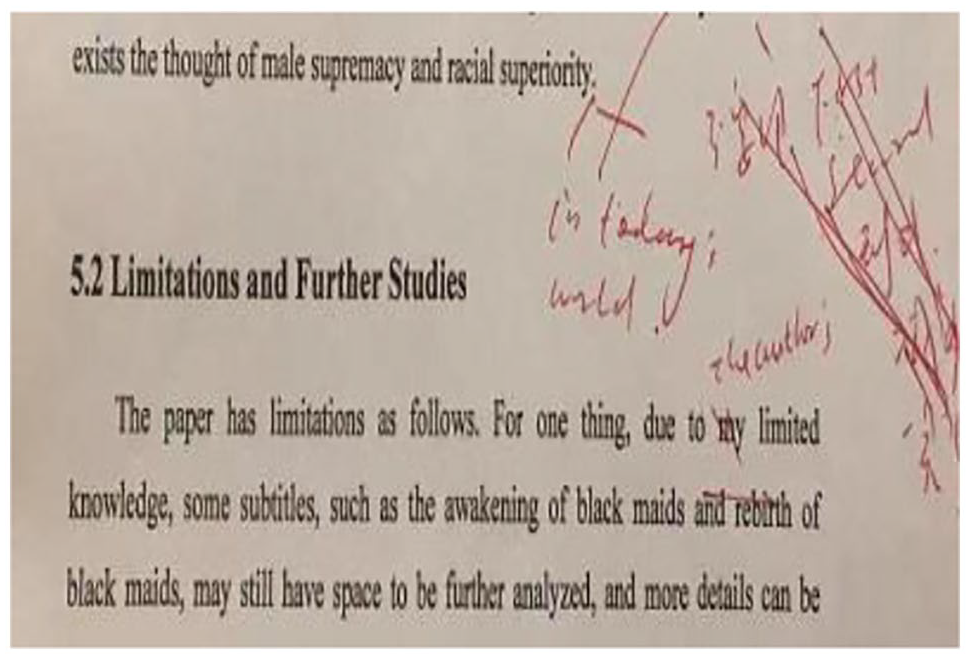
Lit’s advisor’s comment on Draft 2.
When we compared the actual changes in Lit’s drafts with his advisor’s written comments, we saw a high degree of agreement. Lit followed almost all of his advisor’s suggestions when revising his drafts. We did not find structural changes initiated by Lit. The only change in ideas initiated by him was in Draft 2 when Lit revised the “limitations of study” section from the earlier copy-paste template. Other than that, all other changes were suggested by his advisor. Lit used “I,” “my” several times in his early drafts, but those words were replaced by his advisor with more impersonal references such as “the paper” and “the author.” The only exception was that Lit insisted on keeping the administrative roles of some scholars to show their credentials despite his advisor’s disapproval at this practice. It is clear that the authorial voice in Lit’s thesis was co-constructed between his advisor and himself, with advisor feedback taking the leading role in this process.
Lin’s advisor’s feedback
Lin’s advisor provided detailed feedback on all her drafts, in the order of grammar accuracy and language expressions, ideas, structure, citations, and language features of voice. Table 10 presents descriptive data of her total written feedback on Lin’s drafts.
Descriptive Data of Lin’s Advisor’s Written Feedback.

Like Lit’s advisor, Lin’s advisor also provided feedback primarily on grammar and language issues of sentence structure, word choice, tense, choice of articles, and punctuation. She also provided ample comments on ideas throughout the entire paper. Those comments urged Lin to provide more information as clarification, justification, summary, explanation, and analysis, to think about the connection between sources, and to delete unnecessary information. In more than one place, she asked Lin to justify the choice of the participants and provide more information about their age, gender, background (illustrated in Figure 9). In the literature review, Lin first reported different studies without making connections between them, and her advisor asked her to think about how to better connect those studies. In the discussion and conclusion sections, Lin’s advisor asked her to connect cited sources with her own results; otherwise, they read “just like a literature review.” In the data analysis part, Lin’s advisor asked her to briefly explain each table and analyze the results in a deeper way. When Lin provided pedagogical suggestions in one brief sentence, the advisor asked “how (to use this in instruction)?”, encouraging her to propose well-thought teaching activities (illustrated in Figure 10). Overall, these comments and suggestions challenged Lin to discuss and present her own research in a more meaningful way to her scholarly audience.

Lin’s advisor’s comment on chapter 3.

Lin’s advisor’s comment on chapter 6 (first draft).
Lin’s advisor also provided essential structural comments and suggestions. Lin’s early draft put data analysis and discussion in the same chapter, and her advisor asked her to separate them into different chapters. The advisor suggested new ways and different sub-headings to reorganize the literature review section (illustrated in Figure 11). She provided comments on how to reorganize data analysis clearly and logically to answer the research questions. In more than one place, the advisor suggested moving tables or paragraphs around in the same chapter or to a different chapter and moving sample essays and scoring rubrics to appendices. In addition to these fundamental macrostructural comments, Lin’s advisor also provided microstructural suggestions, such as putting the limitations of her study into one paragraph and discussed pedagogical implications in several paragraphs with specific teaching activities and using linking sentences to connect paragraphs. Lin’s advisor made 25 comments on the citation format and directed Lin to additional sources. When Lin made claims without support, her advisor asked her to provide reference sources. In several places, the advisor asked Lin to change non-integral citations to integral citations to contextualize the information and the researchers.

Lin’s advisor’s comment on chapter 2.
Lin’s advisor offered slightly more suggestions on voice-related linguistic features than Lit’s advisor. She provided comments on hedges and boosters, but not on self-references and attitude markers. Specifically, she added “normally,” “can” and “slightly” several times, and changed “have to” to “are required to,” “ought to” and “should” to “can” several times to modify claims. When Lin used “ought to” in her pedagogical suggestions, her advisor commented “too strong” (illustrated in Figure 12). These suggestions helped Lin modify her claims and soften her strong pedagogical suggestions for her fellow readers.

Lin’s advisor’s comment on chapter 6 (second draft).
Revisions in Lin’s multiple drafts showed a high degree of agreement with her advisor’s feedback when she followed all of her advisor’s feedback in revising ideas, structure, citations, and language issues. The constant changes in various voice-related features in both Lin’s and Lit’s drafts clearly followed their advisors’ feedback, and those content changes helped their later drafts express a stronger and more appropriate authorial voice. These suggest that the two student writers and their advisors co-constructed authorial voices in the students’ theses in a dynamic, developmental manner.
After analyzing the actual revisions in their theses and comparing those revisions with their advisors’ feedback, we now discuss Lit and Lin’s understanding of authorial voice construction in academic writing.
Questionnaire
After Lit and Lin submitted their final theses, they were given a questionnaire to investigate their awareness of how authorial voices can be represented in writing. We selected several excerpts from published research articles and student theses in the humanities and asked them to judge the voice construction in those excerpts. Their answers indicated that their judgment relied more on the content and argument but less on the language features in those excerpts.
Lit evaluated the excerpts that use “I analyze,” “my analysis” as expressing “a strong subjective opinion.” This could be related to his advisor’s written comments, as she changed Lit’s use of “I” and “my” to “this paper.” He ignored hedges, boosters, and attitude markers in judging authorial voice. Lit’s evaluation was primarily based on whether opinions are supported by facts in the writing. Lin ignored self-reference and attitude markers and relied on hedges and boosters for her evaluation. In one instance, Lin explained that the writer sounded uncertain: by “using the expression like ‘hesitate over,’ the passage gives an expression of uncertainty and confusion.” In another instance where a student writer used boosters excessively, Lin judged that the writer sounded “too confident and too positive,” from the expressions “certainly enrich,” “propose a new interpretation” and “contribute to a better research.” Lin’s judgment could be traced to her advisor’s feedback, since Lin received explicit comments that she sounded “too strong” for her own booster choices. Lin also based her judgment on content-related features of “logic of the argument,” “simple and general description,” and proper presentation of “each part . . . in good place.” When asked to evaluate their own authorial voice in their theses, Lit did not answer this question. Lin considered herself a “relatively confident writer” as she used “some neutral words” and some “positive words” to support her study, and words such as “relatively” to hedge her claims. Lin felt content at expressing a “relatively confident” voice as “overconfidence is not proper in academic writing.” Lit’s and Lin’s responses to the questionnaire also indicate that their advisors’ feedback on language features has clearly affected their understanding of acceptable authorial voice.
Answers to Research Questions
Our first question asks whether the two participants have changed voice-related features in their theses, and if so, how. Both Lit and Lin made more changes in the content-related features than language-related features of authorial voice during their writing process. Those macro-level changes helped them create a novice researcher voice to a certain extent, presenting their studies as valid and necessary, hence, valuable; the micro-level linguistic features of authorial voice seem to portray them more as student writers, not confident or skillful at evaluating others, struggling to project themselves properly for their academic audience. Their revisions were clearly and heavily guided by their advisors’ written feedback.
Our second question asks about the focus and roles of advisor feedback in this writing process. Both advisors provided quantitatively more feedback on grammar mistakes and language expressions, and valuable suggestions on ideas, structure, and citations to help the two participants develop expected authorial voice. In comparison, they did not provide much feedback on voice-related language features. Advisor feedback has deeply influenced the development of novice student writers’ authorial voice construction in their theses and even their understanding of acceptable authorial voice in research writing, which could be seen from Lit and Lin’s questionnaire responses.
Discussion and Conclusion
Discussion of the Findings
Master’s thesis is a challenging first step toward junior scholarship. Students could gradually learn to develop a desirable authorial voice out of this experience. The changes over the multiple thesis drafts of the two student participants and their judgment of the authorial voices in selected writing samples can be clearly traced to their advisors’ feedback. However, even after months, the two students’ final theses could still be improved in their authorial voices in both content and language expressions. The construction of their authorial voices is longitudinal and dynamic, negotiated with their advisors. This finding is in line with Yang et al. (2021, p. 9) that language learning efforts are “dynamic and contextualized.” In addition, the two student participants rarely initiated changes, but mostly followed advisor feedback in their revisions. Their overreliance on advisor feedback suggests their deference to the supervisors as the authority, and a dominant role of advisors in developing students’ authorial voices.
Both participants have improved content features of structure, significance, and relevance of materials and citation practices in their theses. Those changes indicate their growing awareness to present research to their academic audience with an expected authorial voice. However, the two writers did not show obvious improvement in language features of authorial voice and their deployment of those features portrayed them more as student writers. The conflicting impressions of authorial voices from the two sides of our analysis prove the need for a holistic approach in examining the development of authorial voice construction in writing, as Stock and Eik-Nes (2016) suggested. More studies on authorial voice features in academic writing could investigate both linguistic and content features, rather than limiting themselves to one of the two options.
Our data suggests that of the linguistic features of voice, avoidance of personal pronouns seems to outweigh hedges, boosters and attitude markers in this study. Both writers avoided first-person pronouns to create an objective, impersonal tone. This finding is in alignment with previous studies (Chen, 2020; Koutsantoni, 2006; Molino, 2010; Samraj, 2008). Students’ avoidance of “I” can be largely attributed to the common practice in Chinese academic writing (Chen, 2020), and the belief that research writing should be objective and impersonal. However, disciplinary differences exist in this regard. Social sciences allow more personal projections, as the phenomenon under investigation cannot be separated from its human agents. Contrary to what they and their advisors prefer, using “I” in research writing allows “writers to emphasize their contribution to the academic debate” (Molino, 2010, p. 87) and could create a confident authorial voice.
Pedagogical Implications
This study shows that the two students followed their advisors’ feedback in an uncritical way and rarely initiated significant changes by themselves during their revision process. Their agency appeared to be minimized, as the revision process was predominately guided by their advisors. This could be related to the teacher-centered education system and the teacher-centered view of research in China (Gong et al., 2018, 2020). Furthermore, Zhang and Zhan (2020) pointed out that many Chinese advisors’ understanding of authorial voice is limited, and this could explain unsatisfactory voice construction in Chinese students’ writing. How to broaden advisors’ knowledge repertoire on authorial voice construction, and how to maximize thesis writers’ agency during this process to enhance their own authorial voices? Answers to these questions might be at the national educational policy level, and it requires all stakeholders’ efforts to work toward this long-term goal.
What individual instructors and advisors could do is to guide student researchers to understand that projecting desirable authorial voices requires both macro- and microlevel efforts to strategically commend their own research and other scholarly works, provide insightful evaluation, contextualize their own findings and engage in constructive scholarly conversations. This undoubtedly requires long-term commitment. Even though Lin and Lit had previously taken an academic writing class, and it took them more than 6 months to finish their theses, they were still at the early stage of the academic acculturation process, and they will benefit from explicit instruction, guidance, and feedback in this aspect.
For specific classroom teaching activities, we encourage language teachers, composition instructors, and advisors to offer more explicit classroom instruction on voice-related linguistic features. This could help students make their linguistic choices carefully with a clearer awareness of the voice they would like to project. Jou’s (2019) study provided strong evidence for the effectiveness of explicit instruction. After 7 weeks, the ESL graduate students in this study not only showed more explicit knowledge of “voice” but were able to better construct an evaluative voice in their review articles. For various teaching activities, instructors could use several sentences or paragraphs as examples to draw students’ attention to relevant language features and to analyze how linguistic choices could affect reader perception of writer voices. Advisors may also guide students to conduct textual analysis in their own disciplines to observe how experts establish authorial voice at multiple levels and to reflect upon their own practices. Another useful activity is revision: ask students to pinpoint relevant language features in problematic writing samples and revise them for more effective authorial voice construction. Such knowledge can help students to independently identify and revise similar problems in their own writing. The advisor is not an editor who fixes all language issues, nor is it feasible to do so.
It is essential for students to be equipped with general knowledge of research and research writing. However, it is only through the actual writing process and individualized feedback that graduate students really develop expected authorial voices. Advisors play important roles in this process. We hope our study could invite scholars and instructors to work more efficiently with novice student writers on this challenging task and help them develop expected authorial voice in the academic context of writing.
Limitations and Future Studies
Although our study showed that two master-level graduate students, with their advisors’ help, gradually developed their authorial voices in the content and structure of their theses but less so in linguistic features, this argument should be taken with caution due to the small sample size and the choice of only one discipline. Future studies could investigate more L2 writers in more disciplines to track how they develop their authorial voices longitudinally.
Despite our effort to collect face-to-face discussions between advisors and thesis writers, we were not able to obtain that data to explain the entire process. To avoid interfering with their writing process, we also did not interview students and their advisors to gain more insight into their suggestions and revisions after each draft. Future studies could consider including these triangulated data to reveal a more comprehensive picture of the dynamic and interactive nature of authorial voice development and construction by thesis writers.
Footnotes
Declaration of Conflicting Interests
The author(s) declared no potential conflicts of interest with respect to the research, authorship, and/or publication of this article.
Funding
The author(s) disclosed receipt of the following financial support for the research, authorship, and/or publication of this article: This work is supported by China Social Science Research Foundation [Grant No: 19BYY229].
Ethics Statement
All participants in the study were provided informed written consent.
