




Abstract
This study aims at assessing the association between the facilities of parks and social acceptance toward self-esteem for the elderly population (50 years and above) in Dhaka, Bangladesh. The facilities of parks include social services and infrastructural amenities. The study was carried out in a mixed-method technique, and data were collected from 203 elderly users of four parks selected by stratified random sampling. Participant observation was applied to support quantitative data. The participants were selected using exponential non-discriminative snowball sampling. Data were analyzed using multivariate regression analysis. The findings revealed: (a) Pleasant social services boost-up self-esteem for elderly users; (b) Elderly self-esteem linked to societal acceptance and social inclusion was enhanced by infrastructural facilities and safety measures. Dhaka conserves the need of increasing the number of age-friendly parks. Gerontologists, city governance, and urban planners extract information from the study to build age-friendly parks.
Introduction
The extent of world population aged over 60 years will rise to 22% by 2050 (World Health Organization [WHO], 2015; Zhu et al., 2017). Oldness delivers the opportunity for demographic transition causing a heavy dependence on the elderly health (WHO, 2015). As follows, the WHO proposed the Healthy Aging program focused on increasing and working capacity, which enables well-being established by the personal capacity and social interactions (WHO, 2016a). For instance, the objectives of the Global Strategy and Working Plan on Aging and Health (WHO, 2016b) are followed by the Sustainable Development Goals. A significant goal is to “make cities and human settlements inclusive, safe, resilient, and sustainable by providing universal access to gain, inclusive, and accessible green and public spaces, in particular for elderly persons.” Health refers to the state of complete social, physical, and psychological health and not only the deficiency of disease or disability. Societal health can be derived from social interactions leading to self-esteem (Sugiyama & Thompson, 2006, 2007).
Self-esteem can be defined as the individual appraisals of someone’s self-value, one’s perception of self-respect (Sedikides & Gregg, 2007). To such an extent, the individual preserves practical or negative views about himself. Self-esteem is connected to personal beliefs regarding abilities, skills, and social relationships. Self-respect refers to the universal indicator of self-worth comprising cognitive perceptions about general self-worth that is linked to global appraisals (Murphy et al., 2005). Self-esteem is boosted up by other’s acceptance that relies on one’s societal role (Anthony et al., 2007). On the other hand, continuous rejection leads individuals to lower self-confidence (Leary & Downs, 1995). A study showed undesirable relationships between social rejection and self-esteem. On the other hand, there is an association between social acceptance and self-respect (Arslan, 2019; Deveci Şirin, 2019). Our study indicated the status of practical relationship between green space and elderly self-respect.
Public green space offers a natural environment for holding cultural programs and meeting preferences for people. A study demonstrated the high-level contribution of green space to social inclusiveness (Habeeb & Javaid, 2019). Western grassy parks accommodate people with handicaps and disabilities. Disabled people expressed satisfaction that society develops through assistance-prone characteristics (Seeland & Nicolè, 2006). Public green space promotes the social acceptance of marginalized individuals by others. Social inclusion boosts-up self-esteem for the elderly population in green space use. Senior citizens use urban parks with their peers and others accommodate them. Most of the people who have aged 60 years and above are defined as “elderly.” Those who have aged 60 years and up make up the elderly portion of entire population (WHO, 2018). In spite of this fact that this regulation is actualized in Bangladesh in hone, individuals get elder at an earlier age (from 50 years) since of destitution, the situations related to serious labor, ailing health, and their topographical condition (Barikdar et al., 2016). Our observation showed park users have appeared of 50 years and above and they frequently explored sites mainly to prevent their chronic diseases (e.g., diabetes, hypertension, obesity) and for social engagement. Social services and infrastructural amenities in parks enhance elderly acceptance improving their respect. Elderly people cope with companion loss of encouragement when a dear individual dies or detached (Kahn et al., 2003; Minkler, 1985).
If senior citizens get retired from their work, they have to confront a geographic transfer that causes a discard of their support network (Bronchain et al., 2019; Minkler, 1985). In this way, they have to undergo a psychological disturbance. In addition, some elderly people suffer from substantial challenges and chronic diseases, which limit their human mobility and restrict their ability to social participation (Newsom & Schulz, 1996; Penninx et al., 1998). These aged individuals experience increased challenges of exclusion from society. A study demonstrated that elderly people in the Eastern part of Europe are excluded more than other populations. They mostly experience health, material, and interpersonal isolation (Filipovic Hrast et al., 2013; Grove et al., 2017). This exclusion decreases the productive contribution to society lowering his self-esteem.
The elderly has to experience loneliness as some family members shifted to other places due to their professions. This shipment causes absoluter loneliness causing psychiatric morbidity, physical impairment, and low self-esteem (Bowling et al., 1989; Gnilka & Broda, 2019). Sleep disturbance is a familiar phenomenon for elderly individuals and this disorder increases the risk for morbidity and reduces inflammation, particularly in individuals who experience social exclusion or rejection (Cho et al., 2015). Nevertheless, a short time ago marriage and family underwent a major transformation, and those who are divorced, face low self-esteem (Lu & Lin, 1998). Self-esteem boosts up life satisfaction for the population of all ages (Moksnes & Espnes, 2013; Rizwan & Ahmad, 2015). A study indicated that high self-esteem improved mental health linked to a better life performance that mitigates stress and anxiety for the elderly population (Ben-Zur, 2002; Kling et al., 1999; Shahi & Mohammadyfar, 2017). A person can cognitively be evaluated by life satisfaction that is a factor of subjective wellbeing (Arslan, 2019; Diener & Diener McGavran, 2008). It is noted that the social groups who are affected by societal exclusion in ignorance and rejection that lowers an individual’s self-esteem and happiness (Williams, 2009).
Outdoor green space contributes immensely to the elderly population in their bodily and psychological health. Length of park stay with physical and emotional activities is positively associated with elderly health (Aliyas, 2021). People who live close to green spaces or parks have less mental depression and anxiety. Grassy space provides restorative views and reduces hazardous exposures (Browning et al., 2019; Cruz-Cárdenas & Oleas, 2018). Well-maintained grassy space and woodland improve social cohesion. Moreover, social capital is associated with outdoor infrastructure in urban areas (Nawrath et al., 2019; Oidjarv, 2018). Green exercise (exercise in a park or nature) has a significant effect on self-worth and a cheerful mood. Self-respect is higher in green exercise than club activities (Barton et al., 2012). Through regular park usage, one can enhance his social networks (Wang, 2018). Existing literature demonstrated urban grassy space had significant effects on climate services (Majekodunmi et al., 2020), mass cohesion (Jennings & Bamkole, 2019), social network (Tzoulas & James, 2010), and mental health (Astell-Burt & Feng, 2019; Beyer et al., 2014; Nutsford et al., 2013). It has been disregarded to study how green space impacts social acceptance toward the elderly self-esteem. The study aims to examine how public green space builds up elderly positive self-esteem linked to social acceptance. How social facilities and infrastructural amenities are linked to elderly social acceptance?
Literature Review and Hypothesis Development
Sociometer Theory and Self-Esteem
The self-esteem system may be a sociometer that screens the quality of an individual’s interpersonal connections and goads behaviors that offer help to the person to protect the slightest level of acknowledgment by other people (Leary & Downs, 1995). When poor social appraisal and fundamentally social devaluation is experienced, the sociometer brings out enthusiastic inconvenience as an alarm flag and moves behaviors to reestablish social appreciation (Leary & Baumeister, 2000). In agreement to Leary and Baumeister (2000), self-esteem not because it signaled one’s social regard inside the provoking circumstance but reflects the social perspective for social appreciation. There are two observing systems—one fast and one long term that compare to the common refinement between state and characteristic self-esteem. State self-esteem screens the person’s current social regard and, consequently, the degree to which he or she is likely to be acknowledged and included versus rejected and maintained a strategic distance from by other people inside the provoking circumstance (Leary & Downs, 1995). The state self-respect system screens an individual’s behavior and social atmosphere for prompts relevant to the social evaluation and responds with full of feeling and motivational comes about.
Kirkpatrick and Ellis (Kirkpatrick et al., 2002) proposed that the sociometer model suggested by Leary and colleagues is as well space common since there are different looking glasses. Agreeing to the numerous sociometer system, an individual’s self-evaluation can be gathered from three circles of intelligent comparisons which each reply a particular address: (a) social consideration: what comprises my level of acknowledgment in a gather? (b) between-group competition: how does the quality of my gather compare to other bunches? and (c) with in-group competition: how do I compare to other individuals of my group (Kirkpatrick et al., 2002)? Intervention examinations demonstrated that moo self-esteem peoples’ (LSEs’) readiness to associate the gather was subordinate on their expected social results, which were unexpected on acknowledgment from the gather, while acknowledgment did not influence tall self-esteem peoples’ (HSEs’) decision-making. These outcomes back a sociometer account of social decision-making (Anthony et al., 2007). Peer bolster plays within the rate connections between sociometric theory and common self-concept based on sociometer hypothesis. Sociometric model is connected to self-concept through the seen social bolster of peers. These consequences are examined inside the system of viable brain research and its rational suggestions within the instructive institution setting (Fernández-Zabala et al., 2020).
Elderly self-esteem developed in a park producing the acceptance by elderly peers or other individuals. Sociometer modifies the frequency of rejection by an alert or signal mechanism. This generates emotional trouble for people when one is rejected by others. Relational reestablishment is performed for eliminating the anxiety of rejection. It is worthy to note that the elderly people experience loneliness and depression and green public space is used as their leisure spot. My participant observation offers that mainly elderly population uses public parks in Dhaka for physical and emotional activities. Walking together remain their major activity and secondly, they relax involving with group interaction after walk. Group interaction enhances social inclusion in the park. In addition, accessibility and inclusion increase the gathering discussion, which produces their acceptance to others. When an elderly unique experiences the acceptance or social appreciation, he regards himself as an esteemed person. Sporadically, one can be rejected in a park, sociometer revokes a signal creating emotional trouble and thus, their self-esteem process is recovered in a timeline. It works on a short and long-term basis which persists in the self-respect for an extensive period.
Appraisal of Social Acceptance
Social acceptance delivers the climates of perceived diversity in minority racial groups to the context of majority-group domination. Academic institutions as well as the community gains the representation of diversity (Chen & Hamilton, 2015). The importance of acceptance boosts protection from predators and deliver mates to extend one’s genes to future generations. Cooperative grouped living facilitates early humans exchange and attains resources from each other mitigating to bear the entire burdens of well-being on their shoulders (DeWall & Bushman, 2011). Wullschleger et al. (2020) showed that teacher feedback behavior influences the social acceptance of students in the classroom. If teacher feedback behavior on academic performance is incorrect or negative, pupils’ acceptance decreases by their peers. Existing literature is principally based on peoples’ motives, acceptability of energy consumption.
Children’s support mitigates the anxiety of the elderly and conducive elderly to their subjective well-being. When a more elderly experiences an attachment of children, they grow self-esteemed upon the feeling of social acceptance (Zhang, 2016). Green space is a relaxed setting, which generates more increased self-esteem linked to social acceptance for aged people. Cosmopolitanism is emphatically associated to body appreciation and self-respect. Otherwise, cosmopolitans prefer their clothes as fashionable items to express themselves (Gonzalez-Jimenez, 2016). The aforementioned studies concentrated on social acceptance focusing on economic costs, family attachment, use of social media, and cosmopolitanism. A study on the contribution of social services of a park on the elderly population was rarely conducted paying no attention to the association between green space and elderly social acceptance.
H1: Social services of an urban park positively affect the elderly social acceptance
Social services include the number of elderly peers, young users’ behavior, frequency of cultural programs, frequency of cultural participation, and elderly social skills. The study hypotheses that good number of peers, young users’ pleasant behavior to the elderly, frequent arrangement of park-based cultural programs and participation, and elderly social skills (e.g., empathy, cooperation, communication, listening, conflict resolution) boosts-up their social acceptance to park users. Social acceptance enhances self-esteem for elderly park users.
Healthy Self-Esteem
Social processes affect self-esteem in various dimensions both in early and later life (Yabiku et al., 1999). For example, elementary teachers develop students’ good self-esteem by improving a curriculum and coordinating education methods in a class (Shillingford & Mackin, 1991). Social class produces some socio-psychological values that have diverse effects on self-respect for the elderly (Islam et al., 2003). Detrimental values develop negative self-esteem (Rosenberg & Pearlin, 1978). The aforesaid literature suggested that social organizations affect self-esteem.
There is a viable relationship between the accessibility of green space and less depressive indications. This correlation is incorporated mainly for physical activity in green space (Patel et al., 2019). This study presented the effect of green space on mental health in terms of fewer depressive symptoms as well. However, our investigation is administered to investigate the contribution of green space on social relationships (self-esteem) for the elderly people. Non-motorized outdoor recreation has a significant impact on, economic growth, and human health. Outdoor recreation means mental and physical participation in natural environment like wild land (Lackey et al., 2021). There’s an affiliation between the seeing of green façades and an expanded level of parasympathetic movement. The green façade incorporates a substantial improvement of comfortable and natural feel. The green façade enhances human psychological relaxation (Elsadek et al., 2019). This research work demonstrated a correlation between green façade and mental relaxation for people. Our work concentrated typically on parks and self-esteem for urban older adults. The proximity of green space with the house is linked to sound mental. This performance has differed in terms of age and sex. In Hong Kong, senior individuals opined that societal and physical activity in public spaces is critical to upgrade dynamic oldness and social connections (Song & Zhang, 2020). These findings accentuated the correlation between communal open space and elderly social relationships.
Urban green public space influences people positively in terms of the subjective norm (Chen et al., 2019) and behavioral control when they explore the site for socio-cultural interaction. A densely populated city like Hong Kong gets immensely beneficial for green space in terms of subjective behavior (Wan et al., 2018). Green space provides the opportunity not only for physical exercise but also for interaction with others. Social tie promotes social acceptance toward self-esteem for urban elderly people. Family members’ support mitigates the anxiety of the elderly and conducive adults to their subjective well-being. When the elderly experience an attachment of children, they grow self-esteemed upon the feeling of social acceptance (Zhang, 2016). The aforesaid studies focused on the social relationships, economic growth, and psychological well-being for the elderly people, but our investigation emphasized the influences of infrastructural amenities of urban green space on self-esteem.
H2: Infrastructural amenities of public green space have positive links to the elderly self-esteem.
The study denotes the quality of walkway, seating benches, clean park, and the availability of drinking water, toilet facility, and road connectivity as infrastructural amenities. Our hypothesis demonstrates that infrastructural amenities represent positive link to elderly self-esteem and vice-versa. If the amenities remain well-maintained elderly self-esteem increases significantly.
Method
Over Viewing Study Area
Four parks from the city of Dhaka were selected to examine research questions. This section discussed Dhaka briefly and then illustrated four parks. Socio-demographic and spatial dynamics are interlinked to green parks. Dhaka befalls the capital city in Bangladesh, which is located in South Asia bordering with the West, North, and Northeastern proportion of India as well as the Southeastern part of Myanmar. The city stands in the center of Bangladesh, surrounded by Manikgonj, Narayangonj, Gazipore districts. It comprises a total population of 2.38 billion in 316 km2 in the Dhaka City Corporation (DCC) area. Population ages 65 and above increased from 2.68% in 1960 to 8.10% in 2017.
Bahadur Shah Park
Bahadur Shah Park, previously known as Victoria Park is located in South Dhaka City Corporation (DSCC), Bangladesh. Dhaka South City Corporation (DSCC) maintains Bahadur Shah Park, and its users are composed of lower-middle-class people. Old Dhaka reasonably accommodates very few parks: Bahadur Shah Park contributes to the neighborhood population with the respect to bodily exercise and social participation. The park proximately surrounds a compact zone with local people of high density. Kotwali Thana (sub-district), a service area (0.76 km2), occupies a total of 210,504 population being composed with 7,143 elderly people (Debnath, 2013). The literacy rate in the neighboring areas of the park is increasing quickly. The rate had gone up to 73% by 2011 which is essentially higher than the national standard of 72% (Bangladesh Bureau of Statistics [BBS], 2012). Including 3,000 strangers, around 5,000 regular users visit park primly in the morning and evening. Only one circular walkway engulfing a concrete seating bench, a privately maintained washroom, and few green trees provide services. The majority of park users represent the business community residing in the locality.
Ramna Park
Ramna Park is the most significant green space in Dhaka categorized as an “arbor garden.” In 1610 CE, Mughal Emperor Subedar Islam Khan founded the lush garden for their esthetic pleasure (Rajia et al., 2016). The park is conveniently established in the official center of Dhaka. It occupies a land of 0.32 km2 (but initially it was composed of 0.42 km2 of land) with a superb lake covered with 8.76 acres of protected watersheds (Rajia et al., 2016). The service area (Ramna-city district) possesses 10,181 elderly populations with the density of 2,977 persons/km2. This area has a total 195,167 population comprising 108,262 males and 92,711 females (BBS, 2012). It has a rich collection of plant species like 71 for flowers, 36 for fruit-bearing, 33 for medicinal, 41 for forestry, and 11 for miscellaneous plants (Islam et al., 2015). Additionally, more than 300 concrete benches contribute immensely to park users. Elderly people keenly enjoy the post-exercise moment using these benches for peer gossiping. Around 90,000 people use the park every day.
Chandrima Udyan
Chandrima Udyan, an urban park, is favorably located along with the Bangladesh National Parliament House in the northeastern part of Dhaka. It, flatly a botanical garden (Saika & Kikuchi, 2017). The park lies in the Sher-e-Bangla Nagar sub-district, a service area (4.86 km2) occupies a total of 137,573 population comprising with 13,188 elderly people (Debnath, 2013). The total population consists of 55.2% male and 44.8% female, among which 65.8% are employed and 36.2% unemployed or searching for work. The 73 acres of land area of green patch typically hosts a pleasant lake and a connecting bridge. The density of sturdy trees and shrubs is very amiable to users. But a poorly maintained park overlooks its importance to nearby people. However, every day almost 30,000 of the population uses the green patch. Chandrima Udyan is presently dropping its importance due to national policy issues. Park users are gradually decreasing due to the lack of proper maintenance.
Gulshan Lake Park
Gulshan Lake is, privately managed urban park ideally situated in Gulshan-2, Dhaka. Gulshan properly planned a residential area lies in the northeastern part of the capital city. Upper-middle-class including diplomatic personnel live in this zone. The park consists of 8.36 acres of land area (Neema et al., 2014). The Gulshan Society (a non-governmental organization) maintains Gulshan Lake Park, of which users have consisted of upper-middle class. Although Bangladesh government possesses the land property, the Gulshan Society, efficiently manages the park at their own expenditure (Neema et al., 2014). It has the availability of infrastructural amenities (walkway, toilet, first aid center, and musical theater, seating benches) and natural resources. Gulshan sub-district has a total of 281,337 populations comprising 27,856 elderly people (Debnath, 2013). The total population consists of 55.5% male and 44.5% female, among which 72.4% are employed and 26.4% unemployed or searching for work.
Sampling Strategy
Systematic sampling and exponential nondiscriminative snowball technique were employed to determine the sample size. Out of 21, four parks were selected using systematic sampling; in addition, 203 participants were picked for the survey in exponential non-discriminative snowball sampling. Systematic sampling is both essentially helpful and viable in examining normal populaces like forests (Finney, 1948; Sayed & Ibrahim, 2018) and land utilization (Murthy & Rao, 1988). In any case of the issue of non-integer sampling intervals, systematic sampling can be seen as a cluster examining whereas it was one cluster is chosen arbitrarily from k clusters each of measure n units (Sugden et al., 2000). Besides, Iachan (1982) prescribed a sampling plan where the units of the populaces are numbered around a circle. In such a case, a random number R is received between 1 and N. Each k-th unit is at that point chosen in a repeating way to be within the sample, where k = [N = n], the numbers portion of N = n, speaks to the inspecting interval. Utilizing efficient sampling, we inspected a few highlights from each include stratum, and blend the sampled highlights from distinctive highlight strata to create a component information set.
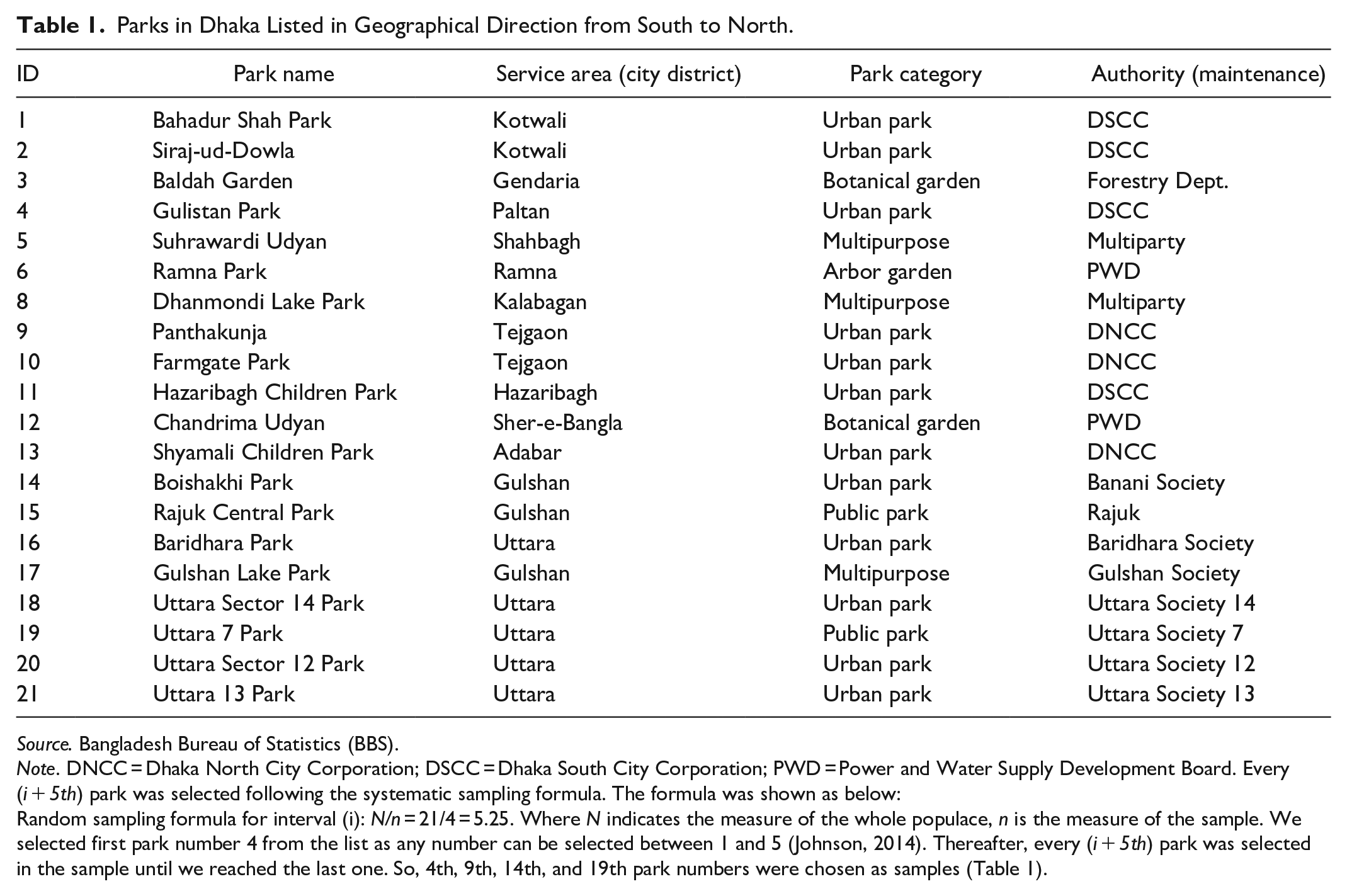
It is vital to note this study administered two groups of diverse features like parks and individual participants. The study on the green space of Dhaka represents other notable cities in Bangladesh. This country is correspondent in terms of ethnographical features, history, social culture, and linguistic dialects. Urban dynamics, per head green space and elderly psycho-social vulnerability are identical across the cities in Bangladesh. We can explore the scenario of major cities on the elderly self-esteem by this study. Dhaka was founded on the bank of the Buriganga River and is progressively extending the north due to overcrowding. Table 1 lists all of the 21 parks in geographical order from the south to the north. Bahadur Shah and Ramna Park from the south zone and Chandrima Udyan, and Gulshan Lake Park were chosen from the north zone in Dhaka.
Parks in Dhaka Listed in Geographical Direction from South to North.
Source. Bangladesh Bureau of Statistics (BBS).
Note. DNCC = Dhaka North City Corporation; DSCC = Dhaka South City Corporation; PWD = Power and Water Supply Development Board. Every (i + 5th) park was selected following the systematic sampling formula. The formula was shown as below:
Random sampling formula for interval (i): N/n = 21/4 = 5.25. Where N indicates the measure of the whole populace, n is the measure of the sample. We selected first park number 4 from the list as any number can be selected between 1 and 5 (Johnson, 2014). Thereafter, every (i + 5th) park was selected in the sample until we reached the last one. So, 4th, 9th, 14th, and 19th park numbers were chosen as samples (Table 1).
Study Participants
The study employed exponential non-discriminative snowball sampling to select potential respondents from elderly park individuals. The urban parks are open for all and the green patches do not record the entrance and exit information of park users. Therefore, it was very challenging to reasonably calculate the number of users and their household identities. As such, exponential non-discriminative snowball sampling was appropriate for participant selection. Snowball sampling represents a distinguished method of the survey for sample selection that discovers invisible and vulnerable peoples (Johnson, 2014). This is widely used in places where there is hard to determine the population (Etikan, 2016). Moreover, this social survey intentionally targets elderly park users.
Elderly respondents were selected up using the exponential non-discriminative sampling technique. Each participant recommends other potential participants recruiting not countless others following the technique (Swadia, 2016). This indicates a respondent recommends those who are familiar to him and might be agreed to participate in the survey process. We nominated the following participant followed by the information of the previous one. Some park users are unknown and uncertain but not completely hidden. All users of green parks possess residential homes but we did not survey households. As the residential identity of participants was unknown, so exponential non-discriminative snowball sampling was deemed appropriate for this study.
Two hundred and three participants (n = 203) were interviewed (Table 2). The ages of all respondents were more than 50 years. Two-thirds of them (n = 141) were males. More than half (n = 112) were undergraduate or up. Less than half (n = 92) were taken education ranged from 1 to 12 grades. The participants (n = 101) were employed in official jobs (government and non-government jobs) and a significant number of respondents (n = 56) were unemployed.
Sample Structure.

Instruments for Data Collection
This study was conducted in a mixed-method approach employing primary data, which was collected from the sample parks. “Mixed methods” are an investigative approach whereby researchers collect and analyze both quantitative and qualitative information inside the same consider Bowers et al., 2013; Creswell & Clark, 2017). This approach draws on the potential qualities of both investigations (Bowers et al., 2013) permitting analysts to investigate different viewpoints and reveal connections among changed inquire questions. The study incorporates a numeric and qualitative dataset. This was a self-administered survey using a questionnaire consisted of close-ended questions. Six questions were nominal, and the rest are ordinal variables with a 5-point-scale. The questionnaire is set to explore participants’ attitudes and satisfaction with the park facilities. The questionnaire was produced followed by an extensive literature review confirmed by two senior experts on green space. A certified translator translated the question sheet from English to Bengali. The observation was performed to investigate elderly activities in parks. A fieldwork note was kept to record data on participants’ bodily and social actions. An expert ratified the note. Observation focused on elderly social activities incorporated among diverse participants’ groups. Data collected in observation was carried out in the overview of study areas and in result discussion.
Data Collection Process
Thirteen participants were surveyed as a pilot study and thus 15% of questions were changed to validate. Data collected from the pilot study were unincluded in the analysis. Before the surveys, the research surveyor has introduced himself to participants, and a brief talk was delivered regarding the objectives of the study. After that, verbal consent was sought, and the respondents were sued to complete demographic information of their age, gender, academic achievement, monthly income, and employment status. At this stage, the data collector explained the particular contents (on parks’ contribution to elderly life) of the survey questionnaire. Participants were provided a questionnaire (printed paper sheet and a pen) to answer filling up one of the circles from each question. The survey focused on participants’ attitudes and satisfaction regarding parks. Suitable probing questions were invited if necessary. To extract further ideas from respondents, they were performed the freedom to express other opinions on park contributions or setbacks. Surveys were conducted on sitting benches or walkways in the parks. Surveys were customarily performed after physical activities. Each survey lasted between 30 and 40 minutes. Field notes were produced during data collection. None of the surveys were redundant.
Participant observation was employed as a supplementary instrument for supporting quantitative data. The observation was conducted with the conversation of park users and non-users (e.g., hawkers and staff) related to park activities. The conversation was carried out to explore park usability, quality of park, social atmosphere, user behavior, and awareness of park use. Participant observation is maybe the essential methodology of interactionism. It could be a concrete demonstration of the practical person accentuation on the hone. The strategy employments the self of the sociologist as a device to investigate social handle. It directs the humanist to put himself within the scenes, which he wishes to analyze, requiring him to observe and take an interest at the same time. Participant observation mirrors other practical person forms since it turns to praxis and is absent from the hypothesis (Rock, 1979).
Data Analysis
The analytical process was initiated with data familiarization by reading survey results repeatedly. At that time, data were classified into demographics, social services, infrastructural amenities, and safety measures for statistical analysis. Data were defined (creating labels and values for each variable) after inputting in IBM SPSS Statistics—version 23.0. Descriptive statistics computed the frequencies of variables. The inferential analysis includes the logit model and path modeling. The conclusion was produced from the outcomes of path modeling, which was operated for result triangulation. The models analyzed correlation coefficients among variables. This study demonstrated a correlation between social ties for the elderly population and urban green space.
The study examines the contribution of green space to the elderly psycho-social well-being. It aims at analyzing the association between green space (social services and infrastructural amenities of parks) and elderly self-esteem linked to social acceptance. Figure 1 shows the hypothetical connection between them. The study hypotheses that social acceptance heightens elderly self-esteem when a park delivers healthy social services, comprising user awareness, the sound mental health of the elderly, young park users’ pleasant behavior, and a decent social atmosphere.

A diagram of hypothetical framework.
Likewise, adequate infrastructural amenities of parks build social acceptance toward self-esteem for elderly users. Infrastructural amenities include the availability of toilets, drinking water facility, and quality of walkway, road connectivity, and accessibility of community centers for aged usage. The statistical analysis examines the significant correlation between green space and elderly psycho-social wellbeing so that the study obtains a new contribution.
Results
Participants’ Social-Demographic Characteristics
A majority of participants were males (67%), and 33% were females. A total of 36.5% respondents received their higher secondary education (Table 3). A vital portion of respondents obtained their undergraduate degrees (59.1%). A majority of participants represent the lower-middle class. The table displayed that 47.8% of respondents’ monthly income ranged from $118 to $355 and 15.6% earned $356 and up. In parks, a total of 73.0% elderly users boosted their self-esteem and 60% received social acceptance in green settings. Altogether, 23% of participants experience negative self-esteem. Green Park constructed social inclusion (free access and use opportunity of the elderly to urban public parks) among the elderly population. Most of the respondents (70.9%) opined that parks were inclusive.
Social-Demographic Characteristics of Respondents.

We observed that the peer group had contributed to building self-esteem for the elderly. Many aged people explore parks to exchange their feelings with others. They walk, organize, and interchange their emotions and feelings to be anxiety-free. Peers sharing get pompous through a pleasant social atmosphere. If parks achieve conducive environments from abhorrent behaviors by other elderly users, they perform their activities efficiently. We found sanitation facilities contributed a remarkable performance to enhance the elderly self-esteem. In addition, sanitation accepted generosities to boost the elderly self-esteem in a green space. The elderly perform their park activities conveniently in the presence of a secure extent.
Green Space and Social Acceptance
Green space promotes social acceptance and self-esteem for the urban elderly population. The four types of components of a park such as, societal services, infrastructural amenity, safety, and walkability, contribute to elderly life quality (emotional, physical, material, and social well-being for the elderly which can be gained from park activities) (Table 4). Park users’ awareness was strongly associated with social inclusion (p-value = .001) but was linked to self-esteem (p-value = .08). Young users’ behavior had a significant and direct impact on social acceptance for the elderly population. Their impact was statistically significant at the 1% level, as their p-values were .001. Societal acceptance and self-esteem were positively affected by participation in recreation programs held in the park. Their correlations were strongly and statistically significant at 1%. The significance values of the variables were .001. Their coefficients (β values) were also above 10.
Multivariate Regression Analysis: the Influences of Green Space on Social Inclusion, Social Acceptance, and Self-Esteem (N = 203).

Note. R2 = .795 (adjusted R2 = .750). Dependent variables: social inclusion, social acceptance, and self-esteem. Sig. = significance (p-value).
p < .1. **p < .05. ***p < .01.
Infrastructural services were positively linked to the elderly quality of life. Infrastructural amenities include drinking water facilities, the availability of toilets, and availability of community centers (Table 4). They retain a positive and statistically significant (at 1% level) association among them. Safety feeling was correlated to life quality for aged people. Feeling safe and park use rules were positively linked to social acceptance and self-esteem. Their relationship was statistically significant at 1%. The walkability of a park possesses a positive effect on the aged life quality. Quality of walkways, road connectivity to and from parks, and the high frequency of park visits influenced the elderly life quality. The association among them was statistically significant at 1%.
Our participant observation shows that user awareness and young visitors’ pleasant behavior construct a decent environment in a park setting, which enhances elderly acceptance among their peers toward self-respect. Adequate seating arrangement normally increases their stay hours, which intensifies emotional exchange building social inclusion and self-esteem. Likewise, a reasonable distance from the residence and quality walkways escalate the accessibility of elderly users to parks boosting their self-esteem.
Actualizing the Contribution of Green Parks on the Elderly Life Quality
A screened effect of infrastructural and social services on the life quality for the elderly population was showed in Figure 2. The PLS-Path model (Figure 2) has been generated in multivariate analysis using study variables. A couple of variables that were not significant to fit the model were omitted. Infrastructural services and safety were correlated with social services (Figure 2). Social services positively affect self-esteem linked to social acceptance for the elderly population. Their relationships were statistically significant at 1% level p < .01). Nevertheless, individually, infrastructural facilities and safety were negatively correlated to self-esteem and social acceptance. The correlation was statistically significant at 1%. Overall, social and infrastructural services were positively associated with social acceptance improving self-esteem for the elderly population.
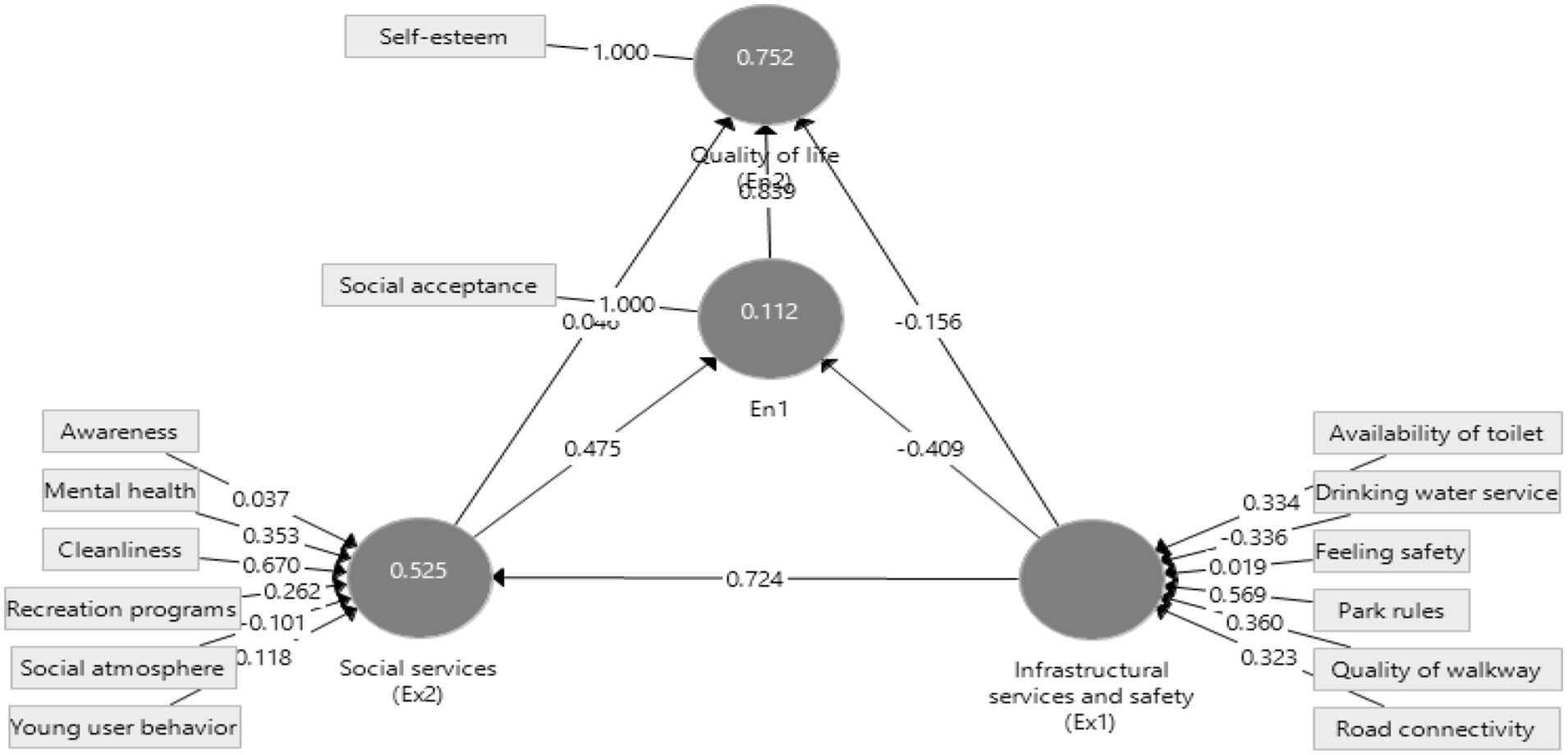
PLS-Path model-association of quality of life with social services and infrastructural service and safety in park for elderly population.
The fitness of the path model (Table 5) is good. R2 value is .914 that is greater than 70% level. The reliability (Cronbach’s alpha) score is significant as the sub-criteria of the model are greater than .70. Sub-criteria includes quality of life, infrastructural, and social services having scores of 0.92, 0.69, and 0.71. A fit model craves a 70% score for rho_A while it consists of 100%. A great SRMR fit requires esteem of less than 0.08 to 0.10 in a preservationist form (Fan & Sivo, 2007). Our model Square Root Mean Residual (SRMR) esteem is 0.081. The Normed Fit Index (NFI) esteem is 0.83 both within the immersed and assessed demonstrate. An NFI esteem ordinarily happens between 0 and 1 but the closer NFI to 1 is superior to fit (Boari & Cantaluppi, 2005). A Chi2 esteem of the PLS path model roughly is (N−1) × L, whereby N is the number of perceptions and L is the most extreme probability function (Boari & Cantaluppi, 2005). By this definition, our Chi2 value (82.17) is well fit. The d_ULS (i.e., the squared Euclidean separate) and d_G (i.e., the geodesic separate) offer ways to calculate this error. A bootstrap running makes the certainty intervals of disparity values. The upper bound in confidence intervals could be larger than the original value of the authentic d_ULS and d_G fit (Dijkstra & Henseler, 2015) (should be at 95% or 99%). The d_ULS value of the model is 82% which good to fit.
Estimation of Model Fit Indices.

Discussion
The key findings such as infrastructural amenities and safety measures produce a practical effect on social services. Social services influence positively to boost up social acceptance building self-esteem for elderly population. The components of social services include user awareness, the cleanliness of parks, frequent recreation programs, frequency of participation in recreation programs, welcoming social atmosphere, and young user behavior. In the same way, infrastructural amenities and safety measure incorporate the availability of toilets, drinking water facility, feeling safe, park use rules, the quality of walkway, and road connectivity. Green exercise (exercise in a park or a natural environment) produce a vaster effect on mood and self-esteem compared to social club activities. Green space contributed to enhance self-esteem and improve mood for people of all ages through green exercise (Barton et al., 2012). Nevertheless, our findings offered a positive contribution of green space on the elderly people’s psycho-social well-being. Social and infrastructural amenities focused on the contribution of social acceptance linked to self-respect. There is a solid relationship between the accessibility of green space and less depressive indications. This correlation incorporates mainly for physical activity in green space (Patel et al., 2019). The study presented the effect of green space on social acceptance in terms of fewer depressive symptoms as well. However, our results investigated the contribution of green space on social acceptance leading to social welfare linked to senior citizens’ self-esteem. Non-motorized outdoor recreation has a significant impact on economic growth and human health. Outdoor recreation means mental and physical participation in natural environment like wildland (Lackey et al., 2021). The contribution of wildland or non-motorized outdoor recreation on job creation and mental health has been emphasized where we emphasized green space and its benefits for the elderly social acceptance.
There is an affiliation between the seeing of green façades and an expanded level of parasymantic action. The green façade incorporates a substantial improvement of comfortable and natural feel. The green façade enhances human psychological relaxation (Elsadek et al., 2019). This research work demonstrated a correlation between green façade and mental relaxation for people. Our work concentrated chiefly on the park and elderly mental soundness toward their self-esteem. The proximity of green space with a house is linked to sound mental health, improved social support, and bodily activity. This performance has differed in terms of age and sex. Senior citizens opined that societal and physical activity, social networks, and clean environment in public open spaces are important to enhance active aging and social wellbeing (Yung et al., 2016). These findings accentuated the correlation between green space and the elderly social wellbeing that is inconsistent with our study which examined the benefits of public green space on the elderly psychological wellbeing upon self-esteem.
Urban green space influences people positively in terms of subjective norm, behavioral control, and attitude when they explore the site for socio-cultural interaction. A densely populated city like Hong Kong gets immensely beneficial for green space in terms of subjective norms and behavior (Wan et al., 2018). Our findings showed self-esteem as an increased social contribution of urban green space along with the attitude, social acceptance, and behavioral control of the elderly population. In a park, elderly people foster their social acceptance through self-esteem in personal interaction with their peers. Green space provides the opportunity not only for physical exercise but also for interaction with others. Some European cities have well-managed green spaces and woodlands and have the most senior level of social ties and inclusiveness. These city areas are also featured with a senior level of social-economic developments (Valente et al., 2020). With these findings, self-esteem has been extended to a new social component of green space. Social ties and inclusion promote psychological wellbeing improving self-esteem.
The connections of unpleasant life occasions with a few numbers of health complaints and seen common health were essentially directed by the sum of green space in a 3-km circle. Respondents with the sum of green space in a 3-km sweep were less influenced by encountering an unpleasant life occasion than respondents with a low sum of green space in this run (Van Den Berg et al., 2010). Natural environments advance physical action (Dad) and are mentally remedial. Performing PA in nature gives added substance benefits for self-esteem (SE) of the pre-adult. It has appeared that nearly half the time within the natural environment was used in direct to incredible PA, compared to a quarter within the built. The PA essentially moved forward self-esteem (Wood et al., 2014). Berg et al. and Wood et al. show that green space lessens life stress in a 3-km radius and promotes self-esteem through arranging physical exercise for adolescent. These are inconsistent with our findings in which green space contributes to social acceptance of the elderly toward their esteemed life. Neighborhood satisfaction was essentially emphatically related to well-being. In any case, inhabitants did not vary in self-reported well-being and useful affordances of green open space. These examinations contribute to an advanced understanding of how the availability and convenience of green spaces may increment people’s neighborhood satisfaction. It highlights the significance of perceived quality in expansion to the sum of green space when looking at the advantageous impacts of green open space (Zhang et al., 2017). Recreational opportunities and civilities are vital human-use administrations created by urban green open spaces. This thinks about investigated the utilization of a design of urban green spaces. The money related value of the non-priced employments was gaged by the unexpected valuation strategy utilizing willingness-to-pay and open-ended installment card approaches (Jim & Chen, 2006). Our study is unique and inconsistent with the analyses of Zhang et al. and Jim and Chen as they showed green space promotes self-reported well-being and monetary value of non-priced benefits of green space. Our study indicated the psycho-social benefits for the elderly population of green public space.
Limitations
This study contains some limitations. We were experienced to access to fewer feminine participants compared to males as Muslim women in Dhaka strictly abide by their religious values. They scarcely go to parks for physical or social activities. Those who visit parks are less interested to talk to unknown individuals. In this circumstance, we collected data from feminine participants at most who were to be accessed. Our survey and observation show that measuring elderly self-esteem was not discriminated against with regard to gender ratio (2:1). Sometimes we faced confrontation to interview in terms of the understandability of the interview schedule. In this situation, we followed a pseudoscientific way to collect quality data. This study identified the direct association between green space and the elderly self-esteem. This means urban green space promotes the quality of life for elderly population. Further research on the contribution of the age-friendly urban park for mobility-impaired patients is required to develop active aging.
Conclusions
Our study revealed the key findings: (1) Infrastructural amenities and safety measures impact on social services of parks and (2) Social services positively boost up elderly self-esteem. The quality of social facilities (user awareness, sound mental health, and friendly young users’ behavior, clean park, and welcoming social atmosphere) provides satisfaction, which boosts-up their acceptance. Besides, social acceptance followed by self-esteem for senior citizens is improved by park infrastructural amenities (the availability of toilets, drinking water facility, quality of walkways, road connectivity). Feeling safe, appropriate park rules, and the responsibility of security staff carry out a significant role to enhance the elderly self-respect. Self-esteem improves the elderly general acceptance, happiness, and mitigates their anxiety. With growing age, elderly individuals ended up slight and helpless to a broad extend of antagonistic results (Fried et al., 2004; Moser et al., 2011). The marvel of depression happens in individuals of all ages but possibly a specific issue within the elderly (Donaldson & Watson, 1996). Loneliness and anxiety increase elderly vulnerability, in which they require social engagement. The societal back makes a difference to diminish the pernicious impacts of stretch on passionate disorders essentially by reinforcing the self-esteem of older grown-ups and influences mental well-being as it were by implication through self-esteem (Sun et al., 2017). The study focuses on the impacts of green open space (social and infrastructural conveniences) on the elderly social acknowledgment connected to self-esteem.
Dhaka has needed to construct adequate age-friendly parks. Age-friendly Park includes confidential social services, adequate infrastructural amenities, and safety. Mentally sound elderly populations contribute immensely to their neighborhood. They are experienced to support the home management process, nurturing children, computer-related jobs, gardening, kitchen marketing, teaching, and training. When elderly members of a family befit active and respected, it has the benefit of happiness. City governance, urban planner, and designer ought to adopt initiatives to promote age-friendly parks.
Supplemental Material
sj-docx-1-sgo-10.1177_21582440211054473 – Supplemental material for Analyzing Association Between Public Green Space and Self-Esteem Linked to Social Acceptance for Elderly Population in Dhaka
Supplemental material, sj-docx-1-sgo-10.1177_21582440211054473 for Analyzing Association Between Public Green Space and Self-Esteem Linked to Social Acceptance for Elderly Population in Dhaka by KM Atikur Rahman and Md. Abu Naim Shorkar in SAGE Open
Footnotes
Acknowledgements
The authors would like to express their thanks to Professor Dunfu Zhang of Sociology for his additional input regarding methodological issues addressed in the article.
Declaration of Conflicting Interests
The author(s) declared no potential conflicts of interest with respect to the research, authorship, and/or publication of this article.
Funding
The author(s) disclosed receipt of the following financial support for the research, authorship, and/or publication of this article: This study was funded by grants from the Reza Printers, Dhaka, Bangladesh (commercial organization): S690R004403.

Supplemental Material
Supplemental material for this article is available online.
References
Supplementary Material
Please find the following supplemental material available below.
For Open Access articles published under a Creative Commons License, all supplemental material carries the same license as the article it is associated with.
For non-Open Access articles published, all supplemental material carries a non-exclusive license, and permission requests for re-use of supplemental material or any part of supplemental material shall be sent directly to the copyright owner as specified in the copyright notice associated with the article.
