




Abstract
This paper comprehensively examines how school leaders in Kazakhstan managed schools during the COVID-19 school closures. An online survey was conducted with 1,298 school leaders, representing 17.5% of all Kazakhstani schools. Anchored in the concept of crisis leadership, the instrument measured school leaders’ views regarding teachers’ digital competence, their support toward teachers in digital pedagogy, as well as their practices in communicating with parents and teacher autonomy and monitoring. The results of bivariate tests indicate that a significant proportion of schools offered teachers online professional development opportunities to improve their digital instruction, with school location and size influencing the level of training in digital pedagogy received by teachers. Notably, school leaders’ confidence in their teachers’ ability to teach effectively online increased significantly after receiving training in digital pedagogy. School leaders also maintained regular communication with parents, but this increased their workload, particularly for women and urban school leaders. Most school leaders allowed teachers to choose online platforms and revise curriculum content, while also monitoring teachers’ attendance and observing online lessons. These practices varied based on the school’s medium of instruction. This study significantly contributes to crisis leadership by examining practices during school closures in addressing teachers’ digital competence, communication challenges, and teacher autonomy, with insights on variations by school type, location, and leaders’ gender. The study’s findings have significant implications for post-pandemic school leadership, emphasizing equity in professional development opportunities for teachers, effective communication with stakeholders, and striking the right balance between teacher autonomy and monitoring.
Plain Language Summary
We conducted an online survey with 1,298 school leaders, representing 17.5% of all schools in Kazakhstan. Our study focused on crisis leadership and measured school leaders’ perspectives on teachers’ digital skills, support for digital teaching, communication with parents, and their practices of teacher autonomy and monitoring. Our results show that many schools provided online professional development opportunities for teachers to improve their digital instruction. We found that school location and size were related to the extent of training teachers received in digital teaching methods. Interestingly, school leaders’ confidence in their teachers’ ability to teach effectively online increased after receiving training in digital pedagogy. School leaders also maintained regular communication with parents, which increased their workload, especially for women and urban school leaders. Most school leaders allowed teachers to choose online platforms and adjust curriculum content while also monitoring attendance and observing online lessons. These practices varied depending on the school’s medium of instruction. The findings of our study have important implications for school leadership in the post-pandemic world. They highlight the need for equitable professional development opportunities for teachers, effective communication with stakeholders, and balancing teacher autonomy and monitoring.
Keywords
Introduction
In March 2020, schools across the globe began to close to contain the swiftly progressing COVID-19 pandemic. By mid-April, 94% of learners worldwide were affected by the pandemic, representing 1.58 million learners in 200 countries (United Nations, 2020). To ensure the provision of schooling in such an unprecedented time, education systems transitioned quickly to emergency remote education; however, even after a year, over 50% of the global student population experienced substantial disruptions to their education, with full school closures reported in around 31 countries and partial closures in another 48 countries (UNESCO, 2021). It is, therefore, vital to understand how school leaders responded to ensure equitable education service delivery to inform future provision in a crisis context—an unforeseen situation that requires urgent and decisive action by the leaders of an organization (Beauchamp et al., 2021; Schechter et al., 2022; Teran, 2022).
This paper contributes to knowledge about the emerging field of school leadership during the COVID-19 pandemic. Specifically, we draw on the case of Kazakhstan, a country where schools operated off-site for around two academic years, to investigate school leaders’ perspectives and practices during school closures related to COVID-19. Globally, empirical studies on school leadership in the unprecedented disruption unleashed by the COVID-19 pandemic are emerging (Arar et al., 2022; Beauchamp et al., 2021; Bradbury et al., 2022; Durrani & Ozawa, 2024; Fotheringham et al., 2022; Longmuir, 2023; Murphy & Devine, 2023; Reid, 2022), but little is known about how school leaders in Kazakhstan led schools under lockdown measures. Recent literature in Kazakhstan has reviewed policy responses and gaps in Kazakhstan’s transition to distance/online learning (Bokayev, Torebekova, Abdykalikova, & Davletbayeva, 2021), the impact of COVID-19 on parents (Bokayev, Torebekova, Abdykalikova, & Davletbayeva, 2021; Bokayev, Torebekova, Davletbayeva, & Zhakypova, 2021; Durrani et al., 2021), teachers (Amirova et al., 2023; Durrani et al., 2023), and students (Durrani et al., 2023; Hajar & Manan, 2023). However, the experiences and perspectives of school leaders are glaringly absent within the literature, which the current study aims to address.
Understanding how school leaders navigate leadership during a crisis context is pivotal for informing policy and practice in crisis contexts in the future. Furthermore, insights from studying crisis contexts can also be applied to non-crisis situations. For example, what is revealed under the scrutiny of crisis might be an exaggeration of already present problems such as inequities. Thus, learning how to address the challenges of schooling and school leadership in crisis contexts can inform how evidence-informed approaches might facilitate transformative policy and leadership agency in the post-pandemic context.
Literature Review: School Leadership During the Pandemic
School leadership during the pandemic is characterized as “crisis leadership” due to the need for quick adjustments in education provision amidst stress and ambiguity (Banerjee-Batist et al., 2022; Beauchamp et al., 2021; Schechter et al., 2022). Crisis leadership refers to the ability of educational leaders to effectively navigate and manage the challenges and uncertainties that arise during times of crisis and restore order afterwards (Wu et al., 2021). Crisis leadership during school closures involved immediate and decisive actions to address urgent issues, such as supporting vulnerable students, choosing online platforms and tools, training teachers and students, and establishing protocols for virtual classrooms and transitioning back to school premises. The literature highlights key aspects of leadership in crisis contexts, including a focus on supporting teachers for digital pedagogy, regular communication with stakeholders, specifically parents, and teacher autonomy as a key aspect of distributed leadership.
Leaders’ Perceptions and Support for Teachers’ Digital Competence
The success of online education crucially depends on teachers’ digital pedagogy and competence (Zhang et al., 2020). An adequate level of digital literacy is a prerequisite for teachers to navigate the challenges of teaching online. While teachers’ technological pedagogical content knowledge and effective use of internet resources are crucial, the pandemic offered an opportunity to transform existing pedagogies by making it possible for parents, teachers, and students to negotiate the curriculum and contribute to the pedagogical process (Ng & Renshaw, 2020).
School leaders’ perceptions of teachers’ digital competence vary by country, although using ordinal level measurement involving categories such as “moderately,”“significantly,”“minor limitation,” or “major limitation” makes interpretation and cross-country comparisons harder. In Ireland, 46% of school leaders (N = 72) believed that teachers’ proficiency in digital technology moderately or significantly hindered teaching and learning during school closure (Scully et al., 2021). In Lithuania, only a quarter of leaders (N = 406) highlighted a lack of teachers’ digital competence as a primary challenge to distance education (Kaminskienė et al., 2021). Likewise, school leaders in both Germany and Poland highlighted the challenge of teachers’ insufficient digital competence as a challenge to online schooling (Demeshkant et al., 2022)
Although studies do not report the extent to which schools provided professional development opportunities in digital pedagogy, pre-COVID-19 literature suggests a positive association between training and teacher practice in digital pedagogy. For example, Ertmer et al. (2006) contend that professional development opportunities, such as workshops and seminars, offer accessible and cost-effective means to help teachers develop digital skills. Additionally, professional development enables teachers to enhance their skills further even if they have received technology training in their initial teacher education programs.
Enhancing digital transformation and promoting technology-based professional development in schools during online or blended learning was a critical dimension of school leadership. A study examining school leaders’ perspectives in Poland and Germany underscored the significance of integrating ICT effectively and providing technical support to ensure the continuity of remote education (Demeshkant et al., 2022). While the majority of German school leaders indicated consistent support for teachers through specialized ICT training, only a minority of Polish school leaders addressed the issue of teacher training (Demeshkant et al., 2022). In Turkey, school leaders were supportive of enhancing technology-based professional development for teachers (Karakose et al., 2021). Additionally, a study involving 325 US teachers revealed that 66% of educators believed that more training in emergency remote teaching was necessary (Trust & Whalen, 2020). However, none of the above studies shed light on the extent to which school leaders actually supported teachers with professional development opportunities.
Parental Communication and Engagement and Leaders’ Work Intensity
School leaders found it imperative to maintain regular, clear, empathetic, and transparent communication with all stakeholders, including education authorities, teachers, staff, students, and parents, during school closures (Fernandez & Shaw, 2020; Mather, 2020; McLeod & Dulsky, 2021). The intensity of communication was particularly profound in the initial stages of COVID-19, often requiring school leaders to create daily lines of communication with teachers, students, and parents.
The shift to online schooling underscored the necessity for heightened parental communication, while the closure of physical schools brought about a notable transformation in home-school communication dynamics (Durrani et al., 2023; Spear et al., 2023). Treating parents as equal partners in learning and guiding them through regular interactions became crucial as families took on more responsibility for schooling (Kaminskienė et al., 2021; Rigby et al., 2020). Timely and regular communication with parents proved a vital means of identifying and troubleshooting problems with distance and online schooling (Okilwa & Barnett, 2021). School leaders ensured consistent communication with parents, guiding them on accessing online materials and providing instructions on utilizing learning resources (O’Connor Bones et al., 2022). They utilized various means, including telephone, email, letters, video clips, social media platforms and technological tools to keep parents engaged and updated (McLeod & Dulsky, 2021; O’Connor Bones et al., 2022). Studies have shown that email and texting via smartphones were the predominant and favored modes of communication between schools and parents during the COVID-19 pandemic (Chen & Rivera-Vernazza, 2023; O’Connor Bones et al., 2022), contrasting with findings that smartphones were the least preferred mode in other research (Pacetti et al., 2021). In cases where parents lacked (digital) literacy, direct telephone communication was favored (Rousoulioti et al., 2022). Furthermore, school leaders elicited regular feedback from parents and other stakeholders through online surveys, which emerged as a vital strategy to cope with the emerging challenges of distance and online schooling (McLeod & Dulsky, 2021). The specific modes of communication and their implementation varied across different school contexts and localities, reflecting the cultural practices, technological infrastructure, and economic capabilities of each school and national context (Brown et al., 2023).
As families started sharing the burden of schooling, involving parents as collaborators in learning and providing guidance through regular interaction became essential (Kaminskienė et al., 2021; Rigby et al., 2020). For example, in Lithuania, a study by Kaminskienė et al. (2021) found that 34% of survey school leaders (N = 406) prioritized interaction with parents/caregivers during the initial stages of online education. However, 29% of school leaders expressed that maintaining regular communication with parents and caregivers posed challenges. Similarly, a survey of 45 school leaders from the US reported that the technologically driven nature of communicating with stakeholders exhibited some challenges (Okilwa & Barnett, 2021). The intensity of communication was challenging for school leaders and increased their workload (Bellemans et al., 2023; Kristensen et al., 2024). However, the evidence reviewed does not indicate the extent to which the burden of intensive communication was unequally distributed across school leaders.
Teacher Autonomy and Trust Through Distributed Leadership
The pre-COVID-19 literature on school leadership emphasizes the significance of the distributed leadership model, which expands leadership responsibilities in schools beyond formal administrative roles (Harris, 2012). This model empowers teachers to take on leadership roles, engage in collaborative decision-making, and contribute to overall school improvement efforts (Spillane et al., 2004). Furthermore, distributed leadership, closely intertwined with teacher autonomy (Özdemir et al., 2023), enables teachers to control their daily schedules, select teaching methods, make instructional decisions, and contribute to curriculum development (Husband & Short, 1994). By fostering a leadership framework that allows teachers to influence instructional practices, curriculum design, and school policies, distributed leadership can enhance teacher autonomy within their professional roles (Spillane et al., 2004).
However, the neoliberal trend of school inspections and accountability rankings negatively impacts distributed leadership and teacher autonomy (Ball, 2003; Perryman, 2006; Skerritt, 2023). School leaders are accountable for school effectiveness and are constantly preparing for inspections, leading to increased control through monitoring and data collection on effectiveness (Perryman, 2006). This often results in intensified surveillance of teachers through direct lesson observations (Skerritt, 2023). When teacher monitoring is employed judiciously, it can contribute to enhancing teaching and instructional practices. However, excessive monitoring leads to heightened feelings of being under surveillance, diminished trust, and a reduction in professional autonomy among teachers (Skerritt, 2023).
In the post-COVID-19 literature, distributed leadership emerges as crucial in managing the work intensity during the pandemic (Harris & Jones, 2020; Longmuir, 2023). Research highlights that distributed leadership became the default strategy during crises, allowing school leaders to delegate authority and leverage the expertise of multiple teachers (Brown et al., 2023; Kwatubana & Molaodi, 2021). This approach is particularly effective in contexts with established distributed leadership styles, where leaders either extended existing practices or transitioned from authoritarian models to foster community and resilience (Beauchamp et al., 2021).
Likewise, post-COVID-19 research underscores the importance of teacher autonomy in remote education, with positive effects noted on teachers’ resilience, emotional well-being, and overall work performance (Bagdžiūnienė et al., 2022; Chang et al., 2022; Collie, 2021; Wong et al., 2022). This is further supported by the findings of an Italian study, which stress the necessity for school leaders to adopt autonomy-supportive leadership to enhance teachers’ emotional well-being (Manuti et al., 2022). Additionally, the importance of teacher autonomy is reinforced by Danish teachers and school leaders in a study by Qvortrup and Lykkegaard (2024), shedding light on the lessons learned from the pandemic.
However, the literature reviewed highlights varying levels of teacher autonomy practiced in remote education settings. During the crisis period, leaders shifted toward a more directive leadership style, limiting teacher freedom (Azhari & Fajri, 2022; Keese et al., 2021; Kramer et al., 2023; Neelakantan et al., 2022). A study of eight Indian school leaders reported that leaders demanded specific lesson plans, teaching materials, and homework tasks following a set format, which was perceived favorably by some teachers who required guidance in unprecedented circumstances (Neelakantan et al., 2022). However, US teachers felt that their autonomy was being restricted through increased monitoring and questioning compared to pre-pandemic levels (Kramer et al., 2023). Likewise, Chang et al. (2022) identified a low perceived level of teacher autonomy in various aspects of curriculum and instruction and choice of digital platforms among US teachers, with decisions predominantly made by school leaders. In a separate study conducted in the US, teachers faced challenges in adjusting the curriculum and incorporating new teaching techniques, while administrators ignored their suggestions regarding platform selection (Kramer et al., 2023). Likewise, a US study reported authorities mandated uniform tasks for all students, restricting teachers’ flexibility (Keese et al., 2022). The more structured approach utilized by leaders might have emerged from their concerns for teachers support. For example, in Estonia and Finland, traditionally teachers’ autonomy is respected, but school closures highlighted the need for teacher support in pedagogy and assessment (Ahtiainen et al., 2024). Leaders responded by introducing clear guidelines about pedagogy and technology.
Despite the challenges faced by teachers in terms of autonomy, school leaders acknowledged the importance of collaborative leadership and involving teachers in decision-making in curriculum and instruction (Bagdžiūnienė et al., 2022; Neelakantan et al., 2022; Qvortrup & Lykkegaard, 2024; Reyes-Guerra et al., 2021).
In summary, the synthesis of the literature highlighted critical dimensions of school leadership during a crisis, including supporting teachers for remote teaching, maintaining timely and clear communication with parents in a context of fluidity and enacting a distributed model of leadership that grants teachers autonomy in academic matters. While these leadership qualities are needed in “normal” contexts, the prolonged period of school closures necessitated an intensified display of these capacities.
Country Background
A brief background of Kazakhstan is presented to situate both the methodology used and the study findings.
School Education
School education is compulsory and free of charge in a state-funded school and comprises nine years, 4 years of primary education (Grades 1–4) and 5 years of secondary education (Grades 5–9). Providing school education is the responsibility of Kazakhstan’s 17 regional authorities.
The geography of Kazakhstan poses specific challenges for education service delivery. Kazakhstan is equivalent to Western Europe in landmass but has a low population density (6.5 people/km2), although large urban centers are more populated. Consequently, urban schools face high demand and operate in multiple shifts, while most rural schools are very small (OECD and World Bank, 2015).
In 2020 to 2021, there were 7,440 schools, an overwhelming majority of which were state-funded (96.4%), and only a negligible proportion (3.4%) constituted private or fee-paying schools, while 0.3% of schools did not report their source of funding (Agency for Strategic Planning and Reforms of the Republic of Kazakhstan, Bureau of National Statistics, 2022a). Most state-funded schools are managed by local, regional, and central education authorities and are called “mainstream schools.” Additionally, there are state-funded selective schools for gifted students, with highly qualified teaching and administrative staff and better resources. Different networks of selective schools include Darian Schools, BILIM-Innovation and Nazarbayev Intellectual Schools (NIS).
Schools are differentiated based on the medium of instruction (MoI). In 2020 to 2021, 54% of schools offered instruction in Kazakh, the state language, 17% of schools offered instruction in Russian, the language of interethnic and international communication, while 29% were “mixed schools” in which children separated by different MoI, usually Kazakh and Russian, share a building (Information and Analytical Center, 2021). Schools using other minority languages were few (0.2%). Students’ learning outcomes vary by MoI. For example, the OECD Program for International Student Assessment (PISA) results show that Kazakh students who attend Russian medium schools perform better than those who attend Kazakh medium schools, implying that school level factors related to MoI might affect student performance (OECD and United Nations Children’s Fund, 2021).
Schooling outcomes and resources vary across urban and rural locations. The majority of schools are rural (71%) and enroll 1.3 million students, while only 29% of schools are in urban locations, serving about 1.4 million students (Agency for Strategic Planning and Reforms of the Republic of Kazakhstan, Bureau of National Statistics, 2022b). Rural schools are under-resourced and lack qualified teachers and effective leadership (Ozawa et al., Tajik et al., 2022). Urban students outperform rural students in the Unified National Test (UNT), an external examination taken at the end of secondary education, which determines students’ enrolment in university and state grants (Chankseliani et al., 2020), as well as in international assessments (OECD and United Nations Children’s Fund, 2021). Rural schools are disadvantaged since school performance in national and international tests impacts funding allocation.
School Leaders and Leadership
In Kazakhstan, the school principal or headteacher is called the “school director,” who is appointed on a competitive basis by regional educational authorities or the Ministry of Education. Candidates must possess a relevant teaching qualification, at least 5 years of teaching experience, and knowledge of the Constitution and state laws (Frost et al., 2014). Most school directors (91.5%) have a bachelor’s or equivalent qualification (OECD, 2019). Studies report that school leaders in Kazakhstan face notable challenges arising from inadequate training prior to assuming their roles, coupled with a lack of essential knowledge in effective school management (Sarmurzin et al., 2023).
National statistics on school directors’ socio-demographic characteristics are not available. However, according to the OECD (2019), the average Kazakhstani school director is 48 years old and has around 22 years of teaching experience. Although women make up 80% of teachers (Agency for Strategic Planning and Reforms of the Republic of Kazakhstan, Bureau of National Statistics, 2022c), they only constitute 53% of school directors (OECD, 2019). Thus, women are underrepresented in school leadership. The gender gap in school leadership in Kazakhstan has not been explored, but some insights can be garnered from research exploring the underrepresentation of women leaders in higher education (Kuzhabekova & Almukhambetova, 2017). Kazakhstani women leaders, like elsewhere, find it harder to balance work and life because of the double burden of being a care provider at home and a professional academic. Furthermore, leadership is widely associated with men in society and education (Durrani et al., 2022).
School Leadership Practices in Kazakhstan: Pre- and Post-COVID-19
Studies on the perspectives and practices of Kazakhstani school leaders are gradually evolving (Nurmukhanova, 2020; Sarmurzin et al., 2023; Tajik & Yesselbayev, 2024). Research suggests that these practices are greatly influenced by the national culture, often characterized by high power distance according to Hofstede’s (2011) organizational culture framework. This cultural influence has resulted in a hierarchical system with substantial distance maintained among stakeholders in centralized education and governance structures, promoting a directive leadership style and top-down decision-making processes (Yakavets, 2016). This setting constrains leaders’ autonomy in driving organizational development and implementing distributed leadership (OECD, 2019; Yakavets, 2017).
Interactions between school leaders and teachers in Kazakhstani schools show teachers demonstrating subservient behavior toward principals, influenced by collectivist mindsets and traditional respect for authority (McLaughlin et al., 2014). Additionally, studies highlight the stress faced by Kazakhstani teachers due to limited autonomy and frequent inspections (Tastanbekova, 2020).
Efforts to transition from traditional to westernized leadership practices are hindered by the hierarchical education system, restricting the implementation of distributed and collegial leadership styles (Yakavets, 2017). School leaders in Kazakhstan are primarily focused on daily operational tasks, discipline enforcement, and compliance with rules, emphasizing outcomes over processes (Tajik et al., 2022). The competitive educational landscape in Kazakhstan, where school funding is tied to student performance, contributes to the emphasis on classroom inspections and results (Tajik et al., 2022). School leaders also face challenges related to managerial accountability demands and concerns about winning or losing schools due to socio-demographic factors beyond their control (Kasa & Ait Si Mhmet, 2023; Winter & Kasa, 2021).
While there is a lack of specific studies on school leaders’ perspectives and practices during COVID-19, insights can be drawn from existing literature. An extensive quantitative study found that 97% of schools transitioned to distance and online education without sufficient preparation or infrastructure (Bokayev et al., 2021b), highlighting the necessity for teacher professional development in digital instruction, especially in rural schools where teachers faced significant challenges with digital learning (Durrani et al., 2023). Teachers have reported limited autonomy in academic matters, stress from class observation, and attendance requirements during the pandemic (Durrani et al., 2021). The reliance on digital platforms like WhatsApp for communication and instruction during school closures has also been noted (Durrani et al., 2021; Hajar & Manan, 2023).
Methodology
Research Questions and Design
In line with the focus and discussion of the literature, the following research questions guided the paper:
RQ1: What are school leaders’ perceptions of teachers’ digital competence and how did they mitigate digital inequities in teachers’ digital competence during school closures?
RQ2: What were school leaders’ communication practices with parents during school closures?
RQ3: What were school leaders’ practices regarding teacher autonomy and monitoring during school closures?
RQ4: How do leadership perspectives and practices differ across contextually relevant markers of disadvantage, namely school location, medium of instruction, and school leaders’ gender?
The study employed an online descriptive cross-sectional survey design, which is well-suited when examining relationships between variables in real-life contexts (Mujis, 2004). This design allows for studying a wide range of variables, gathering a large amount of data, and comparing variables across locations (Mujis, 2004). The selected design was deemed a cost-effective and efficient method for gathering the perspectives and experiences of a large number of school leaders in a short time frame (Sue & Ritter, 2012).
Instrument Description and Administration
The development of the survey was guided by the evolving literature on school leadership during lockdown situations. Through the literature review, we identified existing survey instruments; however, it became apparent that they were unsuitable for exploring school leadership practices in crisis contexts, particularly in developing countries. Consequently, drawing from the findings of relevant studies (Hamilton et al., 2020) and a qualitative investigation conducted by the primary author on distance/online schooling in Kazakhstan (Durrani et al., 2021), we identified the variables that were essential in crisis contexts.
To accommodate the language diversity of the participants, a customized survey in English was translated into two languages—Kazakh and Russian and was then administered online in the Qualtrics platform. The translation process was a collaborative effort between the second and fourth authors, who have professional competence in English, Kazakh, and Russian. Any questions or issues that arose during the translation process were addressed through discussions in a Telegram chat and emails with the primary author, who developed the survey in English. The survey translation followed Behr and Shishido’s (2016) recommendations for survey item translation.
The first step involved adaptive translation, which allowed the retention of the concepts’ meaning that may work in one language or context but not in others (Behr & Shishido, 2016). Next, a “backward” or “back translation” of the survey was performed, where the translated versions were translated back into the source language to identify any discrepancies (Behr & Shishido, 2016, p. 6). Peer checks of the translation were also conducted, with research assistants swapping surveys and reviewing each other’s translations. Finally, the three versions of the survey were compared to ensure equivalence or harmonization of the translated items.
The survey link was sent to Kazakhstan’s 17 Regional Educational Departments, who distributed it to school leaders. The survey ran from June to October 2021. The study was approved by the by Nazarbayev University Institutional Research Ethics Committee (NU-IREC) (No. 411/20052021). The survey was completely anonymous, enabling respondents to complete it at their convenience or skip questions if desired. All respondents provided written informed consent before completing the survey.
The survey from which this paper has been carved out comprised three sections. Section 1 included socio-demographic data to find trends in school leaders’ responses. Section 2 investigated how the school managed the shift to online education and school leaders’ practices and perspectives on online education with respect to digital equity, parental engagement and communication and teacher autonomy. Section 3 studied the multifaceted nature of school leaders’ well-being. The latter is the subject of another paper. The items analyzed and reported in the current manuscript are described in Appendix A1. Most questions required respondents to choose an option from given choices, and a small number of questions asked to provide an additional answer.
Data Analysis
Quantitative data from the survey were exported from Qualtrics into SPSS version 27.0 for statistical analyses. In the first instance, univariate analysis was used to obtain descriptive statistics. In the second instance, bivariate analysis was used to explore the relationship between two variables, with the choice of test depending on the level at which any two variables were measured and the normality of the distribution. Appendix B1 lists the statistical tests that were significant and reported in the paper. All tests were two-tailed.
Quality Issues
Expert validation is a valuable approach for assessing a survey’s construct relevance and structure. It aids in identifying concerns related to item clarity, language, and complexity (Gehlbach & Brinkworth, 2011, p. 384). In line with this, we sought the expertise of deputy school leaders, whom the primary author instructed, as part of their blended post-graduate qualification. By sharing the survey with these experts and engaging in feedback and discussions with them, we gained valuable insights that informed the refinement of the survey items.
The survey’s content validity was enhanced through a preliminary qualitative study by the primary author (Durrani et al., 2021). This qualitative study enabled the design of a contextually relevant survey for the participants. As Creswell and Plano Clark (2018) noted, “With the development of the measure or instrument specific to the culture, there is an increased likelihood that it will be perceived as relevant to the group under investigation” (p. 84). This alignment with the specific cultural context strengthened the content validity of the survey.
The reliability of scales can provide insights into the validity of those scales. To assess the reliability, we utilized Cronbach’s alpha internal consistency values for three scales in the survey (Pallant, 2011, p. 97). The scale reported in the paper, namely, the survey items on agreement with given school leaders’ practices, had Cronbach’s Alpha at an acceptable level (α = .725).
It is important to note that the survey items were designed specifically for the context of remote schooling in Kazakhstan. Although the survey was not formally validated due to the data collection taking place during school closures, we ensured the qualitative validity of the survey through adaptive translation, peer checks, and expert feedback.
Characteristics of Participants and Schools
A total of 1,298 school leaders responded, accounting for 17.5% of the 7,440 schools in the country. Furthermore, the respondents represent all 17 Kazakhstani administrative divisions. However, not all school leaders fully completed the survey. Therefore, the relevant n (i.e., the number of respondents) for the results presented ranges from 988 to 1,266. Percentages in tables and figures have been rounded and thus may not always sum to 100.
Mainstream schools comprised 98% of the responding school leaders, with selective and private schools comprising only 1% each (Table 1). Because of the highly unequal distribution of school types, exploring differences along school types was ruled out. Rural school leaders comprised 50%, while 41% of respondents led a school in urban and 9% in semi-urban locations. Mirroring the national statistics, over half of the respondents led a school using Kazakh MoI (54%), followed by mixed MoI (27%) and Russian MoI (18%).
Percent Distribution of Key Characteristics of Schools.

While according to the OECD (2019), female school leaders constitute 53%, 78% of the responding school leaders were women (N = 1,006), and only 22% were men (N = 292). The average age of the respondents was 44.6 years, lower than the OECD statistics (48%) (OECD, 2019), suggesting that the study sample may not be representative.
School leaders from diverse schools participated in the study, including small rural schools with five students and two teachers, as well as large urban schools with 7,817 students and 500 teachers. On average, the school size, as measured by the number of students, was 359 in rural schools, 751 in semi-urban schools, and 1,287 in urban schools. Regarding the number of teachers, the average count was 47 in rural schools, 79 in semi-urban schools, and 114 in urban schools.
Study Findings
Teacher Support and Inequities
The mitigation of the digital divide crucially depends on supporting teachers to use digital technology effectively in their remote/online lessons. To identify the extent to which teachers were offered professional development opportunities to support them in tackling the challenges of online teaching and learning, school leaders were asked to identify the proportion of teachers in their school who were provided professional development opportunities in digital pedagogy. A substantial number of school leaders indicated the proportion of teachers in their school who received training in online learning and teaching since the pandemic began (N = 1,142, Mean = 56.5, Range 0–100). The proportion of teachers receiving professional development in digital pedagogy was greater in urban schools, followed by semi-urban and rural schools (Table 2). These differences were significant as determined by a one-way ANOVA (F(2,1107) = 30.77, p < .001). A Tukey post-hoc test revealed that the proportion of schoolteachers who had received training in online learning and teaching was significantly higher in the urban areas compared to the rural areas (p < .001) and relative to semi-urban areas (p = .002). However, the differences between rural and semi-urban areas were not significant.
The Proportion of Teachers Receiving Training in Online Teaching and Learning by School Location.

Note. A total of 32 leaders indicated the proportion of teachers receiving training without indicating the location of their school.
The relationship between school size and the number of teachers provided with professional development opportunities was measured by a Pearson correlation test. Schools with a larger number of teachers were more likely to offer professional development opportunities to teachers in digital pedagogy, but the strength of the relationship is weak (p < .001, r = .24).
School leaders’ perceptions of teachers’ digital competence were sought. Findings showed that 36% of school leaders did not consider a lack of teachers’ digital competence to be a limitation, while 48% believed it to be a minor limitation in distance education provision. Only 16% of school leaders perceived a lack of teachers’ digital competence as a major factor limiting online education provision, suggesting school leaders’ confidence in their teachers’ competence in supporting education online.
Leaders were asked to rate their teachers’ skills in teaching online at two points: at the “beginning of school closures” (i.e., April 2020) and “currently” (i.e., summer 2021). Across the two points, over 50% of the leaders rated their teachers as competent or highly competent in teaching online. However, a slight improvement is observed between the two points (Figure 1). Specifically, 55% of school leaders believed their teachers were competent or highly competent in supporting online education at the beginning of the pandemic. The corresponding figure for the summer of 2021 stood at 66%. On average, school leaders’ rating of teachers’ digital competence was significantly greater (M = 2.63, SE = 0.024) in the summer of 2021 than at the beginning of the pandemic (M = 2.51, SE = 0.023), t(1041) = 4.711, p < .001, r = .14.

School leaders’ rating of their teachers’ competence in supporting online education in spring 2020 and summer 2021.
Communication With Parents
During the pandemic, school leaders needed to sustain the virtual image of the school as a community by maintaining regular and quality communication with all stakeholders, particularly with parents who were now taking on a much larger responsibility in educating their children. When queried about the frequency of communication with parents, the majority of leaders reported daily communication (45%) or communication on an as-needed basis (36%). In addition, 6% of leaders communicated with parents more than once a week, while 8% did so weekly. Only 1% of leaders communicated with parents twice a month or once a month, with an additional 2% reporting communication once or twice a month.
School leaders used a variety of means to communicate with parents. WhatsApp (85%) and telephone (72%) were the most commonly used methods to contact parents, although other methods such as online surveys (29%), virtual platforms (24%), social media (24%), school website (17%), and email (17%) were also used.
School leaders contacted parents for both academic and pastoral reasons, including supporting parents to help their child learn (77%), updating parents on children’s progress (65%), sharing curricular updates (60%), and providing well-being advice (29%).
The increased intensity of communicating with parents is expected to increase school leaders’ workload. Therefore, school leaders were asked to report how parental engagement increased their workload during school closures (Table 3). While 28% of leaders reported no change in their workload, 72% experienced an increase, ranging from an additional 1 hour a day (16%) to 4 hours a day (23%).
Increase in School Leaders’ Workload Related to Parental Engagement During School Closures.

Bivariate analysis was conducted to identify the groups of school leaders whose workload concerning parental engagement increased substantially during school closures. While a Spearman correlation test found no relationship between school size as determined by the number of students and time spent on parental engagement, differences were found between male and female school leaders in the time they spent on parental engagement (Mann-Whitney U = 98,984.5, p < .001, z = −4.048), with female school leaders spending more time than male principals on parental engagement. However, the strength of this relationship was found to be fairly weak (r = .12).
Significant differences were also observed between school location and the time school leaders spent on parental engagement (Kruskal Wallis H = 8.514, p = .014, d = 2). On further inspection, it was found that urban school leaders spent more time on parental engagement compared to rural leaders (Mann-Whitney U = 98,984.5, p = .008, z = −2.637), though the strength of the relationship was negligible (r = .08). The differences between urban and semi-urban schools and rural and semi-urban schools were insignificant.
Leadership Practices Regarding Teacher Autonomy and Monitoring
School leaders’ practices of teacher autonomy and monitoring were measured through four statements measured on a 4-point Likert Scale (1 = strongly disagree and 4 = strongly agree). School leaders’ responses indicated a combination of leadership styles. On the one hand, most school leaders agreed/strongly agreed with the two statements about teacher autonomy, suggesting their inclination toward distributed leadership. For example, most school leaders (71%) agreed/ strongly agreed that they gave teachers the autonomy to use online platforms that worked best for them, while only 29% of leaders disagreed/ strongly disagreed. Likewise, 76% of leaders agreed/ strongly agreed that they gave their teachers the freedom to revise the curriculum and redistribute the time needed across curriculum content, while only 24% disagreed/ strongly disagreed with the statement.
On the other hand, school leaders also closely monitored the attendance of teachers online and observed teachers’ online lessons, suggesting leaders’ inclination toward micromanagement. For example, 86% of leaders agreed/ strongly agreed that the school management team has closely monitored teachers’ online attendance, while only 14% disagreed/ strongly disagreed with the statement. Likewise, 88% of leaders agreed/ strongly agreed that the school management had observed teachers’ online lessons, while only 12% disagreed/strongly disagreed.
Differences in leadership styles across school location, gender, and the school MoI were explored. No relationship was observed between gender and leaders’ practices regarding teacher autonomy and monitoring. School location was related only to teacher autonomy in using online platforms (Kruskal Wallis H (2) = 8.982, p = .011). The mean rank score of urban leaders was greater than that of rural leaders, implying urban school leaders were more inclined to agree that their teachers had the freedom to select online platforms (Mann-Whitney U = 102,463, p = .005, z = −2.841), although the strength of the relationship was found to be negligible (r = .09).
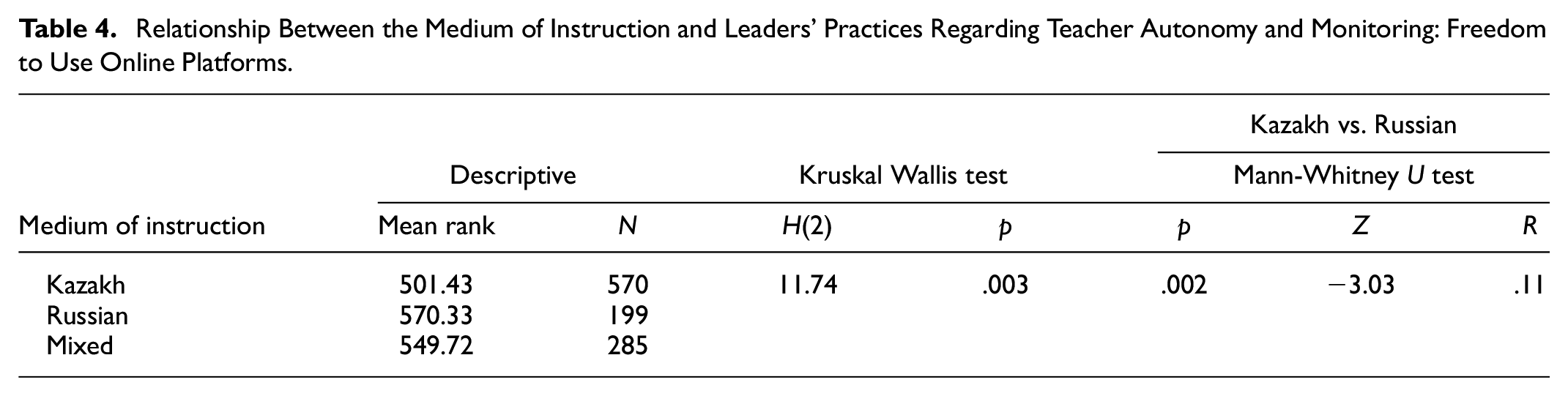
Both statements measuring leaders’ practices of teacher autonomy (Tables 4 and 5) and one measuring their practices of monitoring teachers were related to the school MoI (Table 6). Pair-wise differences were explored across the school MoI using the Mann-Whitney U test. While there were no differences observed between mixed-MoI and Kazakh and mixed-MoI and Russian schools, significant differences were observed between Kazakh and Russian medium schools, with school leaders in Kazakh medium schools giving less freedom to teachers in selecting online platforms (Table 4) and revising the curriculum and the distribution of time across curricular contents (Table 5) than leaders in Russian medium schools.
Relationship Between the Medium of Instruction and Leaders’ Practices Regarding Teacher Autonomy and Monitoring: Freedom to Use Online Platforms.
Relationship Between the Medium of Instruction and Leaders’ Practices Regarding Teacher Autonomy and Monitoring: Freedom to Revise the Curriculum.

Relationship Between the Medium of Instruction and Leaders’ Practices Regarding Teacher Autonomy and Monitoring: Monitoring Teachers’ Online Attendance.

School leaders in Kazakh medium schools were less likely to closely monitor teachers’ online attendance compared to leaders in Russian medium schools (Table 6). However, the strength of the association between the school MoI and leadership styles was found to be weak.
Discussion and Conclusions
This study used an online survey to investigate how Kazakhstani school leaders supported teachers for digital pedagogy, communicated with parents, and implemented teacher autonomy and monitoring. Notably, the paper analyzed how the leaders’ perspectives and experiences varied across school locations, MoI, and leaders’ gender. These findings have relevance beyond contexts of crisis, as the issues of teacher professional development, school leaders’ communication practices with parents and their approach to teacher autonomy and monitoring in the neoliberal contexts of institutional rankings were pertinent before and will remain significant in the post-pandemic world.
Perceptions of Teachers Digital Competence and Mitigating the Digital Divide
The pandemic stimulated school leaders and education authorities to address inequities in teachers’ digital literacy in Kazakhstan. Although existing literature is silent on the extent to which school leaders supported teachers through professional development in digital skills, the current study found that schools in Kazakhstan provided professional development opportunities to teachers in online teaching and learning on a large scale. However, a larger proportion of urban teachers had received training than rural and semi-urban teachers. This discrepancy in professional development opportunities could be attributed to challenges with digital connectivity in rural areas or the fact that rural and semi-urban schools did not operate remotely for extended periods like urban schools did. More equitable distribution of professional development opportunities would require targeting rural teachers since they are a group of teachers who found the transition to remote schooling the most challenging because of their low digital literacy (Durrani et al., 2021).
Compared to previous studies by Kaminskienė and Ling (2021) and Scully et al. (2021), school leaders in Kazakhstan have a more optimistic assessment of teachers’ digital competence. Only a small proportion of Kazakhstani school leaders perceived a lack of teachers’ digital competence as a major constraint on education provision during school closures. School leaders expressed greater confidence in their teachers’ competence to teach effectively online in the summer of 2021 compared to the beginning of the pandemic. This increased confidence can be attributed to teachers’ professional development in digital pedagogy during the summer of 2020 or merely the accumulation of practice and experience. If the former, it follows that access to training in digital pedagogy can have a positive impact on teachers’ practice in digital teaching and learning.
Practices of Parental Engagement and Work Intensity
A considerable aspect of leadership during school closures was concerned with communicating with parents, similar to international evidence (Fernandez & Shaw, 2020; Kaminskienė et al., 2021; Rigby et al., 2020). Kazakhstani school leaders maintained regular communication with parents, primarily via WhatsApp or telephone calls, aligning with findings from international studies (Chen & Rivera-Vernazza, 2023; O’Connor Bones et al., 2022). In Rousoulioti et al.’s (2022) study, direct telephone communication was preferred when parents lacked the necessary literacy and digital skills. This preference for telephone calls in Kazakhstan, where literacy is widespread, may stem from challenges related to parental digital literacy or internet accessibility. While WhatsApp and telephone calls can be convenient and efficient, they may not always be the most effective or inclusive means of communication. Relying solely on smartphones or telephone calls might restrict the depth and complexity of information conveyed, potentially leading to misunderstandings (Chen & Rivera-Vernazza, 2023). Therefore, school leaders should consider complementing these methods with other strategies to ensure a comprehensive, informative, and engaging communication approach with parents. Notably, approximately one-third of school leaders in the current study utilized online surveys to gather feedback from parents. Parental surveys offer a convenient and effective way to collect feedback from a large parent population, overcoming geographical and time constraints. However, these surveys rely on parental digital access and literacy, indicating the importance of schools employing diverse digital communication methods to engage with parents effectively.
Understandably, intensive communication during school closures increased the workload for most school leaders in Kazakhstan, similar to international evidence (Bellemans et al., 2023; Kristensen et al., 2024). Although past research does not address the correlation between high work intensity and school types, location, and school leader gender, the current study reveals that urban school leaders faced a significant increase in their workload compared to their rural counterparts. Likewise, bivariate analysis revealed that women leaders in the current study experienced a considerably greater workload associated with parental engagement. Notably, the proportion of women leaders completing the survey is much higher than the national average, suggesting they either readily complied with the request to complete the survey or the impact of COVID-19 on schools and school leaders was a particular concern for women leaders. Furthermore, existing research suggests that specific leadership traits such as being nurturing, caring, and considerate are stereotypically associated with female leaders and others, such as being assertive, dominant, and task-oriented, are associated with male leaders (Sebastian & Moon, 2017). Leaders internalize these stereotypical gender roles, resulting in men and women leaders carrying out their responsibilities differently even when they have similar job descriptions (Eagly et al., 2003).
Practices of Teacher Autonomy and Monitoring
In Kazakhstan, where schools operate under centralized control, an encouraging finding of the current study is related to school leaders’ practices of teacher autonomy. Most leaders agreed that they offered teachers the freedom to use online platforms that worked best for them and the autonomy to revise the curriculum and redistribute the time needed across curriculum content. This greater self-reported teacher autonomy observed among Kazakhstani school principals stands in contrast to international research that often documents restricted teacher autonomy (Azhari & Fajri, 2022; Chang et al., 2022; Keese et al., 2022; Kramer et al., 2023). However, Kazakhstani school leaders’ self-reported practices of teacher autonomy diverge from the findings of a study on Kazakhstani teachers’ perspectives on school closures, which indicated a lack of teacher autonomy in similar decision-making processes (Durrani et al., 2021).
Despite claiming to give greater autonomy to teachers, most school leaders also monitored teacher attendance and observed their online lessons. School leaders’ close monitoring of teachers’ attendance could imply a lack of trust in teachers or a desire to micromanage teachers (Özdemir et al., 2023). Alternatively, they might have closely monitored teachers to ward off any potential complaints from parents or other stakeholders since the culture of working remotely is something new in the education sector in Kazakhstan, even at the higher education level. Nevertheless, a feeling of being under surveillance is likely to induce teacher stress (Özdemir et al., 2023). Furthermore, close monitoring of teachers is in tension with compassionate leadership practices, which are believed to be stress relieving for school leaders (Harris & Jones, 2020; Longmuir, 2023).
The current study explored the intersection of leadership practices of teacher autonomy and monitoring. While gender was not associated with leadership practices regarding teacher autonomy and monitoring, the school MoI was associated with school leaders’ practices of teacher autonomy and monitoring. In addition, urban school leaders tended to agree more than rural school leaders that their teachers could select online platforms.
Study Implications
Digital Equity and Infrastructure
Schools will likely use some form of digital learning in the future. For example, in the post-pandemic period, all schools in Astana switched to online learning from October 13th to 14th, 2022. The government took this decision to manage traffic congestion as the city hosted the IV Summit of the Conference on Confidence-Building Measures in Asia. Likewise, in the winter of 2023, when there was very heavy snowfall, schools in Astana were directed to operate online. These examples illustrate how schools are utilizing digital learning as a flexible and convenient solution for various circumstances.
It is reasonable to assume that remote schooling for a protracted time has widened teachers’ pedagogic repertoire and students’ learning approaches. Digital equity is vital in the post-pandemic world to sustain the skill sets of teachers and learners and further integrate technology into teaching and learning. Kazakhstan’s extreme winter weather occasionally forces schools to shift to online mode. In this context, closing the urban-rural digital infrastructure gap is vital.
Supporting Teachers’ Digital Literacy
Teachers’ digital competence has been pivotal in ensuring equitable access to education during the pandemic, and globally, schools provided professional development to foster teachers’ digital competence. However, integrating digital literacy into pre-service teacher education programs is the most efficient and cost-effective approach to preparing teachers for future crises. Furthermore, teachers’ digital competence needs to be developed continuously as technology evolves rapidly. By integrating digital literacy into pre-service teacher education and supporting teachers’ ongoing professional development, education systems can better equip teachers to address future crises and promote equitable access to education.
Study Strengths and Limitations
The study contributes to crisis leadership and enhances our understanding of leadership practices during school closures in three significant ways. Firstly, while previous international literature has highlighted how teachers’ insufficient digital competence impacted the effectiveness and frequency of online lessons during school closures (König et al., 2020; Lepp et al., 2021), the current study extends our understanding of how school leaders addressed this issue by supporting teachers’ digital literacy and navigating disparities in professional development opportunities. Secondly, while prior international research has recognized the significance of maintaining regular lines of communication with stakeholders, including parents (McLeod & Dulsky, 2021), resulting in school leaders’ workload intensity (Bellemans et al., 2023; Kristensen et al., 2024), the current study has identified the unequal distribution of the burden of intensive communication among school leaders. Thirdly, while existing literature has touched on teacher autonomy in academic matters during the pandemic (Azhari & Fajri, 2022; Chang et al., 2022; Keese et al., 2022; Kramer et al., 2023), this study examined the intersection of leadership practices regarding autonomy with school type, location, and school leaders’ gender.
One limitation of the study relates to the sampling method. Although a large number of responses were collected from school leaders, the respondents were self-selecting; therefore, the sample is not a random representation of the entire school leaders’ population, and the findings are not necessarily generalizable to all school leaders in Kazakhstan. Furthermore, the school leaders’ practices are self-reported and not measured objectively. However, it is crucial not to trivialize the data set generated. The study benefits from a large sample size, with a significant proportion of school leaders from all 17 administrative regions in Kazakhstan who completed the survey. This provides valuable insights into school leadership in the specific context of prolonged school closures and generates useful data for future reference.
Future Directions
The findings of this study illuminate productive areas for future research. First, this study found how school leaders in Kazakhstan enacted equity by supporting teachers’ professional development during the pandemic. However, our quantitative approach did not allow us to explore how school leaders understood equity and their perspectives on how the education system could better strengthen equity. Qualitative research can better illuminate these issues.
Second, while the current study uncovered school leaders’ practices of teacher autonomy and monitoring during school closures, it is equally important to explore the approaches employed for teacher monitoring, as well as understand the experiences of being monitored. This appears to be a productive area for future research. Qualitative studies can generate deeper knowledge of school leaders’ practices of teacher monitoring and their underpinning rationale.
Thirdly, the study revealed that leadership practices related to teacher autonomy differed based on school locations and the medium of instruction. Qualitative research, specifically school ethnographies, can provide insights into the factors that explain the emergence of these disparities.
Finally, the current study revealed that female teachers experienced a greater sense of being overwhelmed by their workload. However, further quantitative research is needed to better understand the factors that influence gender-related decision-making in the implementation of leadership responsibilities. Additionally, ethnographic or interview studies to investigate the factors contributing to gendered leadership practices would be particularly valuable in this regard.
Footnotes
Appendix
Summary of Statistical Tests Reported.

| No. | Relationship | Test used | Post-hoc tests used |
|---|---|---|---|
| 1. | Association between the proportion of teachers receiving professional development in digital pedagogy |
One-way ANOVA | Tukey post hoc tests |
| 2. | Association between the proportion of teachers receiving professional development in digital pedagogy |
Pearson correlation test | N/A |
| 3. | Association between school leaders’ ratings of teachers’ digital competence at the beginning of the pandemic |
Paired-sample t-test | N/A |
| 4. | Association between school leaders’ increased workload related to parental engagement |
#Spearman correlation test | N/A |
| 5. | Association between school leaders’ increased workload related to parental engagement |
#Mann-Whitney U Test | N/A |
| 6. | Association between school leaders’ increased workload related to parental engagement |
#Kruskal Wallis Test | Mann-Whitney U Test |
| 7. | Association between school leaders’ practices of teacher autonomy |
#Kruskal Wallis Test | Mann-Whitney U Test |
| 8. | Association between school leaders’ practices of teacher autonomy |
#Kruskal Wallis Test | Mann-Whitney U Test |
| 9. | Association between school leaders’ practices of teacher monitoring |
#Kruskal Wallis Test | Mann-Whitney U Test |
| 10. | Association between school leaders’ practices of teacher monitoring |
#Kruskal Wallis Test | Mann-Whitney U Test |
Note. #In all these cases, a non-parametric test was used because one or both variables were measured at nominal or ordinal level, as advised by Connolly (2007, p.177).
Acknowledgements
We would like to thank Prof Filiz Polat and Dr Janet Helmer for their feedback on the survey and Assel Temirbekova for supporting the online data collection. Dr Matthew Courtney provided valuable statistical advice, and Jeremy Spring provided editorial input, both of which we greatly appreciate. We are grateful to the local education authorities for their support in disseminating the survey link to schools, as well as the school leaders who took the time to complete the survey.
Declaration of Conflicting Interests
The author(s) declared no potential conflicts of interest with respect to the research, authorship, and/or publication of this article.
Funding
The author(s) disclosed receipt of the following financial support for the research, authorship, and/or publication of this article: This study is funded by Nazarbayev University via Grant no. 021220CRP1122 awarded to Naureen Durrani.

Data Availability Statement
Data cannot be shared publicly because the authors’ Institutional Research Ethics Committee has prohibited the public availability of data.